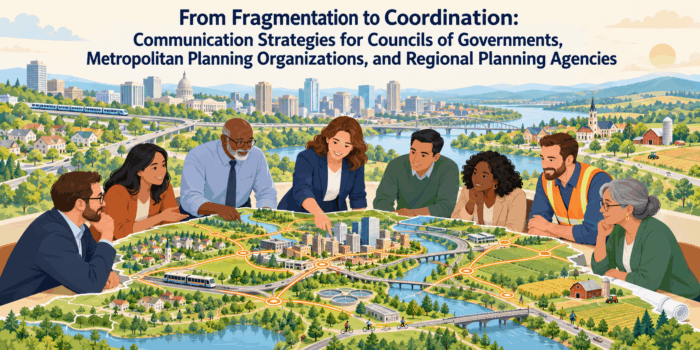
From Fragmentation to Coordination: Communication Strategies for Councils of Governments, Metropolitan Planning Organizations, and Regional Planning Agencies

Councils of governments, metropolitan planning organizations, regional planning commissions, and their partner agencies occupy one of the most structurally complex positions in American public governance. They are not cities. They are not counties. They are not state agencies. They exist in the space between jurisdictions, coordinating across local government boundaries that were drawn long before regional transportation networks, watershed boundaries, housing markets, or climate resilience priorities made those boundaries functionally irrelevant to the problems they govern.
MORPC, the Mid-Ohio Regional Planning Commission serving the Columbus metropolitan area, coordinates transportation planning, data and research, regional services, and intergovernmental collaboration across a multi-county region whose cities, townships, and counties each retain their own elected leadership and their own political priorities. NOACA, the Northeast Ohio Areawide Coordinating Agency serving the Cleveland metropolitan area, performs the same function across a different region with its own history, its own intergovernmental tensions, and its own public that has largely never heard of the agency shaping the transportation investments, air quality conformity determinations, and regional data products that affect daily life across the region.
These agencies are not alone in their communication challenge. Regional transportation authorities allocating capital across multi-county service areas must communicate investment priorities to member governments whose projects may not be at the top of the queue. Regional planning commissions coordinating land use and infrastructure decisions across municipal boundaries must communicate the connection between local decisions and regional outcomes to elected officials whose primary accountability is to local constituents, not regional ones. Councils of governments serving as umbrella coordination bodies must maintain the confidence of member governments with fundamentally different political environments, different fiscal capacities, and different levels of investment in the regional coordination mission.
What these agencies share is a communication environment defined by fragmentation. Fragmentation of authority across jurisdictions that each retain local control. Fragmentation of audiences across geographies, industries, and political environments that do not share common media markets or community anchors. Fragmentation of legitimacy, because a regional body is accountable to member governments rather than directly to residents, which makes building public trust structurally harder than for a city or county with a direct electoral relationship to its constituents.
Communication is not a public relations function for these agencies. It is the mechanism by which regional coordination achieves its purpose. A regional planning organization that cannot explain its long-range transportation plan to member governments and the public cannot build the political support that plan requires to move from document to funded project. A regional body that cannot communicate the connection between local land use decisions and regional transportation, environmental, and economic outcomes cannot motivate the local government alignment that regional goals require. A council of governments that cannot communicate funding allocation decisions transparently and equitably cannot maintain the member government trust that regional collaboration depends on. The communication challenge is not separate from the mission. It is central to it.
The invisibility of regional governance is compounded by the fragmentation of regional media markets. In metropolitan areas with multiple counties, cities, and townships, local media coverage is organized around local government boundaries rather than regional planning boundaries. A regional transportation plan that affects transportation conditions across a dozen municipalities will be covered, if at all, by a few different local news outlets, each covering the story from the perspective of their own jurisdiction rather than from a regional perspective. Regional agencies that do not actively manage this media fragmentation find that their work is either invisible or is covered as a series of disconnected local stories that do not add up to a coherent regional narrative. Building that coherent narrative across fragmented media markets requires communication investment that most regional agencies have not made systematically.
Who This Content Hub Is For
This hub is written for communication staff, program managers, executive directors, and board members at the full range of regional and collaborative agency types.
Metropolitan planning organizations like MORPC and NOACA coordinate regional transportation planning across metropolitan areas, managing the allocation of transportation funding across multiple local governments, conducting regional data and modeling, and facilitating the intergovernmental collaboration that regional transportation investment requires. Their communication obligations span planning process explanation, long-range plan public engagement, Transportation Improvement Program communication, and the ongoing work of maintaining member government confidence across jurisdictions whose transportation priorities do not always align.
Regional transportation authorities operate multi-jurisdictional transit systems, regional rail networks, and transportation coordination programs that serve populations distributed across county lines, city limits, and political boundaries. Their communication challenges center on service equity, capital investment prioritization, fare and service change communication, and the persistent work of building public understanding of why regional transportation coordination produces better outcomes than jurisdictionally fragmented alternatives.
Regional planning commissions coordinate land use, infrastructure, and environmental planning across municipal and county boundaries, often serving member governments that have different land use philosophies, different growth trajectories, and different relationships to regional planning goals. Their communication challenges involve translating the long-range and often abstract language of regional planning into terms that local elected officials, developers, community organizations, and the general public can evaluate and engage with.
Councils of governments serve as umbrella coordination bodies for multiple regional functions, convening member governments around shared challenges, pooling administrative resources, managing regional data and research programs, and facilitating the intergovernmental agreements that regional service delivery requires. Their communication obligations span every dimension of regional governance, from explaining the value of regional coordination to skeptical member governments to communicating program outcomes to the state and federal partners that fund regional programs.
The hub is also relevant for the staff at member local governments who interact with regional agencies and need to communicate regional programs and decisions to their own constituents, for the elected officials who serve on regional boards and must explain regional priorities to local audiences, and for the state and federal agency partners who depend on regional bodies to implement programs that span jurisdictional boundaries.
How to Use This Hub
Regional and collaborative agencies communicate with member governments, elected officials, business communities, community organizations, and the general public across a wide range of planning and coordination contexts. This content hub provides a central resource for regional councils, metropolitan planning organizations, regional transportation authorities, councils of governments, economic development organizations, and other collaborative agencies seeking to strengthen those communication efforts.
The sections below provide a broad framework for understanding the sector. They explain the shared communication foundations that apply across regional agency types, the specific communication demands of metropolitan planning organizations and regional transportation authorities, and the practical challenges of connecting regional planning decisions to outcomes that local communities can see and understand. Agencies can use this hub to evaluate and improve communication related to public participation, transportation planning, funding and resource allocation, service equity, data presentation, media relations, digital engagement, intergovernmental conflict, and relationships with member governments and elected officials. The hub also addresses the strategic communication systems and institutional practices that help regional agencies build trust, demonstrate their value, and sustain collaboration over time.
How Regional and Collaborative Agencies Operate Across a Fragmented Governance Landscape
Understanding who these agencies actually are matters before addressing how they should communicate. The regional governance landscape in the United States is fragmented across multiple organizational structures, legal authorities, and functional mandates that vary significantly by state, region, and community. What follows describes the most common organizational types and their communication contexts.
Metropolitan Planning Organizations
Metropolitan planning organizations coordinate transportation planning across metropolitan areas, managing the multi-jurisdictional process of identifying regional transportation needs, prioritizing projects, and allocating transportation funding across member governments. MPOs like MORPC in the Columbus region and NOACA in the Cleveland region bring together local elected officials, transportation agencies, and community stakeholders to develop long-range transportation plans and shorter-term Transportation Improvement Programs that guide how transportation dollars are spent across the region. Their governance structure, a policy board composed of elected officials from member jurisdictions, means that transportation decisions must reflect regional consensus rather than any single jurisdiction’s priorities.
The communication challenge for MPOs is compounding. They must explain technical transportation planning processes to elected officials who are primarily accountable to local constituencies. They must engage communities in planning decisions whose impacts will not materialize for years or decades. They must communicate funding allocation decisions to member governments that all believe their projects deserve priority. And they must do this while maintaining the organizational neutrality that makes them credible brokers across jurisdictions with competing interests.
Regional Transportation Authorities
Regional transportation authorities operate transit systems, regional rail networks, and coordinated transportation programs that cross county and municipal boundaries. Unlike MPOs that plan and coordinate, regional transportation authorities deliver services directly, operating the buses, trains, and transit infrastructure that serve regional populations. Their communication challenges include service equity obligations under federal civil rights law, capital investment priority communication across a multi-county service area, fare and service change communication, and the ongoing work of building public understanding of why regional transit coordination is more effective than fragmented local alternatives.
Regional Planning Commissions
Regional planning commissions provide technical planning assistance, coordinate land use and infrastructure planning, manage regional data programs, and facilitate intergovernmental collaboration across municipal and county boundaries without the formal transportation planning mandate that MPOs carry. They often serve rural and semi-rural regions where the relationship between local land use decisions and regional outcomes in transportation, water quality, and economic development is less visible to local decision-makers than in dense metropolitan areas. Their communication challenge is making the regional perspective compelling to local governments that believe they can plan effectively within their own boundaries.
Councils of Governments
Councils of governments are multi-purpose regional bodies that convene member governments around shared challenges, pool administrative resources, manage regional data and research programs, administer regional grant programs, and facilitate the intergovernmental agreements that regional service delivery requires. They often function as the organizational home for multiple regional programs including MPO functions, regional data centers, aging and disability services coordination, environmental planning, and economic development. Their breadth of function makes their communication challenge particularly complex: they must communicate relevance to member governments across very different program areas while maintaining the organizational coherence that makes the council of governments a credible and effective regional partner.
Our Comprehensive Guide to Public Communications for State and Local Government Agencies
This article is part of our series on strategic communication for state and local government agencies. To learn more and to see the parent article, which links to other content just like this, click the button below.
The Communication Problem That Defines Regional Governance
Regional and collaborative agencies face a structural communication disadvantage that most other public agency types do not encounter. Their governance is indirect. Their authority is limited. Their decisions affect daily life in ways that most residents never connect back to the regional body that shaped them. A resident who sits in traffic on a corridor that was not prioritized in the regional transportation plan, who cannot afford housing because regional land use patterns have pushed affordable options to the metropolitan fringe, or who experiences poor air quality because regional growth patterns have increased vehicle miles traveled, has experienced the consequences of regional planning decisions without ever knowing that a regional body made choices that contributed to those outcomes.
This invisibility is not accidental. Regional agencies rarely have the direct service delivery relationships that make cities and counties visible to their constituents. They do not collect garbage, issue building permits, respond to 911 calls, or operate the schools that families rely on every day. Their work is coordination, facilitation, planning, and research, functions that produce outcomes over years and decades rather than services that produce immediate daily experiences. Building public understanding of why this work matters, why regional coordination produces better outcomes than fragmented local alternatives, is a communication challenge with no simple solution.
The elected official communication challenge is equally persistent. Local mayors, county commissioners, township trustees, and city council members serve on regional boards and commissions as representatives of their own jurisdictions, not as regional advocates. Their primary accountability is to local voters whose most urgent concerns are local: potholes, school quality, local economic development, and public safety. Asking those officials to prioritize regional goals, to accept funding allocations that benefit other jurisdictions, or to support land use policies that advance regional outcomes at the expense of local flexibility requires communication that makes the regional value proposition compelling in local political terms. Most regional agencies have never invested seriously in that communication work, which is why the same intergovernmental conflicts repeat across regions and across years.
How Regional Agencies Can Explain What They Do and Why It Matters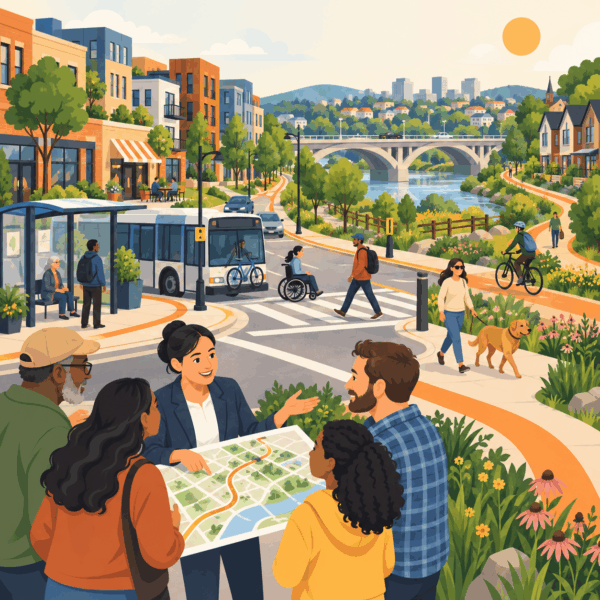
The most fundamental communication failure of regional governance is that most residents, and many local elected officials, cannot explain what the regional agency in their metropolitan area does, why it exists, or how its decisions affect their daily lives. This is not primarily a public awareness problem. It is a communication design problem. Regional agencies communicate in ways that serve their internal purposes, satisfying federal planning requirements, reporting to member governments, engaging the stakeholders who already show up at regional meetings, without investing in the proactive, accessible, community-facing communication that would build genuine public understanding of regional governance.
Translating Regional Work Into Local Experience
The most effective regional agency communication programs build their public outreach around a consistent translation discipline: every regional program, plan, and decision is explained in terms of its local and community-level impact before any explanation of the regional process or governance structure that produced it. A long-range transportation plan is not primarily a planning document. It is a set of decisions about which corridors will be improved, which transit lines will be funded, which bicycle and pedestrian infrastructure will be built, and which communities will have better access to jobs, schools, and services over the next twenty years. Leading with those outcomes rather than with the planning process that produced them communicates to residents and local officials in terms that connect to their actual priorities.
The translation discipline requires regional communicators to resist the professional vocabulary that planning and governance specialists use internally and to communicate consistently in the plain language of local experience. Corridor improvements, not level of service analysis. Access to jobs and services, not transportation network performance. Community investment, not capital programming. The content is the same. The communication orientation is different, and that difference determines whether regional communication reaches the audiences it needs to reach.
Making the Regional Case in Local Political Terms
Elected officials who serve on regional boards are not primarily regional advocates. They are local officials who attend regional meetings as one of many obligations competing for their attention and political capital. Communication that makes the regional value proposition in abstract terms, in language about regional competitiveness, economic resilience, and sustainable growth patterns, will not change how those officials communicate about regional priorities to their local constituents. Communication that makes the regional value proposition in local terms, showing specifically how regional transportation investment improves access for residents in a particular city or township, how regional land use coordination protects local fiscal health by directing growth to areas with existing infrastructure capacity, how regional data programs save member governments the cost of conducting research they could not afford individually, is communication that gives local officials something they can use.
How Regional Agencies Can Build Trust With Member Governments and Elected Officials
Member government trust is the foundation on which effective regional governance is built, and it is built through communication practice more than through governance structure. Regional agencies that communicate with member governments consistently, honestly, and with genuine responsiveness to local concerns build the trust reservoir that sustains regional coordination through the inevitable moments of intergovernmental tension, funding allocation disagreement, and competing priority conflict that regional governance regularly produces.
Consistent Between-Cycle Communication
Most regional agencies communicate intensively with member governments during planning cycles, funding allocation processes, and annual budget negotiations, and communicate minimally between those cycles. Member governments that only hear from the regional agency when something is being asked of them, when a plan needs adoption, a budget needs approval, or a funding formula is being revised, develop a transactional rather than collaborative relationship with the regional body. They engage when required and disengage when the immediate obligation is met.
Regional agencies that invest in regular between-cycle communication, sharing regional data and research findings that help member governments make better local decisions, briefing local staff on program developments before they become public, connecting member governments with resources and technical assistance they did not know were available, build relationships that are collaborative rather than transactional. Those relationships produce more durable regional coordination because member governments understand the regional agency as a partner that adds value to their own work rather than as a coordination overhead that consumes local staff time and political capital.
Honest Communication About What Regional Governance Can and Cannot Do
One of the most damaging communication patterns in regional governance is overpromising. Regional agencies that claim credit for outcomes they did not determine, imply authority they do not have, or promise results that depend on local decisions outside their control consistently damage their credibility with the member governments and communities they serve. An MPO that presents its long-range transportation plan as a commitment to build specific projects, rather than as a framework for prioritizing federal transportation investment over a planning horizon, sets up member governments and communities for disappointment when funding constraints, project development challenges, and shifting priorities change which projects advance.
Honest communication about regional governance means being explicit about what the regional agency can and cannot control. It means explaining clearly which decisions are made at the regional level and which are made by member governments, state agencies, or federal partners. It means communicating funding limitations, planning uncertainty, and implementation timelines honestly rather than projecting false certainty to maintain political support. The regional agencies that communicate most honestly about their limitations are often the ones that maintain the most durable member government trust, because their constituents know that the agency’s communication can be relied upon.
How Regional Agencies Can Manage Public Participation and Engagement
Public participation in regional planning processes is simultaneously a federal requirement, a democratic obligation, and one of the most consistently underperforming functions in regional governance. The public meetings, comment periods, and online surveys that regional agencies conduct to satisfy participation requirements typically reach organized stakeholders, engaged advocates, and the same recurring participants who show up to every regional meeting. They rarely reach the residents who are most affected by regional planning decisions and least likely to show up at a weekday evening public meeting in a government building.
Designing Participation for the People Who Do Not Typically Participate
Effective regional public participation programs begin with an honest assessment of who is not in the room at standard regional meetings and why. Low-income residents who work multiple jobs do not attend weekday evening meetings. Non-English-speaking residents cannot meaningfully engage with participation processes conducted exclusively in English. Residents of communities at the geographic periphery of the region may face transportation barriers to attending meetings at regional offices. Young residents who primarily engage digitally may not encounter regional planning information through the channels regional agencies have historically used.
Participation programs designed around the constraints of the people who do not typically participate look very different from participation programs designed around the preferences of the people who do. They meet participants where they are, at community events, faith communities, community centers, and neighborhood organizations, rather than requiring participants to come to the agency. They provide participation opportunities at multiple times and through multiple formats, online, by phone, and in person. They offer language access as a standard feature of every participation process rather than as an accommodation available on request. And they communicate participation opportunities through channels that reach the communities being targeted, ethnic media, community organization newsletters, and trusted local messengers, rather than only through the regional agency’s own website and mailing lists.
Closing the Loop on Public Participation
One of the most effective and most underused tools for building public confidence in regional participation processes is closing the loop: communicating back to participants, after a comment period closes, what the agency heard, how it responded to what it heard, and what changed as a result of the public input. Regional agencies that hold public meetings, collect comments, and then issue final plans without communicating how public input was considered teach participants that participation is performative. Participants who see no connection between their input and the agency’s decisions will not participate again, and will communicate their experience to others in their networks.
Closing the loop does not require acting on every comment or adopting every community recommendation. It requires communicating honestly about what was heard, what considerations shaped the agency’s response, and what outcomes participants can expect. Regional agencies that build this feedback communication into every participation process build the reputation for genuine responsiveness that attracts broader participation over time.
Case Studies: How Regional Planning Agencies Build Trust, Expand Participation, and Communicate Across Jurisdictions
The following case studies are drawn from documented programs conducted by regional planning bodies across the United States and Canada. Each illustrates a specific communication challenge: engaging diverse stakeholders in scenario planning to shape a long-range transportation plan, building equity-centered public participation programs that reach communities historically excluded from regional planning, and communicating regional planning value across multiple jurisdictions with different political priorities. Each offers practical lessons that transfer to other regional planning contexts.
Philadelphia Region: Scenario Planning as a Public Engagement Strategy at the Delaware Valley Regional Planning Commission
The Delaware Valley Regional Planning Commission, the regional planning body for the greater Philadelphia metropolitan area serving nine counties across Pennsylvania and New Jersey, faced a communication challenge that many MPOs encounter when developing long-range transportation plans: how to engage a diverse regional public in decisions whose consequences will unfold over twenty or more years, and whose technical complexity makes genuine public participation difficult to achieve through standard meeting and comment period formats.
In 2014, DVRPC convened a group of nearly 70 regional stakeholders from academia, the private sector, nonprofit organizations, and government to explore what the commission called broader STEEP trends, social, technical, economic, environmental, and political forces that could shape the region’s transportation future in ways that standard forecasting models do not capture. That group identified potential forces and developed five distinct scenarios of regional change that described very different futures for the Philadelphia region, from high-technology and autonomous vehicle adoption to energy price volatility to demographic and immigration shifts.
DVRPC then used those five scenarios as the foundation for a public outreach campaign designed to engage residents in the values and investment priorities that should guide the long-range transportation plan across all plausible futures. Rather than asking residents to comment on a draft plan, the commission asked them to evaluate transportation investments against scenarios of change, a framing that made abstract long-range planning concrete, engaging, and genuinely relevant to participants’ own concerns about the region’s future.
The communication lesson from DVRPC’s approach is that long-range planning public engagement can be redesigned to produce genuine public input rather than procedural participation. Standard public meeting formats that present draft plans for comment produce input from people who are already engaged with planning processes. Scenario-based engagement that invites residents to wrestle with real uncertainty about the region’s future produces input from a broader range of participants, because the conversation is about futures they recognize and values they hold rather than about technical planning documents they cannot evaluate. The investment in the Futures Group and scenario development paid dividends in the quality and diversity of public engagement that followed.
Columbus Region: MORPC’s Equity-Centered Outreach in a Rapidly Diversifying Metropolitan Area
MORPC, the Mid-Ohio Regional Planning Commission serving the Columbus metropolitan area, faces a communication challenge that is shared by regional planning organizations across the country but acutely present in the Columbus region: a rapidly diversifying population whose demographic composition is changing faster than regional planning communication programs have adapted to reflect. The Columbus region is projected to grow to more than three million people over the next three decades, with racial and ethnic minorities accounting for most of that growth. Regional planning programs and communication strategies designed for an earlier demographic moment are increasingly inadequate for the region MORPC is actually serving.
MORPC’s response to this challenge has involved building equity-centered outreach into its core program structure rather than treating equity as a supplemental communication effort. The commission convenes and facilitates regional conversations with local governments and community partners to promote collaboration on equity-related planning priorities. Its transportation and economic development initiatives are evaluated for their impact on access to education, jobs, healthcare, and other community resources across the full range of regional populations. Its residential services programs provide direct assistance to populations historically underserved and overburdened with energy and housing costs. And its planning and sustainability programs target air quality improvements in the communities that bear disproportionate environmental burdens.
The communication approach that supports these programs reflects a recognition that equity-centered outreach requires more than translating existing communication materials into additional languages or adding images of diverse populations to agency publications. It requires building authentic relationships with community organizations that serve the populations being reached, designing participation processes that are accessible in time, location, format, and language, and demonstrating through program outcomes that regional planning investment is producing measurable benefits for communities that have historically been underserved by regional coordination. MORPC’s ongoing investment in equity-centered program design and communication reflects an understanding that regional governance legitimacy in a diversifying region depends on building genuine relationships with the communities that will account for most of the region’s future growth.
The lesson for regional planning organizations is that demographic change is a communication imperative. Regional agencies whose public engagement programs reflect the demographic composition of their region as it was ten or twenty years ago are systematically excluding the populations who will most shape and be shaped by regional planning decisions over the next generation. Building equity-centered communication into the core program structure, rather than treating it as an add-on, is both a democratic obligation and a strategic investment in the regional agency’s long-term legitimacy.
Genesee County, Michigan: Coordinating Land Use and Transportation Planning Communication Across a Post-Industrial Region
The Genesee County Metropolitan Planning Commission, the regional planning body serving Flint and the surrounding Genesee County area in Michigan, operates in one of the most challenging regional planning communication environments in the country. The region has experienced significant population loss, economic disinvestment, aging infrastructure, and the lasting public trust damage of the Flint water crisis, which fundamentally altered the relationship between many residents and government agencies of all types. Communicating regional planning programs, including long-range transportation planning, housing and land use coordination, and regional data services, in this environment requires communication approaches that are specifically designed for audiences with justified reasons to distrust institutional communication.
In 2020, the Genesee County Metropolitan Planning Commission published its most recent long-range plan with a distinctive communication approach: rather than treating transportation planning and housing planning as separate programs communicated through separate channels to separate audiences, the commission developed a coordinated, multidisciplinary vision that communicated the connection between land use, housing, and transportation as an integrated regional challenge. The plan aimed to better assess and allocate resource needs among neighborhoods to improve livability and mobility for residents across a county whose different communities have very different infrastructure conditions, demographic trends, and planning needs.
The communication approach reflected an understanding that in a post-industrial region with concentrated disinvestment in some neighborhoods and relative stability in others, regional planning communication that treats all areas of the county as equivalent will not be credible to the residents of the most disinvested communities. Effective regional planning communication in this context required geographic specificity, showing residents of specific neighborhoods what the regional plan means for their streets, their transit access, and their housing options. It required honest acknowledgment of the region’s challenges rather than projecting an optimistic regional narrative that does not reflect the experience of communities that have been declining for decades. And it required sustained engagement with community organizations in the most disinvested areas, building the relationships that make participation meaningful rather than performative.
The lesson for regional planning organizations serving communities with deep institutional distrust is that standard regional planning communication, which often emphasizes regional growth, regional competitiveness, and regional opportunity, can feel tone-deaf or actively alienating to residents who are experiencing decline, disinvestment, and institutional failure. Effective regional communication in these contexts requires starting from where residents actually are, acknowledging what has happened, and demonstrating through specific, geographic, and honest communication how regional planning programs connect to the conditions residents actually experience.
Regional Municipality of York, Ontario: Using Strategic Communication and Employee Feedback to Support a Major Workplace Transition
The Regional Municipality of York, commonly known as York Region, undertook a significant workplace transformation when it relocated its Property Services Branch to a newly designed office environment at 130 Mulock. The new workplace introduced a more flexible and open layout intended to improve collaboration, productivity, and employee satisfaction. Because the relocation affected employee work practices as well as public-facing municipal functions, York Region needed a communication strategy that would prepare employees for new ways of working while assuring residents and local businesses that service access and quality would be maintained throughout the transition.
York Region partnered with Stegmeier Consulting Group to develop a two-pronged communication and feedback program for internal and external audiences. Employees received regular email updates, workplace posters, digital progress displays, informational sessions, question-and-answer panels, move guides, visual aids, and practical information about seating arrangements and shared spaces. External communication included public announcements, press releases, constituent emails, newsletter content, social media posts, website materials, and outreach to local businesses and community organizations. Together, these channels created a consistent flow of information that explained what was changing, why the transition was occurring, and how the new environment was expected to support municipal operations and public service delivery.
Employee feedback was integrated directly into the transition through independently administered pre-move and post-move surveys. The pre-move survey documented employee expectations, concerns, work habits, and perceptions before the relocation, while the post-move survey evaluated how effectively the new environment supported work practices, collaboration, productivity, and satisfaction in practice. Confidential administration encouraged candid participation, and the findings helped York Region identify misalignments between workstation arrangements and the needs of different teams. The municipality then used the results to make targeted workplace adjustments and inform the planning of future facilities, including its Central Service Centre.
The lesson for regional municipalities managing major workplace changes is that a physical relocation should not be communicated as a facilities project alone. Changes to office layouts, work practices, and service locations can affect employee confidence, organizational performance, and the public’s experience of government at the same time. York Region’s approach demonstrates how coordinated internal and external communication, supported by structured feedback before and after implementation, can help an agency identify problems early, respond visibly to employee concerns, protect service continuity, and carry practical lessons into future workplace planning
 How Regional Agencies Can Communicate Across Multiple Jurisdictions and Media Markets
One of the most distinctive communication challenges for regional agencies is managing consistent, coherent communication across multiple local media markets, each of which covers a portion of the region and serves communities with different local concerns, different political environments, and different relationships to regional planning. A regional transportation plan that is covered as a positive regional investment story by one local newspaper may be covered as an unfair funding allocation that disadvantages a specific jurisdiction by another. A regional data product that one community uses to support a local planning decision may be cited by a neighboring community as evidence that regional planning is encroaching on local authority.
Regional agencies that do not actively manage this multi-market media environment consistently find that regional narratives are shaped by the most adversarial local coverage rather than by the agency’s own communication. An intergovernmental conflict that receives prominent coverage in one jurisdiction’s local media can damage regional relationships even when the conflict is being resolved constructively, if the resolution is not communicated as clearly and prominently as the conflict was.
Building Regional Media Relationships Before Controversies Arise
Regional agencies that invest in proactive relationships with local journalists across their service area, briefing reporters on complex regional programs before stories run, providing accessible technical context for regional data and planning decisions, and being consistently available and responsive to media inquiries across all local markets, produce more accurate and more balanced regional coverage than agencies that only engage media reactively when controversies force them to. The investment in those relationships is modest compared to the cost of managing media coverage that has been shaped by sources other than the agency itself.
A practical approach for regional agencies with limited communications staff is to develop a regional media contact list that covers every local newspaper, television station, radio station, and digital news outlet serving communities within the region, and to maintain that list as an active communication tool rather than an emergency contact list. Regular regional data releases, program updates, and planning milestone announcements sent proactively to that full list, framed for relevance to each local market where possible, build the familiarity that makes reporters more likely to call the agency for context before publishing a story based on a single source.
How Regional Agencies Can Use Data and Research to Build the Case for Coordination
Regional planning agencies are among the most data-rich organizations in local government. MPOs produce travel demand models, demographic forecasts, air quality analyses, freight movement studies, and regional economic assessments that represent significant investments of public resources and contain information that is genuinely useful to member governments, business communities, and the general public. Most of that data never reaches the audiences for whom it would be most useful, because it is communicated through technical reports designed for planning professionals rather than through accessible products designed for the range of audiences that regional data could serve.
The most effective regional data communication programs treat every data product as the beginning of a communication responsibility rather than the end of one. A regional demographic forecast that shows which communities are growing rapidly and which are losing population is not just a planning input. It is information that local governments need to make infrastructure investment decisions, that school districts need to plan school capacity, that healthcare systems need to plan facility distribution, and that businesses need to make location decisions. Regional agencies that communicate their data products actively to those audiences, in formats those audiences can use, build the relationships and the demonstrated value that sustain regional program investment.
How Regional Agencies Can Communicate During Intergovernmental Conflict
Intergovernmental conflict is not an exceptional circumstance in regional governance. It is a routine feature of a governance structure in which multiple jurisdictions with competing interests must reach consensus on decisions that distribute benefits and burdens unevenly. Funding allocation disagreements, service equity disputes, land use conflict across municipal boundaries, and political disagreements about regional priorities will arise in every regional agency with enough members to have genuine diversity of interest. The question is not whether conflict will occur but whether the agency has prepared to communicate during conflict in ways that maintain organizational credibility and member relationships.
Regional agencies that go silent during intergovernmental conflict, communicating nothing while the conflict plays out through local media and local political channels, allow the narrative to be shaped by the most adversarial participants. Agencies that engage publicly during conflict, acknowledging disagreement honestly while maintaining the agency’s role as a neutral and constructive facilitator, retain the ability to shape how the conflict is understood and how its resolution is communicated.
Effective conflict communication for regional agencies requires clarity about what the agency can say and what it cannot, a designated spokesperson who has both the authority and the communication skill to speak publicly about contested regional decisions, pre-developed talking points for the most common conflict scenarios, and a commitment to factual accuracy that prioritizes honest characterization of disagreements over the appearance of regional consensus that does not exist. Regional agencies that communicate about conflict honestly, acknowledging that member governments sometimes disagree about regional priorities, are more credible to the full range of their audiences than agencies that project false consensus.
How Regional Agencies Can Strengthen Digital Communication
The digital presence of a regional planning agency is increasingly the primary medium through which member governments, community organizations, business leaders, and the general public encounter the agency and form impressions of its relevance and competence. A regional agency website organized around internal program categories, long-range planning, TIP development, air quality conformity, regional data, rather than around the questions that those audiences are actually asking, is a website that serves staff navigation rather than public understanding.
Most regional agency websites share a structural failure with the public sector broadly: they are organized around how the agency thinks about its own work rather than around how the people visiting the site think about their own needs. A local government staff member trying to understand what transportation funding her jurisdiction is eligible to request should not have to navigate through the transportation planning program page to find the application process. A business leader trying to understand what regional infrastructure investments are planned for the corridor his company depends on should not have to understand what a Transportation Improvement Program is before he can find the information he needs. A community organization trying to participate in a regional planning process should not have to read through the agency’s governance structure before finding the comment period deadline and submission instructions.
Organizing Regional Agency Digital Content Around User Questions
The most effective regional agency website redesigns begin with research into what questions the agency’s different audiences are actually asking, drawing on customer service inquiries, public meeting questions, social media comments, and direct conversations with member government staff, community organizations, and business stakeholders. Those questions become the organizational framework for the redesigned website, with navigation structured around how to participate, how to access funding, what projects are planned, what data is available, and how to contact a real person rather than around the agency’s internal program taxonomy.
Regional data portals deserve particular attention in the digital communication investment. Regional agencies that produce demographic forecasts, travel demand models, economic analyses, and environmental monitoring data have invested significant public resources in information that member governments, businesses, researchers, and community organizations could use to make better decisions if that information were accessible in formats designed for non-technical users. Interactive data dashboards, downloadable data products organized by jurisdiction, and plain-language data briefs that translate regional findings into formats that local decision-makers can use are all investments that multiply the value of existing research without requiring additional research investment.
Social Media for Multi-Jurisdictional Audiences
Social media presents a specific challenge for regional agencies communicating across multiple jurisdictions and multiple media markets. Content that is highly relevant to residents of one community in the region may be irrelevant or confusing to residents of another. Regional milestone announcements that are significant from a planning perspective may not resonate with public audiences who have no context for what the milestone means. And the institutional tone that regional agencies often default to in their social media content produces low engagement because it communicates at rather than with the communities the agency is trying to reach.
The most effective regional agency social media programs treat each post as an opportunity to connect a specific regional decision or program to a specific local or community-level outcome that residents can recognize and care about. A Transportation Improvement Program amendment that advances a specific project is communicated as news about that project and what it means for the communities it serves, not as a governance process update. A regional demographic data release is communicated as information about how the region is changing and what that means for specific communities, not as a technical report publication. The shift from institutional communication to community-oriented communication is not a simplification. It is a reorientation around what the audience needs to understand rather than what the agency needs to report.
How Regional Agencies Can Communicate With Underserved and Hard-to-Reach Communities
Regional planning processes have historically been shaped by the participation of organized stakeholders: transportation agencies, major employers, environmental organizations, housing advocates, and the residents who have the time, transportation, and institutional familiarity to attend regional planning meetings. The communities most affected by regional transportation decisions, the low-income residents who depend on transit, the communities of color that bear disproportionate environmental burdens from regional development patterns, the rural residents whose transportation options are ignored by urban-focused regional plans, are consistently underrepresented in the participation processes that shape regional planning priorities.
This underrepresentation is not primarily a motivation problem. It is a design problem. Standard regional participation formats, weekday evening meetings at regional offices, written comment submissions in English, online surveys requiring reliable internet access and digital literacy, are systematically inaccessible to many of the communities that regional planning most directly affects. Addressing that design problem requires intentional investment in participation approaches that are specifically designed for the communities being targeted rather than modified versions of standard participation processes.
Community-Based Participation Design
Community-based participation design begins with genuine community research: understanding where the targeted communities spend time, who they trust as information sources, what barriers prevent them from participating in standard regional processes, and what communication channels and formats are most accessible and familiar to them. This research is not a prerequisite to all participation. It is a prerequisite to effective participation with communities that standard approaches consistently miss.
The participation approaches that reach historically underrepresented communities look very different from standard regional planning meetings. They happen in community spaces, faith communities, community centers, and neighborhood organizations, rather than in government buildings. They happen at times that work for people who work multiple jobs or cannot arrange childcare for weekday evenings. They provide language access as a standard feature rather than an accommodation. They work through trusted community organizations and messengers rather than relying on the regional agency’s own communication channels. And they make participation feel worthwhile by communicating clearly what the agency is asking, why the input matters, and how it will be used.
Title VI and Environmental Justice Communication
Regional transportation authorities and MPOs operate under Title VI of the Civil Rights Act, which prohibits discrimination on the basis of race, color, and national origin in federally assisted programs. Title VI compliance requires regional agencies to ensure that their services, programs, and activities do not disproportionately burden minority and low-income populations, and that their public participation processes provide meaningful access to affected communities regardless of language, literacy, or other barriers to engagement.
Title VI compliance communication is not just a legal obligation. It is an equity communication opportunity. Regional agencies that communicate transparently about how they assess service equity, what the data shows about the distribution of regional transportation benefits and burdens across different populations, and what they are doing to address identified disparities, build the kind of credibility with underserved communities that makes future participation meaningful. Communities that have seen their concerns acknowledged in regional equity analyses, and have seen those analyses translate into program adjustments, are communities that are more likely to engage with future regional participation processes.
How Regional Agencies Can Build Communication Capacity With Limited Staff
Most regional planning agencies operate with communication staffs that are small relative to the communication demands they face. An MPO serving a metropolitan area of several hundred thousand people may have one or two staff members with primary communication responsibilities, while also managing long-range plan updates, TIP amendments, federal planning requirement compliance, member government relations, public meeting facilitation, and regional data program management. The communication capacity gap is structural, not individual, and addressing it requires systematic approaches rather than simply working harder.
Communication Protocols That Do Not Depend on Individual Staff
The most durable communication programs are those that are built into the agency’s operational processes rather than dependent on the communication skills and availability of specific individuals. When a TIP amendment is processed, there should be a standard communication protocol that determines what announcement goes out, to whom, in what format, and through which channels, without requiring communication staff to design a new approach for each amendment. When a public meeting is scheduled, there should be a standard outreach protocol that determines the notification lead time, the channels used, the language access provisions, and the follow-up communication, without requiring staff to reinvent the process each time.
Building these protocols requires upfront investment in documenting and standardizing communication processes that currently exist only in staff knowledge. That investment pays long-term dividends in reduced per-event communication workload, more consistent communication quality, and communication continuity during staff transitions. Regional agencies that have invested in communication protocols can maintain communication quality when experienced staff leave and new staff come on board, because the institutional knowledge about how to communicate effectively has been documented rather than residing only in individual heads.
Partner Organizations as Communication Force Multipliers
Regional agencies with limited communication staff can significantly extend their communication reach by investing in partner communication programs that equip community organizations, member government communications staff, and regional stakeholders with accurate, current, and accessible information about regional programs. A regional agency that briefs the communications directors of its ten member governments before every major regional announcement is not just providing advance notice. It is creating ten additional communication channels that can reach local audiences with regional information in locally relevant terms, through channels and voices that those local audiences already trust.
Community organizations that serve the populations most underrepresented in regional planning processes are particularly valuable communication partners when those relationships are built on genuine mutual investment. A regional agency that regularly provides community organizations with regional data relevant to their work, that includes those organizations in early consultation about planning programs that affect their communities, and that treats them as genuine partners in the regional communication mission rather than as outreach targets, builds relationships that extend the agency’s communication reach into communities it could not reach through its own channels.
How Regional Agencies Can Measure Communication Effectiveness
Regional planning agency communication is almost universally undermeasured. Agencies track meeting attendance, comment volume, website traffic, and social media engagement without assessing whether those outputs are producing the outcomes that regional communication is designed to achieve. Whether member governments are developing the understanding of regional programs that makes collaboration more effective. Whether public participants are gaining the knowledge of regional planning that makes their input more useful. Whether the communities historically excluded from regional planning are beginning to engage in ways that reflect genuine access rather than procedural compliance.
The most meaningful communication metrics for regional agencies are those that assess change in understanding, confidence, and engagement over time rather than the volume of communication activity at a point in time. Member government staff surveys that assess knowledge of regional programs and confidence in the regional agency’s communication before and after a major planning cycle can reveal whether the agency’s communication investment is producing genuine understanding. Community organization feedback about the quality and accessibility of regional participation processes can reveal barriers that attendance data does not capture. Demographic analysis of participation across planning processes can reveal whether equity-centered outreach investments are producing measurable change in who is represented in regional planning.
After-Action Review in Regional Planning Communication
Every major regional planning communication event, a long-range plan public hearing, a TIP amendment announcement, a regional data release, a funding allocation decision, should be followed by a structured after-action review that asks what communication worked as intended, what generated confusion or missing understanding, what questions kept coming up that the communication had not anticipated, and what channels failed to reach the audiences they were designed for. Those reviews should be documented and used to update communication protocols before the next comparable event.
Regional agencies that build after-action review into their standard communication practice develop institutional knowledge about what works and what does not that is not available to agencies that treat each communication challenge as a new problem. Over time, that institutional knowledge produces communication programs that are more efficient, more effective, and more resilient to the staff turnover and organizational change that regional agencies regularly experience.
Closing the loop does not require acting on every comment or adopting every community recommendation. It requires communicating honestly about what was heard, what considerations shaped the agency’s response, and what outcomes participants can expect. Regional agencies that build this feedback communication into every participation process build the reputation for genuine responsiveness that attracts broader participation over time.
Multi-Format Participation for Multi-Dimensional Audiences
Effective regional participation programs offer multiple formats because different community members engage most comfortably through different participation modes. Some residents participate most comfortably in person, in community settings where they can ask questions and hear directly from agency staff. Others engage primarily through written comment, either online or by mail. Others engage through social media, responding to regional content and sharing regional information through their own networks. Others participate most effectively through community organizations that aggregate and represent community perspectives rather than through individual submission.
Regional agencies that offer only one or two participation formats will consistently miss large portions of their potential audience. The investment in multiple participation formats, in-person meetings in accessible locations, online comment tools, mobile-friendly digital participation, telephone comment lines, and community organization liaison programs, is not redundancy. It is recognition that genuine public participation requires meeting participants where they are rather than requiring them to come to the format the agency finds most convenient to administer. For regional agencies with limited staffing, building a multi-format participation infrastructure through community organization partnerships can extend participation reach without proportional staff investment.
How Regional Agencies Can Communicate About Equity, Climate, and Long-Range Planning Challenges
The substantive agenda of regional planning is expanding in ways that create new communication demands for regional agencies. Long-range transportation plans that twenty years ago focused primarily on highway capacity and transit operations now routinely address climate resilience, greenhouse gas reduction, active transportation, land use and transportation integration, and environmental justice. Regional data programs that once focused on demographic forecasting and transportation modeling now address climate vulnerability, housing affordability, broadband access, and economic equity. The communication challenge of making these expanded agendas accessible and relevant to diverse audiences has grown proportionally.
Climate and Resilience Communication Across Jurisdictions
Regional planning organizations are increasingly asked to communicate about climate change, greenhouse gas reduction, and climate resilience in ways that connect regional planning decisions to the local conditions residents experience. This communication challenge is particularly difficult for regional agencies because climate communication is politically contested in ways that standard transportation and land use communication is not. Member governments within a single region may have very different political stances on climate policy, different levels of public support for climate action, and different relationships to the industries and economic activities that contribute to regional greenhouse gas emissions.
Regional agencies navigating this political landscape need communication approaches that frame climate and resilience as practical regional planning challenges rather than as political positions. Communicating about the transportation network vulnerabilities created by extreme weather events, the land use patterns that increase flood risk in low-lying communities, the infrastructure investment needs created by changing precipitation patterns, and the regional economic consequences of air quality conditions that affect workforce health, frames climate as an operational and financial planning issue rather than an ideological one. That framing makes the conversation accessible to member governments and elected officials who might be reluctant to engage with climate as a political topic.
Housing and Affordability Communication in Regional Context
Regional planning agencies are increasingly involved in addressing housing affordability as a regional challenge, recognizing that housing markets operate across jurisdictional boundaries in ways that make local-only approaches inadequate. Communicating about housing in a regional context requires agencies to navigate the political sensitivity of land use as a local prerogative while making the case that regional coordination can produce housing outcomes that individual jurisdictions cannot achieve alone. The communication tension between regional coordination and local control is nowhere more acute than in housing, where the decisions that most affect regional affordability, decisions about zoning, development approval, and infrastructure investment, are made by local governments that are accountable to local constituencies who often oppose the density and change that regional housing goals require.
Regional agencies that communicate about housing most effectively are those that lead with local benefit rather than regional mandate. Communicating how regional housing coordination can help specific member governments address their own housing needs, including workforce housing for local employers, senior housing for aging local populations, and affordable housing for essential workers who cannot afford to live in the communities where they work, is more effective at building local government engagement than communicating about regional affordability goals in the abstract. The regional frame is the same, but the communication orientation is toward local benefit rather than regional obligation.
Long-Range Planning Communication as an Ongoing Conversation
Long-range transportation and land use plans are typically communicated as episodic events: a planning process begins, a public engagement campaign is conducted, a plan is adopted, and communication about the plan largely ceases until the next update cycle begins. This episodic communication model produces plans that are widely unknown between update cycles and that generate public engagement primarily from the organized stakeholders who track regional planning processes rather than from the general public the plans are designed to serve.
Regional agencies that communicate about long-range plans as ongoing commitments rather than completed documents build more durable public understanding of regional planning and more sustained engagement with the regional planning mission. Communicating annually about which plan projects have advanced to design or construction, which plan priorities have been adjusted and why, which communities are experiencing the transportation and land use outcomes the plan projected, and which plan commitments remain unfulfilled and why, keeps the long-range plan alive as a public accountability document rather than letting it become a shelf document consulted only by planning professionals. This ongoing communication is modest in scope but significant in its impact on regional planning legitimacy.
 How Regional Agencies Can Build a Communication Calendar Around Planning and Coordination Cycles
Regional planning agency communication is overwhelmingly reactive. TIP amendments are announced when they are processed. Long-range plan updates are publicized when the planning process begins. Federal planning requirement compliance is communicated when deadlines approach. Member government briefings happen when a specific decision requires approval. A communication calendar moves regional agencies from reactive to ready, building the proactive communication cadence that makes each individual communication challenge easier to manage and each public engagement process more effective.
Regional planning communication cycles are predictable. Long-range plan update schedules are established years in advance. TIP amendment cycles follow predictable timelines. Federal certification review cycles are known. Member government budget cycles create predictable windows when regional program communication is most relevant to local decision-making. Annual data releases and regional indicator updates create predictable moments when regional information is most useful to elected officials, business leaders, and community organizations.
A useful regional planning agency communication calendar should include long-range plan update milestones and associated public engagement windows, TIP development and amendment cycle communication windows, federal certification and compliance requirement deadlines, member government budget and planning calendar milestones that create windows for regional program communication, annual data release and regional indicator publication timelines, state and federal legislative session windows when regional advocacy and communication is most relevant, regional board and committee meeting schedules with associated communication preparation timelines, equity and environmental justice program review and reporting cycles, and media relations cycles aligned with major regional planning milestones and data releases.
Building this calendar requires coordination across program areas within the agency because regional planning communication is rarely the responsibility of a single program. Transportation planning staff manage long-range plan and TIP communication. Data and research staff manage regional data release communication. Member services staff manage member government communication. Public outreach staff manage community participation programs. A communication calendar that integrates these separate program communication cycles into a shared planning tool allows agency leadership to allocate communication staff capacity across competing demands and to anticipate surge periods when multiple major communication events will occur simultaneously.
How Regional Agencies Can Use Volunteers and Partner Organizations as Communication Assets
Regional planning agencies have underutilized communication assets in the form of citizen advisory committees, regional stakeholder networks, member government liaison staff, and community organization partners whose reach, credibility, and community relationships can extend regional communication far beyond what agency staff alone can achieve. Building these volunteer and partner communication programs requires upfront investment in relationship development and information sharing, but the return on that investment in extended reach and enhanced credibility is substantial.
Citizen advisory committees and public participation task forces whose members develop genuine understanding of regional planning processes, funding mechanisms, and program priorities become informal communication ambassadors in their own networks. A business leader who serves on a regional transportation advisory committee and understands why a specific corridor investment was prioritized over alternatives can communicate that rationale to colleagues, clients, and community organizations in ways that carry credibility that agency-issued communications cannot match. A neighborhood association president who has participated in a regional equity planning process and understands how regional data is used to assess transportation access across different communities can communicate the regional planning perspective to residents who would never engage with the regional agency directly.
Member government communications staff are perhaps the most valuable and most underutilized communication partners for regional agencies. When a regional agency briefs member government public information officers before a major regional announcement, provides those staff with localized messaging that frames regional programs in terms relevant to their specific jurisdiction, and maintains regular communication so that member government staff feel equipped to answer constituent questions about regional programs, those staff become a distributed communication network with reach across the entire region. A regional agency with ten member governments that has invested in briefing those governments’ communications staff before every major announcement has effectively multiplied its communication capacity tenfold without adding a single staff position.
How Regional Agency Communication Compares With Other Public Agency Types
Regional and collaborative agencies share many communication challenges with other government agency types, including the need to explain complex programs in plain language, communicate across diverse audiences with different information needs, and maintain public trust through periods of political pressure and resource constraint. But the multi-jurisdictional governance structure, the indirect public accountability, and the long planning horizons of regional agencies create a communication environment that is categorically distinct from city, county, and state agency communication in ways that matter for how communication programs are designed and evaluated.
What Makes Regional Agency Communication Distinct
The most fundamental distinction is that regional agencies must earn legitimacy continuously in ways that directly elected governments do not. A city council or county commission derives its legitimacy from the democratic process that elected its members. A regional planning commission or council of governments derives its legitimacy from the confidence of member governments and the perception of regional value among stakeholders who have chosen to engage with the regional process. That legitimacy can be withdrawn by member governments who vote to reduce participation, withhold funding, or simply stop attending regional meetings. Communication that builds and sustains regional legitimacy is not an enhancement to the regional governance mission. It is a core governance function.
The multi-jurisdictional audience also creates communication demands that single-jurisdiction agencies do not face. A regional agency communicating about a transportation investment must simultaneously communicate to the jurisdictions whose projects are being funded, the jurisdictions whose projects are not, the communities served by the funded projects, the transit riders and commuters who will use the resulting infrastructure, and the general public whose tax dollars are funding the investment. Each of those audiences has different information needs, different stakes in the decision, and different communication channels through which regional information reaches them. Designing communication programs that serve all of those audiences without creating conflicting narratives across media markets and jurisdictional boundaries requires a level of audience segmentation and message coordination that most regional agencies have not invested in systematically.
What Regional Agencies Can Learn From Adjacent Fields
Public health communication offers lessons in reaching skeptical and hard-to-reach populations with information about long-term risks and preventive actions, a communication challenge that regional planning agencies face when trying to build public understanding of how today’s land use and transportation decisions affect regional conditions decades from now. Emergency management communication offers lessons in multi-agency coordination and consistent messaging across jurisdictional boundaries during high-stakes events. Environmental regulatory communication offers lessons in technical translation, making complex regulatory decisions accessible to non-technical audiences, and building public participation processes that reach beyond organized advocates to the communities most affected by regulatory decisions.
What makes regional agency communication distinct is not just the structural features of multi-jurisdictional governance. It is the particular relationship between communication and organizational survival that regional agencies experience more acutely than most other public agency types. A city that communicates poorly does not typically lose its existence as a city. A regional planning agency that consistently fails to communicate its value to member governments can lose members, lose funding, lose staff, and ultimately lose the organizational capacity to fulfill its planning mission. The stakes of communication failure are existential in a way that is unusual in public sector governance, which means that treating communication as a core governance investment is not just a best practice for regional agencies. It is a survival strategy.
Cross-sector learning is particularly valuable for regional agencies because they operate at the intersection of transportation, environmental, economic, and community development planning in ways that few other government bodies do. Public health communication offers lessons in reaching diverse populations with information about long-term risks. Emergency management offers lessons in coordinating consistent messaging across jurisdictional boundaries under pressure. Environmental regulatory communication offers lessons in technical translation and community engagement in complex permitting and planning processes. Urban planning and architecture offer lessons in visual communication that makes abstract spatial planning concepts accessible to non-technical audiences. Regional agencies that invest in learning from these adjacent fields develop communication programs that are significantly more effective than programs built exclusively on regional planning sector precedent.
For readers who want to go deeper on how to design and deliver these kinds of communication efforts, A Comprehensive Guide to Public Communications for State and Local Government Agencies provides a practical, detailed look at many of the same principles that support effective regional planning communication. Regional agencies face familiar challenges that appear across government: building trust among audiences that are skeptical of institutional communication, explaining complex technical decisions in terms that non-technical audiences can evaluate, reaching diverse communities with accessible and culturally appropriate content, and choosing communication channels that reflect how the people being reached actually receive information and seek assistance. The cross-sector perspective in that guide can help regional communicators identify innovations from adjacent fields that translate directly into more effective regional planning and coordination communication.
How Regional Agencies Can Treat Communication as Infrastructure
Regional planning agency communication is not a side function. It is part of how long-range plans achieve the political support they need to move from documents to funded projects. It is part of how member governments develop the shared understanding that makes regional consensus possible. It is part of how communities that are rarely represented in regional planning processes gain genuine access to decisions that shape their transportation, housing, and environmental conditions. And it is part of how the general public develops the baseline understanding of regional governance that sustains political support for regional planning investment over time.
A regional transportation plan that is technically sound but publicly misunderstood will not generate the political will required to fund and implement its priority projects. A regional equity program that is substantively meaningful but poorly communicated will not reach the communities it is designed to serve. A council of governments that delivers genuine value to member governments but cannot communicate that value in terms local officials can use with their constituents will lose the member government confidence that sustains regional coordination through periods of political pressure.
For regional agency leadership, the key shift is to treat communication as a core governance investment rather than an administrative cost. Communication planning should begin alongside program planning, not after programs have been designed. Public participation design should be treated as a professional discipline that requires dedicated attention, not as a compliance function that can be delegated to whoever has capacity at the time. Member government communication should be proactive and consistent, not reactive and episodic. Media relationships should be cultivated before controversies arise, not managed after they develop.
The regional agencies that communicate most effectively are those that have built communication into the way they work, not as a layer applied to programs that were designed without it. They have staff with communication expertise embedded in planning and program teams. They have communication protocols that anticipate the most common intergovernmental and public communication challenges and prepare responses before those challenges arise. They have data and research programs designed from the start for multiple audiences, not just for planning professionals. And they have the institutional discipline to close the loop with participants and partners, communicating back what was heard and what changed, rather than treating public engagement as a one-way information delivery exercise.
Ultimately, the strongest regional planning agency communication programs help member governments, community organizations, and the general public answer three questions: What is the regional agency doing and why does it matter for my community? How are regional resources being allocated and is that allocation fair? Where do I go to participate in regional decisions that affect my community? Regional agencies that answer those questions consistently, proactively, and accessibly build the public understanding and member government confidence that effective regional coordination requires.
The regional agencies that communicate most effectively are not necessarily those with the largest communication budgets or the largest communications staffs. They are those that have made communication a genuine institutional priority, embedded in how programs are designed from the start rather than attached as an afterthought when programs need public support. They are those that have built the community relationships, the media relationships, and the member government relationships that make communication effective before any specific communication challenge demands those relationships. And they are those that treat the question of who is not being reached as seriously as the question of how to reach the people who are already engaged, recognizing that regional governance legitimacy depends on building genuine connection with the full range of communities the regional agency serves rather than the subset that already knows it exists.
The Role of External Communication Support in Regional and Collaborative Agencies
Regional planning organizations typically operate with small professional staffs that carry responsibility across multiple program areas simultaneously. In most regional agencies, communication responsibilities fall to staff who also manage planning programs, data products, grant administration, and member government relations, leaving limited capacity for the kind of strategic communication investment that builds the long-term public understanding and member government trust that effective regional governance requires. When a major planning process, a funding allocation controversy, or a regional equity audit creates surge communication demand, the capacity gap becomes acute.
External communication support, from consultants with regional planning experience, communications firms specializing in multi-jurisdictional public engagement, and content agencies that understand the specific communication demands of intergovernmental governance, can help regional agencies build and maintain communication capacity they could not sustain internally. That support is most valuable when it is structured around the specific communication challenges of regional governance rather than generic public agency communication: understanding how funding allocation communication affects member government trust, how long-range plan engagement can be designed to reach communities that standard participation processes miss, how intergovernmental conflict communication can maintain agency credibility across all parties, and how regional data products can be communicated to audiences that are not planning professionals.
The most effective external communication partnerships for regional agencies are those built around genuine knowledge of the multi-jurisdictional governance context. An external partner who understands why the same regional program needs to be communicated differently to a mayor in a growing suburban jurisdiction than to a township trustee in a rural jurisdiction losing population, who understands why a TIP amendment that represents a significant planning achievement for the regional agency may be experienced as a disappointment by the local government whose project was not included, and who understands why the general public’s relationship to regional planning is so different from its relationship to city and county government, is a partner who can design communication programs that are genuinely effective rather than programs adapted from other public agency contexts that do not map onto regional governance realities.
Stegmeier Consulting Group supports regional planning organizations, councils of governments, and collaborative agencies by helping them build communication programs that are clear, coordinated, and centered on the member governments, partner agencies, and communities they serve. This can include communication audits, long-range plan public engagement strategies, member government communication programs, media relations support across multiple local markets, equity-centered outreach design, staff communication training, and implementation support across the full planning and coordination lifecycle. The value of this support is not simply producing more communication materials. It is helping agencies build the communication infrastructure, the protocols, the partner relationships, the measurement systems, and the communication culture that makes effective regional governance communication sustainable over time rather than dependent on individual effort or exceptional circumstances.
 Strategic Communication Support for Regional Planning and Collaborative Agencies
Managing public communication for councils of governments, metropolitan planning organizations, regional transportation authorities, and regional planning commissions requires understanding that is specific to the multi-jurisdictional governance context. It requires knowing how funding allocation communication affects member government trust in ways that are different from how rate increase communication affects ratepayer trust. It requires understanding how long-range planning engagement can reach communities that standard participation processes consistently miss. It requires knowing how intergovernmental conflict communication can maintain agency credibility across all parties simultaneously. And it requires understanding how regional data products can be communicated to business leaders, elected officials, and the general public in ways that demonstrate value rather than generating technical reports that sit unread.
Agencies often choose to work with an external communication partner when a major long-range plan update, a regional equity initiative, or a funding allocation controversy creates communication demand that internal staff cannot absorb alongside ongoing program responsibilities. When a regional media story shapes the narrative about a regional program in ways that the agency cannot correct without an organized response. When an equity audit or demographic analysis reveals that current participation programs are systematically excluding significant portions of the regional population. Or when an outside perspective can help translate the complex intergovernmental dynamics of regional governance into clearer, more accessible communication for the member governments, partner agencies, and communities the agency needs to reach.
Stegmeier Consulting Group brings specific experience in multi-jurisdictional public agency communication to regional planning organizations, councils of governments, and collaborative agencies. Our work in this space can include long-range plan public engagement program design and implementation, member government communication strategy, equity-centered outreach programs that reach communities historically excluded from regional planning, media relations support across multiple local markets, regional data communication products designed for non-technical audiences, staff communication training, and accountability communication that demonstrates regional value to member governments and the public.
Ready to Strengthen Communication for Your Regional Planning Agency?
At Stegmeier Consulting Group, we help councils of governments, metropolitan planning organizations, regional transportation authorities, and regional planning commissions develop clear, effective communication strategies that build member government trust, expand public participation, demonstrate regional value, and support the long-range planning mission that regional governance exists to fulfill.
We can help your agency:
- Build long-range plan public engagement programs that reach communities historically excluded from regional planning processes, including low-income residents, non-English-speaking populations, and communities at the geographic periphery of the region.
- Develop member government communication strategies that build between-cycle relationships rather than only engaging member governments when plans need adoption or budgets need approval.
- Create plain-language communication products that translate regional data, research, and planning findings into formats that elected officials, business leaders, and the general public can understand and use.
- Design equity-centered outreach programs that genuinely engage underrepresented communities in regional planning decisions rather than satisfying participation requirements with processes that reach the same recurring stakeholders.
- Build media relations programs that maintain consistent regional narratives across multiple local media markets without appearing to favor one jurisdiction over another.
- Develop digital communication programs that serve the different information needs of member governments, partner agencies, and the general public across a multi-county service area.
- Prepare intergovernmental conflict communication protocols that maintain agency credibility and member relationships during the funding allocation disagreements, service equity disputes, and political conflicts that regional governance regularly produces.
- Train planning and program staff to communicate consistently and effectively about regional programs with member government staff, elected officials, community organizations, and the general public.
- Produce annual reports and accountability documents that demonstrate regional program value to member governments and build public understanding of what regional agencies do and why it matters.
- Measure communication effectiveness across a multi-jurisdictional audience using metrics that assess whether member governments and the public are developing the understanding and confidence that effective regional coordination requires.
Whether your agency is preparing for a long-range plan update, managing communication through a funding allocation controversy, building an equity-centered participation program, developing your regional data communication strategy, or building the institutional communication capacity that sustains regional governance over time, SCG can help you create messages, tools, and workflows that work for the member governments, partner agencies, and communities your agency serves.
Use the form below to connect with Stegmeier Consulting Group and explore how we can help strengthen clarity, trust, and engagement across your regional planning and coordination programs.
How Financial Regulators Can Measure Whether Consumer Communication Is Working
Financial regulatory agencies invest significant resources in consumer communication: staff time to produce enforcement announcements, consumer education materials, and complaint process information; budget for translations, website development, and community...
How Financial Regulatory Agencies Should Organize Their Websites Around Consumer Needs
Financial regulatory agency websites are typically organized the way government agencies organize themselves: by division, bureau, program area, and statutory function. The navigation reflects the agency’s internal chart, the content reflects what each unit...
How Financial and Insurance Agencies Can Improve Multilingual Communication
A consumer who cannot access a financial regulatory agency’s services because those services are communicated only in a language they do not read or speak fluently has been denied access to protection the regulatory system was designed to provide them. That...
How Consumer Protection Agencies Can Create Partner Outreach Toolkits
Community organizations that serve financially vulnerable populations are among the most effective consumer protection outreach channels available to state regulatory agencies. But the quality of the outreach they deliver depends entirely on the quality of the...
How Financial Regulatory Agencies Can Build Community Referral Networks
A consumer who needs the help of a financial regulatory agency but who cannot find it on their own has been failed by the system, not just by the company that harmed them. The gap between a consumer who knows their rights and knows where to turn and one who does not...
How State Agencies Can Reach Consumers Most Vulnerable to Financial Fraud
Financial fraud is not distributed equally. It concentrates where vulnerability concentrates: among the populations who face the greatest financial need, the least familiarity with the regulatory system, the most limited access to trusted professional advice, and the...
How Financial Regulators Can Build Public Trust Through Transparency
Public trust in financial regulatory agencies is not a soft institutional value. It is the practical foundation on which effective regulation depends. A regulatory agency that consumers trust is one whose scam warnings are believed and acted on, whose complaint...
How Consumer Protection Agencies Can Communicate Financial Recoveries and Results
Consumer protection agencies operate in an inherently difficult accountability environment. The outcomes they produce are partially invisible by design: the consumer who is not defrauded because they received a timely scam warning, the company that corrects its...
How Enforcement Announcements Can Serve Consumers and Regulated Industries
Every regulatory enforcement announcement lands in front of at least two audiences whose needs are genuinely different, whose relationship to the regulated market is different, and whose questions about the announcement are different. Consumers want to know whether...
How Regulatory Agencies Can Communicate Enforcement Actions in Plain Language
Regulatory enforcement announcements serve a public protection function that extends far beyond the legal record they create. When a state insurance department disciplines an agent for misrepresenting coverage, when a financial protection agency penalizes a lender for...
How Financial Agencies Can Create Compliance Guidance That Regulated Entities Can Use
The gap between what a statute or regulation requires and what a regulated entity needs to know to actually comply with that requirement is rarely bridged by the text of the law alone. Statutes establish general requirements in language that are designed for legal...
How Regulators Can Announce New Licensing and Registration Requirements
Bringing a new industry or a new category of financial services providers under regulatory oversight is one of the most consequential and most communication-intensive actions a financial regulatory agency can undertake. When the legislature expands the agency’s...
How Financial Regulatory Agencies Can Communicate Licensing Requirements to Businesses
A business that does not know it needs a license to operate legally is not deliberately evading regulation. It is a compliance failure waiting to happen, and one that is largely preventable through communication. Financial regulatory agencies that make licensing...
How State Insurance Departments Can Explain Agent and Company Licensing
When a consumer shops for insurance, they interact with a confusing array of professionals whose roles, titles, and regulatory obligations are rarely explained clearly by anyone in the transaction. The person who calls them after they submit an online quote is an...
How Financial Regulators Can Help Consumers Verify Companies and Licenses
One of the most practical consumer protections a financial regulatory agency can provide costs almost nothing to administer: a public database that allows any consumer to confirm, before they hand over money or personal information, that the company or individual they...
How State Consumer Protection Agencies Can Create Scam Alerts That Help Citizens Avoid Fraud
Consumer fraud is not a static threat. Schemes evolve continuously, adapting their tactics, their targets, their contact methods, and their cover stories in response to changes in technology, in consumer behavior, in regulatory attention, and in the specific...
How Financial Regulatory Agencies Can Build an Effective Scam Alert Program
A financial regulatory agency that issues a scam alert once or twice a year when a particularly visible fraud scheme comes to its attention has a scam notification function. An agency that has built a systematic scam alert program, with established monitoring...
How Consumer Protection Agencies Can Warn the Public About Post-Disaster Scams
Disaster strikes twice. The first time is the storm, the flood, the wildfire, or the earthquake. The second time is the fraud. Every major natural disaster is followed by a wave of opportunistic predation targeting the people who are most vulnerable, most desperate,...
How Insurance Regulators Can Communicate After a Natural Disaster
When a major natural disaster strikes, state insurance regulators face an immediate and intense communication responsibility. Policyholders who have lost homes, vehicles, and personal property need specific, accurate, timely information about what to do next. They...
How State Agencies Can Communicate About Insurance Coverage Before a Disaster
The moment a hurricane makes landfall, a wildfire breaches a neighborhood boundary, or floodwaters begin to rise is the worst possible time for a policyholder to discover that their insurance coverage does not protect them the way they assumed. That discovery, made...
How Insurance Departments Can Explain Denied Claims and Appeal Rights
A claim denial is one of the most stressful communications a policyholder can receive. They purchased insurance to protect against exactly the kind of loss they have just experienced. The denial tells them that the protection they thought they had is not what they...
How Financial Regulators Can Write Plain-Language Consumer Rights Guides
Financial rights guides produced by regulatory agencies are among the most consequential documents in the consumer financial protection ecosystem. A consumer who understands their rights under a mortgage contract, an insurance policy, a consumer lending arrangement,...
How Consumer Protection Agencies Can Explain What They Can and Cannot Do
Consumer protection agencies occupy an unusual position in the landscape of government services. They exist to help consumers, and they genuinely can help, but the nature and extent of that help is frequently different from what consumers hope and expect when they...
How State Insurance Departments Can Improve the Consumer Complaint Process
A policyholder who has just had a claim denied after a house fire, a flood, or a major medical event is not in an ideal state to navigate a complex regulatory complaint process. They are already managing a crisis. They may be confused about what happened with their...
How Financial Regulatory Agencies Can Promote Consumer Complaint Services
A consumer who has been wronged by a financial institution, a lender, an insurer, or a financial professional and who does not know where to turn has failed twice. Once by the entity that harmed them. And again by a regulatory system that exists precisely to address...