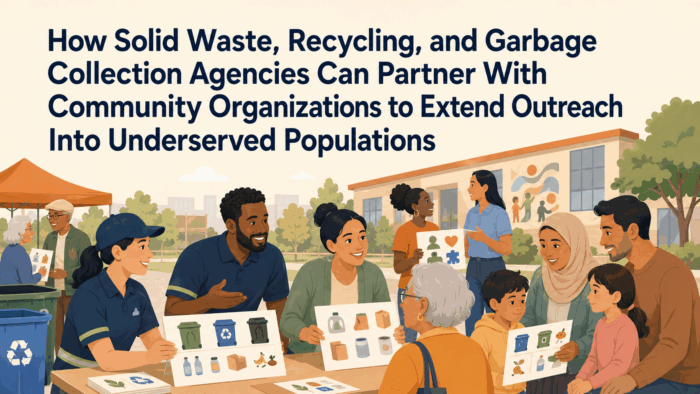
How Solid Waste, Recycling, and Garbage Collection Agencies Can Partner With Community Organizations to Extend Outreach Into Underserved Populations
The residents who generate the most contamination, illegal dumping, and improper disposal in most solid waste agency service areas are not residents who disregard the environment. They are residents who have the least access to information about solid waste programs and the least access to the program infrastructure those programs depend on. They are the households that standard agency communication consistently fails to reach: those whose primary language is not English, those living in areas where disposal infrastructure gaps make proper disposal difficult, those who are new to the community and unfamiliar with local programs, those who distrust government institutions enough to disengage from their communications, and those whose daily circumstances leave little bandwidth for navigating the procedural complexity of multiple solid waste programs with different rules and different schedules.
Standard agency communication, even when it is well designed and multi-channel, has structural limitations that prevent it from reaching these populations effectively. The agency’s mailing list may not reach households that move frequently. Its social media channels may not reach communities that are less digitally connected or that engage primarily in languages the agency does not publish in. Its public outreach events may not be accessible to residents who cannot attend scheduled public meetings. And its customer service channels may not be usable by residents whose language, literacy level, or prior experience with government institutions creates barriers to direct engagement.
Community organizations, including faith communities, social service agencies, ethnic cultural organizations, community health centers, tenant advocacy groups, neighborhood associations, and ethnic media, have what solid waste agencies lack: established trust relationships with the residents that agencies most need to reach. These organizations have built those relationships over years through consistent, culturally appropriate, and genuinely responsive engagement with their communities. When a community organization shares information about a solid waste program with its members, that information carries the credibility of the trusted organization rather than the institutional credibility of the agency, which may be limited or absent in communities with less positive prior experience with government communication.
Building genuine partnerships with community organizations is more demanding and more sustained than distributing materials through community channels. It requires building relationships before the communication need is urgent, engaging partners as genuine collaborators in communication design rather than as distribution outlets for agency-produced materials, and maintaining those relationships through the transitions in program priorities, personnel, and political environments that both agencies and community organizations routinely navigate. This article examines what genuine community partnership for solid waste communication requires, what makes it more effective than translated versions of standard agency materials, and how agencies can sustain partner relationships across the long term.
Why Partnership Communication Outperforms Translated Materials
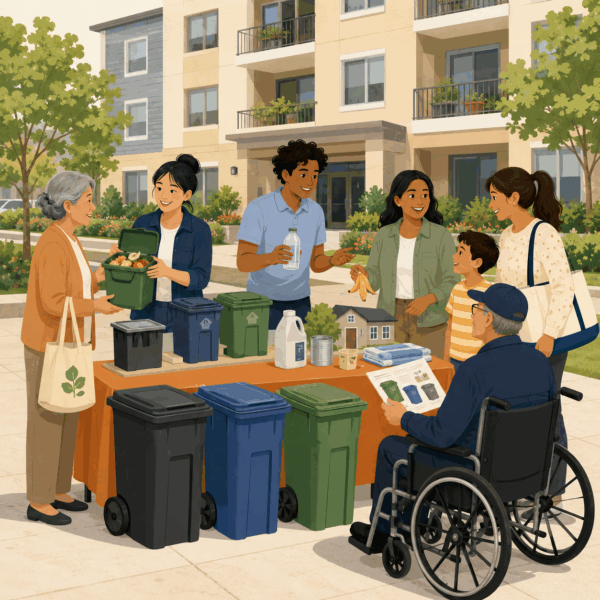 The instinctive response of solid waste agencies seeking to reach non-English-speaking communities is translation: take the existing communication materials, translate them into the languages of the target communities, and distribute them through whatever channels are available. Translation is necessary but not sufficient for effective community outreach, and agencies that treat translation as the primary or sole adaptation required for non-English-speaking communities will consistently find that their translated materials produce less behavior change than they expect.
Translation addresses language barriers without addressing the other dimensions of communication that determine whether a message is received, understood, and acted on in a specific community context. The organizational framing of agency communication, which assumes a ratepayer relationship, a formal notification context, and a one-directional information flow, may not be the communication mode that is most effective in communities where information is typically shared through personal relationships, trusted community leaders, or face-to-face conversation rather than through institutional notices. A translated agency notice may be linguistically accessible to a non-English-speaking resident while remaining institutionally alien in its tone, assumptions, and the kind of action it calls for.
Partnership communication with community organizations addresses these dimensions by placing the communication in a context that is already trusted and already adapted to the community’s communication norms. When a community health center includes information about household hazardous waste disposal in its community health newsletter, it is embedding solid waste information in a trusted health context where community members are already receptive. When a faith community leader mentions a recycling program at a community gathering, the recommendation carries the social weight of a trusted community relationship rather than the institutional authority of an agency notice. When an ethnic community organization distributes a recycling guide that it has reviewed and endorsed as accurate and relevant to its community, the guide carries the organization’s credibility.
The content of partnership communication should be co-developed with partner organizations rather than produced by the agency and distributed through partner channels. Community organizations that are asked to distribute materials they had no role in creating are being used as delivery mechanisms rather than engaged as genuine partners, and the communication they distribute will reflect that limited engagement. Community organizations that are involved in identifying the specific solid waste questions and confusion points that are most common in their community, in designing the communication materials that address those specific issues, and in reviewing those materials for cultural appropriateness and accuracy before distribution, produce communication that is genuinely adapted to their audience.
From Fragmentation to Coordination: Communication Strategies for Councils of Governments, Metropolitan Planning Organizations, and Regional Planning Agencies
This case study is part of SCG’s series on communication for councils of governments, metropolitan planning organizations, and regional planning agencies. To learn more and to see the parent article, which links to other content just like this, click the button below.
Identifying and Recruiting the Right Partner Organizations
Faith Communities as Communication Partners
Faith communities are among the most universally present and most trusted community organizations in most solid waste agency service areas, and they are systematically underutilized as solid waste communication partners. Mosques, churches, temples, synagogues, and other faith communities represent concentrated gatherings of community members with shared social networks, communication channels including weekly services and community newsletters, and institutional credibility that most government agencies cannot replicate. Faith leaders who are engaged as partners in solid waste program communication can reach their congregations in communication contexts where attention, trust, and community norms all support behavior change in ways that agency communication cannot access.
Engaging faith communities as solid waste communication partners requires approaching them with genuine community interest and programmatic humility. A faith leader who is approached by a solid waste agency representative who takes the time to understand the community the congregation serves, who asks what solid waste challenges community members face rather than leading with what programs the agency wants to promote, and who demonstrates genuine interest in the congregation’s community priorities alongside the agency’s communication needs, is far more likely to become an active partner than one who is approached primarily as a distribution channel for agency-prepared materials.
Environmental stewardship has deep resonance in many faith traditions, and agencies that engage faith communities through the lens of stewardship, care for creation, and responsibility to future generations connect solid waste program participation to values that motivate community members more deeply than regulatory compliance or individual environmental benefit arguments. A faith leader who frames recycling participation, proper hazardous waste disposal, and waste reduction as expressions of care for creation and responsibility to neighbors is communicating within a motivational context that agency communication cannot access. Partnerships that equip faith leaders to make these connections authentically, rather than asking them to deliver agency messages verbatim, produce the most genuine and most effective community communication.
Social Service Agencies and Tenant Organizations
Social service agencies that work directly with low-income residents, including food banks, housing assistance organizations, legal aid providers, and family service agencies, have regular contact with the households most likely to face solid waste access and compliance challenges. These organizations interact with their clients in contexts of genuine service provision, where the relationship is built on direct assistance rather than institutional communication. A social service agency that incorporates solid waste program information into its direct client services, whether through informational materials in waiting areas, discussion during case management meetings, or active enrollment support for residents facing solid waste compliance issues, is reaching clients in the most trusted and most responsive context available.
Tenant advocacy groups and affordable housing organizations provide access to the renter population alongside an organizational perspective on the barriers that renters face in accessing solid waste programs. Tenant advocates who engage with landlord-tenant issues related to garbage collection, recycling access, and disposal services in multi-family housing have direct knowledge of the most common solid waste complaints and access problems that renter households encounter. This knowledge is invaluable for agencies seeking to understand where program access and communication gaps are concentrated in the renter population and what program design changes would address them.
Apartment and multi-family housing property managers are intermediaries for a significant portion of low-income renter households, and partnerships that engage property managers as solid waste communication conduits reach residents who may not be on the agency’s direct communication list. A property manager who receives regular solid waste program updates from the agency, who is supported with on-site communication materials including recycling guides, bin labels, and program information for common areas, and who is treated as a genuine partner in the program’s outreach to residents, is providing solid waste program communication to residents who may change frequently but who encounter consistent program information as long as the property management relationship is maintained.
Building Relationships Before They Are Needed
 The most common failure mode in community organization partnerships for solid waste communication is the episodic partnership that activates when a specific communication need arises, produces the needed outreach, and then goes dormant until the next communication campaign. These episodic partnerships do not build the organizational trust and mutual understanding that make community partnerships genuinely effective, and they produce the communication outcomes of a distribution relationship rather than a genuine collaborative partnership.
Building genuine community organization partnerships for solid waste communication requires investment in the relationship before any specific communication need arises. This means attending community events and meetings hosted by partner organizations, learning about the organization’s priorities and the community challenges its members face, and identifying how solid waste agency programs and services connect to those priorities and challenges. It means providing resources to partner organizations that support their own work alongside solid waste communication, whether through funding, technical assistance, or advocacy for community priorities that the agency can support. And it means demonstrating through sustained engagement that the agency values the partnership as a genuine community relationship rather than as a communication channel to be activated when convenient.
Staff continuity on both sides of the partnership is one of the most significant factors in partnership durability. A partnership built between a specific agency program coordinator and a specific community organization staff member is at risk when either of those individuals moves on. Agencies that build partnership relationships at the organizational rather than the individual level, that document partnership agreements and communication protocols in ways that survive staff transitions, and that actively introduce new staff to community partner organizations when transitions occur, are more likely to sustain productive partnerships through the personnel changes that both agencies and community organizations routinely experience.
Partner organization capacity support, including providing funding, training, and technical assistance that strengthens the partner organization’s ability to serve its community alongside its role as a solid waste communication intermediary, is both ethically appropriate and strategically effective. Agencies that treat community organization partnerships as purely one-directional, extracting communication reach without providing organizational support, are building partnerships that will be less durable and less reciprocal than those built on genuine mutual benefit. The most effective and most durable community organization partnerships are those where both the agency and the partner organization receive genuine value from the relationship.
Co-Designing Communication With Community Partners
Partnership communication that produces behavior change in underserved communities is designed around the specific behaviors those communities need to change, the specific barriers that prevent those behavior changes, and the specific communication approaches that are most effective in each community context. Agencies that engage community partners in identifying these specifics, rather than assuming that the same behaviors, barriers, and approaches that apply to the general service area also apply to underserved communities, produce partnership communication that is genuinely adapted to its audience.
The behavior identification process should be specific enough to guide communication design. A general goal of increasing recycling participation in a specific neighborhood is less useful than the specific finding that the residents in that neighborhood most commonly contaminate their recycling with plastic bags, food-contaminated containers, and textiles, because they believe these materials are recyclable or because they lack alternative disposal options. Communication designed around those specific contamination behaviors, addressing each with specific guidance about correct disposal, is communication that the partner organization can share with confidence that it will produce the specific behavior change the agency is trying to achieve.
Barrier identification is the companion to behavior identification. For each behavior that partnership communication is designed to change, the agency and its community partners should identify the specific barriers that prevent that behavior change in the specific community. Language barriers, literacy barriers, lack of access to program infrastructure, distrust of government institutions, unfamiliarity with the concept of recycling from prior cultural context, and economic constraints that make program participation inconvenient or costly are all barriers that require different communication responses. A communication program that addresses the wrong barriers for a specific community, even if it is technically well designed, will produce less behavior change than one that addresses the barriers that are actually preventing participation.
Communication format adaptation is the implementation of barrier identification. For communities with limited literacy in any language, visual communication that uses images and symbols rather than text is more accessible than text-based materials, regardless of translation quality. For communities where trust in government institutions is low, communication that comes from a respected community figure is more credible than identical communication from official channels. For communities where information sharing is primarily oral rather than written, face-to-face community events and door-to-door outreach reach residents that written materials do not. The format of partnership communication should match the communication patterns of the community it serves, not the preferences of the agency producing it.
Ethnic Media as a Partnership Channel
Ethnic media organizations, including newspapers, radio stations, television channels, and online platforms that serve specific language communities, are communication infrastructure that most solid waste agencies have not developed relationships with despite their significant reach into communities that standard agency channels miss. A Spanish-language radio station that reaches tens of thousands of listeners in the agency’s service area is a communication resource of comparable or greater reach than the agency’s own social media program for that population, and it is a resource that operates within the trust relationships and communication norms of the community it serves.
Partnerships with ethnic media require understanding each outlet’s editorial priorities and audience expectations in order to develop content that the outlet will find appropriate to publish or broadcast. A news segment on a Spanish-language radio station about illegal dumping in a specific neighborhood serves the station’s community journalism function while communicating about solid waste issues that the agency cares about. An article in a Chinese-language community newspaper about the expansion of a recycling program serves the paper’s community information function while reaching readers the agency cannot otherwise access. Content that serves the media organization’s editorial function as well as the agency’s communication function will receive more prominent placement and more reader engagement than agency-written content that the outlet publishes as a courtesy.
Paid advertising in ethnic media provides a more direct communication channel than editorial partnerships and does not require the content to meet editorial standards that agency communication may not naturally fulfill. A paid advertisement in an ethnic newspaper or on an ethnic radio station that communicates specific solid waste program information in the community’s language, at a moment when the program information is timely and relevant, reaches the audience with the credibility of a media outlet they trust. The combination of editorial partnerships and paid advertising, with editorial content providing credibility and paid advertising providing control over specific messages at specific times, produces a media partnership that serves both the agency’s communication needs and the media organization’s audience and revenue requirements.
Addressing Illegal Dumping Through Community Partnerships
Illegal dumping is one of the most persistent solid waste management challenges in underserved communities, and it is primarily a communication and access failure rather than a reflection of community residents’ disregard for their neighborhood environment. Residents who illegally dump materials are most commonly doing so because they lack access to proper disposal options, because they do not know about the disposal options that are available, or because the available options are not convenient enough to compete with the immediate convenience of illegal dumping. Each of these causes requires a different response, and community partnerships are essential for identifying which causes are dominant in specific communities and designing responses that address those specific drivers.
Community organization partnerships for illegal dumping reduction should begin with the community’s own diagnosis of why illegal dumping occurs in their neighborhood. A community organization whose members live near an illegal dumping site knows things about the dumping patterns, the types of materials being dumped, and the circumstances that produce the dumping that external analysis cannot replicate. Engaging community organizations as problem diagnosis partners, rather than only as communication channels for agency-designed solutions, produces illegal dumping reduction strategies that are grounded in the actual drivers of the problem in each specific location.
Bulky waste pickup programs that provide residents with a free or low-cost mechanism for disposing of large items that do not fit in regular collection containers are among the most effective illegal dumping prevention tools because they provide a convenient legal disposal alternative for the most common illegally dumped materials. Communication about these programs through community organization partners reaches the residents who are most likely to be generating illegal dumping because they lack convenient legal disposal options for large items. Agencies that expand bulky waste program access in high-dumping neighborhoods alongside community partner communication about the program typically see illegal dumping reductions that the communication alone would not produce.
Sustaining Partnership Relationships Over Time
Community organization partnerships for solid waste communication require sustained investment to maintain their effectiveness, and agencies that do not invest in that maintenance will find their partnerships deteriorating into the episodic distribution relationships that produce limited outcomes. Sustaining genuine partnerships requires regular communication with partner organizations between specific communication campaigns, follow-through on commitments made during partnership development, acknowledgment of partner organizations’ contributions to program outcomes, and ongoing attention to the partner organization’s own priorities and challenges.
Solid waste programs change over time as accepted materials lists are revised, collection schedules are adjusted, and new programs are launched. For agencies that have built community organization partnerships for solid waste communication, each program change creates a communication obligation to update partner organizations with accurate new information before they communicate with their community members. A community organization that continues to provide community members with information about a recycling program that has changed its accepted materials is creating the contamination and confusion that the partnership was designed to prevent. Partner update protocols that ensure community organizations receive accurate program updates before changes take effect are as important as the initial partnership development investment.
Feedback loops that allow community organizations to report back to the agency on what they are hearing from their members about solid waste programs, what questions they are being asked, what barriers they are observing to program participation, and what agency practices or communication design elements are creating problems for the communities they serve, make the partnership a genuine intelligence resource for the agency as well as a communication channel. An agency that actively solicits and responds to this feedback is demonstrating that it values the partnership’s informational contribution as well as its distribution function, and it is building the kind of genuine collaborative relationship that produces better outcomes than a one-directional communication partnership can achieve.
Measuring Partnership Communication Equity Outcomes
The equity outcomes that community partnership programs are designed to produce, reduced contamination in underserved neighborhoods, increased hazardous waste program participation in communities with access barriers, decreased illegal dumping complaint rates in areas where outreach has been sustained, can be measured through program performance data if that data is disaggregated geographically and demographically. Without this disaggregation, equity improvements in specific communities are invisible in aggregate program performance statistics, and the partnership investments that produced them cannot be demonstrated to program funders or policy decision-makers who need evidence of equity impact to justify continued investment.
Longitudinal equity tracking, which measures program performance outcomes in partnered communities over multiple years, provides the most compelling evidence of partnership program effectiveness. A three-year trend of declining contamination rates in a neighborhood where community organization partnerships for recycling education have been active, compared against stable or declining contamination rates in comparable non-partnered neighborhoods, is stronger evidence of partnership effectiveness than a single-year outcome measurement. Agencies that commit to longitudinal equity tracking from the beginning of community partnership programs build the evidence base that demonstrates program value over time.
Community self-assessment of program access and communication quality, conducted through partner organizations that can reach community members honestly and in ways that generate candid feedback, provides qualitative equity data that quantitative program performance measures cannot capture. A community assessment that asks residents whether they know where to recycle, whether they understand what is accepted in their recycling containers, whether they have access to convenient solid waste services, and whether they feel that the agency’s communication reaches them in ways they can use, produces a community perspective on program equity that program performance data alone cannot reveal.
How Community Partnership Communication Compares With Other Outreach Approaches
Community organization partnership communication is more resource-intensive to develop and maintain than broadcast outreach approaches, but it produces outcomes in specific underserved communities that broadcast outreach cannot achieve regardless of its reach or frequency. The investment differential is justified by the specific communication failures that broadcast approaches cannot address in communities where language barriers, institutional distrust, and communication norm differences require community-mediated outreach to be effective.
The comparison with multilingual direct mail reveals a specific limitation of translation-based approaches. Direct mail that is translated into multiple languages reaches residents whose primary language is not English with linguistically accessible information, but it does not address the cultural context, institutional trust, and community relationship dimensions that determine whether that information produces behavior change. Partnership communication that delivers the same information through a trusted community intermediary, in culturally appropriate format and framing, produces behavior change at rates that translated direct mail cannot match in the specific communities where institutional trust is lowest and cultural context differences are most significant.
Language Access and Translation Quality in Partnership Communication
The translation of solid waste communication for non-English-speaking communities is a quality-sensitive function that many agencies approach inadequately. Professional translation of agency materials, while necessary, is only the first step in producing communication that is genuinely accessible to non-English-speaking communities. The quality of translation, the cultural adaptation of the communication style and framing, the review of translated materials by native speakers who are members of the target community, and the testing of translated materials with community members before broad distribution, are all quality assurance steps that most agencies skip in the interest of speed and cost, but that determine whether translated materials actually communicate what they are intended to convey.
Machine translation has become a common approach for solid waste agencies seeking to produce multilingual materials quickly and inexpensively, and it produces results that range from adequate to deeply misleading depending on the language pair, the technical vocabulary involved, and the complexity of the content. Machine-translated solid waste materials that contain technical terms or regulatory language may produce translations that are grammatically plausible but semantically incorrect in ways that could lead community members to dispose of materials incorrectly. Human review of machine-translated materials by native speakers who understand both the target language and the subject matter is a minimum quality standard for materials that will be distributed at scale.
Community organization partners who can serve as translation review partners, reading draft translated materials for both linguistic accuracy and cultural appropriateness, provide a quality assurance function that neither agency staff nor professional translators can fully replace. A community organization staff member who is a native speaker of the target language and who understands the specific community context in which the materials will be distributed can identify translation errors, cultural mismatches, and communication style choices that make materials less accessible to the community they are designed to serve. Building this review function into the translation workflow, rather than distributing translated materials without community review, is a communication quality investment that prevents the silent failures that inadequate translation produces.
Visual communication that uses images and symbols alongside text reduces the language access barrier for materials that must be understood across multiple language groups or by community members with lower literacy in their own language. A recycling guide that uses clear photographs of accepted and non-accepted materials, with minimal text that is supplemented by visual cues, communicates sorting requirements to a broader audience than a text-heavy guide in any language. For programs with high stakes for correct behavior, including hazardous waste disposal and composting contamination reduction, the investment in visual communication design is justified by the broader access it provides across the full language diversity of the service area.
Digital Outreach for Hard-to-Reach Communities
Digital outreach for hard-to-reach communities requires understanding that the digital divide is not uniform. Lower-income communities are not uniformly disconnected from digital communication; many residents have smartphones and access social media, messaging apps, and video platforms regularly, even if they lack consistent home internet access. The digital channels that are most accessible to lower-income communities, including mobile-first platforms accessed primarily through smartphones, may be different from the digital channels that agencies primarily use, which often prioritize website-based information that assumes desktop browsing behavior.
WhatsApp and similar messaging applications have become primary communication channels in many immigrant and non-English-speaking communities, where community groups use these platforms to share information, coordinate community activities, and provide mutual support. An agency that can partner with community organization leaders who maintain active WhatsApp groups for their community members has access to a communication channel that reaches community members through existing trusted relationships, in the communication context they use most regularly, and with the conversational format that messaging applications support rather than the institutional format of agency communications.
Short-form video content in community languages, distributed through YouTube, community organization social media channels, and community-facing platforms, reaches non-English-speaking residents in the format that is most accessible across a range of literacy levels. A thirty-second video that demonstrates the correct sorting of recyclable materials in Spanish or Vietnamese, produced with community organization partners who can ensure the content is culturally appropriate and linguistically natural, reaches community members who might not read a translated recycling guide but who will watch a video that demonstrates the same information in their own language. The investment in producing quality video content in community languages is higher than the investment in text translation, but the accessibility advantage for communities with lower print literacy rates can justify the additional investment.
Youth and School Engagement Through Community Partners
Schools provide access to children during the developmental period when habits and values are most malleable, and community organization partnerships that engage school-based programs for solid waste education are extending the agency’s reach into family households through the children who bring home what they learn at school. A student who learns correct recycling practices in school and corrects their parents’ recycling mistakes at home is a solid waste education outcome that no adult-focused outreach program can replicate. Community organizations that operate after-school programs, summer camps, and youth development initiatives provide complementary channels for solid waste education that reach young people in non-school settings where community norms and peer relationships also influence behavior.
Youth ambassador programs that train and support young people as solid waste education advocates for their own communities extend the agency’s outreach reach through the most credible channel available for peer audiences. Young people who are trained as recycling ambassadors for their communities, who lead sorting demonstrations at community events, who create social media content about recycling program requirements for their peer networks, and who advocate for improved solid waste infrastructure in their neighborhoods are multiplying the agency’s education reach through channels that agency-produced communication cannot access. Community organizations with established youth programs are natural partners for youth ambassador program development.
Intergenerational communication approaches that connect solid waste education to conversations between children and their families create household-level behavior change that both school-based and adult-focused communication can only partially achieve on their own. A solid waste agency that designs take-home activities that involve children and their parents or grandparents in shared sorting or waste reduction exercises is creating a household communication event that engages multiple generations simultaneously. Community organizations that work with multigenerational families can help design and facilitate these intergenerational engagement approaches in ways that are culturally appropriate for the specific communities they serve.
Maintaining Partner Relationships Through Agency Transitions
Solid waste agency leadership transitions, communication staff changes, and program priority shifts all create risks for the continuity of community organization partnerships that have been built on specific interpersonal relationships and programmatic commitments. An agency that loses its primary community outreach coordinator may also lose the institutional knowledge of which community organizations have been engaged, what commitments have been made to those organizations, and what communication protocols have been established for each partnership. Without deliberate transition management, partnerships that took years to build can deteriorate quickly when the staff members who built them are no longer in their roles.
Written partnership agreements that document the scope, responsibilities, communication protocols, and mutual commitments of each community organization partnership reduce the dependency on individual staff members that makes partnerships vulnerable to personnel transitions. These agreements do not need to be legally formal documents. They should be specific enough that a new agency staff member who reads them can understand what the partnership involves, what has been committed to, and how to maintain the partnership relationship through a transition period. Partner organizations should receive copies of these agreements and should be engaged in updating them as the partnership evolves.
Formal introduction protocols for new agency staff who will be working with existing community partners, including introductory meetings that bring new staff and partner organization contacts together with the departing staff member who built the relationship, reduce the awkward gap that partnership transitions create when no introduction is made and the community organization is left uncertain about whether the partnership will continue or who its new agency contact is. The investment in transition management is modest relative to the partnership value it preserves, and it demonstrates to community partner organizations that the agency’s commitment to the partnership is institutional rather than individual.
Evaluating and Sustaining Partnership Communication Effectiveness
Community organization partnerships for solid waste communication require ongoing evaluation to identify which partnerships are producing behavior change in target communities and which are producing activity without measurable outcomes. Agencies that invest equally in all partnerships regardless of their demonstrated effectiveness are not allocating their partnership resources efficiently and may be sustaining partnerships that have drifted from genuine collaboration into passive material distribution relationships. Regular evaluation of partnership effectiveness, conducted through both quantitative program performance data and qualitative feedback from partner organizations and community members, is the discipline that keeps partnership programs focused on outcomes rather than activities.
Partner relationship health assessments, conducted annually through structured conversations with partner organization contacts, provide the qualitative dimension of partnership effectiveness evaluation that program performance data cannot capture. A partner organization whose staff member reports that the partnership materials are not being used by community members, that the agency’s communication approach does not fit the community’s information-sharing norms, or that program changes have made previously distributed materials inaccurate, is providing the feedback that allows the agency to make the partnership more effective rather than continuing to invest in an approach that is not working. Partner assessment conversations should be designed to elicit honest feedback rather than social approval, which requires the agency to demonstrate genuine openness to critical assessment of its own materials and approaches.
Scaling successful partnership approaches, by identifying the specific elements of partnerships that have produced measurable outcomes and replicating those elements in new partnerships with organizations serving different communities, builds the agency’s community partnership capacity more efficiently than treating each partnership as a unique experiment. A faith community partnership approach that produced significant recycling contamination reduction in one community is likely to produce similar results in other faith communities if the approach is adapted to their specific context rather than imported wholesale. Documenting what made specific partnerships effective, in terms of the relationship-building approach, the co-design process, the communication format, and the outreach channel, creates the institutional knowledge that allows the agency to build its partnership program systematically rather than depending on individual staff members’ intuition.
Tying It All Together
Community organization partnerships for solid waste communication are not a supplementary outreach strategy for agencies that have exhausted their standard communication toolkit. They are the primary approach for reaching the specific communities that standard communication systematically fails, and they are justified by the disproportionate solid waste management challenges that inadequate outreach in those communities produces. The contamination, illegal dumping, and improper disposal that generate the most significant solid waste program costs and environmental impacts are concentrated in the communities that agencies have not effectively reached through their standard communication approaches.
Agencies that invest genuinely in community organization partnerships, that build those partnerships through sustained relationship investment rather than episodic campaign activation, and that co-design communication with partners rather than using them as distribution channels for agency-produced materials, produce solid waste program outcomes in underserved communities that no amount of broadcast outreach investment can substitute for. Those outcomes serve the communities that have historically been most disadvantaged by solid waste program communication failures. They also serve the agency’s operational and environmental mission by reducing the contamination, illegal dumping, and improper disposal that inadequate outreach generates.
The equity commitment that community partnership programs represent is not simply a communication strategy. It is the institutional recognition that solid waste programs which serve only the residents that standard communication reaches are programs that serve a portion of the community while imposing disproportionate environmental burdens on the remainder. Closing that gap through genuine partnership is the communication discipline that public solid waste management’s equity obligations require.
Strategic Communication Support for Community Partnership Programs
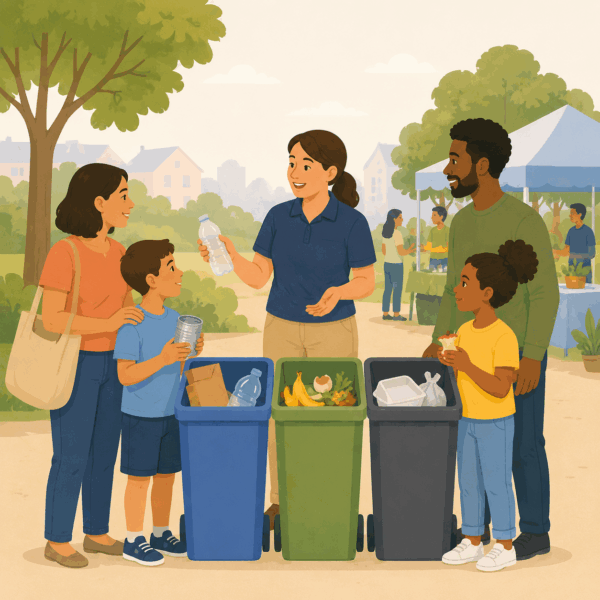 Building and sustaining community organization partnerships for solid waste communication requires expertise in community engagement, co-design facilitation, multilingual communication, ethnic media partnership development, and equity outcome measurement that most solid waste agency communication teams do not maintain as core competencies. The sustained investment required, across relationship building, communication co-design, partner capacity support, and outcome measurement, makes external communication expertise a productive investment for agencies seeking to systematically improve their outreach into underserved populations.
Stegmeier Consulting Group (SCG) works with solid waste agencies to develop community organization partnership programs that are built around genuine relationship investment, co-designed communication, and measurable outcomes in specific underserved populations. This includes identifying the right partner organizations for each target community, developing the partnership engagement approach that builds organizational trust before specific communication needs arise, co-designing communication materials with partner organizations that are genuinely adapted to each community’s communication norms, and building the measurement systems that track behavior change outcomes in partnered communities.
SCG also supports agencies in assessing the current state of their community outreach, identifying the specific populations where participation gaps are widest, and designing partnership development strategies that address those gaps through the community relationships and communication channels that are most effective in each specific community context. The objective is a solid waste agency whose outreach infrastructure reaches the full service area, including the communities that standard communication approaches have consistently missed.
Future Trends in Community Partnership Communication
Digital communication is opening new channels for community partnership outreach that complement but do not replace the relational foundation that effective community partnerships require. WhatsApp and similar messaging applications have become primary communication channels in many immigrant and non-English-speaking communities, where community groups use these platforms to share information, coordinate community activities, and provide mutual support. An agency that can partner with community organization leaders who maintain active messaging groups for their community members has access to a communication channel that reaches community members through existing trusted relationships, in the communication context they use most regularly.
Short-form video content in community languages, distributed through YouTube, community organization social media channels, and community-facing platforms, reaches non-English-speaking residents in the format that is most accessible across a range of literacy levels. A short video that demonstrates the correct sorting of recyclable materials in Spanish or Vietnamese, produced with community organization partners who can ensure the content is culturally appropriate and linguistically natural, reaches community members who might not read a translated recycling guide but who will watch a video that demonstrates the same information in their own language.
The growing recognition of environmental justice as a framework for evaluating solid waste program equity is also reshaping how agencies approach community partnerships. Agencies that position their community partnership programs explicitly within an environmental justice commitment, that measure and report on equity outcomes in addition to overall program performance, and that engage community organizations as genuine partners in identifying and addressing environmental inequities in solid waste service delivery, are building the institutional credibility with underserved communities that makes partnership communication most effective.
Conclusion
The communities that generate the most contamination, illegal dumping, and improper disposal in most solid waste service areas are not the communities that care the least about their environment. They are the communities that have been reached the least by the communication programs that solid waste agencies have built for audiences different from themselves. The gap between agency communication reach and actual community access is a communication design failure, and it is one that community organization partnerships are uniquely equipped to address.
Agencies that invest in genuine community partnerships, that build those partnerships on relationships of mutual respect and genuine value exchange, and that measure their partnership programs through the equity outcomes they produce rather than the outreach activities they generate, are building the most effective solid waste program communication infrastructure available for underserved populations. The return on that investment is measured in reduced contamination rates, decreased illegal dumping, increased participation in programs designed to serve the full community, and the institutional credibility that comes from demonstrating through action that the commitment to serve every resident is genuine rather than rhetorical.
Stegmeier Consulting Group’s Strategic Approach to Communication Systems
Build community partnership programs around genuine relationship investment, co-designed communication, and the equity outcomes that make the partnership’s value measurable.
Solid waste agencies that build genuine community organization partnerships produce solid waste program outcomes in underserved communities that no broadcast outreach program can substitute for. Stegmeier Consulting Group (SCG) helps agencies develop the partnership frameworks, co-design processes, ethnic media relationships, and equity measurement systems that transform community partnerships from episodic outreach campaigns into sustained communication infrastructure for the populations that standard agency communication consistently misses.
Use the form below to connect with our team and explore how strategic communication support can strengthen your agency’s community partnership program.