15 Critical Influences™ — a key result of Stegmeier Consulting Group’s decades of research
Why companies fail when introducing a new change in the workplace
 Many enterprises’ efforts in implementing workplace change initiatives have produced less than optimal results, or have failed altogether, due to factors that business leaders may not know are linked.
Driven by the desire to help organizations better manage change, Stegmeier Consulting Group endeavored to fill the gaps and identify the missing pieces that obstruct or cause initiatives to fail.
A key result of SCG’s research spanning more than 24 years and examining more than 236 organizations across 31 industries was the discovery of 15 interdependent tangible and intangible factors — Critical Influences™ — that impact behavior in the workplace, enable or hinder the success of the workplace strategy and, ultimately, the achievement of overall corporate goals. The results of the study demonstrate the universal impact these 15 factors have on behavior in the workplace, regardless of the type of business or the size of the organization.
The output of our research on resistance to change in the workplace is shared below, as well as in our book, Innovations in Office Design: The Critical Influence Approach to Effective Work Environments™, which has been named the #1 workplace strategy book by Amazon readers.
Understanding Organizational Change Through a Systems Lens
One of the most important lessons from the Critical Influences™ research is that organizational problems are often interconnected.
An employee who appears resistant to a workplace change may actually lack confidence in leadership. A communication problem may originate in an unclear business process. A new technology may function as intended but still experience poor adoption because employees have not received the information, training, autonomy, or support needed to use it effectively. A collaborative workplace may be designed correctly while compensation, performance expectations, management practices, or organizational culture continue to reinforce individual rather than collaborative behavior.
When organizations treat these issues independently, they can invest significant time and resources addressing symptoms without changing the conditions creating them.
The Critical Influences™ provide a broader framework for examining those conditions. Rather than beginning with the assumption that one visible problem has one obvious cause, SCG encourages organizations to examine the relationships among leadership, culture, communication, organizational structure, technology, business processes, incentives, knowledge, employee expectations, and the environments in which people work.
This systems perspective continues to influence how SCG approaches complex organizational challenges today.
The 15 Critical Influences™ uncovered
Undeniably, the physical workplace is regarded as the panacea for all corporate ills. Many rely on it to solve issues that turn out to be deep-rooted problems that need a significantly different approach.
When seeking to change the way work gets done at your organization, be sure to look at the big picture; most workplace strategists will focus exclusively on the physical work environment and how that change will affect your workforce.
Stegmeier Consulting Group encourages organizations to take a more holistic approach to workplace change and examine 14 other key factors. These Critical Influences™, if left unchecked, can derail a workplace initiative no matter how great the design is.
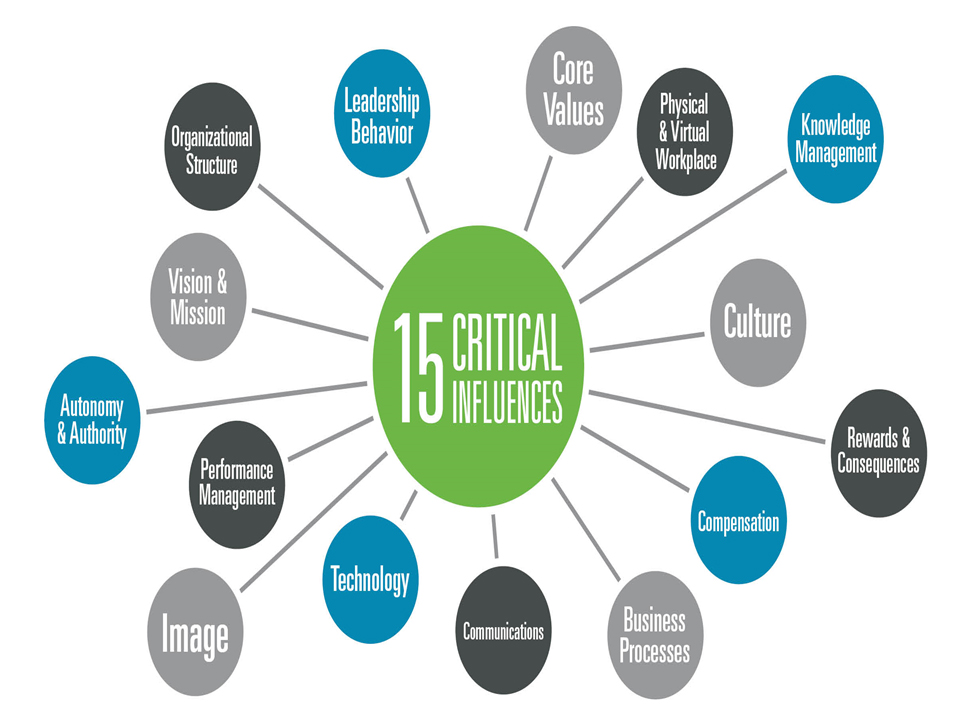
In a series of comprehensive posts, we share an elaborate presentation of our key findings on the 15 Critical Influences™ from our decades of research. Below you will find a positive (+) and negative (-) example of each of these essential factors for leading workplace change. Click on any of the links below to explore each of the Critical Influences™ in more detail and learn how they affect change in the workplace.
The value of the Critical Influences™ is not in treating the 15 factors as an independent checklist. Their importance lies in the way they interact.
Leadership behavior can reinforce or undermine communication. Organizational structure can affect how information moves. Technology can enable a new business process or make that process more difficult. Compensation and performance management can reward behaviors that conflict with an organization’s stated values or workplace strategy. The physical workplace can support collaboration while cultural norms discourage employees from using it as intended.
For that reason, SCG considers the Critical Influences™ as parts of a connected organizational system.
Vision and Mission
(+) A company “walks the talk” when it comes to its vision and mission statements guiding leadership on how to treat employees and customers in given situations.
(-) An organizational vision that emphasizes “long-term trusting relationships with its customers,” yet does not trust employees to adopt on-campus mobility, is not practicing what it preaches.
Core Values
(+) A company’s core values can serve as a theme for unity in order to kick off and follow through with a change initiative.
(-) Too often core values are left on the shelf to collect dust, and components of a workplace change initiative do not reflect the original fundamentals a company was founded upon.
Organizational Image
(+) When used properly, a modern, collaborative work environment creates a positive image in the eyes of customers and serves as an important tool for attracting and retaining talent.
(-) Outdated office designs and layouts send a message that the company is archaic and uninspiring.
Corporate Culture
(+) A goal of many new workplace strategies is to reshape the organization’s culture to one that is more collaborative, transparent, and innovative.
(-) When there is a disconnect between what an organization claims to be and what it is perceived to be, a culture of mistrust can contribute to low employee morale.
Organizational Structure
(+) The new workplace strategy is appropriately aligned with the ever-changing organizational hierarchy by incorporating flexibility to reconfigure departmental space through fewer hard walls.
(-) A new workplace strategy that maintains outdated standards of using space to reward status may invest in many under-utilized private offices.
Leadership Behavior
(+) Workplace changes have a much higher rate of success when top leaders are engaged in the initiative and hold individuals throughout the enterprise accountable for the appropriate use of the new work environment.
(-) Negativity and resistance can cascade down through an organization when leadership does little more than sign off on the new workplace strategy while carrying on as if they are exempt from the changes expected of the balance of the workforce.
Autonomy and Authority
(+) Employees feel empowered to work in a variety of settings in a shared space environment, utilizing the new work space as they see fit to be productive.
(-) Even the greatest workplace design will fail if employees are not given the autonomy and authority to select the most appropriate work setting for the task being conducted.
Compensation
(+) An organization enhances its compensation program to encourage and reward teamwork in a more collaborative work environment.
(-) Concerned with their personal income, individuals shy away from collaboration out of fear someone else may be compensated for their work and ideas.
Rewards and Consequences
(+) Rewards and consequences are used in the correct manner, such as rewarding an employee for embracing a new work space, and providing consequences for those who do not comply with new workplace protocols.
(-) Misguided consequences (such as playful reprimanding of an employee “taking a break” in a focus room) inject confusion into the work environment and discourage full utilization of the new office layout.
Performance Management
(+) In top performing organizations, managers are held accountable for their employees’ success in transitioning to new ways of working.
(-) Not seeing employees at their assigned workstations 100% of the time is not an excuse for managers to delay or forgo performance reviews. With on-campus mobility and greater flexibility in where work happens, managers should consider touching base with employees even more frequently.
Communications
(+) Proper communication is timely, properly reinforced, and is connected holistically to other organizational changes.
(-) Far too often communications regarding change focus on what employees will be losing in the new workplace, coming across as an apology.
Knowledge Management
(+) Companies develop an easily accessible, elaborate database of knowledge.
(-) Information cannot be easily accessed unless employees are in the office or on-campus, and technology hinders flexibility.
Technology
(+) Employees are provided with the devices, software, and connectivity needed to stay productive no matter where they work.
(-) Outdated technology or limited connectivity binds employees to their work area when they could be equally productive across the building, campus, or world!
Business Processes
(+) Many workplace solutions are developed to support changing business processes such as a switch to team settings instead of a linear, assembly-line style of work.
(-) Resistance arises when employees fear the new process and prefer to maintain the “old” way of doing things because of their comfort with the status quo.
Physical and Virtual Workplace
(+) By encouraging employees to choose from a variety of on-campus work settings, appropriate for the task at hand, organizations can increase the amount of time their workers are focusing on their tasks all while maximizing their real estate investment.
(-) Manager resistance to on-campus mobility, due to a lack of trust in employees, deprives an organization of the opportunity to take advantage of the above-mentioned benefits.
The Critical Influences™ Are Most Powerful When Examined Together
Organizations frequently encounter problems that initially appear straightforward.
Employees are not using a new workplace as intended. Managers are resisting a new policy. Information is not reaching the right people. A digital tool has been implemented but adoption remains low. Different departments are interpreting the same initiative differently. Leaders believe they have communicated extensively, while employees continue to say they do not understand what is changing.
Each of these situations can look like a single problem. SCG’s research suggests that the more useful question is often whether several organizational conditions are interacting.
Consider a technology implementation. Low adoption might initially appear to be a technology problem. Further examination could reveal that employees do not understand why the system is changing, managers are reinforcing old processes, training has not addressed real workflows, knowledge resources are difficult to access, and performance expectations have never been updated.
Improving the technology alone would leave most of those barriers untouched.
The same principle can apply to workplace change, organizational transformation, new operating models, policy changes, communication initiatives, and other efforts that require people to behave differently.
Looking across the Critical Influences™ allows organizations to move from asking, “Why are people resisting?” to asking, “What conditions are producing the behavior we are seeing?”
That is a much more actionable question.
Distinguishing Symptoms From Underlying Conditions
One of the greatest risks during organizational change is responding to the most visible symptom without understanding its cause.
Repeated employee questions may appear to indicate a communication problem. Additional communication may help, but the questions could also reveal that the underlying business process remains unclear, managers have received inconsistent information, responsibilities have not been defined, or employees cannot find an authoritative source of information.
Low use of a new workplace may appear to indicate that employees dislike the design. The actual barrier may involve leadership behavior, technology limitations, management expectations, organizational culture, or policies that make it difficult for employees to use the environment differently.
Resistance to a new process may appear to reflect employee unwillingness to change. Further research may show that the process conflicts with performance expectations, creates additional work, or has not been supported by the technology required to make it practical.
The Critical Influence Approach™ helps SCG examine these relationships before recommending a solution. The purpose is not to make every organizational problem more complicated. It is to avoid spending resources solving the wrong problem.
Applying the Critical Influence Approach™ to Change in Your Organization
Using the Critical Influence Approach™ early in the planning or even in the midst of implementing your organization’s workplace strategy, SCG can take a broad look at your enterprise and assess what issues may be barriers to effectively implementing your chosen strategy.
This strategic approach deviates from superficially patching cracks in your workplace. We understand that a significant workplace strategy often necessitates a deep dive into the intricacies of your organization’s unique system to uncover challenges that need attention.
SCG does not begin by assuming which Critical Influence™ is responsible for a problem. We gather information from the organization and from the people experiencing the change so that recommendations are grounded in evidence rather than assumptions.
Depending on the engagement, that research may include employee or stakeholder surveys, interviews with executives and managers, focus groups, workplace observations, review of existing data and materials, communication assessments, facilitated discussions, workshops, or other quantitative and qualitative research methods.
SCG then analyzes the findings to identify patterns, relationships, and organizational conditions that may be enabling or hindering the desired outcome.
This process can reveal that the apparent problem and the underlying problem are not the same. What appears to be employee resistance may reflect inconsistent leadership behavior. What appears to be a communications problem may originate in an unresolved business process. Low utilization of a workplace may reflect management norms rather than physical design. Poor adoption of a new system may involve knowledge management, training, performance expectations, technology, organizational structure, communication, and leadership behavior in addition to the system itself.
Once those relationships are better understood, SCG can help the organization determine where intervention is most likely to provide value and translate the findings into a practical strategy for moving forward.
From Research to Strategy and Implementation
Understanding what is influencing behavior is only the beginning. The next question is what the organization should do with that information.
SCG works across the progression from research and diagnosis through strategic planning and implementation. Findings related to the Critical Influences™ may inform a change management strategy, communication approach, leadership alignment effort, workplace strategy, facilitated planning process, training initiative, employee engagement effort, business process discussion, or another intervention appropriate to the conditions identified through the research.
In one organization, the priority may be improving communication sequencing and preparing managers to reinforce a change. In another, leadership behaviors may need to become more consistent with the expectations being placed on employees. Another organization may discover that its technology, business processes, organizational structure, or knowledge management practices are creating barriers that additional communication alone cannot solve.
The objective is not to prescribe the same solution to every organization. It is to understand the organizational system well enough to determine which combination of actions is most likely to support the desired outcome.
That research-informed, systems-oriented perspective continues to influence SCG’s work across organizational change, workplace strategy, strategic planning, communications, research, facilitation, and implementation support.
Why the Critical Influences™ Remain Relevant as Work Continues to Change
The way organizations work has continued to evolve since SCG began this research.
Hybrid work, distributed teams, digital collaboration platforms, changing employee expectations, new workplace models, organizational restructuring, rapidly evolving technology, and increasingly complex communication environments have changed how people interact with their organizations and with one another.
Those developments make the relationships among the Critical Influences™ more important, not less.
Physical and virtual workplace decisions now intersect directly with technology. Technology changes business processes. Business processes affect knowledge management. Organizational structure influences how information and decisions move. Leadership behavior shapes whether employees believe new expectations will actually be reinforced. Communication helps people understand what is changing, while culture, values, rewards, performance expectations, and organizational experience influence whether the message feels credible.
The specific tools, technologies, workplace models, and management practices will continue to evolve. The central research lesson remains relevant: successful organizational change requires understanding the broader system surrounding the people expected to adopt it.
What Can the Critical Influence Approach™ Help Organizations Understand?
The framework can help leaders investigate questions such as:
-
Why are employees resisting a change that appears logical from a leadership perspective?
-
Are leadership behaviors reinforcing or undermining the desired change?
-
Does the organization’s communication align with what employees are actually experiencing?
-
Are business processes and technology supporting the behavior the organization is asking employees to adopt?
-
Do compensation, rewards, and performance expectations reinforce or contradict the desired outcome?
-
Can employees easily find the information and knowledge required to work differently?
-
Does the organizational structure support the way teams are expected to collaborate and make decisions?
-
Is the physical and virtual workplace aligned with the organization’s strategy, culture, and operating model?
-
Are several small organizational conditions combining to create a larger implementation barrier?
The answers will be different in every organization. That is why SCG’s work begins with understanding the environment rather than assuming the solution.
What’s the buzz from the business community?
“The Critical Influence Approach™ to solving the problem of conflicting objectives (reducing costs and enhancing performance in the workplace) is compelling. It resonates at the core of our business objectives.”
– Seminar attendee
“The concept of the 15 Critical Influences™ is very powerful and comprehensive, and seeks to bring a 360 approach to understanding the work environment—one that speaks the language of senior management. It can help us have more in-depth dialogue with our executives when it comes to making workplace decisions that will impact the workforce.”
– Think Tank participant
“Stegmeier Consulting Group’s research reveals 15 Critical Influences™ that can make or break workplace strategies. Most futurists do not provide practical applications to incorporate today—Stegmeier is the exception to the rule!”
– Amazon reader
“My guess is that this book will be a bestseller in the design community and hopefully, its principal theme, the 15 Critical Influences™, will be adopted as standard for use by all designers.”
– Amazon reader
“The 15 Critical Influences™ ought to be studied by every business professional.”
– Amazon reader
Understand What Is Really Influencing Your Change Initiative
When a change initiative is struggling, the most visible problem is not always the underlying problem.
Your organization may be preparing for a new workplace, implementing new technology, changing how teams operate, restructuring departments, introducing new policies, strengthening communication, or managing another initiative that requires people to work or behave differently. The Critical Influence Approach™ can help identify the organizational conditions that may support or hinder successful implementation.
SCG can help your organization gather the right information, understand what employees and stakeholders are experiencing, identify patterns across the organization, and translate those findings into a practical strategy for change.
Use the form below to connect with Stegmeier Consulting Group and discuss the challenges your organization is experiencing, the changes you are preparing to make, and how a research-informed assessment can help determine where to focus next.