
How State Consumer Protection Agencies Can Create Scam Alerts That Help Citizens Avoid Fraud
Consumer fraud is not a static threat. Schemes evolve continuously, adapting their tactics, their targets, their contact methods, and their cover stories in response to changes in technology, in consumer behavior, in regulatory attention, and in the specific opportunities that current events create. The scam alert is a primary tool by which consumer protection agencies attempt to stay ahead of this evolution, warning consumers about schemes that are active and providing them with the specific information they need to recognize and avoid them.
A scam alert that does its job changes something for the consumer who receives it. It either prevents them from falling victim to a scheme they would otherwise have encountered, or it gives them the information they need to recognize and resist a scheme they are already in contact with. A scam alert that does not do its job is a communication that was produced and distributed without producing any change in consumer behavior or awareness, because it was too vague to be actionable, too late to be relevant, distributed through channels that did not reach the targeted population, or written in a way that consumers could not apply to their own specific situation.
This article provides a practical framework for creating scam alerts that help citizens avoid fraud. It covers what information an effective scam alert must contain, how to structure alerts so that the most critical information is most accessible, how to reach the populations most likely to be targeted by specific schemes, how to time alerts to be maximally useful, how to use illustrative examples and specific warning signs, how to direct consumers to verification and reporting resources, and how to follow up on alerts as schemes evolve or are resolved. Throughout, the emphasis is on communication that changes consumer behavior rather than communication that satisfies a public notification obligation without protective effect.
What Every Scam Alert Must Contain
 An effective scam alert answers a specific set of questions that a consumer who has received or may receive the alert will have. Missing any of these questions creates a gap that undermines the alert’s protective effectiveness. The questions are consistent across alert types: What is happening? Who is being targeted? What does the scam look like? What warning signs indicate a consumer may be in contact with the scheme? What should consumers do to avoid it? What should consumers do if they have already been approached or victimized? Where can consumers report it?
What is happening must be described with enough specificity that consumers can recognize the scheme if they encounter it. A scam alert that says consumers should be aware of phone scams targeting seniors is not specific enough to be protective. A scam alert that says consumers are receiving phone calls from callers who claim to be from the Social Security Administration, who tell the recipient that their Social Security number has been used in criminal activity, and who demand payment in gift cards to avoid arrest, is specific enough that a consumer who receives such a call can recognize it immediately as the scheme described in the alert.
Who is being targeted is important because it helps consumers self-identify as at risk and because it helps partners and community organizations direct alert information to the appropriate populations. If a specific scheme is disproportionately targeting older adults, recent immigrants, or residents of specific geographic areas, stating that targeting pattern allows the alert to be distributed through channels that reach those populations. An alert that does not describe the target population must be distributed broadly to ensure that it reaches those at highest risk, which is less efficient than targeted distribution based on accurate demographic information.
What the scam looks like, described in enough detail that a consumer in contact with the scheme can recognize it, is the core of the alert’s protective content. This description should include the method of initial contact, whether phone, email, text message, social media, or in-person; the cover story the scammer uses; the type of payment or information requested; the pressure tactics used to prevent the consumer from verifying the legitimacy of the contact; and the specific language, names, or identities the scammer uses. Each of these elements represents information that helps consumers recognize the specific scheme rather than just an abstract fraud type.
Protecting the Public Interest: Communication Strategies for Financial Regulation, Insurance, and Consumer Protection Agencies
This article is part of our series on strategic communication for Financial Regulatory Agencies, State Insurance Departments, and Consumer Protection Agencies. To learn more and to see the parent article, which links to other content just like this, click the button below.
Warning Signs That Help Consumers Self-Identify Risk
The most actionable element of a scam alert is a specific list of warning signs that help consumers recognize whether a contact they have received matches the pattern of the scheme being described. Warning signs should be concrete and observable, not general principles about fraud. Unsolicited contact is a warning sign of fraud in general but does not help a consumer recognize a specific scheme. A caller who claims to be from a government agency and who asks for payment in gift cards is a specific, observable warning sign that can be immediately applied to a contact a consumer has received or is receiving.
Warning signs should be presented in a format that consumers can scan quickly and apply to their current situation. A numbered or bulleted list of specific warning signs, each described in one or two concrete sentences, is more useful than a prose description of the scheme’s general characteristics. A consumer who is on a call that may be a scam needs to be able to quickly check the specific characteristics of the call against the warning signs in the alert. A consumer who has to read through multiple paragraphs to find the relevant warning signs may not do so before making a consequential decision.
Warning signs that are specific to the current scheme and that distinguish it from other common fraud types are more useful than general red flags that apply broadly to many types of fraud. A specific scheme may have characteristics that are unusual, such as insisting that the consumer keep the call confidential from family members, requiring payment through a specific channel that is atypical, or using specific agency names or reference numbers that can be verified as fraudulent. These scheme-specific characteristics are the most useful warning signs because they are the ones most likely to be present in the contacts that consumers in the scheme’s target population are actually receiving.
What Consumers Should Do
Telling consumers what a scam looks like and what the warning signs are without telling them specifically what to do when they encounter those warning signs is a scam alert that protects consumers from identifying a risk without helping them avoid it. The recommended consumer actions are as important as the scheme description and should receive equal prominence in the alert.
For consumers who have not yet been approached by the scheme, the recommended actions are primarily precautionary: know that this type of contact is occurring, be skeptical of unsolicited contacts with these characteristics, do not provide the requested information or payment without independent verification, and tell family members and friends about the scheme so that they can also protect themselves. These precautionary actions are simple and low-cost, and they should be described in active, direct language: do not send gift cards to anyone who contacts you claiming to be from a government agency.
For consumers who are currently in contact with a potential scammer, the recommended actions are more urgent: end the contact immediately, do not send money or provide personal information, do not respond to follow-up contacts, and report the contact to the appropriate authority. These actions should be described with the same urgency that the situation warrants: if you are currently on a call that matches this description, hang up. Do not call back if they call again.
For consumers who have already been victimized, the recommended actions address both immediate protective steps and the reporting and recovery resources available to them. Stopping further payment is the most urgent step. Reporting to the appropriate authority is the next step, both to contribute to enforcement efforts and to access any available recovery assistance. Contacting their bank or payment provider about the transactions that have occurred may provide some recovery options. Seeking support from a consumer assistance organization may help them navigate the aftermath. Each of these steps should be described specifically, with the contact information needed to take it.
Reaching the Right Audiences
A scam alert that reaches only the populations that are not being targeted by the scheme has not protected anyone. Effective alert distribution requires identifying the specific populations most likely to be targeted by the scheme being described and distributing the alert through channels that reach those populations directly. This sounds straightforward but requires deliberate attention to how the targeted populations actually receive information, because the channels that most easily reach the general public may not effectively reach the specifically targeted populations.
For schemes that target older adults, effective distribution channels include senior centers and senior services providers, Medicare counseling and benefits assistance programs, AARP and similar organizations, medical providers whose patient population includes older adults, faith communities with significant older adult membership, and local news outlets with strong older adult readership or viewership. The alert should be distributed through as many of these channels as possible, with the format adapted for each channel: a brief verbal announcement at a senior center program, a newsletter item for a membership organization, a social media post for a community Facebook group that older adults in the target area follow.
For schemes that target specific ethnic or language communities, the alert should be translated and distributed through the organizations, media outlets, and community networks that those communities trust and use. An alert distributed only in English will not protect a community whose members primarily communicate in another language. An alert distributed through mainstream media channels will not reach a community that primarily receives information through community-specific channels. The targeting of the scheme should drive the targeting of the alert.
For schemes that involve specific financial products or situations, such as mortgage modification fraud targeting homeowners in financial distress, the alert should be distributed through the organizations that serve people in that situation: housing counseling agencies, legal aid organizations, mortgage servicer contact points, and any social service organizations that work with financially stressed households. These organizations have direct relationships with people in the vulnerable situation that the scheme targets, making them ideal distribution partners for an alert specifically designed to protect that population.
Timing and Urgency of Scam Alerts
The timing of a scam alert relative to the peak of scheme activity significantly affects its protective impact. A scam alert issued weeks after a scheme has reached its peak activity level, when most of the consumers who are going to fall victim have already done so, is less protective than one issued when the scheme is just beginning to scale. Agencies that can identify and alert about emerging schemes early, based on complaint data, law enforcement referrals, or intelligence from partner organizations, can provide protection when it matters most.
The urgency of the alert should be calibrated to the urgency of the scheme. A scheme that is rapidly spreading and that is causing significant consumer harm warrants an alert framed with high urgency, distributed immediately, and pushed through every available channel simultaneously. A scheme that is being monitored but that has not yet reached significant scale warrants an alert that is informative without being alarmist, distributed thoughtfully rather than immediately, and framed as a caution rather than an emergency.
Seasonal and event-driven timing should be built into the alert planning process, because many fraud schemes operate on predictable cycles. Tax season brings a reliable spike in IRS impersonation calls and tax fraud schemes. Disaster events bring fraudulent contractors, fraudulent charity solicitations, and fraudulent insurance claims services. The holiday season brings gift card scams, charitable fraud, and online shopping fraud. Medicare open enrollment brings Medicare card fraud and health plan switching scams. Agencies that plan their alert calendar around these predictable patterns can pre-position warnings before the scheme peaks rather than reacting to them after the damage is done.
Using Specific Examples and Scenarios
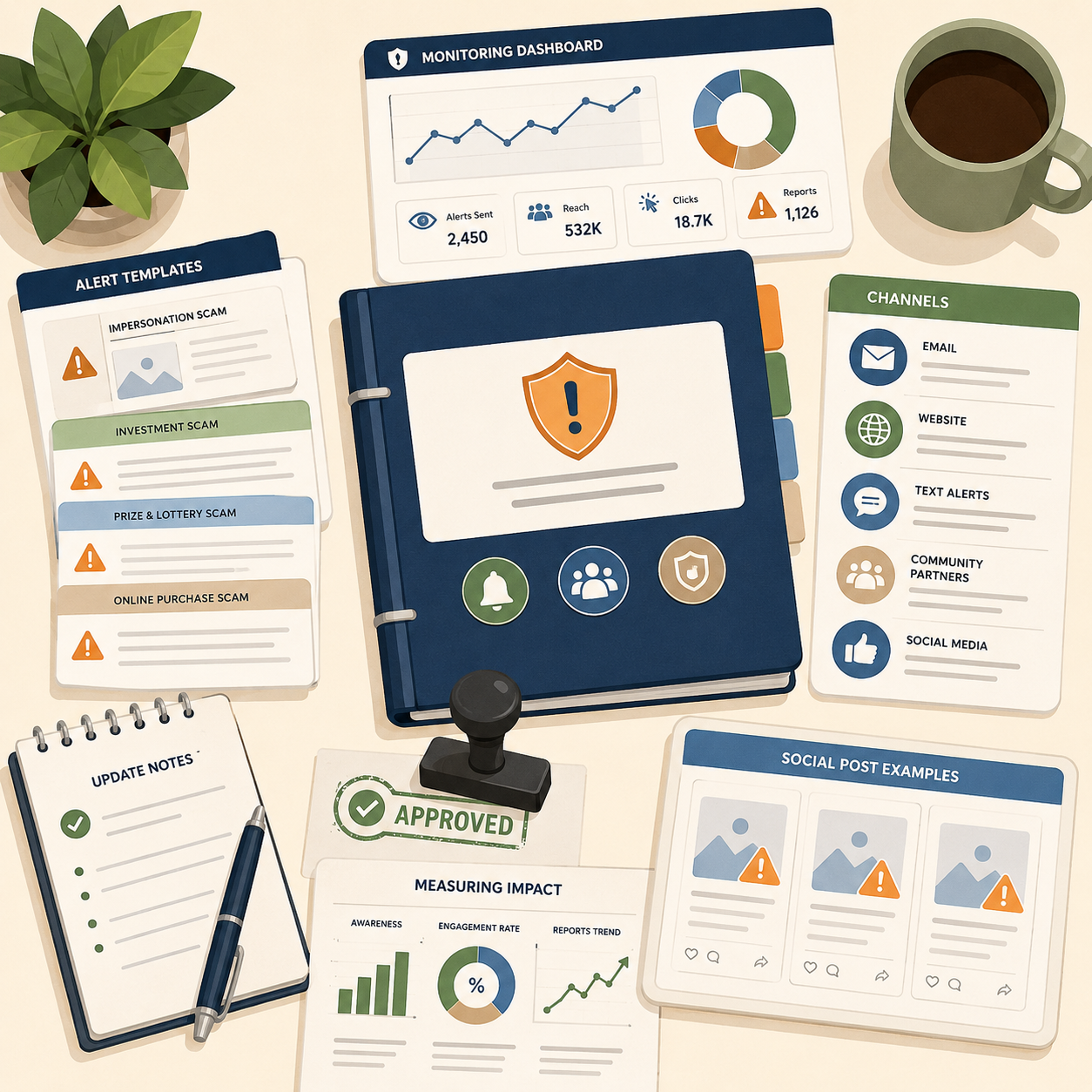 Consumer scam alerts that are written only in the abstract, describing schemes in general terms without providing concrete examples of how they are actually experienced by consumers, are less effective than those that illustrate the scheme with specific, realistic scenarios. A scenario that describes exactly what a targeted consumer is likely to experience, from the initial contact through the pressure tactics to the requested payment, gives consumers the specific recognition cues they need to identify the scheme when they encounter it.
Effective scenarios are written from the consumer’s perspective, in the second person, placing the reader in the situation being described. You receive a call from someone who says they are from the Department of Social Services. They tell you that your benefits have been suspended because of an administrative error. They offer to restore your benefits if you pay a verification fee of ninety-nine dollars. They ask you to pay by purchasing a gift card and reading them the card number over the phone. This second-person scenario gives the reader the visceral experience of being in the situation, which activates the recognition that the same abstract description of the scheme cannot produce.
Scenarios should be as specific as possible about the language the scammer uses, the specific cover story, the specific payment method requested, and the specific pressure tactics employed. These specific details are the recognition cues that allow a consumer to immediately say that is what is happening to me right now when they encounter the scheme. General descriptions of fraud characteristics give consumers general awareness without providing the specific recognition cues that enable in-the-moment protection.
Multiple scenarios, reflecting the different variations of the scheme that are in operation, are more protective than a single scenario that represents only one version of the scheme. Many fraud schemes operate with multiple variations of their cover story, targeted at different consumer situations or using different initial contact pretexts. An alert that illustrates the most common variation of the scheme and notes that the scam also appears in several other forms, with brief descriptions of those forms, gives consumers a more complete picture of the scheme’s range than a single-scenario alert.
Verification and Reporting Resources
Every scam alert should include specific resources for consumers who want to verify the legitimacy of a contact they have received or who want to report a contact or victimization they have experienced. These resources should be named specifically with contact information, not referenced in general terms that require the consumer to search for additional information before they can take action.
Verification resources help consumers who are uncertain whether a contact is legitimate to independently confirm what the agency or organization that the caller claims to represent would actually do and say. If a caller claims to be from Medicare, the consumer should call Medicare directly at the official number to ask whether the contact is legitimate. If a caller claims to be from the state’s Medicaid office, the consumer should hang up and call the official number for that office. The alert should provide these official contact numbers and explain that the consumer should use them rather than calling back the number the suspected scammer provided.
Reporting resources allow consumers who have been approached or victimized to contribute to enforcement efforts and potentially to access assistance. The primary reporting resource should be the consumer protection agency that issued the alert, with the specific contact information for the agency’s fraud reporting mechanism. Additional reporting resources may include the Federal Trade Commission consumer reporting portal, the Internet Crime Complaint Center for online fraud, local law enforcement for immediate threats, and the financial institution or payment provider through which any loss occurred.
For consumers who have already been victimized, the alert should specifically address what resources are available to help them recover. These might include assistance from the agency’s consumer protection staff, referral to legal aid for consumers who need legal advice about their options, information about any government programs that assist fraud victims, and resources for emotional support for consumers who are experiencing significant distress as a result of their victimization. Fraud victims often feel ashamed and reluctant to seek help, and acknowledgment of the emotional dimension of victimization alongside practical recovery resources demonstrates that the agency sees the full human impact of the fraud it is working to prevent.
Following Up on Active Scam Alerts
A scam alert that is issued and then not updated as the scheme evolves, is addressed through enforcement, or is resolved does not serve consumers who are following the situation. Consumers who received the initial alert and who want to know whether the scheme is still active, whether anyone has been held accountable for it, or whether any recovery resources have become available deserve follow-up communication from the agency that issued the alert.
Updates to active scam alerts should be issued when: new information has been obtained about how the scheme is operating or who is responsible for it; the scheme has evolved to use new tactics or contact methods; law enforcement or regulatory action has been taken against the scheme operators; or the scheme appears to have ended, either because enforcement was successful or because the scheme moved to a different target area.
When a scheme that was the subject of a scam alert has resulted in enforcement action, a follow-up communication that connects the enforcement action back to the original alert gives consumers closure and demonstrates that the agency’s warnings are backed by regulatory action. This connection also reinforces the value of consumer reporting: if the enforcement action was initiated or advanced by consumer complaints generated by the alert, noting that connection recognizes the consumers who contributed and encourages future reporting.
Alert Design and Readability
The design of a scam alert, including how the information is organized, what is emphasized visually, and how long the alert is, significantly affects whether consumers actually read it and whether they retain the critical information after reading it. Most consumers who encounter a scam alert will not read it from beginning to end with careful attention. They will scan it, spend a few seconds on the parts that catch their eye, and form a general impression of what it says. Alert design that places the most critical information where scanners will encounter it first is more protective than design that buries the critical information in the middle or end of a dense text block.
The headline or title of the scam alert should describe the specific scheme being addressed in the most recognizable terms. A title like Warning: Social Security Number Scam Calls is more immediately recognizable to someone who has received such a call than one like Consumer Protection Advisory Regarding Telephone Fraud Schemes. The first title will stop a reader who has received such a call; the second may not register as relevant to their specific situation even if they have been targeted.
A summary box at the beginning of the alert, presenting the most critical warning signs and recommended actions in a brief, visually distinct format, allows consumers who encounter the alert under time pressure, such as while they are on a suspicious call, to quickly access the most actionable information. The full text of the alert can follow for readers who want more context. But the summary box ensures that the minimum information needed for immediate protective action is accessible without reading the full alert.
Length of the scam alert should be calibrated to what is needed for complete protective communication, without padding that may discourage reading. A consumer who is scanning a long alert may not reach the verification and reporting resources at the end if the alert includes excessive background or context that does not add protective value. Each element of the alert should pass the test of whether it contributes to the consumer’s ability to recognize, avoid, or respond to the scheme. Elements that do not pass that test should be omitted or moved to supplementary resources linked from the alert.
Language and Accessibility in Scam Alerts
The reading level and accessibility of scam alerts determines whether they can be used by the full population of consumers who are at risk from the scheme being described. An alert that is written at a high reading level will not effectively protect consumers with lower literacy levels, who are often disproportionately represented among the populations targeted by many fraud schemes. Alerts written in plain language at a reading level accessible to the intended audience provide more equitable protection than those that assume levels of literacy and regulatory familiarity that not all at-risk consumers have.
Plain language principles for scam alerts include short sentences with one main idea each, common vocabulary that avoids technical and regulatory jargon, active voice constructions that make clear who is doing what, and specific concrete examples that illustrate abstract concepts. A plain language alert says hang up immediately instead of terminating the communication without providing any personal or financial information. It says the caller will ask you to buy gift cards instead of the scheme involving requests for payment in the form of retail gift cards.
For alerts targeting communities where English is not the primary language, translation into the relevant languages is essential for protective effectiveness. A Spanish-speaking consumer who cannot read an English-language scam alert is not protected by that alert. The translation should be professional quality and culturally appropriate, not machine-translated content that may preserve the literal words without the idiomatic clarity needed for effective communication. Community organizations that serve specific language communities can often advise on both translation quality and the most effective distribution channels for translated alerts.
Accessible formats for consumers with visual impairments, including screen-reader compatible digital versions and audio recordings, extend alert coverage to a population that is disproportionately targeted by some fraud schemes, particularly those that operate through telephone. Providing accessible format versions of significant scam alerts as a standard practice rather than only on request demonstrates a commitment to equitable consumer protection that benefits the full range of consumers the agency serves.
Building Organizational Capacity for Rapid Alert Production
Effective scam alert programs require organizational capacity that allows alerts to be produced quickly when a significant scheme is identified. That capacity includes established alert templates that reduce production time, designated staff who have both the subject matter knowledge and the communication skills to produce high-quality alerts, internal review processes that are fast without sacrificing accuracy, pre-established distribution channel contacts that can be activated immediately, and clear authority for who can approve and issue an alert without delay.
Alert templates that include the structural elements all effective alerts share, with prompts for scheme-specific content in each section, allow a knowledgeable staff member to produce a complete draft alert in a fraction of the time required to compose one from scratch. The template ensures that no critical element is omitted under the time pressure that often accompanies rapidly developing fraud situations. The alert produced from a well-designed template will be structurally complete; the remaining quality control is ensuring that the content filled into the template is accurate and specific.
Distribution channel maintenance, ensuring that contact information for all partner organizations, media contacts, and direct consumer channels is current and that protocols for activating those channels are tested and familiar to the staff who will need to use them, is the infrastructure that enables rapid deployment. A staff member who must figure out how to send an alert to a partner network for the first time under time pressure will experience significant delay. A staff member who has used the same distribution process multiple times and who has current contact information for all relevant partners can deploy the alert rapidly.
Measuring Alert Effectiveness
Scam alert effectiveness is most meaningfully measured by whether it produced behavioral changes that protected consumers from the scheme being described. That measurement is difficult to achieve precisely, but several proxy indicators can give agencies a reasonable assessment of whether their alerts are working.
Consumer awareness surveys, conducted among the populations targeted by a specific scheme before and after the alert, can indicate whether the alert improved recognition of the scheme among the target population. A before-and-after survey that finds a significant increase in the proportion of respondents who can correctly identify the scheme’s warning signs suggests that the alert improved awareness in a way that likely improves protection.
Complaint and reporting volume following an alert can indicate both whether the alert reached the targeted population and whether it prompted reporting from consumers who had been approached. An increase in reports of the specific scheme following the alert suggests that the alert reached consumers who had been targeted and who, as a result of the alert, chose to report rather than engage. A lack of increase in reporting after a widely distributed alert may suggest that the alert did not reach the targeted population effectively.
Strategic Communication Support for Financial and Insurance Regulators
 Scam alerts are a high-visibility, high-impact form of consumer protection communication that requires the same deliberate design as any other communication intended to change consumer behavior. An effective scam alert program requires not only the ability to produce alerts quickly when schemes are identified, but also the audience analysis, channel strategy, scenario development, and follow-up communication practices that determine whether those alerts actually reach and protect the consumers at risk.
Stegmeier Consulting Group (SCG) helps consumer protection agencies and financial regulatory offices develop scam alert communication systems that produce alerts that are specific enough to be actionable, distributed through channels that reach targeted populations, and followed up in ways that maintain consumer protection even as schemes evolve. Whether your agency is improving the quality of individual alerts or building a more systematic scam alert program, SCG can help you develop the approach that gives alerts their maximum protective impact.
Future Trends in Scam Alert Communication
The fraud landscape is evolving rapidly in ways that create new challenges for scam alert communication. Artificial intelligence tools are enabling fraudsters to produce more convincing impersonation calls, more personalized phishing messages, and more realistic fraudulent websites than were previously possible. Alerts about AI-enabled fraud must address the specific capabilities of these tools and the specific ways they change the warning signs that consumers should look for.
The growing use of social media and digital communication as fraud vectors requires scam alert programs to be present on the platforms where fraud is being perpetrated. Agencies that are active on the social media platforms where financial fraud schemes spread are better positioned to reach consumers in the environments where they are most likely to encounter the schemes. Alert communication that is designed for specific digital platforms, rather than being adapted from print formats, is more effective at engaging platform users in the contexts where they are most vulnerable.
Conclusion
An effective scam alert does more than announce that fraud exists. It reaches the people most likely to encounter the scheme, arrives while they still have an opportunity to act, identifies recognizable warning signs, and provides clear steps for protecting themselves. When those elements come together, communication can interrupt fraudulent activity before it becomes financial or personal harm. When they are missing, even a well-intentioned warning may fail to accomplish its consumer protection purpose.
The investment required to produce effective alerts is relatively small compared with the harm that timely communication can prevent. Audience analysis, scenario-specific messaging, trusted distribution channels, and follow-up communication give agencies the ability to respond as scams evolve rather than treating each warning as an isolated publication. Over time, that capability does more than protect individual consumers. It builds a track record of reliable public guidance that strengthens confidence in the agency as a trusted source of consumer protection information.
Stegmeier Consulting Group’s Strategic Approach to Communication Systems
Align your scam alert communication with the specificity, reach, and timing that genuine consumer protection requires.
Consumer protection agencies need scam alerts that describe schemes specifically enough to be recognized, reach the populations most at risk through channels those populations actually use, and follow through with updates and enforcement communication that demonstrates the value of consumer reporting. SCG helps agencies develop scam alert communication systems that produce genuinely protective alerts rather than informational bulletins that satisfy a notification obligation without changing consumer behavior.
Use the form below to connect with our team and explore how effective scam alert communication can strengthen your agency’s fraud prevention and consumer protection impact.