
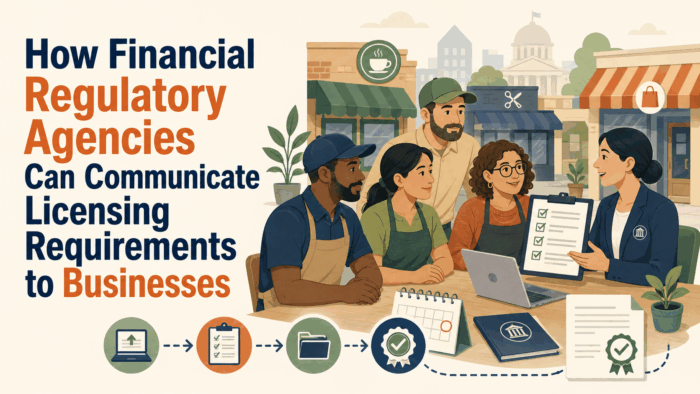
How Financial Regulatory Agencies Can Communicate Licensing Requirements to Businesses
A business that does not know it needs a license to operate legally is not deliberately evading regulation. It is a compliance failure waiting to happen, and one that is largely preventable through communication. Financial regulatory agencies that make licensing requirements clear, specific, and findable for the businesses subject to them reduce inadvertent unlicensed activity, improve compliance rates, and direct their limited enforcement resources toward the entities that are intentionally operating without licenses rather than those that are doing so through ignorance.
The communication challenge for business-facing licensing requirements is different from the challenge of consumer-facing licensing information in important ways. Business audiences have more capacity to handle regulatory complexity than general consumer audiences, but they also have more pressing day-to-day operational priorities that compete with regulatory compliance attention. A business that is focused on growing its customer base, managing its staff, and maintaining its technology infrastructure may not naturally prioritize identifying and meeting licensing requirements unless those requirements are communicated in ways that make their significance, their applicability, and their process clearly visible.
This article addresses how financial regulatory agencies can communicate licensing requirements to businesses in ways that improve compliance without requiring businesses to become regulatory experts. It covers how to organize licensing requirement communication around business activities rather than regulatory categories, how to explain application requirements clearly enough that applicants can prepare a complete submission, how to communicate about licensing timelines in ways that allow businesses to plan their operations, how to explain renewal and continuing education obligations, how to communicate about fees, and how to be clear about the consequences of operating without required licenses.
Organizing Licensing Information Around Business Activities
 The most common failure of business-facing licensing requirement communication is organizing the information around the regulatory agency’s internal categories rather than around the business activities that the categories apply to. An agency that organizes its licensing information by license type, with each type described in terms of the statutory authority it implements, requires businesses to first determine which license type applies to their activities before they can find the relevant requirements. Many businesses cannot make that determination without regulatory expertise they do not have.
A business-activity-based organization asks a different question: what are you trying to do? If you want to sell insurance, here are the licensing requirements that apply. If you want to originate mortgage loans, here are the requirements. If you want to operate a money transmission service, here are the requirements. If your business model combines elements of multiple regulated activities, here are the requirements that apply to each combination. This organization is immediately useful to a business that knows what it wants to do but does not know what regulatory requirements apply.
For financial services businesses that operate in multiple states, the licensing requirement communication should address multistate licensing considerations explicitly. A business that is planning to operate nationally should understand from the outset that each state has its own licensing requirements, that those requirements vary in ways that are not always intuitive, and that multistate licensing coordination resources, such as the NMLS for mortgage originators or the NAIC resources for insurance, exist to reduce the burden of navigating state-by-state requirements.
Frequently asked questions organized around the specific business models and activities that generate the most licensing inquiries are among the most efficient business licensing communication tools available. A FAQ that answers the questions that new applicants most commonly ask, in the order those questions most commonly arise, gives businesses a self-service resource that reduces the volume of pre-application inquiries the agency must handle and ensures that those who do ask questions are coming in with a baseline of understanding that makes the conversation more efficient.
Protecting the Public Interest: Communication Strategies for Financial Regulation, Insurance, and Consumer Protection Agencies
This article is part of our series on strategic communication for Financial Regulatory Agencies, State Insurance Departments, and Consumer Protection Agencies. To learn more and to see the parent article, which links to other content just like this, click the button below.
Application Requirements and Pre-Application Preparation
License application processes that result in high rates of incomplete or deficient submissions waste the agency’s processing resources and delay the licensing of applicants who would be fully qualified if they had submitted a complete application. The most efficient way to reduce incomplete applications is to communicate the application requirements clearly enough that applicants can prepare a complete submission before they file.
A complete application requirement guide should describe every piece of information and documentation required for the application, in the order it should be submitted, with a plain-language explanation of what each requirement is and why it is needed. For requirements that may be unfamiliar to applicants, such as surety bond requirements, state-specific financial statement formats, or background check submission processes, the guide should include enough detail that an applicant can complete the requirement without additional research.
Pre-application checklists that allow applicants to confirm they have each required element before submitting are a simple and highly effective tool for reducing incomplete submissions. A checklist that covers every application requirement and that asks applicants to confirm they have prepared each item before submitting significantly reduces the rate at which applications arrive without required elements. This reduction in incomplete applications improves both the applicant’s experience and the agency’s processing efficiency.
For applications that involve complex requirements, such as those requiring demonstration of financial solvency, completion of a background investigation, or submission of organizational documents that must meet specific technical requirements, providing applicants with examples or templates of compliant submissions gives them a concrete reference for what the agency is looking for. An example of a financial statement in the format the agency requires, or a sample background attestation that shows the required elements, prevents the most common compliance errors without requiring applicants to determine on their own what compliance looks like.
Pre-application consultations, in which agency staff are available to answer specific questions from prospective applicants about whether their business model requires a license and what the application process involves, are an investment in licensing communication that pays returns in higher-quality applications and fewer enforcement actions against businesses that might have complied if they had received clearer guidance. These consultations should be accessible through multiple channels, including email, phone, and in some contexts in-person meetings for applicants with complex situations.
Communicating Application Processing Timelines
Businesses that are planning to launch or expand financial services operations need to know how long the licensing process will take in order to plan their operations accordingly. A business that applies for a license expecting a four-week processing time and that receives its license ten weeks later has been materially harmed by inaccurate timeline communication, even if the license was ultimately approved. Accurate, honest communication about licensing timelines allows businesses to plan realistically and reduces the pressure on applicants and agency staff that unrealistic expectations create.
Processing time communication should distinguish between the agency’s target processing time for complete applications and the actual processing time that applicants can realistically expect based on current workloads. An agency that has a statutory target of thirty days for initial application review but that is currently reviewing applications in forty-five days should communicate the current processing time rather than the statutory target, because applicants will plan around actual expectations rather than statutory goals.
Timeline communication should also address the factors that can extend processing time, so that applicants understand what they can do to avoid unnecessary delays. Applications that are submitted during the agency’s peak licensing season may take longer to process than those submitted at other times of year. Applications that require additional information or documentation from the applicant after submission will take longer to process than complete applications. Applications for license types that require investigation before approval will take longer than those that can be processed based on the application documentation alone.
For businesses that need a license by a specific date in order to meet contractual obligations, launch a new product, or comply with another regulatory requirement, the agency should communicate clearly about whether expedited processing is available, what conditions apply, and what the realistic timeline for expedited processing is. An agency that offers expedited processing without being clear about the conditions and timelines creates expectations it may not be able to meet, which is worse for business applicants than not offering expedited processing at all.
Explaining Fees in Context
Licensing fees are a necessary element of regulatory administration, and they should be communicated clearly and in full before applicants begin the application process. An applicant who discovers unexpected fees midway through the application process, or at submission, has been given incomplete information that may affect their decision about whether to proceed and that adds friction to the licensing process unnecessarily.
The fee schedule for each license type should be clearly disclosed upfront, including initial application fees, annual renewal fees, any additional fees for supplemental licenses or endorsements, and any fees associated with regulatory processes such as fingerprinting or background investigations that are part of the licensing process. The total cost of obtaining and maintaining a license, presented as a clear annual and multi-year figure, gives applicants a complete financial picture that partial disclosure of application fees alone does not provide.
For businesses that are evaluating multiple regulatory jurisdictions as potential locations for their operations, comparative fee information can help inform that decision. While the regulatory agency has no control over other states’ fee structures, providing the fee context that allows businesses to understand how the state’s fees compare to those of neighboring states or similar jurisdictions serves the agency’s interest in maintaining a competitive regulatory environment.
Fee waivers or reductions that are available for small businesses, nonprofits, or other qualifying entities should be communicated as prominently as the standard fee schedule, so that qualifying applicants are aware of the reduction and can apply for it. An agency that maintains a fee waiver program that is underutilized because qualifying applicants do not know about it has a communication problem rather than a program design problem.
Renewal Requirements and Ongoing Compliance
Obtaining an initial license is only the beginning of the licensing relationship between the agency and the licensed entity. The ongoing compliance obligations of licensed businesses, including license renewal requirements, continuing education, financial reporting, and notification requirements for changes in business circumstances, must be communicated clearly and must reach licensees reliably.
License renewal communication should be sent well in advance of the renewal deadline, with enough lead time that businesses can complete any continuing education requirements and prepare renewal documentation without a last-minute scramble. The communication should clearly state the renewal deadline, list every requirement that must be met for renewal, describe the consequences of failing to renew before the deadline, and identify the process for reinstatement if a license lapses.
Changes in business circumstances that require notification to the agency, such as changes in ownership, key personnel, business location, or the activities the licensed entity engages in, should be communicated to licensees as a standing compliance obligation rather than only at the time of initial licensing. Many compliance violations related to unreported business changes occur because licensees were not aware that the change required notification, not because they were trying to conceal the change. Proactive communication about notification requirements, including through automated reminders when key renewal dates approach, significantly reduces inadvertent notification failures.
For license types that require continuing education, communication about the continuing education requirement should include not only the number of hours required but also guidance on how to find approved continuing education providers, what topics must be covered, how completion must be documented, and what happens if continuing education requirements are not met before the renewal deadline. Licensees who understand the full scope of the renewal process from the time they receive their initial license are better positioned to meet their ongoing obligations than those who discover renewal requirements only when the deadline is approaching.
Consequences of Operating Without Required Licenses
Clear communication about the consequences of operating without a required license serves both the businesses that are at risk of inadvertent non-compliance and the public interest in maintaining a well-licensed financial services market. Businesses that understand the specific consequences of unlicensed operation are more motivated to ensure they are properly licensed, and the certainty about consequences that clear communication provides is itself a compliance incentive.
The consequences of unlicensed operation that agency communication should describe include the regulatory consequences, such as cease and desist orders, civil monetary penalties, and referrals to law enforcement for criminal prosecution where applicable, and the civil consequences, such as the potential for contracts entered by an unlicensed entity to be voidable by consumers and the personal liability that may attach to the principals of an unlicensed entity in some jurisdictions.
For businesses that are uncertain whether their activities require a license, the most important communication is the direction to seek a regulatory determination before beginning the unlicensed activity rather than proceeding on the assumption that no license is required. An agency that provides a clear process for businesses to obtain a pre-operational determination of their licensing requirements gives those businesses an alternative to both inadvertent non-compliance and the uncertainty that may discourage otherwise compliant businesses from entering the market.
The agency’s enforcement policy for unlicensed activity should be communicated with enough specificity that businesses can understand what factors the agency considers in determining how to respond to unlicensed operation. An agency that distinguishes between businesses that were unaware of the licensing requirement and cooperated immediately upon notification, businesses that were aware of the requirement but delayed compliance, and businesses that deliberately evaded the requirement is communicating an enforcement approach that gives businesses context for the risk they are taking if they delay or avoid compliance.
Communicating Licensing Requirements for Specific Financial Activity Types
 Different categories of financial services activity generate distinct licensing requirements with their own specific characteristics. Business-facing licensing communication that addresses these specific activity types is more useful than generic licensing guidance that must be adapted by each business to determine what applies to them. The most commonly licensed financial activity types warrant dedicated communication that addresses the specific requirements, processes, and ongoing obligations of each.
Money transmission is a regulated activity that encompasses a wide range of businesses, from traditional money services businesses to modern payment platforms, digital asset exchangers, and peer-to-peer payment facilitators. Many businesses that engage in money transmission activities are unaware that those activities are regulated, either because they do not recognize their activity as money transmission or because they believe that federal registration as a money services business substitutes for state licensing when it does not. Business-facing licensing communication about money transmission should specifically address the types of activities that constitute money transmission under state law, the businesses that most commonly engage in those activities without realizing they require a license, and the distinction between state licensing and federal registration.
Mortgage loan origination requires registration under federal law as well as licensing under state law in most jurisdictions, creating a compliance obligation that spans multiple regulatory systems. Business-facing communication about mortgage originator licensing should address both the federal registration requirement through the Nationwide Multistate Licensing System and the additional state-specific requirements that may apply, including any state-specific background check, education, or financial requirements that exceed the federal baseline. Businesses that comply with the federal registration requirement but are unaware of additional state requirements are in violation of state law, and the state agency’s communication should proactively address this common compliance gap.
Consumer lending activities, including personal loans, installment loans, payday loans, and title loans, are regulated under state consumer credit statutes that vary significantly in their scope, their licensing requirements, and their rate and fee restrictions. A lender that operates in multiple states may face very different licensing requirements in each state for what appears to be a similar loan product. Business-facing communication about consumer lending licensing should address the most common sources of variation across state lending frameworks, flag the states with the most distinctive requirements, and direct multi-state lenders to resources for navigating the multistate licensing landscape.
Digital and Online Business Licensing Considerations
Businesses that operate primarily or exclusively through digital channels face licensing questions that physical businesses do not. A digital financial services platform may offer services to customers in dozens of states simultaneously, and the licensing requirements of each state where it has customers may apply to its operations. The assumption that digital services are not subject to state licensing requirements because they are accessed online rather than through a physical presence is a common misconception that can result in significant regulatory exposure for businesses that operate on that assumption.
Consumer-facing digital financial services are generally subject to the same state licensing requirements as comparable services provided through traditional channels. An online lender must comply with the lending licensing requirements of each state where it makes loans to consumers, regardless of whether it has a physical presence in that state. A digital insurance platform that provides personalized coverage recommendations to consumers in a state must comply with that state’s insurance licensing requirements, regardless of where the platform is headquartered or hosted.
Business-facing communication about digital financial services licensing should address the nexus standards that determine when a digital business has sufficient connection to a state to be subject to that state’s licensing requirements. These standards vary by state and by activity type, but the general principle that serving consumers in a state creates regulatory obligations in that state applies broadly. Businesses that offer financial services digitally without having conducted a systematic state-by-state licensing analysis are exposed to regulatory risk in every state where they have customers.
The technological infrastructure of digital financial services, including the use of application programming interfaces to integrate financial services into third-party platforms and the use of algorithmic decision-making in lending and insurance applications, creates specific licensing questions about who is the licensed entity in the regulatory sense and who must hold the required license. Business-facing communication about these technological licensing questions can help digital financial services businesses navigate compliance questions that may not be obviously addressed by traditional licensing frameworks designed for physical financial services providers.
Industry Associations as Licensing Communication Partners
Industry associations and trade groups that represent businesses subject to financial regulatory licensing requirements are valuable partners for licensing requirement communication. These associations have direct relationships with their member businesses, communication channels that those businesses actively use, and credibility with the business community that makes their compliance communications more likely to be read and acted on than communications from the regulatory agency alone.
Financial regulatory agencies that establish working relationships with the industry associations that represent their licensees can significantly extend the reach of their licensing requirement communication through those associations’ member communications. A licensing requirement update distributed through the regulatory agency’s channels may reach the compliance officers and regulatory affairs staff of larger companies but may not reach the principals of smaller businesses that are not actively monitoring regulatory agency communications. The same update distributed through an industry association newsletter may reach the owner of a smaller business who trusts and reads the association’s publications.
The regulatory agency’s relationship with industry associations should be reciprocal. The agency provides associations with timely, accurate information about licensing requirements and changes. The associations provide the agency with feedback about how licensing requirements are being understood and implemented in the market, about what aspects of licensing communication are causing confusion or creating compliance barriers, and about emerging business model innovations that may raise new licensing questions. This two-way information exchange improves both the quality of the agency’s licensing communication and its understanding of the compliance landscape it is regulating.
Agencies should be aware of the limitations of industry associations as licensing communication partners. Association membership is not universal, and businesses that are not association members will not receive association-distributed regulatory information. Smaller, newer, or more geographically dispersed businesses are less likely to be association members and more likely to be the ones that inadvertently operate without required licenses. Supplementing association-distributed communication with direct agency outreach that reaches the non-association-member business population is important for achieving comprehensive licensing communication coverage.
Communicating Licensing Requirements to Emerging and Startup Financial Businesses
New financial services businesses, including startups and companies entering new markets, face a specific licensing communication challenge: they may not know what questions to ask about licensing requirements, because they do not yet know enough about the regulatory landscape to know what they do not know. An agency that publishes clear licensing requirement communication assumes a baseline of regulatory awareness that startup businesses may not have.
Targeted licensing communication for new market entrants should begin with the foundational question that many new businesses have not thought to ask: does the financial service activity we are planning require any kind of regulatory license, registration, or approval? The answer to that question for most financial services activities is yes, but many startup businesses assume that unless they have specifically heard that their activity requires a license, it probably does not. Proactive communication that reaches startup businesses in the financial services space before they begin operations, through entrepreneurial support organizations, incubators, law firms that serve startups, and investor networks, can prevent the inadvertent unlicensed activity that results from this assumption.
Regulatory sandbox programs, through which new financial business models can operate under a limited regulatory framework while their licensing status is being assessed, are a communication tool as well as a regulatory tool. An agency that communicates clearly about its regulatory sandbox, including what types of businesses qualify, what the application process involves, what the limitations on sandbox operation are, and how sandbox participation transitions to full licensing, provides startup businesses with an alternative to choosing between potentially unlicensed operation and not launching at all while full licensing is being determined.
Strategic Communication Support for Financial and Insurance Regulators
 Business licensing communication is most effective when it helps businesses understand what they need to do before they begin the application process, not simply after they encounter a licensing problem. Businesses often need to determine which licenses apply to their specific activities, what documentation is required, how long the process may take, what fees they should expect, and what obligations continue after approval. Clear communication can reduce avoidable confusion while helping businesses move through the regulatory process with greater confidence.
Effective licensing communication is built around the way businesses actually operate rather than the internal structure of the agency. Activity-based guidance, application checklists, clear timelines, renewal reminders, fee explanations, and practical descriptions of compliance obligations can make regulatory requirements easier to understand and follow. Communication should also explain the consequences of non-compliance accurately and constructively, giving businesses a clear understanding of what is expected before enforcement becomes necessary.
Developing this type of communication system requires specialized expertise in audience research, plain-language communication, content strategy, process communication, information design, and communication evaluation. Many financial and insurance regulators choose to partner with external communication specialists such as Stegmeier Consulting Group (SCG) because these capabilities complement the agency’s regulatory expertise while providing the strategic communication knowledge needed to translate complex licensing requirements into practical guidance that supports voluntary compliance.
Working alongside financial and insurance regulatory agencies, SCG develops business licensing communication strategies that help regulated businesses understand and navigate their obligations. Support may include developing activity-based licensing guides, creating pre-application checklists, clarifying application requirements and expected timelines, explaining fees and renewal obligations, developing compliance reminder systems, communicating consequences of non-compliance, and establishing measurement frameworks that identify where businesses continue to encounter confusion or communication barriers.
Licensing communication must also remain current as requirements, fees, application processes, and regulatory priorities change. SCG helps agencies establish repeatable content review processes, governance practices, and performance measurement frameworks that keep business-facing information accurate and consistent across websites, applications, guides, email communications, outreach materials, and other channels used to communicate with regulated businesses.
The objective is to create a communication environment in which businesses can clearly understand what is required to operate legally, complete licensing processes with fewer avoidable obstacles, and remain aware of their ongoing compliance responsibilities. By strengthening business licensing communication, financial and insurance regulators can improve compliance while building a more transparent and productive relationship with the businesses they oversee.
Future Trends in Business Licensing Communication
The financial services landscape is changing rapidly, with new business models, new technologies, and new hybrid activities creating regulatory gray areas where the applicable licensing requirements are not always clear. Agencies that invest in proactive communication about how they apply licensing requirements to novel business models reduce inadvertent non-compliance and enable innovation within regulatory bounds. As the pace of financial services innovation accelerates, the capacity to communicate quickly and clearly about new regulatory interpretations will become an increasingly important component of effective regulatory agency communication.
Regulatory technology solutions for licensing application, renewal, and compliance monitoring are becoming more sophisticated and more accessible to smaller regulatory agencies. These solutions have the potential to significantly improve the experience of both businesses applying for licenses and agencies processing those applications. The communication of these technological improvements, including what changes businesses should expect in the application process and how to access new digital licensing tools, is an important component of their successful implementation.
Conclusion
Clear licensing communication helps create a regulatory relationship in which businesses understand what is expected of them before they encounter preventable compliance problems. When requirements are organized around actual business activities, timelines and fees are explained honestly, renewal obligations are easy to identify, and consequences are communicated clearly, businesses have a stronger foundation for making informed decisions and maintaining compliance.
The value of this approach extends beyond making applications easier to complete. Accessible licensing communication can reduce unnecessary administrative burden, support higher voluntary compliance, and allow agencies to focus enforcement resources on more serious or persistent violations. By treating communication as part of the regulatory infrastructure rather than simply as a way to announce requirements, agencies can create a system that helps responsible businesses comply while strengthening the effectiveness and credibility of regulation itself.
Stegmeier Consulting Group’s Strategic Approach to Communication Systems
Align your business licensing communication with the compliance facilitation your regulated market needs.
Financial regulatory agencies need business licensing communication that is organized around what businesses want to do, specific about how to apply and what to expect, honest about costs and timelines, and clear about the consequences of operating without required licenses. SCG helps agencies develop business licensing communication that facilitates compliance and strengthens the regulatory relationship with the market.
Use the form below to connect with our team and explore how clearer business licensing communication can improve compliance rates and reduce inadvertent unlicensed activity in your regulated market.