
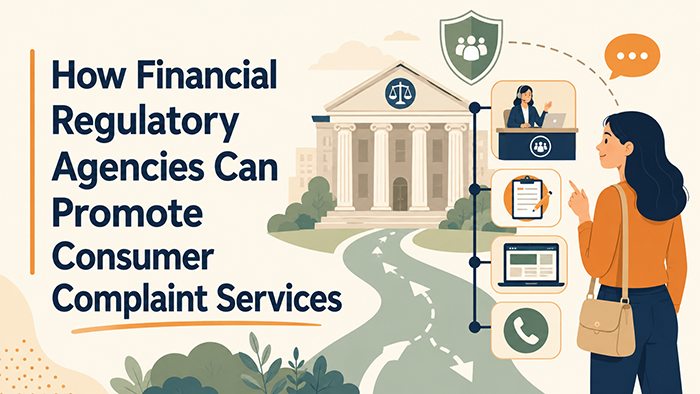
How Financial Regulatory Agencies Can Promote Consumer Complaint Services
A consumer who has been wronged by a financial institution, a lender, an insurer, or a financial professional and who does not know where to turn has failed twice. Once by the entity that harmed them. And again by a regulatory system that exists precisely to address such situations but that has not made itself visible or accessible enough to be useful. That second failure is a communication failure, and it is one that financial regulatory agencies have the power to prevent.
Consumer complaint services are among the most direct expressions of a financial regulatory agency’s public mission. They provide individual consumers with a mechanism for seeking resolution when financial products or services have not performed as promised, when rights have been violated, or when suspected fraud has occurred. They also provide the agency itself with a crucial source of market intelligence: complaint data reveals which entities are generating consumer harm, which practices are becoming problems, and where regulatory attention is most needed. A complaint program that is underutilized because consumers do not know it exists is a program that is failing on both dimensions simultaneously.
The underutilization of consumer complaint services is rarely the result of consumer indifference. Most consumers who have experienced significant financial harm want to do something about it. The problem is that they do not know the complaint option exists, cannot find it when they look, do not understand what the agency can do with their complaint, or conclude that the process is too complicated to be worth attempting. Each of these is a communication problem with a communication solution.
This article addresses how financial regulatory agencies can promote their consumer complaint services more effectively. It covers where complaint information should appear and how it should be presented, how to make complaint services findable through search, what outreach messages are most effective at reaching consumers before and during a dispute, how partner referrals can extend the reach of the complaint program, how to set realistic expectations about what the complaint process can and cannot accomplish, and how to explain clearly what happens after a complaint is submitted. The goal is a complaint program that functions at its full potential because consumers know it exists, can find it easily, understand what it does, and believe it is worth using.
Making the Complaint Service Visible Before Consumers Need It
 The most common approach to complaint service promotion is reactive: the information is available on the agency’s website for consumers who know to look for it. This approach reaches the consumers who already know the agency exists and who think of it when a problem arises. It does not reach the large and more typical population of consumers who have experienced financial harm, are not sure who to contact, and do not think to search for the specific agency that might be able to help.
Proactive promotion of the complaint service, meaning communication that reaches consumers before they have a specific problem, builds the awareness that makes the reactive approach effective when the moment arrives. A consumer who has seen the agency’s complaint service mentioned in a utility bill insert, in a social media post about consumer rights, or in a community organization’s newsletter is far more likely to think of the agency when a financial problem develops than one who has never encountered the agency’s consumer services at all.
Proactive promotion should appear in the contexts where consumers are already engaging with the financial products and services that generate complaints. Financial literacy materials. Homebuyer education programs. Small business resources. Insurance information distributed before hurricane and flood seasons. Community organization newsletters that serve populations with high rates of financial product use. Each of these contexts creates an opportunity to mention that the agency’s complaint service exists and to describe it briefly enough that consumers will remember it when they need it.
The consistent element of proactive promotion should be simple and memorable: the agency receives complaints about specific types of financial products or services, and consumers who have experienced a problem can submit a complaint by taking a specific simple action such as visiting a web address, calling a number, or scanning a QR code. That information, repeated across enough contexts over enough time, builds the awareness that makes the complaint program accessible to the full population it is designed to serve.
Protecting the Public Interest: Communication Strategies for Financial Regulation, Insurance, and Consumer Protection Agencies
This article is part of our series on strategic communication for Financial Regulatory Agencies, State Insurance Departments, and Consumer Protection Agencies. To learn more and to see the parent article, which links to other content just like this, click the button below.
Homepage Placement and Website Organization
The agency’s website is the primary tool through which consumers find and access the complaint service, and the placement of complaint information on the site significantly affects how many consumers can find and use it. A complaint portal buried several clicks deep in a section labeled by the agency’s internal organizational structure, such as Division of Consumer Affairs or Office of Regulatory Services, is not accessible to a consumer who does not know the agency’s structure and who is looking for help with a financial problem.
Consumer complaint access should be prominently placed on the agency’s home page and should use the language consumers use to describe their situation rather than the agency’s internal terminology. A homepage button or link labeled File a Complaint or Get Help With a Problem is more useful than one labeled Consumer Services Portal. A navigation menu that includes complaint options under a clear consumer-facing label, accessible without hovering over dropdown menus or navigating through organizational sections, reduces the friction between a consumer with a problem and the complaint system that could help them.
The agency’s website should also be organized around the tasks consumers are most likely to perform rather than around the agency’s internal structure. A consumer who visits the site with a specific need, such as filing a complaint, checking a company’s license, or understanding their rights, should be able to reach the relevant resource from the home page in one or two clicks, without needing to know which division or bureau handles that function internally. Task-based navigation, organized around what consumers need to do rather than how the agency is organized, is among the most impactful improvements available to agencies whose current sites are organized primarily for internal purposes.
For agencies that serve consumers with complaints about multiple product types, the home page should make clear which types of complaints the agency handles. A state insurance department’s complaint page should immediately tell consumers that it handles complaints about insurance companies, agents, and claims. A financial regulatory agency that handles bank and non-bank consumer complaints should make that distinction clear rather than leaving consumers to guess whether their particular situation falls within the agency’s jurisdiction. Clarity about scope reduces the volume of complaints submitted to the wrong agency and reduces consumer frustration from misdirected contacts.
Search Visibility and Digital Findability
Most consumers who are looking for help with a financial problem will start with a search engine, not by typing the agency’s web address directly. They will search for something like how to complain about my insurance company, what to do if my lender overcharged me, or where to report a financial scam. If the agency’s complaint service does not appear prominently in those search results, the consumer will find another resource, which may or may not connect them with the agency that can actually help.
Search engine visibility for consumer complaint services requires deliberate attention to the language that consumers use when they are searching for help. That language is different from the language agencies use to describe their own services. Consumers search for complain about, report a problem, get help with, dispute a charge, or appeal a denial rather than for consumer complaint portal or regulatory intake system. Agency complaint pages that are written in the language of the second group will not appear prominently in searches conducted using the language of the first group.
Improving search visibility requires that complaint page content include the specific language consumers use to describe their problems, organized around the types of situations consumers experience rather than around the agency’s categories for organizing complaints. A page that describes the complaint service in terms of the actual consumer situations it addresses, such as an insurer denied my claim, my lender charged fees I did not agree to, or I think I was sold a fraudulent investment, will appear in more relevant searches than a page that describes the service in administrative terms.
Search visibility also benefits from the technical dimensions of search engine optimization, including clear page titles that describe the complaint service in plain consumer language, appropriate use of descriptive headers throughout the complaint information pages, and the presence of a mobile-friendly design that functions well on the devices most likely to be used by consumers seeking help. Agencies that have not conducted a recent review of how their complaint service pages perform in consumer searches should do so, because the gap between what consumers search for and what the agency has described is often significant.
Local search visibility is a particular opportunity for agencies whose jurisdiction is geographically defined. A consumer who searches for insurance complaint help in their state should find the state insurance department prominently. Including the state name prominently in page titles and content, and ensuring that the agency’s Google Business or similar profiles are current and accurate, supports local search visibility that helps residents of the state find the agency when they need it.
Outreach Messages That Reach Consumers During Disputes
Many consumers who could benefit from filing a complaint with the regulatory agency do not do so because they are not aware of the option at the moment they most need it. They are in the middle of a dispute with a financial company. They may have already tried to resolve the issue directly with the company and been unsuccessful. They are frustrated, uncertain about their options, and looking for a path forward. This is the moment when an outreach message about the agency’s complaint service can be most effective.
Complaint Promotion in the Context of Financial Product Disputes
The most effective outreach messages for complaint services are those that appear at the moments when consumers are most likely to have or be developing a dispute with a financial company. Insurance policy documents typically include a complaint rights notice; agencies should ensure that the language of that notice is clear, specific, and prominent enough to be useful rather than buried in fine print. Billing statements, account closures, loan modification denial notices, and claim denial letters are all moments when a consumer may be experiencing a dispute and when a mention of the regulatory agency’s complaint service could be valuable.
Agencies can encourage or require regulated entities to include complaint service information in specific communications to consumers. A claim denial letter that includes a clear statement that the consumer may contact the state insurance department with questions or complaints, along with the department’s web address and phone number, reaches consumers at exactly the right moment. An agency that has not reviewed what information about its complaint service appears in regulated entity communications to consumers is missing one of the most effective promotion opportunities available to it.
Social media outreach about the complaint service can reach consumers who are already discussing financial disputes in public forums. A consumer who posts on social media about a problem with an insurance company, a bank, or a lender is a consumer who may not know that a regulatory agency could help them. Agencies that monitor relevant social media discussions and respond with information about the complaint service, when that response is appropriate and within the agency’s capacity, are using a low-cost channel to reach consumers at the moment they are seeking help.
Seasonal and Event-Based Outreach
Consumer complaint volumes are not uniform throughout the year. Insurance complaints spike after major weather events. Investment fraud complaints increase during market volatility. Mortgage-related complaints increase during periods of rising interest rates. Financial product complaints generally increase around the periods when annual fees, rate resets, or policy renewals take effect. Agencies that align their complaint service outreach with these predictable peaks in consumer need can reach consumers precisely when the outreach is most relevant.
Pre-disaster outreach, which informs consumers about the complaint service before the event that will generate insurance disputes, is among the most effective timing strategies available to insurance regulators. A consumer who has been told before a hurricane season that the state insurance department handles insurance complaints and how to contact them is prepared to use the complaint service when they need it. That preparation is far more effective than communication that reaches consumers for the first time when they are already in the middle of a disputed claim.
Back-to-school and tax seasons create predictable consumer financial decision moments that generate specific types of complaints. The period following major financial changes, such as interest rate increases or changes to consumer financial protection rules, may generate increased consumer confusion and dispute. Agencies that build a calendar of event-based and seasonal outreach moments into their communication planning can distribute complaint service promotion at the times when it is most likely to be useful.
Partner Referrals and the Extended Reach of Complaint Services
Financial regulatory agencies cannot reach every consumer who might benefit from their complaint services through their own direct communication channels. They need a referral network: organizations that are in regular contact with the consumers most likely to experience financial harm and that can direct those consumers to the agency’s complaint service when appropriate.
Legal aid organizations are among the most valuable referral partners for financial regulatory agencies because they serve clients who are actively dealing with financial problems, who often have the most serious disputes, and who may not know that a regulatory complaint channel exists alongside the legal options they are exploring. An agency that has a clear, well-documented referral protocol established with local legal aid organizations ensures that legal aid staff who encounter regulatory complaints can make efficient, accurate referrals rather than improvising or providing incomplete information.
Libraries, senior centers, community health centers, faith organizations, and consumer advocacy groups are all potential referral partners that can extend the agency’s reach to consumers who do not regularly engage with government agencies. These partners can distribute complaint service information through their own channels, display informational materials at their facilities, and refer clients to the agency when they present with relevant complaints. The investment in establishing these referral relationships, providing partners with accurate and current information about the complaint service, and maintaining those relationships over time is a high-return communication investment.
A referral network is only as effective as the information that referral partners have about the agency’s complaint service. Partners need to know specifically what types of complaints the agency handles, what the process looks like for consumers who submit complaints, what consumers can realistically expect, and how to reach the agency directly when they have questions about a specific referral. Providing partners with a simple, accurate referral guide that covers these elements, updated when the complaint process changes, is the foundational investment in referral network effectiveness.
Partner referrals generate a specific type of complaint that often has different characteristics from complaints submitted directly by consumers: referred complaints may be more complex, may involve consumers who have already tried other remedies, and may be accompanied by more documentation and more clearly articulated grievances. Ensuring that the complaint intake process can handle referred complaints effectively, including acknowledging the referral source appropriately and ensuring that referred consumers receive timely follow-up, maintains the referral relationship and demonstrates that the agency takes partner referrals seriously.
Setting Realistic Expectations About Complaint Outcomes
 One of the most important and most frequently neglected elements of complaint service promotion is honest communication about what the agency can and cannot do with a complaint. Consumers who submit complaints with unrealistic expectations about what will happen, and who then discover that the agency cannot provide individual legal advice, cannot order specific refunds, cannot guarantee specific outcomes, and may not be able to investigate every complaint individually, will experience the process as a disappointment regardless of what the agency actually accomplishes.
Setting realistic expectations is not the same as discouraging complaints. Realistic expectation-setting tells consumers the truth about what the complaint process does so that those who submit complaints do so with accurate information and those who might need a different type of assistance can be directed toward it from the outset. The agency that is honest about its limitations also builds more credibility when it explains what it can do, because consumers understand that the agency is not overpromising.
Common areas where consumer expectations frequently diverge from complaint process reality include the belief that filing a complaint will produce a direct, enforceable outcome for the individual consumer in a short timeframe; the expectation that the agency will be able to tell them whether they have a strong case or whether they should hire an attorney; and the assumption that every complaint will receive an individualized investigation and response. Clear, upfront communication about each of these areas reduces frustration and helps consumers make better decisions about whether and how to pursue their dispute.
The most effective approach to expectation-setting is to explain the complaint process as a series of steps with honest descriptions of what happens at each step and what the likely outcomes are. A consumer who understands that the agency will acknowledge their complaint, contact the company for a response, review the response for regulatory compliance, and take any warranted regulatory action, while also understanding that the specific resolution of their individual dispute may involve steps the consumer takes independently, has a complete and accurate picture that allows them to participate in the process appropriately.
Explaining What Happens After a Complaint Is Submitted
The period immediately after a complaint is submitted is when consumer confidence in the process is most fragile. The consumer has taken the step of submitting the complaint and is now waiting to hear what happens next. If they do not hear anything for days or weeks, or if what they hear does not match what they expected, they may conclude that their complaint has been lost, that the agency is not taking it seriously, or that the process is not working. Clear communication at this stage is essential for maintaining consumer trust in the complaint process.
Acknowledgment and Next Steps
Every complaint submission should be followed immediately or very quickly by an acknowledgment that tells the consumer their complaint has been received, provides a complaint reference number they can use for follow-up, describes the next steps in the process, and gives a realistic estimate of when they can expect to hear more. An acknowledgment that provides only a complaint number without describing what happens next leaves the consumer with a confirmation but not with the information they need to understand what to expect.
The acknowledgment should tell the consumer what the agency will do with their complaint at the next stage, which typically involves contacting the company that is the subject of the complaint and requesting a response. This explanation is important because it sets the expectation that the process involves the company before it may produce a resolution, which prevents the consumer from being surprised when they receive a call or a letter from the company as part of the complaint process.
The acknowledgment should also direct the consumer to information about the full complaint process, either on the agency’s website or in an enclosed document, so that they can read the complete explanation at their own pace and reference it as the process unfolds. A hyperlink to a clear, plain-language explanation of the complaint process in every acknowledgment communication is a low-cost way to ensure that every consumer who submits a complaint has access to accurate information about what will happen.
Case Updates and Resolution Notices
Complaint processes that provide no updates between acknowledgment and resolution leave consumers in the dark for potentially weeks or months, during which their frustration and uncertainty are likely to grow. Regular status updates, even brief ones that confirm the complaint is active and describe the current stage of the process, maintain consumer confidence and reduce the volume of follow-up contacts that staff must manage when consumers call or email to ask about their case status.
The resolution notice is the final communication in the complaint process and should be as informative as the initial acknowledgment. It should describe clearly what the agency found, what action was or was not taken, why, and what options the consumer has for further recourse if they are not satisfied with the outcome. A resolution notice that simply says the matter has been reviewed and closed without explaining what was found or why no action was taken leaves the consumer without the information they need to decide what to do next.
Resolution notices should always include information about additional options, even when the agency’s finding is that no regulatory violation occurred and no agency action is warranted. These options might include the consumer’s right to pursue a legal claim, referral to other agencies with different jurisdiction, information about mediation services, or contact information for consumer advocacy organizations. A consumer who receives a resolution that does not resolve their individual dispute but who is clearly directed to the next available option has been served better than one who receives a closed case with no path forward.
Measuring Complaint Promotion Effectiveness
Complaint service promotion is a communication investment, and like any investment it should be evaluated to determine whether it is producing the desired results. The most relevant measures for complaint service promotion are those that reflect the degree to which the promotion is making the complaint service more accessible and better understood, not simply measures of complaint volume.
Website analytics that show how consumers are finding the complaint service page, how long they spend on the page, whether they complete or abandon the complaint intake process, and which elements of the process description they engage with most provide useful information about how effectively the digital promotion is working. A high abandonment rate during complaint intake suggests that the process is more difficult or confusing than consumers expected, which may reflect a promotion communication failure as much as a process design problem.
Partner feedback about the usefulness and accuracy of referral materials, the frequency with which they refer consumers to the agency, and whether those referred consumers successfully complete the complaint process is a valuable measure of the referral network’s effectiveness. This feedback can identify which partners are most active in referrals, which materials are most useful, and what additional support the referral network needs.
Consumer satisfaction surveys administered after complaint resolution provide direct feedback on whether the communication about complaint outcomes and process met consumer expectations. Low satisfaction scores on clarity of explanation, timeliness of communication, or understanding of next steps point to specific communication improvements rather than to complaints about the outcome itself.
Accessibility of Complaint Services for Underserved Populations
Consumer complaint services are most needed by the consumers who face the greatest barriers to accessing them. Older adults who are less comfortable with digital interfaces. Non-English speakers who encounter complaint processes designed entirely in English. Rural residents whose only reliable communication channel may be the telephone. Low-income consumers whose first language is not the formal prose of regulatory notices. Each of these populations is more likely than average to experience financial harm and less likely than average to successfully navigate a complaint system that was not designed with their specific needs in mind.
Complaint service promotion for underserved populations requires deliberate attention to both the channels through which promotion is delivered and the format of the promotional materials themselves. A complaint service that is promoted primarily through digital channels will not reach consumers who are not digitally connected. A complaint service that is described only in English will not reach consumers whose primary language is Spanish, Vietnamese, Arabic, or any of the dozens of other languages spoken by financial consumers in many states. Promotion through the organizations that serve these populations, in formats that reflect those populations’ actual communication habits, is the most effective approach.
For older adults, complaint service promotion through senior centers, Medicare counseling programs, and organizations that serve retired populations can reach a group that is both disproportionately targeted by financial fraud and disproportionately underrepresented in complaint databases. For non-English speakers, promotion through ethnic community organizations, bilingual media, and faith communities that serve specific language groups can reach consumers whose barriers to complaint submission include not just awareness but language. For rural consumers, promotion through agricultural extension offices, rural credit unions, and community organizations that hold physical presence in rural areas can reach residents who are geographically distant from any agency office.
Accessibility of the complaint submission process itself is as important as accessibility of the promotion. A complaint intake process that is available only online will not serve consumers without reliable internet access. A process that requires documentation that not all consumers will have readily available will discourage legitimate complaints from consumers who lack those documents. A process that is available only in English will not serve non-English speakers. Agencies that have reviewed their complaint service promotion but not the accessibility of the complaint process itself may find that promotion improvements are partially offset by process barriers that reduce completion rates among the consumers who most need help.
Connecting Complaint Promotion to Consumer Financial Education
Complaint service promotion is most effective when it is part of a broader consumer financial education effort rather than a standalone communication. A consumer who understands their rights under their insurance policy is better positioned to recognize when those rights have been violated and to describe that violation accurately in a complaint. A consumer who understands the basic obligations of a licensed financial professional is better positioned to identify and report conduct that falls below the standard required. Financial education and complaint service promotion are mutually reinforcing investments.
Consumer education materials, whether produced by the agency directly or in partnership with community organizations, financial literacy programs, or educational institutions, are an appropriate vehicle for mention of the agency’s complaint service. A guide to understanding insurance policies that explains what to do if an insurer fails to honor a valid claim is more useful than one that explains the policy without addressing what the consumer can do when things go wrong. Including the complaint service reference in consumer education materials ensures that consumers who have learned their rights also know how to exercise them.
Financial education contexts that involve professionals, such as housing counselors, credit counselors, or insurance agents who are explaining products to clients, are also appropriate places to mention the agency’s complaint service. A housing counselor who mentions the state housing finance agency’s complaint service as part of explaining mortgage rights is extending the agency’s promotional reach in a highly credible and contextually appropriate way. Building these professional referral channels through education and outreach to the professional communities whose clients are the agency’s consumer constituency is a cost-effective promotion strategy.
The timing of educational outreach about complaint services should reflect the moments when consumer financial decisions are being made rather than only the moments when problems have already arisen. A consumer who is in the process of selecting an insurance policy, applying for a loan, or choosing a financial advisor is at a moment when learning about the regulatory oversight that applies to those products and the complaint channel available if problems arise is both relevant and memorable. Pre-transaction education about complaint rights and resources is more effective at building lasting awareness than post-problem outreach that reaches consumers after frustration has already set in.
Integrating Complaint Promotion Into Existing Agency Communications
Agencies that are building complaint service promotion capacity often focus on creating new, standalone communication efforts: a complaint awareness campaign, a new promotional brochure, a social media series. These efforts have value, but they frequently miss the highest-value promotion opportunity available: integrating complaint service mentions into communications the agency is already producing and that are already reaching relevant audiences.
Every enforcement announcement the agency publishes is a communication to consumers who have experienced or may experience harm from the type of conduct described. That announcement is an appropriate place to mention that consumers who have experienced similar conduct can file a complaint with the agency. Every consumer advisory the agency issues about a financial risk or a product problem is a communication that can include a mention of the complaint service as a resource. Every press release about a regulatory action is a potential consumer touchpoint that can include the complaint service contact.
Annual reports, legislative testimony, and public presentations are also opportunities to reinforce awareness of the complaint service with the audiences that attend those communications. Stakeholders, advocates, legislators, and community leaders who understand the complaint service well are more likely to refer consumers to it and to support the resources the agency needs to operate it effectively. The internal and external audiences for agency institutional communications are not the same as the consumer audiences for complaint service promotion, but they are audiences whose awareness and understanding of the complaint program affects how effectively that program reaches consumers.
Agency social media accounts, which are designed primarily for regular public engagement rather than for specific campaign communication, are among the most efficient vehicles for integrating complaint service promotion into ongoing communication. A brief regular cadence of posts that remind followers that the agency’s complaint service exists, that describe specific situations in which filing a complaint might be appropriate, and that provide the link or number for the complaint service keeps complaint awareness present in the information environment of consumers who follow the agency without requiring the development of standalone campaign materials.
Strategic Communication Support for Financial and Insurance Regulatory Agencies
 Promoting consumer complaint services requires more than adding a complaint form to an agency website or mentioning the service in public outreach materials. Effective communication helps consumers understand when they should file a complaint, what issues the agency can address, how the process works, and what they can expect after submitting a complaint. Clear, accessible communication encourages appropriate use of complaint services while strengthening public confidence in the agency’s consumer protection mission.
Successful complaint service communication systems are built through audience research, plain-language messaging, intuitive website navigation, partner outreach, expectation management, and ongoing evaluation. Consumers often seek assistance during stressful or confusing situations, making it essential for agencies to provide information that is easy to find, understand, and act upon. Coordinated communication across websites, call centers, community partners, and public education efforts helps ensure consumers receive consistent guidance regardless of how they first engage with the agency.
Developing this type of communication system requires specialized expertise in communication strategy, user experience, content design, stakeholder engagement, workflow development, and communication evaluation. Many financial regulatory agencies choose to partner with external communication specialists such as Stegmeier Consulting Group (SCG) because these capabilities complement the agency’s regulatory and consumer protection expertise while providing the strategic communication knowledge needed to build systems that improve public awareness, strengthen consumer confidence, and increase appropriate use of complaint services.
Working alongside financial regulatory agencies, SCG develops communication strategies that make complaint services easier for consumers to understand and access. Support may include evaluating website navigation and complaint pathways, developing plain-language complaint process materials, strengthening communication with referral partners, creating consumer expectation management resources, improving outreach strategies that increase awareness of complaint services, and implementing measurement systems that evaluate communication effectiveness and consumer engagement over time.
As consumer expectations, communication channels, and regulatory environments continue to evolve, complaint service communication must evolve alongside them. SCG helps agencies establish repeatable communication processes, governance practices, and performance measurement frameworks that enable complaint service communication to remain accurate, accessible, and responsive while supporting continuous improvement across consumer protection programs.
The objective is to create a communication environment in which consumers understand their rights, know when and how to seek assistance, and have confidence in the complaint process from beginning to end. By strengthening complaint service communication systems, financial regulatory agencies are better positioned to improve consumer access, build public trust, and enhance the effectiveness of their consumer protection mission.
Future Trends in Consumer Complaint Service Communication
The environment for consumer complaint service communication is evolving in ways that create both new opportunities and new challenges for financial regulatory agencies. Several trends are shaping how agencies will need to approach complaint promotion in the coming years.
Digital complaint channels are becoming the expectation rather than the exception for consumer engagement with government agencies. Consumers increasingly expect to be able to submit complaints online, receive status updates digitally, and communicate with the agency through channels that mirror their experience with commercial customer service. Agencies that have not invested in digital complaint experiences that are genuinely accessible and efficient on mobile devices are falling behind consumer expectations in ways that reduce complaint utilization.
The growing role of social media in consumer decision-making and dispute navigation creates both an opportunity and a responsibility for regulatory agencies. Consumers who are actively discussing financial disputes on social media platforms are consumers who might benefit from knowing about regulatory complaint channels. Agencies that are present on the platforms where those conversations happen, and that can provide helpful information at the right moment, are more effective at promoting complaint services than those that rely only on traditional outreach channels.
Artificial intelligence tools for complaint intake, including chatbot interfaces that can help consumers determine whether their complaint falls within the agency’s jurisdiction, what information they will need to submit, and what to expect from the process, are becoming more accessible to government agencies. These tools have significant potential to reduce the barriers to complaint submission for consumers who are uncertain about the process, if they are designed to be genuinely helpful rather than to redirect consumers away from the complaint system.
Conclusion
A consumer complaint service that is hard to find, difficult to understand, or unclear about what it can accomplish is a service that is not fulfilling its potential. Promoting consumer complaint services effectively is not a peripheral communication function. It is a core element of the regulatory agency’s public mission, because a complaint service that consumers cannot access provides neither the individual assistance nor the market intelligence that justifies its existence.
The investments described in this article, from homepage prominence to search visibility, from partner referral networks to realistic expectation-setting, from acknowledgment communication to resolution notices, are all achievable for agencies that are willing to prioritize them. None requires extraordinary resources. All require deliberate attention to how the complaint service is presented to the public and to whether that presentation is serving consumers or only the agency’s convenience.
Agencies that invest in making their complaint services accessible and understandable will find that the investment pays returns across multiple dimensions: more complaints from the consumers who most need help, better market intelligence about emerging harms, stronger public trust in the regulatory system, and a complaint program that functions at its full potential rather than reaching only the consumers who already know where to look.
Stegmeier Consulting Group’s Strategic Approach to Communication Systems
Align your agency’s consumer communication with the accessibility and clarity your mission requires.
Financial regulatory agencies and consumer protection offices need complaint service communication that reaches consumers before problems arise, guides them clearly through the complaint process, sets honest expectations about outcomes, and follows through with informative resolution communication. Building that system requires homepage visibility, search optimization, partner network development, and the consistent follow-through communication that maintains consumer confidence throughout the complaint process.
SCG helps financial and insurance regulatory agencies develop consumer communication systems that make regulatory services genuinely accessible to the people they are designed to protect. Whether your agency needs to improve a specific element of its complaint service communication or build a more comprehensive approach to consumer outreach and access, SCG can help you develop the strategy that serves consumers effectively.
Use the form below to connect with our team and explore how strategic consumer communication can help your agency fulfill its public protection mission more effectively.