
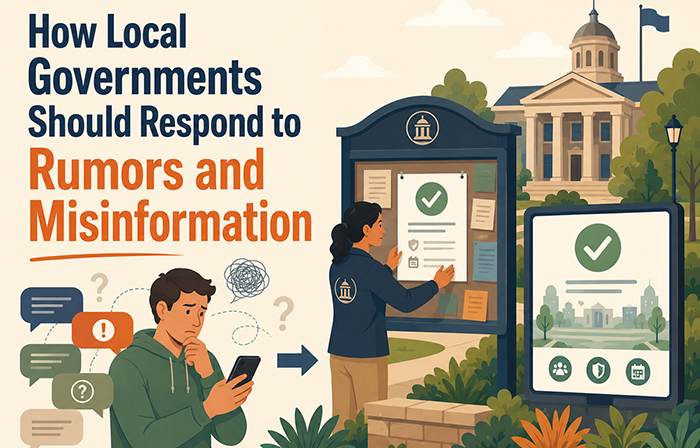
How Local Governments Should Respond to Rumors and Misinformation
Misinformation about local government travels quickly through small communities. A neighbor tells a neighbor that the road project was cancelled. A social media post claims the water rate increase was much larger than the governing board approved. A local business owner hears from a customer that a new ordinance will require all properties to connect to public sewer regardless of their existing well and septic systems. None of these things are true. All of them are circulating and being believed, and the people who believe them are making decisions, forming opinions, and sharing the information further based on what they heard.
The misinformation problem in local government is not new, but it has changed in character and velocity with the spread of social media and digital communication. What once traveled through word of mouth over days or weeks now spreads through neighborhood apps, community Facebook groups, and text message chains within hours. A screenshot of a partial document, presented without context. A misquotation of what was said at a board meeting. An interpretation of a proposal that was not actually adopted. A claim about what the agency plans to do that has no basis in any official communication. All of these can reach most of the community before the agency is even aware that misinformation is circulating.
This creates a specific communication challenge for small local governments: how to assess when a response is warranted, how to correct misinformation without inadvertently amplifying it, how to coordinate the response among staff and elected officials so that the correction is consistent across all channels, and how to maintain credibility as an accurate information source in an environment where inaccurate information may have gotten there first. These are not rhetorical questions. They require practical answers that small agencies can apply consistently, without specialized public relations expertise, in the course of their normal communication operations.
This article addresses how local governments should respond to rumors and misinformation in small and rural communities. It covers how to assess whether a rumor warrants a response, how to respond effectively when one is warranted, how to structure a factual correction that gives residents accurate information without creating additional confusion, how to coordinate staff and elected official responses, how to update official channels to prevent the continued spread of outdated information, and how to build the communication credibility that makes the agency’s corrections more trusted than the misinformation it is correcting. The goal is a practical, measured approach that neither overreacts to minor misinformation nor ignores significant inaccuracies that could lead residents to make harmful decisions or form significantly distorted views of their local government.
Assessing Whether a Response Is Warranted
 Not every rumor or piece of misinformation about local government requires an official response. Some inaccurate information is trivial, reaches few people, and will correct itself through normal community communication as more people encounter the accurate version through official channels. Responding to every inaccuracy, regardless of its significance or circulation, allocates limited communication resources inefficiently and may draw attention to misinformation that would otherwise fade without amplification.
The decision to respond should be guided by a simple risk assessment that considers three factors: how widely is the misinformation circulating, what is the likely harm if it is not corrected, and will a response be more effective than allowing the misinformation to correct itself. Each of these factors varies significantly across the range of misinformation that local governments encounter.
Circulation matters because misinformation that has reached a significant share of the community poses a different risk than misinformation confined to a small conversation. A rumor that several hundred residents have seen in a neighborhood Facebook group has the potential to influence community attitudes and resident behavior at a scale that warrants official response. A rumor that two neighbors discussed in a backyard conversation probably does not, unless one of those neighbors has the reach and credibility to amplify it significantly.
Potential harm matters because misinformation that could lead residents to take dangerous actions, fail to comply with important requirements, or form significantly distorted views of the agency requires correction regardless of its current circulation. A false claim that a boil water advisory has been lifted warrants immediate correction even if it has not yet spread widely, because the potential harm of residents using unsafe water is too serious to wait for wider circulation before responding. A false claim about meeting dates or locations warrants correction before residents who rely on that information miss an opportunity to participate. A false characterization of a policy that could lead residents to take or avoid regulatory action warrants correction before those actions occur.
Self-correction potential matters because some misinformation will be corrected by residents who know the accurate information, by continued accurate official communication that provides the context missing from the inaccurate account, or simply by the passage of time as the issue the misinformation concerned becomes resolved or less relevant. An agency that monitors misinformation and identifies situations where accurate information is already competing effectively with the inaccurate version may decide that an official response would add little value beyond what is already happening.
Engaged & Connected: Communication Strategies for Small Towns, Villages, Townships, and Rural Communities
This article is part of our series on strategic communication for Small Towns, Villages, Townships, and Rural Local Governments. To learn more and to see the parent article, which links to other content just like this, click the button below.
How to Frame an Effective Correction
When a response to misinformation is warranted, the correction must be designed to actually correct the inaccuracy rather than simply being noticed. A correction that does not give residents a reason to update what they believe, or that is buried in a general update without clearly connecting to the specific inaccuracy in circulation, is not an effective correction. Effective corrections are specific, direct, factual, and accessible to the residents who encountered the misinformation in the first place.
Name the Inaccuracy Specifically
An effective correction names the specific inaccuracy it is addressing rather than being a general defense of the agency’s record or a broad statement of accurate information that does not connect to what residents have actually been hearing. A correction that says the agency wants to clarify information about the proposed sewer extension project is less effective than one that says the agency has heard reports that the sewer extension project will require all properties to connect regardless of their current septic status, and that this is not accurate.
Naming the inaccuracy specifically gives residents the information they need to update what they believe. A resident who has heard that the sewer connection will be mandatory and who receives a general update about the project may not realize the general update is intended to correct the specific inaccuracy they encountered. A resident who receives a correction that directly addresses the mandatory connection claim will immediately recognize it as responsive to what they heard and will be able to update their understanding accordingly.
There is a common concern that naming an inaccuracy specifically will amplify it by giving it wider attention. In practice, for misinformation that is already circulating widely enough to warrant a response, the amplification concern is usually outweighed by the effectiveness benefit of specific identification. A correction that is specific enough for residents who encountered the misinformation to recognize it as relevant to what they heard is far more effective than one that is vague enough to avoid any risk of amplification but that residents who need the correction cannot connect to the misinformation they encountered.
Provide the Accurate Information Clearly
The most important element of a correction is the accurate information itself, stated clearly and specifically. The accurate information should be the primary content of the correction, not a secondary addendum to a lengthy rebuttal of the inaccuracy. A correction that spends three paragraphs explaining why the inaccuracy is wrong and one sentence providing the accurate information has its priorities reversed. Residents who read the correction need the accurate information far more than they need a detailed account of why the inaccuracy was wrong.
The accurate information should be stated in plain language without technical jargon or bureaucratic qualifications that make it harder to understand than the misinformation it is correcting. Misinformation is often effective precisely because it is simpler, more vivid, and easier to repeat than complex, nuanced, accurate information. A correction that matches the clarity and simplicity of the misinformation it is correcting has a better chance of replacing it in residents’ understanding than one that requires careful reading and interpretation.
The accurate information should include enough context to be self-contained. A correction that says the claim is inaccurate, with a reference to the full project description available on the agency’s website, is less effective than one that provides the accurate information directly, with a link to the full description for residents who want more detail. Residents who need the correction the most are often the ones least likely to follow a link to additional context.
Avoid Defensive or Adversarial Framing
Corrections that are framed defensively, as evidence that the agency is being unfairly attacked, or that characterize the misinformation as deliberately malicious rather than as an honest misunderstanding or an incomplete account, typically generate more conflict than they resolve. The agency’s credibility as a source of accurate information is not strengthened by demonstrating that it is upset by misinformation. It is strengthened by providing accurate information calmly, specifically, and without animosity toward the residents who may have believed and repeated an inaccurate account.
The tone of a correction should be informational rather than prosecutorial. The agency is not trying to embarrass the residents who repeated the misinformation. It is trying to give the full community access to accurate information. A correction framed as the agency wants to make sure everyone has the correct information about this project, as there has been some confusion circulating in the community, is more likely to be received as helpful than one that is framed in ways that imply the people who spread the misinformation were acting in bad faith.
Where to Publish the Correction
An effective correction must reach the residents who encountered the misinformation. If the misinformation spread primarily through a specific social media platform or community group, the correction should be published in that space, or should be designed specifically to be shared in that space. A correction published only on the agency’s website will not reach residents who encountered the misinformation through neighborhood apps or local social media groups if those residents are not in the habit of checking the agency’s website.
The agency’s own channels, including its website, social media accounts, and email newsletter, should carry the correction regardless of where the misinformation originated. These channels serve residents who are actively seeking accurate information from official sources, and they establish the correction as part of the official record. The website version of the correction should be the most comprehensive, with clear information about the specific inaccuracy being addressed and the accurate information in full detail. Social media posts should be concise, link to the website version, and be written for easy sharing so that residents who want to help correct the misinformation can do so by sharing the official post.
For misinformation that has spread through community organizations, partner organizations can be enlisted to help distribute the correction through the same channels that may have inadvertently spread the inaccurate information. A community group that shared or discussed an inaccurate claim may be willing to share the official correction if the agency reaches out directly and provides a clear, accessible version of the correction suitable for distribution through that channel. This approach requires the kind of partner relationship that effective rural communication depends on, and it is one of the most effective ways to reach residents who encountered the misinformation through informal community networks.
Coordinating Staff and Elected Official Responses
Misinformation that is significant enough to warrant an official correction is significant enough to warrant internal alignment before the correction goes out. Staff members who receive calls or messages from residents about the misinformation should all be working from the same accurate information and the same corrective framing. Elected officials who may be asked about the misinformation by constituents should have the accurate information and a clear understanding of what the official correction says before they communicate with the community.
The internal briefing for a misinformation response should cover: what the inaccuracy is, what the accurate information is, what the official correction says, where the correction will be published, and what staff and officials should say if asked about the situation before or after the correction is published. That briefing prevents the situation where different people speaking for the agency provide slightly different corrective information, which can itself become a source of confusion.
Elected officials who are asked about misinformation by constituents before the official correction is published should be prepared to refer to the forthcoming correction rather than attempting to improvise a response that may diverge from what the correction ultimately says. A brief response that says the agency is aware of the confusion circulating about this issue and is preparing accurate information that will be published shortly, and that directs the constituent to the agency’s official channels for the update, is both accurate and responsible while the correction is being finalized.
Updating Official Channels to Remove Ambiguity
Sometimes misinformation develops not from false claims but from ambiguous official information that residents have interpreted in different ways. An official document that is technically accurate but that leaves room for misinterpretation is a source of misinformation even without any deliberate distortion. When misinformation appears to be rooted in ambiguous official communication, the most effective response includes updating the original communication to remove the ambiguity, not only issuing a separate correction.
A project description that could be read as implying mandatory connection when the actual policy is voluntary, an agenda item title that could be read as indicating a final decision when the item is actually a preliminary discussion, or a notice that describes a geographic area in terms that are imprecise enough to be interpreted as broader than intended, are all examples of official communication that creates misinformation without any intermediary distortion. Correcting the misinterpretation without also correcting the original ambiguity leaves the source of the misinformation in place and risks generating the same confusion again.
When original communications are updated to remove ambiguity, the update should be noted clearly in the document: what was changed, when, and why. That notation maintains the integrity of the official record while allowing the corrected version to serve as an accurate source going forward. It also gives any resident who encountered the original ambiguous version a clear indication that the document has been updated if they return to it.
Building the Communication Credibility That Makes Corrections Effective
 The effectiveness of any individual correction depends significantly on the accumulated credibility of the agency as a source of accurate information. An agency that is known for communicating consistently, accurately, and completely will find that its corrections are trusted and acted on more readily than those of an agency whose communication has been unreliable or evasive. Building that credibility is a long-term investment that happens through every communication the agency produces, not only through how it handles misinformation when it arises.
Proactive communication that anticipates questions and provides context before misinformation has a chance to develop is the most effective misinformation prevention strategy. An agency that publishes a clear, plain-language explanation of a proposed project before the project is officially announced, that describes what the project will and will not require of residents, and that provides a contact for questions, gives residents accurate information early enough that the information environment is dominated by the accurate version rather than by speculation and rumor.
Consistency of communication over time builds the credibility that makes corrections effective. Residents who have learned through experience that the agency’s official communications are accurate and complete, that the agency corrects its own errors promptly when they occur, and that the agency does not use communication to manage perceptions rather than to inform, will be more likely to trust an official correction than residents who have experienced inconsistent or evasive official communication. The investment in consistent, honest communication is therefore also an investment in the agency’s ability to correct misinformation effectively when it arises.
Acknowledging the existence of misinformation without amplifying it is a communication skill that takes some practice to develop. A correction that reaches the right audience, uses the right channel, and is framed in a way that is informative rather than defensive can reduce the circulation of misinformation without significantly amplifying it. The key is making the correction accessible and easy to share while making it specific and factual enough that residents who share it are distributing accurate information rather than participating in a controversy.
Special Considerations for Misinformation From Official-Looking Sources
Some of the most damaging misinformation about local government comes from sources that appear official: documents that resemble government notices but that contain inaccurate information, social media accounts that use official-looking names or graphics but that are not managed by the government, or statements attributed to official figures that were not actually made. These sources create a specific credibility challenge because residents who encounter them may reasonably believe they are receiving official information.
For documents that appear to be official government materials but that contain inaccurate information, the correction should be specific about the difference between the inaccurate document and the official version. Making the official version clearly and easily accessible, with a visual design that is distinctly official and that residents can learn to recognize, helps over time to create a reliable standard against which unofficial documents can be compared. An agency that consistently uses distinctive and professional visual branding on its official materials gives residents a baseline for identifying what is and is not actually from the agency.
For social media accounts that use names or profiles that could be confused with the official agency, the correction should include a clear identification of the agency’s official accounts and should advise residents that only those accounts carry official government communication. This information should be included in the correction and should also be part of the standing information on the agency’s official website and communication materials so that residents have a standing reference for identifying official communication.
When Misinformation Persists After Correction
Some misinformation persists after official correction because the correction did not reach the residents who encountered the original misinformation, because those residents found the misinformation more credible than the correction, or because the misinformation serves a purpose in a community conflict that makes some residents reluctant to abandon it regardless of the correction. Understanding which of these situations is at play helps the agency decide whether additional corrective effort is warranted and what form it should take.
Persistent misinformation that reflects a genuine trust deficit between the agency and some community members may be more effectively addressed through engagement and relationship building than through additional corrections. If residents who continue to believe and repeat misinformation are residents who have had negative experiences with the agency, who do not trust official communication from that source, or who are engaged in a broader conflict with the agency over a policy or decision, addressing the underlying trust issues is likely to be more effective than producing additional versions of the same correction.
For significant misinformation that persists despite correction and that continues to affect community understanding of important government matters, enlisting trusted community intermediaries to carry the accurate information may be more effective than additional official corrections. A community leader, a trusted organization, or a respected longtime community member who is willing to publicly affirm the accurate information may reach residents who would not update their beliefs based on an official correction alone.
The Role of Proactive Communication in Misinformation Prevention
The most effective misinformation management strategy is proactive communication that fills the information vacuum before speculation and rumor can occupy it. Misinformation most often develops when residents have questions that official channels have not answered, when a decision or event has occurred without adequate explanation, or when official communication has been ambiguous enough to support multiple interpretations. Each of these conditions is addressable through deliberate communication practice.
A communication calendar that anticipates the questions residents will have at each stage of a project or decision, and that schedules communication to answer those questions before they generate speculation, is the most systematic proactive approach. An agency that publishes a plain-language explanation of a proposed project one week before the public hearing, rather than only posting the formal agenda, gives residents accurate information to work with before informal speculation can develop. An agency that communicates immediately when an unexpected development occurs, rather than waiting until it has a complete picture, prevents the information vacuum that rumors fill.
Monitoring community information channels, including local social media groups, neighborhood apps, and community organization networks, allows the agency to detect developing misinformation before it becomes widely established. An administrator who follows the local community Facebook group, or who has relationships with community leaders who can provide early warning of significant misinformation, can identify and respond to inaccurate information while it is still relatively limited in circulation rather than after it has become widespread.
Transparency about difficult or controversial matters is especially important for misinformation prevention, because controversy is the condition under which misinformation is most likely to develop and most difficult to correct. An agency that is open about a budget shortfall, an infrastructure failure, or any other situation that residents might view negatively, and that provides accurate information about the situation before speculation and rumor develop, is managing both its credibility and its misinformation risk simultaneously. The agency that avoids difficult communication because it fears the reaction often finds that the reaction to misinformation that develops in the absence of accurate information is considerably worse than the reaction to honest communication would have been.
Maintaining a Fact-Check Resource for Common Local Questions
Many of the rumors and misinformation claims that circulate in small communities are recurring misunderstandings about the same subjects: what the agency does and does not have authority over, what specific projects require of residents, how the governance process works, and how specific services are managed. Agencies that develop a standing fact-check resource or frequently asked questions document that addresses the most commonly misunderstood topics have a ready reference that can be distributed immediately when a relevant rumor surfaces.
The fact-check resource is most effective when it is already on the website in a clearly accessible location, so that residents who encounter misinformation and want to check it can do so without waiting for the agency to produce a response. A fact-check or FAQ section of the website that addresses the most commonly misunderstood aspects of agency operations, updated regularly to address new questions as they arise, serves both as a proactive information resource and as a standing corrective for recurring misinformation.
When a rumor surfaces that is addressed in the existing fact-check resource, the correction can simply direct residents to the relevant section of that resource rather than requiring a new, full-length corrective communication. That efficiency benefit is significant for small agencies with limited communication capacity: a correction that links to an already-existing, well-developed explanation saves time and effort while providing residents with a more complete and authoritative source than a brief social media post could contain.
Community Misinformation and the Election Environment
Local government misinformation takes on additional characteristics in election environments, where inaccurate claims about agency performance, fiscal management, and pending decisions can serve electoral purposes rather than originating from simple misunderstanding. Local government agencies must be especially careful during election periods to distinguish between factual corrections that are clearly within the agency’s communication responsibility, and electoral advocacy that would be inappropriate for an official agency. Correcting a false claim that a specific project failed to achieve its stated goals is appropriate official communication. Defending a specific official from political criticism, even when the criticism contains inaccuracies, is inappropriate advocacy from an official agency platform.
Staff members who are asked about political claims regarding the agency should be clear about their role as agency staff rather than as representatives of any elected official or political position. Providing accurate factual information about agency operations, referring to official documents and public records for verification, and directing residents to the agency’s official communication channels for authoritative information are all appropriate staff responses. Using agency time and resources for electoral purposes is not.
The most effective response to election-season misinformation is the same as the effective response to misinformation at any other time: consistent, factual, specific corrections through official channels, coordinated among staff and officials, and grounded in verifiable public record. The political context may create more urgency around some corrections and more caution around others, but the principles of effective corrective communication do not change based on the political calendar.
When Correction Is Not the Right Response
Not every claim that is inaccurate from the agency’s perspective warrants correction through official channels. Some claims reflect a legitimate difference in interpretation of ambiguous facts. Some reflect a genuine dispute about values or priorities that cannot be resolved by citing the facts. Some reflect deep community conflicts in which official corrections will be dismissed as self-serving regardless of how carefully they are crafted. Understanding when correction is unlikely to be effective, or when it risks escalating a situation that would be better managed through engagement and relationship building, is as important as understanding how to correct effectively.
A claim that the agency should have prioritized a different road for repair is not factual misinformation. It is a policy disagreement that correction cannot address. A claim that an official acted in bad faith on a specific decision is a characterization that may or may not be grounded in facts, but that a factual correction about the decision itself may not resolve if the underlying trust deficit is what is driving the claim. A rumor that has become a vehicle for expressing broader dissatisfaction with the agency may respond better to engagement that addresses the underlying dissatisfaction than to a correction that addresses only the factual inaccuracy.
Recognizing these situations requires the kind of community judgment that comes from genuine familiarity with the community’s concerns and communication patterns. The administrator or communication coordinator who knows the community well enough to distinguish between honest misunderstanding, motivated reasoning, and deep community conflict can make better decisions about when and how to respond to misinformation than one who applies the same corrective approach to every inaccurate claim regardless of its nature or origin.
Strategic Communication Support for Small and Rural Governments
 Managing misinformation effectively requires both reactive capacity, the ability to produce specific, timely, well-framed corrections when misinformation is significant enough to warrant them, and proactive habits that reduce the conditions in which misinformation develops and spreads. Both require communication discipline that is built through consistent practice rather than improvised in individual situations.
Outside support for misinformation response can help agencies develop the internal briefing processes that prevent staff and official responses from diverging, the correction templates that ensure key elements are not omitted under pressure, the channel strategies that reach the residents who most need the correction, and the credibility-building communication habits that make corrections more effective when they are needed. For agencies that have experienced significant misinformation challenges, that support can also help assess what communication gaps may have created the conditions for misinformation to develop and what proactive changes could reduce the frequency of those conditions in the future.
Stegmeier Consulting Group (SCG) helps small and rural governments develop the communication practices and systems that reduce the conditions under which misinformation develops, and that enable effective responses when misinformation does occur. That work includes proactive communication planning, misinformation assessment frameworks, correction template development, staff and official briefing protocols, partner network activation strategies, and the credibility-building communication habits that make official corrections more trusted than the misinformation they replace.
Future Trends in Local Government Misinformation Management
The misinformation environment for local government is likely to become more complex in the coming years, driven by the continued growth of social media as a primary community communication channel, the increasing sophistication of tools for creating official-looking documents and accounts, and the broader decline in trust in public institutions that makes residents more receptive to information that confirms their existing skepticism.
Platform changes on major social media sites are also affecting how misinformation spreads and how corrections reach community members. Algorithmic changes that prioritize content that generates emotional engagement can amplify misinformation that provokes strong reactions more effectively than corrections that are accurate but less emotionally compelling. Understanding how the specific platforms most used by the local community distribute information allows agencies to design corrections that are more likely to reach the residents who need them.
The growing availability of artificial intelligence tools for generating realistic-looking fake content creates new misinformation risks that local governments are not yet well-prepared to address. A fake meeting video, a generated document that looks official, or an AI-written social media post attributed to a local official could circulate widely before most residents can identify it as fabricated. Building the communication transparency and digital literacy habits that give residents tools for evaluating the credibility of what they see will become an increasingly important dimension of local government communication.
Conclusion
Misinformation about local government is inevitable in communities where residents care about decisions that affect them and where informal communication channels are faster than official ones. The question is not whether it will occur but how effectively the agency responds when it does, and how well the agency communicates proactively to reduce the conditions that allow misinformation to spread unchallenged.
The practices described in this article, from assessing whether a response is warranted, to framing corrections specifically and calmly, to coordinating internal alignment before responding, to updating original communications that created ambiguity, to building the sustained credibility that makes corrections effective, are all achievable for any small local government that treats communication as a professional responsibility rather than an afterthought to operations. Applied consistently, they produce a communication environment in which accurate information has a genuine competitive advantage over misinformation, and in which residents learn to turn to official channels for reliable information rather than treating official communication as one option among many of uncertain reliability.
Local governments that communicate well do not eliminate misinformation. They create the conditions in which misinformation is less likely to take root, less likely to spread widely, and more likely to be displaced by accurate information when it does occur. Those conditions are built through the same consistent, honest, complete communication that this article series has addressed throughout, and the investment they require is the same investment that makes effective local governance possible.
Stegmeier Consulting Group’s Strategic Approach to Communication Systems
Align your agency’s communication credibility with the transparency and consistency that makes corrections trusted.
Small and rural governments need both the reactive capacity to respond effectively to significant misinformation and the proactive communication habits that reduce the conditions in which misinformation develops. Building that capacity requires misinformation assessment frameworks, correction templates, staff and official briefing processes, partner network activation strategies, and the sustained credibility that makes official corrections more trusted than inaccurate alternatives.
SCG helps public agencies develop the communication practices that reduce misinformation risk and enable effective responses when misinformation does occur. Whether your agency is dealing with a specific significant misinformation challenge or building the proactive communication habits that reduce future risk, SCG can help you develop the approach that gives accurate information a genuine advantage in your community’s information environment.
Use the form below to connect with our team and explore how a strategic approach to communication credibility and misinformation response can help your agency maintain accurate public understanding and community trust through the communication challenges that every local government will eventually face.