
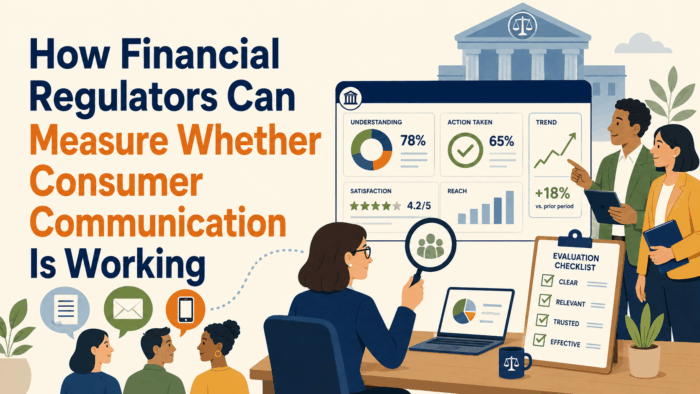
How Financial Regulators Can Measure Whether Consumer Communication Is Working
Financial regulatory agencies invest significant resources in consumer communication: staff time to produce enforcement announcements, consumer education materials, and complaint process information; budget for translations, website development, and community outreach; and organizational attention to the public-facing communication that represents the agency to the consumers it serves. Most agencies evaluate these investments through input metrics, counting how many materials were produced, how many outreach events were held, how many website pages were published. Very few evaluate them through outcome metrics that reflect whether the communication actually changed what consumers know, what consumers do, or what outcomes consumers experience as a result of the agency’s communication.
The gap between input measurement and outcome measurement in regulatory communication is a fundamental accountability failure. An agency that produces one hundred consumer education materials but cannot determine whether any consumer became better informed or better protected as a result has invested in communication without investing in the evidence that would allow it to know whether that communication was worth the investment. An agency that holds fifty community outreach events but cannot determine whether the consumers reached at those events were more likely to file complaints, recognize fraud, or exercise their rights than comparable consumers who were not reached, has no basis for deciding whether to continue, expand, or redesign its outreach program.
This article addresses how financial regulatory agencies can build measurement frameworks for consumer communication that go beyond input counting to assess whether communication is actually achieving the knowledge, behavior, and outcome changes it is designed to produce. It covers the different levels of measurement available for consumer communication, the specific metrics most useful for different communication goals, the data collection methods that produce reliable measurement without creating undue burden, how to use measurement to improve communication programs rather than just evaluate them, and how to report communication effectiveness honestly to leadership, legislators, and the public.
The agencies that measure consumer communication most effectively are those that have made measurement a design requirement rather than an afterthought. They build measurement capacity into communication programs when those programs are designed, defining what success looks like and how it will be assessed before the program is launched. They use the data collected to make specific, documented changes to the programs they measure, creating an improvement cycle that makes each iteration more effective than the last. And they report their measurements honestly, including the results that show programs need improvement alongside those that show programs are working, treating measurement as a tool for learning rather than a tool for self-promotion.
The Levels of Communication Effectiveness
 Consumer communication effectiveness operates at multiple levels, each of which requires different measurement approaches and provides different types of evidence. Understanding these levels and what can be measured at each is the foundation for designing a measurement framework that provides useful, actionable information about whether communication programs are achieving their goals.
The first level is reach: did the communication get to the intended consumers? A scam warning that was distributed to ten thousand households reached ten thousand households in terms of distribution, but reach measurement is more demanding than that: it requires evidence that consumers actually received and encountered the communication, not just that it was distributed. A household that received a mailed flyer but that discarded it unread has not been reached in the meaningful sense. Reach measurement at this demanding level requires asking whether consumers were exposed to the communication in a way that allowed them to receive its content.
The second level is awareness: did consumers who were reached by the communication become aware of the specific information it contained? A consumer who received and read a scam warning may or may not be aware of the specific fraud scheme the warning described, depending on whether they engaged with the content closely enough to retain the key information. Awareness measurement requires asking consumers whether they are aware of specific information that the communication contained, allowing comparison between those who received the communication and those who did not.
The third level is knowledge: do consumers who are aware of the communication’s content understand it well enough to apply it to their own situation? A consumer who is aware that the agency issued a warning about investment fraud may not know enough about what investment fraud looks like to recognize it when they encounter it. Knowledge measurement requires assessing whether consumers can apply the information in the communication to realistic situations, not just whether they know the communication exists or can recall its general topic.
The fourth level is behavior: did consumers who received the communication and who understood its content change their behavior in ways the communication was designed to produce? A fraud warning that informed consumers about a specific fraud scheme and that taught them to recognize its characteristics should produce increased complaint rates about that scheme from consumers who were reached and who subsequently encountered it. Behavior measurement is more demanding than awareness or knowledge measurement but provides the most direct evidence of whether the communication is actually changing what consumers do.
The fifth level is outcomes: did the behavior changes produced by the communication result in better outcomes for consumers and for the regulatory system? Consumers who reported a fraud scheme earlier because they recognized the warning signs may have recovered more of their losses, or the early reporting may have allowed the agency to intervene before more consumers were harmed. Outcome measurement is the most demanding but provides the most compelling evidence of the communication’s ultimate value.
Protecting the Public Interest: Communication Strategies for Financial Regulation, Insurance, and Consumer Protection Agencies
This article is part of our series on strategic communication for Financial Regulatory Agencies, State Insurance Departments, and Consumer Protection Agencies. To learn more and to see the parent article, which links to other content just like this, click the button below.
Metrics for Awareness and Knowledge Outcomes
Awareness and knowledge measurement requires asking consumers directly whether they know specific things. This can be done through surveys administered to populations who received a specific communication and comparable populations who did not, allowing the difference between the two groups to be attributed to the communication. It can be done through post-event surveys administered to attendees at community outreach events. It can be done through follow-up surveys with consumers who have used the agency’s complaint service or consumer education materials. Each of these approaches provides a different angle on the awareness and knowledge outcomes of specific communication programs.
Pre- and post-knowledge surveys are the most controlled method for assessing whether a specific communication produced the knowledge change it was designed to produce. Administering a brief survey before a consumer education event, and the same survey immediately after the event, allows the event’s organizers to assess how much the event changed consumer knowledge about the topics covered. The difference between pre- and post-event knowledge, measured through the same questions, provides specific evidence of what the event accomplished and where knowledge gaps remain after the event.
The specific knowledge items measured in awareness and knowledge surveys should reflect the most important consumer protective actions that the communication was designed to support. A fraud warning should be assessed for whether consumers can identify the warning signs it described. A consumer rights guide should be assessed for whether consumers know the specific rights it described and can recognize situations where those rights apply. A complaint process description should be assessed for whether consumers know how to file a complaint, what to expect from the process, and what information they need to submit. Measuring knowledge of the most protective content, rather than general awareness of the communication’s topic, provides the most actionable evidence of what the communication accomplished.
Population surveys that assess consumer knowledge about specific financial rights, fraud risks, and regulatory resources at the population level provide baseline data that allows the agency to assess whether its overall communication program is moving the needle on consumer financial literacy over time. An annual population survey that tracks what proportion of the agency’s service area population can correctly identify how to file a complaint with the agency, what the most common fraud types targeting the area are, and what specific rights consumers have in insurance and lending disputes, provides the longitudinal baseline data that makes it possible to assess whether the aggregate investment in consumer communication is producing population-level knowledge improvement.
Metrics for Behavior Change
Behavior change metrics measure whether consumers who received a communication took specific protective actions as a result. These metrics require connecting communication exposure to subsequent consumer behavior, which is more complex than measuring awareness or knowledge but provides more direct evidence of the communication’s protective value.
Complaint volume analysis, examining whether complaint rates for specific topics or from specific communities change following specific communication interventions, provides indirect evidence of behavior change at the population level. An agency that distributes a specific fraud warning about a new scheme and that sees increased complaint reports about that specific scheme in the weeks following the warning has indirect evidence that the warning motivated reporting behavior. This analysis requires careful attention to confounding factors, since complaint volume changes can reflect many things besides communication impact, but it provides a practical, low-cost behavior change indicator that is available from data the agency already collects.
License verification tool usage, measured through website analytics, can provide evidence of whether consumers who received consumer education about the importance of verifying licenses before doing business with a financial company are using the verification tool at higher rates. An agency that promoted license verification as part of a consumer protection campaign and that sees increased verification tool usage following the campaign has behavioral evidence that the campaign produced an intended behavior change. The challenge is attributing the usage change specifically to the campaign rather than to other factors, which requires comparison to baseline usage data and consideration of other potential causes.
Community-specific complaint rates, comparing complaint rates from communities that received targeted outreach to comparable communities that did not, provide a controlled comparison that can more confidently attribute complaint rate differences to the outreach. An agency that conducted intensive outreach to specific zip codes as part of a community outreach program can compare complaint rates from those zip codes to comparable zip codes that did not receive the outreach, controlling for demographic differences, to assess whether the outreach produced different levels of complaint behavior. This geographically controlled comparison is among the most rigorous behavior change assessments available for community outreach programs.
Partner organization tracking of the protective actions their clients took after receiving consumer financial protection information through the partner’s programs can provide behavior change evidence from the partner organization’s perspective. A credit counseling agency that refers clients to the regulatory agency’s complaint service and that follows up with those clients about whether they filed complaints provides behavior change data about the referral’s effectiveness that the agency cannot easily obtain from its own records. Building behavior change tracking into partner organization reporting requirements, with a simple, low-burden mechanism for partners to report on the actions their clients took after receiving outreach, creates a distributed behavior change measurement capability that extends the agency’s reach beyond its own data.
Digital Analytics as a Communication Measurement Tool
Digital analytics tools provide continuous, low-cost measurement of how consumers interact with the agency’s digital communication, including the website, email campaigns, and social media. These tools generate large volumes of data about consumer behavior in digital channels, but most of the data they generate reflects inputs rather than outcomes: page views, click rates, email open rates, and social media engagement metrics measure whether consumers encountered the digital communication but not whether that encounter produced awareness, knowledge, or behavior change.
Website analytics that are most useful for communication effectiveness assessment go beyond page view counting to analyze the actions consumers take on the site. Complaint submission rates, license verification completion rates, consumer education material download rates, and the completion rates for specific consumer actions that are facilitated by website content are all action-based metrics that are closer to behavior change than page view metrics alone. Tracking these action metrics, rather than only measuring how many visitors arrived at each page, provides evidence of whether the site’s consumer communication is actually motivating consumer action.
Email analytics that measure whether consumers who opened an email about a specific consumer protection topic subsequently visited the relevant section of the website, completed a specific action on the website, or filed a complaint, provide a more complete picture of the email’s effectiveness than open rates and click rates alone. This multi-step analytics analysis requires connecting email engagement data to website behavior data, which is technically feasible for agencies with appropriate analytics infrastructure. The result is a picture of whether the email communication produced the consumer action it was designed to motivate, not just whether consumers read it.
Social media analytics that measure reach and engagement at the surface level, including impressions, likes, shares, and comments, are the most commonly reported but least useful communication effectiveness metrics. These metrics tell the agency that content was distributed and that some proportion of the audience acknowledged it, but they do not indicate whether consumers understood the content, retained the information, or took any protective action as a result. More meaningful social media effectiveness measurement requires asking what behavior the social media post was designed to motivate and tracking whether that behavior occurred at higher rates among consumers who were exposed to the post.
A/B testing of digital communication content, including different framings of scam warnings, different calls to action for complaint filing, and different formats for consumer rights information, provides controlled evidence of which communication approaches produce better consumer engagement and action. Running two versions of an email campaign simultaneously and comparing the action rates of the two groups, or displaying two versions of a web page to different visitors and measuring which version produces more complaint submissions, converts digital analytics from a descriptive tool into an experimental tool that generates causal evidence about which communication choices work better.
Complaint Data as a Communication Effectiveness Indicator
Complaint data is among the richest sources of communication effectiveness evidence available to financial regulatory agencies, because it reflects consumer knowledge and behavior at a level of specificity that survey-based measurement cannot achieve. The types of complaints consumers file, the descriptions consumers provide of the conduct that generated their complaints, the timeliness of consumer complaint reporting relative to the events they describe, and the demographic characteristics of consumers who file complaints all provide information about the effectiveness of the agency’s consumer communication program.
Complaint quality, assessed by the completeness and specificity of the information consumers provide in their complaints, reflects whether consumers understood from the agency’s complaint process communication what information they needed to provide. A complaint that clearly describes the conduct at issue, provides the relevant documentation, and accurately identifies the regulated entity involved is a complaint that was submitted by a consumer who was well-prepared for the complaint process. A complaint that is vague, incomplete, and misdirected to the wrong agency reflects a consumer who was not well-served by the agency’s complaint process communication. Tracking complaint quality over time, and assessing whether improvements to complaint process communication produce improvements in complaint quality, connects communication improvement to a directly observable outcome.
Complaint demographics that show whether the population filing complaints reflects the demographic composition of the population most affected by the regulated conduct, or whether specific demographic groups are underrepresented, provide evidence of whether the agency’s consumer communication is reaching the populations most in need of the regulatory system’s protection. An agency whose complaint filers are disproportionately high-income, English-speaking, and digitally connected, relative to the demographic composition of the population experiencing the types of financial harm the agency addresses, has evidence that its consumer communication is failing to reach the populations most at risk.
Early reporting rates, measured by the lag between the conduct that generated the complaint and the date the complaint was filed, reflect whether consumers are aware of the complaint option and are using it promptly when they encounter a problem. An agency whose consumer communication program has emphasized that consumers should report suspected fraud as soon as it occurs should see a decrease in the average lag between the incident and the complaint report among consumers who were reached by the program. Tracking early reporting rates as a communication effectiveness indicator connects the agency’s communication investment to the timeliness of consumer reporting that benefits both individual consumers and the agency’s ability to investigate fraud and enforcement cases.
Building a Communication Measurement System
An effective communication measurement system is not a collection of ad hoc data collection efforts but an integrated framework that identifies the communication goals most important to the agency, the metrics most useful for assessing whether those goals are being achieved, the data collection methods that produce reliable metrics, and the processes for analyzing and acting on the resulting data. Building this system requires upfront investment in measurement design but produces ongoing returns in the evidence that allows the agency to allocate communication resources to the approaches that are most effective.
Goal definition is the first step in measurement system design. Communication goals should be specific, measurable, and connected to the consumer protection outcomes the agency is responsible for producing. Raising consumer awareness of common fraud types in the service area by a specific percentage is a specific, measurable communication goal. Improving consumer financial literacy is not. Increasing the proportion of consumers who know how to file a complaint by a specific percentage among specific demographic groups is a specific, measurable goal. Educating consumers about their rights is not. Specific, measurable goals allow specific, measurable assessments of whether the communication program is achieving them.
Data collection design, developed alongside the communication program rather than after it is launched, identifies what data will be collected, from whom, when, and through what mechanism. For a community outreach program, this might include pre- and post-event surveys of event attendees, follow-up surveys of attendees three months later to assess knowledge retention, complaint tracking for participants to assess behavior change, and partner organization reporting of actions taken by clients who received the outreach. Planning these data collection methods before the program launches ensures that the data needed for effectiveness assessment is actually collected, rather than realizing after the program has concluded that the evidence needed to assess it was not gathered.
Analysis protocols that specify how collected data will be analyzed and what comparisons will be made, developed alongside the data collection design, ensure that the data collected is used effectively rather than sitting in a spreadsheet without being turned into actionable insight. An analysis protocol that specifies the comparison between outreach recipients and a control group, the statistical test that will be used to assess whether observed differences are likely to be due to the outreach rather than to chance, and the threshold for concluding that a specific outcome change is attributable to the communication, gives the measurement effort the methodological structure needed to produce reliable conclusions.
Reporting structures that regularly present communication effectiveness data to agency leadership, communication staff, and partner organizations create the organizational attention to measurement that sustains the effort to collect and use it. A monthly communication effectiveness dashboard that presents key metrics from each major communication program, a quarterly review meeting where communication staff discuss what the data reveals and what changes are being made in response, and an annual communication effectiveness report that summarizes what was learned from measurement across all major programs, build measurement into the agency’s operational rhythm rather than treating it as an occasional research project.
Using Measurement to Improve Communication Programs
 Measurement is most valuable not as an evaluation of past performance but as a feedback mechanism for improving future performance. An agency that collects communication effectiveness data but uses it only to assess what happened, without making specific, documented changes to its communication programs in response, is investing in measurement without using the most important return that measurement can generate: the improvement cycle that makes each iteration of a communication program more effective than the last.
Documenting the changes made in response to measurement findings, and the reasoning behind those changes, creates an organizational record of the agency’s communication learning over time that is valuable beyond its immediate application. An agency that has documented the specific changes it made to its fraud warning format after measurement revealed that the prior format was not producing recognition of the specific warning signs it described, and that can show what improvement in consumer recognition followed the format change, has evidence of a complete improvement cycle that demonstrates the value of the measurement investment.
Testing new communication approaches before full-scale deployment, using small-scale pilots with measurement built in from the start, allows the agency to assess what works before investing in broad distribution. A pilot program that tests a new community outreach model with a small number of partner organizations, measuring awareness and behavior change among clients reached through the pilot, provides evidence of the model’s effectiveness before the agency commits to replicating it at scale. Pilot measurement that reveals significant effectiveness allows confident scale-up; pilot measurement that reveals problems allows redesign before scale-up wastes resources on an approach that does not work.
Sharing measurement findings with partner organizations creates a collaborative improvement cycle that benefits both the agency and its partners. A partner organization that receives feedback on the effectiveness of the outreach it delivered using the agency’s toolkit, including what the measurement showed about consumer awareness and behavior change among its clients, can use that feedback to improve its own outreach practice. An agency that shares measurement findings with the full partner network, including findings that reveal toolkit content or delivery approaches that are not working as intended, creates a learning community among partner organizations that improves the whole network’s outreach effectiveness rather than only the agency’s own programs.
Honest Reporting of Communication Effectiveness
Communication effectiveness measurement is only as valuable as the honesty of the reporting it produces. An agency that measures its communication programs carefully but reports only the results that show the programs working well, while omitting the results that show programs falling short of their goals, is not using measurement as a genuine improvement tool. It is using measurement selectively to support the conclusion it preferred before measuring. That selective reporting undermines the credibility of the measurement program and prevents the organization from learning from the areas where improvement is most needed.
Honest reporting of communication effectiveness includes describing what was measured and how, what was found, what the findings imply for the program’s effectiveness, and what changes are being made in response. A communication effectiveness report that describes a program that fell short of its awareness goals, that explains what the measurement revealed about why the shortfall occurred, and that describes the specific changes being made to address it, demonstrates the kind of honest institutional learning that builds credibility with oversight bodies and advocates who are assessing whether the agency’s consumer communication investment is worthwhile.
Acknowledging measurement limitations is also part of honest reporting. Communication effectiveness measurement is inherently imperfect: control groups are rarely perfect, confounding factors are difficult to fully account for, and the causal link between communication and outcome is often probabilistic rather than certain. A measurement report that acknowledges these limitations, describes how the measurement design attempted to address them, and characterizes the findings with appropriate confidence rather than false certainty, is more credible than one that presents measurements as if they were definitive proof. Appropriate epistemic humility about what measurement can and cannot establish does not undermine the value of measurement; it demonstrates the intellectual integrity that makes the measurement findings trustworthy.
Comparative reporting that presents the agency’s communication effectiveness findings alongside comparable benchmarks, whether from prior years, from peer agencies in other states, or from published research on consumer communication effectiveness, gives leadership and oversight bodies the context they need to assess whether the agency’s communication program is performing well or poorly. An agency that finds that forty percent of consumers in its service area can correctly identify how to file a complaint is reporting a finding that means very little without knowing whether that is high or low relative to comparable agencies, to prior years’ baselines, or to the goal the agency set for that measure. Building benchmarking into the communication effectiveness reporting practice provides the context that makes measurements meaningful.
Designing Measurement Into Communication Programs From the Start
The most common failure in communication program measurement is treating measurement as a retrospective evaluation that is conducted after the program has run rather than as a design requirement that shapes how the program is structured from the outset. A communication program that was not designed with measurement in mind will not have the data collection mechanisms, the comparison groups, or the baseline data needed to assess its effectiveness after the fact. Retrofitting measurement onto a completed program produces weak evidence at best and no usable evidence at worst.
Measurement design should begin when program design begins, as a parallel track that ensures the program will produce the evidence needed to evaluate it alongside the consumer protection outcomes it is designed to produce. When the agency decides to launch a community outreach program on mortgage fraud, measurement design should identify what consumer knowledge and behavior change the program is expected to produce, what data will be collected to assess whether those changes occurred, from whom and when the data will be collected, what comparison will be made between participants and non-participants, and who will be responsible for conducting the analysis and reporting the findings.
Baseline data collection, conducted before the communication program launches, provides the reference point against which post-program data can be compared to identify change attributable to the program. A community outreach program on mortgage fraud for which the agency collects baseline consumer awareness data before the program and awareness data after the program can attribute the difference between the two data points to the program, controlling for other factors. Without baseline data, any post-program awareness measurement is an absolute level rather than a change measure, which cannot be attributed to the program.
Random or structured assignment of communities, partner organizations, or consumer populations to program and comparison conditions, when feasible, allows the strongest possible causal inference about program effectiveness. A community outreach program that is delivered to ten randomly selected communities from a pool of twenty eligible communities, with the other ten serving as a comparison group, allows the agency to compare outcomes between program and comparison communities and to attribute observed differences to the program with substantially more confidence than a comparison between communities that self-selected into the program and those that did not. Random assignment is not always feasible in regulatory program contexts, but structured comparison designs that approximate it through matching or stratification can produce useful evidence even without pure randomization.
Integrating measurement reporting into program management, rather than treating it as a separate research function, creates the organizational accountability for measurement that keeps it from being deprioritized when operational demands compete for attention. A program manager who reports quarterly on program reach, awareness outcomes, and behavior change, alongside operational metrics like events held and materials distributed, is managing a program that is accountable for its outcomes. A program manager who reports only on operational metrics is managing a program that is accountable only for its activities.
Partner Organization Feedback as a Measurement Input
Partner organizations that deliver consumer financial protection outreach on behalf of the agency have direct experience with whether the communication programs they are implementing are working for their clients. Their frontline observations, collected systematically, provide qualitative measurement evidence that quantitative data collection alone cannot generate. A partner organization staff member who observes that clients consistently ask questions about aspects of a consumer rights guide that suggest they did not understand the guide’s central points is providing measurement evidence about that material’s effectiveness that no analytics tool can replicate.
Structured partner feedback protocols that collect specific, comparable information from partner organizations about the consumer response to the outreach they delivered produce measurement data that is more systematic and more comparable across partners than informal anecdotal feedback. A monthly partner feedback form that asks how many clients received specific information, how many asked follow-up questions about specific topics, how many were referred to the agency as a result, and what the most common client misconceptions or gaps in understanding were, produces a data set from which patterns of communication effectiveness and failure can be identified across the full partner network.
Partner observations about the cultural and linguistic appropriateness of materials in their specific community context are a form of measurement evidence that is particularly valuable for multilingual and community-specific communication programs. A partner organization serving a specific immigrant community who reports that clients are not engaging with translated materials because the translation uses vocabulary that is not used in the specific dialect or regional variety spoken in that community is providing measurement evidence that should trigger material revision. This community-specific measurement evidence cannot be gathered through population-level surveys and requires the trusted frontline relationships that partner organizations have with their clients.
Follow-up with consumers who were referred to the agency through partner organizations provides a direct link between partner outreach and agency service use that connects the outreach investment to the regulatory outcomes it is designed to enable. An agency that tracks whether consumers referred by partner organizations follow through on contacting the agency, what complaints they filed, and how those complaints were resolved, can assess the full chain from outreach to consumer protection outcome that demonstrates the value of the partner outreach investment. This tracking requires coordination between partner organizations and the agency’s complaint management systems, which presents technical and privacy challenges but produces the most complete picture of outreach effectiveness available.
Cost-Effectiveness Analysis of Communication Programs
Communication effectiveness measurement produces evidence about what outcomes communication programs achieve. Cost-effectiveness analysis uses that evidence to assess what those outcomes cost to produce, allowing comparison of the cost-effectiveness of different programs and informing decisions about where to allocate limited communication resources for maximum consumer protection impact. An agency that can show that its community outreach program produces a certain number of informed consumers per dollar invested, and that its social media campaign produces a different number at a different cost, has the comparative data needed to allocate resources to the approaches that produce the most consumer protection per dollar.
Cost measurement for communication programs should include not just direct financial costs but also the staff time invested, the partner organization capacity consumed, and any other resources that the program uses. A community outreach program that appears inexpensive in direct financial costs but that requires substantial agency staff time for partner training, materials development, and relationship maintenance may actually be more resource-intensive than a digital communication program that has higher direct financial costs but lower staff time requirements. Fully-loaded cost measurement, including all resource categories, provides more accurate comparisons than measurement of direct financial costs alone.
Per-unit cost metrics, such as the cost per consumer reached, the cost per complaint generated, or the cost per consumer who demonstrates awareness of a specific fraud risk, allow direct comparison of the cost-effectiveness of different communication approaches. An agency that knows its community outreach program costs a certain amount per consumer reached and its social media campaign costs a different amount per consumer reached can use this comparison, in combination with evidence about the quality of awareness produced by each approach, to make informed decisions about the allocation of its communication budget between the two approaches.
Return on investment analysis for consumer communication programs, estimating the consumer protection value of the behavior change and outcomes produced by the program relative to the cost of producing it, represents the most sophisticated level of communication cost-effectiveness analysis. This analysis requires estimates of the value of the consumer protection outcomes produced, which involves difficult assumptions about how to quantify the value of fraud prevented, rights exercised, or informed financial decisions made. Despite these methodological challenges, even rough return on investment estimates can be valuable for demonstrating to legislative and oversight audiences that consumer communication investment produces demonstrable consumer protection value relative to its cost.
Communicating Measurement Findings to External Audiences
Communication effectiveness measurement findings are most valuable when they are communicated to the audiences who can act on them: agency leadership who makes resource allocation decisions, legislators who approve agency budgets, advocates who monitor whether the agency’s communication programs are reaching vulnerable populations, and partner organizations who deliver outreach programs and can use effectiveness evidence to improve their own practice. Each of these audiences has different information needs and different capacities for engaging with technical measurement findings.
Legislative communication about communication effectiveness should be organized around the question legislators are most likely to ask: is the agency’s consumer communication investment producing results that justify the expenditure? A legislative communication that presents specific, understandable evidence that communication programs are changing consumer knowledge and behavior, describes the consumer protection outcomes associated with those changes, and compares the cost of achieving those outcomes to what they would cost if they were not achieved through prevention but instead through remediation after harm occurred, makes the most compelling case for sustained communication investment.
Advocate communication about communication effectiveness should be transparent about both what the measurement shows the programs are achieving and where the programs are falling short. Advocates who monitor equity in regulatory programs are particularly interested in evidence about whether communication programs are reaching the populations most at risk. An agency that shares measurement evidence showing that its outreach is reaching lower-income and minority communities at equivalent rates to higher-income and white communities, or that candidly shares evidence that specific communities are underrepresented in its outreach reach and describes what it is doing about the gap, is demonstrating the kind of transparent accountability that builds trust with advocacy communities.
Public communication about communication effectiveness, in the agency’s annual reports, on its website, and in its general public-facing communication, demonstrates accountability to the public the agency serves. A brief annual communication effectiveness summary, accessible to a general public audience, that describes what the agency’s consumer communication programs are designed to accomplish and what the measurement evidence shows about whether they are accomplishing it, is a transparency practice that builds public trust in the agency’s investment in consumer protection communication.
Building Measurement Capacity Over Time
Few financial regulatory agencies have the full measurement capacity they need to rigorously assess all of their consumer communication programs simultaneously. Building measurement capacity is a staged process that begins with the most feasible measurements and expands to more sophisticated assessments as the agency develops the data infrastructure, staff skills, and institutional practices that more rigorous measurement requires. Starting with imperfect but useful measurements that can be implemented immediately is better than waiting for perfect measurement capacity that may never arrive.
A measurement maturity model for consumer communication can guide the staged development of measurement capacity. At the most basic level, agencies measure inputs: how many materials were produced, how many events were held, how many consumers were reached. At an intermediate level, agencies measure outputs: complaint volumes, website action completion rates, and partner-reported client referrals. At an advanced level, agencies measure outcomes: consumer knowledge and awareness change, behavior change, and the ultimate consumer protection outcomes that communication programs are designed to produce. Moving from the basic level to the intermediate level is achievable for most agencies with modest investment. Moving to the advanced level requires more substantial investment in survey capacity, data integration, and analytical capability.
Staff development in communication measurement, including training in survey design, data analysis, and evidence-based program management, builds the internal capacity that reduces the agency’s dependence on external consultants for every measurement effort. An agency with staff who can design a basic pre-post survey, conduct an analysis of complaint volume changes following a communication intervention, and interpret web analytics to identify consumer behavior patterns, has measurement capacity that can be applied continuously rather than only when budget allows an external evaluation. Building this capacity through hiring, professional development, and peer learning among communication staff is an investment that pays returns across all of the agency’s communication measurement efforts.
Technology infrastructure for communication measurement, including integrated data systems that can connect consumer outreach records to complaint data, web analytics tools that measure consumer actions rather than only page views, and survey platforms that allow efficient data collection from consumer audiences, represents the technical foundation for sophisticated measurement. Many of the technologies needed for effective communication measurement are available at low or no cost through government software agreements, open-source tools, or the standard platforms that agencies already use for other purposes. A technology audit that assesses what measurement-relevant data is already being collected in existing agency systems, and what connections between systems would enable more powerful analysis, often reveals measurement capacity that already exists but is not being used.
Strategic Communication Support for Financial and Insurance Regulators
 Measuring consumer communication effectiveness gives financial and insurance regulators the information they need to understand whether their communication investments are actually helping consumers. Reach, website traffic, email engagement, and other activity measures can show whether information was distributed, but they do not necessarily demonstrate whether consumers understood it, trusted it, or took the intended action. A meaningful measurement approach connects communication activity to changes in consumer knowledge, behavior, service access, or other outcomes that reflect the agency’s consumer protection goals.
Effective communication measurement combines clear objectives, realistic performance indicators, practical data collection methods, and regular opportunities to apply what the data reveals. Depending on the communication initiative, agencies may use surveys, interviews, website analytics, referral data, complaint patterns, service utilization data, partner feedback, or other qualitative and quantitative methods. Establishing multiple levels of measurement helps agencies distinguish between communication that reached an audience and communication that actually influenced understanding or behavior.
Developing this type of measurement system requires specialized expertise in communication evaluation, audience research, data interpretation, performance measurement, behavioral outcomes, and continuous improvement. Many financial and insurance regulators choose to partner with external communication specialists such as Stegmeier Consulting Group (SCG) because these capabilities complement the agency’s regulatory and consumer protection expertise while providing the measurement and communication strategy knowledge needed to evaluate effectiveness beyond basic activity statistics.
Working alongside financial and insurance regulatory agencies, SCG develops measurement frameworks that connect communication objectives with meaningful indicators of success. Support may include defining communication goals and outcome measures, developing survey and feedback instruments, establishing website and channel analytics approaches, designing partner and stakeholder feedback processes, creating communication performance dashboards or reporting structures, and developing review cycles that turn measurement findings into specific improvements to messaging, channels, content, and outreach strategies.
Measurement systems also need to be practical enough for agencies to maintain consistently. SCG helps agencies identify the information that can realistically be collected with existing resources, establish repeatable reporting processes, and prioritize metrics that provide useful insight rather than creating unnecessary data collection burdens. Over time, this creates a continuous improvement cycle in which communication performance informs future planning, resource allocation, audience targeting, and program design.
The objective is to create a communication function that agencies can manage based on evidence rather than assumptions. By understanding who communication reaches, what audiences understand, how they respond, and where barriers remain, financial and insurance regulators can make more informed communication investments and demonstrate how those investments contribute to broader consumer protection outcomes.
Future Trends in Communication Effectiveness Measurement
Data infrastructure investment at regulatory agencies is increasing the availability of the consumer-level data that makes sophisticated communication effectiveness measurement possible. Agencies that are building integrated data systems that can connect consumer outreach records, website interactions, complaint filings, and consumer outcome data will have significantly greater measurement capacity than those relying on siloed data systems that cannot be connected for analysis. This infrastructure investment is primarily driven by operational needs, but it creates measurement capacity as a valuable secondary benefit.
Academic research partnerships that produce rigorous evaluations of regulatory communication program effectiveness are becoming more common in the regulatory context as communication researchers recognize regulatory agencies as interesting and important sites for studying the determinants of consumer financial literacy and behavior. Agencies that develop research partnerships with universities or policy institutes, sharing data and cooperating in study design, can produce evaluation evidence that is methodologically more rigorous than agency-conducted assessments and that contributes to the broader knowledge base about what works in consumer financial protection communication.
Conclusion
Communication measurement is what allows an agency to distinguish between producing information and producing results. A campaign may reach thousands of consumers without improving their understanding, while a smaller targeted effort may generate meaningful changes in behavior or access. Looking beyond activity measures allows agencies to understand those differences and make better decisions about which communication strategies deserve continued investment, which need refinement, and which are not producing the intended results.
A strong measurement framework also creates institutional value over time. When agencies consistently connect communication efforts to audience feedback, engagement data, behavioral indicators, and service outcomes, each communication cycle can inform the next. That evidence supports more effective resource allocation, strengthens accountability to legislative and public audiences, and helps ensure that communication remains a managed component of consumer protection rather than a collection of activities whose impact is assumed but never demonstrated.
Stegmeier Consulting Group’s Strategic Approach to Communication Systems
Align your communication measurement with the outcomes that matter for consumer protection.
Financial regulatory agencies need communication measurement frameworks that assess awareness, knowledge, behavior change, and outcomes, not just output production, using feasible data collection methods, honest reporting practices, and improvement cycles that make each communication iteration more effective. SCG helps agencies design measurement systems that provide the evidence base for informed communication investment and genuine program improvement.
Use the form below to connect with our team and explore how a stronger communication measurement framework can make your agency’s consumer communication investment demonstrably effective.