MI Bridges in Michigan as an Integrated Benefits Communication and Community Resource Navigation Platform
 The Human Resources Administration is one of the largest social service agencies in the United States. The agency oversees a broad range of public assistance programs that affect millions of New Yorkers every year. Prior to the expansion of ACCESS HRA, residents frequently depended on physical offices to complete tasks associated with benefit applications and case management. Applicants often needed to travel to HRA centers to submit forms, provide verification documents, resolve case issues, or attend appointments.
This office-centered system created multiple barriers for residents. Many applicants worked jobs with inflexible schedules and risked losing wages if they took time off to attend appointments. Others faced transportation difficulties, caregiving responsibilities, disabilities, or unstable housing conditions that made repeated office visits extremely difficult. Long lines, crowded waiting areas, and inconsistent communication contributed to frustration and delays throughout the process.
In addition to logistical burdens, the traditional system often created communication problems between residents and the agency. Residents frequently struggled to determine whether documents had been received, whether applications were still under review, or what actions were required next. Missing paperwork or unclear notices could result in delayed approvals or interrupted benefits. Many residents were left uncertain about the status of their cases and unsure how to resolve problems efficiently.
As technology became increasingly integrated into everyday life, New York City recognized the need to modernize its human services infrastructure. ACCESS HRA emerged as part of a broader digital transformation effort intended to improve efficiency, increase accessibility, and reduce barriers to public assistance.
The platform was designed not simply as an informational website, but as an interactive service portal where residents could manage key aspects of their benefits remotely. Through ACCESS HRA, users gained the ability to complete tasks that once required in-person visits or mailed paperwork. This included applying for SNAP benefits, recertifying eligibility, submitting documents electronically, checking application status, and receiving reminders regarding deadlines or missing information.
The initiative reflected a growing understanding that public service modernization must be centered on the lived experiences of residents rather than solely on internal administrative systems.
Communication as Infrastructure
From Information Distribution to Resident Navigation
One of the most important dimensions of ACCESS HRA is its communication philosophy. Traditional government communication often operates through one-directional information distribution. Agencies send notices, publish instructions, or provide forms, while residents are expected to independently navigate complicated systems.
ACCESS HRA introduced a different model by embedding communication directly into the operational structure of the benefits process. Instead of separating information from action, the platform connected them in real time.
This distinction is significant. In many public benefits systems, communication failures are not caused by a lack of information alone. Residents may technically receive notices or instructions, yet still struggle to complete required tasks because the process itself remains difficult to navigate. A reminder is only useful if the resident can easily respond. ACCESS HRA addressed this issue by reducing the distance between receiving information and taking action.
For example, when residents are notified that documentation is missing, they can immediately upload the required materials using their phones. When users are informed that recertification deadlines are approaching, they can complete relevant steps through the same platform. Rather than requiring residents to interpret complex instructions and travel to physical offices, the system creates a more direct and manageable pathway through the benefits process.
This approach transformed communication from a passive activity into an active support mechanism. The platform does not merely communicate policies or deadlines. It guides residents through processes, clarifies next steps, and creates opportunities for immediate response.
The communication strategy behind ACCESS HRA demonstrates an important lesson for public institutions: communication is most effective when it is integrated into service delivery itself. Information alone cannot resolve barriers if residents still encounter procedural friction. ACCESS HRA reduced that friction by making communication actionable.
More Than Just Applications: Human Services and Public Benefits Communication Strategies for State and Local Agencies
This article is part of our series on strategic communication for Human Services Agencies, Public Benefits Agencies, and Health and Human Services departments. To learn more and to see the parent article, which links to other content just like this, click the button below.
Communication Through Integrated Navigation
Moving Beyond Single-Program Communication
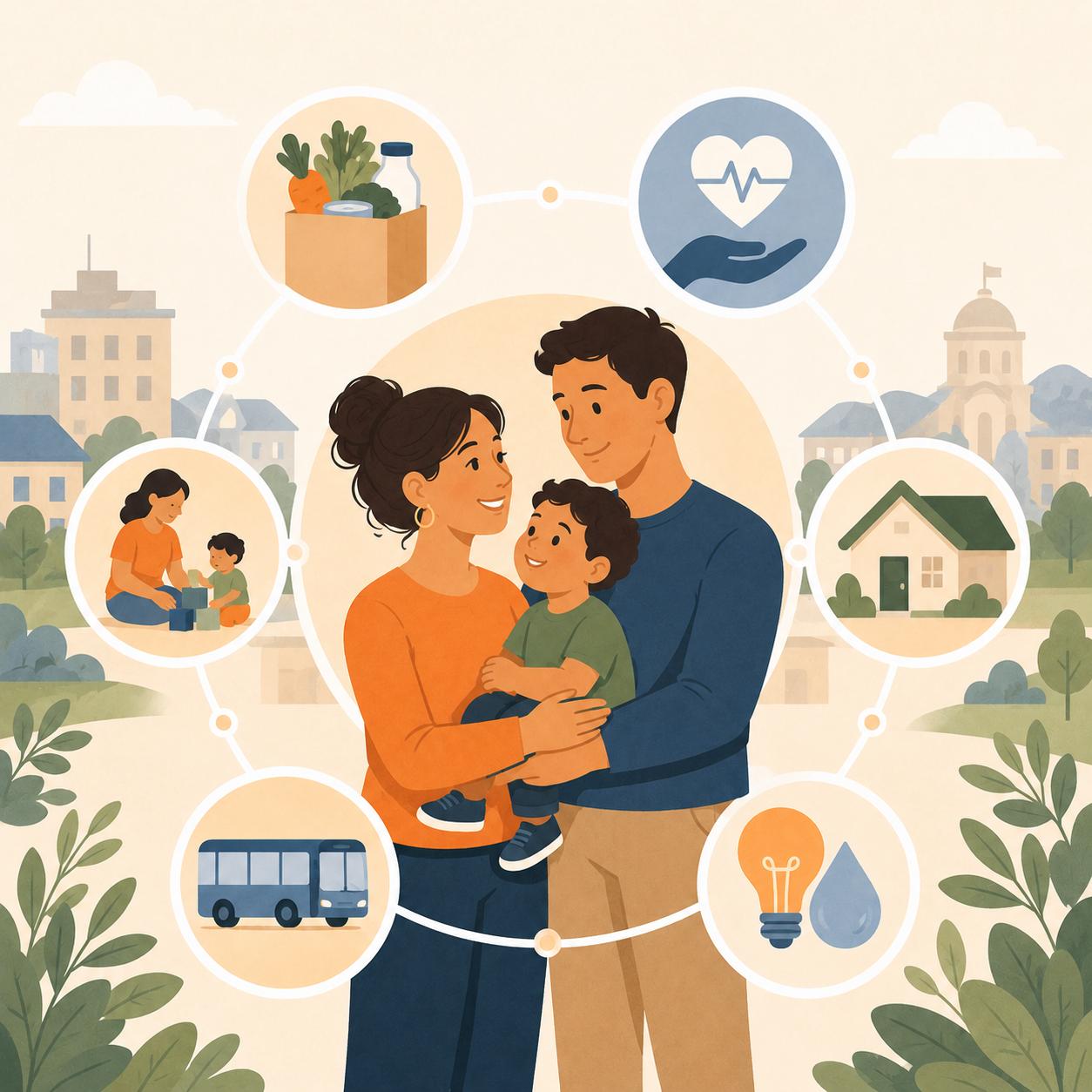
One of the most significant communication features of MI Bridges is its integrated approach to resident navigation. Traditional public assistance communication often focuses narrowly on individual programs. Agencies explain eligibility rules, application procedures, or deadlines for specific services without helping residents understand the broader support environment surrounding them.
MI Bridges reflects a different communication philosophy. The platform acknowledges that public assistance needs frequently overlap and that residents benefit from systems capable of connecting services together.
For example, a resident applying for food assistance may also require:
-
utility support,
-
Medicaid coverage,
-
child care assistance,
-
housing referrals,
-
transportation help,
-
or local nonprofit resources.
Without integrated communication systems, residents are often left to independently identify these additional supports. This creates inequities because individuals with greater institutional knowledge or stronger support networks are better positioned to navigate fragmented systems successfully.
MI Bridges addresses this issue by functioning not only as an eligibility portal, but also as a broader resource-navigation environment. Residents can explore services, identify additional forms of assistance, and connect with community resources through a centralized platform.
From a communication standpoint, this represents an important evolution in human services delivery. Communication is no longer limited to explaining individual programs. Instead, communication becomes a form of guidance that helps residents move across systems more effectively.
This integrated model reduces the likelihood that residents will remain trapped within isolated service pathways. It also increases opportunities for earlier intervention by connecting households to multiple forms of support before crises deepen.
The communication lesson from MI Bridges is clear: agencies cannot assume residents automatically understand how programs connect to one another. Institutions must actively explain those relationships and help residents navigate them.
Digital Accessibility and Resident Experience
Designing Services Around Real-Life Conditions
MI Bridges emphasizes accessibility through digital infrastructure designed to simplify interactions between residents and public systems. Like many modern public service platforms, MI Bridges recognizes that digital accessibility is essential for improving convenience and reducing procedural barriers.
Many residents seeking assistance face unstable schedules, transportation challenges, caregiving responsibilities, or limited financial flexibility. Requiring repeated office visits can create additional burdens that discourage participation or delay access to support.
The platform allows residents to complete applications, manage cases, and explore services remotely. This reduces reliance on physical offices while improving flexibility for households balancing multiple responsibilities.
The digital design of MI Bridges also reflects an understanding that residents often seek assistance during periods of stress or crisis. Communication systems that are overly technical, fragmented, or difficult to navigate can increase frustration and discourage engagement.
By centralizing services within a single platform, MI Bridges attempts to reduce cognitive overload and simplify decision-making for users. Residents do not need to search across multiple websites or agencies to begin exploring available assistance.
This approach aligns with broader principles of resident-centered communication design. Effective communication systems should reduce confusion, clarify next steps, and support decision-making under difficult circumstances.
The platform’s role as both a case-management tool and a resource-navigation system is particularly important because it reduces the separation between information and action. Residents can move from learning about a resource to exploring eligibility or managing applications within a connected environment.
Community Partners as Communication Infrastructure
Extending Government Reach Through Trusted Organizations

A defining feature of MI Bridges is its integration of trained community partners into the broader service ecosystem. Public information associated with the platform references organizations and community-based partners that assist residents with applications, navigation, and resource identification.
This model recognizes an important reality of public communication: residents often trust local organizations more than large government agencies. Community groups, nonprofits, faith-based organizations, libraries, and social service providers frequently serve as frontline navigators for vulnerable populations.
Rather than treating these organizations as separate from the public assistance system, MI Bridges incorporates them into the communication infrastructure itself.
This approach significantly expands the reach of state services. Residents who may feel intimidated by government systems can receive guidance from trusted local organizations familiar with community conditions and cultural contexts.
However, the effectiveness of partner-based communication depends heavily on coordination and consistency. Community organizations must receive:
-
updated materials,
-
clear instructions,
-
training support,
-
referral guidance,
-
and escalation pathways for complicated cases.
Without this coordination, residents may receive conflicting information that increases confusion rather than reducing it.
MI Bridges highlights the importance of viewing community partnerships not merely as outreach tools, but as operational communication networks that require continuous maintenance and support.
The communication lesson is especially important for large public agencies. Expanding access involves more than publishing information online. Residents often need trusted intermediaries capable of translating bureaucratic systems into understandable and actionable guidance.
Explaining the Public Assistance Pathway
Clarifying Relationships Between Services
One of the central communication challenges in public assistance systems is helping residents understand how different services relate to one another.
Many households approach public systems with immediate concerns, such as food insecurity or overdue utility bills. However, these immediate problems may be connected to broader structural issues involving employment, housing instability, health care access, or caregiving responsibilities.
MI Bridges attempts to address this challenge by presenting public assistance as part of an interconnected support environment rather than a collection of isolated programs.
This communication strategy matters because residents cannot effectively navigate systems they do not understand. Agencies must explain:
-
how to apply for services,
-
how eligibility works,
-
how to manage cases,
-
how programs interact,
-
when to seek community support,
-
and when direct agency contact is necessary.
The platform therefore functions not only as an administrative tool, but also as a communication guide that helps residents move through a complicated institutional environment.
This guidance-oriented communication model reflects broader changes in public administration thinking. Increasingly, agencies recognize that residents should not be expected to become experts in bureaucratic systems simply to receive essential support.
Instead, public systems should be designed to reduce navigational complexity and improve clarity throughout the resident experience.
Transparency, Trust, and Resident Empowerment
Reducing Confusion Through Centralized Communication
A major challenge within fragmented public assistance systems is inconsistency. Residents may receive information from multiple offices, organizations, or websites that appears contradictory or incomplete.
MI Bridges attempts to reduce this fragmentation by centralizing communication and case-management functions within a single environment. Residents can manage benefits, explore resources, and connect with support systems through one platform rather than navigating disconnected systems independently.
Centralized communication improves transparency by helping residents understand:
-
where they are in the process,
-
what actions remain incomplete,
-
what services may be available,
-
and where to seek further assistance.
Transparency is especially important because public assistance systems directly affect health, housing stability, nutrition, and family well-being. Confusing communication can lead to missed deadlines, interrupted benefits, or unnecessary stress for vulnerable households.
MI Bridges also contributes to resident empowerment by shifting users from passive recipients of information toward active navigators of their own support pathways. Residents gain greater ability to explore resources, manage cases, and make informed decisions about available assistance.
This empowerment-based communication model reflects a broader shift toward participatory public service design..
Lessons for Human Services Agencies
 MI Bridges offers several important lessons for public agencies modernizing human services communication.
First, agencies should recognize that resident needs rarely exist in isolation. Communication systems should help residents understand how services connect to broader support pathways rather than focusing narrowly on individual programs.
Second, integrated navigation improves accessibility. Residents benefit when applications, case management, and resource exploration are connected within a centralized system.
Third, community organizations should be treated as essential communication partners rather than peripheral outreach tools. Effective partnerships require training, coordination, and clear escalation processes.
Fourth, transparency and clarity are critical in systems involving multiple programs and agencies. Residents should understand what steps are required, what organizations are involved, and where to seek assistance when problems arise.
Finally, digital systems should be evaluated according to how effectively they reduce confusion and improve resident understanding—not simply according to technological sophistication.
Conclusion: MI Bridges as a Model for Integrated Human Services Communication
MI Bridges represents an important example of how public assistance communication can evolve from isolated program messaging toward integrated resident navigation.
By combining benefits applications, case management, and community resource exploration within a centralized platform, Michigan created a communication environment designed to reflect the interconnected realities of residents’ lives.
The platform demonstrates that effective public communication involves more than distributing information about eligibility or deadlines. It requires helping residents understand relationships between services, navigate complex systems, and connect with broader networks of support.
MI Bridges also highlights the importance of collaboration between government agencies and community organizations. Trusted local partners extend the reach of public systems while helping residents navigate bureaucratic complexity more confidently.
Most importantly, the initiative reflects a broader shift toward resident-centered public administration. Rather than expecting residents to adapt to fragmented institutional systems, MI Bridges attempts to organize communication around how people actually experience hardship and seek help.
As governments across the United States continue modernizing public assistance systems, MI Bridges offers a valuable model for how integrated communication, digital accessibility, and community partnership can work together to create more understandable, responsive, and equitable human services systems.
SCG’s Strategic Approach to Communication Systems
Align your agency’s messaging, processes, and public engagement strategies
SCG helps human services agencies build communication systems that make complex public programs easier for residents to understand, access, and navigate. By aligning resident-facing language with digital tools, operational processes, and service pathways, agencies can reduce confusion, improve accessibility, and strengthen trust throughout the public service experience.
Whether your agency is modernizing a benefits portal, improving application and case-status communication, developing multilingual and accessible materials, or creating clearer pathways between information and action, a strategic communication framework can help ensure residents know what to expect, what steps to take, and where to turn when they need assistance.
Use the form below to connect with our team and explore how a strategic communication framework can elevate your agency’s impact.