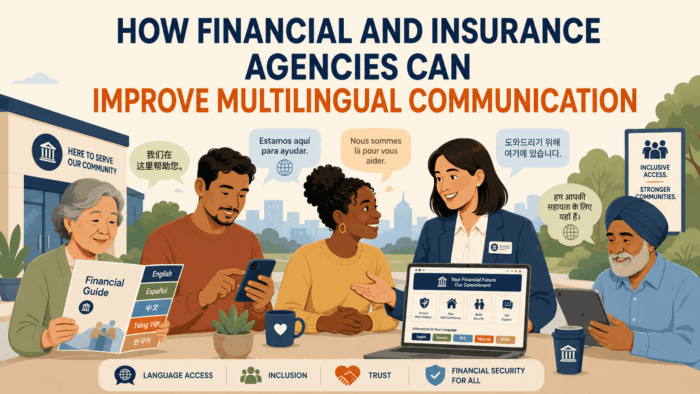
How Financial and Insurance Agencies Can Improve Multilingual Communication
A consumer who cannot access a financial regulatory agency’s services because those services are communicated only in a language they do not read or speak fluently has been denied access to protection the regulatory system was designed to provide them. That denial is not a matter of the consumer’s choice or ability. It is a matter of the agency’s investment in making its services accessible. For a state insurance department that regulates insurers doing business with Spanish-speaking policyholders, a financial regulatory agency that oversees lenders serving immigrant communities, or a consumer protection office that fields complaints from residents across the full linguistic diversity of a major metropolitan area, the question of multilingual communication is not peripheral to the agency’s mission. It is central to whether the agency is fulfilling that mission equitably.
The demographics of consumer financial protection are not monolinguistic. Significant populations in most states conduct their primary economic and social life in languages other than English: Spanish in communities across the Southwest, Southeast, and Midwest; Vietnamese, Korean, and Tagalog in states with large Southeast and East Asian populations; Mandarin and Cantonese in urban centers with significant Chinese immigrant communities; Arabic in communities across the Midwest and Mid-Atlantic; Haitian Creole in Florida and the Northeast; and dozens of other languages in communities across the country. Each of these populations contains consumers who purchase insurance, take out loans, seek investment advice, and experience the same financial disputes and fraud that English-speaking consumers experience. Each has the same legal rights. And each deserves the same access to the regulatory services that protect those rights.
Improving multilingual communication is not a single initiative with a defined endpoint. It is an ongoing institutional commitment to equitable access that requires investment in translation and interpretation capacity, in community engagement with non-English-speaking populations, in the development and maintenance of multilingual communication materials, and in the organizational culture that treats language access as a professional obligation rather than an optional enhancement. This article addresses how financial and insurance agencies can develop and sustain multilingual communication that genuinely serves the full linguistic diversity of their consumer constituencies.
The agencies that have made the most progress on multilingual communication share several characteristics. They have assessed the linguistic demographics of their service area and used that assessment to prioritize translation investments proportionately to population need. They have invested in professional translation rather than relying on machine translation or bilingual staff for consumer-facing materials. They have developed community relationships that provide feedback on the quality and cultural appropriateness of their multilingual materials. And they have made language access a standing operational priority rather than a periodic project, building the infrastructure and practices that sustain multilingual communication over time rather than producing one-time translated documents that are never updated.
Assessing Language Access Needs in the Service Area
 Effective multilingual communication investment begins with understanding which languages are most commonly spoken by the non-English-speaking residents of the agency’s service area, and in what proportions. Without this demographic understanding, language access investments may be misallocated, producing translations into languages with small populations while larger non-English-speaking populations remain unserved. Demographic assessment guides the prioritization that makes language access investment both equitable and efficient.
State and county demographic data from the Census Bureau, specifically the data on languages spoken at home and English proficiency from the American Community Survey, provides the primary basis for language needs assessment. This data identifies which languages are most common, what proportion of speakers report limited English proficiency, and how the language distribution varies geographically across the state. An agency whose jurisdiction covers a diverse state will find that language needs vary significantly by region, with some areas requiring Spanish communication primarily and others requiring Vietnamese, Mandarin, or other languages for significant portions of the population.
Complaint and inquiry data from the agency’s own records can supplement demographic data by revealing which languages the consumers who contact the agency actually speak. An agency that has received inquiries or complaints in specific languages, or that has noted specific languages as barriers in complaints about inaccessibility, has direct evidence of language access gaps in its own operations that should inform investment priorities. This operational data may reveal language needs that demographic data understates because limited-English-speaking consumers are underrepresented in contact data precisely because language barriers prevent them from contacting the agency.
Community organization partners who serve specific linguistic communities can provide practical insight about the language needs of their clients that demographic data cannot capture. A Vietnamese community services organization that serves a large population of Vietnamese-speaking seniors with limited English proficiency knows something important about the language access needs of that specific population that aggregate demographic data may obscure. Engaging community partners in the language needs assessment process, rather than relying solely on demographic statistics, produces a more nuanced and more actionable understanding of where language access investments will have the greatest impact.
Language needs assessment should be updated regularly rather than conducted once and treated as definitive. Demographic patterns shift over time as immigration patterns change, as communities develop and move, and as younger generations who may have higher English proficiency shift the language profile of specific communities. An assessment conducted five years ago may significantly understate or overstate the current language access needs in specific areas. Building regular demographic reassessment into the agency’s language access planning cycle, rather than treating the initial assessment as a permanent baseline, keeps language access investments aligned with current demographic reality.
Protecting the Public Interest: Communication Strategies for Financial Regulation, Insurance, and Consumer Protection Agencies
This article is part of our series on strategic communication for Financial Regulatory Agencies, State Insurance Departments, and Consumer Protection Agencies. To learn more and to see the parent article, which links to other content just like this, click the button below.
The Standards for Professional Translation
Professional translation of consumer financial protection materials is a specialized discipline that requires not only fluency in the target language but expertise in financial and insurance terminology, knowledge of the cultural context in which the materials will be used, and understanding of the regulatory framework the materials describe. Materials translated by bilingual staff who have financial regulatory expertise but not professional translation skills, or by professional translators who have general language skills but not financial regulatory knowledge, are at risk of inaccuracies that can harm the consumers who rely on them for guidance about their rights and options.
The minimum standard for translated consumer-facing materials should be professional translation by a certified translator with relevant subject matter expertise, followed by review by a native speaker of the target language who is familiar with the financial regulatory context in which the materials will be used. This two-step process catches both the translation errors that professional translators occasionally make and the technical inaccuracies that reviewers without financial regulatory knowledge may not identify. For the most sensitive materials, such as those describing specific consumer rights and complaint processes, a third step of review by a community member or community organization who is familiar with how the target language is used in the specific community the materials serve, can identify cultural adaptation issues that the translation and technical review steps may miss.
Machine translation, including AI-assisted translation tools, can play a role in the multilingual communication process as a starting point for professional translator review or as a rapid-response tool for time-sensitive consumer alerts where professional translation is not available within the required timeframe. But machine translation should not substitute for professional translation for primary consumer-facing materials. The errors that current machine translation systems make in financial and legal terminology, in idiomatic usage, and in cultural adaptation are frequent enough to produce materials that are misleading or confusing to the consumers they are designed to serve. Any use of machine-translated content should be clearly identified as such, and agencies should invest in replacing machine-translated materials with professionally translated versions as resources allow.
Translation memory and terminology management tools that maintain consistent translation of key financial and insurance terms across all agency materials ensure that consumers who encounter the same term in different agency documents see consistent translation rather than different translations of the same concept. A consumer who reads the term deductible translated one way in a consumer guide and a different way in a complaint acknowledgment letter faces unnecessary confusion. Maintaining a financial regulatory terminology glossary in each target language, and using translation memory software to ensure consistency, is a technical investment that significantly improves the quality and coherence of multilingual communication over time.
Cultural adaptation, which goes beyond translation to address how concepts are framed, what examples are used, and what assumptions are made about the consumer’s background and context, is an important dimension of multilingual communication that is distinct from linguistic accuracy. A consumer guide translated accurately into Spanish that uses examples involving products, institutions, and consumer experiences specific to the US mainstream financial system may be linguistically correct but culturally alien to a Spanish-speaking consumer from a country with a very different financial system and regulatory environment. Cultural adaptation ensures that translated materials are not just understandable in the target language but resonant with the actual experiences and expectations of the target community.
Oral Language Access Through Interpretation Services
Written multilingual materials address the language access needs of consumers who can read their primary language. They do not address the needs of consumers whose primary language access is oral rather than written, including consumers with limited literacy in any language, consumers who prefer to communicate about complex topics by speaking rather than by reading, and consumers who are in an emergency situation where reading a document is not practical. Oral interpretation services are an essential complement to written translation for comprehensive language access.
Telephone interpretation services, which connect non-English-speaking consumers to a professional interpreter who can facilitate a conversation with agency staff in real time, are the most practical and most scalable solution for oral language access across a wide range of languages. These services can cover dozens of languages simultaneously, are available on demand without advance scheduling, and require no upfront investment in translation of specific materials. Many state agencies already use telephone interpretation services for some consumer interactions; ensuring that these services are available for all consumer-facing agency functions, that staff are trained to use them effectively, and that consumers are informed of their availability in every outreach communication, is the investment that converts a nominal service into a genuinely accessible one.
Informing consumers of their right to interpretation services, in the languages those consumers speak, is a prerequisite for those services being used. A consumer who calls the agency’s complaint line and who is connected to staff who speak only English needs to know that interpretation services are available before they give up and hang up. Information about interpretation service availability in the top languages spoken in the service area, provided in agency correspondence, on the agency’s website, and on call-in phone system messages, ensures that consumers who need interpretation services know they are available and how to access them.
For agencies with significant populations speaking specific languages, having at least one or two bilingual staff members who handle incoming contacts in those languages eliminates the additional step of telephone interpretation for the most common language access situations. A state insurance department in a state with a large Spanish-speaking population that has dedicated Spanish-speaking consumer assistance staff is providing higher-quality service to Spanish-speaking consumers than one that routes all Spanish-speaking callers through telephone interpretation, because the bilingual staff member understands both the regulatory context and the consumer’s situation more directly than an interpreter who is working between two parties unfamiliar with each other. Where bilingual staff hiring is feasible given the agency’s demographic profile, it is an investment worth making.
Community-based interpretation, in which the agency works with community organizations that have bilingual staff or volunteers to facilitate consumer interactions, can supplement agency-based interpretation capacity for languages where dedicated agency staff are not feasible. A community organization that serves a specific linguistic community and that is willing to provide interpretation support for consumers seeking agency assistance is extending the agency’s language access capacity into the community in a way that also builds the partnership relationship between the agency and the community organization. This collaborative approach requires clear protocols about what the community organization is asked to do and appropriate compensation or recognition for their contribution.
Building Multilingual Digital and Web Presence
The agency’s website is often the first point of contact between non-English-speaking consumers and the agency’s services, and the language accessibility of that website determines whether multilingual consumers can access the information and services they need or must either navigate in a language they do not fully understand or give up. Building a genuinely multilingual web presence requires more than adding a machine-translated version of the site; it requires deliberate, professionally translated content organized to serve the specific information needs of non-English-speaking consumers.
Dedicated multilingual landing pages for the agency’s most consumer-relevant services, including complaint filing, consumer education, and fraud reporting, in the primary languages spoken by significant populations in the agency’s service area, serve the consumers who are most likely to seek those services while not requiring the full investment of translating the entire website. These landing pages should describe the service in plain language, provide the specific contact information and instructions needed to access the service, and link to additional translated materials where they exist. A well-designed multilingual landing page converts a language barrier into a navigable path in minutes.
Multilingual content for social media, where many non-English-speaking consumers are more active than on agency websites, extends the agency’s digital language access beyond the website to the platforms where non-English speakers are most likely to encounter consumer protection information. Spanish-language posts about fraud warnings targeting the Spanish-speaking community, Vietnamese-language posts about the complaint filing process, and Mandarin-language posts about insurance rights reach consumers in the digital spaces they already use rather than requiring them to navigate to the agency’s website. Regular multilingual social media presence, rather than occasional multilingual posts, is more effective at building awareness and trust among non-English-speaking communities.
Multilingual complaint submission processes, including translated intake forms, translated instructions, and the ability to submit a complaint in a language other than English, remove the practical barrier that prevents non-English-speaking consumers from using the complaint process even when they know it exists. An agency that accepts complaints only through an English-language online form is effectively excluding consumers who cannot complete an English form, regardless of what its language access policy says. Translated complaint intake forms in the top languages spoken in the service area, with staff capacity to process and respond to complaints submitted in those languages, is the operational implementation of language access that transforms policy into practice.
Community Feedback on Multilingual Materials
The quality of multilingual consumer protection materials can only be reliably assessed by members of the linguistic communities those materials are designed to serve. A Spanish-language fact sheet that agency staff consider well-translated may use vocabulary that is standard in one Spanish dialect but unfamiliar in another, may use examples that are not culturally resonant with the specific Spanish-speaking community in the agency’s service area, or may describe regulatory rights and processes in terms that do not connect with the way those topics are understood in the target community. Community feedback is the quality assurance mechanism that addresses these gaps.
Community review panels composed of native speakers of the target languages, who are also familiar with the financial and insurance situations of their communities, provide pre-publication feedback on draft multilingual materials that can identify and correct cultural and linguistic issues before the materials are distributed. Recruiting these reviewers from community organizations that serve the relevant linguistic communities, from faith communities, from ethnic media, and from community leader networks in those communities, ensures that the reviewers have the community knowledge to provide the culturally grounded feedback the materials need.
Post-distribution community feedback, collected through community organizations that distribute the materials to their clients, through community surveys, or through the feedback channels that the agency provides, reveals issues with materials after they have been distributed that were not caught in pre-publication review. A community organization that reports that clients are consistently confused by a specific section of a translated fact sheet has identified a quality issue that should trigger revision. A community survey that reveals that translated materials are not being used because they do not address the specific situations the community experiences is evidence that the materials need to be redesigned for the specific community context.
Ongoing community advisory relationships, in which community organizations and leaders are engaged as standing advisors to the agency’s multilingual communication program rather than as one-time reviewers, provide the sustained community connection that keeps the agency’s multilingual communication current, relevant, and genuinely useful to the communities it serves. These advisory relationships require investment in maintaining regular communication with community advisors, in responding substantively to their input, and in demonstrating through the quality and currency of the agency’s multilingual materials that community advice is actually incorporated rather than solicited and ignored.
Language Access Policies and Accountability
Multilingual communication investment is most effective when it is grounded in a formal language access policy that establishes the agency’s commitments, sets standards for the quality and scope of multilingual communication, defines accountability for meeting those standards, and provides a mechanism for consumers to report language access failures and receive redress. A language access policy is the institutional foundation that gives multilingual communication investment a legal and organizational framework that sustains it through leadership transitions, budget pressures, and competing priorities.
A language access policy should specify which languages the agency provides materials in, what standards apply to translation quality, what interpretation services are available to non-English-speaking consumers seeking agency services, how consumers can request materials in a specific language, and what the agency’s process is for responding to language access requests it cannot immediately fulfill. The policy should also specify how language access performance will be measured and reported, and what internal accountability mechanism exists for ensuring that the policy is implemented consistently.
Language access compliance within the agency requires that all staff who interact with consumers, not just dedicated language access staff, understand the agency’s language access obligations and know how to fulfill them. Staff training on language access should cover how to use telephone interpretation services, how to identify consumers who may need language assistance, how to provide non-English-speaking consumers with information about available language access services, and what to do when a consumer contact involves a language for which the agency has no internal capacity. This training should be provided to all consumer-facing staff, not just to those who work primarily with non-English-speaking consumers.
External accountability for language access performance, through civil rights compliance oversight, consumer complaint analysis, and regular self-assessment against the commitments in the language access policy, keeps the agency’s language access program focused on outcomes rather than on inputs. An agency that can report how many complaints it received in languages other than English, what proportion of those complaints were handled through professional interpretation, how long it took to process complaints submitted in non-English languages compared to those submitted in English, and how consumer satisfaction with the complaint process compared between English-speaking and non-English-speaking consumers, has the accountability data that demonstrates whether its language access commitments are being fulfilled in practice.
Training Staff for Culturally Competent Consumer Interactions
Multilingual communication extends beyond materials and interpretation services to encompass the quality of the human interactions between agency staff and non-English-speaking consumers. A non-English-speaking consumer who is assisted by an interpreter but who encounters staff who are impatient, who speak too quickly for interpretation to be accurate, who make assumptions about the consumer’s sophistication based on their language proficiency, or who treat the interaction as a lower priority than interactions with English-speaking consumers, has received nominally accessible but practically inequitable service. Cultural competency training for staff who interact with non-English-speaking consumers is an essential component of genuine language access.
Cultural competency training for regulatory agency staff should cover the specific cultural backgrounds, financial systems, and regulatory experiences that consumers from the primary linguistic communities in the service area bring to their interactions with the agency. Consumers who come from countries with very different financial systems may have fundamentally different expectations about how financial contracts work, what regulators do, and what rights they have as consumers. Staff who understand these background differences can communicate more effectively with non-English-speaking consumers by adjusting their explanations to meet the consumer where they are rather than assuming the same regulatory literacy baseline that English-speaking consumers typically have.
Practical skills for working with interpreters, including how to speak in short, complete thoughts that can be accurately interpreted, how to address the consumer rather than the interpreter, how to confirm that the consumer has understood what was communicated rather than assuming that interpretation equals understanding, and how to recognize when an interpretation may be incomplete or inaccurate, are skills that many staff lack because they have not received specific training in effective interpreted communication. These skills significantly improve the quality of interpreted consumer interactions and reduce the misunderstandings that interpreted interactions generate without them.
Attitudes toward language access are as important as skills. Staff who view language access requests as complications to be managed rather than as legitimate consumer needs to be met will not provide equitable service regardless of what skills and tools they have. Cultural competency training that addresses the institutional values underlying language access, that helps staff understand how language barriers affect consumers’ ability to exercise their rights, and that frames language access as a professional obligation rather than an optional courtesy, builds the attitudinal foundation for genuinely equitable service delivery.
Ongoing cultural competency development, through regular training updates as the linguistic demographics of the service area change, as staff turnover brings new employees who need initial training, and as community feedback reveals specific cultural competency gaps in current staff practice, sustains the cultural competency capacity of the agency’s consumer-facing workforce over time. A one-time training that is not refreshed or reinforced will have diminishing impact as staff forget specific guidance, as the specific communities the agency serves evolve, and as the cultural contexts of specific languages change in response to community development.
Multilingual Emergency and Crisis Communication
 The need for multilingual consumer communication is most acute in emergency and crisis situations, when consumers must make important financial decisions quickly, when fraud schemes proliferate in the confusion that disasters create, and when the consequences of receiving inaccurate or inaccessible information are most severe. Insurance departments that regulate in hurricane, flood, or wildfire prone areas face recurring emergency communication challenges that require multilingual capacity at the moments of greatest consumer need. Agencies that have not invested in multilingual emergency communication capacity before a disaster will struggle to build it in the crisis period when it is needed most.
Pre-event multilingual communication that reaches non-English-speaking communities before a disaster or financial emergency occurs, providing information about their insurance rights, their options for filing emergency claims, and the resources available to them through the regulatory agency, prepares those communities to access regulatory protection when they need it rather than discovering the agency’s services for the first time in the aftermath of a crisis. An insurance department that distributes Spanish-language hurricane season preparation materials through community organizations serving Spanish-speaking communities in flood-prone areas before hurricane season begins, and that promotes its complaint service through Spanish-language media when storms are forecast, is investing in pre-event multilingual communication that significantly improves its ability to serve Spanish-speaking policyholders when claims disputes follow a major storm.
Rapid multilingual communication during and immediately after a disaster requires the ability to produce and distribute translated content quickly, before full professional translation is feasible. Maintaining relationships with experienced translators in the primary languages of the service area, and having agreements in place that allow rapid turnaround on critical consumer protection communications, is the contingency planning that makes rapid multilingual communication possible. Pre-translated templates for the most common disaster-related consumer alerts, with blanks for the specific details of the current event, can be completed and distributed quickly even when time does not permit full professional translation from scratch.
Post-disaster multilingual communication must sustain the initial rapid response over the weeks and months of claims processing and dispute resolution that follow. Non-English-speaking communities that received multilingual communication in the immediate disaster period but then faced only English-language communication as the disaster transitions from emergency response to regulatory process have received partial language access that is inadequate for the duration and complexity of the actual consumer protection need. Sustaining multilingual communication through the full arc of a disaster response, from initial alerts through claims resolution and enforcement, requires building language access into the disaster response plan rather than treating it as an initial emergency add-on.
Multilingual Scam Warnings and Fraud Alerts
Fraud schemes that target non-English-speaking communities are often specifically designed to exploit the language isolation of those communities: they are delivered in the target language by fraudsters who speak that language and who understand the specific circumstances and vulnerabilities of the target community. Regulatory scam warnings and fraud alerts that are distributed only in English do not reach the consumers who are most actively targeted by language-specific fraud schemes. Distributing scam warnings in the languages of the communities being targeted is both the most equitable and the most effective consumer protection response to these schemes.
Monitoring fraud complaints from non-English-speaking communities can reveal language-specific fraud patterns that would not be visible in English-language complaint data. An agency that receives a cluster of similar complaints from Spanish-speaking consumers about a specific type of phone fraud, or from Vietnamese-speaking consumers about a specific type of investment scheme, has intelligence about a language-targeted fraud scheme that warrants a targeted warning in the relevant language. Building the ability to analyze complaint data by the language of the complainant is a data infrastructure investment that allows the agency to identify and respond to language-specific fraud patterns as a routine part of its market monitoring.
Partnering with ethnic media, including Spanish-language radio and television, Vietnamese-language newspapers, Mandarin-language community publications, and other media serving linguistic communities in the service area, to distribute fraud warnings and scam alerts is among the most effective ways to reach non-English-speaking consumers with time-sensitive consumer protection information. Ethnic media has established audiences in specific linguistic communities that the agency’s own channels cannot reach, and ethnic media journalists who cover community affairs are often interested in financial fraud stories that affect their communities. Building relationships with ethnic media contacts, providing them with accurate, timely information about fraud schemes targeting their communities, and offering agency spokespersons for interviews in the relevant language, creates a media partnership that significantly extends the reach of the agency’s multilingual consumer protection communication.
Social media communities organized around specific linguistic and cultural identities, including Facebook groups, WhatsApp communities, and messaging channels for specific immigrant communities, are informal but highly effective communication channels for fraud warnings and consumer protection information that have trusted relationships within those communities. Information shared through these channels by trusted community members can reach thousands of consumers quickly and at low cost. Identifying community leaders and organizations that have established presence in these digital communities, and working with them to distribute accurate consumer protection information when fraud schemes are active, extends the agency’s multilingual reach into the informal digital spaces where many community members are most active.
Procurement and Vendor Management for Translation Services
The quality of multilingual communication depends on the quality of the translation and interpretation vendors the agency uses. Procuring translation and interpretation services requires clear specifications that communicate the quality standards the agency requires, the subject matter expertise that translators must have, the languages for which services are needed, the turnaround times for different categories of materials, and the quality assurance processes the vendor must follow. Without clear procurement specifications, agencies may select vendors based primarily on price and receive translation quality that is inadequate for consumer-facing regulatory materials.
A request for proposals for translation and interpretation services that requires vendors to demonstrate specific experience in financial and insurance regulatory translation, to provide sample translations for agency evaluation, to describe their quality assurance processes including back-translation or community review, and to explain their approach to cultural adaptation for the specific communities the agency serves, is a procurement process that produces vendor candidates whose qualifications match the agency’s actual needs. Procurement based on price alone, without evaluation of subject matter expertise and quality assurance processes, is a false economy that produces lower-quality materials whose errors must eventually be corrected at greater cost than the initial quality investment would have required.
Ongoing vendor performance management, including regular review of translation quality through community feedback, sample re-translation of completed materials by a different vendor or reviewer, and tracking of the number of corrections required to materials after delivery, maintains translation quality over the life of a vendor contract. Vendors whose quality slips over time, or who cannot meet the agency’s evolving language needs as the service area’s demographic profile changes, should be held to performance standards that are specified in the contract and enforced through the vendor management process.
Building redundant vendor capacity for the agency’s primary languages, rather than depending on a single vendor for each language, ensures that the agency can continue to produce high-quality multilingual communications when a specific vendor is unavailable, when a contract period ends and procurement must be repeated, or when an urgent communication need exceeds a single vendor’s capacity. A roster of qualified translators or translation agencies for each primary language, maintained through regular qualifying updates and periodic use, provides the redundancy that makes multilingual communication reliable under varying conditions.
Measuring Multilingual Communication Reach and Quality
Language access is one of the most difficult aspects of agency communication to measure, because the consumers who are excluded by language barriers are precisely the consumers who are least likely to appear in the agency’s data. An agency that receives no complaints in Vietnamese may have excellent service to Vietnamese-speaking consumers, or it may have virtually no Vietnamese-speaking consumers contacting the agency at all because language barriers have prevented them from doing so. Measuring language access requires proactive effort to understand whether multilingual communication is reaching its intended audiences, not just tracking whether multilingual materials exist.
Outreach measurement through community organization partners who distribute multilingual materials can provide data on how many consumers received specific materials, how those consumers responded to the materials, and what questions or follow-up the materials generated. A community organization that distributed five hundred copies of a Spanish-language fact sheet and that is asked to report on how many clients received the materials, how many had questions about the content, and how many were referred to the agency as a result, is providing the outreach data that demonstrates whether multilingual materials are actually reaching and being used by the intended consumers.
Consumer satisfaction data disaggregated by language of consumer interaction reveals whether non-English-speaking consumers have equivalent experiences to English-speaking consumers with the agency’s services. If Spanish-speaking consumers who used interpretation services report lower satisfaction with the complaint process than English-speaking consumers, that gap identifies a service quality problem with the interpreted interaction that requires investigation and remediation. If Vietnamese-speaking consumers who received translated materials report higher confusion about their complaint rights than English-speaking consumers who received English materials, that gap identifies a translation quality or cultural adaptation issue that requires revision of the Vietnamese materials.
Annual language access reports that compile data on the volume of multilingual communications produced, the languages covered, the number of consumer interactions conducted in each language, the quality assessment results for translated materials, and the consumer satisfaction comparison between English-speaking and non-English-speaking consumers, create a public accountability record for the agency’s language access performance. These reports serve both internal accountability, by providing leadership with the information needed to assess whether language access commitments are being fulfilled, and external accountability, by giving consumer advocates and oversight bodies the information needed to assess whether the agency’s language access program meets the needs of the communities it is designed to serve.
Language Access in the Complaint and Enforcement Process
Language access obligations do not end at the point of consumer education and outreach. They extend throughout the full arc of a consumer’s interaction with the agency, including the complaint filing process, the investigation and mediation of that complaint, and the enforcement process that may follow from it. A non-English-speaking consumer who can access complaint filing in their language but who then receives all subsequent communication from the agency in English has received partial language access that may still prevent them from effectively participating in the regulatory process that is supposed to protect them.
Complaint intake in languages other than English requires more than a translated intake form. It requires staff capacity to read and understand complaints submitted in the target language, to conduct follow-up communication with the complainant in that language, and to seek additional information or documentation in a language the complainant can provide. An agency that accepts Spanish-language complaint submissions but processes them with staff who cannot read Spanish, who rely on machine translation for their understanding of the complaint, or who conduct all follow-up in English, has provided nominally accessible but practically inadequate language access.
Investigation and mediation of complaints from non-English-speaking consumers may require obtaining statements, documents, and responses in a language other than English. Companies that receive regulatory complaints about their treatment of non-English-speaking consumers may have internal records in the consumer’s language; those records should be obtainable through the regulatory process in whatever language they exist. Investigation staff who work with non-English-speaking complainants need interpretation support for any interaction that requires direct communication with the complainant, not just for the initial complaint intake.
Enforcement communication with non-English-speaking consumers who are part of an enforcement action as affected parties, including notification of restitution programs and instructions for participation, must be provided in a language those consumers can understand. An enforcement action that produces a restitution program for Spanish-speaking consumers harmed by a predatory lender must include Spanish-language notification and Spanish-language participation instructions, or many of the eligible consumers will not receive the restitution the enforcement action was designed to deliver to them. Language access in enforcement communication is a regulatory effectiveness obligation as much as an equity obligation.
Multilingual Communication With Regulated Industries
Non-English-speaking consumers are not the only linguistic minority constituency that financial regulatory agencies must consider. The regulated industries themselves include businesses owned and operated by people for whom English is not a primary language, and individual licensees such as insurance agents and financial advisors who serve primarily non-English-speaking client populations and who may themselves operate primarily in languages other than English. Regulatory communication with these regulated entities must also consider language access to ensure that licensing requirements, compliance guidance, and enforcement communications are accessible to the full range of regulated entities within the agency’s jurisdiction.
Licensing requirements communicated only in English may not be accessible to prospective licensees who are non-English speakers seeking to serve non-English-speaking communities. A Mandarin-speaking insurance agent who wishes to serve the Mandarin-speaking population in their community faces a licensing process that is conducted primarily in English, accessing licensing requirements that are available only in English, and submitting to an examination that is administered only in English. Language access in the licensing process, to the extent feasible within applicable legal requirements, expands access to licensure for qualified individuals who can serve non-English-speaking communities and who would otherwise face language barriers to regulatory compliance.
Compliance guidance and regulatory expectations communicated to regulated entities only in English are not accessible to entity owners and compliance staff who do not read English well. An insurance agency owned and operated by a Vietnamese-speaking entrepreneur, serving a Vietnamese-speaking client base, may struggle to understand its compliance obligations from English-only regulatory guidance in ways that affect its ability to comply with standards designed to protect its clients. Multilingual compliance guidance, at least for the most important regulatory requirements and for the industries where non-English-speaking ownership and management is most common, reduces compliance failures that result from language barriers rather than from deliberate non-compliance.
Enforcement proceedings against non-English-speaking regulated entities require language access at every stage of the proceeding, from the initial notice of inquiry through any hearing or adjudication. An entity that cannot understand the allegations against it because they are communicated only in a language the entity does not read cannot mount an effective defense or response. Language access in enforcement proceedings is not just an equity obligation; it is a due process requirement that the agency must meet to conduct legally valid enforcement proceedings against non-English-speaking entities.
Building Multilingual Capacity Into Agency Operations
Multilingual communication that depends on ad hoc arrangements, individual staff initiative, and external vendors who are engaged on a project-by-project basis is inherently fragile. When the bilingual staff member who handles Spanish-language contacts leaves the agency, if there is no institutional capacity behind that individual’s bilingual skills, Spanish-language service deteriorates. When the translation vendor whose quality was excellent is replaced in a new contract cycle, translated material quality may decline. When the community relationships that supported feedback on multilingual materials fade as the contact person at the community organization moves on, the quality assurance function those relationships provided disappears. Embedding multilingual capacity into agency operations rather than depending on individual contributors or episodic project engagement is the difference between a multilingual communication program that is sustainable and one that exists at the sufferance of specific people and circumstances.
Operational embedding of multilingual capacity begins with formal policies and procedures that specify what language access services are provided, how they are accessed, what standards apply, and what staff are responsible for each element of the program. These policies and procedures create institutional knowledge that does not depend on any specific individual to sustain, and that guides new staff on their language access responsibilities without requiring them to reinvent the wheel from whatever ad hoc arrangements preceded their arrival.
Budget allocation for multilingual communication as a standing line item, rather than as an occasional supplemental expense that must be justified for each project, reflects the institutional commitment that treats language access as a normal operational function rather than a special project. An agency that has a dedicated language access budget, approved annually as part of its regular planning and resource allocation process, is an agency that has made the institutional decision that language access is a standing obligation that requires standing resources. An agency that funds multilingual communication from emergency or discretionary budgets when specific needs arise is treating language access as an episodic cost rather than an operational investment.
Staff positions or position descriptions that include specific language access responsibilities, whether dedicated language access coordinator positions or language access components built into broader consumer communication roles, create clear organizational ownership for the language access program. An agency that has no staff with explicit responsibility for multilingual communication quality will find that language access falls between the cracks of other responsibilities, with no one owning the problem when translated materials become outdated, when vendor quality slips, or when community feedback reveals gaps in the language access program. Clear organizational ownership, backed by accountability in performance evaluations, is the operational infrastructure that makes language access a managed program rather than an intention.
Strategic Communication Support for Financial and Insurance Regulators
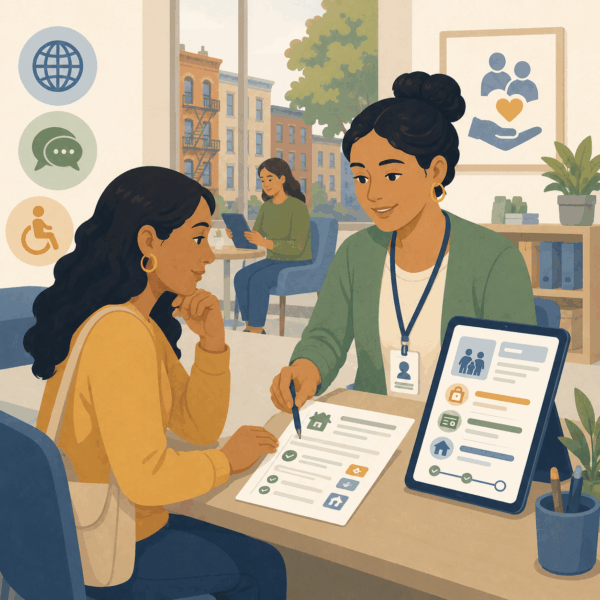 Language access is an essential part of making financial and insurance regulatory services usable by the full population an agency is responsible for protecting. Consumers who prefer or require a language other than English may encounter barriers when trying to understand insurance requirements, recognize financial risks, submit complaints, respond to agency communications, or find available assistance. Addressing those barriers requires more than translating a few high-traffic documents. It requires a communication approach that considers where language needs arise across the consumer experience and how information is delivered in each context.
Effective multilingual communication combines demographic and audience analysis, professional translation, interpretation services, culturally appropriate content adaptation, accessible digital and print materials, community partnerships, and quality assurance. Different audiences may require different languages, formats, levels of assistance, or communication channels. Agencies also need processes for determining which materials should be translated, maintaining consistency in terminology, reviewing translated content as policies change, and ensuring consumers can access oral assistance when written translation is not sufficient.
Developing this type of communication system requires specialized expertise in language access planning, audience research, multilingual content strategy, accessibility, community engagement, translation workflows, and communication evaluation. Many financial and insurance regulators choose to partner with external communication specialists such as Stegmeier Consulting Group (SCG) because these capabilities complement the agency’s regulatory expertise while providing the strategic communication knowledge needed to build language access into the broader communication system rather than treating translation as an occasional production task.
Working alongside financial and insurance regulatory agencies, SCG develops multilingual communication strategies based on the linguistic characteristics and communication needs of the communities each agency serves. Support may include assessing language access needs, prioritizing materials and services for translation, developing multilingual content standards, establishing professional translation and interpretation workflows, identifying community organizations that can extend language-accessible outreach, creating culturally responsive communication materials, and developing measurement frameworks that assess whether multilingual communication is reaching and serving intended audiences.
Maintaining language access requires ongoing organizational coordination as programs, regulations, consumer resources, and community needs change. SCG helps agencies establish repeatable review processes, terminology and content standards, translation governance practices, partner communication workflows, and performance measurement frameworks that support consistent quality over time. This allows multilingual communication to remain an active part of agency operations rather than an initiative that depends on individual staff attention or is activated only when a specific need arises.
The objective is to create a communication environment in which language differences do not prevent consumers from understanding their rights, accessing agency services, recognizing financial risks, or seeking appropriate assistance. By strengthening multilingual communication systems, financial and insurance regulators can make consumer protection more accessible, improve engagement with linguistically diverse communities, and ensure that the effectiveness of regulatory services does not depend on a consumer’s ability to communicate in English.
Future Trends in Multilingual Regulatory Communication
The demand for multilingual government communication is increasing as the linguistic diversity of state populations continues to grow and as legal and regulatory expectations for language access become more defined. Agencies that have built robust multilingual communication capacity now will be better positioned to meet increasing expectations than those that are starting from a minimal baseline when those expectations intensify. Proactive investment in multilingual communication infrastructure is a better investment than reactive compliance.
Technology developments in machine translation, voice translation, and multilingual AI assistants are creating new possibilities for extending language access to a broader range of languages at lower cost than professional translation alone can support. These technologies are not yet reliable enough to replace professional translation for primary consumer-facing materials, but they are improving rapidly and will play a larger role in regulatory multilingual communication over the coming years. Agencies that develop policies for appropriate use of machine translation, that invest in quality assurance processes for machine-translated content, and that track the accuracy and usefulness of machine-translated materials compared to professionally translated ones, will be better positioned to integrate these technologies effectively as they mature.
Conclusion
Multilingual communication is a practical component of equitable consumer protection. A consumer who cannot understand an agency’s guidance, complete a complaint process, or obtain assistance because information is available only in English may have formal access to the same protections as other consumers but lack meaningful access to use them. Providing professional translation, interpretation, culturally appropriate communication, and accessible pathways for assistance helps close that gap and makes the agency’s protections more usable in practice.
The value of language access extends beyond translated materials. When agencies establish sustainable processes for identifying language needs, maintaining multilingual content, working with trusted community partners, and gathering feedback from the communities they serve, they create a more responsive communication system for the long term. That investment strengthens consumer trust and helps ensure that financial and insurance regulatory protections reach the full range of people the agency exists to serve, regardless of the language they use.
Stegmeier Consulting Group’s Strategic Approach to Communication Systems
Align your multilingual communication with the full linguistic diversity of your consumer population.
Financial and insurance regulatory agencies need multilingual communication grounded in demographic assessment, built on professional translation and cultural adaptation standards, supported by oral interpretation services and community feedback, and sustained through formal language access policy and accountability. SCG helps agencies develop multilingual communication programs that fulfill the equity obligation of serving all consumers regardless of language.
Use the form below to connect with our team and explore how stronger multilingual communication can extend your consumer protection mission to the full linguistic diversity of your service area.