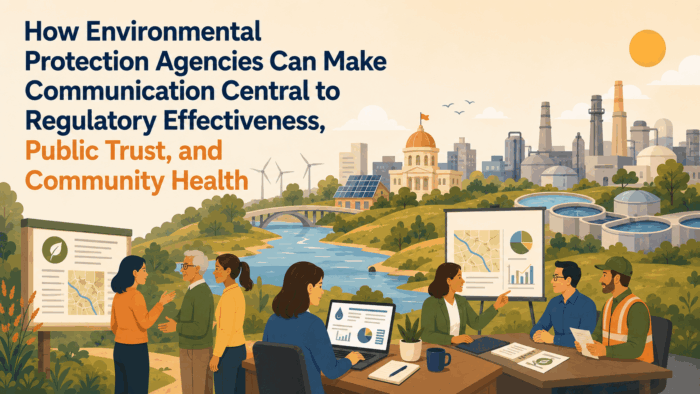
How Environmental Protection Agencies Can Make Communication Central to Regulatory Effectiveness, Public Trust, and Community Health
 Environmental protection does not happen primarily in federal buildings or administrative offices. It happens in the communities where industrial facilities operate, in the neighborhoods where contaminated land sits unremediated for decades, in the air sheds where emissions monitoring data tells a story that too few residents have ever been given the tools to read. The agencies doing this work carry a range of names and jurisdictions: state environmental quality agencies, departments of environmental protection, air quality management districts, regional water quality control boards, local planning and land use departments, and county environmental health offices. Together they form the regulatory infrastructure that governs what enters the air people breathe, the water people drink, the soil where children play, and the land where communities live and work.
They share a common operating reality. They are responsible for enforcing laws, issuing permits, managing remediation, conducting inspections, and communicating regulatory decisions to audiences who range from corporate legal teams to residents who have never read an environmental impact report and never will. They do this work with technical staff trained in science and law, not communication. They operate under legal constraints that limit what can be said and when. They serve communities that may distrust them, regulated industries that may contest them, and elected officials who may not support them. And they are expected to be transparent, accessible, and effective communicators in every direction simultaneously.
This communication challenge is not a minor administrative function. It is central to whether environmental protection agencies fulfill their missions. An air quality management district that monitors pollution but cannot communicate health risk data in ways residents understand has not completed its public health function. A state environmental quality agency that issues thorough environmental impact reports that no community member can read has not achieved meaningful public participation. A department of environmental protection that enforces penalties for illegal dumping but cannot communicate those enforcement actions clearly loses its deterrent effect. A regional water quality control board that sets rigorous basin plan standards but cannot explain those standards to municipalities and agricultural operators will see widespread noncompliance.
Communication is not a public relations function layered on top of environmental protection programs. It is the mechanism by which regulatory decisions reach the communities, industries, and governments they are designed to affect.
The audience for environmental protection communication is also more diverse than the regulatory framework suggests. Industrial operators with environmental compliance teams need precise, technically accurate information about permit conditions and enforcement expectations. Residents living near contaminated sites need honest communication about health risks, remediation timelines, and what agencies are actually doing on their behalf. Community organizations in overburdened neighborhoods need to know how to participate meaningfully in permitting processes and enforcement decisions. Municipal governments need to understand their own compliance obligations under permits they may barely have the capacity to manage. Elected officials need information they can use to make funding and policy decisions. And the general public needs a baseline understanding of what environmental agencies do and why it matters.Most agencies have never systematically tried to build that ba.
This content hub provides a practical framework for building stronger environmental protection communication. It is organized around the real operating contexts that state environmental quality agencies, air quality management districts, regional water quality control boards, local planning departments, and departments of environmental protection face: how they communicate about contaminated land remediation, how they explain permit decisions in plain language, how they enforce pollution laws transparently, how they build trust with communities that have historical reasons to doubt them, how they reach non-English-speaking populations, how they coordinate across fragmented jurisdictional boundaries, and how they respond when environmental incidents require rapid public communication.
Who This Content Hub Is For
This content hub is designed for public agencies, quasi-governmental bodies, and their partners involved in environmental regulation, enforcement, permitting, remediation, and public engagement on behalf of communities, ecosystems, and public health.
That includes state environmental quality agencies administering CEQA, NEPA, and equivalent environmental review frameworks; departments of environmental protection with broad regulatory mandates covering air, water, land, and waste; air quality management districts responsible for emissions monitoring, permitting, and enforcement; regional water quality control boards setting and enforcing standards for surface water, groundwater, and stormwater; local planning and land use departments conducting environmental review for development projects; county and municipal environmental health departments handling pollution complaints and public education; and the community organizations, tribal governments, and advocacy partners who extend environmental protection work into populations that institutional outreach often misses.
It is also relevant for the people who lead and support this work: agency directors and program managers, public information officers, environmental planners, permit writers, enforcement staff, compliance officers, community engagement coordinators, interagency liaisons, elected officials who oversee environmental regulatory bodies, and consultants supporting public-sector environmental communication.
The common thread is that these agencies and organizations need to explain complex, consequential regulatory decisions to audiences with vastly different levels of technical knowledge, institutional trust, and stake in the outcome. A permit applicant needs an accurate explanation of what conditions will be placed on their operation and why. A neighborhood adjacent to a contaminated site needs honest information about what the contamination is, what risk it poses, and what the agency is doing about it. A municipal government needs clear guidance on its own stormwater compliance obligations. A community organization participating in a public comment period needs to know that its comments will be considered, not simply logged. An elected official needs data that demonstrates whether the agency’s programs are reaching the communities most in need. Strong communication helps each audience answer the questions that matter to them without forcing them to first understand the administrative structure of environmental regulation.
How to Use This Environmental Protection and Compliance Communications Hub
Environmental protection agencies communicate with people whose needs, regulatory relationships, and levels of trust in government vary widely. This content hub provides a central resource for state environmental quality agencies, air quality management districts, regional water quality control boards, local planning departments, departments of environmental protection, and county environmental health offices seeking to strengthen those communication efforts.
The sections below provide a broad framework for understanding the sector. They explain who these agencies are, what regulatory decisions they need to communicate about, where communication most often breaks down, why plain language and cultural competence matter, and how agencies can strengthen communication systems across permitting, enforcement, remediation, public comment, and community engagement. Agencies can use this hub to evaluate and improve communication across brownfield and greenfield projects, pollution law education and enforcement, environmental compliance and permitting, agency-specific communication challenges, and cross-cutting issues including environmental justice, multilingual outreach, crisis communication, and climate adaptation.
How Environmental Protection Agencies Operate Across a Fragmented Landscape
Understanding who the agencies in this space actually are matters before addressing how they should communicate. The environmental protection ecosystem in the United States is distributed across multiple levels of government, with overlapping and sometimes competing jurisdictions. There is no single model. What follows describes the most common organizational types and their communication contexts.
State Environmental Quality Agencies
State environmental quality agencies carry broad mandates governing environmental review, pollution control, waste management, and regulatory compliance. They administer the environmental impact review processes that govern major development projects, oversee the state programs that implement federal environmental law, and serve as the primary state-level regulatory authority when environmental incidents occur. Their communication obligations are correspondingly broad: they must communicate with regulated industries, local governments, community organizations, tribal governments, elected officials, and the general public about regulatory decisions that affect all of them. State environmental quality agencies face a structural communication challenge: their decisions are often technically complex and legally constrained, their audiences are highly diverse, and their regulatory authority can create adversarial dynamics with the industries and local governments they regulate.
Air Quality Management Districts
Air quality management districts operate at the regional level, typically covering multi-county air sheds, and are responsible for monitoring air pollution, issuing permits for stationary sources of air emissions, enforcing air quality standards, and communicating air quality information to the public. Their communication work spans technical data translation, converting AQI numbers and emissions monitoring results into actionable public health guidance, and regulatory communication, explaining permit conditions to industry and permit decisions to affected communities. Districts that publish air quality data without providing the context, plain-language interpretation, and action guidance that communities need are generating information without achieving communication.
Regional Water Quality Control Boards
Regional water quality control boards set water quality standards, administer discharge permits, oversee remediation of contaminated water bodies, and enforce water quality law within their designated basins. Their regulatory reach extends to municipalities, agricultural operations, industrial facilities, and residential development, audiences with fundamentally different compliance capacities, regulatory relationships, and communication needs. Water quality boards that communicate basin plan requirements and permit conditions through regulatory documents written for technical and legal audiences routinely fail to achieve genuine understanding from the municipal and agricultural entities they most need to reach.
Local Planning and Land Use Departments
Planning departments sit at the front line of environmental review for development projects. When a proposed project triggers CEQA or NEPA review, the lead agency is often a local planning department that must manage the environmental review process, communicate review findings to the public, hold comment periods, and ultimately make decisions that may approve projects with significant environmental impacts. Planning departments must communicate the purpose and limits of environmental review honestly. That is a difficult task when community expectations of what the review process can accomplish often exceed what it is legally designed to do.
Departments of Environmental Protection
Departments of environmental protection at the state and regional level carry integrated environmental mandates that may span air, water, land, waste, and remediation. They are often the agencies responsible for contaminated site cleanup, illegal dumping enforcement, public health risk communication around environmental hazards, and coordination with federal environmental authorities. Their communication obligations are among the most complex in public administration: they must communicate enforcement actions, remediation progress, health risk data, and regulatory decisions to audiences ranging from corporate operators to community members living adjacent to contaminated land.
Local Environmental Health Departments
County and municipal environmental health departments are often the most direct point of contact between residents and environmental regulation. They handle pollution complaints, conduct inspections, enforce waste disposal laws, and provide public education on environmental health risks. Their communication effectiveness has direct implications for public health outcomes: a department that cannot communicate reporting mechanisms in ways residents understand, or that cannot follow up on complaints in ways that maintain community trust, is failing its core public health function even when its regulatory programs are technically sound.
Our Comprehensive Guide to Public Communications for State and Local Government Agencies
This article is part of our series on strategic communication for state and local government agencies. To learn more and to see the parent article, which links to other content just like this, click the button below.
How Environmental Protection Agencies Operate Across a Fragmented Landscape
Understanding who the agencies in this space actually are matters before addressing how they should communicate. The environmental protection ecosystem in the United States is distributed across multiple levels of government, with overlapping and sometimes competing jurisdictions. There is no single model. What follows describes the most common organizational types and their communication contexts.
State Environmental Quality Agencies
State environmental quality agencies carry broad mandates governing environmental review, pollution control, waste management, and regulatory compliance. They administer the environmental impact review processes that govern major development projects, oversee the state programs that implement federal environmental law, and serve as the primary state-level regulatory authority when environmental incidents occur. Their communication obligations are correspondingly broad: they must communicate with regulated industries, local governments, community organizations, tribal governments, elected officials, and the general public about regulatory decisions that affect all of them. State environmental quality agencies face a structural communication challenge: their decisions are often technically complex and legally constrained, their audiences are highly diverse, and their regulatory authority can create adversarial dynamics with the industries and local governments they regulate.
Air Quality Management Districts
Air quality management districts operate at the regional level, typically covering multi-county air sheds, and are responsible for monitoring air pollution, issuing permits for stationary sources of air emissions, enforcing air quality standards, and communicating air quality information to the public. Their communication work spans technical data translation, converting AQI numbers and emissions monitoring results into actionable public health guidance, and regulatory communication, explaining permit conditions to industry and permit decisions to affected communities. Districts that publish air quality data without providing the context, plain-language interpretation, and action guidance that communities need are generating information without achieving communication.
Regional Water Quality Control Boards
Regional water quality control boards set water quality standards, administer discharge permits, oversee remediation of contaminated water bodies, and enforce water quality law within their designated basins. Their regulatory reach extends to municipalities, agricultural operations, industrial facilities, and residential development, audiences with fundamentally different compliance capacities, regulatory relationships, and communication needs. Water quality boards that communicate basin plan requirements and permit conditions through regulatory documents written for technical and legal audiences routinely fail to achieve genuine understanding from the municipal and agricultural entities they most need to reach.
Local Planning and Land Use Departments
Planning departments sit at the front line of environmental review for development projects. When a proposed project triggers CEQA or NEPA review, the lead agency is often a local planning department that must manage the environmental review process, communicate review findings to the public, hold comment periods, and ultimately make decisions that may approve projects with significant environmental impacts. Planning departments must communicate the purpose and limits of environmental review honestly. That is a difficult task when community expectations of what the review process can accomplish often exceed what it is legally designed to do.
Departments of Environmental Protection
Departments of environmental protection at the state and regional level carry integrated environmental mandates that may span air, water, land, waste, and remediation. They are often the agencies responsible for contaminated site cleanup, illegal dumping enforcement, public health risk communication around environmental hazards, and coordination with federal environmental authorities. Their communication obligations are among the most complex in public administration: they must communicate enforcement actions, remediation progress, health risk data, and regulatory decisions to audiences ranging from corporate operators to community members living adjacent to contaminated land.
Local Environmental Health Departments
County and municipal environmental health departments are often the most direct point of contact between residents and environmental regulation. They handle pollution complaints, conduct inspections, enforce waste disposal laws, and provide public education on environmental health risks. Their communication effectiveness has direct implications for public health outcomes: a department that cannot communicate reporting mechanisms in ways residents understand, or that cannot follow up on complaints in ways that maintain community trust, is failing its core public health function even when its regulatory programs are technically sound.
How Environmental Protection Agencies Can Explain Regulatory Decisions Clearly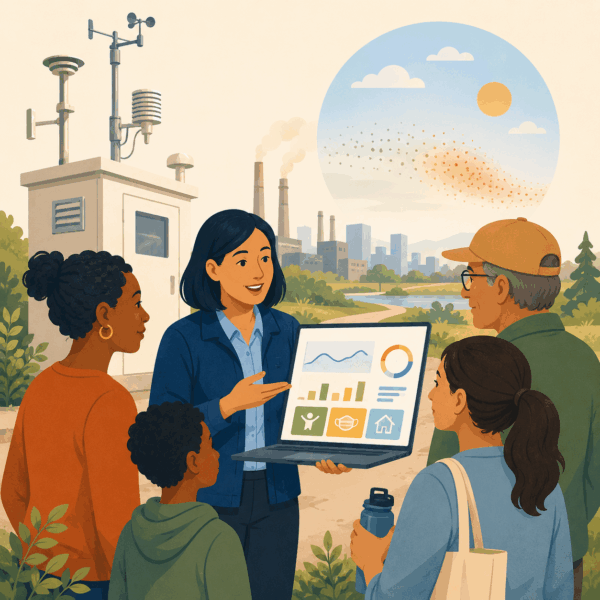
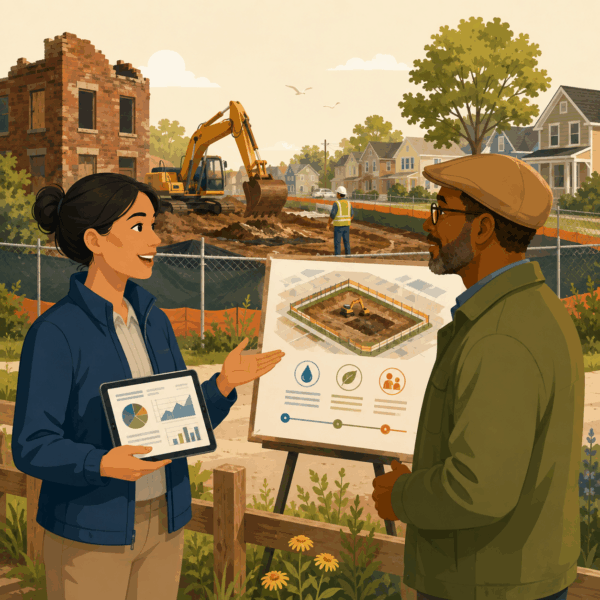
One of the most consistent failures in environmental protection communication is that agencies describe regulatory decisions without explaining what they actually mean, who is actually affected, or what the experience of compliance, remediation, or community engagement actually involves. Environmental impact reports are written for lawyers. Permit conditions are written for compliance engineers. Enforcement notices are written for legal proceedings. Community meetings are held to satisfy procedural requirements rather than to achieve genuine public understanding. The result is a regulatory system that is technically rigorous and communicatively inaccessible.
Brownfield and Greenfield Communication
Brownfield remediation communication is among the most difficult environmental communication challenges agencies face. Remediation timelines are long, often spanning years or decades, and frequently revised. Health risks are real but often technically contested. Property value concerns are emotionally charged. Community trust is frequently low, particularly in communities that have been waiting for cleanup action for years or decades. Agencies that communicate about brownfield remediation primarily through required legal notices, without proactive plain-language outreach, timeline transparency, and genuine community engagement, consistently fail to maintain the public trust that sustained remediation projects require.
Greenfield communication presents a different but equally significant challenge. When development projects on previously undisturbed land bring residential communities into proximity with agricultural operations, or vice versa, the communication obligations involve managing competing interests, explaining environmental review findings to audiences with fundamentally different stakes, and communicating mitigation measures to communities that may believe mitigation is inadequate. Planning departments and environmental quality agencies that approach greenfield communication as a procedural compliance exercise rather than a genuine public engagement responsibility produce the conditions for protracted controversy and litigation.
Pollution Law Education and Enforcement
Environmental agencies have dual communication obligations in pollution law: they must educate the public and regulated industries about what the law requires, and they must communicate enforcement actions in ways that maintain agency credibility, deter future violations, and serve the communities affected by pollution. Public education about waste disposal laws, dumping prohibitions, and reporting mechanisms must be accessible, multilingual, and organized around the questions people actually ask. Enforcement communication must be precise, legally defensible, and transparently connected to the regulatory violations it addresses, without prejudicing ongoing legal proceedings or triggering political backlash that can undermine enforcement programs.
Environmental Compliance and Permitting
Permitting is the core regulatory function of most environmental agencies, and it is also one of the most poorly communicated. CEQA and NEPA documents routinely run to hundreds or thousands of pages, written in regulatory language that most community members cannot parse. Public comment periods open and close without generating the meaningful input they are designed to produce, because agencies have not done the communication work required to make participation genuinely accessible. Agencies that treat permitting communication as a compliance function, producing the notices, posting the documents, holding the hearings, rather than as a genuine public engagement function consistently produce worse regulatory outcomes: higher rates of appeal, more protracted litigation, more community opposition, and less public confidence in the integrity of the process.
How Environmental Protection Agencies Can Improve On-the-Ground Communication
The gap between how environmental protection agencies communicate and how communities, industries, and partner governments actually need to receive information is one of the most persistent operational problems in the field. The following practical approaches address that gap directly.
Plain Language as a Regulatory Obligation, Not a Communications Preference
Environmental agencies often treat plain language communication as an optional enhancement, something to pursue when time and resources allow. In practice, plain language is a regulatory obligation. When a permit condition is communicated in language that the permit holder cannot understand, compliance is undermined. When an environmental impact report is distributed to a community in language that no member of that community can parse, the public comment process is a procedural fiction. When a health advisory about air quality is issued in technical units that residents cannot translate into protective action, the advisory has not served its public health purpose. The investment in plain language communication is not a communication cost. It is a regulatory investment that produces better compliance, more meaningful participation, and fewer legal challenges.
Community Engagement Before the Regulatory Clock Starts
Environmental agencies that wait until a project triggers formal CEQA or NEPA review to begin community engagement consistently produce worse outcomes than agencies that engage early. By the time a notice of preparation is issued, community members who were not involved in the project’s early planning have already formed impressions about what the project involves, what risks it poses, and whether the agency can be trusted to manage the process fairly. Those impressions are very difficult to change through formal public comment processes. Early, informal community engagement, before the regulatory clock starts, allows agencies to understand community concerns, identify issues that the formal review process should address, build relationships with community organizations that will play a role throughout the process, and establish the credibility that makes formal engagement more productive.
The Technical Assistance Visit as a Communication Strategy
Many environmental agencies conduct technical assistance visits to regulated facilities, inspections designed to help facilities understand and achieve compliance before enforcement becomes necessary. For the agency, technical assistance visits provide real intelligence about compliance barriers, misunderstandings about permit conditions, and operational challenges that may explain noncompliance without excusing it. For regulated facilities, a technical assistance visit signals that the agency is interested in achieving compliance, not simply in generating enforcement actions. A facility operator who receives clear, practical guidance from an agency inspector about how to achieve compliance with a complex permit condition will comply more reliably, and with less adversarial friction, than a facility operator whose first interaction with the agency is an enforcement notice.
Data as Communication: Making Monitoring Results Meaningful
Environmental agencies generate enormous quantities of monitoring data, air quality readings, water quality measurements, emissions inventories, discharge monitoring reports, that is routinely published in formats that serve regulatory and technical purposes but do not serve public understanding. The most effective environmental agency communication programs treat monitoring data as the beginning of a communication responsibility, not the end of one. They develop plain-language interpretations of monitoring results, communicate the connection between monitoring data and regulatory action, explain what the data means in terms of health risk and what protective actions are available, and do this consistently through channels that reach the communities most exposed to the pollution being monitored.
Staff Training as a Communication Investment
Environmental agencies invest heavily in technical training for staff and comparatively little in communication training. The result is agencies full of people who understand the regulatory substance of their work but lack the tools to communicate it effectively to non-technical audiences. A permit writer who cannot explain in plain language why a permit condition was set at a specific threshold, a compliance inspector who cannot communicate clearly about what a facility needs to change and by when, a public information officer who lacks the technical background to accurately represent a complex enforcement action. Each of these represents a communication failure that technical expertise alone cannot prevent.
Communication training for environmental agency staff should address: plain language writing for regulatory documents, public notices, and community-facing materials; techniques for explaining technical concepts without losing accuracy; active listening and facilitation skills for community meetings and public hearings; media interview preparation for staff who may be asked to speak on the record about regulatory decisions; cultural competence and trauma-informed communication for engagement with overburdened or adversarial communities; and crisis communication protocols for the environmental incident scenarios most relevant to the agency’s regulatory portfolio. Agencies that invest in staff communication training build institutional communication capacity that is distributed across the agency rather than concentrated in a public information office, and that survives staff turnover because the competency has been developed broadly rather than stored in a few individuals.
Equity as a Communication Design Principle
Environmental protection agencies have increasingly adopted environmental justice as a stated policy priority, but the translation of that commitment into communication practice is uneven. An agency that commits to environmental justice in its strategic plan but organizes its public comment process around written English submissions, holds public meetings at times and locations that exclude working residents, and provides no multilingual outreach for communities with limited English proficiency has not aligned its communication practice with its stated values. Equity in environmental communication is not a supplemental program. It is a design requirement that should shape every decision about how the agency communicates, with whom, through which channels, and in what languages and formats.
Equity-centered communication design begins with understanding who is most affected by the regulatory decisions the agency makes and ensuring that those populations can access, understand, and act on the information the agency produces. It requires disaggregating communication reach data to identify whether overburdened communities are being reached at rates proportional to their environmental exposure. It requires designing public participation processes that genuinely lower barriers for low-income residents, non-English speakers, and communities with limited experience engaging government agencies. And it requires building feedback loops that allow the agency to learn whether its communication is actually reaching and serving the populations most in need, not merely whether it has satisfied procedural notice requirements.
Partner Organizations as Communication Infrastructure
Environmental protection agencies cannot reach every affected community through their own direct outreach. Community-based organizations, faith communities, ethnic media outlets, schools, healthcare providers, and local businesses carry communication credibility in these communities that government agencies often do not. When environmental protection agencies build genuine partnerships with these organizations, providing current information, clear referral pathways, and direct staff contact, those existing community relationships become an extension of the agency’s communication capacity. This is not a substitute for direct agency communication. It is a recognition that in communities with low institutional trust, trusted local messengers are often the only channel through which agency messages will be received.
Building effective partner communication programs requires more than distributing fact sheets to community organizations and asking them to share agency information. It requires genuine investment in partner relationships: briefing community organizations before major regulatory decisions rather than after, providing partner-ready materials that organizations can use without modification in their own communications, establishing direct lines of communication between agency staff and partner organizations so that partners can get accurate answers quickly when community members bring questions, and building feedback mechanisms that allow partner organizations to communicate back to the agency about what questions are coming up, what confusion exists in the community, and where agency communication is falling short. Partner organizations that feel genuinely equipped and respected in their role as communication intermediaries are far more effective advocates for accurate environmental information than organizations that feel they are being used as distribution channels for agency-produced content.
How Environmental Protection Agencies Can Build Volunteer and Citizen Science Communication Programs
Some of the most engaged advocates for environmental protection are the volunteers, citizen scientists, and community stewardship programs that devote time and energy to monitoring, restoration, and environmental education. Building strong communication with these groups is a two-way investment: volunteers and citizen scientists contribute data, labor, and community credibility that agencies could not generate internally, and in return they become knowledgeable, motivated ambassadors for environmental protection programs in the communities the agency serves.
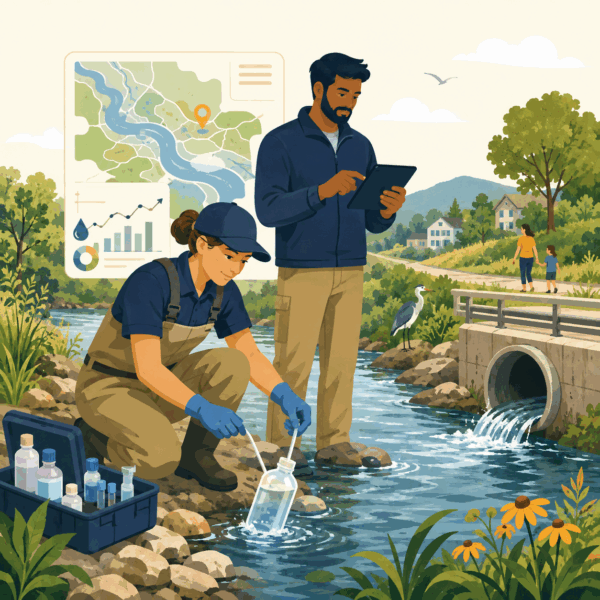
Citizen science programs have become increasingly significant communication assets for environmental agencies. Community air quality monitoring networks, volunteer water quality testing programs, invasive species reporting systems, and wildlife observation databases all represent programs where community members contribute directly to the environmental data that agencies use for regulatory and management decisions. When agencies communicate well with citizen science participants, those participants develop a working understanding of environmental conditions in their communities that no passive outreach program can replicate. A resident who has spent a season collecting water quality samples from a local waterway understands the agency’s water quality program in ways that no website or public meeting can achieve.
Communicating With Citizen Science Volunteers
Effective communication with citizen science volunteers requires treating participants as partners in the agency’s environmental mission rather than as data collectors executing a protocol. That means explaining clearly what the data they collect will be used for, how it will be incorporated into agency regulatory and management decisions, and what they can expect to receive back in terms of findings and program updates. Volunteers who understand the purpose and impact of their contribution are more likely to maintain participation over time, recruit other volunteers from their networks, and communicate accurately about the agency’s programs to neighbors and community organizations.
Agencies that publish the results of citizen science programs in accessible formats, that communicate back to volunteers about what the data showed and what the agency is doing in response, and that publicly acknowledge the contribution of volunteer monitoring networks build the kind of sustained community engagement that formal outreach programs rarely achieve. Citizen science participants who feel genuinely valued by the agency become its most credible community communicators, particularly in communities where institutional trust is otherwise limited.
Friends Groups and Environmental Stewardship Volunteers
Environmental protection agencies that manage natural areas, open space, or environmental education programs often work with friends groups, conservation volunteers, and stewardship organizations whose members are deeply committed to the health of specific places or ecosystems. These groups have their own communication channels, their own community networks, and their own credibility with neighbors, elected officials, and local media. When agencies build genuine partnerships with these organizations, equipping them with accurate and current program information and treating their input as meaningful rather than performative, those organizations become an extension of the agency’s communication capacity in communities where direct agency outreach is limited.
Agencies should keep their volunteer and stewardship networks well-informed and engaged: regular updates that share program developments and policy changes before they become public, special briefing sessions that allow volunteers to understand the technical and regulatory context of agency work they support, and clear channels for volunteers to communicate concerns and observations back to agency staff. Volunteers who are kept in the loop can help correct public misunderstandings, speak credibly at community meetings, and model responsible environmental behavior in their own networks. Over time, the individuals who have invested in a place through volunteer stewardship develop a personal stake in the agency’s success that is among the most durable forms of community support available to public environmental agencies.
How Environmental Protection Agencies Can Strengthen Digital Communication
The digital presence of an environmental protection agency is now the primary medium through which many regulated parties, community members, and partner organizations form their first impression of the agency’s competence and accessibility. A state environmental quality agency website that buries permit application guidance under layers of internal program navigation, or that maintains outdated contact information for programs that have been reorganized, will lose the regulated party before a human connection is ever made. A department of environmental protection whose website is organized around agency divisions rather than around the questions residents actually ask will fail to serve the residents who most need accessible environmental information.
Most environmental agency websites share a common structural failure: they are organized around internal agency architecture rather than around user needs. Navigation that requires visitors to know whether their question belongs to the air quality program, the water quality program, or the land use program before they can find the relevant page is navigation designed for agency staff, not for the public. A resident who discovers illegal dumping in their neighborhood, a small business operator trying to understand permit requirements, a community organization seeking data about pollution sources near a school. None of these users enter an agency website knowing how the agency organizes its internal programs. They enter knowing what they need to find.
Organizing Digital Content Around What Users Actually Need to Know
The most effective environmental agency websites organize content around the questions that regulated parties and community members actually ask: How do I apply for a permit? What are the air quality standards that apply to my facility? How do I report illegal dumping? What does the AQI reading in my neighborhood mean for my health? How do I participate in a public comment period? What remediation is happening at the contaminated site near my home? Each of these questions should lead to content organized around the user’s decision point, not around the agency’s program inventory. Plain-language eligibility explanations and process descriptions should appear before application forms. Contact information for a real person should be easy to find from every program page. Regulatory documents that require technical background to interpret should be accompanied by plain-language summaries that allow non-technical users to understand the key findings and decisions.
Social Media and Content Strategy for Environmental Protection Agencies
Environmental agency social media is most effective when it connects regulatory activity to visible community outcomes. It is most effective when it shows not only what the agency decided but what that decision means for the air quality, water quality, or land conditions in specific communities. A social media post announcing a permit denial that explains, in plain language, what pollutants would have been authorized and why the denial protects community health is more credible and more shareable than a post that announces the denial without context. Peer voice and community story content is underused by environmental agencies but highly effective in communities where agency credibility is limited. Agencies that invest in authentic content production, with appropriate community consent, build the kind of public credibility that institutional content alone cannot achieve.
Accessibility as a Core Digital Communication Principle
Environmental agency digital communication regularly fails residents with disabilities, residents with limited English proficiency, and residents with limited digital access or literacy. PDF documents that are not screen-reader accessible exclude residents with visual impairments. Videos without captions exclude residents with hearing impairments. Websites that are not optimized for mobile devices exclude residents who access the internet primarily through smartphones. Complex regulatory language excludes residents without technical backgrounds regardless of the platform on which that language appears. Agencies should review digital accessibility systematically and treat it as a baseline requirement, not an enhancement. Accessibility is a direct determinant of whether the agency’s communication reaches the residents it is designed to serve.
Language access planning deserves particular attention in jurisdictions with significant non-English-speaking populations. A community in which a substantial proportion of residents speak Spanish, Vietnamese, Tagalog, Hmong, Farsi, or Arabic as their primary language is not being served by an agency website that is available only in English. Translation is the minimum; genuine multilingual communication requires that translated content reflects the reading level and vocabulary of the target community, not merely a word-for-word translation of English regulatory language that is itself inaccessible to most English-speaking residents. Agencies that invest in genuine multilingual digital communication extend their reach to the populations most likely to face compounded barriers, both the language barrier and the institutional distrust barrier, in accessing environmental regulatory information.
How Environmental Protection Agencies Can Communicate at Permitted Sites, Public Hearings, and Agency Offices
The physical communication environment of an environmental agency, whether at a permitted facility inspection, a public hearing room, a remediation site perimeter, or an agency service counter, communicates messages about agency competence, transparency, and respect for the public that no digital channel can replicate. Agencies that invest in digital presence while neglecting the physical communication environments where they meet regulated parties and community members in person are missing some of the most consequential communication moments in their regulatory work.
Public Hearings as Communication Events
Environmental agency public hearings are among the highest-stakes communication events in the regulatory calendar. They are moments when community members who have been affected by a permit decision, a remediation project, or an enforcement action are given a formal opportunity to speak and be heard. How agencies design and conduct those hearings communicates far more than the regulatory record will reflect. Hearings held in locations that are inaccessible to the communities most affected, at times that exclude working residents, with technical presentations that do not include plain-language summaries, and with comment processes that feel procedural rather than genuine, signal that the agency views public participation as a compliance requirement rather than a valued input into regulatory decisions.
Well-designed public hearings begin with proactive outreach before the hearing is held, so that community members who are not already engaged with the agency have a genuine opportunity to participate. They include plain-language presentations of the regulatory decision being considered, accessible materials in the languages spoken by affected communities, navigation support for community members who are unfamiliar with formal regulatory proceedings, and clear explanations of how public comment will be considered and what will happen next. The physical layout of the hearing room, the accessibility of seating and translation services, and the presence of agency staff who are available to answer questions before and after formal proceedings all contribute to whether community members experience the hearing as a genuine engagement opportunity or a bureaucratic formality.
Communication at Remediation Sites and Environmental Incident Scenes
When an environmental agency is managing active remediation or responding to an environmental incident, the physical presence of agency staff, equipment, and signage at and around the site communicates to neighboring communities whether the agency is present, competent, and responsive. Community members living near a brownfield remediation who cannot get basic questions answered at the site perimeter, who see equipment arrive and depart without explanation, or who encounter contradictory information from different agency staff on site will form impressions of agency competence and transparency that no subsequent press release can fully correct.
Agencies managing visible environmental work should establish clear on-site communication protocols: posted information that explains in plain language what is happening and why, direct contact information for a community liaison who can answer questions, regular community updates scheduled at predictable intervals, and clear procedures for community members who observe activities that concern them. These protocols are not burdensome add-ons to technical remediation work. They are the communication infrastructure that maintains the community trust that sustained remediation projects require.
How Environmental Protection Agencies Can Build a Communication Calendar Around Regulatory and Community Cycles
 Environmental protection agency communication is often reactive. Agencies issue permits when applications are complete, publish enforcement notices when violations are cited, hold public meetings when regulatory processes require them, and respond to community questions when they arise. A communication calendar helps agencies move from reaction to readiness, anticipating the moments when communication is most needed and investing in preparation before those moments arrive.
Environmental protection agencies have predictable communication cycles that a well-structured calendar can address systematically. Permit renewal cycles create predictable windows when regulated facilities and surrounding communities need current information about permit conditions and the review process. Air quality monitoring seasons, including wildfire season, ozone season, and winter inversion periods, create predictable moments when public health communication about air quality is most needed and most consequential. Annual reporting deadlines for stormwater, air quality, and water quality programs create predictable moments when program performance data should be translated into public-facing accountability communication. Environmental awareness months and public participation campaigns create hooks for community engagement communication that can be prepared in advance rather than assembled reactively.
Regulatory Cycles That Drive Communication Needs
State environmental quality agencies operating under CEQA and NEPA face predictable communication moments at each phase of the environmental review process: notice of preparation, scoping, draft environmental review, public comment period, final environmental review, and permit decision. Each of these phases requires different communication. The notice of preparation requires proactive community outreach to ensure that affected residents know a review is happening and how to participate; the scoping phase requires accessible guidance on what kinds of comments are most useful; the public comment period requires active outreach to ensure that historically underrepresented communities have genuine access to the process; and the final decision requires plain-language communication about what was decided and why.
Agencies that build communication planning for each of these phases into their project management timelines produce more meaningful public participation, fewer legal challenges, and more durable regulatory decisions than agencies that treat communication as a reactive function triggered by process deadlines. A communication calendar that maps these phases across the agency’s full project portfolio, and that allocates communication staff capacity accordingly, transforms environmental review communication from a recurring crisis into a managed program.
Community Cycles and Seasonal Communication
Effective environmental agency communication calendars also account for the rhythms of the communities the agency serves. Agricultural communities have seasonal cycles that affect when communication about water quality, pesticide regulation, and discharge permits will be most received and most relevant. Urban communities have event cycles, including school year beginnings, community festivals, and neighborhood association meeting schedules, that create outreach opportunities that agencies rarely exploit systematically. Environmental justice communities have organizing cycles tied to community meetings, advocacy campaigns, and policy processes that environmental agencies can engage with proactively rather than reactively.
A communication calendar that integrates these community cycles with the agency’s regulatory calendar allows communication staff to invest preparation time where it will be most effective, to coordinate with community partners before major regulatory moments rather than after, and to build the sustained community relationships that make environmental governance more legitimate and more effective over time. A useful environmental protection communication calendar should include: permit renewal and review cycles by program area; air quality season milestones and monitoring event communication windows; annual enforcement report and program outcome publication timelines; community event outreach cycles by geography and regulated community type; partner briefing schedules for local governments, community organizations, and tribal governments; legislative and regulatory change communication windows; media relations cycles aligned with major monitoring data releases; and after-action review windows following major public comment periods and community engagement events.
How Environmental Protection Agencies Can Communicate With Tribal Governments and Rural Communities
Tribal governments and rural communities represent two of the most consistently underserved audiences in environmental protection communication. Their communication needs are distinct. Tribal governments have sovereign status and government-to-government consultation rights that require a fundamentally different communication approach than standard community outreach; rural communities face geographic and institutional access barriers that standard agency communication channels are not designed to address. Both deserve communication strategies tailored to their specific contexts, not adaptations of urban-focused agency outreach applied with reduced resources.
Tribal Consultation as a Communication Obligation
Federal and state environmental law establishes consultation rights for tribal governments that go beyond standard public participation requirements. When environmental agencies fail to treat tribal consultation as a distinct, early, and substantive communication obligation rather than a checkbox in the formal public comment process. When treated that way, they produce regulatory decisions that are legally vulnerable, culturally inadequate, and operationally problematic when tribal resource interests conflict with project approvals or remediation decisions. Tribal consultation is not public comment. It is government-to-government communication that requires agency leadership engagement, not just staff-level outreach.
Environmental agencies building tribal consultation communication programs should establish direct, respectful relationships with tribal environmental departments and natural resource offices before specific projects or permits require consultation. Agencies should understand which resources, including watersheds, air sheds, sacred sites, and traditional gathering areas, are of particular importance to tribal nations within their jurisdiction, so that communication about projects or permits affecting those resources can be initiated early, conducted in appropriate formats, and genuinely responsive to tribal input. Agencies that treat tribal consultation as a late-stage procedural requirement, rather than an early-stage substantive engagement, consistently produce regulatory decisions that are challenged or that damage the government-to-government relationships that effective environmental co-management requires.
Rural Environmental Communication: Reaching Communities With Limited Agency Access
Rural communities face environmental communication challenges that are structural rather than individual: the nearest agency office may be hours away, local media that might carry agency communication has often contracted significantly, community organizations that could serve as communication partners are less dense than in urban areas, and residents may have deep institutional skepticism toward government agencies that predates any specific regulatory controversy. At the same time, rural communities often face significant environmental challenges, groundwater contamination, agricultural runoff, industrial facility siting, wildfire air quality impacts, that require effective communication between agencies and communities with limited existing relationships.
The most effective rural environmental communication programs build on the institutions that rural communities already trust: agricultural extension offices, rural electric cooperatives, county fair organizations, faith communities, local agricultural lenders, and the community newspapers and radio stations that still reach rural audiences in ways that digital channels often do not. Environmental agencies that build partnerships with these institutions, providing accurate, accessible information about environmental programs and regulatory decisions, extend their communication reach into rural communities that standard agency outreach consistently misses.
Telehealth and digital communication have expanded the reach of some environmental agency programs into rural areas, but they introduce their own communication challenges: residents without reliable broadband access cannot use digital platforms, residents unfamiliar with online public comment systems may not know how to participate, and the loss of in-person engagement opportunities means that agencies must invest more deliberately in accessible, proactive communication to replace the informal information sharing that happens naturally in communities where agency staff and residents share the same civic spaces. Mobile outreach, meaning agency staff attending community events, county fairs, and agricultural gatherings, remains the most effective communication strategy for many rural populations, and agencies that treat in-person outreach as a supplemental activity rather than a core communication program will consistently underreach rural communities.
How Environmental Protection Agencies Can Manage Media Relations and Public Narratives
Environmental protection agencies are regular subjects of media coverage, and the quality of that coverage significantly shapes public understanding of environmental conditions, regulatory effectiveness, and agency credibility. A regulatory decision that is accurately and clearly communicated directly by an agency can be mischaracterized, oversimplified, or sensationalized in media coverage that reaches far more residents than the agency’s own outreach. An enforcement action that the agency communicates carefully and transparently can be framed by a single media story in ways that undermine the deterrent effect the agency intended. A remediation progress update that the agency releases proactively can be displaced in public attention by a media story that focuses on delays without the context of why remediation is taking longer than originally projected.
Environmental agencies that do not have proactive media relations programs, and that communicate with media only reactively in response to press inquiries, consistently find that the media narratives about their work are shaped by sources other than the agency itself: by industry advocates contesting permit decisions, by community organizations frustrated with remediation progress, by elected officials pursuing oversight agendas, or by journalists who lack the technical background to evaluate regulatory claims independently. Agencies that invest in proactive media relations, briefing journalists on complex regulatory decisions before stories run, providing accessible technical context for monitoring data and permit decisions, and being consistently available and responsive to media inquiries, produce more accurate media coverage and more informed public understanding.
Proactive Media Communication for Major Regulatory Decisions
When an environmental agency issues a significant permit decision, releases major enforcement action results, announces a remediation milestone, or publishes monitoring data that reflects significant health risk, proactive media communication, not just a press release, is warranted. Proactive communication means briefing key journalists before a decision is announced, providing plain-language background that helps journalists understand the regulatory context without having to explain it from scratch in deadline conditions, making agency technical staff available for on-the-record background conversations that improve reporting accuracy, and providing visual materials such as maps, charts, and monitoring data visualizations that help journalists communicate environmental conditions to general audiences.
Agencies that treat media communication as a legal and administrative function, releasing only what is required in language drafted for legal defensibility rather than clarity, consistently produce less accurate public coverage than agencies that treat media relations as a strategic communication investment. The goal is not to control media narratives. It is to ensure that reporters covering environmental decisions have access to the technical context, plain-language explanation, and agency perspective that produces accurate coverage.
Responding to Environmental Controversies in Media
Environmental agencies will inevitably face media coverage of controversies: permit decisions that community organizations believe were inadequate, enforcement records that advocates characterize as inequitable, remediation timelines that media frames as examples of agency failure, or monitoring data that journalists present as evidence of regulatory inadequacy. Effective crisis media communication for environmental agencies requires: a designated spokesperson with both technical credibility and communication skill; pre-developed talking points for the most common controversy scenarios; a clear protocol for who approves media statements before release; a commitment to factual accuracy that prioritizes correcting errors over avoiding uncomfortable truths; and an understanding that a slow or evasive response to a media inquiry will produce worse coverage than a prompt, honest response that acknowledges complexity.
Agencies that go silent in the face of environmental controversies allow the controversy narrative to be written by others. Agencies that engage promptly, honestly, and with appropriate technical context retain the ability to shape public understanding of complex regulatory situations. The agencies that emerge from environmental controversies with their credibility intact are not those that claim no problems exist, they are those that communicate honestly and quickly about the problems they have identified, the actions they are taking, and the accountability they are accepting for situations that have fallen short of community or regulatory standards.
How Environmental Protection Agencies Can Measure Communication Effectiveness and Drive Continuous Improvement
Environmental protection agency communication is almost universally undermeasured. Agencies track the outputs of communication activity, including press releases issued, public meetings held, documents posted, and social media posts published, but rarely track whether those outputs achieved the outcomes that communication is designed to produce: whether permit applicants understood their permit conditions, whether community members received accurate information about environmental risks, whether public comment processes generated meaningful input from affected communities, whether enforcement communication deterred future violations, or whether remediation communication maintained community trust through difficult and extended cleanup processes.
The gap between communication output measurement and communication outcome measurement is not merely an evaluation problem. It is a program management problem. Agencies that measure only outputs cannot identify where communication is failing before that failure produces regulatory consequences. These include appeals that could have been prevented by clearer permit communication, community opposition that could have been reduced by earlier engagement, noncompliance that could have been avoided by more accessible guidance. Agencies that measure outcomes can identify communication failures early enough to address them, and can demonstrate to oversight bodies and the public that communication investment is producing genuine regulatory and public health benefits.
Meaningful Metrics for Environmental Agency Communication
More useful communication metrics for environmental protection agencies include: permit application completion rates and rates of applicant requests for clarification, which indicate whether permit guidance is clear enough to support independent application; appeal rates for permit decisions, which indicate whether the basis for decisions is being communicated clearly enough to reduce disputes; public comment quality and demographic diversity, which indicate whether comment periods are reaching the full range of affected communities or primarily organized advocacy groups; compliance rates among regulated facilities that received pre-enforcement technical assistance, which indicate whether compliance communication is translating into behavioral change; community satisfaction with remediation communication, measured through periodic surveys or focus groups; and demographic reach analysis for outreach programs, which indicates whether communication is reaching overburdened communities at rates proportional to their exposure and need.
Environmental justice-specific communication metrics are particularly important and particularly underused. If an agency’s outreach events, website content, and public comment periods are systematically failing to reach communities of color, low-income communities, or communities with limited English proficiency, groups that are disproportionately affected by environmental burdens, that failure will not be visible in aggregate communication output metrics. It becomes visible only when agencies track the demographic and geographic reach of their communication programs against the demographic and geographic profile of the communities most affected by the regulatory decisions they are communicating about. Agencies that commit to this level of communication measurement build the institutional accountability that distinguishes environmental justice as a practiced commitment rather than a stated value.
After-Action Learning as a Communication Improvement System
The most effective environmental agency communication programs build after-action review into every major communication moment: after a contested permit decision, after a public comment period closes, after a community meeting on remediation progress, after an environmental incident response, after a major enforcement announcement. After-action review asks: What communication worked as intended? What generated confusion, misunderstanding, or unintended community response? What questions kept coming up that the agency’s communication had not anticipated? What channels failed to reach the audiences they were designed for? What partner organizations reported that the information they received was insufficient or inconsistent?
These reviews should be structured, documented, and used to update communication protocols, templates, and training before the next comparable communication moment. Agencies that treat communication failures as isolated incidents to be managed, rather than as systematic signals to be analyzed and addressed, will repeat the same failures across different regulatory contexts. Agencies that build learning systems into their communication programs steadily improve the quality and effectiveness of their communication over time. They also build the institutional knowledge that allows communication to remain effective even as staff turns over and regulatory contexts evolve.
Case Studies: How Environmental Protection Agencies Communicate Trust, Access, and Accountability
The following three case studies are drawn from documented real-world programs conducted by environmental agencies and their partners across the United States. Each illustrates a specific communication challenge: community-driven air quality monitoring in overburdened urban neighborhoods, integrated environmental justice planning in a community with multiple Superfund sites, and communication of remediation progress and enforcement accountability during long-term industrial cleanup. Each offers practical lessons that transfer to other geographies and organizational contexts.
Sacramento, California: Community-Driven Air Quality Monitoring and the Translation of Data Into Action
The neighborhoods of North Sacramento and Oak Park in Sacramento, California represent the kind of environmental communication challenge that air quality management districts across the country face in overburdened communities. Both neighborhoods bear disproportionate air pollution burdens from nearby industrial sources, heavy traffic corridors, and regional wildfire smoke, and both have populations that include significant proportions of residents with limited English proficiency. The Sacramento Metropolitan Air Quality Management District, the regional body responsible for air quality regulation in Sacramento County, had extensive monitoring infrastructure but a persistent gap between the technical data that monitoring produced and the community understanding that public health protection requires.
The response to that gap took shape through a partnership between the air district and a regional civic organization, supported by state funding through a community air grant program. Rather than deploying monitors at locations selected by technical staff, the program placed community members at the center of the monitoring network design. Nineteen air quality sensors were sited at locations determined by community members themselves, based on where residents understood their exposures to be highest. The monitoring data was made available through a publicly accessible online portal, but the program did not stop at data publication. Visualizations were developed to translate air quality readings into neighborhood-level maps that residents could read without technical background. Workshops were held in multiple languages, including Spanish, Hmong, and Farsi, with paid stipends for participation to remove economic barriers to engagement. Community members reviewed the data and developed local air action plans that identified neighborhood-specific priorities for emissions reduction.
The air district’s role in this program illustrates a communication model that most environmental agencies underuse: genuine co-design with affected communities rather than community notification about agency decisions already made. By building the monitoring network around community-identified priorities, the program produced both more meaningful data and more credible communication. Residents who participated in siting the monitors understood why those locations mattered. They understood the data because they had helped design the process of collecting it. And when the data identified elevated pollution in specific locations, community members had both the information and the relationships with agency staff to push for regulatory response. The lesson for air quality management districts and other environmental monitoring agencies is that technical data becomes meaningful public communication only when communities have been involved in determining what questions the data is designed to answer, and when agencies invest in making the results accessible, actionable, and connected to regulatory consequence.
Jacksonville, Florida: Integrated Environmental Justice Planning in a Community With Multiple Superfund Sites
Health Zone 1 in Jacksonville, Florida presents one of the most complex environmental communication challenges in the country. The area, a predominantly low-income community with significant proportions of residents of color, sits within proximity of five Superfund sites, multiple brownfields, contaminated waterways, and properties where contamination is suspected but not yet formally assessed. It was designated as an EPA Region 4 Environmental Justice Showcase Community, a designation that comes with the expectation that the agency and its local partners will do more than conduct cleanup. They will build the community’s capacity to participate meaningfully in environmental decisions.
The communication approach that emerged from this designation, the Jacksonville Integrated Planning Project, was significant precisely because it refused to treat environmental communication as separate from community planning. Rather than convening public meetings about specific Superfund sites, the project convened a planning committee of more than 40 representatives from government agencies, community organizations, and resident groups to identify goals and priorities for the broader neighborhood. The planning process produced a map of cumulative environmental risk that allowed the community to visualize the aggregate burden it carried, not just individual site-by-site exposures. That map became a communication tool that translated technical environmental data into a form community members could use to advocate for prioritized investment and regulatory response.
The program also conducted a comprehensive study of fish and shellfish in two local waterways and posted consumption advisory signs, a direct communication action that met community members at the point where their behavior was most directly affected by environmental contamination. Residents who fish those waterways for food needed to know whether it was safe to eat what they caught. Advisory signs in accessible locations, in plain language, addressed that communication need directly without requiring residents to navigate agency websites or understand regulatory frameworks. The lessons from Jacksonville’s experience are transferable to any environmental agency working in communities with cumulative environmental burdens: treat community members as participants in environmental decision-making, make cumulative impact visible through tools communities can use, and meet residents at the points where environmental contamination most directly affects their daily lives.
Midwestern Industrial Communities: Communicating Remediation Progress and Enforcement Transparency During Long-Term Cleanup
Across the industrial Midwest, departments of environmental protection and state environmental quality agencies have accumulated experience with one of the most persistent environmental communication challenges: maintaining public trust during contaminated site remediation processes that extend for years or decades, involve multiple responsible parties, and produce visible activity, including trucks, equipment, fencing, and soil excavation, that generates community anxiety even when remediation is proceeding as planned. The communication failures that have characterized many long-term remediation projects share a common pattern: agencies communicate required regulatory notices but not voluntary updates; they communicate milestone completions but not milestone delays; they communicate technical findings but not plain-language implications; and they hold required public meetings but invest little in making those meetings genuinely informative or responsive to community concerns.
The remediation communication programs that have performed most effectively in these contexts share several characteristics that depart from standard agency practice. They establish a single point of community contact, a staff member or contractor who community members can reach directly, who attends community events, and who communicates proactively rather than reactively. They issue regular plain-language updates about remediation progress, even when progress is slow or setbacks have occurred, on the principle that a community that receives honest negative information maintains more trust in the agency than a community that discovers setbacks through media coverage or regulatory filings. They communicate explicitly about the limits of remediation, including what the cleanup will and will not achieve, what residual risks will remain, and what institutional controls will govern long-term land use.
These programs also address property value concerns directly rather than deflecting them. Community members living near contaminated sites routinely worry about how remediation activity affects their property values, independent of the actual contamination. Agencies that acknowledge this concern honestly, explain what they know and do not know about property value impacts, and commit to consistent communication throughout the remediation process build more durable community relationships than agencies that treat property value concerns as outside the scope of environmental communication. The lesson for departments of environmental protection and state environmental quality agencies managing long-term remediation projects is that community trust is not built through regulatory compliance. It is built through sustained, honest, proactive communication that treats community members as partners in a difficult and extended process rather than as audiences for required regulatory disclosures.
How Environmental Protection Agencies Can Align Internal Staff, Partners, and the Public Before Major Communication Moments
Environmental protection communication often fails because public-facing messages are developed before internal communication systems are ready. A community member may hear about a permit decision from the permitting agency, a different explanation from a local planning department, a third version from an environmental advocacy organization, and a fourth from a media report that draws on each of these sources inconsistently. If those accounts contradict each other on basic factual questions about what the decision was, what it means for the community, and what comes next. When those accounts contradict each other, the community experience becomes confusing and the agency’s credibility suffers even when each individual account is technically accurate from the perspective of the agency that produced it.
Environmental protection agencies should align internal and partner communication before major external moments. That includes permit decisions with significant community impact, enforcement actions involving regulated facilities that are visible to surrounding communities, remediation milestones and setbacks, environmental incident responses, regulatory changes that affect community exposures, and any time a high-profile story about environmental protection creates increased public attention to agency programs.
A strong alignment process for environmental agencies should include: a shared message framework that explains the decision, action, or change in plain language accessible to non-technical audiences; technical talking points for permit writers, enforcement staff, and public information officers that ensure consistent communication of factual details; partner briefing materials for community organizations, local governments, and other agencies that share communication responsibilities; a single source of accurate information on the agency website where community members and partner organizations can find current information; clear referral protocols so that community members reaching different agency touchpoints receive consistent guidance; and media communication that reflects the same factual foundation as community-facing and partner-facing materials. Internal alignment is not about controlling every word that every partner says. It is about making sure the core factual content is consistent across every channel through which community members might encounter it.
How Environmental Protection Agencies Can Build Trust, Reduce Regulatory Burden on Communities, and Maintain Public Accountability
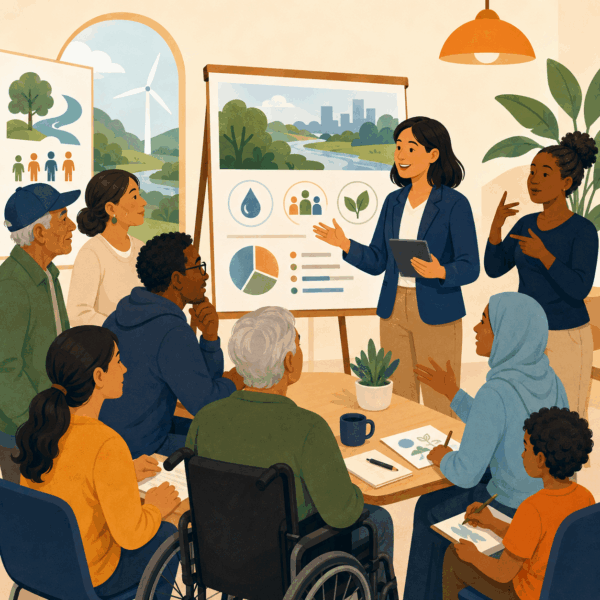 Environmental protection agencies work with communities that have often had difficult experiences with environmental governance. Communities adjacent to contaminated sites may have been waiting for remediation action for years or decades. Communities in the path of industrial development may have learned that formal public comment processes do not meaningfully constrain project approvals. Communities bearing disproportionate pollution burdens may have been told by agencies that air quality or water quality meets regulatory standards while they experience health effects that those standards do not capture. These experiences create justified skepticism that agencies must earn their way past through demonstrated accountability, not merely through communication.
Transparency About What Agencies Can and Cannot Control
One of the most important trust-building communication practices for environmental agencies is honesty about the limits of regulatory authority. An air quality management district can regulate stationary source emissions within its jurisdiction but cannot regulate mobile source emissions or upwind pollution from outside the air shed. A state environmental quality agency can require mitigation measures for significant environmental impacts but cannot override land use decisions made by local governments. A regional water quality control board can set basin plan standards but cannot compel the infrastructure investments that would be required to meet those standards in aging municipal systems without state or federal funding support. Communities that understand these jurisdictional limits are better positioned to direct their advocacy effectively and maintain realistic expectations of what agency action can accomplish.
Enforcement Data and Accountability Reporting
When a state or regional agency uses public authority to regulate environmental impacts, residents and communities have a legitimate interest in knowing how many violations were detected, what enforcement actions were taken, what penalties were assessed and collected, and whether enforcement is being applied consistently across regulated facilities regardless of facility size, industry type, or the demographic characteristics of surrounding communities. Agencies that publish annual enforcement reports, permit compliance summaries, and community-facing accountability documents with honest data about both successes and gaps are better positioned to defend their work, attract continued support, and identify where enforcement strategy needs to be improved. Environmental justice advocates and academic researchers have consistently found that enforcement of environmental law is not applied consistently across communities. Agencies that acknowledge this pattern and commit to transparent reporting on enforcement equity are engaging in the kind of accountability communication that builds genuine public trust.
Crisis Communication Requires Preparation Before the Crisis
Environmental protection agencies will encounter public controversies: a remediation that discovers new contamination and extends its timeline, a permit issued for a facility that neighboring communities believe poses unacceptable health risks, an enforcement action that a regulated industry contests publicly, a water quality violation that threatens drinking water safety. These moments are communication tests, and agencies that have no protocol for responding will handle them worse than agencies that have prepared. Crisis communication for environmental agencies should include clear protocols for who speaks, what factual information can be confirmed and released at what stage, how to acknowledge regulatory failures or unexpected contamination without abandoning the communities being served, and how to channel a moment of public attention toward an honest account of what the agency is doing and what it needs to do better.
How Environmental Protection Communication Compares With Other Public Agency Types
Environmental protection agencies have a distinct mission, but many of the communication strategies they use are shared across public health, regulatory compliance, human services, emergency management, and benefits administration. Across these fields, communication is the mechanism by which regulatory decisions achieve their intended effects: permit conditions that produce actual compliance, by which remediation programs maintain community support through long and difficult processes, by which enforcement actions deter future violations, and by which public participation processes generate the community input that makes environmental decisions more legitimate and more durable.
Shared Core Principles
Effective communication begins with strategic planning, regardless of the agency type. An environmental protection agency communicating a permit decision, a public health department communicating a vaccination program, or a human services department communicating a benefits change must answer the same foundational questions: What should this communication accomplish? Who needs the information? What does that audience need to understand or do? Which channels will actually reach them? How will the agency know whether the communication worked? Environmental protection agencies that approach communication as a strategic planning function rather than a documentation function consistently produce better outcomes across all of these dimensions. Audience segmentation is equally important across sectors. The same monitoring data communicates different things to industrial operators, community members, local governments, and the general public, and requires different communication approaches to be effective with each.
High-Stakes Communication and Vulnerable Populations
Environmental protection communication shares important characteristics with public health, behavioral health, and emergency management communication because the populations most affected by environmental conditions are often experiencing significant vulnerability. In each of these contexts, communication errors have consequences beyond inconvenience: unclear health risk communication may lead to continued exposure; missed remediation milestones communicated without explanation may lead to community disengagement from oversight processes; enforcement communication that appears to protect industry over community may permanently damage agency credibility. Veterans services agencies face an additional layer of complexity because military culture and past experiences with government institutions may shape how messages are received. Environmental agencies face a comparable dynamic in communities with long histories of environmental injustice.
Trust, Transparency, and Follow-Through
Trust is central to communication across every public agency type. For environmental protection agencies, trust often depends as much on follow-through as on the message itself. An agency that holds a community meeting about a contaminated site, generates extensive community input, and then does not communicate what happened to that input has not built trust. It has demonstrated that community engagement is performative. An agency that issues an enforcement notice and then does not communicate the outcome of enforcement proceedings has not demonstrated accountability. The communication creates expectations that agency operations must be prepared to meet.
Measurement and Continuous Improvement
Communication measurement is important across all public agencies. More meaningful measures for environmental protection agencies include application completion rates and appeal rates for permitting decisions, public comment quality and diversity for environmental review processes, compliance rates among regulated facilities that received pre-enforcement technical assistance, and the demographic reach of outreach programs relative to the demographic profile of affected communities. Agencies that measure communication by outcome rather than activity are better positioned to identify what is working, improve what is not, and demonstrate to oversight bodies and the public that their communication programs are producing genuine environmental and public health benefits.
Stakeholder Expectations and Public Accountability
Like regulatory, benefits, and human services agencies, environmental protection organizations operate under significant stakeholder pressure. Communities living near regulated facilities and contaminated sites expect respectful treatment, timely information, and honest communication about health risk. Elected officials and taxpayers expect public resources to be used responsibly and regulatory programs to produce measurable environmental improvement. Advocacy groups and community organizations expect agencies to identify communication gaps, address access barriers, and demonstrate that environmental justice commitments extend beyond policy documents to actual program delivery. Regulated industries expect regulatory clarity and procedural fairness. These expectations are sometimes in direct tension, and environmental agencies must communicate transparently about trade-offs and constraints rather than managing each stakeholder’s expectations in isolation.
When agencies communicate inconsistently across stakeholder groups, projecting regulatory toughness to advocacy organizations while signaling flexibility to regulated industries, or communicating environmental progress to elected officials while failing to communicate ongoing environmental risk to affected communities. The resulting inconsistency damages agency credibility with all audiences when the discrepancy becomes visible. Environmental protection agencies that commit to consistent, accurate communication across all stakeholder groups, even when that consistency requires delivering unwelcome information to some audiences, build the durable credibility that makes effective environmental governance possible over time.
Cross-Agency Learning Opportunities
Environmental protection communicators can learn from other public sectors, and other agencies can learn from environmental protection. Public health agencies offer lessons in risk communication, stigma reduction, and reaching at-risk populations with information about threats they may not yet perceive as urgent. Emergency management agencies demonstrate how to communicate clearly under pressure and coordinate across jurisdictions in real time when information is incomplete and rapidly changing. Human services agencies provide models for benefits navigation, case coordination, and trauma-informed communication that translate directly to environmental justice contexts where community members are navigating complex regulatory systems under conditions of stress and institutional distrust. Disability services agencies offer guidance on accessibility and inclusive design that environmental agencies consistently underinvest in. Environmental protection agencies bring their own strengths to this shared field: their use of monitoring data as a communication foundation, their experience with multi-agency coordination across complex regulatory landscapes, and their growing practice of community-driven environmental monitoring and co-design can inform other agencies working to build genuine public participation in regulatory decision-making. The cross-sectoral exchange of communication knowledge and practice is one of the most underutilized resources available to public agency communicators.
How Environmental Protection Agencies Can Communicate With Elected Officials and Oversight Bodies
Environmental protection agencies operate within political environments that shape their funding, their statutory authority, their enforcement priorities, and ultimately their capacity to serve the communities that depend on effective environmental governance. Elected officials at the state, regional, and local level, legislators, county commissioners, city council members, board members of regional environmental bodies. They are simultaneously the agencies’ governance principals, their funding sources, and their most powerful advocates or critics in the public arena. Agencies that treat elected officials primarily as recipients of required reports, rather than as stakeholders who need ongoing, strategically framed communication about agency programs and performance, consistently find themselves less supported when budget decisions are made and more exposed when controversies arise.
Effective communication with elected officials and oversight bodies requires understanding what these audiences need from environmental agencies, which is often quite different from what agencies produce for public and regulatory audiences. Elected officials need information that helps them defend their support for environmental programs to constituents who may be skeptical of regulatory costs, communicate environmental successes in terms that resonate with their districts, understand what agency programs are achieving with public resources, and identify where constituent concerns about environmental conditions or agency responsiveness require a response. They do not typically need the technical regulatory detail that permit documents and monitoring reports contain. They need the executive summary, the constituent impact, and the concrete outcome that tells the story of why environmental investment matters.
Budget Communication and the Case for Environmental Investment
Environmental protection agencies regularly face budget pressures that require them to communicate effectively about the value of their programs to decision-makers who may not have direct experience with environmental regulation. Budget communication for environmental agencies is not simply a matter of defending existing appropriations, it is an ongoing program of demonstrating regulatory effectiveness, connecting environmental investment to public health and economic outcomes, and making the case that adequately funded environmental programs are less costly to the public than the health, economic, and remediation costs that result from inadequate environmental protection.
Agencies that communicate budget needs primarily through detailed line-item justifications, without connecting those line items to the environmental and public health outcomes they support, consistently find their budget requests evaluated on administrative efficiency rather than on regulatory effectiveness. The most effective environmental agency budget communication tells a story: it connects permit fee revenues and enforcement resources to the inspections and enforcement actions they support, connects those enforcement actions to the compliance improvements they produce, and connects those compliance improvements to the measurable environmental and public health outcomes, including cleaner air, safer water, remediated land, and reduced community health burdens, that justify the public investment. Agencies that build this narrative consistency between their budget communication and their public accountability reporting produce more durable legislative support than agencies that treat budget justification as a separate exercise from program performance communication.
Legislative Change Communication: Getting Ahead of Policy Shifts
Environmental law and regulation change in response to court decisions, legislative amendments, federal rulemaking, and executive action, and those changes often require rapid, coordinated communication to regulated industries, local government partners, community organizations, and the public. Agencies that are reactive to legislative and regulatory change. Agencies that wait for confusion to arise and then respond to it consistently find that misinformation fills the gap between a regulatory change and the agency’s communication response, and that correcting entrenched misinformation is far more resource-intensive than preventing it through proactive, well-timed communication.
Proactive legislative change communication requires agencies to maintain monitoring systems that track relevant legislative and regulatory developments, to develop communication response plans for anticipated changes before those changes are finalized, and to build the partner communication capacity, through briefing relationships with community organizations, industry associations, local governments, and VSO equivalents in the environmental space, that allows coordinated multi-channel communication when major regulatory changes require rapid public outreach. Agencies that invest in these communication readiness systems are not predicting the future. They are building the infrastructure that allows them to move quickly and coherently when the regulatory landscape shifts, rather than discovering months later that regulated communities and affected populations are operating on the basis of outdated or incorrect information about what the law requires and what agencies are doing about it.
Public Reporting as Strategic Communication
Annual reports, program outcome summaries, and environmental condition reports serve multiple audiences simultaneously: they satisfy oversight and accountability requirements, they provide the factual foundation for media coverage of agency programs, they give community organizations the data they need to advocate for continued or increased environmental investment, and they communicate to the general public that environmental agencies are accountable stewards of both regulatory authority and public resources. Agencies that treat public reporting as a compliance exercise, producing required reports in formats that serve administrative requirements rather than public understanding, and miss the strategic communication opportunity that well-designed accountability reporting provides.
The most effective environmental agency public reports are designed with their multiple audiences in mind. They lead with the outcomes that matter most to community members, including improvements in air quality readings, reductions in permit violations, acres of contaminated land remediated, and community health risk reductions achieved, rather than with the process metrics that matter most to regulatory staff. They include geographic and demographic breakdowns that allow community organizations and advocates to assess whether environmental improvements are reaching the communities that most need them. They acknowledge gaps and challenges honestly, on the principle that a report that is credible in its acknowledgment of failure is more trusted in its claims of success than a report that presents only positive outcomes. And they are written and designed to be accessible to non-technical audiences, with plain-language summaries, visualizations, and clear explanations of what the data means and what the agency is doing in response to what the data shows.
For readers who want to go deeper on how to design and deliver these kinds of communication efforts, A Comprehensive Guide to Public Communications for State and Local Government Agencies provides a practical, detailed look at many of the same principles that support effective environmental protection communication. Environmental agencies face familiar challenges that appear across government: building trust among people who may be skeptical of institutions, explaining complex regulatory requirements in plain language, reaching diverse audiences with accessible and culturally competent content, and choosing communication channels that reflect how regulated parties, affected communities, and partner agencies actually receive information and seek assistance. The cross-sector perspective in that guide can help environmental communicators identify innovations from adjacent fields that translate directly into more effective environmental agency communication practice.
The Role of External Communication Support in Environmental Protection
Most state environmental quality agencies, air quality management districts, and regional water quality boards operate with technical staff whose expertise is in environmental science, engineering, and regulatory law. They are not trained in public communication. Communication responsibilities are often distributed across program staff who are already managing complex caseloads, assigned to public information officers who may lack the environmental technical knowledge to communicate regulatory decisions accurately, or left unaddressed when technical and legal priorities consume available staff capacity.
This capacity gap is real. Environmental agencies regularly produce technically sound regulatory decisions that are communicated poorly: permit decisions that regulated industries and community members cannot understand, remediation updates that omit the plain-language context that community members need, enforcement announcements that satisfy legal notice requirements but do not achieve the deterrent effect that public communication of enforcement can produce, and public comment processes that satisfy procedural requirements but do not achieve the genuine community participation that well-designed engagement can generate. External communication support can help agencies build and maintain communication capacity they could not sustain internally, including plain-language permit condition summaries, community-facing remediation communication plans, enforcement communication frameworks, and crisis communication protocols for environmental incidents.
Agencies evaluating external communication partners for environmental protection work should prioritize partners who understand the regulatory complexity of environmental law, the communication dynamics of communities with environmental justice concerns, the legal constraints on what environmental agencies can say and when, and the cultural and linguistic diversity of the communities most affected by environmental regulatory decisions. The most durable external communication partnerships in environmental protection are structured as ongoing relationships rather than project-by-project engagements, because the institutional context, the community relationships, and the communication history that an external partner accumulates over time are strategic assets that cannot be rebuilt from scratch at the start of each new project.
External communication partners who work well with environmental agencies understand that their role is not to replace agency expertise but to extend it. A communication partner who has worked with air quality management districts over multiple permit cycles understands why a permit decision communicated one way to industry creates community backlash, and can help the agency design communication that serves both audiences without sacrificing accuracy or regulatory credibility. A partner who has developed remediation communication programs for departments of environmental protection understands the particular anxiety that long-term cleanup projects generate in neighboring communities, and can help agencies build the proactive communication rhythms that sustain community trust through years of slow progress. A partner who has conducted multilingual outreach for environmental review processes understands not only which languages are needed but which community organizations are trusted translators and interpreters in the most affected communities, and can help agencies build the genuine multilingual communication programs that translate stated equity commitments into actual community access. These competencies are built through experience. They are not transferable from generic government communication contexts to the specific demands of environmental regulation.
How Environmental Protection Agencies Can Treat Communication as Infrastructure
Environmental protection communication is not a side function. It is part of how permit decisions achieve compliance, how remediation programs maintain community support, how enforcement actions deter future violations, how public comment processes generate meaningful input, and how communities build the understanding and engagement that effective environmental governance requires over the long term.
An industrial facility that cannot understand its permit conditions will not achieve compliance, however technically rigorous those conditions are. A community that has never been given accessible information about a contaminated site in its neighborhood cannot meaningfully participate in remediation decisions. A regulated municipality that receives basin plan requirements in regulatory language it cannot interpret will not implement those requirements effectively. An overburdened community that has consistently received insufficient communication from environmental agencies will not trust those agencies enough to engage with their outreach programs when they eventually prioritize genuine community engagement. Communication is the connective tissue between environmental protection programs, regulatory decisions, partner agencies, and the communities those programs are designed to serve.
For environmental protection agency leaders, the key shift is to treat communication as infrastructure. It should be planned, staffed, funded, tested, measured, and improved alongside the permitting programs, enforcement operations, and remediation projects the agency manages. It should be integrated into regulatory program design from the beginning, not attached as an afterthought when a project generates public controversy or a permit decision triggers community opposition. When a new permit program, remediation project, or community engagement initiative is being developed, the communication question should be asked early: What will regulated parties need to understand to achieve compliance? What will affected communities need to know to participate meaningfully? What will partner agencies need to communicate consistently? What will happen if permit conditions, remediation timelines, or enforcement criteria are unclear?
The future of environmental protection communication will involve more digital transparency tools, more community-driven monitoring partnerships, more data visualization for public accessibility, more integration across federal, state, and local regulatory layers, and more public expectation of demonstrated environmental justice outcomes rather than procedural compliance. These developments can help agencies communicate more effectively, reach more communities, and demonstrate more clearly that environmental regulatory investment is producing real improvements in public health and environmental quality. But those benefits will only materialize if agencies remain focused on the foundational communication principles that no technology can substitute for: honesty about what is known and unknown, plain language about what regulatory decisions mean and what they do not mean, genuine responsiveness to community concerns rather than procedural acknowledgment of them, and sustained commitment to reaching the communities most affected by environmental conditions rather than the communities easiest to reach through standard agency outreach.
The technology dimension of environmental communication infrastructure deserves particular attention as agencies navigate the transition from paper-based and in-person communication to digital-first engagement. Agencies that have built robust digital communication infrastructure, including well-organized and regularly maintained websites, active and strategically managed social media presence, accessible digital public comment systems, real-time monitoring data portals that translate technical readings into plain-language public information, and they are better positioned to communicate rapidly and at scale when regulatory or public health situations require it. Agencies that have neglected digital infrastructure find that modernizing it under pressure, whether when a wildfire drives air quality emergencies, when a remediation generates intense community concern, when a legislative change requires rapid public outreach, is far more costly and less effective than building that infrastructure as a sustained program investment. Digital communication infrastructure requires ongoing maintenance, regular content updating, periodic accessibility review, and continuous evaluation of whether the platforms and formats the agency uses are actually reaching the populations they are designed to serve. Treating digital infrastructure as a capital investment made once rather than an operational investment maintained continuously is one of the most common and costly communication mistakes that environmental agencies make.
Environmental agencies that treat communication as infrastructure are also better positioned to absorb the organizational disruptions that environmental governance regularly produces, including leadership transitions, budget cuts, reorganizations, legislative changes, and the periodic crises that test agency credibility and community trust. Communication infrastructure that has been built systematically, with documented protocols, trained staff, established partner relationships, and tested crisis response plans, is more resilient than communication capacity that depends on particular individuals or that has developed informally over time. When an experienced public information officer leaves, when a community meeting goes unexpectedly adversarial, when a major enforcement action generates intense media scrutiny, the agency with communication infrastructure in place is better equipped to respond effectively than the agency that is improvising in the moment. Investing in communication as infrastructure is not only a matter of regulatory effectiveness. It is also a form of organizational resilience that protects the agency’s ability to serve its mission through the inevitable disruptions that long-lived public institutions must navigate.
Ultimately, the strongest environmental protection communication systems help regulated industries, affected communities, partner agencies, and the general public answer four questions: What environmental regulatory decisions are being made and why? What do those decisions mean for my health, my business, my community, or my environment? What is the agency doing about violations, contamination, or unacceptable environmental conditions? Where do I go if I have concerns, need more information, or want to participate in the process? If an agency can answer those questions consistently across its website, its permit documents, its enforcement communications, its public meetings, and its partner briefings, it will be better positioned to achieve the regulatory outcomes it was created to produce, and to maintain the public confidence that makes continued investment in environmental protection possible.
Strategic Communication Support for Environmental Protection Agencies
 Managing public communication for state environmental quality agencies, air quality management districts, regional water quality control boards, departments of environmental protection, local planning departments, and county environmental health offices requires more than good writing and clear graphics. It requires understanding the regulatory complexity of environmental law, the communication dynamics of communities with long histories of environmental burden and institutional distrust, the legal constraints that govern what environmental agencies can say and when, the technical translation challenges of converting monitoring data and permit conditions into information that regulated parties and community members can actually use, and the accountability obligations that come with exercising public authority over the environmental conditions that shape community health.
Many agencies have strong internal teams with deep technical expertise and genuine commitment to environmental protection. Those teams are essential. At the same time, they are often stretched across permitting caseloads, enforcement proceedings, remediation oversight, interagency coordination, and public comment management simultaneously, leaving little capacity for the kind of strategic communication investment that builds genuine public trust and regulatory effectiveness over time. Agencies often choose to work with an external communication partner when internal capacity is limited; when a major permit decision, remediation milestone, enforcement action, or regulatory change creates surge communication demand; when a public controversy or community opposition campaign puts the agency under heightened scrutiny; or when an outside perspective can help translate complex regulatory decisions into clearer, more accessible messages for the communities, industries, and partner agencies the agency needs to reach.
Stegmeier Consulting Group (SCG) supports public environmental protection agencies by helping them build communication systems that are clear, coordinated, and centered on the communities, regulated parties, and partners they serve. For state environmental quality agencies, air quality management districts, regional water quality control boards, local planning departments, and departments of environmental protection, this can include communication audits, plain-language permit communication frameworks, community engagement strategies for contested environmental review processes, partner toolkits for local governments and community organizations, staff communication training, crisis communication protocols, environmental justice outreach strategies, and implementation support across the full communication lifecycle. The value of this support is not simply producing more materials. It is helping agencies connect their communication to the larger operating environment so that regulatory decisions, community engagement, partner briefings, and media communication all reinforce the same accurate, accessible, and credible message.
SCG’s approach to environmental protection communication support is grounded in the recognition that communication problems in environmental agencies are rarely caused by a lack of information or a lack of commitment. They are caused by structural gaps: the gap between regulatory expertise and communication capacity, between agency-internal language and public accessibility, between procedural compliance and genuine community engagement, between stated equity commitments and the outreach programs that are supposed to deliver them. Addressing these structural gaps requires more than producing better materials. It requires helping agencies build the internal processes, the partner relationships, the measurement systems, and the communication culture that make effective communication sustainable over time rather than dependent on individual effort or exceptional circumstances. That is the work SCG brings to environmental protection agencies that are ready to invest in communication as a core regulatory function rather than a supplemental activity.
Ready to Strengthen Communication for Your Environmental Protection Agency?
At Stegmeier Consulting Group, we help state environmental quality agencies, air quality management districts, regional water quality control boards, departments of environmental protection, local planning departments, and county environmental health offices develop clear, effective communication strategies that support regulatory compliance, community trust, environmental justice, and the public accountability that makes environmental governance legitimate. Our work is grounded in the principle that communication should make environmental regulatory decisions easier to understand and act on, especially for communities most affected by environmental conditions and most in need of clear, honest, accessible information about what agencies are doing on their behalf.
We can help your agency:
-
Build plain-language communication frameworks for permitting decisions, enforcement actions, remediation updates, and environmental review findings that regulated parties and affected communities can understand and use.
-
Develop community engagement strategies for contested environmental review processes, brownfield remediation projects, and permit decisions with significant community impact, including early engagement before the formal regulatory clock starts.
-
Create partner toolkits that equip local governments, community organizations, tribal governments, environmental justice advocates, and other agencies with accurate, consistent, and current information about environmental regulatory programs and decisions.
-
Design public comment engagement programs that reach beyond organized advocacy groups to achieve meaningful participation from communities most affected by environmental decisions, including residents with limited English proficiency and populations without existing relationships with the regulatory agency.
-
Translate monitoring data, air quality readings, water quality measurements, emissions inventories, discharge monitoring results, into plain-language public communication that connects technical findings to health risk, protective action, and regulatory response.
-
Train permitting staff, enforcement officers, public information officers, and community engagement coordinators to communicate consistently, accurately, and with cultural competence across the full range of audiences environmental agencies serve.
-
Develop crisis communication protocols for environmental incidents, remediation setbacks, enforcement controversies, and regulatory changes that require rapid public communication under legal and operational constraints.
-
Build environmental justice communication strategies that reach overburdened communities with the information and engagement opportunities they need to participate meaningfully in regulatory decisions that affect their health, including multilingual outreach and genuine co-design with community organizations.
-
Prepare accountability communication, annual reports, enforcement summaries, remediation progress updates, and program outcome dashboards, that demonstrates regulatory effectiveness honestly and builds the public confidence that continued investment in environmental protection requires.
-
Measure communication effectiveness across permitting, enforcement, remediation, and community engagement programs using outcome-based metrics that assess whether communication is actually helping regulated parties achieve compliance, communities participate meaningfully, and environmental programs produce the outcomes they were designed to deliver.
Whether your agency is preparing for a contested permit decision, managing community communication through a long-term remediation project, building an environmental justice outreach strategy, responding to a public controversy about enforcement, redesigning your digital presence to serve community members rather than internal agency structure, or developing a long-term communication system that supports both regulatory effectiveness and public accountability, SCG can help you create messages, tools, and workflows that work for the communities, industries, partner agencies, and elected officials your agency serves.
Use the form below to connect with Stegmeier Consulting Group and explore how we can help strengthen clarity, trust, and access across your environmental protection programs.
Climate Adaptation and Environmental Compliance: How State Environmental Quality Agencies Communicate Shifting Regulatory Landscapes
Climate adaptation is increasingly changing the context in which environmental compliance decisions are made. State environmental quality agencies may need to communicate new expectations related to water availability, wildfire risk, extreme heat, flooding,...
Crisis Communication for Environmental Incidents: How Air Quality Districts, Water Boards, and Environmental Protection Departments Respond to Spills and Violations
Environmental incidents compress technical investigation, regulatory response, public concern, and media attention into the same narrow window. A spill, unauthorized discharge, hazardous release, air quality event, industrial violation, or contamination discovery can...
Multilingual Outreach in Environmental Compliance: How State and Local Environmental Agencies Can Reach Non-English-Speaking Populations
Environmental compliance information is only useful when affected communities can understand it. State and local environmental agencies may publish accurate notices, permit information, enforcement updates, monitoring results, cleanup instructions, or public...
Translating Air Quality Monitoring Data for Public Understanding: How Air Quality Management Districts Can Communicate Risk
Air quality monitoring data can appear highly objective because it is presented through measurements, charts, indices, maps, pollutant concentrations, and time-based trends. Yet the public interpretation of those data is rarely straightforward. Residents may see a...
Communicating Regulatory Authority Without Alienating Stakeholders: A Guide for State Environmental Quality Agencies
State environmental quality agencies operate within legal and regulatory frameworks that define what they can require, what they can approve, what they must enforce, and where their authority ends. Those boundaries are essential to regulatory consistency, but they can...
When Permits Are Denied: How Environmental Compliance Agencies Should Communicate Adverse Decisions Without Escalating Conflict
Permit denials are among the most difficult decisions environmental compliance agencies communicate because they combine regulatory judgment with immediate practical consequences. A denied permit can delay or halt a proposed activity, require redesign, affect...
Air Quality Permit Communication: How Air Quality Management Districts Should Explain Thresholds and Permitting Decisions
Air quality permitting is technically precise, legally constrained, and often difficult for the public to interpret. Air quality management districts may evaluate emissions estimates, control technologies, health risk information, monitoring data, permit conditions,...
Stormwater Permit Compliance Communication: How Municipal Agencies and Regional Water Quality Control Boards Can Explain MS4 Obligations
Municipal Separate Storm Sewer System, or MS4, requirements can be difficult to explain because they sit at the intersection of environmental regulation, municipal operations, infrastructure management, land development, public works, inspections, and community...
Managing Public Comment Periods: How Environmental Compliance Agencies Should Communicate Before, During, and After
Public comment periods are among the most consequential communication moments in environmental regulation because they create a formal bridge between agency decision-making and the people, organizations, businesses, and governments affected by it. Environmental...
Plain Language Permitting: How State Environmental Quality Agencies Can Translate CEQA and NEPA for Public Audiences
Environmental review under the California Environmental Quality Act (CEQA), the National Environmental Policy Act (NEPA), and comparable state and federal processes produces some of the most information-dense documents that public agencies ask communities to engage...
Communicating Repeat Violations and Ongoing Enforcement: How Regional Water Quality Control Boards Can Maintain Public Confidence
Repeat violations create a different communication challenge than a single enforcement action. When a regional water quality control board has already cited, ordered, fined, or otherwise addressed a regulated entity and similar problems continue, the public may begin...
Building Public Reporting Mechanisms That People Actually Use: A Guide for Air Quality Management Districts and Environmental Health Departments
Public reporting systems are often designed as administrative intake tools, but residents experience them as part of the agency’s public service. A complaint form, odor report, emissions concern, illegal burning report, nuisance submission, hazardous materials...
Enforcement Transparency: How Departments of Environmental Protection Can Communicate Penalties and Actions Without Creating Backlash
Environmental enforcement becomes a communication challenge at the moment an agency’s regulatory authority becomes visible to the public. Inspections, notices of violation, administrative orders, penalties, corrective actions, settlements, permit restrictions,...
Industry Compliance Communication: How State Environmental Quality Agencies Should Communicate Regulatory Expectations to Businesses
Regulatory compliance communication sits at the intersection of environmental protection, operational decision-making, and institutional trust. Businesses subject to environmental requirements are often expected to translate statutes, regulations, permits, technical...
Explaining Dumping and Waste Disposal Laws to the Public: A Communication Guide for Local Environmental Health Departments
Dumping and waste disposal rules affect everyday behavior in ways that are easy for the public to underestimate. A discarded mattress left beside an alley, construction debris placed on an undeveloped parcel, household waste burned or buried on private property, or...
Multi-Agency Messaging on Land Rehabilitation: Coordinating Communication Across Environmental Protection Departments
Land rehabilitation projects rarely sit within the responsibility of a single public agency. A contaminated, degraded, or environmentally impaired site may involve state environmental regulators, regional environmental authorities, local governments, public works...
Property Value Concerns and Environmental Remediation: How Regional Environmental Agencies Communicate Transparently
Environmental remediation can change how a community understands a property long before it changes the physical condition of the site. Once contamination, investigation, cleanup activity, or regulatory oversight becomes publicly associated with a location, nearby...
Greenfield Projects and the Urban-Agricultural Interface: What Local Planning and Land Use Departments Need to Say
Greenfield development at the edge of an urban area is often discussed in terms of land use, growth, infrastructure, housing, economic development, or community expansion. For residents and agricultural operators already living or working near the proposed development...
Brownfield Redevelopment and Public Trust: How Departments of Environmental Protection Manage Community Expectations
Brownfield redevelopment occupies a complicated space between environmental remediation and community transformation. A contaminated or potentially contaminated property may be viewed by environmental professionals as a site requiring investigation, cleanup,...
Communicating Remediation Timelines to Anxious Communities: A Guide for State Environmental Quality Agencies
Environmental remediation is rarely experienced by nearby communities as a straightforward sequence of technical tasks. Residents may first learn that contamination exists and then encounter months of sampling, technical analysis, regulatory review, remedy...