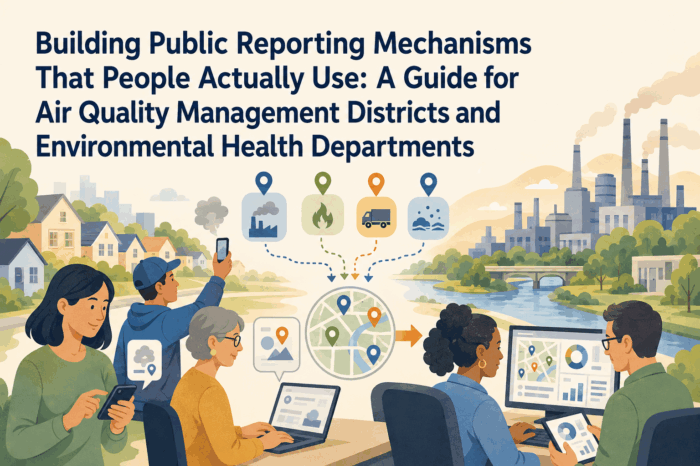
Building Public Reporting Mechanisms That People Actually Use: A Guide for Air Quality Management Districts and Environmental Health Departments
Public reporting systems are often designed as administrative intake tools, but residents experience them as part of the agency’s public service. A complaint form, odor report, emissions concern, illegal burning report, nuisance submission, hazardous materials concern, or environmental health complaint may be the first direct interaction a person has with an air quality management district or environmental health department. If that reporting experience is confusing, burdensome, difficult to find, or unclear about what happens next, the agency can lose valuable information before staff ever have an opportunity to evaluate the underlying issue.
For agencies responsible for air quality and environmental health, the central challenge is not simply creating a way for people to submit complaints. It is creating a reporting mechanism that residents can recognize, understand, complete, and trust enough to use when they encounter a concern. A technically functional form can still fail if the public does not know it exists, cannot determine whether their issue belongs there, or abandons the process because too much information is required before submission.
Reporting systems also sit at the intersection of public expectations and regulatory authority. Residents may believe that submitting a complaint automatically confirms a violation, triggers an inspection, produces an immediate response, or guarantees enforcement. Agencies may instead need to evaluate jurisdiction, determine whether sufficient information is available, assess the seriousness and timing of the concern, coordinate with another program, or decide whether additional investigation is appropriate. If these procedural realities are not explained clearly, the reporting system can create frustration even when staff handle the submission correctly.
Air quality concerns illustrate this challenge particularly well. Odors, smoke, dust, visible emissions, open burning, industrial activity, or other conditions may be intermittent, difficult to document, or subject to different regulatory authorities depending on the source and location. Environmental health departments may face similar complexity with waste, sewage, vectors, hazardous materials, nuisance conditions, food-related concerns, or other public reports. Residents typically do not know how these responsibilities are divided, nor should the system require them to understand agency organizational structures before seeking help.
A strong public reporting mechanism therefore does more than collect information. It helps the public determine whether they are in the right place, communicates what information will be useful, explains what the agency can and cannot do, establishes realistic expectations about follow-up, and directs people appropriately when another entity is responsible. These functions are part of the communication system, not separate from it.
The most effective reporting mechanisms also recognize that the quality of public participation depends on accessibility. People may report from a mobile device, during an active incident, outside normal business hours, with limited technical knowledge, or after attempting to resolve the issue elsewhere. A reporting process that assumes users have time, regulatory expertise, detailed evidence, and familiarity with government procedures will exclude useful reports and disproportionately favor people who already know how to navigate public agencies.
Air quality management districts and environmental health departments should therefore evaluate reporting systems from the perspective of the person encountering a problem, not solely from the perspective of the staff receiving the data. The objective is to collect enough useful information to support agency review while minimizing unnecessary barriers. When reporting mechanisms achieve that balance, they can improve complaint quality, strengthen public understanding, support more efficient routing, and provide agencies with a clearer picture of recurring environmental concerns.
Make the Reporting Path Easy to Find Before Asking the Public to Use It
 A reporting system cannot support public participation if residents cannot find it quickly. Air quality management districts and environmental health departments often maintain complaint information across program pages, contact directories, service portals, FAQs, mobile applications, or general customer service sections. From the agency’s internal perspective, this structure may reflect organizational responsibilities. From the resident’s perspective, it can create uncertainty about where to begin.
Public reporting should be accessible through language people are likely to use when describing their concern. A resident experiencing smoke may search for how to report smoke rather than for the formal name of an air quality complaint program. Someone noticing a strong odor may not know whether the issue is classified as an odor complaint, air pollution concern, nuisance, hazardous materials incident, or another category. Agency websites should therefore provide recognizable entry points that connect ordinary public descriptions to the appropriate reporting mechanism.
Visibility is especially important during high-interest or recurring issues. If an agency regularly receives questions about odors, dust, burning, dumping, sewage, or another complaint category, those reporting pathways should not be buried several levels into the website. Frequently reported concerns should be easy to reach from relevant program pages and public information materials.
Searchability also matters beyond the agency website. Residents often begin with a general web search rather than navigating from an agency homepage. Public-facing reporting pages should use clear titles and plain-language descriptions that make their purpose obvious in search results. A page called “Submit an Air Quality Complaint” is easier to recognize than a page labeled only with an internal program or form number.
Agencies should also ensure that staff communication reinforces the same pathway. If a resident calls a general information line, speaks with field staff, attends a public meeting, or contacts another department, they should receive consistent guidance about where and how to report the concern. The public should not encounter several competing submission options that appear to perform the same function unless the distinctions among them are genuinely necessary and clearly explained.
A visible reporting system signals that the agency wants the information. This can influence whether residents choose to report concerns at all. When complaint mechanisms are difficult to locate, people may conclude that the agency is inaccessible or uninterested, even when staff are actively responding to reports submitted through the correct channel.
How Environmental Protection Agencies Can Make Communication Central to Regulatory Effectiveness, Public Trust, and Community Health
This article is part of our series on strategic communication for Environmental Protection Agencies, Environmental Compliance Agencies, and state and local environmental departments. To learn more and to see the parent article, which links to other content just like this, click the button below.
Let People Describe the Problem Before Requiring Them to Classify It
One of the most common design mistakes in public reporting systems is asking residents to determine the regulatory category of their concern before they can submit it. Agencies may distinguish among stationary sources, mobile sources, open burning, nuisance odors, hazardous materials, waste, vectors, food safety, sewage, or other program areas because those distinctions determine internal routing. The public often does not have the knowledge necessary to make the same classification accurately.
Reporting mechanisms should therefore begin with the observable condition whenever possible. What did the person see, smell, hear, or experience? Where did it occur? When did it occur? Is it happening now? Is the source known? These questions are more useful to residents and can still provide the information staff need to route the complaint appropriately.
This approach reduces abandonment because users do not need to solve the agency’s jurisdictional structure before they can ask for help. It also reduces inaccurate self-classification. A person who selects the wrong program category may unintentionally send the complaint to staff who cannot address it, creating additional delays or transfers.
Agencies can still collect structured information after the resident describes the concern. Follow-up questions can be tailored to the type of issue selected or inferred. For an odor complaint, the system might request the location, time, duration, and description of the odor. For visible smoke or dust, the system might ask whether the condition is ongoing and whether the apparent source is known. The exact questions should reflect the agency’s actual operational needs rather than a generic reporting template.
The objective is to translate public observations into useful agency intake information without requiring the resident to know the legal terminology behind the complaint. Staff remain responsible for determining jurisdiction, regulatory relevance, and investigative next steps.
This distinction also supports public trust. When residents are told that they selected the wrong category after navigating a complicated form, they may interpret the experience as bureaucratic avoidance. A system that accepts the concern first and manages classification internally communicates a different message: the agency is responsible for helping the public reach the correct process.
Ask for Useful Evidence Without Making Documentation a Barrier
Public reports can become more actionable when residents provide specific information about what they observed. Location, time, duration, frequency, visible conditions, source information, and other factual details may help staff assess a complaint. Photos, videos, or supporting documentation may also be useful in some circumstances. However, agencies should be careful not to make extensive evidence collection a prerequisite for reporting unless it is genuinely required.
Residents should not be encouraged to put themselves at risk, enter private property, approach an industrial source, follow vehicles, collect unknown materials, or otherwise investigate the concern on the agency’s behalf. Reporting instructions should make clear that safe observation is sufficient and that agency staff determine what additional investigation is appropriate.
Forms should also distinguish required information from optional information. If a report can be submitted without knowing the exact source, the form should not imply that source identification is mandatory. If photographs are helpful but not required, that distinction should be explicit. Requiring unnecessary fields can discourage reporting and can produce invented or inaccurate information when users feel they must provide an answer to proceed.
Agencies should consider what information is essential for initial review and what can reasonably be obtained through follow-up. The best reporting form is not necessarily the one that collects the most data at submission. It is the one that captures enough reliable information to support appropriate routing and review while remaining usable under real-world conditions.
Explain What Happens After a Report Is Submitted
The reporting experience does not end when a resident presses submit. People need to know what their submission means and what they should expect next. Without that explanation, even a well-designed intake form can generate frustration because residents may assume that submission guarantees a particular agency response.
Air quality management districts and environmental health departments should clearly explain that a public report initiates an agency review process. Depending on the agency’s procedures, staff may evaluate jurisdiction, review the information provided, contact the reporting party, refer the matter to another program, determine whether field response is appropriate, assess available evidence, or take other steps consistent with their authority.
The communication should avoid promising inspections, enforcement, or immediate resolution unless the agency’s procedures support those expectations. A complaint is information provided to the agency. It is not, by itself, proof that a regulatory violation occurred. Making this distinction early can reduce later frustration when agency findings differ from what the reporting party expected.
Agencies should also explain what acknowledgment the public will receive. If users receive a confirmation number, email, or case identifier, the reporting mechanism should explain how it can be used. If status information is available, residents should know where to find it. If the agency generally does not provide detailed case updates, that limitation should be communicated rather than discovered after repeated follow-up attempts.
Referral procedures require similar clarity. Some reports may fall outside the agency’s jurisdiction or involve another authority. When possible, residents should be directed toward the appropriate entity rather than simply informed that the department cannot act. If the agency transfers the report internally or externally, the person should understand whether they need to take any additional action.
This expectation-setting is an important part of transparency. It allows agencies to communicate the difference between receiving a concern, evaluating it, confirming a violation, and taking enforcement action. Residents are more likely to understand the process when these stages are described before the outcome becomes personally important to them.
Design for Mobile Use, Speed, and Real-World Reporting Conditions
Many environmental reports occur when residents are away from a desktop computer and responding to a condition in real time. Someone may notice smoke while traveling, encounter a strong odor outside their home, observe improper disposal while walking through a neighborhood, or identify a sanitation concern while visiting a business. Reporting systems should be designed around these conditions rather than assuming users will return later with extensive information.
Mobile usability should therefore be treated as a core reporting requirement. Forms should load clearly on smaller screens, avoid unnecessary text entry, use understandable field labels, and minimize navigation between pages. Long instructions can be provided where necessary, but they should not prevent a resident from reaching the submission process quickly.
Location collection also needs thoughtful design. Residents should be able to identify the location of the concern even when it is different from their home or mailing address. A recognizable address, intersection, landmark, map location, or other practical identifier may be more useful than a rigid address field depending on the type of report and agency capabilities.
The system should also account for intermittent conditions. Odors, smoke, dust, noise associated with regulated activity, or other environmental concerns may disappear before staff arrive. Reporting forms can help residents provide useful timing information without suggesting that their observation alone establishes a violation. Capturing when the condition began, how long it lasted, whether it has happened before, and whether it is currently occurring can support agency assessment.
Submission speed matters because additional friction increases the likelihood that residents abandon the process. Every required field should have a clear operational purpose. Agencies should periodically review forms to determine whether information added over time is still necessary or whether internal administrative needs have gradually made the public process more complicated than it needs to be.
A reporting system that works under real-world conditions is more likely to produce consistent participation. It also demonstrates that the agency understands the practical circumstances in which environmental concerns are encountered.
Treat Reporting Mechanisms as Part of the Agency’s Public Trust Infrastructure
Public reporting systems influence how residents perceive agency accessibility and responsiveness. A person may never attend an air district board meeting, read an environmental regulation, or interact with an inspector, but they may remember whether they were able to report an environmental concern and whether the process made sense.
This makes the reporting mechanism part of the agency’s broader trust infrastructure. When residents can find the correct process, describe the concern in their own terms, receive a clear acknowledgment, and understand what happens next, the agency demonstrates procedural accessibility even if the final outcome does not match the reporter’s preferred result.
The opposite is also true. A reporting mechanism that is difficult to locate, asks for unexplained technical information, requires unnecessary documentation, or provides no indication of what happens after submission can create the perception that the agency is discouraging complaints. That perception can develop even when the form was designed primarily around internal administrative efficiency.
Agencies should therefore evaluate reporting mechanisms through both operational and communication criteria. Staff need enough information to assess and route complaints effectively, but residents need a process that does not require specialized knowledge or excessive effort. Successful design balances these needs rather than allowing either one to dominate completely.
Public reports can also provide valuable information beyond individual complaint response. Patterns in location, timing, type of concern, referral rates, incomplete submissions, and recurring questions can help agencies identify where public education, service coordination, or reporting instructions need improvement. The reporting mechanism can become a feedback system for communication as well as an intake system for environmental concerns.
Building a reporting mechanism that people actually use requires more than adding a digital form to an agency website. It requires agencies to understand how residents identify environmental problems, how they search for help, what information they can reasonably provide, and what they expect the government to do after they report a concern. Air quality management districts and environmental health departments that design around those realities can create reporting systems that are more accessible to the public and more useful to the professionals responsible for evaluating environmental conditions.
Reduce Friction Without Sacrificing the Information Staff Need
Public reporting mechanisms are most useful when they collect information that supports agency review without forcing residents through unnecessary steps. Air quality management districts and environmental health departments often add fields over time in response to operational needs, legal considerations, data analysis goals, or staff preferences. The result can be a form that is technically comprehensive but difficult for the public to complete.
Agencies should periodically review every required field and ask whether it is necessary for initial intake. Information that is helpful later may not need to be mandatory at the beginning. A resident should not have to know the legal name of a facility, identify a permit number, determine a source category, or provide technical measurements unless those details are genuinely essential to submitting the concern.
This distinction matters because reporting often happens under imperfect conditions. Residents may know where they experienced an odor but not which business caused it. They may see smoke but not know whether the source is regulated by the air district, fire department, or another agency. They may observe a sanitation concern but be uncertain whether it falls under environmental health, code enforcement, or public works. A process that requires certainty before submission will exclude potentially useful information.
A more practical system separates essential intake information from supplemental detail. Basic information might include the location, date and time, description of the condition, whether it is ongoing, and a method for follow-up if the resident chooses or is required to provide one. Additional questions can then help staff refine the report without making the entire submission dependent on information the public may not reasonably possess.
The same principle applies to form length. Long forms create cognitive and practical barriers, particularly on mobile devices. Agencies should avoid collecting information simply because a database contains a field for it. Public-facing intake should be designed around what staff actually need to determine jurisdiction, urgency, routing, and next steps.
Reducing friction does not mean lowering the quality of reports. In many cases, a shorter and clearer form produces better information because users are more likely to complete it carefully. The objective should be reliable, actionable information rather than maximum data collection at the first point of contact.
Use Plain Language to Explain What the Agency Can and Cannot Address
Public reporting mechanisms work better when residents understand the agency’s role before they submit a complaint. Air quality management districts and environmental health departments operate within defined areas of authority, but those boundaries are often invisible to the public. Residents typically experience an environmental concern first and encounter jurisdiction only after seeking help.
Agencies should explain their role in plain language without turning the reporting page into a detailed legal description of jurisdiction. Residents need enough information to understand the kinds of concerns the agency generally handles and where they may need to go for issues outside that scope.
For an air quality management district, this may mean clarifying the kinds of air pollution or emissions concerns the district can evaluate while distinguishing matters that are primarily handled by fire agencies, occupational safety programs, transportation authorities, or other jurisdictions. For an environmental health department, it may mean explaining the types of environmental health complaints the department receives while directing other concerns to public works, code enforcement, housing, planning, or another responsible agency.
The communication should be designed around recognizable situations rather than internal program names. Residents are more likely to understand “report smoke from a business or industrial source” than the formal administrative title of the program responsible for evaluating the complaint.
Agencies should also avoid language that places the full burden of jurisdictional determination on the user. A public reporting page that presents a long list of exclusions without offering a clear alternative can feel like a barrier rather than guidance. When possible, agencies should provide direct referral information or an initial intake process that helps route the concern appropriately.
This approach is especially valuable when agency responsibilities overlap. Some environmental conditions may involve more than one department, and the resident may not be able to determine which authority has the primary role. Internal routing and interagency coordination are usually more effective than expecting the public to understand those distinctions in advance.
Use Emergency Guidance Sparingly and Precisely
Public reporting pages should clearly distinguish routine complaints from conditions requiring immediate emergency response. However, emergency warnings should be precise enough that residents can understand when they apply.
A generic instruction to call emergency services for any situation that “seems dangerous” can be too vague, while lengthy emergency criteria can overwhelm users. Agencies should provide concise direction for circumstances that require immediate response and identify the appropriate emergency contact where relevant.
For example, a reporting mechanism may need to direct users away from a routine complaint form when there is an immediate threat to life or safety, an active fire, a medical emergency, or another condition requiring emergency response. The exact language should reflect the agency’s local procedures and authority.
Agencies should also avoid positioning routine environmental reporting as an emergency service if it is not designed to function that way. Residents need to understand whether reports submitted after hours are monitored immediately, reviewed the next business day, or handled according to another operational schedule. This is especially important for air quality complaints involving intermittent odors or visible emissions, where users may assume that a digital submission produces an immediate field response.
Clear emergency guidance protects residents and agency staff. It helps the public use the appropriate response channel while reducing expectations that a routine reporting system can provide services outside its operational purpose.
Provide a Clear Acknowledgment That Confirms More Than Submission
The confirmation residents receive after submitting a report can shape their perception of the entire process. A generic message stating that the form was successfully submitted may verify a technical transaction, but it does little to explain what the agency will do with the information.
Air quality management districts and environmental health departments should use acknowledgment messages to establish the next stage of the process. The confirmation should tell the reporting party that the concern has been received, identify any reference number or tracking information, explain what review generally occurs next, and clarify whether additional information may be requested.
If the agency provides status updates, the acknowledgment should explain how residents can access them. If the agency does not routinely provide case-specific updates, that expectation should also be clear. Silence after submission is more likely to produce frustration when the reporting system never explained what communication would follow.
Acknowledgment language should also avoid implying that a complaint has been validated. Statements such as “your violation report has been received” can unintentionally suggest that the agency has already determined a violation occurred. More neutral language such as “your complaint” or “your report” preserves the distinction between the information submitted by the resident and the findings the agency may later make.
Where reports may be referred to another agency or program, the acknowledgment can explain that routing may occur after initial review. If the resident may need to contact another entity directly, the process should make that clear rather than leaving the person uncertain about whether the agency has transferred the report.
This communication is operationally useful as well. Clear confirmation messages can reduce repeat submissions and follow-up calls from residents who are unsure whether the system worked. They also reinforce that the reporting mechanism is part of a defined agency process rather than a digital suggestion box.
Make Follow-Up Proportionate to What the Agency Can Realistically Provide
Residents often want to know what happened after they submitted a concern, but agencies vary considerably in what they can share. Investigations may be ongoing, information may be confidential, findings may not yet be established, or staff may have limited capacity for individual case updates. A strong reporting system should reflect these realities without leaving users with the impression that their complaint disappeared.
Agencies should define what level of follow-up they can consistently provide and communicate that standard before expectations develop. This may include confirmation of receipt, notification of referral, a general status category, notice that the matter has been reviewed, or another level of information consistent with agency procedures.
The most important principle is consistency. If some residents receive detailed updates while others receive none without a clear operational reason, the reporting system can appear arbitrary. Agencies should establish predictable practices that staff can apply across similar complaints.
Follow-up should also avoid disclosing information that the agency cannot appropriately release. A resident may want to know whether a business was cited, what an inspector observed, or whether another person also complained. The agency’s communication should follow applicable confidentiality, investigative, and public records requirements rather than treating the reporting party as automatically entitled to all case information.
At the same time, departments should not underestimate the value of a simple closure message where their procedures allow one. Knowing that a report was reviewed, referred, addressed, or closed can provide residents with a sense that the process reached an endpoint even when detailed enforcement information is unavailable.
Agencies should also make clear that a lack of enforcement does not necessarily mean the complaint was ignored. Staff may investigate a report and determine that the available information does not establish a violation, that the matter falls outside agency jurisdiction, or that another response is appropriate. Communicating these distinctions can reduce the perception that enforcement is the only evidence of agency action.
Design Reporting for Accessibility Across Different Public Audiences
A reporting mechanism that functions well for experienced government users may still exclude residents who face language, technology, disability, literacy, or access barriers. Air quality management districts and environmental health departments should treat accessibility as a core operational feature rather than an optional improvement.
Language access is one important consideration. Communities may need reporting instructions, forms, or assistance in languages other than English depending on local needs and applicable requirements. Translation should extend beyond the introductory webpage when practical. A multilingual entry page is of limited value if the resident reaches a complex form that is available only in English.
Digital accessibility matters as well. Forms should support users who rely on assistive technologies, keyboard navigation, or other accessibility tools. Instructions, required fields, error messages, and confirmation screens should be structured so that users can understand what is being requested and correct problems without restarting the process.
Agencies should also consider people with limited digital access. A web form may be the primary reporting mechanism, but alternative methods such as phone reporting or other supported channels may still be necessary for residents who cannot reasonably use the digital system. These channels should feed into a consistent intake process where possible so that residents are not treated differently simply because they used another method.
Plain language supports accessibility across all audiences. Technical terms, unexplained acronyms, and legal language can create barriers even for fluent English speakers. Reporting instructions should focus on what the resident needs to observe or provide, leaving regulatory classification to staff.
Accessibility also includes the emotional and practical experience of reporting. People may be frustrated, concerned, or uncertain when they encounter an environmental condition. A reporting system should not require them to navigate dense instructions before they can communicate the basic problem. Clear structure, concise explanations, and visible next steps can make the process more usable for a wide range of residents.
Use Reporting Data to Identify Communication and Service Gaps
Public reports provide more than information about individual environmental concerns. They can reveal patterns in how residents understand the agency, where they struggle to navigate jurisdiction, and which environmental issues generate recurring uncertainty.
Air quality management districts and environmental health departments can examine patterns in incomplete submissions, misrouted complaints, repeat reports, common search terms, frequently asked questions, and follow-up calls. These patterns may indicate where reporting instructions or broader public education need improvement.
If many residents select the wrong complaint category, the categories may be poorly designed rather than the public being uninformed. If people repeatedly call after submitting a report to ask what happens next, confirmation messages may not be setting expectations effectively. If a high percentage of complaints are referred elsewhere, the agency may need clearer jurisdictional guidance or better coordination with the entity receiving those referrals.
Reporting data can also identify where community education may be useful. Recurring concerns about the same source type, environmental condition, or regulatory issue may show that residents need more information about what the agency regulates and how complaints are evaluated. Public communication can address those recurring questions without discouraging future reporting.
Agencies should be cautious, however, about treating complaint volume as a direct measure of environmental conditions. More reports can reflect greater public awareness, easier reporting, repeated submissions, heightened attention to an issue, or an actual increase in concerns. Reporting data should be interpreted alongside technical, operational, and regulatory information rather than used as a standalone indicator.
The larger opportunity is to create a feedback loop. Public reporting reveals where residents encounter environmental concerns, but it also reveals where they encounter the agency’s communication system. By examining both, air quality management districts and environmental health departments can improve the reporting process itself while strengthening the broader relationship between public participation and environmental oversight.
Build Reporting Around the Resident’s Experience of an Environmental Concern
Public reporting systems work best when they reflect how residents actually experience environmental problems. A person usually notices a condition first, such as smoke, dust, a strong odor, waste accumulation, sewage, pests, or another visible or sensory concern. They do not begin by identifying the regulatory program, determining jurisdiction, or deciding whether the condition meets an enforcement threshold. Air quality management districts and environmental health departments should therefore design reporting mechanisms around the sequence residents naturally follow: observe a concern, determine where to report it, describe what happened, submit available information, and understand what happens next.
This resident-centered structure can improve both usability and data quality. When forms begin with recognizable observations rather than technical classifications, people are more likely to provide information they actually know. Staff can then interpret that information within the agency’s regulatory framework. This division of responsibility reduces the likelihood that residents guess at source categories or regulatory terms simply to complete the form.
The same principle should guide instructions surrounding the form. Agencies can explain what kinds of observations are useful without suggesting that the public is responsible for conducting an investigation. A resident may be able to describe when an odor began, where smoke appeared to originate, how long dust was visible, or whether a condition has occurred repeatedly. Those observations can be valuable even if the person cannot identify the regulated source or determine whether a violation occurred.
Resident-centered reporting also requires attention to uncertainty. Environmental conditions are not always easy to describe. An odor may be difficult to characterize, a source may be obscured, or a condition may have ended before the person submits the report. Forms should allow users to indicate uncertainty rather than requiring definitive answers they do not possess.
When agencies make room for this uncertainty, they can obtain more reliable reports. A person who can say “source unknown” is more useful than a person forced to select a business or facility without confidence. Reporting mechanisms should encourage accurate observation, not artificial certainty.
Design Intake Questions That Support Triage and Routing
A public reporting mechanism should help agency staff determine what happens next without becoming an investigative questionnaire. Air quality management districts and environmental health departments need enough information to assess jurisdiction, urgency, location, timing, and the general nature of the concern. Beyond that point, additional information should be requested only when it supports a clear operational purpose.
The most useful intake questions are often those that help staff make an initial decision. Where did the condition occur? When did it begin? Is it still occurring? Has it happened before? What did the resident observe? Is there an apparent source? These questions support triage without requiring regulatory expertise from the reporter.
Agencies may also need information that differs by complaint type. An odor report may benefit from timing, duration, frequency, and a description of the odor. A visible emissions report may require information about location, appearance, and whether the condition is continuing. An environmental health complaint may need different details depending on whether it concerns waste, sewage, vectors, sanitation, or another issue. Dynamic forms can present follow-up questions based on the resident’s initial description rather than displaying every possible field to every user.
This approach can reduce unnecessary burden while improving the relevance of submitted information. It also helps prevent the form from becoming progressively longer as individual programs add their own data requests. The public-facing intake should remain focused on information residents can reasonably provide.
Agencies should distinguish clearly between information required for submission and information that may improve follow-up. Contact information, for example, may be necessary in some processes and optional in others. Photos or documents may assist review but may not be essential. If a field is optional, the form should not visually or verbally imply otherwise.
The design objective is operational usefulness, not completeness at all costs. A concise report that allows staff to determine where the concern belongs and what review is appropriate can be more valuable than a highly detailed form that many residents never finish.
Create Clear Internal Routing So the Public Does Not Experience Agency Silos
 A well-designed public reporting form can still fail if the information enters an internal system that does not route complaints effectively. Air quality management districts and environmental health departments should treat internal routing as part of the reporting experience because delays, transfers, and conflicting instructions ultimately become visible to the resident.
Agencies should define how common complaint types move from intake to the responsible program. Staff receiving reports should know which issues can be handled internally, which require referral, which need immediate escalation, and which involve another agency entirely. These pathways should be documented well enough that routing does not depend solely on the institutional knowledge of individual employees.
This is particularly important for concerns that cross jurisdictional boundaries. Smoke may involve air quality, fire response, or another authority depending on the source and circumstances. Waste conditions may involve environmental health, solid waste services, code enforcement, public works, or property management. Hazardous materials concerns may require specialized review. Residents should not bear the burden of navigating these distinctions after they have already submitted a reasonable report.
Internal routing should therefore preserve the original information whenever possible. Asking residents to repeatedly resubmit the same complaint to different programs creates frustration and increases the likelihood that they stop pursuing the issue. When an internal transfer is possible, the agency should use it and communicate what happened.
External referrals require similar care. If another agency is responsible, residents should receive enough information to understand why and what action they need to take next. A referral should feel like a continuation of assistance rather than a dismissal.
Agencies can also use routing data to improve the public-facing system. If a large number of reports consistently move from one category to another, that may indicate that the original categories are unclear or that the website is directing residents to the wrong entry point. Internal routing patterns can therefore reveal where public communication needs revision.
Use Reporting Mechanisms to Support Timely Environmental Response Without Promising Immediate Action
Some environmental complaints become more useful when agencies receive them quickly. Intermittent odors, visible emissions, dust, smoke, or other temporary conditions may be difficult to evaluate if significant time passes before the report reaches staff. Public reporting mechanisms should therefore make timely submission easy while being precise about what the agency can realistically do after receiving the information.
Agencies can encourage residents to report ongoing or recent concerns promptly without implying that every report produces immediate field deployment. The distinction between timely reporting and immediate response should be explicit. Residents should understand that current information may help staff evaluate the issue, while response timing depends on agency procedures, jurisdiction, available information, operational capacity, and the nature of the concern.
This is especially important outside regular operating hours. If an online form is available at all times but complaints are reviewed only during specific periods, the system should say so. Otherwise, residents may assume that a continuously available digital form is also continuously monitored.
Agencies should also provide appropriate direction when a condition falls outside the purpose of the routine reporting mechanism. Immediate threats to life or safety, active emergencies, or other circumstances requiring emergency response should be directed to the responsible emergency service rather than left within a standard complaint queue.
For non-emergency concerns, reporting systems can still communicate useful timing information. Residents may be encouraged to note whether a condition is currently occurring, when it began, how long it lasted, and whether it has happened previously. These details can help staff understand the temporal pattern without asking the public to determine its regulatory significance.
The goal is a reporting process that supports timely information flow while maintaining realistic expectations. Residents are more likely to trust the system when the agency is clear about the difference between receiving information promptly and guaranteeing a particular response time.
Preserve Trust When the Agency Cannot Confirm a Violation
One of the most difficult moments in public reporting occurs when a resident submits a concern but the agency does not confirm a violation. The person may have genuinely experienced an unpleasant or concerning condition, yet the information available to the agency may not establish noncompliance. If this distinction is not communicated carefully, residents may conclude that their report was ignored or that the agency does not believe them.
Air quality management districts and environmental health departments should explain that the validity of a resident’s observation and the regulatory determination are not always the same question. A person may accurately report an odor, smoke event, or other condition without the agency ultimately determining that an enforceable violation occurred. Regulatory findings depend on the applicable requirements, available evidence, jurisdiction, timing, and other case-specific factors.
Communication should avoid language that dismisses the report simply because enforcement does not follow. Where agency procedures allow, residents can be told that the concern was reviewed and that the available information did not establish a violation or support further action. The exact explanation should remain consistent with the agency’s findings and any confidentiality limitations.
This distinction is particularly important for intermittent environmental conditions. Staff may arrive after an odor or visible emission has ended, or the available information may be insufficient to identify the source. The inability to confirm the condition at a later point does not necessarily mean the resident reported inaccurately. Agencies should avoid wording that creates that implication.
At the same time, agencies should not suggest that every public observation should result in enforcement. The reporting mechanism exists to provide information for agency evaluation. The department remains responsible for determining whether regulatory requirements apply and whether additional action is warranted.
Clear communication around these outcomes can preserve trust even when the resident does not receive the result they expected. People are more likely to continue using a reporting system when they understand how their information was considered and why reporting and enforcement are distinct stages.
Protect Reporter Privacy Through Clear and Realistic Communication
Residents may hesitate to report environmental concerns if they are uncertain about how their personal information will be used. Concerns may be particularly strong when the reported source is an employer, neighboring business, landlord, property owner, or other entity with whom the person has an ongoing relationship. Air quality management districts and environmental health departments should communicate privacy practices clearly enough that users can make informed decisions about submitting identifying information.
Agencies should avoid making blanket confidentiality promises unless those promises are supported by applicable law and agency procedure. Contact information, complaint records, or other submitted material may be subject to different disclosure requirements depending on jurisdiction and circumstances. Public-facing language should accurately describe what the agency can protect, what may become part of an agency record, and whether anonymous or confidential reporting options exist.
When contact information is requested, the form should explain why it is useful or required. Staff may need to clarify location, timing, or other details. Residents are more likely to provide accurate contact information when they understand its operational purpose rather than assuming it is collected merely as an administrative requirement.
If anonymous reporting is permitted, agencies should explain any practical limitations associated with it. Staff may be unable to seek clarification, provide updates, or obtain additional information when no contact method is available. Explaining these tradeoffs helps residents choose the reporting option that best fits their circumstances.
Privacy communication should also extend to attachments and narrative fields. Residents may unintentionally provide personal or sensitive information that is not necessary to evaluate the environmental concern. Clear instructions can encourage users to focus on relevant observations and avoid submitting unnecessary personal details.
Trust depends on accuracy in this area. An agency that promises complete confidentiality and later must disclose information can damage confidence far beyond the individual complaint. Precise and realistic privacy language protects both the reporter and the agency.
Treat Complaint Patterns as Signals for Broader Public Communication
Individual reports serve an immediate operational purpose, but patterns across reports can reveal broader communication needs. Air quality management districts and environmental health departments should examine recurring complaints not only as potential environmental or enforcement issues but also as evidence about what the public understands, misunderstands, or needs help navigating.
Repeated reports about the same type of condition may indicate that residents need clearer information about what the agency regulates, how a particular environmental issue is evaluated, or which reporting details are most useful. A high volume of misdirected reports may indicate that jurisdictional information is unclear. Frequent duplicate submissions may suggest that users do not know whether their original complaint was received.
Patterns can also identify opportunities for targeted communication in locations where certain concerns recur. Agencies may need to explain how to report a particular condition, what information supports review, what services or authorities are responsible, or what the community should expect after submitting a concern. This communication should complement rather than discourage reporting.
Departments should be careful not to equate complaint volume directly with regulatory severity. A highly visible issue may generate many reports, while another environmental problem may generate few because residents are unaware of it or reporting access is limited. Complaint data should therefore be interpreted within the broader technical and regulatory context.
The same caution applies to evaluating the success of a reporting system. An increase in complaints after simplifying a form may indicate that the mechanism has become more accessible rather than that environmental conditions have worsened. A decline may reflect improvement, reduced awareness, increased barriers, or other factors. Agencies should avoid interpreting changes in reporting volume without additional context.
When complaint patterns are considered alongside operational findings and public feedback, reporting systems can support continuous communication improvement. The agency learns not only what residents are reporting but also how effectively the public understands the process for reporting it.
Define Success by Usefulness, Accessibility, and Public Confidence
A successful public reporting mechanism is not simply one that receives a high volume of submissions. Air quality management districts and environmental health departments should evaluate whether the system collects useful information, reaches the people who need it, routes concerns appropriately, sets realistic expectations, and supports continued public willingness to report environmental issues.
Operational indicators can help agencies assess whether submissions contain enough information for initial review, whether complaints reach the correct program, whether staff must repeatedly contact reporters for basic details, and whether certain form fields consistently create errors or incomplete submissions. These patterns can reveal where the intake process needs refinement.
Accessibility indicators are equally important. Agencies should examine whether mobile users can complete the process successfully, whether language access functions across the full reporting journey, whether alternative reporting channels remain workable, and whether residents with different levels of technical knowledge can understand what information is being requested.
Public confidence is more difficult to measure, but recurring behavior provides useful clues. Residents who repeatedly submit duplicate reports because they received no acknowledgment may be signaling a communication failure. Frequent calls asking whether a complaint was received may indicate that confirmation messages are inadequate. Repeated frustration about lack of enforcement may show that the reporting system has not clearly distinguished submission from regulatory determination.
Agencies should use these findings to improve the mechanism rather than assuming that public difficulty is unavoidable. Forms can be shortened, instructions clarified, acknowledgment messages strengthened, categories reorganized, referral pathways improved, and internal routing adjusted as patterns emerge.
Over time, this continuous improvement can transform public reporting from a static administrative requirement into a more responsive communication system. When residents can easily report what they observe, understand what the agency does with that information, and receive realistic expectations about the outcome, air quality management districts and environmental health departments gain better public input while strengthening confidence in the processes used to evaluate environmental concerns.
Integrate Public Reporting With the Agency’s Operational Workflow
A reporting mechanism is only as effective as the process that begins after a resident submits information. Air quality management districts and environmental health departments may invest significant effort in improving forms, accessibility, and public guidance, but those improvements will have limited value if reports enter internal systems that are slow, fragmented, or unclear about ownership. Public-facing design and internal operations should therefore be developed as one connected process.
Agencies should map how a report moves from initial intake to review, routing, investigation, referral, follow-up, and closure. Staff should understand who is responsible at each stage and what information must move with the report. This is particularly important when complaints involve several programs or when responsibility depends on the source, location, material, or type of environmental condition being reported.
Clear internal ownership helps prevent reports from remaining in general inboxes or being transferred repeatedly without resolution. It also improves communication with the reporting party because staff can provide more accurate information about what happens next. When internal responsibility is unclear, public updates often become vague because no one can confidently explain where the matter stands.
Agencies should also consider whether their reporting platforms support the information staff actually use. A public form may collect detailed information that is difficult to transfer into an inspection or case management system, requiring staff to re-enter data manually or search across multiple systems. Conversely, an internal database may drive a public form toward technical fields that make sense to staff but not to residents. Reviewing the full workflow can reveal where these mismatches create unnecessary burden.
Integration should include alternative reporting channels as well. Complaints received by phone, email, in person, or through another supported method should enter a consistent intake and routing structure where possible. Residents should not receive fundamentally different treatment because they used a phone line instead of an online form.
The strongest systems reduce the distance between public reporting and agency action. They allow staff to receive usable information, determine responsibility quickly, and maintain enough visibility over the complaint to communicate accurately with the person who submitted it.
Maintain Reporting Information as Programs, Contacts, and Responsibilities Change
Public reporting mechanisms require ongoing maintenance because the agency systems behind them change. Contact information, reporting categories, jurisdictional responsibilities, service hours, digital platforms, referral relationships, and program structures may evolve over time. If public guidance does not change with them, residents can be directed toward inactive forms, outdated phone numbers, or programs that no longer handle the issue.
Air quality management districts and environmental health departments should assign clear responsibility for maintaining reporting information. This includes the primary complaint page, online forms, FAQs, contact directories, automated confirmations, downloadable materials, and any partner resources that regularly direct the public toward the agency.
Updates should not depend solely on periodic website reviews. Operational changes should trigger communication review. If a complaint program moves to another division, a new online portal replaces an older form, or a partner agency begins handling a category of reports differently, the related public information should be reviewed as part of that transition.
Agencies should also pay attention to old links and materials that may continue circulating. Residents may reach reporting information through search engines, bookmarked pages, community organization websites, social media posts, or PDFs downloaded months earlier. When a reporting pathway changes, redirects and clear notices can help prevent outdated resources from becoming dead ends.
Maintenance is especially important for referral information. If an agency tells residents that another department handles a particular concern, those instructions should be verified periodically. An outdated referral can produce repeated transfers and create the appearance that government agencies are avoiding responsibility.
The reporting system should therefore have an identifiable owner from a communication perspective as well as an operational one. Someone should be responsible for confirming that the public-facing process continues to reflect how the agency actually receives and handles complaints.
Prepare Reporting Systems for Periods of Increased Public Attention
Complaint volume can increase quickly when an environmental issue becomes highly visible. Smoke events, recurring odors, widely discussed industrial activity, unusual environmental conditions, community concern about a facility, or significant local incidents may drive many residents toward agency reporting channels within a short period. Air quality management districts and environmental health departments should consider how their systems will function when public attention increases.
The first challenge is access. A reporting page that is normally easy to locate may become difficult to find when residents are arriving through media coverage, social posts, or community discussion rather than through the agency’s normal website structure. Agencies may need to temporarily elevate reporting links or provide a dedicated informational page that connects the concern with the correct complaint mechanism.
The second challenge is expectations. During periods of heightened concern, residents may assume that large numbers of reports will produce immediate inspections, public findings, or enforcement. Agencies should explain how reports are reviewed and how multiple complaints about the same condition are handled without discouraging individuals from providing useful information.
Staff also need a shared approach to duplicate reports. Multiple complaints may provide meaningful information about location, timing, duration, or geographic reach, but they may also describe the same event. Agencies should have processes that preserve useful public observations without requiring staff to treat every submission as an entirely separate environmental incident.
High-volume situations can also expose weaknesses in confirmation and follow-up. If residents do not receive prompt acknowledgment, they may submit the same report several times or call the agency to make sure it was received. Automated confirmations and clear status information can reduce that additional workload.
Public communication outside the reporting form can also help. When an agency is aware of a widely reported environmental condition and can appropriately acknowledge that reports are being received, a brief update may reduce uncertainty. Any such communication should remain within what the agency has established and should not imply a cause, violation, or risk level before those conclusions are supported.
Preparing for increased attention allows agencies to preserve the usability of the reporting system precisely when the public is most likely to depend on it.
Strengthen Coordination With Other Agencies Before Referrals Become Necessary
Residents frequently encounter environmental concerns that cross organizational boundaries. An air quality complaint may also involve fire response, public health, transportation, land use, or another regulatory authority. An environmental health complaint may intersect with housing, code enforcement, wastewater, solid waste, public works, or another local program. Reporting mechanisms are more effective when these relationships are coordinated before individual complaints begin moving between agencies.
Air quality management districts and environmental health departments should establish basic referral protocols with the agencies that commonly receive related concerns. Staff should know which entity handles which issues, what information is useful for a referral, whether reports can be transferred directly, and when the resident needs to contact another agency independently.
This coordination should be reflected in public communication. If residents are regularly directed elsewhere for a particular issue, the reporting page can explain that pathway clearly. However, agencies should avoid creating long lists of jurisdictional exceptions that force users to diagnose the problem before reporting. The objective is to make referral easier, not to move the complexity of interagency government onto the public.
Where multiple agencies may have roles in the same matter, communication should explain those roles rather than presenting them as competing jurisdictions. One agency may evaluate an air pollution concern while another addresses an immediate fire hazard. One department may investigate a sanitation issue while another addresses property maintenance. Residents benefit when agencies explain how those responsibilities fit together.
Coordination also becomes important when referrals are frequent enough to reveal a structural issue. If one agency consistently receives complaints that belong elsewhere, the two organizations may need to revise websites, search terminology, public education, or intake procedures so residents reach the right starting point more often.
Strong interagency referral systems help preserve trust because residents experience government as connected rather than fragmented. Even when an agency cannot address the concern itself, it can still provide a clear and useful pathway forward.
Use Staff Feedback to Improve the Reporting Mechanism Continuously
Frontline staff often understand reporting-system problems before formal metrics reveal them. Employees who review complaints, answer phone calls, conduct inspections, manage referrals, or respond to public questions can identify where residents are confused and where the system is creating unnecessary work.
Air quality management districts and environmental health departments should create a practical way for staff to surface recurring issues. A field that users frequently misunderstand, a category that produces constant misrouting, an instruction that generates repeated phone calls, or a missing question that forces staff to seek basic clarification may all warrant review.
This feedback should be evaluated collectively rather than through isolated changes. Reporting forms can become unnecessarily complex when every staff suggestion leads to another required field. Agencies should ask whether a proposed change improves the overall intake experience and whether the information is necessary at the point of submission.
Staff feedback can also reveal where public communication outside the form needs improvement. If residents repeatedly misunderstand what the agency regulates, a clearer reporting page may be more effective than modifying the form. If users consistently expect immediate enforcement, the confirmation message may need stronger explanation. If reports are frequently incomplete because people cannot locate the source, the form may need to make clear that source identification is optional.
Agency staff should also understand why usability matters. A form designed only for internal convenience may increase abandonment or reduce the accuracy of public information. Including intake, technical, field, communications, and accessibility perspectives in periodic reviews can help balance operational needs with the resident experience.
Continuous improvement does not require constant redesign. Small adjustments to terminology, field order, confirmation language, mobile layout, or referral instructions can significantly improve usability when they are based on observed patterns.
Measure Whether the Reporting System Produces Better Participation and Better Information
Evaluating a public reporting mechanism requires more than counting submissions. A large number of reports may demonstrate public awareness, but it does not necessarily show that the system is easy to use or that the information received is useful. Agencies need measures that reflect the quality of participation and the effectiveness of the process.
Air quality management districts and environmental health departments can examine form completion rates, abandoned submissions where that information is available, mobile performance, routing accuracy, repeat submissions, frequency of missing essential information, staff follow-up needs, and common referral patterns. These indicators can help identify points where users encounter friction or where intake questions are not producing the information staff need.
Agencies can also examine whether residents are using the intended reporting pathway. If large numbers of complaints continue arriving through general email inboxes, social media, or unrelated phone lines despite the existence of a formal system, the issue may be visibility or public confidence rather than form design.
Response-related measures can provide additional insight. Agencies might review whether reports are acknowledged consistently, whether referrals are communicated clearly, and whether staff can determine responsibility without excessive internal transfers. These operational measures affect the public experience even when the resident never sees the internal process directly.
Public feedback should be interpreted carefully. People may remain dissatisfied when an agency does not reach the regulatory conclusion they wanted, even if the reporting experience itself was effective. Evaluation should therefore distinguish satisfaction with the outcome from clarity and accessibility of the process.
The most meaningful measure is whether the reporting mechanism helps people provide useful information without unnecessary barriers and helps the agency handle that information efficiently. A successful system gives residents a practical way to participate in environmental oversight while giving staff a reliable foundation for review, referral, and regulatory response.
When air quality management districts and environmental health departments treat reporting mechanisms as maintained communication systems rather than static complaint forms, they can improve both public access and agency effectiveness. The result is a reporting process that is easier to find, easier to use, more transparent about what happens next, and better connected to the operational work that follows each submission.
Strategic Communication Support for Public Reporting and Environmental Complaint Systems
 Public reporting mechanisms can become difficult to improve when air quality management districts and environmental health departments are balancing operational intake needs, public accessibility, jurisdictional complexity, staff capacity, digital systems, referral relationships, and expectations about enforcement or follow-up. A reporting form may function correctly from an administrative perspective while still creating confusion for residents who do not understand agency structure or regulatory terminology. External strategic communication support can help agencies assess these barriers, organize the reporting experience around the public’s needs, and strengthen the communication surrounding intake, routing, acknowledgment, referrals, and follow-up.
Stegmeier Consulting Group (SCG) can support air quality management districts and environmental health departments by reviewing public reporting pathways, developing plain-language reporting guidance, strengthening form instructions and confirmation messages, creating staff talking points, improving referral communication, and aligning public-facing information across websites, complaint portals, phone systems, and partner agencies. SCG can also help agencies identify recurring points of confusion, organize reporting categories around recognizable public concerns, develop communication frameworks for high-volume reporting periods, and improve how agencies explain what happens after a complaint is submitted. This work supports the agency’s communication system without assuming any investigative, regulatory, enforcement, technical, or environmental health decision-making authority.
External support can also help agencies examine how the reporting mechanism fits within the broader public experience. If residents repeatedly reach the wrong program, abandon forms, submit duplicate complaints, or expect outcomes the agency cannot guarantee, those patterns may indicate communication problems that can be addressed systematically. By strengthening accessibility, expectations, routing information, and public-facing consistency, SCG can help agencies create reporting systems that are easier for residents to use and more useful to the professionals responsible for reviewing environmental concerns. Connect with SCG to explore strategic communication support for public reporting and environmental complaint systems.
Future Trends
Public expectations for environmental reporting are likely to continue shifting toward faster, simpler, and more accessible digital experiences. Residents increasingly expect to be able to report a concern from a mobile device, receive immediate confirmation, understand whether the agency has jurisdiction, and know what will happen next. Air quality management districts and environmental health departments will need to balance these expectations with the realities of regulatory review, staffing, confidentiality, technical investigation, and case-specific decision-making.
Future reporting systems may place greater emphasis on guided intake rather than static forms. Instead of presenting every user with the same long list of questions, agencies can organize reporting pathways around the type of condition observed and display only the information relevant to that concern. This can improve usability while helping staff receive more targeted information.
Digital mapping and location tools may also become increasingly useful for environmental reporting, particularly when residents cannot provide a precise street address. However, agencies will need to ensure that technology improves accessibility rather than creating another barrier for users who are less comfortable with digital systems. Alternative reporting methods will remain important for maintaining broad public access.
Expectations for status visibility may increase as well. Residents who can track deliveries, service requests, and other transactions digitally may reasonably expect more transparency about government complaints. Agencies will need to determine what status information they can consistently and appropriately provide while maintaining investigative integrity and protecting information that cannot be publicly disclosed.
Interagency integration is another likely area of development. Environmental concerns frequently cross boundaries among air quality, environmental health, public works, code enforcement, public health, fire response, and other agencies. Better referral systems and shared public guidance can reduce the number of times residents are required to restart the reporting process when responsibility lies elsewhere.
Agencies may also rely more heavily on reporting data to understand communication needs. Patterns in complaint categories, incomplete submissions, referral rates, repeated locations, mobile abandonment, public searches, and follow-up questions can provide insight into where the reporting system is difficult to navigate. Used carefully alongside technical and regulatory information, these patterns can help agencies refine both public education and intake design.
The broader trend will be toward treating reporting as an integrated public service rather than an isolated complaint form. Agencies that connect accessibility, intake design, internal routing, acknowledgment, privacy, referral, and follow-up will be better positioned to receive useful information while maintaining realistic public expectations.
Conclusion
A public reporting mechanism succeeds when people can find it, understand it, complete it, and trust that their information has entered a legitimate agency process. For air quality management districts and environmental health departments, this requires more than making a complaint form available online. It requires a reporting experience that reflects how residents actually encounter environmental concerns and how agencies actually evaluate them.
Residents should not be required to understand regulatory classifications, agency divisions, or jurisdictional boundaries before they can describe what they observed. Reporting systems should allow the public to begin with recognizable conditions, provide the information reasonably available to them, and rely on agency staff to determine the regulatory significance and appropriate routing.
Strong reporting mechanisms also set realistic expectations. Submission does not automatically establish a violation, guarantee an inspection, or require enforcement. Agencies can preserve public trust by explaining these distinctions early, acknowledging receipt consistently, clarifying referral procedures, and communicating what follow-up residents can reasonably expect.
Accessibility and operational design are equally important. Mobile usability, language access, privacy explanations, alternative reporting channels, internal routing, and current contact information all affect whether people are able and willing to use the system. Each unnecessary barrier reduces the likelihood that useful public information reaches the agency.
The reporting mechanism should also evolve over time. Staff feedback, public questions, incomplete submissions, misrouted complaints, repeat reports, and referral patterns can reveal where the process needs improvement. Agencies that use this information thoughtfully can strengthen both the public experience and the operational value of the reports they receive.
Air quality management districts and environmental health departments do not need reporting systems that collect every possible detail from every resident. They need systems that make it easy for the public to provide accurate observations, make it possible for staff to determine what happens next, and make the overall process understandable enough that residents remain willing to participate in environmental oversight.
Stegmeier Consulting Group’s Strategic Approach to Communication Systems
Make environmental reporting easier to use through clear entry points, practical intake, and transparent expectations.
Air quality management districts and environmental health departments need reporting systems that help residents identify where to begin, describe concerns without regulatory expertise, understand what happens after submission, and navigate referrals when another agency is responsible. Stegmeier Consulting Group (SCG) helps agencies strengthen reporting guidance, public-facing forms, acknowledgment messages, staff communication, referral pathways, and broader complaint-system messaging so that public participation is easier to access and more useful to agency operations.
Use the form below to connect with our team and explore how strategic communication support can strengthen environmental reporting and complaint communication.