Brownfield Redevelopment and Public Trust: How Departments of Environmental Protection Manage Community Expectations
Brownfield redevelopment occupies a complicated space between environmental remediation and community transformation. A contaminated or potentially contaminated property may be viewed by environmental professionals as a site requiring investigation, cleanup, regulatory oversight, and eventual reuse, while nearby residents may see the same property through a much broader lens. It can represent years of neglect, unanswered questions about environmental conditions, concerns about neighboring property values, expectations for new investment, memories of earlier promises, or uncertainty about who will ultimately benefit if redevelopment moves forward. As a result, public expectations often begin forming long before remediation is complete or a redevelopment outcome is certain.
For departments of environmental protection, this creates a distinctive communication responsibility. These agencies may oversee or participate in environmental investigation, cleanup requirements, regulatory review, or other components of the remediation process, but they do not necessarily control every decision that determines how a property will ultimately be redeveloped. Property owners, developers, local governments, planning agencies, economic development organizations, infrastructure providers, and other entities may each influence different parts of the process. When these responsibilities are not clearly distinguished, communities can attribute expectations about development timing, land use, amenities, employment, property values, or neighborhood improvements to an environmental agency that may not have authority over those outcomes.
The challenge becomes more significant when environmental progress and redevelopment expectations begin moving at different speeds. A site may advance through investigation and cleanup while development plans remain preliminary. A proposed reuse may change because of financing, market conditions, local approvals, infrastructure requirements, or decisions made by the property owner or developer. Conversely, a redevelopment proposal may generate significant public attention before environmental investigation has established the full scope of contamination or before the cleanup approach has been finalized. In either situation, communication that treats remediation and redevelopment as a single predictable process can create expectations that neither the environmental agency nor the broader project team can reliably meet.
Managing community expectations therefore requires more than describing cleanup activities or promoting the potential benefits of redevelopment. Departments of environmental protection need to help residents understand which decisions have been made, which outcomes remain conditional, what the environmental process can establish, and where responsibility shifts to other agencies or project participants. This approach protects public trust because it allows communities to follow the project without requiring environmental agencies to overstate certainty, authority, or control.
Brownfield Redevelopment Creates Expectations Beyond Environmental Cleanup
 Brownfield projects often attract attention precisely because they offer the possibility of change. A property that has remained vacant, underused, contaminated, or physically deteriorated may become associated with hopes for neighborhood improvement, new development, safer conditions, expanded public amenities, economic activity, or a more productive use of land. Those expectations can become an important part of community interest in the project, but they can also complicate the environmental communication environment if potential outcomes begin to be presented as though they are already guaranteed.
Departments of environmental protection should distinguish carefully between the environmental objective of addressing site conditions and the broader redevelopment objectives being pursued by other participants. Cleanup may make redevelopment possible or help a property move toward a more usable condition, but environmental remediation alone does not determine what will ultimately be built, when development will occur, whether a proposed use will remain financially viable, or how local land-use decisions will be resolved. Communicating these distinctions early helps prevent the environmental agency from becoming the perceived guarantor of outcomes outside its authority.
This does not require agencies to separate environmental communication entirely from redevelopment context. Residents often need to understand why remediation is occurring and how environmental work relates to the potential future use of the property. The stronger approach is to describe those relationships accurately. If cleanup is being conducted to support a proposed redevelopment, the agency can explain that connection while also making clear that the redevelopment itself may depend on separate approvals, financing, planning decisions, or other conditions. If the future use has not yet been established, communication should avoid implying that environmental progress guarantees a particular development outcome.
The distinction becomes especially important when agencies participate in highly visible redevelopment initiatives involving multiple levels of government or public-private coordination. A community may encounter project announcements, planning concepts, cleanup notices, development proposals, infrastructure discussions, and economic development messaging within the same general period. Without a clear explanation of roles, these different activities can merge into a single public narrative in which every participating organization appears responsible for every element of the project.
Environmental agencies can reduce this confusion by consistently identifying their role in relation to the broader redevelopment process. Public-facing materials should explain what the department is reviewing, overseeing, requiring, or communicating and where other decisions belong. This allows the agency to remain engaged in the broader project context without creating the impression that it controls land use, development financing, construction schedules, or other responsibilities that may rest elsewhere.
Separate Confirmed Project Decisions From Redevelopment Possibilities
One of the most important communication disciplines in brownfield redevelopment is distinguishing between confirmed decisions and potential outcomes. Early redevelopment discussions frequently involve concepts, preferred uses, preliminary plans, or anticipated benefits that may change substantially before implementation. When those possibilities are communicated without sufficient qualification, they can become embedded in community expectations even though the project has not reached the point where those outcomes can be assured.
Departments of environmental protection should be particularly careful when referencing potential redevelopment benefits in environmental communication. Describing a possible future use can help residents understand the broader context for remediation, but the language should accurately reflect the status of the proposal. A concept being evaluated should not be described as an established outcome, and a development anticipated by another project participant should not be presented as an environmental agency commitment. The level of certainty in the communication should match the level of certainty in the underlying project.
This distinction matters because communities often remember the substance of early promises more strongly than the qualifications surrounding them. A preliminary description of future housing, commercial activity, public space, employment, or other redevelopment benefits can later be interpreted as a commitment if the project changes direction. When that happens, disappointment may be directed not only toward the developer or local decision-makers but toward every public agency associated with the project.
Clear status language can help prevent this expectation gap. Agencies can identify whether a redevelopment concept is proposed, under review, conditionally approved, approved, or moving into implementation, using terminology appropriate to the actual project and jurisdiction. The purpose is not to burden residents with procedural distinctions for their own sake. It is to ensure that the public can understand which aspects of the project’s future are reasonably established and which remain dependent on decisions that have not yet occurred.
Recognize That Communities Evaluate Redevelopment Through Past Experience
Community expectations surrounding a brownfield site are also influenced by the property’s history and by residents’ previous experiences with public agencies, private developers, and redevelopment efforts. A technically accurate description of the current project may not be enough to establish confidence if the site has been the subject of years of delays, changing proposals, incomplete cleanup efforts, enforcement concerns, or redevelopment plans that never materialized. In those circumstances, residents may interpret new announcements through a history that is much longer than the agency’s current communication campaign.
Departments of environmental protection should account for this context when developing public information. If the project has a complicated history, communication should provide enough continuity for residents to understand how the current phase differs from previous efforts and what has actually changed. Avoiding that history may make an announcement appear disconnected from community experience, while overstating a fresh start can create skepticism among people who remember earlier plans or commitments.
Historical context is also important when a site has contributed to broader neighborhood concerns. Residents may associate the property with industrial decline, environmental burden, visual deterioration, restricted use, or longstanding uncertainty about future development. Redevelopment can therefore carry symbolic significance beyond the boundaries of the property itself. Expectations about the project may reflect a desire for visible neighborhood improvement as much as a desire for environmental cleanup.
Environmental agencies should acknowledge these expectations without assuming responsibility for resolving every underlying community issue. Their communication can recognize why the site matters, explain the environmental work under their authority, and clarify how that work contributes to the broader redevelopment process. This approach respects the community’s experience while maintaining accurate boundaries around the department’s responsibilities.
The foundation of public trust in brownfield redevelopment is therefore not certainty about every future outcome. It is a shared understanding of what has been established, what remains conditional, who is responsible for each major decision, and how environmental progress connects to the larger redevelopment process. Establishing that framework early gives departments of environmental protection a more credible basis for communicating later changes, setbacks, milestones, and opportunities without allowing evolving project conditions to become interpreted as broken promises.
How Environmental Protection Agencies Can Make Communication Central to Regulatory Effectiveness, Public Trust, and Community Health
This article is part of our series on strategic communication for Environmental Protection Agencies, Environmental Compliance Agencies, and state and local environmental departments. To learn more and to see the parent article, which links to other content just like this, click the button below.
Manage Expectations Across a Process With Multiple Decision-Makers
Brownfield redevelopment becomes difficult to communicate when communities perceive the project as a single coordinated undertaking even though authority is distributed across multiple organizations. A department of environmental protection may oversee environmental investigation, cleanup requirements, technical review, or regulatory compliance, while land-use decisions may rest with local planning authorities, redevelopment agreements may involve municipal or economic development entities, and construction timing may depend on private owners or developers. From the public’s perspective, however, all of these activities may appear to belong to one project with one set of commitments, one timeline, and one group of institutions collectively responsible for delivering the final outcome.
That difference between institutional structure and public perception creates a significant expectation-management challenge. Residents may reasonably assume that an agency participating in public meetings, issuing environmental notices, or approving elements of a cleanup plan also has influence over the timing or design of the redevelopment itself. If that assumption is not corrected early, the department can become associated with commitments it never made and outcomes it cannot control. This is especially likely when project communication emphasizes partnership and coordination without clearly explaining how responsibilities are divided among environmental regulators, local governments, developers, property owners, and other participants.
Departments of environmental protection should therefore communicate the boundaries of their role as part of the project narrative rather than as a legalistic disclaimer introduced only when conflict emerges. Public-facing materials should identify the environmental decisions within the department’s authority and explain where responsibility shifts to other entities. That explanation should remain consistent across project webpages, public meetings, fact sheets, media responses, and stakeholder briefings so that communities are not given different impressions of agency authority depending on the communication channel or the individual delivering the message.
Role clarity should also extend to the sequencing of decisions because environmental and redevelopment processes may advance at different rates. A redevelopment concept may be publicly visible before cleanup requirements are fully resolved, while environmental remediation may move forward before local development approvals are finalized. Communities should understand that progress in one area does not automatically mean that every other component of the project has reached the same stage. Explaining these parallel tracks can reduce the tendency to interpret an environmental milestone as a guarantee that construction, occupancy, economic development, or another redevelopment outcome will immediately follow.
The same discipline is necessary when agencies communicate project milestones. Completion of an environmental investigation may provide a clearer understanding of site conditions, but it does not necessarily mean the property is ready for construction. Approval of a cleanup approach may establish how contamination will be addressed, but it does not resolve every land-use, financing, design, infrastructure, or development decision associated with the property. Likewise, a local approval for a proposed development does not necessarily mean that all environmental requirements have been completed.
Departments of environmental protection can improve public understanding by explaining the significance of each milestone rather than presenting milestones as isolated accomplishments. Communication should identify what changed because of the milestone, what remains unresolved, and which decisions can now proceed. If investigation is complete and the project is moving into remedy selection, residents should understand that the environmental information is now sufficiently developed to support evaluation of how identified site conditions should be addressed. If cleanup work is substantially complete but monitoring or other continuing requirements remain, the agency should explain what environmental obligations continue and whether they affect future use of the property.
This distinction becomes especially valuable when one part of the project encounters a setback while another continues to advance. If a redevelopment proposal changes because of financing, market conditions, or local planning decisions while environmental work remains on track, the department can explain that the environmental status has not necessarily changed. Conversely, if new environmental findings require additional investigation or a revised cleanup approach, the agency can clarify how that development may affect the broader project without assuming responsibility for decisions that belong to other participants. This creates a more disciplined public narrative in which communities can understand that brownfield redevelopment advances through related but distinct processes.
Communicate Uncertainty Without Creating an Expectation Vacuum
Brownfield redevelopment often contains long periods in which some elements of the project are well established while others remain unsettled. Environmental conditions may still be under evaluation, a cleanup approach may be under development, a potential reuse may be advancing through local review, or a developer may still be determining whether a proposed project is financially viable. During these periods, departments of environmental protection may hesitate to communicate because definitive answers are not yet available, particularly when they do not want preliminary information to be mistaken for a commitment.
That hesitation can create an expectation vacuum. In the absence of current, authoritative information, communities may rely on older plans, preliminary concepts, statements from other project participants, informal discussion, or assumptions based on visible activity at the site. These sources may not accurately reflect the environmental status of the property, but they can become influential when the agency is not providing a clear explanation of what is known, what remains unresolved, and what information is expected next.
The stronger approach is to communicate uncertainty with structure. Agencies should distinguish between elements that have been established, elements that remain under evaluation, and the next milestone expected to provide greater clarity. This allows the department to remain informative without speculating about outcomes that cannot yet be confirmed. It also reduces the likelihood that preliminary information will harden into public expectation simply because no more current explanation is available.
This is particularly important when redevelopment concepts are more visible than environmental decision-making. Architectural renderings, development announcements, planning discussions, or early descriptions of potential uses can make a future project appear highly advanced even when environmental work remains incomplete. Departments of environmental protection should not attempt to control communication produced by organizations outside their authority, but they can ensure that their own materials accurately describe the environmental status of the site and identify the decisions that remain outstanding.
Community frustration can also increase when residents know that a project is active but do not understand what the next meaningful event will be. A general statement that review is ongoing may be accurate, but it provides little sense of direction. Departments of environmental protection can strengthen expectation management by identifying the next environmental milestone and explaining what that milestone is intended to accomplish. The next step may involve additional sampling, evaluation of a proposed remedy, technical review, field implementation, or another project-specific activity, but the important point is that residents can see how the current stage connects to the next one.
This approach gives agencies a more credible way to communicate timing as well. Rather than attempting to predict the final redevelopment date, the department can focus on the next environmental milestone within its area of responsibility. As the project advances, those shorter planning horizons can be updated with increasing precision. Over time, residents receive a sequence of understandable expectations instead of one distant completion promise that may depend on decisions outside the agency’s control.
The value of this method is cumulative. When residents repeatedly receive information that identifies the current status, next milestone, and significance of that milestone, they develop a more stable mental model of the project. This can reduce the tendency to interpret every pause, revised proposal, or new technical finding as evidence that the entire redevelopment effort has failed. It also gives the agency a more durable communication framework for addressing uncertainty without allowing silence or outdated information to shape community expectations.
Avoid Letting Redevelopment Benefits Become Communication Promises
Brownfield redevelopment is often discussed in terms of future benefits, and those benefits can be central to public interest in the project. New development may be associated with housing, commercial activity, public space, infrastructure improvements, employment, increased investment, additional tax revenue, or broader neighborhood revitalization. Departments of environmental protection should recognize the relevance of these expectations while remaining disciplined about how projected outcomes are described in environmental communication.
The risk emerges when anticipated benefits are presented with more certainty than the project supports. Even when another organization is responsible for the redevelopment proposal, environmental agencies can contribute to inflated expectations if they repeat projected outcomes without clearly identifying their status. Communities may then interpret those benefits as part of the public commitment surrounding the cleanup rather than as possibilities dependent on future approvals, financing, design decisions, market conditions, or other factors outside the environmental agency’s authority.
Agencies should therefore use redevelopment benefits as context rather than as guarantees. Public communication can explain why remediation matters to the potential reuse of a property and how environmental progress can support redevelopment, while avoiding language that implies a particular economic, social, or physical outcome is assured. This distinction is especially important early in a project, when plans are most likely to change and when public enthusiasm can cause preliminary concepts to become embedded in expectations before important decisions have been finalized.
Maintaining that discipline helps protect public trust if the redevelopment later evolves. A project may ultimately result in a different land use, smaller development, altered design, delayed construction, or another outcome that differs from the earliest public concept. If the environmental agency has consistently distinguished cleanup objectives from broader redevelopment possibilities, those changes are less likely to be interpreted as broken environmental commitments.
This approach does not diminish the value of brownfield redevelopment or require agencies to communicate without acknowledging its potential benefits. Instead, it creates a more credible relationship between environmental progress and future possibility. Departments of environmental protection can support public understanding of how remediation may contribute to productive reuse while still distinguishing aspiration from commitment, environmental responsibility from development authority, and current progress from outcomes that remain dependent on decisions yet to come.
Build a Communication Strategy Around Expectations, Not Just Announcements
Departments of environmental protection can strengthen public trust in brownfield redevelopment by treating expectation management as an ongoing communication function rather than a series of isolated project announcements. Communities are more likely to understand a complex redevelopment process when they receive consistent explanations of what has been decided, what remains conditional, who is responsible for each major action, and how environmental progress relates to the broader redevelopment effort. This requires a communication structure that can remain coherent even as technical findings, redevelopment plans, schedules, and participating organizations change over time.
A strong strategy begins by identifying the expectations most likely to shape public interpretation of the project. These may include expectations about cleanup timing, future land use, neighborhood benefits, visible construction, property impacts, public access, or the role of government agencies in delivering the final redevelopment outcome. The purpose is not to predict every concern in advance, but to recognize where misunderstanding is most likely to emerge if technical, regulatory, and redevelopment information are communicated separately.
Once those expectations are identified, agencies can organize communication around a stable set of project distinctions. Residents should be able to understand the difference between environmental investigation and cleanup, between cleanup progress and redevelopment readiness, between a proposed future use and an approved one, and between an environmental agency decision and a decision made by another public or private entity. Repeating these distinctions consistently across communication channels helps communities interpret new developments without having to relearn the structure of the project each time.
This strategy also requires coordination among the organizations involved. Departments of environmental protection should work with local governments, redevelopment agencies, property owners, developers, consultants, and other relevant participants to reduce contradictory public messages. Coordination does not mean that every organization must speak with one voice or issue identical materials. It means that the underlying facts, project status, and division of responsibilities should remain aligned enough that residents are not forced to reconcile competing explanations on their own.
The most effective communication systems also anticipate change. Brownfield projects frequently evolve as environmental information becomes clearer, redevelopment concepts are refined, or implementation conditions shift. A communication strategy built around a single fixed narrative is therefore vulnerable to becoming outdated. A strategy built around confirmed facts, current responsibilities, meaningful milestones, and clearly identified uncertainties can adapt without losing credibility because the public has already been given a framework for understanding why change may occur.
Connect Technical Progress to Community-Relevant Meaning
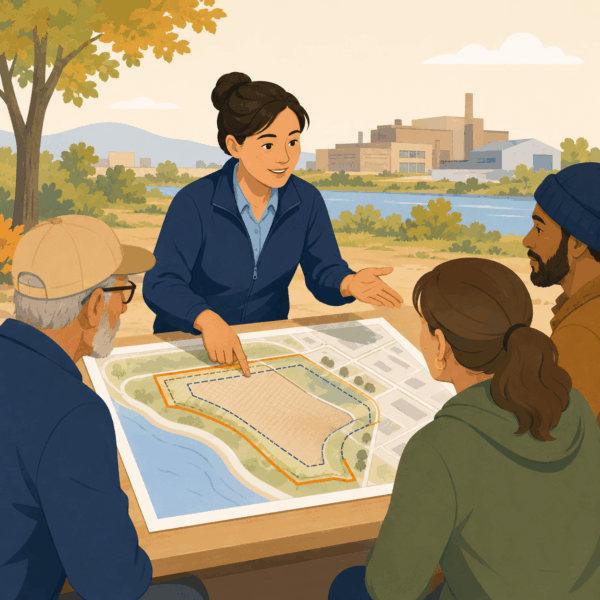 One of the most important responsibilities for departments of environmental protection is translating environmental progress into information that communities can interpret in relation to the broader redevelopment process. Technical milestones may be significant to environmental professionals while remaining abstract to residents who are primarily interested in whether the site is becoming safer, whether redevelopment is moving closer, or whether the project is still proceeding as expected.
Communication should therefore explain not only what technical work has occurred, but what that work changes. Completion of additional sampling may narrow uncertainty about the extent of contamination. Approval of a cleanup approach may establish the method by which identified conditions will be addressed. Completion of field work may move the project into monitoring or another follow-up phase. Each of these milestones becomes more meaningful when residents understand how it affects the environmental status of the site and what it does, or does not, allow to happen next.
This is particularly important because technical progress does not always produce visible change. A site may appear inactive while laboratory analysis, engineering design, regulatory review, or documentation continues. Without explanation, residents may conclude that the project has stalled, especially if earlier public attention focused on eventual construction or redevelopment. Agencies can reduce that gap by connecting less visible forms of environmental work to the next public-facing milestone and by explaining why certain decisions cannot responsibly be made until the current work is complete.
The same principle should apply when environmental findings complicate the project. If additional contamination is identified, the agency should explain how that information affects the remediation process and whether it changes the expected sequence of work. If the environmental status remains unchanged while redevelopment plans shift for other reasons, the department should clarify that distinction as well. This helps prevent the environmental agency from becoming the default explanation for every change that occurs around the site.
Communicating meaning rather than activity also improves long-term continuity. Residents who understand why a particular milestone matters are better positioned to interpret later updates. Instead of receiving a series of disconnected technical notices, they can follow a progression in which each stage contributes to a clearer understanding of the site’s condition, the remediation response, and the relationship between environmental work and potential reuse.
Use Communication to Prevent Optimism and Skepticism From Becoming Polarized
Brownfield redevelopment can generate strong and sometimes competing community reactions. Some residents may view the project as an opportunity for long-awaited investment and neighborhood improvement, while others may be skeptical because of the site’s history, previous redevelopment failures, concerns about contamination, or distrust of the institutions involved. Departments of environmental protection should avoid communicating in ways that reinforce either unrealistic optimism or generalized skepticism.
Overly promotional communication can create the impression that environmental review is simply a step toward a predetermined development outcome. This can weaken trust if residents believe that cleanup decisions are being framed primarily around redevelopment goals rather than environmental conditions. It can also create expectations that the final project will deliver benefits that remain uncertain. Environmental agencies should therefore maintain a clear distinction between supporting the responsible reuse of property and endorsing specific redevelopment outcomes beyond their authority.
At the same time, communication that focuses only on uncertainty, contamination, and regulatory process can make a project appear more stagnant or problematic than the actual status supports. Communities need a balanced explanation that acknowledges environmental complexity while also showing where meaningful progress has occurred. The agency’s role is not to persuade residents to feel positive about the project. It is to provide enough context that public judgment can be based on current information rather than incomplete or outdated assumptions.
This balance is especially important when public sentiment becomes polarized. Once residents begin interpreting every development through either strong support or strong opposition, individual project updates can be absorbed into those existing narratives. A technical milestone may be presented by supporters as proof that redevelopment is imminent, while skeptics may interpret a schedule change as evidence that the project is failing. Consistent, precise communication can reduce the space for those interpretations to drift too far from the actual status of the project.
Departments of environmental protection can support this balance by communicating in a way that separates facts from projections and progress from promises. Confirmed environmental findings should be presented as confirmed. Anticipated redevelopment outcomes should remain clearly identified as conditional when they are not yet established. Changes in schedule or scope should be acknowledged without being dramatized, and completed milestones should be recognized without being presented as evidence that every remaining issue has been resolved.
This disciplined approach supports public trust because it gives communities a stable source of information even when opinions about the redevelopment itself remain divided. The agency does not need to eliminate disagreement about the future of the site. It needs to maintain a credible explanation of the environmental process and its relationship to the broader redevelopment context.
Make Community Engagement Useful to the Decision and Communication Process
Community engagement in brownfield redevelopment should do more than provide residents with opportunities to receive information. When structured effectively, it can help departments of environmental protection identify where expectations are becoming misaligned, where project roles are misunderstood, and where technical explanations are not addressing the concerns shaping public interpretation of the site.
The value of engagement depends on the quality of the information exchanged. Public meetings, listening sessions, written comments, direct outreach, and other engagement methods can reveal whether residents understand the difference between environmental cleanup and redevelopment approval, whether they believe a proposed future use is already guaranteed, or whether they are interpreting a period of technical review as inactivity. These insights can help agencies improve subsequent communication before misunderstandings become more difficult to correct.
Agencies should also distinguish between engagement topics that fall within their authority and issues that need to be directed to other project participants. Residents may raise questions about zoning, housing affordability, traffic, tax impacts, public amenities, local hiring, or development design during an environmental meeting because those concerns are part of how they experience the redevelopment as a whole. The department should acknowledge the relevance of those concerns while clearly identifying which organization is responsible for addressing them.
This approach avoids two unhelpful extremes. One is allowing environmental staff to speculate about issues outside their authority in an effort to be responsive. The other is dismissing broader redevelopment concerns simply because they are not environmental regulatory questions. A more strategic response recognizes the concern, clarifies the agency’s role, and provides an appropriate pathway for the issue to reach the entity responsible for it.
Engagement can also improve communication sequencing. If residents repeatedly express confusion about the relationship between cleanup and redevelopment, the agency may need to explain that relationship earlier and more prominently. If community questions consistently focus on what will happen after a particular environmental milestone, future updates can provide clearer forward-looking context. When agencies use engagement feedback in this way, public participation becomes a source of communication intelligence rather than an activity conducted separately from the project’s broader communication strategy.
Over time, this can strengthen trust even when the redevelopment process remains complicated. Communities are more likely to see the agency as responsive when their recurring questions are reflected in subsequent public information and when responsibilities are explained consistently. The goal is not to guarantee agreement with every project decision. It is to create a communication environment in which residents can understand how decisions are being made, where their concerns fit within the process, and which institutions are accountable for the outcomes they care about.
Build Communication Into the Operational Structure of Brownfield Redevelopment
Managing community expectations becomes more sustainable when communication is integrated into the operational structure of a brownfield project rather than treated as a separate public-relations activity. Departments of environmental protection often work within a network of technical staff, legal teams, local officials, developers, property owners, consultants, and community representatives. If those participants do not share a common understanding of project status, timing, responsibilities, and unresolved issues, public communication can become inconsistent even when each organization is acting in good faith.
A more effective approach is to establish communication checkpoints alongside major environmental and redevelopment milestones. These checkpoints can be used to confirm what has changed, what remains uncertain, which organization is responsible for the next action, and what information is appropriate to communicate publicly. The goal is not to create another layer of bureaucracy. It is to reduce the risk that public information is assembled after the fact from incomplete or conflicting internal interpretations of the project.
This operational alignment is especially important when the project changes direction. Brownfield redevelopment may evolve because of new environmental findings, revised cleanup requirements, altered development concepts, infrastructure constraints, financing challenges, or local approval processes. When communication systems are connected to project management, agencies can respond more coherently because they are already tracking the implications of those changes for public expectations. The communication does not need to reconstruct the project narrative each time a new issue emerges.
Departments of environmental protection can also benefit from clearly documenting which public messages belong to the environmental agency and which belong to other project participants. This helps prevent duplication, contradiction, or role confusion. A local government may be best positioned to explain zoning or land-use decisions, while a developer may be responsible for construction timing and project design. The environmental agency should remain focused on site conditions, cleanup requirements, regulatory status, and the relationship between those factors and the broader redevelopment process.
When communication responsibilities are clearly defined, residents receive a more coherent picture of the project. They can better understand where to direct questions, which statements reflect confirmed environmental information, and which aspects of the redevelopment remain outside the department’s authority. This clarity can reduce frustration for both the public and agency staff, particularly in projects where many organizations are participating simultaneously.
Maintain a Reliable Public Record as the Project Evolves
Brownfield redevelopment often unfolds over a long period, and the public record can become fragmented as plans, schedules, technical findings, and redevelopment concepts change. Older webpages, meeting materials, press releases, renderings, notices, or project summaries may remain accessible long after the information they contain has been superseded. Without careful management, residents can encounter multiple versions of the project and have difficulty determining which information is current.
Departments of environmental protection should therefore treat the public record as an active communication asset. Current project materials should make it easy for residents to identify the present environmental status, the latest confirmed milestones, and the relationship between current conditions and earlier phases. When older information remains available for transparency or historical purposes, it should be clear that it reflects an earlier stage of the project and may no longer represent the current schedule or redevelopment concept.
This is particularly important when a project has experienced significant changes. If an early redevelopment plan is replaced by a different proposal, or if new environmental findings alter the cleanup approach, residents should not have to compare multiple documents to determine what changed. The current project summary should explain the transition in a concise but meaningful way, preserving enough historical context to show continuity without forcing readers to reconstruct the entire sequence themselves.
A reliable public record also supports accountability. When project milestones, changes in assumptions, and revised expectations are documented consistently, communities can see how the project developed over time. This can reduce the perception that agencies are quietly changing positions or avoiding earlier commitments. It also helps new residents, local officials, reporters, and other stakeholders enter the conversation with a clearer understanding of the project’s history and current status.
The practical benefit extends to agency staff as well. A well-maintained public record reduces the need to repeatedly answer basic questions about past milestones or explain discrepancies between older and current materials. It creates a common reference point that can support public meetings, media responses, stakeholder coordination, and direct inquiries. Over time, this consistency becomes part of the agency’s credibility.
Prepare for High-Attention Moments Before They Occur
Public attention to brownfield redevelopment is rarely constant. Interest may increase sharply when new contamination is identified, a redevelopment plan is announced, demolition or cleanup begins, construction activity becomes visible, a public meeting is scheduled, or a major project change is reported. These high-attention moments can significantly influence how the community interprets the entire project, particularly if residents encounter new information before the agency has provided context.
Departments of environmental protection should anticipate these moments and prepare communication in advance whenever possible. If field work is expected to become highly visible, residents should understand what they are likely to see and how that activity fits into the environmental process. If a major redevelopment announcement is expected, the department should be prepared to clarify the current environmental status and distinguish between confirmed cleanup milestones and future development plans. If technical findings may alter the project schedule or scope, communication should be ready to explain the significance of those findings without speculation.
Advance preparation also improves coordination with other organizations. Developers, local governments, consultants, and property owners may be communicating about the same event from different perspectives. When the environmental agency understands what those organizations intend to announce, it can ensure that its own information is accurate, complementary, and clear about the limits of its authority. This does not require joint messaging in every case, but it does reduce the risk that communities receive conflicting explanations during periods of heightened attention.
High-attention moments also create opportunities to reinforce the broader project framework. A public announcement should not only describe the immediate event. It should remind residents how the event relates to the environmental status, what decisions have already been made, what remains unresolved, and what comes next. This allows the agency to use moments of increased public interest to strengthen understanding rather than simply respond to immediate questions.
Preparation becomes especially valuable when unexpected developments occur. Not every issue can be anticipated, but agencies that already have established message structures, internal escalation procedures, and current project summaries can respond more quickly and accurately. The result is a communication system that is better equipped to maintain trust when the project becomes more visible or more complicated.
Use Community Feedback to Improve Ongoing Expectation Management
Community feedback can provide useful evidence about whether the agency’s communication strategy is actually helping residents understand the redevelopment process. Departments of environmental protection should look beyond the volume of comments or inquiries and examine the patterns within them. Repeated questions about the same issue often indicate that the existing communication is not sufficiently clear, prominent, or accessible.
If residents consistently ask whether cleanup is complete, the agency may need to explain environmental milestones more precisely. If questions focus on when construction will begin, the communication may need to distinguish more clearly between remediation progress and redevelopment timing. If people continue attributing local land-use decisions to the environmental department, role clarification may need to become more prominent across project materials.
This kind of feedback should inform future communication rather than remain confined to individual interactions. Public meetings, email inquiries, hotline calls, comments from local officials, and discussions with community organizations can reveal where expectations are becoming misaligned. When agencies systematically use that information, they can address misunderstandings before they become entrenched and refine communication around the issues that matter most to the community.
Evaluation should remain proportionate to the project. Not every brownfield site requires formal surveys or extensive public-opinion research. In many cases, recurring questions, meeting feedback, website behavior, stakeholder conversations, and staff observations provide enough information to identify communication gaps. The important point is to treat those signals as evidence about the effectiveness of the communication system rather than as isolated reactions.
Over time, this approach can improve institutional practice across multiple projects. Departments of environmental protection may begin to identify recurring points of confusion in brownfield redevelopment, such as the relationship between cleanup and development, the meaning of environmental milestones, or the limits of agency authority. Those lessons can inform future project templates, staff guidance, public-facing materials, and coordination practices.
The broader value is a more adaptive form of expectation management. Brownfield redevelopment will always involve uncertainty, multiple decision-makers, and evolving plans. Agencies cannot eliminate those conditions, but they can improve how communities understand them by monitoring where confusion persists and adjusting communication accordingly. This helps move public engagement from reactive explanation toward a more deliberate system of trust-building throughout the life of the redevelopment process.
Strategic Communication Support for Brownfield Redevelopment and Community Trust
 Brownfield redevelopment requires communication that can hold together environmental complexity, redevelopment uncertainty, multiple institutional roles, and community expectations over an extended period. Departments of environmental protection may have strong technical and regulatory processes in place while still facing challenges translating those processes into public information that residents can follow and trust. These challenges become more significant when communities are navigating changing redevelopment concepts, evolving environmental findings, high-attention project milestones, and differing messages from public and private partners.
In these circumstances, external strategic communication support can help agencies create a more coherent system for managing expectations. Support may include developing message frameworks that distinguish environmental responsibilities from redevelopment responsibilities, organizing milestone-based project updates, strengthening public-facing explanations of uncertainty, preparing materials for community engagement, aligning communication across partner organizations, and establishing protocols for responding to changes in scope or schedule. The value lies in helping agencies turn a complex, multi-organization project into a public narrative that remains accurate, understandable, and consistent as conditions evolve.
Stegmeier Consulting Group (SCG) can support departments of environmental protection by helping connect technical information, stakeholder communication, public engagement, and project coordination into a practical communication framework. This kind of support is especially useful when agencies need to clarify roles, explain the significance of environmental milestones, manage expectations around redevelopment benefits, or prepare for periods of heightened public attention. The objective is not to simplify the project beyond what the facts support, but to ensure that communities receive enough context to understand how environmental progress relates to the broader redevelopment process.
Strategic communication support can also help agencies identify where public expectations are becoming misaligned before those misunderstandings develop into broader trust problems. Recurring questions, confusion about agency authority, outdated project materials, or conflicting descriptions of future redevelopment can all signal that the communication system needs adjustment. Addressing those issues systematically allows agencies to strengthen both individual project communication and their broader institutional approach to brownfield redevelopment.
Future Trends
Brownfield redevelopment communication is likely to become more demanding as communities gain access to a wider range of project information and as redevelopment processes become increasingly visible through digital channels. Residents may encounter planning documents, environmental reports, redevelopment renderings, public meeting materials, local government discussions, property information, and project announcements from multiple organizations. Greater access can improve transparency, but it also increases the likelihood that preliminary, outdated, or context-specific information will circulate alongside current agency communication.
Departments of environmental protection will therefore need increasingly disciplined approaches to maintaining a coherent public record. Current project information should clearly identify the environmental status of the site, the latest confirmed milestones, and the relationship between remediation and redevelopment activity. Older materials may remain available for transparency, but agencies should make it easier for residents to distinguish historical information from current expectations so that obsolete plans or schedules do not continue shaping public understanding.
Digital communication also increases the speed at which expectations can form. A redevelopment rendering, announcement, or visible change at a site can circulate widely before environmental agencies have provided context about what has actually been approved or completed. This creates a stronger need for communication systems that can respond promptly to meaningful developments without sacrificing technical accuracy. Agencies that establish internal triggers for communication, maintain current project summaries, and prepare reusable message structures will be better positioned to provide context when public attention increases suddenly.
Another emerging expectation is that agencies will do more than make technical documents available. Communities increasingly need help understanding what those documents mean for the project’s direction, timing, and potential redevelopment. Plain-language project summaries, milestone explanations, role clarification, and accessible descriptions of uncertainty will become increasingly important as the volume of available information grows. Transparency will be judged not only by access to information, but by whether residents can reasonably interpret its significance.
Departments may also become more systematic in using lessons from individual brownfield projects to strengthen future communication practices. Repeated areas of public confusion, such as the distinction between remediation and redevelopment approval, the meaning of cleanup milestones, or the limits of environmental agency authority, can inform more consistent templates and guidance across programs. This institutional learning can help agencies communicate more effectively from the beginning of future projects rather than rebuilding their approach each time a new site enters the redevelopment process.
Conclusion
Brownfield redevelopment places departments of environmental protection in a communication environment where technical responsibilities intersect with expectations that extend far beyond environmental cleanup. Communities may associate a site with redevelopment opportunities, neighborhood improvement, property concerns, environmental risk, government accountability, and promises made over many years. Managing those expectations requires agencies to explain not only what environmental work is occurring, but also what that work means within a broader process that includes decisions outside the department’s authority.
Public trust is strengthened when agencies consistently distinguish confirmed decisions from possibilities, environmental milestones from redevelopment milestones, and agency responsibilities from those of other participants. These distinctions allow communities to understand progress without assuming that every environmental action guarantees a specific development outcome. They also give agencies a more credible foundation for explaining changes when redevelopment concepts, schedules, or environmental conditions evolve.
The strongest communication approach is therefore one built around continuity rather than promotion. Departments of environmental protection should maintain a clear public record, communicate uncertainty with enough specificity to be useful, coordinate with project partners, and use community feedback to identify where expectations are becoming misaligned. These practices allow residents to follow the project through its changing phases without requiring certainty that the redevelopment process itself cannot always provide.
Brownfield redevelopment will continue to involve complex interactions among environmental remediation, land use, investment, development decisions, and community priorities. Departments of environmental protection do not need to control every element of that process to communicate it effectively. Their responsibility is to ensure that the environmental portion of the project remains understandable, accurately framed, and connected to the broader redevelopment context in ways that support informed public expectations and durable trust.
Stegmeier Consulting Group’s Strategic Approach to Communication Systems
Align brownfield communication with confirmed environmental progress, clear agency roles, and realistic redevelopment expectations.
Departments of environmental protection need communication systems that help communities distinguish environmental cleanup progress from broader redevelopment possibilities while keeping roles, milestones, and changing expectations clear. Stegmeier Consulting Group (SCG) helps agencies develop coordinated public information, stakeholder messaging, and engagement approaches that connect technical environmental work to the redevelopment context without overstating certainty or agency authority.
Use the form below to connect with our team and explore how strategic communication support can strengthen public trust throughout complex brownfield redevelopment projects.