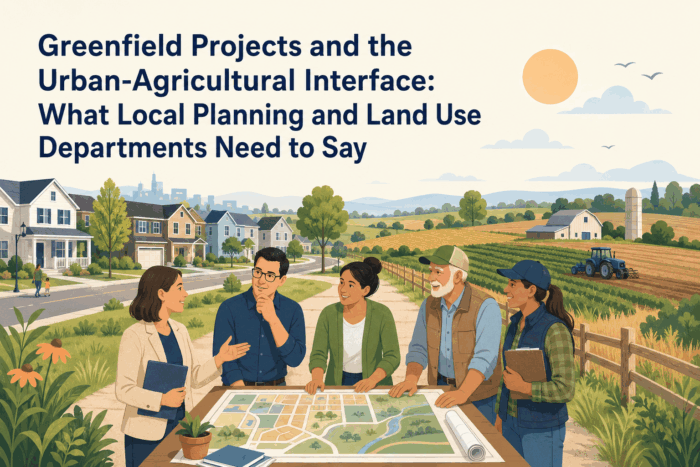
Greenfield Projects and the Urban-Agricultural Interface: What Local Planning and Land Use Departments Need to Say
Greenfield development at the edge of an urban area is often discussed in terms of land use, growth, infrastructure, housing, economic development, or community expansion. For residents and agricultural operators already living or working near the proposed development area, however, the project can represent something more immediate. It may change the relationship between homes and working farmland, introduce new traffic and infrastructure into previously undeveloped areas, alter expectations about future growth, and create uncertainty about how agricultural operations and new development will function next to one another over time.
This makes communication at the urban-agricultural interface especially important for local planning and land use departments. These departments often serve as one of the primary public-facing institutions through which residents encounter a proposed greenfield project, yet their authority is defined by local planning, zoning, development review, land-use policy, and related processes rather than by every environmental, agricultural, infrastructure, or economic issue that may become associated with the proposal. Communities may nevertheless expect planning staff to explain a wide range of consequences, from future development intensity and road changes to farmland compatibility, drainage, noise, dust, odors, agricultural equipment movement, public services, and the long-term character of the area.
The challenge is not simply to describe what a development application contains. Planning and land use departments need to explain how the proposal fits within the local land-use framework, what decisions are actually before the jurisdiction, which effects are being evaluated through the applicable review process, and which concerns fall within the responsibility of other agencies or decision-makers. They also need to communicate with enough clarity that residents and agricultural operators can distinguish between what has been proposed, what has been analyzed, what has been approved, and what remains subject to change.
Greenfield projects can become particularly contentious when different groups begin from different assumptions about the land itself. A developer may view a site as an opportunity for planned growth. Nearby residents may view it as open space that defines the edge of their community. Agricultural operators may understand it as part of a larger working landscape whose viability depends on access, circulation, water, buffers, infrastructure, and compatible neighboring uses. Local officials may be considering the site within adopted growth strategies, housing needs, infrastructure planning, or long-range development patterns. When these perspectives are not acknowledged in public communication, the project can quickly become framed as a simple contest between development and preservation even when the actual land-use questions are more complex.
Local planning and land use departments can improve public understanding by communicating the project as a transition between land uses rather than as an isolated development proposal. This framing recognizes that the most significant communication issues often occur at the boundary where new urban or suburban development meets existing agricultural activity. The department’s responsibility is not to predetermine how every stakeholder should view that transition. It is to explain the land-use process, the practical interface issues under consideration, the limits of agency authority, and the decisions that will shape whether different uses can function next to one another successfully.
The Urban-Agricultural Interface Is a Land-Use Communication Challenge
 The urban-agricultural interface creates communication challenges because neighboring land uses can operate according to very different expectations. Residential and commercial development is generally designed around patterns of daily access, utility service, roadway use, neighborhood circulation, landscaping, public amenities, and predictable environmental conditions. Agricultural operations may involve seasonal activity, early-morning or evening work, heavy equipment, truck movements, dust, odors, irrigation, crop protection practices, livestock activity, or other conditions associated with working land. When development moves closer to agricultural areas, activities that were previously separated by distance can become direct neighborhood issues.
For planning departments, the communication challenge is to explain these differences without characterizing normal agricultural activity as inherently incompatible with development or dismissing legitimate concerns from future or existing residents. Both audiences need a realistic understanding of what proximity may mean. New residents may need to understand that nearby agricultural land is not simply undeveloped open space and that active agricultural operations can produce sounds, smells, traffic, or seasonal activity. Agricultural operators may need clarity about how proposed development could change access, roadway conditions, drainage patterns, utility expansion, or the long-term pattern of adjacent land use.
This becomes more complicated because many concerns raised during greenfield development review extend beyond the boundaries of the project site. A proposed subdivision or mixed-use development may be evaluated on a specific parcel, but its effects can be experienced across surrounding roads, agricultural properties, drainage systems, infrastructure networks, and neighboring communities. Residents may therefore focus less on the internal design of the project and more on what the development represents for the future of the area.
Communication should acknowledge that broader context while remaining anchored to the decisions actually under review. Local planning and land use departments should explain how the proposal relates to existing plans, zoning, growth policies, development standards, or other applicable local frameworks without suggesting that those frameworks predetermine every project outcome. If the site has already been identified for potential future development through an adopted plan, that context should be explained. If a land-use change or discretionary approval is still required, the communication should make equally clear that the proposal remains subject to the applicable review and decision-making process.
The distinction between planned growth and approved development is particularly important. Long-range plans may identify an area for potential urban expansion, but residents can interpret that designation as evidence that a specific project has already been decided. Conversely, project opponents may interpret the initiation of environmental or land-use review as confirmation that approval is inevitable. Clear communication should separate these stages so that the public understands the difference between policy direction, an applicant’s proposal, staff analysis, advisory recommendations where applicable, and final decision-making authority.
Explain the Interface Conditions That Will Shape Everyday Compatibility
Public communication about greenfield projects should address the practical conditions that will determine how new development and existing agricultural uses interact after construction. Broad statements about compatibility are rarely sufficient because residents and agricultural operators may define compatibility differently. Planning departments should explain which interface conditions are being considered through the land-use process and why those conditions matter to the long-term functioning of both uses.
Roadway circulation is one example. Agricultural operators may depend on roads that were originally designed for rural traffic patterns and that accommodate tractors, trailers, harvesting equipment, or seasonal truck movements. New development can introduce significantly different travel patterns, more frequent vehicle movements, pedestrian activity, school transportation, delivery traffic, and expectations for roadway improvements. Communication should explain how transportation and access issues are being evaluated without implying that the planning department alone controls every roadway decision.
Buffers and site design can raise similar expectations. Residents may assume that physical separation will eliminate all agricultural effects, while agricultural operators may be concerned that new development will create complaints about routine farming practices. If project design includes setbacks, landscaping, drainage features, road alignments, or other measures intended to address the transition between uses, the department should explain their purpose accurately. These features should not be presented as guarantees that every potential conflict will disappear. Instead, they can be described as planning and design tools intended to reduce predictable interface issues where appropriate.
Water and drainage concerns may also become central, particularly in areas where agricultural land, irrigation systems, drainage patterns, and new urban infrastructure interact. Planning departments should communicate the issues within their authority and coordinate carefully when technical responsibility lies with engineering, public works, water agencies, drainage districts, or other entities. Residents should not receive the impression that every environmental or infrastructure concern raised during a land-use process is being resolved solely through planning review.
The same principle applies to noise, dust, odors, lighting, construction effects, agricultural activity, and other conditions that may become more noticeable as land uses move closer together. Effective communication does not require the planning department to predict every future interaction. It requires the department to identify foreseeable interface conditions, explain how they are being considered, and distinguish between mitigation or design measures that are part of the proposal and conditions that may remain inherent to the surrounding land-use context.
How Environmental Protection Agencies Can Make Communication Central to Regulatory Effectiveness, Public Trust, and Community Health
This article is part of our series on strategic communication for Environmental Protection Agencies, Environmental Compliance Agencies, and state and local environmental departments. To learn more and to see the parent article, which links to other content just like this, click the button below.
Define What the Planning Department Can Decide and What It Cannot
Greenfield projects often generate questions that extend well beyond the formal authority of a local planning or land use department. Residents may ask whether the project will change agricultural economics, increase taxes, affect school enrollment, alter water availability, reduce property values, change traffic throughout the region, or encourage additional development on nearby land. Agricultural operators may raise concerns about long-term access, infrastructure expansion, land conversion pressure, future complaints from residents, or the cumulative effect of multiple projects on agricultural viability.
Many of these concerns may be relevant to the broader public discussion, but they do not all fall within the same decision-making process or agency responsibility. Planning departments should therefore communicate their role with enough precision that residents understand what the department is evaluating, what information informs the review, what other agencies may be responsible for related issues, and which decisions ultimately belong to elected or appointed bodies.
This distinction should be explained proactively rather than only when staff are unable to answer a particular question. When role boundaries appear only as disclaimers, residents may perceive them as an attempt to avoid responsibility. When they are incorporated into the project communication from the beginning, they provide a clearer roadmap for understanding how the overall review process works.
Planning departments should also avoid speaking beyond the certainty of the record. If an impact has not yet been evaluated, staff should not speculate simply to provide a definitive answer. If another department or agency is responsible for a technical determination, public communication should identify that responsibility and explain how the resulting information will connect back to the land-use decision where appropriate. This protects both accuracy and institutional credibility.
The same discipline is necessary when discussing future development beyond the project itself. A greenfield proposal may create public concern that the entire surrounding agricultural area is destined for development. Planning staff should explain adopted plans, zoning conditions, growth boundaries, or other relevant policy frameworks accurately, but they should not imply certainty about future applications or decisions that have not occurred. The presence of one proposal does not automatically establish the outcome of every adjacent parcel, just as existing agricultural use does not necessarily mean that surrounding land-use policy will remain unchanged indefinitely.
Managing expectations at the urban-agricultural interface therefore depends on disciplined communication about both possibility and authority. Communities need enough information to understand what the proposed project could change, how existing agricultural activity is being considered, which issues are part of the land-use review, and where responsibility rests for decisions outside that process. Establishing those distinctions early gives local planning and land use departments a stronger foundation for communicating later analysis, public input, project revisions, and final decisions without allowing uncertainty to be replaced by assumptions.
Explain How Greenfield Development Changes the Relationship Between Land Uses
Greenfield development at the urban-agricultural edge creates a communication challenge because the project is not introducing a new use into an empty landscape. It is introducing a new pattern of activity into an existing system of agricultural operations, rural circulation, open land, infrastructure, drainage, property ownership, and community expectations. Local planning and land use departments should communicate this distinction clearly because many disagreements surrounding greenfield projects emerge from competing assumptions about what the surrounding land is and how it is expected to function in the future.
Residents may view agricultural land near an urban area as open space, a visual buffer, or an informal boundary to growth, while agricultural operators understand that same land as part of an active production environment. Developers may view a greenfield site through the lens of adopted land-use plans, market demand, infrastructure feasibility, and project design. Local governments may be balancing long-range growth policy, housing demand, fiscal considerations, infrastructure planning, environmental review, and agricultural preservation goals. These perspectives can coexist, but they do not automatically align.
Planning departments are in a strong position to help communities understand the difference between existing land use, adopted policy, and proposed development. That distinction becomes particularly important when residents assume that current agricultural use guarantees permanent agricultural use, or when applicants and supporters assume that a future land-use designation guarantees approval of a particular project. Neither assumption accurately reflects the role of the land-use process. Public communication should explain how current conditions, adopted plans, zoning, applicable standards, project-specific review, and decision-making authority interact without presenting any single element as determinative when it is not.
This approach helps shift the public conversation away from oversimplified narratives. A greenfield proposal does not necessarily represent the abandonment of agricultural interests, just as continued agricultural use does not necessarily mean that growth pressures or planning policy can be ignored. The relevant communication task is to explain how the jurisdiction evaluates the transition between uses, what factors are considered, and how the proposed project is expected to function within the broader land-use pattern.
Planning departments should also recognize that residents often interpret a single project as evidence of a much larger growth trajectory. A subdivision, employment center, commercial development, or mixed-use project at the edge of an agricultural area may prompt concern about whether neighboring properties will follow, whether infrastructure expansion will make additional development more likely, or whether the community’s physical edge is shifting permanently. These concerns may extend beyond the immediate application, but they are still part of the public context in which the project is being evaluated.
Communication should address that context through established plans and policies rather than speculation. If the jurisdiction has adopted growth boundaries, future land-use maps, annexation policies, agricultural preservation areas, infrastructure plans, or other relevant frameworks, staff can explain how those tools relate to the project. If future development on surrounding parcels would require separate applications or approvals, that should also be made clear. The department should avoid either minimizing long-term growth concerns or predicting future development that has not yet been proposed.
Distinguish Compatibility From the Elimination of Conflict
One of the most difficult concepts to communicate at the urban-agricultural interface is the meaning of land-use compatibility. In public discussion, compatibility is sometimes interpreted as a promise that neighboring uses will not inconvenience or affect one another. In practice, planning decisions frequently involve determining whether different uses can function alongside one another with acceptable levels of impact, appropriate design measures, and realistic expectations about existing conditions.
Local planning and land use departments should avoid suggesting that approval of a greenfield project means every potential conflict between agricultural operations and new development has been eliminated. Working agricultural areas can generate conditions that are noticeable beyond property boundaries, including equipment movement, truck traffic, seasonal noise, dust, odors, lighting, and other operational effects. New development can likewise introduce traffic, pedestrians, pets, lighting, drainage changes, infrastructure, recreational activity, and different expectations about neighborhood conditions.
The communication should explain how the planning process considers foreseeable interface issues and what tools may be used to address them. Depending on the jurisdiction and project, these tools may include setbacks, buffers, landscaping, roadway design, access planning, fencing, drainage measures, disclosure requirements, site orientation, or other land-use conditions. Agencies should describe only those measures that are actually relevant to the proposal and within the applicable review framework rather than implying that a standard set of techniques applies to every greenfield project.
It is equally important to explain the limits of those measures. A landscaped buffer may reduce visual or operational conflict, but it cannot guarantee that nearby residents will never experience agricultural noise or odor. A roadway improvement may improve circulation, but it may not remove every interaction between farm equipment and passenger vehicles. Communication is more credible when it explains what a planning measure is intended to accomplish without presenting it as a complete solution to conditions that are inherent to adjacent land uses.
This distinction can help manage expectations on both sides of the interface. Future residents gain a more realistic understanding of what it means to live near active agricultural land, while agricultural operators gain clearer information about how the project is being designed to reduce foreseeable conflict. The objective is not to persuade either group that the interface will be frictionless. It is to demonstrate that compatibility has been considered as a practical land-use issue rather than treated as an abstract planning concept.
The same principle applies when public discussion becomes focused on whether agriculture or development should receive priority. Planning departments should keep communication grounded in the actual policy and regulatory framework governing the site. If agricultural preservation policies apply, their relevance should be explained. If adopted plans anticipate urban development in the area, that context should also be communicated. The department’s role is to explain how competing land-use considerations are evaluated, not to reduce the process to a binary choice between two competing identities.
Make the Review Process Legible to Both Residents and Agricultural Operators
Greenfield projects often become more contentious when people do not understand how decisions are being made or where they can influence the process. Local planning and land use departments should therefore explain the review process in a way that is accessible to both nearby residents and agricultural operators, particularly when the proposal involves several stages of technical review, public notice, advisory recommendations, and formal decision-making.
The communication should distinguish between application submittal, completeness review, technical analysis, environmental review where applicable, public hearings, staff recommendations, advisory body action where relevant, and final decision-making authority. The exact sequence will vary by jurisdiction and project type, so agencies should describe the actual local process rather than rely on generic descriptions. The central goal is to prevent residents from interpreting early project activity as final approval or assuming that public participation begins only after key decisions have already been made.
Clarity about process also helps agricultural operators determine when and how to raise operational concerns. Issues involving equipment access, roadway design, irrigation, drainage, farm entrances, livestock activity, seasonal operations, or other interface conditions may be most useful when raised early enough to inform project review. If those stakeholders do not understand the sequence, important compatibility concerns may surface only after design decisions have become more difficult to adjust.
Planning departments should communicate not only when public input can occur, but how different types of information are used. Community comments about neighborhood character, traffic, agricultural operations, infrastructure, or land-use compatibility may enter the review process differently depending on the jurisdiction and applicable standards. Explaining these distinctions can help residents understand why some concerns directly affect the land-use decision while others may need to be addressed through separate agencies, technical studies, or policy processes.
This is also an opportunity to clarify the difference between public participation and decision authority. Residents and agricultural operators should understand that participation provides information, perspectives, and concerns that can inform the process, but it does not necessarily mean that every requested outcome can be adopted. Transparent communication about this distinction can reduce frustration later, particularly when a final decision does not reflect every position expressed during public review.
A legible review process strengthens trust because it allows the public to see how the project moves from proposal to analysis to decision. When communities understand the sequence, the applicable standards, the responsible decision-makers, and the opportunities for participation, they are better positioned to evaluate the process on its actual terms rather than relying on assumptions about how development decisions are made.
Keep Environmental, Agricultural, and Planning Responsibilities Distinct
Greenfield projects frequently raise environmental and agricultural concerns that overlap with, but are not identical to, land-use planning responsibilities. Local planning departments may coordinate with environmental agencies, public works departments, transportation agencies, water providers, agricultural commissioners, drainage entities, or other organizations depending on the jurisdiction and nature of the project. Public communication should reflect this complexity without creating the impression that the planning department independently controls every issue associated with the proposal.
When residents raise concerns about water supply, habitat, drainage, air quality, agricultural practices, roadway safety, or other technical matters, planning staff should explain how those issues connect to the land-use review and which agencies or departments are responsible for the underlying analysis. If a technical determination will inform the planning decision, that relationship should be made clear. If an issue falls primarily outside the planning department’s authority, staff should identify the appropriate responsibility without dismissing the concern as irrelevant.
This distinction helps preserve institutional credibility. Planning departments weaken trust when they speculate about issues outside their expertise or present another agency’s responsibility as though it were their own. They can also create frustration when they respond to legitimate concerns with procedural deflection. A stronger communication approach acknowledges the concern, explains how it relates to the project, identifies who is responsible for evaluating it, and describes how that information will be incorporated into the decision process where appropriate.
Agricultural issues require the same care. Planning staff should not generalize about the viability or future of individual agricultural operations unless the record supports those conclusions. They can, however, explain how the project addresses land-use compatibility, access, buffers, circulation, or other planning considerations relevant to adjacent agricultural properties. This allows the department to recognize agricultural concerns without claiming expertise or authority that may belong elsewhere.
Maintaining these distinctions also helps prevent the greenfield project from being incorrectly categorized as an environmental regulatory issue simply because environmental concerns are involved. The central professional context remains land-use planning at the urban-agricultural interface. Environmental review, infrastructure analysis, and agricultural considerations may contribute important information, but the communication strategy should remain anchored to the planning decisions, compatibility questions, and growth-management issues that define the project.
When local planning and land use departments maintain that discipline, they can provide communities with a clearer understanding of how a complex greenfield proposal is actually being evaluated. Residents and agricultural operators do not need every concern to be resolved by the same office. They need a communication system that shows where responsibility lies, how relevant information enters the process, and how the final land-use decision relates to the broader set of issues surrounding development at the urban-agricultural edge.
Communicate Growth as a Sequence of Land-Use Decisions, Not an Inevitable Outcome
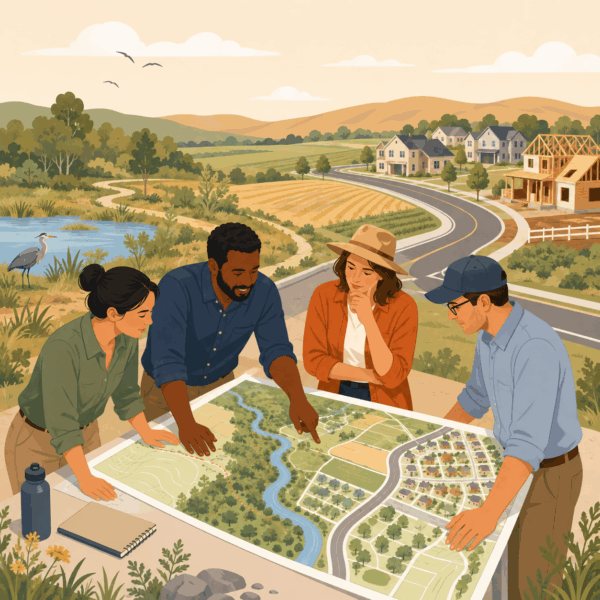 One of the most consequential communication challenges in greenfield development is the tendency for a single proposal to become interpreted as evidence of an inevitable broader growth pattern. Residents may view a new project at the edge of an agricultural area as the beginning of continuous outward expansion, while applicants or development advocates may describe the same proposal as a natural extension of adopted growth policy. Local planning and land use departments should avoid reinforcing either interpretation when the formal decision before the jurisdiction is narrower.
The most credible approach is to explain growth as a sequence of policy and project decisions rather than as a predetermined trajectory. A jurisdiction may have adopted plans that identify areas for future urbanization, infrastructure expansion, or different land uses, but those plans do not always resolve the details of individual projects. Each proposal may still require its own review, technical analysis, public process, conditions, or discretionary action depending on the local framework. Communicating that distinction helps residents understand that long-range planning and project approval are related but not interchangeable.
This matters because assumptions about inevitability can affect trust on both sides of the process. If residents believe a proposal has effectively been approved before public review begins, participation can feel performative rather than meaningful. If applicants assume that consistency with a broad planning designation guarantees approval of every project detail, later changes or conditions may be interpreted as unexpected barriers. Planning departments can reduce both forms of misunderstanding by explaining what the adopted framework establishes and what remains open for project-specific evaluation.
The communication should also address the role of infrastructure without treating infrastructure availability as proof of future development. Roads, water systems, wastewater capacity, drainage facilities, and other public improvements can influence where growth is feasible, but infrastructure planning and land-use approval remain distinct processes. A planned extension may make future development possible, yet individual applications may still depend on separate review. Conversely, a land-use designation may anticipate growth in an area where infrastructure sequencing has not yet been resolved.
Explaining these relationships can help communities interpret development pressure more accurately. Residents may still disagree about whether growth should occur, how quickly it should occur, or what form it should take. The planning department’s communication responsibility is not to eliminate those policy disagreements. It is to ensure that the public understands which aspects of growth have already been established through adopted policy, which decisions remain pending, and how each project fits within the broader planning framework.
Address Agricultural Continuity as an Operational Land-Use Issue
Agricultural concerns at the urban edge are often discussed in broad terms such as farmland preservation, rural character, or compatibility, but planning departments should also communicate the operational realities that determine whether agricultural activity can continue alongside new development. Working farms depend on more than the acreage within their property boundaries. They may rely on road access, equipment movement, irrigation systems, drainage patterns, seasonal labor, deliveries, processing relationships, and the ability to conduct ordinary agricultural activities without repeated conflict from nearby nonagricultural uses.
New development can alter those conditions even when agricultural parcels themselves are not directly converted. Additional traffic may make equipment movement more difficult. New residents may be unfamiliar with seasonal noise, dust, or odor. Changes in drainage or infrastructure can affect neighboring properties. Increased pedestrian activity, pets, lighting, or recreational use can create new points of interaction along property boundaries. These conditions do not automatically make development incompatible with agriculture, but they should be acknowledged as part of the planning context.
Local planning and land use departments should communicate how the project addresses these interface conditions without implying that the department can guarantee the future viability of individual agricultural operations. The agency can explain the planning tools, design considerations, conditions, or coordination measures being used to reduce foreseeable conflicts. It should also be candid about limits. Some aspects of living next to working agricultural land cannot be eliminated through project design alone.
This is particularly important when public communication uses phrases such as “protecting agriculture” or “maintaining compatibility.” Those statements can become misleading if they are not connected to specific planning actions. Residents and agricultural operators benefit more from knowing what measures are actually proposed, what problems those measures are intended to address, and what conditions will likely remain part of the urban-agricultural interface after development occurs.
Planning departments should also avoid assuming that all agricultural properties face the same concerns. A row-crop operation, orchard, livestock operation, nursery, or other agricultural use may interact with neighboring development differently. Communication should remain tied to the actual conditions surrounding the project rather than relying on a generic description of agriculture. This improves credibility with agricultural operators and helps residents understand that agricultural compatibility is a practical planning issue, not simply a symbolic land-use category.
Communicate Project Changes Before They Become Evidence of a Broken Process
Greenfield projects frequently change during review. Site layouts may be revised, road connections adjusted, density modified, buffers expanded, infrastructure plans refined, or other design elements altered in response to technical review, public comments, agency coordination, or applicant decisions. These changes can demonstrate that the review process is functioning, but they can also create confusion if communities are not told why the project has changed.
Local planning and land use departments should communicate major revisions as part of the decision process rather than allowing residents to discover them indirectly through updated plans or hearing materials. A revised proposal should be accompanied by a clear explanation of what changed, what prompted the revision, and whether the change affects the issues residents or agricultural operators have already raised. This helps the public understand that project evolution is not necessarily evidence of instability or hidden decision-making.
The timing of that explanation matters. If residents spend weeks discussing an outdated project design, the public conversation can become disconnected from the proposal actually under review. The department should therefore maintain a current public-facing project summary that reflects meaningful revisions and identifies when earlier materials have been superseded. This is especially important for projects that move through several hearing cycles or extended technical review.
Changes should also be communicated proportionately. Minor technical revisions do not require extensive public explanation if they do not materially affect the project’s land-use implications. Significant changes involving access, density, setbacks, interface design, circulation, drainage, or another major element deserve greater visibility because they may alter how nearby residents and agricultural operators experience the proposal.
This approach supports trust because it makes the review process legible. Communities can see that the project is being tested, revised, and evaluated rather than moving through a fixed sequence toward an inevitable outcome. At the same time, applicants gain a clearer public record showing how the proposal changed in response to review.
Build Public Communication Around the Decisions People Actually Need to Follow
Greenfield project communication can become difficult to navigate when agencies provide large volumes of technical material without clearly identifying the decisions that matter most to the public. Planning reports, environmental documents, traffic studies, infrastructure analyses, maps, and hearing packets may all contain important information, but they do not necessarily help residents understand the project’s current status or what decision comes next.
Local planning and land use departments should organize public communication around the key decisions that shape the project. Residents should be able to identify what is currently under review, which body or official has decision-making authority, what standards or policies guide that decision, when public input is relevant, and what happens after the decision is made. This creates a practical framework for understanding the project without requiring members of the public to interpret every technical document independently.
The same structure can help agricultural operators focus their participation more effectively. If a particular hearing concerns site design, access, or land-use compatibility, communication should make that scope clear. If a later decision involves infrastructure, annexation, or another separate process, stakeholders should understand that distinction. This reduces the likelihood that concerns are raised in the wrong forum or at a stage when the responsible agency cannot address them.
Public-facing communication should also distinguish between staff analysis and final decisions. Planning staff may recommend approval, denial, modification, or additional conditions, but the final authority may rest with a planning commission, board, council, hearing officer, or another decision-maker depending on the jurisdiction. Residents should understand that distinction so that a staff recommendation is not mistaken for a predetermined outcome.
The most useful communication systems make these relationships visible without oversimplifying them. A project page, public notice, meeting presentation, or community update should help people understand where the proposal is in the review sequence and what the next consequential decision will be. This allows the public to follow the process as a progression rather than encountering disconnected documents and announcements.
When communication is organized around decisions rather than information volume, planning departments can reduce confusion while preserving access to technical detail. Communities gain a clearer understanding of how the greenfield project is being evaluated, agricultural operators can participate more strategically, and the agency can maintain a consistent narrative as the proposal moves through review. That structure becomes especially important at the urban-agricultural interface, where the public is often trying to understand not only a development application but also the larger question of how growth will reshape the relationship between urban uses and working land.
Integrate Communication With the Operational Work of Development Review
Greenfield project communication is most reliable when it is connected directly to the operational work of planning and development review. Local planning and land use departments are often coordinating application materials, technical comments, public notices, interdepartmental review, environmental analysis, staff reports, hearings, and applicant revisions at the same time. If communication is developed separately from these activities, public information can quickly fall behind the actual status of the project or oversimplify issues that remain under review.
A stronger approach is to establish communication checkpoints at the same moments when the project itself reaches meaningful decision points. When a revised site plan is submitted, when major technical findings become available, when agency comments materially affect the proposal, or when a public hearing is scheduled, staff should consider whether the public-facing explanation also needs to be updated. This makes communication part of the review process rather than an activity added after technical work is complete.
Operational integration also helps departments maintain consistency across staff and channels. A project planner may understand the latest revision in detail, while front-counter staff, communications personnel, local officials, or other departments may still be relying on an earlier version of the proposal. Without a shared communication reference, residents can receive different answers depending on whom they contact. Maintaining a current project summary that identifies the proposal, current review stage, major recent changes, next decision point, and applicable responsibilities can reduce this risk.
This is especially important at the urban-agricultural interface because questions frequently cross departmental boundaries. Residents may contact planning staff about traffic, drainage, water, road improvements, agricultural operations, construction activity, or environmental concerns even when another department or agency has primary responsibility for the issue. Internal coordination allows planning staff to provide accurate context and direct questions appropriately without suggesting that every concern is resolved through the land-use process.
The department should also establish clear internal expectations about when information is sufficiently developed for public release. Sharing preliminary technical information without context can create unnecessary confusion, while withholding clearly established project changes can make the agency appear unresponsive. A structured review process helps staff distinguish between working information that is still being evaluated and material developments that should be communicated because they affect public understanding of the project.
Maintain a Current and Understandable Public Record
Long greenfield review processes can generate a large volume of public material. Initial applications, revised plans, technical studies, staff reports, meeting presentations, hearing notices, environmental documents, and public comments may accumulate over months or years. Although access to those materials supports transparency, volume alone does not make the process understandable.
Local planning and land use departments should maintain a current public-facing project record that helps residents identify which information matters now. The most recent proposal should be distinguishable from superseded versions, major revisions should be explained, and the current review stage should be easy to identify. Older documents may remain available for transparency and historical context, but residents should not have to compare multiple plan sets or staff reports to determine which project configuration is actually under consideration.
This becomes especially important when visual materials change. A preliminary site plan, conceptual rendering, or circulation diagram may continue circulating in community discussions after the applicant has substantially revised the proposal. If the department’s own project page does not clearly indicate which materials are current, outdated information can continue shaping expectations and public debate. Maintaining clear version distinctions helps keep discussion focused on the proposal that is actually being reviewed.
A strong public record should also preserve continuity between revisions. Simply replacing an older document with a newer one may remove useful context about why the project changed. Where revisions are significant, the department can provide a concise explanation of the changes and the issues that influenced them. This allows residents to see that the review process is producing substantive analysis and adjustment rather than presenting each new plan as though it appeared independently.
The same principle applies to policy context. If the project is evaluated against an adopted plan, zoning framework, agricultural policy, development standard, or other local requirement, public materials should explain that relationship in accessible language. Residents should be able to understand why particular issues are being evaluated and how those issues connect to the decision before the jurisdiction.
A well-maintained public record reduces administrative burden as well as public confusion. Staff can direct residents, agricultural operators, local officials, and other stakeholders to a common source of current information instead of repeatedly reconstructing the project history through individual responses. Over time, that consistency supports confidence that the department is tracking the project carefully and communicating changes transparently.
Prepare for High-Attention Moments at the Urban-Agricultural Edge
Public attention to greenfield development often increases sharply at predictable points in the review process. The initial announcement of a major project, release of an environmental document, circulation of a revised plan, a planning commission hearing, a local legislative decision, or the beginning of visible site work can rapidly expand interest beyond the group of residents who have followed the project from the beginning.
Planning departments should prepare for these moments rather than assuming that routine project materials will be sufficient. A technically detailed staff report may support a formal decision, but residents encountering the project for the first time may need a clearer explanation of what is being decided, what has already occurred, what major issues have been evaluated, and what remains unresolved. Providing that orientation can make high-attention moments more productive and reduce the spread of outdated or incomplete information.
Preparation is particularly important when agricultural concerns are likely to receive renewed attention. A revised roadway connection, buffer, drainage feature, or development edge may have practical implications for nearby agricultural operations. If those changes are likely to become central to public discussion, planning staff should be prepared to explain what changed, why it changed, and how the revised design addresses the issue within the limits of the department’s authority.
The same is true when public attention is driven by imagery rather than formal documents. Site plans, renderings, aerial photographs, or conceptual diagrams can strongly influence how people perceive a proposal. Planning departments should ensure that visual materials used in public communication are accurately labeled and do not imply a level of finality that the project has not reached. Conceptual imagery should be presented as conceptual when appropriate, while approved plans should be distinguished clearly from preliminary alternatives.
High-attention moments also require coordination with other public agencies and project participants. Local elected officials, public works departments, developers, agricultural agencies, utilities, and other organizations may receive questions simultaneously. If those parties are working from different assumptions about project status, public confusion can increase quickly. Coordinated factual understanding allows each organization to respond within its own authority while maintaining consistency about the underlying project.
Advance preparation does not require predicting every public reaction. It means identifying the decisions, changes, and interface issues most likely to attract attention and ensuring that staff have accurate, accessible information ready when interest increases. This allows the department to communicate from a position of clarity rather than trying to reconstruct the project narrative in response to rapidly developing public concern.
Use Community Feedback to Improve the Quality of the Planning Conversation
Community feedback is most useful when planning departments treat it as information about both the project and the communication process. Public comments can identify operational concerns that technical review may need to consider, but they can also reveal where residents or agricultural operators misunderstand the proposal, the review process, or the division of agency responsibilities. These communication signals should inform how later project information is presented.
Recurring questions are particularly valuable. If residents repeatedly ask whether the project has already been approved, the department may need to explain the decision sequence more prominently. If agricultural operators continue raising concerns about equipment access or roadway interactions, staff may need to provide clearer information about how those issues are being evaluated. If people frequently assume that one greenfield project guarantees future development on adjacent parcels, the relationship between the current application and long-range planning policy may require additional clarification.
Planning departments should use this information to improve subsequent communication rather than answering the same questions individually without changing the broader public materials. Project webpages, hearing presentations, staff summaries, fact sheets, and meeting materials can be adjusted to address recurring points of confusion. This creates a more responsive communication system without requiring the department to change the underlying planning process.
Community feedback can also help departments determine whether information is reaching the people most affected by the urban-agricultural interface. Agricultural operators may not engage through the same channels as residents of nearby subdivisions, and property owners farther from the immediate project boundary may still be affected by circulation or infrastructure changes. Reviewing who is participating and which concerns are emerging can help staff determine whether additional outreach is warranted.
The purpose of this feedback loop is not to measure success by whether opposition decreases or support increases. Land-use decisions can remain contested even when communication is strong. A more useful measure is whether participants understand the proposal, the decision process, the relevant interface issues, and the limits of agency authority well enough to engage on the substance of the project.
Over time, local planning and land use departments can apply these lessons across multiple greenfield projects. Patterns may emerge around common misunderstandings, recurring agricultural concerns, or stages of review that consistently generate confusion. Incorporating those lessons into future communication practices can improve institutional readiness and reduce the need to rebuild the same explanatory framework for every project at the urban-agricultural edge.
Strategic Communication Support for Greenfield Development and Urban-Agricultural Interface Planning
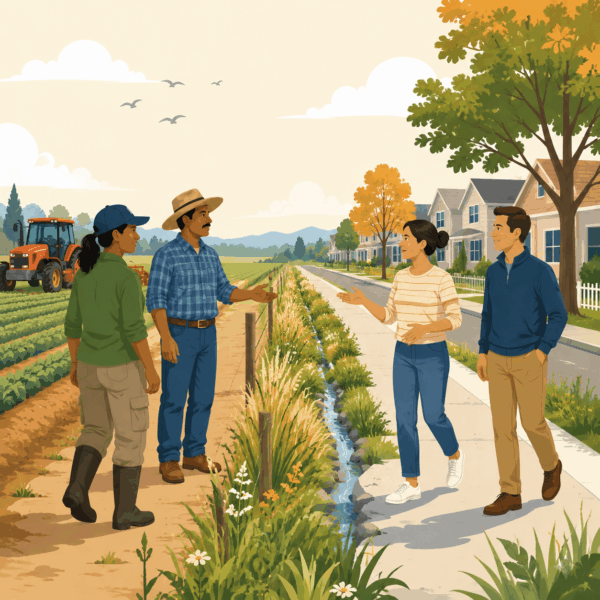 Greenfield development at the urban-agricultural edge can create communication demands that exceed the capacity of routine project notices, staff reports, or hearing materials. Local planning and land use departments may need to explain how an individual proposal relates to broader land-use policy, what is currently under review, which issues remain unresolved, and how responsibilities are divided among planning, public works, transportation, agricultural, environmental, infrastructure, and other relevant functions. External strategic communication support can be valuable when these overlapping responsibilities, changing project details, and recurring public concerns make it difficult to maintain a clear and consistent public narrative throughout a multi-stage review process.
Stegmeier Consulting Group (SCG) can provide external strategic communication expertise that helps planning departments assess communication needs, organize complex project information, develop message frameworks and public-facing materials, coordinate information across participating departments and agencies, and support stakeholder communication around urban-agricultural interface issues. SCG can help agencies explain the relationship between development proposals and adopted land-use policy, clarify planning authority versus the responsibilities of other entities, communicate evolving information about infrastructure, access, buffers, agricultural compatibility, and future growth, and maintain accurate project information as proposals change. This support strengthens the communication surrounding the responsible agency’s planning and review work without assuming any planning, regulatory, engineering, agricultural, or land-use authority.
External support can also help departments identify recurring misunderstandings and build communication systems that remain useful as projects move from application and technical review through public hearings, revisions, and final decisions. By strengthening the structure, consistency, and accessibility of public information, SCG can help agencies create clearer expectations and more credible engagement around complex greenfield development. Connect with SCG to explore strategic communication support for greenfield development and urban-agricultural interface planning.
Future Trends
Communication around greenfield development is likely to become more demanding as growth pressures, housing needs, infrastructure constraints, and agricultural preservation concerns continue to intersect at the edges of urban areas. Communities increasingly expect to understand not only the immediate proposal but also how it fits within long-range growth strategies, infrastructure plans, agricultural policy, and future land-use patterns. This will place greater pressure on planning departments to explain the relationship between individual development applications and broader policy frameworks with precision.
Digital access will also make project evolution more visible. Residents may encounter preliminary site plans, conceptual renderings, technical studies, planning maps, and hearing materials through multiple online channels, sometimes without clear indication of which materials are current. As a result, local planning departments will need increasingly disciplined approaches to maintaining current project information, labeling superseded materials, and explaining major revisions before outdated versions continue shaping public discussion.
Another emerging trend is the growing importance of cross-departmental communication. Greenfield projects often sit at the intersection of land use, transportation, infrastructure, water, drainage, environmental review, and agricultural concerns. Residents are unlikely to distinguish among those institutional boundaries unless the jurisdiction explains them clearly. Planning departments that build stronger coordination processes with relevant agencies and departments will be better positioned to provide coherent answers without implying authority they do not hold.
The urban-agricultural interface will also require more deliberate communication about coexistence rather than simple separation. As development moves closer to working agricultural areas, local governments may need to explain how design, access, buffers, circulation, and other planning tools are intended to reduce foreseeable conflicts while acknowledging that some agricultural conditions will remain part of the surrounding environment. This will require communication that is practical, site-specific, and honest about what planning measures can and cannot achieve.
Over time, departments may also become more systematic in using lessons from individual projects to improve future communication. Recurring misunderstandings about planned growth, development approvals, agricultural compatibility, or agency authority can inform more effective templates, project webpages, hearing materials, and outreach practices. Institutional learning will become increasingly valuable as jurisdictions face repeated development pressure at the urban-agricultural edge.
Conclusion
Greenfield projects at the urban-agricultural interface are difficult to communicate because they represent more than a single development application. They raise broader questions about growth, land-use transition, agricultural continuity, infrastructure, neighborhood character, and the future shape of the community. Local planning and land use departments are often expected to explain these issues even when authority is distributed across multiple agencies and decision-makers.
The strongest communication approach is grounded in clarity about process, responsibility, and uncertainty. Departments should explain how the proposal fits within adopted policy, distinguish planned growth from approved development, identify the practical interface conditions being evaluated, and make clear which decisions are within the planning department’s authority. Residents and agricultural operators should be able to understand what is currently under review, what remains unresolved, and what the next meaningful decision will be.
Public trust is strengthened when planning departments avoid overstating either certainty or control. Greenfield development can involve legitimate disagreement, and strong communication does not require consensus. It requires a process that is legible enough for people to understand how decisions are being made, what information is being considered, and how their concerns relate to the actual land-use framework.
When communication is integrated into project review, maintained across changing proposals, and informed by recurring community feedback, departments are better positioned to manage expectations throughout the life of the project. The result is not a conflict-free urban-agricultural interface, but a more credible and understandable planning process in which residents, agricultural operators, applicants, and decision-makers can engage with the proposal on clearer terms.
Stegmeier Consulting Group’s Strategic Approach to Communication Systems
Build a clear communication system around land-use roles, evolving project information, and urban-agricultural interface expectations.
Local planning and land use departments need communication systems that help residents and agricultural operators understand how greenfield proposals relate to broader policy, which issues are still under review, how responsibilities are divided across agencies, and how compatibility concerns are being addressed as projects evolve. Stegmeier Consulting Group (SCG) helps agencies strengthen the frameworks, messaging, stakeholder communication, and public-facing materials that support clearer and more consistent development review.
Use the form below to connect with our team and explore how strategic communication support can strengthen public understanding throughout greenfield development and urban-agricultural interface planning.