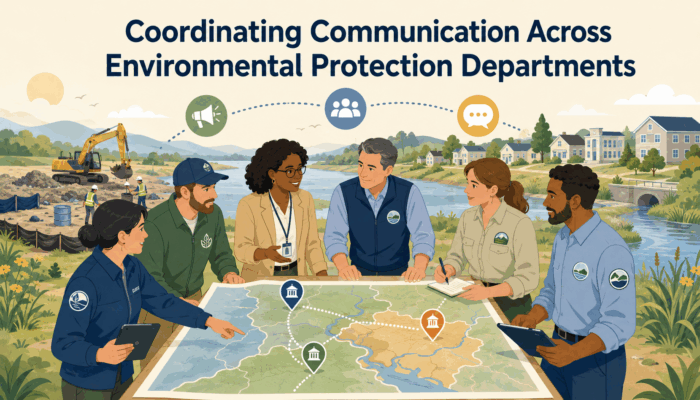
Multi-Agency Messaging on Land Rehabilitation: Coordinating Communication Across Environmental Protection Departments
Land rehabilitation projects rarely sit within the responsibility of a single public agency. A contaminated, degraded, or environmentally impaired site may involve state environmental regulators, regional environmental authorities, local governments, public works departments, redevelopment agencies, health departments, natural resource programs, transportation agencies, and other entities depending on the location and scope of the work. Each organization may oversee a different part of the process, yet residents usually experience the project as one public undertaking.
That difference creates a communication problem before it becomes an operational one. Agencies may be coordinating effectively behind the scenes while still presenting fragmented information to the public. One department may describe remediation progress, another may discuss redevelopment timing, a local agency may focus on access or infrastructure, and a separate environmental office may address monitoring or regulatory compliance. Even when each message is accurate within its own institutional context, the combined public narrative can become difficult to follow if terminology, timing, responsibilities, or expectations are not aligned.
For environmental protection departments, the central challenge is therefore not simply to communicate their own role clearly. It is to participate in a broader communication system that allows multiple agencies to explain a shared project without blurring authority or creating contradictory expectations. Residents need to understand which agency is responsible for which decision, how the different phases connect, what information is current, and where unresolved questions still remain.
This becomes especially important in land rehabilitation because the project often develops through several overlapping tracks. Environmental investigation may proceed alongside land-use planning, infrastructure design, property acquisition, redevelopment preparation, or long-term monitoring. One agency may be ready to communicate a milestone while another is still evaluating how that development affects its own responsibilities. If agencies communicate independently without a shared structure, the public may hear multiple timelines or receive different explanations for the same project status.
The communication objective should not be to collapse all agencies into a single voice. Different departments have different authorities, technical responsibilities, and obligations to the public. The stronger goal is coordinated clarity. Each organization should communicate from within its own role while using a common factual foundation, consistent terminology where appropriate, and an agreed understanding of how the project fits together.
Multi-Agency Projects Create a Shared Public Narrative Whether Agencies Plan for One or Not
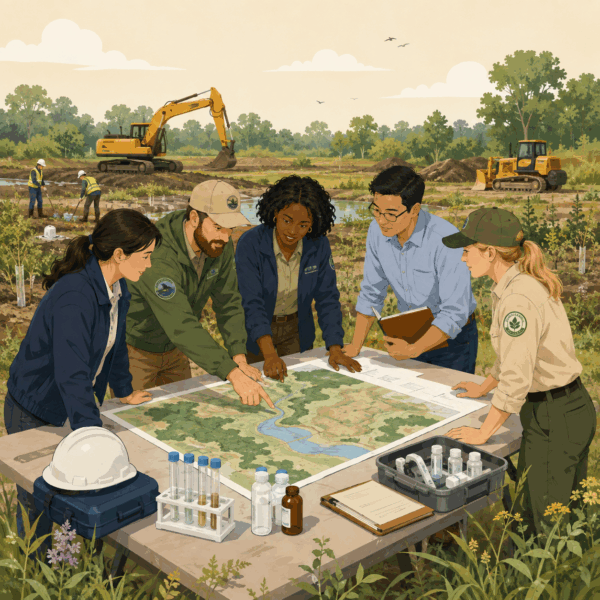 When several agencies participate in land rehabilitation, the public naturally combines their messages into one overall interpretation of the project. Residents may not distinguish between a state environmental regulator, a regional remediation program, a local planning department, or a public works agency when all are discussing the same site. If one organization says cleanup is nearly complete while another says additional environmental work remains, the public may interpret the difference as a contradiction even if both statements are technically accurate within different phases of responsibility.
Environmental protection departments should recognize that they are contributing to a shared narrative whether or not a formal communication structure has been established. This means that individual agency accuracy is necessary but not sufficient. Public understanding depends on whether the separate pieces of information fit together coherently.
A coordinated communication approach begins by identifying the project’s major public-facing questions. Communities generally want to know what has happened at the site, what environmental conditions are being addressed, which agency is responsible for which action, what has already been completed, what work remains, and how the project is expected to progress. If each agency answers only the portion of those questions that falls within its own jurisdiction, residents may still be left without a clear understanding of the overall process.
The most effective approach is to build a shared framework for the project while preserving agency-specific responsibility. This can include agreed terminology for major phases, a common description of the current project status, consistent definitions of key milestones, and clear language about where one agency’s responsibility ends and another’s begins. Agencies do not need identical wording, but their explanations should be compatible enough that residents can understand how the pieces connect.
This is particularly important when a project changes. New environmental findings, revised rehabilitation plans, infrastructure adjustments, redevelopment decisions, funding changes, or regulatory requirements can affect multiple agencies differently. Without coordination, one department may update its public information while another continues using an earlier description of the project. The resulting mismatch can make the agencies appear disorganized even when the underlying work remains coordinated.
Establish a Common Definition of the Project Before Coordinating Messages
Multi-agency communication becomes difficult when participating organizations are not using the same conceptual definition of the project. One agency may describe the work primarily as environmental remediation, another as brownfield redevelopment, another as land rehabilitation, and another as infrastructure improvement. Each label may be appropriate from that agency’s perspective, but the differences can shape public expectations in unintended ways.
Environmental protection departments should work with partner agencies to identify a common project frame that accurately reflects the overall effort without erasing the distinctions among agency responsibilities. The shared frame should explain the condition being addressed, the broad purpose of the work, and the relationship among environmental, land-use, infrastructure, or redevelopment activities where relevant.
This common definition should not be promotional or overly broad. If the project is still primarily an environmental cleanup with possible future redevelopment, communication should not describe it as a completed redevelopment initiative. If land rehabilitation includes habitat restoration, infrastructure stabilization, or another environmental objective, those elements should be reflected accurately. The goal is to give residents a stable reference point for understanding why multiple agencies are involved.
A common project frame also helps agencies decide which terms should remain consistent. Words such as remediation, rehabilitation, restoration, redevelopment, monitoring, closure, or completion can carry different technical meanings in different programs. When multiple agencies use those terms differently without explanation, residents may assume they refer to the same milestone. Coordinated communication should either harmonize terminology where appropriate or clearly explain when the same project includes distinct program-specific milestones.
How Environmental Protection Agencies Can Make Communication Central to Regulatory Effectiveness, Public Trust, and Community Health
This article is part of our series on strategic communication for Environmental Protection Agencies, Environmental Compliance Agencies, and state and local environmental departments. To learn more and to see the parent article, which links to other content just like this, click the button below.
Clarify Agency Roles Without Creating a Maze of Jurisdictions
Role clarity is one of the most important components of multi-agency communication, but it can easily become too complicated. Residents generally do not need a detailed organizational chart showing every internal responsibility. They do need to understand which agency is accountable for the major decisions and activities that affect the project.
Environmental protection departments should therefore focus public-facing role explanations on consequential responsibilities. One agency may oversee environmental investigation, another may manage cleanup implementation, a local department may handle land-use approvals, and a public works agency may coordinate infrastructure. Communication should identify these responsibilities in plain language and explain how they relate to one another.
The challenge is to avoid two extremes. One is oversimplification, where a lead agency appears responsible for everything associated with the site. The other is excessive fragmentation, where residents are directed from one office to another without a clear understanding of who can answer a particular question. A coordinated system should make responsibility understandable while still giving the public a practical path to the right information.
This becomes especially important during public meetings and stakeholder engagement. Residents often ask questions that cross agency boundaries. A question about cleanup timing may affect redevelopment planning. A question about access may involve public works. A question about long-term monitoring may return to the environmental agency. Agencies should prepare for these intersections so that residents are not forced to navigate jurisdictional boundaries in real time.
The strongest approach is to coordinate not only who owns each issue, but also how handoffs are explained. If one agency cannot answer a question because it falls outside its authority, the response should identify the responsible organization and explain how that issue connects back to the overall project. This preserves responsiveness without encouraging staff to speak beyond their expertise.
Coordinate Timing So Agencies Do Not Create Conflicting Expectations
Timing is one of the most visible areas where multi-agency communication can break down. Different departments may maintain separate schedules for environmental investigation, cleanup, design, construction, permitting, infrastructure work, redevelopment, or monitoring. These schedules are often interdependent, but they are not always updated at the same time.
Residents can become confused when one agency communicates a milestone based on its own schedule without explaining how that milestone affects the broader project. Completion of an environmental phase may be interpreted as evidence that redevelopment will begin immediately. A local construction schedule may be announced before environmental work is fully resolved. A monitoring phase may be described as ongoing after another agency has used language suggesting the project is complete.
Environmental protection departments should coordinate around major public-facing milestones before those milestones are announced. This does not require agencies to wait for every participant before communicating routine information. It does require shared understanding when one agency’s announcement is likely to affect public expectations about another agency’s work.
A coordinated timing framework should distinguish between agency-specific milestones and broader project milestones. Residents should be able to understand when an environmental task is complete, when a project is moving into another phase, and when later activities remain dependent on separate decisions. This reduces the likelihood that progress in one area is mistaken for completion of the entire land rehabilitation effort.
The same principle applies when schedules change. If a delay or new finding affects multiple agencies, public communication should explain the broader consequence rather than allowing each department to issue disconnected updates. Coordinated timing does not eliminate uncertainty, but it gives communities a more coherent explanation of how that uncertainty affects the project as a whole.
Build a Shared Communication Architecture Before Public Confusion Develops
Multi-agency land rehabilitation projects are easier to communicate when participating departments establish a shared communication architecture before public information begins to diverge. Without that structure, each agency may produce accurate updates based on its own responsibilities while unintentionally creating a fragmented public record. Residents then have to reconcile different terminology, separate schedules, varying levels of detail, and different interpretations of what constitutes progress.
A shared communication architecture does not require every agency to use identical language or surrender control over its own public information. It requires agreement on the core elements that should remain consistent across the project. These elements may include the overall project description, the current status, the major public-facing milestones, the responsibilities of participating agencies, the terminology used for key phases, and the process for updating shared information when project conditions change.
Establishing this structure early can prevent later disputes over wording and responsibility. If agencies wait until a major schedule change, new environmental finding, or public controversy to determine how information should be coordinated, communication decisions become more reactive. A standing framework allows agencies to respond from an agreed foundation rather than negotiating basic project facts under pressure.
The framework should also identify which information requires joint coordination and which information can be communicated independently. Routine agency-specific updates may not need cross-agency review, while major developments that affect the shared project narrative often do. This distinction helps agencies avoid two common problems: overcoordination that slows ordinary communication and undercoordination that allows important public messages to conflict.
Create Clear Rules for Message Ownership and Review
Message ownership is especially important in projects where several agencies are responsible for different phases or technical areas. If ownership is unclear, agencies may duplicate information, contradict one another, or leave important topics unaddressed because each assumes another organization is responsible for communicating them.
Environmental protection departments should work with partner agencies to identify which organization leads communication on major issue areas. One agency may be responsible for explaining environmental findings, another for infrastructure impacts, another for land-use decisions, and another for construction logistics. These roles should reflect actual authority and expertise rather than convenience.
Clear ownership does not mean that only one agency can mention a topic. In many cases, agencies will need to reference one another’s work to explain how the overall project fits together. The important distinction is between describing how another agency’s work connects to the project and speaking on that agency’s behalf. Coordinated communication should preserve this boundary so that public information remains accurate and responsibility remains traceable.
Review protocols should be proportionate to the significance of the message. A routine environmental monitoring update may not require review by every project partner, but a major announcement about project completion, redevelopment readiness, or a substantial schedule change may warrant broader coordination. Agencies should identify these thresholds in advance so that communication does not become either unnecessarily slow or insufficiently aligned.
A practical review structure can also reduce inconsistencies caused by timing. If one agency is preparing an announcement that affects another department’s responsibilities, the second agency should have enough opportunity to confirm the factual implications before release. This helps prevent situations in which one department publicly commits to a milestone or interpretation that another department is not yet prepared to support.
Align Public-Facing Timelines Without Pretending the Project Has One Schedule
Land rehabilitation projects often involve several schedules operating at once. Environmental investigation, remediation, permitting, infrastructure work, redevelopment planning, construction, habitat restoration, or long-term monitoring may each follow a different sequence. Attempting to collapse these into one simplified timeline can create false expectations, while presenting them as entirely separate schedules can make the project difficult to understand.
The stronger approach is to show how the schedules relate without pretending they are identical. Environmental protection departments can help establish a public-facing timeline that identifies major cross-agency milestones and explains the dependencies between them. Residents should understand which activities can proceed independently, which depend on earlier environmental or regulatory decisions, and which represent separate project tracks.
This becomes particularly important when one agency reaches a milestone that appears significant to the public. Completion of a remediation phase may be an important environmental achievement, but redevelopment or infrastructure work may still depend on separate approvals or preparation. Conversely, visible construction or site preparation may begin while some environmental obligations continue. The public-facing timeline should make these distinctions visible.
Agencies should also coordinate how they describe uncertainty within these timelines. One department may have a firm schedule for its next activity while another agency’s future work remains conditional. If those differences are not explained, residents may assume that all subsequent phases are equally certain. Coordinated communication should preserve the varying levels of certainty associated with each track.
When schedules change, agencies should identify whether the change is local to one department or whether it affects the broader project sequence. A delay in an agency-specific administrative task may have little public consequence, while a new environmental finding may alter several downstream activities. Public messaging should reflect that difference so that the scale of the communication response matches the significance of the change.
Prevent Terminology Differences From Becoming Perceived Contradictions
Multi-agency projects frequently involve technical terms that have different meanings across programs. Words such as remediation, rehabilitation, restoration, completion, closure, monitoring, redevelopment, or reuse may be used differently by environmental, planning, infrastructure, and natural resource agencies. When those terms appear in public communication without clarification, residents may assume that all agencies are referring to the same project status.
Environmental protection departments should identify terms that are likely to create confusion and coordinate their use where possible. If different agencies need to retain program-specific terminology, the public explanation should clarify the distinction. For example, one department may consider an active cleanup phase complete while another agency continues restoration or monitoring work. Both descriptions can be accurate, but the overall communication should make clear that completion of one phase does not mean completion of the entire land rehabilitation effort.
Terminology alignment also matters when agencies use different geographic descriptions of the site. One department may refer to a remediation area, another to a redevelopment district, and another to a watershed or habitat zone. If those boundaries are not clearly distinguished, residents may assume that environmental findings or project requirements apply across the entire area when they do not.
The same risk exists with status language. Terms such as proposed, approved, underway, complete, or closed can carry strong public implications. Agencies should use these terms carefully and consistently, particularly when a project includes multiple approvals and phases. A development proposal may be approved while environmental obligations continue, or an environmental remedy may be implemented while final project closeout remains pending.
Clear terminology is not a cosmetic issue. It directly affects whether communities can interpret the public record accurately. When agencies coordinate key terms and explain unavoidable differences, they reduce the likelihood that residents mistake technical distinctions for institutional disagreement.
Design Communication for People Who Will Not Follow Every Agency Separately
Most residents will not monitor multiple agency websites, attend every public meeting, or track separate technical documents to understand one land rehabilitation project. Multi-agency communication should therefore be designed for people who need a coherent overview without becoming experts in the institutional structure behind the work.
A central project information source can be valuable when several agencies are involved. Depending on the project, this may take the form of a shared webpage, coordinated project summary, common timeline, or another public-facing resource that directs residents to the appropriate agency for more detailed information. The central source should not replace agency-specific records, but it can provide a stable point of orientation.
That resource should answer the basic questions residents need to follow the project: what the rehabilitation effort is intended to address, which agencies are involved, what each organization is responsible for, where the project currently stands, what major work remains, and where people can obtain more detailed information. The goal is to reduce the burden on residents to assemble the project narrative themselves.
Agencies should also ensure that updates issued through separate channels point back to the same current project status. A public meeting presentation, social media update, news release, mailed notice, or technical webpage should not leave residents with competing descriptions of where the work stands. Cross-referencing a shared factual foundation helps preserve continuity even when each agency communicates through its own established channels.
This approach becomes more valuable as projects extend over time. Staff, local officials, contractors, and community participants may change, but the public still needs a stable way to understand the project. A well-maintained communication structure creates institutional continuity and reduces dependence on individual staff members who may hold much of the project’s historical context.
Ultimately, multi-agency communication works best when residents do not need to understand the entire governmental structure in order to understand the project. Environmental protection departments can support that goal by helping create a coordinated public narrative that preserves agency-specific authority while making the overall land rehabilitation process easier to follow.
Coordinate Communication Around Decisions That Affect More Than One Agency
 Multi-agency land rehabilitation projects become most vulnerable to public confusion when one agency makes a decision that changes the work, timing, or responsibilities of several others. A new environmental finding may require additional investigation, which can affect infrastructure sequencing, redevelopment planning, site access, or restoration activities. A land-use decision may alter the anticipated future use of the property, changing how environmental work is explained. A funding or construction decision may shift implementation timing even though the environmental requirements themselves remain unchanged. In each case, the public may experience the result as one project change even though several agencies are managing different consequences.
Environmental protection departments should therefore distinguish between decisions that are primarily internal to one agency and decisions that require coordinated public explanation. Not every technical determination needs a joint communication process, but developments that materially alter the shared project narrative should trigger cross-agency alignment. Before information is released, participating organizations should understand what changed, why it changed, which responsibilities are affected, and what the development means for the next major public-facing milestone.
This coordination is especially important when the consequences of a decision extend beyond the agency that made it. Environmental staff may understand that additional characterization affects only a specific technical phase, while a planning department may need to determine whether the revised environmental schedule affects redevelopment review. Public works staff may need to adjust access or infrastructure timing, while local officials may need updated information for constituent questions. If these implications are communicated separately without a common factual foundation, residents may receive several explanations that appear inconsistent even when they describe different aspects of the same development.
A coordinated approach should also preserve the distinction between confirmed consequences and potential downstream effects. Agencies should not assume that every environmental change will necessarily delay redevelopment, just as they should not imply that a regulatory milestone automatically clears the way for every later activity. Public communication is strongest when agencies identify what the decision definitely changes, what may be affected, and what remains under review by other responsible entities.
Create a Cross-Agency Escalation Process for High-Impact Communication
Projects involving several departments benefit from a defined process for identifying developments that warrant broader communication coordination. Without such a process, the need for alignment may not become apparent until one agency has already issued information that affects how the public interprets another agency’s responsibilities. At that point, subsequent clarification can appear corrective or contradictory even when the underlying problem was simply a lack of coordinated timing.
A cross-agency escalation process can establish practical criteria for determining when a development requires broader review. Significant changes in environmental findings, rehabilitation scope, project timing, public access, redevelopment readiness, infrastructure sequencing, or other major milestones may justify coordinated communication because they influence the shared public narrative. Routine technical activity, minor administrative adjustments, or agency-specific updates may continue through normal channels without unnecessary review.
The value of this process lies in proportionality. Requiring every agency to approve every message can slow communication and create unnecessary administrative burden. Allowing every organization to communicate major developments independently can create fragmentation. A defined escalation structure helps agencies identify the middle ground by reserving coordination for issues that materially affect public understanding of the overall project.
The process should also identify who convenes the communication discussion when a high-impact development occurs. Depending on the project, this may be the lead environmental agency, a designated project manager, a local government coordinator, or another organization with responsibility for cross-agency communication. The coordinating role should not be confused with authority over every agency’s work. Its purpose is to ensure that the participating organizations understand the shared implications before public messages are released.
When this structure is established in advance, agencies can respond more quickly during periods of heightened attention. Staff do not need to determine from scratch who should be consulted, which facts require confirmation, or whether a development affects the shared project narrative. The result is a more disciplined communication process that supports timely information without sacrificing accuracy or institutional responsibility.
Develop Message Frameworks That Preserve Both Consistency and Agency Authority
A common challenge in multi-agency communication is finding the appropriate balance between consistency and independence. If agencies communicate too independently, the public may encounter conflicting terminology, timing, or interpretations. If communication is standardized too aggressively, individual organizations may lose the ability to explain their responsibilities accurately or may appear to speak for decisions outside their authority.
Environmental protection departments should support message frameworks that establish a shared foundation while allowing agency-specific explanation. The framework can identify the core project description, current status, major milestones, key terminology, known uncertainties, and division of responsibilities. Each agency can then build its own communication around those elements while adding the technical or operational detail relevant to its role.
This approach is particularly useful when several agencies are preparing materials for the same public event. A community meeting may include environmental regulators, local officials, infrastructure representatives, and redevelopment staff. Without a shared framework, each presentation can begin from a different understanding of the project’s status, forcing residents to reconcile the differences during the meeting itself. A coordinated structure allows each participant to address a distinct area while reinforcing the same overall explanation of where the project stands.
Message frameworks can also support day-to-day communication. Staff responding to emails, media inquiries, public records questions, or stakeholder outreach can rely on a consistent project summary instead of reconstructing the narrative independently. This becomes increasingly important as projects extend over time and new staff members or partner organizations become involved.
The framework should remain adaptable. Land rehabilitation projects evolve, and a message architecture that does not change with the project will eventually become inaccurate. Agencies should therefore establish a process for updating the shared foundation when milestones are reached, responsibilities shift, or new information changes the understanding of the site. Maintaining that discipline allows consistency to support accuracy rather than preserve outdated assumptions.
Coordinate Public Engagement So Communities Do Not Have to Navigate the Agency Structure
Public engagement can become unnecessarily burdensome when residents are expected to determine which agency is responsible for each question before they participate. Land rehabilitation projects often involve concerns that cross institutional boundaries, including contamination, cleanup timing, redevelopment, access, infrastructure, environmental monitoring, public health, habitat, or long-term land use. A resident may not know which department owns a particular issue, and requiring that knowledge before the question can be addressed places the burden of governmental coordination on the community.
Multi-agency engagement should therefore be organized around the project rather than around the internal structure of government whenever feasible. Public meetings, listening sessions, stakeholder briefings, and other engagement activities can provide a clear explanation of which organizations are participating and how their responsibilities connect. When questions cross agency boundaries, staff should coordinate the response rather than redirecting residents repeatedly without context.
This does not mean every agency needs to attend every engagement activity. Participation should reflect the issues likely to be discussed and the stage of the project. An early environmental investigation meeting may require a different group of agencies than a later discussion focused on redevelopment or infrastructure. The communication plan should identify which organizations need to participate, which information can be provided in advance, and how questions outside the meeting’s scope will be routed afterward.
Agencies should also coordinate how they document and respond to recurring concerns. If residents repeatedly ask about the same cross-agency issue, the problem may not be the absence of an individual answer but the absence of a coherent public explanation. Developing a shared response, updating project materials, or clarifying the division of responsibility can reduce repeated confusion and make future engagement more productive.
This approach improves the quality of public participation because residents can focus on the substance of the rehabilitation project rather than on navigating institutional boundaries. It also improves efficiency for agencies by reducing duplicate inquiries and inconsistent responses. Over time, the public begins to encounter a coordinated system in which different organizations remain accountable for their own responsibilities while still functioning as part of a comprehensible project structure.
Prepare for Disagreement Without Allowing Agencies to Contradict One Another Publicly
Multi-agency coordination does not mean that every participating organization will always interpret project priorities in the same way. Departments may operate under different mandates, technical standards, schedules, or policy objectives. Environmental protection agencies may prioritize regulatory compliance and remediation effectiveness, while local governments may be simultaneously considering redevelopment, infrastructure, public access, or community development objectives. These differences can be legitimate and should not be concealed through artificial consensus.
The communication challenge is to distinguish legitimate institutional differences from preventable factual inconsistency. Agencies may disagree about preferred sequencing, resource priorities, or policy choices while still agreeing on the current environmental status, completed milestones, applicable responsibilities, and information that remains unresolved. Public communication should preserve that shared factual foundation even when different organizations have distinct perspectives on what should happen next.
This becomes especially important during public controversy. When a project receives criticism, agencies may feel pressure to emphasize their own role or distance themselves from decisions made by others. If each organization begins communicating defensively, the shared narrative can deteriorate quickly. Residents may encounter statements that appear to shift responsibility rather than explain the project, which can weaken confidence in the overall public process.
A stronger approach is to communicate institutional distinctions directly and professionally. If one agency controls an environmental decision and another controls redevelopment timing, that division should be stated clearly. If a later activity depends on a decision that has not yet been made, the public should understand that dependency. Agencies do not need to present every issue as resolved, but they should avoid creating unnecessary contradiction through inconsistent descriptions of the same facts.
Internal coordination can also help agencies prepare for difficult questions before public events. Identifying likely areas of disagreement, confirming the factual record, and determining which organization should address each issue can reduce the risk of conflicting answers in real time. This preparation is not about scripting away legitimate differences. It is about ensuring that those differences are communicated within a coherent and accurate understanding of the project.
When agencies maintain this discipline, disagreement does not have to become evidence of dysfunction. Communities can understand that complex land rehabilitation projects involve multiple authorities and perspectives while still receiving consistent information about the project’s status, responsibilities, and next steps. That distinction is essential to sustaining credibility across a long-term, multi-agency process.
Integrate Communication Into Cross-Agency Project Management
Multi-agency communication is most reliable when it is built into the operational structure of the land rehabilitation project rather than treated as a separate public-information function. Environmental protection departments may be coordinating investigation, remediation, monitoring, restoration, infrastructure, land-use, or redevelopment activities with several partner organizations at once. If communication is developed only after technical or administrative decisions have already been made, agencies risk releasing fragmented information that reflects individual responsibilities without explaining how the project has changed as a whole.
A stronger approach is to establish communication checkpoints at major cross-agency milestones. When new environmental findings are confirmed, responsibilities shift, schedules change, rehabilitation phases are completed, or downstream activities become possible, participating agencies should review whether the public-facing explanation also needs to change. These checkpoints help ensure that the shared project narrative remains current and that important developments are not communicated in isolation by one department before their broader implications are understood.
Operational integration also strengthens internal consistency. Project managers, technical staff, communications personnel, local officials, and partner agencies may each hold different pieces of the project history. A current cross-agency project summary can provide a common reference point that identifies the overall status, recent milestones, unresolved issues, next major actions, and the organizations responsible for each area. This reduces the risk that staff rely on outdated information or unintentionally describe the project differently depending on which agency receives the question.
The goal is not to centralize every communication decision within one office. Agencies should retain control over the information associated with their own authority and responsibilities. What matters is that significant public-facing information is connected to a shared operational understanding of the project so that agency-specific messages do not inadvertently undermine the coherence of the broader rehabilitation effort.
This structure becomes particularly valuable as projects extend over time. Staff changes, contractor transitions, leadership turnover, funding shifts, and evolving technical conditions can all weaken institutional memory. A communication system tied to project management helps preserve continuity because the public narrative is documented and maintained rather than residing primarily with individual staff members.
Maintain a Current Cross-Agency Public Record
Land rehabilitation projects can generate extensive public records across multiple departments. Environmental reports, project webpages, public notices, redevelopment materials, infrastructure updates, restoration plans, meeting presentations, technical documents, and status announcements may all be housed in different locations. Although each agency may maintain its own records appropriately, the combined public record can become difficult to navigate when information is updated unevenly.
Environmental protection departments should work with project partners to establish a clear method for identifying the current project status across those materials. Residents should be able to determine which information is current, which documents reflect earlier project phases, and where the most reliable summary of the overall rehabilitation effort can be found. This is particularly important when older schedules or project descriptions remain publicly accessible after significant changes have occurred.
A current public record should also make project evolution understandable. If remediation findings alter the anticipated rehabilitation scope, the public should not have to compare several agency documents to determine what changed. If infrastructure sequencing changes because of environmental conditions, the relationship should be explained clearly. When redevelopment or restoration plans evolve independently of the environmental work, that distinction should also be visible.
Historical information should not be removed simply because it has been superseded. Transparency requires preserving an understandable record of how the project developed. The communication challenge is to ensure that current materials provide enough context to prevent older information from being interpreted as the present project status. Clear date labeling, status descriptions, revision notes, and links between related agency materials can all support that objective where appropriate.
A coherent public record also improves agency efficiency. Staff can direct residents, local officials, media representatives, community organizations, and other stakeholders to a reliable source rather than repeatedly reconstructing project history in individual conversations. Partner agencies can reference the same current project framework while continuing to provide deeper information about their specific responsibilities.
Over time, this becomes an important part of public trust. Communities are more likely to view a multi-agency effort as coordinated when the public record reflects the same project reality across departments. Consistency does not require identical documents, but it does require that residents can move among agency sources without encountering fundamentally different versions of what is happening.
Prepare Jointly for High-Attention Project Milestones
Public attention often increases sharply at particular points in a land rehabilitation project. New environmental findings, the beginning of visible cleanup, demolition, restoration activity, infrastructure construction, redevelopment announcements, major schedule changes, or transitions into long-term monitoring can all draw renewed interest. These moments create communication risks because residents may encounter information from several agencies at the same time and compare their explanations immediately.
Environmental protection departments should identify likely high-attention milestones in advance and coordinate with relevant partners before those events occur. Preparation should include agreement on the current project status, the significance of the milestone, the responsibilities of each agency, the expected next steps, and any important uncertainties that remain. This allows each organization to communicate accurately from within its own role while reinforcing a compatible explanation of the broader project.
Joint preparation is especially important when the milestone may be interpreted differently by different audiences. Completion of a remediation phase may be viewed by residents as evidence that the entire site is finished, while planners or redevelopment officials may understand that additional work remains before reuse can proceed. A major restoration activity may create the impression that environmental obligations have ended even though monitoring continues. Coordinated messaging can clarify these distinctions before inaccurate expectations take hold.
Preparation should also extend to anticipated public questions. Agencies can identify which organization is best positioned to answer questions about environmental conditions, infrastructure, land use, redevelopment, restoration, or other project components. This reduces the likelihood that staff speculate outside their authority or redirect residents repeatedly without providing useful context.
The communication response should remain proportionate to the significance of the milestone. Not every development requires a joint press release, combined public meeting, or formal cross-agency announcement. Some issues may be handled through aligned website updates or coordinated talking points. The important requirement is that agencies assess the communication impact together when a milestone is likely to shape public understanding of the project as a whole.
Use Public Feedback to Identify Coordination Failures
Community feedback can reveal where multi-agency communication is not functioning as clearly as intended. Repeated questions about which agency is responsible for a particular issue, conflicting understandings of project timing, or confusion about whether a phase is complete can indicate that the public-facing structure is fragmented even when internal coordination appears strong.
Environmental protection departments should treat these patterns as information about the communication system rather than as isolated resident misunderstandings. If people consistently ask the same cross-agency question, the issue may require a shared explanation rather than repeated individual responses. If residents are being redirected among agencies without resolution, the project may need a clearer ownership structure or a better public pathway for obtaining information.
Feedback can come from public meetings, email inquiries, call logs, stakeholder discussions, local government partners, community organizations, media questions, and staff observations. Formal evaluation may be appropriate for large or highly visible projects, but many coordination problems can be identified through systematic review of recurring questions and points of confusion.
Agencies should use these findings to improve both current communication and future project design. A recurring problem with terminology may indicate a need for shared definitions. Confusion about agency roles may justify a clearer responsibilities summary. Persistent uncertainty about project timing may suggest that the public-facing timeline does not adequately explain dependencies among agencies.
The value of this feedback extends beyond one rehabilitation project. Environmental protection departments that participate regularly in multi-agency work can identify recurring coordination challenges and develop stronger institutional practices for future projects. Shared templates, escalation protocols, message frameworks, role descriptions, and public-information structures can all be improved based on lessons learned from earlier communication problems.
The broader objective is to create a communication system that becomes more coherent as the project evolves rather than more fragmented. Multi-agency land rehabilitation will always involve institutional complexity, separate authorities, and overlapping responsibilities. Agencies cannot remove that complexity, but they can prevent it from becoming an unnecessary burden on the public by continuously improving how the different parts of the project are explained and connected.
Strategic Communication Support for Multi-Agency Land Rehabilitation Communication
 Multi-agency land rehabilitation projects can place substantial communication demands on environmental protection departments because public understanding depends on more than the accuracy of any single agency’s message. Agencies may need to align terminology, explain overlapping responsibilities, coordinate timing, maintain a shared public record, prepare for high-attention milestones, and respond to recurring confusion across several departments or jurisdictions. External strategic communication support can be valuable when these needs exceed available internal capacity or when an objective outside perspective can help identify where fragmented messaging, unclear ownership, or inconsistent project information is weakening the public narrative.
Stegmeier Consulting Group (SCG) can provide external strategic communication expertise that helps environmental protection departments assess communication needs, organize complex multi-agency information, develop shared message frameworks, clarify agency roles, coordinate public-facing updates, and create communication tools that remain useful as land rehabilitation projects evolve. SCG can support agencies in building current project summaries, cross-agency communication protocols, stakeholder messaging, meeting materials, public information structures, and processes for identifying when a major development requires broader coordination. This support strengthens how responsible agencies explain their own work and connect it to related activities without implying that SCG performs environmental, regulatory, planning, engineering, restoration, or redevelopment functions.
External support can also help agencies identify recurring communication breakdowns and convert those lessons into stronger systems for future coordination. When residents repeatedly encounter conflicting timelines, unclear terminology, uncertain agency ownership, or outdated information, those patterns can signal a structural communication problem rather than a one-time messaging issue. SCG can help agencies address those gaps in a way that supports clearer expectations, more consistent public information, and a more credible multi-agency process. Connect with SCG to explore strategic communication support for complex land rehabilitation initiatives involving multiple environmental and public-sector partners.
Future Trends
Multi-agency land rehabilitation communication is likely to become more complex as environmental projects increasingly intersect with redevelopment, infrastructure, climate resilience, habitat restoration, community development, and long-term site management. These overlapping responsibilities will create more situations in which several agencies are communicating about the same property or landscape from different professional perspectives. The need for coordinated public explanation will therefore grow even when the underlying institutional structure remains decentralized.
Digital communication will intensify this challenge. Residents may encounter environmental reports, redevelopment announcements, infrastructure updates, meeting materials, maps, agency webpages, and public records from several organizations at once. When these materials use different terminology or reflect different points in the project’s development, inconsistencies can become visible immediately. Agencies will need stronger practices for maintaining current information, identifying superseded materials, and ensuring that separate public channels still reflect a compatible understanding of project status.
Another emerging expectation will be greater clarity about cross-agency accountability. Communities are increasingly unlikely to accept being redirected repeatedly between departments without a clear explanation of how responsibilities connect. Environmental protection agencies and their partners will need communication structures that preserve jurisdictional boundaries while making the overall project easier to navigate. This may increase the value of shared project summaries, coordinated timelines, integrated public meeting materials, and clearer pathways for routing questions across agencies.
Agencies may also become more systematic in identifying communication milestones alongside technical milestones. A new environmental finding, rehabilitation phase, infrastructure decision, or redevelopment development may have implications across several organizations even when the formal decision belongs to only one. Recognizing these points in advance can improve readiness and reduce the likelihood that separate announcements create conflicting expectations.
Over time, multi-agency projects may also generate stronger institutional knowledge about recurring coordination problems. Departments that document where terminology diverges, where responsibilities become unclear, and where public confusion repeatedly emerges can refine future communication protocols before the same issues reappear. The long-term trend is likely to be toward more deliberate integration of communication planning into the governance of complex environmental projects rather than treating coordination as something that occurs only when public concern increases.
Conclusion
Land rehabilitation projects involving multiple agencies create a communication challenge because communities experience the work as one connected public effort even when authority is distributed across several departments, programs, and levels of government. Environmental protection departments must therefore do more than ensure that their own information is technically accurate. They need to understand how their messages interact with the broader public narrative surrounding the site.
The strongest approach preserves agency-specific authority while coordinating the information that communities need to follow the project as a whole. This includes shared definitions of project status, clear explanations of agency roles, aligned terminology, coordinated treatment of major schedule changes, and a public record that remains coherent as different phases advance at different speeds. These practices reduce the likelihood that legitimate institutional complexity is interpreted as contradiction or disorganization.
Effective coordination also depends on operational systems. Communication checkpoints, message ownership, escalation protocols, joint preparation for high-attention milestones, and structured use of public feedback can help agencies maintain consistency without creating unnecessary approval layers. The objective is not to create a single institutional voice, but to ensure that multiple voices remain compatible, accurate, and understandable.
When agencies manage communication in this way, residents do not need to become experts in governmental structure to understand the rehabilitation effort. They can see what has happened, what remains, who is responsible for each major decision, and how the different parts of the project connect. That clarity supports a more credible multi-agency process and gives environmental protection departments a stronger foundation for sustaining public trust throughout long-term land rehabilitation.
Stegmeier Consulting Group’s Strategic Approach to Communication Systems
Coordinate multi-agency land rehabilitation communication around shared facts, clear ownership, and consistent project status.
Environmental protection departments need communication systems that allow multiple agencies to explain one land rehabilitation effort without blurring authority or creating conflicting expectations. Stegmeier Consulting Group (SCG) helps agencies strengthen shared message frameworks, public-facing project information, stakeholder communication, cross-agency coordination, and internal communication protocols so that residents receive a coherent explanation of project status, responsibilities, and next steps.
Use the form below to connect with our team and explore how strategic communication support can strengthen coordination and public understanding across complex land rehabilitation projects.