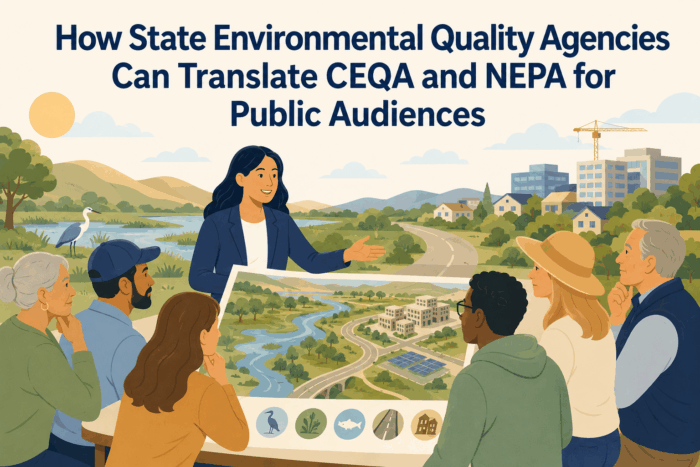
Plain Language Permitting: How State Environmental Quality Agencies Can Translate CEQA and NEPA for Public Audiences
Environmental review under the California Environmental Quality Act (CEQA), the National Environmental Policy Act (NEPA), and comparable state and federal processes produces some of the most information-dense documents that public agencies ask communities to engage with. Environmental impact reports, environmental assessments, environmental impact statements, technical appendices, notices, findings, mitigation measures, alternatives analyses, and supporting studies may contain the information residents need to understand a proposed project, but they are primarily structured to satisfy regulatory, analytical, and administrative requirements. They are not inherently designed to help a resident determine what a project would change in their community, which environmental effects matter most, what the agency has concluded, what remains open for consideration, and how public participation can influence the process.
For state environmental quality agencies, plain-language permitting and environmental review communication should not mean simplifying CEQA or NEPA until the legal and technical distinctions disappear. It should mean creating a reliable translation layer between the formal environmental review record and the public audiences expected to participate in it. That translation must preserve the meaning of the underlying analysis while reorganizing information around the decisions, impacts, and participation questions people actually need to understand.
This work is particularly important because environmental review often attracts public attention at moments when communities are already forming opinions about a proposed project. A large industrial facility, infrastructure project, energy development, transportation improvement, waste facility, housing development, or other major proposal may generate concerns about air quality, water, traffic, noise, habitat, public health, land use, cultural resources, construction impacts, or cumulative change. By the time the formal environmental document becomes available, residents may already have encountered project descriptions from developers, advocacy organizations, local officials, media coverage, or neighbors. The agency’s environmental review enters an existing information environment rather than beginning the public conversation.
If the agency’s contribution consists primarily of posting a technical document and announcing a comment deadline, the most accessible explanations may come from parties with their own interests in the outcome. State environmental quality agencies should therefore treat plain-language environmental review communication as part of the infrastructure of meaningful public participation. The public needs an authoritative explanation of what is being reviewed, what the analysis found, what the review process can and cannot decide, and where public input fits before the regulatory record becomes too difficult for non-specialists to navigate.
The communication responsibility also changes as the review progresses. Early communication should help communities understand the proposed action and the purpose of environmental review. Draft-stage communication should help people identify significant findings, alternatives, mitigation measures, unresolved questions, and opportunities for comment. Final-stage communication should explain what changed, how significant issues were addressed, what decisions were made, and which commitments will carry forward into implementation. Treating each phase as though the same notice language is sufficient misses the different information needs that arise throughout the process.
State environmental quality agencies can strengthen public understanding by designing these communication layers deliberately. The objective is not to produce a shorter substitute for the environmental document. It is to give people enough orientation that they can use the formal record more effectively and participate from an informed position.
Explain the Purpose of Environmental Review Before Explaining the Document
 Many communication problems begin because agencies assume the public already understands what CEQA or NEPA review is designed to accomplish. Residents may believe an environmental impact report is a permit, a public vote on whether a project should exist, a health study that determines whether every possible exposure is safe, or a process that requires the agency to select the option with the fewest environmental impacts. When those expectations do not match the actual review process, even technically accurate communication can leave people feeling that the agency ignored the issues they raised.
State environmental quality agencies should establish the purpose and boundaries of environmental review before asking communities to interpret its findings. Public-facing communication should explain that environmental review identifies and evaluates potential environmental effects, considers measures or alternatives as required by the applicable process, provides information for agency decision-making, and creates opportunities for public and agency input. The exact description should reflect the specific review framework and the agency’s role rather than collapsing CEQA and NEPA into a single procedural model.
This distinction is important because CEQA and NEPA are often spoken about together in public communication even when the legal processes, terminology, decision structures, and agency responsibilities differ. A project involving both state and federal review may generate documents and procedural steps that overlap without being identical. Agencies should explain which process applies, which agency is responsible for which review, and whether the public is participating in one coordinated process or several related ones.
Plain language should make these relationships easier to understand without suggesting that the laws are interchangeable. A community member should not need to know the difference between every administrative term before understanding who is analyzing the project, which decision is pending, and where comments should be directed.
The agency should also distinguish environmental review from other approvals. A project may require land use approval, environmental permits, construction authorization, water or air permits, federal approvals, or other decisions administered by separate agencies. Environmental review may inform some of those decisions without replacing them. When the public assumes the environmental review agency controls every aspect of the project, comments may focus heavily on matters outside the decision before that agency.
Rather than dismissing those concerns as irrelevant, state environmental quality agencies should explain the decision structure. Clear communication can show which issues are addressed within environmental review, which are considered through another permitting or approval process, and which agency is responsible for that process. This helps communities direct their participation more effectively and reduces the sense that government is using jurisdictional boundaries to avoid difficult questions.
How Environmental Protection Agencies Can Make Communication Central to Regulatory Effectiveness, Public Trust, and Community Health
This article is part of our series on strategic communication for Environmental Protection Agencies, Environmental Compliance Agencies, and state and local environmental departments. To learn more and to see the parent article, which links to other content just like this, click the button below.
Build a Public-Facing Project Summary Around Community Decision Points
Executive summaries can help readers navigate complex environmental documents, but they are not always written as public communication tools. They may still rely heavily on regulatory terminology, impact codes, technical findings, cross-references, and tables that assume familiarity with environmental review. State environmental quality agencies should consider a separate plain-language project summary designed around the questions a community member is likely to ask first.
The summary should begin with the proposed project itself. What is being proposed. Where would it occur. What would physically change. What major activities would occur during construction and operation. Which public agency is conducting the environmental review. What decision or approval is being considered at this stage. These basic facts provide the frame needed to interpret everything that follows.
The next layer should identify the environmental topics that are most consequential to the review. Rather than listing every resource category with equal emphasis, communication can help readers understand where the analysis identified potentially important effects and where the review found relatively limited concern. This should be done carefully so that the agency does not substitute communication judgment for the formal significance determinations in the environmental document.
Public summaries should also distinguish the proposed project from alternatives. Community members sometimes encounter alternatives only deep within a document and may not understand why the agency evaluated them. A plain-language explanation can identify the principal alternatives analyzed, describe the major differences among them, and explain why alternatives are part of the review process without implying that every alternative remains equally feasible or available for selection.
The same approach should apply to mitigation. Communities need more than a statement that impacts will be mitigated. They need to understand what significant mitigation measures actually require. If a measure changes construction practices, establishes monitoring, restricts activities, requires restoration, alters project design, or establishes another concrete obligation, the public-facing explanation should describe that practical effect accurately.
A project summary can therefore function as an orientation tool rather than a substitute document. It should tell readers where the most consequential issues are located in the formal record and help them determine which sections they may want to examine in greater detail.
Separate What the Analysis Found From What the Agency Has Not Yet Decided
Environmental review communication becomes confusing when analysis, recommendation, and final decision are presented as though they are the same thing. A draft environmental document may contain findings about potential effects and proposed mitigation while the agency’s ultimate decision remains pending. Public audiences need to understand that distinction if the comment process is expected to feel meaningful.
State environmental quality agencies should clearly label what has been analyzed, what is proposed, what remains subject to public review, and what has already been determined. If a mitigation measure is proposed in a draft document, communication should not describe it as a completed commitment unless the applicable process has reached that stage. If an alternative remains under consideration, the agency should not use language that implies the preferred outcome is already final.
This distinction is particularly important when project proponents, partner agencies, or public officials communicate more definitively than the environmental review process allows. Residents may hear that a project “is happening” while the environmental document tells them their comments are still being accepted. Even if those statements refer to different decisions, the inconsistency can make the review process appear predetermined.
The agency’s communication should therefore establish a precise procedural status. Public audiences should know what document has been released, what decisions remain ahead, what type of input is being requested, and what will happen after the current phase ends. This gives participation a visible relationship to the regulatory process rather than presenting public comment as an isolated administrative requirement.
Translate Significance Findings Without Turning Them Into Simple Labels
Environmental review relies on significance determinations that can be difficult to communicate outside technical and regulatory contexts. Phrases describing significant impacts, less-than-significant impacts, mitigation, thresholds, cumulative effects, or unavoidable impacts carry specific meaning within the review process. When those terms are presented without context, residents may either underestimate or overinterpret what the agency has concluded.
State environmental quality agencies should translate significance findings by explaining both the conclusion and the basis for it. Instead of presenting a category alone, public communication should identify the environmental effect being evaluated, what the analysis considered, and what measures or project features affect the conclusion.
This is especially important when the public’s lived experience appears to conflict with a formal significance determination. Residents may already experience traffic congestion, odors, poor air quality, noise, flooding concerns, or another environmental burden and then encounter a document stating that a project’s impact in that area is less than significant. Without additional explanation, the terminology may sound as though the agency is saying the existing problem does not matter.
A stronger explanation distinguishes the condition being evaluated from the broader environmental experience of the community. The agency can explain what project-related change was analyzed, which threshold or analytical framework was applied, and what conclusion the review reached without making broader claims that the analysis does not support.
The same caution applies when an impact is identified as significant. The term should not automatically be translated into language suggesting catastrophe, imminent danger, or a project that cannot legally proceed. The public needs to understand the regulatory meaning of the finding and what happens next in the review process.
Mitigation status also requires precision. If mitigation would reduce a particular effect, communication should explain what action would be required and how that action relates to the significance conclusion. Agencies should avoid phrases such as “the impact has been addressed” when the practical meaning is that a measure is proposed or required to reduce the effect according to the applicable analysis.
Plain-language communication is strongest when it preserves these distinctions. The goal is not to replace environmental review terminology with more reassuring or alarming wording. It is to explain the terminology well enough that residents can understand what the agency actually found.
Give Readers a Navigation Path Through the Environmental Document
A major environmental review document can be difficult to use even for readers who understand its terminology. Information may be distributed across a project description, technical resource chapters, alternatives analysis, appendices, response-to-comments sections, mitigation tables, and supporting studies. Public communication should therefore help residents navigate the record rather than simply linking to a large collection of files.
State environmental quality agencies can provide a public-facing document guide that explains where different types of information are located. A resident concerned about construction air emissions should be able to identify the relevant analysis without first understanding the document’s entire architecture. Someone interested in habitat, water supply, noise, cultural resources, transportation, or another topic should have a clear route to the relevant sections and supporting materials.
The guide should also explain the relationship between the main environmental document and its appendices. Technical appendices may contain modeling assumptions, calculations, surveys, data, or methodologies that are essential to the analysis but difficult for general readers to interpret. A plain-language description can explain what each major supporting document contributes without attempting to reproduce its technical content.
Digital presentation matters as well. Breaking a document into separate files may improve downloadability while making navigation more difficult if the files have vague names or no explanation of their contents. Conversely, one enormous file can be difficult to access on mobile devices or slower internet connections. Agencies should organize the online record around usability as well as administrative completeness.
Public-facing pages can identify the current document, prior versions where relevant, comment instructions, key deadlines, meeting information, technical appendices, and subsequent decisions in one consistent location. This becomes increasingly important as a review progresses and older notices remain searchable online. Residents should not have to determine which of several similarly named documents represents the current stage.
Navigation is part of plain language because accessibility is not limited to sentence structure. A document written clearly but buried inside an incomprehensible digital filing system remains difficult for the public to use.
Explain Public Comment as a Way to Improve the Environmental Record
Public comment periods frequently communicate deadlines more clearly than purpose. Notices tell residents when comments must be submitted, where to send them, and sometimes which formal requirements apply. They often provide much less guidance about what makes a comment useful within environmental review.
State environmental quality agencies should explain public comment as an opportunity to contribute relevant information, question assumptions, identify environmental concerns, point to local conditions, address alternatives or mitigation, and engage with the environmental analysis according to the applicable process. This helps residents move beyond the assumption that comments function primarily as votes for or against the project.
Communities should not be expected to write like environmental lawyers or technical consultants. A resident may possess important local knowledge about seasonal flooding, wildlife movement, neighborhood travel patterns, recurring odors, use of a cultural resource, or another condition that is not easily visible in a technical dataset. Agencies can explain that specific observations and information can be valuable without suggesting that every anecdotal statement automatically changes an environmental conclusion.
At the same time, public guidance should be honest about the limits of the process. Commenting does not guarantee that the agency will adopt the outcome the commenter prefers. Environmental review provides a framework for evaluating information and making decisions under applicable law. Strong communication should explain how comments enter that framework and what the agency does with them after the comment period closes.
This is where plain-language environmental review becomes directly connected to regulatory legitimacy. A community cannot participate meaningfully in a process it cannot understand. Posting the required environmental documents and opening a comment period may satisfy procedural obligations, but public understanding depends on additional communication that explains the project, the analysis, the unresolved decisions, and the role residents can actually play.
For state environmental quality agencies, the central task is not to make CEQA and NEPA simple. These processes address complicated projects, competing environmental considerations, technical evidence, and formal legal requirements that cannot always be reduced to short explanations. The task is to make the process navigable. When agencies create clear translation layers around formal environmental documents, communities are better equipped to understand what is being analyzed, locate the information that matters to them, and participate in the review before critical decisions are complete.
Translate the Review Process Into a Sequence the Public Can Follow
Environmental review becomes easier to understand when state environmental quality agencies communicate it as a sequence of decisions and opportunities rather than as a collection of document types. Residents may encounter notices of preparation, scoping materials, draft environmental documents, technical appendices, public hearings, response-to-comments documents, findings, mitigation monitoring requirements, and final decisions without understanding how those pieces connect. The result can be procedural overload even when each individual notice is accurate.
Agencies should explain the review as a progression. Public-facing communication can identify what has already happened, what is happening now, what the agency is asking the public to do at the current stage, and what will happen next. This structure gives residents a practical mental model for the process and reduces the need to interpret procedural terminology before participating.
The sequence should also distinguish environmental analysis from the underlying project approval. In some cases, the environmental document is one component of a larger decision process. In others, several agencies may rely on related environmental information while making separate decisions under their own authorities. Public communication should make these relationships visible so that residents understand why one hearing may concern environmental analysis while another concerns a permit, land use action, or other approval.
Agencies should avoid presenting the process as perfectly linear when it is not. New information may lead to additional analysis, documents may be revised, schedules may change, or related approvals may proceed on different timelines. Plain-language communication should provide enough structure to orient the public while acknowledging where the process can evolve.
This approach is especially useful for people entering the process late. A resident who first learns about a project during the draft review stage should be able to understand what earlier steps occurred without reading every prior notice. A current project page can provide that context through a concise process summary tied to the actual status of the review.
Make Technical Analysis Understandable Without Converting It Into Advocacy
State environmental quality agencies frequently face pressure from all sides when explaining technical findings. Project proponents may want the agency to emphasize that impacts are manageable. Opponents may believe the agency is minimizing serious consequences. The agency’s communication role is neither to promote nor criticize the project. It is to translate the environmental analysis accurately enough that the public can understand what was studied and what the analysis concluded.
This requires discipline in how technical findings are summarized. A public explanation should identify the question the analysis examined, the information or method used to evaluate it, the result, and the regulatory significance of that result. Where important assumptions shape the conclusion, those assumptions should be visible enough that interested readers can understand the basis for the finding.
Agencies should avoid replacing technical terminology with emotionally loaded substitutes. A finding should not be translated into language that sounds safer or more dangerous than the underlying analysis supports. Plain language should improve accessibility, not change tone to influence public reaction.
This is particularly important for topics such as air quality, greenhouse gas emissions, noise, water resources, biological resources, transportation, hazardous materials, or health-related analysis. These subjects may involve models, thresholds, projections, baseline conditions, and technical uncertainties. Public summaries should explain the practical meaning of the analysis while making clear that the formal environmental document remains the authoritative source for the complete methodology and findings.
Agencies should also distinguish between measured conditions and modeled outcomes. A model may estimate future project effects based on assumptions about activity, equipment, population, traffic, emissions, or other variables. Residents should understand when a number represents an estimate rather than a direct measurement. Conversely, monitoring or existing-condition data should not be described as though it predicts future project performance unless the analysis supports that use.
Clear translation becomes more credible when the agency explains both what the analysis can show and what it cannot establish with certainty.
Explain Baseline Conditions Before Discussing Project Impacts
One of the most confusing concepts in environmental review is the baseline against which project-related changes are evaluated. Community members often judge a proposal against the environmental conditions they believe should exist, while the formal analysis may compare the project with an existing or otherwise defined baseline under the applicable review framework.
State environmental quality agencies should explain this distinction because many apparent disagreements about significance begin with different assumptions about the starting point. A resident may already consider local traffic, noise, air quality, habitat loss, water demand, or another condition unacceptable. If the environmental document then evaluates only the incremental change associated with the proposed project, a less-than-significant conclusion may appear disconnected from community experience.
Public communication should clarify that the environmental review is evaluating a project-related change according to the applicable analytical framework. This does not mean existing conditions are unimportant. They may be central to understanding the baseline, cumulative conditions, or other aspects of the analysis. It means the specific significance determination may address a different question than whether the community currently experiences an environmental problem.
The agency should avoid using this explanation defensively. Saying that a concern “already exists” can sound dismissive if residents are describing a real burden. A more useful explanation identifies the existing condition, explains how it is represented in the analysis, and then describes what additional change the project is expected to create.
This can also help communities understand why two projects in different locations may receive different environmental conclusions even if they appear similar. Baseline conditions, surrounding land uses, environmental sensitivity, available infrastructure, and other contextual factors can affect the analysis.
When the starting point is clear, the public is better positioned to understand what a significance finding actually means rather than interpreting it as a judgment about the overall quality of existing environmental conditions.
Clarify How Alternatives Function Within Environmental Review
Alternatives analysis is one of the most important and least intuitive components of major environmental review. Public audiences may assume that every alternative listed in an environmental document is equally likely to be selected, that the agency is required to choose the alternative with the lowest environmental impact, or that community members can create an unlimited number of substitute projects for formal consideration.
State environmental quality agencies should explain why alternatives are analyzed and how they relate to the decision at hand. The specific legal requirements differ between CEQA and NEPA contexts, so public communication should reflect the applicable framework rather than rely on generic language. At a practical level, residents need to understand that alternatives help decision-makers and the public compare different ways of meeting project objectives or addressing the proposed action while examining environmental tradeoffs.
The communication should identify the major differences among the alternatives without reducing the comparison to a single ranking. One alternative may reduce an air quality impact while increasing another environmental effect. Another may change project scale, location, design, or operational characteristics. A no-project or no-action alternative may provide an analytical reference that does not necessarily represent the agency’s recommended outcome.
Public summaries should also explain why certain alternatives received more detailed analysis than others when that information is part of the environmental record. Communities may propose options that appear reasonable from a local perspective but differ significantly from the project objectives, jurisdictional authority, feasibility considerations, or analytical requirements used by the agency. A clear explanation of the review framework can help residents understand how alternatives enter the process without treating their suggestions as automatically invalid.
Agencies should be cautious about describing one alternative as the “best” option unless the agency has formally reached that conclusion. Before a decision is made, communication should preserve the distinction between the environmental comparison and the ultimate policy or regulatory choice.
Turn Mitigation Measures Into Understandable Commitments
Mitigation measures often contain some of the most consequential information in an environmental document because they describe actions intended to avoid, reduce, minimize, or otherwise address identified environmental effects. Yet mitigation language is frequently written in technical or administrative form that makes it difficult for the public to understand what will actually happen.
State environmental quality agencies should translate significant mitigation measures into practical descriptions while preserving the enforceable language in the formal record. The public should be able to understand who is expected to act, what action is required, when it must occur, and how implementation will be documented or monitored where the process provides for that information.
For example, a measure may require construction practices during a particular phase, biological surveys before ground disturbance, limits on equipment or activity, restoration of affected resources, implementation of monitoring programs, or changes to project design. Public summaries should describe those obligations in concrete terms rather than relying only on measure numbers or abbreviated references.
Agencies should also distinguish mitigation measures from general recommendations or voluntary project features. If an action is part of the formal environmental commitment, that status should be clear. If it is proposed but not yet adopted, the communication should preserve that distinction.
The relationship between mitigation and significance findings should also be explained. Some impacts may be reduced through mitigation to a level identified by the environmental analysis as less than significant. Others may remain significant even after mitigation. Residents should be able to understand that difference without navigating several sections of the environmental document.
Where implementation will occur over a long period, the agency should explain how mitigation obligations carry forward beyond the final environmental decision. A public process that devotes substantial attention to mitigation during review but provides no accessible explanation of later implementation can create the impression that commitments disappear after project approval.
Explain Cumulative Effects Without Suggesting One Project Is Responsible for Every Existing Burden
Cumulative impact analysis can be particularly difficult to communicate because it asks the public to think beyond the proposed project while still distinguishing the project’s contribution from broader environmental conditions. Communities often experience cumulative effects directly. They may live near several industrial facilities, transportation corridors, development projects, or other sources of environmental change and understandably view a new proposal as part of that larger pattern.
State environmental quality agencies should explain how the applicable environmental review evaluates cumulative conditions and the project’s relationship to them. This explanation should be specific to the analysis rather than relying on broad statements that cumulative impacts were “considered.”
Residents need to understand what other past, present, or reasonably foreseeable conditions or projects were incorporated into the analysis as applicable, what environmental resource was evaluated, and what the agency concluded about the proposed project’s contribution.
The agency should avoid two opposite communication errors. One is treating cumulative concerns as irrelevant because no single project creates the entire problem. The other is communicating as though the project under review is responsible for all existing environmental burdens in the area. A credible explanation distinguishes the larger condition from the incremental contribution being evaluated.
This is particularly important in communities that have experienced long-term environmental burdens. Residents may use the language of cumulative impacts broadly to describe their lived experience, while the formal environmental review applies a more specific analytical framework. Agencies should not dismiss the community’s use of the term simply because it differs from the regulatory analysis. They should explain the distinction and show where the broader concern intersects with the environmental review.
This communication can also help clarify the relationship between cumulative analysis and separate environmental justice, health, land use, permitting, or policy processes that may apply. The agency should not imply that one environmental review document resolves every question about cumulative burden if its authority and methodology do not extend that far.
Build Plain Language Into Notices, Hearings, and Public Meetings, Not Only Summary Documents
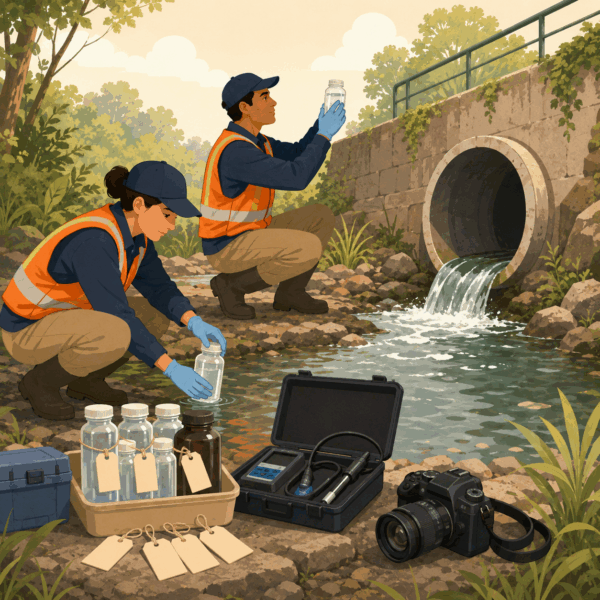 Plain-language environmental review cannot be limited to a single fact sheet. Residents encounter the process through notices, webpages, emails, public meetings, hearings, presentations, staff responses, document portals, and conversations with partner agencies. If these channels use different terminology or levels of explanation, the public can receive a fragmented understanding even when a strong summary document exists.
State environmental quality agencies should establish a consistent communication framework that follows the review across channels. The same basic explanation of the project, current procedural stage, major environmental issues, participation opportunity, and next steps should appear in public notices, project webpages, presentation materials, and staff talking points.
Required notices may need to contain formal language, but agencies can accompany them with accessible explanations rather than assuming the notice itself must carry the entire communication burden. A concise plain-language introduction can help readers understand why the notice matters before they encounter the procedural detail.
Public meetings should also be designed around understanding rather than document recitation. Presentations that reproduce tables and technical language from the environmental review rarely help residents interpret the analysis. Agency staff can instead explain the project’s key components, major findings, alternatives, mitigation, and current decision point, then direct participants toward the detailed sections of the record where they can learn more.
The structure of question-and-answer periods matters as well. Residents may ask broad questions that span several environmental topics or agency responsibilities. Staff should be prepared to explain which questions can be answered within the environmental review, which require additional technical follow-up, and which belong to another agency or approval process.
Consistency across these communication moments helps the agency become the most reliable source for understanding the environmental review. When residents hear the same clear procedural and analytical framework from the project webpage, public notice, meeting presentation, and staff response, the process becomes easier to navigate.
Treat Translation as More Than Converting Regulatory English Into Another Language
Language access is essential in environmental review processes serving multilingual communities, but effective translation requires more than producing another-language version of an English document that was already difficult to understand. If the source material relies heavily on regulatory terminology and complex sentence structure, direct translation may preserve the same accessibility barriers in another language.
State environmental quality agencies should begin with clear source content. Plain-language project summaries, participation instructions, impact explanations, and meeting materials should be understandable in English before they are translated into the languages needed by affected communities.
Translated materials should preserve the regulatory meaning of important terms while using vocabulary appropriate for the intended audience. Agencies may need to maintain consistent translations for recurring technical concepts so residents do not encounter different terms for the same environmental issue across notices, presentations, and project updates.
Language access planning should also extend beyond written documents. Interpretation at meetings, multilingual phone or contact options, accessible digital content, and community partner communication may be necessary depending on the population affected and the applicable requirements. Agencies should consider how people will ask follow-up questions, not simply whether they can read the initial notice.
Community organizations can be valuable communication partners because they often understand which environmental concepts create confusion and which channels residents actually use. Their role should not be limited to distributing translated notices. Agencies can use partner feedback to improve terminology, identify unanswered questions, and determine whether the communication is working in practice.
Plain-language CEQA and NEPA communication becomes stronger when agencies recognize that accessibility involves both language and structure. A translated document that remains procedurally opaque has not solved the underlying communication problem.
Preserve a Single Authoritative Source as the Review Evolves
Environmental review can produce a growing collection of materials over time. Draft documents, revised notices, hearing presentations, technical memoranda, comment letters, responses, final documents, findings, mitigation materials, and decision records may all remain online. Without a clear organizational structure, residents can easily encounter outdated information and mistake it for the current status.
State environmental quality agencies should maintain a single authoritative project page or equivalent public information location where the current stage of review is immediately visible. This source should identify the latest documents, active deadlines, upcoming participation opportunities, significant procedural developments, and the next expected step.
Historical documents should remain available where appropriate, but they should be organized so that the public can distinguish them from current materials. A draft schedule should not appear beside a revised schedule without explanation. A superseded notice should not be easier to find than the current one. A previous project description should not continue circulating without context after a material revision.
The authoritative source should also connect plain-language materials with the formal environmental record. Residents who want a concise explanation should be able to access it easily, while those who want technical detail should have a direct path to the complete documents and appendices.
This structure becomes especially important during controversy. Media reports, advocacy materials, project-proponent communication, social media, and older agency materials may circulate simultaneously. The agency cannot control those sources, but it can maintain a current, well-organized public record that gives audiences a reliable place to verify what stage the review has reached and what the agency has actually concluded.
Plain-language environmental review is most effective when it functions as a continuous system rather than a one-time translation exercise. State environmental quality agencies need to carry clarity from the earliest description of the proposed project through technical analysis, alternatives, mitigation, public participation, final decision-making, and later implementation. When each stage builds on the same accessible framework, communities can follow the process without repeatedly reconstructing what the agency is doing and why.
Organize Public Communication Around the Environmental Issues People Are Most Likely to Follow
Major environmental reviews may address many resource areas, but residents rarely approach the process by reading each technical chapter with equal attention. They tend to focus on the effects most connected to their daily lives, such as air quality, water, traffic, noise, habitat, wildfire risk, hazardous materials, construction activity, or another locally significant concern. State environmental quality agencies can make complex CEQA and NEPA materials easier to navigate by organizing public-facing communication around these recognizable issue areas while preserving access to the complete environmental record.
Topic-based communication is especially useful when one community concern appears across several technical sections. Water questions, for example, may involve supply, groundwater, surface water, stormwater, biological resources, and infrastructure. A resident thinking broadly about water impacts may not know that relevant analysis is distributed across multiple chapters and appendices. A plain-language topic summary can connect those analyses, explain the different questions they address, and direct readers to the supporting sections without collapsing them into one generalized conclusion.
The same approach can help when public terminology differs from regulatory terminology. Residents may talk about health effects while the environmental document separately evaluates air emissions, hazardous materials, noise, or other environmental pathways. The agency should not force community questions into technical categories before acknowledging them. Instead, communication can begin with the issue as residents understand it and then explain how the environmental review analyzes its different components.
This structure improves accessibility without changing the legal organization of the environmental document. The formal review can retain the technical architecture required for analysis while the public-facing layer helps people enter the record through the concerns most meaningful to them.
Explain Significance Thresholds Without Turning Them Into Simple Definitions of Safety
Significance thresholds can be difficult to communicate because members of the public may interpret them as universal dividing lines between safe and unsafe conditions. In environmental review, however, a threshold generally serves a more specific analytical purpose. It helps determine whether a project-related environmental effect reaches a level that carries particular significance under the applicable review framework.
State environmental quality agencies should explain both the threshold and the question it is being used to answer. If a threshold relates to noise, emissions, transportation, biological resources, water demand, or another topic, the public should understand what is being measured or estimated and why that benchmark matters to the environmental analysis. This provides more context than simply stating that an impact falls above or below a threshold.
Agencies should be particularly careful with less-than-significant findings. Such a determination should not automatically be translated into language suggesting that no effect, concern, or risk exists. The conclusion may mean that the project-related change does not meet the applicable significance criterion. Residents may still experience existing environmental burdens or notice changes that matter to them even when the formal analysis reaches that conclusion.
The opposite caution applies to significant impacts. A significant finding should not be translated into language suggesting inevitable severe harm or automatic project rejection unless the regulatory record supports that interpretation. Plain-language communication should explain what the significance finding means for the review process, including the role of mitigation, alternatives, additional analysis, or decision-making.
Distinguish Regulatory Findings From Broader Community Judgments
Communities often evaluate a proposed project through a broader lens than the environmental review framework itself. Residents may consider whether their neighborhood already carries too much traffic, industrial activity, noise, development pressure, or environmental burden. A significance determination may address only the incremental project effect under the applicable methodology.
State environmental quality agencies should explain this difference without suggesting that broader community concerns are irrelevant. The agency can identify what the environmental review formally evaluates while acknowledging that residents may be raising related policy, planning, public health, or quality-of-life concerns that extend beyond the specific significance determination.
This distinction can reduce one of the most common sources of distrust in environmental review. A community may hear “less than significant” as a statement that its concern does not matter. Clear communication can show that the phrase describes a regulatory analytical conclusion, not a judgment about whether residents are justified in caring about the issue.
Make Analytical Assumptions and Uncertainty Understandable
CEQA and NEPA analyses often depend on assumptions about future conditions. Construction schedules, traffic volumes, operating levels, emissions, water demand, habitat conditions, population growth, or other variables may need to be estimated before a project exists in its final form. Technical documents describe these assumptions through models, scenarios, methodologies, and professional analysis, but public summaries may present the resulting numbers without explaining how they were developed.
State environmental quality agencies should distinguish clearly between observed conditions, analytical assumptions, and projected outcomes. A measured existing condition is not the same as a modeled future result. A modeled result is not a guarantee of what will occur. When these categories are visible, residents can better understand why actual conditions may later differ from projections without assuming that the analysis was necessarily misleading.
This is also important when different documents contain different numbers. A technical appendix, project description, emissions analysis, transportation study, or revised project scenario may use different assumptions for different purposes. Without explanation, those differences can appear contradictory. Public-facing communication should identify when figures refer to different scenarios, time periods, operating conditions, or analytical questions.
Agencies should not hide uncertainty in an effort to make the analysis sound more authoritative. Confidence is better served by explaining what is known, what is estimated, what assumptions shape the analysis, and what future monitoring or implementation may reveal. The goal is not to weaken the environmental review, but to help the public understand the nature of the evidence being used.
Help Residents Connect Their Comments to the Environmental Analysis
Public participation becomes more meaningful when residents understand how their observations and concerns relate to the questions being examined in the environmental review. State environmental quality agencies can provide practical guidance that helps people submit specific, relevant information without requiring them to write like attorneys, engineers, or environmental consultants.
A resident may know that a roadway floods during particular storms, that wildlife regularly moves through a location not obvious from regional mapping, that construction noise would affect a nearby school at specific times, or that traffic behaves differently during local events than standard datasets suggest. These kinds of observations can provide useful context when they relate to the environmental analysis. Agencies can explain that comments may identify factual information, question assumptions, address mitigation, discuss alternatives, or point to local conditions that deserve consideration.
Guidance should remain open enough that it does not become a barrier to participation. A checklist that is too technical can make residents feel their comments will be disregarded unless they use the correct terminology. The better approach is to explain what kinds of specificity can make comments easier to evaluate while affirming that community members do not need specialized credentials to participate.
When comments concern matters outside the environmental review agency’s authority, the response should also remain useful. Rather than simply labeling the issue outside scope, the agency can explain why it is not part of the current analysis and, where appropriate, identify the separate decision-maker or process that addresses it. This helps residents navigate government rather than merely informing them that they have reached the wrong regulatory door.
Show the Public What Changed Between Draft and Final Environmental Review
A final environmental document can differ meaningfully from the draft that residents originally reviewed. Technical analysis may be clarified or expanded, mitigation measures may change, project features may be revised, alternatives may receive additional discussion, or public comments may result in new information. If the agency releases the final document without an accessible explanation of these changes, residents may struggle to determine whether the public review process had any practical effect.
State environmental quality agencies should provide a focused summary of material revisions. The summary should identify what changed, why the change occurred where appropriate, and whether the revision affected the environmental conclusion. This allows the public to distinguish substantive changes from editorial corrections or routine document refinement.
Where public or agency comments contributed to additional analysis or modifications, that relationship should be visible when supported by the record. Showing that a comment led to clarification, revised mitigation, supplemental analysis, or another documented change provides concrete evidence that public participation is connected to the environmental review process.
Agencies should also explain when a revision does not change the significance finding. A more detailed analysis or adjusted measure does not necessarily mean the earlier document was fundamentally invalid. Conversely, if the environmental conclusion did change, the public should not have to discover that shift by comparing technical chapters line by line. Clear change communication helps people follow the evolution of the review and understand how the final record differs from the draft they originally saw.
Translate Final Decisions Into Clear Commitments and Next Steps
The end of environmental review should answer the practical questions residents have carried throughout the process. What was ultimately decided. Which environmental effects remain important. What mitigation or project commitments were adopted. Which alternatives influenced the decision. What happens next. These questions are often answered across several formal documents rather than in one accessible explanation.
State environmental quality agencies should provide a plain-language final decision summary that reflects the formal record without attempting to replace it. The communication should distinguish completion of the environmental review from any additional permits, approvals, or implementation steps that remain. This is particularly important when several agencies have different responsibilities for the same project.
The summary should also make adopted mitigation and ongoing obligations visible. If project implementation depends on specific measures, residents should be able to understand those commitments without searching through long mitigation tables. Where significant environmental effects remain after mitigation, the agency should explain that status accurately and connect it to the applicable decision framework rather than presenting project approval as evidence that the impact no longer matters.
A strong final explanation creates continuity between environmental review and implementation. It shows what the agency learned through analysis and public participation, what commitments resulted, and where future accountability will reside. Plain-language environmental review is most effective when communities can follow that progression from the first project description through the final decision without having to reconstruct the process from technical documents alone.
Build Plain-Language Review Into the Agency’s Project Management Process
Plain-language environmental review is more reliable when it is planned alongside the technical and procedural work rather than added after major documents are complete. State environmental quality agencies should identify the communication products, public decision points, translation needs, partner coordination, and review responsibilities that will arise at each stage of a CEQA or NEPA process.
This planning helps prevent a common pattern in which communication staff receive a highly technical draft shortly before a notice, hearing, or release deadline and are expected to create an accessible explanation immediately. By that stage, key assumptions, terminology, and project descriptions may already be fixed across multiple documents. Earlier coordination allows technical, legal, environmental, and communication staff to establish a shared factual framework before public materials are developed.
Agencies should also define which developments require updated public communication. A revised project description, changed schedule, major analytical revision, new mitigation measure, additional public meeting, or significant procedural change may affect what residents need to understand. Building these triggers into project management reduces the risk that the formal environmental record advances while public-facing information remains outdated.
The objective is not to create another approval layer around every environmental document. It is to ensure that public communication is treated as part of implementation planning, with clear ownership and enough preparation time to preserve accuracy, accessibility, and continuity throughout the review.
Coordinate Agency Staff and Partners Before Major Public Releases
Large environmental reviews often involve more than one public agency, consultant team, technical discipline, or regulatory process. A lead agency may release an environmental document while local governments, responsible agencies, federal partners, project proponents, or other entities communicate about related approvals at the same time. If those explanations conflict on basic facts, the public may struggle to distinguish procedural differences from actual disagreement.
State environmental quality agencies should align the factual foundation before major public communication moments. Staff and relevant partners should share a common understanding of the project description, current procedural stage, principal environmental findings, public participation opportunity, major deadlines, and which agency controls which decision. This does not require every organization to use identical language, but the core facts should remain consistent.
Internal alignment is equally important. Environmental planners, technical specialists, legal staff, public information officers, leadership, and staff participating in public meetings should be prepared to explain the same procedural status and environmental conclusions. Residents can lose confidence quickly when one agency representative describes an issue as unresolved while another speaks as though it has already been decided.
A concise message framework, current project summary, and shared response guidance can improve consistency without overscripting staff. The purpose is to reduce avoidable contradictions and ensure that the public receives an accurate explanation regardless of which agency touchpoint they encounter.
Test Public-Facing Materials With People Who Do Not Work in Environmental Review
Environmental professionals can become accustomed to terminology that remains unfamiliar to the public. Words such as significance, mitigation, baseline, alternative, cumulative impact, lead agency, responsible agency, scoping, and findings may feel routine internally while creating substantial barriers for people encountering the process for the first time.
State environmental quality agencies can improve plain-language materials by testing whether intended audiences can actually use them. Review does not need to become a large research exercise for every project. Even a small number of readers who are not involved in the environmental analysis can identify unclear terminology, missing context, difficult navigation, or instructions that assume too much procedural knowledge.
Testing should focus on comprehension and action. Readers should be able to identify what project is under review, what stage the process has reached, what the major environmental issues are, where to find more detail, how to participate, and what happens next. If those basic questions remain difficult to answer, the material needs improvement regardless of whether every sentence is technically correct.
Feedback from community organizations, local partners, interpreters, accessibility specialists, or staff who routinely answer public questions can also reveal where communication is likely to fail. The most useful revisions often involve organization and context rather than simply replacing individual technical words.
Maintain Language Access and Accessibility Across the Full Review Lifecycle
Accessibility can weaken as environmental review progresses. An agency may translate an initial notice or provide interpretation at one meeting, then return to English-only technical updates, revised materials, final findings, or implementation information. This creates an uneven participation process in which some residents can enter the review but cannot follow it through completion.
State environmental quality agencies should identify which public-facing materials require continued language access and accessibility as the process evolves. The answer may vary by project, affected population, applicable requirements, and communication significance, but the principle should remain consistent. Important changes should not become accessible only to people who can navigate technical English.
Digital accessibility deserves the same continuity. Project pages, notices, summaries, presentations, videos, comment instructions, and downloadable documents should be usable across common assistive technologies and devices. A plain-language summary provides limited benefit if the file cannot be accessed effectively by the people it is intended to serve.
Agencies should also preserve terminology across translated and accessible materials. When a significant environmental issue is described differently from one phase to another, residents may have difficulty determining whether the agency’s conclusion changed or only the wording changed. Consistent terminology supports continuity and reduces confusion throughout long review processes.
Prepare for High-Interest Projects Before Public Attention Peaks
Some environmental reviews attract limited public attention until a major document is released. Others become controversial much earlier because of project location, perceived environmental risk, existing community concerns, political attention, or previous experience with the agency. State environmental quality agencies should identify high-interest projects early enough to prepare communication before the most consequential public moments occur.
Preparation should include a clear project overview, procedural explanation, issue-specific summaries, staff talking points, partner coordination, media-ready factual information, language access planning, and a current digital information source. These tools allow the agency to respond consistently when public attention increases rather than improvising explanations after controversy has already shaped the conversation.
High-interest communication should remain grounded in the environmental review record. The agency should not become a promoter or opponent of the project in response to heightened scrutiny. Its value lies in providing the clearest authoritative account of what is being analyzed, what has been found, what remains unresolved, and where the public can participate.
Early preparation also reduces the likelihood that the agency communicates defensively. When common questions and points of confusion have already been anticipated, staff can acknowledge concerns directly and explain the process without appearing surprised by issues that were foreseeable from the project’s context.
Create a Clear Handoff From Environmental Review to Implementation
The public experience of environmental review should not end abruptly when the final document is certified, adopted, completed, or otherwise reaches its formal conclusion. Residents who followed the analysis may still want to know when project activity begins, how adopted mitigation will be implemented, which agency is responsible for oversight, and where future compliance or project information can be found.
State environmental quality agencies should develop a clear communication handoff from review into implementation. This may involve directing residents to a mitigation monitoring program, permitting agency, project implementation page, local jurisdiction, federal partner, or another responsible entity. The specific pathway will depend on the project and the agency’s actual authority.
The handoff should make continuing responsibilities visible. If the environmental review established mitigation commitments, residents should understand who tracks them. If additional permits remain pending, the public should know that environmental review completion did not resolve those separate decisions. If the agency’s role largely ends at that point, that boundary should be stated clearly rather than leaving residents to assume continued oversight.
This transition is important because environmental review creates expectations that extend beyond document production. Plain-language communication is strongest when it connects the analysis to the next operational stage and helps the public understand where accountability will reside after the formal review closes.
Measure Whether Plain-Language Environmental Review Is Improving Participation
State environmental quality agencies should evaluate whether their communication is making environmental review easier to understand, not simply whether materials were produced on schedule. Output measures such as notices issued, summaries posted, meetings held, or translations completed are useful for administration but do not demonstrate that people were able to use the information effectively.
More meaningful indicators can include recurring public questions, the quality and specificity of comments, participation patterns, requests for clarification, attendance across different communities, use of translated materials, project-page behavior, and whether residents can identify the correct stage and decision point. These indicators can reveal where communication remains too technical or where public guidance is failing to answer the questions people actually have.
Agencies should interpret these measures carefully. A higher volume of comments does not automatically mean communication improved, and fewer questions do not necessarily mean the process became clearer. The goal is to look for patterns that reveal whether people can engage with the review more effectively and whether recurring confusion is decreasing.
After-action review can strengthen future projects. Staff can identify which explanations worked, which terms repeatedly caused confusion, where the public entered the process too late, and which materials or channels were most useful. Over time, these lessons can improve templates, staff practices, project-page structures, meeting formats, and plain-language guidance across the agency’s environmental review portfolio.
When plain-language CEQA and NEPA communication is planned, coordinated, tested, maintained, and measured as part of environmental review itself, it becomes more than a writing exercise. It becomes a practical communication system that helps state environmental quality agencies connect complex analysis with meaningful public participation while preserving the legal, technical, and procedural integrity of the underlying review.
Strategic Communication Support for Plain-Language Environmental Review
 State environmental quality agencies often have deep internal expertise in environmental analysis, planning, engineering, science, law, and regulatory procedure, but translating that work for public audiences requires a different set of communication skills. CEQA and NEPA materials can involve thousands of pages of technical analysis, overlapping agency roles, strict procedural requirements, multilingual outreach needs, and public participation processes that are vulnerable to misunderstanding when communication is developed too late. External strategic communication support can help agencies create a clearer public information structure around the formal environmental review without changing the substance, authority, or legal meaning of the underlying documents.
Stegmeier Consulting Group (SCG) can support state environmental quality agencies by developing plain-language project summaries, public participation guidance, issue-specific environmental review materials, public meeting content, staff talking points, multilingual communication frameworks, project-page structures, and communication plans aligned with major review milestones. SCG can also help agencies organize complex information around the questions public audiences are most likely to ask, clarify the relationship among CEQA, NEPA, permitting, and other agency decisions, and build consistent communication across technical staff, public information teams, partner agencies, and community-facing channels. This support remains focused on communication. SCG does not perform environmental analysis, make significance determinations, prepare legal findings, select mitigation, or make permitting or project approval decisions on behalf of the responsible agency.
External support can be particularly valuable for major or contested projects where internal teams are managing substantial technical workloads and public attention at the same time. An objective communication perspective can help identify terminology that assumes too much regulatory knowledge, points where the public is likely to misinterpret procedural status, and gaps between what the formal record contains and what residents need in order to navigate it. Connect with SCG to explore strategic communication support for plain-language CEQA and NEPA communication, public participation, and environmental review outreach.
Future Trends
Public expectations for environmental review communication will continue moving toward greater digital accessibility, easier navigation, and faster access to understandable explanations of complex regulatory information. Posting a complete environmental document online will remain necessary in many processes, but it will increasingly be viewed as only one layer of public access. Communities will expect agencies to provide clear orientation, searchable topic-based information, accessible summaries, and straightforward explanations of where the review stands.
Digital tools may make it easier to organize large environmental records around individual topics, geographic areas, mitigation commitments, or stages of review. Interactive maps, searchable document systems, data visualizations, and project dashboards can help residents locate relevant information without reading a complete technical document. These tools will be most useful when they are designed around public questions rather than simply digitizing existing agency filing structures.
Agencies are also likely to face greater expectations for continuity after final environmental decisions. Communities that participate in lengthy review processes may increasingly expect to see how mitigation, monitoring, project changes, and later approvals connect to the commitments described during environmental review. This will place more emphasis on communication handoffs between environmental review teams and the agencies or programs responsible for implementation.
At the same time, technological improvements will not eliminate the core translation challenge. Automated summaries, digital search tools, and other emerging systems can make information easier to retrieve, but agencies will still need to determine which distinctions must be preserved, how uncertainty should be communicated, and how public-facing explanations remain aligned with the authoritative environmental record. Plain language will continue to require professional judgment, technical coordination, and careful attention to what the underlying analysis actually supports.
Conclusion
CEQA and NEPA environmental review processes are complex because the projects, environmental conditions, regulatory requirements, and decisions they address are complex. Plain-language communication should not attempt to remove that complexity by reducing environmental review to a few simplified conclusions. Its purpose is to make the process understandable enough that people can follow it, locate the information relevant to them, participate meaningfully, and understand what the agency ultimately decided.
For state environmental quality agencies, that requires more than rewriting technical terminology. Effective communication begins by explaining the purpose of environmental review, the agency’s role, the current procedural stage, and the decisions that remain open. It continues through clear descriptions of project impacts, significance findings, alternatives, mitigation, analytical assumptions, uncertainty, and public comment opportunities.
The strongest communication systems also help communities navigate the environmental record itself. Topic-based summaries, document guides, multilingual materials, accessible project pages, coordinated public meetings, and clear explanations of revisions can help residents move between plain-language information and the formal technical record without losing the connection between them.
Plain language also strengthens the integrity of public participation. Residents are better positioned to provide relevant information and evaluate the agency’s conclusions when they understand what is being analyzed, how their comments relate to the decision, and what happens after the comment period closes. The agency does not need the public to become experts in CEQA or NEPA. It needs the process to be accessible enough that technical expertise is not a prerequisite for meaningful participation.
State environmental quality agencies that treat communication as part of environmental review infrastructure can preserve the rigor of the regulatory process while making it far more navigable to the communities affected by major environmental decisions. That balance between technical accuracy and public understanding is essential to a review process that is not only complete on paper but credible in practice.
Stegmeier Consulting Group’s Strategic Approach to Communication Systems
Make environmental review easier to navigate without sacrificing technical or regulatory accuracy.
State environmental quality agencies need communication systems that help residents understand what is being reviewed, which environmental findings matter, what remains undecided, how public comments fit into the process, and what happens after a final decision. Stegmeier Consulting Group (SCG) helps agencies strengthen plain-language project summaries, public participation guidance, issue-specific communication, multilingual outreach, staff messaging, and digital information structures so that CEQA and NEPA processes are easier for public audiences to follow while remaining aligned with the formal environmental record.
Use the form below to connect with our team and explore how strategic communication support can strengthen environmental review communication and public participation.