
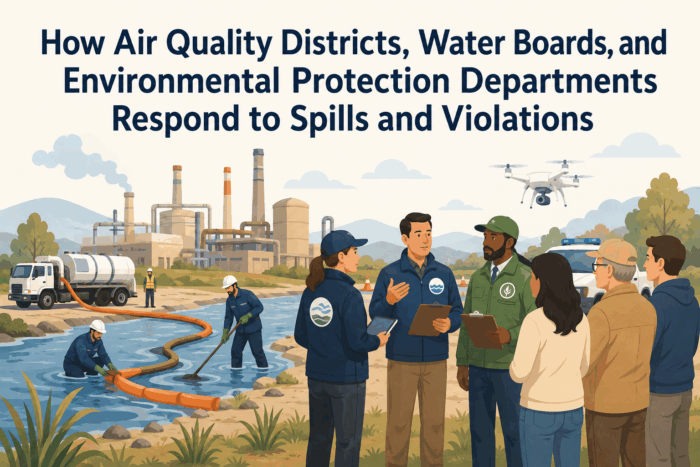
Crisis Communication for Environmental Incidents: How Air Quality Districts, Water Boards, and Environmental Protection Departments Respond to Spills and Violations
Environmental incidents compress technical investigation, regulatory response, public concern, and media attention into the same narrow window. A spill, unauthorized discharge, hazardous release, air quality event, industrial violation, or contamination discovery can create immediate questions about exposure, responsibility, enforcement, cleanup, and public safety before agencies have completed their technical review. Air quality districts, water boards, and environmental protection departments therefore need communication systems that function under uncertainty without sacrificing accuracy.
The communication challenge is rarely limited to announcing that an incident occurred. Residents may want to know whether they should avoid an area, whether air or water is safe, what substances were released, who caused the event, how far contamination may have traveled, and whether the responsible party will face enforcement. Media outlets and elected officials may seek definitive answers at the same time technical staff are still sampling, inspecting, modeling, or verifying the facts.
Environmental agencies should resist two opposite failures during this period. One is communicating too little because the investigation is incomplete, leaving information gaps that are quickly filled by speculation. The other is communicating too confidently before the evidence supports a conclusion, creating later corrections that can undermine credibility. Effective crisis communication provides timely information while making uncertainty visible.
A strong response should distinguish immediate protective information from longer-term regulatory findings, clarify which agency controls which part of the response, explain what is known and unknown, and establish a reliable rhythm for updates. The objective is not to make an evolving incident appear fully resolved. It is to give the public a credible way to understand what is happening as the environmental and regulatory picture develops.
Separate Immediate Public Protection From the Longer Regulatory Investigation
 The first communication priority during an environmental incident is often practical protection. Residents may need information about avoiding exposure, staying away from a location, limiting outdoor activity, avoiding contact with contaminated water or soil, or following another protective recommendation issued by the appropriate authority. These messages should be clear and operational.
At the same time, air quality districts, water boards, and environmental protection departments may still be determining whether a violation occurred, how extensive the release was, what caused it, and what enforcement response is appropriate. Agencies should distinguish those questions from the immediate protective guidance rather than waiting for the entire investigation to be complete.
This distinction protects both public safety and regulatory integrity. A precautionary recommendation does not necessarily mean the agency has completed its risk assessment or reached a final enforcement conclusion. Likewise, an incomplete enforcement investigation does not prevent the agency from communicating known environmental conditions and appropriate protective actions.
Public materials should show these two tracks clearly. Residents need to know what they should do now and what the agency is still investigating. Making that separation visible helps prevent early protective measures from being mistaken for final regulatory findings.
Communicate What Is Known Before Trying to Explain What Happened
Environmental incidents often generate immediate pressure to identify a cause, responsible party, and regulatory violation. Those conclusions may eventually be necessary, but the first public communication should begin with confirmed facts rather than attribution.
Air quality districts, water boards, and environmental protection departments should identify what has been observed or reported, where the incident occurred, when the agency became aware of it, what environmental media may be affected, and what response activities are underway. If monitoring or sampling has begun, the agency can explain what it is intended to determine.
Information that remains uncertain should be labeled accordingly. The source of a release may be suspected but not confirmed. The geographic extent may still be under investigation. Preliminary field observations may require laboratory confirmation. The agency should avoid converting those early indicators into settled conclusions.
This approach creates a stable factual foundation that can be expanded as evidence develops. It is easier to update a public explanation built around confirmed facts than to retract a premature theory about cause, responsibility, or environmental impact.
Use a Clear Known, Unknown, and Next-Step Framework
During the early phase of an environmental incident, agencies can organize communication around three questions: what is known, what remains unknown, and what the agency is doing next. This structure gives the public useful information without implying that every question has already been answered.
Known information can include the location, reported event, confirmed environmental observations, current protective guidance, and response activities. Unknown information can include the precise volume released, source attribution, full extent of contamination, health implications, or final compliance status.
The next-step explanation should identify sampling, inspections, source investigation, cleanup, coordination, or regulatory review that will address those uncertainties. This gives the public a reason to expect additional information rather than interpreting uncertainty as agency inaction.
Clarify Which Agency Is Responsible for Which Part of the Incident
Environmental incidents frequently involve multiple government bodies. An air quality district may assess emissions, a water board may evaluate a discharge, an environmental protection department may oversee cleanup or enforcement, a public health agency may issue exposure guidance, and local emergency responders may manage immediate operational conditions.
The public should not have to determine these responsibilities independently. Agencies should explain who is managing immediate response, who is conducting environmental monitoring, who provides health guidance, who oversees cleanup, and who has authority to determine whether a regulatory violation occurred.
This clarification is particularly important when one agency serves as the primary public contact but does not control every decision. Communication leadership should not be confused with regulatory authority. A lead communicator can provide an overall status while directing technical or health-specific questions to the responsible institution.
Clear role descriptions reduce contradictory expectations. Residents understand why several agencies may issue information about the same event and which source is authoritative for each type of decision.
Explain Preliminary Monitoring Without Turning Early Data Into a Final Risk Conclusion
Monitoring data are often among the first pieces of technical information requested during an environmental incident. Air readings, water samples, field measurements, screening results, or visual observations can provide important evidence, but early results may have significant limitations.
Air quality districts, water boards, and environmental protection departments should explain what was measured, where, when, and what the result can reasonably indicate. If the data are preliminary, subject to laboratory confirmation, or limited to a particular time or location, those constraints should remain visible.
Agencies should avoid presenting one result as proof that the entire affected area is safe or unsafe unless the evidence supports that conclusion. Conditions may vary geographically and over time, particularly during active releases or rapidly changing incidents.
Public communication should connect monitoring to the next decision. Residents should understand whether results will influence protective guidance, additional sampling, cleanup boundaries, source investigation, enforcement, or another aspect of the response.
How Environmental Protection Agencies Can Make Communication Central to Regulatory Effectiveness, Public Trust, and Community Health
This article is part of our series on strategic communication for Environmental Protection Agencies, Environmental Compliance Agencies, and state and local environmental departments. To learn more and to see the parent article, which links to other content just like this, click the button below.
Coordinate Environmental and Public Health Risk Communication
Environmental agencies may be responsible for measuring or investigating contamination while public health agencies determine appropriate health guidance. During a crisis, those roles need to be closely coordinated so residents do not receive technically accurate but seemingly inconsistent messages.
Air quality districts, water boards, and environmental protection departments should communicate environmental findings in a way that allows health agencies to explain practical implications without overstating what the data establish. Terms such as detection, exceedance, exposure, violation, and health risk should be used carefully because they do not necessarily describe the same conclusion.
Protective guidance should identify the authoritative source. If a health department recommends avoiding certain activities or locations, the environmental regulator can reinforce that recommendation while explaining the environmental conditions under investigation. The agencies should avoid independently inventing different behavioral advice.
Coordination becomes even more important as findings change. If later sampling modifies the understanding of exposure or geographic extent, environmental and health communication should be updated together so residents are not left comparing conflicting versions of the situation.
Address Violations Without Announcing Enforcement Conclusions Prematurely
Some incidents involve an obvious operational failure, but the formal regulatory consequences may still require investigation. Environmental agencies should distinguish between describing an observed event and announcing that a specific violation or enforcement outcome has been established.
Air quality districts, water boards, and environmental protection departments can explain which requirements may be relevant and what investigative steps are underway. If an inspection, discharge report, permit condition, sampling result, or other evidence will inform the compliance determination, the agency should say so.
When a violation has already been formally established, the communication should explain what requirement was violated, what corrective action is required, and what enforcement process follows. It should avoid using penalties alone as the measure of seriousness or suggesting outcomes that remain subject to further administrative or legal process.
This distinction protects due process while maintaining transparency. The public can understand that the agency is investigating or enforcing the matter without being given conclusions the regulatory record does not yet support.
Establish an Update Rhythm Before the Information Gap Expands
One of the most damaging communication failures during an environmental incident is prolonged silence after an initial announcement. Residents may receive the first alert quickly and then hear nothing while sampling, investigation, cleanup, or enforcement work continues.
Agencies should establish an update schedule appropriate to the pace and seriousness of the event. During an active incident, updates may need to occur frequently. As conditions stabilize, the cadence can shift to milestone-based communication tied to new results, cleanup progress, regulatory actions, or changes in protective guidance.
An update does not always require a new conclusion. Agencies can explain what work has been completed, what remains underway, and when the next meaningful information is expected. Confirming that the response continues can be valuable when technical work takes time.
A predictable rhythm reduces dependence on rumor and informal information sources. It also helps communities distinguish between the absence of new findings and the absence of government action.
Preserve One Authoritative Source for the Current Incident Status
Crisis communication quickly becomes fragmented when agencies publish separate press releases, social posts, sampling reports, meeting notices, and partner updates without one source that reflects the current status. Air quality districts, water boards, and environmental protection departments should maintain a clearly identified authoritative incident page or equivalent information source.
The source should summarize the current situation, protective guidance, affected area, agency roles, latest findings, cleanup or response activities, and next update. Supporting technical documents can remain available for people who want greater detail.
Older information should be preserved where appropriate but clearly labeled as superseded if conditions have changed. During rapidly evolving incidents, an outdated fact sheet or social media post can continue circulating long after the agency has revised its understanding.
Maintaining one current source improves consistency across every other communication channel. Media, local governments, elected officials, community organizations, and agency staff can all direct audiences to the same authoritative status rather than creating parallel versions of the incident.
Build the First Public Update Around Immediate Decisions
The first public update during an environmental incident should help residents understand what they need to do and what the agency is doing next. Air quality districts, water boards, and environmental protection departments should avoid overloading the initial message with every available technical detail when the most urgent need is practical orientation.
A strong first update should identify the incident, location, current response status, any protective guidance, the agencies involved, and where additional information will be posted. If the incident is still being investigated, the communication should say so directly rather than filling information gaps with preliminary assumptions.
The update should also distinguish between information that may change and instructions that remain in effect. Residents should be able to tell whether a recommendation is precautionary, whether a geographic boundary is still being evaluated, and whether additional sampling or monitoring may alter the agency’s understanding.
This structure creates a stable foundation for later communication. As more technical information becomes available, agencies can build on the first update rather than correcting an unnecessarily detailed early narrative.
Use Geographic Information Carefully During an Active Incident
Environmental incidents often create immediate questions about who may be affected and where. Maps, monitoring locations, spill boundaries, plumes, drainage areas, and downstream or downwind zones can help answer those questions, but early geographic information may be incomplete.
Air quality districts, water boards, and environmental protection departments should explain whether a mapped area represents a confirmed impact zone, an investigation area, a precautionary boundary, a monitoring network, or another technical designation. These distinctions matter because residents may interpret any shaded area as evidence of confirmed contamination.
Agencies should also explain how boundaries may change. Wind direction, water movement, new sampling results, field observations, or additional site information may expand or narrow the area under evaluation. Updating a map should therefore be accompanied by a concise explanation of what changed and why.
Geographic communication should help residents determine relevance without creating false precision. Maps are most useful when they show what the agency knows while remaining clear about the limits of current information.
Distinguish Monitoring Areas From Confirmed Impact Areas
A monitoring location does not necessarily prove that the surrounding area is contaminated, and an investigation boundary does not necessarily represent the final extent of an incident. Agencies should label these areas precisely.
Public-facing maps and summaries should explain why particular locations were selected and what the monitoring is intended to determine. This helps residents understand that data collection is part of the investigation rather than a conclusion about every location shown.
Clear labeling reduces unnecessary alarm while preserving transparency about where the agency is looking and why.
Explain Cleanup and Containment Before Discussing Long-Term Resolution
During the early and middle stages of an environmental incident, residents may hear terms such as containment, recovery, removal, treatment, remediation, or cleanup used interchangeably. Air quality districts, water boards, and environmental protection departments should explain what each activity means in the context of the incident.
Containment may be intended to stop further spread without resolving existing contamination. Removal may address contaminated material while additional monitoring continues. Temporary controls may reduce exposure before a permanent remedy is selected. Public communication should make these distinctions visible so early response actions are not mistaken for complete resolution.
Agencies should also explain who is performing the cleanup and who oversees it. The responsible party may conduct field work while the regulator sets requirements, reviews plans, verifies performance, or takes separate enforcement action. Those roles should not be blurred.
Clear cleanup communication helps residents understand progress realistically. Visible activity can be encouraging, but the agency should not imply that an incident is resolved until the relevant environmental and regulatory objectives have actually been met.
Communicate With Affected Communities Before Relying on Broad Public Messaging Alone
Press releases and agency webpages can reach large audiences, but they may not reach the people most directly affected by an environmental incident. Air quality districts, water boards, and environmental protection departments should identify communities closest to the event and establish direct communication pathways where appropriate.
This may include targeted notifications, local meetings, multilingual materials, community organization partnerships, neighborhood contacts, or direct outreach to facilities such as schools, care centers, or businesses within the affected area. The appropriate approach should reflect the incident rather than rely on a generic crisis communication template.
Direct outreach also allows agencies to hear information that broad public channels may miss. Residents may report odors, visible conditions, drainage patterns, recurring symptoms, or operational activity that can help technical teams understand how the incident is being experienced on the ground.
Community communication should remain connected to the official incident record. Local outreach can be more specific and responsive, but it should not create a separate set of facts from the information being communicated publicly.
Coordinate Media Communication Before Conflicting Explanations Spread
Environmental incidents attract media attention quickly, particularly when there is visible pollution, potential exposure, a large responsible facility, or a significant enforcement history. Reporters may contact several agencies and receive different explanations if internal coordination has not occurred.
Air quality districts, water boards, and environmental protection departments should identify spokespersons early and establish the facts, uncertainties, agency roles, and current protective guidance that should remain consistent across interviews. Technical specialists can support media communication, but they should understand which findings are preliminary and which conclusions have been formally established.
Agencies should also avoid allowing media pressure to accelerate conclusions that technical teams have not reached. It is appropriate to say that sampling is underway, source attribution remains under investigation, or an enforcement determination has not yet been completed.
Coordinated media communication keeps public attention focused on the environmental issue and response rather than on apparent contradictions among government agencies. It also reduces the need for later corrections generated by inconsistent interviews.
Prepare Elected Officials and Agency Leadership With the Same Current Facts
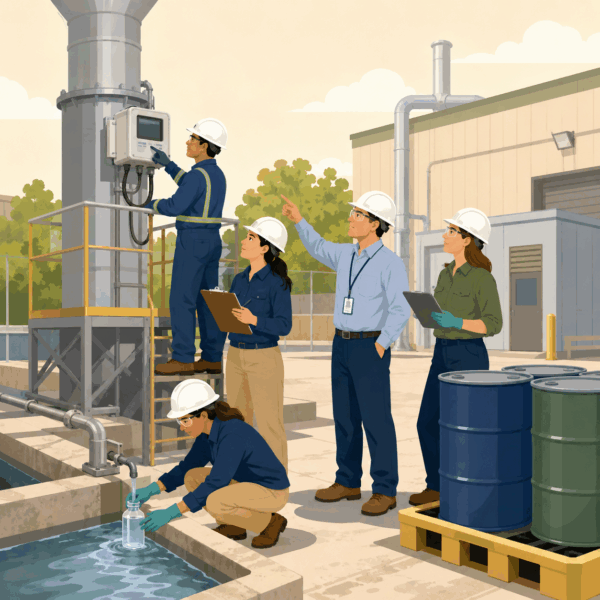 Environmental incidents can quickly draw attention from mayors, county officials, legislators, governors’ offices, boards, and senior agency leadership. Their public statements may reach larger audiences than technical agency updates and can strongly shape expectations.
Air quality districts, water boards, and environmental protection departments should provide concise leadership briefings that identify confirmed facts, current uncertainties, protective guidance, agency roles, and the next decision points. Briefing materials should be updated as conditions change so leaders are not relying on information that was accurate earlier in the incident.
Leadership communication should also preserve technical boundaries. Elected officials may appropriately speak about concern, resources, accountability, or community impact while the responsible environmental agency retains authority over compliance findings, technical conclusions, or enforcement determinations.
Consistent leadership briefings help prevent political statements from creating promises or conclusions that the regulatory process cannot support. They also reinforce the same factual foundation across technical and executive communication.
Correct Early Information Transparently When the Facts Change
Environmental incidents evolve, and early information may later prove incomplete or inaccurate. A release volume may be revised, a source may be identified differently, a geographic boundary may change, or new sampling may alter the understanding of environmental impact.
Air quality districts, water boards, and environmental protection departments should correct material changes visibly rather than quietly replacing earlier information. Public updates should identify what changed, what new evidence led to the revision, and whether the change affects protective guidance or regulatory response.
A correction does not necessarily indicate that the earlier communication was irresponsible. Preliminary information can be appropriate when it is labeled as preliminary. Credibility is better protected when agencies explain how the evidence developed than when stakeholders discover inconsistencies independently.
Transparent correction also demonstrates that the response is evidence-driven. The public can see that agency communication changes when the underlying facts change rather than remaining fixed for reputational reasons.
Explain the Transition From Incident Response to Enforcement and Long-Term Oversight
Environmental crises do not end when the immediate spill is contained or the visible release stops. The response may transition into investigation, remediation, permit modification, enforcement, long-term monitoring, or other regulatory work that receives less public attention.
Air quality districts, water boards, and environmental protection departments should communicate this transition clearly. Residents should know which emergency activities have ended, what environmental work continues, whether a compliance investigation remains open, and what future milestones will determine longer-term resolution.
The agency should also explain when responsibility shifts among programs or institutions. Emergency responders may leave the scene while environmental regulators remain involved for months or years. Cleanup oversight may move to a specialized unit, and public health agencies may reduce their role once immediate exposure concerns have been addressed.
Making the transition visible prevents the end of emergency operations from being interpreted as the end of government involvement. It also gives communities a clear pathway for following the incident through regulatory resolution.
Organize Crisis Communication Around the Decisions People Need to Make
During an environmental incident, residents do not need every technical detail at once. They need to understand whether they are affected, whether they should change their behavior, what the agency is doing, and when they will receive the next meaningful update. Air quality districts, water boards, and environmental protection departments should organize crisis communication around those decisions rather than around internal program structure.
This approach is particularly important when technical information is evolving. A spill investigation may involve sampling, source control, modeling, inspections, laboratory analysis, cleanup, enforcement review, and public health coordination at the same time. If agencies present those activities as separate technical workstreams without explaining how they relate to public decisions, residents may struggle to understand the overall response.
Public-facing communication should therefore create a clear sequence. It should explain what happened, what is known about environmental conditions, whether protective action is recommended, what the agency is doing now, what remains unresolved, and what evidence will determine the next step. Supporting technical documents can remain available for people who need more detail.
A decision-centered structure makes crisis communication more useful without oversimplifying the incident. It helps the public understand both immediate action and the broader regulatory response as conditions change.
Explain Incident Severity Without Relying on Alarmist or Reassuring Labels
Environmental incidents are often described using broad terms such as minor, significant, serious, controlled, or contained. These labels can be interpreted differently by technical staff, media outlets, elected officials, and residents. Air quality districts, water boards, and environmental protection departments should explain the factors that make an incident more or less consequential instead of relying on labels alone.
Severity may depend on the substance involved, quantity released, duration, location, environmental pathway, potential exposure, affected population, persistence, regulatory significance, and effectiveness of containment. Not every factor will be known immediately, and agencies should identify which elements remain under investigation.
Agencies should also avoid using the absence of a major immediate health threat as shorthand for saying the incident is insignificant. An event may pose limited short-term exposure while still requiring substantial cleanup, compliance action, or long-term monitoring. Conversely, visible or alarming conditions do not automatically establish severe health consequences.
Explaining the basis for the agency’s assessment gives the public something more meaningful than a reassuring adjective. Residents can understand why the response is proportionate to the current evidence and how that assessment may change if new information emerges.
Translate Technical Incident Data Into Practical Meaning
Environmental crisis communication often involves numbers such as pollutant concentrations, discharge volumes, air monitoring readings, sampling results, flow rates, or permit limits. These figures are important, but they rarely communicate their significance without additional context.
Air quality districts, water boards, and environmental protection departments should explain what the measurement represents, where it was collected, what benchmark or condition it is being compared against, and what action follows from the result. A raw number without that context can be easily misinterpreted.
Agencies should also distinguish among screening values, regulatory standards, action levels, permit limits, and health-based guidance where those concepts differ. Exceeding one benchmark may trigger further investigation without automatically proving a specific health effect, while remaining below a particular threshold may not resolve every environmental question associated with the incident.
Practical explanation helps residents understand what the data mean for the response. Monitoring becomes more useful when the public can see how results influence protective guidance, cleanup decisions, investigation boundaries, or enforcement.
Show Trends Without Suggesting More Precision Than the Data Support
During ongoing incidents, agencies may publish repeated monitoring results to show whether conditions are improving, worsening, or remaining stable. These trends can be useful, but they should be interpreted carefully.
A decline at one monitoring location may not represent conditions throughout the affected area, and a single elevated result may not establish a sustained pattern. Agencies should explain the geographic and temporal limits of the data.
Clear trend communication helps residents follow the incident over time without treating every individual result as a final conclusion.
Make Protective Guidance Specific, Actionable, and Easy to Update
Protective guidance should tell residents exactly what action is recommended, who should follow it, where it applies, and how long it remains in effect. Vague statements advising the public to “use caution” can leave people uncertain about what behavior actually reduces exposure.
Air quality districts, water boards, and environmental protection departments should coordinate protective instructions with the appropriate public health or emergency authority where applicable. The communication should identify whether guidance is precautionary, based on confirmed exposure conditions, or being maintained while additional investigation continues.
Instructions should also be practical. If residents are advised to avoid certain water use, outdoor activity, soil contact, or another exposure pathway, the agency should explain what alternatives or support are available where relevant. Protective communication is more effective when it acknowledges the real burden placed on households and businesses.
As conditions change, agencies should update or withdraw guidance visibly. Residents should not have to infer whether an earlier recommendation still applies after new monitoring information becomes available.
Use Community Reports as Incident Intelligence Without Treating Them as Confirmed Findings
Residents may be among the first to observe odors, discoloration, smoke, dead vegetation, unusual water conditions, visible releases, or other signs of an environmental incident. Their reports can help agencies identify patterns and locations that formal monitoring has not yet captured.
Air quality districts, water boards, and environmental protection departments should provide clear pathways for submitting these observations and explain what information is most useful. Location, time, duration, photographs, repeated patterns, and descriptions of environmental conditions can support technical follow-up.
Community reports should be taken seriously without being treated automatically as verified evidence of source, exposure, or violation. The agency should explain how observations are evaluated and when they may trigger inspection, sampling, monitoring, or additional investigation.
This approach helps residents see that reporting can contribute to the response while preserving the distinction between observed conditions and formal regulatory findings.
Coordinate With the Responsible Party Without Allowing It to Control the Public Narrative
Companies, utilities, municipalities, facility operators, or other responsible parties may possess critical operational information during an environmental incident. They may know what occurred, what equipment failed, what material was released, and what immediate corrective actions are underway. Environmental agencies often need that information quickly.
Coordination should not mean delegating the government’s public communication role to the regulated entity. Air quality districts, water boards, and environmental protection departments should independently verify material facts where appropriate and remain the authoritative source for compliance status, regulatory requirements, environmental findings, and enforcement actions.
Public communication should clearly distinguish the responsible party’s statements from agency determinations. A company may report an estimated spill volume or describe corrective work, while the regulator explains whether those facts have been verified and what requirements apply.
Maintaining this separation supports credibility during a period when residents may already question whether the responsible party is minimizing the incident. The agency can use operational information while preserving independent regulatory accountability.
Prepare for Rumors and False Information Without Treating Every Disagreement as Misinformation
Environmental incidents can create a fast-moving information environment in which partial facts, outdated screenshots, speculative claims, and legitimate criticism circulate at the same time. Agencies should be prepared to correct errors without characterizing every challenge as misinformation.
When a claim is factually incorrect, the agency should identify the correct information and provide the evidence supporting it. This may involve clarifying the affected area, contaminant, source status, monitoring result, cleanup progress, or enforcement stage.
Disagreement about whether the response is adequate, whether monitoring should be expanded, or whether enforcement should be stronger is different. These are questions of policy, judgment, or public confidence and should not be dismissed simply because the agency disagrees.
Separating factual correction from substantive disagreement allows air quality districts, water boards, and environmental protection departments to protect the integrity of the incident record without appearing defensive toward legitimate public scrutiny.
Keep Community Communication Active After Media Attention Declines
Public and media attention often peaks during the first days of an environmental incident and declines before investigation, remediation, or enforcement is complete. For affected communities, however, the environmental issue may continue long after the broader news cycle moves on.
Air quality districts, water boards, and environmental protection departments should maintain communication according to the actual regulatory and environmental lifecycle rather than the level of media interest. Updates may become less frequent, but they should continue through major monitoring, cleanup, enforcement, and closure milestones.
The agency should explain when the incident enters a slower phase and what work continues during that period. If laboratory analysis, remediation design, responsible-party negotiations, or long-term monitoring is underway, residents should be able to see that the response has not ended simply because public announcements are less frequent.
Sustained communication is especially important for communities that experienced the initial exposure or disruption directly. Continuing to provide updates demonstrates that agency accountability extends beyond the moment of crisis.
Build Crisis Communication Into Incident Response Planning
Crisis communication is most reliable when it is integrated into environmental incident planning before an emergency occurs. Air quality districts, water boards, and environmental protection departments should identify communication roles, approval pathways, technical contacts, public information channels, and coordination procedures as part of their broader incident response systems.
Planning should establish who confirms environmental facts, who communicates protective guidance, who coordinates with public health or emergency agencies, and who speaks publicly about regulatory or enforcement matters. These responsibilities may shift as the incident evolves, but agencies should know the initial structure before public pressure intensifies.
Agencies should also identify communication triggers tied to operational developments. A new monitoring result, expanded affected area, change in protective guidance, confirmed source, cleanup milestone, or formal violation finding may require an immediate public update. Building these triggers into the response framework reduces the chance that technical developments outpace public communication.
Integrating communication into incident planning allows public information to move alongside the actual response. It reduces last-minute coordination and helps agencies maintain consistency during periods when technical and regulatory decisions are changing quickly.
Establish Clear Internal Approval and Escalation Paths
Environmental crisis communication often requires faster review than routine agency messaging. At the same time, some statements may involve significant technical, legal, public health, or enforcement implications. Air quality districts, water boards, and environmental protection departments should establish approval pathways that preserve accuracy without creating unnecessary delays.
Routine factual updates may be appropriate for streamlined approval, while statements involving source attribution, health implications, confirmed violations, penalties, or long-term risk may require additional technical, legal, or executive review. Staff should know these distinctions before an incident occurs.
Agencies should also identify what can be communicated while a higher-risk conclusion is still under review. It may be possible to confirm that sampling is underway, a facility is being inspected, cleanup is continuing, or a compliance determination remains pending without waiting for the final investigative outcome.
Clear escalation rules help staff communicate confidently within defined boundaries. They reduce both premature conclusions and avoidable silence during the periods when residents are most actively seeking information.
Create a Shared Incident Communication Dashboard or Status Framework
During complex incidents, information can become scattered across technical teams, field staff, leadership briefings, emergency partners, and public communication channels. Air quality districts, water boards, and environmental protection departments should maintain a shared internal status framework that reflects the current incident picture.
The framework can identify confirmed facts, unresolved questions, affected areas, current monitoring, protective guidance, agency roles, responsible-party actions, cleanup status, enforcement stage, and next expected milestones. It should be updated whenever material information changes.
A shared status framework supports consistency across public statements, call centers, websites, media responses, elected-official briefings, and community meetings. Staff are less likely to rely on outdated information when one current internal source guides external communication.
The framework can also support transition into long-term oversight. As emergency conditions stabilize, it becomes a record of how the incident evolved and what information was communicated at each major stage.
Track Material Changes Rather Than Every Technical Detail
A useful crisis communication framework should focus on developments that materially affect public understanding or action. Not every field observation or technical adjustment requires a public update.
Agencies should identify changes that alter protective guidance, affected geography, source understanding, cleanup status, regulatory findings, or expected next steps. These developments should trigger coordinated communication.
This keeps the public narrative current without overwhelming residents with technical information that does not meaningfully change the incident status.
Build Multilingual and Accessible Communication Into Emergency Workflows
Environmental incidents can create serious information disparities when English-language updates are released rapidly while translated or accessible versions follow later. Air quality districts, water boards, and environmental protection departments should include multilingual and accessibility planning in their crisis communication systems.
Agencies should identify likely language needs, interpreter resources, translation vendors, accessible digital formats, and rapid notification pathways before an emergency. High-priority messages such as protective guidance, evacuation information, water-use restrictions, air quality precautions, or public meeting notices should receive language access attention immediately.
Source materials should also be written clearly enough to translate quickly and accurately. Dense technical or legal wording slows emergency translation and increases the risk of inconsistent meaning across languages.
Accessible crisis communication should continue as the incident evolves. Multilingual audiences should receive updates when guidance changes, cleanup progresses, or regulatory findings are issued, not only during the initial emergency phase.
Coordinate Staff, Contractors, and Consultants Under One Communication Structure
Environmental incidents may involve outside laboratories, cleanup contractors, technical consultants, responsible-party specialists, and communications vendors in addition to agency staff. These participants can generate information that reaches the public quickly, sometimes before the agency has reviewed its implications.
Air quality districts, water boards, and environmental protection departments should establish who is authorized to speak publicly and how contractor-generated information enters the agency communication process. Technical consultants may explain methods or findings, but the agency should remain responsible for official regulatory interpretation.
This is particularly important during public meetings or media interviews. A contractor may understand a monitoring system in detail but should not inadvertently make statements about health risk, compliance status, or enforcement beyond the scope of their role.
A clear communication structure protects both accuracy and accountability. Technical expertise remains available to the public while the agency retains control over official conclusions and regulatory messaging.
Prepare for Leadership Transitions During Long Incidents
Some environmental incidents remain active long enough to outlast individual response teams, project managers, agency leaders, or elected officials. Without deliberate handoff procedures, communication can become inconsistent as new personnel inherit the issue.
Air quality districts, water boards, and environmental protection departments should preserve the key communication history, including major findings, unresolved questions, prior public commitments, community concerns, current messaging, and anticipated milestones. New leaders should be able to understand not only the technical status but also how the incident has been explained publicly.
A transition should not result in a complete change in terminology or communication style unless the underlying evidence has changed. Communities may interpret abrupt shifts in language as evidence that the agency is reversing its position or withholding prior information.
Institutional continuity helps long-running crisis communication remain credible. Residents should experience one evolving agency response even when the individuals managing that response change.
Measure Crisis Communication by Whether It Reduces Confusion and Supports Action
Agencies should evaluate crisis communication according to whether people understood what was happening and knew what to do. Counting press releases, social posts, meetings, or website visits provides useful operational information but does not show whether communication actually supported the response.
Useful indicators may include recurring confusion about the affected area, protective guidance, source status, agency authority, cleanup progress, or enforcement stage. Repeated public questions can reveal where the communication framework was unclear or where updates failed to reach affected audiences.
Agencies should also review whether information reached communities quickly enough, whether multilingual access was timely, whether media coverage reflected the agency’s current facts, and whether partner agencies communicated consistently. Front-line staff and community organizations can provide additional insight into where information gaps remained.
After-action review should translate those findings into operational improvements. Lessons from one incident can strengthen future templates, approval paths, notification systems, spokesperson preparation, language access, and interagency coordination.
Build Institutional Crisis Communication Capacity Between Incidents
Crisis communication capability should not be rebuilt from the beginning every time a spill, violation, or environmental emergency occurs. Air quality districts, water boards, and environmental protection departments should preserve the systems, tools, and lessons needed for future incidents.
Institutional resources can include first-update templates, known-unknown-next-step frameworks, incident webpage structures, spokesperson protocols, multilingual materials, media coordination procedures, agency role maps, monitoring explanation tools, correction protocols, and long-term communication handoff practices.
Agencies should periodically review and test these systems. Staff changes, new technologies, updated emergency structures, and changing community communication patterns can make older procedures less effective even if they worked well during a previous incident.
Building durable capacity allows agencies to respond more quickly and consistently when the next environmental crisis occurs. Communication becomes part of organizational readiness rather than an improvised response to public pressure.
Strategic Communication Support for Environmental Incident and Crisis Response
 Environmental incidents place extraordinary pressure on agencies to communicate quickly while technical, regulatory, and public health information is still changing. Air quality districts, water boards, and environmental protection departments may need to explain immediate protective actions, monitoring results, cleanup activities, jurisdictional roles, potential violations, and enforcement status at the same time. Internal teams may not always have the capacity to organize those elements into one coherent public communication system during a fast-moving event.
Stegmeier Consulting Group (SCG) can support environmental agencies by developing crisis communication plans, first-response messaging frameworks, incident webpages, public FAQs, multilingual materials, spokesperson guidance, media protocols, leadership briefings, interagency coordination tools, community update structures, and long-term communication handoff procedures. SCG can also help agencies organize complex technical information into clear public-facing explanations so residents understand what is known, what remains uncertain, what protective actions apply, and what the agency is doing next.
External support can be particularly valuable when internal communication capacity is limited, several agencies are responding at once, technical information is evolving quickly, or an objective outside perspective can help identify gaps before they become public confusion. SCG’s role remains focused on communication strategy, information organization, stakeholder engagement, and public-facing systems. SCG does not conduct environmental investigations, make regulatory findings, issue health determinations, direct emergency operations, determine violations, or make enforcement decisions on behalf of the agency.
Future Trends
Environmental incident communication will increasingly operate in an environment where residents expect near-real-time information across websites, mobile alerts, social platforms, dashboards, maps, and local government channels. Air quality districts, water boards, and environmental protection departments will need stronger systems for keeping these channels synchronized as monitoring results, geographic boundaries, protective guidance, and regulatory status change.
Public expectations will also extend beyond the emergency phase. Communities will increasingly expect to follow the full lifecycle of an incident from initial discovery through containment, investigation, remediation, enforcement, and long-term monitoring. Agencies that preserve a visible chronology of what changed and why will be better positioned to maintain credibility after immediate media attention declines.
Interagency coordination will become even more important as environmental incidents intersect with public health, emergency management, utilities, local governments, and other regulatory authorities. Agencies will need communication frameworks that clarify who speaks to environmental conditions, who provides protective guidance, who oversees cleanup, and who makes formal compliance or enforcement decisions.
Technology can support faster notification, multilingual communication, mapping, monitoring displays, and incident documentation, but it will not remove the need for professional judgment. Agencies will still need to decide when preliminary information is reliable enough to communicate, how uncertainty should be framed, when public guidance should change, and how corrections should be made when the evidence evolves.
Conclusion
Environmental incident communication succeeds when agencies provide timely information without pretending to know more than the evidence supports. Air quality districts, water boards, and environmental protection departments need to distinguish immediate public protection from longer regulatory investigation, communicate what is known and unknown, and make the next steps visible throughout the response.
The strongest communication systems also preserve role clarity. Residents should understand which agency manages environmental monitoring, which provides public health guidance, which oversees cleanup, and which determines compliance or enforcement. Coordinated communication should make the response easier to navigate without blurring legal and technical authority.
Crisis communication must also continue after the visible emergency ends. Cleanup, investigation, enforcement, and long-term monitoring may continue for months or years, and affected communities need a reliable pathway for following that work. Maintaining updates through these stages helps prevent the end of media attention from being mistaken for the end of agency involvement.
Environmental incidents will always involve some level of uncertainty and pressure. Agencies cannot eliminate those conditions, but they can build communication systems that reduce confusion, support protective action, preserve accountability, and maintain public confidence as the technical and regulatory picture develops.
Stegmeier Consulting Group’s Strategic Approach to Communication Systems
Build crisis communication systems that connect rapid public updates, technical accuracy, agency coordination, and long-term accountability.
Air quality districts, water boards, and environmental protection departments need communication systems that help communities understand environmental incidents as they evolve, from the first protective notice through monitoring, cleanup, enforcement, and long-term oversight. Stegmeier Consulting Group (SCG) helps agencies organize complex incident information, strengthen crisis messaging, align interagency communication, improve multilingual and community outreach, and build durable communication frameworks that remain clear under pressure. Use the form below to connect with our team and explore how strategic communication support can strengthen environmental incident response and public understanding.