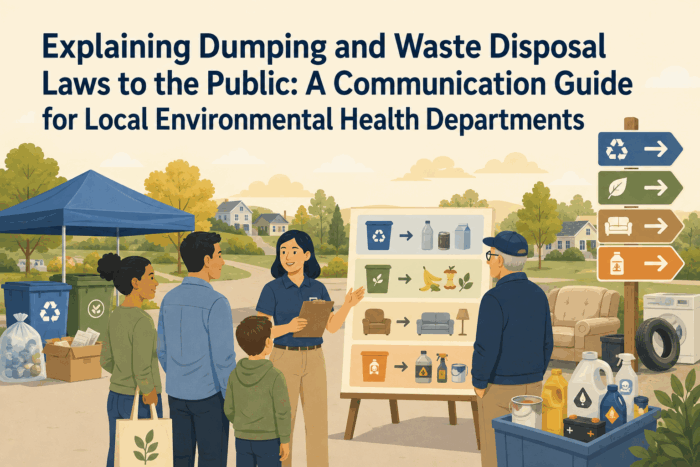
Explaining Dumping and Waste Disposal Laws to the Public: A Communication Guide for Local Environmental Health Departments
Dumping and waste disposal rules affect everyday behavior in ways that are easy for the public to underestimate. A discarded mattress left beside an alley, construction debris placed on an undeveloped parcel, household waste burned or buried on private property, or material deposited near a drainage channel may appear to some residents as a minor nuisance or an informal disposal choice. For local environmental health departments, however, these situations can involve broader concerns related to sanitation, pests, water quality, neighborhood conditions, environmental contamination, fire risk, illegal disposal activity, and the proper handling of materials that may require specialized management.
The communication challenge begins with the fact that residents do not necessarily organize waste-related behavior according to the same categories used by public agencies. A local code, solid waste program, environmental health division, public works department, hazardous materials program, or enforcement unit may distinguish among illegal dumping, littering, abandoned waste, construction and demolition debris, bulky items, household hazardous materials, commercial waste, and other categories. Members of the public may see all of these situations simply as “trash” and expect one rule, one agency, and one disposal pathway to apply.
Local environmental health departments therefore need communication that does more than warn people not to dump illegally. Residents need to understand what kinds of disposal behavior are prohibited, why particular practices create environmental or public health concerns, which disposal alternatives are available, where jurisdictional responsibility lies, and what happens when a complaint is reported. Businesses, contractors, property owners, tenants, and residents may also have different responsibilities depending on the type of material and the circumstances surrounding its disposal.
This creates an important distinction between legal education and enforcement communication. Enforcement may be necessary when prohibited activity occurs, but public understanding should not depend entirely on citations, penalties, or complaint investigations. A stronger communication system helps people recognize improper disposal before it happens and gives them practical information about lawful alternatives. It also helps communities understand that dumping enforcement is not simply about maintaining appearance. Proper waste management supports sanitation, environmental protection, neighborhood safety, and the responsible use of public and private property.
The challenge is complicated further by jurisdiction. Local environmental health departments may have responsibility for some aspects of waste disposal or nuisance conditions while solid waste agencies, public works departments, code enforcement offices, law enforcement, regional environmental authorities, or state agencies handle others. The exact division varies by jurisdiction. Public communication should therefore reflect the actual local structure rather than presenting environmental health as the sole authority over every form of dumping or waste management.
Effective communication begins by making the rules understandable without making them appear simpler than they are. The public does not need an exhaustive summary of every applicable ordinance, permit requirement, or program distinction before taking responsible action. It does need a clear explanation of the behaviors that create problems, the disposal options people should use instead, the agency responsible for different circumstances, and the consequences of ignoring established requirements. When those elements are communicated consistently, local environmental health departments can move beyond reactive enforcement and create a stronger foundation for voluntary compliance.
The Public Needs to Understand the Behavior, Not Just the Legal Category
 One of the most common weaknesses in waste disposal communication is an overreliance on terminology that makes sense inside government but does not necessarily help residents recognize prohibited behavior. Terms such as illegal dumping, unauthorized disposal, solid waste violation, nuisance abatement, or improper waste handling may be accurate within a local program, but they can still leave people uncertain about what they are actually allowed to do.
Local environmental health departments can improve understanding by organizing public information around recognizable actions and situations. A resident should be able to determine whether leaving unwanted furniture beside a roadway, placing debris on someone else’s property, depositing waste in an unauthorized container, abandoning construction materials, or disposing of certain materials through ordinary household trash creates a problem under the applicable local system. The exact rules will differ by jurisdiction and material type, so communication should remain tied to local requirements rather than relying on broad statements that imply universal standards.
Behavior-based explanation is particularly important because improper disposal does not always look intentional. A resident may place a bulky item next to a collection point believing it will be removed automatically. A property owner may assume that waste generated on private land can be buried or burned there. A small contractor may misunderstand where construction debris can be taken. A tenant may leave discarded materials near a shared dumpster without knowing that the service does not accept them. These situations may still violate local requirements, but the communication problem differs from deliberate dumping carried out to avoid disposal costs or responsibility.
Public education should therefore distinguish prohibited behavior from the lawful alternatives available to residents and businesses. If certain bulky items require scheduled pickup, that pathway should be easy to find. If construction debris must go to an authorized facility or be handled through an approved service, the communication should explain that requirement in practical terms. If household hazardous materials require separate collection, residents should understand that they should not simply place those materials with ordinary waste. The goal is to connect each restriction with the action the public should take instead.
This approach also makes enforcement messages more credible. A warning that dumping is illegal is stronger when residents can see that the jurisdiction has also explained how to dispose of common materials properly. Enforcement communication should reinforce an understandable system rather than substitute for one. When agencies provide only prohibitions and penalties, residents may understand that a behavior is discouraged without understanding how to comply.
Local environmental health departments should also be cautious about assuming that one message will work equally well for every audience. Residents disposing of household items, landlords managing multi-unit properties, businesses handling commercial waste, contractors generating project debris, and property owners dealing with abandoned material may encounter different responsibilities and disposal pathways. Communication can remain consistent in its core principles while still directing different audiences toward the information most relevant to their circumstances.
How Environmental Protection Agencies Can Make Communication Central to Regulatory Effectiveness, Public Trust, and Community Health
This article is part of our series on strategic communication for Environmental Protection Agencies, Environmental Compliance Agencies, and state and local environmental departments. To learn more and to see the parent article, which links to other content just like this, click the button below.
Explain Why Improper Disposal Is an Environmental Health Issue
Dumping communication is more effective when the public understands why the behavior matters. If improper disposal is framed only as an aesthetic problem, residents may view enforcement as primarily concerned with cleanliness or neighborhood appearance. Those concerns are legitimate, but the environmental health implications can be broader.
Accumulated waste can create conditions that attract rodents, insects, or other pests. Materials left outdoors can deteriorate, leak, blow into surrounding areas, or enter drainage systems. Certain discarded materials may create physical hazards, fire concerns, or environmental risks depending on their contents and condition. Large dumping sites can also create recurring problems when visible waste signals that an area is being used informally for disposal.
The appropriate explanation should remain proportional to the actual concern. Agencies should not portray every discarded household object as a severe environmental threat. Overstatement can undermine credibility, particularly when residents can see that the immediate issue is a relatively ordinary bulky item or debris pile. Communication should instead explain that waste rules exist because different materials and disposal practices create different sanitation, environmental, and safety consequences and because authorized systems are designed to manage those materials more appropriately.
This distinction helps environmental health departments communicate enforcement as part of a broader prevention system. The objective is not merely to remove waste after it appears. It is to reduce the conditions that allow improper disposal to become normalized, recurring, or concentrated in particular locations.
The same framing can improve community reporting. Residents who understand the environmental health reasons behind dumping rules may be better able to recognize when a situation requires attention and provide useful information when making a complaint. They may also be more likely to distinguish between an ordinary collection issue, a code concern, and a potentially more serious disposal problem that warrants environmental health involvement.
Communication should nevertheless avoid implying that residents are responsible for investigating or classifying potentially hazardous materials themselves. If the nature of dumped material is uncertain, public instructions should focus on safe reporting and avoiding unnecessary contact rather than encouraging residents to inspect, move, or identify materials without appropriate expertise. This keeps public participation focused on observation and reporting while leaving technical assessment to the responsible authorities.
Clarify Responsibility Before Residents Are Passed Between Agencies
Waste disposal complaints can become frustrating when residents contact one department and are repeatedly redirected to another. A person reporting dumped material may not know whether the issue belongs to environmental health, solid waste, public works, code enforcement, law enforcement, a property owner, or another agency. From the resident’s perspective, the distinction matters less than whether the government can explain what happens next.
Local environmental health departments should make jurisdictional boundaries understandable without turning the public-facing process into a map of government structure. Communication should identify the major categories of issues the department handles and provide a clear pathway for concerns that belong elsewhere. When multiple agencies share responsibility, the public should understand enough of the process to know where to begin and what information may be needed.
This is especially important for reports involving private property. Residents may assume that any dumped material automatically becomes a government cleanup responsibility, while local rules may place certain obligations on property owners or distinguish between public and private land. Communication should explain those differences carefully and accurately without making assumptions about requirements that vary by jurisdiction.
Departments should also distinguish between reporting a possible violation and guaranteeing a particular enforcement outcome. A complaint may require investigation, verification, coordination with another agency, contact with a responsible party, or another locally established process before action can occur. Residents should understand that submitting a report begins a process rather than automatically establishing that a violation has been confirmed.
A clear reporting framework improves trust because it sets realistic expectations about what the agency can do. It can also reduce duplicate complaints and unnecessary transfers among departments. When residents know where to report, what information is useful, what agency will review the issue, and what general steps may follow, the enforcement system becomes more understandable even when individual cases take time to resolve.
The broader communication objective is to make compliance and reporting easier than guessing. Local environmental health departments do not need to turn every resident into an expert on waste regulation. They need to create a public information system that translates local rules into recognizable behavior, practical disposal choices, understandable agency responsibilities, and realistic expectations about enforcement. That foundation allows later communication about penalties, recurring dumping locations, specialized waste streams, community partnerships, and prevention strategies to build on public understanding rather than beginning with confusion.
Distinguish Illegal Dumping From Other Waste Problems the Public Encounters
Local environmental health departments can reduce confusion by helping residents distinguish illegal dumping from other waste-related problems that may look similar but follow different rules or reporting pathways. A pile of furniture beside a road, overflowing household trash, abandoned construction debris, litter scattered across a vacant lot, improperly stored commercial waste, and a suspicious container left near a drainage area may all be described informally as dumping. From an enforcement and service perspective, however, the responsible agency, applicable requirement, and appropriate response may differ significantly.
This distinction matters because vague public messaging can unintentionally send residents to the wrong program. A campaign that directs every waste complaint to one reporting line may appear simple, but it can create delays if the receiving department does not have authority over many of the situations being reported. Conversely, a highly technical classification system can discourage reporting because residents may not know which category applies. The communication goal should be to give the public enough information to recognize common types of problems while preserving a straightforward route for situations that are difficult to classify.
Departments can accomplish this by describing waste issues through practical circumstances rather than relying primarily on legal terminology. Residents may understand that abandoned household furniture on public property follows one pathway, waste accumulation on private property may involve another, and potentially hazardous or unknown materials may require a different response. These distinctions should reflect the actual local enforcement and service structure. Agencies should not generalize beyond their jurisdiction, particularly when responsibility may vary between environmental health, solid waste, code enforcement, public works, fire or hazardous materials programs, and other authorities.
Clear categorization also supports more accurate expectations about response. Some reports may lead to inspection or enforcement, while others may be referred for routine collection, property maintenance action, or specialized assessment. Residents are less likely to perceive referral as government inaction when the communication has already explained that different waste conditions are handled through different systems.
The same clarity benefits agency staff. When public-facing terminology aligns with internal routing categories, intake personnel can more efficiently determine where a report belongs and what additional information may be needed. Over time, this reduces unnecessary transfers and gives the public a more coherent understanding of how local waste regulation and service delivery fit together.
Explain the Difference Between Unauthorized Disposal and Ordinary Collection Problems
One recurring source of confusion is the difference between illegal or unauthorized disposal and a problem involving regular waste collection. A household container left out too long, a missed pickup, an overfilled dumpster, or a bulky item placed incorrectly for an otherwise legitimate collection service may not represent the same type of violation as deliberately abandoning waste on another property or in an unauthorized location. Local communication should make that distinction clear enough that residents know when to contact a collection provider, when to use a local service request, and when to report a possible dumping violation.
This distinction also prevents enforcement messaging from becoming unnecessarily punitive. Residents who misunderstand collection requirements may need clearer service information rather than the same communication used for deliberate dumping. At the same time, repeated or intentional misuse of collection areas may still create enforcement concerns under local rules. Agencies should describe the available pathways accurately rather than assuming intent based solely on the appearance of the waste.
Clear differentiation can also help communities understand why government responses vary. A collection issue may be resolved through service coordination, while an illegal dumping complaint may require investigation, documentation, identification of a responsible party, or another enforcement process. When residents understand that these are different problems with different administrative paths, response times and outcomes are less likely to appear inconsistent.
The communication should remain practical. Residents do not need to determine the legal classification before requesting help, particularly when the situation is unclear. They should instead be given enough guidance to choose the most appropriate starting point, with internal agency systems designed to route the report correctly when further classification is necessary.
Connect Prohibited Disposal Practices to Clear Legal Alternatives
Rules are easier to follow when residents understand what they should do instead. Waste communication that emphasizes only prohibited actions can leave people aware that certain disposal practices are illegal while still uncertain about how to dispose of the material lawfully. This gap can be especially significant for bulky items, construction debris, appliances, electronic waste, household hazardous materials, tires, yard waste, and other materials that may not belong in standard residential collection.
Local environmental health departments should coordinate with the agencies and service providers responsible for lawful disposal pathways so that enforcement education points residents toward practical alternatives. The specific options will vary by community and may include scheduled bulky-item pickup, transfer stations, permitted disposal facilities, drop-off events, specialized collection programs, contractor requirements, or other locally available services. Public communication should reflect actual services rather than offering broad recommendations that may not apply within the jurisdiction.
The information should also account for barriers that may influence improper disposal. Residents may not know that a material requires special handling, may be unaware of available services, or may misunderstand whether a fee or appointment is required. Businesses and contractors may face different rules than household residents. Property managers may need guidance for recurring waste accumulation around shared disposal areas. Understanding these circumstances helps agencies develop communication that supports compliance instead of relying solely on warnings after a violation occurs.
Clear alternatives are particularly important when disposal rules are more restrictive than residents expect. A person may reasonably assume that an item can be placed in ordinary trash because it is used in the home, even though the local system requires separate handling. In those situations, the communication should explain both the restriction and the appropriate disposal method. This reduces the likelihood that the rule appears arbitrary and makes compliance more achievable.
Departments should avoid overwhelming the public with a single exhaustive list of every possible waste category. A layered information structure is generally more useful. Broad public messaging can address the most common disposal questions, while more detailed guidance can be available for specific materials, business activities, or specialized waste streams. The core principle should remain consistent: every major prohibition communicated to the public should be paired, where possible, with a realistic lawful alternative.
Explain Enforcement as a Process Rather Than a Threat
Enforcement is an important part of dumping and waste disposal communication, but it should be explained in a way that supports understanding rather than functioning primarily as a deterrent slogan. Statements about fines or penalties may attract attention, yet they provide limited guidance about how the enforcement process actually works or what residents should expect after reporting a suspected violation.
Local environmental health departments should explain that enforcement generally depends on the facts of the specific situation and the authorities available within the jurisdiction. A report may lead to inspection, documentation, coordination with another agency, contact with a property owner or responsible party, or another locally established process. Not every complaint will immediately produce a citation, and not every visible waste problem will fall within the same enforcement authority.
This is important because residents may interpret the absence of immediate visible enforcement as evidence that the agency is ignoring the problem. In reality, establishing responsibility may require information that is not apparent from the dumped material itself. Waste may have been abandoned anonymously, placed by someone other than the property owner, or located in an area where jurisdiction is shared. Public communication should set realistic expectations without revealing investigative details that should remain internal.
Enforcement messaging should also avoid implying that penalties are the primary measure of program effectiveness. A successful waste communication and enforcement system should support lawful disposal, reduce recurring dumping, improve reporting quality, and address problem locations through a combination of education, service access, coordination, and enforcement where appropriate. Penalties are one tool within that broader system.
When agencies do discuss consequences, they should use locally accurate language and avoid generalized claims about fines, criminal liability, vehicle seizure, cleanup charges, or other sanctions unless those outcomes are supported by the applicable local framework. Enforcement information should be specific enough to be credible but not so detailed that public education becomes dominated by punishment rather than compliance.
Set Realistic Expectations About What Happens After a Complaint
Residents are more likely to trust a reporting system when they understand what submitting a complaint can reasonably accomplish. A report typically provides information that the responsible agency can evaluate, but it does not by itself prove that a violation occurred or identify who is responsible. Communicating this distinction helps prevent frustration when enforcement cannot proceed as quickly or visibly as the reporting party expected.
Public guidance should explain what information is useful when making a report, such as the location, general description of the material, observed timing, or other information the agency actually requests. Agencies should avoid encouraging residents to confront suspected violators, search through discarded material, or take unnecessary risks to collect evidence. The public’s role should remain focused on safe observation and reporting.
Departments should also explain whether residents can expect acknowledgment, status information, referral to another agency, or closure notification based on the local process. Not every jurisdiction will provide the same level of case follow-up, so the communication should reflect actual practice rather than promise updates that staff cannot consistently deliver.
Clear expectations are especially important when responsibility cannot be determined. Residents may see the waste remain in place and assume no action has occurred, even though the agency may have inspected the site, contacted another department, or initiated a process that is not immediately visible. Where appropriate, communication can explain the general sequence without overstating what will happen in every case.
A transparent complaint process reinforces the broader educational message surrounding dumping laws. The public learns not only what conduct is prohibited, but also how local government responds, where different responsibilities lie, and why some cases require coordination or investigation before resolution. This makes enforcement more understandable and strengthens the credibility of the overall waste communication system.
Adapt Waste Disposal Communication to Different Audiences Without Fragmenting the Message
Waste disposal laws apply across a community, but the communication needs of different audiences are not identical. A household resident disposing of unwanted furniture, a landlord managing a multi-unit property, a contractor generating demolition debris, a small business handling commercial waste, and a property owner discovering abandoned material on private land may all encounter different responsibilities and service pathways. Treating these audiences as though they face the same decisions can produce information that is technically broad but practically unhelpful.
Local environmental health departments should maintain a consistent core message while adapting the supporting information to each audience. The central principles can remain stable: use authorized disposal methods, do not abandon waste, follow applicable requirements for specialized materials, and report suspected illegal dumping through the appropriate pathway. Audience-specific communication can then explain what those principles mean in the circumstances residents, businesses, or property managers are likely to encounter.
For contractors and businesses, communication may need to emphasize lawful handling and disposal responsibilities associated with commercially generated material. For property owners and managers, the focus may include preventing recurring accumulation, understanding obligations related to private property, and knowing how to respond when waste is abandoned by others. Household communication may need to make bulky-item services, special collection programs, and disposal restrictions easier to find.
This segmentation should not create contradictory messages. Different audiences may receive different levels of detail, but the legal and environmental foundation should remain consistent. When people encounter information through multiple channels, they should see the same basic explanation of why proper disposal matters and how local enforcement and service systems work.
A well-structured communication system therefore balances simplicity with specificity. Residents should not need to understand the full complexity of local waste regulation before taking responsible action, while businesses and other regulated parties should still be able to access the more detailed information relevant to their activities. By combining a clear public foundation with targeted guidance, local environmental health departments can make dumping and waste disposal laws easier to understand without reducing them to generic warnings.
Build Public Education Around Prevention, Not Just Violation Response
 Local environmental health departments can improve compliance when dumping and waste disposal communication reaches people before they make a disposal decision. Public information that appears only after illegal dumping has occurred, or primarily in the context of enforcement, is necessarily reactive. A stronger system gives residents, property owners, businesses, contractors, and other audiences enough practical information to choose lawful disposal methods in advance.
Prevention-focused communication begins with identifying the decisions that most often lead to improper disposal. Residents may be unsure what to do with bulky furniture, appliances, construction debris, household hazardous materials, electronic waste, tires, yard waste, or other items that do not fit easily into standard collection. Property managers may face recurring accumulation around shared dumpsters. Small businesses may not understand which disposal pathways apply to commercially generated waste. Contractors may need clearer direction about authorized handling and disposal requirements for project debris. These situations should inform the communication strategy because they represent points where confusion can turn into noncompliance.
The most useful public education connects each common disposal problem to a clear action. If an item requires a special collection appointment, that step should be easy to find. If a material must be taken to an authorized facility, the communication should explain that pathway. If disposal rules differ for households and businesses, the distinction should be visible rather than buried in program details. This makes compliance easier because the public is not being asked to interpret legal requirements without also receiving practical guidance.
Preventive communication should also be designed around timing. Waste disposal needs are often immediate. Someone moving out of a residence, completing a renovation, replacing an appliance, or clearing a property may make a disposal decision quickly. Information that is difficult to locate or requires several agency handoffs may arrive too late to influence behavior. Departments should therefore consider how residents are most likely to search for disposal information and ensure that the appropriate guidance is accessible through those channels.
This approach does not eliminate the need for enforcement. Deliberate dumping, repeated violations, or improper disposal intended to avoid lawful costs or responsibilities may still require enforcement action. Prevention and enforcement work best when they reinforce one another. Public education explains the lawful pathway, while enforcement addresses situations in which that pathway is ignored.
Use Clear Message Architecture Across Waste Communication Channels
Dumping and waste disposal information is often distributed through several public-facing channels, including agency webpages, collection guides, social media, community newsletters, flyers, complaint portals, public notices, and direct responses to residents. If each channel explains the rules differently, the public may encounter inconsistent terminology, different disposal instructions, or conflicting descriptions of agency responsibility.
Local environmental health departments should use a consistent message architecture across these channels. The core public explanation should identify the prohibited behavior, the environmental or sanitation concern it creates, the lawful alternative, the appropriate reporting or service pathway, and the general role of enforcement. Different communication products can vary in length and detail, but the underlying structure should remain recognizable.
Consistency is especially important when multiple departments participate in waste communication. Environmental health, public works, solid waste programs, code enforcement, and other local functions may each maintain their own webpages or public materials. If one department describes a material as eligible for collection while another directs residents to a separate disposal facility, confusion can undermine compliance. Coordinating core messages and referral pathways helps ensure that residents receive compatible information regardless of where they begin.
The same principle applies to terminology. Agencies should decide which public-facing terms are most understandable and use them consistently. Technical or legal terms may still be necessary in some contexts, but they should be accompanied by plain-language explanation where appropriate. Residents should not need to determine the difference between several government classifications before understanding what action to take.
A clear message architecture also makes future updates easier. When a disposal program changes, a collection service is added, or responsibility shifts between departments, agencies can update the same core elements across channels. This reduces the risk that old instructions remain visible after the system has changed.
Coordinate Communication Around Recurring Dumping Locations
Some dumping problems become concentrated in particular locations, such as alleys, vacant lots, rural roads, construction edges, commercial areas, or places where residents believe waste will be removed without consequence. These recurring sites present a different communication challenge from isolated incidents because repeated dumping can become normalized within the community.
Local environmental health departments should treat recurring locations as communication signals as well as enforcement concerns. Repeated activity may indicate that residents misunderstand local disposal options, that a lawful service is difficult to access, that a property management issue is contributing to accumulation, or that a location has become known informally as a place where waste can be abandoned. Communication alone may not resolve the problem, but it can help agencies understand which messages or service information are missing.
Coordination with other local departments is often necessary. Public works may be involved in cleanup, code enforcement may address property conditions, law enforcement may become involved in certain cases, and solid waste programs may manage collection services. A coordinated communication response can explain both the local problem and the lawful alternatives without presenting the issue as belonging to only one department.
Public messaging around recurring sites should avoid stigmatizing neighborhoods or suggesting that residents collectively are responsible for illegal behavior. The communication should focus on the specific conduct, the environmental or sanitation consequences, the available disposal pathways, and the reporting process. If the jurisdiction is increasing enforcement or changing service options, those developments can be explained clearly without turning the message into a punitive campaign against a community.
Recurring dumping locations can also provide opportunities for targeted outreach. Property owners, nearby businesses, tenant associations, neighborhood groups, contractors, or other relevant audiences may benefit from information tailored to the circumstances driving the local problem. This outreach should remain connected to the broader waste communication system so that targeted messages reinforce rather than contradict general guidance.
Make Reporting Easy Without Shifting Enforcement Responsibility to Residents
Community reporting can help local agencies identify dumping activity, but the reporting system should be designed so that residents are not expected to investigate violations themselves. Public instructions should make clear what information is useful while emphasizing safe observation and avoiding confrontation.
A strong reporting process should be simple enough that residents can use it without understanding the legal classification of the incident. The reporting tool can ask for practical information such as location, approximate time, general description of the material, and whether the waste is on public or private property if that distinction matters within the local system. Internal staff can then determine the appropriate program or enforcement pathway.
Departments should avoid encouraging residents to search through dumped material, follow suspected violators, photograph people at close range, enter private property, or otherwise take unnecessary risks in an effort to collect evidence. The public’s role is to report what they safely observe. Investigation and enforcement remain the responsibility of the appropriate agency.
Clear reporting instructions can also improve case quality. Incomplete location information, vague descriptions, or duplicate reports may slow response. Public education can explain what information is most useful without creating the impression that a complaint will be rejected unless every detail is available.
The system should also set realistic expectations about follow-up. Some cases may be resolved through cleanup, inspection, referral, or property owner contact without a visible enforcement action. Other cases may remain unresolved because the responsible party cannot be identified. If residents understand the general process, they are less likely to assume that every complaint should produce an immediate citation.
Use Communication Feedback to Improve Compliance Over Time
Dumping and waste disposal communication should evolve based on the questions and problems the agency continues to encounter. Repeated public confusion about the same waste category, service, or reporting pathway may indicate that the existing communication is not clear enough or is not reaching the right audience.
Local environmental health departments can use complaint data, call logs, website searches, public inquiries, staff observations, and feedback from partner departments to identify recurring communication gaps. If residents frequently ask where to take a particular material, that disposal pathway may need greater visibility. If reports are routinely sent to the wrong agency, jurisdictional guidance may need simplification. If a specific neighborhood experiences recurring dumping of the same material, targeted education may be warranted.
This evaluation should focus on behavior and understanding rather than on communication volume. Producing more flyers, posts, or notices is not inherently useful if the same misunderstandings continue. The more important question is whether residents know what disposal options exist, whether they can identify the right reporting path, and whether recurring problems are decreasing or shifting.
Departments should also distinguish between communication problems and service-access problems. Residents may fully understand the rules but still face barriers such as inconvenient hours, fees, limited pickup availability, or unclear eligibility. Communication cannot solve every operational issue, but it can help agencies identify where noncompliance may be linked to practical service limitations rather than lack of awareness.
Over time, this feedback loop can strengthen the broader waste management system. Public education becomes more targeted, referral pathways become clearer, and enforcement communication becomes more credible because it is supported by practical alternatives. Local environmental health departments are then better positioned to explain dumping and waste disposal laws as part of a coherent compliance system rather than as a collection of prohibitions.
Integrate Waste Communication Into Enforcement and Service Operations
Dumping and waste disposal communication is most effective when it is connected directly to the operational systems residents use to comply with the rules or report problems. Local environmental health departments may be responsible for only part of the overall waste system, while collection providers, public works departments, code enforcement programs, hazardous materials programs, law enforcement agencies, property managers, and other entities handle related functions. If those operational relationships are not reflected in public communication, residents can receive accurate information from one program while still being unable to determine what action to take.
A stronger approach is to build communication checkpoints into the same processes used for enforcement, service delivery, and complaint routing. When a new disposal program is introduced, collection requirements change, a recurring dumping location emerges, or enforcement procedures are adjusted, departments should review whether public-facing guidance still reflects the actual system. This helps prevent outdated instructions from remaining online after services or responsibilities have changed.
Operational alignment also helps agencies maintain consistency across staff. Residents may encounter information through a complaint line, field inspector, department website, public works office, customer service representative, or community outreach event. If those sources provide different instructions, the public may conclude that the rules themselves are unclear. Maintaining a current internal reference for common waste categories, disposal pathways, reporting routes, and enforcement responsibilities can reduce this risk.
This shared reference should remain practical rather than overly legalistic. Staff need enough information to direct residents accurately without requiring every employee to interpret complex waste regulations. The objective is to create a common operational understanding of who handles which types of issues, what services are available, what information residents need, and when a matter requires technical or enforcement review.
Coordination is especially important when waste conditions cross departmental boundaries. A dumped appliance may involve collection, code enforcement, or environmental health depending on location and circumstances. Construction debris may raise different issues than household waste. Unknown containers may require specialized assessment. A clear internal routing system allows residents to begin with a reasonable point of contact without being expected to navigate the jurisdictional structure on their own.
Keep Public Information Current as Disposal Services and Requirements Change
Waste disposal communication can become outdated quickly when collection programs, authorized facilities, service schedules, fees, eligibility rules, or agency responsibilities change. Information that was accurate when a webpage or flyer was created may later direct residents toward a service that no longer exists or omit a new option that makes lawful disposal easier.
Local environmental health departments should therefore treat waste communication as a maintained service resource rather than a one-time educational product. High-use materials should be reviewed periodically to confirm that contact information, disposal pathways, reporting instructions, and agency responsibilities remain current. Updates should also be triggered when operational changes occur rather than waiting for a scheduled review.
This maintenance is particularly important for specialized waste streams. Residents may rely on agency guidance to determine how to dispose of materials that cannot be handled through standard collection. If the information is outdated, the consequences can include confusion, missed disposal opportunities, improper placement, or repeated calls to staff for clarification. Clear maintenance responsibility helps prevent these gaps.
Agencies should also distinguish current guidance from historical or superseded information. Old event notices, outdated disposal instructions, or previous service schedules may remain visible through search engines, archived pages, or community sharing. When possible, departments should ensure that current pages are clearly identified and that obsolete materials are either updated, archived appropriately, or redirected to current guidance.
Consistency across departments matters as well. If public works updates its bulky-item program but environmental health continues linking to an older process, residents may receive contradictory instructions. Communication maintenance should therefore include coordination among the programs that share responsibility for waste disposal education and enforcement.
A current information system reduces administrative burden because staff spend less time correcting misinformation that government sources created inadvertently. It also strengthens compliance by making lawful disposal pathways easier to identify at the moment residents need them.
Prepare Targeted Communication for Recurring and High-Visibility Problems
Some waste issues require more focused communication because they are recurring, highly visible, or associated with particular locations or behaviors. A community may experience repeated mattress dumping in alleys, construction debris along rural roads, unauthorized use of commercial dumpsters, or accumulation around multifamily properties. These patterns can indicate that general public education is not sufficiently addressing the behavior or audience involved.
Local environmental health departments should use recurring problems to determine where targeted communication may be appropriate. The goal is not simply to repeat the general rule more loudly. It is to identify the specific misunderstanding, service gap, audience, or behavior contributing to the problem and develop information that addresses it directly.
For example, repeated bulky-item dumping may indicate that residents do not know how scheduled pickup works or assume that placing items beside a collection point automatically triggers removal. Recurring construction debris may require outreach to contractors, property owners, or renovation-related audiences rather than a general household campaign. Accumulation at multifamily properties may reveal confusion about tenant responsibilities, landlord obligations, or the capacity of shared waste systems.
Targeted communication should remain coordinated with enforcement. If an agency increases inspections or enforcement in a recurring dumping area, public information should explain the lawful disposal alternatives and reporting pathways available. This creates a clearer compliance message than enforcement alone because residents can understand both the prohibited behavior and the action expected instead.
Departments should also be careful not to frame recurring dumping as a characteristic of an entire neighborhood or population. The communication should focus on the behavior and the local conditions contributing to it. Stigmatizing language can weaken community cooperation and distract from the practical objective of reducing improper disposal.
High-visibility incidents may require similar preparation. A large dumping site, unusual material, enforcement action, or media-covered cleanup can generate broader public attention. Agencies should be prepared to explain the specific issue, the applicable disposal expectations, the role of the department, and any lawful alternatives relevant to the situation without generalizing beyond what the facts support.
Strengthen Coordination With Property Owners, Businesses, and Community Partners
Government communication alone cannot address every waste disposal problem. Property owners, landlords, businesses, contractors, neighborhood organizations, waste service providers, and other local partners often influence whether residents understand disposal options and whether problem locations remain manageable over time.
Local environmental health departments can strengthen compliance by giving these partners communication materials that are accurate, practical, and easy to use. Property managers may need clear guidance for tenants about bulky items, shared dumpsters, and prohibited placement. Businesses may need information about commercial waste responsibilities and unauthorized dumping around their properties. Community organizations may help distribute lawful disposal information when cleanup events, moving periods, or recurring neighborhood issues increase demand.
The value of partnership communication depends on consistency. Agencies should avoid creating separate guidance for each partner that gradually diverges from the official public message. A stronger model uses shared core information that can be adapted for different audiences while preserving the same disposal rules, reporting instructions, and service pathways.
Partners can also provide useful feedback about where communication is failing. Property managers may report recurring tenant questions. Businesses may identify illegal dumping patterns around commercial areas. Community organizations may recognize barriers that make lawful disposal difficult to access. These observations can help departments determine whether additional education, operational coordination, or service changes should be considered.
Coordination should also establish clear boundaries around responsibility. Community partners can help distribute information and encourage compliance, but they should not be expected to perform enforcement functions or investigate violations. Public agencies should remain responsible for regulatory interpretation, complaint handling, inspection, and enforcement within their authority.
Evaluate the Communication System Alongside the Waste Problem Itself
The effectiveness of dumping and waste disposal communication should be evaluated in relation to public understanding, reporting quality, and recurring behavior rather than only by the amount of content produced. A department can publish numerous notices and still face the same confusion about where items belong, which agency handles complaints, or how lawful disposal services work.
Local environmental health departments can examine recurring questions, improperly routed complaints, website search behavior, hotline calls, field observations, and feedback from partner agencies to determine whether communication is helping residents take the correct action. If residents consistently ask about the same disposal category, that issue may need clearer guidance. If large numbers of reports are sent to the wrong department, the reporting pathway may be too complicated. If residents know a practice is prohibited but continue asking what lawful alternative exists, disposal information may be incomplete.
Evaluation should also distinguish communication failures from operational barriers. A resident may understand exactly how an item should be disposed of but still face limited service availability, unclear eligibility, inconvenient scheduling, or other practical constraints. Communication cannot resolve every service issue, but it can help agencies identify when persistent noncompliance is connected to more than a lack of awareness.
Departments should use these findings to improve the entire communication system rather than simply adding more content. A confusing webpage may need simplification, a recurring referral problem may require cross-departmental coordination, and a common disposal question may warrant a dedicated public resource. The objective is to make compliance progressively easier to understand and the enforcement system progressively easier to navigate.
Over time, this creates institutional learning that can strengthen future waste programs. Local environmental health departments can identify which disposal issues repeatedly confuse the public, which audiences require more tailored information, which agency boundaries create unnecessary friction, and which messages are most useful in preventing improper disposal. That knowledge allows waste communication to evolve from reactive notices into a more durable system supporting lawful behavior, effective reporting, and coordinated local enforcement.
Strategic Communication Support for Dumping and Waste Disposal Compliance
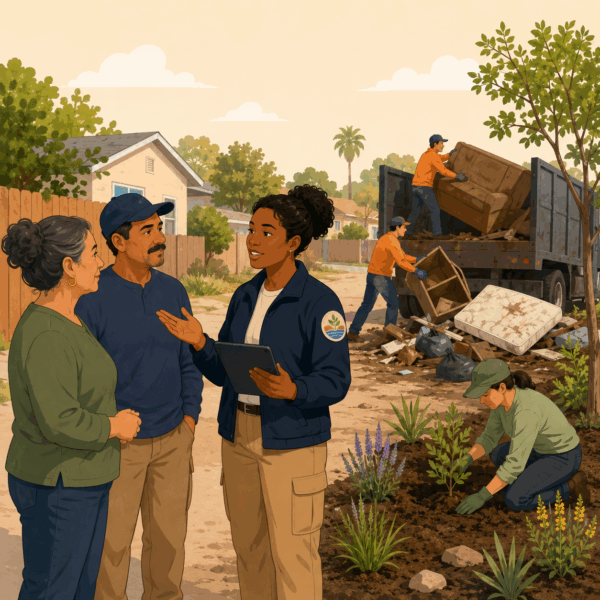 Dumping and waste disposal communication can become difficult for local environmental health departments when legal requirements, service options, enforcement responsibilities, and public reporting pathways are spread across several programs or agencies. Residents may understand that improper disposal is prohibited while still being unsure what to do with a specific material, which department handles the issue, or what happens after a complaint is submitted. External strategic communication support can help agencies assess these gaps, organize complex waste information, clarify responsibilities, and build a more coherent public-facing system around prevention, compliance, reporting, and enforcement.
Stegmeier Consulting Group (SCG) can support local environmental health departments by developing message frameworks, disposal guidance, complaint and reporting information, staff talking points, public education materials, stakeholder outreach tools, and cross-departmental communication structures that make waste rules easier to understand and act on. SCG can also help agencies align information across environmental health, public works, solid waste, code enforcement, property management, and other relevant functions so that residents receive consistent guidance about prohibited behavior, lawful alternatives, agency roles, and realistic enforcement expectations. This support strengthens the communication surrounding the responsible agency’s work without assuming any regulatory, enforcement, waste management, or operational authority.
External support can also help departments identify recurring misunderstandings, outdated information, poorly routed complaints, or audience-specific gaps that weaken compliance over time. By strengthening the structure and consistency of public information, SCG can help agencies make lawful disposal easier to understand, improve reporting quality, and support a more credible local enforcement system. Connect with SCG to explore strategic communication support for dumping prevention and waste disposal education.
Future Trends
Public expectations around waste disposal communication are likely to increase as communities rely more heavily on digital information to determine how and where materials should be handled. Residents may search for disposal options at the moment they need them and expect current guidance about bulky items, special waste streams, reporting procedures, and service availability. This places greater pressure on local environmental health departments and partner agencies to maintain information that is accurate, searchable, and coordinated across multiple public channels.
Digital access can also expose inconsistencies more quickly. A resident may encounter one set of disposal instructions on an environmental health page, another on a public works site, and a third through a waste service provider. Even small discrepancies in accepted materials, scheduling, contact information, or reporting pathways can reduce confidence in the overall system. Agencies will therefore need stronger maintenance practices and clearer ownership of shared public information.
Another emerging need will be more responsive communication around recurring dumping patterns. Complaint data, service requests, field observations, and community feedback can help agencies identify where certain materials, locations, or audiences are associated with repeated problems. Departments that use this information strategically can develop more targeted public education rather than relying only on broad jurisdiction-wide messaging.
Public communication may also need to become more integrated with service design. If residents repeatedly misunderstand a disposal pathway, the problem may not be messaging alone. The underlying process may be difficult to navigate, poorly labeled, or fragmented across agencies. Environmental health departments and partner programs can use communication feedback to identify where operational simplification may support better compliance.
Over time, local agencies are likely to benefit from treating waste communication as a maintained system rather than a collection of individual campaigns. Clear message architecture, coordinated referral pathways, current service information, targeted outreach, and structured feedback can create a more durable foundation for reducing improper disposal and improving public understanding.
Conclusion
Explaining dumping and waste disposal laws effectively requires more than telling the public that certain behavior is illegal. Residents need to understand what actions are prohibited, why those rules exist, what lawful alternatives are available, which agency is responsible for different types of problems, and what they can realistically expect when they report a possible violation.
Local environmental health departments are most effective when they translate legal and programmatic distinctions into practical public guidance. Clear explanations of common waste categories, lawful disposal pathways, enforcement processes, and reporting responsibilities can reduce confusion before it becomes noncompliance. At the same time, agencies should preserve appropriate distinctions among household waste, commercial material, construction debris, specialized waste streams, and other categories that may follow different local requirements.
Strong communication also depends on coordination. Environmental health departments often operate within a broader system that includes public works, solid waste services, code enforcement, property owners, businesses, contractors, and community partners. When those participants provide compatible information, residents are more likely to understand how the system works and where to begin when they need help.
The long-term objective is not simply greater awareness of penalties. It is a public information environment in which lawful disposal is easier to understand, reporting is easier to navigate, and enforcement is seen as one part of a broader compliance system. Local environmental health departments that maintain clear, current, and coordinated communication are better positioned to prevent recurring dumping problems while strengthening trust in the local waste management process.
Stegmeier Consulting Group’s Strategic Approach to Communication Systems
Make waste disposal rules easier to follow through clear guidance, coordinated responsibilities, and practical compliance pathways.
Local environmental health departments need communication systems that connect prohibited disposal practices with understandable alternatives, clear reporting instructions, and consistent explanations of agency responsibility. Stegmeier Consulting Group (SCG) helps agencies strengthen public education, staff messaging, cross-departmental coordination, stakeholder outreach, and disposal guidance so residents can understand what to do before improper disposal occurs.
Use the form below to connect with our team and explore how strategic communication support can strengthen dumping prevention, waste disposal compliance, and public understanding.