Stormwater Permit Compliance Communication: How Municipal Agencies and Regional Water Quality Control Boards Can Explain MS4 Obligations
Municipal Separate Storm Sewer System, or MS4, requirements can be difficult to explain because they sit at the intersection of environmental regulation, municipal operations, infrastructure management, land development, public works, inspections, and community behavior. Municipal agencies may be responsible for implementing permit requirements locally, while regional water quality control boards or comparable regulatory authorities oversee compliance within the broader regulatory framework. Residents, businesses, contractors, property owners, and elected officials often encounter only one piece of that system at a time, making the overall purpose and structure of MS4 obligations difficult to understand.
The communication challenge is not simply that stormwater regulations are technical. It is that many obligations are distributed across different programs and actors. Illicit discharge detection, construction-site controls, post-construction requirements, municipal operations, public education, inspections, reporting, and watershed protection may all be connected to the same permit framework. A business may experience the system through an inspection, a developer through design requirements, and a resident through messages about dumping, yard waste, vehicle washing, or neighborhood drainage. Without clear communication, those experiences can feel like unrelated rules rather than parts of a coordinated water quality program.
This fragmentation can create unnecessary resistance. Municipal agencies may be perceived as imposing local requirements without explanation, while regional water quality control boards may appear distant from the practical responsibilities cities and counties must carry out. Regulated audiences may not understand which obligations originate in a regional permit, which are implemented through local ordinances or programs, and which requirements apply specifically to their activities. Residents may also assume that storm drains operate like sanitary sewers and that runoff is routinely treated before reaching waterways, even though stormwater systems and treatment practices differ by jurisdiction and infrastructure.
Effective MS4 communication therefore needs to explain both the regulatory structure and the practical purpose behind it. Municipal agencies and regional water quality control boards should help audiences understand what the permit is designed to accomplish, how responsibilities are divided, why certain activities are regulated, and what compliance looks like in everyday settings. When the communication system connects regulatory obligations to recognizable environmental outcomes, MS4 requirements become easier to understand and easier to implement consistently.
Explain What an MS4 Is Before Explaining What the Permit Requires
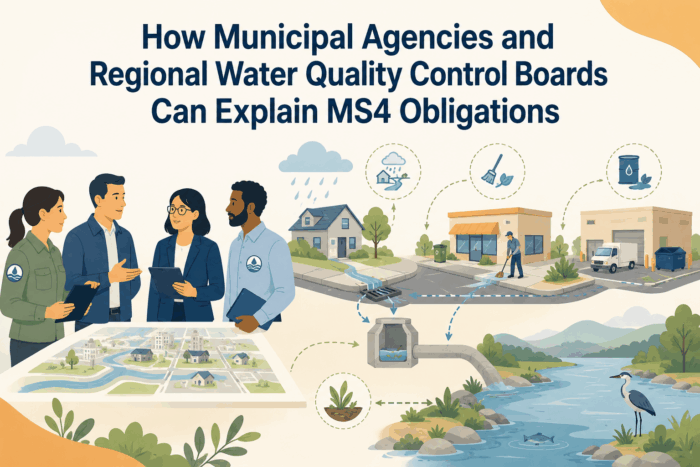
 The term MS4 is familiar to stormwater professionals but often meaningless to the public and many regulated audiences. Communication should begin by explaining the system itself in practical terms. An MS4 generally refers to a publicly owned or operated system of conveyances used to collect or move stormwater, which can include streets, gutters, drains, pipes, channels, and related infrastructure. The exact regulatory definition and permit structure should be described according to the applicable jurisdiction, but public-facing explanations should make clear that the system is designed to manage runoff rather than function as a conventional sanitary sewer.
That distinction matters because people often assume water entering a storm drain is treated in the same way as wastewater from homes or businesses. In many communities, stormwater may travel through drainage infrastructure and eventually reach creeks, rivers, lakes, coastal waters, or other receiving waters with limited or different treatment. Communication should therefore connect routine activities on streets, parking areas, construction sites, industrial properties, and municipal facilities with their potential downstream effects.
Municipal agencies can use this explanation to establish why local practices matter. Materials washed into a gutter or storm drain may include sediment, oil, trash, chemicals, nutrients, bacteria, or other pollutants depending on the activity. The agency does not need to overwhelm residents with regulatory terminology at this stage. The purpose is to establish a simple environmental pathway: runoff moves across developed surfaces, enters the stormwater system, and can carry pollutants toward receiving waters.
Regional water quality control boards can reinforce the same foundation when explaining permit requirements to municipalities and broader public audiences. Consistent terminology across regulatory and local communication helps prevent situations in which the regional permit is discussed as an abstract legal instrument while municipal programs are presented as unrelated local rules.
How Environmental Protection Agencies Can Make Communication Central to Regulatory Effectiveness, Public Trust, and Community Health
This article is part of our series on strategic communication for Environmental Protection Agencies, Environmental Compliance Agencies, and state and local environmental departments. To learn more and to see the parent article, which links to other content just like this, click the button below.
Clarify the Different Roles of Regional Regulators and Municipal Agencies
MS4 compliance communication becomes confusing when audiences cannot tell which agency is responsible for which part of the system. Regional water quality control boards or comparable authorities may establish, administer, enforce, or oversee requirements under the applicable regulatory framework, while municipalities implement permit obligations through local programs, ordinances, inspections, maintenance practices, development standards, education, and reporting. The exact division of authority varies, so agencies should describe their respective roles accurately rather than relying on broad labels.
Municipal agencies should explain that many local stormwater requirements are connected to obligations the municipality itself must satisfy. This context is important when businesses, developers, contractors, or property owners encounter inspections or corrective requirements and assume they are merely local administrative preferences. Clear communication can explain that the municipality is implementing a broader water quality compliance framework while still distinguishing local discretion from permit-driven obligations.
Regional regulators should likewise avoid communicating only at the level of permit language. Municipal staff, elected officials, and affected stakeholders benefit from understanding what regional requirements mean operationally. When a permit requires local programs for pollution prevention, inspections, development controls, monitoring, education, or another function, communication should clarify the outcome expected without implying that every municipality must implement the requirement through identical procedures.
The strongest approach is coordinated but role-specific. Regional agencies can explain the regulatory framework and compliance expectations, while municipal agencies translate those expectations into local procedures and audience-specific responsibilities. Consistency between the two levels reduces the risk that regulated audiences receive conflicting explanations about why a requirement exists or which agency has authority over it.
Separate Permit Requirements From Local Implementation Choices
Not every operational detail associated with an MS4 program should be described as though it appears directly in a regional permit. Municipalities often need to translate broader permit obligations into local ordinances, inspection protocols, administrative procedures, design standards, educational programs, or enforcement practices. Communication should distinguish between what the permit requires and how the municipality has chosen or is authorized to implement that requirement.
This distinction improves credibility because it prevents agencies from using the permit as a blanket explanation for every local practice. Where a municipality has discretion, that discretion should be acknowledged. Where a requirement is directly tied to the regulatory framework, that connection should be explained precisely.
For regulated audiences, the distinction can also make compliance easier. Businesses, developers, and contractors need to know whether they are responding to a specific local standard, a broader permit obligation, or both. Clear explanation reduces disputes about authority and helps people identify the correct document, agency contact, or process when they need additional guidance.
Translate MS4 Obligations Into Everyday Operational Responsibilities
MS4 permits can contain detailed regulatory language, reporting expectations, implementation schedules, and program requirements. Municipal staff responsible for public works, streets, facilities, parks, fleet operations, planning, development review, code enforcement, or inspections may not interact with the permit document regularly even though their daily work contributes directly to compliance. Agencies should therefore translate permit obligations into responsibilities that are recognizable within municipal operations.
For municipal employees, communication should connect requirements to actual work processes. Street sweeping, catch basin maintenance, spill response, material storage, construction oversight, landscape management, facility housekeeping, vehicle maintenance, illicit discharge response, and development review may all have stormwater implications. Staff are more likely to understand their responsibilities when the communication explains what they need to do, when they need to document it, and how their work supports the municipality’s permit obligations.
The same principle applies to outside audiences. A contractor needs to understand what practices are expected on a construction site. A commercial property owner may need clear guidance about prohibited discharges or maintenance practices. A developer may need to understand post-construction stormwater requirements and how they enter the review process. Generic statements about protecting water quality are not sufficient when compliance depends on specific actions.
Regional water quality control boards can support this translation by communicating expectations in ways that help municipalities build operational systems around the permit. The regulatory language remains authoritative, but complementary guidance can help local agencies understand how different permit components relate to program administration, documentation, staff responsibilities, and public communication.
Explain Illicit Discharges in Language Residents and Businesses Can Recognize
The concept of an illicit discharge is central to many MS4 programs but can be difficult for nontechnical audiences to recognize in practice. People may understand that dumping chemicals into a storm drain is prohibited while overlooking less obvious activities such as wash water entering the street, sediment leaving a worksite, improperly managed landscape materials, leaking fluids, or certain commercial cleaning practices. Communication should move beyond the term itself and explain the types of situations that may create a stormwater concern.
Municipal agencies should use examples that reflect local conditions and the audiences they are trying to reach. Residential communication may focus on household activities, vehicle maintenance, pool or spa water, yard practices, pet waste, or illegal dumping where relevant. Business communication may need to address washdown activities, outdoor storage, waste handling, loading areas, maintenance practices, spills, or other sector-specific sources. Construction audiences require a different set of examples related to sediment, concrete washout, materials management, erosion controls, and site housekeeping.
The agency should also explain what residents or businesses should do when they observe a suspected discharge. Reporting pathways should be easy to locate and should distinguish urgent spills or environmental emergencies from routine complaints where necessary. If the municipality needs certain information to investigate effectively, such as location, time, photographs, or the apparent source, that guidance can improve the usefulness of reports without making the process burdensome.
Regional regulators can reinforce these messages by maintaining consistent definitions and explaining how illicit discharge programs fit within the larger MS4 framework. The objective is not simply to increase reporting volume. It is to help communities recognize potential problems, understand why they matter, and know how the appropriate agency will respond.
Connect Stormwater Compliance to Water Quality Without Overstating Individual Impacts
Stormwater communication is stronger when audiences understand why requirements exist, but agencies should avoid oversimplifying environmental causation. A single discharge, construction site, parking lot, or municipal activity should not automatically be described as the cause of a broader watershed problem unless the evidence supports that conclusion. MS4 communication should explain how pollutant sources can contribute to cumulative water quality pressures while maintaining appropriate scientific precision.
Municipal agencies can connect local requirements to recognizable pathways. Sediment may affect receiving waters, trash can move through drainage systems, vehicle fluids can enter runoff, and improperly managed materials can be transported during rain or washdown activities. These explanations show how individual practices relate to water quality without making claims that exceed what the agency can establish about a particular incident or source.
This distinction is particularly important in watersheds with multiple pollution sources. Municipal runoff may interact with industrial activity, agriculture, legacy contamination, wastewater systems, natural conditions, or other contributors depending on the location. Public communication should not imply that MS4 controls alone can resolve every water quality problem or that municipal agencies are responsible for sources outside their authority.
By explaining both contribution and limitation, municipal agencies and regional water quality control boards can strengthen public understanding of why MS4 compliance matters. The permit becomes easier to understand when audiences see it as one part of a broader water quality protection system, with defined responsibilities, measurable obligations, and practical actions that reduce pollutants entering stormwater infrastructure.
Explain Construction Stormwater Responsibilities Before Problems Reach the Street
Construction activity is one of the most visible sources of stormwater concern because disturbed soil, exposed materials, concrete washout, fuels, debris, and site runoff can move quickly beyond a project boundary. Contractors and developers may understand that erosion and sediment controls are required, but they may not understand how those requirements connect to the municipality’s broader MS4 obligations or which responsibilities belong to the site operator, the local agency, and another regulator.
Municipal agencies should explain construction stormwater expectations at the point when project teams can still plan for them. Communication should identify when stormwater controls enter permitting or development review, what documentation may be required locally, who is responsible for maintaining controls, and how inspections or corrective actions fit into the process. The goal is to reduce situations in which stormwater requirements are treated as a late-stage compliance issue rather than part of normal site management.
Public-facing explanations should also distinguish between visible sediment leaving a site and the broader range of construction-related pollutants that may affect runoff. Materials storage, concrete operations, vehicle tracking, waste handling, fueling, and temporary drainage conditions can all create stormwater concerns. Clear examples help contractors and property owners understand that compliance is not limited to installing perimeter controls.
Regional water quality control boards can support municipal implementation by communicating the relationship between local oversight and any separate construction stormwater requirements that may apply under the broader regulatory framework. This distinction helps project teams understand that satisfying one local inspection does not necessarily resolve every applicable obligation.
Make Post-Construction Requirements Understandable During Development Review
Post-construction stormwater requirements can be difficult to communicate because they often involve design features, long-term maintenance obligations, site planning decisions, and technical standards that become relevant well before a project is built. Developers and property owners may focus primarily on obtaining approval and underestimate the continuing responsibilities associated with stormwater treatment, retention, infiltration, flow control, or other required measures.
Municipal agencies should explain these obligations early in planning and development review. Applicants need to understand when stormwater requirements may affect site design, which documents or calculations are expected, and who will be responsible for maintaining installed controls after construction. Waiting until final approval to explain long-term obligations increases the likelihood of redesign, disputes, or future maintenance failures.
Communication should also help elected officials, neighboring residents, and property owners understand that stormwater features may serve regulatory functions even when they resemble landscaping, open space, drainage areas, or other site amenities. Bioswales, treatment areas, detention features, permeable surfaces, or related infrastructure may require specific maintenance to continue functioning as intended. Public explanations should avoid presenting every feature as interchangeable, since design requirements and performance expectations vary.
Regional regulators can reinforce this message by explaining why post-construction controls are part of the MS4 compliance framework and how they support longer-term water quality objectives. Municipal agencies then translate those requirements into local development standards, inspection practices, maintenance agreements, or other implementation tools.
Clarify Who Maintains Stormwater Controls After Construction Ends
A recurring communication problem occurs when responsibility shifts after a development is completed. A developer may install required stormwater controls, but long-term maintenance may later become the responsibility of a property owner, homeowners association, commercial operator, public agency, or another entity. If this handoff is not communicated clearly, required infrastructure can become neglected even though the original project was constructed correctly.
Municipal agencies should identify maintenance responsibility in plain language and make the obligation visible to the parties who inherit it. Owners should understand what must be maintained, how often inspections or maintenance may be required, what records must be retained where applicable, and who to contact when a system needs repair or clarification.
This communication should also survive changes in ownership or management. Long-term stormwater requirements are only effective if the obligation remains understandable after the individuals who originally designed or approved the project are no longer involved.
Communicate Inspection Programs as Compliance Support, Not Only Enforcement
Businesses, contractors, property owners, and municipal departments may encounter MS4 obligations most directly through inspections. If communication begins only when an inspector identifies a problem, the inspection process can feel punitive even when its broader purpose is to verify compliance and prevent pollutants from reaching the stormwater system.
Municipal agencies should explain what inspectors are looking for, what types of sites may be inspected, and how findings are documented. Regulated audiences should understand the difference between routine observations, required corrective actions, follow-up inspections, and situations that may lead to escalated enforcement. The exact terminology should reflect local authority and permit requirements.
Pre-inspection guidance can improve compliance by helping businesses and facilities identify common issues before they become violations. This may include outdoor storage, waste handling, vehicle maintenance, wash water, spills, exposed materials, drainage connections, or other activities relevant to the particular site. Sector-specific communication is more useful than a generic reminder to keep pollutants out of storm drains.
Regional water quality control boards can support municipalities by communicating the purpose of inspection and oversight requirements at the permit level. When local agencies and regional regulators explain inspections consistently, regulated audiences are more likely to understand that inspections are part of a structured compliance system rather than isolated local enforcement actions.
Explain Corrective Action and Escalation Before Enforcement Becomes the Only Message
Stormwater compliance problems do not all have the same severity, cause, or regulatory consequence. Some may involve housekeeping deficiencies or maintenance failures that can be corrected promptly, while others may involve repeated noncompliance, significant discharges, or circumstances requiring stronger enforcement. Communication should reflect those differences without minimizing serious problems.
Municipal agencies should explain what happens after a problem is identified. Regulated parties need to understand whether they will receive written findings, what corrective action is expected, what timeframe applies, what documentation may be required, and when follow-up will occur. Clear next steps can reduce confusion and help businesses or property owners focus on correcting the actual condition.
Where enforcement escalation is possible, agencies should communicate that progression accurately. The objective is not to threaten regulated audiences but to establish predictable expectations. A party that understands the consequences of failing to correct a condition is better positioned to make informed compliance decisions.
Regional regulators should likewise distinguish municipal implementation from their own oversight and enforcement roles. If a municipality itself is responsible for meeting MS4 permit requirements, communication should explain that local program performance may also be subject to regulatory review. This reinforces that the compliance framework applies at multiple levels without blurring the separate authorities involved.
Give Municipal Employees the Same Compliance Clarity Expected From the Public
MS4 permits often require municipalities to manage their own facilities and operations in ways that reduce stormwater pollution. Public works yards, fleet facilities, parks operations, road maintenance, material storage areas, municipal construction, and other activities can create runoff risks if stormwater responsibilities are treated as the responsibility of one environmental program rather than the entire organization.
Internal communication should translate permit obligations into job-specific expectations. Employees need to understand what practices apply to their work, how to manage materials and spills, when to report a problem, what documentation is required, and which staff can provide technical assistance. Training is more effective when it connects stormwater requirements directly to normal work activities rather than presenting the permit as a separate compliance document.
Supervisors and department leaders also need enough context to support these responsibilities. If operational schedules, purchasing decisions, staffing, or facility conditions interfere with compliance, employees may not be able to correct the issue through training alone. Communication should therefore connect frontline practices with management accountability.
Regional water quality control boards can strengthen municipal implementation by recognizing that internal communication systems are part of effective permit administration. Municipal compliance depends not only on what an environmental coordinator understands, but on whether stormwater expectations are integrated across the departments whose work affects runoff.
Help Elected Officials Understand What MS4 Compliance Requires From the Organization
 Stormwater programs often require sustained municipal investment in staffing, inspections, maintenance, monitoring, infrastructure, data management, education, and enforcement. Elected officials may encounter these needs primarily through budget requests or public complaints and may not immediately see how individual expenditures connect to the municipality’s MS4 obligations.
Municipal agencies should provide elected officials with concise explanations of the regulatory framework, major program responsibilities, current compliance priorities, and consequences of inadequate implementation. This communication should distinguish mandatory permit obligations from discretionary program enhancements so decision-makers understand where the municipality has flexibility and where it does not.
Officials also benefit from understanding why stormwater compliance can require coordination across departments. A budget decision affecting street maintenance, inspection staffing, capital improvements, development review, or facility operations may have implications for the municipality’s broader compliance system. Explaining those connections supports more informed governance.
Regional regulators can contribute by communicating permit expectations in ways that are understandable beyond technical stormwater staff. When elected leaders understand the purpose and structure of MS4 requirements, municipal implementation is less likely to be viewed as a collection of optional environmental initiatives and more accurately understood as an ongoing regulatory responsibility.
Use Public Education to Support Compliance Without Making Residents Responsible for the Entire System
Public education is an important element of stormwater communication, but agencies should avoid implying that water quality problems can be solved primarily through individual behavior. Residents can reduce certain pollutant sources, report suspected discharges, manage household activities responsibly, and understand how local drainage systems function. Municipal agencies, businesses, developers, and regulators also carry significant responsibilities that should remain visible.
Effective public education should therefore connect individual actions to the larger MS4 program. A message about keeping yard waste out of gutters can explain why the practice matters while also showing that the municipality maintains drainage infrastructure, inspects potential pollution sources, manages its own operations, and implements broader permit requirements.
This balanced framing improves credibility. Residents are less likely to dismiss outreach as superficial when they can see that the agency is also addressing institutional and regulated sources of pollution. Communication becomes a shared-responsibility message rather than a campaign that places environmental accountability primarily on household behavior.
Regional water quality control boards can reinforce this balance by explaining that public education is one component of a broader compliance structure. MS4 programs are strongest when residents understand their role without losing sight of the regulatory, operational, and infrastructure responsibilities carried by public agencies and other regulated parties.
Build Audience-Specific Guidance Instead of One General Stormwater Message
MS4 communication becomes more effective when agencies recognize that different audiences encounter stormwater obligations through different activities. A resident trying to understand whether wash water can enter a gutter has a different information need from a contractor managing erosion controls, a commercial facility preparing for an inspection, or a municipal employee responsible for material storage. One generalized stormwater brochure is unlikely to provide enough practical direction for all of them.
Municipal agencies should organize guidance around the decisions each audience actually makes. Residential materials can focus on household activities, reporting pathways, and everyday runoff behavior. Business guidance can address outdoor operations, waste handling, washing practices, spills, and inspection expectations. Construction communication can emphasize erosion, sediment, site controls, and corrective action. Development guidance can focus on design standards, post-construction controls, and long-term maintenance responsibilities.
Regional water quality control boards can support this approach by providing consistent regulatory framing while allowing municipalities to adapt communication to local conditions and program structures. The objective is not to create different interpretations of the permit for different audiences. It is to translate the same compliance framework into practical responsibilities that are easier for each group to understand and act on.
Audience-specific communication also reduces unnecessary enforcement friction. People are more likely to comply when they can recognize how a requirement applies to their activity before an inspection or complaint occurs. Clearer guidance turns stormwater communication from a broad environmental message into an operational compliance tool.
Explain Documentation and Recordkeeping as Part of Compliance, Not Administrative Burden
Many MS4 obligations depend not only on whether an activity occurred but also on whether the municipality or regulated party can demonstrate that required actions were completed. Inspection records, maintenance logs, training documentation, corrective action records, monitoring information, and other materials may support permit compliance depending on the applicable program. For staff and regulated audiences, these requirements can feel disconnected from the environmental purpose of the work.
Municipal agencies should explain why documentation matters. Records provide evidence that inspections occurred, maintenance was completed, problems were corrected, and program responsibilities were carried out consistently. They can also help agencies identify recurring issues, track unresolved conditions, and demonstrate implementation when permit compliance is reviewed.
Internal guidance should make recordkeeping responsibilities specific. Staff need to know what information must be documented, who is responsible for maintaining it, where records are stored, and how long they must be retained when applicable. Vague instructions to “document compliance” are unlikely to produce consistent results across departments or facilities.
Regional water quality control boards can reinforce this connection by explaining how documentation supports oversight without reducing compliance communication to paperwork. The strongest message links records to accountability, program continuity, and the ability to show that required stormwater controls are functioning as intended.
Communicate Monitoring and Water Quality Data in Ways That Support Interpretation
Stormwater programs may generate monitoring data, inspection findings, pollutant measurements, outfall observations, watershed information, or other technical results. Publishing these materials without explanation can create confusion, particularly when audiences do not understand what was measured, why a location was selected, what comparison value is relevant, or whether one result represents an isolated condition or a broader pattern.
Municipal agencies and regional water quality control boards should provide context alongside technical data. Public-facing communication can explain the purpose of the monitoring, the type of information collected, the period represented, and how the results relate to the applicable compliance framework. This does not require simplifying every dataset into a single conclusion.
Agencies should also avoid overinterpreting individual results. One elevated measurement does not automatically establish the source of a pollutant, while one low measurement does not necessarily demonstrate that a broader watershed concern has been resolved. Where trends, additional investigation, or multiple data sources are necessary for interpretation, that limitation should be visible.
Clear data communication supports credibility because it helps audiences distinguish measurement from conclusion. Residents, elected officials, and regulated entities are better positioned to understand water quality information when agencies explain both what the data show and what the data alone cannot establish.
Separate Compliance Indicators From Broader Watershed Outcomes
Municipalities may be meeting specific MS4 program requirements while broader receiving-water conditions remain impaired or otherwise concerning. Conversely, improvement in one water quality indicator does not automatically prove that every element of the stormwater program is fully compliant. These are related but distinct questions.
Communication should distinguish between implementation performance and environmental outcomes. Program measures may show that inspections, maintenance, training, or required controls are occurring. Watershed indicators may show changes in pollutant concentrations, habitat conditions, or other environmental measures influenced by multiple sources.
This distinction helps agencies avoid promising that permit implementation alone will produce immediate or easily attributable environmental change. It also allows municipal agencies and regional regulators to communicate progress accurately while acknowledging the broader complexity of watershed conditions.
Explain Reporting Pathways So Complaints Reach the Right Agency
Stormwater concerns often cross jurisdictional boundaries. A resident may observe a discharge from a construction site, industrial property, municipal facility, roadway, or unknown source without knowing which agency has authority to investigate. If reporting pathways are unclear, complaints may be sent to multiple agencies, delayed, or abandoned.
Municipal agencies should provide simple instructions for reporting suspected illicit discharges, spills, drainage concerns, or other stormwater problems within their jurisdiction. The guidance should identify what information is helpful, such as location, time, observed conditions, photographs where appropriate, and whether the discharge appears ongoing. Emergency incidents should be clearly distinguished from routine reporting when different response channels apply.
Regional water quality control boards can help by explaining when concerns should begin with the municipality and when direct regional reporting may be appropriate under the applicable regulatory structure. Agencies should avoid forcing residents to determine complex jurisdictional questions before they can report a potential environmental problem.
A well-designed referral process is equally important behind the scenes. If a complaint reaches the wrong agency, staff should know how to direct it appropriately rather than requiring the resident to restart the process. Clear public reporting and internal referral systems together make stormwater oversight more accessible and responsive.
Use Compliance Communication to Reduce Repeat Violations
Repeated stormwater problems often indicate that initial communication did not produce lasting operational change. A business may correct one housekeeping issue after an inspection but fail to understand the underlying practice that caused it. A construction site may repeatedly reinstall controls without addressing why sediment continues to leave the site. A municipal facility may resolve an isolated incident while the same risk remains embedded in routine operations.
Municipal agencies should use recurring compliance issues as an opportunity to improve the explanation of expectations. Corrective communication should address not only what is wrong but also what practice needs to change, who is responsible, and how the party can prevent recurrence. Where appropriate, agencies can direct regulated audiences toward sector-specific guidance or technical assistance resources.
Patterns across multiple sites can also reveal broader communication gaps. If inspectors repeatedly encounter the same misunderstanding, the municipality may need to update training materials, pre-inspection guidance, permit handouts, or development instructions rather than treating every violation as an isolated failure.
Regional regulators can use similar patterns when communicating with permittees. Repeated deficiencies across municipalities may point to permit provisions that require stronger implementation guidance, more consistent interpretation, or clearer expectations. Compliance communication is strongest when recurring problems inform better systems rather than only repeated enforcement.
Coordinate Messaging When Stormwater Responsibilities Cross Jurisdictions
Stormwater systems and watersheds rarely align neatly with municipal boundaries. Runoff can move between neighboring jurisdictions, drainage infrastructure may connect across agencies, and regional water quality requirements may apply to multiple municipalities within the same watershed. Public confusion increases when each jurisdiction explains related responsibilities differently.
Municipal agencies should coordinate around common facts where shared systems or watershed issues are involved. This can include consistent explanations of reporting pathways, major pollutant concerns, regional permit requirements, shared monitoring activities, or public education campaigns. Coordination should not erase local differences in ordinances, procedures, or enforcement authority.
Regional water quality control boards are well positioned to support this consistency by reinforcing common regulatory terminology and clarifying how municipal obligations fit within the larger permit structure. When municipalities receive different interpretations or communicate conflicting expectations, regulated audiences may struggle to determine which requirements govern their activities.
Cross-jurisdictional communication is especially important during incidents that affect more than one community. A spill, major runoff event, or shared water quality concern may require several agencies to communicate at once. Establishing coordination practices before an incident occurs reduces contradictory messaging and helps the public understand which agency is responsible for investigation, response, and follow-up.
Connect MS4 Communication to Compliance Milestones Throughout the Permit Cycle
Stormwater communication should not occur only when a new permit is issued or an enforcement problem arises. Municipal agencies and regional water quality control boards should connect communication to meaningful milestones throughout the permit cycle so that responsibilities remain visible as programs evolve.
For municipalities, these milestones may include updates to local ordinances, changes in inspection programs, new development requirements, revised training practices, annual reporting periods, infrastructure improvements, or changes in public education priorities. Communicating these developments helps staff, regulated parties, and elected officials understand that MS4 compliance is an ongoing operational responsibility rather than a one-time response to permit adoption.
Regional water quality control boards can similarly explain when permit changes alter municipal responsibilities, implementation schedules, reporting expectations, or program priorities. Early explanation gives municipalities time to understand the operational implications before deadlines or compliance concerns become urgent.
A milestone-based communication approach creates continuity across the life of the permit. Instead of repeatedly reintroducing stormwater regulation during isolated compliance events, agencies maintain an understandable narrative about what the program requires, how responsibilities are changing, and what actions are expected next.
Integrate Stormwater Communication Into Municipal Program Management
MS4 communication is most effective when it is built into program management rather than handled only when a permit is renewed, an inspection finds a problem, or a public complaint occurs. Municipal agencies should identify communication needs alongside operational responsibilities so that staff, regulated audiences, elected officials, and residents receive information at the points when it can actually affect behavior and compliance.
Program planning should connect communication to inspections, staff training, development review, construction oversight, maintenance schedules, monitoring, reporting, and public education. This allows agencies to prepare guidance before recurring compliance problems emerge and ensures that communication reflects the procedures staff are actually expected to follow. It also reduces the risk that different departments explain the same stormwater obligation in inconsistent ways.
Municipal stormwater programs should establish ownership for major communication functions. Staff should know who maintains public guidance, who updates internal procedures, who communicates permit changes, who coordinates with regional regulators, and who responds when technical or public information becomes outdated. Clear responsibility helps prevent communication gaps that can persist even when the underlying compliance program is functioning well.
Regional water quality control boards can support this integration by communicating permit expectations early enough for municipalities to incorporate them into operational planning. When regulatory changes are explained only near implementation deadlines, local agencies may have limited time to update staff guidance, public materials, workflows, and partner communication.
Create Consistent Internal Guidance Across Municipal Departments
MS4 compliance often depends on departments that do not identify themselves primarily as environmental programs. Public works, streets, parks, fleet operations, facilities, planning, building, engineering, code enforcement, procurement, and emergency response may all make decisions that affect stormwater compliance. If each department relies on its own interpretation of requirements, inconsistent practices can develop even within the same municipality.
Municipal agencies should create shared guidance that translates stormwater responsibilities into department-specific expectations while maintaining a consistent compliance framework. Staff working at a maintenance yard need different operational instructions from planners reviewing development applications, but both should understand how their responsibilities connect to the municipality’s permit.
Internal communication should also clarify escalation pathways. Employees need to know when a routine stormwater issue can be handled through normal procedures and when a spill, repeated problem, suspected illicit discharge, or potential compliance failure requires immediate coordination with environmental staff, supervisors, or another agency.
Consistent internal guidance strengthens both compliance and external communication. When municipal employees understand the same core requirements, businesses and residents are less likely to receive conflicting explanations from different departments.
Build Communication Checkpoints Into Inspections and Corrective Action
Inspection programs generate repeated opportunities to explain stormwater obligations, yet communication is often concentrated in violation notices or corrective directives. Municipal agencies can improve compliance by designing communication checkpoints before, during, and after inspections so that regulated parties understand both the expectations and the consequences of failing to meet them.
Before an inspection, sector-specific guidance can explain common areas of concern and the types of practices inspectors may evaluate. During the inspection, staff can distinguish observed conditions from final compliance determinations where appropriate and explain what additional information may be needed. Afterward, written communication should identify required corrections, deadlines, documentation expectations, and follow-up steps clearly enough that the regulated party understands what successful resolution looks like.
This structure is particularly important when multiple deficiencies are identified. A long list of technical findings can be difficult for a business or facility operator to prioritize. Clear organization can distinguish immediate issues from longer-term corrective actions while preserving the exact regulatory significance of each finding.
Regional regulators can reinforce this approach by providing municipalities with consistent expectations for inspection documentation, follow-up, and program implementation. Strong communication does not replace enforcement, but it can reduce repeat problems by making corrective requirements more understandable.
Strengthen Digital Access to Stormwater Compliance Information
Stormwater information is often distributed across municipal webpages, engineering manuals, permit documents, development standards, inspection forms, public works pages, and regional regulatory websites. A person trying to understand one obligation may have to search multiple systems without knowing which source is current or authoritative.
Municipal agencies should organize digital information around user needs rather than internal departmental structures. Businesses should be able to find compliance guidance relevant to their operations. Developers should be able to locate construction and post-construction requirements. Residents should be able to understand prohibited discharges and reporting pathways. Municipal staff should have access to current internal procedures without relying on outdated files stored independently by individual departments.
Regional water quality control boards can strengthen this ecosystem by making permit documents, amendments, implementation guidance, compliance expectations, and related resources easy for municipal staff to locate. Where regional information is highly technical, complementary summaries can help local staff understand what changed and what operational action may be required.
Version control is essential. Stormwater requirements evolve, and outdated digital materials can remain visible long after procedures change. Agencies should identify current guidance clearly, archive superseded materials appropriately, and update links when regional or local requirements are revised.
Design Stormwater Information Around the User’s Next Action
Digital communication should help users determine what to do, not simply provide a library of regulations. A contractor visiting a stormwater page may need to know which requirements apply before beginning work. A commercial operator may need guidance after receiving an inspection notice. A resident reporting an apparent discharge needs a clear submission pathway rather than a complete description of the MS4 permit.
Agencies can improve usability by organizing information around common actions and decision points. This approach does not remove the detailed regulatory material. It gives users an understandable entry point and then connects them to the technical documents relevant to their situation.
Action-based organization also reduces staff workload. When users can identify the correct procedure, form, contact, or requirement independently, agency staff spend less time answering basic navigation questions and more time addressing substantive compliance issues.
Prepare Communication Systems for Stormwater Incidents and High-Visibility Violations
Routine stormwater compliance communication can change rapidly when a significant spill, visible discharge, infrastructure failure, enforcement action, or other incident attracts public attention. Municipal agencies should prepare communication procedures before such events occur so that staff can provide accurate information without improvising during an active response.
Incident communication should distinguish confirmed facts from preliminary information. Agencies may know that a discharge occurred before they know its source, composition, environmental effect, or regulatory consequence. Public messaging should reflect that uncertainty rather than filling information gaps with conclusions that may later change.
Roles should also be clear when several agencies are involved. A municipality may be responding operationally while a regional water quality control board, emergency response agency, facility operator, or another regulator conducts separate work. Coordinated communication should identify who is addressing the immediate condition, who is investigating compliance, and where authoritative updates will be provided.
Post-incident communication should explain corrective action and follow-up when appropriate. Residents are often most concerned not only with what happened, but with whether the source was controlled, what agencies learned, and what actions are being taken to prevent recurrence.
Measure Whether Stormwater Communication Is Improving Compliance
Municipal agencies and regional regulators should evaluate communication based on whether it helps people understand and carry out stormwater responsibilities, not simply on how many brochures, webpages, trainings, or outreach messages are produced. Output measures are useful administratively, but they do not show whether communication is reducing recurring compliance problems.
Agencies can look for patterns in inspection findings, repeat violations, public reporting quality, staff questions, development review corrections, training results, and recurring misunderstandings. If the same stormwater requirement is repeatedly misapplied across businesses, construction sites, or municipal departments, the issue may reflect more than individual noncompliance. It may indicate that guidance is unclear or reaching audiences too late.
Public communication can be evaluated similarly. Agencies can examine whether residents know where to report discharges, whether reports include enough information to support investigation, and whether stormwater education is reaching the activities most closely connected to local program concerns.
Measurement should lead to adjustment. The purpose is not to prove that communication is successful, but to identify where it can better support the broader compliance system. Stormwater programs become more effective when communication performance is treated as part of operational improvement.
Build Institutional Knowledge That Survives Permit Cycles and Staff Turnover
MS4 programs are long-term regulatory systems, while staff assignments, consultants, elected officials, and organizational structures can change frequently. Municipal agencies should preserve communication knowledge so that each permit cycle does not require the organization to rediscover the same public questions, compliance misunderstandings, and internal coordination problems.
Institutional resources can include approved terminology, audience-specific guidance, inspection communication templates, training materials, partner contact structures, reporting protocols, frequently asked questions, and lessons from previous incidents or enforcement issues. These materials should be reviewed periodically so institutional memory does not become a repository of outdated requirements.
Regional water quality control boards can also support continuity by communicating permit transitions clearly and maintaining accessible guidance that helps both experienced and newly assigned municipal staff understand regulatory expectations. Consistency is particularly valuable when responsibility for a local MS4 program changes hands during an active permit term.
Strong institutional knowledge reduces dependence on individual employees and makes stormwater communication more resilient. The goal is a system in which accurate explanations, compliance expectations, and public guidance remain consistent even as the people administering the program change.
Strategic Communication Support for MS4 Compliance and Stormwater Programs
 MS4 programs require municipal agencies to translate complex permit obligations into practical expectations for staff, businesses, developers, contractors, residents, elected officials, and partner agencies. That communication work can become difficult when stormwater responsibilities are distributed across departments, permit requirements are highly technical, regulated audiences need different types of guidance, and internal staff capacity is already focused on inspections, reporting, infrastructure, development review, and operational compliance. External strategic communication support can help agencies organize these responsibilities into a clearer system while preserving the distinction between communication functions and regulatory authority.
Stegmeier Consulting Group (SCG) can support municipal agencies and regional water quality control boards by developing plain-language MS4 communication frameworks, audience-specific compliance materials, staff guidance, inspection and corrective-action communication, public education resources, project and permit webpages, elected-official briefing materials, multilingual outreach, incident communication protocols, and cross-agency messaging systems. SCG can also help agencies identify where regulated audiences are repeatedly misunderstanding requirements, organize complex technical information around practical user needs, and create communication workflows that connect regional permit expectations with local implementation.
External support can be particularly useful when agencies have limited internal communication capacity, need specialized expertise in translating technical regulatory information, or would benefit from an objective outside perspective on where their current materials create confusion. SCG’s role remains focused on communication strategy, information organization, public-facing content, and stakeholder engagement. SCG does not determine MS4 permit requirements, make compliance findings, conduct water quality analysis, perform inspections, issue enforcement actions, or make regulatory decisions on behalf of municipal or regional agencies.
Future Trends
MS4 communication will increasingly need to support more complex stormwater programs while remaining understandable to people who do not work in water quality regulation. Municipal agencies are likely to rely more heavily on digital inspection systems, online reporting, searchable compliance resources, interactive mapping, asset management platforms, and web-based development guidance. These tools can make information easier to access, but only if agencies organize them around the tasks users are trying to complete rather than around internal program structures.
There will also be greater pressure to connect permit implementation with visible environmental outcomes. Residents and elected officials may increasingly expect agencies to explain not only which activities were completed but also how those activities relate to watershed conditions, recurring pollutant concerns, infrastructure priorities, and long-term water quality goals. Agencies will need to communicate that relationship carefully so they do not overstate what individual MS4 actions can accomplish or imply causal conclusions that available data do not support.
Regional and municipal coordination will become increasingly important as stormwater challenges cross jurisdictional boundaries. Shared watersheds, regional monitoring, interconnected drainage systems, climate-related runoff pressures, and overlapping infrastructure responsibilities can make fragmented communication less effective. Municipal agencies and regional water quality control boards will need stronger systems for aligning terminology, public guidance, incident communication, and compliance expectations while preserving each agency’s distinct authority.
Technology may assist with data organization, inspection tracking, reporting, and document navigation, but effective MS4 communication will continue to require human judgment. Agencies will still need to determine how technical requirements should be explained, which audiences need different levels of detail, where jurisdictional boundaries must be clarified, and how to communicate uncertainty without weakening credibility. The communication challenge will remain one of making complex regulatory systems usable without oversimplifying them.
Conclusion
MS4 compliance depends on more than the language contained in a stormwater permit. Municipal agencies must translate regional and regulatory requirements into operational practices, inspection systems, development standards, maintenance responsibilities, public education, internal procedures, and reporting structures that many different audiences can understand and follow.
Clear communication begins with explaining what the stormwater system is, how runoff moves through it, and why pollutant control matters. It also requires precision about authority. Regional water quality control boards and municipal agencies play different roles, and businesses, contractors, residents, property owners, employees, and elected officials need to understand which agency is establishing requirements, which is implementing them, and what responsibilities apply to their own activities.
The strongest stormwater communication systems extend across the entire compliance lifecycle. They prepare audiences before inspections or development reviews, explain corrective action when problems arise, maintain accessible digital information, support internal staff consistency, clarify reporting pathways, and preserve institutional knowledge as permits and personnel change. Communication should also help agencies distinguish program implementation from broader watershed outcomes so progress can be described accurately.
When MS4 communication is treated as part of compliance infrastructure, rather than as an occasional public education function, agencies are better positioned to reduce recurring confusion, improve operational consistency, and strengthen confidence in the stormwater regulatory system. Effective communication makes complex obligations more understandable without weakening the technical and regulatory precision on which permit compliance depends.
Stegmeier Consulting Group’s Strategic Approach to Communication Systems
Turn complex stormwater permit obligations into clear responsibilities that agencies, regulated audiences, and communities can act on.
Municipal agencies and regional water quality control boards need communication systems that connect MS4 permit requirements with everyday operations, development practices, inspections, public reporting, staff responsibilities, and long-term stormwater management. Stegmeier Consulting Group (SCG) helps agencies organize technical information, develop audience-specific guidance, strengthen internal and external messaging, improve digital access, and build communication frameworks that make stormwater compliance easier to understand while remaining aligned with the applicable regulatory structure.
Use the form below to connect with our team and explore how strategic communication support can strengthen MS4 compliance communication and stormwater program implementation.