
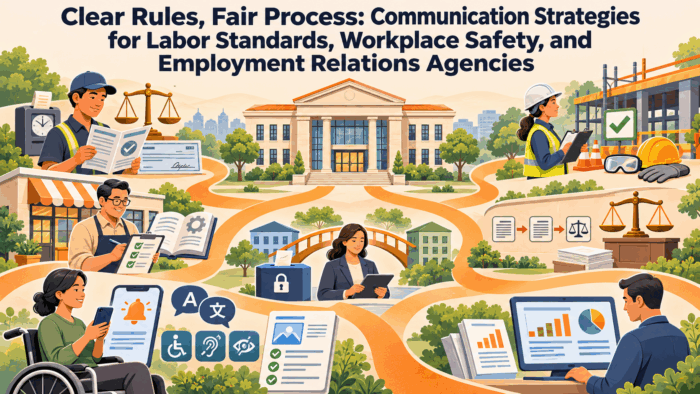
Clear Rules, Fair Process: Communication Strategies for Labor Standards, Workplace Safety, and Employment Relations Agencies

A worker who finds missing hours on a paycheck may have to decide whether to raise the issue while still depending on the next shift. A small business owner opening an inspection letter needs to distinguish the immediate correction from the evidence the agency wants later. Public employees voting on representation need instructions they can use regardless of which position they favor. In each situation, agency communication affects whether people can exercise a right, meet an obligation, or participate in a public process.
The people on either side of a workplace dispute often arrive with different information and different risks. Workers may have pay records dispersed across apps, paper schedules, and text messages. Employers may have payroll records that require explanation or worksite responsibilities shared across a contractor and a host business. An agency has to explain what it can accept, what it will examine, and what parties can do next while preserving the integrity of the case. The same standard applies whether people encounter the agency through a poster, an investigator, a hearing notice, or a news story.
This content hub follows communication from prevention and rights education through reports, investigations, decisions, and follow-through. It also covers the responsibilities carried by occupational safety and health programs, public employment relations boards, and central personnel offices. Each function needs a public explanation that reflects its own authority. The shared goal is for workers, employers, and public employees to understand whose instructions apply, what action they can take, when it is due, and where they can get assistance.
Communication can also shape what happens before an issue grows into a case. A payroll lead who understands which work a local ordinance covers can check a change before the first affected pay run. A supervisor who knows which safety concern requires prompt escalation can reach the right program without waiting for a routine callback. A county HR team that explains an upcoming policy in time for supervisors to practice applying it can resolve inconsistencies before employees receive conflicting instructions. These prevention opportunities deserve the same planning as inspections and public statements.
The people responsible for those outcomes may sit outside a communications office. Program staff own the procedure, records teams govern what information can be shared, and supervisors see where the public repeatedly gets stuck. This guide gives those teams common tasks they can carry out together, including checking handoffs, testing notices, setting update expectations, and deciding what to measure. The examples show how to put those tasks into practice at the state, county, and city levels.
Who This Content Hub Is For
This guide serves state labor and industrial relations departments, wage claim and field enforcement units, state occupational safety and health programs and their consultation services, and city and county labor standards offices. It is written for commissioners, division chiefs, public information officers, program managers, intake teams, investigators, and inspectors. Each has a role in keeping public instructions and case-specific communication aligned.
Public employment relations boards, labor relations commissions, and mediation and conciliation services can use this guide to communicate procedures and service availability while protecting their neutral role. Central human resources and personnel agencies, civil service commissions, merit system boards, and departmental HR and labor relations teams can use it to explain requirements and coordinate implementation. Workers’ compensation administrators and apprenticeship standards divisions can apply the guidance on role clarity, referrals, notices, and outreach to their own programs.
Program managers, intake teams, investigators, inspectors, hearing staff, HR leaders, and legal reviewers all shape what the public sees, hears, and receives from a labor agency, and communications and public information staff work alongside them. The hub is written for all of these roles.
How to Use This Labor Standards, Workplace Safety, and Employment Relations Communications Hub
Labor agencies communicate with workers, employers, unions, worker centers, industry associations, public employees, and government departments. These audiences interact with agencies for different reasons and bring different levels of familiarity with labor laws, administrative processes, and available services. This content hub provides a central resource for labor standards agencies, occupational safety and health programs, labor relations boards, and central personnel agencies seeking to explain rights and responsibilities, improve access to services, and communicate consistently throughout formal proceedings and policy changes.
The sections below provide a broad framework for understanding labor agency communication. They explain how labor agencies can educate workers about their rights, work with trusted community partners, guide people through claim intake and case updates, and help employers understand compliance requirements and respond to inspection findings. Agency leaders and staff can also use this hub to improve communication during representation elections, bargaining, disputes, workplace incidents, and personnel policy rollouts. Sections on communication channels, staff alignment, and measurement apply across these functions, while sections on external support and future trends address how agencies can sustain and adapt their communication practices over time.
The case studies from Seattle, Oregon, Massachusetts, and Washington examine how labor agencies use published materials to address specific communication challenges. The comparison section connects labor agency communication with related work in workforce development, financial regulation, courts, and environmental agencies. Labor agency leaders and staff can use these examples to assess their own materials and consult related hubs when a communication issue involves multiple agencies or services.
Our Comprehensive Guide to Public Communications for State and Local Government Agencies
This article is part of our series on strategic communication for state and local government agencies. To learn more and to see the parent article, which links to other content just like this, click the button below.
How Labor and Public Employment Agencies Operate Across Jurisdictions
The name on the agency’s front door can conceal several distinct authorities. A state labor department may house wage enforcement, safety enforcement, apprenticeships, and workers’ compensation. A municipal labor office may enforce local wage, leave, or scheduling ordinances within a defined area. Public-sector bargaining disputes can go to a labor relations board while an examination or classification question goes to central HR or a civil service body. Workers rarely describe their problem in the terms agencies use, and a person dealing with missing wages, a hazard on a jobsite, a bargaining charge, or a question about a government job classification is often unsure which of these offices handles the matter.
Jurisdiction should appear at the point where it affects what someone does. For a worker who lives in one city and performs work in another, a location question should specify whether it is asking for the worksite, the employer’s mailing address, or the worker’s home address. For safety questions, coverage can differ by jurisdiction and employee group. OSHA’s State Plans directory shows which plans cover private-sector and state and local government workers and which cover state and local government workers only. Agencies should provide a current, official destination for each referral and explain why the referral applies.
Build separate routes for an unpaid wage issue, a workplace injury and benefits question, and a current safety hazard, even when all three arise from the same event. The same person may need several routes with separate intake requirements. An apprenticeship inquiry may also involve both the program sponsor and the state standards office. A referral should say what the receiving office handles, how to reach it, and whether the person must take another action to start the process. When an agency transfers information, tell the person what was sent and what they should expect next.
A referral a person can act on
A referral can include a short description of the issue, the office and channel, any time-sensitive instruction verified for that program, and the records the person can have ready. If coverage is uncertain, tell the worker which office can make that determination and how to contact it. Staff can track calls returned by another program, failed links, and repeated transfers to identify where an agency chart is creating work for the public. Have each receiving office confirm its entry on the referral guide and update it when its process changes.
Explaining workers’ compensation and apprenticeship responsibilities
A worker asking about an injury may need to understand benefits intake, workplace safety reporting, and the employer’s reporting role. A benefits administrator can describe its own process using three stages that the worker can distinguish in a conversation, such as reporting the event, starting the benefits process, and receiving a determination. Use the jurisdiction’s actual procedure and explain where a worker can get help identifying the right recipient. Where authorized offices use separate records systems, tell the worker how to identify their matter when calling each office.
For apprenticeship, a directory entry or recruitment flyer can lead to several distinct questions. Prospective apprentices need to know how to apply and which organization controls selection. Current apprentices may need to reach a sponsor for training records or a standards office for questions about an approved program. Employers may need guidance on registering or making changes to a program. Describe the appropriate office beside the relevant action so the worker can follow through even when several organizations use the same program name.
How Labor Agencies Can Communicate Fairly With Workers and Employer
Fairness is visible in the information both parties receive about the process. Use the same terms for shared milestones, including receipt, request for information, review, determination, and closure. Tailor the preparation instructions to each party. A worker might need help identifying the dates and locations worked. An employer might need a way to submit payroll data for the relevant period and identify the employee who can explain discrepancies. Every party should be able to tell who sent the message, what prompted it, what action is required or available, and what happens next.
The first contact should be usable by a worker worried about exposure and by an employer worried that an inquiry signals a finding. Describe where the process stands and identify what can be shared at that point. For a worker, explain what information the agency requests, who may receive it, and at what stage disclosure can occur under the applicable procedure. For an employer, distinguish an allegation, a request for records, a finding, and a final order. Give formal legal terms a short explanation wherever they first appear.
Create one procedural reference for public pages, case correspondence, staff, and partner organizations. Include approved answers for questions about contact with parties, changes to records, extensions, case transfers, and where to obtain language assistance. Keep the public explanation useful even when facts or timelines are uncertain. A message can name the stage, say whether the person has an action today, and give the date or condition for the next update. Review mirrored worker and employer pages together so the descriptions of the same process continue to agree.
A shared process description still needs to account for uneven access to records, devices, and advice. For example, a worker and an employer may receive the same deadline through formal notices, but the worker may need language assistance and the employer may need instructions on exporting records from a vendor system. Provide both supports where appropriate and explain the authorized routes to ask for practical help. Supervisors can review case correspondence for consistency in the issues raised, the instructions given, and the opportunities to respond under the governing procedure.
Separate procedural information from public statements about enforcement priorities. A campaign can describe a pattern the agency is addressing without implying how an individual allegation will be decided. An investigator’s early letter can identify the matters within scope and use precise language about where the case stands. If verified facts change, update the description through the proper process and explain any change to what the parties are being asked to do. Keep records of those updates so later decisions and public reporting can be interpreted in context.
How Labor Standards Agencies Can Build Year-Round Rights Education
Labor standards agencies should organize rights education around moments when a worker might recognize a problem. The first paycheck, a change in shift, a missed break, a denied request for paid leave, the last day of work, and a sudden change after reporting a concern each give workers a reason to ask a question. A useful explainer starts with the situation, identifies who may be covered, gives a realistic example, and points to one next action. If an example uses a calculation, identify its assumptions and direct employees to the rate or rule for their jurisdiction and date.
Make the same information available before an expected increase in demand. For a local minimum wage update, coordinate the public announcement with a dated rate table, updated posters, staff scripts, a partner handout, and an employer payroll checklist. Seasonal hiring, major construction periods, and high-volume retail schedules may call for outreach ahead of the first pay cycle. A calendar should identify when source information will be confirmed, who can authorize publication, and who will remove or archive materials carrying the old rate.
Design pieces for the moment of use. A worker may need a small card that fits in a pocket with a phone number and an action they can take from a safe device. An employer may need a one-page explanation that can be given directly to a payroll vendor. A community partner may need a short workshop guide with examples, the date of the guidance, and permission to link to the current version. Keep contact routes, English source copy, translations, and print ordering under one content owner so the materials remain useful over multiple seasons.
Extend education beyond a campaign launch by creating a small library of worked situations. A scheduling example can identify the facts that matter, such as the work location, the date of a change, and how the worker was informed. A paid leave example can start with the question a supervisor or worker actually asks and direct employees to the appropriate program when coverage or employer obligations depend on the circumstances.Labor standards agencies should review examples with policy staff and update them whenever the source rules, forms, or office contacts change.
Invite employers and worker organizations to identify the earliest practical opportunity to teach each topic.
Employers and worker organizations can help identify the earliest practical opportunity to teach each topic. Orientation may work for the basics, a pay statement insert may work when a rate changes, and an information card at a community event may help workers whose employers are hard to reach. Schedule a review after the next major hiring or payroll period. Ask partners and call staff which questions they received, and check whether the materials helped people recognize a concern or identify the correct source of assistance.
A targeted education effort can also accompany a proactive field enforcement initiative. Before visits begin, define what information can be distributed widely, including the rights and responsibilities that apply and how to reach the office. Prepare a separate set of staff materials for worksite conversations, with directions on safe follow-up and document handling. If enforcement identifies recurring misunderstandings across several worksites, revise the public education materials using the pattern while respecting the protections that apply to individual matters. A later check can compare the questions employers and workers bring to the office before and after outreach.
How Labor Agencies Can Reach Workers Through Trusted Partners and Address Retaliation Concerns
The cost of asking a question can feel high to someone whose shifts, assignments, or references depend on an employer. Labor agencies should make it possible to read basic information and ask how the process works before entering case details. Explain what is needed to start a report, how the agency will use contact information, whether a third party can help, and whether filing starts a separate process for retaliation. Ask a worker which channel is safe, whether messages can identify the agency, and how to reach them if that channel changes.
Worker centers, unions, libraries, legal aid providers, immigrant-serving organizations, and other community partners often hear about workplace concerns before an agency does. Labor agencies should give partners an approved explanation, a named agency role to contact, a language assistance route, and an escalation path for urgent matters. Define what partners may collect and pass along. Sensitive records should travel through the agency’s authorized method. Ask partners to report recurring points of confusion through a feedback routine that uses patterns and avoids identifiable case information where possible.
Pair outreach to worker-serving organizations with accessible employer communication through industry associations, small business advisers, and payroll networks. Each partner group can teach the same verified procedural facts using examples that suit its audience. Agency staff should retain responsibility for coverage and case decisions. A written partner guide can address how to handle a disputed case, inquiries from journalists, expired handouts, and requests for help outside the partner’s role. Periodic review of the questions partners receive can show where the agency’s own materials need work.
Privacy language people can use to decide
Words such as anonymous, confidential, private, and protected can imply different things to the public. Describe the actual handling of information at the relevant stage. Explain what the agency can keep confidential, what may have to be shared, and where the worker can ask a specific question. Give staff a way to recognize and route retaliation concerns promptly. A statement about legal protections can accompany that explanation, along with an approved description of any separate process and applicable time limits.
Plan for the contact preference to change. A worker who initially uses a work email account may later lose access to it, and a personal phone may be shared with others. An intake system should offer a way to verify identity and update contact details through an authorized channel. Before using any reminder that could be seen by someone else, identify how staff will confirm permission and what identifying information can appear in the message. Review contact instructions when a case is transferred between teams or assigned to a new worker.
Distinguishing a report from a retaliation concern
A worker may report a hazard or a pay issue and later describe a reduction in hours, changed duties, or another action they believe followed their report. Build a handoff for that point in the conversation. Record what the worker is describing through the authorized intake method, identify the office that handles the concern, and explain how to reach it promptly. OSHA’s worker complaint guidance illustrates how an agency can present safety and health complaints and whistleblower complaints as distinct routes. State and local agencies should verify which routes and time limits apply to the matters they handle.
A useful partnership also needs a feedback path when a referral fails. Give partner staff a program contact for situations such as a broken translated link, an office that redirects callers repeatedly, or instructions that appear to conflict. Capture the issue and the channel where it occurred, then assign it to the team that can correct the source. Share the resolution with the referring partner when appropriate. This practice helps program managers see recurring barriers and lets partners update the instructions they give to other people.
How Labor Agencies Can Explain Intake, Case Status, and Wage Recovery
Labor agencies should design claim forms to collect enough information to route and evaluate a submission, starting with questions the worker can answer directly. Ask how they were paid, where the work happened, and which dates they can identify. Provide examples of the records the program accepts and explain how people can describe work when they have partial records. Make language assistance and alternate submission routes visible before a person enters information. Where a form contains mandatory declarations or attachments, explain each requirement next to the field that triggers it.
A confirmation should tell the filer whether the agency received an inquiry, a complaint, or a formal claim. Include a reference number where available, the expected contact method, any action already due, and the channel for correcting contact details or adding documents. If screening and assignment are separate stages, give them distinct labels. When a transfer occurs, explain what moved with the file. Someone checking case status should be able to see whether the agency needs something from them and how to provide it securely.
After an initial period of silence, people will often call for confirmation that their case still exists. Labor agencies should define which changes trigger an update and how long a case can remain in one stage before a routine status message is sent. Use a dated line such as “Your claim is waiting for initial review. You can update your contact details through the secure channel shown below.” Keep estimates separate from binding deadlines, and state whether a new notice changes any action or date. When a program is behind, explain where the delay occurs, which cases the estimate describes, and when the estimate was updated.
Distinguish the events that can occur after a wage claim decision or agreement. A finding, a payment obligation, receipt of a payment, and distribution to the worker are separate milestones. Use terms such as wages assessed and wages paid with clear definitions in notices and public reporting. If collection is handled elsewhere or a party has another step to take, specify the responsible office, the action and timing, and how to get procedural assistance. The same case status vocabulary should appear in letters, portal screens, and staff responses.
Showing the status of evidence and next steps
A record posted to a portal can have several states. An upload may have reached the system, been linked to the claim, or been reviewed by staff. These distinctions matter when a party is deciding whether to send the same material a second time. Use a timestamped receipt and describe what the receipt confirms. When staff find an unreadable or incomplete file, explain what needs to be replaced and what remains usable. Give the person a route to ask about a submission when the system cannot display its current state.
A closure message deserves the same testing as intake. Explain what was completed, whether payment or correction has been verified when relevant, and where the worker can find a copy of the decision or agreement through the appropriate channel. If another office handles collection or follow-up, name its role and describe any action the recipient needs to take. Keep final correspondence usable for someone who returns to it weeks later and needs to understand the connection between the decision, the status, and the record the agency sent.
How Labor Agencies Can Write Clear Notices, Hearings, and Decisions
The first page of a notice should let the worker identify the case, the purpose of the communication, and the action required. Give an actual due date when the applicable procedure allows it, and explain the event that starts the clock if the recipient needs to calculate it. Specify which submission channels the agency accepts, what the submission should include, and what confirmation the person should retain. Put the governing authority, detailed findings, and required legal language where the worker can connect them to the instruction they support.
Labor agencies should review notices in sequence. A request for payroll records, a reminder, and a determination should use the same case reference and terms for the records. A hearing notice should say how to join, what materials to prepare, where to request language or accessibility assistance, and which procedural rule governs service or submission. Decision letters should distinguish the decision, its scope, any obligation, and the available review or appeal process. Verify the precise instructions for the case type and jurisdiction before publication.
Labor agencies can test the notice with a person unfamiliar with the file. Ask them to point to the action, give the deadline in their own words, identify which address or portal they would use, and explain when they should contact staff. Conduct the same test in priority languages and on the screen where users usually read the notice. If a localized version omits an attachment name or the portal calls a submission by a different term, fix the mismatch across both. A revision should be checked against procedural requirements and the actual transaction people are asked to complete.
Develop a family of templates with defined places for the facts that vary. A notice may need to distinguish the issue under review from the outcome, specify a date that depends on how service occurred, or give an address used only for a particular filing. Connect those fields to the approved notice requirements and identify what the preparer must verify before issuing it. Staff should be able to recognize which instructions can be reused and which require a decision for the individual matter.
Plan for access to the hearing and the documents. Give people a clear way to request accommodations or language assistance and allow staff time to arrange it. If the agency uses a remote platform, explain the practical steps for joining, checking audio, and contacting the hearing office if access fails. Instructions about filing evidence should use the same names and deadlines the person will see in the platform or formal notice. Test the exchange of documents from each party’s perspective, including what proof of submission or service the procedure calls for.
People may read the notice at several points and for different purposes. A first-time reader needs an immediate action, a person preparing a response needs precise instructions, and someone reviewing the file later needs to understand what the notice established. Put the case reference, issue date, and sender in a consistent location. Use the same service address and file labels across the notice, attachments, and portal. Even small inconsistencies can send parties to the wrong route when their next step depends on matching information across documents.
How Labor Agencies Can Help Employers Comply Before and After Enforcement
Small employers often encounter rules through payroll settings, schedules, notices posted at worksites, and employee questions. Labor agencies should translate each requirement into the place where an employer has to make a decision. For a wage rate change, that might be identifying covered work, updating the rate for the correct pay period, checking the first payroll after the change, and ensuring supervisors know where to send questions. Provide worked examples with assumptions and dates, and include a path to authoritative program guidance for arrangements that differ from the example.
Labor agencies can give employer guidance a predictable structure across publications. A short overview can identify who may be covered, the date the rule applies, the records employers may need, and where to direct questions. Use deeper examples for recurring issues such as work across city boundaries or shared responsibilities at a jobsite when those examples are within the agency’s authority. Ask business associations and payroll advisers to test whether the handout helps them implement the change while keeping formal interpretations with the responsible agency.
After an enforcement action, explain the connection between the finding and the correction. For a notice involving payroll records, distinguish what applies to the period under review from what the employer needs to change for future pay periods. If the paperwork calls for evidence of correction, identify the required evidence and how to submit it. Give a clear path for procedural questions, an applicable review process, and a way to confirm receipt. Employer assistance can make instructions workable while leaving each case decision with the proper official.
Employer education can focus on the implementers who make the rule visible in everyday work. A franchise operator may need a payroll contact and a site manager to update different parts of the process. A contractor may need to identify where responsibilities lie when several employers share a location. Group employer materials by the operational decision being made and include the rule owner’s contact for questions about unusual arrangements. Distinguish an illustration from case-specific direction and review examples with enforcement and assistance staff before releasing them.
Create a feedback loop between assistance staff and enforcement leaders. If small businesses repeatedly ask whether an updated rate applies to a particular group or pay period, use the questions to improve the public guide and related notices. After a corrective action is communicated, review which submissions demonstrate the requested change and which require follow-up. The pattern can reveal where the agency’s examples, requested records, or review instructions need to be more specific.
How Occupational Safety and Health Programs Can Explain New Standards and Emerging Hazards
A new standard creates several communication tasks that should be scheduled independently. Employers need to know whether the standard applies, when provisions take effect, and what implementation looks like. Workers need to know what to expect at the worksite, which protective practices apply to their tasks, and how to ask about a concern. Inspectors, consultants, trainers, and call center staff need a shared account of coverage, enforcement dates, and the distinction between requirements and examples. Occupational safety and health programs should build a dated source page with links to the rule, implementation guidance, and relevant training or technical assistance.
Heat, workplace violence, and emerging hazards each warrant their own guidance. For outdoor heat, the worker may need a shift-level plan that reflects the conditions, work, and rules applicable at a site. The Washington State Department of Labor & Industries developed a heat safety guide that demonstrates how state agencies can provide workers with clear, practical information to help them prepare for hot working conditions before temperatures rise. Connect policy communication with the people who set schedules, train crews, and check conditions throughout a workday. Verify the audience, coverage, and effective dates before adapting material from another jurisdiction.
Workplace violence guidance often reaches employees whose risk varies by setting and duty. A public-facing counter, a home visit, and a night shift at a facility can require different procedures. New York developed a workplace violence prevention fact sheet specifically for public employees, demonstrating how labor agencies can tailor educational materials to a defined audience and connect workers with the prevention programs that apply to their workplaces. Agencies can help employers explain how to raise concerns, participate in prevention efforts where applicable, and reach the person assigned to follow up. Staff materials should align with the policy and with the means workers actually have to report an incident.
Emerging hazards can require useful communication before the agency has complete information. Workplace safety agencies can separate the verified facts, existing duties, interim protective guidance, and open questions. Assign an update owner, show when the material was revised, and point employers and workers to current resources when evidence changes. During a rulemaking, explain what is proposed, what currently applies, how stakeholders can participate, and when the agency expects to issue another update. This structure can support communication about a changed process, new equipment, or a hazard that appears in multiple industries.
Preparing supervisors and workers for a rule change
Plan communication around the people who have to act at different times. Before a heat season, that may include operations staff arranging resources, supervisors preparing crews, contractors coordinating schedules, and workers who need instructions they can use in the field. Run a tabletop exercise around a changing condition, a worker with a concern, and a shift where the usual supervisor is absent. Verify that the written guidance identifies how to get an answer under the program and which precautions or requirements the agency can describe for that setting.
For workplace violence prevention, test communication with staff who work alone, meet the public away from an agency facility, or use shared reporting tools. A program may need distinct instructions for a hazard concern, an active emergency, and follow-up after an incident. Give each route an audience and a review owner. For a newly identified hazard in any industry, build a short change record so workers, employers, and partners can see which guidance changed, when it changed, and where to find the current source.
How Safety Programs Can Communicate Inspection Findings, Abatement, and Consultation
An inspection closing conversation and subsequent correspondence should describe the same path forward. Explain what the agency observed, how formal findings will be communicated, and what the employer can do while awaiting a notice. When issuing a finding or citation, distinguish the conditions requiring correction, relevant deadlines, evidence required under the procedure, and any review or contest process. Explain corrective actions using worksite language that a supervisor can translate into assignments. If the employer uses a contractor to make the correction, the official communication should still identify who is responsible for responding.
Abatement instructions should distinguish the remedy from verification. If a protective measure must be installed, a purchase receipt may show progress while other documentation may be required to establish that the measure is in use. Safety programs should use examples that match the actual program’s evidence requirements, offer a channel for clarifying requests, and explain whether the agency will confirm receipt or review the correction later. Where the required notice involves employees or workplace representatives, make the applicable posting, timing, or access requirements clear and verify how they interact with review rights.
Workplace safety agencies should provide a distinct route for employers who want prevention assistance. OSHA describes its On-Site Consultation Program as separate from enforcement, with employers expected to address serious hazards and an obligation to protect workers immediately in imminent-danger situations. Its consultation and enforcement rules set out the handling of information and relevant exceptions. An outreach piece can explain eligible employers, what the visit involves, follow-through responsibilities, and how to request assistance under the applicable program. Put those conditions near any description of confidentiality so employers can understand the commitment before requesting a visit.
When several businesses operate at the same worksite, the company receiving the communication may have to coordinate with others to complete a correction. Federal OSHA’s multi-employer citation policy illustrates why the role of each employer can matter. The issuing office should identify the addressee, the obligations described in its own notice, and the contact for clarification. Provide practical instructions on what the recipient should submit while basing guidance on the policy applicable to that jurisdiction and inspection.
Consider what happens after a consultation report or an abatement submission. A business may complete a physical correction and still need to revise a training routine or document implementation. The agency can give the employer a way to distinguish evidence already received from evidence still requested, then explain whether a verification step remains. This is also an opportunity to check that the people expected to maintain the correction received instructions on how it will work after the agency closes its part of the process.
How Workplace Safety Agencies Can Communicate During Serious Incidents
Workplace safety agencies should separate urgent protective instructions, required reporting, and public communication about an investigation. Each has a different audience and approval path. An employer may need a verified reporting contact and clear jurisdiction-specific reporting instructions. Workers on site may need immediate directions from the responsible incident lead. Families, workers elsewhere in the organization, media, and elected officials may need confirmed facts and a reliable point for updates. Prepare materials for each route and identify which agency, employer, or emergency authority is responsible for issuing them.
A first public statement should identify what the issuing agency can confirm, the status of its involvement, and where people can find further verified information. Coordinate release of details with the authorities managing the incident and use the relevant process for notification and disclosure. Make the agency’s role clear if more than one body is responding. Set an update time if one can be sustained, or explain what event will prompt another release. Keep the statement and staff talking points aligned so calls do not produce inconsistent descriptions.
After the initial response, maintain a distinction between facts confirmed during the incident and findings established through a subsequent investigation. Move questions about case evidence into the proper process, and update safety guidance if the incident reveals a broadly relevant issue the agency can describe. Keep a record of public statements, corrections, partner messages, and translation decisions. In a review of the response, examine whether workers received timely instructions, employers found the right reporting channel, and public updates kept pace with what the agency could substantiate.
An incident with multiple agencies can generate several public contact points in the first hour. Workplace safety agencies should agree in advance which team will release confirmed incident information, which office can explain investigation status, and where workers or employers should report information relevant to the inquiry. Maintain a shared record of approved statements and when they were issued. If a partner posts an incorrect phone number or premature detail, contact the partner and publish the correction through the channels people are already following.
Communication should continue for audiences who need a practical next step after the initial coverage fades. Workers may ask where to report an ongoing concern or get an update. Employers in the same industry may want to review applicable prevention guidance. Families and the public may ask when the agency can discuss findings. Prepare a plan for transitions between response, investigation, and any eventual public findings, with approved language for each stage and a clear owner for follow-up.
 How Public Employment Relations Boards Can Explain Elections, Bargaining, and Disputes
The public can easily confuse representation, negotiations, grievance procedures, mediation, and adjudication. Public employment relations boards should give each procedure its own explanation and show common points of connection. A representation guide can explain what triggers an election, how official voting instructions are provided, what happens to contested procedural questions, and where parties will find results or rulings. A bargaining guide can describe the agency’s authority and the procedural options parties may use when negotiations reach an impasse. Specific steps and timing should come from the board’s approved materials.
Neutrality depends on the language used and how access is provided. Labor relations boards should publish the same procedural information for parties at the same time through the prescribed channels. Describe party positions as allegations or arguments where applicable and label procedural decisions so workers can distinguish them from decisions on the merits. In a contentious matter, give staff an approved way to redirect questions about likely outcomes or disputed facts to the public record and the proper filing process. Identify who approves and releases updates.
A mediation page should explain how a request is made, what participation entails, who can answer logistical questions, and what rules govern confidentiality. A hearing page should describe how parties obtain notices and access accommodations. Use process diagrams or calendars where timing is difficult, and publish date-stamped corrections through the same channels used for the original instruction. If a board can act in several capacities, the public should be able to tell which role it is serving in the matter they are following.
Keeping party instructions and public information aligned
In a contested election, routine updates about logistics can take on added significance. Separate an official instruction to parties from any public summary. State when and where applicable instructions were issued, identify the next scheduled event, and explain how later changes will appear. If an election is rescheduled or a procedural ruling changes the sequence, notify the parties through the authorized channel and update the public calendar with the correct status. A reviewer should be able to reconstruct which instructions were available at each point.
Develop separate examples for charges, representation proceedings, and mediation. Give the person filing a charge enough procedural information to understand what the agency asks them to submit and how to obtain the current forms. Give a party exploring mediation a description of the service and an appropriate request route. The Massachusetts Department of Labor Relations developed guidance on grievance mediation that demonstrates how labor agencies can clearly explain the purpose of a specific service and help parties understand when and under what circumstances they may request it. Use the relevant agency’s rules when describing participation, confidentiality, or deadlines.
Inquiries during bargaining or a public dispute should be reviewed against the institutional role of the office answering. A mediator, board spokesperson, and employer’s labor relations lead may all receive questions about the same event and need different responses. Agree on who can confirm scheduling and public records, and where to send questions about negotiations or disputed facts. Screen scheduled newsletters and training announcements during a contentious matter for language that could be confused with official case communication.
How Central HR Agencies Can Roll Out Personnel Policy Changes Consistently Across Departments
A central policy takes effect through the decisions of supervisors, HR teams, payroll staff, and other departments. Central HR agencies should publish an authoritative version that identifies effective dates, covered positions or departments, transition instructions, and the responsible office, and pair it with a manager briefing, employee summary, implementation checklist, and channel for questions about particular situations. Give managers a date for when they should use the new materials and describe how they can confirm whether they have the latest version.
Explain who controls each implementation decision. Central HR may maintain the policy and interpret its application while departmental HR updates local instructions and trains managers. Payroll or HR systems teams may need separate lead time for changes in forms, codes, or eligibility settings. Labor relations staff should identify any applicable consultation or bargaining requirements and coordinate when communications can be released. Before distribution, test the policy against a routine question from an employee and a more complex scenario involving different schedules, work units, or bargaining arrangements.
Civil service commissions and central HR agencies can apply the same clarity to civil service hiring and classification. Guide applicants through the route from posting to examination or assessment where applicable, including the submission steps, how eligibility is communicated, and whom to ask about accommodations. Give employees a separate explanation of classification and review procedures. Define terms such as minimum qualifications, eligible list, and appointment in the context where the employee sees them. Applicants need to understand when to act, what status messages mean, and which office can answer questions about the next stage.
Statewide and countywide rollout
A statewide rollout may have to coordinate agencies with distinct field operations, personnel systems, and communications teams. A countywide rollout may reach departments with different schedules and work locations, as well as elected offices or other entities whose coverage has to be established. In both settings, use a dated coverage statement and assign someone in each affected office to verify distribution, training, and system readiness. Countywide rollout deserves its own application of the method. For example, a county can brief HR leads and managers across departments, then test whether an employee on an overnight shift receives the same instruction as a daytime office worker.
Before rollout, test how departments will handle employees already in the middle of a process. A revised leave procedure may raise questions from staff with pending requests, while a change to a promotional process may affect people who have already applied. Explain how the transition works under the approved policy, which date or event determines the applicable process, and how staff can ask for a decision on an unusual situation. Give HR teams the same examples and a way to record unresolved implementation questions.
Create separate instructions for distribution and application. Distribution requires reaching employees on different shifts and in the field, collecting acknowledgments when the policy calls for them, and providing a current copy supervisors can share. Application requires seeing whether different departments give the same answer to an identical scenario and whether local steps match the central requirements. Ask each department to verify both before declaring the rollout complete, and reconcile the results after an initial payroll, scheduling, or hiring cycle where relevant.
Give the policy a maintenance path after launch. If a department discovers that a form or approval path needs revision, the central owner should decide whether the change affects guidance across all departments. Provide a dated summary of approved changes and circulate it through the manager and employee channels used for the original announcement. Archive superseded versions where needed for reference, and make the current version easy to distinguish when people search a shared drive or intranet.
How Labor Agencies Can Coordinate Channels, Outreach, and Timing
Labor agencies should start with an inventory of where a person encounters the program. Public pages, posters, letters, portals, caseworker calls, association newsletters, workplace meetings, and translated handouts may all carry instructions for the same process. Assign a source for each instruction, then decide which channels should carry the full explanation and which can direct people to it. A wallet card can help someone reach a report page, while a formal notice should provide the directions and deadlines needed for the action specified.
Match channels to location and audience. Field enforcement teams may need a phone number and a short printed explanation they can leave with workers. An inspector may need a dated handout an employer can share with a site manager. A central HR office may have to reach workers without regular access to agency email. Where partners or supervisors deliver the message in person, give them a short explanation and a current URL or printed copy. Keep language assistance and accessibility information visible on each frequently used path.
Labor agencies can use a publication calendar for rate changes, seasonal safety outreach, hearings or rulemaking, and annual reports. Include review, community distribution, translation, and obsolete-material removal in the calendar. For media requests and incidents, practice a faster approval route that can publish verified information and correct an error across channels. Assign an owner for updating social posts, partner briefings, official webpages, and call center scripts when the underlying facts change.
Building translation and accessibility into publication
Start with an approved plain-language source and a short glossary of recurring program terms. Give translators enough context to understand who receives the document and what action it requests. Have a second qualified reviewer check deadlines, document names, submission instructions, and terms that may carry a distinct procedural meaning. When the English source changes, identify which versions need revision and tell partners how to obtain the current materials. Include updates to scripts and recorded messages in the same cycle.
Test common transactions with a keyboard, a screen reader, and a mobile device. High-priority tasks include finding the applicable office, opening and reading a notice, requesting assistance, completing a form, uploading evidence, and receiving a confirmation. Give errors a clear relationship to the fields involved and help users recover their work. The U.S. Department of Justice’s accessibility fact sheet for state and local government web content and mobile apps is a starting point for checking applicable digital accessibility requirements. Coordinate that review with the people who maintain forms, portals, and third-party tools.
Use assisted and offline paths as part of the same service design. Give people a phone or in-person route where the program offers one, and verify which functions staff can complete through it. An accommodation can fail in practice if a caller receives an alternate form but cannot submit it through the instructions provided. Run a complete test from the first request through receipt of the agency’s response. Track where alternate routes require extra visits, repeated identity checks, or corrections that could be avoided.
Media and public information staff also need a plan for routine coverage. Prepare explanations that clarify what a pending matter means, how enforcement priorities are set, and which categories in a public report reflect verified outcomes. Give reporters and community partners a place to find those explanations when a case attracts attention. Coordinate publication with program staff so commonly shared excerpts carry the necessary dates and scope. Train spokespeople to address general policy questions through the relevant source and handle questions about individual matters under the agency’s disclosure rules.
How Labor Agencies Can Measure Communication Effectiveness
Labor agencies should track where people succeed or encounter avoidable work at each stage. Intake measures might include complete submissions, time from receipt to first meaningful instruction, successful referrals, and duplicate submissions. For notices, review how often parties miss an action, submit to the wrong channel, or need help interpreting the request. For outreach, pair participation figures with evidence that people can explain what the program does or take a next step. Segment by channel or language when the data can be used responsibly and sample sizes support interpretation.
Case outcomes require definitions, time periods, and context. Distinguish wages assessed from wages received or distributed, inspections from cases with verified corrections, and cases closed from cases resolved in favor of a party. Show what enters an open caseload, what leaves it, and the age of cases still pending. Median times for closed cases can coexist with long waits among open cases. Report both where useful, and explain how staffing, referral volume, complex investigations, or data changes affect comparisons.
Labor agencies can set up a review where program leaders can act on what they see. If incomplete submissions decline after a redesign, check that accessibility and completion improved across major submission paths. If case status calls increase, look for inconsistent confirmation language or stage estimates before interpreting the rise. Pair case data with input from staff and community partners. Set clear ownership for the next change and record when the agency will check its effect. A measure earns its place when it helps someone decide what to revise or investigate.
A useful indicator has a defined numerator, denominator, data source, and owner. If measuring first-pass intake completeness, specify which submissions count as received and which information must be present for staff to screen them. Keep the definition consistent as the form changes, or explain how the revision affects comparison. Sample the underlying records periodically to see whether differences reflect actual completion or changes in how staff classify submissions.
Look for effects across the whole transaction. A new case status page may reduce calls, but people could still be unable to act if the portal label does not match the letter they receive or if staff route questions differently. Compare repeat contacts, abandoned sessions, processing exceptions, and feedback from assisted channels. For safety inspections, consider whether clearer instructions improve the quality of abatement submissions and reduce clarification requests. Treat those as communication measures and show them alongside, where available, separately defined measures of corrective action.
Establish a regular improvement cycle and give each review a decision point. A monthly program meeting can examine several recently issued instructions and choose one issue to correct. A quarterly review can compare outcomes across channels and determine whether a broader change is needed. A periodic public report can summarize the results that can be presented reliably. Document changes to definitions, known gaps, and small groups where disclosure or unreliable comparisons are a concern. The internal group should know which details it can use to diagnose problems and which can be reported publicly.
Case Studies in Labor Standards, Workplace Safety, and Employment Relations Communication

Labor agencies across the country publish materials that show how rights education, intake, notices, safety guidance, and procedural explanations can work in practice. The four examples below draw on public pages and documents from labor standards, labor relations, and workplace safety agencies. They describe published materials and program design, not measured results, and each is paired with a way another agency could test the same approach.
Seattle Office of Labor Standards
Seattle provides a public complaint entry page that includes referrals for issues within another office’s authority. Its Community Outreach and Education Fund announcement describes an investment in worker education and technical assistance through community outreach. The combination illustrates how a local office can reach workers before they decide to file and give them an agency route when they need one. A comparable effort can track the questions outreach partners encounter and use those questions to revise the public screening page.
A labor standards agency adapting Seattle’s approach can separate two evaluation questions. The first is whether educators can help someone recognize a covered issue and explain how to seek assistance. The second is whether the agency offers an accessible and accurate route once the person chooses to proceed. The agency can review a partner’s workshop materials and a sample public referral together. Where instructions diverge, it can make its approved process easier for partners to find and ask how subsequent updates will reach people already using the materials.
Oregon Bureau of Labor and Industries
Oregon’s wage claim page pairs the filing route with help and information about what to expect from an investigation. Its paycheck guidance starts from a common worker question and addresses available routes. The example shows why an agency should maintain both the early rights education page and the more formal intake instructions. Labor agencies can test that a person who arrives with a missing-pay question can reach the right filing path and understand the next step from either entry point.
Labor standards offices can run a similar review of a local intake pathway, starting with a realistic inquiry about a short paycheck or final pay. A tester locates the filing page, identifies the information needed to proceed, and explains what they would do if they cannot retrieve a record, while a staff reviewer traces the same submission into the receiving workflow. These two views reveal whether the public’s expectations match the agency’s process and where staff could explain the next contact more clearly.
Massachusetts Department of Labor Relations
Massachusetts publishes a guide to determining bargaining representatives that documents the relationship between representation proceedings and related procedural questions. The state audit of the Department of Labor Relations describes mediation services for different kinds of disputes. A useful design lesson is to keep explanations and instructions available for each procedure and link between them where one process affects another. The examples document public materials and program design. A claim about their effect on outcomes would require separate evaluation.
Representation questions often arrive from people who already know the names of parties but have limited familiarity with the agency’s process. A labor relations board borrowing this approach could offer an overview for a first-time worker and link to rules and procedural guidance for a participant preparing to act. Both routes can be tested with a question about where to obtain official instructions after a schedule change, and the two paths should lead to the same authoritative update.
Washington Department of Labor & Industries
Washington’s heat safety guide provides an example of a practical publication connected to the state’s outdoor heat rules. Workplace safety agencies can use that format as part of a coordinated rollout. The rule page can remain the source for coverage and current requirements, while concise publications can help supervisors and crews prepare for the workday. Whenever the short guide and source page are issued together, workplace safety agencies should review the dates, contacts, and definitions on both.
A workplace safety agency adapting this format can test it with a supervisor planning work for the next shift and a worker looking for instructions once the shift has started. The supervisor may need to know which resources and records to prepare, while the worker may need instructions that can be accessed on site. An implementation review can check whether the publication reached the intended worksites and whether people could identify the right action under a changing condition. Those checks can guide revisions to the material without making claims about outcomes that have not been measured.
How Labor Agencies Can Align Staff, Partners, and Public Communication
Labor agencies should give investigators, inspectors, intake teams, hearing staff, and call center staff a shared reference that reflects the limits of their roles. It should include the current stage descriptions, approved next-step explanations, referral routes, and a way to elevate unusual or time-sensitive questions. A worker describing a schedule change after asking about missing wages needs prompt routing under the agency’s applicable procedures. An employer seeking clarification about an inspection finding needs to reach someone authorized to discuss the notice. In both cases, frontline staff can explain who will handle the question and how the person can prepare.
Labor agencies can build the reference into training by rehearsing difficult calls. Staff can practice responding to someone who fears losing work, a proprietor who believes a letter is a final decision, and a public employee who thinks the agency has endorsed a position in a representation dispute. In each exercise, they practice acknowledging the concern, identifying the applicable procedure, and giving a clear next step. Supervisors need a short set of observable criteria for coaching and can use recurring questions to update the guidance. The exercise should be run again when the agency changes forms, intake software, or its escalation rules.
Legislators, county executives, city councils, and other oversight bodies need consistent context for backlogs and enforcement outcomes. Agencies should give them a dated account of incoming work, pending caseload, the age of cases, and the results the agency can verify. When presenting changes in recovery or timeliness, explain whether factors such as a large settlement, a change in case mix, or a revised reporting method account for some of the difference. If an agency expects a backlog reduction initiative to help, identify the milestone and the data it will use to measure progress.
The same discipline applies to public reporting. Provide definitions and identify the reporting period where the measure appears. Give workers a place to find explanatory information and a channel to ask for clarification. Coordinate public reports with privacy review, especially for small groups, rare incidents, or identifiable worksites. Keep a common reporting reference for agency leadership, media contacts, and legislative affairs staff so they describe the same figures and can explain legitimate limits on disclosure.
Supervisors should have a way to distinguish a script problem from a policy question. When agents receive recurring questions about a missing portal receipt, review the language and workflow that produce the receipt. When the question depends on authority or a case-specific fact, direct it to the designated official. Record the approved answer with the conditions that make it applicable. This gives staff something reliable to use the next time a similar question arises and helps avoid local versions of the same instruction.
For public and legislative reporting, connect headline figures to what someone may see in individual cases. Explain why a quarter can include a high recovery figure alongside a growing number of older claims, and provide context for increases in inspections after a targeted initiative. For case delays, show the main processing stages and where the queue is building, then name the point at which improvements will be assessed. Share the definitions with executives, policymakers, and public information staff before release so follow-up discussion uses the same measures.
Leaders should test how these handoffs perform before a policy announcement, hearing, or period of high enforcement activity. A short rehearsal can begin with a worker call, an employer submission, or a request from an oversight office and end after the responsible team delivers the authorized response. Examine whether staff reached the right person, used the current materials, and documented the follow-up. Assign a deadline for fixing any broken links, unclear approval steps, or gaps in coverage identified during the exercise.
How Labor Standards, Workplace Safety, and Employment Relations Communication Compares With Other Agency Types
Workforce development agencies help people connect to employment, training, and support. Their communications often help someone choose a service, prepare for an appointment, or decide what to do after a referral. Labor standards and safety agencies may work with the same workers and employers through a rights, hazard, or compliance matter. A dislocated worker may need a career center referral and a separate avenue for a wage question. Labor agencies can strengthen that handoff by explaining the purpose of each program and giving the person specific next steps for each.
Financial regulation, insurance, and consumer protection agencies share the need to explain complaint intake, jurisdiction, evidence, case timing, and enforcement outcomes. SCG’s financial regulation and consumer protection communications hub covers related issues around consumer complaints and public accountability. Labor agencies also have to account for the continuing relationship between the parties. A worker may still rely on shifts at the same workplace, and a safety problem may affect other people at that site. Safe contact preferences, procedural privacy explanations, and correct routing for immediate hazards deserve attention early in the communication.
Courts and labor relations boards have a shared interest in explaining procedures while protecting the integrity of pending matters. Both can describe how a person participates, who has authority to decide, and where official notices or outcomes appear. A labor department with enforcement, education, and adjudicative responsibilities may have additional work to explain how those functions interact. Central personnel offices face a different communication task within government itself. They need employees, managers, and HR teams in multiple departments to implement the same verified policy through different work environments.
Environmental compliance agencies offer a useful comparison for inspections and corrective action. Both sectors can be asked to translate technical observations into obligations that a responsible party can act on and the public can understand where disclosure is allowed. Workplace safety communications also have to reach people who may be present only on a particular shift, assigned to a site through another employer, or affected by a change before an inspection is complete. These conditions make worksite distribution and clear communication about immediate responsibilities especially important.
Cross-agency comparisons can help leaders decide which process improvements transfer readily. A status notification that names the responsible office and next action can work across public benefits, regulatory complaints, and wage claims. Public notice examples from another sector may need more substantial review if the labor agency handles information subject to different disclosure, participation, or review requirements. In a shared initiative, labor agencies should agree on the general description of the issue and have each agency own the instructions that depend on its authority.
The Role of External Communication Support in Labor and Public Employment
Outside support can help when a communication problem crosses programs, affects several operating teams, or requires sustained work alongside normal case responsibilities. A review can start with the full path people use today, including search results, posters, partner materials, screening forms, confirmation messages, and case notices. The agency can then focus its time on decisions about jurisdiction, process, and disclosure while the project team documents inconsistencies and prepares options for testing.
An outside team can facilitate input from workers, employers, labor organizations, community partners, and agency staff using a defined scope that protects individual case information. Structured interviews and document walkthroughs can show where a person makes a decision using incomplete instructions. For example, people may understand a letter once it is explained on the phone but consistently miss the important instruction when reading it alone. That distinction helps the agency determine whether it needs a rewrite, a revised portal step, a better way to confirm receipt, or a change in an operating procedure.
Support is most valuable when staff can maintain the materials after launch. Labor agencies should assign someone to own each template, describe the events that trigger a revision, and document the approval path. Training cases delivered with the new guidance let managers coach staff on applying it. For public descriptions of rights, obligations, or case procedures, the agency’s designated officials should review and approve the source language. The work should leave the agency with a practical way to keep its public materials aligned as rules and operations change.
Define the deliverables around work the agency can verify. For a notice redesign, the work might include a set of approved templates, instructions for variable fields, a review of how the notice is issued, and results from walkthroughs with staff and representative users. For an outreach program, it might include priority audiences, vetted partner materials, translation ownership, and a schedule for reviewing referral patterns. Give the agency an acceptance check for each deliverable based on an actual transaction.
Take account of operational constraints early. Staff may have enough time to pilot revised confirmation messages in a single program even if updates to a statewide portal depend on a longer release schedule. A first phase can produce changes that are maintainable within current systems while identifying dependencies for the next phase. Labor and public employment agencies should build a plan for staff turnover and recurring policy revisions so new managers can identify what was approved, why it was changed, and where to propose an update.
Future Trends in Labor Standards, Workplace Safety, and Employment Relations Communication
Online filing and self-service case updates can reduce uncertainty if they give users accurate information about the next step. Status labels need to reflect the actual workflow, including whether a submission has been received, accepted for processing, assigned, or returned for additional information. Labor agencies should keep accessible paths for people who share devices, need language assistance, or have limited connectivity. They should also provide an authorized way to change contact preferences and explain which messages count as formal communications under the applicable procedure.
Automated tools can help locate public guidance, route common inquiries, and explain general processes. Labor agencies using these tools should make clear when a tool is using published information and who can clarify a case-specific question, and should establish human review for outputs that interpret a requirement, advise on a deadline, or communicate a case determination. Program owners need a way to update what the tool retrieves, and testing should include translated questions, ambiguous facts, and incorrectly routed issues. A steep drop in call volume can be evaluated alongside abandonment, reopened inquiries, and user feedback to understand what changed.
Workplace risks and work arrangements will continue to develop faster than some publication cycles. Agencies can prepare by assigning ownership of emerging-issue pages, keeping an approval process for interim guidance, and maintaining contacts with groups that can reach affected workers and employers quickly. In public reporting, expect workers to ask how enforcement figures relate to meaningful correction or payment. A clear explanation of definitions, methodology, and changes over time will help workers interpret dashboards as the available data expands.
As agencies exchange more information across systems, build explicit expectations about what gets transferred and what the person needs to do. A referral record may exist without creating a filing in the receiving system. Give people confirmation that describes the specific action completed and any step still required. For staff, make ownership of follow-up clear when two agencies or case systems share a workflow. This is especially important when a portal modernization changes the way records, contact preferences, or notices are handled.
Develop a way to maintain communications during technology outages or incidents that affect access to systems. Identify who can verify service availability, how changes to public filing instructions will be approved, and how staff will give consistent answers about documents people attempted to submit. Publish an accessible update through a channel independent of the affected system. When service resumes, provide instructions on checking whether a submission reached the agency and where to ask about circumstances that require individual review.
Prepare for more digital content to reach the public through summaries, previews, and reposts. Put jurisdiction, dates, and the responsible office near the information people are most likely to quote. Give evergreen resources stable links and make revisions visible when older materials continue circulating. Review which search terms or partner channels send people to a retired page. Timely redirection and a short explanation of what changed can reduce questions generated by an outdated source.
Tying It All Together for Your Labor and Employment Communication Strategy
Labor and employment communication belongs inside the work of administering a fair process. The first notice can determine whether someone responds with usable information. An intake message can shape whether a worker feels able to continue, and an inspection letter can influence how quickly an employer addresses a hazard. Leaders should assign responsibility for communication at each operational handoff so reviews of timeliness, compliance, and access include what people were told and when. For each handoff, record the owner, when the message goes out, what the recipient can verify, and where unresolved questions return. A basic workflow record can make a breakdown visible even while teams are working across separate systems.
Labor agencies should begin with the situations that place the greatest demand on the public. A worker contacting an agency from a shared phone needs a safe, credible first point of contact. A small employer receiving a records demand needs the exact action and a way to ask a procedural question. A public employee participating in a representation process needs reliable information about where official instructions will appear. Test these journeys with the people who use them and incorporate staff observations about the questions that come up repeatedly. Include a person who uses an assisted path or needs information in a priority language if that reflects the program’s audience. Have facilitators record the action testers attempt and where it differs from the instruction, then retest the revised path.
The agency’s voice can be consistent across different functions when it is precise about authority. Describe the role of an intake worker, investigator, inspector, consultant, mediator, hearing officer, or personnel specialist in the context of the action the worker is taking. A referral should help the person reach the office that can act. A status update should identify what has happened so far. A decision should make the obligation or available review path easy to locate and follow. This applies to public education as well as case correspondence. An agency can teach what belongs within its jurisdiction, make the appropriate referral clear, and explain why a different office may handle a related issue that arises at the same workplace.
Staff and partners put the strategy into practice. Give them timely, dated information and make it easy to flag unclear language or an outdated handout. Build an update routine that connects program managers, legal reviewers, translation and accessibility staff, and frontline supervisors. The organization can use that routine for a rate change, a new safety standard, a personnel policy update, or an incident that requires coordinated public communication. Plan for the moment when an organization outside the agency needs to publish or withdraw material. Give partners a current point of contact and make it clear how they will learn when a date, instruction, or referral changes.
Labor and public employment agencies can start implementation with a small set of changes people can see. Rewrite one high-volume notice, improve one referral that often returns to intake, and define a status update routine for one program with a long wait. Choose measures such as usable submissions, time to first actionable instruction, or avoidable follow-up calls. Review what changes across the phone, web, and assisted paths, then apply the revisions where the evidence supports them. If a change helps staff screen cases but makes filing harder for some workers, revise the public path and check it again. Use improvements in accessibility, clarity, and completeness to decide what merits wider adoption.
The same method gives agency leaders a more precise way to report progress. They can describe what the program handles, where delays occur, what has been corrected or recovered, and what remains pending. For workers, employers, and public employees, progress is visible when instructions arrive in time to use them and match what happens next. That is the standard to apply when reviewing a new outreach campaign, a case system, a policy rollout, or an enforcement report. Keep the next review date visible to each team responsible for follow-through. A regular review ensures that communication stays accurate as responsibilities, systems, or case volumes change, and gives future managers a record of what to test when the program changes again.
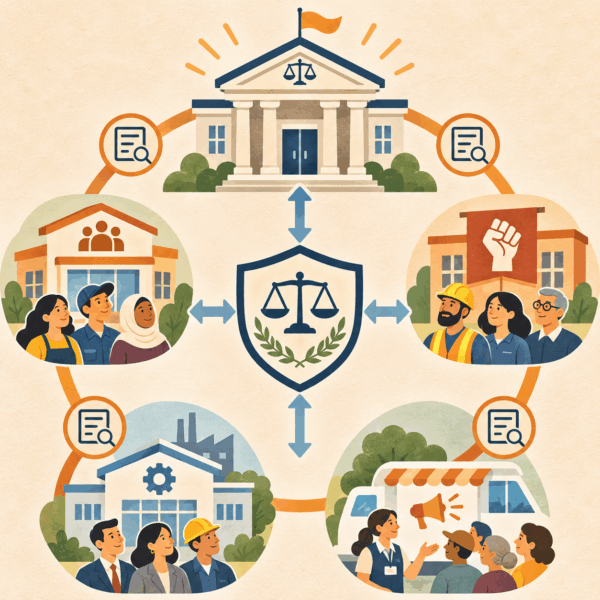 Strategic Communication Support for Labor Standards, Workplace Safety, and Employment Relations Agencies
State and local labor agencies turn to Stegmeier Consulting Group when workers and employers struggle to find the right information, notice requirements generate repeated calls, or several programs need to communicate through a shared public entry point. SCG can help identify where people misunderstand the agency’s role or lose their next step, then work with program staff to improve the content and workflows behind that experience. The engagement can focus on one function or on the referrals and handoffs that connect several offices. For offices with overlapping responsibilities, SCG can work with program leaders to define what information each team can confirm and how it will be communicated consistently to workers, employers, parties, and partners.
SCG can assess public-facing materials, call patterns, staff tools, and sample journeys through intake, case updates, inspections, determinations, or personnel policy implementation. The assessment can include stakeholder interviews and usability walkthroughs that show where different audiences encounter barriers. Findings can be used to prioritize improvements to plain-language guidance, multilingual access, notification timing, referral steps, and document templates. SCG can help agency teams select representative situations to test, such as a submission in a priority language, a request for proof of correction, or a personnel question that involves two departments. The review can confirm what people encounter before a larger rollout.
SCG can develop practical tools for staff, supervisors, and partners. These can include case status scripts, approved procedural language, notice templates, manager briefing materials, partner guides, and training scenarios. SCG can also help map approval responsibilities and maintenance routines. Staff should be able to find the current guidance, use it during a difficult conversation, and elevate questions that need program review. SCG can help make these materials usable by incorporating the terms and system screens staff encounter throughout the day. Supervisors can use realistic coaching cases to check that the guidance works across shifts, work units, and locations.
For urgent matters, SCG can help teams plan how they will communicate when deadlines are short and the facts are changing. Support can include incident update templates, media protocols, internal coordination procedures, briefings for oversight bodies, and exercises that test how teams will release and correct information. The same planning can apply to a sudden safety issue, a policy change affecting multiple departments, or unusually high public interest in a labor dispute. SCG can help define what can be released at each stage and how the organization will keep a record of approvals. An exercise can test how alternate staff take over and how the agency handles a correction when its usual communication channels are unavailable.
SCG can help agencies choose measures that reflect whether communication is working. Examples include the share of filings that can be screened on receipt, the time it takes to receive useful direction, whether respondents submit the requested evidence, and the consistency of manager guidance after a policy change. SCG can help design the measurement approach, document definitions, and build a review process that links findings to concrete updates. When an agency tests a change, SCG can help match the measures to the intended outcome and identify when more information is needed to interpret the results. The agency can use those findings to improve future campaigns, notices, and staff training.
Ready to Strengthen Communication for Your Labor or Public Employment Agency?
At Stegmeier Consulting Group, we help labor and public employment agencies develop communication strategies, materials, and workflows that people can use during routine transactions and time-sensitive decisions. An engagement can focus on a high-volume notice, an upcoming policy change, or a broader review of the path from public education through case resolution. We tailor the scope to the programs and departments involved, the people who need to act, and the materials agency staff will maintain after implementation.
- Assess worker, employer, and public employee communication from first contact through resolution.
- Build year-round rights education and employer compliance campaigns around actual workplace decisions and effective dates.
- Develop language access plans, outreach materials, and referral tools for trusted community and industry partners.
- Improve intake forms, safe contact options, case confirmations, and self-service status messages.
- Rewrite procedural notices, evidence requests, hearing instructions, and decisions in plain language.
- Develop communication for safety standards, inspection findings, abatement requirements, and consultation services.
- Create neutral materials for representation elections, bargaining procedures, mediation, and dispute resolution.
- Plan personnel policy rollouts and equip central and departmental HR teams with manager and employee materials.
- Train frontline staff and establish approval workflows and messages for urgent incidents.
- Design public performance reports and measures that explain enforcement outcomes, backlogs, and communication results.
Use the form below to connect with our team and explore how strategic labor standards, workplace safety, and employment relations communication can help your agency explain rights and obligations clearly, guide people through formal processes, and report results in a way the public can understand.
How Public Electric Utilities Can Communicate Grid Reliability, Rate Increases, and Clean Energy Transition to Ratepayers and Elected Officials
Publicly owned electric utilities operate at the intersection of infrastructure management, environmental policy, and energy economics in ways that no other utility type does, and their communication challenges reflect that complexity. A publicly owned electric...
How Public Utilities Can Measure Communication Effectiveness and Use Data to Improve Ratepayer Engagement Over Time
Most public utility communication programs measure the wrong things. They count the notices sent, the social media posts published, the public meetings held, and the website pages visited. These are output measures, and they are easy to collect because they reflect...
How Public Works Departments Can Build Accountability Communication Around Capital Program Performance
Public works capital programs are among the largest and most consequential expenditures in local government, and most ratepayers and taxpayers have no reliable way to assess whether those programs are delivering value. A capital program that spends one hundred million...
How Port Authorities Can Communicate Environmental and Community Impact to Neighboring Populations
Port authorities operate some of the most consequential and most contested industrial facilities in any metropolitan area, and they do so in close proximity to residential communities that bear the concentrated environmental and quality-of-life costs of port...
How Public Works Departments Can Communicate Construction Disruptions and Right-of-Way Projects to Affected Communities
Construction communication is where public works departments most frequently damage community relationships, not because projects go wrong but because the people affected by them were not told what was coming, when it would end, or why it was worth enduring. The...
How Municipal Broadband Authorities Can Communicate Service Availability, Equity, and Infrastructure Plans
Municipal broadband is among the most politically contested utility investments that local governments undertake, and its communication challenges are correspondingly more complex than those facing any other utility type. Unlike water, wastewater, or solid waste,...
How Sewer and Stormwater Agencies Can Build Environmental Stewardship Communication Into Routine Outreach
Environmental stewardship communication is most effective when it does not announce itself as a campaign. The resident who opens a bill insert and reads about the connection between their household’s stormwater runoff and the health of the local creek is...
How Public Natural Gas Utilities Can Communicate Safety, Infrastructure Investment, and Energy Transition to Customers and Communities
Natural gas utilities communicate within a safety-first environment that no other utility type fully shares. The combustible nature of natural gas, its potential for explosive concentration in enclosed spaces, and the direct safety consequences of leaks, incidents,...
How Wastewater Agencies Can Communicate Rate Increases and Capital Program Investments Without Losing Public Trust
Wastewater rate increases occupy a particular position in the political economy of local public services. They fund infrastructure that no one sees, maintaining a service that no one thinks about until it fails, for a utility that most ratepayers regard as an...
How Stormwater Utilities Can Communicate MS4 Permit Obligations and Pollution Prevention to Residents and Businesses
Stormwater pollution prevention depends almost entirely on the behavior of thousands of individual residents and businesses who do not know that what they put in a storm drain affects water quality in local waterways. The fundamental challenge of municipal separate...
How Sewer Departments Can Communicate Service Disruptions, Emergency Repairs, and Spill Events
A sewer system failure is not simply an inconvenience. It is a public health event. When raw or partially treated sewage overflows a collection system, backs up into residential properties, or reaches a waterway, the consequences extend well beyond the operational...
How Wastewater Agencies Can Communicate Infrastructure Projects and System Upgrades to the Public
Wastewater infrastructure sits at a particular disadvantage in the competition for public understanding. The pipes, pump stations, treatment processes, and collection systems that handle every gallon of wastewater generated in a community are almost entirely invisible...
How Waste Management Departments Can Communicate Environmental Compliance and Landfill Operations Transparently
Landfills and transfer stations occupy a particular position in community life: they are essential infrastructure whose presence is a permanent source of concern for the neighborhoods that host them, whose operations generate ongoing questions about odor, traffic,...
How Solid Waste, Recycling, and Garbage Collection Agencies Can Partner With Community Organizations to Extend Outreach Into Underserved Populations
The residents who generate the most contamination, illegal dumping, and improper disposal in most solid waste agency service areas are not residents who disregard the environment. They are residents who have the least access to information about solid waste programs...
How Solid Waste, Recycling, and Garbage Collection Agencies Can Communicate Hazardous Waste Disposal Programs to Residential and Commercial Customers
Hazardous waste disposal programs are among the most safety-critical services that solid waste agencies provide, and among the most consistently underutilized. The gap between program availability and program participation is wider for household hazardous waste than...
How Solid Waste, Recycling, and Garbage Collection Agencies Can Build Public Education Programs Around Recycling, Composting, and Waste Reduction
Recycling and composting programs are among the most behaviorally dependent public services that local governments operate. Unlike water service or electricity, whose value is delivered to residents passively regardless of their behavior, recycling and composting...
How Solid Waste, Recycling, and Garbage Collection Agencies Can Communicate Service Changes, Route Adjustments, and Collection Program Updates
A missed garbage collection notice has an outsized effect on the relationship between a solid waste agency and the residents it serves. It is not a large harm. The garbage is still there the next day, and it gets picked up eventually. But the experience of putting...
How Energy Providers Can Communicate Rate Increases Tied to Capital Investment Without Triggering Ratepayer Backlash
Capital-driven rate increases are among the most difficult communication challenges that energy providers face because they ask ratepayers to accept a concrete and immediate financial burden in exchange for infrastructure benefits that will materialize slowly, that...
How Public Power Authorities Can Build Trust With Ratepayers During Long-Term Infrastructure Upgrades
The trust that ratepayers extend to a public power authority at the beginning of a major infrastructure upgrade program is almost always greater than what they extend at the middle of one. This is not because infrastructure programs fail to deliver value. Most do,...
How Public Power Authorities Can Communicate Clean Energy Transition Programs to Ratepayers and Elected Officials
Clean energy transition programs ask ratepayers and elected officials to accept something that ordinary infrastructure investment does not: a commitment to a long-term direction whose costs are immediate and concrete while its benefits are distributed, deferred, and...
How Municipal Utilities Can Communicate Energy Efficiency Programs and Rebate Offerings to Diverse Audiences
Energy efficiency programs are among the most consistently underperforming communication challenges in public utility management. The programs themselves are well-designed, genuinely beneficial, and directly responsive to the interests of the ratepayers they serve....
How Municipal Energy Providers Can Communicate Power Outages, Grid Events, and Restoration Timelines
The first hour of a power outage is the most consequential communication window in a municipal energy provider’s operational relationship with its customers. In that hour, customers decide whether the utility is managing the situation or has lost control of it,...
How Public Utilities Can Communicate With Vulnerable, Low-Income, and Underserved Ratepayers
Essential utility services occupy a unique position in the lives of the people who depend on them. They are not optional. A household that cannot pay its water bill does not simply go without a service it enjoys. It loses access to something essential for health,...