
How State Personnel Agencies Can Make Civil Service Hiring, Exams, and Classification Understandable to Applicants
Civil service hiring systems are designed to support fair, consistent, and merit-based public employment, but the processes used to achieve those goals can be difficult for applicants to understand. Job classifications, minimum qualifications, examinations, eligibility lists, scoring, ranking, certification, hiring lists, probationary periods, and appointment rules may all influence whether someone advances toward a government position. Applicants who are accustomed to private-sector hiring may expect to submit a resume, interview with a hiring manager, and receive a decision, only to encounter a public-sector system in which several administrative steps occur before an interview is even possible.
The complexity becomes more significant when terminology has specific administrative meaning that differs from ordinary employment language. An “exam” may involve an online assessment, evaluation of training and experience, structured questionnaire, written test, performance exercise, or another authorized assessment rather than a traditional classroom examination. Being placed on an eligibility list may mean an applicant can be considered for certain positions, but it does not necessarily mean the applicant has been selected for an interview or offered employment. Classification titles may also differ from the titles applicants recognize in the private sector, making relevant opportunities harder to identify.
When these distinctions are not explained clearly, applicants can misinterpret routine civil service procedures as rejection, inconsistency, or unnecessary bureaucracy. Qualified candidates may abandon an application because they do not understand what happens next, assume they are ineligible because a classification title is unfamiliar, or believe a passing examination score guarantees employment. Confusion can also increase the workload of personnel agencies and hiring departments as applicants repeatedly contact staff for explanations that could have been built into the communication system from the beginning.
State personnel agencies can improve the applicant experience without weakening merit-system requirements by translating the civil service process into understandable stages, explaining specialized terminology when it first appears, and showing applicants what each milestone does and does not mean. The objective is not to make civil service hiring identical to private-sector recruiting. It is to make the public-sector system sufficiently transparent that applicants understand how opportunities are organized, how they are evaluated, what happens after each step, and where they stand within the process.
Start With a Plain-Language Map of the Civil Service Hiring Process
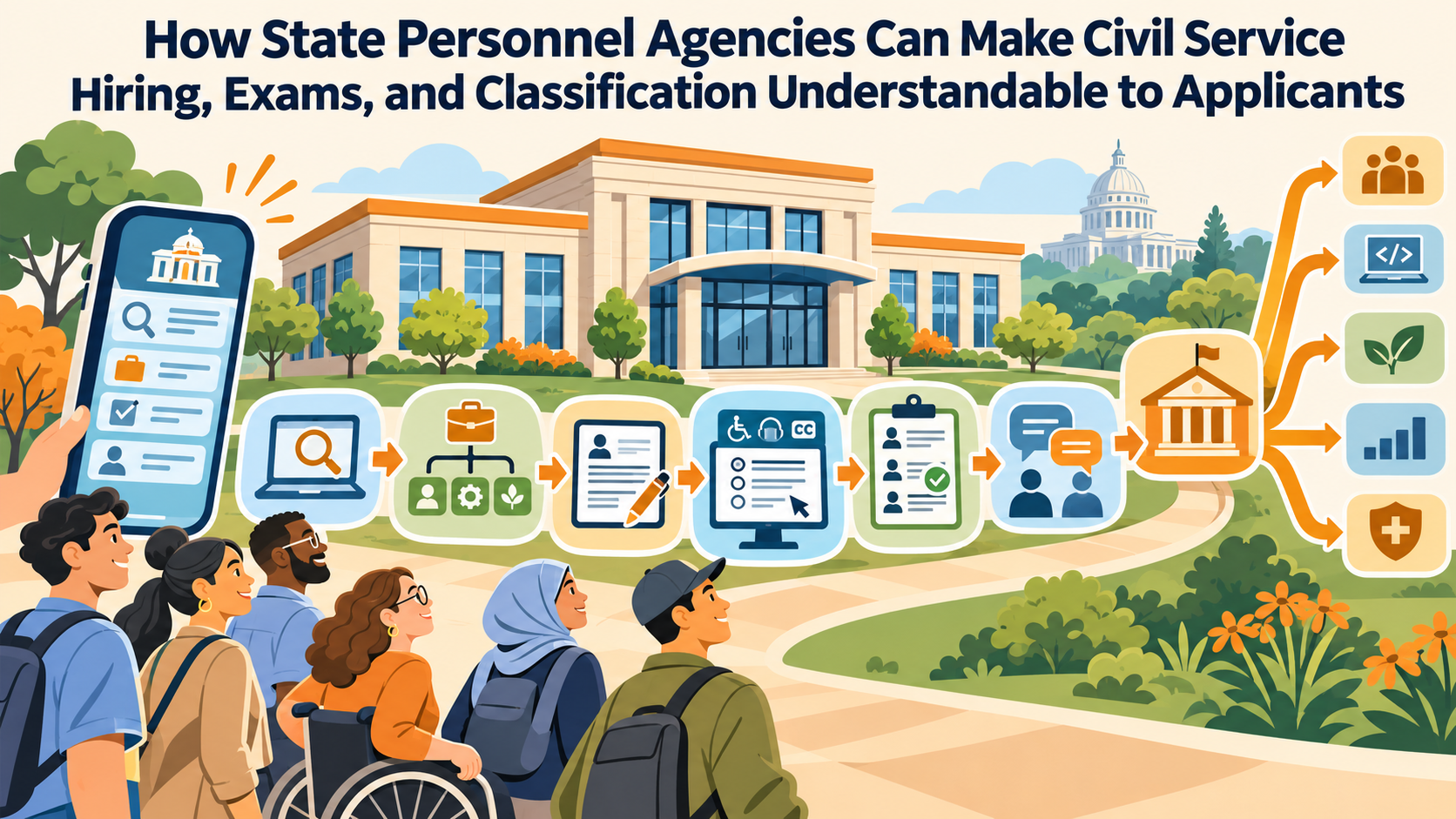
 Applicants should not have to understand the entire personnel system before they can understand what happens after they click “Apply.” State personnel agencies should provide a simple overview showing the major stages that may occur between identifying a vacancy and receiving an appointment, while acknowledging that individual recruitments may follow different paths. A process map gives applicants a framework for interpreting the more detailed instructions they receive later.
The overview might distinguish job search, application review, minimum qualification determination, examination or assessment, eligibility placement, referral or certification to a hiring department, interview or selection procedures, conditional requirements where applicable, appointment, and probation. The exact sequence should reflect the jurisdiction’s actual civil service system rather than presenting a generic model that may not match agency practice.
Each stage should also identify what the applicant is expected to do and what the personnel agency or hiring department is doing. Applicants may understand that they submitted an application but have little visibility into why several administrative steps occur before the hiring department contacts them. Explaining those responsibilities can make waiting periods and status changes easier to interpret.
The process map should appear early in applicant guidance and link to more detailed explanations for people who need them. Applicants should be able to understand the overall journey in a few minutes, then explore examination rules, eligibility lists, classifications, or appointment procedures as those topics become relevant to their own application.
Explain the Difference Between a Classification and a Specific Job Opening
One of the most important distinctions in civil service hiring is the difference between a job classification and an individual vacancy. Applicants may see a classification title and assume they are applying for one particular position, or they may encounter several vacancies using the same classification and assume they are duplicates. Personnel agencies should explain how classifications organize positions with sufficiently similar duties, qualification standards, compensation structures, or other characteristics within the jurisdiction’s personnel system.
A classification can serve as the administrative framework within which multiple positions exist across departments, locations, or program areas. A specific vacancy, by contrast, represents an actual opening that a department is seeking to fill. Applicants should understand whether they are applying directly to a vacancy, entering an eligibility process for a classification, or participating in another type of recruitment used by the jurisdiction.
This distinction is especially important when classification names do not resemble common private-sector job titles. An applicant searching for communications, accounting, program management, information technology, or analytical work may overlook a relevant classification because its formal title does not immediately communicate the type of work involved. Agencies can improve discoverability by pairing classification titles with plain-language descriptions, occupational categories, or examples of common assignments.
Explaining classifications also helps applicants understand why positions with the same title may have somewhat different duties. The classification establishes the broader employment category, while individual departments may assign work within that framework according to operational needs. Clear communication can prevent applicants from assuming that every position in the same classification is identical.
Translate Classification Specifications Into Applicant-Focused Guidance
Classification specifications are essential administrative documents, but they are not always effective recruiting tools. They may contain formal language describing distinguishing characteristics, typical duties, knowledge requirements, allocation standards, or qualification patterns that are meaningful to human resources professionals but difficult for applicants to interpret. Agencies should preserve the authoritative specification while providing a more accessible explanation alongside it.
Applicant-focused guidance can summarize what people in the classification typically do, the types of programs or departments where the work may occur, the level of responsibility involved, and the experience or education generally expected. This explanation should not replace the formal specification or alter qualification requirements. Its purpose is to help applicants determine whether the classification is relevant before they commit significant time to an application.
Agencies should also explain when examples of duties are illustrative rather than exhaustive. Applicants sometimes assume they must have performed every duty listed in a classification specification, even when the document is intended to show the range of work that may occur within the classification. Clear labeling can help applicants distinguish required qualifications from examples of assignments.
Better translation can expand the applicant pool without lowering standards. People are more likely to recognize transferable experience when they understand what the classification is actually intended to accomplish, while personnel staff retain the formal criteria needed to administer the merit system consistently.
Pair Every Formal Classification With a “What This Means for Applicants” Summary
A short applicant summary can sit alongside the official classification specification and explain the classification in language designed for someone encountering the civil service system for the first time. The summary can describe the general work, typical level of responsibility, qualification categories, and relationship between the classification and individual vacancies.
The summary should clearly distinguish explanatory language from the official requirements. If there is any conflict, applicants should be directed to the authoritative classification specification or recruitment announcement rather than assuming that a simplified description changes eligibility standards.
This paired approach allows agencies to preserve the precision required for classification administration while making the system easier to navigate. Applicants receive a practical entry point without losing access to the formal information that governs the process.
Explain Minimum Qualifications Before Applicants Invest in a Lengthy Application
Applicants need to understand minimum qualifications early because these standards often determine whether they can proceed in a civil service recruitment. Education, years of experience, specialized experience, licenses, certifications, or combinations of these factors may be required depending on the classification. When qualification language is difficult to interpret, candidates may either self-select out unnecessarily or apply without understanding why they are later determined to be ineligible.
Personnel agencies should explain which requirements are mandatory and which experience descriptions are intended to help staff determine equivalency or relevance. If multiple qualification patterns are available, applicants should be able to see those options clearly rather than reconstruct them from dense paragraphs. The communication should remain faithful to the official standard while making the pathways easier to compare.
Agencies should also clarify how experience is evaluated when that issue commonly creates confusion. Applicants may not know whether part-time work, overlapping employment, internships, volunteer experience, graduate education, or experience gained outside government can be considered. The answer may differ by jurisdiction and classification, so agencies should explain their actual rules rather than relying on broad assumptions.
Early qualification guidance respects applicants’ time and supports administrative efficiency. Candidates can make better decisions about whether to apply, while personnel staff receive applications from people who have a clearer understanding of the threshold requirements and the documentation needed to demonstrate them.
Explain What a Civil Service Exam Actually Is
The word “exam” can discourage applicants who imagine a traditional written test covering material they are expected to memorize. In many civil service systems, however, examinations or assessments can take several forms depending on the classification and jurisdiction. Agencies should explain the assessment method before applicants begin so they understand what is being evaluated and how they should prepare.
An examination may involve a written test, online assessment, evaluation of education and experience, structured questionnaire, performance exercise, oral assessment, simulation, or another authorized method. The agency should identify the format used for the specific recruitment and explain what abilities, knowledge, experience, or competencies the process is designed to assess at an appropriate level.
Applicants should also understand the difference between preparing appropriately and attempting to obtain prohibited advance information. Agencies can provide sample questions, preparation guides, descriptions of assessment dimensions, technology requirements, or testing instructions where permitted. Clear preparation information can make the process more accessible without compromising examination security or fairness.
Explaining the purpose of the assessment is equally important. The exam is not an arbitrary hurdle added before hiring. It is part of the merit process used to evaluate applicants according to established criteria. When candidates understand that connection, examination requirements are easier to interpret within the broader civil service system.
Explain Examination Scores Without Implying That a Passing Score Guarantees a Job
Applicants may interpret a passing civil service examination score as confirmation that they will receive an interview or job offer, particularly if they are unfamiliar with eligibility systems. Personnel agencies should explain exactly what a passing score establishes within their process and what additional steps may occur before appointment. The difference between qualifying for consideration and being selected for employment should be unmistakable.
Where applicants receive numerical scores, bands, categories, ranks, or other results, agencies should explain what those results mean. Applicants should know whether scores determine placement on an eligibility list, affect the order in which candidates may be considered, or serve another administrative purpose. If hiring departments have discretion among eligible candidates under applicable rules, that distinction should be clear.
Agencies should also explain when examination results can be used for more than one vacancy or recruitment. Some systems establish eligibility that remains valid for a period of time, while others tie an assessment to a specific opening or process. Applicants should not have to guess whether they need to apply again when another opportunity appears.
Clear score communication can reduce one of the most common sources of frustration in civil service hiring. Applicants may still be disappointed when they pass an assessment but are not selected, but they are less likely to feel misled when the agency clearly explained what the score represented from the beginning.
Make Eligibility Lists Understandable to Applicants
Eligibility lists are central to many civil service systems but unfamiliar to applicants coming from other employment environments. Being placed on a list may mean that a candidate has met established requirements and can be considered for appointment under applicable rules, but the practical consequences can vary considerably. Personnel agencies should explain how the list functions within their own system.
Applicants should understand how they are placed on the list, whether ranking or score affects consideration, how long eligibility may remain active, and what can cause eligibility to expire or change. If candidates may be contacted about multiple vacancies, decline opportunities under certain conditions, or update availability preferences, those procedures should also be explained clearly.
The agency should distinguish eligibility from active consideration for a particular vacancy. A person can remain eligible without currently being reviewed by a hiring department, just as being referred to a department may not mean an interview has been guaranteed. Applicants benefit when these milestones are described separately instead of being combined under a vague status such as “qualified.”
Eligibility communication should also explain what applicants need to monitor. Contact information, geographic availability, required responses, or deadlines may affect whether the agency can continue considering someone. Clear instructions help applicants maintain eligibility without inadvertently losing opportunities because they did not understand an administrative requirement.
Explain Referral and Certification to Hiring Departments
Applicants may become especially confused when responsibility shifts from the central personnel agency to an individual hiring department. A status message indicating that a candidate has been certified, referred, reachable, or forwarded may sound like a selection decision even when it only means the candidate can now be considered by a department. Agencies should explain this handoff carefully.
The communication should identify what the personnel agency has determined and what the hiring department will decide next. The central agency may have confirmed qualifications, administered an assessment, or established eligibility, while the hiring department may conduct interviews, evaluate job-specific fit, complete reference checks, or make a final selection under applicable rules.
Applicants should also understand that not every referred candidate will necessarily be contacted for an interview if the civil service system permits departments to select among an eligible group. Where rules prescribe a particular consideration process, the agency should explain that process accurately without promising an outcome beyond what the rules guarantee.
Clear handoff communication helps applicants know whom to contact and what kind of information each organization can provide. It also prevents personnel agencies from appearing to control hiring decisions that belong to departments and prevents departments from being blamed for administrative eligibility determinations made centrally.
Replace Vague Application Statuses With Meaningful Explanations
Online applicant systems often display short status labels such as received, under review, eligible, referred, closed, inactive, or not selected. These labels may be administratively convenient but provide little value when applicants do not know what they mean or whether they need to take action. State personnel agencies should pair status labels with plain-language explanations.
A useful status should answer three questions whenever possible: what has happened, what happens next, and whether the applicant needs to do anything. “Application received” can explain that the submission is awaiting review, while “eligible” can explain whether the candidate has entered an eligibility pool and whether further contact will come from the personnel agency or hiring department.
Agencies should be especially careful with statuses that can be interpreted as rejection. A recruitment may close because a vacancy was filled, an eligibility list expired, or the hiring process changed, and those situations are not necessarily equivalent to a determination that the applicant was unqualified. More precise explanations can reduce unnecessary frustration.
Meaningful status communication also reduces repetitive inquiries. Applicants are less likely to contact staff simply to ask what a portal message means when the system provides enough context to understand the current stage. Better applicant communication can therefore improve both service quality and administrative efficiency.
Explain Civil Service Rules as Protections, Not Merely Bureaucratic Requirements
Applicants may experience civil service procedures as a series of forms, tests, waiting periods, and administrative rules without understanding why the system is structured that way. Personnel agencies should explain that merit-based procedures are intended to create consistent standards for public employment, reduce arbitrary decision-making, and establish transparent methods for evaluating and considering candidates. Understanding the purpose can make individual requirements easier to navigate.
This explanation should not suggest that the system is perfect or that every applicant will experience the process identically. Different classifications and recruitments may require different assessments, and hiring departments may have legitimate job-specific needs within the broader civil service framework. The agency should explain consistency of principles without promising uniformity where procedures appropriately differ.
Applicants should also understand that some steps protect them as well as the government employer. Published qualification requirements, standardized assessments, defined eligibility procedures, and documented appointment rules can make expectations more visible than a process based entirely on informal managerial discretion. Clear communication can connect these administrative mechanisms to the public values they are intended to support.
When agencies explain both the process and the purpose behind it, civil service hiring becomes easier to interpret as a structured employment system rather than an accumulation of obstacles. Applicants may still find the process more complex than private-sector hiring, but they can better understand why each stage exists and how to participate effectively within it.
Explain How Applicants Move From Eligibility to Actual Consideration
Applicants often understand that they have passed an examination or qualified for a classification but still do not know when, how, or whether a hiring department will actually consider them for a vacancy. State personnel agencies should explain this transition in practical terms so candidates understand that eligibility creates an opportunity to be considered but may not place them automatically into every hiring process.
The communication should describe how hiring departments receive or access eligible candidates, whether applicants must express interest in individual vacancies, and whether separate applications are required after eligibility is established. If departments receive a certified group, reachable list, referral list, or another authorized subset of candidates, the agency should explain what that means without assuming applicants understand civil service terminology.
Applicants should also know whether they may be considered by more than one department at the same time and whether they need to respond to notices, availability inquiries, or interview requests to remain active. Where the rules differ by classification or hiring method, the agency should clearly distinguish those pathways rather than presenting one process as universal.
Explaining this handoff can reduce the frustration that occurs when applicants believe they have completed the hiring process after passing an exam. Eligibility should be communicated as one important milestone within a larger sequence, not as the final selection decision.
Explain Reachability, Ranking, and Selection Rules in Plain Language
Civil service systems may use rank, score, band, category, or another method to determine which eligible applicants can be considered for appointment. These systems can be especially confusing because a candidate may be qualified and remain on an eligibility list while still not being reachable for a particular appointment. Agencies should explain these distinctions directly.
The communication should identify how the jurisdiction determines which applicants may be considered at a given time and whether hiring departments may choose among several eligible candidates. If the rules allow movement among candidates based on availability, declinations, removals, veterans’ preferences, or other authorized factors, those concepts should be explained carefully and accurately.
Applicants should also understand that ranking is an administrative feature of the merit system, not necessarily a complete judgment about their overall professional value. A candidate with a lower rank may still have substantial experience, but the civil service process may limit when that individual can be considered according to established rules.
Clear explanations are particularly important when applicants compare themselves with others who appear to have similar qualifications but advance differently. When the agency explains how reachability works, applicants are less likely to interpret every difference as arbitrary or inconsistent.
Use a Simple Example to Show How Eligibility and Reachability Differ
A hypothetical example can explain that several applicants may pass an exam and appear on an eligibility list, while only a subset may be reachable for a particular vacancy under the jurisdiction’s rules. The example should focus on process rather than imply how any real candidate would be treated.
The agency can also show how changes in availability, declinations, or other authorized factors may affect who becomes reachable over time. The goal is to help applicants understand that list position and active consideration are related but not identical.
Examples should always reflect the actual civil service framework used by the jurisdiction. A simplified scenario is useful only if it does not create expectations that conflict with formal appointment rules.
Explain How Departments Use Interviews After Civil Service Screening
Applicants may assume that once the civil service process has determined eligibility, the hiring department must appoint the person with the highest score or rank. In some systems, however, civil service screening determines who may be considered, while departments retain discretion to interview and select among eligible candidates according to applicable rules. Agencies should explain this distinction clearly.
The communication should describe the role of interviews in evaluating job-specific experience, communication skills, technical fit, supervisory expectations, or program knowledge that may not have been fully assessed during the civil service examination. Applicants should understand that the exam and interview serve different purposes within the overall hiring process.
Agencies should also explain whether interviews are required, how many candidates may be considered, and whether departments use structured or standardized methods where applicable. If those practices vary among departments, the agency should avoid implying that every interview process is identical.
This explanation can reduce confusion when two applicants with similar civil service scores have different hiring outcomes. The merit system may establish a fair pool of eligible candidates while still allowing departments to evaluate position-specific factors within authorized boundaries.
Explain Why Applicants May Need to Apply More Than Once
Applicants frequently assume that one application to a classification or examination places them into consideration for every future vacancy using that classification. Depending on the civil service system, that may or may not be true. Agencies should clearly explain when applicants must submit separate applications for individual openings and when an existing eligibility status can be reused.
The communication should distinguish among classification-level examinations, continuous recruitments, vacancy-specific recruitments, departmental hiring lists, and any other pathways the jurisdiction uses. Applicants should know whether they are entering a broad eligibility pool or competing for one particular position.
Agencies should also explain when an applicant must update information or renew eligibility. A candidate who qualified months earlier may need to submit a new application, confirm availability, or meet updated requirements depending on the system. These obligations should not be hidden within technical notices.
Clear guidance can prevent qualified applicants from missing opportunities because they incorrectly believed they were already under consideration. It can also reduce duplicate applications where the system does not require them.
Explain Continuous, Open, and Periodic Recruitments
State personnel agencies may use different recruitment models depending on the classification, hiring volume, and workforce needs. Some opportunities remain open continuously, while others accept applications only during specific periods or for particular vacancies. Applicants should understand these differences before they decide when and how to apply.
A continuous recruitment may allow applicants to enter an eligibility process throughout the year, while a periodic examination may establish a list during a defined window. Vacancy-specific recruitments may close once a hiring department has enough candidates or when a fixed deadline is reached. The agency should describe each model in terms applicants can recognize.
The communication should also explain whether an open recruitment means the agency is actively filling positions at that moment. Applicants may assume that a continuously available application reflects an immediate vacancy when it may instead support future hiring needs. Clarity about the purpose of the recruitment can manage expectations.
Providing these distinctions helps applicants plan more effectively. They can decide whether to apply immediately, monitor for future openings, or maintain eligibility while waiting for departments to request candidates.
Explain Exam Retakes, Waiting Periods, and Score Validity
Applicants who receive a lower-than-expected exam score often want to know whether they can retake the assessment, how soon they may do so, and whether a new score replaces the old one. Civil service systems may have detailed rules governing retesting and score validity, so agencies should explain those policies in plain language before applicants invest time in another attempt.
The communication should state whether retakes are permitted, whether a waiting period applies, and how multiple scores are handled. If different examination types have different rules, the agency should organize those differences clearly rather than forcing applicants to compare several technical documents.
Applicants should also understand how long an exam result remains valid. A passing score may create eligibility for a defined period, after which the applicant may need to retest or reapply. The agency should communicate expiration dates and renewal requirements early enough that candidates can take action before losing eligibility.
Clear retesting guidance can reduce both frustration and administrative inquiries. Applicants who understand the rules can make informed decisions about whether to prepare for another attempt, wait for a future recruitment, or pursue a different classification.
Explain Appeals, Reviews, and Applicant Rights Without Overcomplicating the Process
Applicants may have the right to request review, appeal a qualification decision, challenge an examination issue, or seek reconsideration of another personnel action depending on the jurisdiction. These rights are important, but they can be difficult to use if instructions are written only for attorneys or experienced human resources professionals.
Agencies should explain what types of decisions can be reviewed, where a request must be filed, what information should be included, and which deadlines apply. The guidance should distinguish between asking a general question and initiating a formal review process so applicants understand when additional procedural requirements begin.
The communication should also explain what the review can and cannot accomplish. A reconsideration process may examine whether qualifications were evaluated correctly, for example, without allowing applicants to substitute new experience acquired after the application deadline. The exact limits should reflect the jurisdiction’s rules.
Accessible review information supports trust in the civil service system. Applicants are more likely to accept an adverse outcome when they understand how it was reached and what formal options exist if they believe an error occurred.
Explain Classification Changes Without Making Applicants Start Over Conceptually
Classification systems evolve as work changes, agencies reorganize, and personnel structures are updated. Titles may be consolidated, renamed, split, or revised, creating confusion for applicants who previously qualified under an older classification or who encounter unfamiliar new titles. State personnel agencies should explain these changes in applicant-focused language.
The communication should describe what changed, when the change takes effect, and whether existing eligibility, exam results, or applications are affected. If applicants do not need to take action, the agency should say so explicitly. If they do need to reapply or qualify under a revised process, that requirement should be equally clear.
Crosswalks can be especially useful when titles change. Showing the relationship between old and new classifications can help applicants recognize that a familiar career path still exists even though the administrative label has changed.
Clear change communication also supports recruitment. Without it, qualified candidates may stop searching for opportunities because the titles they know have disappeared from the system. A simple explanation can preserve continuity while the classification structure evolves.
Explain Geographic, Departmental, and Work-Schedule Availability
 Applicants may be placed on an eligibility list without realizing that their stated availability can affect which vacancies they are considered for. Geographic location, department, work schedule, shift, travel requirements, or other preferences may influence referrals depending on the civil service system. Agencies should make those implications visible.
The communication should explain when applicants can select or update availability and how those choices affect consideration. A candidate who limits availability to one location may remain eligible while receiving fewer referrals than someone willing to work in several regions. Applicants should understand that this difference may reflect their stated preferences rather than a change in qualification.
Agencies should also explain whether declining an opportunity affects future eligibility. Some systems may allow applicants to decline certain locations or schedules without penalty, while others may have rules governing repeated declinations or removals. Those consequences should be communicated before applicants respond to offers of consideration.
Making availability rules understandable allows candidates to make deliberate choices. It also reduces confusion when applicants compare their referral activity with others who selected broader options.
Use Applicant Communication to Reduce Unnecessary Self-Selection
Complex civil service language can discourage qualified people from applying before the agency ever evaluates them. Applicants may see unfamiliar classification titles, lengthy qualification statements, or examination requirements and conclude that government employment is not intended for people with backgrounds like theirs. Personnel agencies should examine whether communication itself is narrowing the applicant pool unnecessarily.
Plain-language classification summaries, examples of qualifying experience, explanations of transferable skills, and clear descriptions of assessment methods can help candidates determine whether their background may fit without lowering the underlying standards. The agency should encourage applicants to evaluate themselves against actual requirements rather than against assumptions about government careers.
This is especially important for applicants coming from private industry, nonprofit organizations, military service, academia, or other sectors where job titles and organizational structures differ from state government. Relevant experience may be easy to overlook when qualification language assumes familiarity with public-sector terminology.
Reducing unnecessary self-selection strengthens the merit system by helping more qualified people understand where they may compete. The agency is not promising eligibility or appointment. It is making the standards understandable enough that candidates can decide whether applying is worth their time.
Explain Transferable Experience Across Public, Private, Nonprofit, and Military Backgrounds
Applicants often struggle to determine whether experience gained outside state government will satisfy civil service qualification requirements. A classification may describe experience using public-sector terminology that does not match the titles, structures, or responsibilities used in private companies, nonprofit organizations, universities, local governments, or military service. State personnel agencies should help applicants understand that the substance of their experience may matter more than whether their previous job titles resemble state classifications.
Applicant guidance can explain how candidates should describe duties, level of responsibility, supervision, technical work, program scope, and other relevant experience rather than relying only on position titles. A private-sector project manager, for example, may have performed work comparable to a government program classification even if the titles are completely different. The agency should encourage applicants to document what they actually did in enough detail for reviewers to evaluate the experience fairly.
The same principle applies to applicants transitioning from military service. Military occupational titles, rank structures, and assignments may not translate directly into civilian classification language, even when the applicant has substantial supervisory, logistical, technical, analytical, or administrative experience. Agencies can provide guidance on translating responsibilities without attempting to guarantee that a particular background will qualify.
Clear communication about transferable experience can reduce unnecessary self-selection and improve the quality of applications. Applicants are more likely to describe relevant experience accurately when they understand what personnel reviewers are evaluating, while agencies gain a more complete record for determining whether qualification standards have been met.
Explain Education Substitutions and Equivalencies Without Creating False Assumptions
Civil service classifications may allow education to substitute for some experience, experience to substitute for some education, or several qualification patterns to satisfy the same minimum standard. Applicants can easily misread these provisions, particularly when the relationship between credits, degrees, years of experience, and specialized coursework is presented through dense classification language. State personnel agencies should make these alternatives easier to compare.
A plain-language qualification guide can separate each recognized pathway and explain what an applicant would generally need to demonstrate under each one. If a degree must be in a particular field, if a specified number of credits is required, or if only certain experience can substitute, those distinctions should be visible. Applicants should not have to infer whether any degree or any professional experience will qualify.
Agencies should also explain that substitutions are governed by the actual classification requirements and are not automatically granted because an applicant believes two forms of experience are equivalent. Personnel staff must evaluate the application according to established standards. Clear communication can help applicants provide the documentation needed for that evaluation without implying that every combination will be accepted.
Where equivalency questions depend on case-specific facts, the agency should direct applicants toward the appropriate review process rather than attempting to resolve every possibility through a general FAQ. The objective is to make the framework understandable while preserving the formal evaluation needed for fair and consistent qualification decisions.
Present Multiple Qualification Patterns Side by Side
When a classification offers several ways to qualify, agencies can present those pathways in a side-by-side format that allows applicants to compare them easily. One column might describe an education-based pathway, another an experience-based pathway, and another a permitted combination where applicable.
The comparison should preserve the exact substantive requirements while reducing the cognitive burden created by long paragraphs. Applicants can quickly identify which pathway appears most relevant and then review the formal specification for additional detail.
This approach also helps personnel staff by reducing applications that are based on a misunderstanding of the qualification structure. Better presentation can improve applicant decision-making without changing the standards themselves.
Explain How Application Materials Are Actually Evaluated
Applicants may assume that personnel reviewers will infer relevant experience from a resume, job title, or employer name, but civil service systems may require more detailed information in the formal application. State personnel agencies should explain how applications are evaluated so candidates understand what evidence reviewers rely on when determining qualifications.
The guidance should identify which parts of the application are considered authoritative and whether supplemental questionnaires, employment histories, transcripts, licenses, or other documents are required. Applicants should know if a resume is accepted only as supporting information rather than as a substitute for completing required fields. This distinction can prevent otherwise qualified candidates from being screened out because essential information was omitted.
Agencies should encourage applicants to describe duties with enough specificity to demonstrate the type and level of work performed. Statements such as “managed projects” or “performed administrative duties” may be too general for reviewers to determine whether the experience satisfies a specialized requirement. Applicants benefit from understanding that complete descriptions support fair evaluation.
The agency should also explain whether personnel staff can seek clarification after submission or whether the application must stand on the information provided by the deadline. Where rules limit later supplementation, that limitation should be communicated before applicants submit. Transparency about evaluation methods allows candidates to take greater responsibility for presenting a complete record.
Explain Supplemental Questions as Part of the Assessment Process
Supplemental questionnaires can appear repetitive when applicants have already submitted a resume or employment history, but those questions may serve a specific civil service purpose. They can help agencies evaluate minimum qualifications, specialized experience, examination factors, or job-specific competencies in a structured format. Applicants should understand why the questions exist and how their responses will be used.
The agency should distinguish between supplemental questions used for eligibility screening and those that are scored as part of an examination or ranking process. Candidates may answer very differently if they assume a question is simply administrative when it actually contributes to their assessment. Clear instructions should identify the role of the questionnaire before the applicant begins.
Applicants should also be warned against relying on brief statements such as “see resume” when the process requires detailed responses. If reviewers must score the questionnaire based only on the information entered there, the agency should say so plainly. Candidates need to know which materials will be evaluated together and which will be considered independently.
Clear questionnaire instructions support fairness because every applicant receives the same explanation of what is expected. They also reduce the likelihood that strong candidates underperform because they misunderstood the purpose of the assessment rather than because they lacked the relevant experience.
Explain Why Hiring Processes Can Take Longer Than Applicants Expect
Civil service hiring can take longer than private-sector recruitment because several administrative stages may occur before a final appointment. Qualification review, examination scoring, eligibility establishment, referral, departmental interviews, approval steps, background requirements, and other procedures may each add time. Applicants should receive enough information to understand why the process can extend beyond the timeline they may expect from other employers.
Agencies should distinguish between formal deadlines and estimated processing times. If applications close on a particular date or an exam must be completed within a specific window, those requirements should be stated precisely. If review time varies depending on volume, complexity, or department needs, the agency should avoid presenting an estimate as though it were guaranteed.
Regular status communication becomes especially important during long periods when applicants are not required to take action. A short message explaining that applications remain under review, scores are being processed, or hiring departments are considering referred candidates can reduce uncertainty even when no final decision is available.
Personnel agencies should also explain where their responsibility ends and departmental hiring begins. Applicants may interpret silence from a hiring department as a delay by the central agency even after the referral has occurred. Clear ownership of each stage can make long processes easier to understand and reduce misplaced inquiries.
Explain Background Checks, Medical Reviews, and Other Post-Selection Requirements
Applicants may reach the final stages of a civil service hiring process and then encounter background investigations, medical examinations, licensing verification, driving record checks, fingerprinting, or other requirements associated with particular positions. These steps can feel unexpected if they were not clearly identified earlier in the recruitment. Agencies should communicate conditional requirements before applicants reach the appointment stage whenever possible.
The agency should distinguish between requirements that apply broadly and those triggered only by specific classifications or duties. A position involving law enforcement, regulated professional work, driving, access to sensitive information, or physically demanding duties may require additional screening that does not apply to other jobs. Applicants should understand why different positions can have different post-selection steps.
Communication should also clarify that a conditional selection may still depend on successful completion of required reviews. Applicants should not be told they have received a final appointment if additional conditions remain unresolved. Precise terminology can reduce confusion when a candidate has been selected by the hiring department but has not yet completed every required step.
Privacy and procedural boundaries should also be communicated carefully. Applicants should know who administers the review, what information they may need to provide, and where questions about the process should be directed. The agency should avoid making broad statements about what will or will not affect appointment when those determinations depend on individual circumstances and governing rules.
Explain Probation as Part of the Appointment Process
Applicants may assume that receiving a civil service appointment means the entire hiring and evaluation process has concluded, but many public employment systems include a probationary period following appointment. State personnel agencies should explain the purpose of probation before applicants accept a position so they understand how it fits within the broader merit system.
The communication should identify whether probation is a standard requirement for the classification or appointment type and explain its general purpose. Probation may provide a period for evaluating performance, conduct, suitability, or successful adjustment to the position under the jurisdiction’s personnel rules. The agency should avoid presenting one universal model if probation requirements differ across classifications or appointment types.
Applicants should also understand that probation is different from temporary or provisional employment unless the system specifically defines it otherwise. A person may hold a regular appointment while still completing a required probationary period. Clear terminology helps applicants interpret their employment status accurately.
Explaining probation early can reduce surprise after appointment and help candidates evaluate the full employment process before accepting an offer. It also reinforces that civil service systems continue to use structured procedures after selection rather than ending at the moment of hire.
Explain Temporary, Limited-Term, Provisional, and Permanent Appointments Clearly
State personnel systems may use several appointment types to meet different workforce needs, and applicants can easily misunderstand what each one means for job duration, benefits, eligibility, or future opportunities. Terms such as temporary, limited-term, provisional, emergency, intermittent, and permanent may carry specific administrative meanings that differ across jurisdictions. Agencies should explain the distinctions wherever applicants encounter them.
Recruitment announcements should state the appointment type prominently and describe what applicants should expect. If a position is funded for a defined period, tied to a project, used temporarily while a permanent recruitment proceeds, or scheduled only intermittently, that information should not be buried in technical language. Applicants need it to evaluate whether the opportunity fits their circumstances.
The agency should also explain whether accepting one appointment type affects eligibility for other positions. In some systems, a temporary appointment may not confer the same status or rights as a permanent appointment, while in others it may provide experience relevant to future competitions. These consequences should be described according to actual rules rather than generalized assumptions.
Clear appointment terminology supports informed choice. Candidates may be willing to accept a temporary or limited-term opportunity, but they should do so because they understand the arrangement rather than because they mistakenly believed it was permanent.
Explain Classification Levels and Career Progression
Applicants may encounter several related classifications with titles such as analyst, associate, specialist, senior, supervisory, or manager without understanding how those levels differ. State personnel agencies should explain the relationship among classifications within common career paths so applicants can identify opportunities that match their current experience and understand how advancement may occur over time.
Career-path communication can describe differences in responsibility, complexity, independence, supervision, or specialized expertise without implying that progression is automatic. A higher-level classification may require additional experience, competitive examination, promotion, or another formal process. Applicants should understand both the relationship among classifications and the requirements for moving between them.
Agencies can also show how entry-level classifications connect to more advanced roles. This is particularly useful for applicants who may initially overlook state employment because the formal titles do not reveal a recognizable professional progression. A simple career map can help people see how experience gained in one classification may prepare them for future opportunities.
The agency should remain careful not to guarantee promotion. Career-path information should explain possibilities within the classification structure, not promise that every employee will advance. Clear progression guidance helps applicants make informed decisions while preserving the competitive and merit-based requirements associated with future appointments.
Use Civil Service Communication to Support Applicant Trust After Rejection
Not every applicant will qualify, become reachable, receive an interview, or be selected, and those outcomes can create frustration when the process is difficult to understand. State personnel agencies should treat rejection communication as an important part of the applicant experience rather than as a final administrative notice that requires little explanation.
Where possible, applicants should be told which stage ended their candidacy and what that outcome means. A person who did not meet minimum qualifications should receive a different explanation from someone who passed an exam but was not selected by a hiring department. Distinguishing these outcomes helps applicants understand whether the issue involved eligibility, competition, departmental selection, or another factor.
Agencies should also identify appropriate next steps. An applicant may be able to request review, strengthen future application materials, retake an exam after an authorized period, apply for a related classification, or remain eligible for other vacancies. The communication should describe available options without implying that a different outcome is guaranteed.
Respectful rejection communication reinforces the legitimacy of the merit system. Applicants are more likely to consider future public employment when they understand what occurred and feel that the process was transparent, even if the immediate result was disappointing. Clear explanations can therefore support both fairness and long-term recruitment.
Build One Authoritative Applicant Communication System
State personnel agencies should manage civil service hiring communication through one coordinated system rather than allowing classifications, examinations, eligibility rules, job announcements, and hiring guidance to develop independently. Applicants experience these elements as one hiring journey, even when several internal offices administer different parts of the process. If each office uses different terminology, status labels, or instructions, the applicant may experience the system as fragmented and inconsistent.
A coordinated framework should identify which office owns classification information, exam guidance, qualification standards, applicant status communication, referral procedures, and departmental hiring instructions. Program specialists can maintain the technical accuracy of each component, while communications staff can help translate that information into plain language that applicants can use. Clear ownership also makes updates easier when civil service rules or hiring procedures change.
The communication system should distinguish between information that applies broadly and information that is specific to one recruitment. General guidance can explain how civil service exams, eligibility lists, and classifications work, while job announcements should identify the exact requirements, assessment method, appointment type, and next steps for that opening. Applicants should not have to determine which general rules apply to their particular recruitment without guidance.
Centralizing communication also reduces internal inconsistency. When hiring departments, call center staff, recruiters, and personnel analysts all rely on the same approved resources, applicants are less likely to receive different explanations depending on whom they contact. Consistency supports trust in the merit system and reduces avoidable administrative confusion.
Standardize Applicant Status Language Across the Hiring Journey
Applicant portals, emails, exam systems, and departmental hiring platforms often use short administrative labels that may make sense internally but provide little meaning to applicants. State personnel agencies should create standardized status language that follows the applicant from application submission through qualification review, examination, eligibility, referral, interview, selection, appointment, and closure. Each status should communicate enough context for the applicant to understand where they are in the process.
The agency should define what each status means, what has already occurred, and whether the applicant must take any action. Labels such as “eligible,” “referred,” “certified,” “reachable,” “inactive,” or “closed” should never appear without explanation when those terms have specific civil service meanings. A short plain-language description can prevent applicants from interpreting an administrative milestone as a hiring decision.
Status language should also distinguish between central personnel actions and departmental actions. An applicant may have completed the civil service process successfully but still be awaiting a hiring department’s decision. The system should identify that distinction so the applicant knows which organization currently controls the next step.
Standardized statuses can also improve internal reporting and service delivery. When staff and applicants use the same terminology, questions become easier to answer and case histories are easier to interpret. The applicant experience becomes more predictable even when individual recruitments follow different timelines.
Create a Civil Service Terminology Guide for Applicants
Civil service hiring includes many terms that may be unfamiliar even to experienced job seekers, including classification, examination, eligibility list, certification, reachability, provisional appointment, probation, reinstatement, transfer, promotion, and minimum qualifications. State personnel agencies should maintain a plain-language terminology guide that applicants can access throughout the hiring process. The purpose is not to replace formal definitions but to make them usable.
Each term should include a concise explanation of what it means for the applicant and how it fits within the hiring process. For example, “classification” can be explained as the broader job category used to organize positions with similar duties and qualification standards, while “vacancy” can be explained as a specific opening within that classification. This helps applicants understand how administrative terms affect their actual employment opportunities.
The guide should also identify terms that have different meanings in civil service than in everyday employment. An “exam” may not be a written test, and “certified” may not mean hired. Flagging these differences can prevent applicants from relying on assumptions formed in private-sector hiring.
The terminology guide should be linked directly from job postings, exam notices, status pages, and applicant help resources. Applicants should not have to search a separate policy manual every time they encounter an unfamiliar term. Consistent access to definitions can make the entire system easier to navigate.
Pair Technical Terms With Applicant-Focused Explanations
Agencies can preserve formal terminology while placing a plain-language explanation immediately beside it. This approach allows personnel professionals to use the language required by civil service rules while giving applicants enough context to understand what the term means in practice.
The explanation should focus on consequences and next steps. Instead of defining “reachable” only in administrative terms, the agency can explain whether the status means the applicant may be considered for a current vacancy and what may happen next.
This paired format is especially useful in portals, email notices, exam instructions, and classification pages because it prevents the applicant from having to translate technical language independently. The formal system remains intact while the communication becomes more accessible.
Build Consistent Templates for Job Announcements
Job announcements should follow a common structure so applicants know where to find the most important information regardless of department or classification. When each hiring unit organizes postings differently, applicants may miss essential requirements or struggle to compare opportunities. Standard templates can improve both usability and consistency across state government.
The template should clearly separate classification title, working title where applicable, salary information, appointment type, work location, schedule, minimum qualifications, preferred qualifications, examination requirements, application instructions, required documents, and major hiring steps. Information should be organized according to applicant decisions rather than internal administrative order.
Agencies should also distinguish between mandatory requirements and descriptive information. Applicants need to know which qualifications determine eligibility and which skills or experiences are preferred by the hiring department. Mixing these categories can cause qualified candidates to self-select out because they assume preferred experience is required.
A standardized posting format can still allow departments to describe the unique work and mission of the position. Consistency should apply to structure and terminology, not eliminate meaningful job-specific information. Applicants benefit when every announcement follows a familiar pattern while still explaining what makes the actual opportunity distinct.
Create Clear Ownership for Applicant Questions
Applicants often do not know whether a question belongs to the central personnel agency, the hiring department, an exam unit, or another office. A qualification question may require personnel review, while an interview scheduling question belongs to the hiring department. Without clear ownership, applicants can be transferred repeatedly or receive incomplete answers from staff who do not control the relevant part of the process.
Agencies should explain who handles each category of question at the point where the issue is most likely to arise. Job announcements can identify contacts for recruitment questions, exam notices can direct assessment questions to the appropriate unit, and eligibility pages can explain where to ask about list status. This reduces the burden on applicants to understand the internal organizational structure.
Staff should also have internal routing guidance so questions reach the correct office without unnecessary transfers. A coordinated service model can include shared scripts, escalation procedures, and referral pathways for issues that cross organizational boundaries. Applicants should experience the system as connected even when several offices are involved.
Clear ownership becomes especially important when a problem is time-sensitive. An applicant who discovers a missing document, exam access problem, or eligibility issue near a deadline should know immediately where to seek assistance. Good routing is part of applicant communication, not merely an internal administrative concern.
Improve Examination Communication Before, During, and After Assessment
Civil service examinations should be supported by communication at every stage, beginning before the applicant starts the assessment and continuing after results are released. Applicants need to understand the exam format, technology requirements, completion window, preparation resources, prohibited conduct, scoring method, and what the result will mean within the hiring process. Providing only a test link is rarely sufficient.
Before the assessment, agencies should explain what applicants should expect and identify any accommodations process or technical support available. Clear instructions can reduce avoidable failures caused by technology problems, scheduling misunderstandings, or incomplete preparation. The communication should distinguish between legitimate preparation and any activity prohibited by exam security rules.
During the assessment period, applicants should know where to report technical problems and what happens if the system fails. These procedures should be established before an issue occurs so applicants are not left trying to prove that a problem was outside their control. Consistent incident handling supports fairness across candidates.
After the assessment, result communication should explain whether the applicant passed, how the score affects eligibility, how long the result remains valid, and what next steps may follow. Applicants should leave the examination process understanding their status rather than receiving only a number with no context.
Build Version Control Into Classification and Hiring Guidance
Civil service systems change over time as classifications are revised, salary structures change, qualification standards are updated, exams are redesigned, and appointment procedures evolve. State personnel agencies should ensure that applicants are not relying on outdated PDFs, archived exam bulletins, old classification descriptions, or obsolete FAQs when making employment decisions. Version control should be treated as a core communication function.
Every major applicant-facing resource should have an identified owner, review date, and process for retirement or replacement when information changes. Webpages should be updated together when a classification or hiring rule changes so applicants do not encounter one current source and one outdated source within the same agency website.
Agencies should also manage documents distributed through hiring departments or external partners. Universities, workforce agencies, professional associations, and recruiting partners may continue circulating old materials after the central agency has updated its own information. Replacement notices and clearly dated resources can reduce that problem.
Version control is particularly important when applicants’ eligibility or application decisions depend on the information provided. An outdated qualification standard or exam instruction can create real consequences for candidates. Maintaining current guidance is therefore part of administering a fair hiring system.
Audit Applicant Communication for Accessibility and Usability
Civil service hiring information should be evaluated not only for technical accuracy but also for whether applicants can actually find, understand, and use it. State personnel agencies should periodically review job postings, classification pages, application portals, exam notices, FAQs, and status messages from the perspective of someone unfamiliar with government hiring. The objective is to identify where complexity in communication creates avoidable barriers.
The audit should examine readability, navigation, mobile usability, disability access, language access, document formatting, and the clarity of instructions. Applicants may be completing applications on phones, using assistive technology, or navigating the process in a language that is not their strongest. A technically correct system can still exclude qualified applicants if it is difficult to use.
Agencies should also test whether users can answer basic questions without contacting staff. Can applicants determine whether they meet minimum qualifications, what the exam involves, whether they need to apply again for another vacancy, and what an eligibility status means? Repeated inability to answer these questions signals a communication problem.
Audit findings should lead to concrete improvements rather than a general recommendation to simplify content. Agencies can reorganize pages, revise status messages, redesign FAQs, shorten instructions, improve headings, or create new process guides where confusion is concentrated. Usability should be managed continuously as the hiring system evolves.
Use Applicant Feedback and Service Data to Improve the System
State personnel agencies can identify communication weaknesses by studying the questions applicants repeatedly ask and the points where they abandon the hiring process. Call center inquiries, help desk tickets, incomplete applications, exam support requests, portal searches, review requests, and recruitment surveys can all reveal where civil service procedures remain difficult to understand.
If applicants repeatedly ask whether passing an exam guarantees an interview, the agency may need stronger eligibility communication. If many candidates fail to upload required documents, the application instructions may be unclear. If applicants routinely miss relevant opportunities because classification titles are unfamiliar, search and classification communication may need improvement.
Feedback should be analyzed by stage of the hiring journey rather than treated as one broad applicant satisfaction measure. A person may find the application process easy but become confused during exam scoring or referral. Breaking the experience into stages allows the agency to target improvements more precisely.
The agency should also monitor whether changes actually reduce confusion. Revised guidance can be compared with subsequent inquiry patterns, completion rates, or applicant feedback to determine whether the new communication worked. Continuous measurement turns applicant communication into an operational improvement tool.
Make Applicant Understanding a Permanent Merit-System Priority
State personnel agencies should treat applicant understanding as part of administering a fair merit system rather than as a secondary customer service function. Merit-based hiring depends on qualified people being able to identify opportunities, understand requirements, complete assessments, and navigate eligibility procedures accurately. When the process is unnecessarily difficult to interpret, communication itself can become a barrier to competition.
Leadership should assign ongoing responsibility for maintaining process maps, classification summaries, exam guidance, terminology standards, status language, help resources, and applicant feedback systems. These tools require continuous attention because hiring practices, technology, workforce needs, and applicant expectations change over time.
Agencies should also coordinate with hiring departments so the applicant experience remains coherent after the central civil service process ends. A clear qualification and exam process can still be undermined if departmental interview communication becomes inconsistent or opaque. The full hiring journey should be treated as one connected experience from job search through appointment.
A mature communication system preserves the rigor of civil service while making that rigor understandable. Applicants should not need prior government experience to navigate public employment successfully. By combining accurate rules with plain language, consistent systems, and continuous improvement, state personnel agencies can strengthen both applicant trust and the accessibility of merit-based public service careers.
Strategic Communication Support for Civil Service Hiring and Applicant Understanding
 State personnel agencies need communication systems that make civil service hiring understandable without weakening the rules, standards, and merit principles that govern public employment. Applicants should be able to understand how classifications relate to vacancies, how minimum qualifications are evaluated, what examinations measure, how eligibility lists work, when candidates become reachable, and what happens after referral to a hiring department. Clear communication can preserve the structure of the civil service system while reducing the unnecessary confusion that discourages qualified candidates from completing the process.
Stegmeier Consulting Group (SCG) can support state personnel agencies by developing applicant journey maps, classification summaries, examination guidance, eligibility explanations, application status language, job announcement templates, FAQs, staff talking points, digital content, and communication measurement approaches. SCG can also help agencies examine whether their current systems rely too heavily on technical terminology or assume applicants already understand concepts that are familiar only to government human resources professionals.
Strategic communication support can be particularly valuable when an agency is trying to improve recruitment without changing the underlying civil service framework. Qualified applicants may leave the process because they cannot tell whether they meet the requirements, misunderstand what an exam result means, overlook relevant classifications, or become uncertain during long periods without a status update. A structured communication review can identify those barriers and distinguish problems caused by policy from those caused primarily by how the process is explained.
SCG’s role remains focused on communication strategy, applicant experience, plain-language content, internal alignment, accessibility, digital communication, and measurement. SCG does not determine whether an applicant meets minimum qualifications, assign examination scores, establish classification standards, decide eligibility, make hiring selections, adjudicate personnel appeals, or provide legal advice. Strategic communication support helps agencies explain authorized civil service processes more clearly while preserving the responsibilities of personnel analysts, hiring authorities, exam administrators, appeals bodies, agency counsel, and other authorized officials.
Future Trends
State personnel agencies are likely to place greater emphasis on guided digital hiring experiences that help applicants understand civil service requirements as they move through the process. Instead of expecting applicants to locate separate classification specifications, exam bulletins, eligibility rules, and application instructions, agencies may increasingly organize this information around the applicant journey. Contextual explanations, progress indicators, guided eligibility information, and more meaningful status messages can make complex systems easier to navigate.
Classification communication may also become more closely connected to skills and career pathways. Applicants increasingly search for opportunities based on the work they know how to perform rather than the formal classification titles used within government. Agencies can respond by improving occupational search, showing related classifications, explaining transferable experience, and developing career maps that connect entry-level, journey-level, specialist, supervisory, and management opportunities without suggesting that advancement is automatic.
Civil service examination communication is also likely to become more transparent as agencies use a wider range of assessment methods. Applicants may encounter online assessments, structured experience evaluations, job simulations, or other approaches that do not resemble traditional written exams. Clear explanations of assessment format, purpose, preparation, accessibility, scoring, and next steps will become increasingly important to applicant trust as testing methods evolve.
Applicant experience data may also become a stronger management tool. Personnel agencies can examine where candidates abandon applications, which qualification questions generate the most inquiries, where exam support requests occur, which classifications receive fewer qualified applicants than expected, and how applicants interpret status messages. The strongest systems will use those insights to improve communication while maintaining the consistent standards required by merit-based hiring.
Conclusion
Civil service hiring does not need to operate like private-sector recruiting in order to become easier for applicants to understand. Classification systems, minimum qualifications, examinations, eligibility lists, reachability rules, referrals, appointment types, and probationary requirements serve important administrative purposes within merit-based public employment. The communication challenge is to explain those mechanisms clearly enough that applicants can participate without already knowing how government personnel systems work.
The strongest applicant communication begins by explaining the overall hiring journey and then providing more detail at the moments when candidates need it. Applicants should understand the difference between a classification and a vacancy, between passing an examination and receiving an interview, between eligibility and reachability, and between referral and selection. These distinctions reduce false expectations while making the system more transparent.
State personnel agencies should also recognize that communication affects who chooses to compete. Unfamiliar classification titles, dense qualification language, unexplained exam requirements, and vague status messages can cause qualified candidates to leave the process before the merit system ever evaluates them. Plain-language summaries, career pathways, clearer job announcements, and accessible applicant guidance can reduce those barriers without lowering standards.
A mature civil service communication system preserves rigor while making the rules, milestones, and responsibilities visible. Applicants may still face competitive examinations, qualification reviews, eligibility procedures, and departmental selection, but they should understand what each stage means and what they need to do next. When agencies combine procedural accuracy with applicant-focused communication, they can strengthen both trust in the merit system and access to public service careers.
Stegmeier Consulting Group’s Strategic Approach to Communication Systems
State personnel agencies need communication systems that connect classification information, job announcements, minimum qualifications, examinations, eligibility, applicant status, referrals, departmental hiring, appointment requirements, and career guidance into one coherent applicant experience. Each part of the system should reinforce the others so candidates do not receive one explanation when applying, another after testing, and a third when they reach the hiring department.
SCG helps agencies examine how applicants move through civil service hiring and where terminology, fragmented information, unclear responsibilities, or inconsistent status communication create avoidable barriers. This can include developing applicant journey frameworks, classification communication standards, examination content, job posting structures, status language, help resources, internal staff guidance, and measurement approaches that identify where applicants continue to struggle.
The broader objective is to create a civil service communication system that remains precise enough to support merit administration while becoming understandable to people without prior government employment experience. Applicants should be able to identify relevant opportunities, assess whether they may qualify, understand how they will be evaluated, follow their status, and recognize what each milestone does and does not mean.
Build an applicant communication framework that makes civil service hiring understandable from job search through appointment.
A strong framework should connect classification discovery, qualification review, application requirements, examinations, scoring, eligibility, reachability, referral, interviews, conditional requirements, appointment, and probation into a sequence applicants can follow. It should also identify where pathways differ so the agency does not create the false impression that every recruitment follows an identical process.
The framework should connect public-facing communication with internal staff practice. Classification pages, job announcements, portal statuses, exam notices, applicant emails, FAQs, call center scripts, and departmental guidance should use compatible terminology and explain responsibilities consistently. This reduces the chance that applicants receive conflicting information simply because their question moved from one office to another.
Over time, agencies should use applicant questions, application completion patterns, exam support requests, appeal trends, portal behavior, and feedback to refine the framework. Continuous improvement can help the civil service system remain understandable as classifications, hiring technology, assessment methods, and workforce needs evolve.
Use the form below to connect with our team and explore how strategic communication support can strengthen civil service hiring communication, classification guidance, examination messaging, applicant status transparency, and access to public service careers.