
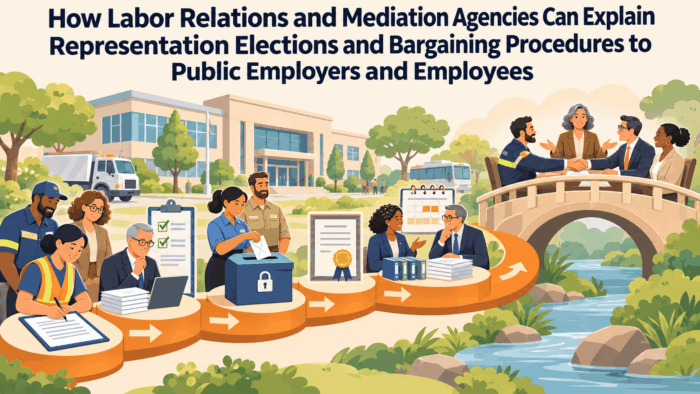
How Labor Relations and Mediation Agencies Can Explain Representation Elections and Bargaining Procedures to Public Employers and Employees
Public-sector labor relations procedures can be difficult to understand even for employers, employees, supervisors, and union representatives who encounter them regularly. Representation petitions, bargaining-unit questions, employee eligibility, elections, certification, negotiations, mediation, impasse procedures, unfair practice allegations, and contract administration may operate under different rules and timelines depending on the jurisdiction. When agencies explain these processes primarily through statutes, regulations, formal notices, or legal terminology, people may understand that a procedure exists without understanding what they are expected to do within it.
The communication challenge becomes more significant because representation and bargaining procedures often occur in environments where the parties have different interests and may provide employees with competing explanations. An employer may focus on operational consequences, an employee organization may emphasize representation rights, and individual employees may receive informal information from coworkers or supervisors. Labor relations and mediation agencies need to provide a neutral source that explains the process without becoming an advocate for any participant or attempting to replace legal advice.
Clear procedural communication can also reduce unnecessary conflict. When parties understand what a petition means, what an election determines, which issues belong in bargaining, what mediation can accomplish, and what happens when negotiations reach impasse, they are less likely to interpret routine procedural events as evidence that the agency has favored one side. Better information does not eliminate substantive disagreement, but it can prevent confusion about process from becoming an additional source of conflict.
A strong communication strategy therefore explains labor relations as a sequence of understandable decisions and procedural stages rather than as a collection of legal documents. Agencies should distinguish representation from bargaining, explain the roles of employers and employee organizations, identify the agency’s own responsibilities, and make clear when procedures or requirements vary by jurisdiction. The goal is to help employers and employees understand how the system works while preserving agency neutrality and the formal legal framework governing each proceeding.
Begin With a Plain-Language Map of the Labor Relations System
 Labor relations agencies should begin by helping employers and employees understand how the major parts of the system fit together. Representation, bargaining, mediation, impasse resolution, unfair practice proceedings, and contract administration are related, but they answer different questions and may be handled through different processes. Without an overview, people can easily assume that one procedure automatically determines issues that belong somewhere else.
A plain-language process map can show that representation generally concerns who, if anyone, represents a group of employees for collective bargaining, while bargaining concerns negotiations between a recognized or certified representative and the public employer. Mediation may support those negotiations, while unfair practice procedures address alleged violations of applicable labor relations requirements. The exact structure and terminology may differ by jurisdiction, so the agency should adapt the framework to its authority.
The overview should also identify the agency’s role at each stage. An agency may administer elections, determine bargaining units, certify representatives, provide mediation, adjudicate disputes, or perform only some of those functions. Employers and employees should not have to infer which responsibilities belong to the labor relations agency, which belong to the parties, and which may belong to another institution.
Providing this map early gives people a framework for understanding later details. When someone receives an election notice or hears that negotiations have entered mediation, they can place that event within the broader system rather than interpreting it as an isolated or unfamiliar government action.
Explain the Difference Between Representation and Collective Bargaining
Representation and bargaining are often discussed together, but agencies should explain clearly that they are distinct processes. Representation generally addresses whether employees will be represented for collective bargaining and which organization holds that representative role, while bargaining concerns negotiations between the employer and the recognized or certified representative over matters governed by the applicable labor relations framework.
Employees may incorrectly assume that voting for representation means approving a particular contract, wage increase, or workplace proposal. Employers may likewise treat a representation proceeding as though the agency is deciding substantive bargaining terms. Clear communication should explain that an election determines a representation question, not the eventual content of a negotiated agreement.
The agency should also explain that representation can involve questions beyond the election itself, including the scope of the bargaining unit, employee eligibility, competing representation claims, or other procedural matters. These questions may need to be resolved before an election can occur or before the representative relationship is formally established.
Separating the two concepts early improves understanding throughout the process. Employees can evaluate representation based on what the election actually decides, while employers can prepare for their procedural responsibilities without assuming that certification predetermines the outcome of future negotiations.
Explain How a Representation Case Begins
Employers and employees should understand what starts a representation proceeding and what the filing of a petition actually means. A petition may request an election, raise a question about representation, seek changes involving an existing bargaining relationship, or initiate another process authorized within the jurisdiction. Filing the petition begins a procedure, but it does not necessarily establish that the petitioning party will receive the outcome it requested.
Agency materials should explain who may file, what basic information is required, and what happens after the agency receives the filing. If the agency conducts an initial review, provides notice to interested parties, requests additional information, or evaluates whether procedural requirements have been met, those stages should be described in ordinary language.
The communication should also distinguish filing from agency approval. Employees may hear that a representation petition has been filed and assume an election is already scheduled, while employers may interpret the filing as evidence that the agency has accepted the petitioner’s position. Agencies should make clear that additional review or proceedings may be required.
Providing a straightforward explanation of the beginning of the process can reduce immediate speculation. The filing becomes understandable as the first step in a defined procedure rather than a signal that the agency has already decided the representation question.
Use a “What Happens Next” Sequence After a Representation Petition
A short sequence can show what generally happens after a petition is filed, such as agency review, notice to relevant parties, consideration of bargaining-unit or eligibility questions, scheduling of additional proceedings where necessary, and movement toward an election or another appropriate disposition. The sequence should reflect the agency’s actual procedures rather than a generic national model.
The agency should indicate where the process may branch depending on whether issues are disputed. A straightforward case may move differently from one involving competing organizations, disputed unit boundaries, employee eligibility questions, or other contested matters.
This format helps employers and employees understand that representation cases have stages. It can reduce confusion when a proceeding takes longer than expected because people can see which questions must be resolved before the next step occurs.
Explain Bargaining Units Without Assuming Familiarity With Labor Relations Terminology
The concept of a bargaining unit can be confusing to employees who may work for the same public organization but have different job classifications, supervisory responsibilities, professional roles, or working conditions. Agencies should explain that representation generally applies to a defined group of employees rather than automatically to every employee of the organization.
Communication should describe how bargaining-unit questions are addressed within the jurisdiction without reducing complex standards to a single factor. Job duties, organizational structure, existing bargaining relationships, supervisory status, professional responsibilities, or other considerations may be relevant depending on the governing framework. The agency should direct people toward authoritative rules when additional detail is necessary.
Employees should also understand that disagreement about the proposed unit does not necessarily mean the employer or employee organization opposes collective bargaining itself. Parties may disagree about which positions belong together or whether particular employees are eligible to participate. Distinguishing unit questions from broader representation positions can reduce unnecessary polarization.
Employers benefit from the same clarity because managers and human resources staff may need to identify classifications, organizational relationships, or employment information relevant to the proceeding. Plain-language guidance helps them understand why the agency is requesting information and how that information relates to the representation process.
Explain Employee Eligibility Before the Election
Questions about who can vote can become some of the most contentious issues in a representation election. Employees may assume that anyone working in the organization can participate, while eligibility may actually depend on the bargaining unit, employment status, payroll period, classification, or other factors established under the applicable procedures. Agencies should communicate eligibility standards before voting begins.
The explanation should identify the general basis for eligibility and describe how disputed cases are handled. If an employee’s eligibility remains unresolved when voting occurs, the agency should explain the applicable process, such as a challenged ballot procedure where that exists. Employees should know that a disputed eligibility question does not necessarily mean their participation has been ignored.
Employers and employee organizations should also understand their roles in providing or reviewing information used to establish voter eligibility. The agency should communicate deadlines and procedures consistently so neither side appears to have privileged access to the process.
Early eligibility communication reduces election-day confusion. Employees are more likely to trust the process when they understand why the voter list exists, how questions are resolved, and what they can do if they believe their eligibility information is incorrect.
Explain What a Representation Election Does and Does Not Decide
Representation election communication should clearly identify the question employees are being asked to decide. The election generally concerns representation for collective bargaining under the applicable system, but employees may receive campaign messages connecting the vote to wages, benefits, workplace rules, or other future outcomes. The agency should explain that those issues may be subjects of bargaining rather than guaranteed consequences of the election.
The board or agency should also explain the choices that will appear on the ballot and what each choice means procedurally. It should not characterize one option as preferable or attempt to forecast the consequences of the election beyond what the governing process establishes. Employees should be able to understand the decision without receiving advocacy from the agency administering it.
Employers need the same clarity because supervisors and managers may receive questions from employees about what will happen if a particular option prevails. Agency guidance can help employers direct workers toward authoritative information rather than encouraging managers to improvise explanations of the representation process.
This distinction can reduce later disappointment and conflict. Employees who understand that an election determines representation rather than specific contract terms are better prepared for the bargaining process that may follow certification.
Explain Election Administration in Practical Steps
Employees should know how the election will actually work, including when voting occurs, how ballots are cast, how official instructions will be provided, and where they can obtain assistance. The agency should organize this information around the employee experience rather than around the internal administrative structure used to conduct the election.
Where voting methods differ across proceedings, the agency should explain the method used in the specific election rather than assuming employees understand the process. Mail ballots, in-person voting, electronic systems, or other authorized approaches can create different practical questions. Clear instructions should be issued early enough for employees to prepare.
The agency should also explain how ballot secrecy is protected under its procedures. Employees may fear that employers, unions, coworkers, or supervisors will know how they voted, particularly in highly contentious campaigns. A clear description of ballot handling and confidentiality can strengthen confidence in the process.
Communication should identify official sources for election updates. If dates, locations, or procedures change, employees should know how the agency will notify them. One authoritative source reduces the risk that informal or campaign information becomes mistaken for an official election instruction.
Explain Certification and What Happens After the Election
Employees and employers may assume that election night or ballot counting immediately ends the representation process, but additional procedural steps may remain. Agencies should explain how results become official, whether objections or challenged ballots may need to be resolved, and when certification or another formal action occurs under the applicable process.
The communication should distinguish preliminary results from final agency action where that distinction exists. If unresolved challenged ballots could affect the result or an objection is pending, the agency should make that status clear rather than describing the outcome as fully settled prematurely.
Once the representative is formally recognized or certified, the agency can explain the basic procedural significance of that action. Certification identifies the representative relationship under the governing labor relations system, but it does not itself create a complete collective bargaining agreement or determine every future workplace term.
A clear post-election explanation helps people transition from the representation process to what may come next. Employers and employees can understand that certification may begin a new phase of labor relations rather than functioning as the final step in every issue surrounding representation.
Introduce Collective Bargaining as a Process Rather Than a Single Event
Collective bargaining is often discussed publicly as though it consists primarily of major negotiation sessions or final contract votes, but the process may involve preparation, proposals, counterproposals, information exchange, meetings, tentative agreements, mediation, and other steps. Agencies should explain bargaining as an ongoing process shaped by the governing labor relations framework and the decisions of the parties.
The communication should identify the basic roles of the public employer and the recognized or certified employee representative. The agency may establish procedures or provide mediation, but it generally does not negotiate the agreement for the parties. Clarifying this distinction helps employees understand why the agency cannot simply order the parties to agree on preferred contract terms.
Agencies should also explain that bargaining procedures and the range of matters subject to negotiation can vary by jurisdiction. Rather than presenting one universal model, public information should identify the framework that applies to the agency’s own authority and provide pathways to more detailed guidance where necessary.
Introducing bargaining in this way creates realistic expectations. Employers and employees can see that negotiation requires a sequence of decisions and interaction between the parties, and that disagreement at one stage does not necessarily mean the process has failed.
Explain the Agency’s Neutral Role Before Disputes Develop
Labor relations and mediation agencies should explain their neutral role before a representation election or bargaining dispute becomes contentious. Employers and employees may otherwise encounter the agency primarily when a disagreement arises, making procedural decisions easier to interpret as support for one party. Early communication can establish what the agency does and does not decide.
The agency should describe whether it administers elections, determines procedural disputes, provides mediation, conducts hearings, certifies representatives, or performs other functions within the labor relations system. It should also explain which decisions remain with employers, employee organizations, employees, mediators, or other authorities.
Neutrality does not require the agency to avoid explaining rights and procedures. It requires the agency to provide information consistently, avoid advocacy, and distinguish procedural assistance from strategic advice. Employers and employees should receive the same authoritative explanation of how the system works.
When the agency’s role is understood before controversy develops, later actions are easier to interpret within the proper context. A scheduled hearing, election ruling, mediation referral, or procedural notice is less likely to be viewed as evidence of favoritism when audiences already understand why the agency takes those actions and how they fit within the labor relations process.
Explain What Happens When Representation Questions Are Contested
Representation proceedings can become more difficult to understand when employers, employee organizations, or individual employees disagree about the proposed bargaining unit, voter eligibility, the status of a petition, or another procedural issue. Labor relations agencies should explain that contested questions are a normal part of the process and do not necessarily indicate that one party is obstructing the election or that the agency has taken sides. The central communication task is to show how disagreements are resolved within established procedures.
Public information should identify the types of issues that may need resolution before an election can proceed and explain the general process the agency uses to address them. Depending on the jurisdiction, that may involve written submissions, conferences, hearings, administrative review, or other procedures. The agency should avoid suggesting that every contested question follows the same path if actual procedures vary.
Employees should also understand why these disputes can affect timing. A delayed election may reflect the need to resolve bargaining-unit boundaries, employee eligibility, or another issue that affects the integrity of the vote. Explaining this connection can reduce speculation that the agency is postponing the process for political or strategic reasons.
Employers and employee organizations benefit from the same clarity because they can better understand what information the agency needs and why. When the process for resolving contested representation questions is visible, the agency is less likely to be perceived as making decisions informally or without a consistent framework.
Explain Challenged Ballots Without Making Employees Feel Their Votes Do Not Count
Challenged ballots can be confusing to employees because someone may be permitted to vote while the agency has not yet determined whether that ballot should be included in the final count. Without explanation, employees may interpret the process as arbitrary or assume that their vote has been discarded. Agencies should describe the purpose of challenged ballots before they become relevant to a close election.
The communication should explain that a challenged ballot can preserve an individual’s opportunity to participate while an eligibility question is resolved. Where applicable, the ballot remains separated or otherwise protected so the employee’s voting choice is not revealed during the eligibility review. The agency should describe the actual safeguards used within its process rather than making broad promises that may not apply in every jurisdiction.
Employees should also understand that challenged ballots may not need to be resolved if their number cannot affect the outcome. If the governing procedure allows that result, the agency should explain why unresolved challenges do not necessarily mean the election is incomplete. This can prevent people from assuming that the board ignored disputed votes.
Clear communication can make challenged ballots easier to understand as a procedural safeguard rather than a sign that the election process is uncertain or unfair. The agency should provide enough detail that employees know why the procedure exists while preserving the neutrality and confidentiality of the vote.
Use a Simple Election Scenario to Explain Challenged Ballots
A short hypothetical example can help employees understand the process without relying on a real contested election. The agency can describe a situation in which an employee’s eligibility is disputed, the employee is allowed to cast a protected ballot, and the agency later determines whether that ballot must be considered.
The example should remain procedural and should not suggest how a real eligibility dispute would be resolved. Its purpose is to show why the process exists and how it protects participation while preserving the agency’s ability to decide eligibility correctly.
Scenario-based explanations can be particularly effective in FAQs, election guides, and short videos because they translate an unfamiliar procedure into a sequence employees can follow. The agency should ensure that every example accurately reflects its own rules.
Explain Objections and Post-Election Challenges as Part of the Process
Employees may assume that ballot counting immediately ends a representation election, but parties may have the ability to raise objections or other post-election challenges under applicable procedures. Agencies should explain this possibility before the vote so a later objection does not appear to be an unexpected attempt to overturn the outcome. Early explanation can make the post-election phase easier to understand.
The agency should distinguish between disagreement with the result and a formal objection based on issues recognized within the governing process. Not every complaint about campaign conduct or election administration necessarily leads to additional proceedings. Public guidance should explain that objections must be evaluated according to established standards and procedures.
Where additional investigation, briefing, or hearing may be required, the agency should describe those steps without suggesting that the existence of an objection means the election was improper. A challenge begins a review process, just as a petition begins a representation proceeding. The outcome remains unresolved until the agency completes the appropriate review.
Employers and employees should also understand how post-election challenges may affect certification. If certification is delayed while a material issue is resolved, the agency should explain that connection clearly. This helps audiences interpret the delay as part of the election framework rather than as evidence that the agency is unwilling to recognize the vote.
Explain the Transition From Certification to Bargaining
Once a representative is formally certified or otherwise recognized under the applicable system, employers and employees may immediately ask when bargaining will begin and what will change. Agencies should explain that certification establishes the representation relationship, but the next steps may depend on governing requirements, existing agreements, scheduling, and the actions of the parties. The transition should be described as a new phase rather than as an instant change to every workplace term.
Employers should understand which representatives they will interact with and what procedural obligations may follow certification. Employees should understand that the representative generally acts for the bargaining unit within the scope established by applicable law and procedure. The agency should avoid attempting to summarize every legal consequence if those questions depend on jurisdiction-specific requirements.
Communication should also explain that negotiations can take time. The existence of a certified representative does not guarantee immediate agreement on wages, benefits, scheduling, or other terms. Bargaining requires proposals, responses, discussion, and potentially additional dispute-resolution procedures before an agreement is reached.
A clear transition message can reduce unrealistic expectations after an election. Employees who understand the distinction between representation and bargaining are better prepared for the negotiation process, while employers can focus on the procedural responsibilities that arise from the newly established relationship.
Explain Mandatory, Permissive, and Restricted Bargaining Subjects Carefully
Public-sector bargaining often involves questions about which matters must be negotiated, which may be negotiated, and which are limited or excluded by statute, policy, management authority, or another legal framework. These categories can vary substantially across jurisdictions, so labor relations agencies should avoid presenting a single universal list as though it applies everywhere. The communication should focus on how parties can understand the framework that governs them.
Agency guidance can explain the general concept that not every workplace issue is treated the same way in bargaining. Some matters may require negotiation, others may be negotiable only by agreement, and some may remain outside the scope of bargaining. The agency should direct parties toward authoritative jurisdiction-specific rules for determining where a particular issue belongs.
Employers and employees should also understand that disagreements over bargaining scope do not necessarily mean one party is refusing to negotiate in bad faith. Parties may genuinely disagree about whether a subject is negotiable, and the labor relations system may provide procedures for resolving that question. Clear communication can help prevent substantive legal disagreements from being interpreted immediately as misconduct.
The agency should be especially careful when using examples. A topic that is negotiable in one jurisdiction may be restricted in another, and oversimplified examples can create false expectations. Illustrative material should always be framed as general unless the agency is explaining its own specific governing rules.
Explain Proposals and Counterproposals Without Turning Bargaining Into a Scorecard
Employees and members of the public may follow collective bargaining through news reports or statements from the parties and assume that negotiations can be evaluated simply by comparing the latest proposals. Labor relations agencies should explain that bargaining is an iterative process in which proposals, counterproposals, package discussions, tentative agreements, and unresolved issues may change over time. A single proposal rarely tells the entire story.
The agency should avoid presenting or summarizing bargaining positions in a way that appears to judge which side is more reasonable. If public information about the process is appropriate, it should focus on procedural status, such as whether negotiations are continuing, mediation has been requested, or another formal stage has begun. Evaluating the substantive merits of proposals generally belongs to the parties, not the neutral agency.
Employees should also understand that tentative agreements on individual issues may not mean a complete agreement has been reached. Bargaining packages can remain subject to further negotiation or final approval processes. Explaining this distinction can reduce confusion when parties later revisit issues that appeared settled earlier.
Public employers benefit from this communication because elected officials, managers, and community members may otherwise pressure negotiators based on incomplete snapshots of the bargaining process. Neutral procedural explanation helps keep the agency from becoming a commentator on negotiation strategy.
Explain Good-Faith Bargaining Without Reducing It to Willingness to Agree
The concept of good-faith bargaining is often misunderstood by employees and public observers as a requirement that the parties compromise or reach agreement. Agencies should explain that labor relations systems generally evaluate bargaining conduct according to applicable legal standards, and that disagreement or failure to reach a contract does not automatically establish a violation. The exact standard should be described according to the jurisdiction.
Public guidance can explain that bargaining typically involves participation, exchange of positions, and conduct evaluated within the governing framework, but the agency should avoid presenting a simplified checklist that appears to predetermine future cases. Whether particular conduct violates bargaining obligations may depend on context and facts developed through formal proceedings.
Employers and employee organizations should also understand that public accusations of bad-faith bargaining are not the same as agency findings. If a party files an unfair practice charge or similar allegation, the agency should describe that filing as an allegation until the process produces a determination. This distinction preserves neutrality during contentious negotiations.
Explaining good faith carefully can help employees interpret bargaining conflict more realistically. Strong disagreement, rejected proposals, and extended negotiations may be frustrating, but they should not automatically be described as unlawful conduct unless the authorized process reaches that conclusion.
Explain Mediation as Assistance Rather Than a Decision Imposed on the Parties
Mediation can be misunderstood as a process in which a neutral third party decides which bargaining position should prevail. Labor relations and mediation agencies should explain that mediation generally helps parties communicate, identify areas of agreement, clarify disputes, and explore possible resolution, while the parties remain responsible for deciding whether to accept proposed terms. The exact scope of mediation should reflect the agency’s program.
Employers and employees should understand that mediators may use different techniques depending on the dispute. A mediator may meet jointly with the parties, conduct separate discussions, help identify priorities, or test possible settlement options. These activities should not be interpreted as support for one side simply because the mediator questions or challenges a party’s position.
Confidentiality should also be explained according to the program’s actual rules. Parties may assume that all mediation communications are protected in the same way across jurisdictions, but the applicable framework may contain specific protections or limitations. Agencies should provide plain-language guidance without making broader promises than their authority permits.
Clarifying the mediator’s role can make the process less intimidating and reduce unrealistic expectations. Mediation is more likely to be understood as a structured opportunity to resolve disagreement when participants know that the mediator supports the process without taking ownership of the final agreement.
Explain What Happens When Bargaining Reaches Impasse
 The term impasse can sound like the bargaining process has failed completely, but in many public-sector labor relations systems it marks a procedural stage that may lead to mediation, fact-finding, arbitration, recommendations, or another authorized process. Agencies should explain what impasse means within their jurisdiction and what procedures may follow. A general description should not assume that every public employer operates under the same model.
Employees should understand that declaring or determining impasse does not necessarily end negotiations permanently. Parties may continue discussions while other procedures occur, or the process may be designed to help them move toward resolution. The agency should describe how the next stage relates to the bargaining process without predicting whether an agreement will result.
Employers should also understand what filings, notices, or procedural steps may be required if they believe bargaining has reached impasse. Clear guidance can reduce avoidable disputes over process and help parties focus on the substantive issues they have been unable to resolve.
The public may need additional context when impasse affects highly visible services. Agency communication should explain its own role while distinguishing labor relations procedures from operational decisions made by the employer or employee organization. This keeps the neutral agency from being treated as responsible for every consequence of the bargaining dispute.
Build Parallel Guidance for Employers and Employees
Labor relations agencies should provide information that serves both public employers and employees without assuming they enter the process with the same knowledge or responsibilities. Employers may need guidance about notices, records, bargaining representatives, timelines, and procedural submissions, while employees may need clearer explanations of elections, representation, bargaining, and how official information differs from advocacy material. Both audiences deserve access to authoritative information.
Parallel guidance does not mean creating conflicting versions of the process. The underlying procedures should remain the same, but examples, terminology, and practical explanations can be tailored to the questions each audience is most likely to have. An employer guide may explain administrative responsibilities, while an employee guide explains what those same procedures mean for participation.
The agency should cross-reference these resources so users can see the broader process rather than remaining within one perspective. An employee should be able to understand why the employer is being asked to provide information, while an employer should be able to understand why employees receive particular election notices or voting protections. Shared understanding can reduce suspicion.
Providing balanced, audience-specific guidance demonstrates neutrality more effectively than relying on one highly technical manual. When both employers and employees can access clear explanations designed for their needs, the agency strengthens understanding without becoming an advocate for either side.
Explain Bargaining Timelines Without Creating False Expectations
Public employers, employees, and bargaining representatives often want to know how long negotiations will take, but labor relations agencies should be careful not to present bargaining as though it follows a predictable calendar. Some negotiations move quickly because the parties agree on many issues, while others require extended discussions, mediation, fact-finding, or other procedures. The agency should explain the stages that may occur without implying that every negotiation will take the same amount of time.
Communication can identify procedural deadlines that actually exist within the jurisdiction while distinguishing them from estimated or typical timeframes. If a filing must occur within a defined period, the agency should state that clearly. If timing depends on scheduling, complexity, the number of issues, or the decisions of the parties, the agency should explain that variability rather than offering a date that may later become unrealistic.
Employees may otherwise interpret a long bargaining process as proof that one side is refusing to cooperate or that the agency has failed to intervene. Employers may face similar pressure from elected officials or the public to explain why an agreement has not been reached. A neutral agency can reduce that speculation by explaining that bargaining duration depends on both procedural requirements and the substance of the negotiations.
Clear timeline communication should therefore separate what the agency controls from what the parties control. The agency may schedule mediation, hearings, or other formal procedures, but it does not necessarily control how quickly the parties exchange proposals or reach agreement. This distinction helps audiences understand why some parts of the process can be scheduled while others remain uncertain.
Explain Tentative Agreements and Ratification Without Treating Them as Final Too Early
Tentative agreements can be difficult for employees and the public to interpret because the parties may announce progress before a complete agreement has been approved. Labor relations agencies should explain that a tentative agreement generally means the parties have reached a provisional understanding on particular terms or on an overall package, but additional approval steps may still be required. The exact process depends on the governing framework and the parties’ procedures.
Employees may need to understand whether ratification by union members, approval by a governing body, or another formal action must occur before the agreement becomes final. Public employers may also need to follow budgeting, legislative, board, or administrative approval processes. The agency should describe these steps at a general level without assuming that every jurisdiction or bargaining relationship uses the same sequence.
Communication should also distinguish between tentative agreements on individual subjects and a complete tentative contract. Parties may resolve several issues while continuing to negotiate others, and public statements can create confusion if they imply that the entire dispute has been settled. Clear terminology can help employees understand the actual status of negotiations.
The agency should avoid celebrating or criticizing a tentative agreement. Its role is to explain the procedural significance and what remains to occur. Neutral communication is especially important when one side is actively encouraging approval and the other is explaining reservations to its members or governing officials.
Use a Bargaining Status Guide to Explain Common Milestones
A short status guide can help employees and employers understand terms such as proposal exchanged, negotiations ongoing, tentative agreement reached, mediation scheduled, impasse declared, ratification pending, and agreement approved. Each term can be accompanied by a brief explanation of what it generally means and what may happen next.
The guide should make clear that these labels describe procedural status rather than the quality or fairness of the parties’ positions. A tentative agreement is not inherently better than continued negotiations, and mediation does not mean the bargaining process has failed.
Boards and mediation agencies should update the guide to reflect their own procedures. A generic national sequence can become misleading when state or local public-sector bargaining systems use different terms or approval requirements.
Explain Fact-Finding Without Making the Neutral’s Recommendations Sound Binding Unless They Are
Some public-sector labor relations systems use fact-finding when negotiations remain unresolved after bargaining or mediation. Employees and employers may assume that the fact-finder decides the contract or that the recommendations automatically become binding, even when the actual procedure is advisory. Agencies should explain the role carefully according to the jurisdiction.
The communication should identify what information the fact-finder reviews, how the parties participate, and what type of report or recommendation may result. If the fact-finder considers wages, comparability, financial information, bargaining history, or other factors under the governing framework, the agency can explain that process without predicting how those factors will be weighed in a particular dispute.
Where recommendations are nonbinding, the agency should make that limitation explicit. The report may influence negotiations or public understanding without itself becoming the collective bargaining agreement. If a jurisdiction uses a different form of fact-finding with greater legal effect, the agency should explain that distinction accurately.
Employees and members of the public may rely heavily on the resulting report because it comes from a neutral source. Agencies should therefore explain its procedural role without suggesting that the report necessarily identifies one party as reasonable and the other as unreasonable. The fact-finding process should be understood within the larger bargaining framework.
Explain Arbitration and Other Binding Dispute-Resolution Procedures Carefully
Public-sector labor relations systems may use arbitration or another binding mechanism for certain disputes, but the authority, scope, and availability of those procedures can vary significantly. Agencies should avoid presenting arbitration as a universal final step after mediation or impasse. Instead, communication should explain when the procedure applies within the specific jurisdiction and what questions it is authorized to resolve.
Where binding arbitration is available, employers and employees should understand the difference between a neutral who facilitates negotiation and a neutral who has authority to issue a decision. A mediator generally helps the parties pursue agreement, while an arbitrator or other decision-maker may resolve designated issues according to the governing framework. Those roles should not be described interchangeably.
The agency should also explain whether the decision applies to the entire agreement, selected unresolved issues, grievances, or another category of dispute. Public audiences may hear that a matter is “going to arbitration” without understanding what portion of the labor relationship is actually being decided.
Clear explanation can reduce unrealistic expectations about what arbitration will accomplish. It can also help employees and public officials understand why some issues return to bargaining even after another matter has been decided through a binding process. The agency’s communication should remain focused on the authority of the procedure rather than the desirability of the outcome.
Explain Unfair Practice Charges That Arise During Bargaining Without Collapsing Two Processes Into One
Bargaining disputes and unfair practice proceedings may occur at the same time, which can make the labor relations process especially confusing. A party may file a charge alleging refusal to bargain, interference, retaliation, or another violation while negotiations continue on separate substantive issues. Agencies should explain that the existence of a charge does not necessarily suspend or resolve the bargaining process unless the applicable rules provide otherwise.
Employees may assume that an unfair practice filing proves the opposing party has violated bargaining obligations. Employers or unions may likewise publicize the charge as evidence that the other side is responsible for the lack of agreement. The agency should consistently describe the filing as an allegation until the authorized process produces a determination.
The agency should also explain whether the unfair practice case and bargaining process are handled through different procedural tracks. One may involve investigation, hearing, or adjudication, while the other continues through negotiation, mediation, or impasse procedures. A simple explanation of those parallel tracks can prevent people from assuming that every dispute has been merged into one case.
Keeping the processes distinct strengthens neutrality. The agency can acknowledge that the same underlying relationship may give rise to multiple proceedings while still explaining what each process is designed to decide. This prevents one filing from becoming a substitute for understanding the broader bargaining situation.
Explain Information Requests and Procedural Exchanges Without Giving Strategic Advice
Collective bargaining can involve requests for information, records, data, or other materials that one party believes are relevant to negotiations or representation responsibilities. Labor relations agencies should explain the general procedural framework surrounding these exchanges without advising either side about what specific information to seek, provide, withhold, or contest in a particular case.
Employers and employee organizations may need plain-language guidance about how disputes over information can arise and what procedures are available if they cannot resolve them. The agency can explain that applicable rights and obligations depend on the governing labor relations framework and the facts involved. It should avoid reducing those questions to broad statements that appear to decide future disputes in advance.
Employees may also benefit from understanding why bargaining can involve detailed data exchanges. Requests concerning compensation, staffing, schedules, classifications, or other issues may be part of the parties’ preparation for negotiations. Providing this context can help employees understand why bargaining sometimes progresses through technical information exchanges before visible movement occurs at the table.
The agency should maintain a clear boundary between education and legal strategy. Explaining the process helps parties participate effectively, while advising one side how to use the process could undermine the agency’s neutral role. Clear referral language can direct parties toward their own representatives or legal advisors for case-specific guidance.
Explain the Role of Elected Officials and Governing Bodies in Public-Sector Bargaining
Public-sector bargaining often operates within a broader governmental structure that may include elected boards, councils, commissions, executives, budget officials, or other authorities. Employees may assume that the individuals sitting at the bargaining table have complete authority to finalize every term, while public employers may be subject to approval processes that extend beyond the negotiating team. Agencies should explain these institutional relationships at a general level.
The communication should distinguish between negotiation authority and final approval where that distinction exists. A bargaining team may reach a tentative agreement that still requires action by a governing body or another authorized entity. Employees should understand that this does not necessarily mean the employer is reopening negotiations or refusing to honor the bargaining process.
Agencies should also be careful not to characterize the political choices of governing bodies. If elected officials approve, reject, or modify an agreement within their lawful authority, the labor relations agency should explain the procedural consequence rather than evaluate whether the decision was wise or fair.
Understanding these governmental layers is particularly important for public-sector employees who may compare their bargaining process with private-sector labor relations. Public budgeting, legislative authority, and public accountability can shape procedures in ways that need clear explanation. The agency can provide that context without becoming involved in the policy debate itself.
Explain Contract Duration, Reopeners, and Successor Bargaining
Employees may think of a collective bargaining agreement as a permanent set of workplace rules once it is approved, but agreements generally operate for a defined period and may include provisions that allow certain subjects to be reopened. Agencies should explain how contract duration relates to future bargaining without attempting to interpret specific agreements for the parties.
Public guidance can describe the general concept that parties may begin successor negotiations before an existing agreement expires and that some contracts establish procedures for reopening selected issues during the agreement term. The exact timing and legal consequences vary by jurisdiction and contract, so agencies should avoid presenting one schedule as universal.
Employers and employees should also understand that the expiration of an agreement does not necessarily mean every negotiated term disappears immediately. The legal consequences of expiration can depend on applicable law, agreement language, and the nature of the issue. Agencies should point users toward authoritative rules rather than giving a simplified answer that may be inaccurate.
Explaining the lifecycle of an agreement helps employees see bargaining as an ongoing institutional process rather than a one-time event. Representation, negotiation, implementation, expiration, and successor bargaining can then be understood as connected stages within a continuing labor relationship.
Explain Labor Relations Procedures During Highly Visible Public Disputes
Bargaining disputes involving schools, transportation, public safety, local government operations, or other visible public services can generate intense media and community attention. Employees and employers may receive simplified public narratives suggesting that one party is responsible for every delay or that the labor relations agency has authority to impose an immediate solution. Agencies should prepare clear procedural communication for these situations.
The agency should explain which stage of the labor relations process is underway, what authority it has, and what decisions remain with the parties. If mediation, fact-finding, or another procedure is in progress, the agency can describe that process without discussing confidential negotiations or predicting the outcome.
Public communication should also distinguish bargaining procedures from service-continuity decisions made by the employer or other public authorities. Staffing plans, closures, emergency operations, and public service adjustments may have significant consequences, but they may fall outside the labor relations agency’s role. Clarifying those boundaries reduces misplaced expectations.
A consistent public explanation helps prevent the agency from being drawn into the parties’ advocacy. The board or mediation agency can remain informative and visible without becoming a commentator on who should compromise, which proposal is stronger, or how the dispute ought to end.
Use Case and Process Communication to Build Long-Term Labor Relations Literacy
Labor relations agencies should view procedural education as an ongoing responsibility rather than something provided only when an election or bargaining dispute becomes contentious. Employers, employees, supervisors, union representatives, elected officials, and members of the public benefit when basic information about representation and bargaining is available before they urgently need it. Early education can reduce confusion when formal proceedings begin.
The agency can maintain evergreen guides explaining representation, elections, certification, bargaining, mediation, impasse, fact-finding, arbitration, and unfair practice procedures at a level accessible to non-specialists. More detailed technical resources can remain available for practitioners who need them. Layered information allows users to choose the depth appropriate to their role.
Training sessions, webinars, orientation materials, and partner outreach can extend that education beyond the agency website. New supervisors, newly represented employees, elected officials, and human resources staff may all benefit from understanding the structure of public-sector labor relations before they become directly involved in a contested matter.
Over time, stronger labor relations literacy can reduce the communication burden created by every new dispute. People who already understand the difference between representation, bargaining, mediation, and adjudication are less likely to interpret routine procedural developments as unexpected or biased. The agency can then spend more time explaining case-specific developments and less time rebuilding basic understanding from the beginning.
Build a Formal Communication Framework for Representation and Bargaining Procedures
Labor relations and mediation agencies should manage representation and bargaining communication through a coordinated framework rather than relying on separate explanations developed by individual programs, mediators, hearing staff, election staff, or communications personnel. Employers and employees often move across several parts of the system, and inconsistent terminology or process descriptions can make related procedures appear contradictory. A shared framework helps ensure that each stage is explained as part of one coherent labor relations system.
The framework should identify who is responsible for maintaining public guidance on representation petitions, election procedures, certification, collective bargaining, mediation, impasse, unfair practice proceedings, and related dispute-resolution processes. Program specialists can provide the substantive foundation, while communications staff can help translate that information into plain language. Legal review may also be necessary when public explanations describe rights, procedural thresholds, or jurisdiction-specific distinctions.
Agencies should also define which materials are evergreen and which must be updated for individual proceedings. A general explanation of collective bargaining may remain useful for years, while an election notice, mediation schedule, or case status page may require frequent changes. Separating those functions makes it easier to maintain reliable baseline guidance while keeping case-specific communication current.
Leadership should review the framework periodically to determine whether users are receiving a consistent explanation from the agency regardless of where they enter the system. If employees hear one description from election staff and another from mediation personnel, or employers encounter conflicting website and staff explanations, the communication system itself can become a source of unnecessary confusion.
Create One Authoritative Process Library for Employers and Employees
Agencies should maintain a centralized collection of plain-language resources covering the major stages of representation and collective bargaining. Employers and employees should be able to move from a basic overview to more detailed guidance without searching across disconnected pages, archived notices, technical manuals, or legal documents. A well-organized process library can serve as the authoritative starting point for both routine questions and contentious proceedings.
The library can include representation process maps, bargaining-unit explanations, election guides, challenged ballot information, certification guidance, bargaining process overviews, mediation explanations, impasse procedures, and descriptions of other dispute-resolution mechanisms used in the jurisdiction. Each resource should clearly state what it explains, who it is intended for, and where users can find more technical authority if needed.
Information architecture matters because people rarely approach the agency using the same terminology staff use internally. Employees may search for phrases such as “who gets to vote,” “what happens after union election,” or “what does mediation mean,” while employers may look for “what happens after certification” or “how bargaining starts.” Resources should be organized around practical questions as well as formal procedural labels.
A centralized library also supports consistency across outreach. Staff, mediators, employer associations, employee organizations, and other partners can direct audiences to the same current resources rather than circulating separate explanations. This reduces the likelihood that outdated or incomplete guidance continues to shape expectations.
Standardize Terminology Across Representation and Bargaining Programs
Representation and bargaining procedures often include specialized terminology that can create confusion when different programs use overlapping words differently. Agencies should develop a controlled language framework covering terms such as petition, bargaining unit, certification, recognition, representative, impasse, mediation, fact-finding, arbitration, unfair practice, tentative agreement, and final agreement. Consistency helps users understand how one stage relates to another.
The framework should include both formal terminology and recommended plain-language explanations. Staff may need to use a statutory term in an official document while also explaining what it means to an employee or manager unfamiliar with labor relations law. Providing both versions allows the agency to preserve accuracy without sacrificing accessibility.
Terminology should also reflect important procedural distinctions. A petition is not an election, an election result may not yet be a final certification, mediation is not arbitration, and a tentative agreement may still require approval. These distinctions should appear consistently in webpages, staff responses, training materials, case notices, and public statements.
Agencies should review terminology when laws, procedures, or organizational structures change. A phrase that once accurately described a process can become misleading after a procedural revision. Maintaining the language framework is therefore part of maintaining the broader labor relations communication system.
Develop Parallel Employer and Employee Communication Pathways
Employers and employees participate in the same labor relations system from different positions, which means they often need different practical explanations even when the underlying procedure is identical. Agencies should develop parallel guidance that addresses the specific responsibilities and questions each audience is likely to encounter without creating separate versions of the law or process.
Employer-facing resources can explain obligations related to election notices, employee lists, bargaining representatives, scheduling, information requests, mediation participation, and procedural filings. Employee-facing resources can explain voting eligibility, ballot secrecy, representation choices, certification, bargaining stages, mediation, and how workplace terms may be affected by future negotiations. Both should be grounded in the same authoritative process.
The agency should also make it easy for users to see the other perspective. An employee may benefit from understanding why the employer must provide certain information during an election, while an employer may benefit from understanding why employees receive particular notices or protections. Cross-referencing resources can reduce suspicion about routine procedural requirements.
Parallel communication demonstrates neutrality because neither audience is forced to rely entirely on explanations written for the other. Each group receives practical information tailored to its role, while the agency maintains one consistent procedural foundation across both.
Use Matched Employer and Employee Guides for Major Process Stages
Agencies can create matched guides for key stages such as representation petitions, elections, certification, bargaining, mediation, and impasse. Each pair can explain the same stage from the perspective of the responsibilities, questions, and decisions most relevant to that audience.
The guides should use consistent terminology and link to one another so users can compare perspectives without encountering conflicting descriptions. This makes the process easier to understand while reinforcing that both sides are operating within the same framework.
Matched guidance can also help agency staff respond consistently. Rather than creating separate answers for every inquiry, staff can direct employers and employees toward approved resources designed for their role.
Establish Communication Checkpoints at Major Representation Milestones
Representation proceedings should include planned communication checkpoints so employees and employers receive updated information as the case moves from filing through election and certification. Without those checkpoints, people may continue relying on information that was accurate earlier but no longer reflects the current procedural status. A structured update system can reduce that risk.
Checkpoints may occur after a petition is accepted for processing, after bargaining-unit questions are resolved, before voting begins, when election procedures are finalized, after ballots are counted, and when certification or another final action occurs. The specific milestones should reflect the agency’s actual process rather than a generic sequence.
At each stage, the agency should explain what has been decided and what remains open. If an election has been scheduled but eligibility questions remain unresolved, that distinction should be clear. If results have been counted but objections are pending, employees should understand why the process may not yet be final.
Milestone communication creates continuity. Instead of receiving isolated notices, employees and employers can follow a recognizable sequence and understand how each new action changes the status of the representation case.
Build Communication Checkpoints Into the Bargaining and Mediation Process
Collective bargaining can extend over months and may involve long periods in which employees or members of the public hear little official information. Agencies should identify appropriate points where procedural communication can clarify the status of mediation, impasse, fact-finding, or other agency-managed processes without disclosing confidential negotiation content. The goal is to explain the process rather than the substance of bargaining positions.
A mediation agency may be able to confirm that mediation has been requested, scheduled, or concluded while remaining silent about confidential discussions. If the matter moves to another dispute-resolution stage, the agency can explain what that stage is designed to do and what authority the neutral participant has. Clear procedural updates prevent silence from being interpreted as inactivity.
Agencies should coordinate with mediators and case staff so public explanations do not inadvertently reveal confidential information or create pressure on the parties. Approved status language can help staff distinguish between what can be communicated and what must remain within the mediation process.
These checkpoints also help employees understand that bargaining can continue even when there is little public movement. A lack of detailed public information does not necessarily mean nothing is happening. The agency can explain procedural activity while protecting the confidentiality necessary for effective dispute resolution.
Train Staff to Explain Process Without Providing Strategy
Agency staff frequently receive questions that begin as requests for procedural information but quickly move toward strategic advice. An employer may ask how to respond to a representation petition, while an employee may ask which representation option would be better. Staff should be trained to explain procedures clearly while recognizing when the question crosses into advocacy or legal strategy.
Training should include practical distinctions between explaining what a rule requires and advising someone how to use that rule to achieve a particular result. Staff can describe filing deadlines, available forms, election procedures, mediation stages, and where to find governing authority. They should avoid recommending bargaining positions, predicting case outcomes, or coaching parties on how to strengthen their legal arguments.
Employees should also know how to refer users who need case-specific legal advice or representation. A neutral referral can explain that the agency cannot advise a party on strategy while still helping the person identify the type of professional assistance they may wish to seek.
Scenario-based training can make these boundaries easier to apply. Representation and bargaining questions often arise in emotionally charged environments, and staff benefit from practicing how to remain helpful without becoming part of the dispute.
Audit Process Communication for Accessibility and Usability
Accurate labor relations guidance can still fail if employers and employees cannot understand or find it. Agencies should periodically audit webpages, notices, forms, FAQs, process maps, and educational materials for readability, navigation, accessibility, and practical usefulness. The objective is to determine whether the communication works for non-specialists, not simply whether it is technically correct.
The audit should examine whether users can identify what happens next, which deadlines matter, who is responsible for each step, and where to obtain more information. Dense legal language, unexplained acronyms, long PDF documents, or fragmented web navigation can make basic procedures difficult to follow even when all necessary information technically exists.
Accessibility should also include language access, disability access, mobile usability, and the needs of employees who may not regularly use government websites. Representation elections and bargaining procedures affect people with very different levels of familiarity with labor relations systems, so communication should not assume professional expertise.
Usability findings should lead to concrete improvements. Agencies can reorganize resources, create shorter explanations, add process diagrams, revise headings, improve forms, or develop additional guidance for recurring questions. A communication audit should function as a management tool rather than a one-time compliance exercise.
Use Data and Feedback to Identify Where Procedural Confusion Persists
Labor relations agencies can learn a great deal from the questions employers and employees repeatedly ask. Call center inquiries, election questions, mediation requests, website searches, filing errors, webinar questions, and staff observations can reveal which parts of the system remain difficult to understand. Agencies should collect and review those signals systematically.
If employees repeatedly confuse certification with a completed collective bargaining agreement, the agency may need stronger post-election guidance. If employers regularly misunderstand when mediation becomes available, the problem may lie in the process explanation rather than in the underlying procedure. Repeated confusion should be treated as evidence that communication needs improvement.
Feedback should also be reviewed across different audience groups. Human resources professionals may understand a process that remains confusing to frontline employees, while experienced union representatives may navigate procedures that newly organized employees find inaccessible. Looking only at experienced users can hide communication gaps affecting broader participation.
Using these data to refine materials creates a continuous improvement cycle. The agency can revise guidance, monitor whether questions change, and determine whether the new explanation actually reduced confusion. This makes procedural education more responsive over time.
Make Representation and Bargaining Education a Permanent Institutional Function
Labor relations agencies should not wait for a contentious election or bargaining crisis before explaining how the system works. Representation and bargaining education should be maintained as a permanent institutional function that supports employers, employees, union representatives, supervisors, elected officials, and other stakeholders throughout the labor relations lifecycle. Continuous education reduces the amount of basic explanation required during high-conflict moments.
Agencies can maintain recurring webinars, orientation materials, process guides, training sessions, and partner outreach that introduce the fundamentals of representation and bargaining before a specific dispute arises. New managers, newly represented employees, human resources staff, and public officials can all benefit from understanding the process before they are required to participate directly.
Ongoing education also supports institutional neutrality. When the agency provides the same procedural guidance during routine periods that it provides during contentious cases, parties are less likely to interpret new information as an attempt to influence a particular dispute. Consistency over time strengthens the credibility of the message.
A mature communication system makes labor relations procedures understandable before, during, and after formal proceedings. By combining clear governance, standardized language, audience-specific guidance, staff training, accessible resources, and continuous improvement, agencies can help employers and employees participate more effectively while preserving the neutral role necessary for representation and bargaining systems to function.
Strategic Communication Support for Representation and Bargaining Procedures
 Labor relations and mediation agencies need communication systems that help public employers and employees understand representation, elections, bargaining, mediation, impasse, and related procedures without turning procedural education into advocacy. These systems are most effective when they explain what each stage is designed to accomplish, what the agency controls, what the parties control, and how one stage connects to the next. Clear communication can reduce procedural confusion while preserving the neutrality required for labor relations institutions to remain credible.
Stegmeier Consulting Group (SCG) can support labor relations and mediation agencies by developing process maps, employer and employee guides, election communication materials, bargaining procedure explanations, mediation messaging, staff talking points, FAQs, website content, partner toolkits, and communication measurement approaches. SCG can also help agencies identify where current materials rely too heavily on technical terminology or fail to explain what users should expect next.
Strategic communication support can be especially valuable when agencies serve several audiences with different levels of familiarity with labor relations. Human resources professionals, union representatives, elected officials, supervisors, and frontline employees may all interact with the same process but need different explanations of their responsibilities and options. A structured communication framework can provide tailored guidance while maintaining one consistent procedural foundation.
SCG’s role remains focused on communication strategy, public information systems, plain-language content, stakeholder communication, internal alignment, accessibility, and communication measurement. SCG does not determine bargaining-unit status, decide representation questions, direct bargaining strategy, conduct legal representation, adjudicate unfair practice cases, determine whether a bargaining obligation has been violated, or provide legal advice. Strategic communication support helps agencies explain authorized processes clearly while preserving the responsibilities of mediators, hearing officers, board members, counsel, and other authorized labor relations professionals.
Future Trends
Labor relations and mediation agencies are likely to expand the use of digital process tools that help employers and employees understand where they are within a representation or bargaining procedure. Interactive process maps, status pages, guided FAQs, short explanatory videos, and standardized milestone updates can make complex procedures easier to follow without requiring users to read lengthy technical documents at every stage.
Agencies may also place greater emphasis on audience-specific communication. Employer guides, employee guides, supervisor resources, elected official briefings, and representative-facing materials can explain the same process from different practical perspectives while relying on the same underlying rules. This approach can improve usability without fragmenting the agency’s official message.
Data and user feedback are also likely to play a larger role in improving procedural education. Agencies can analyze search terms, repeated staff questions, filing errors, webinar participation, incomplete forms, and common misunderstandings to identify where people are struggling. This can allow communication resources to evolve based on demonstrated user needs rather than assumptions about what audiences understand.
Mediation and dispute-resolution communication may also become more sophisticated as agencies try to explain confidentiality, neutral roles, and procedural boundaries to broader audiences. The strongest future systems will make clear that a lack of detailed public information during mediation does not mean the process is inactive, while also helping employees and employers understand what happens before and after confidential discussions.
Conclusion
Representation elections and collective bargaining procedures can become difficult to navigate when employers and employees encounter them primarily through formal notices, advocacy messages, or technical legal language. Labor relations and mediation agencies can reduce that confusion by explaining the system as a sequence of connected stages, beginning with representation and continuing through certification, bargaining, mediation, impasse, agreement, and future contract cycles.
The most effective communication distinguishes clearly between representation and bargaining, explains what elections do and do not decide, identifies how contested questions are resolved, and describes the roles of mediators and other neutral participants accurately. It also recognizes that procedures vary by jurisdiction and avoids presenting one public-sector labor relations model as universal.
Employers and employees benefit when the agency provides parallel guidance designed around their respective responsibilities while maintaining one consistent procedural foundation. Staff training, centralized resources, process checkpoints, plain-language terminology, and regular communication audits can help ensure that users receive the same explanation regardless of where they enter the system.
A mature communication strategy does more than answer questions after disputes begin. It builds long-term labor relations literacy so employers, employees, supervisors, representatives, and public officials understand the system before they are required to act within it. That foundation can reduce avoidable conflict, improve participation, and strengthen confidence in the neutrality and legitimacy of labor relations institutions.
Stegmeier Consulting Group’s Strategic Approach to Communication Systems
Labor relations and mediation agencies need communication systems that connect representation guidance, election information, bargaining procedures, mediation explanations, staff training, case updates, accessibility, and continuous improvement into one coordinated framework. These elements should reinforce one another so users receive a consistent explanation whether they enter through a petition, election notice, bargaining dispute, mediation request, or general information search.
SCG helps agencies examine how employers and employees move through labor relations procedures and where communication barriers create uncertainty. This can include developing process architecture, controlled terminology, matched employer and employee resources, milestone communication, digital content, partner materials, and methods for evaluating whether procedural guidance is actually reducing confusion.
The broader objective is to make labor relations procedures understandable without oversimplifying the legal framework or turning agency communication into strategic advice. Agencies should be able to explain what happens next, what each stage means, and where parties can obtain additional information while remaining firmly within their neutral institutional role.
Build a representation and bargaining communication framework that makes complex procedures easier to follow from petition through agreement.
A strong framework should show how representation petitions, bargaining-unit questions, elections, certification, bargaining, mediation, impasse, and agreement fit together while clearly identifying where the process may branch or vary. Employers and employees should be able to understand both the overall sequence and the specific responsibilities associated with their role.
The framework should also connect public guidance with staff practice. Election notices, FAQs, staff scripts, mediation information, bargaining guides, and website content should use consistent terminology and describe procedural stages in compatible ways. This reduces the risk that users receive technically different explanations from different parts of the same agency.
Over time, agencies should use feedback, recurring questions, filing errors, and participation patterns to refine the framework. Continuous review can help ensure that representation and bargaining procedures remain understandable as laws, practices, technology, and user expectations change.
Use the form below to connect with our team and explore how strategic communication support can strengthen representation election guidance, bargaining procedure communication, mediation messaging, employer and employee education, and labor relations process transparency.