
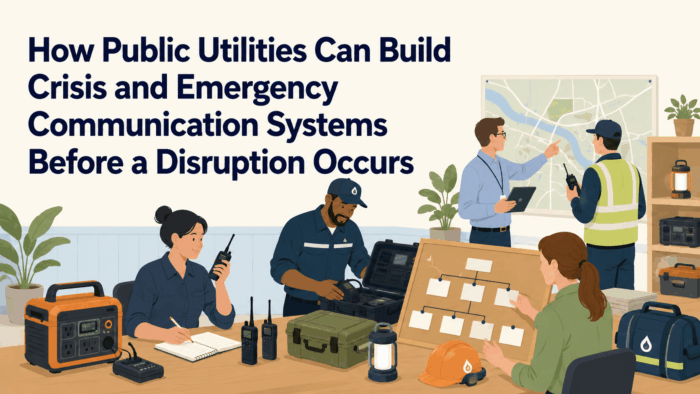
How Public Utilities Can Build Crisis and Emergency Communication Systems Before a Disruption Occurs
 The most consequential decisions in utility crisis communication are not made during the emergency. They are made in the months and years before it, when the pressure of an active disruption is absent and the organizational capacity to think clearly, build deliberately, and test rigorously is available. Utilities that wait until a crisis is underway to discover that their notification systems are incomplete, their interagency coordination protocols are unclear, and their public messaging is inconsistent with what emergency management partners are communicating have already lost the most valuable resource in a crisis: time.
Crisis communication is not a natural extension of routine utility communication. The pace is different. The stakes are different. The audience is different, in the sense that a community experiencing a service disruption, a water quality event, or an energy emergency is processing information under stress, with reduced patience for complexity, and with an immediate need for actionable guidance that routine communication rarely requires. The communication system that works well for announcing a capital project launch or explaining a rate increase will not function adequately for managing the first hours of a major service failure, and utilities that discover this only after a crisis has begun pay a significant cost in public trust.
Building a crisis communication system before it is needed requires a different kind of organizational commitment than most utilities are accustomed to making for communication functions. It requires cross-departmental investment of time from operations, engineering, customer service, communications, and executive leadership. It requires relationships with external partners, including local emergency management agencies, public health departments, elected officials, and media contacts, that are built before they are needed. It requires testing and revision through exercises that simulate the conditions of a real crisis without the consequences. And it requires the institutional discipline to maintain and update the system as the utility’s infrastructure, service area, and organizational structure change over time.
This article examines how public utilities can build crisis and emergency communication systems that are ready to function effectively when a disruption occurs, how those systems should be tested and maintained, and why the investment in pre-crisis communication preparation is one of the highest-value communication commitments a utility can make.
Understanding What Crisis Communication Requires
Crisis communication for public utilities is defined by three conditions that distinguish it from all other forms of utility communication. The first is urgency. Ratepayers and community members who are directly affected by a service disruption need information immediately, and the window in which early communication can prevent additional harm, public panic, or operational interference is narrow. The second is uncertainty. Crises rarely arrive with complete information. The cause of a disruption may be unknown at first. The scope may be expanding. The estimated restoration time may be genuinely uncertain. Communicating accurately under these conditions requires a system that can be honest about what is known and what is not without creating additional alarm.
The third defining condition of utility crisis communication is multiplicity. A significant service disruption typically involves multiple communication channels, multiple audiences, and multiple organizational actors simultaneously. Ratepayers need notification through direct channels. Elected officials need briefing through appropriate political channels. The media need timely and accurate information that prevents inaccurate reporting from filling the information vacuum. Emergency management partners need operational coordination that is distinct from public messaging. All of this must happen concurrently, consistently, and at a pace that the disruption itself is setting.
A crisis communication system that has not been built, documented, tested, and maintained before a crisis occurs will not be able to meet these conditions reliably. Improvised crisis communication can work in mild situations, but serious service disruptions, water main breaks affecting large portions of a service area, extended power outages during extreme weather, sewer spills affecting public health, present communication challenges that improvisation cannot adequately address. The systems, the protocols, the pre-approved message frameworks, and the coordination relationships must be in place before they are needed.
The Cost of Crisis Communication Failure
The consequences of inadequate crisis communication are not limited to the duration of the disruption. They extend into the months and years that follow, shaping the public’s perception of the utility and its management in ways that are difficult to reverse. A utility that handles a significant service disruption with slow, incomplete, or inconsistent communication will find that its ratepayers remember the communication failure long after the service has been restored. The disruption itself becomes evidence of infrastructure vulnerability. The communication failure becomes evidence of institutional incompetence or indifference.
These perception consequences have material implications. Rate cases that follow a poorly communicated crisis face heightened public skepticism. Capital programs that might otherwise receive community support encounter opposition from ratepayers who have lost confidence in the utility’s management capacity. Governing boards face constituent pressure from elected officials who were not kept informed during the crisis and who may use subsequent oversight opportunities to demonstrate accountability for the communication failures they experienced.
Utilities that have handled a crisis well, that communicated early, accurately, and consistently, that coordinated effectively with emergency partners, and that followed through on restoration commitments emerge from disruptions with enhanced public credibility rather than depleted credibility. The difference between these outcomes is not the crisis itself. It is the preparation that preceded it.
From Fragmentation to Coordination: Communication Strategies for Councils of Governments, Metropolitan Planning Organizations, and Regional Planning Agencies
This case study is part of SCG’s series on communication for councils of governments, metropolitan planning organizations, and regional planning agencies. To learn more and to see the parent article, which links to other content just like this, click the button below.
Designing the Crisis Communication System
Establishing the Communication Command Structure
A crisis communication system begins with a clear answer to the question of who is responsible for what, before a crisis creates the conditions under which that question cannot be deliberated. The communication command structure identifies who has authority to approve public messages during a crisis, who is responsible for maintaining communication with elected officials, who coordinates with emergency management partners, who serves as the primary media contact, and who manages internal communication to keep all operational teams working from the same information.
This structure should reflect the utility’s actual organizational authority, not an idealized version of it. The person designated as primary media contact during a crisis must have both the authority to speak on behalf of the utility and the communication capacity to do so effectively under pressure. If the utility director is the appropriate spokesperson for a major crisis, the system should reflect that and provide for clear delegation if the director is unavailable. If a communications director or public information officer has the primary spokesperson role, the system should define the conditions under which executive leadership becomes directly involved in communication.
The command structure should also identify backup designees for every critical communication role. Crises occur without regard for vacation schedules, sick leave, or organizational transitions. A system that depends on a single individual being available will fail in exactly the circumstances where it is most needed. Every critical role should have at least one identified and prepared backup, and the backup should have sufficient knowledge of the system to function effectively without detailed briefing during an active crisis.
Pre-Approved Message Frameworks
One of the most valuable components of a pre-built crisis communication system is a library of pre-approved message frameworks for the most likely disruption scenarios. Pre-approved frameworks do not eliminate the need for real-time communication judgment. They reduce the time required to develop initial communications by providing a starting structure that has already cleared the approval process, so that the communication team can focus on populating the framework with current, accurate information rather than developing messages from scratch while the crisis is underway.
Effective message frameworks are scenario-specific rather than generic. A framework for communicating a water main break is different from one for a water quality event. A power outage framework is different from a dam safety notification. Each framework should reflect the specific communication needs of the scenario, including the regulatory notification requirements that apply, the public safety guidance that is appropriate, the information about scope and affected areas that should be communicated as soon as it is available, and the estimated restoration timeline communication approach that fits the scenario.
Message frameworks should also include the plain-language translations of technical terms that are most likely to appear in each scenario. A sewer overflow creates specific terminology that emergency communication must handle carefully. A water quality event involving specific contaminants generates questions about health implications that must be addressed accurately without creating undue alarm. Energy emergencies that involve specific grid conditions require technical explanations that most ratepayers cannot interpret without translation. Building these translations into the framework before the crisis ensures that they are available when there is no time to develop them.
Multi-Channel Notification Systems
A crisis communication system that relies on a single notification channel will fail to reach significant portions of the affected population. No single channel reaches all ratepayers. Direct mail is too slow for crisis notification. Email reaches only those with email addresses on file. Social media reaches those who follow the utility’s accounts. Automated phone calls reach those with listed numbers. Emergency alert systems reach those enrolled in the program. A robust crisis notification system uses multiple channels simultaneously, recognizing that different ratepayers will receive and process the initial notification through different means.
The design of the multi-channel notification system should reflect the demographics and communication patterns of the utility’s service area. A service area with a large non-English-speaking population requires notification in multiple languages, which means that translated message frameworks must be pre-approved along with the English versions. A service area with significant elderly populations requires channels that reach those who may not use digital communication. A service area with large commercial or industrial customers has notification needs that differ from those of residential ratepayers and may require separate communication protocols.
The technical infrastructure of the notification system must be tested regularly, not just documented. A utility that has contracted with an automated notification vendor but has not tested the system with a realistic scenario does not know whether the system will function at the scale and speed that a real crisis requires. Regular testing, including full-scale notification drills that simulate the conditions of an actual disruption, identifies technical gaps, database coverage issues, and message delivery failures before a crisis makes them consequential.
Managing Information Flow During a Rapidly Evolving Situation
One of the most difficult challenges in utility crisis communication is managing information flow when the situation is changing faster than the communication system can keep up. The early hours of a significant disruption often involve rapidly changing assessments of scope, cause, and estimated restoration time. Communicating too early with incomplete information risks having to correct or retract messages, which damages credibility. Communicating too late because of a desire for certainty risks leaving ratepayers without information they need to make decisions about their immediate circumstances.
The approach that most effectively manages this tension is structured acknowledgment communication. Rather than waiting until the situation is fully understood before communicating, utilities can communicate what is known, be explicit about what is not yet known, and commit to a specific timeframe for the next update. This approach keeps ratepayers informed at the pace that the situation allows without requiring a level of certainty that the situation may not yet support.
Structured acknowledgment communication requires pre-built protocols for what constitutes sufficient information to issue an initial notification, what commitments to update timing are realistic given the utility’s operational capacity to generate new information, and what escalation triggers should prompt a move from routine notification to emergency communication protocols. These protocols cannot be designed reliably during an active crisis. They must be worked through in advance, when there is time to think carefully about the communication implications of each operational phase of the response.
Interagency Coordination in Crisis Communication
Major utility service disruptions rarely occur in isolation from other emergency management functions. A water system failure during a natural disaster intersects with emergency management operations, public health response, and potentially law enforcement activities that all have their own communication streams. An extended power outage affects public health facilities, transportation systems, and emergency services that are managed by agencies with their own communication responsibilities. A sewer overflow affecting a waterway generates regulatory response, environmental monitoring, and public health advisories from multiple agencies simultaneously.
Utilities that have not established interagency coordination protocols before a crisis occurs will find during the crisis that different agencies are communicating different information about the same event, creating public confusion and media inquiries that are more difficult to manage than the underlying disruption. Interagency communication coordination requires pre-established relationships, agreed roles, and shared protocols for how information is shared, verified, and communicated publicly when multiple agencies are involved in the response.
The relationships that enable effective interagency communication during a crisis are built during normal operations. A utility that has a standing working relationship with its local emergency management agency, that has participated in multi-agency exercises, and that has established protocols for information sharing and joint communication during emergencies is positioned to coordinate effectively during a real crisis. A utility that encounters emergency management partners for the first time during an active disruption is starting from a significant deficit.
Communication With Elected Officials During a Crisis
Elected officials play a specific and important role in crisis communication that utility communication systems often fail to adequately accommodate. When a significant service disruption occurs, elected officials at every level of government will receive constituent calls and inquiries that they need to be able to respond to accurately. Officials who do not have current, accurate information from the utility are likely to provide responses that may be inconsistent with what the utility is communicating publicly, or to make public statements that create political complications the utility must then manage on top of the operational response.
A crisis communication system that includes elected official notification as a specific function, with designated contacts, specific information protocols, and regular update commitments, treats elected officials as part of the communication network rather than as an afterthought. This does not mean giving elected officials information before the public receives it. It means ensuring that elected officials receive the same information the public receives, in a format appropriate for their communication needs, and with enough context to allow them to respond to constituent inquiries accurately and consistently.
Pre-crisis relationship building with elected officials is as important for crisis communication as it is for rate communication. Officials who understand how the utility operates, who have participated in briefings on infrastructure condition and capital program status, and who have a direct contact relationship with utility leadership before a crisis are positioned to be constructive partners during one. Officials who encounter the utility primarily during crises are more likely to respond to those crises as political opportunities than as shared governance challenges.
Testing and Maintaining the Crisis Communication System
 A crisis communication system that is built but not tested is a plan, not a capability. The difference between a plan and a capability is the gap that a real crisis will expose if testing has not closed it. Testing should occur at multiple scales and with varying degrees of complexity, from tabletop exercises that walk communication team members through the decisions and communications a specific scenario would require, to full-scale drills that engage notification systems, interagency partners, and media protocols in real time.
Tabletop exercises are the foundation of crisis communication testing because they allow communication teams, operations staff, and executive leadership to work through scenario-specific decisions without the operational complexity of a full-scale drill. A tabletop exercise simulating the first four hours of a major water main break can reveal assumptions about information availability that do not hold in practice, identify gaps in the pre-approved message framework for that scenario, surface disagreements about communication command authority that need to be resolved before a real crisis occurs, and generate practical improvements to the communication protocols that would not have been identified through document review alone.
Full-scale notification drills that test the actual technical performance of notification systems are essential for multi-channel notification infrastructure. A drill that sends actual notifications through all planned channels to a test population, measuring delivery rates, timing, and message accuracy, provides information that no amount of documentation review can replicate. Technical failures, database gaps, and channel performance issues that are discovered in a drill are correctable. Those discovered during an actual crisis are not.
After-Action Review as a System Improvement Tool
Every significant service disruption, even those managed well, generates lessons that should be systematically captured and integrated into the crisis communication system. After-action reviews that examine the communication performance of the response alongside the operational performance identify what worked, what did not, and what should be changed in the system before the next disruption occurs. This review process is the mechanism by which crisis communication systems improve over time rather than simply persisting in their original form.
After-action reviews are most productive when they are structured and inclusive. Structured means organized around specific performance questions: Was the initial notification issued at the appropriate time. Did the communication accurately reflect the situation as it was understood at that point. Were elected official and interagency communications handled consistently with public communications. Did the update schedule commitments made during the crisis hold. Were there significant ratepayer questions or concerns that the communication system did not anticipate. Inclusive means involving all functional areas that participated in the communication response, including operations, customer service, communications, and executive leadership, rather than only the communications team.
The improvements identified through after-action review should be documented and assigned to specific responsible parties with timelines for completion. A review that identifies needed changes but does not produce accountable commitments to make them is an exercise in documentation rather than system improvement. The value of the review is in the changes it generates and the testing that confirms those changes have been successfully integrated into the system.
Special Populations and Equity in Crisis Communication
Crisis communication systems that are designed primarily for the general ratepayer population may fail to reach or appropriately serve the populations whose needs during a crisis are most acute. Low-income ratepayers, elderly community members, people with disabilities, non-English-speaking households, and ratepayers in medically vulnerable circumstances all have crisis communication needs that standard notification systems may not adequately address. Building equity into the crisis communication system is not a supplementary concern. It is a functional requirement for a system that is actually meant to reach the full service area.
Ratepayers with medical equipment that depends on utility service, such as electricity for life-support systems or water for dialysis, represent a specific population with crisis communication needs that go beyond standard notification. Many utilities maintain medical baseline registries or similar programs that allow them to identify these customers and provide targeted communication during outages or disruptions. These registries must be current, the notification protocols for medically vulnerable customers must be faster than standard notification, and the communication must include specific guidance about what to do if service is not restored within a timeframe that is medically safe.
Non-English-speaking households require translated communications that reflect the same information as English-language notifications, at the same time. A crisis notification that reaches English-speaking households immediately and non-English-speaking households hours later is not an equitable communication system, and it may create public health and safety consequences for the households that received delayed notification. Building translation capacity into the pre-crisis system, including pre-approved translated message frameworks, ensures that multilingual notification is a built-in capability rather than an improvised response.
Low-Income Ratepayers and Crisis Communication
Low-income ratepayers often face heightened vulnerability during utility service disruptions because they are less likely to have the financial resources to manage the consequences of extended outages, less likely to have access to alternative arrangements for essential needs, and less likely to be reached through digital communication channels that assume internet access and smartphone use. Crisis communication systems that are designed primarily for digitally connected, financially stable ratepayers are likely to perform inadequately for this population.
Building crisis communication capacity for low-income communities requires partnerships with the organizations that serve those communities. Social service agencies, food banks, community health centers, and community organizations that work in low-income neighborhoods can serve as communication intermediaries during a crisis, distributing notifications through their own channels and helping community members navigate the resources available to them. These partnerships must be established before a crisis, through relationship building and joint planning, not improvised during an emergency when both the utility and its community partners are managing competing demands.
Utilities that have developed these partnerships as part of their regular community engagement programs find that crisis communication in underserved communities is significantly more effective than utilities that attempt to build those channels during an active disruption. The investment in pre-crisis community partnership pays returns across multiple functions, including routine communication, rate change communication, and crisis notification.
How Crisis Communication Compares With Other Public Agency Communication Contexts
Utility crisis communication operates in a distinct context that separates it from most other forms of public agency emergency communication. Unlike natural disaster response communication managed by emergency management agencies, utility crisis communication typically involves the same organization as both the source of the problem and the primary communicator. This dual role creates specific challenges. The utility must simultaneously manage the operational response, coordinate with external partners, and communicate with the public in a way that is honest about its own service failure without undermining confidence in its capacity to resolve it.
Public health agencies managing disease outbreaks or environmental health events face a communication challenge that shares some characteristics with utility crisis communication, including the need for urgency, the challenge of communicating under uncertainty, and the requirement for multilingual and multi-channel outreach. But public health agencies are typically responding to conditions that were not created by their own systems. The reputational dimension of their crisis communication is different from that of a utility explaining a service failure in its own infrastructure.
Transportation agencies managing significant infrastructure failures, bridge closures, transit disruptions, or highway incidents, face a closer analog to utility crisis communication in terms of the direct service impact on the public and the need for rapid, multi-channel notification. The primary difference is that transportation users typically have alternatives, however inconvenient, while ratepayers experiencing a utility outage affecting essential services like water, power, or wastewater often do not. This makes the stakes of utility crisis communication higher and the demand for information more acute.
Tying It All Together
Crisis communication is not a communication challenge. It is the entire organizational challenge of a utility distilled into its most compressed and consequential form. The way a utility communicates during a crisis reveals everything about its preparation, its values, and its relationship with the community it serves. Utilities that communicate early, accurately, and consistently during disruptions, that coordinate effectively with emergency partners, that reach all segments of their service area including those hardest to reach, and that follow through on restoration commitments demonstrate a level of operational integrity that builds lasting public confidence.
The investment required to build this capacity is substantial but well defined. It requires time from organizational leaders across functional areas. It requires resources for notification system development, multilingual communication capacity, and regular testing. It requires relationship building with emergency management partners, elected officials, and community organizations before a crisis creates the need for those relationships. And it requires institutional discipline to maintain and improve the system over time as the utility’s infrastructure, service area, and organizational structure evolve.
Utilities that make this investment find that crises, when they occur, are manageable in a way they would not be without it. The first hour of a major disruption does not become a scramble to figure out who is responsible for what, which messages have been approved, and whether the notification system can reach affected ratepayers. Instead, it becomes the activation of a system that was designed and tested for exactly this purpose. That activation may not make the disruption less serious. But it makes the communication of it accurate, consistent, and responsive in a way that protects public safety, maintains public confidence, and gives the utility the credibility it needs to sustain its relationship with the community through the disruption and beyond.
Strategic Communication Support for Crisis and Emergency Preparedness
 Building a crisis communication system that is genuinely ready for activation requires expertise that most utility communication teams do not develop through routine operations alone. Crisis communication planning involves scenario analysis, protocol development, stakeholder mapping, system testing, and after-action review disciplines that are specialized and distinct from the communication skills required for ordinary utility outreach. Utilities that rely on internal staff to develop crisis communication systems without external expertise often produce plans that are comprehensive on paper but inadequate in practice.
Stegmeier Consulting Group (SCG) works with public utilities to develop crisis communication systems that are built around the specific service scenarios, stakeholder environments, and organizational structures of the utility. This includes developing the communication command structure, creating pre-approved message frameworks for the most likely disruption scenarios, designing multi-channel notification protocols, establishing interagency coordination practices, and building the exercise and testing program that transforms a crisis communication plan into an operational capability.
SCG’s approach to crisis communication planning is grounded in the understanding that a plan is only as good as the organizational capacity to execute it under pressure. This means that system design is paired with staff preparation, that protocols are tested before they are needed, and that after-action review is built into the system as a continuous improvement mechanism rather than treated as an optional follow-up to significant events. The goal is a crisis communication capability that is reliable, equitable, and consistent with the utility’s overall public communication commitments.
Utilities that are developing or revising crisis communication systems, preparing for regulatory requirements around emergency communication, or seeking to assess the adequacy of their current crisis communication capacity are well positioned to benefit from external support that brings both specialized expertise and an objective assessment of where the current system falls short of what a real disruption would require.
Future Trends in Utility Crisis Communication
The crisis communication landscape for public utilities is changing in ways that require proactive system adaptation. Social media and digital communication channels have fundamentally altered the pace and dynamics of public crisis communication. Information about a service disruption now travels through community networks faster than a utility can issue a formal notification, and ratepayers who learn about a disruption through unofficial channels before receiving utility communication are likely to arrive at the official communication with skepticism already formed about why the utility was slow to respond.
This dynamic puts a premium on notification speed and channel breadth that earlier crisis communication systems were not designed to provide. Utilities that have invested in robust digital communication infrastructure, including social media monitoring, rapid notification capabilities, and mobile-first communication design, are better positioned to be the first source of reliable information about a disruption rather than one of many competing voices. Being the first reliable source is a significant credibility asset in a crisis, because it establishes the utility’s communication as the authoritative reference that subsequent community discussion either confirms or questions.
Climate-related service disruptions are also becoming more frequent and more severe for utilities across all service categories. Extended power outages driven by extreme weather, water system disruptions caused by flooding or drought, and stormwater system failures during high-intensity rainfall events represent a growing category of utility crisis that was not adequately accounted for in crisis communication systems designed for ordinary infrastructure failures. Utilities whose crisis communication systems were built around the scenarios of the past may find them inadequate for the climate-driven disruptions of the present and future.
Adaptation of crisis communication systems for climate-related scenarios requires the same structured planning, scenario development, and testing that effective crisis communication has always required, applied to a broader and more complex set of potential disruptions. Utilities that begin this adaptation now, before climate-related disruptions have exposed the gaps in their current systems, are making the same proactive investment in communication preparedness that the best crisis communication practice has always recommended.
Conclusion
The public utility that communicates well during a crisis is not the one that improvised most cleverly under pressure. It is the one that was most thoroughly prepared before the pressure arrived. Crisis communication systems that are built deliberately, tested rigorously, maintained consistently, and designed to reach the full diversity of the service area represent the highest form of utility communication investment because they protect public safety, maintain public confidence, and demonstrate operational integrity at the moments when those things matter most.
The communities that depend on public utility services have a reasonable expectation that those services will be reliable and, when they fail, that the failure will be communicated honestly, completely, and quickly. Meeting that expectation under crisis conditions requires preparation that is extensive, deliberate, and organizationally sustained. It cannot be achieved through goodwill alone or through communication skill alone. It requires systems, relationships, protocols, and testing that transform the intention to communicate well into the organizational capacity to do so when circumstances are most demanding.
Utilities that make this investment are not simply preparing for the worst. They are building the communication infrastructure that allows them to be the trusted institution their communities need in every situation, routine and emergency alike. The crisis communication system is not separate from the utility’s overall communication strategy. It is the most demanding test of it.
Stegmeier Consulting Group’s Strategic Approach to Communication Systems
Build crisis communication capacity through deliberate preparation, tested protocols, and equitable notification systems designed to function under the conditions that real emergencies create.
Public utilities that prepare for crisis communication before a disruption occurs are the ones that maintain public confidence through it. Stegmeier Consulting Group (SCG) helps utilities build the crisis communication systems, message frameworks, interagency coordination protocols, and testing programs that transform a communication plan into a genuine operational capability.
Use the form below to connect with our team and explore how strategic communication support can strengthen your utility’s preparedness for the disruptions that every public system eventually faces.