
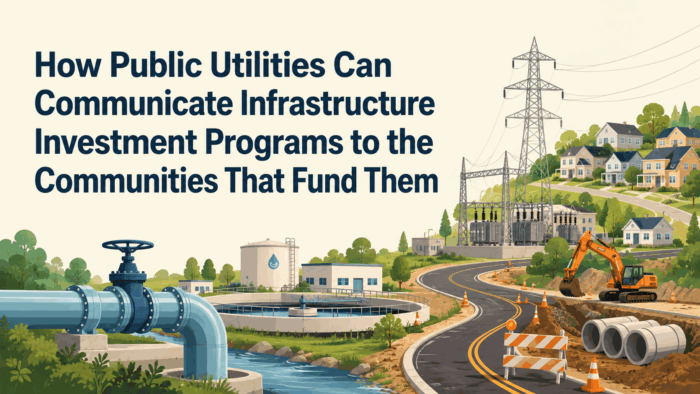
How Public Utilities Can Communicate Infrastructure Investment Programs to the Communities That Fund Them
 Infrastructure investment is the defining financial commitment of public utility governance, and it is also one of the least understood by the communities that fund it. Capital improvement programs representing hundreds of millions of dollars can proceed over years and even decades with minimal public comprehension of what is being built, why it is being built, or how the investment connects to the reliability and safety of the services that ratepayers and taxpayers depend on every day. This is not a problem caused by public disinterest. It is a problem caused by communication that was never designed to produce understanding in the first place.
The invisibility of infrastructure investment is not accidental. It reflects the nature of the work itself. Pipes are underground. Pump stations are enclosed in utilitarian structures with no interpretive signage. Treatment plants are operational environments, not public ones. The physical infrastructure that underlies every modern utility service is, almost by design, removed from public view. And the financial structures that fund its replacement and expansion, capital budgets, rate structures, bond programs, and regulatory compliance schedules, are technical enough to be opaque to any audience that has not spent years working inside them.
What makes this problem consequential is not the information gap itself but what fills it. When communities lack a coherent understanding of why infrastructure investment is necessary and what it costs, they fill that gap with skepticism. Rate increases seem arbitrary. Construction disruptions seem avoidable. Long project timelines seem like evidence of mismanagement. The absence of public understanding does not produce public neutrality. It produces public opposition grounded in the only information available, which is incomplete, episodic, and rarely contextualized.
Building a sustained infrastructure investment narrative requires a different approach to communication than most utilities currently practice. It requires treating public understanding as a strategic objective, not just a regulatory obligation, and investing in the communication systems and disciplines that produce it over time. This article examines how public utilities can build, maintain, and adapt infrastructure investment communication programs that generate the public confidence their capital programs depend on.
The Strategic Case for Infrastructure Communication Investment
Infrastructure communication is not a peripheral function of utility management. It is a strategic input into the financial and political conditions that determine whether capital programs can proceed. Utilities that cannot maintain public and political support for their investment programs face real consequences: rate cases challenged, bond programs contested, construction projects delayed by community opposition, and capital plans deferred to future ratepayer generations who will pay more for the same infrastructure because it deteriorated further in the interim.
The strategic case for investing in infrastructure communication rests on a straightforward observation. Capital programs that communities understand are more likely to proceed than those they do not. A utility that has established a clear public narrative around the condition of its infrastructure, the necessity of replacement, and the connection between capital investment and service reliability has built the political and social license that its capital program requires. A utility that has not built that narrative must establish it under pressure, in the middle of a rate case or a construction project dispute, when the conditions for effective communication are worst.
This means that infrastructure communication investment should be understood as part of the capital program itself, not as an optional add-on. The cost of communicating a major capital program to the public is small relative to the cost of that program failing to proceed because of opposition that better communication could have prevented. Utilities that account for communication as a capital program input, planning it as carefully as they plan the engineering, procurement, and construction elements, are making a rational investment in the conditions of success.
What Public Understanding Actually Requires
Public understanding of infrastructure investment does not require technical sophistication. It requires a grasp of a relatively small set of ideas that can be communicated clearly and consistently over time. Ratepayers and community members need to understand that infrastructure ages and eventually requires replacement or rehabilitation, that deferred replacement typically costs more over time, that the cost of replacement is funded through rates or bonds that ratepayers ultimately bear, and that the agency managing the infrastructure is doing so according to a plan that prioritizes the investments with the highest consequence for service reliability and public safety.
From Fragmentation to Coordination: Communication Strategies for Councils of Governments, Metropolitan Planning Organizations, and Regional Planning Agencies
This case study is part of SCG’s series on communication for councils of governments, metropolitan planning organizations, and regional planning agencies. To learn more and to see the parent article, which links to other content just like this, click the button below.
Framing the Capital Program for Public Audiences
From Technical Plans to Community Stories
Capital improvement programs are produced for technical and regulatory audiences. They contain engineering specifications, cost estimates, procurement schedules, regulatory compliance milestones, and asset management data that are essential for program management but inaccessible to most community members. The communication challenge is not to make capital programs less technical. It is to translate the essential logic of a capital program into a form that community members can understand and evaluate without the background that engineers, financial analysts, and regulatory staff bring to the same document.
The most effective approach to this translation is narrative framing. A capital program understood as a sequence of technical tasks is opaque. The same program understood as a story about community infrastructure, its condition, its role in daily life, and the decisions required to sustain it, is substantially more accessible. The framing begins with the infrastructure itself, not the program. What does the infrastructure do for the community. How long has it been in service. What happens when it fails. What does sustained investment allow the community to avoid. These are the questions that connect the capital program to the community’s experience and make the investment comprehensible without requiring technical knowledge.
Community stories within the capital program provide additional texture. A water main replacement project becomes more understandable when connected to the service disruptions that aging mains cause, the streets that have been repaired repeatedly because of main breaks, and the neighborhoods that have experienced reduced water pressure because aging infrastructure cannot maintain system performance. These specific, localized stories are more compelling than program-level statistics and more likely to generate the public recognition that sustains political support for capital investment over time.
The Multi-Year Communication Challenge
Most significant capital programs extend over multiple years, and the communication challenge is correspondingly extended. Public attention does not sustain itself uniformly over the life of a capital program. It peaks at announcement, often spikes during phases of visible construction activity that affects communities, and tends to decline during procurement, design, and other pre-construction phases that produce little visible change. Utilities that manage communication only during peaks of public attention leave long gaps in the public understanding of where the program stands and whether it is proceeding as planned.
A sustained communication discipline for multi-year programs requires a calendar-based approach that ensures meaningful updates reach the public at regular intervals regardless of whether there is a visible construction milestone to announce. Quarterly updates that explain what has been completed, what is underway, and what is planned for the coming period provide the continuity that multi-year programs require. Annual summaries that connect the year’s investment to the overall program trajectory give the public a way to track cumulative progress over time.
The content of these updates needs to evolve to remain useful. An update that restates the same program facts quarter after quarter does not build understanding. It generates the impression that nothing is happening. Updates that identify specific milestones completed, specific challenges encountered and addressed, specific infrastructure replaced and the service consequence of that replacement, demonstrate genuine program activity and give the public new information to integrate into its understanding of the program’s progress.
Communication Channels for Infrastructure Investment Programs
Effective infrastructure investment communication reaches different segments of the community through different channels at different points in the program lifecycle. No single channel reaches every ratepayer, and utilities that rely on a single communication channel for their entire investment narrative are leaving large portions of their community uninformed. A multi-channel approach that combines digital communication, traditional outreach, governing board engagement, and community partnership recognizes that different ratepayers access information differently and that a comprehensive communication strategy must work across that diversity.
Digital channels, including project websites, email notification programs, and social media, reach ratepayers who actively seek information about utility operations and who tend to be more engaged in rate and governance questions. These channels are well suited for detailed program information, progress updates, financial reporting, and links to technical materials for ratepayers who want to explore the program in depth. They are less effective for reaching ratepayers who do not actively seek utility information, who may be lower-income, less digitally connected, or simply less engaged with utility governance.
Traditional outreach channels, including bill inserts, mailed notices, public meetings, and community presentations, reach broader and more diverse audiences than digital channels alone. Bill inserts are particularly valuable because they reach every ratepayer, including those who would never visit a utility website or follow a utility on social media. The constraint is space and frequency. Bill inserts must communicate efficiently and direct ratepayers to additional resources for those who want more information. Public meetings and community presentations allow for dialogue and question-and-answer, which is valuable for addressing specific community concerns that written materials cannot fully anticipate.
Governing Board Communication as Public Communication
Governing board meetings are an underutilized communication channel for infrastructure investment programs. Board meetings that include substantive public-facing presentations on capital program status, infrastructure condition, and investment rationale create a public record of accountability and transparency that supports the broader communication program. Board members who ask informed questions about program progress, cost performance, and schedule adherence signal to the public that the investment is subject to ongoing governance scrutiny, not merely administrative execution.
The design of board presentations for capital programs should reflect their dual purpose: serving the board’s governance needs and serving the broader public’s comprehension needs. Presentations that are designed exclusively for a technically sophisticated board audience may be impenetrable to community members attending the meeting or watching a recording. Presentations that include plain-language summaries of program status, cost performance, and schedule alongside the technical details serve both audiences without sacrificing substance.
Board meeting minutes and recordings that are easily accessible to the public extend the reach of board-level infrastructure communication beyond those who attend. A community member who wants to understand the status of a capital program should be able to find that information in board materials without needing to contact utility staff or navigate technical document repositories. Accessibility of board materials is itself a form of infrastructure communication transparency.
Community Partnership as a Communication Channel
Community organizations, neighborhood associations, business groups, and civic organizations are communication intermediaries that utilities often underutilize for infrastructure investment communication. These organizations have established relationships with specific community segments, including low-income households, non-English-speaking communities, small business owners, and other groups that standard utility communication channels do not reach effectively. Partnership with these organizations allows utilities to extend their infrastructure investment narrative into communities where it would otherwise not penetrate.
Partnership communication requires investment in the relationship before the communication is needed. Organizations that are asked to help explain a utility’s capital program to their members are more effective when they understand the program well, when they have been engaged as partners rather than simply as distribution channels, and when the communication materials they are being asked to share are appropriate for their audience in terms of language, format, and level of technical detail. One-size-fits-all communication materials designed for a general utility audience may not work in specific community contexts without adaptation.
Communicating When Programs Experience Delays or Cost Overruns
Capital programs do not always proceed as planned. Delays caused by design changes, procurement challenges, site conditions, permitting requirements, or other factors are common in complex infrastructure programs. Cost overruns driven by material price increases, scope changes, or unforeseen conditions are also not uncommon. How a utility communicates these developments has a significant effect on public confidence in the program and in the utility’s management of it.
The instinct when a program experiences a delay or cost overrun is often to minimize the communication around it, to mention it in technical reports without giving it prominent public attention. This instinct is understandable but counterproductive. Ratepayers and elected officials who discover that a capital program has experienced significant delays or cost increases through news coverage, advocacy group reports, or regulatory filings rather than from the utility itself are likely to interpret the discovery as evidence that the utility is not forthcoming about program performance. The credibility cost of discovered concealment exceeds the credibility cost of proactive disclosure.
Proactive disclosure of program delays and cost changes should explain the cause of the change, the consequence for the overall program, and what the utility is doing to address it. A delay caused by an unforeseen site condition that required design modification is a different situation from a delay caused by inadequate project management, and the communication should reflect that difference. An honest explanation of a genuine challenge, accompanied by a clear account of the corrective steps being taken, is more likely to maintain public confidence than one that presents the delay without context or that attributes it entirely to factors beyond the utility’s control without acknowledging any management dimension.
Distinguishing Program Evolution From Program Failure
Capital programs that evolve over time in response to new information, changing regulatory requirements, or updated infrastructure assessments are not failing programs. They are programs that are being managed responsibly in a dynamic environment. The communication challenge is to help the public understand this distinction, because from the outside, a program that has changed its scope, timeline, or cost profile may look like a program that is not being managed well.
Utilities that have established a strong infrastructure investment narrative before program changes occur are better positioned to contextualize those changes when they happen. A ratepayer who understands that capital programs involve complex technical assessments, procurement processes, and site conditions that are not fully known at the outset of a project is better equipped to receive a scope change as a reasonable programmatic response than one who has been told that the program will deliver a specific set of outcomes on a fixed schedule and cost.
The communication surrounding program evolution should emphasize continuity of purpose even when the specifics of execution change. The goal of the capital program, improving infrastructure reliability and ensuring regulatory compliance, does not change because a specific project timeline was extended or a cost estimate was revised. Communication that maintains that continuity of purpose while being transparent about the changes in execution demonstrates that the utility is managing the program’s underlying objectives even when the path to those objectives has been adjusted.
Connecting Infrastructure Investment to Service Reliability
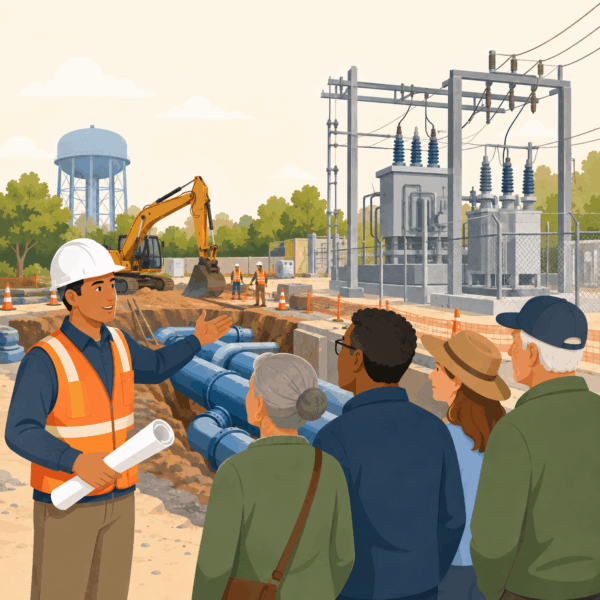 The most compelling case for infrastructure investment is not financial or regulatory. It is experiential. Ratepayers who have experienced service disruptions, water quality events, power outages, or other direct consequences of infrastructure failure understand intuitively why investment in that infrastructure is necessary. Utilities that connect their capital investment programs to the service outcomes those programs produce create the most durable form of public support, because it is grounded in ratepayer experience rather than in technical arguments that ratepayers must take on faith.
This connection requires communication that tracks the relationship between infrastructure investment and service performance over time. When a capital program completes a phase, the communication should not simply announce what was built. It should explain what service improvement resulted from the investment. A water main replacement program that communicates the reduction in main break frequency before and after rehabilitation demonstrates value in terms that ratepayers can evaluate directly. An energy infrastructure upgrade that communicates improvements in outage frequency or restoration time connects the investment to the service experience that ratepayers care about most.
Service performance data that is communicated regularly and consistently, rather than only when programs are complete, builds the cumulative public understanding that infrastructure investment requires. Annual reports that show the relationship between capital investment and infrastructure performance indicators, presented in plain language with clear visual organization, give ratepayers and elected officials a way to assess whether the investment is producing the intended results. This ongoing accountability is the most effective long-term argument for continued capital investment, because it demonstrates rather than merely asserts that the investment is working.
Avoiding the Trap of Infrastructure Invisibility
One of the persistent challenges in infrastructure investment communication is that successful investment tends to be invisible. A water main that was replaced before it failed does not generate news coverage or community attention. A pump station that was upgraded before it failed does not produce a service disruption for ratepayers to notice and respond to. The absence of failure, which is the primary objective of proactive capital investment, is not an experience that ratepayers are likely to attribute to the investment that prevented it.
Utilities that wait for infrastructure failures to generate public attention before explaining the importance of capital investment are operating on a reactive communication model that is fundamentally at odds with the proactive investment strategy they are trying to fund. The communication discipline required to make invisible success visible, to explain what was prevented and how, is exactly the discipline that proactive capital investment communication demands.
Making invisible success visible requires specific and deliberate communication choices. A utility that communicates the number of main replacements completed in a year alongside the projected service disruptions those replacements are expected to prevent gives ratepayers a way to value the investment in terms they would otherwise never encounter. A utility that explains the relationship between completed infrastructure upgrades and the absence of the service failures that aging infrastructure would otherwise have produced creates the counterfactual awareness that makes proactive investment comprehensible.
How Infrastructure Investment Communication Compares With Other Agency Communication Challenges
Infrastructure investment communication occupies a distinct position among public agency communication challenges because of the scale and duration of the financial commitments involved and the combination of technical complexity and personal financial impact that it presents to the public. Other public agency communication contexts involve significant public interest, but few involve the combination of long timelines, large capital commitments, captive audiences, and direct financial impact through rates that define utility infrastructure communication.
Transportation agencies face capital communication challenges that share some characteristics with utility infrastructure programs, including multi-year project timelines, complex construction logistics, and significant community disruption. But transportation capital programs are typically funded through general revenues, grants, and bonds backed by public credit rather than by direct rate charges to a captive customer base. The political dynamics of transportation capital communication are different from those of utility rate-funded infrastructure programs, and the personal financial stake of individual community members is less direct.
Environmental regulatory agencies communicate about compliance investments and cleanup programs that also involve significant public interest and complex technical content. But those programs are typically the obligation of regulated parties rather than the investment decision of a public utility managing a ratepayer-funded system. The accountability relationship is different, and the communication challenge is correspondingly different. Utility infrastructure investment communication combines the technical complexity of environmental compliance communication with the personal financial stakes of utility rate communication in a way that does not have a precise analog in other public agency communication contexts.
Tying It All Together
Infrastructure investment communication is not a side function of utility operations. It is the mechanism by which communities develop the understanding and confidence that large-scale capital programs require to proceed. Utilities that build strong communication programs for their capital investments are not doing so to make ratepayers feel good about paying rates. They are doing so because capital programs that lack public understanding are vulnerable to political opposition, rate case challenges, and the kind of community friction that delays projects and increases their cost.
The investment in communication that a major capital program requires is small relative to the capital program itself, but it is consequential. A major infrastructure program that is well communicated will proceed more smoothly, face less opposition, and be more likely to deliver on its objectives than one that is not. The communication is not separate from the capital program. It is part of the conditions of success.
Utilities that commit to sustained, honest, and specific infrastructure investment communication build something that is more durable than any single capital project: a public relationship grounded in demonstrated accountability and followed-through commitments. That relationship is the most valuable long-term asset a utility can hold, because it is the foundation on which future rate cases, future capital programs, and future community partnerships are built.
Strategic Communication Support for Infrastructure Investment Programs
 Capital investment programs present communication challenges that are genuinely difficult for utilities to manage with internal resources alone. The combination of technical complexity, long timelines, political sensitivity, and the need for sustained multi-channel engagement exceeds the capacity of most utility communication teams, which are typically sized for routine operational communication rather than for the intensive engagement that major capital programs require.
Stegmeier Consulting Group (SCG) provides specialized communication support for public utilities managing infrastructure investment programs at every stage of the capital cycle. This includes developing the investment narrative that builds community understanding before a capital program is launched, designing public-facing materials that translate technical program information into accessible community communication, creating engagement strategies that sustain public understanding through multi-year programs, and establishing accountability communication systems that connect program performance to the community’s experience of service reliability.
SCG’s approach to infrastructure investment communication is built on the understanding that the most effective capital program communication is not a series of announcements. It is a sustained narrative that evolves with the program, reflects the program’s actual progress and challenges honestly, and demonstrates the utility’s commitment to accountability as well as execution. This kind of communication requires expertise, consistency, and the ability to translate complex technical and financial information into clear and credible public language.
Utilities that are managing major capital programs, preparing for rate cases that will fund significant infrastructure investment, or seeking to build the community understanding that sustained investment requires are the ideal partners for this work. SCG brings the communication expertise and public agency experience needed to design and sustain the investment narrative that capital programs depend on.
Future Trends in Infrastructure Investment Communication
The expectations that communities and elected officials bring to infrastructure investment communication are evolving, driven by broader changes in digital communication, data transparency, and public accountability expectations. Utilities that understand these trends and adapt their communication programs accordingly will be better positioned to maintain public confidence through a period of growing infrastructure investment pressure.
Data transparency is the most significant emerging expectation in infrastructure investment communication. Ratepayers and elected officials increasingly expect access to program performance data, cost tracking information, and schedule adherence metrics that allow them to evaluate capital program management without relying exclusively on utility-provided summaries. Utilities that develop accessible online dashboards showing capital program status, investment commitments, and performance against those commitments create a level of transparency that builds confidence precisely because it gives the public the tools to hold the utility accountable.
Visual communication is becoming more important as communities expect infrastructure investment information to be accessible without extensive reading. Project maps that show where work has been completed, where it is underway, and where it is planned give ratepayers a geographic frame for understanding capital programs that text-based communications cannot provide. Before-and-after documentation of infrastructure conditions, presented visually with clear explanations of what changed and why, makes the case for capital investment in terms that are immediately comprehensible to non-technical audiences.
Climate resilience is also reshaping the infrastructure investment communication landscape. Capital programs that include climate adaptation elements, hardening infrastructure against flooding, extreme heat, or other climate impacts, require communication that explains not only what is being built but why the climate context makes it necessary. Communities that have experienced climate-related infrastructure failures are often more receptive to this communication than those where the connection between climate risk and infrastructure investment is still abstract. Utilities that build climate resilience into their investment narratives now are developing communication competencies that will become increasingly important as climate-related infrastructure demands intensify.
Conclusion
Infrastructure investment communication succeeds when it transforms the capital program from an internal technical process into a public story about community infrastructure, long-term system health, and the financial commitments that a well-functioning utility requires its community to sustain. That transformation requires sustained effort, clear communication choices, and the discipline to maintain an investment narrative through the full multi-year lifecycle of a capital program rather than treating communication as a launch event and a completion announcement.
Utilities that make that investment in communication find that their capital programs face less opposition, their rate cases are more manageable, and their communities are better equipped to understand and support the ongoing infrastructure commitments that reliable public utility service requires. The communication is not a cost of the capital program. It is an enabler of it.
Public utilities that communicate their infrastructure investments honestly, consistently, and with genuine respect for the public’s capacity to understand complex information are demonstrating something important about how they regard the communities they serve. They are saying that the public has a right to understand what is being built with its money, why it is being built, and whether it is delivering the service improvements it was funded to produce. That demonstration of respect is, in the end, the most durable foundation for the public confidence that capital-intensive public utilities require.
Stegmeier Consulting Group’s Strategic Approach to Communication Systems
Build infrastructure investment communication around sustained public narrative, honest accountability, and community-level translation of capital program purpose and performance.
Public utilities investing in major capital programs need communication systems that can sustain public understanding across multi-year program timelines, political transitions, and the inevitable program changes that complex infrastructure investment involves. Stegmeier Consulting Group (SCG) helps utilities design and maintain those systems, from investment narrative development through capital program launch, implementation, and accountability communication.
Use the form below to connect with our team and explore how strategic communication support can strengthen your capital program’s public foundation.