
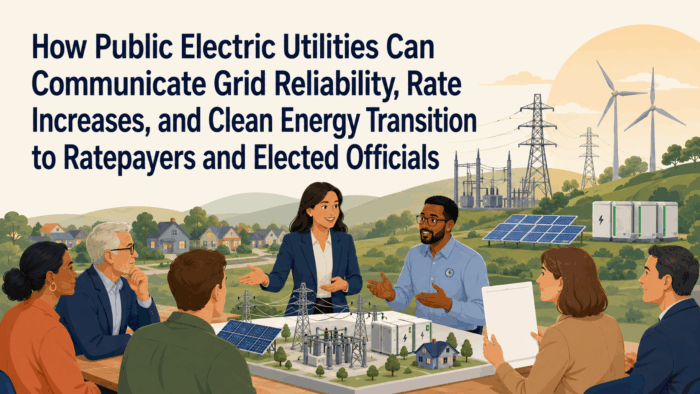
How Public Electric Utilities Can Communicate Grid Reliability, Rate Increases, and Clean Energy Transition to Ratepayers and Elected Officials
Publicly owned electric utilities operate at the intersection of infrastructure management, environmental policy, and energy economics in ways that no other utility type does, and their communication challenges reflect that complexity. A publicly owned electric utility may simultaneously be managing the outage communication demands of a major storm event, navigating a rate case driven by grid modernization investment, communicating the rollout of smart meters to ratepayers who have concerns about data privacy, explaining a clean energy mandate to elected officials who have constituents with varying views on climate policy, and serving customers whose medical equipment depends on reliable power with a level of care that standard outage communication does not adequately address. No other utility type faces this combination of communication challenges simultaneously, and none is served by a generic utility communication framework.
The publicly owned dimension of these utilities creates additional communication obligations that investor-owned utilities do not face to the same degree. A publicly owned electric utility is accountable not only to a regulatory commission but to the elected officials and community members who are its ultimate governors, and the communication that sustains that accountability relationship requires a degree of transparency, accessibility, and genuine community engagement that the commercial context of investor-owned utilities does not demand. A cooperative, a municipal utility, or a public power district whose ratepayers are also its member-owners has a governance relationship with its ratepayers that is qualitatively different from a commercial service relationship, and the communication that sustains that governance relationship must reflect the participatory accountability it entails.
Clean energy transition communication is the dimension of public electric utility communication that is most politically contested and most consequential for the long-term governance environment in which these utilities operate. The transition from fossil-fuel-based generation to renewable sources, which is required by state or federal policy mandates in many jurisdictions and which is driven by the economics of rapidly declining renewable energy costs in others, generates community conversations about rate impacts, energy reliability, local jobs, and environmental values that divide ratepayers along lines that do not map neatly onto standard utility communication categories. A public electric utility that communicates the clean energy transition only as a technical and regulatory program, without engaging the political and values-based dimensions of the community conversation about it, is leaving the most consequential communication challenge in its program unaddressed.
This article examines the unique communication demands of publicly owned electric utilities, covering outage communication, rate case proceedings under public utility commission oversight, grid modernization and smart meter rollouts, clean energy mandate communication, demand response programs, extreme weather preparedness, and the specific needs of medical baseline and life-support-dependent customers.
Outage Communication
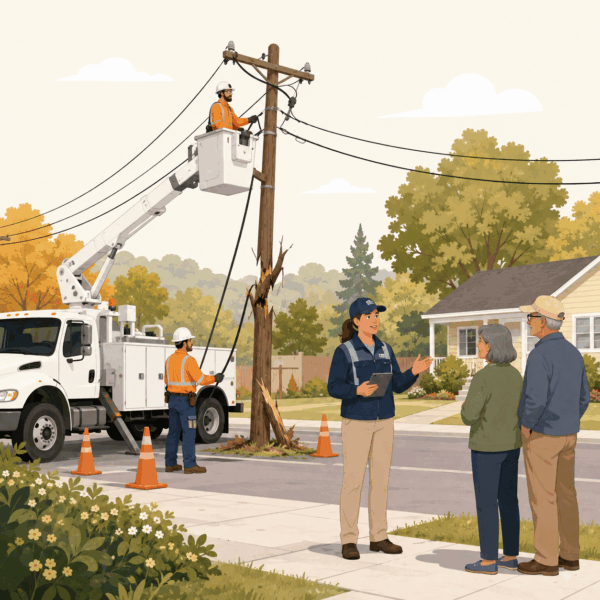 Electric outage communication is the utility communication moment that receives the most public attention and that most directly tests the ratepayer’s confidence in the utility’s operational competence and communication responsiveness. A utility that communicates clearly, rapidly, and accurately during an outage, that provides specific restoration timelines, that updates those timelines honestly when the restoration takes longer than projected, and that explains the cause of the outage in terms that ratepayers can understand, is demonstrating operational and communication competence simultaneously. A utility that is slow to communicate, vague about restoration timelines, and silent about the causes of extended outages, is failing both tests simultaneously.
The first outage notification is the most important communication event of any significant outage, because it establishes the information framework within which all subsequent communications will be received. A first notification that arrives within thirty minutes of a major outage beginning, that accurately characterizes what is known about the outage cause and extent, and that provides a realistic restoration timeline range with a specific commitment to the next update, creates a communication relationship with affected ratepayers that is fundamentally more constructive than one that arrives hours after the outage begins with vague assurances that crews are working on the problem.
Outage map communication, which provides ratepayers with a real-time geographic view of current outages, affected customer counts, and estimated restoration times by affected area, has become the most used outage communication tool for ratepayers who have internet access, and it is among the most demanding to maintain accurately during major events when the outage data is changing rapidly and the operations team managing the restoration is simultaneously managing the communication. Utilities that maintain accurate, current outage maps during major events, that update restoration estimates as the restoration progresses, and that communicate explicitly when restoration estimates cannot be provided with meaningful precision, build the outage map credibility that ratepayers depend on during extended events.
Restoration priority communication, which explains the sequence in which outage restoration work will proceed and the criteria that determine restoration priority, addresses the ratepayer equity question that extended outages always generate. Ratepayers who experience extended outages while neighboring areas are restored more quickly have legitimate questions about why their restoration is taking longer, and those questions deserve honest answers about the operational factors, including transmission line accessibility, circuit configuration, crew deployment logistics, and infrastructure condition, that affect restoration sequence. Communicating restoration priority criteria proactively, before individual ratepayers call to ask why their neighborhood has not been restored, prevents the frustration that unaddressed restoration equity concerns generate.
From Fragmentation to Coordination: Communication Strategies for Councils of Governments, Metropolitan Planning Organizations, and Regional Planning Agencies
This case study is part of SCG’s series on communication for councils of governments, metropolitan planning organizations, and regional planning agencies. To learn more and to see the parent article, which links to other content just like this, click the button below.
Medical Baseline and Life-Support Customer Communication
Medical baseline and life-support-dependent customers represent a specific ratepayer population whose relationship with the electric utility is unlike that of any other customer: for them, a power outage is not an inconvenience but a medical emergency. A ratepayer whose home oxygen concentrator, dialysis machine, electric wheelchair, or other life-sustaining equipment depends on uninterrupted power has a safety stake in outage communication that standard outage notification programs do not adequately serve.
Medical baseline program communication must ensure that every eligible customer is aware of the program, enrolled in it, and receiving the enhanced outage notification and priority restoration services that the program provides. Enrollment in medical baseline programs is typically voluntary and requires customer disclosure of the medical equipment dependency, and the communication that drives enrollment must reach the eligible population through channels and in terms that motivate enrollment without creating barriers of medical privacy concern or administrative complexity that prevent eligible customers from accessing the protection they qualify for.
Advance outage notification for medical baseline customers, which provides enrolled customers with advance warning of planned outages before general public notification and extends notification windows beyond what standard ratepayer communication provides, is the most direct safety service that medical baseline program communication can provide. A customer who receives forty-eight hours notice of a planned maintenance outage, rather than the standard twenty-four hours, has more time to arrange backup power, schedule medical appointments around the outage, or make other arrangements that the outage requires. Communicating the advance notification benefit clearly in program enrollment materials, and delivering it consistently with every planned outage, demonstrates the utility’s genuine commitment to the safety of its most vulnerable customers.
Life safety coordination with local emergency services, which connects the utility’s medical baseline customer registry with local fire departments, emergency medical services, and public health agencies that may need to conduct wellness checks during extended outages, is the community safety partnership that extends the utility’s care for life-support-dependent customers beyond what utility communication alone can provide. Communication about this coordination, including how it works, what triggers a wellness check, and how medical baseline customers can request emergency support during extended outages, provides life-support-dependent customers with the safety assurance that their registration in the medical baseline program activates a broader community support system during outage events.
Rate Case Communication Under PUC Oversight
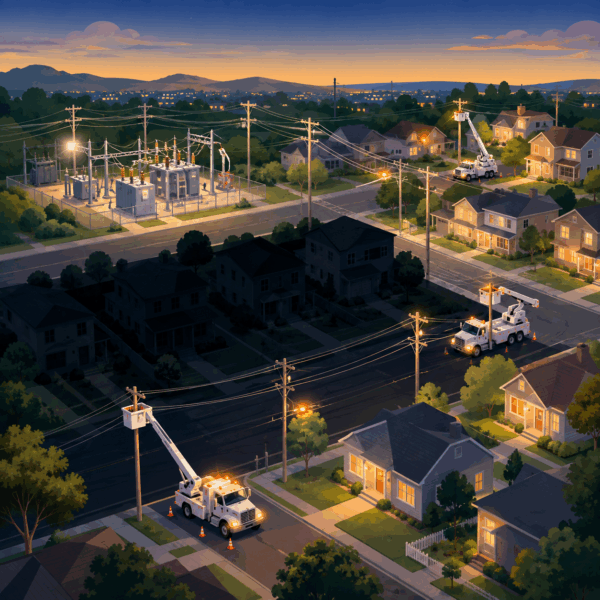 Public utility commission rate cases for publicly owned electric utilities involve a regulatory accountability framework that private utility rate cases do not typically require, and the communication that accompanies those rate cases must navigate both the public commission process and the utility’s own community governance accountability. A publicly owned electric utility whose rate case is reviewed by a public utility commission must communicate with its ratepayers about both the rate increase the utility is proposing and the commission process through which that proposal will be evaluated, approved, or modified. This dual accountability, to the ratepayers who are the ultimate community governors of the utility and to the regulatory commission that oversees its rate-setting, creates a communication complexity that most investor-owned utility communication frameworks do not account for.
Commission proceeding communication should explain the regulatory process in terms that ratepayers can navigate if they choose to participate. Public utility commission proceedings have defined opportunities for ratepayer participation, including public comment periods, intervener status, and public hearing testimony, that most ratepayers do not know exist and that most utility rate case communication does not proactively communicate. A utility that actively informs its ratepayers about their participation opportunities in the commission proceeding, explains what each type of participation involves, and provides the information needed to participate effectively, is treating its governance accountability to ratepayers as a genuine commitment rather than as a procedural formality.
Intervenor communication, where ratepayer advocacy organizations, consumer groups, and other parties have formally entered the rate case proceeding as intervenors, creates specific communication challenges for the utility that are analogous to those of contested rate proceedings for other utility types. Intervenors who are raising legitimate ratepayer concerns in the proceeding deserve honest engagement with the substantive issues they are raising, not dismissive characterizations of their participation as obstructionist. Communication that acknowledges the concerns intervenors have raised, explains how those concerns have been addressed in the utility’s proposal or why they were not, and treats the intervenors as legitimate accountability partners in the rate case process, builds the proceeding credibility that adversarial engagement does not.
Smart Meter and Grid Modernization Communication
Smart meter rollouts are among the most challenging technology communication programs that electric utilities undertake because they require customers to accept a change in the physical infrastructure of their service that many did not ask for and some actively oppose, for benefits that are primarily realized at the system level rather than in the individual customer’s bill or service experience. The ratepayer who is comfortable with their existing meter, who is concerned about radio frequency emissions from wireless meters, who is worried about how their usage data will be used, and who is not convinced that the utility’s reasons for changing the meter justify the disruption, has a set of concerns that generic smart meter communication rarely addresses with the specificity and honesty those concerns deserve.
Data privacy communication for smart meter programs is the concern that generates the most sustained opposition to smart meter rollouts, and it is the concern that most utility smart meter communication addresses least effectively. The specific data that smart meters collect, how frequently it is collected, who has access to it, how long it is retained, under what legal circumstances it can be disclosed to third parties, and what specific protections prevent unauthorized access, are all questions that data-concerned ratepayers have a right to have answered specifically and honestly. General assurances about data security without the specific policy commitments and technical safeguards that back those assurances are less credible and less effective at addressing data privacy concerns than communication that engages the specific questions directly.
Opt-out program communication for smart meter rollouts, where opt-out options are available to ratepayers who decline smart meter installation, deserves the same proactive communication that the standard installation program receives. A utility that communicates the smart meter program widely while making opt-out information difficult to find or understand is not providing genuine opt-out access. Proactive communication about opt-out options, including what the opt-out involves, what the cost implications of opting out are, and how to exercise the opt-out option, is the communication standard that genuine opt-out access requires.
Clean Energy Transition Communication
Clean energy mandate communication is the most politically contested communication challenge in publicly owned electric utility management because it requires the utility to explain and defend an energy policy direction that may be endorsed or contested by different segments of its ratepayer community for reasons that extend well beyond the utility’s technical and financial analysis. A clean energy transition that is required by a state renewable portfolio standard, driven by the economics of declining renewable generation costs, or mandated by a local government climate commitment, is a transition that the utility is implementing in a specific community context whose political character determines how the communication will be received.
Rate impact communication for clean energy investments must be honest about the specific cost implications of the transition for current ratepayers, including both the near-term rate adjustments that clean energy capital investment requires and the long-term rate trajectory that the transition is expected to produce as fossil fuel cost exposure is replaced by the fixed cost of renewable generation. A utility that communicates only the favorable long-term rate projection of the clean energy transition without the near-term rate adjustments it requires, or that communicates only the near-term costs without the long-term rate stability benefit, is providing incomplete information about a decision whose full cost-benefit picture ratepayers need to evaluate it honestly.
Reliability communication for clean energy transitions addresses the ratepayer concern that renewable generation, which is variable rather than dispatchable, will produce less reliable service than the fossil fuel generation it replaces. This concern is technically substantive and deserves specific, honest communication about how the utility is managing the reliability implications of the transition, including the battery storage investments, transmission infrastructure upgrades, and grid management tools that maintain reliability as the generation portfolio changes. Communication that dismisses reliability concerns as misinformation, rather than engaging them with the specific technical and operational information that addresses them, is less effective and less honest than communication that treats the reliability question as a legitimate engineering challenge that the utility has analyzed and addressed.
Fossil fuel workforce transition communication addresses the specific concerns of workers in fossil fuel generation who face displacement as clean energy replaces the plants they operate. This is a community communication challenge that extends beyond the utility’s ratepayer communication into the labor and community development domains, and it requires partnership with workforce development agencies, labor unions, and economic development organizations whose communication relationships with affected workers are more direct than the utility’s. A utility that communicates about the clean energy transition without acknowledging the workforce transition challenge it creates in communities that have hosted fossil fuel generation is communicating about the transition incompletely in ways that those communities will recognize as dismissive of their legitimate concerns.
Demand Response Communication
Demand response programs, which compensate ratepayers for reducing or shifting their electricity consumption during periods of peak grid stress, are among the most communication-intensive utility programs because they require ratepayers to take specific, time-sensitive actions in response to utility signals that arrive with limited advance notice. The ratepayer who participates in a demand response program is making a commitment to modify their consumption behavior in exchange for a financial benefit, and the communication that supports that participation must explain clearly what the commitment involves, when and how the utility will communicate demand response events, what the ratepayer is expected to do in response, and how the financial benefit will be calculated and credited.
Event communication for demand response programs must be rapid, specific, and actionable in ways that most utility communication is not designed to be. A demand response event notification that arrives as an automated text message at 2 PM telling the ratepayer that a demand response event will begin at 4 PM and asking them to reduce consumption for the following three hours, provides the specific, time-sensitive behavioral guidance that the program requires. A notification that provides only a general alert that a demand response event is underway, without specifying what the ratepayer should do and for how long, is a communication that provides the notification without the behavioral guidance that makes it useful.
Performance feedback communication for demand response programs, which tells participating ratepayers how much they reduced their consumption during each event and what financial credit they have earned, closes the accountability loop that motivates continued participation. A ratepayer who receives a post-event report showing that their household reduced consumption by a specific percentage during the event, earning a specific dollar credit, has received the direct evidence of participation value that motivates the next event response. A ratepayer who participates in a demand response program without ever receiving information about their specific performance is participating in a program whose value is opaque, which reduces the motivation for sustained participation.
Extreme Weather Preparedness Communication
Extreme weather preparedness communication for electric utilities has become one of the most consequential communication programs as climate change increases the frequency and intensity of weather events that stress the grid and produce extended outages. The ratepayer who has been adequately prepared for an extended power outage, who has the supplies, the backup power arrangements, and the knowledge of local warming and cooling centers that a multi-day outage may require, is in a fundamentally better position than one who experiences the same outage without preparation. The communication investment that produces that preparedness is among the highest-value utility communication available.
Pre-storm communication for anticipated major weather events should be specific, timely, and actionable in ways that most utility weather communication is not. A pre-storm communication that tells ratepayers to expect possible extended outages and to prepare accordingly, without specifying what preparation involves, what the likely duration of outages is, and where community resources are available for those who cannot sustain an extended outage at home, is communication that creates awareness without enabling preparation. A pre-storm communication that provides a specific preparation checklist, identifies the locations and operating hours of community cooling or warming centers, explains how to register a medical need or request priority restoration, and commits to a specific communication timeline for storm progress and outage updates, provides the actionable information that genuine preparedness communication requires.
Post-storm restoration communication must address the equity dimension of restoration sequencing in ways that most post-storm utility communication does not. Extended outages that last for days affect lower-income households without backup power resources, households with medical equipment dependencies, and elderly residents living alone more severely than they affect households with greater resources and stronger social support networks. Communication that acknowledges these differential impacts, that directs the most severe cases to the community support resources and priority restoration mechanisms that address them, and that treats restoration equity as a genuine operational and communication priority rather than as a public relations concern, demonstrates the community care that public electric utilities’ governance obligations require.
How Public Electric Utility Communication Compares With Investor-Owned Utility Communication
Publicly owned electric utilities communicate within a governance accountability framework that investor-owned utilities do not share. A publicly owned utility whose ratepayers are its member-owners, or whose board is elected by or accountable to the ratepayers it serves, has a governance relationship with its ratepayers that creates communication obligations that commercial service relationships do not. The communication that serves this governance relationship is not primarily customer service communication, which aims at customer satisfaction within a commercial service context. It is civic communication, which aims at the informed participation of community members in the governance of a public institution that belongs to them.
The clean energy transition is the dimension of public electric utility communication that most dramatically illustrates the difference between the commercial and governance communication contexts. An investor-owned utility that is implementing a state-mandated clean energy transition is communicating about a regulatory compliance requirement that its shareholders are indifferent to beyond its financial implications. A publicly owned utility that is implementing the same transition is communicating about a policy direction that its member-owners may have voted on directly, that their elected board has adopted or resisted, and that reflects the collective energy values of the community in ways whose democratic legitimacy is subject to ongoing community debate. The communication that serves this governance context requires a level of genuine community engagement with values-based disagreement that regulatory compliance communication does not.
Ratepayer Communication for Grid Modernization
Grid modernization programs, which upgrade transmission and distribution infrastructure, install advanced monitoring and control systems, and deploy the grid management technology that renewable integration and distributed resource management require, are among the most significant capital investments that publicly owned electric utilities make, and among the investments whose community communication rationale is most difficult to convey. The modernized grid that the investment produces is more reliable, more resilient, and more capable of integrating renewable generation and distributed energy resources than the grid it replaces, but these benefits are largely invisible to ratepayers who experience the grid primarily through their bills and through outages.
Grid modernization communication must make the functional improvements that modernization produces tangible to ratepayers who will not directly observe the engineering changes that underlie them. The reduction in outage frequency and duration that advanced distribution automation produces, the improvement in outage detection speed that smart sensors enable, the increase in renewable energy integration that grid management systems allow, and the demand flexibility that smart meter and control systems provide, are all functional outcomes that grid modernization communication can describe in specific terms that ratepayers can connect to their own service experience. Making these connections, between the capital investment and the service outcome that ratepayers actually care about, is the communication work that transforms grid modernization from an engineering program into a community investment story.
Advanced metering infrastructure communication, which explains the specific capabilities that smart meters provide beyond the billing functions of existing meters, helps ratepayers understand the service value that smart meter investment produces alongside its cost. Real-time usage data that allows ratepayers to monitor and manage their consumption, outage detection capability that allows the utility to restore service faster by knowing immediately when a meter loses power, and the demand response capability that smart meters enable by allowing the utility to communicate directly with enrolled customer devices, are all specific service improvements that smart meter communication can describe in terms that ratepayers can evaluate against the cost of the installation.
Cyber security communication for grid modernization programs, which addresses ratepayer concerns about the vulnerabilities that networked grid technology creates, deserves specific and honest engagement rather than generic reassurance about the utility’s security practices. The specific security measures that protect smart meter networks, advanced distribution automation systems, and utility operational technology from cyber threats are technical details that most ratepayers will not need to understand at a technical level, but the commitment to specific security standards, independent security audits, and transparent incident reporting that the utility makes about its grid modernization security program is institutional communication that builds credibility with ratepayers who are concerned about grid security in ways that generic security assurances do not.
Vulnerable Customer Communication Programs
Publicly owned electric utilities serve customer populations that include a range of vulnerable individuals whose relationship with reliable electric service is more critical than that of the general ratepayer population. Beyond the medical baseline and life-support-dependent customers that most utility vulnerable customer programs address explicitly, electric utilities serve elderly customers who are at heightened risk during extreme temperature events when electric service is interrupted, customers with low incomes who must choose between paying their utility bill and meeting other basic needs, customers with cognitive or sensory disabilities who may not be able to navigate standard utility communication, and customers experiencing homelessness or housing instability who may not have consistent billing addresses or communication channel access.
Elderly customer communication programs that recognize the specific communication needs and safety risks of older ratepayers, including higher rates of disconnection risk from fixed income and cognitive changes that make bill management difficult, higher heat and cold vulnerability during service outages, and more limited digital access that makes digital-only communication inadequate, are an investment in the equity of electric utility service that publicly owned utilities have particular governance obligations to make. Direct mail communication that is designed for readability by older adults, telephone customer service that is specifically staffed for patient, clear communication with cognitively challenged callers, and weatherization and efficiency program outreach that reaches elderly customers through the community organizations that serve them, are the communication dimensions of elderly customer program design that most utilities have not systematically addressed.
Payment difficulty communication, which reaches customers showing payment difficulty indicators before their accounts reach disconnection risk rather than after, demonstrates the proactive customer care that publicly owned utility governance obligations require. A utility that identifies customers with late payment patterns, contacts them proactively with information about payment plan options and assistance program eligibility, and provides direct enrollment assistance for programs that reduce their burden, is treating payment difficulty as a service and equity issue rather than only as an accounts receivable management problem. The communication investment in proactive payment difficulty outreach is modest relative to the disconnection prevention and customer relationship value it produces.
Elected Official and Governance Communication
Publicly owned electric utilities have governance relationships with elected officials that investor-owned utilities do not, and the communication that sustains those governance relationships is both more demanding and more consequential than the stakeholder management communication that investor-owned utilities maintain with elected officials. For a municipal electric utility whose city council sets rate policy, or a rural electric cooperative whose board is directly elected by member-ratepayers, elected official communication is not stakeholder outreach but governance accountability, and the standards that apply to it are those of democratic governance rather than commercial stakeholder management.
Board and council education programs for publicly owned electric utilities, which systematically develop the technical and financial literacy of elected governing bodies in the specific infrastructure, regulatory, and operational dimensions of electric utility management, build the governance competence that informed rate and capital investment decisions require. A utility board that understands the relationship between grid infrastructure investment and service reliability, that knows how renewable portfolio standards are structured and what their cost implications are, and that can explain the basic economics of demand response programs to the ratepayers whose questions they will field, is a governing board that can exercise genuine oversight rather than simply ratifying the recommendations of utility management.
Transparency in governance communication for publicly owned electric utilities means providing governing bodies and the public with the financial and operational information they need to evaluate management performance and governance decisions, not only the information that management considers relevant to the decisions it is requesting approval for. A utility that provides its governing board with comprehensive financial performance data, operational reliability metrics, customer satisfaction indicators, and program outcome information on a regular basis, rather than only the specific analyses that support specific management recommendations, is enabling the genuine oversight function that governance accountability requires.
Community Engagement for Energy Policy Decisions
Publicly owned electric utilities that face significant energy policy decisions, including decisions about generation portfolio changes, infrastructure investment priorities, clean energy transition timing, and rate structure redesign, have governance obligations to engage their ratepayer communities in those decisions that investor-owned utilities, which make such decisions primarily through regulatory proceedings, do not face to the same degree. The community engagement that public power governance requires is not a public relations supplement to management decision-making but a genuine input into decisions that affect the community’s energy costs, reliability, environmental outcomes, and long-term infrastructure.
Community energy planning processes, which engage a representative range of community members in identifying their energy priorities, evaluating the trade-offs among different energy policy options, and developing the shared understanding of energy system constraints and opportunities that informed community choice requires, are the most demanding and most consequential form of public engagement that publicly owned electric utilities can undertake. These processes require communication investment that goes well beyond standard utility outreach: the facilitation expertise to manage diverse group processes, the technical education that allows non-experts to evaluate complex energy choices, and the honest presentation of trade-offs that does not predetermine the outcomes of community deliberation.
Energy equity community engagement that specifically reaches and includes low-income communities, communities of color, and other historically underserved populations in energy policy conversations, demonstrates the governance commitment that equitable public power management requires. The communities that are most affected by energy affordability challenges, by the reliability impacts of aging distribution infrastructure in their neighborhoods, and by the air quality consequences of fossil fuel generation in their areas, are often the communities that are least represented in standard utility public engagement processes. Designing community engagement that specifically reaches these communities, that addresses their specific energy concerns, and that incorporates their input into energy policy decisions, is the equity communication investment that public power governance accountability requires.
Communicating Electric Vehicle Charging Infrastructure
Electric vehicle charging infrastructure represents a new category of utility communication challenge that is growing rapidly as electric vehicle adoption accelerates in most service areas. The ratepayers who are considering or have already purchased electric vehicles need specific information about the charging options available to them, the rate schedules that apply to electric vehicle charging, the home installation requirements for Level 2 charging, and the utility programs that may support EV adoption through charging equipment rebates or special rate offers. This information need is both specific to EV owners and prospects, and rapidly evolving as the EV market, the utility’s own EV infrastructure programs, and the applicable rate structures all change frequently.
Public charging infrastructure communication, which explains the location, availability, and usage process for utility-operated or utility-supported public charging stations, serves both the utility’s public charging customers and the broader community’s awareness of the charging infrastructure available in the service area. Communication that is specific about the charging speeds available at specific locations, the payment methods accepted, the hours of operation, and the real-time availability status through a utility or third-party app, provides the practical information that EV drivers need to rely on public charging rather than only home charging. Utilities that maintain current, accurate, and accessible public charging location information are supporting the confidence in charging availability that EV adoption requires.
Grid impact communication for electric vehicle charging addresses the ratepayer concerns and the grid management realities of widespread EV charging on distribution infrastructure that was not designed for the additional load. A utility that communicates honestly about the distribution infrastructure upgrades that widespread EV adoption will require, the rate structures that provide incentives for off-peak charging that reduces peak demand impacts, and the demand response programs that allow the utility to manage EV charging timing in coordination with enrolled customers, is providing the full picture of EV grid integration that responsible utility communication requires. This communication serves both the ratepayers who are considering EV adoption and the ratepayers who are not but who will be affected by the grid investment that widespread adoption requires.
Income-qualified EV program communication reaches the lower-income ratepayers for whom the upfront cost of EV purchase and charging equipment installation is the primary barrier to adoption, and for whom the long-term operating cost savings of EV ownership are greatest. Utility programs that provide rebates for used EV purchases, subsidize Level 2 charger installation for income-qualified customers, and offer special low rates for off-peak charging by income-qualified EV owners, address the equity dimension of EV adoption in ways that standard EV communication programs do not. Communicating these income-qualified programs proactively, through the channels and in the terms that reach lower-income ratepayers, is the communication investment that makes EV program equity meaningful rather than aspirational.
Publicly Owned Utility Identity Communication
Publicly owned electric utilities have an institutional identity that investor-owned utilities do not share, and communicating that identity clearly and consistently is a communication investment that sustains the governance relationship that public ownership is meant to provide. The cooperative member-owner who understands that their electric cooperative is governed by an elected board of fellow members, that its rates are set to cover costs rather than to generate investor returns, and that its service territory and capital investment decisions reflect community priorities rather than shareholder interests, has an understanding of their utility relationship that motivates the civic engagement, the participation in governance, and the community investment support that public power governance depends on.
Community ownership communication that regularly reminds ratepayers of the ownership structure and governance model of their publicly owned utility, that explains what the member-owner or ratepayer-owner relationship means for how rates are set and how capital investment decisions are made, and that provides specific examples of how public ownership has produced outcomes that investor-owned utility governance would not have produced in the same community, builds the identity awareness that sustains public power’s governance legitimacy. A ratepayer who has been consistently reminded that they are a member-owner of their electric cooperative, not simply a customer of a commercial service provider, is a ratepayer who is more likely to engage with governance opportunities and to evaluate utility performance against governance standards rather than only commercial service standards.
The public power brand communication that positions publicly owned electric utilities as community institutions with governance accountability, environmental commitment, and service equity obligations that investor-owned utilities do not share, provides the institutional identity framework within which specific program communications, rate case communications, and clean energy transition communications are received. A ratepayer who understands the public power identity is more likely to evaluate a rate increase communication in the governance accountability framework it deserves than one who experiences the same rate increase as a commercial service price change. That interpretive frame, built through sustained public power identity communication, is the most fundamental communication investment that publicly owned electric utilities can make.
Tying It All Together
Public electric utility communication serves a community purpose that extends beyond the ratepayer information function that utility communication commonly performs. It is the communication that sustains the governance relationship between a community-owned energy institution and the community that owns it, that informs the democratic participation in energy policy that public ownership is supposed to enable, and that demonstrates the institutional accountability that distinguishes a public utility from a commercial service provider. The specific communication challenges of outage management, rate case transparency, clean energy transition, and life-support customer safety all connect to this larger governance communication purpose.
Utilities that communicate these challenges with the honesty, specificity, and genuine community engagement that the governance relationship requires find that they build the institutional trust that makes each successive communication challenge more manageable. The community that has received honest, specific outage communication through major events trusts the next outage communication more readily. The community that has received genuine engagement with clean energy transition concerns, rather than dismissal of those concerns as misinformation, is more likely to receive the utility’s clean energy investment rationale in a framework of institutional trust rather than institutional skepticism. Trust, built through sustained honest communication, is the most valuable institutional asset a public electric utility can hold, and communication is the primary tool for building it.
Strategic Communication Support for Public Electric Utilities
 Developing the outage communication systems, rate case communication strategies, smart meter engagement programs, clean energy transition communication frameworks, demand response program materials, extreme weather preparedness campaigns, and medical baseline customer communication programs that publicly owned electric utilities require is work that most utility communication teams cannot accomplish at the level of quality and specificity that each challenge requires. The range and complexity of communication challenges that public electric utilities face simultaneously makes external communication expertise a practical necessity rather than a luxury for utilities seeking to maintain the institutional trust that community ownership requires.
Stegmeier Consulting Group (SCG) works with publicly owned electric utilities to develop communication programs that address the full range of communication challenges specific to community-owned electric power, with particular attention to the governance accountability dimensions that distinguish public utility communication from commercial utility communication. This includes developing the outage communication systems that serve medical baseline customers and general ratepayers effectively, designing the rate case community engagement programs that treat ratepayers as governance partners rather than regulatory audiences, creating the clean energy transition communication that engages values-based disagreement honestly rather than avoiding it, and building the extreme weather preparedness campaigns that reduce the differential vulnerability of the community’s most exposed residents.
Future Trends in Public Electric Utility Communication
Distributed energy resources, including customer-owned solar installations, battery storage systems, and electric vehicles that can serve as grid assets, are fundamentally changing the communication relationship between public electric utilities and their ratepayers in ways that require new communication frameworks. A ratepayer who generates electricity from rooftop solar, who stores energy in a home battery system, and who charges an electric vehicle that the utility may draw on during peak demand events, is no longer simply a consumer of utility electricity. They are a participant in a community energy system whose communication needs and governance interests are more complex than those of a passive ratepayer receiving one-directional electricity service.
Grid resilience communication, which explains to ratepayers how the electric grid is designed and operated to maintain reliability through the increasingly severe weather events that climate change is producing, is becoming a critical component of public electric utility communication as communities experience more frequent and more extended outages from climate-related events. Communication that explains how transmission and distribution infrastructure is being hardened, what grid management capabilities are being developed to maintain reliability during extreme weather, and how community microgrids and distributed resources can maintain service in local areas when the broader grid is disrupted, prepares communities for the energy resilience challenges ahead in ways that reactive outage communication alone cannot.
The electrification of transportation, heating, and industrial processes, which is a central element of most jurisdictions’ climate strategies, is creating new ratepayer loads and new grid management challenges that public electric utilities must communicate about honestly. A community that is being encouraged to electrify its vehicles and heating systems as part of a climate commitment, without clear communication about the grid investment and rate implications of that electrification, is receiving incomplete information about the energy transition it is being asked to support. Communication that is honest about the infrastructure investment, the rate implications, and the operational challenges of large-scale electrification, alongside the environmental and long-term energy cost benefits, provides the full picture that communities need to make informed decisions about their energy future.
Conclusion
Public electric utilities face communication challenges that are unique in their combination of operational urgency, governance accountability, environmental policy complexity, and community values engagement. The outage that knocks out power to a thousand households, the rate case that will increase bills by fifteen percent to fund grid modernization, the clean energy mandate that is reshaping the generation portfolio over the next decade, and the life-support-dependent customer who cannot be without power for more than a few hours, are all communication challenges that the same utility communication program must be designed to address.
The public utilities that address these challenges most effectively are those that design their communication programs around the governance accountability framework that public ownership creates, treating ratepayers as the community members and democratic participants they are rather than as customers of a commercial service. That governance communication orientation produces the institutional trust that makes outage communication more credible, rate cases more manageable, clean energy transitions more navigable, and the care for the most vulnerable customers more genuine than commercially oriented communication can achieve.
Stegmeier Consulting Group’s Strategic Approach to Communication Systems
Build public electric utility communication around the governance accountability framework that community ownership requires, serving the full range of outage, rate, clean energy, and vulnerable customer communication challenges with the honesty and specificity that public trust demands.
Publicly owned electric utilities that communicate grid reliability, rate increases, and clean energy transition with the specificity, honesty, and genuine community engagement that governance accountability requires build the institutional trust that makes community-owned energy institutions worth having. Stegmeier Consulting Group (SCG) helps utilities develop the outage communication systems, rate case engagement frameworks, clean energy transition programs, and vulnerable customer communication protocols that serve the full range of public electric utility communication challenges.
Use the form below to connect with our team and explore how strategic communication support can strengthen your utility’s community communication program.