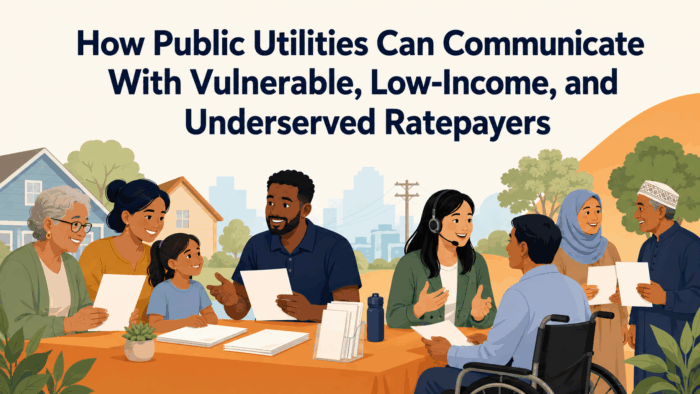
How Public Utilities Can Communicate With Vulnerable, Low-Income, and Underserved Ratepayers
 Essential utility services occupy a unique position in the lives of the people who depend on them. They are not optional. A household that cannot pay its water bill does not simply go without a service it enjoys. It loses access to something essential for health, sanitation, and basic human functioning. A low-income ratepayer facing a shutoff notice is not navigating a consumer inconvenience. They are facing a crisis that will cascade through every other dimension of their daily life. The communication that utilities direct at these ratepayers must reckon honestly with this reality, because communication that does not understand what is at stake for the audience it is trying to reach will not serve that audience.
And yet the standard toolkit of utility communication, the bill notice, the website update, the email program, the bill insert, was built for a different ratepayer. It was built for someone with a stable mailing address, reliable internet access, adequate literacy in the utility’s primary language, and the cognitive and logistical bandwidth to navigate a multi-step assistance program application. Many of the ratepayers who most need the programs and protections that utilities offer do not match that profile. They are renters who receive utility communication secondhand if at all. They are elderly ratepayers who do not use digital channels. They are households managing multiple crises simultaneously, for whom a utility bill is one of many urgent demands competing for limited attention and limited resources. They are residents whose first language is not the language of the utility’s standard communication. Reaching them requires something different from what reaches the general ratepayer population.
This is not only a service equity issue, though it is that. It is a communication discipline issue. A utility that has designed assistance programs, shutoff protections, and payment options that could genuinely help low-income ratepayers, but that communicates about those programs in ways that systematically fail to reach the people they are designed to serve, has produced policy that exists on paper while delivering inadequate results in practice. The communication failure is inseparable from the program failure. Closing the gap between what utilities offer and what vulnerable ratepayers actually access requires treating the communication design challenge with the same seriousness applied to the program design challenge.
This article examines how public utilities can communicate effectively with vulnerable, low-income, and underserved ratepayers across the full range of communication situations they face: announcing and explaining assistance programs, communicating shutoff protections and payment options, reaching residents with limited English proficiency, building the community partnerships that extend communication reach into underserved populations, and ensuring that equity commitments are reflected in actual communication practice rather than only in policy documents.
Understanding the Ratepayer Populations That Standard Communication Misses
Low-income ratepayers are not a uniform population. They include elderly residents on fixed incomes, working families whose incomes fluctuate with employment conditions, people experiencing temporary financial crisis following job loss or medical emergency, and people in chronic poverty for whom utility cost burden is a permanent rather than episodic challenge. Each of these situations creates different communication needs and different barriers to program access. A one-size communication approach designed for any single profile will systematically underserve the others.
Renters are a particularly significant and often overlooked segment of the underserved ratepayer population. In many service areas, a large share of low-income households are renters who do not hold the utility account directly, receiving service through a landlord who pays the bill and passes costs through rent. These residents are often invisible to the utility’s communication systems entirely, because the utility has no direct relationship with them and no contact information for them. When assistance programs are available, they may be inaccessible to renters who do not hold accounts. When shutoff notices arrive, they may arrive only to the account holder without reaching the residents who will be affected.
Residents with limited English proficiency are a second major underserved population in most utility service areas. A utility that communicates exclusively in English is communicating to a fraction of its service area in many jurisdictions. The specific language composition of the non-English-speaking population varies by service area, but utilities that have not assessed that composition and built multilingual communication capacity to match it are operating with a systematic communication gap that no amount of investment in English-language outreach can close.
Elderly ratepayers, particularly those living alone or with limited family support, may face barriers of digital access, cognitive load, and mobility that make standard utility communication channels ineffective. An elderly ratepayer who receives a complex shutoff notice and has difficulty understanding its implications, navigating the assistance program application process, or getting to a utility office to resolve their situation in person is facing a communication barrier that digital-first utilities are often poorly equipped to address.
Households experiencing domestic violence, homelessness, or housing instability face communication barriers that are not primarily linguistic or technological but situational. A ratepayer in an unsafe living situation may not want the utility to contact them at their current address. A person experiencing housing instability may have had service at multiple addresses, may owe balances at previous addresses that are now barriers to establishing new service, and may have communication needs that shift rapidly as their housing situation changes. These ratepayers require communication systems and program designs that are flexible enough to serve unstable situations.
From Fragmentation to Coordination: Communication Strategies for Councils of Governments, Metropolitan Planning Organizations, and Regional Planning Agencies
This case study is part of SCG’s series on communication for councils of governments, metropolitan planning organizations, and regional planning agencies. To learn more and to see the parent article, which links to other content just like this, click the button below.
Communicating Assistance Programs That Ratepayers Can Actually Use
The Awareness Gap in Assistance Program Communication
Most utilities offer some form of low-income rate assistance, payment plan flexibility, or emergency bill relief. Many of these programs are underutilized not because eligible ratepayers choose not to participate but because they do not know the programs exist, do not understand what they offer, do not believe they qualify, or cannot navigate the application process. The awareness gap in assistance program communication is one of the most consequential and most addressable communication failures in public utility management.
Awareness of assistance programs is not simply a function of how often the utility mentions them. It is a function of whether the communication reaches the people who need it, in a format they can process, at a moment when it is relevant to their situation. A general assistance program announcement in an annual bill insert will reach some eligible ratepayers, but it will miss the many who are not closely reading utility mailings, who receive communications in a language they do not fully understand, or who encounter the announcement at a time when they are not in immediate financial stress and so file it mentally as not relevant to their situation.
The most effective awareness communication for assistance programs is targeted and timely. Targeted means directed specifically at the households most likely to be eligible and most likely to benefit, rather than distributed uniformly across the full ratepayer base. Utilities that use account data to identify ratepayers who are enrolled in other means-tested programs, whose payment histories suggest chronic financial strain, or whose consumption patterns indicate vulnerable household circumstances can direct targeted assistance program communication to those ratepayers with a relevance that broad outreach cannot achieve. Timely means communicated at the moment when the ratepayer’s financial situation makes the program most relevant, which is often at the point of a past-due notice or a shutoff warning rather than in a general program announcement months earlier.
Plain Language and Accessible Design
Assistance program communication that is written at a reading level or with a complexity of language that many eligible ratepayers cannot navigate defeats its own purpose. The populations most likely to need assistance programs are also, on average, more likely to face literacy barriers, educational access gaps, and cognitive load challenges related to the stress of financial hardship. Communication designed for a general audience will consistently fail to reach the portions of the eligible population with the most significant need.
Plain language design for assistance programs means choosing the simplest accurate word over the technically precise but opaque one, structuring information in the sequence that matches the reader’s decision process rather than the utility’s administrative logic, and testing communication materials with members of the intended audience before deploying them. A program description that tells eligible ratepayers specifically what the program offers, specifically who qualifies, and specifically what the enrollment steps are, in that order and in direct language, will produce higher enrollment than one that leads with program history, administrative structure, or regulatory authorization.
Visual design matters as much as language in assistance program communication. A dense page of small-font text with no visual hierarchy is not accessible to ratepayers with limited literacy, limited time, or visual impairments. Large type, clear headers, short paragraphs, and visual cues that guide the reader through the key information, what the program is, whether they qualify, how to apply, and what happens next, are design choices that directly affect whether eligible ratepayers can act on the information they receive.
Communicating Shutoff Protections and Payment Options
Shutoff notices are among the most consequential communications that utilities send, and they are often among the least effectively designed for the audience receiving them. A ratepayer who has received a shutoff notice is, almost by definition, experiencing financial stress that reduces their cognitive and logistical capacity for navigating complex communications. A notice that is technically accurate but communicatively opaque, that buries the most important information in administrative language, or that fails to clearly identify the options available to avoid shutoff has failed at its most important communication task.
Effective shutoff communication should lead with the immediate reality: service will be interrupted on a specific date unless specific action is taken. It should immediately follow with the options for avoiding that outcome: payment plan arrangements, assistance program enrollment, payment extension requests, and any other protections that apply to the ratepayer’s situation. And it should provide clear, specific guidance on how to access each option, including phone numbers, addresses, online portals, and the hours during which each channel is available. Every step between the ratepayer receiving the notice and the ratepayer successfully accessing the protection they need is a potential dropout point, and the communication should minimize the number and difficulty of those steps.
Payment plan communication deserves particular attention for its plain-language design. The terms of a payment plan, including the amount of the down payment required, the installment amount, the payment frequency, and the consequences of missing an installment payment, should be communicated in language that any ratepayer can evaluate without financial literacy training. A payment plan summary that tells the ratepayer exactly what they will pay, when, and what happens if they cannot make a specific payment, in clear and specific terms, gives them the information they need to make an informed decision about enrollment. A summary written in the language of account management and regulatory compliance does not.
Reaching Residents With Limited English Proficiency
 Language access in utility communication is not a courtesy. For a public utility serving a linguistically diverse community, it is an operational necessity. A ratepayer who cannot understand a shutoff notice, who cannot navigate a payment plan application because it is available only in English, or who cannot access an assistance program because the program’s eligibility information has not been translated, is being systematically excluded from protections that the utility is obligated to make available. The communication failure is a program access failure.
Effective multilingual utility communication begins with knowing the linguistic composition of the service area. Most utilities serve communities where multiple languages other than English are spoken by significant numbers of residents, but the specific languages vary substantially by geography. A utility that has not assessed the languages spoken in its service area cannot make rational decisions about which languages to translate into, which community organizations can serve as communication intermediaries for specific linguistic communities, or what the specific communication barriers are for different non-English-speaking populations.
Translation alone is not sufficient for effective multilingual communication. A translated notice that is linguistically accurate but uses legal or technical register that is unfamiliar to the intended reader may be technically translated but practically inaccessible. The most effective multilingual assistance program communication is designed from the ground up for the target language audience, with attention to the specific vocabulary, register, and cultural communication norms that characterize how information is effectively conveyed within each linguistic community. This requires working with translators and community liaisons who are native speakers of the target language and who are familiar with the specific community being served, not only with general translation services.
Oral communication is essential for many non-English-speaking populations, particularly those with lower literacy in their native language. A translated written notice may not be sufficient for a ratepayer who reads limited English and limited of their own language. Telephone assistance in the ratepayer’s language, in-person service at utility offices through bilingual staff or interpreter services, and partnerships with community organizations that can provide oral guidance through the assistance program process are all components of a genuinely accessible multilingual communication program.
Building Partnerships With Social Service Organizations
The organizations that work most directly with low-income, underserved, and vulnerable populations in any community are almost never the utility itself. They are the food banks, community health centers, faith communities, legal aid organizations, tenant advocacy groups, social service agencies, and community organizing groups that have established relationships of trust with the households that utilities find hardest to reach. These organizations are among the most valuable and most underutilized communication assets available to public utilities seeking to extend the reach of their assistance programs and protective communication into underserved populations.
Partnership with these organizations requires investment in the relationship before the communication is needed. Organizations that are asked to distribute utility assistance program information to their clients are more effective partners when they understand the programs thoroughly, when they have been engaged as partners rather than simply as distribution channels, and when the communication materials they are being asked to share are appropriate for their specific client populations in terms of language, literacy level, and cultural context. A utility that presents community partners with materials designed for the general ratepayer public and asks them to distribute those materials to vulnerable populations has not built a genuine communication partnership. It has delegated an inadequate communication task.
The most productive community partnerships for utility assistance communication are those where the utility and the community organization develop the communication together, with the organization providing insight into how its clients encounter utility issues, what barriers they face in accessing assistance programs, and what communication approaches are most likely to be effective for the specific population the organization serves. This co-design process produces communication materials that are genuinely suited to their audience, and it produces organizational relationships that are more durable and more useful than those built only around material distribution.
Community partner organizations can also serve as enrollment assistance channels, helping their clients navigate the assistance program application process with support that the utility’s own customer service channels often cannot provide. A social service caseworker who can sit with a client and complete a utility assistance program application, who knows how to help the client gather the required documentation, and who can follow up with the utility on the client’s behalf if problems arise, is providing program access support that dramatically reduces the enrollment barriers that many eligible ratepayers face. Formalizing this role through training, program materials, and a utility liaison relationship converts community organizations from general awareness channels into genuine enrollment partners.
The Disconnection Between Equity Policy and Communication Practice
Many public utilities have adopted formal equity commitments that acknowledge the disproportionate impact of utility cost burden on low-income households and commit the utility to addressing that disparity through program design and outreach. These commitments appear in strategic plans, board resolutions, rate case filings, and public-facing equity statements. What they often do not appear in is the actual design and execution of the utility’s day-to-day communication with the populations those commitments are intended to serve.
The gap between equity policy and communication practice is one of the most common and most consequential failures in public utility management. A utility that has designed an income-qualified assistance program that could serve thirty percent of its ratepayer base but achieves five percent enrollment has not made good on its equity commitment. The enrollment gap is not evidence that the other twenty-five percent of eligible ratepayers do not need or want assistance. It is evidence that the communication designed to connect them to that assistance has failed. And a utility that measures its equity commitment by the existence of the program rather than by the enrollment rate it achieves is using a standard of accountability that the populations the program is meant to serve would not recognize as adequate.
Closing the gap between equity policy and communication practice requires measuring the right things. Utilities that track the enrollment rates of their assistance programs, by zip code, by language group, by housing tenure, and over time, have the data they need to identify where communication is failing and to design targeted improvements. Utilities that measure only aggregate enrollment without the demographic and geographic disaggregation that would reveal disparate access patterns are managing their programs without the information needed to manage them equitably.
Equity in utility communication also means designing communication systems that do not place disproportionate burden on the populations that face the greatest barriers. An assistance program that requires applicants to submit multiple forms of documentation, navigate a multi-step online application, and follow up by phone if questions arise is a program that places higher effective burden on the ratepayers with the fewest resources for managing bureaucratic complexity. Communication design that simplifies the enrollment process, accepts a broader range of documentation, allows enrollment through multiple channels including community partners, and proactively reaches eligible households rather than waiting for them to self-identify is equity in practice rather than only in policy.
Communication During Service Interruptions for Vulnerable Populations
Service interruptions affect all ratepayers, but their impact is not uniform. A household that loses power for eight hours in summer heat faces a very different situation depending on whether it includes elderly residents, infants, or individuals with medical conditions that depend on climate control. A water service interruption has different consequences for a household without any alternative water access than for one with the resources to purchase bottled water or temporarily relocate. Communication during service disruptions that does not account for the differential impact on vulnerable populations is communication that has designed for the average ratepayer and left the most vulnerable ratepayers with the least relevant information.
Medical baseline programs and vulnerable customer registries allow utilities to identify the ratepayers whose circumstances make service disruptions most consequential and to direct more intensive communication to those customers when disruptions occur. A utility that maintains a current registry of customers who depend on electricity for medical equipment, who are elderly and living alone, or who have registered other vulnerability indicators can notify those customers earlier, more specifically, and through more direct channels than its general disruption communication reaches. Building and maintaining these registries requires deliberate investment, but it produces a communication capability that is literally life-protecting for the customers it is designed to serve.
During extended disruptions, communication about available community resources, warming or cooling centers, water distribution sites, emergency food access, and similar support services is as important as communication about restoration timelines for vulnerable ratepayer populations. A utility that provides restoration timeline updates to all ratepayers without providing specific resource information to vulnerable populations is communicating incompletely for the audience whose needs are most acute. Coordination with local emergency management, public health departments, and social service organizations during extended disruptions allows the utility to incorporate resource information into its disruption communication in ways that single-agency communication cannot achieve.
How Vulnerable Ratepayer Communication Compares With Other Utility Communication Challenges
Vulnerable ratepayer communication is distinctive among utility communication challenges because its primary goal is not public understanding of utility operations but individual access to specific programs and protections. Rate change communication aims at public comprehension and acceptance. Infrastructure investment communication aims at sustained public confidence. Crisis communication aims at rapid, accurate information delivery to a broad population. Vulnerable ratepayer communication aims at connecting specific individuals, often the hardest-to-reach individuals in the service area, with specific programs that can address their immediate circumstances.
This individual-level access goal requires a communication approach that is more targeted, more relational, and more process-sensitive than the broadcast communication that serves other utility communication purposes. It is less about crafting messages that reach a large audience effectively and more about designing systems that reliably connect each eligible individual to the support they need, regardless of the barriers they face in accessing that support. The communication discipline required is closer to case management than to public outreach, and utilities that approach vulnerable ratepayer communication with public outreach tools alone will consistently fall short of the access outcomes their programs are designed to achieve.
Communicating with vulnerable, low-income, and underserved ratepayers effectively is not a peripheral function of public utility management. It is the test of whether the utility’s commitment to serving all ratepayers is genuine or rhetorical. A utility that serves its average ratepayer well while systematically failing to connect its most vulnerable ratepayers to the programs designed to help them has not fulfilled its public service mission. It has delivered utility service to the ratepayers who needed it least urgently while leaving the most acute needs unmet.
The communication investments required to close this gap are not unlimited. They require assessment of the service area’s linguistic and demographic composition, development of plain-language and multilingual materials, investment in community partnerships that extend communication reach, targeted outreach at the moments when vulnerable ratepayers are most likely to need and be receptive to assistance program information, and measurement systems that track enrollment by demographic group and identify the specific populations where communication is failing.
None of this replaces well-designed programs. Communication cannot compensate for assistance amounts that are too small to address genuine affordability burdens, for eligibility criteria that exclude households that genuinely need support, or for program structures that create barriers to participation that communication cannot remove. But where programs exist and eligible ratepayers are not accessing them, communication is almost always part of the explanation. Addressing that communication failure is among the highest-value investments a public utility can make in the equity of its service.
Program Design Communication: When the Barrier Isn’t Awareness
Not every eligible ratepayer who fails to enroll in an assistance program is unaware of it. A significant share of low-income ratepayers who know about available programs do not enroll because the enrollment process itself presents barriers that communication has not adequately addressed. Application forms that require documentation many low-income ratepayers do not have readily available, processes that require in-person visits during hours that working ratepayers cannot accommodate, and eligibility verification requirements that create multiple steps between the eligible ratepayer and the program benefit are all program design barriers that communication must explicitly address rather than assume away.
Communication that addresses program design barriers honestly is different from standard program awareness communication. It does not simply announce program availability. It anticipates the specific points in the enrollment process where eligible ratepayers are most likely to drop out and provides specific guidance for navigating each of them. A communication that tells eligible ratepayers that the utility accepts multiple forms of income verification, that enrollment can be completed by phone if in-person visits are not possible, and that community partner organizations can help with the application process is addressing the actual barriers rather than assuming they do not exist.
Documentation requirements deserve particular attention in assistance program communication for low-income ratepayers. Requirements that seem standard from an administrative perspective, such as proof of income, proof of address, and identification documentation, may be genuinely difficult for some eligible ratepayers to produce. A ratepayer experiencing housing instability may not have a lease or utility bill that establishes their address. A household whose income comes from informal or cash employment may not have pay stubs or tax records that reflect their actual earnings. A recent immigrant may have limited identity documentation in the standard forms that the utility requires. Communication that acknowledges these situations and identifies the acceptable alternatives available does not lower program standards. It ensures that the standards the program sets are actually calibrated to serve the population it was designed for.
Self-attestation for income and household eligibility, which allows eligible ratepayers to certify their own eligibility subject to audit rather than requiring upfront documentation, is a program design approach that dramatically reduces enrollment barriers and has been adopted by a growing number of utilities in recognition of the enrollment gap it addresses. When a utility adopts self-attestation, communicating this change explicitly, and communicating that the simplified enrollment process is now available, is essential for generating the enrollment increase that the program design change is intended to produce.
Communicating During Financial Hardship Events
Financial hardship is not always chronic. Many low-income ratepayer episodes involve households that are ordinarily able to pay their bills but have encountered a specific event, a job loss, a medical expense, a family emergency, that has temporarily disrupted their ability to pay. Communication designed only for chronically low-income ratepayers will miss this population, which is large and which has access needs that are just as acute as those of chronically low-income households during the hardship period.
Hardship event communication should be triggered by account behavior that indicates financial stress, including a missed payment, a request for a payment extension, or a pattern of partial payments, rather than only by a ratepayer’s proactive contact with the utility. A utility that reaches out to a customer whose account shows the first missed payment in twelve months of on-time payment history, offering information about payment plan options and emergency assistance programs before a shutoff notice is issued, is communicating at exactly the right moment and with exactly the relevance that hardship event communication requires.
The tone of hardship event communication matters as much as its content. A communication that is technically accurate but bureaucratically cold will not serve ratepayers who are experiencing financial stress effectively. The experience of financial hardship involves shame, anxiety, and the fear of judgment from institutions. Communication that acknowledges the difficulty of the situation without judgment, that presents the available options as genuine support rather than bureaucratic procedures, and that conveys the utility’s interest in helping the customer navigate the situation successfully is communication that reduces the emotional barrier to seeking help alongside the informational barrier.
Emergency assistance programs that provide one-time relief for ratepayers experiencing acute financial hardship require communication that is even more time-sensitive than standard assistance program outreach. A ratepayer facing shutoff who does not know about an emergency assistance fund that could prevent it is facing a preventable crisis. Communication systems that automatically flag and directly contact at-risk accounts, that operate through customer service channels with minimal friction, and that connect ratepayers with community partner organizations that can provide same-day enrollment support are the systems that make emergency assistance programs functional rather than merely available.
Multilingual and Culturally Responsive Communication in Practice
Producing translated versions of standard utility communication is a necessary first step toward multilingual communication but an insufficient one. Truly effective multilingual utility communication goes beyond translation to address the cultural dimensions of how different communities relate to institutional communication, seek help, and make decisions about financial matters. A utility that translates its shutoff notice into Spanish but delivers it with the same bureaucratic tone and administrative structure as the English original has translated the words without translating the communication.
Cultural responsiveness in utility communication recognizes that different communities have different relationships with government and institutional authority, different norms around discussing financial difficulty, and different patterns for making decisions about assistance programs and payment arrangements. Some communities place high value on personal relationships with institutional representatives and will respond more readily to direct phone outreach or in-person engagement than to written notices. Some communities have well-founded reasons for wariness toward government institutions and will be more responsive to communication that comes through trusted community intermediaries than through the utility directly. Understanding these differences, and designing communication that works within them rather than against them, is the cultural responsiveness that effective multilingual communication requires.
Community liaison programs, which engage bilingual community members or community organization staff as paid or volunteer intermediaries between the utility and specific linguistic or cultural communities, provide a communication channel that bridges institutional communication with community trust in ways that translated materials alone cannot achieve. A community liaison who speaks the language, understands the culture, and has an existing relationship with the community members they are communicating with is not simply a translator. They are a trust bridge between the institution and the community, and the communication they carry has a credibility that utility-produced materials cannot replicate regardless of translation quality.
Utility customer service staff who speak the languages of the service area’s significant non-English-speaking populations are a direct communication asset for vulnerable ratepayer outreach. A customer who can speak with a customer service representative in their own language to navigate a payment plan, ask about assistance program eligibility, or understand a shutoff notice has access to the utility’s programs that a customer limited to English communication does not. Investing in bilingual customer service capacity, and communicating its availability to non-English-speaking customers through the channels that reach them, is an operational investment in equity that produces both service access and customer trust.
How Vulnerable Ratepayer Communication Compares With General Utility Communication
Vulnerable ratepayer communication is distinctive in its individual-level access orientation, its reliance on community partner intermediaries, its need for multilingual and culturally adapted materials, and its requirement for proactive outreach triggered by account behavior rather than general schedule. But it shares the foundational requirements of all effective utility communication: honesty, accessibility, and genuine regard for the audience being served. The utilities that communicate most effectively with vulnerable ratepayers are those that have developed a general communication culture of clarity, respect, and responsiveness, and that have applied that culture specifically to the additional requirements of the vulnerable ratepayer audience.
The equity dimension of vulnerable ratepayer communication is also an accountability dimension. A utility that measures its equity performance only by the existence of its assistance programs and not by the enrollment rates those programs achieve among eligible populations is using a standard of accountability that the populations those programs are designed to serve would not recognize as adequate. The communication investment required to close enrollment gaps is an accountability investment, and utilities that treat it as such will find that the measurement and improvement cycle it requires produces both better communication outcomes and better institutional accountability than programs whose equity performance is never formally assessed.
Tying It All Together
Vulnerable ratepayer communication is the communication function that most directly determines whether public utility management serves its full ratepayer base or only the portion of that base for whom standard communication is adequate. Utilities that invest in this function, that design communication around the actual barriers that vulnerable ratepayers face, that build the community partnerships that extend communication reach into underserved populations, and that measure their equity performance by enrollment outcomes rather than program availability, are delivering on the public service obligation that public utility governance embodies.
The ratepayers who most need the programs and protections that utilities offer are also the ratepayers for whom the standard toolkit of utility communication was least designed. Closing this gap requires deliberate communication investment, community partnership development, multilingual capacity, and measurement systems that reveal where enrollment gaps exist and what communication improvements would address them. None of this is technically complex. All of it requires the institutional will to treat vulnerable ratepayer communication as a genuine organizational priority rather than a compliance obligation.
The utilities that meet this standard are not simply more equitable. They are more effective at delivering the public service mission that their governance structures were designed to achieve. And the ratepayers who are hardest to reach, who face the most barriers to accessing the programs designed to help them, are exactly the ratepayers whose access to those programs most demonstrates whether the utility’s equity commitment is real or rhetorical.
Technology and Data in Vulnerable Ratepayer Communication
Data that utilities already hold about their customers is an underutilized resource for vulnerable ratepayer communication. Account payment history, program enrollment status, consumption data, contact information currency, and geographic distribution all provide signals about which ratepayers are most likely to be eligible for assistance programs, most likely to face shutoff risk, and least likely to be reached through standard communication channels. A utility that uses this data to drive targeted outreach is not doing something extraordinary. It is applying basic customer intelligence to the communication function that serves the customers with the most at stake.
Predictive account analytics that identify accounts showing early indicators of financial distress, including a first missed payment after a history of on-time payments, a pattern of partial payments over several billing cycles, or a contact pattern that indicates a customer is avoiding the utility rather than engaging with it, can trigger targeted communication before the account reaches shutoff status. A utility that contacts an account showing early distress signals, offering information about payment plan options and assistance programs, is communicating at the moment of maximum utility for the customer, when options are still available and the financial situation has not yet become a crisis.
Geographic analysis of assistance program enrollment rates relative to estimated eligible populations can reveal the specific neighborhoods and communities where the communication program is failing to reach eligible ratepayers. A utility that maps its assistance program enrollment against census demographic data will typically find that enrollment rates are not uniformly distributed across the service area, that specific geographic areas with high concentrations of eligible households have significantly lower enrollment rates than areas with comparable demographics elsewhere in the service area. These geographic patterns point directly to the community-level communication failures that targeted outreach through local organizations and channels can address.
Smart meter data, where available, adds another dimension to the vulnerable ratepayer communication intelligence. Consumption patterns that indicate very low usage, which may reflect extreme conservation behavior driven by affordability concerns, can identify households that are managing financial stress through energy deprivation rather than through program access. A utility that identifies households with consumption patterns suggesting energy insecurity and directs targeted outreach to those households about available assistance programs is using operational data to serve a population that standard communication would not reach.
The Intersection of Utility Communication and Housing Stability
Utility service status is one of the factors that most directly affects housing stability for low-income households. A utility shutoff can precipitate lease violations, eviction proceedings, and housing loss in ways that cascade well beyond the restoration of utility service. Communicating about utility assistance programs in the context of the housing stability implications of utility service interruption, and coordinating utility assistance communication with the broader housing support ecosystem in the community, is a communication practice that serves the whole person rather than only the utility account.
Housing organizations, tenant advocacy groups, and affordable housing providers are natural partners for utility assistance communication because their clients are the population most likely to face the intersection of housing and utility affordability challenges simultaneously. A tenant facing eviction may also be facing utility shutoff. A resident in an affordable housing complex may not know about the utility assistance programs available to them because the landlord who manages their utility relationship has not communicated that information. A utility that has established communication partnerships with housing organizations, providing those organizations with current and accurate information about available assistance programs, is extending its communication reach into the housing context where utility affordability intersects most acutely with ratepayer wellbeing.
Winter shutoff protections, which many jurisdictions provide through regulation or utility policy, are among the most critical utility protections for vulnerable ratepayers, and their communication deserves priority investment. A ratepayer who does not know that winter shutoff protections exist, or who does not understand how to access those protections when threatened with shutoff during a protected period, is facing a preventable crisis that communication could have prevented. Communication about winter shutoff protections should be proactive and prominent, reaching ratepayers before the heating season begins rather than only after they have received a shutoff notice.
Life support equipment protections, which many utilities extend to customers whose household members depend on electrically powered medical equipment for survival, create specific communication obligations that go beyond standard assistance program outreach. Ratepayers who qualify for life support protections may not know they exist, may not know how to register, and may not understand what the protections cover and when they apply. A utility that proactively communicates about life support protections through channels that reach the medical community, social service organizations, and healthcare providers who work with medically dependent patients, is extending its protective communication reach to the population that needs it with the urgency that life-safety implications require.
Measuring Equity in Vulnerable Ratepayer Communication
Equity measurement in utility communication requires tracking not just what is communicated but who receives it, who acts on it, and who benefits from it. A utility that sends its assistance program communication to one hundred percent of its ratepayer base but achieves enrollment rates that are half as high in neighborhoods with high concentrations of non-English-speaking households as in English-speaking neighborhoods has a measured equity gap that the communication program needs to address. Without that measurement, the gap remains invisible behind the aggregate enrollment statistics that most utilities track.
Disaggregated enrollment tracking, which breaks assistance program enrollment data down by geography, by language group, by housing tenure, and by other demographic proxies that the utility can reasonably associate with ratepayer accounts, is the measurement practice that makes equity gaps visible. Most utilities have the account data needed to perform at least geographic disaggregation of their enrollment numbers, and census data provides demographic context that allows geographic enrollment data to be evaluated against the eligible population it should be serving. The analysis does not require sophisticated data infrastructure. It requires the organizational will to ask the equity question and the analytical capacity to examine the answer.
Equity measurement should also track the downstream outcomes of communication, not only enrollment rates. A utility that achieves high enrollment in its assistance program but whose enrolled low-income customers still experience shutoff at higher rates than enrolled customers in higher-income areas may have a program that is enrolling people but not adequately serving them. Communication that tells enrolled customers clearly what their protections are, how to access them, and what to do if they are at risk of losing service despite enrollment is as important for equity outcomes as the communication that drives initial enrollment.
Reporting equity outcomes publicly, in the same annual performance reporting that covers operational and financial performance, demonstrates that the utility holds itself accountable for equity in its service delivery as well as in its infrastructure management and financial management. A utility that publishes its assistance program enrollment rates alongside its outage frequency data and its capital program progress is treating equity as a performance dimension that belongs in the accountability reporting that ratepayers, elected officials, and advocates use to evaluate the institution’s management. That public accountability creates the institutional pressure for continuous equity improvement that internal measurement alone does not produce.
Strategic Communication Support for Vulnerable and Underserved Ratepayer Outreach
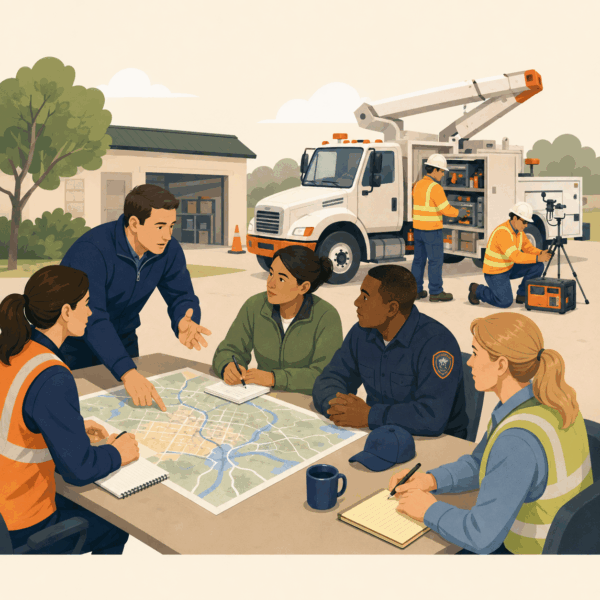 Designing communication programs that effectively reach vulnerable, low-income, and underserved ratepayer populations requires expertise in plain-language communication design, multilingual outreach, community partnership development, and equity-centered program evaluation that most utility communication teams do not maintain as core competencies. The specialized requirements of this work make external communication expertise a practical investment for utilities seeking to close the gap between their equity commitments and their enrollment outcomes.
Stegmeier Consulting Group (SCG) works with public utilities to develop vulnerable and underserved ratepayer communication programs that are grounded in the specific demographic, linguistic, and housing characteristics of the utility’s service area. This includes designing plain-language and multilingual assistance program materials, developing community partnership frameworks that extend enrollment support into underserved populations, creating targeted outreach strategies that reach eligible ratepayers at moments of peak relevance, and building measurement systems that track program access equity across ratepayer populations.
SCG also supports utilities in assessing the current state of their vulnerable ratepayer communication, identifying the specific gaps between program availability and program enrollment, and designing targeted improvements that address the communication failures most responsible for those gaps. The objective is a communication program that delivers the equity outcomes the utility’s programs are designed to produce, measured by enrollment rates that reflect the genuine availability of programs to all eligible ratepayers regardless of the barriers they face.
Future Trends in Vulnerable Ratepayer Communication
The communication landscape for vulnerable and underserved ratepayer outreach is evolving in several directions that utilities need to anticipate. Automatic enrollment, which identifies eligible ratepayers through data sharing with other means-tested programs and enrolls them in utility assistance without requiring them to submit a separate application, represents the most significant shift in the relationship between communication and enrollment. A utility that can enroll eligible low-income ratepayers automatically, based on their enrollment in food assistance, Medicaid, or other income-qualified programs, eliminates the communication barrier at the enrollment step entirely for those ratepayers. This approach is gaining regulatory support in several states and represents a fundamental rethinking of how utilities can serve ratepayers who face the highest barriers to program access.
Text-based communication, including SMS notifications and messaging app channels, is becoming an increasingly important channel for reaching ratepayers who have limited internet access but do have mobile phones. Many low-income ratepayers who do not reliably access email or utility websites have mobile phones and are reachable through text. Utilities that develop text-based assistance program communication and enrollment pathways, in multiple languages, are extending their reach to a segment of the vulnerable ratepayer population that digital-first strategies miss.
Community health worker and social service navigator models, which embed utility assistance program knowledge and enrollment support in the organizations that serve vulnerable populations most directly, represent a service delivery and communication approach that is gaining traction in communities seeking to address the interlocking challenges of utility affordability, housing stability, food security, and health. A utility that is a recognized partner in these integrated service delivery models is communicating about its assistance programs through the most trusted and most relevant channels available for the populations those programs serve.
Conclusion
The ratepayers who most depend on public utility services, for whom an unexpected shutoff notice or an unmanageable rate increase is not an inconvenience but a crisis, are also the ratepayers that standard utility communication systems are least well designed to reach. Closing this gap is a communication discipline that requires understanding who those ratepayers are, what barriers they face in accessing the programs designed to help them, and what specific communication investments would remove those barriers rather than working around them.
Public utilities that make this investment are not simply being equitable. They are being effective. A utility that successfully enrolls ninety percent of its eligible low-income ratepayers in its assistance program has reduced the energy cost burden of its most vulnerable customers, reduced the rate of service interruptions among the population that can least afford them, and reduced the collection and reconnection costs that service interruptions generate. The communication investment pays returns in operational efficiency as well as in equity, which is the nature of communication that actually works for the full range of ratepayers a public utility is obligated to serve.
Stegmeier Consulting Group’s Strategic Approach to Communication Systems
Build vulnerable ratepayer communication around genuine access, not program availability, because equity is measured in enrollment, not in offerings.
Public utilities that close the gap between their assistance program availability and their enrollment rates are the ones that treat communication as a program design function, not an afterthought. Stegmeier Consulting Group (SCG) helps utilities develop the outreach strategies, partnership frameworks, plain-language materials, and measurement systems that make equity commitments real in practice.
Use the form below to connect with our team and explore how strategic communication support can strengthen your utility’s reach into the ratepayer populations that need it most.