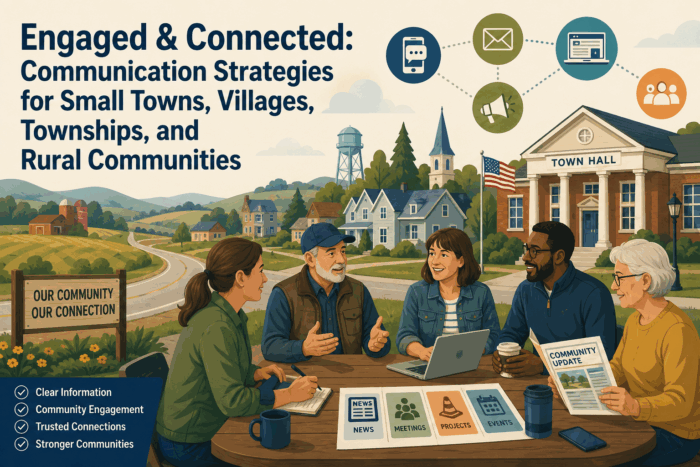
Engaged & Connected: Communication Strategies for Small Towns, Villages, Townships, and Rural Communities

The Communication Challenge Closest to Home
Small towns, villages, townships, and rural communities occupy a distinctive place in public communication. Their governments are often the public institutions closest to residents’ daily lives. They maintain local roads, operate utilities, organize community events, manage parks, oversee development, adopt ordinances, coordinate emergency response, and make decisions that residents can see and experience directly.
The relationship between the agency and the community is often personal. Residents may know the mayor, clerk, township supervisor, public works director, fire chief, library director, or board members. They may encounter local officials at schools, businesses, community events, places of worship, or neighborhood gatherings. A policy decision, service disruption, construction project, or public disagreement rarely feels distant. It becomes part of the community conversation quickly.
This closeness creates opportunities that larger agencies do not always have. Smaller local governments can communicate in a direct and familiar voice. They can build relationships over time. They can use community institutions, local events, neighborhood networks, and trusted messengers to reach residents. They can respond to questions with a level of local knowledge that would be difficult for a large centralized agency to replicate.
The same closeness can also magnify communication problems.
An unexplained rate increase may feel like a personal betrayal rather than an administrative adjustment. An inaccurate social media post may circulate throughout the community before the agency has time to respond. A council member’s individual opinion may be mistaken for an official decision. A road closure notice that omits one neighborhood may generate dozens of calls to a small municipal office. A website that has not been updated may cause residents to rely on rumors, screenshots, or informal neighborhood groups instead of official information.
These agencies must communicate about a remarkably broad range of issues, often without a communications department. The municipal clerk may also manage the website and newsletter. The manager may draft public statements between budget meetings and personnel responsibilities. Department heads may provide project updates while continuing to oversee operations. Elected officials may communicate directly with residents through personal social media accounts. One employee may be responsible for public notices, meeting materials, emergency updates, event promotion, and routine customer service at the same time.
The central challenge is therefore not simply producing more communication. It is building a manageable system that allows a small agency to communicate consistently across many subjects without creating an additional workload it cannot sustain.
This content hub and its related articles provide a practical framework for communication in small-community government. The focus includes recurring newsletters, public meeting information, leadership messages, community announcements, ordinance and policy communication, public works updates, local financial decisions, websites, social media, rural outreach, community engagement, emergency alerts, accessibility, internal alignment, and communication continuity.
The goal is to help smaller public agencies create communication that is clear, useful, timely, accessible, and realistic for the staff and resources available.
The Small-Community Government Landscape: Towns, Villages, Townships, Rural Communities, and Districts
Small-community government in the United States does not follow one organizational model. The terms town, village, township, borough, municipality, county, authority, and district have different legal meanings from one state to another. Two communities with similar populations may have very different structures, responsibilities, staffing models, and communication needs.
Understanding this diversity is important because the communication system should reflect the organization’s actual role in the community.
Small Towns and Municipalities
Small towns and municipalities are usually general-purpose governments responsible for a wide range of local functions. Depending on the state and community, these responsibilities may include:
- Streets and public works
- Water and sewer services
- Waste and recycling
- Police or public safety
- Parks and recreation
- Planning, zoning, and development
- Business licensing
- Code enforcement
- Municipal buildings and facilities
- Community events
- Local ordinances
- Public meetings and records
- Budgeting and local taxation
This breadth creates a communication challenge. A single agency must explain operational updates, policy decisions, community programs, emergencies, construction projects, public meetings, and financial choices through the same limited set of channels.
Residents do not always distinguish among departments. To them, it is all the town. A confusing parks registration page, an unanswered utility question, and a poorly explained ordinance may all affect their overall perception of local government.
Villages and Boroughs
Villages and boroughs are often compact communities with highly visible local leadership and strong community identity. Their exact powers vary, but they frequently provide many of the same services as towns and small cities.
Communication in these communities may be shaped by:
- A small administrative staff
- A part-time or volunteer elected body
- Direct resident access to officials
- A concentrated downtown or central gathering area
- Longstanding local traditions
- Active neighborhood or community organizations
- Heavy reliance on local events and informal networks
Because the community is close-knit, residents may expect communication to be immediate and personal. They may also expect local officials to understand the history behind a recurring issue, neighborhood concern, or controversial decision.
Townships
Townships vary more widely than almost any other form of local government.
Some townships function much like municipalities and provide roads, public safety, parks, waste collection, development review, and other services. Others have narrower responsibilities, such as road maintenance, property assessment, cemeteries, fire protection, or limited administrative services.
A township may serve an area that includes:
- Densely developed neighborhoods
- Rural roads and agricultural land
- Unincorporated communities
- Several postal addresses
- Multiple school or utility districts
- Residents who identify more strongly with a nearby city or village than with the township itself
These conditions can make communication difficult. Residents may not know which services the township provides, which decisions belong to another jurisdiction, or where to direct a question.
Township communication often begins with role clarity. The agency must explain not only what is happening, but also what the township is responsible for and what falls under the authority of another government or district.
Rural Counties and Regional Agencies
Rural counties and regional agencies may serve residents across large geographic areas with limited population density. Their communication responsibilities may span multiple communities, each with different local institutions, newspapers, service providers, and communication habits.
A countywide message may need to reach:
- Incorporated municipalities
- Unincorporated areas
- Agricultural communities
- Remote households
- Tribal communities
- Seasonal residents
- Older adults
- Residents with limited broadband or cellular access
- Businesses and employers spread across a large area
The communication challenge is not simply reaching many people. It is ensuring that residents understand whether a message applies to their location and which agency is responsible.
A county road closure, public health notice, wildfire update, election message, or emergency shelter announcement may affect only certain areas. General language can cause unnecessary alarm or leave affected residents uncertain about what they should do.
Rural and Special Districts
Fire protection districts, water districts, sewer districts, library districts, park districts, public health districts, transit districts, utility districts, and other special-purpose agencies may serve the same small or rural communities as municipal governments.
These agencies often have a narrower mission but even leaner administrative capacity. A district may have:
- A small professional staff
- A volunteer or part-time board
- Limited public awareness of its role
- No dedicated communication employee
- A basic website or shared social account
- A service area that crosses municipal boundaries
- Customers who do not realize they are served by a separate government entity
The district may communicate infrequently until a rate change, service interruption, election, major project, or emergency occurs. At that point, the absence of an established communication system becomes highly visible.
The Common Communication Environment
Despite their structural differences, these agencies frequently share the same operating conditions:
- Lean staffing
- Broad or highly visible public responsibilities
- Limited communication infrastructure
- Strong local relationships
- Heavy reliance on recurring, practical information
- High resident expectations for direct access
- Informal information networks
- Limited local media capacity
- Uneven digital access
- Strong sensitivity to local history, identity, and trust
The common thread is not a specific form of government. It is the need to communicate effectively in a smaller, closely connected, or geographically dispersed community without the resources of a large public information operation.
How Small Local Governments Can Adapt Communication to Limited Staff, Informal Networks, and High Public Visibility
Small governments do not operate as scaled-down versions of large cities or state agencies. Their communication environment is different in ways that affect staffing, tone, channels, approval processes, public expectations, and risk.
Communication Responsibilities Are Distributed
In a larger agency, different employees may handle media relations, digital content, public engagement, emergency communication, graphic design, internal communication, and executive messaging.
In a smaller agency, those responsibilities may be spread informally among several people. The clerk may post public notices. The manager may prepare the newsletter. Public works may send road updates. Parks staff may promote events. Police or fire personnel may publish emergency information. Elected officials may post independently.
Without a shared process, residents may receive inconsistent messages from people who are all speaking on behalf of the same organization.
The Agency Communicates About Nearly Everything
A state tax department can focus its public communication on tax administration. A public health agency can focus on health information. A transit agency can focus on mobility.
A small municipal government may need to communicate about:
- A water main break in the morning
- A parks event at noon
- A council agenda in the afternoon
- A road closure before the end of the day
- A new ordinance the following week
- A budget hearing later in the month
- A winter storm over the weekend
The communication system must support many subjects without requiring a separate strategy for every department.
Local Issues Become Personal Quickly
Residents may know the employees performing the work, the business affected by a street closure, the property owner involved in a development proposal, or the family organizing a community event.
This familiarity can strengthen understanding, but it can also complicate communication. Staff and officials must provide factual, consistent information while navigating personal relationships and local history.
A dismissive tone, incomplete explanation, or defensive response can damage trust beyond the immediate issue.
Informal Networks Compete With Official Channels
Residents may receive information through neighborhood groups, community Facebook pages, local businesses, schools, libraries, churches, volunteer organizations, newspapers, or word of mouth.
These networks are valuable, especially where local media and government communication capacity are limited. They are also difficult to control.
The agency’s goal should not be to eliminate informal communication. It should become the most reliable source that residents and community partners can reference and share.
Local Media May Be Limited
Many smaller communities have experienced reductions in local newspaper coverage, fewer reporters attending public meetings, or less frequent publication schedules.
When independent local coverage declines, the government becomes more responsible for distributing basic civic information. This does not mean the agency should act as its own news outlet or present promotional content as journalism. It does mean residents may depend more heavily on official newsletters, meeting recaps, websites, and social channels to understand what local government is doing.
Public Trust Is Built Through Routine Communication
Smaller agencies may focus on communication only when something goes wrong. By then, the community may not know which channels are official, how often updates will be provided, or whether the agency communicates reliably.
Routine newsletters, project updates, meeting information, and community announcements create familiarity before an emergency or controversy occurs. Residents who regularly receive useful information are more likely to recognize and trust urgent communication when it matters most.
How Small Towns and Rural Agencies Can Build a Practical Communication System With Limited Staff
The most effective communication system for a small agency is not the one with the most channels, software, or content. It is the one staff can maintain consistently.
A practical system should reduce repeated work, clarify responsibilities, and make it easier to communicate accurately.
Identify Recurring Communication Responsibilities
Agencies should begin by identifying the information they communicate regularly.
This may include:
- Public meeting agendas and reminders
- Newsletters
- Mayor, manager, supervisor, or board messages
- Community events
- Recreation registration
- Public works projects
- Road closures
- Utility service updates
- Waste and recycling schedules
- Seasonal reminders
- Permit and licensing deadlines
- Ordinance and policy updates
- Budget and financial information
- Emergency alerts
- Job and volunteer opportunities
Once these recurring responsibilities are visible, the agency can build schedules, templates, and workflows around them.
Establish Clear Roles
A basic communication process should define:
- Who identifies the need for communication
- Who provides the operational facts
- Who drafts the message
- Who reviews technical or legal accuracy
- Who approves sensitive content
- Who publishes it
- Who responds to follow-up questions
- Who serves as backup when the primary employee is unavailable
This does not require a complicated approval chart. Even a one-page responsibility guide can prevent delays and contradictions.
Create Reusable Templates
Templates are particularly valuable for agencies with limited staff.
Useful templates may include:
- Road closure notices
- Utility disruption updates
- Public meeting reminders
- Event announcements
- Weather-related cancellations
- Ordinance explainers
- Project updates
- Mayor or board messages
- Emergency alerts
- Correction notices
- Frequently asked questions
A template should provide structure without forcing every message into identical language. It should remind staff to include the information residents need most, such as location, timing, impact, required action, contact information, and the next update.
Build a Realistic Communication Calendar
A communication calendar should track predictable needs without becoming another burdensome administrative system.
It may include:
- Newsletter publication dates
- Council and board meetings
- Budget milestones
- Seasonal service changes
- Recreation registration
- Community events
- Public works projects
- Annual reports
- Utility notices
- Elections
- Permit renewals
- Emergency preparedness campaigns
- Scheduled leadership messages
Planning routine communication in advance gives staff more capacity to respond to unexpected issues.
Define the Official Source of Information
Residents should know where confirmed local government information will appear.
In most cases, the website should serve as the primary source of truth. Email, social media, printed materials, text alerts, and partner channels can direct residents to the website for complete information.
When the website is outdated or incomplete, residents begin to rely on screenshots, comments, forwarded messages, or unofficial pages. Maintaining one reliable source reduces confusion across every other channel.
Our Comprehensive Guide to Public Communications for State and Local Government Agencies
This article is part of our series on strategic communication for state and local government agencies. To learn more and to see the parent article, which links to other content just like this, click the button below.
How Small Local Governments Can Use Newsletters and Recurring Communication to Keep Residents Informed
For many small communities, a municipal, village, or township newsletter can become the most important communication channel.
Residents may not visit the government website regularly. Social media platforms do not show every post to every follower. Local newspaper coverage may be limited. A recurring newsletter gives the agency a predictable way to bring information directly to residents.
Establish a Sustainable Schedule
A weekly newsletter may be appropriate for a community with frequent activity and enough staff capacity. A monthly or seasonal newsletter may be more realistic elsewhere.
Consistency matters more than frequency.
A newsletter that arrives on a dependable schedule helps residents develop the habit of reading it. An ambitious weekly newsletter that stops after two months is less useful than a well-managed monthly update.
Organize Around Resident Needs
A useful newsletter may include:
- A short leadership message
- Upcoming meetings
- Major decisions or proposals
- Public works and infrastructure updates
- Utility or service reminders
- Recreation programs
- Community events
- Seasonal information
- Emergency preparedness reminders
- Forms, deadlines, and registration links
- Community partner information
Each item should answer practical questions:
- What is happening?
- Who is affected?
- When will it happen?
- What should residents do?
- Where can they find details?
- Who can answer questions?
Avoid Turning the Newsletter Into a Department Report
Residents do not need a complete inventory of everything staff accomplished during the month.
The strongest newsletters translate government activity into information that helps residents understand, prepare, participate, or take action.
Instead of stating that the public works department completed several maintenance activities, the newsletter can explain which areas were improved, what work remains, and how residents will be affected.
Coordinate Digital and Printed Versions
Some residents prefer email. Others depend on printed communication.
A community may use:
- An email newsletter
- A printed quarterly publication
- A utility bill insert
- Copies at municipal buildings
- Library distribution
- Senior center distribution
- Local business or community partner distribution
The content can be coordinated without making every version identical. Email may link to detailed web pages, while print may provide more complete explanations and telephone contact information.
Leadership Communication Strategies for Small Governments to Clarify Decisions, Roles, and Official Positions
Leadership communication is unusually visible in smaller communities.
Residents may view the mayor, council president, township supervisor, board chair, manager, or clerk as the voice of the local government. Their messages can help residents understand priorities, recognize accomplishments, and prepare for difficult decisions.
They can also create confusion when individual views, official decisions, staff recommendations, and operational information are not clearly distinguished.
Use Leadership Messages to Explain, Not Simply Promote
A leadership message is most useful when it helps residents understand:
- What the agency is working on
- Why an issue is receiving attention
- What decisions are approaching
- What tradeoffs are being considered
- What residents can expect next
- How the community can participate
- What progress has been made
General statements about community pride may have a place, but they should not replace substantive information.
Distinguish Personal Views From Official Positions
Elected officials have individual perspectives. Residents also need to know the official status of an issue.
Communication should clearly distinguish among:
- An individual official’s opinion
- A staff recommendation
- A committee recommendation
- A proposal under discussion
- A majority position of the governing body
- A final adopted decision
- An operational instruction from the agency
This distinction is especially important when officials communicate through personal social media accounts.
Prepare Shared Talking Points
Before a major announcement, public meeting, service change, or controversial decision, staff and officials should agree on the essential facts.
Shared talking points can explain:
- What is happening
- Why it is happening
- What has been decided
- What remains under discussion
- What residents should do
- Where additional information is available
- Who should answer technical questions
Talking points do not require every official to use identical wording. They help ensure that residents hear consistent facts.
Protect Administrative Communication From Political Conflict
Staff may need to explain a policy, meeting process, project schedule, or service change while elected officials disagree about the underlying decision.
The agency’s administrative communication should remain factual and neutral. It should explain the process, impact, and next steps without appearing to advocate for one political position unless the governing body has formally directed the agency to do so.
How Small Governments Can Communicate Public Meetings, Ordinances, and Local Decisions Clearly
Public meetings are central to small-community governance. They are also a frequent source of communication failure.
Posting a legally compliant agenda does not necessarily help residents understand what will be discussed, whether a decision will be made, or how they can participate.
Communicate Before the Meeting
Residents should be able to find:
- The meeting date and time
- The location or virtual participation information
- The agenda
- Instructions for public comment
- Accessibility information
- Supporting documents
- A plain-language description of major items
- Whether an item is for discussion, public hearing, preliminary action, or final action
When an issue is complex or highly visible, the agency should consider publishing a separate explainer before the meeting.
Explain the Decision-Making Stage
Residents often become confused about whether a proposal has already been approved.
Communication should distinguish clearly among:
- Early staff review
- Community discussion
- Committee recommendation
- Public hearing
- Preliminary vote
- Final vote
- Implementation
This helps residents understand when participation can influence the outcome and prevents unnecessary alarm.
Translate Ordinances and Policies Into Practical Information
Residents should not need to read an entire ordinance or staff report to understand how a change affects them.
A public-facing explanation should address:
- What is changing
- Why the issue is being considered
- Who may be affected
- When the change would begin
- What residents or businesses may need to do
- What exceptions may apply
- How enforcement will work
- Where the official documents are available
This is especially important for zoning, parking, short-term rentals, animals, property maintenance, business licensing, utility rules, fees, waste collection, and development regulations.
Communicate After the Meeting
Official minutes serve a legal and historical purpose, but they may not provide the clearest resident summary.
A meeting recap can explain:
- What was discussed
- What decisions were made
- What was postponed
- What public concerns were raised
- What happens next
- When the issue will return
- Where supporting information can be found
Regular recaps can reduce rumors and help residents remain connected even when they cannot attend meetings.
How Small Governments Can Explain Budgets, Rate Changes, Capital Projects, and Service Tradeoffs to Residents
Local financial decisions are among the most sensitive communication responsibilities small governments face.
Residents experience these decisions directly through taxes, utility bills, service levels, fees, construction, staffing, and the condition of public infrastructure. They may also have limited context for the legal, financial, and operational constraints behind those decisions.
Explain the Connection Between Costs and Services
A budget presentation may show funds, departments, and account categories. Residents usually want to know:
- What services are being maintained
- What services may change
- Why costs are increasing
- What alternatives were considered
- What projects are being delayed
- What risks exist if action is not taken
- How the decision affects households or businesses
Communication should connect financial information to visible community outcomes.
Provide Context for Rate and Fee Changes
A utility rate, permit fee, recreation fee, or waste collection increase should not be communicated only as a new dollar amount.
Residents may need to understand:
- What the current rate supports
- Why revenue is no longer sufficient
- Whether infrastructure or operating costs have changed
- Whether outside requirements are affecting the service
- What alternatives were considered
- Whether increases will occur gradually
- What assistance or payment options are available
- How the new rate compares with nearby communities
The goal is not to make every resident agree with the decision. It is to ensure that the rationale and consequences are understandable.
Communicate Capital Projects Over Time
A road, water, sewer, facility, park, or public safety project may take years to plan, fund, approve, and construct.
Residents should receive communication throughout the project lifecycle:
- Why the project is needed
- What studies or assessments have been completed
- How it will be funded
- What approvals are required
- What the schedule is
- What temporary impacts are expected
- How progress will be reported
- What changes occur when conditions shift
When agencies communicate only at the start and completion, residents may assume delays, cost changes, or visible inactivity reflect poor management.
Explain Service Tradeoffs Honestly
Small governments often face decisions involving:
- Maintaining services in-house
- Contracting with a private provider
- Sharing services with another jurisdiction
- Deferring maintenance
- Reducing operating hours
- Changing staffing levels
- Consolidating facilities
- Seeking grants or issuing debt
- Asking voters to approve additional revenue
Communication should explain both the benefits and limitations of the available options. Overpromising can damage trust when the chosen approach cannot meet every expectation.
Promoting Community Events, Programs, and Local Announcements Effectively
Community events are not separate from local government communication. They are one of the most visible ways smaller agencies build relationships, reinforce community identity, and connect residents with services.
Promote Events Through a Sequence
A single announcement is rarely enough.
A manageable event communication sequence may include:
- An initial announcement
- A save-the-date or registration message
- A reminder with logistical details
- A final reminder
- A day-of update
- A weather, parking, or location update when necessary
- A post-event thank-you or recap
This sequence gives residents several opportunities to see the information without requiring daily promotion.
Include Practical Details
Event communication should explain:
- Who the event is for
- Whether registration is required
- The date and time
- The location
- Parking and transportation
- Accessibility
- Costs
- What attendees should bring
- Whether food, activities, or services are available
- What happens if weather affects the event
- Where updates will be posted
Use Events as Communication Opportunities
Events can also help agencies explain services and gather feedback.
A festival may include municipal information tables. A public works open house can help residents understand equipment, infrastructure, and seasonal operations. A parks event can promote future programs. A community expo can connect residents with public agencies and nonprofit resources.
The communication strategy should make these opportunities visible rather than treating the event only as entertainment.
How Clear Service Updates Help Small Governments Prepare Residents for Public Works and Utility Disruptions
Residents often judge local government communication through everyday operational experiences.
A road closure, missed waste collection, water disruption, snow response, or construction project can affect residents immediately. Clear communication can reduce frustration even when the disruption itself cannot be avoided.
Planned Work
Planned work should be communicated early enough for residents to prepare.
A useful notice should include:
- The location
- The start date
- The expected duration
- The purpose of the work
- Traffic, parking, noise, or service impacts
- Alternative routes or arrangements
- Contact information
- Where future updates will appear
Longer projects should receive periodic progress updates, even when the schedule has not changed.
Unexpected Disruptions
When a disruption occurs unexpectedly, the agency may not have every detail.
It should still communicate:
- What is known
- What area is affected
- What residents should do
- What response is underway
- When the next update will be provided
- Where updates will appear
A commitment to the next update is often more valuable than an uncertain estimate.
Explain Operational Constraints
Residents may not understand why crews cannot immediately repair every road, restore every service, or collect every delayed route.
Communication can explain:
- Safety priorities
- Crew availability
- Equipment limitations
- Weather conditions
- Contractor coordination
- Regulatory requirements
- The order in which areas are being addressed
This information should be specific enough to be useful without becoming defensive.
Use Maps and Visual Information
Maps, service-area graphics, route diagrams, and project photographs can help residents determine whether they are affected.
Visual communication should also include clear text descriptions so the message remains accessible to people who cannot use the image.
How Small Governments Can Create One Reliable Information System Across Every Communication Channel
Smaller agencies frequently struggle with channel fragmentation. The website says one thing, Facebook says another, a printed notice remains posted after circumstances change, and staff answering the telephone have a different update.
Residents experience these channels as one communication system. The agency should manage them accordingly.
The Website as the Official Source
The website should contain complete, current information about:
- Services
- Departments
- Contact information
- Meetings and agendas
- Forms and applications
- News and announcements
- Projects
- Events
- Emergency information
- Ordinances and policies
- Public records
- Employment opportunities
The site should be organized around resident tasks and questions, not only around the agency’s internal department structure.
Email for Direct Communication
Email is useful for recurring updates, reminders, newsletters, meeting information, and urgent notices.
Subscription options should remain simple. Too many categories can confuse residents and create an administrative burden.
A community may begin with:
- General news
- Emergency alerts
- Public meetings
- Parks and recreation
- Public works or utility updates
Social Media for Timely Distribution
Social media can promote events, distribute reminders, provide timely updates, and direct residents to official information.
It should not become the only place where important information appears.
Agencies should establish:
- Who may post
- Which accounts are official
- How comments are moderated
- When staff respond
- How records are retained
- How corrections are issued
- How official and personal accounts remain separate
- What happens when the primary account manager is unavailable
Print for Residents Who Are Not Reliably Online
Printed communication remains essential in many small and rural communities.
Useful channels may include:
- Mailed newsletters
- Utility bill inserts
- Flyers
- Bulletin boards
- Libraries
- Senior centers
- Municipal facilities
- Local newspapers
- Door hangers
- Community partner distribution
- Notices at post offices, stores, or other gathering places when appropriate
The correct channel mix depends on how residents actually receive information, not on assumptions about how they should receive it.
How Small Governments Can Gather Resident Feedback and Show How Community Input Shapes Decisions
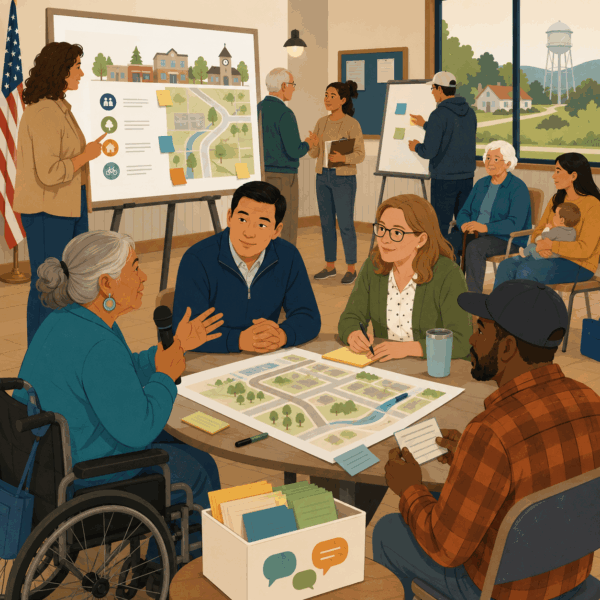
Community engagement in a smaller jurisdiction does not always require a large campaign, formal advisory process, or expensive platform.
It occurs whenever residents are invited to understand an issue, share information, ask questions, or influence a decision.
Define the Purpose of Engagement
Before requesting input, the agency should explain:
- What decision is being considered
- What has already been decided
- What remains open to influence
- How feedback will be used
- When the decision will occur
- How the results will be shared
Residents can become frustrated when they are invited to participate after the practical choices have already been made.
Use Methods That Fit the Community
Engagement methods may include:
- Short online surveys
- Printed surveys
- Open houses
- Public meetings
- Small-group discussions
- Listening sessions
- Interviews
- Community event outreach
- Library or market pop-ups
- Business roundtables
- Youth or senior discussions
- Meetings hosted by trusted partner organizations
The method should match the audience and issue.
An evening meeting at the municipal building may not reach working families, residents without transportation, older adults, or people living far from the community center.
Use Existing Community Spaces
Smaller agencies may not need to create a new event for every engagement effort.
They can gather feedback at:
- Festivals
- Recreation programs
- Library events
- Farmers markets
- School events
- Senior programs
- Business meetings
- Neighborhood gatherings
- Public service events
- Community organization meetings
This reduces the burden on staff and residents.
Close the Feedback Loop
Residents should hear what the agency learned and what happened next.
A summary may explain:
- How many people participated
- What themes emerged
- What recommendations were accepted
- What suggestions could not be implemented
- Why certain decisions were made
- What the next steps are
Closing the loop demonstrates that participation had a purpose.
How Rural Governments Can Reach Residents Through Trusted Partners and Multiple Communication Channels
Rural communication requires more than adding the word rural to a general local government strategy.Rural communication requires a strategy built around how people actually receive information across widely dispersed communities. Distance, limited broadband and cellular coverage, overlapping jurisdictions, and the lack of a single central information source can make it difficult for residents to know whether a message applies to them, where to find updates, or which agency is responsible.
Effective rural outreach therefore depends on clearly identifying affected locations, working through trusted local institutions, giving partners ready-to-use materials, and providing both digital and offline ways to access important information. Agencies should assume that no single channel will reach everyone and design communication that can travel through multiple community networks.
Communicate by Location
A countywide or districtwide message should make clear which communities, roads, service areas, or households are affected.
Useful tools may include:
- Maps
- Community-specific headings
- Service-area descriptions
- Road or route names
- Postal code references
- Landmarks
- Separate versions for different areas
A message that is too broad may create unnecessary concern. A message that is too vague may fail to reach the people most affected.
Use Trusted Community Institutions
Rural residents may regularly interact with:
- Libraries
- Schools
- Volunteer fire departments
- Extension offices
- Electric cooperatives
- Healthcare providers
- Senior centers
- Faith communities
- Local businesses
- Chambers of commerce
- Agricultural organizations
- Nonprofit organizations
- Newspapers and radio stations
These institutions can extend the reach of official communication.
Give Partners Ready-to-Use Information
Community partners are more likely to share information when the agency provides:
- Approved message language
- A clear headline
- A brief summary
- A link or contact
- Printable materials
- Social media copy
- Translation when needed
- A date showing when the information was last updated
Partners should also know where to find corrections or revised information.
Account for Limited Digital Access
Some rural residents may have unreliable internet, limited data plans, or low confidence using online systems.
Critical information may also need to be available through:
- Telephone messages
- Local radio
- Printed notices
- Direct mail
- Community partners
- Public facilities
- Door-to-door distribution
- In-person assistance
Digital communication can improve rural access, but it should not be treated as universal access.
How Small Governments Can Prepare Emergency Alert Systems and Keep Residents Informed
Emergency communication is one part of a broader small-community communication system. It should not be the only time residents hear from their local government.
Communities that communicate reliably during normal operations are better positioned during urgent situations because residents already recognize official channels.
Establish Official Alert Channels
Depending on capacity, urgent channels may include:
- Website alerts
- Official social media accounts
- Email notifications
- Text alerts
- Emergency notification platforms
- Recorded telephone messages
- Local radio or television
- School and community partner lists
- Digital signs
- Printed or direct notices
A community does not need every available system. It needs a dependable combination that staff can activate quickly.
Create Templates in Advance
Templates can support communication about:
- Road closures
- Severe weather
- Flooding
- Utility outages
- Boil water notices
- Building closures
- Event cancellations
- Public safety incidents
- Shelters
- Evacuations
- Air quality
- Public health concerns
- Service delays
Templates should include the time, location, affected area, required action, source of information, and next update.
Assign Backup Publishers
Urgent communication should not depend on one employee having access to an account.
The agency should document:
- Account ownership
- Password management
- Backup staff
- Approval authority
- After-hours procedures
- Contact information for partner agencies
- Procedures for updating or correcting a notice
Continue Updating
The first alert is rarely the last message residents need.
Follow-up communication may include:
- Changed instructions
- Expanded or reduced affected areas
- Response progress
- Estimated restoration
- Correction of rumors
- An all-clear message
- Recovery resources
- A summary of what happens next
Even when little has changed, a scheduled update can reassure residents that the issue remains under active review.
How Small Governments Can Make Communication Accessible, Multilingual, and Digitally Inclusive
A message is not effective if residents cannot find, understand, or use it.
Smaller agencies may have limited resources, but accessibility and language access should be built into the communication system rather than treated as optional additions.
Use Plain Language
Public information should:
- Lead with the main point
- Use familiar words
- Explain technical and legal terms
- Break long information into sections
- Use descriptive headings
- Highlight deadlines and required actions
- Provide clear contact information
- Avoid unnecessary internal terminology
Plain language does not remove legal accuracy. It helps residents understand what official language means.
Make Digital Communication Accessible
Web pages, emails, documents, and social posts should support residents who use assistive technology.
Key practices include:
- Descriptive link text
- Alternative text for meaningful images
- Accessible headings
- Sufficient color contrast
- Captions or transcripts for video
- Accessible document formatting
- Text descriptions for maps and graphics
- Mobile-friendly layouts
Plan for Language Needs
Agencies should identify languages commonly used in the community and determine which information requires translation.
Priority content may include:
- Emergency alerts
- Public safety information
- Utility disruptions
- Public health notices
- Voting and meeting information
- Applications
- Service changes
- Major policy decisions
- Community resources
Translation should be paired with distribution through channels the intended audience actually uses.
Consider Residents With Limited Digital Access
Accessibility also includes residents who cannot rely on online communication.
Important information may need to be available by telephone, in print, at public facilities, through trusted partners, or in person.
How Small Governments Can Align Staff and Maintain Communication Through Leadership and Employee Transitions
Many public communication problems begin inside the agency.
A department may announce a date before another department confirms it. A council member may learn about an issue from a resident before receiving an internal update. Front counter staff may not know a new policy has taken effect. A community partner may distribute an outdated notice.
Brief Staff Before Major Announcements
Before significant communication is published, relevant staff and officials should receive:
- The approved message
- Frequently asked questions
- Contact information
- The publication schedule
- Guidance on who should answer technical questions
- The next planned update
Frontline employees should be included because they often receive resident questions first.
Maintain a Shared Communication Calendar
A shared calendar can show:
- Planned announcements
- Meeting dates
- Newsletter deadlines
- Project milestones
- Public hearings
- Events
- Seasonal campaigns
- Emergency exercises
- Major decisions
This helps departments identify conflicts, coordinate timing, and avoid surprising one another.
Document Accounts and Procedures
Small agencies are vulnerable when communication knowledge is held by one employee.
The agency should document:
- Website access
- Social media ownership
- Email platform access
- Alert system access
- Newsletter procedures
- Approval workflows
- Template locations
- Contact lists
- Vendor information
- Records retention requirements
Official accounts should be owned by the agency, not tied only to an employee’s personal email or device.
Prepare for Vacancies and Turnover
A staff departure should not interrupt public communication.
Transition materials should allow another employee to:
- Publish an urgent update
- Send the newsletter
- Update the website
- Access official accounts
- Locate approved templates
- Contact key partners
- Understand recurring deadlines
Communication continuity is part of operational continuity.
Measuring Communication Without Creating an Administrative Burden
Smaller agencies do not need complicated dashboards to understand whether communication is working.
Measurement should answer practical questions:
- Are residents receiving the information?
- Are they finding what they need?
- Are they taking the requested action?
- Are common questions decreasing?
- Are updates being published on time?
- Are residents from different parts of the community being reached?
- Are staff spending less time correcting preventable confusion?
Useful measures may include:
- Newsletter subscribers
- Email open and click rates
- Visits to important website pages
- Event registrations
- Meeting attendance
- Survey participation
- Social media reach and shares
- Telephone and email inquiry patterns
- Repeated resident questions
- Form completion
- Missed deadlines
- Time required to publish an urgent notice
- Language access requests
- Partner feedback
- Resident satisfaction
- After-action findings
The most visible metric is not always the most meaningful.
A social media post may receive few reactions but direct many residents to an important page. A newsletter may not grow rapidly but may reduce repeated telephone calls. A clearer meeting explainer may not increase attendance but may reduce confusion about a proposed decision.
Measurement should focus on whether communication helps residents understand, prepare, participate, and act.
How Small-Community Government Communication Compares With Other Agency Types
Small-community governments share many communication principles with larger public agencies, but the operating environment is distinct.
Like state agencies, they must communicate accurately about programs, regulations, deadlines, public decisions, and services. Like large cities, they must coordinate communication across departments. Like public utilities, they must provide operational updates that affect residents directly. Like emergency management agencies, they must communicate quickly during urgent situations. Like parks, libraries, and cultural agencies, they must promote events and build community participation.
What makes small-community communication different is the combination of breadth, visibility, limited capacity, and personal proximity.
A state agency may have a narrow program mission and a large communication staff. A small town may have a broad mission and no dedicated communication employee.
A large city may have separate departments for media relations, digital engagement, emergency communication, public meetings, and executive messaging. A village clerk or municipal manager may coordinate all of those functions while managing unrelated administrative responsibilities.
A special-purpose agency may communicate primarily about one type of service. A general-purpose small government must move rapidly among public works, recreation, budgets, public meetings, ordinances, development, utilities, events, and emergencies.
A large jurisdiction may struggle to make communication feel local. A small community may struggle to keep communication factual and coordinated because relationships are already highly local and personal.
Public engagement also operates differently. A large agency may conduct a formal campaign across many neighborhoods and demographic groups. A small community may rely on a newsletter, a town hall, a library conversation, a local event, and direct discussion with residents. These approaches can be highly effective, but only when the agency is clear about what participation can influence and how feedback will be used.
The principles remain consistent across government:
- Clear language
- Accurate information
- Early planning
- Accessible content
- Defined responsibilities
- Consistent messages
- Trusted channels
- Timely updates
- Respectful engagement
- Continuous improvement
The difference is that smaller agencies must apply those principles through simpler systems that work across many subjects and can be sustained by lean staff.
Tying It All Together for Your Small-Community Communication Strategy
Communication is not a separate activity added after local government has completed its work. It is part of how residents experience that work.
A public meeting is more accessible when residents understand what will be discussed and what decisions may occur. A road project is easier to navigate when residents know the schedule, impact, and next update. A budget decision is more credible when the agency explains the service needs and tradeoffs behind it. A utility interruption is less disruptive when residents receive timely instructions. A community event is more successful when practical information reaches residents through the channels they use.
The communication strategies in this hub are interconnected.
Recurring newsletters establish a reliable rhythm. Leadership messages help residents understand priorities and upcoming decisions. Meeting explainers connect formal governance processes to practical community concerns. Financial communication helps residents understand the relationship between costs, services, and long-term needs. Public works notices help people prepare for disruptions. Websites provide a central source of truth. Email and social media distribute timely updates. Printed materials and local partners extend reach. Engagement methods give residents meaningful ways to participate. Emergency protocols help staff communicate quickly when conditions change.
For smaller agencies, the most important shift is to treat communication as a manageable operating system rather than a series of unrelated tasks.
That system should help residents answer basic questions:
- What is happening?
- Why is it happening?
- Does it affect me?
- What do I need to do?
- When will I know more?
- Where can I find official information?
- Who can answer my question?
- How can I participate?
A mature small-community communication strategy also recognizes the emotional context of local government.
Residents may be worried about a rate increase, frustrated by construction, attached to a longstanding service, skeptical of a development proposal, or concerned that a decision has already been made without them. Because local government is close to home, these issues can feel personal.
Clear communication does not eliminate disagreement. It helps ensure that disagreement is grounded in accurate information and a shared understanding of the process.
The future of small-community communication will likely involve more digital tools, more electronic newsletters, more text alerts, more online services, and greater pressure to provide rapid updates. These tools can improve access and efficiency, but they should support the community’s actual needs rather than create systems staff cannot maintain.
Technology is useful when it makes local government easier to understand and navigate. It is not a substitute for clear writing, defined responsibilities, leadership alignment, trusted relationships, and consistent follow-through.
Ultimately, the strongest communication systems help smaller communities remain informed, engaged, and connected. They give residents confidence that their local government will explain what is happening, provide useful information, acknowledge uncertainty, and return with updates when circumstances change.
That confidence is built over time, through the routine communication residents receive long before a crisis, controversy, or major decision occurs.

Strategic Communication Support for Small Towns, Villages, Townships, and Rural Communities
Managing communication for a smaller public agency requires more than posting announcements or producing an occasional newsletter.
It requires understanding the full range of information residents need, the limited staff capacity available to provide it, the relationships among elected officials and employees, the role of local partners, the differences among digital and printed channels, and the importance of maintaining trust in a close-knit community.
Many small governments have capable staff with deep institutional knowledge. Those employees understand the community, the services, the local history, and the practical realities behind decisions. Their knowledge is essential.
At the same time, they may be stretched across meeting administration, budgeting, public records, personnel, customer service, operations, project management, elected-official support, and communication. A new newsletter, website refresh, community engagement process, major service change, utility rate adjustment, capital project, emergency alert system, or controversial policy issue can create communication demands beyond what the existing team can absorb.
Agencies may choose to work with an external communication partner when:
- They need to establish a basic communication system
- They are launching or redesigning a newsletter
- Their website no longer reflects resident needs
- A major local decision requires coordinated explanation
- A service change or vendor transition may generate concern
- A rate, fee, tax, or budget decision needs clear public communication
- Staff and elected officials need shared messages
- Public meeting communication needs improvement
- A community engagement effort requires planning and facilitation
- Emergency and urgent communication procedures are not documented
- Communication depends too heavily on one employee
- Rural or underserved residents are not being reached
- Routine communication is inconsistent across departments
- Staff need templates, calendars, and workflows they can sustain
External communication support should not replace local knowledge or create an elaborate system the agency cannot maintain.
Its value is helping the organization turn local expertise into clear, coordinated, resident-centered communication.
This may include reviewing current channels, identifying gaps, organizing responsibilities, developing templates, creating newsletter systems, improving website content, preparing leadership messages, explaining complex decisions, developing partner materials, building emergency protocols, training staff, and establishing practical measures for improvement.
The strongest approach connects individual materials to the larger resident experience.
A road closure notice should align with the website, social media post, map, and information provided by staff answering telephone calls. A mayor’s message should align with the official status of the issue. A rate increase explainer should align with the utility bill, meeting presentation, frequently asked questions, and customer service scripts. An emergency alert should align with partner agencies and include a clear plan for the next update.
An outside perspective can also help agencies identify assumptions that are invisible to people who work inside the organization every day.
Staff may know which department handles a service, where a form is located, how a meeting process works, why a project schedule changed, or what a technical term means. Residents may not.
The purpose of communication support is to bridge that gap while respecting legal accuracy, agency voice, local relationships, and operational reality.
Ready to Strengthen Communication in Your Community?
At Stegmeier Consulting Group, we help state and local government agencies develop clear, practical communication strategies that support residents, staff, elected officials, community partners, and public trust.
For small towns, villages, townships, rural communities, and public districts, we can help:
- Build manageable communication plans for agencies with limited staff
- Develop municipal, village, township, or district newsletters
- Create recurring resident update systems
- Improve website organization and resident-facing content
- Establish practical social media and email communication processes
- Prepare mayor, council, supervisor, trustee, and board messages
- Develop talking points and frequently asked questions for major decisions
- Explain ordinances, policies, budgets, utility rates, fees, and service changes
- Create public meeting explainers, reminders, and recaps
- Plan communication for capital projects and infrastructure work
- Develop road closure, utility, public works, and service-update templates
- Create emergency alert protocols and message libraries
- Build communication calendars, approval processes, and staff workflows
- Develop community engagement and resident feedback strategies
- Create partner toolkits for rural and hard-to-reach communities
- Improve plain-language, accessibility, and multilingual communication
- Document communication systems to support staff transitions and continuity
- Train staff and elected officials to communicate consistently
- Assess communication performance and identify practical improvements
Whether your community is launching its first email newsletter, improving an outdated website, explaining a difficult local decision, preparing for a major project, strengthening rural outreach, establishing an emergency alert process, or building a long-term communication system that fits a lean team, SCG can help create messages, tools, and workflows that support both residents and staff.
Use the form below to connect with SCG and discuss communication needs in your town, village, township, rural community, or public district.
Level of Interest*Just researching, no projectActive project, timeline under 1 yearActive project, timeline over 1 yearActive project, unknown timeline
How Small Local Governments Can Use Newsletters and Recurring Communication to Keep Residents Informed
For many small communities, a municipal, village, or township newsletter can become the most important communication channel.
Residents may not visit the government website regularly. Social media platforms do not show every post to every follower. Local newspaper coverage may be limited. A recurring newsletter gives the agency a predictable way to bring information directly to residents.
Establish a Sustainable Schedule
A weekly newsletter may be appropriate for a community with frequent activity and enough staff capacity. A monthly or seasonal newsletter may be more realistic elsewhere.
Consistency matters more than frequency.
A newsletter that arrives on a dependable schedule helps residents develop the habit of reading it. An ambitious weekly newsletter that stops after two months is less useful than a well-managed monthly update.
Organize Around Resident Needs
A useful newsletter may include:
- A short leadership message
- Upcoming meetings
- Major decisions or proposals
- Public works and infrastructure updates
- Utility or service reminders
- Recreation programs
- Community events
- Seasonal information
- Emergency preparedness reminders
- Forms, deadlines, and registration links
- Community partner information
Each item should answer practical questions:
- What is happening?
- Who is affected?
- When will it happen?
- What should residents do?
- Where can they find details?
- Who can answer questions?
Avoid Turning the Newsletter Into a Department Report
Residents do not need a complete inventory of everything staff accomplished during the month.
The strongest newsletters translate government activity into information that helps residents understand, prepare, participate, or take action.
Instead of stating that the public works department completed several maintenance activities, the newsletter can explain which areas were improved, what work remains, and how residents will be affected.
Coordinate Digital and Printed Versions
Some residents prefer email. Others depend on printed communication.
A community may use:
- An email newsletter
- A printed quarterly publication
- A utility bill insert
- Copies at municipal buildings
- Library distribution
- Senior center distribution
- Local business or community partner distribution
The content can be coordinated without making every version identical. Email may link to detailed web pages, while print may provide more complete explanations and telephone contact information.
Leadership Communication Strategies for Small Governments to Clarify Decisions, Roles, and Official Positions
Leadership communication is unusually visible in smaller communities.
Residents may view the mayor, council president, township supervisor, board chair, manager, or clerk as the voice of the local government. Their messages can help residents understand priorities, recognize accomplishments, and prepare for difficult decisions.
They can also create confusion when individual views, official decisions, staff recommendations, and operational information are not clearly distinguished.
Use Leadership Messages to Explain, Not Simply Promote
A leadership message is most useful when it helps residents understand:
- What the agency is working on
- Why an issue is receiving attention
- What decisions are approaching
- What tradeoffs are being considered
- What residents can expect next
- How the community can participate
- What progress has been made
General statements about community pride may have a place, but they should not replace substantive information.
Distinguish Personal Views From Official Positions
Elected officials have individual perspectives. Residents also need to know the official status of an issue.
Communication should clearly distinguish among:
- An individual official’s opinion
- A staff recommendation
- A committee recommendation
- A proposal under discussion
- A majority position of the governing body
- A final adopted decision
- An operational instruction from the agency
This distinction is especially important when officials communicate through personal social media accounts.
Prepare Shared Talking Points
Before a major announcement, public meeting, service change, or controversial decision, staff and officials should agree on the essential facts.
Shared talking points can explain:
- What is happening
- Why it is happening
- What has been decided
- What remains under discussion
- What residents should do
- Where additional information is available
- Who should answer technical questions
Talking points do not require every official to use identical wording. They help ensure that residents hear consistent facts.
Protect Administrative Communication From Political Conflict
Staff may need to explain a policy, meeting process, project schedule, or service change while elected officials disagree about the underlying decision.
The agency’s administrative communication should remain factual and neutral. It should explain the process, impact, and next steps without appearing to advocate for one political position unless the governing body has formally directed the agency to do so.
How Small Governments Can Communicate Public Meetings, Ordinances, and Local Decisions Clearly
Public meetings are central to small-community governance. They are also a frequent source of communication failure.
Posting a legally compliant agenda does not necessarily help residents understand what will be discussed, whether a decision will be made, or how they can participate.
Communicate Before the Meeting
Residents should be able to find:
- The meeting date and time
- The location or virtual participation information
- The agenda
- Instructions for public comment
- Accessibility information
- Supporting documents
- A plain-language description of major items
- Whether an item is for discussion, public hearing, preliminary action, or final action
When an issue is complex or highly visible, the agency should consider publishing a separate explainer before the meeting.
Explain the Decision-Making Stage
Residents often become confused about whether a proposal has already been approved.
Communication should distinguish clearly among:
- Early staff review
- Community discussion
- Committee recommendation
- Public hearing
- Preliminary vote
- Final vote
- Implementation
This helps residents understand when participation can influence the outcome and prevents unnecessary alarm.
Translate Ordinances and Policies Into Practical Information
Residents should not need to read an entire ordinance or staff report to understand how a change affects them.
A public-facing explanation should address:
- What is changing
- Why the issue is being considered
- Who may be affected
- When the change would begin
- What residents or businesses may need to do
- What exceptions may apply
- How enforcement will work
- Where the official documents are available
This is especially important for zoning, parking, short-term rentals, animals, property maintenance, business licensing, utility rules, fees, waste collection, and development regulations.
Communicate After the Meeting
Official minutes serve a legal and historical purpose, but they may not provide the clearest resident summary.
A meeting recap can explain:
- What was discussed
- What decisions were made
- What was postponed
- What public concerns were raised
- What happens next
- When the issue will return
- Where supporting information can be found
Regular recaps can reduce rumors and help residents remain connected even when they cannot attend meetings.
How Small Governments Can Explain Budgets, Rate Changes, Capital Projects, and Service Tradeoffs to Residents
Local financial decisions are among the most sensitive communication responsibilities small governments face.
Residents experience these decisions directly through taxes, utility bills, service levels, fees, construction, staffing, and the condition of public infrastructure. They may also have limited context for the legal, financial, and operational constraints behind those decisions.
Explain the Connection Between Costs and Services
A budget presentation may show funds, departments, and account categories. Residents usually want to know:
- What services are being maintained
- What services may change
- Why costs are increasing
- What alternatives were considered
- What projects are being delayed
- What risks exist if action is not taken
- How the decision affects households or businesses
Communication should connect financial information to visible community outcomes.
Provide Context for Rate and Fee Changes
A utility rate, permit fee, recreation fee, or waste collection increase should not be communicated only as a new dollar amount.
Residents may need to understand:
- What the current rate supports
- Why revenue is no longer sufficient
- Whether infrastructure or operating costs have changed
- Whether outside requirements are affecting the service
- What alternatives were considered
- Whether increases will occur gradually
- What assistance or payment options are available
- How the new rate compares with nearby communities
The goal is not to make every resident agree with the decision. It is to ensure that the rationale and consequences are understandable.
Communicate Capital Projects Over Time
A road, water, sewer, facility, park, or public safety project may take years to plan, fund, approve, and construct.
Residents should receive communication throughout the project lifecycle:
- Why the project is needed
- What studies or assessments have been completed
- How it will be funded
- What approvals are required
- What the schedule is
- What temporary impacts are expected
- How progress will be reported
- What changes occur when conditions shift
When agencies communicate only at the start and completion, residents may assume delays, cost changes, or visible inactivity reflect poor management.
Explain Service Tradeoffs Honestly
Small governments often face decisions involving:
- Maintaining services in-house
- Contracting with a private provider
- Sharing services with another jurisdiction
- Deferring maintenance
- Reducing operating hours
- Changing staffing levels
- Consolidating facilities
- Seeking grants or issuing debt
- Asking voters to approve additional revenue
Communication should explain both the benefits and limitations of the available options. Overpromising can damage trust when the chosen approach cannot meet every expectation.
Promoting Community Events, Programs, and Local Announcements Effectively
Community events are not separate from local government communication. They are one of the most visible ways smaller agencies build relationships, reinforce community identity, and connect residents with services.
Promote Events Through a Sequence
A single announcement is rarely enough.
A manageable event communication sequence may include:
- An initial announcement
- A save-the-date or registration message
- A reminder with logistical details
- A final reminder
- A day-of update
- A weather, parking, or location update when necessary
- A post-event thank-you or recap
This sequence gives residents several opportunities to see the information without requiring daily promotion.
Include Practical Details
Event communication should explain:
- Who the event is for
- Whether registration is required
- The date and time
- The location
- Parking and transportation
- Accessibility
- Costs
- What attendees should bring
- Whether food, activities, or services are available
- What happens if weather affects the event
- Where updates will be posted
Use Events as Communication Opportunities
Events can also help agencies explain services and gather feedback.
A festival may include municipal information tables. A public works open house can help residents understand equipment, infrastructure, and seasonal operations. A parks event can promote future programs. A community expo can connect residents with public agencies and nonprofit resources.
The communication strategy should make these opportunities visible rather than treating the event only as entertainment.
How Clear Service Updates Help Small Governments Prepare Residents for Public Works and Utility Disruptions
Residents often judge local government communication through everyday operational experiences.
A road closure, missed waste collection, water disruption, snow response, or construction project can affect residents immediately. Clear communication can reduce frustration even when the disruption itself cannot be avoided.
Planned Work
Planned work should be communicated early enough for residents to prepare.
A useful notice should include:
- The location
- The start date
- The expected duration
- The purpose of the work
- Traffic, parking, noise, or service impacts
- Alternative routes or arrangements
- Contact information
- Where future updates will appear
Longer projects should receive periodic progress updates, even when the schedule has not changed.
Unexpected Disruptions
When a disruption occurs unexpectedly, the agency may not have every detail.
It should still communicate:
- What is known
- What area is affected
- What residents should do
- What response is underway
- When the next update will be provided
- Where updates will appear
A commitment to the next update is often more valuable than an uncertain estimate.
Explain Operational Constraints
Residents may not understand why crews cannot immediately repair every road, restore every service, or collect every delayed route.
Communication can explain:
- Safety priorities
- Crew availability
- Equipment limitations
- Weather conditions
- Contractor coordination
- Regulatory requirements
- The order in which areas are being addressed
This information should be specific enough to be useful without becoming defensive.
Use Maps and Visual Information
Maps, service-area graphics, route diagrams, and project photographs can help residents determine whether they are affected.
Visual communication should also include clear text descriptions so the message remains accessible to people who cannot use the image.
How Small Governments Can Create One Reliable Information System Across Every Communication Channel
Smaller agencies frequently struggle with channel fragmentation. The website says one thing, Facebook says another, a printed notice remains posted after circumstances change, and staff answering the telephone have a different update.
Residents experience these channels as one communication system. The agency should manage them accordingly.
The Website as the Official Source
The website should contain complete, current information about:
- Services
- Departments
- Contact information
- Meetings and agendas
- Forms and applications
- News and announcements
- Projects
- Events
- Emergency information
- Ordinances and policies
- Public records
- Employment opportunities
The site should be organized around resident tasks and questions, not only around the agency’s internal department structure.
Email for Direct Communication
Email is useful for recurring updates, reminders, newsletters, meeting information, and urgent notices.
Subscription options should remain simple. Too many categories can confuse residents and create an administrative burden.
A community may begin with:
- General news
- Emergency alerts
- Public meetings
- Parks and recreation
- Public works or utility updates
Social Media for Timely Distribution
Social media can promote events, distribute reminders, provide timely updates, and direct residents to official information.
It should not become the only place where important information appears.
Agencies should establish:
- Who may post
- Which accounts are official
- How comments are moderated
- When staff respond
- How records are retained
- How corrections are issued
- How official and personal accounts remain separate
- What happens when the primary account manager is unavailable
Print for Residents Who Are Not Reliably Online
Printed communication remains essential in many small and rural communities.
Useful channels may include:
- Mailed newsletters
- Utility bill inserts
- Flyers
- Bulletin boards
- Libraries
- Senior centers
- Municipal facilities
- Local newspapers
- Door hangers
- Community partner distribution
- Notices at post offices, stores, or other gathering places when appropriate
The correct channel mix depends on how residents actually receive information, not on assumptions about how they should receive it.
How Small Governments Can Gather Resident Feedback and Show How Community Input Shapes Decisions
Community engagement in a smaller jurisdiction does not always require a large campaign, formal advisory process, or expensive platform.
It occurs whenever residents are invited to understand an issue, share information, ask questions, or influence a decision.
Define the Purpose of Engagement
Before requesting input, the agency should explain:
- What decision is being considered
- What has already been decided
- What remains open to influence
- How feedback will be used
- When the decision will occur
- How the results will be shared
Residents can become frustrated when they are invited to participate after the practical choices have already been made.
Use Methods That Fit the Community
Engagement methods may include:
- Short online surveys
- Printed surveys
- Open houses
- Public meetings
- Small-group discussions
- Listening sessions
- Interviews
- Community event outreach
- Library or market pop-ups
- Business roundtables
- Youth or senior discussions
- Meetings hosted by trusted partner organizations
The method should match the audience and issue.
An evening meeting at the municipal building may not reach working families, residents without transportation, older adults, or people living far from the community center.
Use Existing Community Spaces
Smaller agencies may not need to create a new event for every engagement effort.
They can gather feedback at:
- Festivals
- Recreation programs
- Library events
- Farmers markets
- School events
- Senior programs
- Business meetings
- Neighborhood gatherings
- Public service events
- Community organization meetings
This reduces the burden on staff and residents.
Close the Feedback Loop
Residents should hear what the agency learned and what happened next.
A summary may explain:
- How many people participated
- What themes emerged
- What recommendations were accepted
- What suggestions could not be implemented
- Why certain decisions were made
- What the next steps are
Closing the loop demonstrates that participation had a purpose.
How Rural Governments Can Reach Residents Through Trusted Partners and Multiple Communication Channels
Rural communication requires more than adding the word rural to a general local government strategy.Rural communication requires a strategy built around how people actually receive information across widely dispersed communities. Distance, limited broadband and cellular coverage, overlapping jurisdictions, and the lack of a single central information source can make it difficult for residents to know whether a message applies to them, where to find updates, or which agency is responsible.
Effective rural outreach therefore depends on clearly identifying affected locations, working through trusted local institutions, giving partners ready-to-use materials, and providing both digital and offline ways to access important information. Agencies should assume that no single channel will reach everyone and design communication that can travel through multiple community networks.
Communicate by Location
A countywide or districtwide message should make clear which communities, roads, service areas, or households are affected.
Useful tools may include:
- Maps
- Community-specific headings
- Service-area descriptions
- Road or route names
- Postal code references
- Landmarks
- Separate versions for different areas
A message that is too broad may create unnecessary concern. A message that is too vague may fail to reach the people most affected.
Use Trusted Community Institutions
Rural residents may regularly interact with:
- Libraries
- Schools
- Volunteer fire departments
- Extension offices
- Electric cooperatives
- Healthcare providers
- Senior centers
- Faith communities
- Local businesses
- Chambers of commerce
- Agricultural organizations
- Nonprofit organizations
- Newspapers and radio stations
These institutions can extend the reach of official communication.
Give Partners Ready-to-Use Information
Community partners are more likely to share information when the agency provides:
- Approved message language
- A clear headline
- A brief summary
- A link or contact
- Printable materials
- Social media copy
- Translation when needed
- A date showing when the information was last updated
Partners should also know where to find corrections or revised information.
Account for Limited Digital Access
Some rural residents may have unreliable internet, limited data plans, or low confidence using online systems.
Critical information may also need to be available through:
- Telephone messages
- Local radio
- Printed notices
- Direct mail
- Community partners
- Public facilities
- Door-to-door distribution
- In-person assistance
Digital communication can improve rural access, but it should not be treated as universal access.
How Small Governments Can Prepare Emergency Alert Systems and Keep Residents Informed
Emergency communication is one part of a broader small-community communication system. It should not be the only time residents hear from their local government.
Communities that communicate reliably during normal operations are better positioned during urgent situations because residents already recognize official channels.
Establish Official Alert Channels
Depending on capacity, urgent channels may include:
- Website alerts
- Official social media accounts
- Email notifications
- Text alerts
- Emergency notification platforms
- Recorded telephone messages
- Local radio or television
- School and community partner lists
- Digital signs
- Printed or direct notices
A community does not need every available system. It needs a dependable combination that staff can activate quickly.
Create Templates in Advance
Templates can support communication about:
- Road closures
- Severe weather
- Flooding
- Utility outages
- Boil water notices
- Building closures
- Event cancellations
- Public safety incidents
- Shelters
- Evacuations
- Air quality
- Public health concerns
- Service delays
Templates should include the time, location, affected area, required action, source of information, and next update.
Assign Backup Publishers
Urgent communication should not depend on one employee having access to an account.
The agency should document:
- Account ownership
- Password management
- Backup staff
- Approval authority
- After-hours procedures
- Contact information for partner agencies
- Procedures for updating or correcting a notice
Continue Updating
The first alert is rarely the last message residents need.
Follow-up communication may include:
- Changed instructions
- Expanded or reduced affected areas
- Response progress
- Estimated restoration
- Correction of rumors
- An all-clear message
- Recovery resources
- A summary of what happens next
Even when little has changed, a scheduled update can reassure residents that the issue remains under active review.
Accessible, Multilingual, and Digitally Inclusive Communication for Small Governments
A message is not effective if residents cannot find, understand, or use it.
Smaller agencies may have limited resources, but accessibility and language access should be built into the communication system rather than treated as optional additions.
Use Plain Language
Public information should:
- Lead with the main point
- Use familiar words
- Explain technical and legal terms
- Break long information into sections
- Use descriptive headings
- Highlight deadlines and required actions
- Provide clear contact information
- Avoid unnecessary internal terminology
Plain language does not remove legal accuracy. It helps residents understand what official language means.
Make Digital Communication Accessible
Web pages, emails, documents, and social posts should support residents who use assistive technology.
Key practices include:
- Descriptive link text
- Alternative text for meaningful images
- Accessible headings
- Sufficient color contrast
- Captions or transcripts for video
- Accessible document formatting
- Text descriptions for maps and graphics
- Mobile-friendly layouts
Plan for Language Needs
Agencies should identify languages commonly used in the community and determine which information requires translation.
Priority content may include:
- Emergency alerts
- Public safety information
- Utility disruptions
- Public health notices
- Voting and meeting information
- Applications
- Service changes
- Major policy decisions
- Community resources
Translation should be paired with distribution through channels the intended audience actually uses.
Consider Residents With Limited Digital Access
Accessibility also includes residents who cannot rely on online communication.
Important information may need to be available by telephone, in print, at public facilities, through trusted partners, or in person.
Internal Alignment, Staff Transitions, and Communication Continuity
Many public communication problems begin inside the agency.
A department may announce a date before another department confirms it. A council member may learn about an issue from a resident before receiving an internal update. Front counter staff may not know a new policy has taken effect. A community partner may distribute an outdated notice.
Brief Staff Before Major Announcements
Before significant communication is published, relevant staff and officials should receive:
- The approved message
- Frequently asked questions
- Contact information
- The publication schedule
- Guidance on who should answer technical questions
- The next planned update
Frontline employees should be included because they often receive resident questions first.
Maintain a Shared Communication Calendar
A shared calendar can show:
- Planned announcements
- Meeting dates
- Newsletter deadlines
- Project milestones
- Public hearings
- Events
- Seasonal campaigns
- Emergency exercises
- Major decisions
This helps departments identify conflicts, coordinate timing, and avoid surprising one another.
Document Accounts and Procedures
Small agencies are vulnerable when communication knowledge is held by one employee.
The agency should document:
- Website access
- Social media ownership
- Email platform access
- Alert system access
- Newsletter procedures
- Approval workflows
- Template locations
- Contact lists
- Vendor information
- Records retention requirements
Official accounts should be owned by the agency, not tied only to an employee’s personal email or device.
Prepare for Vacancies and Turnover
A staff departure should not interrupt public communication.
Transition materials should allow another employee to:
- Publish an urgent update
- Send the newsletter
- Update the website
- Access official accounts
- Locate approved templates
- Contact key partners
- Understand recurring deadlines
Communication continuity is part of operational continuity.
Measuring Communication Without Creating an Administrative Burden
Smaller agencies do not need complicated dashboards to understand whether communication is working.
Measurement should answer practical questions:
- Are residents receiving the information?
- Are they finding what they need?
- Are they taking the requested action?
- Are common questions decreasing?
- Are updates being published on time?
- Are residents from different parts of the community being reached?
- Are staff spending less time correcting preventable confusion?
Useful measures may include:
- Newsletter subscribers
- Email open and click rates
- Visits to important website pages
- Event registrations
- Meeting attendance
- Survey participation
- Social media reach and shares
- Telephone and email inquiry patterns
- Repeated resident questions
- Form completion
- Missed deadlines
- Time required to publish an urgent notice
- Language access requests
- Partner feedback
- Resident satisfaction
- After-action findings
The most visible metric is not always the most meaningful.
A social media post may receive few reactions but direct many residents to an important page. A newsletter may not grow rapidly but may reduce repeated telephone calls. A clearer meeting explainer may not increase attendance but may reduce confusion about a proposed decision.
Measurement should focus on whether communication helps residents understand, prepare, participate, and act.
How Small-Community Government Communication Compares With Other Agency Types
Small-community governments share many communication principles with larger public agencies, but the operating environment is distinct.
Like state agencies, they must communicate accurately about programs, regulations, deadlines, public decisions, and services. Like large cities, they must coordinate communication across departments. Like public utilities, they must provide operational updates that affect residents directly. Like emergency management agencies, they must communicate quickly during urgent situations. Like parks, libraries, and cultural agencies, they must promote events and build community participation.
What makes small-community communication different is the combination of breadth, visibility, limited capacity, and personal proximity.
A state agency may have a narrow program mission and a large communication staff. A small town may have a broad mission and no dedicated communication employee.
A large city may have separate departments for media relations, digital engagement, emergency communication, public meetings, and executive messaging. A village clerk or municipal manager may coordinate all of those functions while managing unrelated administrative responsibilities.
A special-purpose agency may communicate primarily about one type of service. A general-purpose small government must move rapidly among public works, recreation, budgets, public meetings, ordinances, development, utilities, events, and emergencies.
A large jurisdiction may struggle to make communication feel local. A small community may struggle to keep communication factual and coordinated because relationships are already highly local and personal.
Public engagement also operates differently. A large agency may conduct a formal campaign across many neighborhoods and demographic groups. A small community may rely on a newsletter, a town hall, a library conversation, a local event, and direct discussion with residents. These approaches can be highly effective, but only when the agency is clear about what participation can influence and how feedback will be used.
The principles remain consistent across government:
- Clear language
- Accurate information
- Early planning
- Accessible content
- Defined responsibilities
- Consistent messages
- Trusted channels
- Timely updates
- Respectful engagement
- Continuous improvement
The difference is that smaller agencies must apply those principles through simpler systems that work across many subjects and can be sustained by lean staff.
Tying It All Together for Your Small-Community Communication Strategy
Communication is not a separate activity added after local government has completed its work. It is part of how residents experience that work.
A public meeting is more accessible when residents understand what will be discussed and what decisions may occur. A road project is easier to navigate when residents know the schedule, impact, and next update. A budget decision is more credible when the agency explains the service needs and tradeoffs behind it. A utility interruption is less disruptive when residents receive timely instructions. A community event is more successful when practical information reaches residents through the channels they use.
The communication strategies in this hub are interconnected.
Recurring newsletters establish a reliable rhythm. Leadership messages help residents understand priorities and upcoming decisions. Meeting explainers connect formal governance processes to practical community concerns. Financial communication helps residents understand the relationship between costs, services, and long-term needs. Public works notices help people prepare for disruptions. Websites provide a central source of truth. Email and social media distribute timely updates. Printed materials and local partners extend reach. Engagement methods give residents meaningful ways to participate. Emergency protocols help staff communicate quickly when conditions change.
For smaller agencies, the most important shift is to treat communication as a manageable operating system rather than a series of unrelated tasks.
That system should help residents answer basic questions:
- What is happening?
- Why is it happening?
- Does it affect me?
- What do I need to do?
- When will I know more?
- Where can I find official information?
- Who can answer my question?
- How can I participate?
A mature small-community communication strategy also recognizes the emotional context of local government.
Residents may be worried about a rate increase, frustrated by construction, attached to a longstanding service, skeptical of a development proposal, or concerned that a decision has already been made without them. Because local government is close to home, these issues can feel personal.
Clear communication does not eliminate disagreement. It helps ensure that disagreement is grounded in accurate information and a shared understanding of the process.
The future of small-community communication will likely involve more digital tools, more electronic newsletters, more text alerts, more online services, and greater pressure to provide rapid updates. These tools can improve access and efficiency, but they should support the community’s actual needs rather than create systems staff cannot maintain.
Technology is useful when it makes local government easier to understand and navigate. It is not a substitute for clear writing, defined responsibilities, leadership alignment, trusted relationships, and consistent follow-through.
Ultimately, the strongest communication systems help smaller communities remain informed, engaged, and connected. They give residents confidence that their local government will explain what is happening, provide useful information, acknowledge uncertainty, and return with updates when circumstances change.
That confidence is built over time, through the routine communication residents receive long before a crisis, controversy, or major decision occurs.
Strategic Communication Support for Small Towns, Villages, Townships, and Rural Communities
Managing communication for a smaller public agency requires more than posting announcements or producing an occasional newsletter.
It requires understanding the full range of information residents need, the limited staff capacity available to provide it, the relationships among elected officials and employees, the role of local partners, the differences among digital and printed channels, and the importance of maintaining trust in a close-knit community.
Many small governments have capable staff with deep institutional knowledge. Those employees understand the community, the services, the local history, and the practical realities behind decisions. Their knowledge is essential.
At the same time, they may be stretched across meeting administration, budgeting, public records, personnel, customer service, operations, project management, elected-official support, and communication. A new newsletter, website refresh, community engagement process, major service change, utility rate adjustment, capital project, emergency alert system, or controversial policy issue can create communication demands beyond what the existing team can absorb.
Agencies may choose to work with an external communication partner when:
- They need to establish a basic communication system
- They are launching or redesigning a newsletter
- Their website no longer reflects resident needs
- A major local decision requires coordinated explanation
- A service change or vendor transition may generate concern
- A rate, fee, tax, or budget decision needs clear public communication
- Staff and elected officials need shared messages
- Public meeting communication needs improvement
- A community engagement effort requires planning and facilitation
- Emergency and urgent communication procedures are not documented
- Communication depends too heavily on one employee
- Rural or underserved residents are not being reached
- Routine communication is inconsistent across departments
- Staff need templates, calendars, and workflows they can sustain
External communication support should not replace local knowledge or create an elaborate system the agency cannot maintain.
Its value is helping the organization turn local expertise into clear, coordinated, resident-centered communication.
This may include reviewing current channels, identifying gaps, organizing responsibilities, developing templates, creating newsletter systems, improving website content, preparing leadership messages, explaining complex decisions, developing partner materials, building emergency protocols, training staff, and establishing practical measures for improvement.
The strongest approach connects individual materials to the larger resident experience.
A road closure notice should align with the website, social media post, map, and information provided by staff answering telephone calls. A mayor’s message should align with the official status of the issue. A rate increase explainer should align with the utility bill, meeting presentation, frequently asked questions, and customer service scripts. An emergency alert should align with partner agencies and include a clear plan for the next update.
An outside perspective can also help agencies identify assumptions that are invisible to people who work inside the organization every day.
Staff may know which department handles a service, where a form is located, how a meeting process works, why a project schedule changed, or what a technical term means. Residents may not.
The purpose of communication support is to bridge that gap while respecting legal accuracy, agency voice, local relationships, and operational reality.
Ready to Strengthen Communication in Your Community?
At Stegmeier Consulting Group, we help state and local government agencies develop clear, practical communication strategies that support residents, staff, elected officials, community partners, and public trust.
For small towns, villages, townships, rural communities, and public districts, we can help:
- Build manageable communication plans for agencies with limited staff
- Develop municipal, village, township, or district newsletters
- Create recurring resident update systems
- Improve website organization and resident-facing content
- Establish practical social media and email communication processes
- Prepare mayor, council, supervisor, trustee, and board messages
- Develop talking points and frequently asked questions for major decisions
- Explain ordinances, policies, budgets, utility rates, fees, and service changes
- Create public meeting explainers, reminders, and recaps
- Plan communication for capital projects and infrastructure work
- Develop road closure, utility, public works, and service-update templates
- Create emergency alert protocols and message libraries
- Build communication calendars, approval processes, and staff workflows
- Develop community engagement and resident feedback strategies
- Create partner toolkits for rural and hard-to-reach communities
- Improve plain-language, accessibility, and multilingual communication
- Document communication systems to support staff transitions and continuity
- Train staff and elected officials to communicate consistently
- Assess communication performance and identify practical improvements
Whether your community is launching its first email newsletter, improving an outdated website, explaining a difficult local decision, preparing for a major project, strengthening rural outreach, establishing an emergency alert process, or building a long-term communication system that fits a lean team, SCG can help create messages, tools, and workflows that support both residents and staff.
Use the form below to connect with SCG and discuss communication needs in your town, village, township, rural community, or public district.
Board Agenda and Deal Approval Communication for Development Finance Authorities: What Elected Officials and Residents Need to Understand Before the Vote
The period before a development finance authority board approves a financing deal is among the most consequential and most poorly managed communication moments in public finance. Everything that determines whether the approval process builds or erodes public trust...
Conduit Bond Program Communication for Industrial Development Authorities: Explaining the Tool to First-Time Borrowers and the Public
Conduit bond financing occupies an unusual space in the public finance landscape. It is a tool that industrial development authorities use regularly, that sophisticated borrowers in the nonprofit and private sectors have learned to navigate, and that the public almost...
How State Infrastructure Banks Can Explain Financing Programs to Local Governments That Have Never Used Them Before
There is a quiet and persistent gap at the center of public infrastructure finance. State infrastructure banks across the country have developed financing programs that are, by any reasonable measure, well-structured, competitively priced, and designed to serve the...
Public Agency Revenue Bond Communication for State Infrastructure Banks and State Finance Authorities
Revenue bond financing sits at the heart of public infrastructure investment in the United States. For state infrastructure banks, state finance authorities, and the local governments and utilities they serve, revenue bonds are often the most important and most...
One Message Across the State: How State Economic Development Organizations Can Align Incentives, Sites, Financing, and Regional Partners
State economic development organizations operate at a fundamental tension. Their job is statewide, but most of the work that actually attracts, retains, and grows business investment happens locally. A state agency may develop the incentive programs, maintain the site...
Business Attraction Campaign Communication for State Economic Development Organizations: Building a Sector Story That Local Partners Can Actually Use
State economic development organizations invest enormous resources in business attraction. They fund marketing campaigns, develop sector strategies, attend trade shows, commission research, and build relationships with site selectors and corporate real estate...
Terminal Expansion Communication for Port Authorities: Explaining Redevelopment, Debt, and Community Impact Together
Port authorities occupy a distinctive position in public life. They manage infrastructure that most residents rarely think about until it changes. A terminal expansion, a cargo facility upgrade, or a waterfront redevelopment project can reshape the physical and...
Investor Relations Communication for Port Authorities: How to Explain Bond-Financed Infrastructure to Both Markets and the Public
A port authority occupies an unusual position among public agencies. It borrows money the way a corporation might, issuing revenue bonds to finance terminals, cranes, rail connections, and berth deepening projects that can cost hundreds of millions of dollars. At the...
Measuring Communication Success for Economic Development and Public Finance Agencies: Which Metrics Actually Matter
Economic development and public finance agencies invest significant resources in communication: websites, program materials, press releases, social media, community events, partner toolkits, annual reports, and a continuous stream of content intended to attract...
Public Meeting and Community Engagement Communication for City Economic Development Agencies
A public meeting about a proposed economic development project or neighborhood investment plan is one of the most revealing tests of an agency’s actual commitment to community engagement, because the difference between genuine engagement and procedural...
Digital Content Strategy for Economic Development Agencies: How to Turn Program Pages Into Qualified Inquiries
Most economic development agency websites contain a meaningful quantity of program information that does almost nothing to generate the qualified inquiries the agency needs to fill its pipeline with viable projects. The information exists. The programs are described....
Board and Elected Official Communication for Development Finance Authorities: Preparing Leaders to Explain Deals Clearly
Development finance authorities operate at the intersection of technical complexity and political accountability in a way that creates a recurring communication challenge unique to their institutional structure. They administer financing tools, conduit bonds, tax...
Development Project Controversy Communication for Economic Development Agencies: What to Say When Incentive Deals Face Backlash
Every economic development agency that operates at sufficient scale will eventually face a moment that tests everything its communication practices have built. A major incentive deal announced with fanfare becomes the subject of organized community opposition. A...
One Message Across Many Partners: How Economic Development Agencies Can Align Counties, Cities, Chambers, CDFIs, and Utilities
A business owner or developer trying to understand what economic development support is available in a region is navigating a landscape of organizations that simultaneously claim to be working toward the same goals and routinely give inconsistent answers to the same...
New Markets Tax Credit Communication for Economic Development and Public Finance Agencies: Making a Complex Tool Understandable
The New Markets Tax Credit program occupies a distinctive and often underappreciated position in the community development finance landscape. It is one of the most powerful federal financing tools available for projects in low-income communities, capable of generating...
Opportunity Zone Communication for Economic Development Agencies: Explaining the Tool Through Real Projects, Not Tax Jargon
When Congress created the Opportunity Zone program in 2017, it established a tax incentive that was genuinely novel in federal economic development policy and that created an almost immediate communication crisis for the state and local economic development agencies...
Workforce Incentive Communication for Economic Development Agencies: Helping Businesses Understand Training Support and Talent Programs
When a business owner thinks about what keeps them up at night, the inability to find, train, and keep qualified workers is among the most consistent answers across regions, sectors, and business sizes. Workforce challenges, whether manifesting as difficulty...
Business Attraction Campaigns for Regional Economic Development Organizations: Building a Sector Brand That Holds Up Under Scrutiny
Regional economic development organizations face a branding challenge that is structurally unlike almost any other in public communications: they must persuade sophisticated, skeptical decision-makers that a specific geographic area possesses genuine advantages for a...
Equity in Program Access for Economic Development Agencies: Using Communication Data to Find Who Is Being Missed
Equity commitments in economic development agencies have proliferated in recent years, appearing in strategic plans, annual reports, mission statements, and board resolutions with an increasing frequency that reflects genuine organizational intention in many cases and...
Rural Economic Development Communication Strategies: How Local Agencies Can Work Through Trusted Community Institutions
The geography of rural economic development communication is not simply a scaled-down version of urban economic development communication. It is a fundamentally different landscape with different organizational infrastructure, different information pathways, different...
Language Access for Economic Development Agencies: Reaching Immigrant and Ethnic Business Communities More Effectively
Across the United States, immigrant entrepreneurs and ethnic business communities contribute disproportionately to local economic vitality, often anchoring neighborhood commercial corridors, sustaining employment in industries that native-born businesses have...
CDFI Partner Toolkits for Economic Development Agencies: Expanding Reach Through Trusted Business Finance Intermediaries
Community development financial institutions occupy a position in the small business capital ecosystem that no government economic development agency can replicate from the outside: they have earned trust through direct relationship, often over years, with exactly the...
Corridor-Level Stakeholder Mapping for City Economic Development Agencies: Reaching Small Businesses Beyond Downtown
City economic development agencies face a geography problem that rarely appears on organizational charts but shapes everything about how their programs actually reach the businesses that need them most. Downtown corridors attract disproportionate attention: they have...
Inquiry Response and Process Mapping for Economic Development Organizations: From First Contact to Qualified Project
The first contact between a business, developer, or site selector and an economic development organization is a moment that the organization almost always underestimates. In the internal accounting of economic development work, it is a small event: an email received,...
Inquiry Response and Process Mapping for Economic Development Organizations: From First Contact to Qualified Project
The first contact between a business, developer, or site selector and an economic development organization is a moment that the organization almost always underestimates. In the internal accounting of economic development work, it is a small event: an email received,...