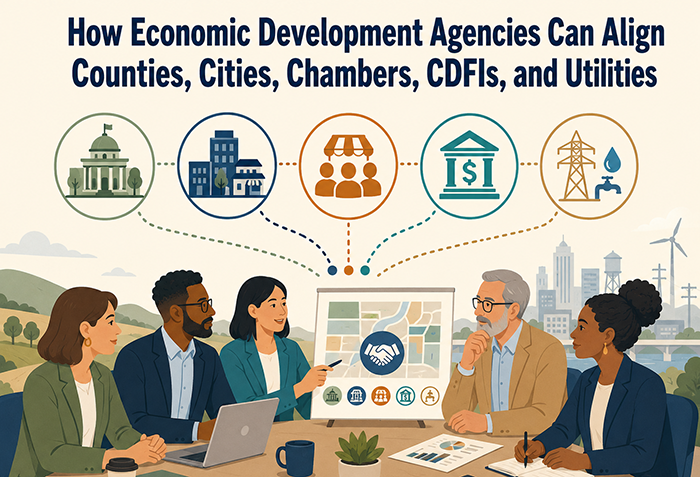
One Message Across Many Partners: How Economic Development Agencies Can Align Counties, Cities, Chambers, CDFIs, and Utilities
A business owner or developer trying to understand what economic development support is available in a region is navigating a landscape of organizations that simultaneously claim to be working toward the same goals and routinely give inconsistent answers to the same questions. The county economic development office describes a financing program differently than the city does. The chamber of commerce has a different understanding of the incentive eligibility criteria than the community development financial institution that administers one of the relevant programs. The utility’s economic development representative uses different terminology and cites different timelines than the regional development organization. The regional development organization’s website describes a program that the state changed the terms of eight months ago, but the update has not reached the regional partner yet.
The business seeking to navigate this landscape is not experiencing a single economic development ecosystem, however the organizations within it describe themselves as working together. They are experiencing a fragmented communication environment in which the information available about available resources depends entirely on which door they walked through first, which organization they happen to have a relationship with, and which staff member they happened to reach on the day they called. In this environment, access to accurate and complete information about available economic development resources is not a matter of need or eligibility. It is a matter of luck: the luck of reaching the right organization through the right channel at the right time.
Economic development agency leaders recognize this fragmentation as a problem and regularly commit to better coordination. What they less often recognize is that the coordination they are committing to is primarily a communication coordination problem that requires specific design rather than general intention. Good intentions among the agencies, chambers, CDFIs, and utilities in an economic development ecosystem do not automatically produce consistent messaging about programs, eligibility, and process. Consistent messaging requires deliberate architecture: shared message frameworks, partner toolkits built around consistent language, regular briefing cycles that propagate updates across the partner network, and governance mechanisms that identify and correct inconsistencies before businesses encounter them in the field.
This article examines how economic development agencies can build the message alignment infrastructure that allows a business to receive consistent, accurate, complementary information about available resources regardless of which organization in the ecosystem they contact first. It covers the design of shared message frameworks, the development of partner toolkits that operationalize those frameworks, the briefing and update disciplines that maintain alignment over time, and the governance structures that make message alignment a managed organizational practice rather than a periodic aspiration.
Why Message Fragmentation Persists Despite Good Intentions
 The persistence of message fragmentation across economic development partner networks is a structural problem that good intentions do not solve, and understanding its structural roots is the prerequisite for designing structural solutions. Each source of fragmentation is distinct and calls for a different design response, which is why an undifferentiated commitment to better coordination consistently produces less alignment than the commitment implied.
Organizational silos and vocabulary differences are the most foundational source of fragmentation. Each organization in an economic development ecosystem has its own internal vocabulary for describing what it does, developed over time through the professional frameworks, funding requirements, and organizational cultures that shape each organization’s work. A CDFI’s language for describing its loan programs reflects the CDFIF reporting requirements and community development finance industry conventions it operates within. A utility’s economic development language reflects the rate structure, power availability, and infrastructure investment considerations that shape its work. A city economic development office’s language reflects the municipal finance frameworks, local ordinance structures, and zoning and permitting processes that define its scope of work. When these organizations describe overlapping or complementary resources to the same business, using their respective professional vocabularies, the result is a set of descriptions that are individually accurate but collectively confusing because they do not use consistent terms for the same concepts.
Program update propagation failures are the second major source of fragmentation. Programs change: eligibility criteria are modified, funding is exhausted, new allocations are made, interest rates change, application processes are updated, and program administrators change. When these updates are not systematically propagated to the full partner network, the partners who were not updated continue communicating the prior version of the program, and the business that contacts different partners at different times receives different versions of the same program information. This is among the most damaging forms of message fragmentation because it produces direct misinformation rather than merely imprecision: a business that is told it qualifies for a program under outdated eligibility criteria and pursues an application based on that information has been actively misled, not merely inconsistently informed.
Relationship asymmetry is the third source of fragmentation, reflecting the reality that in most economic development ecosystems some organizations have direct and current relationships with every relevant program administrator while others have only secondhand or outdated knowledge of the full program landscape. A regional development organization that is actively engaged with every relevant state and federal program office, regularly participates in program administrator briefings, and has staff who are expert in the full range of available resources, is very differently positioned to communicate accurately about those resources than a local chamber of commerce that receives general economic development updates occasionally and may not have specific knowledge of program terms, eligibility, or process. Yet both organizations are part of the partner network that businesses encounter, and businesses have no reliable way to assess which partner’s information is more current or more accurate.
Competitive instincts, even in ostensibly collaborative ecosystems, create a fourth source of fragmentation. Organizations that compete for the same business relationships, for the same funding, or for recognition of their role in the same project outcomes, sometimes communicate about partner organizations’ programs less accurately or less completely than they communicate about their own. This is not usually deliberate misrepresentation but a natural consequence of the competitive dynamics that exist within any ecosystem of organizations with overlapping missions and limited resources, and it produces the particular form of fragmentation in which partner organization programs are either not mentioned, mentioned incompletely, or described less accurately than the organization’s own programs.
What Inconsistent Messaging Costs the Region
The costs of message fragmentation in an economic development ecosystem fall on both businesses and the agencies that are supposed to serve them, and those costs are significant enough to justify the investment required to address fragmentation systematically rather than tolerating it as an acceptable feature of a complex multi-organizational landscape.
For businesses, the primary cost is wasted time and missed opportunities. A business owner who receives inconsistent information from different partners about a program’s eligibility or process will spend additional time trying to reconcile the inconsistency, may contact multiple organizations seeking confirmation, and in some cases will decide not to pursue the program because the process appears more confusing and time-consuming than the benefit justifies. The business that ultimately reaches the right organization with the right information is the one with the most persistence or the best initial luck; the business that gives up because the information landscape was too confusing to navigate may be equally eligible and equally in need of the support.
For the economic development ecosystem itself, message fragmentation undermines the collective credibility of the network in ways that affect every organization within it. A business that receives inconsistent information from two organizations in the network does not conclude that one organization is reliable and the other is not. It concludes that the network itself cannot be trusted to provide accurate information, which reduces the likelihood that the business will engage with any organization in the network in the future without additional verification effort. This credibility damage is distributed across the network even when it originates with a specific organization’s outdated or inaccurate communication.
Growing Places: Communication Strategies for Economic Development and Public Finance Agencies
This article is part of our series on strategic communication for Economic Development organizations, including state and local economic development agencies, regional partnerships, and business attraction initiatives. To learn more and to see the parent article, which links to other content just like this, click the button below.
Building a Shared Message Framework
 A shared message framework is the foundational architecture for message alignment across an economic development partner network. It is not a set of talking points or a joint press release. It is a structured document that defines, for each significant program and resource available in the ecosystem, the agreed-upon language that all partner organizations will use to describe it when communicating with businesses, developers, and other stakeholders. This language is specific enough to be accurate, accessible enough to be usable by organizations without deep technical expertise in each program, and consistent enough across partner organizations that a business receives the same description of a program regardless of which partner they contact.
Developing a shared message framework requires bringing together the organizations that administer the relevant programs and the partner organizations that communicate about them, working through the description of each program together until a version is reached that each party can accurately represent and that each organization’s staff can deliver in a client conversation without needing to look up additional information. This process is more labor-intensive than having a single organization write a program guide and distribute it to partners, and it is substantially more effective, because the organizations that participate in developing the shared framework understand it better, are more committed to using it, and are more likely to identify when it needs to be updated because they are in direct contact with the programs it describes.
The shared message framework should cover, for each significant program: a plain-language program name that all partners will use rather than varying abbreviations or informal names that different organizations have developed independently; a one to two sentence program description that accurately describes what the program provides and who it serves; the key eligibility criteria stated in operational terms that a business can evaluate without expert guidance; the basic program parameters including size, rate, and terms at a level of specificity that allows an initial self-assessment of fit; the application process at a summary level including the first step a business should take to pursue the program; and the designated program administrator contact that all partners should direct businesses to when their interest has been confirmed. This level of specificity in the shared framework is what produces consistency in partner communication; a framework that provides only general guidance about each program will be interpreted differently by different partners, reproducing the fragmentation the framework was designed to address.
The shared message framework should also include explicit guidance about what each partner organization should and should not say about programs they do not administer. One of the most consistent sources of message fragmentation is partner organizations providing detailed information about programs administered by other organizations in the network, based on secondhand or outdated knowledge, when the accurate response would be to describe the program at the framework’s specified level of accuracy and then direct the business to the administering organization for current, specific information. Establishing this norm explicitly in the framework prevents the well-intentioned but inaccurate elaboration that partners sometimes provide when they want to be helpful but do not have current program knowledge.
Developing Partner Toolkits That Operationalize the Framework
A shared message framework that exists as a document but is not operationalized through materials that partners can actually use in their client work will not produce the message alignment it was designed to achieve. The message framework describes what partners should say. The partner toolkit provides the materials that make saying it practical in the specific contexts where each partner organization interacts with businesses.
The partner toolkit should include a quick reference card for each program in the framework, formatted for the kind of rapid consultation that occurs during a client conversation rather than for extended reading. A staff member at a chamber of commerce or a CDFI who is in a meeting with a business owner and wants to mention a relevant program should be able to find the accurate, current description in ten seconds, not by searching through a lengthy document. The quick reference card format, with program name, one-paragraph description, key eligibility criteria, and a direct contact for the administering organization, serves this in-conversation use case better than any other format.
Client-facing summary materials are a second toolkit element: one-page descriptions of specific programs or clusters of programs that partners can hand directly to a business owner during a conversation or follow-up communication. These materials should be designed and written by the program administrator or the lead agency, ensuring their accuracy, and formatted and cleared for distribution by all partner organizations, so that every business that receives program information from any partner in the network receives the same document rather than a partner-produced paraphrase that may introduce inaccuracies. Maintaining a current library of cleared, partner-distributable one-pagers for each significant program is an administrative investment that produces consistent program description across the partner network.
A partner referral guide identifies, for each program in the framework, the specific contact information and referral pathway that partners should use when directing a business to the program administrator. General references to contact the workforce development board or reach out to the small business development center are insufficient referral guidance because they do not tell the business which person to contact or what information to have ready when they do. A referral guide that provides a specific staff person’s name and contact information, describes what the business should be prepared to share in the initial conversation, and indicates the typical timeline from initial contact to program determination, gives partners the referral specificity that converts a program mention into an actual program connection.
Keeping Partner Materials Current
The most consistently underinvested element of partner toolkit management is the discipline of keeping materials current. Partner toolkits are typically developed during a period of organizational alignment effort, distributed to the partner network, and then left in place until the next alignment effort, while the programs they describe continue to evolve. The partner organization that uses a toolkit program description developed eighteen months ago to advise a business about a program that has since changed its eligibility criteria or interest rate structure is providing inaccurate information regardless of how carefully they are using the toolkit as their reference.
Maintaining current partner materials requires designating specific ownership for each program’s description in the toolkit, establishing a review cycle that checks all toolkit materials against current program parameters at least annually and immediately whenever a program change occurs, distributing updates to the partner network through a reliable channel and in a format that makes it clear what has changed and when, and maintaining a version-dating system that allows partners to identify whether they are using the most current version of any given material. This maintenance discipline is more demanding than the initial toolkit development, and it is more important, because the toolkit that is accurate when distributed and then becomes inaccurate over time is worse in some respects than no toolkit at all, because it provides partners with a false confidence in the accuracy of information they should be independently verifying.
Regular Briefing Cycles as the Engine of Alignment
Toolkits and shared message frameworks provide the content architecture of message alignment, but they cannot sustain alignment on their own over time, because the organizations that use them are subject to staff turnover, competing priorities, and the natural drift that occurs when organizations use materials without regular reinforcement of the underlying understanding those materials are built on. Regular briefing cycles are the mechanism that maintains alignment by ensuring that the organizations in the partner network periodically refresh their understanding of the programs they describe, learn about relevant program changes before those changes produce misinformation in the field, and maintain the relationship with program administrators and with each other that makes the shared framework feel like a genuine collaborative resource rather than a static document.
The frequency and format of partner briefings should be calibrated to the pace of change in the program landscape and the communication norms of the partner network. A quarterly briefing call of thirty to forty-five minutes that covers all significant program updates, reminds partners of the shared framework’s key content, and allows partners to raise questions about specific client situations they have encountered, maintains alignment with a time investment that most partner organizations can sustain without significant burden. Annual in-person convenings that allow deeper relationship building and more extended discussion of program strategy and partner coordination challenges supplement the quarterly calls with the face-to-face interaction that sustains organizational relationships across a multi-institution network.
The structure of the briefing should be consistent enough that partners know what to expect and what they are responsible for preparing, and specific enough about program changes that partners leave each briefing with a clear understanding of what has changed and how that affects the information they should be providing to businesses. A briefing that opens with a review of significant program changes since the last meeting, proceeds through a structured discussion of any shared framework updates those changes require, includes time for partner questions about specific client situations, and closes with a reminder of the shared referral pathways and toolkit resources, is a format that produces the alignment maintenance function the briefing is designed to serve.
Governance Structures That Sustain Message Alignment Over Time
Message alignment across an economic development partner network is an ongoing organizational discipline that requires governance structures, not just a coordination effort. Without governance, alignment achieved at one point in time will decay as programs change, staff turn over, organizational priorities shift, and the partner network evolves through the addition of new organizations and the departure of existing ones. Governance structures convert message alignment from a periodic project into a sustained organizational practice.
The most effective governance structures for message alignment designate clear ownership of the coordination function rather than distributing it across the network as a shared but unassigned responsibility. A lead organization, typically the regional economic development organization, the state economic development agency, or another organization with the network position and the organizational capacity to maintain the coordination role, takes explicit responsibility for the shared message framework, the partner toolkit, the briefing cycle, and the monitoring of message consistency across the partner network. This designation is more effective than rotating responsibility across partner organizations or treating the coordination function as a joint responsibility that no organization owns specifically, because responsibilities that are jointly held tend to be inconsistently performed.
Monitoring message consistency requires a mechanism for identifying when partner organizations are communicating about programs in ways that diverge from the shared framework, which requires some visibility into what partners are actually saying rather than only into what the framework specifies they should say. Mystery shopping exercises, in which a trained evaluator contacts partner organizations posing as a business seeking program information and evaluates the accuracy and consistency of the response against the framework, provide direct evidence of alignment quality that self-reported partner compliance cannot. Client feedback surveys that ask about the consistency and accuracy of information received from different organizations in the network provide a business-perspective view of alignment quality that complements the mystery shopping evidence. Periodic review meetings in which partners share examples of client conversations that revealed framework gaps or inconsistencies provide qualitative intelligence about where the framework needs to be strengthened.
Governance structures should also include a defined process for onboarding new partner organizations into the shared message framework, because partner networks change over time as organizations join, leave, merge, or shift their focus, and new organizations that enter the network without structured onboarding into the shared framework will either produce message fragmentation through their independent communication practices or will rely on secondhand accounts of the framework from existing partners, which introduces the risk of the framework being transmitted inaccurately as part of the onboarding process. A standard onboarding packet, a required onboarding briefing with the lead coordination organization, and a check-in during the new organization’s first quarter of network participation establish the message alignment foundation for new partners more reliably than informal introduction to the framework through existing partner relationships.
Managing Message Alignment During Economic Development Controversies
The message alignment challenge is most acute during periods of controversy around specific economic development projects or decisions, when partner organizations may be tempted to distance themselves from a controversial project by communicating about it differently than the lead agency is, or when community opposition is driving a media narrative that creates pressure on partner organizations to modify or qualify their support for a project they have previously endorsed. Inconsistent partner messaging during a controversy amplifies the controversy by creating the appearance that the economic development community itself is divided on the project, which is both substantively inaccurate in most cases and strategically damaging to the project’s eventual success.
Managing message alignment through controversies requires having established the communication coordination infrastructure before the controversy arises, because building it in response to a specific controversy under media and community pressure is extremely difficult and inevitably slower than the controversy demands. A partner network with an established shared message framework, a functional briefing cycle, and a designated coordination lead, is equipped to convene a rapid partner briefing when a controversy breaks, align partner messaging around an agreed-upon response to the specific controversy, and maintain that alignment through the period of public scrutiny. A partner network without that infrastructure will produce the fragmented messaging that amplifies the controversy rather than containing it.
Strategic Communication Support for Economic Development Agencies
 Building and maintaining message alignment across a multi-partner economic development ecosystem is one of the most demanding communication challenges in the field, partly because it requires organizational cooperation across institutions with distinct missions, cultures, and competitive interests, and partly because it requires sustained investment in the maintenance disciplines that prevent alignment from decaying between the periodic coordination efforts that most organizations substitute for genuine governance. The agencies that have built genuine message alignment across their partner networks have done so through specific, deliberate organizational choices: designating a coordination lead, investing in the development of shared frameworks and partner toolkits, establishing regular briefing cycles, and building governance structures that sustain the function rather than relying on organizational goodwill.
Stegmeier Consulting Group (SCG) helps economic development agencies build the message alignment infrastructure that produces consistent, accurate, complementary communication across partner networks of counties, cities, chambers, CDFIs, utilities, and other ecosystem organizations. That support may include shared message framework development, partner toolkit design, briefing cycle design and facilitation, monitoring and measurement framework development, governance structure design, partner onboarding protocol development, controversy communication alignment support, and partner network assessment that identifies the specific sources of current message fragmentation and their appropriate design responses.
The goal of this work is an economic development ecosystem in which a business that contacts any partner organization in the network receives information that is consistent, accurate, and complementary with what they would receive from any other partner, because the network has built the architecture that makes consistency possible rather than relying on individual organizational goodwill to produce it spontaneously.
Future Trends in Multi-Partner Message Alignment
The multi-partner coordination challenge in economic development communication is evolving in response to changes in the organizational landscape of economic development, the technology available for coordination, and the increasing sophistication of the businesses seeking resources.
Digital coordination platforms are reducing the transaction cost of keeping partner networks aligned on program information by enabling real-time updates, shared resource libraries, and notification systems that alert partners when program information in the shared library has been updated. Organizations that invest in these platforms can maintain partner alignment at significantly lower ongoing cost than organizations that rely on email distribution of updated materials, periodic in-person meetings, and informal relationship maintenance. The platform investment converts what would otherwise be a high-maintenance coordination function into a more automated one, without eliminating the relationship and governance dimensions that platforms alone cannot provide.
The proliferation of economic development organizations and programs is increasing the complexity of the coordination challenge by expanding the number of organizations and programs that need to be included in a coherent shared message framework. As new programs are created, new organizations are established, and existing organizations expand their scope, the framework must expand accordingly, which requires the coordination infrastructure to be scalable rather than built around a fixed set of partners and programs. Organizations that design their coordination governance with scalability in mind, with clear processes for onboarding new partners and adding new programs to the shared framework, are better positioned to maintain alignment as the ecosystem grows.
Business sophistication and digital access mean that businesses are increasingly likely to encounter information about economic development resources through multiple channels before contacting any partner organization, and that the information they encounter through these channels, including state and federal program websites, industry association resources, and peer business networks, may or may not be consistent with what the local partner network communicates. This expanded information environment raises the importance of ensuring that local partner communication is consistent with the broader program information landscape, and creates a new coordination challenge: aligning not just the messages of organizations within the local partner network but ensuring that the local network’s communication is consistent with how programs are described at the state and federal level where businesses are increasingly likely to first encounter them.
Conclusion
A business that contacts an economic development partner organization for information about available support should receive information that is accurate, consistent with what any other organization in the network would provide, and specific enough to allow the business to evaluate the program’s relevance to their situation and take a clear next step. The fragmented communication environment that most economic development ecosystems currently produce does not meet this standard, and the gap between the standard and the current reality is not primarily a matter of organizational will or individual competence. It is a matter of communication architecture: the shared frameworks, partner toolkits, briefing cycles, and governance structures that make consistent messaging possible across a multi-organization network.
Building this architecture requires sustained organizational investment that goes beyond the periodic coordination meetings and goodwill commitments that most ecosystems currently substitute for genuine message alignment governance. It requires designating clear ownership, developing specific shared frameworks and materials, maintaining those materials through regular update cycles, and building governance mechanisms that monitor and correct message inconsistencies when they arise. Agencies that make this investment build something their partner businesses can rely on: an economic development ecosystem that functions as a genuine network rather than a collection of independent organizations with occasionally overlapping missions and consistently inconsistent messages.
SCG’s Strategic Approach to Communication Systems
Align your agency’s messaging, processes, and public engagement strategies.
Economic development agencies need message alignment infrastructure that produces consistent, accurate communication across partner networks of counties, cities, chambers, CDFIs, utilities, and other ecosystem organizations. That means shared message frameworks that define the agreed-upon language all partners use to describe programs, partner toolkits that operationalize those frameworks in materials partners can use in client work, regular briefing cycles that propagate program updates and maintain partner alignment, governance structures with clear ownership of the coordination function, monitoring mechanisms that identify message inconsistencies before businesses encounter them, and partner onboarding protocols that bring new network members into the shared framework efficiently.
SCG helps economic development agencies build the message alignment infrastructure that makes a multi-partner ecosystem function as a coherent network rather than a collection of independently communicating organizations. Whether your agency needs shared framework development, partner toolkit design, briefing cycle facilitation, governance structure development, or network assessment, SCG can help you build the architecture that produces the consistency your businesses deserve and your network’s collective credibility requires.
Use the form below to connect with our team and explore how strategic message alignment can help your agency build an economic development partner network that gives every business the same accurate, consistent information regardless of which door they walk through first.