
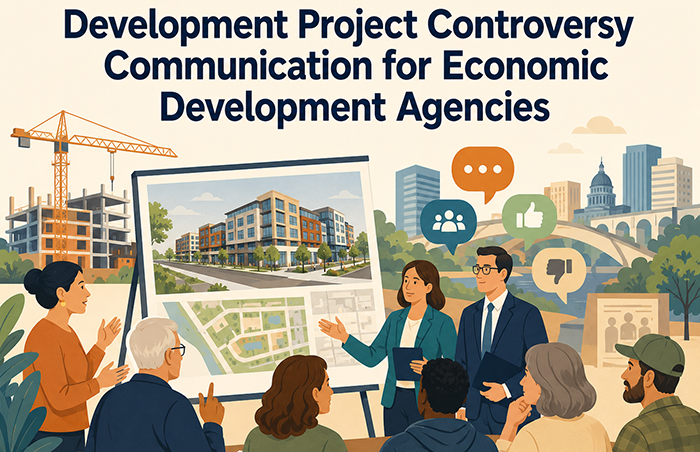
Development Project Controversy Communication for Economic Development Agencies: What to Say When Incentive Deals Face Backlash
Every economic development agency that operates at sufficient scale will eventually face a moment that tests everything its communication practices have built. A major incentive deal announced with fanfare becomes the subject of organized community opposition. A project with genuine public benefit gets reframed in the press as a giveaway to a developer. A tax abatement the agency believed was straightforward is characterized by a newly elected official as exactly the kind of corporate welfare they ran against. A neighborhood is promised economic revitalization and asks why none of the promised jobs have materialized three years later. These moments are not failures of economic development strategy. They are failures of communication strategy, and in many cases they are failures that were entirely predictable and preventable with the right preparation.
The instinct in many economic development agencies when controversy erupts is to communicate defensively: to release a statement emphasizing the project’s benefits, to point to the public record showing all required approvals were properly obtained, to highlight the economic projections that supported the incentive decision, and to wait for the controversy to subside. This instinct is understandable, but it consistently produces worse outcomes than a more proactive and more honest approach, because it treats the controversy primarily as a public relations problem to be managed rather than as a communication failure to be corrected.
Controversy around economic development incentive deals almost always has a legitimate communication failure at its root. The project’s benefits were described in promotional terms that did not distinguish projections from commitments. The trade-offs involved in the incentive decision, the costs the agency accepted in exchange for the benefits it expected, were never communicated publicly. Community members in the affected area were not engaged before the decision was made in a way that would have allowed them to shape its terms or at minimum understand what was being decided and why. Elected officials who are now being asked to defend the decision were not given clear materials that would have prepared them for public questions. The communication that would have made the controversy less likely to erupt, or less severe when it did, was never produced.
This article examines how economic development agencies can prepare for, navigate, and recover from controversy around incentive deals and development projects, through communication that is honest, specific, prepared in advance, and organized around the agency’s genuine accountability to the public it serves rather than around its interest in being perceived favorably. It treats controversy communication not as a crisis management exercise but as the test of whether the agency’s broader communication practices have built the credibility and the relationships that allow honest engagement with a skeptical public.
Why Controversy Erupts and What the Agency’s Communication Has to Do With It
 Controversy around economic development projects does not typically emerge from nowhere. It emerges from a specific combination of communication failures that create the conditions in which opposition can organize, media narratives can take hold, and public skepticism can convert into political resistance. Understanding the specific communication failures that most commonly precede controversy is the starting point for building the communication practices that make controversy less likely and less severe when it does occur.
The announcement-without-context failure is the most common antecedent to economic development controversy. A project is announced at a press conference with the mayor and the developer, emphasizing the job numbers and the investment figure, with no prior public communication about the incentive, what it involves, and why the agency concluded it was warranted. Community members who hear about the project for the first time at the press conference or from media coverage of it have no basis for evaluating the decision except the promotional framing of the announcement, which immediately invites the counter-framing that the decision was made without community input, that the jobs numbers cannot be trusted, and that the developer is receiving public money they did not need. The agency that had a perfectly defensible decision and made it through a thorough public process has produced a public introduction to that decision that made all of these critiques possible.
The projection-as-commitment failure is the second most common antecedent. An agency announces a project citing the economic impact analysis’s total economic impact projection, including direct, indirect, and induced jobs, as though those figures represent what the project will deliver. When the project opens with a fraction of the projected employment and the induced jobs prove to be a model output that no one can point to in the actual economy, the agency faces the accusation of having oversold the project’s benefits, which is accurate. The jobs were projected, not promised, and the communication failed to make that distinction clearly, which means the agency created an expectation it was not in a position to enforce or deliver.
The community exclusion failure is the third common antecedent. A project that significantly affects a specific neighborhood, displaces existing uses, changes the character of an area, or raises costs for existing residents and businesses is planned and approved without meaningful engagement with the people most directly affected. When those people learn about the project and experience its effects, their sense of exclusion from the decision-making process that produced those effects is entirely legitimate, and their opposition to the project or to the agency that approved it is a rational response to having been treated as objects of economic development rather than participants in it. The agency’s communication response to this opposition, which typically emphasizes the project’s benefits and the legitimacy of the approval process, does not engage with the actual concern, which is not whether the process was procedurally correct but whether the community that bears the project’s costs had meaningful input into its terms.
The accountability gap failure is the fourth common antecedent. Prior projects in the same area or from the same agency were approved with benefit promises that were not monitored, enforced, or communicated publicly after approval. The community’s experience of economic development is that promises are made before approval and forgotten afterward, and the new project arrives in that context rather than in a context of established credibility. The agency’s communication about the new project’s benefits is filtered through the community’s memory of prior projects that did not deliver, and no amount of current project communication can address that underlying credibility deficit without also acknowledging and addressing it directly.
The Specific Forms That Controversy Takes and What Each Demands
Economic development project controversy takes several distinct forms, and each form demands a somewhat different communication response because each represents a different underlying concern that generic crisis messaging will not address. Identifying the specific form of the controversy before designing the response is the first analytical step in effective controversy communication.
Process legitimacy controversy arises when critics claim that the decision was made improperly: that the required approvals were not obtained, that the public process was inadequate, that information was withheld from decision-makers, or that the decision-making was influenced by inappropriate relationships between the agency and the developer. This form of controversy requires a communication response that documents the actual process: specifically, what approvals were obtained, what public engagement occurred, what information was provided to decision-makers, and what relationships exist between the relevant parties. The documentation must be specific and verifiable rather than general, because a general defense of process integrity is no more credible than a general critique of it.
Benefit adequacy controversy arises when critics accept that the process was legitimate but contest whether the public benefit received justifies the public cost. This form of controversy requires a communication response that engages directly with the benefit-cost question: what specifically is the agency receiving in exchange for what specifically it is giving, why the agency concluded that the exchange was favorable, and how the agency will know over time whether that judgment was correct. The honest version of this response sometimes requires acknowledging that the decision involved genuine uncertainty and genuine trade-offs, which is more credible than a defense that treats the deal as obviously and incontrovertibly beneficial.
Community impact controversy arises when critics, often from the affected neighborhood, contest the project’s impact on existing residents, businesses, and community character. This form of controversy requires a communication response that engages with the specific community impacts being raised, not with the project’s aggregate economic benefits. A response that says the project will create hundreds of jobs and generate millions in economic activity to a community that is worried about being displaced by rising rents is not engaging with the concern. The communication that is required here is about what specifically is being done to protect existing residents and businesses, what commitments the developer has made about affordable housing, local hiring, or small business support, and how those commitments are being monitored and enforced.
Growing Places: Communication Strategies for Economic Development and Public Finance Agencies
This article is part of our series on strategic communication for Economic Development organizations, including state and local economic development agencies, regional partnerships, and business attraction initiatives. To learn more and to see the parent article, which links to other content just like this, click the button below.
Preparing for Controversy Before It Erupts
The most effective controversy communication is the communication that was produced before the controversy began, in the form of plain-language project summaries, honest accountability frameworks, clear community engagement records, and elected official briefings that prepared decision-makers to explain and defend the project’s merits rather than discovering its critics’ arguments from media coverage. Agencies that have done this preparatory communication work are equipped to respond to controversy from a position of documented credibility. Agencies that have not done it must build their factual record under pressure, in a communication environment where everything they produce is viewed as motivated self-defense rather than honest accounting.
Controversy preparedness assessment should be a standard element of every significant incentive decision process, identifying the specific arguments that critics of the project are most likely to make, the factual record that supports the agency’s position on each of those arguments, and the gaps in that factual record that need to be addressed before a controversy forces the issue. This assessment should be conducted before the project is announced, while there is still time to produce the communication materials that close the gaps, to conduct additional community engagement that addresses predictable community concerns, and to brief elected officials on the arguments they will face so that their public defense of the project does not catch them unprepared.
The plain-language project summary, described in detail elsewhere in this content series, is the single most important controversy preparedness document an agency can produce, because it establishes a clear, honest, publicly available record of what was approved, what the public cost and benefit were, what commitments the developer made, and how those commitments will be monitored. An agency that has produced a thorough plain-language project summary before the project announcement has a document it can point to immediately when a controversy erupts that demonstrates it communicated clearly and honestly about what it approved. An agency that has not produced such a summary must produce it under pressure, which creates the appearance that it is responding to criticism rather than maintaining an established transparency practice.
Stakeholder mapping and engagement, conducted before major project announcements, identifies the community members, organizations, and individuals most likely to oppose the project and most important to engage before their opposition becomes public. Engaging predictable critics before a project announcement is not co-optation. It is a demonstration of genuine openness to the concerns those critics represent, and in many cases it produces community benefit provisions and project modifications that make the project more defensible because they reflect genuine responsiveness to community concerns rather than post-announcement damage control. An agency that approached a community before announcing a major project in their neighborhood, explained what was being proposed, solicited feedback, and incorporated reasonable concerns into the project’s terms, is in a fundamentally different position when controversy erupts than one that announced the project and then engaged the community in response to their opposition.
What to Say When Controversy Erupts
 When controversy around an economic development project erupts despite preparatory communication work, the agency’s initial response determines the trajectory of the controversy more than any subsequent communication. A response that is defensively promotional, technically detailed, or dismissive of critics’ concerns will intensify the controversy by confirming the impression that the agency is more interested in defending its position than in engaging honestly with the public. A response that is specific, honest, and genuinely engaging with the concerns being raised will, in many cases, reduce the controversy’s intensity by demonstrating that the agency takes accountability seriously.
The initial response to controversy should acknowledge the specific concerns being raised before defending the project, because a defense that does not acknowledge the concern it is responding to is not engaging with critics and will not persuade the undecided public that the agency has heard and considered the criticism. Acknowledging the concern does not mean conceding its validity. It means demonstrating that the agency understands what is being said and is prepared to engage with it specifically rather than responding with a generic restatement of the project’s benefits.
The substantive response should be organized around the specific factual record that supports the agency’s position, not around the agency’s assessment of its own conduct. A response that says we conducted a rigorous and transparent process that followed all required approvals is less credible than one that says the project was reviewed by a list of specific bodies and received approvals in specific forms after a public process that included specific dates of community meetings, and that specific community benefit provisions were added to the development agreement in response to community input received at a specific date. The factual specificity is what distinguishes an accountable response from a self-serving one, and that distinction is what the undecided public is evaluating when they assess the controversy.
The agency’s response should also address what it will do differently, if anything, in response to the controversy. If the controversy has revealed genuine gaps in the agency’s communication practice, such as insufficient community engagement before announcement, inadequate distinction between projections and commitments, or insufficient monitoring and reporting on prior project performance, acknowledging those gaps and committing to specific improvements is both the honest response and the strategically effective one. An agency that responds to controversy by defending everything it did without acknowledging any room for improvement invites the conclusion that it views accountability as a threat rather than as a standard. An agency that responds by acknowledging specific gaps and committing to specific improvements demonstrates the self-awareness that makes future trust possible.
Communicating When the Agency Made a Mistake
Some economic development project controversies arise not from communication failures around a sound decision but from decisions that were in some respects genuinely wrong: projections that were too optimistic, commitments that were inadequately monitored, community engagement that was genuinely insufficient, or incentive terms that in retrospect were more generous than the facts supported. These situations require a different kind of communication than controversies around sound decisions that were poorly communicated, because the factual record does not support a defense of the decision itself and attempting to mount that defense will be both unsuccessful and credibility-damaging.
Acknowledging mistakes in economic development is among the most difficult communication challenges agencies face, both because institutions are culturally resistant to public acknowledgment of error and because the legal environment around public finance decisions creates legitimate concerns about the implications of admissions. These concerns are real and must be navigated with the agency’s legal counsel. But they are not a justification for sustained public defense of decisions that cannot be defended on the merits, because the reputational cost of that defense, if and when the facts become fully public, is substantially greater than the cost of an honest, specific acknowledgment of what went wrong.
The communication standard for mistakes is honesty about what happened, specific rather than general, combined with specific commitments about what the agency will do differently as a result. The combination of honest acknowledgment and specific commitment to improvement is what converts a damaging controversy into a credibility-building moment, because it demonstrates the institutional honesty that makes future decisions trustworthy even when they turn out to be wrong.
Managing Controversy Across Multiple Communication Channels
Economic development project controversies play out simultaneously across multiple communication channels, including news media coverage, social media, community meetings, public hearings, political communication from elected officials, and direct communication from community organizations and advocacy groups. Managing the controversy effectively requires a communication strategy that addresses each of these channels with consistent, coordinated messaging rather than allowing different parts of the agency to respond to each channel independently with potentially inconsistent messages.
Media engagement during a controversy requires providing journalists with the specific, factual record that supports the agency’s position, along with clear and direct availability for follow-up questions. Agencies that are unavailable to journalists during a controversy cede the informational field to the critics, whose narrative then fills the coverage gap. Agencies that are available, specific, and willing to engage honestly with the hardest questions produce better coverage than those that provide only prepared statements because the journalists’ access to the full record, including information that supports the agency’s position, produces more complete reporting than a statement-only communication approach.
Social media during a controversy is a channel that agencies often mismanage by either ignoring it entirely or by engaging every critical comment with a defensive response that amplifies the controversy rather than containing it. A more effective approach acknowledges that social media is a relevant channel for controversy communication, maintains a consistent factual record of the agency’s position available for sharing, and engages substantively with specific factual misrepresentations rather than with every critical or emotional reaction. The goal of social media engagement during a controversy is not to win arguments but to ensure that the factual record is visible and accessible to people who are following the controversy and forming their own assessments.
Community meetings convened during a controversy are the channel where the agency’s genuine accountability to the public it serves is most directly tested, because a community meeting is a face-to-face encounter with the people who are most affected by the project and most skeptical of the agency’s account. The communication discipline required for effective community meeting engagement during a controversy is primarily about listening rather than presenting: genuinely hearing what community members are saying, acknowledging the specific concerns they raise rather than redirecting to the project’s general benefits, and making specific commitments about what will happen as a result of what is heard. Agencies that approach community meetings during controversies as opportunities to defend their position rather than as opportunities to hear the community’s genuine concerns consistently make the controversy worse rather than better.
The Role of Long-Term Communication Practice in Controversy Resilience
The agencies most resilient to economic development controversy are not those that have the best crisis communication teams. They are those whose long-term communication practices have built the credibility and the relationships that allow the public to extend reasonable good faith to the agency when a specific decision is challenged. This resilience is built through the consistent practices described throughout this content series: plain-language incentive summaries, honest accountability reporting, meaningful community engagement before decisions are made, clear distinction between projections and commitments, and genuine follow-through reporting that allows the public to evaluate whether prior decisions delivered what they promised.
An agency that has built this communication practice over time is in a fundamentally different position when a project is challenged than one that has not. The long-term communication record demonstrates a pattern of honesty and accountability that makes the agency’s current position on a specific challenged project more credible, because the public can evaluate it against a history of honest reporting rather than against no prior record at all. The community relationships built through genuine engagement on prior projects provide social capital that reduces the intensity of opposition on new projects, because community members who have experienced the agency as a genuine partner are less likely to assume the worst about a new decision than those who have no prior relationship.
Building this long-term communication practice is not primarily a controversy avoidance strategy, though it does make controversies less likely and less severe. It is the communication standard that honest, accountable economic development practice demands on its own terms, and the controversy resilience it produces is a benefit that compounds over time as the practice is sustained and as the agency’s communication track record accumulates.
Strategic Communication Support for Economic Development Agencies
 Development project controversy communication is one of the highest-stakes communication challenges in economic development, and it is one where the quality of prior communication practice most directly determines the quality of the current response. Agencies that have built genuine transparency and accountability practices before a controversy erupts are equipped to respond from strength. Agencies that have relied on promotional communication and minimal accountability disclosure are equipped only to defend a position that the factual record may not fully support.
Stegmeier Consulting Group (SCG) helps economic development agencies build both the long-term communication practices that reduce controversy likelihood and the controversy response frameworks that manage specific challenges effectively when they occur. That support may include controversy preparedness assessment, plain-language project summary development, community engagement strategy for high-risk projects, elected official briefing and preparation, initial response framework development, multi-channel controversy communication strategy, factual record organization for media and public engagement, and post-controversy communication including honest acknowledgment of gaps and specific improvement commitments.
The goal of this work is an agency that approaches public controversy around its decisions from a position of established credibility and specific factual documentation, that responds to criticism honestly and specifically rather than defensively, and that uses controversy as an opportunity to demonstrate the accountability standards that make the agency’s future decisions trustworthy to the public it serves.
Future Trends in Development Project Controversy Communication
The controversy environment for economic development agencies is evolving in ways that raise both the stakes and the demands of effective controversy communication. Several trends are shaping the direction of that evolution.
Social media has fundamentally changed the speed and scale at which economic development controversies develop and spread. A project announcement that would have generated a week of local newspaper coverage and a community meeting can now generate thousands of social media interactions within hours, reaching audiences far beyond the local community and creating a public record of the controversy that is searchable and permanent. Agencies that have not built the digital communication infrastructure and the real-time response capabilities that this environment demands will consistently find themselves behind in controversies that develop faster than their traditional communication timelines can accommodate.
Investigative journalism focused on economic development incentives has become more sophisticated and more prevalent, with reporters at major and regional publications developing specific expertise in public finance, data analysis, and policy evaluation that allows them to identify and document project failures, inflated projections, and inadequate accountability mechanisms more rigorously than general assignment reporting has historically been able to do. Agencies whose communication has not met the standard this journalism will apply are increasingly vulnerable to the specific form of controversy that well-researched investigative reporting creates: one that is not based on community opposition but on documented factual gaps between what was claimed and what occurred.
Community organizing capacity around economic development issues is growing, with neighborhood organizations, housing advocates, and equity-focused coalitions developing more sophisticated analytical capacity, more effective communication strategies, and more sustained engagement with economic development decisions than earlier generations of community opposition. The agencies best positioned to navigate this environment are those that have engaged these communities as genuine partners in the economic development process rather than as obstacles to be managed, because the relationships built through genuine partnership are the most effective protection against the kind of organized community opposition that well-resourced advocacy organizations can generate.
Conclusion
Development project controversy is not an aberration in economic development practice. It is a recurring feature of the field, reflecting the genuine tensions between public resource allocation, private benefit, community impact, and political accountability that make economic development decisions inherently contestable. Agencies that approach this reality by building communication practices designed to minimize transparency and contain controversy when it erupts will face recurring crises that leave the agency’s credibility somewhat more depleted than before. Agencies that approach it by building communication practices designed to maximize transparency and maintain accountability will face controversies that are less frequent, less intense, and less damaging because the credibility they have built through honest communication is a genuine asset that sustains them through even legitimate challenges.
The specific practices described in this article, controversy preparedness assessment, plain-language project summaries, genuine community engagement before decisions, specific factual responses to criticism, honest acknowledgment of mistakes, and long-term accountability communication, are not primarily controversy management tools. They are the practices that honest, accountable economic development communication requires on its own terms. The controversy resilience they produce is a benefit of doing communication right, not a strategy for avoiding accountability.
SCG’s Strategic Approach to Communication Systems
Align your agency’s messaging, processes, and public engagement strategies.
Economic development agencies need controversial communication practices built on long-term transparency rather than reactive crisis management. That means plain-language project summaries produced before announcements, not after controversies erupt. It means genuine community engagement that happens before decisions are made, not in response to opposition. It means elected official briefings that prepare leaders for the specific arguments they will face. It means honest, specific initial responses that acknowledge concerns before defending positions. And it means post-controversy communication that commits to specific improvements when gaps are found, rather than defending everything that was done.
SCG helps economic development agencies build the long-term communication practices and the controversy response frameworks that allow them to navigate public challenges from a position of established credibility rather than reactive defense. Whether your agency needs controversy preparedness assessment, plain-language project summary programs, community engagement strategy, official briefing preparation, or multi-channel controversy response frameworks, SCG can help you build the communication foundation that makes accountability a strength rather than a vulnerability.
Use the form below to connect with our team and explore how strategic controversy communication can help your agency maintain public trust through the challenges that inevitably arise when public resources are allocated to development decisions.