
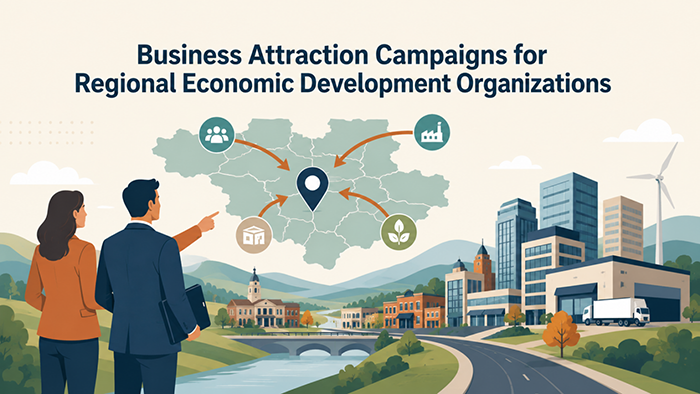
Business Attraction Campaign Communication for State Economic Development Organizations: Building a Sector Story That Local Partners Can Actually Use
State economic development organizations invest enormous resources in business attraction. They fund marketing campaigns, develop sector strategies, attend trade shows, commission research, and build relationships with site selectors and corporate real estate professionals. Yet many of these investments produce campaigns that work reasonably well at the state level and fall apart the moment they reach the local delivery network. A sector story that sounds compelling in a state brochure becomes uncertain and inconsistent when a regional development authority, a county economic development director, or a municipal official tries to tell it to a prospect.
This gap between state-level campaign development and local delivery is one of the most persistent problems in economic development communication. It is not primarily a marketing problem or a branding problem. It is a structural communication problem rooted in how states build sector stories and whether those stories are designed to be used by partners who work at a different scale, serve different geographies, and interact with prospects in real conversations rather than polished presentations.
A business attraction campaign that produces a sector story local partners can actually use requires more than a tagline, a landing page, and a set of fact sheets. It requires a message architecture that works at multiple levels of specificity, proof points that partners can verify and deploy, message discipline that holds up under prospect scrutiny, and a clear relationship between the statewide sector story and the regional and local stories partners need to tell. This article examines what that kind of campaign looks like and why it produces better outcomes than generic state branding efforts that give local partners little to work with.
Why State Business Attraction Campaigns Underdeliver
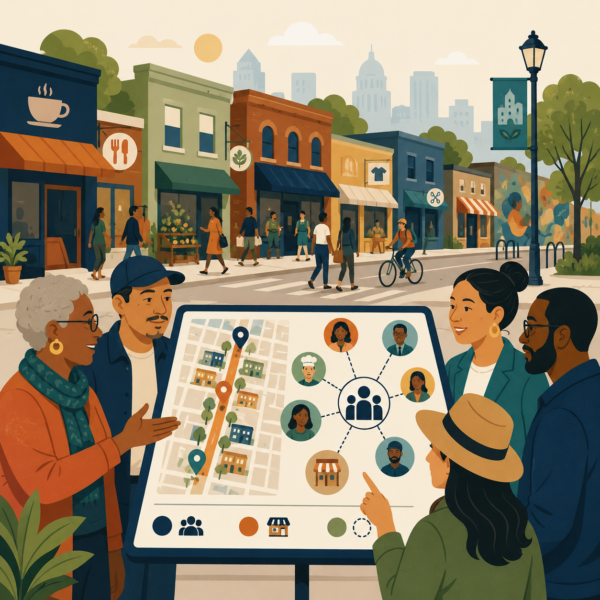 State economic development campaigns often fail not because the underlying economic case is weak but because the message is built around what the state wants to say rather than what prospects need to hear. There is a persistent tendency in state-level economic development marketing to lead with geography, climate, lifestyle, and quality of life, attributes that matter to individual executives making relocation decisions but that rarely drive corporate site selection at the first stage of the process. Before lifestyle enters the picture, a site selector or corporate real estate professional is asking whether the state has the workforce, the infrastructure, the regulatory environment, the supply chain, and the incentive structure to support a specific kind of investment.
When a campaign does not answer those questions with specificity and evidence, it falls into the same generic register as every other state’s pitch. Claims about a business-friendly environment, a talented workforce, and a strategic location describe nearly every state in some form. A sector-specific message built around verifiable strengths, documented industry presence, and credible workforce data stands apart from that generic noise.
There is also a tendency to build campaigns primarily for consumption at the state level, in trade publications, at national conferences, and in direct outreach to large corporate targets, without thinking carefully about how local and regional partners will use the same message in their own conversations. A state economic development organization may have a communications team capable of telling a sophisticated sector story, but if that story does not translate into language a county economic development director can use in a conversation with a prospect who is also looking at three other states, the campaign has failed at the moment that matters most.
The Local Delivery Problem
The local delivery problem is structural. State economic development organizations typically have more resources, more research capacity, and more direct access to sector data than their local and regional partners. They can build a strong initial sector narrative. But the actual prospect experience often happens at the local level, where a regional development authority or a municipal economic development office is coordinating site visits, answering logistical questions, connecting prospects with workforce development contacts, and managing the day-to-day conversation that determines whether a prospect stays interested.
If those local partners are working from their own improvised version of the state’s sector story, the prospect hears a different message at every level. The state pitch emphasizes one cluster of strengths. The regional pitch emphasizes a different set of assets. The local pitch focuses on site-specific features. None of these is wrong, but together they produce a fragmented narrative that can leave prospects uncertain about what the state’s sector story actually is.
The solution is not to centralize all prospect communication at the state level. The solution is to build a sector story that has enough structure to hold consistency at every level while leaving room for regional and local partners to add the specific assets and proof points relevant to their geography. That requires deliberate message architecture, not just a strong state campaign.
Growing Places: Communication Strategies for Economic Development and Public Finance Agencies
This article is part of our series on strategic communication for Economic Development organizations, including state and local economic development agencies, regional partnerships, and business attraction initiatives. To learn more and to see the parent article, which links to other content just like this, click the button below.
Building a Sector Story on Verifiable Strengths
The foundation of an effective sector story is verifiable sector strength. Claims that cannot be substantiated with data, documented industry presence, or specific workforce evidence will not hold up under prospect scrutiny. Site selectors and corporate real estate professionals routinely press on the specifics behind state claims. If the state says it has a strong advanced manufacturing workforce and cannot quickly produce data on certified technicians, apprenticeship program enrollment, community college manufacturing program capacity, or regional wage benchmarks, the claim evaporates.
Verifiable sector strength starts with an honest assessment of what the state actually has. That assessment should identify documented concentrations of companies in the target sector, including both anchor employers and supply chain depth. It should include specific workforce data tied to the occupational categories most relevant to prospect companies in that sector. It should include infrastructure and site inventory that matches the physical requirements typical of sector investment, whether that means available industrial land, three-phase power, rail access, water capacity, or proximity to distribution networks.
The assessment should also be honest about gaps. A state that is trying to attract life sciences investment but has limited clinical trial infrastructure should acknowledge that limitation and explain what it is doing to address it, rather than hoping the gap will not be noticed. Prospects who discover that a state’s sector story glosses over real weaknesses tend to discount the entire pitch, including the accurate parts. Honest, specific communication about both strengths and gaps tends to build more durable credibility than comprehensive optimism.
Converting Research Into Usable Talking Points
Research that lives in a report that local partners have not read does not help anyone win a deal. One of the most common gaps in state business attraction campaigns is the distance between the research that informs the sector strategy and the talking points that partners can actually use in a live conversation with a prospect. Converting research into usable talking points requires deliberate translation work that goes beyond summarizing the report.
A usable talking point for a local partner is specific enough to be memorable and credible, simple enough to be delivered without notes, and connected to a proof point that the partner can elaborate on if the prospect asks a follow-up question. Saying that the state has a strong logistics sector is not a talking point. Saying that the state is home to more than two hundred third-party logistics providers, including several of the largest in the region, and that the community college system produces eight thousand logistics and supply chain technicians annually, is a talking point.
State economic development organizations should invest in translating their sector research into layered talking points that work at different levels of depth. The top level is the single-sentence positioning statement. The second level is the two-to-three-sentence elaboration with the key supporting facts. The third level is the full set of proof points that a partner can call on if a prospect wants more detail. Partners should have all three levels, and they should be trained on how and when to use each.
Site and Workforce Proof Points That Hold Up Under Scrutiny
Site and workforce proof points are the most important components of a business attraction sector story because they are the ones prospects will test most rigorously. A prospect considering a major facility investment will send a site selector to assess available properties, engage a workforce consulting firm to evaluate labor market conditions, and commission due diligence on infrastructure capacity. If the proof points the state and its partners have been using do not align with what those third-party evaluators find, the state’s credibility suffers at a critical moment in the decision process.
Site proof points should be grounded in actual available inventory. Available site databases maintained by state economic development organizations often include properties that are not genuinely investment-ready: sites with unclear title, unresolved environmental conditions, inadequate infrastructure, or zoning that does not match the target sector’s needs. Partners who promote these sites to prospects and then have to walk back the claim during due diligence damage both their own credibility and the state’s. Investment-ready site certification programs, when they are rigorous and current, help solve this problem by giving partners a set of sites they can confidently promote.
Workforce proof points should be tied to specific occupational data rather than general labor market statistics. A state’s overall unemployment rate or total employment figure tells a prospect little about whether the local area can supply the specific mix of skills the investment requires. Useful workforce proof points identify the supply of workers in relevant occupational categories, the training pipeline including community college and technical school capacity, the wage structure relative to competing locations, and the presence of major employers who demonstrate that a relevant workforce exists and can be retained.
Message Discipline Across the Campaign
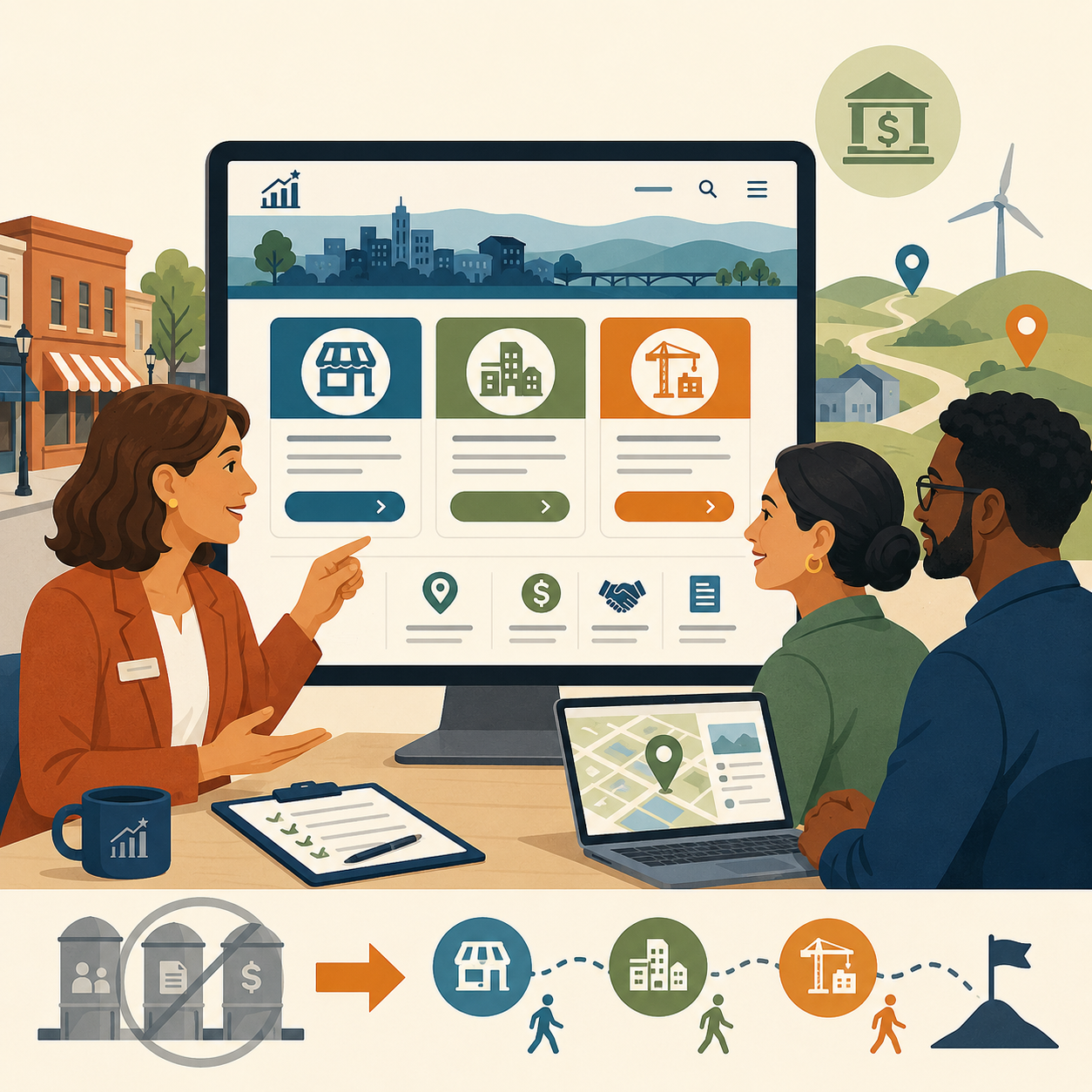 Message discipline in a state business attraction campaign means that every partner, every channel, and every communication product tells the same sector story in a way that is consistent on the facts even when it varies in emphasis or detail. Message discipline does not mean that every partner uses the same words. It means that no partner contradicts the core claims, inflates the proof points, or drifts into a different sector story than the one the state has built.
Achieving message discipline requires more than distributing a brochure or hosting a partner meeting. It requires ongoing coordination between the state economic development organization and its local and regional partners, including regular updates when sector data changes, clear channels for partners to ask questions about the state’s positions on specific claims, and a feedback mechanism through which partners can report when prospect questions reveal gaps in the state’s story.
It also requires clear guidance on what partners should not say. Business attraction conversations are competitive, and local and regional partners sometimes feel pressure to oversell in order to keep a prospect engaged. A partner who claims that a site has available rail access that does not actually exist, or who inflates workforce availability numbers to match a prospect’s requirements, may advance the conversation in the short term but will create a credibility problem during due diligence that is very difficult to recover from. State economic development organizations should give partners explicit guidance on the claims they can make with confidence and the claims they should route back to the state for verification.
Partner Toolkits That Support Real Conversations
A partner toolkit for a state business attraction campaign should be built around the conversations partners actually have, not around the information the state finds easiest to package. That distinction matters because the format and content of standard economic development toolkits, which typically include a state profile document, a sector fact sheet, a site inventory, and a set of contact information, reflects the state’s organizational structure rather than the prospect’s decision-making process.
A better toolkit is organized around the questions prospects typically ask at each stage of the attraction process. Early-stage prospects are asking whether the state’s sector story is credible and whether the general location merits further investigation. Mid-stage prospects are asking about specific site options, workforce availability, incentive structures, and logistical requirements. Late-stage prospects are asking about deal terms, timeline commitments, and what the state will do to help close and implement the project. A toolkit that provides partners with the right information for each stage of that conversation is far more useful than a comprehensive document that does not distinguish between the questions a first-conversation prospect asks and the questions a due-diligence-stage prospect asks.
The Relationship Between the State Story and Local Stories
One of the most important and often most poorly managed relationships in state economic development communication is the one between the statewide sector story and the local and regional stories that partners tell. In many states, the relationship is competitive rather than complementary. Local and regional organizations feel that the state’s branding overshadows their specific assets. State organizations feel that local and regional partners dilute the campaign message with divergent claims. Prospects experience the resulting tension as a confused pitch.
A better model treats the statewide sector story as a platform that local and regional stories build on rather than compete with. The state establishes the overarching sector narrative, the documented industry presence, the statewide workforce data, the policy environment, and the competitive positioning relative to other states. Local and regional partners then add the specific assets relevant to their geography: the available sites, the local workforce programs, the business park infrastructure, the community relationships, and the specific advantages of their particular location within the state’s broader sector geography.
This layered model works when the state’s sector story is strong enough to provide a genuine foundation and when local and regional partners have been given the tools to understand how their specific assets fit into and reinforce the statewide narrative. It breaks down when the state’s sector story is generic enough that every region can claim it equally, leaving partners with no framework for explaining what distinguishes their location. It also breaks down when the state and local organizations have not communicated enough to know what each other is saying to prospects.
Strategic Communication Support
 Business attraction campaign communication is not a marketing project with an economic development label. It is a complex, multi-level communication challenge that requires clear message architecture, verifiable proof points, trained delivery partners, and ongoing coordination across organizations that have different capacities, different geographic mandates, and different relationships with the prospects they are trying to attract. State economic development organizations that treat campaign communication as a function to be handled primarily by their marketing team without structured engagement of their partner network tend to produce campaigns that perform adequately at the state level and underperform where the deals are actually made.
Stegmeier Consulting Group (SCG) works with state economic development organizations to build business attraction campaign communication that produces sector stories local partners can actually use. That work includes sector message architecture development, partner toolkit creation, talking point translation from research to deployment, message discipline frameworks, partner training and briefing structures, and alignment between statewide campaign messaging and regional and local delivery. The goal is not to centralize all prospect communication at the state level. The goal is to give every partner in the network a clear, credible, and consistent foundation for the conversations that matter.
Engagement is particularly valuable when an organization is launching a new sector strategy, refreshing an existing campaign, on-boarding new regional or local partners, or finding that its message is not holding up consistently in the field. A well-designed sector story with strong local delivery infrastructure is one of the highest-return investments a state economic development organization can make.
Future Trends in Business Attraction Communication
The competitive environment for business attraction is intensifying. More states are investing in sector-specific campaigns, more companies are conducting rigorous site selection processes that pressure-test state claims, and more site selectors are sophisticated enough to quickly identify when a sector story is built on generic claims rather than verifiable strengths. In this environment, the states that will win are not necessarily the ones with the largest marketing budgets. They are the ones with the most disciplined and credible sector stories.
Data-driven proof points are becoming a more important differentiator. States that can produce real-time workforce supply data, documented industry cluster maps, certified site inventories, and verifiable training pipeline information will be in a stronger position than states that rely on static research reports and dated fact sheets. The communication infrastructure around business attraction is becoming as important as the physical infrastructure that the campaign promotes.
The relationship between state organizations and local delivery partners is also evolving. Digital tools are making it easier to share updated campaign materials with partners in real time, but they are not solving the fundamental problem of message alignment if the materials are not designed around the conversations partners actually have. Investment in partner training and ongoing communication with the delivery network will remain essential even as the tools for sharing information improve.
Finally, the substance of sector stories is shifting as economic development priorities evolve. Clean energy, advanced manufacturing, semiconductor supply chain, life sciences, and technology sectors are receiving significant federal investment attention that creates new dynamics for state business attraction. States that can situate their sector story within these broader national investment trends, and explain clearly how their existing assets align with the kinds of investment that federal programs are designed to support, will have a stronger foundation for the next generation of business attraction campaigns.
Conclusion
A business attraction campaign is only as strong as the sector story its local partners can deliver in a real conversation with a prospect. Generic state branding, attractive as it may look in a trade publication, does not give partners the specific, verifiable, and layered message they need to hold a prospect’s attention through the increasingly rigorous site selection processes that major corporate investments require. Building a sector story that works at every level of the delivery network, from the state campaign through the regional pitch to the local site visit, requires deliberate message architecture, honest proof point development, and ongoing coordination that most state economic development organizations underinvest in.
The states that consistently win major business attraction competitions are not necessarily the ones with the most generous incentive packages or the most polished campaign materials. They are the ones where the sector story is credible, specific, and consistently delivered by every member of the partner network. That consistency does not happen by accident. It is the product of a communication strategy that takes the local delivery challenge as seriously as the state-level marketing effort.
SCG’s Strategic Approach to Communication Systems
Align your agency’s messaging, processes, and public engagement strategies.
State economic development organizations need business attraction campaign communication that gives local and regional partners a sector story they can actually use. That means message architecture built on verifiable strengths, talking points that hold up under prospect scrutiny, site and workforce proof points that align with due diligence findings, and a clear relationship between the statewide campaign and the local conversations that determine whether prospects move forward.
SCG helps state economic development organizations build sector stories that travel well from the state level to the local delivery network. Whether your organization is developing a new sector campaign, strengthening an existing one, improving partner toolkit content, or building the message discipline and coordination structures that make statewide campaigns more coherent, SCG can help you communicate with specificity, consistency, and competitive credibility.
Use the form below to connect with our team and explore how a strategic communication system can help your organization build business attraction campaign messages that local partners can deliver with confidence.