
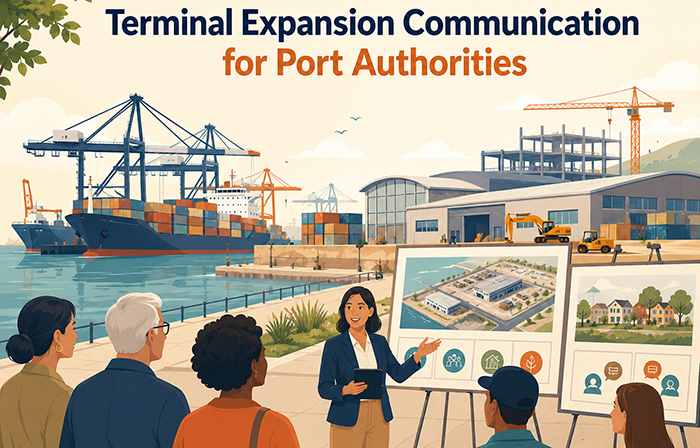
Terminal Expansion Communication for Port Authorities: Explaining Redevelopment, Debt, and Community Impact Together
Port authorities occupy a distinctive position in public life. They manage infrastructure that most residents rarely think about until it changes. A terminal expansion, a cargo facility upgrade, or a waterfront redevelopment project can reshape the physical and economic character of an entire region, yet the public conversation around these projects often begins too late, covers too little, or speaks to the wrong audience entirely. The result is a communication gap that no amount of project management can bridge after the fact.
What makes port expansion communication genuinely difficult is not that the projects are complex, although they are. It is that they are complex in multiple directions at once. A single terminal expansion may involve long-term debt issuance, environmental mitigation commitments, freight capacity modeling, labor agreements, neighborhood impact assessments, changes to truck traffic patterns, waterfront access questions, and economic development projections that stretch decades into the future. Each of those dimensions carries its own audience, its own vocabulary, and its own set of concerns. The port authority that communicates to investors in bond documentation language will lose the neighborhood coalition. The one that speaks only in community benefit terms will fail to explain why the project requires the financing structure it does.
Strong communication for port redevelopment must hold all of these dimensions together simultaneously. It must explain what is being built, why the investment is structured as it is, what outcomes the authority expects, who will bear the costs, who will receive the benefits, and what happens if conditions change. That is not a public relations challenge in the conventional sense. It is a strategic communication discipline that requires clarity of purpose, consistency of message, and a genuine understanding of what different audiences need to know before they can form a reasonable judgment about a project of this scale.
Stegmeier Consulting Group (SCG) works with port authorities and public infrastructure agencies on exactly this kind of communication challenge. The sections that follow examine why terminal expansion communication fails when it treats investor messaging and community relations as separate tracks, and what a more integrated approach looks like when an authority decides to explain redevelopment, debt, and community impact together.
Why Terminal Expansion Projects Are Especially Difficult to Explain
 Most large public infrastructure projects carry some communication complexity. Terminal expansions at port authorities carry more than most, and the reasons are structural rather than incidental. The first is the timeline. A major terminal expansion may take five to fifteen years from planning through construction to full operation. Public audiences are not accustomed to holding a complex story in mind for that long, and the authority must communicate in a way that remains coherent across political cycles, staff transitions, market changes, and shifting community priorities. The initial justification for a project may be accurate when the project opens and still feel disconnected from the world residents actually see around them.
The second structural difficulty is the nature of port finance. Terminal expansions are frequently funded through revenue bond issuance, which means the project’s financial viability depends on long-term projections of cargo volume, container throughput, lease revenue, or user fees. Those projections are real and defensible, but they are also inherently conditional. When a port authority issues debt to fund a terminal expansion, it is making a long-horizon commitment based on assumptions about global trade patterns, shipping line contracts, intermodal connectivity, and market demand. None of that translates easily into the kind of language that reassures a neighborhood resident worried about diesel truck traffic through residential streets.
The third difficulty is the multi-dimensional nature of impact. Terminal expansions create freight and logistics benefits that are often diffuse, regional, and slow to materialize. They also create neighborhood impacts that are specific, localized, and immediate. Increased truck traffic affects particular streets. Expanded operations affect noise levels for particular neighborhoods. Changed waterfront access affects particular communities. When the authority leads with aggregate economic benefit numbers and follows with community impact mitigation plans, residents often feel that the ordering itself reveals a priority structure that places freight volume above neighborhood quality of life.
The fourth difficulty is that terminal expansion projects sit at the intersection of institutional audiences with very different information needs. Bond investors, rating agencies, and financial analysts need detailed information about revenue projections, debt coverage ratios, capital improvement plans, and risk mitigation strategies. Local elected officials need to understand what the project does for regional employment, tax base, and infrastructure capacity. Neighborhood residents need to know what will change in their immediate environment and what commitments the authority is prepared to make. Environmental advocates need to know what mitigation measures are in place and how the authority intends to monitor compliance. Media need a story that connects the project to something a broad audience can care about. Treating any one of these audiences as the primary audience, to the exclusion of the others, produces communication that fails to build the broad credibility a long-horizon project needs.
The Risk of Running Investor Messaging and Community Relations as Separate Tracks
Port authorities often manage this complexity by separating their communication into tracks. The finance and investor track handles bond documentation, rating agency presentations, investor roadshows, and financial disclosures. The community relations track handles public meetings, neighborhood outreach, environmental justice communications, and media inquiries. Each track may be staffed by different teams, guided by different advisors, and measured by different success criteria. The result is two communication systems that operate in parallel without producing a coherent public understanding of the project as a whole.
This separation creates problems that compound over time. When the investor track emphasizes revenue upside and project scale without acknowledging community tradeoffs, and the community relations track emphasizes mitigation commitments without explaining the financial logic behind the project’s size and structure, residents and advocates begin to sense an inconsistency. The project that looks like a strong revenue-generating asset in a bond presentation looks like a freight intensification with vague promises in a community meeting. Those are not actually different projects. They are the same project described through incompatible lenses, and sophisticated community members will eventually notice the gap.
Media scrutiny tends to surface these inconsistencies at the worst possible moments. A journalist covering the bond issuance who also attends a public hearing can ask questions that neither track has fully prepared the authority to answer. Why does the revenue projection depend on assumptions the authority cannot guarantee? Why does the community benefit commitment lack an enforcement mechanism? Why did the authority present the project differently to investors than to residents? These questions are not unfair. They are the natural result of a communication structure that never required the authority to hold its entire story together in a single, coherent frame.
The alternative is not to simplify the project beyond recognition or to present identical materials to every audience. Different audiences do have genuinely different information needs. Bond investors need financial detail that would be overwhelming in a community meeting. Neighborhood residents need localized impact information that is too granular for a rating agency presentation. The goal is not identical content across all audiences. The goal is a shared foundational story, grounded in the same facts, that can be adapted for each audience without creating contradictions. The financing logic should be explainable at a community meeting. The community impact commitments should appear in investor materials as part of the project’s long-term risk and stakeholder management framework.
Growing Places: Communication Strategies for Economic Development and Public Finance Agencies
This article is part of our series on strategic communication for Economic Development organizations, including state and local economic development agencies, regional partnerships, and business attraction initiatives. To learn more and to see the parent article, which links to other content just like this, click the button below.
Building a Communication Structure That Holds the Whole Project Together
A port authority embarking on a major terminal expansion should build its communication architecture around a core project narrative before it begins distributing materials to any audience. That core narrative should answer several foundational questions in plain, non-technical language: What is being built and why does the authority believe it is needed? How is the project being financed and what does the debt structure mean for the port’s long-term financial position? Who benefits from the project and over what timeframe? What are the expected impacts on surrounding communities and what mitigation measures are part of the project? What does successful project delivery look like, and how will the authority measure and report on that success?
Each of these questions has technical answers that live in environmental impact documents, bond offering statements, capital improvement plans, and engineering reports. The communication task is to extract the essential meaning from those technical sources and render it in language that a reasonably informed public audience can follow. That does not mean removing complexity. It means building a narrative structure that helps audiences understand why each element of the project is connected to the others.
For example, the financial structure of a terminal expansion is not simply a technical matter for bond investors. It is directly relevant to community audiences as well. If the project is financed through revenue bonds backed by cargo throughput projections, the size and scope of the expansion is tied to those revenue assumptions. A community that wants to negotiate the scale of the project down needs to understand that reducing scope has financing implications. A community that wants stronger mitigation commitments needs to understand what those commitments cost and how the authority intends to fund them. Explaining the financing is not a way of deflecting community concerns. It is a way of giving community members the information they need to engage with the real tradeoffs rather than the simplified version.
The authority’s communication structure should also define how it will provide updates throughout the project lifecycle. A terminal expansion that takes a decade to complete will pass through multiple distinct phases, each with its own communication needs. Environmental review generates one set of public questions. Bond issuance generates another. Construction commencement generates another. Operational opening generates another. Each phase should have a planned communication approach that connects back to the core project narrative without requiring audiences to start from scratch each time.
Connecting Debt Explanation to Project Rationale
One of the most consistently underdeveloped areas of port expansion communication is the explanation of project financing. Authorities often treat debt issuance as a technical matter that belongs in bond documents and rating agency presentations, not in public outreach materials or media statements. This leaves a significant gap in public understanding because the financing structure of a major terminal expansion is directly relevant to questions about project scale, financial risk, long-term operational priorities, and what happens if the revenue projections do not materialize as expected.
Plain-language debt explanation does not require simplifying the financial structure into inaccuracy. It requires translating the essential elements of the structure into terms that a non-specialist can understand. A port authority can explain that the terminal expansion will be financed through bonds repaid from future cargo revenue, that the authority is confident in the revenue projections based on existing contracts and market analysis, and that the debt structure is designed to preserve the authority’s financial flexibility even in a scenario where volume falls short of projections. That explanation is not complete from an investor’s perspective, but it is accurate, honest, and useful for public audiences who want to understand whether the authority is making a prudent financial commitment.
Debt explanation also gives the authority an opportunity to distinguish between types of public risk. Revenue bonds backed by authority operations are not general obligation bonds backed by taxpayer funds. Most community members do not know the difference, and the distinction matters significantly for how residents understand the financial implications of the project. Taking time to explain what the debt structure actually means, and what it does not mean, can reduce misinformation and make public conversations more substantive.
Communicating Economic Outcomes Without Overpromising
Terminal expansion projects are almost always justified in part by economic development arguments. Job creation, regional GDP contribution, supply chain strengthening, business attraction, and tax base growth are common benefits cited in project materials. These economic arguments are often genuine and well-supported by economic analysis. They are also frequently communicated in ways that inflate expectations, understate uncertainty, or fail to specify who actually receives the benefits and over what timeframe.
When economic projections are presented as certainties rather than modeled outcomes, they create credibility problems down the road. If the project opens and job creation is slower than projected, or if the economic benefits are concentrated among large freight companies rather than distributed across local workers, the community has been set up to feel misled. Strong economic communication acknowledges that projections are estimates, explains the methodology behind them, and distinguishes between direct employment at the terminal, indirect employment in the supply chain, and induced employment from broader spending effects. These distinctions are not pedantic. They help communities form realistic expectations rather than responding to outcomes that do not match what they were told.
Economic communication should also address distribution. A terminal expansion may generate significant regional economic benefit while creating concentrated negative impacts on specific neighborhoods. The aggregate benefit number does not resolve the distributional question. Authorities should explain specifically how local hiring commitments, contractor requirements, community benefit agreements, or other mechanisms are intended to direct economic benefit toward the communities that bear the most direct impact.
Public Meetings, Project Updates, and the Challenge of Sustained Engagement
 Public meetings for terminal expansion projects are often structured around legal requirements and project milestones rather than around the communication needs of the communities most affected by the project. An environmental review public hearing is designed to collect formal comment on a specific document, not to facilitate genuine dialogue about project design, financing rationale, or long-term community commitments. That mismatch between the formal purpose of the meeting and what community members actually want to discuss can make these settings adversarial rather than constructive.
Port authorities that approach public engagement as a compliance exercise will produce the engagement outcomes that compliance exercises typically produce: formally satisfied requirements and deeply unsatisfied communities. Authorities that approach public engagement as a genuine communication function will design meeting formats that give community members enough background to engage with the real substance of the project, enough time to ask questions and receive meaningful answers, and enough confidence that their concerns are being received by people with the authority to act on them.
This does not mean that every community concern will or should change the project. It means that the authority should be able to explain clearly why a particular concern was addressed in the way it was, what alternatives were considered, and what commitments the authority is prepared to make going forward. Vague assurances that community concerns have been heard are not a substitute for specific, documented responses. When authorities fail to provide specific responses, communities lose confidence in the engagement process and often become more adversarial, not less.
Project updates throughout the construction and implementation period should be regular, structured, and tied to the commitments the authority made during the approval process. If the authority committed to quarterly progress reports, those reports should be published on schedule and should address specific metrics, not just general progress. If the authority committed to noise monitoring, traffic counts, or emissions measurements, those data points should be shared publicly with accessible explanations. Ongoing transparency is not just a community relations strategy. It is how an authority builds the credibility it will need when the next major capital project requires public support.
Media Scrutiny and the Importance of a Defensible Public Narrative
Journalists covering major port expansion projects are increasingly sophisticated about the intersection of public finance, environmental impact, and economic development. A reporter who has covered revenue bond issuances, environmental justice disputes, or waterfront development controversies in other cities will bring that context to coverage of a new terminal expansion project. The authority’s communication strategy should anticipate that level of scrutiny rather than assuming that project announcements will be covered at face value.
A defensible public narrative is not a media management strategy. It is the natural output of an authority that has genuinely worked through the hard questions the project raises and is prepared to discuss them honestly. Why is the project this large? Why is the financing structure what it is? What happens if cargo projections fall short? What specifically is the authority committing to for affected neighborhoods and how will those commitments be enforced? What environmental trade-offs are involved and how did the authority decide they were acceptable? An authority that cannot answer these questions directly and consistently will find that media coverage fills in the gaps with answers drawn from critics, advocates, and opposition voices.
The authority’s public narrative should also be consistent across its leadership. When executive directors, board members, chief financial officers, and community liaison staff all tell slightly different versions of the project story, that inconsistency becomes the story. Message alignment across the authority’s leadership team is not just about staying on talking points. It is about demonstrating that the organization has genuinely worked through the project’s implications and arrived at a shared understanding of what it is doing and why.
Strategic Communication Support
 Terminal expansion projects involve a level of communication complexity that most port authorities encounter infrequently, even those with experienced communications staff. The combination of long-horizon finance, multi-audience engagement, environmental review, community impact assessment, and sustained project updates requires a communication discipline that goes well beyond routine public affairs work. Authorities often need structured support to develop the core project narrative, build out the audience-specific materials, prepare for public meetings and media scrutiny, and maintain communication consistency across a multi-year project lifecycle.
SCG provides strategic communication support for port authorities and public infrastructure agencies facing exactly this kind of challenge. That support includes developing core project narratives that hold financing, economic outcomes, and community impact together in a coherent frame, building plain-language explanations of revenue bond financing and debt structure, preparing materials for community meetings and elected official briefings, developing media Q and A frameworks, aligning communication across authority leadership, and creating ongoing project update structures that maintain credibility across the full project timeline.
The goal of this kind of support is not to make a difficult project easier to sell. It is to make a genuine project easier to understand. Port authorities that can explain what they are doing, why they are doing it, how it will be financed, who will benefit, and what they are committing to for affected communities are not just better at public relations. They are better at governance. And projects that earn genuine public understanding are more likely to succeed over the long timelines that terminal expansions actually require.
Future Trends in Port Expansion Communication
The communication environment for major port infrastructure projects is shifting in several important directions. Environmental justice considerations are increasingly central to project approval processes, and authorities that treat community impact as a secondary concern will face growing resistance from both regulators and community organizations. Future terminal expansion projects will need to integrate environmental justice communication from the earliest stages of project development, not as a response to opposition but as a genuine element of project design.
Digital transparency tools are also changing what communities expect from public agencies managing large capital projects. Real-time data dashboards, publicly accessible project documentation, digital engagement platforms, and social media monitoring all create new opportunities for authorities to build ongoing communication connections with affected communities. They also create new risks for authorities that are not prepared to respond quickly and accurately when project information spreads through social networks ahead of official communication.
The relationship between port expansion projects and broader supply chain policy is also becoming more prominent in public discourse. Pandemic-era supply chain disruptions made port capacity a topic of mainstream concern, and future terminal expansion projects are likely to be evaluated in a public context that includes greater awareness of global supply chain interdependencies, domestic manufacturing needs, and the relationship between port investment and economic resilience. Authorities that can connect their projects to this broader policy context will have more to say and more credibility in saying it.
Finally, the financing environment for major port infrastructure projects is evolving. Federal infrastructure programs, resilience funding, climate adaptation grants, and new financing vehicles are expanding the options available to port authorities beyond traditional revenue bond structures. Each new financing tool brings its own communication requirements and public understanding challenges. Authorities that build strong communication capacity now will be better positioned to explain complex financing structures to public audiences as those structures become more varied.
Conclusion
Terminal expansion projects require port authorities to explain infrastructure, finance, and community impact simultaneously to audiences with very different information needs and very different stakes in the outcome. The failure to hold those dimensions together produces communication that satisfies no audience fully and leaves the authority exposed to the kind of inconsistency scrutiny that can derail projects long after the planning and approval process is complete.
The answer is not simpler communication. It is more disciplined communication. A core project narrative that connects the financing rationale to the operational purpose to the community impact framework gives the authority a foundation it can adapt for investors, elected officials, neighborhood residents, environmental advocates, and media without creating contradictions. That narrative needs to be developed before the first public meeting, updated as the project progresses, and maintained by leadership who understand why consistency matters as much as content.
Port authorities that invest in this kind of communication discipline are not just managing risk. They are building the institutional credibility that allows ambitious infrastructure investment to happen in communities that have every reason to be skeptical of large promises and long timelines. Terminal expansions succeed not just because they are built well, but because they are explained well enough that the people who live and work near them understand what was promised, what was delivered, and why the project was worth doing.
SCG’s Strategic Approach to Communication Systems
Align your agency’s messaging, processes, and public engagement strategies.
Port authorities managing terminal expansions, cargo facility upgrades, or waterfront redevelopment projects need communication systems that connect financing rationale, operational outcomes, and community impact into a coherent public narrative. Strategic communication for major port projects requires plain-language debt explanation, audience-specific materials, consistent leadership messaging, structured public engagement, and ongoing transparency mechanisms that maintain credibility across multi-year project timelines.
SCG helps port authorities build communication frameworks that hold the full project story together, from bond financing and revenue projections to neighborhood impact commitments and long-term accountability structures. Whether your authority is preparing for a bond issuance, entering environmental review, planning a public meeting series, responding to media scrutiny, or building a community benefit communication framework, SCG can help you communicate with the clarity and consistency that major infrastructure projects demand.
Use the form below to connect with our team and explore how a strategic communication system can help your port authority build the public understanding that a terminal expansion project requires.