
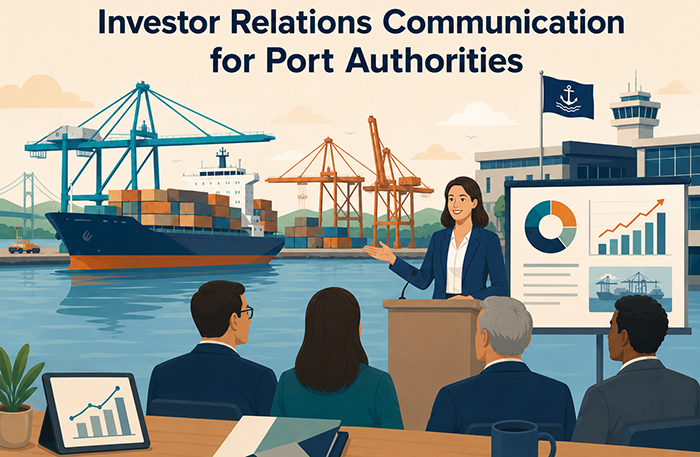
Investor Relations Communication for Port Authorities: How to Explain Bond-Financed Infrastructure to Both Markets and the Public
A port authority occupies an unusual position among public agencies. It borrows money the way a corporation might, issuing revenue bonds to finance terminals, cranes, rail connections, and berth deepening projects that can cost hundreds of millions of dollars. At the same time, it operates as a public body accountable to elected officials, residents, environmental regulators, and neighboring communities that live beside the very infrastructure the bonds finance. Few other public entities sit this squarely at the intersection of Wall Street and Main Street. A city water district issues bonds too, but its public-facing story is usually simple: keep the water running and the rates fair. A port authority’s story is layered with freight economics, global trade patterns, environmental tradeoffs, and capital structures that most residents have never had reason to learn.
This dual identity creates a communication challenge that is easy to underestimate. Investor relations teams are trained to speak the language of capital markets, where precision, disclosure completeness, and technical accuracy are not stylistic preferences but legal and reputational necessities. Public affairs teams are trained to speak the language of community trust, where clarity, accessibility, and responsiveness matter more than technical exactness. Port authorities need both capabilities operating at a high level, but they rarely need them operating in isolation from each other. When investor relations and public communication function as separate systems with separate vocabularies, the agency ends up telling two different stories about the same set of facts. That gap is where trust erodes, even when nothing improper has occurred.
The purpose of this discussion is to examine why port authorities face a distinctive dual-audience communication challenge, what each audience actually requires, and how a coherent communication structure can serve both without diluting the precision investors need or the accessibility residents deserve. This is not a call to simplify investor materials until they lose their financial meaning, nor is it a call to load public communication with capital-markets terminology in the name of transparency. It is an argument that a port authority’s communication about revenue bonds, capital programs, and public benefit should function as connected infrastructure, not as parallel tracks that happen to describe the same project.
Two Audiences, One Set of Underlying Facts
 A port authority’s investor relations communication and its public communication are not actually describing different things. They are describing the same debt issuance, the same capital program, the same terminal expansion, and the same set of financial and operational commitments, filtered through different vocabularies for different purposes. An official statement prepared for a bond offering and a fact sheet distributed at a community meeting may look like unrelated documents, but they should be traceable back to the same underlying set of facts about revenue sources, project scope, timeline, and risk.
This matters because when the two documents diverge in substance rather than just in style, the agency creates a credibility problem that surfaces later. A project timeline described optimistically in a community presentation but qualified heavily with risk factors in the official statement is not technically dishonest, since disclosure documents are expected to be conservative and comprehensive. But if a resident or journalist later compares the two, the gap reads as evasiveness rather than as the normal difference between a legal disclosure document and a public communication. Port authorities that treat both audiences as recipients of the same underlying story, translated rather than altered, avoid this problem before it starts.
The practical implication is that communication planning for a bond issuance or major capital project should begin with a single, internally agreed set of facts about what is being financed, why, and what the expected public and financial outcomes are. From that shared foundation, the agency can then build an official statement calibrated for institutional investors and rating agencies, and separate materials calibrated for residents, elected officials, and local media, without the risk that the two versions drift apart in ways that later look inconsistent.
Growing Places: Communication Strategies for Economic Development and Public Finance Agencies
This article is part of our series on strategic communication for Economic Development organizations, including state and local economic development agencies, regional partnerships, and business attraction initiatives. To learn more and to see the parent article, which links to other content just like this, click the button below.
What the Capital-Markets Audience Actually Requires
Institutional investors, bond counsel, underwriters, and rating agencies evaluating a port authority’s revenue bonds are not reading investor materials for inspiration. They are reading them to assess repayment capacity, project risk, competitive position, and legal structure with enough precision to price the debt and assign a rating. This audience expects official statements, continuing disclosure filings, and investor presentations to follow established conventions: audited financial statements, debt service coverage ratios, traffic and revenue projections prepared by qualified consultants, detailed risk factor sections, and legal opinions that have been vetted by bond counsel.
Precision in this context is not bureaucratic caution. A vague or incomplete risk factor section can affect how a rating agency views the credit, which in turn affects the interest rate the port authority pays over the life of the bonds. An overly promotional tone in an investor presentation, one that understates competitive threats from other ports or overstates cargo growth projections without appropriate caveats, can create legal exposure under securities law if actual performance falls short of what was implied. For this reason, capital-markets communication is necessarily conservative, hedged, and detailed in ways that would feel foreign or even alarming to a general public audience encountering the same document.
This does not mean capital-markets communication should be dense for its own sake. Investor presentations that are well organized, that lead with a clear project narrative before moving into financial detail, and that explain competitive position in plain business terms tend to perform better with analysts than presentations that bury the story in undifferentiated data. But the audience’s core requirement remains constant: enough specificity, disclosure, and technical rigor to support an informed credit decision. Any communication built for this audience that sacrifices that rigor for readability has failed at its primary purpose, regardless of how polished it looks.
What the Public Audience Actually Requires
Residents, community organizations, local elected officials, and regional media evaluating the same bond issuance are asking a different set of questions. They want to know what is being built, why the port is taking on debt to build it, what the project means for jobs, traffic, air quality, and neighborhood character, and what public benefit is expected in exchange for the investment. Few members of this audience have the background to interpret a debt service coverage ratio or a rate covenant, and most are not trying to acquire that background. They are trying to understand whether the project serves their interests and whether the port authority is a trustworthy steward of public infrastructure and public debt.
This audience requires communication that starts with the project itself rather than with the financing mechanism. A plain-language summary that opens by explaining that the port is building a new terminal berth to accommodate larger cargo vessels, and that this expansion is expected to support regional jobs and reduce shipping delays, gives residents an immediately understandable reason to care. Only after establishing that narrative does it make sense to explain that the project is funded through revenue bonds repaid from terminal lease and cargo fee revenue rather than general tax dollars, a distinction that matters enormously to public trust but that gets lost if it is buried inside financial language the reader cannot parse.
The public audience also requires honesty about tradeoffs. Terminal expansions and channel deepening projects often carry real environmental and traffic implications for surrounding communities. A communication strategy that emphasizes only the economic benefits while minimizing legitimate community concerns will eventually be read as one-sided, particularly once opposition groups or local journalists begin raising the concerns the agency did not address. Public communication that acknowledges tradeoffs directly, explains what mitigation measures are in place, and treats community concerns as legitimate rather than as obstacles tends to hold up better over the life of a long capital project than communication that only presents the favorable case.
Why Capital-Markets Language Fails When It Becomes the Only Language
The most common failure mode in port authority communication is not dishonesty. It is the assumption that a well-prepared official statement or investor presentation, if simply made available to the public, satisfies the agency’s transparency obligation to residents. This assumption treats disclosure as a single act rather than as a translation exercise, and it consistently underserves the public audience even when the underlying document is completely accurate.
Official statements are written under securities law conventions that prioritize completeness and risk disclosure over narrative clarity. A resident who reads a bond official statement encounters extensive legal boilerplate, detailed risk factors written to protect the issuer and underwriters from liability, and financial tables that assume a level of fluency in municipal finance that most readers do not have. Even a highly engaged and educated resident is likely to come away from that document without a clear sense of what the port is actually building or why. The technical accuracy of the document does not translate into public understanding, because the document was never designed to produce public understanding. It was designed to satisfy investors and regulators.
When a port authority relies on capital-markets documents as its primary public communication, whether by posting the official statement on its website as the main source of project information or by directing public inquiries to investor relations materials, it inadvertently signals that public understanding was never the priority. This is rarely intentional. It typically happens because the agency has a well-resourced investor relations function producing polished, legally vetted materials, and a thinner public communication function that has not been asked to build an equivalent, purpose-built resource for residents. The result is a communication gap that looks like opacity from the outside, even when the agency believes it has been fully transparent.
Why Purely Public-Facing Messaging Also Fails Capital Markets
 The reverse failure is less common but equally damaging. Some port authorities, aware that capital-markets language alienates residents, respond by building public communication that leans heavily into promotional narrative without maintaining discipline around the financial and risk details that anchor the investor-facing story. A public presentation that describes a project in glowing, uniformly optimistic terms, without any acknowledgment of financing structure, repayment source, or project risk, can create problems that surface later in the capital-markets relationship.
Analysts and rating agencies do pay attention to how an issuer communicates publicly, not just to what appears in official disclosure documents. A pattern of public messaging that consistently overstates project certainty, cargo growth projections, or economic impact, in ways that are not reflected in the more conservative official statement, can raise questions about management credibility and internal communication discipline. Rating agencies evaluating management quality as part of a credit assessment are, in effect, evaluating whether the agency’s public statements and its official disclosures tell a consistent story. A gap between an upbeat public narrative and a hedged official statement does not necessarily indicate wrongdoing, but it can be read as an agency that says what is convenient to each audience rather than a coherent underlying position.
There is also a more immediate risk. Statements made in public settings, including public board meetings, press releases, and community presentations, can themselves become part of the disclosure record if they contain material information about the project or its financing. Port authorities that treat public communication as entirely separate from disclosure discipline can inadvertently create statements that underwriters and bond counsel later have to account for, reconcile, or walk back. Coordinating public messaging with the same underlying facts and the same degree of care used in official disclosure protects the agency in both directions.
Building a Coherent Story Across Bonds, Capital Programs, and Public Benefit
The most effective port authority communication treats the financing, the physical project, and the public benefit as three parts of one continuous story rather than as separate topics assigned to separate teams. A terminal expansion project can be described coherently across every audience if the underlying narrative logic stays the same: here is what the port is building, here is why it matters for the region’s economy and supply chains, here is how it is being financed and by whom the debt is repaid, and here is what residents and the broader public can expect to see and experience as the work moves forward.
This coherence does not require identical language across investor and public materials. It requires identical facts, presented at different levels of technical detail appropriate to each audience’s needs. An investor presentation might spend several slides on projected cargo volume growth, competitive positioning against neighboring ports, and debt service coverage under different revenue scenarios. A public fact sheet describing the same project might spend a single paragraph explaining that growing cargo volume supports the case for expansion, without walking through the financial modeling behind that projection. Both are accurate. Both are appropriately calibrated to their audience. Neither contradicts the other, because both are drawing from the same underlying analysis.
Building this kind of coherence usually requires a deliberate internal process rather than something that happens naturally between separate finance and communications teams. Establishing a shared project narrative early, before either the official statement or the public materials are drafted, gives both teams a common foundation to translate from. Reviewing public materials against the official statement’s risk factors before release, and reviewing investor presentations for tone consistency with public messaging, closes the gap that otherwise opens between the two documents over time as separate teams revise their materials independently.
Plain-Language Project Summaries as Communication Infrastructure
One of the most effective tools for bridging the capital-markets and public audiences is a plain-language project summary developed specifically to sit between the official statement and general public messaging. This document is not a simplified investor presentation, and it is not a marketing brochure. It functions as a translation layer that explains, in accessible terms, what is being built, how it is being financed, what the expected public benefits are, and what tradeoffs or risks the community should understand, without attempting to replace the legal precision of the official statement.
A well-constructed project summary typically opens with the project itself, described in terms a resident with no finance background can follow. It then explains, in a paragraph or two, that the project is funded through revenue bonds repaid from specific revenue sources rather than general tax dollars, addressing one of the most common public misconceptions about port financing before it has a chance to take root. It addresses timeline, expected construction impacts, and any mitigation measures tied to environmental or traffic concerns. It closes by identifying where residents can find more detailed financial information if they want it, pointing toward the official statement or investor relations page rather than trying to reproduce that level of detail within the summary itself.
This document earns its value by being reusable across many contexts. The same plain-language summary can anchor a public meeting presentation, a media backgrounder, a website project page, and a briefing document for elected officials who need to explain the project to constituents. Rather than each of these audiences receiving a separately drafted, potentially inconsistent explanation, they all receive translations of the same core narrative, which keeps the agency’s public position stable even as it is repeated across many different channels and speakers over the life of a multi-year capital program.
Investor-Facing Versus Resident-Facing Materials
Port authorities benefit from being explicit, internally, about which materials are built for which audience, rather than assuming that a single document can efficiently serve both purposes. Investor-facing materials, including the official statement, continuing disclosure filings, and investor presentations, should be built to the standards capital markets require, without compromise for readability. These documents will always be more technical than a general audience finds comfortable, and that is appropriate given their legal and financial function.
Resident-facing materials, including project fact sheets, website content, public meeting presentations, and press materials, should be built to prioritize comprehension and should not attempt to incorporate the full technical apparatus of the official statement. A resident-facing fact sheet does not need a rate covenant explanation or a detailed debt service schedule. It needs enough financial context to answer the questions residents actually ask, chiefly whether the project is funded through taxes, what the repayment source is at a general level, and what financial risk, if any, falls on the public as opposed to bondholders.
The discipline of maintaining this separation, while keeping both sets of materials anchored to the same underlying facts, allows each document to do its job well. Attempts to build a single hybrid document that serves both audiences typically satisfy neither. The result is either an investor presentation that has been watered down in ways that concern sophisticated readers, or a public document so dense with financial qualification that it fails to communicate anything clearly to the audience it was meant to reach.
Message Consistency Across Official Statements and Public Briefings
Consistency between what a port authority says in its official disclosure documents and what its executives and board members say in public briefings, press interviews, and community meetings is not a stylistic preference. It is a discipline that protects both the agency’s credibility with the public and its legal position with capital markets. When a port director describes a project’s expected completion date, cargo volume outlook, or economic impact in a public setting, that statement should be traceable to the same analysis underlying the official statement’s more conservative, hedged language.
This consistency is easiest to maintain when communications staff, finance staff, and executive leadership review key public statements against current disclosure language before major announcements, groundbreaking events, or public meetings. A briefing document prepared for board members or executives ahead of a public appearance should include not only the talking points the agency wants to convey, but also a short summary of how those talking points align with, or diverge from, the official statement’s risk factors and projections. This gives the person speaking publicly the context needed to avoid overstating certainty about outcomes that the official statement treats more cautiously.
Consistency also extends to how the agency handles unexpected developments, such as construction delays, cost overruns, or changes in projected cargo volume. Capital-markets disclosure obligations may require the agency to file a notice of a material event under its continuing disclosure agreement. Public communication about the same development should be issued on a similar timeline and should not contradict what has been or will be disclosed to bondholders. Agencies that delay public acknowledgment of a problem already reflected in disclosure filings, or that characterize a problem differently in public statements than in disclosure filings, create exactly the kind of inconsistency that undermines trust with both audiences at once.
What Port Authorities Risk When They Communicate Only in Capital-Markets Language
Port authorities that default to capital-markets language as their primary mode of public communication tend to underestimate how much trust erosion accumulates quietly before it becomes visible. Residents who cannot understand why the port is taking on debt, what specific project the debt funds, or what benefit they can expect in return do not necessarily file complaints or attend board meetings to object. More often, they simply form an impression that the port authority operates opaquely and primarily serves shipping and logistics interests rather than the broader public. That impression tends to surface at the moments when the agency most needs public support, such as during a controversial expansion proposal, a rate increase, or a community dispute over environmental impact.
This dynamic is compounded by the fact that port authorities frequently need public and political support for projects that extend well beyond the bond issuance itself, including permitting processes, environmental review, and land use approvals that involve elected officials responsive to constituent sentiment. An agency that has spent years communicating primarily to bondholders and rating agencies, while treating public communication as an afterthought, arrives at these moments with a public relations deficit that is difficult to overcome quickly. Public trust built through consistent, accessible communication over time is far more durable than trust manufactured reactively during a controversy.
There is also a more direct financial cost. Port authorities that maintain strong public support and clear, positive relationships with elected officials and community stakeholders often find it easier to advance future capital programs, secure necessary local approvals, and avoid the kind of public opposition that can delay projects and increase costs. Communication that serves only the capital-markets audience protects the agency’s relationship with investors in the near term, but it can quietly undermine the broader political and community support the agency needs to execute its long-term capital program.
Treating Investor Relations as Communication Infrastructure, Not a Standalone Function
The strongest port authority communication programs treat investor relations as one component of a broader communication infrastructure rather than as a self-contained function that operates independently of public affairs, media relations, and community engagement. This framing matters because it changes how the agency staff, resources, and coordinates communication work. When investor relations sits in isolation, typically inside the finance department and focused narrowly on disclosure compliance and analyst relationships, the agency loses the natural opportunity to translate that work for public audiences as a matter of routine practice rather than as an occasional, reactive project.
An integrated communication infrastructure connects investor relations staff, public affairs staff, and executive communications staff around a shared calendar of major agency milestones, including bond issuances, groundbreaking events, project completions, and annual disclosure filings. Each of these milestones represents an opportunity to communicate to both audiences from the same underlying facts, and treating them as coordinated moments rather than as separate departmental responsibilities produces communication that is more consistent and requires less after-the-fact reconciliation.
This structural approach also strengthens the agency’s position when unexpected events require rapid, coordinated communication. A port authority that has already built the habit of aligning investor and public messaging around routine milestones is far better positioned to manage a crisis, a construction delay, or a material financial event without the confusion that arises when finance and communications teams are coordinating for the first time under pressure. Communication infrastructure, like physical infrastructure, performs best when it has been built and tested before the moment it is needed most.
Strategic Communication Support for Port Authorities
 Port authorities operate under a communication burden that few other public agencies share, holding capital-markets disclosure obligations, public accountability expectations, and complex regional economic narratives within a single organization. Meeting that burden well requires more than a capable investor relations team and a capable public affairs team working independently. It requires a deliberate structure that connects the two, so that every major financing decision, capital project, and public announcement is communicated as one coherent story rather than as separate messages calibrated for separate rooms.
Stegmeier Consulting Group (SCG) works with port authorities and similar public finance entities to build this kind of connected communication structure. That work often includes developing plain-language project summaries that translate official statement content for public audiences, reviewing public messaging for consistency with disclosure obligations, building briefing materials that prepare executives and board members to speak accurately to both investor and public audiences, and creating communication frameworks that keep investor relations, public affairs, and executive communications aligned around shared facts.
This kind of support is particularly valuable during periods of active capital investment, when a port authority may be preparing a bond issuance, breaking ground on a major terminal or infrastructure project, and managing ongoing public engagement simultaneously. Rather than allowing these workstreams to proceed independently, with the risk of inconsistency that entails, SCG helps agencies build the connective tissue that lets investor relations and public communication reinforce each other, strengthening both the agency’s standing in capital markets and its trust with the communities it serves.
Future Trends in Port Authority Investor and Public Communication
Port authorities are likely to face growing pressure to make capital-markets communication more accessible to non-specialist audiences as public scrutiny of infrastructure spending and municipal debt continues to increase. Residents, journalists, and advocacy organizations are more likely than in the past to seek out bond disclosure documents directly, particularly for controversial projects, which means official statements and investor materials may reach public audiences whether or not the agency intended them to serve that purpose. This trend increases the value of proactively developing plain-language companion materials rather than relying on the assumption that technical documents will only be read by their intended financial audience.
Environmental, social, and governance considerations are also likely to play a larger role in how port authorities communicate about capital projects, given that terminal expansions, dredging projects, and infrastructure investments increasingly draw attention from investors and communities alike on questions of environmental impact and climate resilience. Agencies that build ESG-related disclosure and public messaging around a shared, coherent narrative, rather than treating environmental communication as a separate track from financial and project communication, will likely be better positioned to satisfy both investor expectations and community concerns.
Finally, digital communication channels are likely to continue narrowing the separation between investor-facing and public-facing information. Port authority websites, social media channels, and public dashboards increasingly serve as a single point of access where both institutional investors and residents may look for information about a given project. This convergence makes the discipline of maintaining a coherent, consistent narrative across audiences more important, not less, since the same digital page may now be read by an analyst assessing credit risk and a resident trying to understand construction noise on the same afternoon.
Conclusion
Port authorities carry a communication responsibility that is genuinely more complex than that of most public agencies, because they must satisfy the precision and disclosure standards capital markets require while also earning and maintaining the trust of the communities their infrastructure serves. Neither audience can be treated as secondary. Capital-markets communication that lacks rigor threatens the agency’s cost of borrowing and its legal standing. Public communication that lacks clarity threatens the political and community support the agency needs to execute its capital program over the long term.
The agencies that manage this dual responsibility well are the ones that stop treating investor relations and public communication as separate functions describing separate things. They build a shared factual foundation for every major financing decision and capital project, then translate that foundation appropriately for each audience, maintaining consistency in substance even as they adjust the level of technical detail. This approach protects the agency’s credibility with bondholders and rating agencies while giving residents a genuine, accessible understanding of what is being built, why it matters, and how it is being paid for.
Communication infrastructure, once built, tends to pay dividends across every future project a port authority undertakes. An agency that has already established consistent practices for translating financial disclosure into public understanding is far better prepared for its next bond issuance, its next terminal expansion, and its next moment of public scrutiny than an agency attempting to build that connective structure for the first time under pressure.
SCG’s Strategic Approach to Communication Systems
Align your agency’s messaging, processes, and public engagement strategies.
Port authorities need communication systems built to serve capital markets and communities at the same time, without allowing either audience to be treated as an afterthought. That requires plain-language project summaries, disciplined consistency between disclosure documents and public statements, coordinated planning across investor relations and public affairs, and a communication structure that holds up under the scrutiny both audiences bring to major infrastructure investment.
SCG helps port authorities and public finance entities build these connected communication systems, from translating official statements into resident-facing materials to preparing executives for public appearances that stay consistent with disclosure obligations. Whether your agency is preparing a bond issuance, breaking ground on a terminal expansion, or strengthening ongoing investor and community relationships, SCG can help you communicate with the precision capital markets require and the clarity your community deserves.
Use the form below to connect with our team and explore how a strategic communication system can help your agency align investor relations and public communication around one coherent story.