
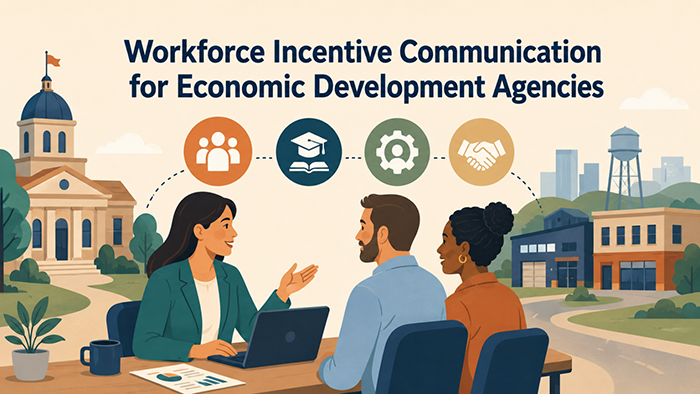
Workforce Incentive Communication for Economic Development Agencies: Helping Businesses Understand Training Support and Talent Programs
When a business owner thinks about what keeps them up at night, the inability to find, train, and keep qualified workers is among the most consistent answers across regions, sectors, and business sizes. Workforce challenges, whether manifesting as difficulty recruiting for skilled positions, high turnover in entry-level roles, gaps between the education system’s outputs and the workplace’s actual requirements, or the cost and complexity of training programs needed to develop internal talent, represent a category of operational pain that most businesses manage largely on their own because they do not know that public support exists. Not because the support does not exist. It often does. But because the communication connecting available workforce programs to the businesses that need them has failed to reach the right people, in the right language, at the moment when the connection would be most actionable.
Workforce incentive communication sits at an intersection that economic development agencies are not always well positioned to navigate: between the labor and workforce development systems, which design and administer training programs, and the business community, which experiences workforce challenges primarily as operational problems rather than as training program eligibility questions. A business owner facing high turnover in a production role is not thinking about on-the-job training reimbursement programs or customized training grants. They are thinking about how to fill the position, how to reduce the time and cost of getting a new employee productive, and whether there is any way to make the training investment they already know they need more financially manageable. The agency that can connect those operational concerns to available programs, in language that matches how the business owner frames the problem rather than how the program administrator categorizes the solution, is performing a communication function with real economic value.
The challenge is compounded by the proliferation of workforce programs, which exist at the federal, state, and local levels, through multiple administering agencies including workforce development boards, community colleges, economic development agencies, and sector-specific industry partnerships, and which vary in their eligibility, their funding structures, their application processes, and their specific supported activities in ways that are genuinely difficult to navigate without guidance. A business human resources manager who sits down to research available training support programs will encounter a landscape of acronyms, agency names, eligibility criteria, and program descriptions that requires significant effort to sort through, and the business that most needs the support is often the one with the least capacity to conduct that research.
This article examines how economic development agencies can design and deliver workforce incentive communication that connects businesses to available training support and talent programs in language that matches their operational reality, through channels that reach them at the moment when their workforce challenges are most acute, and with enough specificity about what is available and how to access it to convert awareness into action. It addresses the communication barriers that keep eligible businesses from using available programs, the message design that crosses the gap between program language and business language, the intermediary channels that reach employers most effectively, and the coordination across the fragmented workforce program landscape that makes communication more useful rather than more confusing.
Why Workforce Programs Are So Consistently Underused
 The underuse of workforce incentive programs by eligible businesses follows a pattern consistent enough across program types and regions that it has become a recognized phenomenon in the field, generating its own body of practitioner knowledge about what interventions improve program uptake. Understanding the specific reasons for underuse is the foundation for designing communication that addresses them, because each reason calls for a different response.
The awareness gap is the most fundamental barrier. A substantial share of eligible businesses simply do not know that specific programs exist or that they might qualify. This awareness gap is particularly pronounced for smaller businesses and for businesses not connected to the trade associations, chambers of commerce, and industry groups through which program information most commonly travels. An employer of twenty-five people running a manufacturing operation does not have the professional network connections, the trade association membership, or the human resources capacity that larger employers use to stay current on available incentive programs, and the agency’s standard outreach channels, a program website, a quarterly newsletter, a mention at the chamber’s business luncheon, consistently miss businesses at this scale and in this position.
The relevance uncertainty gap is the second most significant barrier. Many businesses that have heard of a program, or that are found by program outreach, still do not pursue it because they are uncertain whether the program applies to their specific situation. Eligibility criteria for workforce programs are often stated in bureaucratic terms that a business owner cannot easily evaluate without professional guidance: references to Workforce Innovation and Opportunity Act funding streams, employer size thresholds defined in specific ways, wage requirements stated relative to regional averages, and training activity descriptions that do not map clearly to what the employer actually does. A business that reads program eligibility criteria and cannot confidently determine whether it qualifies, and that lacks the time to invest in finding out, will default to not pursuing the program. The communication that eliminates this uncertainty by describing eligibility in operational terms the business can evaluate without expertise is the communication that converts awareness into action.
The complexity barrier compounds both of the above. Even businesses that are aware of a program and confident they qualify often do not pursue it because the application and compliance process appears more complex and time-consuming than the value of the incentive seems to justify. Workforce program applications frequently require the business to document training plans, identify eligible training activities, track participant wage data, submit reimbursement documentation, and complete compliance reporting in formats designed for program administration rather than for employer convenience. A business that calculates the staff time required to pursue a training grant and compares it to the maximum reimbursement available may rationally conclude that the net benefit does not warrant the investment, particularly if the business lacks the administrative capacity to manage the process efficiently.
The fragmentation barrier is a fourth dimension that affects businesses whose workforce challenges span multiple program areas. A manufacturer that needs to address both recruitment pipeline and incumbent worker upskilling may discover that the programs addressing each need are administered by different agencies with different application processes, different timelines, and different eligibility determinations, and that navigating both simultaneously while also running the business is beyond the practical capacity of the available staff. The fragmentation of the workforce program landscape is a genuine structural problem that communication alone cannot fully address, but communication that helps employers understand which programs they should pursue first and in what sequence, and that connects them to a single point of contact who can help them navigate the landscape, reduces the fragmentation barrier significantly compared to communication that describes each program in isolation.
The Language Gap Between Program Administration and Business Reality
The language gap between how workforce programs are described by their administrators and how the workforce challenges those programs address are experienced by the businesses they serve is one of the most persistent and most solvable communication failures in the workforce incentive space. Program administrators, who are embedded in the policy and regulatory frameworks that govern their programs, naturally describe those programs in the language of that framework: funding streams, eligible activities, matching requirements, performance metrics, and compliance obligations. Business owners, who are embedded in their operational realities, naturally describe their workforce challenges in operational terms: we cannot find welders, we have high turnover in our assembly line positions, we cannot afford to train new employees during the first three months before they become productive, we need our supervisors to develop better skills for managing a diverse workforce.
Communication that bridges this language gap starts from the business’s description of the problem and translates it into the program structure that addresses it, rather than starting from the program structure and expecting the business to perform that translation for themselves. The translation looks like this: a business owner who says we struggle to afford training new employees in the first ninety days before they are fully productive is describing an on-the-job training program opportunity, in which the program reimburses a portion of the wages paid during the period the employee is in structured training. Communicating that connection directly, saying if your business trains new employees in structured on-the-job settings during their first several months on the job, you may be able to recover a portion of those training costs through the on-the-job training program, is a communication that the business owner can immediately evaluate for relevance to their situation, because it uses their language to describe their situation before introducing the program that addresses it.
Growing Places: Communication Strategies for Economic Development and Public Finance Agencies
This article is part of our series on strategic communication for Economic Development organizations, including state and local economic development agencies, regional partnerships, and business attraction initiatives. To learn more and to see the parent article, which links to other content just like this, click the button below.
Designing Workforce Incentive Communication That Works
Effective workforce incentive communication is built around business problems rather than program features, delivered through the specific channels that reach employers in the moments when workforce challenges are most salient, and specific enough about what is available and how to access it that a business that encounters the communication can take a clear next step without needing to conduct additional research before deciding whether to pursue the program.
Problem-centered message design is the most important structural choice in workforce incentive communication, and it requires mapping each program to the specific operational problems it addresses before designing any outreach materials. The on-the-job training program addresses the problem of training costs during the new employee ramp-up period. The customized training grant addresses the problem of developing specific skills that no standard training provider offers. The sector partnership addresses the problem of recruiting from a workforce pipeline that does not yet have the specific skills the sector requires. The apprenticeship program addresses the problem of developing highly skilled workers for positions where the training pathway does not exist in the formal education system. Each of these problem statements is how a business owner would describe the situation the program is designed to address, and leading with that problem statement in outreach materials creates an immediate relevance signal that program-first communication cannot produce.
Specificity about what is available is the second critical design element. Workforce incentive communication that says training support may be available for eligible businesses, or that describes programs with ranges so wide they provide no useful signal, fails to give the business owner the information they need to assess whether pursuing the program is worth the effort. Effective communication specifies what businesses typically receive from the program, in terms of reimbursement amounts, training coverage, or service value, at a level of specificity that allows the business to make a rough cost-benefit assessment before investing time in the application process. A program that typically reimburses fifty to seventy-five percent of wages paid during on-the-job training periods of up to six months communicates a value proposition the employer can evaluate. A program that offers financial assistance for training costs communicates almost nothing of evaluative value.
Timeline and process clarity is the third design element that distinguishes communication that produces action from communication that produces interest without action. Businesses that are managing workforce challenges are managing them in the context of hiring timelines, production schedules, and operational realities that have specific timing requirements. A program whose application takes twelve weeks to process and whose approved training plan must be in place before training begins is not usable for a business that needs to start training an employee next week. Communicating program timelines honestly, including both the application timeline and the timing constraints on program participation, allows businesses to determine whether the program fits their specific operational context before they invest time in pursuing it and discover the mismatch after the fact.
The next step must be specific and immediately actionable. Every piece of workforce incentive communication should close with a single clear next step that the business can take immediately: call this specific person, visit this specific program page, attend this specific information session, or submit this specific request for a quick eligibility assessment. A next step that says visit the workforce development board website and learn more produces less action than one that says call the workforce board’s business services line, identify the program that fits your situation, and start the application process. The specificity and directness of the call to action determines what fraction of the businesses that were reached by the outreach actually take the first step, and the fraction that takes the first step determines the program’s uptake rate.
Channel Strategy for Reaching Employers With Workforce Program Information
 Workforce incentive communication reaches businesses most effectively when it arrives through channels they already use and trust for operational guidance rather than through channels the agency has built primarily for other purposes. The workforce director who manages the agency’s communication infrastructure naturally gravitates toward the channels the agency already controls: the website, the newsletter, the social media account, the press release to the local paper. Each of these channels reaches a specific audience, and for most workforce incentive programs, the audience most consistently missed by these channels is the small-to-medium employer who is not already connected to the agency and who does not actively seek out government program information.
Employer intermediaries are the highest-value channel for workforce incentive communication, precisely because they already have relationships with the employers the programs need to reach. Human resources professionals associations and roundtables, where HR directors from the region’s employers gather to share challenges and solutions, are an environment where workforce program information lands with immediate context: the people in the room are the ones managing the exact operational problems the programs address, and they are in a professional community of practice where sharing useful resources is a normal and expected behavior. An agency representative who participates in these communities as a knowledgeable resource rather than as a program marketer will build relationships that generate referrals over time in ways that an occasional presentation to the group will not.
Industry associations and sector partnerships provide concentrated access to employers with shared workforce challenges, and communication through these channels benefits from the association’s pre-existing trust with its members. A machining industry association that distributes information about on-the-job training programs to its members is delivering that information through a source the members trust for sector-relevant operational guidance, which gives the program information a credibility boost that the same information distributed through an agency newsletter would not receive. Building relationships with industry associations that include workforce program information in their regular member communications requires providing those associations with materials that serve their members’ interests, which means the materials must be sector-specific, operationally relevant, and free of the bureaucratic framing that makes government program communication feel foreign in an industry association context.
Business services providers, including payroll companies, HR software vendors, staffing agencies, professional employer organizations, and accounting firms that serve small and medium businesses, interact regularly with the employers the programs need to reach and routinely discuss workforce topics in those interactions. A payroll company that mentions available training reimbursement programs in a quarterly client newsletter, or a staffing agency that informs clients about sector partnership recruitment pipelines as part of its service relationship, is delivering workforce program information through a trusted advisory relationship at a moment of high relevance. Building referral relationships with business services providers requires making the referral easy and relevant to their own client relationships, which means providing them with accurate, current, concise program summaries that fit naturally into their existing client communication patterns.
Workforce Development Boards as Communication Partners
Workforce development boards occupy a structural position in the workforce program landscape that makes them both natural partners for economic development agency communication and potentially underutilized ones. WDBs administer the majority of federally funded workforce programs at the local level, have business services teams whose explicit function is to connect employers with available training resources, and typically have relationships with employers across the full range of the regional economy through their labor market intelligence functions. For an economic development agency seeking to reach employers with workforce program information, the WDB’s business services team is often the most natural partner: they are already in the business of delivering this information, they know the programs, and they have the employer relationships that effective outreach requires.
Building a productive partnership with the WDB requires recognizing what each party brings to the relationship and designing the collaboration around genuine complementarity rather than overlap. The economic development agency typically has stronger relationships with larger established employers through its business retention and attraction activities, and may have sector intelligence and business attraction leads that generate workforce program demand from specific company situations. The WDB typically has broader reach into the small business community through its American Job Center network and its business services team, and has the program knowledge and case management capacity to support employers through the application and compliance process. A partnership that uses each organization’s strengths, with the economic development agency generating employer demand from its existing relationships and the WDB providing program expertise and case management, produces better outcomes for employers than either organization working independently.
Navigating the Fragmented Workforce Program Landscape in Communication
The complexity of the workforce program landscape, with federal programs, state programs, locally funded programs, sector-specific programs, and programs administered by different agencies with different eligibility criteria and different application processes, creates a genuine communication challenge that no single piece of program-specific outreach fully resolves. A business that becomes aware of one program through an outreach effort may be better served by a different program, or by a combination of programs, that the outreach did not describe, and directing that business to the most relevant resources requires a level of landscape knowledge that most agency outreach communications do not provide.
The most effective communication solution for a fragmented program landscape is not to describe every program in every communication, which produces overwhelming information density, but to provide every communication with a clear path to a navigator who can help the business identify the right program for their specific situation. This navigator function, which may be performed by a workforce development board business services representative, an economic development agency staff member who has been trained on the full program landscape, a small business development center advisor, or another intermediary who knows the landscape and the business, converts the fragmentation of the landscape from a barrier into a feature: every program access point connects to a person who can map the full range of available resources to the specific business’s situation, rather than requiring the business to map that landscape independently.
Jointly branded employer guides that describe the full range of available workforce programs in a single accessible document, organized by the employer’s workforce challenge rather than by the administering agency, are one of the most practical communication investments that economic development agencies and WDBs can make together. A guide that organizes available programs under headings like If you are trying to reduce the cost of training new hires, or If you are trying to develop skills that are not available in the current workforce, or If you are trying to build a pipeline of qualified applicants for hard-to-fill positions, gives employers a navigation tool that the current siloed program-by-program communication landscape does not provide. Producing this guide collaboratively across programs and administering agencies requires organizational coordination that takes investment, but the result is a communication asset that no single program’s outreach could produce and that significantly improves the employer’s ability to find the programs most relevant to their situation.
Measuring Whether Workforce Incentive Communication Is Working
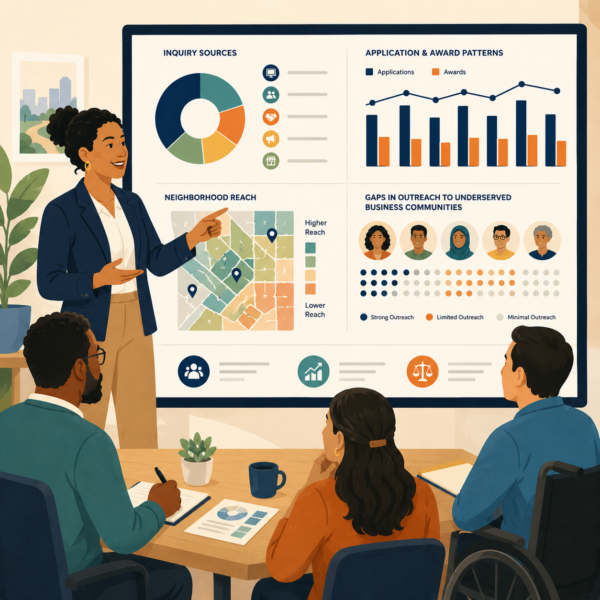
Workforce incentive communication effectiveness should be measured by program uptake rather than by outreach activity, because the purpose of the communication is not to raise awareness in the abstract but to connect eligible employers to programs that improve their workforce outcomes. The specific metrics that most directly capture whether the communication is working include the number of new employer inquiries generated by specific communication investments, the conversion rate from initial inquiry to program application, the conversion rate from application to approved program participation, and the characteristics of the employers being reached, including whether the communication is reaching the size, sector, and geographic distribution of employers that reflects the eligible population rather than only the employers most connected to the agency’s existing networks.
Tracking the source of employer inquiries is the most actionable measurement practice, because it identifies which communication channels and materials are actually generating employer engagement rather than which ones the agency invested in. An employer who calls the workforce board’s business services line and identifies themselves as calling because they saw information at the chamber luncheon, read it in the machining association newsletter, heard about it from their payroll company, or found it through a targeted Google search, provides data that the agency can use to allocate future outreach investment toward the channels that are producing results. Without this source tracking, the agency cannot distinguish between channels that are generating inquiries and channels that are consuming outreach resources without producing engagement.
Employer feedback on what they found useful, what was confusing, what barriers they encountered in the application process, and what additional information would have made the programs more accessible, is qualitative data that complements the quantitative tracking and surfaces the specific communication and process improvements that would most increase uptake. Collecting this feedback systematically, through follow-up surveys after employer inquiries and after program participation, and using it to drive specific communication improvements rather than treating it as interesting but non-actionable information, is the measurement discipline that allows workforce incentive communication to improve continuously rather than repeating the same approaches regardless of their effectiveness.
Strategic Communication Support for Economic Development Agencies
 Workforce incentive communication requires economic development agencies to operate effectively at the intersection of two systems, the economic development system and the workforce development system, that have different organizational cultures, different vocabularies, different program structures, and different relationships with the employer community. Agencies that are fully embedded in one system and only superficially connected to the other consistently fail to communicate about the full range of available workforce supports, because they either lack the program knowledge to communicate the workforce system’s programs accurately or lack the employer relationships to reach the businesses most in need of those programs.
Building effective workforce incentive communication capacity requires investment in the cross-system knowledge, partnerships, and communication infrastructure that neither system fully provides on its own. The economic development agency that has deep employer relationships but limited workforce program knowledge needs to build the WDB partnership and the program training that fills that gap. The workforce board that has deep program knowledge but limited reach into the employer community it needs to serve needs to build the economic development partnership and the business-centric communication design that fills that gap. The investment that produces the most durable improvement in workforce incentive program uptake is usually the investment in both.
Stegmeier Consulting Group (SCG) helps economic development agencies build workforce incentive communication systems that connect employers to available training support and talent programs at the moment and in the language that makes the connection actionable. That support may include employer needs assessment and problem-to-program mapping, workforce program landscape navigation guide development, channel and intermediary strategy for employer outreach, problem-centered message design for specific program types, WDB and intermediary partnership design, employer guide and toolkit development, and measurement framework design for workforce incentive communication uptake.
The goal of this work is a workforce incentive communication system in which the employer facing a specific workforce challenge encounters that program as a solution to that challenge, through a channel they trust, in language that matches their operational reality, with a clear and specific path to accessing the support, and with enough simplicity in the access process that the expected value of pursuing the program clearly justifies the effort required.
Future Trends in Workforce Incentive Communication
The workforce incentive communication landscape is evolving in response to changes in employer workforce challenges, workforce program structures, and the channels through which employer information flows. Several trends are shaping the direction of that evolution.
Skills-based hiring and training frameworks are gaining traction among employers across sectors, creating new relevance for workforce programs that support skills validation, competency-based training, and alternative credentials. As more employers shift from degree-based to skills-based hiring practices, the communication opportunity is to connect those employers to programs that support the development and validation of specific skills, rather than continuing to frame workforce programs primarily around traditional education and training pathways. Agencies that update their workforce incentive communication to reflect skills-based framing will reach a growing segment of employers whose current workforce practices are more aligned with skills-based approaches than with the traditional frameworks most workforce programs were built around.
Apprenticeship program expansion at the state and federal level is creating new program options for employers who want to develop highly skilled workers through structured earn-and-learn pathways, and those programs are consistently underutilized relative to their potential because most employers have limited awareness of registered apprenticeship as a viable training option for their specific occupations and industry. Communicating about apprenticeship in terms of what it produces for employers, a structured path to developing high-skill workers who are committed to the employer because the employer invested in their development, rather than in terms of the regulatory structure of a registered program, reaches employers more effectively than program-centric apprenticeship communication.
The intersection of workforce development and economic development in specific industry sectors is becoming a higher-profile policy and program priority, with sector partnership models that bring together employers, training institutions, and workforce agencies around a shared commitment to developing the talent pipelines specific sectors need. Communication about sector partnerships should emphasize their employer-benefit orientation, the fact that the partnership’s goal is to produce the specific trained workers the participating employers need through programs designed with employer input, rather than their organizational complexity. An employer that understands it can participate in shaping the training programs that will produce its next generation of workers, and that the sector partnership structure is the vehicle for that participation, is more likely to engage than one that is asked to support a consortium that will eventually benefit its sector.
Conclusion
Workforce programs designed to help businesses find, train, and develop talent are among the most practically valuable public resources available to employers, and they are among the most consistently underused. The gap between availability and utilization is primarily a communication gap: programs that eligible businesses do not know about, do not understand as relevant to their specific situation, cannot navigate without more effort than they believe the benefit justifies, or cannot access through the fragmented landscape of administering agencies and application processes. Closing this gap requires communication that leads with the business’s problem rather than the program’s structure, that reaches employers through the channels and intermediaries they already trust for operational guidance, and that provides a clear, specific, and low-friction path to the support that is available.
Economic development agencies that make this communication investment build something of real value for the employers in their communities: genuine awareness of the support that exists, combined with genuine ability to access it, which is the combination that actually produces the workforce outcomes that the programs were designed to achieve. That combination is what connects the program’s design intention to the employer’s operational reality, and the connection is made entirely through communication.
SCG’s Strategic Approach to Communication Systems
Align your agency’s messaging, processes, and public engagement strategies.
Economic development agencies need workforce incentive communication systems that lead with the employer’s workforce problem rather than the program’s administrative structure, reach employers through trusted intermediaries including HR associations, industry groups, business services providers, and WDB business services teams, provide specific and honest information about what programs offer and what they require, and offer a clear and low-friction next step that converts awareness into action. That means problem-to-program mapping, intermediary channel strategy, jointly produced employer navigation guides, WDB partnership design, and measurement systems that track uptake by source and by employer characteristics.
SCG helps economic development agencies build workforce incentive communication that connects employers to the training support they need at the moment and in the language that makes the connection actionable. Whether your agency needs problem-centered message design, intermediary partnership strategy, employer navigation guide development, or uptake measurement frameworks, SCG can help you build a communication system that closes the gap between program availability and program use.
Use the form below to connect with our team and explore how strategic workforce incentive communication can help your agency connect more employers to the training support that improves their operations and the region’s workforce.