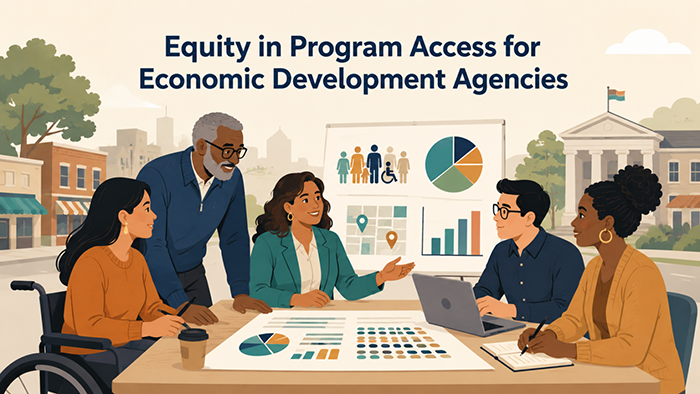
Equity in Program Access for Economic Development Agencies: Using Communication Data to Find Who Is Being Missed
Equity commitments in economic development agencies have proliferated in recent years, appearing in strategic plans, annual reports, mission statements, and board resolutions with an increasing frequency that reflects genuine organizational intention in many cases and performative alignment with funding and political expectations in others. What distinguishes the genuine from the performative is not primarily the language of the commitment or the sophistication of the equity framework it references. It is whether the agency has done the analytical work of understanding where its programs are actually going, who is receiving the services and resources it administers, how the demographic profile of program participants compares to the demographic profile of the eligible population, and what specific communication and access failures explain the gaps it finds. Equity statements that are not backed by this analysis are aspirations that have not yet become strategy.
This article is about the analytical work: how economic development agencies can use data on inquiries, applications, awards, and the demographic characteristics of the businesses they serve to understand where communication is failing and who is being missed, and how that understanding can translate into specific, measurable communication improvements rather than a general commitment to do better. The data required for this analysis is often already being collected, in program application databases, intake forms, outreach contact lists, and award records, but has not been organized or analyzed in a way that reveals its equity implications. The analytical discipline required to make this data speak to equity is not technically complex; it requires the organizational will to look honestly at what the data shows and the strategic clarity to respond to what it reveals.
The relationship between communication strategy and equity outcomes in economic development programs is direct and underappreciated. Most equity gaps in program participation are not primarily the result of program design failures, eligibility criteria that are intentionally exclusionary, or deliberate discrimination. They are the result of communication systems that were built to reach the communities most connected to the agency’s existing networks and most comfortable with the channels through which the agency communicates, which are systematically not the communities facing the greatest economic challenges. A loan fund with no eligibility criteria that would exclude any creditworthy business may still show stark geographic and demographic concentration in its award portfolio because the communication strategy that generates its applications reaches some communities and not others. Fixing that inequity requires understanding the communication system’s failure, not just the program’s eligibility criteria.
This article examines how economic development agencies can build the data analysis and communication improvement cycle that converts equity commitments into measurable equity outcomes. It addresses the data that agencies should be collecting and analyzing, the analytical frameworks that reveal communication gaps versus other types of program access barriers, the specific communication improvements that different types of equity gaps call for, and the governance and reporting practices that hold agencies accountable for progress rather than allowing equity commitments to remain permanently aspirational.
The Data That Reveals Who Is Being Missed
 The first analytical question an agency must answer is: who is using our programs relative to who could be using them? This requires two datasets: the actual program participation data, which the agency has, and an estimate of the eligible or target population, which the agency typically has to construct from external sources. The comparison between these two datasets is where equity gaps become visible and where communication strategy becomes an equity tool.
Program inquiry data is the earliest point in the participation pipeline at which equity gaps can be identified, and it is the point most directly connected to communication strategy. An inquiry is a moment when a business owner has become aware enough of a program to take an initial action, whether calling the agency, submitting a web form, or attending an information session. The demographic and geographic profile of inquiries reveals which communities the agency’s communication is reaching well enough to generate active interest, and comparing that profile to the estimated eligible population reveals where the communication is failing before any program design or underwriting question arises. An agency that receives inquiries predominantly from established businesses in central city locations, while its target population includes businesses of all sizes across a geographically dispersed market, has a communication reach problem that is visible at the inquiry stage and must be addressed at the communication strategy level rather than at the underwriting or technical assistance level.
Application data is the next point in the pipeline and reveals a different dimension of equity: whether businesses that learn about a program and express interest are actually able to complete the application process. An agency that receives diverse inquiries but a less demographically diverse application pool has a different problem than one with a homogeneous inquiry pool: the program application process, which may include documentation requirements, financial statement standards, English-language completion requirements, or other structural elements, is creating a barrier for businesses that found out about the program but could not complete the application. This is a program design and technical assistance problem as much as a communication problem, though communication about the technical assistance available to support application completion is itself an important intervention.
Award data is the final point in the participation pipeline and reveals the cumulative effect of all upstream gaps: communication reach, application process, and underwriting criteria. Award data that shows stark demographic or geographic concentration relative to the eligible population requires investigation of each upstream stage to identify where the concentration originates. If the concentration is already visible at the inquiry stage, the communication strategy is the primary intervention point. If it emerges between inquiry and application, the application process is the primary intervention point. If it emerges between application and award, the underwriting or program criteria are the primary intervention point. Treating award data concentration as a single undifferentiated problem leads to the wrong interventions; pipeline analysis that identifies where the concentration originates leads to targeted, effective ones.
Geographic data analysis reveals equity gaps along spatial dimensions that demographic data may not fully capture. A program award portfolio concentrated in certain neighborhoods or zip codes while the eligible population is distributed more broadly across the market reveals geographic equity gaps that may reflect communication reach patterns, historical agency focus areas, or partner network geography. Mapping award locations against the geographic distribution of eligible businesses is a basic equity analysis that many agencies have not performed and that reveals spatial patterns of program access that aggregate demographic statistics obscure.
Building the Eligible Population Denominator
The most analytically challenging aspect of equity gap analysis is constructing the denominator: a credible estimate of the eligible population against which actual participation can be compared. Without this denominator, the agency can describe who it is serving but cannot evaluate whether it is serving them equitably, because it has no reference point for what equitable service would look like.
The eligible population denominator varies by program and must be constructed specifically for each program type. For a revolving loan fund that lends to small businesses with creditworthy plans, the relevant denominator is not all businesses in the market but the subset of businesses that meet the basic eligibility criteria: the right size, the right sector if the program has sector restrictions, and the right geographic location. Constructing this denominator requires combining data sources, including business registry data that identifies eligible businesses by sector and employment size, geographic data that identifies which businesses are in the program’s eligible area, and any other eligibility criteria that can be applied to available data to narrow the denominator to an appropriately comparable eligible population.
Even an imperfect eligible population estimate is more analytically useful than no estimate at all, because it provides an order-of-magnitude sense of the gap between current participation and potential participation, reveals the directional pattern of over- and under-service, and provides a basis for measuring progress as communication improvements are implemented. Agencies that wait for a perfect denominator before conducting any equity gap analysis will wait indefinitely; the practical standard is a good-enough estimate clearly described with its limitations, used consistently over time to track relative change rather than as a precise measure of absolute equity.
Growing Places: Communication Strategies for Economic Development and Public Finance Agencies
This article is part of our series on strategic communication for Economic Development organizations, including state and local economic development agencies, regional partnerships, and business attraction initiatives. To learn more and to see the parent article, which links to other content just like this, click the button below.
Distinguishing Communication Gaps From Other Access Barriers
One of the most important analytical distinctions in equity gap analysis is between gaps that are primarily communication failures and gaps that reflect other types of access barriers. Treating all equity gaps as communication problems leads to communication interventions that do not address the actual barrier; treating all equity gaps as program design problems leads to program revisions that do not address communication failures that are causing or compounding the equity gap. Getting this distinction right requires analyzing the pipeline at multiple stages rather than looking only at the final participation outcome.
A communication gap is indicated when the demographic or geographic profile of program inquiries shows significantly less diversity or representation than the eligible population, because this suggests that the communication strategy is not reaching all segments of the eligible population with awareness of the program. The remedy for a communication gap is a communication strategy intervention: reaching the underrepresented communities through different channels, different messengers, different materials, or different programmatic entry points that fit the information behavior of those communities better than the current approach.
An application barrier is indicated when inquiry diversity is reasonably proportionate to the eligible population but application diversity is significantly less so, suggesting that businesses from underrepresented communities are learning about the program but not completing the application. The remedy for an application barrier is an application process intervention: simplifying documentation requirements, providing application preparation support in relevant languages and through trusted intermediaries, reducing the administrative burden of completing the application, or providing explicit technical assistance at the application stage for businesses that need it. A communication intervention that increases awareness among the underrepresented communities without addressing the application barrier will increase the number of applications started and abandoned, not the number of funded projects.
An underwriting barrier is indicated when application diversity is reasonably proportionate to the eligible population but award diversity is significantly less so, suggesting that businesses from underrepresented communities are applying but not being approved at rates comparable to more represented communities. The remedy for an underwriting barrier is a program design intervention: reviewing underwriting criteria for factors that have disparate impact on underrepresented communities without being necessary to program integrity, providing supplemental support such as technical assistance or credit enhancement that helps underrepresented businesses become more competitive applicants, or explicitly designing program tiers that serve different stages of business development.
Most real equity gaps are not cleanly located at a single stage of the pipeline; they reflect failures at multiple stages that compound each other. A community that is underreached by communication, faces higher application barriers because the application process was designed for more formally organized businesses, and then faces higher underwriting barriers because underwriting criteria favor businesses with longer operating history and more formal financial records, will show low participation at every stage for reasons that are compounding rather than independent. Addressing this kind of multi-stage barrier requires interventions at each relevant stage rather than a single intervention at the most visible point of the gap.
Translating Gap Analysis Into Communication Strategy
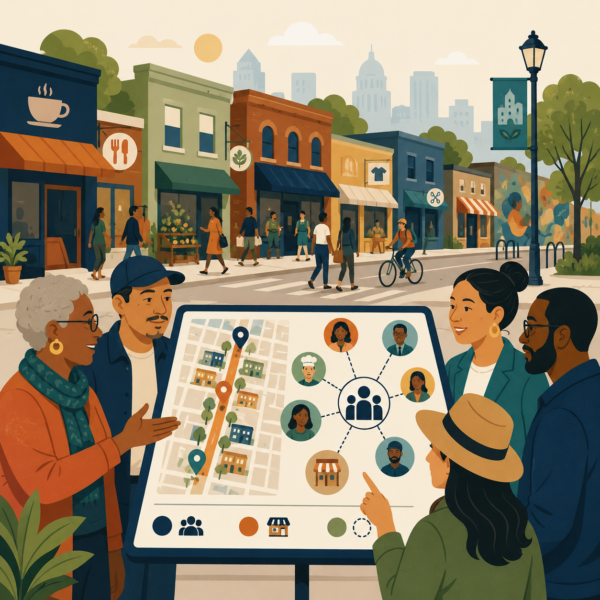 Once an agency has identified that a specific equity gap in program participation is primarily or substantially attributable to communication reach failures, the analytical work transitions to communication strategy design: identifying the specific changes to channel selection, messenger engagement, material design, and outreach investment that will extend program awareness into the underreached communities that the current strategy is not reaching.
Geographic gap analysis that reveals specific neighborhoods or regions with low program inquiry and participation relative to their eligible business population points directly to a geographic outreach strategy: the agency needs to build or strengthen its communication presence in those specific areas, through the institutions and channels that carry credibility in those communities rather than through the existing outreach infrastructure that is evidently not reaching them. The corridor stakeholder mapping and trusted messenger strategies discussed in other articles in this series are the specific tools for translating a geographic gap finding into a geographic outreach intervention.
Demographic gap analysis that reveals specific business owner populations, whether defined by race, ethnicity, immigrant status, gender, or other characteristics, with low program inquiry and participation relative to their share of the eligible business population points to a targeted outreach strategy: building the ethnic chamber partnerships, ethnic media relationships, trusted messenger networks, and language-accessible materials that extend program awareness into those specific communities. The language access and CDFI partnership strategies discussed in other articles provide the specific tools for these interventions.
Sector gap analysis that reveals specific business types with low program participation, despite apparent program relevance, points to a sector-specific outreach strategy: engaging the trade associations, supplier networks, and professional organizations that serve those sectors, and designing outreach materials and program entry points calibrated to the specific characteristics and information behaviors of those business types. A program that is theoretically relevant to home-based childcare providers but is systematically not reaching them may need outreach through the childcare regulatory and licensing infrastructure, through childcare resource and referral networks, or through childcare-specific professional development channels that the agency has not previously engaged.
Size gap analysis that reveals very small businesses with low participation relative to their share of the eligible population points to a combination of communication and program design interventions: ensuring that outreach channels and materials reach micro-enterprises and sole proprietors who are not connected to formal business organizations, and examining whether program minimums, documentation requirements, and application processes are calibrated to the capacity of the smallest eligible businesses or designed for somewhat larger and more formally organized ones.
Setting and Tracking Equity Communication Goals
Equity analysis without accountability mechanisms produces the same aspirational gap as equity statements without equity analysis. The organizations that make genuine, measurable progress on program access equity are those that translate gap analysis findings into specific, time-bound communication goals and then track performance against those goals with the same discipline they bring to financial performance management.
Equity communication goals should be specific enough to be measurable: not we will improve equity in program access but we will increase the share of program inquiries from businesses located in the three neighborhoods with the lowest current inquiry rates by a specified percentage within twelve months, through the corridor outreach strategy we are implementing in those neighborhoods. This goal is testable: the agency can track inquiry geography quarterly and evaluate whether the strategy is producing the intended shift in inquiry sourcing.
The discipline of setting specific equity communication goals and tracking them quarterly forces two organizational behaviors that equity aspirations without measurement do not: it requires the agency to make specific outreach investments before it knows whether they will work, accepting the risk of investing in approaches that may need to be adjusted, and it requires the agency to look honestly at its own performance against a specific standard rather than evaluating its equity progress through the more comfortable mechanism of assessing effort invested rather than outcomes produced. Both of these behaviors are uncomfortable, which is partly why they are rare, and both are necessary for genuine equity progress, which is why agencies that practice them tend to outperform their peers on equity outcomes over time.
Collecting the Data Needed for Ongoing Equity Analysis
The analytical work described in this article requires data that most economic development agencies do not systematically collect in a form that supports equity analysis, and building the data collection practices that make ongoing equity analysis possible is an organizational investment that must precede the analysis. Many agencies collect program participation data for compliance and reporting purposes but not in a form that allows demographic and geographic analysis over time; others collect some demographic data at application but not at inquiry, making pipeline analysis impossible; and still others collect the data but store it in systems that are not designed for the cross-program, longitudinal analysis that equity tracking requires.
Building equity-grade data collection requires making several specific design decisions about what data to collect, when to collect it, how to store it in a way that supports analysis, and how to balance the need for demographic data with the privacy expectations of program participants. Race and ethnicity data collected in voluntary, optional form at the inquiry stage is less complete but more ethically appropriate than data collected as a required field; the trade-off between data completeness and participant autonomy should be resolved in ways that respect participant privacy while collecting enough information to support meaningful equity analysis. At a minimum, agencies should collect geographic data at every stage of the pipeline, because location can often be used as a proxy for demographic characteristics in geographic equity analysis even when direct demographic data is limited.
Inquiry intake forms and business assistance intake processes are the earliest collection points, and they are also the most resource-intensive to redesign if they were not built with equity data collection in mind. Agencies that are redesigning their intake processes should build equity-relevant data fields into the new design from the beginning rather than retrofitting them afterward, because retrofitting typically produces incomplete and inconsistent collection rather than the systematic data capture that equity analysis requires. The specific fields most important for equity analysis include business location, business owner demographics collected voluntarily, primary language of the business owner, year business was established, and business size by both employment and revenue, each of which contributes to the equity analysis in specific and complementary ways.
Equity Reporting as Organizational Accountability
The final element of a genuine equity communication strategy is public reporting on equity outcomes, which converts internal data analysis into public accountability in a way that sustains organizational commitment to equity progress through leadership transitions, budget cycles, and the inevitable competing priorities that every organization faces. Agencies that report publicly on their equity progress, including honest reporting on gaps that have not yet been closed, are making a commitment to their communities and stakeholders that internal analysis alone does not produce.
Equity reporting should present the gap analysis findings, the communication interventions implemented in response, and the measured change in program participation patterns over time, all in language that a non-technical public audience can understand. This is not primarily about defending the agency’s equity record but about being honest with the communities that depend on equitable program access about where the agency is succeeding and where it still falls short. An agency that can report that its outreach investments in specific underserved corridors produced a measurable increase in program inquiries from those areas while acknowledging that the increase has not yet fully closed the gap has produced a transparency that builds trust. An agency that can only report that it has made equity a priority has produced a statement that tells the community nothing about whether that priority is producing any change.
The equity reporting audience includes not only the general public but the specific communities that have been underserved, whose members have a particular interest in knowing whether the agency’s equity commitments are producing changes in the programs they interact with, and whose feedback on both the reports and the underlying program changes should be actively solicited rather than passively received. Building formal community feedback mechanisms into the equity reporting cycle, including listening sessions in underserved communities, partnerships with community organizations that serve those populations, and explicit solicitation of community input on whether reported improvements are being experienced on the ground, converts equity reporting from a one-way agency communication into a genuine accountability relationship between the agency and the communities it serves.
Strategic Communication Support for Economic Development Agencies
 The analytical and communication work of genuine equity in program access requires organizational capacity that most economic development agencies have not built, partly because the technical skills required for pipeline analysis and equity metrics development are different from the program management and deal structuring skills that dominate most agency staffing, and partly because the cultural change required to look honestly at equity gaps and respond to what that analysis reveals is more organizationally demanding than adding equity language to existing communications. The agencies that have made genuine progress on program access equity have usually made it through sustained leadership commitment, analytical investment, and the willingness to be publicly accountable for outcomes rather than only for intentions.
Stegmeier Consulting Group (SCG) helps economic development agencies build the data analysis and communication improvement cycles that translate equity commitments into measurable equity outcomes. That support may include equity gap analysis framework design, program pipeline analysis at inquiry, application, and award stages, eligible population denominator construction, geographic equity mapping, communication gap versus other barrier type distinction analysis, equity communication goal setting and tracking framework, equity data collection design for intake processes, equity reporting framework and community accountability mechanism development, and targeted outreach strategy design for specific underreached communities identified through gap analysis.
The goal of this work is an agency that knows, in specific and measurable terms, who is benefiting from its programs and who is not, why the gaps exist at each stage of the participation pipeline, what specific communication investments are closing specific gaps, and how to report honestly on that progress to the communities that depend on equitable access to the programs the agency administers. That level of analytical and communicative honesty is what equity commitment actually requires, and it is achievable through the disciplines described in this article.
Future Trends in Economic Development Equity Communication
The equity landscape for economic development agencies is evolving rapidly in ways that will raise both the expectations and the tools available for equity gap analysis and equity communication.
Data availability and quality for equity analysis is improving, driven by expanding business registry data, better integration between government administrative databases, and growing availability of demographic business ownership data through census and survey programs. Agencies that invest in the analytical capacity to use this improving data landscape will be able to conduct more precise and more current equity gap analyses than were possible a few years ago, and the precision of those analyses will support more targeted and more effective communication interventions.
Funders, federal agencies, and state governments are increasingly requiring equity data and equity progress reporting from economic development agencies as conditions of program funding and program authorization. This regulatory and funder pressure is creating external accountability for equity outcomes that supplements the internal commitment some agencies have built, and it is raising the analytical standard for what equity accountability means in practice. Agencies that have already built the data collection and analysis infrastructure that genuine equity accountability requires will find these external requirements relatively straightforward to meet; those that have not will find the compliance burden of new requirements steep.
Community organizations and advocacy groups focused on economic equity are becoming more sophisticated in their ability to analyze program participation data and hold agencies publicly accountable for equity gaps, using Freedom of Information Act requests, publicly available data, and their own analysis to produce equity assessments of agency programs that are independent of agency self-reporting. Agencies that have been transparent and honest in their own equity reporting will find this independent scrutiny confirming; those that have not will find it exposing. The strategic implication is that the investment in genuine equity analysis and honest reporting is also an investment in the agency’s ability to engage productively with external scrutiny rather than being ambushed by it.
Conclusion
Equity in economic development program access is not achieved by declaring it a priority or by adding equity language to program descriptions. It is achieved by doing the analytical work of understanding who is using the programs and who is not, identifying the specific communication and access barriers that explain those gaps, implementing targeted interventions at each stage of the participation pipeline where barriers are found, and reporting honestly on whether those interventions are producing the changes in program access that equity requires. This is demanding work that requires organizational commitment, analytical investment, and the cultural willingness to look honestly at gaps between intention and reality. Agencies that do it well are building programs that serve the full range of their communities rather than the communities that were already easiest to reach.
The communication strategy dimension of this work is substantial and specific. Most equity gaps in economic development program participation are communication gaps at their root, reflecting outreach systems that reach some communities and not others for reasons of channel design, messenger credibility, language, cultural fit, and geographic presence. Understanding where those communication gaps are, through the pipeline analysis that this article describes, is the analytical foundation for designing the targeted interventions that actually close them. And closing them is what equity commitment, at its most honest and its most useful, requires.
SCG’s Strategic Approach to Communication Systems
Align your agency’s messaging, processes, and public engagement strategies.
Economic development agencies need equity gap analysis and communication improvement systems that move beyond equity statements to measurable outcomes. That means pipeline analysis at inquiry, application, and award stages to locate where gaps originate, eligible population denominators that allow meaningful comparison of actual to potential reach, geographic and demographic mapping of program participation patterns, distinction between communication gaps and other access barriers so interventions target the right stage of the pipeline, specific equity communication goals with quarterly tracking, equity-grade data collection designed into intake processes, and honest public reporting on gap trends and intervention results.
SCG helps economic development agencies build the data analysis and communication improvement cycles that convert equity commitments into measurable equity outcomes. Whether your agency needs gap analysis framework design, pipeline analysis, eligible population estimation, communication strategy for specific underreached communities, data collection redesign, or equity reporting and accountability framework development, SCG can help you build the analytical and communicative discipline that genuine program access equity requires.
Use the form below to connect with our team and explore how data-driven equity communication strategy can help your agency close program access gaps and build a track record of equitable economic development that the communities you serve can hold you accountable to.