
Conduit Bond Program Communication for Industrial Development Authorities: Explaining the Tool to First-Time Borrowers and the Public
Conduit bond financing occupies an unusual space in the public finance landscape. It is a tool that industrial development authorities use regularly, that sophisticated borrowers in the nonprofit and private sectors have learned to navigate, and that the public almost never encounters in a form that makes sense to them. When it does appear in public view, whether through a board approval process, a news article, or a community notice, it tends to generate confusion or suspicion precisely because the basic structure is counterintuitive: a public authority is issuing bonds on behalf of a private or nonprofit borrower, the public entity is not on the hook for repayment, and the arrangement is legal, common, and beneficial. That set of facts is genuinely difficult to explain, and most industrial development authorities have not invested in explaining it well.
The conduit bond communication challenge is really two challenges that require different approaches and different materials. The first is the borrower education challenge: helping private companies, nonprofit healthcare organizations, higher education institutions, and other eligible borrowers who have never used conduit financing understand what it is, whether it applies to their situation, and how the process works. The second is the public understanding challenge: helping community members, elected officials, journalists, and oversight bodies understand why a public authority is involved in what appears to be private or nonprofit project financing, and what the public benefit justification is.
Failing to address either challenge creates real problems. First-time borrowers who cannot understand the tool do not use it, even when it would serve their financing needs. Public audiences who cannot understand the public benefit rationale may conclude that the authority is acting improperly or using public resources for private benefit. Neither outcome serves the authority, the borrower, or the community. This article examines both communication challenges and offers a framework for addressing them with the specificity and clarity they require.
What Conduit Bond Financing Is and Why It Is Hard to Explain
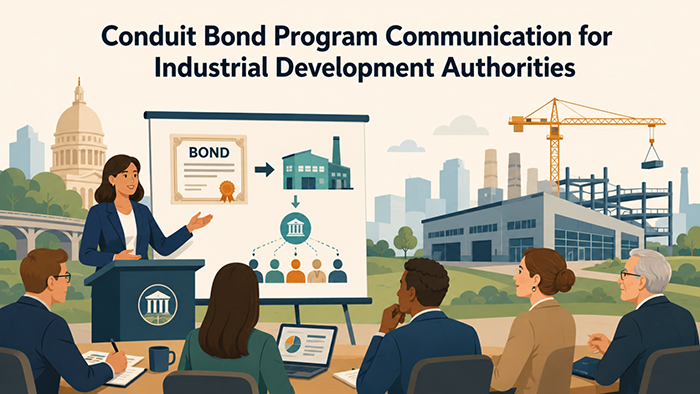
 Conduit bond financing works by having a public authority, typically an industrial development authority or a related public entity, issue bonds on behalf of a private or nonprofit borrower. The proceeds go to the borrower to finance an eligible project. The borrower makes the debt service payments. The public authority is the issuer of record but does not repay the bonds from public funds and does not bear the credit risk of the transaction. The bonds may carry tax-exempt status under federal law, which reduces the borrower’s borrowing cost below what conventional taxable financing would produce.
This structure is genuinely difficult to explain because it contradicts the assumptions most people bring to the phrase “public bond issuance.” When most people hear that a public authority is issuing bonds, they assume the authority is borrowing money to pay for a public project, that taxpayers are backing the debt, and that public funds will repay it. None of those assumptions are correct for a conduit bond transaction. The borrower is private or nonprofit. The repayment obligation belongs to the borrower, not the authority. The public benefit is indirect, coming through the economic development, employment, healthcare access, educational capacity, or other outcomes the project produces rather than through a publicly owned asset.
The explanation challenge is compounded by the legal and financial complexity of the underlying structure. Conduit bonds involve bond counsel, indenture trustees, loan agreements, deed of trust arrangements, and federal tax law compliance requirements that are genuinely technical. Explaining the tool without explaining all of that complexity requires deliberate choices about what to include, what to leave out, and what to substitute with simpler framing that captures the essential logic without misrepresenting the legal structure.
The Public Benefit Rationale Requires Active Explanation
The public benefit rationale for conduit bond financing is real and legally required, but it is not self-evident to public audiences. Industrial development authorities are authorized to use conduit financing for projects that serve recognized public purposes such as job creation, economic development, healthcare access, educational capacity, housing, or environmental improvement. The connection between the private or nonprofit borrower’s project and these public purposes may be clear to the authority and its bond counsel but is rarely communicated clearly to the general public.
When public audiences encounter conduit bond transactions without that explanation, they fill the gap with the assumption that a public entity is helping a private company or nonprofit with its financing at some public expense or risk. That assumption is understandable given the general public’s limited familiarity with conduit bond mechanics, and it is not entirely irrational without more information. The authority’s job is to provide the information that replaces that assumption with an accurate understanding of what the transaction does, who benefits, and why the authority’s involvement is appropriate.
A strong public benefit explanation for a conduit bond transaction names the specific public purpose the project serves, quantifies it where possible, and connects it to the community outcomes that the authority exists to support. A manufacturing facility that will create a specific number of jobs in a defined wage range, a hospital expansion that will expand access to a specific medical service, or an educational facility that will serve a specific student population are all concrete enough to support a credible public benefit explanation. Vague claims about economic development or community benefit are not.
Growing Places: Communication Strategies for Economic Development and Public Finance Agencies
This article is part of our series on strategic communication for Economic Development organizations, including state and local economic development agencies, regional partnerships, and business attraction initiatives. To learn more and to see the parent article, which links to other content just like this, click the button below.
Borrower Education for First-Time Conduit Bond Users
First-time conduit bond borrowers come to the tool from a wide range of backgrounds. A privately held manufacturing company may have financed prior capital projects through conventional bank lending and have no experience with tax-exempt financing. A nonprofit healthcare system may have issued its own revenue bonds for major capital projects but never used a conduit structure for a smaller facility. A charter school may be pursuing its first permanent facility and navigating public finance for the first time. Each of these borrowers brings different prior knowledge, different concerns, and different questions to the engagement.
What they share is the need to understand, before they invest significant time and professional fees in exploring the transaction, whether conduit financing is likely to be beneficial in their situation. The primary benefit for most eligible borrowers is the interest rate advantage that tax-exempt conduit financing carries relative to taxable alternatives. But that advantage is not free. There are costs associated with the conduit structure, including authority fees, bond counsel fees, trustee fees, and ongoing compliance requirements, that reduce the net benefit. Whether the net benefit is positive depends on the size of the transaction, the borrower’s alternative financing options, and the compliance burden the organization can realistically absorb.
Effective borrower education for first-time conduit bond users should help potential borrowers think through that calculation before they invest in formal exploration. It should explain the interest rate advantage clearly, describe the costs associated with the structure at a realistic level of specificity, and give potential borrowers a rough sense of the transaction size at which the economics tend to work. This is not a substitute for the borrower-specific financial analysis that bond counsel and financial advisors will provide. It is the preliminary filter that helps borrowers decide whether detailed analysis is worth pursuing.
Explaining the Authority’s Role and What It Does Not Do
One of the most important and most commonly misunderstood elements of conduit bond financing is the authority’s role in the transaction. First-time borrowers sometimes assume that the authority’s involvement means the authority is reviewing and approving the project on its merits beyond the public benefit determination, that the authority is providing some form of financial backing or guarantee, or that the authority will be an ongoing operational partner after the financing closes. None of these assumptions are generally correct, and misunderstanding the authority’s role can create unrealistic expectations that complicate the transaction.
A clear explanation of the authority’s role should cover what the authority does, what it does not do, and what the borrower is responsible for. The authority reviews the project for eligibility, issues the bonds as conduit issuer, and receives fees for its services. It does not guarantee the bonds, does not conduct detailed due diligence on the borrower’s financial capacity or project viability, and does not become financially exposed to the project’s performance. The borrower is responsible for the debt service, the compliance obligations, and the project itself. This division of responsibility should be clear from the earliest stages of borrower education.
Plain-Language Explanations of the Public Process
Conduit bond transactions at industrial development authorities typically involve a public process that includes board approval, a public hearing, and in some cases advance notice to relevant governmental bodies. This public process is required by federal tax law and state enabling statutes, and it serves important transparency and accountability functions. But it also creates a public communication moment that many authorities are not well prepared for.
When a conduit bond transaction appears on a board agenda or in a public hearing notice, it may be the first time community members, local journalists, or elected officials have encountered the transaction. If the agenda item description and the public hearing notice consist primarily of legal recitations and technical identifiers, the public communication moment has been missed. The people who show up to the public hearing or read the board agenda may leave with more confusion than they arrived with.
A stronger approach treats the board agenda item and the public hearing notice as communication opportunities. The agenda description should explain in plain language what project is being financed, who the borrower is, what the financing structure does, what the public benefit is, and what the authority is and is not responsible for. This explanation does not replace the formal legal description but can accompany it as a plain-language summary. The public hearing notice should similarly include enough context that a community member can understand what they are being given the opportunity to comment on before they decide whether to attend or submit comments.
Managing Common Misconceptions About Public Risk
The most common and most damaging misconception about conduit bond financing in public discourse is that the public authority is putting public money or public credit at risk to benefit a private or nonprofit borrower. This misconception is understandable given the counterintuitive structure of the transaction, and it can gain traction quickly in community settings where trust in public institutions is limited or where prior economic development decisions have generated controversy.
Managing this misconception requires proactive communication that addresses it directly before it takes hold. The authority should have clear, ready-made language for explaining that conduit bonds are not backed by public funds or public credit, that the obligation to repay belongs entirely to the borrower, that the authority’s fees are designed to cover its costs rather than subsidize the borrower, and that the federal tax law requirements that govern the transaction include specific limitations on the types of projects that are eligible and the ways in which the tax-exempt interest benefit can be used.
This language should be available in multiple formats: a brief paragraph for agenda descriptions and public notices, a one-page fact sheet for community members who want more detail, and a longer explanation for journalists, elected officials, or oversight bodies that are conducting more thorough review. Having these materials ready before a specific transaction raises public questions is far better than developing them in response to already-published coverage that has framed the transaction inaccurately.
Translating Legal and Financial Structures Into Decision-Making Language
 The legal and financial documents that govern a conduit bond transaction are detailed, precise, and written for the professionals who will interpret and enforce them. They are not written for the elected board members who must approve the transaction, the community members who may attend a public hearing, or the local journalists who may cover the story. Translating those structures into language that supports informed decision-making is one of the most important and most underinvested communication functions at industrial development authorities.
Translation in this context does not mean simplification to the point of inaccuracy. It means finding the level of explanation that gives each audience enough understanding to fulfill their legitimate role in the transaction. A board member approving a conduit bond transaction needs to understand what is being approved, what the authority is committing to, what the public benefit justification is, and what the authority’s exposure is if something goes wrong. That is a different and much simpler set of information needs than the full legal and financial documentation of the transaction, and it can be addressed in a two-to-four-page plain-language deal summary that accompanies the formal resolution.
A journalist covering a conduit bond transaction needs to understand the structure well enough to explain it accurately to readers, identify whether there are legitimate questions about public benefit, and assess whether the process was conducted appropriately. That requires an explanation of the basic mechanics, the specific public benefit claimed, the approval process that was followed, and the authority’s general track record with conduit financing. It does not require the journalist to read the bond indenture, and providing the indenture without any plain-language summary is not a satisfactory response to journalistic inquiry.
Improving Program Access Through Better Communication
Industrial development authorities that communicate their conduit bond programs clearly and accessibly tend to reach a broader range of eligible borrowers than those that rely on word of mouth, professional network referrals, and the ability of potential borrowers to navigate complex program documentation. This matters because the distribution of conduit bond financing tends to favor larger, more sophisticated borrowers with access to experienced bond counsel and financial advisors, while smaller and less experienced eligible borrowers may not realize the tool is available to them or may conclude that the complexity is not worth navigating.
A more accessible program communication approach, built around plain-language program descriptions, clear eligibility explanations, transparent process guides, and realistic cost-benefit information, can expand the effective reach of conduit financing to borrowers who would benefit from it but who currently cannot find their way to it through existing program documentation. This is not about reducing the standards for program use. It is about removing the communication barrier that prevents eligible borrowers from reaching the point of informed evaluation.
Authorities that invest in this kind of accessible program communication also tend to run smoother transactions with first-time borrowers, because those borrowers arrive better prepared, have more realistic expectations, and make fewer decisions based on misunderstanding the authority’s role or the structure of the transaction. The upfront investment in clear communication pays dividends throughout the transaction process and in the long-term reputation of the program.
Strategic Communication Support
 Conduit bond program communication sits at the intersection of legal precision, financial complexity, public accountability, and borrower education in a way that makes it genuinely challenging to manage without structured support. Industrial development authorities that rely on their legal counsel and bond counsel to handle all program explanation tend to produce communication that is legally sound and practically inaccessible. Those that delegate public communication to staff without communication expertise tend to produce materials that are readable but imprecise. The combination of technical accuracy and genuine accessibility that effective conduit bond communication requires is a specialized capability.
Stegmeier Consulting Group (SCG) works with industrial development authorities and development finance agencies to build conduit bond program communication that serves both first-time borrowers and public audiences effectively. That work includes plain-language program description development, borrower education materials, public hearing communication support, board briefing materials, deal summary templates, public misconception management frameworks, and the communication strategy infrastructure that helps authorities communicate about individual transactions as well as the overall program.
The goal is not to make conduit bond financing simpler than it is. It is to make it understandable enough that eligible borrowers can make informed decisions about whether to pursue it and public audiences can form accurate views about what their industrial development authority is doing and why. Both of those outcomes serve the authority’s long-term effectiveness and credibility.
Future Trends in Conduit Bond Communication
Several trends are likely to intensify the communication demands on industrial development authorities that use conduit bond financing. Public scrutiny of economic development decisions is increasing across many communities, driven by heightened awareness of how public institutions make decisions that affect private interests and public resources. Conduit bond transactions, which involve a public entity in private or nonprofit financing, are exactly the kind of activity that this increased scrutiny is likely to reach.
At the same time, the range of eligible uses for conduit bond financing is expanding in many states, as legislatures and policy makers recognize the tool’s potential for addressing housing, healthcare, clean energy, and broadband investment needs. As new categories of eligible borrowers encounter the tool for the first time, the borrower education challenge grows. Authorities that have invested in clear, accessible program communication will be better positioned to serve these new borrower categories than those that have not.
Digital communication channels are also changing how industrial development authorities can reach potential borrowers and inform the public about their programs. A well-designed program page, a plain-language FAQ, and clear public meeting materials available online before a board meeting can dramatically expand the audience that receives accurate information about conduit bond financing before they encounter it in a confusing or adversarial context. Authorities that treat digital communication as a serious channel for program explanation will have a significant advantage over those that treat it as an afterthought.
Conclusion
Conduit bond financing is a valuable and versatile tool for industrial development authorities, but its value is only realized when eligible borrowers can understand it well enough to use it and public audiences can understand it well enough to accept it. Both of those conditions require communication that is deliberately designed to address the specific information needs of each audience, using language that is plain without being imprecise and specific without being inaccessible.
The investment in that communication is not large relative to the size of the transactions it supports, but it is consistently undervalued. Authorities that make it will find that their programs reach more borrowers, run more smoothly, generate less public confusion, and build the kind of institutional credibility that makes the next transaction easier. The tool is sound. The communication is what determines whether it reaches its potential.
SCG’s Strategic Approach to Communication Systems
Align your agency’s messaging, processes, and public engagement strategies.
Industrial development authorities need communication systems that make conduit bond programs understandable to two very different audiences simultaneously. First-time borrowers need a plain-language explanation of what the tool does, whether their situation qualifies, what the process looks like, and what the realistic costs and benefits are. Public audiences need a clear explanation of the public benefit rationale, what the authority is and is not responsible for, and why the structure serves legitimate public purposes.
SCG helps industrial development authorities build conduit bond communication frameworks that serve both audiences effectively. Whether your authority is developing new program materials, preparing for a high-profile public hearing, creating borrower education resources, or building the communication infrastructure that supports consistent and credible program explanation across multiple transactions, SCG can help you communicate with the precision and accessibility that conduit bond financing requires.
Use the form below to connect with our team and explore how a strategic communication system can help your authority improve both program access and public understanding of your conduit bond programs.