Inquiry Response and Process Mapping for Economic Development Organizations: From First Contact to Qualified Project
The first contact between a business, developer, or site selector and an economic development organization is a moment that the organization almost always underestimates. In the internal accounting of economic development work, it is a small event: an email received, a call logged, a web form submitted. But for the person on the other end, it may be a significant decision in the making. A company evaluating a location. A developer assessing the viability of a project. A business owner wondering whether the agency has something that could help their situation. The organization that responds well to that first contact, quickly, knowledgeably, and helpfully, materially advances the probability that the contact becomes a relationship and the relationship becomes an outcome. The organization that responds poorly, slowly, vaguely, or inconsistently, typically loses that opportunity before understanding it existed.
The difference between responding well and responding poorly is rarely a matter of staff talent or organizational commitment. Most economic development organizations have capable people who genuinely want to be helpful. The difference is usually structural: whether the organization has mapped the process by which an inquiry moves from first contact to qualified project, whether roles and ownership are clear at each step of that process, whether response standards are defined and tracked, and whether the internal handoffs that convert an initial contact into an advanced project happen by design or by accident. Organizations with a mapped, owned, and managed inquiry process handle inquiries well because the process makes that possible. Organizations without one handle inquiries inconsistently because the outcome depends on which staff person happened to receive the contact, how busy they were, and whether institutional knowledge needed to route it correctly happened to be in their head.
This article focuses on how economic development organizations can map and improve the process that takes an inquiry from first contact to qualified project. It argues that speed matters, but that speed without process produces a fast first response that then stalls or routes incorrectly, and that the organizational investments required for consistent, high-quality inquiry handling are process investments as much as they are staffing investments. It examines intake design, routing logic, internal handoff disciplines, response time standards, follow-up protocols, and the common bottlenecks that lose projects between the front door and the development pipeline.
Why First Response Quality Is a Competitive Variable
 Site selection consultants and experienced business development professionals are consistent in their observation that inquiry response quality is one of the most reliable signals they receive about a community’s overall capability to support a project. A region that responds to an inquiry quickly, with specific information rather than a general welcome, and that demonstrates through its response that it understood what was asked and has organized itself to be helpful, communicates something about its operational capability that a promotional brochure never could. A region that responds slowly, vaguely, with a redirect to a website the inquirer has already visited, communicates the opposite, and in a competitive evaluation process, the communication is often dispositive.
This matters because inquiry response is one of the few dimensions of economic development performance that is entirely within an organization’s control. The region’s labor market, its infrastructure, its proximity to major markets, and its cost structure are competitive factors shaped by forces far beyond what any single organization manages. The quality and speed of the response to an inquiry about those factors is shaped entirely by the organization’s own process, priorities, and design. Choosing to invest seriously in this dimension of competitive performance is a choice, and organizations that make it gain an advantage that is disproportionate to the effort required, because most of their peers have not made it.
The inquiry response challenge is also more complex than a simple speed problem, because a fast response to the wrong person, with the wrong information, routing the inquiry to a staff member who lacks the context or authority to advance it, is not better than a slower but better-targeted response. Speed and quality must be achieved together, which is why process design rather than simply urgency is the operative variable. An organization that routes all inquiries to a single point of contact who then conducts a genuine assessment of what the inquiry requires, before either responding substantively or routing it to the right program area, will produce better outcomes than one that routes inquiries to the nearest available person with instructions to respond quickly.
The Types of Inquiries Economic Development Organizations Receive
Before mapping the process, an organization needs a clear taxonomy of the inquiry types it receives, because different inquiry types require different responses, different routing logic, and different qualification thresholds. Treating all inquiries as equivalent is one of the most common sources of process inefficiency in economic development organizations, producing a one-size-fits-all response that serves no inquiry type optimally.
Business attraction inquiries, in which a company or its representative is evaluating a location for a new or relocated facility, typically require the fastest and most comprehensive response, because these inquiries are often part of an active, time-sensitive evaluation process in which response speed is itself a selection criterion. These inquiries also require the widest range of information, covering site availability, labor market conditions, incentive programs, utility infrastructure, and permitting processes, and the person best positioned to respond is usually someone with broad regional knowledge rather than a single program specialist.
Business expansion inquiries, in which an existing business in the region is exploring growth options including additional space, additional workforce, additional financing, or additional locations, require a response calibrated to the business’s specific situation, which means some degree of triage before routing. An existing employer looking to expand a facility has different needs from an existing employer looking to add workforce training capacity, which has different needs from an existing employer exploring acquisition of a competitor. The routing logic for expansion inquiries needs to identify the specific need before directing the inquiry to the most relevant program area or staff person.
Program and financing inquiries, in which a business or developer is asking specifically about a program they have heard about or found on the website, require accurate, specific information about the program and a quick assessment of whether the inquiry appears to be a fit. These inquiries are often the highest-volume and most consistently mishandled, because the temptation to provide general program information quickly without assessing fit first produces a high volume of initial interactions that lead nowhere because the program and the inquirer’s situation were not actually a match.
Development and real estate inquiries, in which a developer or investor is evaluating a specific site, seeking planning or permitting information, or exploring a project concept, require routing to the staff and partner organizations with the specific knowledge needed to respond, which varies significantly by project type and location. These inquiries are often the most complex to route correctly because they frequently involve multiple agencies and approvals, and the economic development organization is rarely the only relevant party.
Growing Places: Communication Strategies for Economic Development and Public Finance Agencies
This article is part of our series on strategic communication for Economic Development organizations, including state and local economic development agencies, regional partnerships, and business attraction initiatives. To learn more and to see the parent article, which links to other content just like this, click the button below.
Mapping the Process From First Contact to Qualified Project
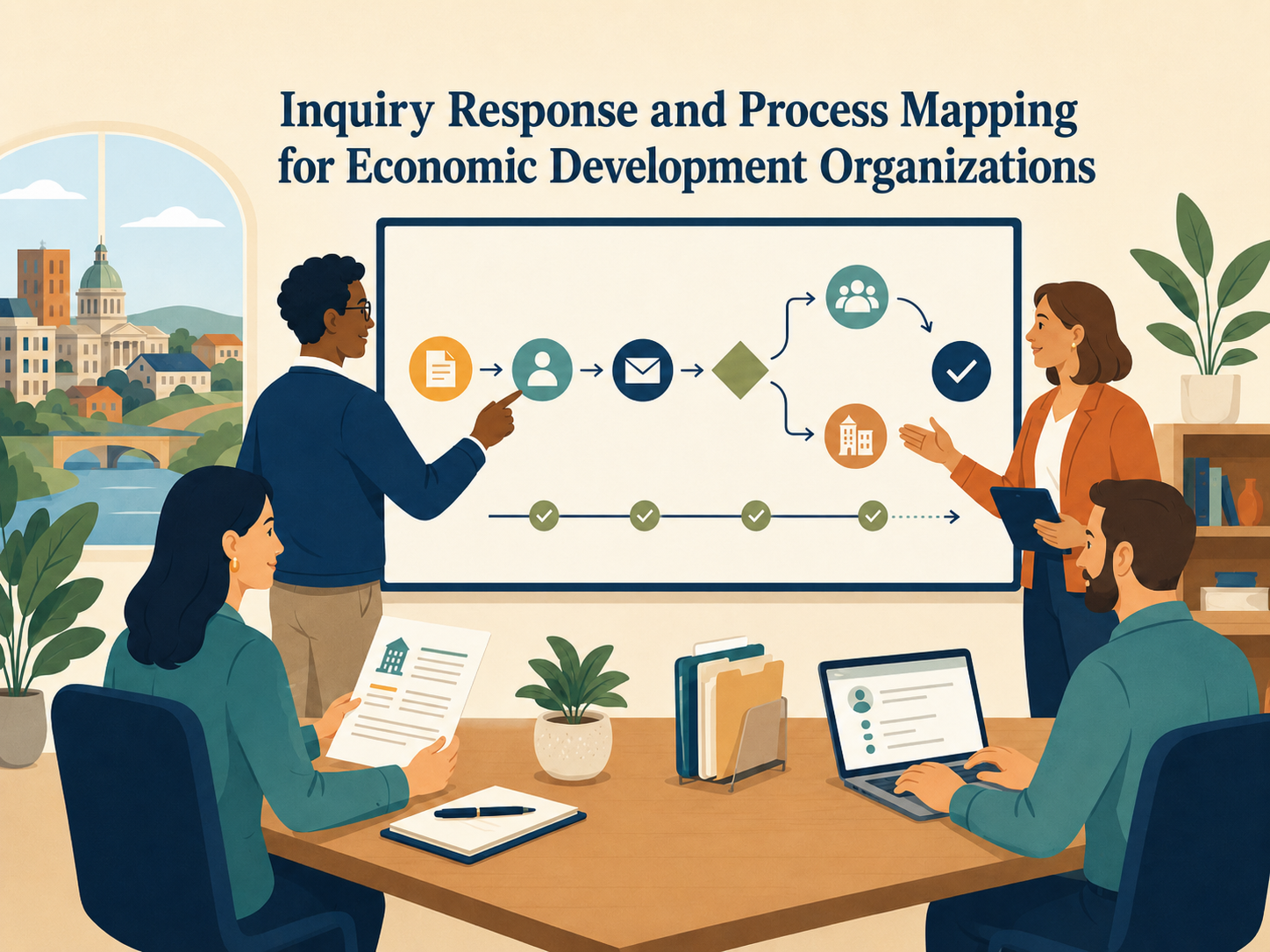
Process mapping for inquiry handling begins with understanding exactly what happens between the moment an inquiry arrives and the moment the organization knows whether it is a qualified project worth advancing. For most economic development organizations, this journey has never been explicitly mapped, which means it happens differently for every inquiry depending on the circumstances of arrival. Mapping it reveals, almost universally, a set of decision points, handoff moments, and potential bottlenecks that the organization did not know existed because no one had ever looked at the whole sequence from end to end.
The intake stage is where the inquiry arrives and where the first routing decision is made. Intake channels typically include email, phone, website contact forms, referrals from partner organizations, and in some cases social media or direct contacts at events. Each channel may route to a different person or team within the organization, and the routing logic may or may not be based on a systematic assessment of what the inquiry requires. A process map of the intake stage reveals how many different paths exist for an inquiry to enter the organization, how consistently those paths are monitored, how quickly the monitoring person is typically able to triage the inquiry, and whether there is a single accountable owner for ensuring that every inquiry receives some form of initial response within a defined period regardless of which channel it arrived through.
The triage stage is where the inquiry is assessed well enough to route it correctly and to determine the appropriate initial response. Effective triage requires enough information about the inquiry to understand whether it is a business attraction opportunity, an existing business expansion opportunity, a program eligibility question, a development inquiry, or something else entirely, because the correct routing and the appropriate response differ significantly by type. Organizations that skip triage, routing all inquiries directly to the nearest available staff person or to a single catch-all program manager, frequently misroute inquiries in ways that produce delays, confused conversations, and missed opportunities.
The initial response stage is where the organization communicates back to the inquirer for the first time, and its design determines the inquirer’s experience of the organization at the most impressionable moment in the relationship. An effective initial response acknowledges receipt immediately, demonstrates that the inquiry was understood rather than just received, provides whatever specific information can be offered at the triage stage, identifies the staff person or team that will be the primary point of contact going forward, and sets a realistic expectation about when the inquirer will receive a more substantive engagement. An ineffective initial response is any of several common failure modes: silence for days, a generic auto-reply with no substantive content, a routing to a program page the inquirer has already seen, or an enthusiastic acknowledgment followed by a long period of nothing.
The qualification stage is where the organization gathers enough information to determine whether the inquiry represents a genuine economic development opportunity worth advancing, and what level of organizational investment is appropriate to advance it. This stage requires a structured conversation, typically a call or meeting, in which the staff member responsible for the relationship asks the questions needed to understand the inquirer’s situation: the company’s size and sector, the project’s nature and scale, the timeline, the decision criteria, and what the inquirer specifically needs from the organization. The output of this conversation should be a clear assessment of the opportunity’s fit with the organization’s programs and priorities, and a decision about the level of engagement to pursue.
The Internal Handoff Problem and How It Loses Projects
The most common place where qualified projects are lost in economic development organizations is not at intake or at initial response. It is at internal handoffs: the moments when responsibility for an inquiry or an advancing project transfers from one staff person or team to another, and the transfer happens without adequate information, without clear ownership transfer, or without follow-through verification that the handoff was received and the next step taken.
Internal handoffs in economic development are endemic because the work is inherently interdisciplinary and partner-dependent. A business attraction inquiry that begins with a site readiness question may need to involve workforce development, incentive programs, permitting and planning, and utility coordination before it is fully addressed. A financing inquiry that begins with one program may need to involve complementary programs at partner organizations before a complete capital solution is assembled. Each of these involvement expansions requires a handoff of some kind, and each handoff is a potential dropout point for the project if the receiving party does not receive adequate context, does not acknowledge receipt, or does not follow through within a reasonable timeframe.
Designing handoffs for reliability requires explicit protocols that specify what information must be transferred with the project when responsibility changes, how the transfer is documented, how the receiving party acknowledges it, and how the originating party verifies that the handoff was completed and the next step taken. Organizations that treat handoffs as informal transfers of institutional memory, conducted through email chains or verbal conversations that may or may not be documented, routinely lose projects at exactly the handoff moments that would have been most productive. Organizations that treat handoffs as structured events with defined information requirements and defined follow-up verification produce dramatically better continuity of engagement with advancing projects.
Establishing and Maintaining Response Time Standards
Response time standards are the accountability mechanism that prevents inquiry response from defaulting to the pace of available staff bandwidth rather than the pace that competitive economic development requires. Without explicit standards, inquiries are responded to when staff have time, which means fast response happens during slow periods and slow response happens during busy ones, which is almost perfectly misaligned with the actual pattern of inquiry importance, since high-stakes opportunities often arrive during peak activity periods.
The standards that high-performing economic development organizations have converged on reflect an understanding of the inquiry types and their competitive stakes. Business attraction inquiries, particularly those from site selectors with active projects, warrant an acknowledgment within hours and a substantive response within one to two business days. Program and financing inquiries warrant acknowledgment within one business day and a substantive response within three to five business days. Development inquiries vary more by complexity but should receive acknowledgment within one business day and a routing to the appropriate contact within two to three business days. These standards are not arbitrary; they reflect the tolerance for delay that each type of inquirer can be expected to have, and they ensure that high-stakes inquiries receive high-priority treatment rather than joining a general queue.
Tracking performance against response time standards requires a system, whether a simple inquiry log or a purpose-built customer relationship management tool, that timestamps inquiry arrivals and responses and allows comparison of actual response times against the standard. Without this tracking, it is impossible to know whether the standards are being met or where the most significant gaps are, and the standards exist as aspirations rather than managed performance targets. Organizations that track their response performance consistently find opportunities for improvement that the absence of tracking conceals, including specific channels or inquiry types where response is systematically slower than the standard, specific staff or team capacity constraints that create bottlenecks, and specific program areas or partner dependencies that delay response when a routing or referral is required.
Follow-Up Protocols That Keep Inquirers Engaged
 Inquiry handling does not end with the initial response. A substantial share of economic development inquiries require multiple exchanges before reaching qualification, because the inquirer does not have all the information needed to assess fit on their own, the relevant program or opportunity requires more discovery to describe accurately, or the project is in an early stage where the inquirer is still forming their own understanding of what they need. The organizations that advance the highest share of initial inquiries to qualified projects are those whose follow-up protocols keep these multi-exchange processes moving rather than allowing them to stall between touches.
The most common follow-up failure is the lack of any protocol at all. An initial response is sent, the inquirer does not immediately reply, and no one follows up, leaving the ball perpetually in the inquirer’s court until either the inquirer sends a follow-up themselves or the opportunity quietly expires. This pattern is so common in economic development that it has become a competitive differentiator to simply not follow it: an organization that consistently follows up inquiries at defined intervals, with specific and useful content at each touch rather than just checking in, signals through its behavior that it is more engaged and more organized than the typical economic development organization, which is a signal that matters in competitive project evaluation.
Follow-up protocols should specify, for each inquiry type, the timeline and content of each follow-up contact if the inquirer has not responded: the timing of the first follow-up, the content it should include, the timing and content of any subsequent follow-up, and the point at which the organization concludes that an inquiry has gone dormant and moves it to a different status in the pipeline. These protocols are not formulaic; they should be calibrated to the inquiry type and adapted to the specific context of each engagement. But having a defined protocol, even a simple one, is dramatically better than having no protocol, because it ensures that follow-up happens by design rather than by whoever happens to think of it.
Logging and Pipeline Management as Organizational Intelligence
Every inquiry that enters the organization’s process is a data point, and the accumulation of those data points over time is one of the most valuable and least utilized sources of organizational intelligence available to an economic development organization. Where are inquiries coming from, by geography, by sector, by inquiry type? What is the conversion rate from initial inquiry to qualified project, by inquiry type and by source? Where are inquiries most commonly lost, at which stage of the process and for what reasons? What is the typical timeline from first contact to project announcement for different types of projects? These questions are answerable from inquiry log data for organizations that maintain it consistently, and the answers inform staffing, program design, outreach strategy, and process improvement in ways that no other data source can replicate.
Organizations that maintain a simple, consistently updated inquiry log, tracking at minimum the date of receipt, the source, the inquiry type, the assigned staff person, the initial response date, the current status, and the eventual outcome, have a data foundation that supports this kind of intelligence analysis. Organizations that do not maintain this log are flying blind on the performance of their own front-door operations, managing capacity and priorities based on staff impressions rather than actual patterns, and missing the systematic feedback on process quality that the data would provide.
Special Handling for High-Value Opportunities
Not all inquiries deserve the same level of organizational investment, and a well-designed inquiry process includes clear protocols for escalating high-value opportunities to the level of organizational attention and responsiveness that their competitive stakes warrant. A site selection consultant representing a company evaluating multiple regions for a significant facility deserves not only a fast initial response but a level of coordinated, comprehensive engagement that a standard program inquiry does not require. The organizations that handle these high-stakes opportunities best are those that recognize them early and activate a different level of response before the competitive window closes.
Identifying high-value opportunities requires a triage protocol that includes explicit signals to watch for: a site selector calling on behalf of a client rather than on their own behalf, a level of specificity about project requirements that suggests an active evaluation rather than exploratory research, a timeline for site selection that indicates a decision process underway, or project parameters that fall within the organization’s highest-priority sectors or geographies. When these signals are present, the appropriate response is escalation: alerting leadership, activating partner coordination, assembling a comprehensive response package, and designating a senior point of contact who will own the relationship through the evaluation process.
High-value opportunity handling also requires maintaining the organizational readiness to respond comprehensively on short notice, which means having current site data, workforce analytics, incentive program descriptions, and utility information maintained in a state of readiness that allows a comprehensive response to be assembled quickly rather than assembled from scratch. Organizations that prepare this readiness proactively are better positioned to respond to high-stakes opportunities than those that begin assembling response materials only after the opportunity has been identified, because the time required to gather and compile information is time during which the competitive evaluation continues without the organization’s full engagement.
Partner Coordination in the Inquiry Process
Most significant economic development inquiries involve partners beyond the receiving organization: the local municipality for permitting and zoning information, the utility for capacity and cost information, the workforce development board for labor market and training information, the community college for workforce pipeline information, the regional transportation authority for infrastructure information. The quality of the organization’s inquiry response often depends as much on the speed and accuracy of these partner inputs as on its own internal process, and organizations that have not built the partner coordination infrastructure to access partner information quickly will consistently produce slower and less comprehensive responses than those that have.
Building partner coordination infrastructure means establishing relationships with the relevant staff at partner organizations before an inquiry requires their input, agreeing on protocols for rapid information exchange, and maintaining the mutual awareness of each partner’s current program offerings and capacity that allows accurate referrals and quick information gathering. An economic development organization whose staff personally knows the economic development representatives at the serving utilities, the relevant municipal planning departments, the workforce board, and the community college system will respond to complex inquiries faster and more accurately than one whose partner coordination is episodic and transactional.
Formalizing some of this coordination through regular partner briefings, shared project tracking, or joint inquiry response protocols, particularly for the highest-value project types and the most commonly needed partner inputs, converts ad hoc coordination into systematic collaboration. This investment pays off most clearly at exactly the moments that matter most: when a high-stakes inquiry arrives with a tight response timeline and the organization needs partner information fast. The partner relationships built through routine coordination are the ones that produce rapid, reliable support when the competitive pressure is on.
Strategic Communication Support for Economic Development Organizations
 Process mapping and inquiry response improvement are organizational investments that most economic development organizations have not made systematically, partly because the gap between current and potential performance is invisible when no one has mapped what currently happens, and partly because the work of building better systems feels less urgent than the work of responding to the inquiries that are actively in the pipeline. The organizational cost of this prioritization is real and cumulative: every inquiry that is handled inconsistently is an opportunity that the organization may never know it lost, and every bottleneck that goes unaddressed is a recurring tax on the organization’s competitive performance that compounds over time.
A structured process assessment of an economic development organization’s inquiry handling typically finds a consistent pattern: multiple intake channels monitored inconsistently, triage that is informal and person-dependent rather than systematic, initial response times that vary widely by channel and by which staff member received the inquiry, internal handoffs that transfer responsibility without reliably transferring context or follow-up accountability, and no tracking system that allows performance against response standards to be measured or improved. Each element of this pattern is improvable through process design, and improvement in any one of them produces measurable improvement in the organization’s inquiry conversion rate.
Stegmeier Consulting Group (SCG) helps economic development organizations map and improve the process that takes an inquiry from first contact to qualified project. That support may include inquiry process mapping, intake and triage protocol design, response time standard development and tracking framework, follow-up protocol design, internal handoff protocol development, inquiry pipeline management system design, partner coordination infrastructure development, and high-value opportunity identification and escalation protocol design.
The goal of this work is an inquiry process that handles every contact the organization receives with a consistency and quality that reflects what the organization is capable of delivering, rather than with the variability that comes from an unmapped, unmanaged, person-dependent process. Every inquiry handled well is an opportunity more fully realized. Every inquiry handled poorly is a cost the organization pays without knowing it.
Future Trends in Economic Development Inquiry Management
The inquiry management landscape for economic development organizations is evolving as digital channels proliferate, user expectations rise, and technology makes more sophisticated process management accessible to organizations of all sizes. Several trends are shaping what leading practice will look like in the years ahead.
Customer relationship management tools designed for economic development, or adapted from commercial CRM platforms for economic development use, are becoming more accessible and more capable, allowing organizations to track inquiry pipelines, manage follow-up protocols, and measure response performance without custom-built systems. Organizations that have not yet adopted a systematic inquiry tracking tool are operating at an increasing disadvantage relative to those that have, because the data these tools generate is the foundation for the performance improvement and intelligence analysis that unmapped, untracked inquiry processes cannot support.
Digital intake tools, including structured web forms that gather triage-relevant information at the point of submission, interactive tools that route inquiries based on user-provided information, and online scheduling systems that allow inquirers to book substantive conversations without a back-and-forth coordination sequence, are reducing the friction in initial contact while improving the information quality available for triage. Organizations that invest in the front-end of their inquiry process through well-designed digital intake tools are reducing the staff time required for initial triage while improving the quality of the information available for routing decisions.
The rising expectation among sophisticated business and site selection users for a digital inquiry experience comparable to what they receive from the most capable commercial services means that organizations whose inquiry process begins with a generic contact form and proceeds through email correspondence will increasingly appear behind relative to those offering structured intake, rapid substantive response, and a clear process path toward the information and engagement the inquirer needs. Investing in the front-door experience of economic development organizations is no longer a competitive advantage only for the largest and most resource-rich; it is becoming a competitive necessity for any organization that wants to be taken seriously by the most sophisticated inquirers.
Conclusion
The journey from first inquiry to qualified project is one of the most consequential and most poorly managed sequences in economic development practice, because its management determines which opportunities the organization advances and which it loses before anyone inside the organization understands they existed. The discipline of mapping and improving this process is not glamorous work, and it does not produce the kind of visible, quotable results that project announcements and ribbon cuttings do. But it is the work that determines the pipeline from which those announcements eventually come, and the organizations that do it well win a competitive advantage in every market they participate in simply by being more consistently capable than their peers of turning an inquiry into a relationship and a relationship into a result.
Speed matters, but speed without process produces fast first responses that then stall or route incorrectly. Ownership matters, but ownership without handoff protocols produces gaps at exactly the moments when continuity is most critical. Standards matter, but standards without tracking produce aspirations rather than managed performance. And coordination matters, but coordination without infrastructure produces episodic partner engagement rather than the systematic collaboration that high-stakes project response requires. Building all of these elements together is the investment that converts an inquiry process from a source of inconsistency into a source of competitive advantage.
SCG’s Strategic Approach to Communication Systems
Align your agency’s messaging, processes, and public engagement strategies.
Economic development organizations need inquiry handling processes that convert first contacts into qualified projects consistently, regardless of which channel the inquiry arrived through, which staff member received it, or how busy the organization was at the moment it arrived. That means mapped intake and triage protocols, explicit response time standards tracked against actual performance, defined internal handoff procedures that transfer context and accountability reliably, structured follow-up protocols that keep multi-exchange engagements moving, partner coordination infrastructure that enables comprehensive responses to complex inquiries, and pipeline management systems that capture the organizational intelligence the inquiry process generates.
SCG helps economic development organizations map and improve the process from first contact to qualified projects. Whether your organization needs an inquiry process assessment, intake and triage protocol design, response standard development, handoff protocol design, pipeline management system development, or partner coordination infrastructure, SCG can help you build a process that handles every opportunity your organization receives with the consistency and quality it deserves.
Use the form below to connect with our team and explore how strategic inquiry process improvement can help your organization convert more of the opportunities that reach your door into the projects and outcomes your community needs.