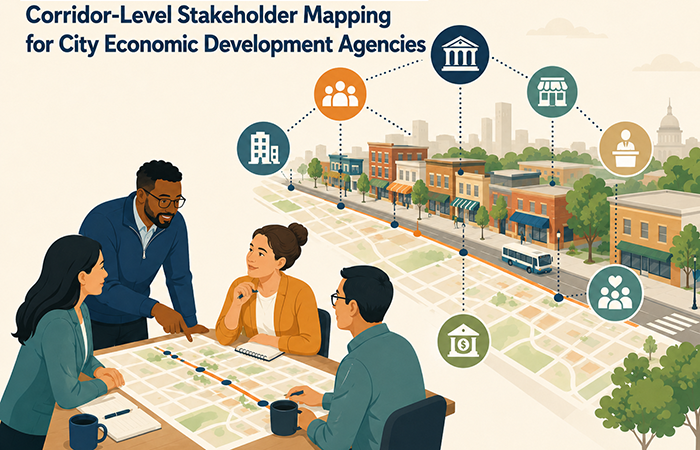
Corridor-Level Stakeholder Mapping for City Economic Development Agencies: Reaching Small Businesses Beyond Downtown
City economic development agencies face a geography problem that rarely appears on organizational charts but shapes everything about how their programs actually reach the businesses that need them most. Downtown corridors attract disproportionate attention: they have organized business improvement districts, visible anchor tenants, active property owners, accessible foot traffic, and a physical concentration that makes communication relatively straightforward. The neighborhood commercial corridors that exist in every other part of the city are different in almost every dimension. They are geographically dispersed, often fragmented in their organization, diverse in language and culture, anchored by businesses that may operate in isolation from formal trade networks, and served by property owners who may be absentee landlords with no local presence and no connection to the agency at all. A city agency that communicates primarily through the channels that work downtown is, by design, communicating primarily with downtown.
The consequences of this geographic communication gap are not abstract. Economic development programs funded with city resources, grants for facade improvements, loans for equipment and working capital, technical assistance for workforce and operations, and space availability information, go consistently underutilized in neighborhood commercial corridors relative to their potential population of eligible businesses. The businesses that do not use the programs are not less entrepreneurial or less interested in support than their downtown counterparts. They are less reachable through the channels the agency has built, which are overwhelmingly designed around businesses that already have formal organizational affiliations, regular internet access, English-language proficiency, and the social capital to learn about government programs through the professional networks those programs tend to reach.
Stakeholder mapping is the discipline that allows a city economic development agency to move beyond this default toward a deliberate, evidence-based understanding of how communication actually flows in specific neighborhood commercial corridors. It identifies the people, organizations, and institutions that shape how small businesses in a given corridor receive and evaluate information, whether a program exists for them in any meaningful sense, and whether a relationship with the agency is something they would pursue if they understood what was available. It then uses that understanding to build communication strategies calibrated to how each corridor actually works rather than how the agency assumes communication should work.
This article examines how city economic development agencies can use stakeholder mapping to improve outreach in neighborhood commercial corridors, covering the mapping process itself, the full range of stakeholder types that shape corridor communication, the differences between corridors that require differentiated rather than uniform strategies, and the practical changes in agency communication behavior that mapping makes possible. It treats stakeholder mapping not as an academic exercise but as a planning tool with specific, implementable outputs that change how the agency shows up in the communities its programs are intended to serve.
What Stakeholder Mapping Is and Why It Changes Outreach Strategy
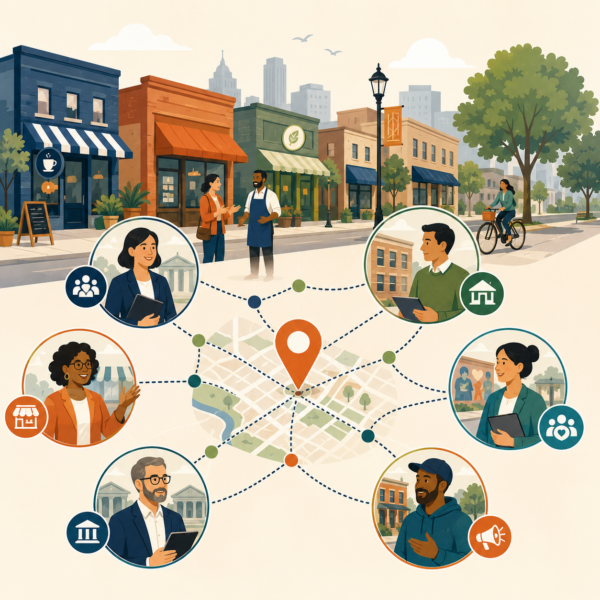 Stakeholder mapping is the process of systematically identifying the individuals, organizations, and institutions that influence how information moves through a specific community, how trust is built and maintained, and how decisions, including decisions about whether to seek government assistance, are made by the people the agency is trying to reach. It is distinct from a contact list, which simply records who exists, and from a network diagram, which records connections between entities. Stakeholder mapping assesses influence: who shapes what information businesses receive, which sources they trust, what relationships affect their willingness to engage with specific institutions, and what barriers stand between the agency’s communication and the business owner’s attention and decision-making.
In the context of neighborhood commercial corridor outreach, stakeholder mapping produces a specific set of strategic outputs. It identifies which organizations and individuals in a given corridor are trusted brokers for small business information, meaning the parties that businesses actually consult when they are trying to understand what resources are available, whether a program is legitimate, and whether the effort of pursuing it is worth the time and risk. It identifies which channels, whether in-person meetings, ethnic media, WhatsApp groups, word of mouth through landlord networks, or community social events, are actually used to share business-relevant information in the corridor rather than the channels the agency has built its outreach around. It identifies the stakeholders whose active partnership would extend the agency’s reach and the stakeholders whose indifference or opposition would undermine it. And it identifies the gaps: the business types, language communities, and sections of the corridor that no existing stakeholder network reaches, which are the segments most likely to be systematically missed by current outreach.
The strategic value of this mapping is that it replaces assumption with evidence in outreach planning. Most city agencies make implicit assumptions about how information reaches small businesses in neighborhood corridors, and those assumptions are usually wrong in the same direction: they overestimate the reach of formal channels, overestimate the connectivity of organized stakeholder networks, and underestimate the degree to which large portions of the small business community operate outside those networks entirely. The mapping process surfaces those assumptions, tests them against observable reality, and provides a more accurate picture of the communication landscape that outreach strategy can be built on.
Stakeholder mapping also changes the agency’s posture from broadcaster to relationship builder in a way that has lasting effects on program access and community trust. An agency that approaches a neighborhood corridor with a communication plan built around its own channels and materials is broadcasting at a community. An agency that approaches the same corridor by first understanding who shapes information flow, what those stakeholders need from the agency to be useful partners, and how the agency can support those stakeholders’ existing relationships with the business community, is entering a collaborative relationship that produces sustained access rather than episodic outreach. The difference in program uptake and community trust between these two approaches, sustained over several years, is substantial.
Why Downtown-Centric Outreach Fails Neighborhood Corridors
The failure of downtown-centric outreach to reach neighborhood commercial corridors is structural, not incidental, and understanding the structural reasons is important because it explains why simply extending the same outreach strategies that work downtown into neighborhood corridors consistently underperforms expectations. The structural differences are real and require genuinely different approaches rather than the same approach applied with greater intensity.
Organizational density is the first structural difference. Downtown business districts in most cities have organized business improvement districts, active chamber of commerce chapters, professional associations with regular meeting schedules, and in many cases business improvement district staff who function as communication intermediaries. These organizations create a ready-made infrastructure for reaching the businesses they represent: the agency can partner with a BID, send materials to its membership list, speak at its meetings, and reach a significant portion of the downtown business community through a single relationship. Neighborhood corridors often lack this organizational density. A corridor may have a loose merchant association that meets irregularly, or an ethnic chamber that serves specific language communities but not others, or no formal organization at all, with individual business relationships fragmented across property owners, landlords, and informal social networks that have no single institutional access point.
Language and cultural diversity is the second structural difference. Downtown business communities in most cities are more linguistically homogeneous than neighborhood commercial corridors, partly because the formal organization and networking infrastructure downtown tends to operate in English and attract businesses whose owners are comfortable operating in that environment. Neighborhood corridors, particularly in cities with significant immigrant populations, may have business communities where the majority of owners primarily speak a language other than English, communicate with suppliers and customers in that language, receive business information through ethnic media channels, and make business decisions through cultural networks that have no formal institutional expression. Communication directed at these business communities through English-language materials distributed through formal organizational channels will reach a small fraction of the relevant population.
Property owner dynamics create a third structural difference that most outreach strategies completely ignore. In neighborhood commercial corridors, the relationship between a business and its property often shapes its access to information and its ability to make investment decisions more than its relationship with formal business organizations does. A business owner in a space controlled by an attentive, engaged local landlord who communicates actively with tenants exists in a very different information environment than one whose landlord is an absentee investor with no local presence. A business constrained by a lease that prohibits facade improvements or equipment modifications cannot use programs designed to fund those investments regardless of how well the agency communicates about them. And a landlord who has been burned by previous tenant defaults may be systematically discouraging tenants from pursuing government programs out of concern that the program application process will create compliance obligations or scrutiny of the property itself.
Growing Places: Communication Strategies for Economic Development and Public Finance Agencies
This article is part of our series on strategic communication for Economic Development organizations, including state and local economic development agencies, regional partnerships, and business attraction initiatives. To learn more and to see the parent article, which links to other content just like this, click the button below.
The Full Taxonomy of Corridor Stakeholders
A complete stakeholder map for a neighborhood commercial corridor encompasses a much wider range of stakeholder types than most agency outreach strategies actively engage with, and the stakeholders most often overlooked are frequently the ones with the greatest actual influence over how information reaches the business community. Building a comprehensive map requires systematically considering each category of potential stakeholder and assessing, through observation and conversation rather than assumption, their actual role in corridor communication dynamics.
Formal business organizations, including merchant associations, neighborhood chambers of commerce, and business improvement districts, are the first and most obvious category. Where they exist, they provide institutional access to the business community they represent, but the key assessment question is the quality and completeness of that representation. A merchant association with twelve active members in a corridor of eighty businesses represents a specific slice of the corridor rather than the corridor as a whole, and the businesses it does not represent are often the ones the agency most needs to reach. Mapping formal organizations means understanding not only what organizations exist but who they actually reach, what language and cultural communities they engage with, how frequently and through what channels they communicate with members, and what the agency’s relationship with each organization currently is and could become.
Community development financial institutions and microlenders that operate in or near a corridor are among the most valuable potential stakeholder partners for economic development outreach because they already have relationships with exactly the businesses that tend to be hardest to reach through formal channels: small, early-stage, capital-seeking businesses that may not qualify for conventional financing and that have sought out alternative sources. A CDFI or microlender that is actively reviewing applications from businesses in a specific corridor has a direct relationship with a business owner who is, by definition, actively seeking capital and open to learning about additional resources. Equipping CDFI’s loan officers and intake staff with accurate, current information about city programs and the clear permission and materials to refer their clients to those programs, converts every loan officer’s client meeting into a potential program referral at almost no cost to the agency.
Anchor institutions, including large employers, educational institutions, hospitals, faith communities, and major retail anchors, shape corridor dynamics in ways that are frequently underappreciated in outreach planning. A hospital that is the largest employer in a corridor employs residents who shop and eat in the corridor, may source goods and services from corridor businesses, and may have community benefit programs that extend support to neighborhood businesses. A community college or vocational school in or near the corridor produces a workforce that local businesses hire, and its small business development resources may overlap with the agency’s programs in ways that create both partnership opportunities and confusion. A large faith community that anchors a corridor’s social and cultural life is often the most trusted information source for the congregation-adjacent businesses that operate around it. Each of these anchor institutions represents a potential channel for reaching specific segments of the corridor business community that formal business organizations may not reach.
Landlords and property owners are perhaps the most underengaged category in corridor outreach, despite the fact that their decisions about property investment, tenant selection, lease terms, and physical maintenance are among the most influential forces shaping corridor economic conditions. A landlord who actively maintains property, works with tenants on improvements, and invests in the physical quality of the corridor creates conditions in which business investment makes sense. A landlord who extracts rent without maintaining property, sets lease terms that prohibit tenant investment, or uses short lease terms that prevent businesses from making the long-term commitments that program investments require, actively undermines the conditions the agency’s programs are designed to support. Engaging landlords in outreach, helping them understand how programs can support property value and tenant stability, and in some cases working with them to change lease practices that prevent program participation, is outreach infrastructure work that most agencies have not done.
Ethnic media, including print publications, radio programs, online platforms, and social media accounts that serve specific immigrant and ethnic business communities, reach audiences that mainstream business media does not. A Korean-language business newspaper, a Spanish-language radio program with a small business advice segment, or a Vietnamese Facebook group for local business owners, may reach hundreds of businesses that have never encountered an agency program through any formal outreach channel. Building relationships with ethnic media outlets, providing them with accurate, translated program information, and creating content that serves their audiences rather than requiring their audiences to consume content designed for a different market, is one of the highest-leverage outreach investments available to a city agency for reaching immigrant business communities.
Trusted community leaders, who may hold no formal title or organizational affiliation but whose opinion and advice shapes the decisions of other community members, are a category that stakeholder maps must attempt to identify despite the fact that they are often invisible to agency staff. In some communities, a religious leader carries extraordinary influence over the financial decisions of community members, including business investment decisions. In others, a community elder, a respected professional like a doctor or accountant, or a long-established business owner whose success has made them a reference point for others in the community, plays this role. Identifying these trusted leaders requires time in the community and genuine conversations rather than database searches, and engaging them effectively requires building relationships with them as partners rather than simply asking them to distribute agency materials.
Suppliers and trade partners that serve corridor businesses are a stakeholder category that most outreach strategies overlook entirely but that have significant communication reach and substantial relevance to the programs the agency offers. A food supplier that serves dozens of restaurants in a corridor knows those businesses, their owners, their financial situations, and their needs better than almost any formal organization. A construction contractor who builds out commercial spaces for small businesses may be the person those businesses consult about what improvements are possible and what they cost. A business accountant or bookkeeper who serves a cluster of corridor businesses is a trusted professional advisor who shapes how those businesses think about financing and investment decisions. Each of these supplier and trade partner relationships is a potential channel for accurate program information that the agency could activate with relatively modest investment in relationship building.
Prioritizing Stakeholders by Influence and Accessibility
A comprehensive corridor stakeholder map will typically identify far more potential partners than an agency can actively engage simultaneously, which means the map must produce a prioritization as well as an inventory. Prioritization should be based on two dimensions assessed together: the stakeholder’s actual influence over information flow to the business community, and the stakeholder’s accessibility to a productive partnership with the agency, which depends on factors including their existing awareness of agency programs, their organizational capacity for partnership, and the alignment between their own interests and the agency’s outreach goals.
The highest-priority stakeholders for active engagement are those with high influence and high accessibility: organizations that reach significant portions of the corridor’s business community through trusted relationships, that have organizational capacity to carry program information and referrals into those relationships, and that have interests aligned with helping their constituencies access economic development resources. A well-organized ethnic chamber of commerce that represents a large share of the corridor’s immigrant business community and has staff who regularly advise members on business resources is a high-priority partner candidate because it has the reach, the trust, the capacity, and the alignment needed to function as an effective agency partner.
High-influence but lower-accessibility stakeholders, such as informal community leaders who are not connected to formal organizations, landlords who have no current relationship with the agency, or ethnic media outlets that have not previously partnered with government agencies, require a different engagement approach: relationship building before program partnership, focused on establishing the agency’s credibility and understanding the stakeholder’s perspective before asking for anything. These stakeholders are worth the investment because their influence makes them valuable partners, but the investment timeline is longer and the initial engagement should be focused on listening rather than outreach.
Lower-influence but highly accessible stakeholders, including some formal business organizations that are easy to reach but represent only a small and already-connected portion of the corridor business community, are not necessarily unworthy of engagement, but they should be engaged in proportion to their actual influence rather than their accessibility. An agency that concentrates its outreach on the most accessible organizations will consistently reach the least-hard-to-reach businesses, which is the opposite of what equity-focused corridor outreach requires.
Conducting the Mapping Process
 Stakeholder mapping for corridor outreach is fieldwork as much as it is desk research, and agencies that attempt to build a useful map without spending time in the corridor and talking to people who know it well will produce a map that looks comprehensive but reflects the agency’s existing network rather than the corridor’s actual communication dynamics. The mapping process has desk research components and field research components, and both are necessary.
Desk research for corridor stakeholder mapping includes reviewing available data on business demographics in the corridor, including the languages spoken by business owners and employees where data is available, the sectors and sizes of businesses, the property ownership patterns, and any prior agency engagement or program participation history in the corridor. It includes identifying all formal organizations with any stated presence in or relevance to the corridor, including merchant associations, chambers, CDFIs, community organizations, faith communities, schools, and anchor employers. It includes reviewing ethnic media outlets and social media communities that serve the corridor’s language and cultural communities. And it includes identifying any prior stakeholder engagement or community needs assessments that may have been conducted in or near the corridor by other city agencies, academic researchers, or community organizations.
Field research for corridor stakeholder mapping begins with walking the corridor, observing its physical character, its business mix, its anchors, its vacancies, its foot traffic patterns, and the informal gathering points that function as social infrastructure. This observation provides context for the conversations that follow and often surfaces stakeholders and dynamics that no database would reveal. It is followed by structured conversations with a representative sample of corridor stakeholders, including business owners across language communities, property owners and managers, formal organization representatives, community leaders, and professionals who serve corridor businesses, all conducted with a genuine spirit of learning rather than a goal of distributing information about existing programs.
The questions these conversations should explore include how the business owner learned about their current location and how they typically learn about new resources or programs available to them; which organizations, publications, or individuals they trust for business-relevant information; what their relationship with their landlord is like and how that relationship affects their ability to make investments in the business; what barriers they have encountered in accessing city programs; whether they are aware of specific agency programs; and what would make it easier or more likely for them to use agency programs in the future. These conversations produce rich qualitative data that the desk research cannot, revealing the actual texture of information flow, trust, and barrier that the map needs to capture.
Translating the Map Into Outreach Strategy
The value of a stakeholder map is not in the map itself but in the strategic changes it enables in how the agency approaches outreach in a specific corridor. A completed map should produce specific, actionable changes in the agency’s communication behavior: which channels it uses, which partners it invests in, which materials it develops, which languages it communicates in, which barriers it addresses programmatically, and how it allocates staff time and outreach budget across the corridor’s different business communities.
Channel strategy changes are often the most immediate and most visible output of a stakeholder map. An agency that has been relying primarily on email newsletters, agency website postings, and flyer distribution through formal business organizations may discover through mapping that the corridor’s most underreached businesses primarily receive information through a Spanish-language radio program, a WhatsApp group run by an informal community leader, and word of mouth through a supplier network that none of the formal channels reach. Shifting outreach investment to include these channels, by developing a relationship with the radio station, identifying and engaging the WhatsApp group administrator, and building a referral relationship with the supplier, produces access to a portion of the corridor business community that the previous channel strategy systematically missed.
Partner investment decisions are the second major strategic output. The map identifies which stakeholder organizations have the reach, trust, capacity, and alignment to function as effective agency partners and which do not. Investing in equipping high-value partners with accurate, translated program information, training their staff on program basics and referral processes, providing them with materials they can use in their existing work with businesses, and maintaining the relationship through regular communication and feedback loops, converts passive stakeholder knowledge into active referral capacity. This investment produces program reach into communities that the agency’s direct outreach cannot penetrate as effectively, at a cost that is typically far lower than building the direct outreach infrastructure to serve those communities without partner intermediaries.
Material development decisions should follow from the mapping’s findings about language, literacy, and format preferences across the corridor’s business communities. A corridor with significant Chinese-speaking and Spanish-speaking business communities requires not just translated versions of the agency’s standard English materials but materials designed around the communication preferences of those specific communities: the length, the visual style, the channels through which they are distributed, and the messengers who deliver them. Translation alone, without cultural adaptation and messenger calibration, produces materials that are technically accessible but practically unreachable because they are delivered in the wrong format through the wrong channels by the wrong sources.
Barrier reduction work, addressing the structural barriers that prevent eligible businesses from participating in programs regardless of their awareness of those programs, is a strategic output that most agencies do not identify as a communication function but that stakeholder mapping consistently reveals. A corridor where a significant share of businesses is constrained by lease terms that prohibit participation in facade or equipment programs needs work on the landlord relationship as much as on business awareness. A corridor where businesses are operating without formal licenses or permits because the licensing process is confusing and inaccessible needs work on the intake and assistance process rather than additional program marketing. A corridor where business owners fear that agency program participation will trigger immigration enforcement inquiries needs explicit trust-building and confidentiality assurance before any program marketing will be effective. The map reveals these barriers; the strategic response is to address them rather than to communicate around them.
Building Feedback Loops to Maintain Map Accuracy Over Time
A stakeholder map built at a single point in time begins to go stale immediately, as organizations change their capacity and focus, new community leaders emerge, existing ones depart, new businesses open and establish themselves in the corridor, and new communication channels develop that did not exist when the mapping was conducted. An agency that conducts a mapping exercise and then uses the resulting strategy unchanged for years will find its corridor outreach gradually drifting out of alignment with corridor reality in exactly the same way that its pre-mapping strategy was misaligned.
Maintaining the accuracy and utility of a corridor stakeholder map requires building feedback mechanisms into the outreach strategy itself: regular check-ins with key partner organizations that surface changes in their capacity, focus, or membership; periodic conversations with business owners that reveal whether the outreach is reaching the intended audiences and through what channels; tracking of which referral sources are actually producing program inquiries and which are not producing results despite the investment; and deliberate attention to new organizations, media outlets, and community voices that emerge in the corridor over time. This ongoing maintenance does not require repeating the full mapping process annually; it requires treating the map as a living document that is updated based on what the agency’s corridor presence actually observes, rather than as a static planning artifact produced once and then filed.
Applying Stakeholder Mapping Across Multiple Corridors
City economic development agencies that are responsible for outreach across multiple neighborhood commercial corridors face the additional challenge of managing the diversity of corridor contexts without either defaulting to a single uniform strategy that serves no corridor well or investing in full custom strategies for every corridor, which most agencies lack the capacity to do. Stakeholder mapping helps resolve this challenge by providing the evidence needed to make informed decisions about where custom investment is most needed and where a more templated approach can be adapted with corridor-specific modifications.
Corridors with similar stakeholder dynamics, comparable levels of formal organization, similar language community compositions, and similar property ownership patterns can often be served with similar outreach approaches that differ in their specific partner relationships and channel choices but share a common strategic logic. Corridors with significantly different stakeholder dynamics, for instance a corridor with dense formal organization and high agency program awareness versus one with minimal formal organization, predominantly immigrant business owners, and no prior agency engagement, require genuinely different approaches that reflect the different realities of how communication works in each context.
Mapping multiple corridors also produces cross-corridor insights about which outreach approaches, partner types, and communication channels perform consistently well across diverse contexts and which are highly context-dependent. An ethnic media partnership strategy that works exceptionally well in a corridor with high language concentration may produce modest results in a more linguistically diverse corridor where no single media outlet reaches a majority of the business community. A supplier referral network that functions as a high-productivity outreach channel in a corridor with dense restaurant and food industry concentration may have no equivalent in a corridor anchored by professional services businesses. Building organizational knowledge about these cross-corridor patterns improves outreach design across the portfolio rather than requiring each corridor strategy to be built from scratch.
Strategic Communication Support for City Economic Development Agencies
 City economic development agencies that have been operating with undifferentiated corridor outreach strategies, applying the same materials and channels across diverse neighborhood commercial districts, are not failing because of inadequate commitment to neighborhood business communities. They are failing because they have not had access to the structured evidence about how communication actually works in those communities that would allow them to design more effective strategies. Stakeholder mapping provides that evidence, and the strategic changes it enables are available to agencies of all sizes through a process that is time-intensive but not technically complex.
The most common barriers to conducting corridor-level stakeholder mapping are not resource barriers but organizational ones: the assumption that the agency already knows the corridor well enough not to need formal mapping, the concern that field research and community conversations will take staff away from program delivery, and the absence of an internal process for translating mapping findings into strategy changes. Each of these barriers is real and each is solvable with the right organizational framing: mapping as an investment in program effectiveness rather than a diversion from it, field research as a source of program intelligence rather than a separate activity, and strategy translation as a direct output of the mapping process rather than a subsequent optional step.
Stegmeier Consulting Group (SCG) helps city economic development agencies conduct corridor-level stakeholder mapping and translate mapping findings into outreach strategies that reach the businesses their programs are designed to serve. That support may include corridor assessment and mapping process design, field research protocols and interview frameworks, stakeholder inventory and prioritization analysis, ethnic media landscape research, property owner and landlord engagement strategy, partner toolkit development for CDFI and community organization partners, multilingual and culturally adapted outreach material development, barrier identification and reduction strategy, and cross-corridor comparison and portfolio outreach strategy development.
The goal of this work is city economic development programs that reach the businesses their communities most need to reach, not just the businesses whose existing connections to formal networks make them easiest to reach. Stakeholder mapping is the tool that reveals the gap between those two populations and the strategic investment that closes it.
Future Trends in Corridor-Level Outreach
The environment for neighborhood corridor outreach is evolving in ways that raise both the stakes and the potential of stakeholder-based approaches. Several trends are shaping the direction of that evolution and creating new opportunities for agencies that have built the understanding of corridor communication dynamics that mapping provides.
Digital community platforms are becoming increasingly important in how neighborhood business communities share information, with WhatsApp groups, Facebook groups, and neighborhood-specific online communities functioning as de facto merchant associations in some corridors that lack formal organizational infrastructure. These platforms are largely invisible to city agencies unless someone within the agency has a connection to the community that uses them, but they are often among the highest-trust and highest-reach communication channels for the businesses in those communities. Agencies that identify and build relationships with the administrators of these digital community networks, and that earn the trust of those administrators through consistent and helpful engagement, are extending their reach into exactly the informal communication infrastructure that most corridor outreach misses.
Demographic shifts in neighborhood commercial corridors are accelerating in many cities, with established business communities changing composition as immigration patterns shift, gentrification pressures displace long-established businesses and bring new ones, and economic conditions differentially affect businesses across different sectors and ownership characteristics. These shifts make corridor stakeholder maps less durable over time and raise the frequency with which they need to be updated, but they also create moments when the social and organizational infrastructure of a corridor is fluid enough for new relationships to be established, including relationships with the agency, that would be harder to build in a more settled environment.
Equity-focused economic development policy is increasingly demanding evidence of equitable program reach, and corridor-level stakeholder mapping is among the most direct methodological responses to that demand. An agency that can demonstrate, through systematic mapping and tracking, that it has identified the stakeholder networks that reach underserved business communities in specific corridors, invested in partnerships with those networks, and measured the change in program inquiry and participation from those communities, is producing the kind of evidence that equity accountability requires. The discipline of stakeholder mapping and the discipline of equity reporting are, in this sense, the same discipline applied to the same question from different directions.
Conclusion
Neighborhood commercial corridors are where a significant share of a city’s small business activity occurs, where many of its most economically vulnerable business owners operate, and where the gap between program availability and program access is typically widest. Closing that gap requires not just more outreach but better-calibrated outreach: communication designed around the actual information dynamics of specific corridors rather than around the channels and partners that are most convenient for the agency. Stakeholder mapping is the evidence-gathering process that makes this calibration possible, identifying who shapes information flow in each corridor, which communication channels actually reach which business communities, and which barriers stand between eligible businesses and program participation.
Agencies that build stakeholder mapping into their corridor outreach practice are making an investment in evidence-based communication strategy that pays off in program reach, community trust, and equity of access that undifferentiated outreach cannot produce regardless of its intensity. The small business owner who learned about a program through a trusted supplier, a community leader, an ethnic media outlet, or a WhatsApp conversation with a neighbor is not a different kind of business owner than the one who learned about it through the agency’s email newsletter. They are the same kind of person reached through the channel that actually worked for them. Stakeholder mapping is how agencies learn what those channels are.
SCG’s Strategic Approach to Communication Systems
Align your agency’s messaging, processes, and public engagement strategies.
City economic development agencies need corridor outreach strategies built on evidence about how information actually flows in specific neighborhoods rather than on assumptions derived from downtown models. That means stakeholder maps that identify the trusted brokers, channel preferences, language communities, property dynamics, and organizational gaps in each corridor, outreach investments calibrated to the stakeholders with the greatest actual influence over program awareness in underreached business communities, materials designed for the specific language and cultural contexts of each corridor’s business population, barrier reduction work that addresses the structural factors preventing eligible businesses from participating, and feedback loops that maintain the accuracy of the strategic picture over time.
SCG helps city economic development agencies build corridor-level stakeholder mapping practices and the outreach strategies those maps enable. Whether your agency needs a corridor mapping process design, field research support, stakeholder analysis, partner toolkit development, multilingual material design, barrier reduction strategy, or cross-corridor portfolio strategy, SCG can help you build an outreach system that reaches the businesses your programs were designed to serve.
Use the form below to connect with our team and explore how stakeholder-mapped corridor outreach can help your agency close the gap between program availability and program access in the neighborhood commercial districts where that gap matters most.