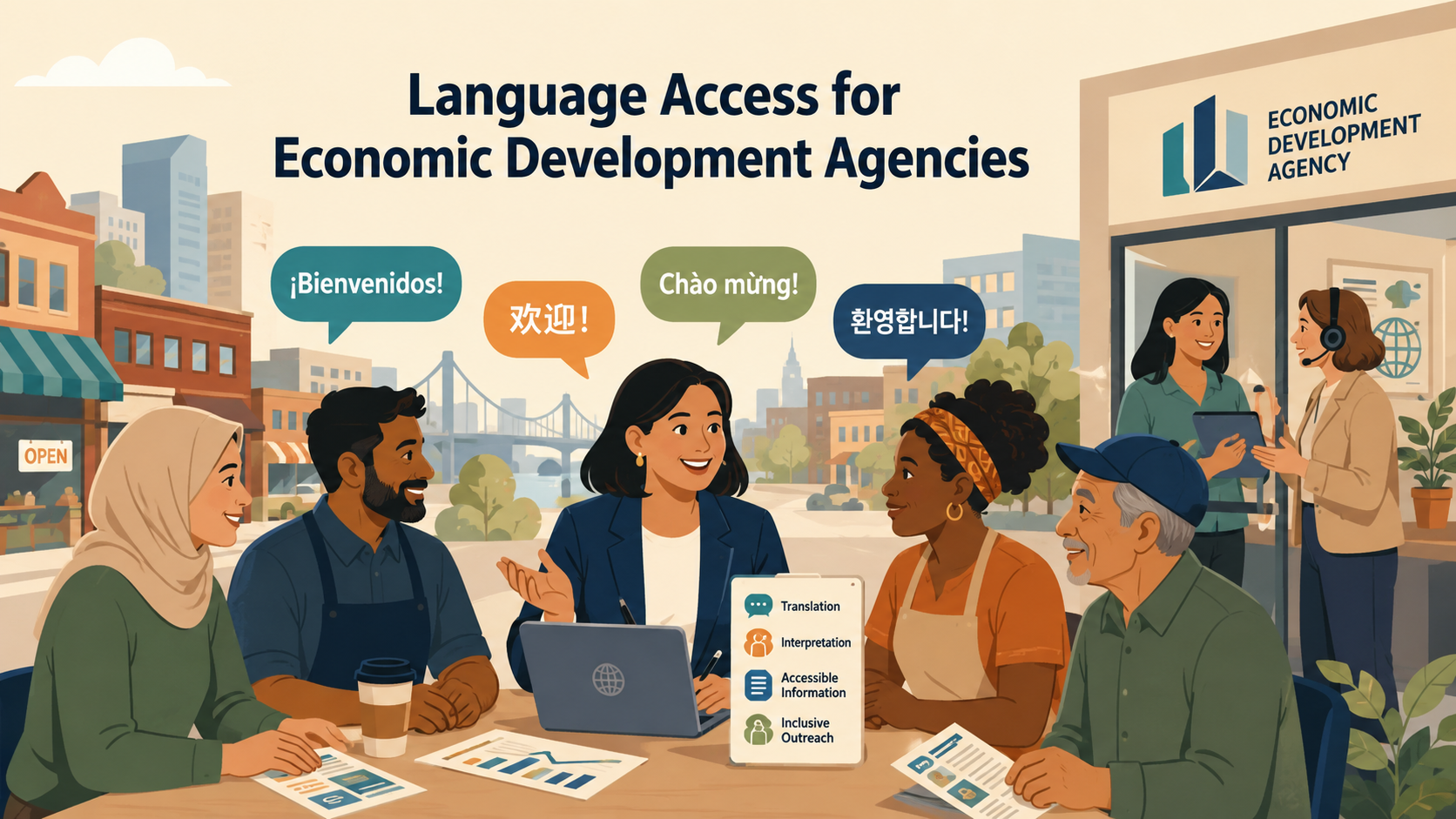
Language Access for Economic Development Agencies: Reaching Immigrant and Ethnic Business Communities More Effectively
Across the United States, immigrant entrepreneurs and ethnic business communities contribute disproportionately to local economic vitality, often anchoring neighborhood commercial corridors, sustaining employment in industries that native-born businesses have withdrawn from, and demonstrating remarkable resilience through economic cycles that close less resourceful operations. The irony embedded in most local and regional economic development agency portfolios is that the business communities contributing most visibly to neighborhood commercial health are often the ones least reached by the public programs designed to support those neighborhoods. The failure is rarely a failure of willingness on either side. It is almost always a failure of communication, compounded by the assumption that translation alone constitutes language access.
Translation is necessary. It is not sufficient. A perfectly translated flyer describing a city revolving loan fund delivered through the agency’s standard English-language channels, to a Vietnamese immigrant business owner who gets business information through Vietnamese-language community radio and receives financial advice from a trusted accountant in the Vietnamese business community, has achieved linguistic accuracy and communicative failure simultaneously. The words are in the right language. The delivery system is wrong. The messenger is wrong. The cultural context of the information presentation is wrong. And the implicit message conveyed by receiving government financial information through a formal bureaucratic channel with no prior relationship is, in many immigrant communities, its own form of communication, one that does not say this program can help you but rather this institution does not know how to talk to people like me.
Language access for economic development agencies is therefore a more complex discipline than translation management, though translation management is part of it. It encompasses a set of decisions about communication design, channel selection, messenger calibration, cultural adaptation, and relationship building that together determine whether a program is genuinely accessible to immigrant and ethnic business communities or merely technically available to those who have already overcome every barrier except the language of the marketing materials. Getting these decisions right requires a level of community knowledge and cultural humility that most agencies have not built into their standard operations, and it requires sustained investment in community relationships rather than episodic outreach campaigns around specific programs or funding cycles.
This article examines how economic development agencies can build language access strategies that genuinely extend program reach into immigrant and ethnic business communities, covering the full range of communication decisions that determine whether outreach succeeds, from the selection of languages and the quality of translation, through the identification and engagement of trusted messengers, to the relationship with ethnic chambers and community organizations that carry cultural credibility the agency cannot generate on its own. It treats language access not as a compliance obligation but as the foundation of equitable program delivery, and it identifies the specific design and investment decisions that distinguish agencies doing it well from those doing it nominally.
Understanding What Language Access Actually Requires
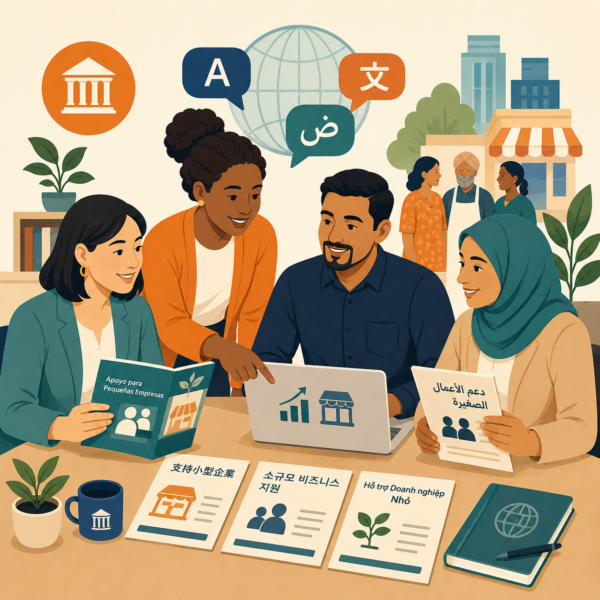 The framing of language access as a translation task is the most persistent and most limiting misconception in this field of practice. Translation of materials is one element of language access, and it is an element that agencies can manage relatively mechanically once the decision to do it has been made. The elements that require deeper thought and genuine community knowledge are the ones that determine whether the translated materials, delivered through the right channels and by the right messengers, actually reach the people they were translated for.
The first element beyond translation is channel alignment: ensuring that the channels used to deliver translated materials are channels that the target community actually engages with. This requires understanding, for each significant immigrant and ethnic business community in the agency’s market, how business owners in that community primarily receive information relevant to running their businesses. The answer varies dramatically by community and by the demographics within it. More established immigrant communities with higher median incomes and longer tenures in the United States may engage significantly with English-language channels, with ethnic media serving a complementary role. More recently arrived communities, communities with lower rates of English proficiency, or communities with strong internal social and informational cohesion may rely almost exclusively on ethnic-language media and informal social networks for business-relevant information. Delivering translated materials through English-language channels serves the former communities reasonably well and the latter communities almost not at all.
The second element is messenger credibility: ensuring that the source through which translated materials or verbal information is delivered is perceived as credible, trustworthy, and relevant by the target community. In many immigrant business communities, information from a government agency, regardless of its linguistic accessibility, carries an ambient wariness that reflects community members’ prior experiences with government in their countries of origin and in the United States. This wariness is not irrational; it is a rational response to institutional environments that have not historically served these communities well. Overcoming it through direct government-to-business outreach alone is possible but slow and resource-intensive. Overcoming it through trusted intermediaries who have already established credibility within the community, and who can vouch for the program and the agency through their own existing relationships, is faster, more effective, and more respectful of how trust actually works in these communities.
The third element is cultural adaptation beyond linguistic accuracy: recognizing that effective communication in a community is shaped by cultural conventions about how information is presented, what relationships authorize information, what level of formality is appropriate, and what the implicit signals of a communication medium convey to its audience. A program description that is appropriate and effective in an English-language business context may be too formal, too impersonal, too legalistic, or insufficiently relationship-oriented when translated directly into Vietnamese, Somali, or Mandarin without adaptation to the communication norms of those communities. Cultural adaptation requires input from members of the target community, not just from professional translators, and it produces materials that read as genuinely intended for the audience rather than as translations of materials that were intended for someone else.
The fourth element is sustained relationship rather than episodic outreach: recognizing that genuine access for immigrant and ethnic business communities requires the agency to be present in those communities in an ongoing way rather than appearing when a new program is launched or when a funding cycle creates an outreach budget. Immigrant business communities have often experienced well-intentioned government outreach that arrived, distributed materials, generated some initial awareness, and then disappeared when the outreach budget was exhausted or the staff member responsible for the effort moved to a different assignment. The lasting effect of this episodic outreach is often skepticism rather than trust, because the community learns that the agency’s interest is transactional rather than genuine. Building the relationships that sustain genuine access requires being present in the community in ways that are not contingent on specific program launches or funding cycles.
The Specific Communication Barriers Immigrant Business Communities Face
Understanding the specific barriers that immigrant business owners face in accessing economic development programs helps agencies design outreach that addresses those barriers directly rather than assuming that providing translated materials is sufficient to overcome them. The barriers are multiple and interact with each other in ways that compound the challenge for business owners navigating them without professional guidance.
Information barriers are the most basic: the business owner does not know the program exists or does not understand what it covers. These are the barriers that translation directly addresses, when the translation is delivered through channels the business owner actually uses. But many business owners who have heard of a program in general terms still do not know whether it applies to their specific business situation, what the application process involves, or whether the effort of pursuing it is worthwhile given their time constraints. These more specific information gaps require not just translated materials but translated materials delivered by a messenger who can answer follow-up questions in the business owner’s language.
Process barriers are the second layer: the business owner understands the program but cannot navigate the application process because it requires documentation they may not have in the required form, involves interactions with government systems that feel unfamiliar or risky, or requires completing forms and producing financial statements in English or at a standard of financial documentation that immigrant businesses, which frequently operate with less formal financial systems, may not currently meet. Addressing process barriers requires not only outreach but technical assistance that helps businesses prepare for program participation, including help with financial recordkeeping, document gathering, and application preparation, provided in the appropriate language and through appropriate cultural channels.
Trust barriers are the third layer and often the deepest: the business owner has heard of the program and may even understand how to apply but does not trust that the government agency offering it has their interests at heart, will treat their application fairly, or will not use the information they provide in ways that could harm them or their community. These trust barriers are particularly significant for undocumented community members, for business owners who have experienced discriminatory treatment in financial or government settings, and for communities whose histories include instances of government programs being used against rather than for the communities they were nominally designed to serve. Addressing trust barriers requires patient, consistent relationship building through trusted intermediaries and sustained agency presence in the community, not through marketing materials regardless of their linguistic quality.
Growing Places: Communication Strategies for Economic Development and Public Finance Agencies
This article is part of our series on strategic communication for Economic Development organizations, including state and local economic development agencies, regional partnerships, and business attraction initiatives. To learn more and to see the parent article, which links to other content just like this, click the button below.
Building a Language and Cultural Competency Strategy
A language and cultural competency strategy for an economic development agency is not a translation management system. It is an organizational commitment to designing and delivering programs in ways that are genuinely accessible to the full diversity of the business communities the agency serves, backed by the operational investments that make that commitment real rather than aspirational.
The strategy begins with a rigorous assessment of the agency’s service area, identifying the immigrant and ethnic business communities present in the market, their languages, their business concentrations by sector and geography, their organizational infrastructure including ethnic chambers, trade associations, and community organizations, their media landscape including print, broadcast, and digital channels in each community’s primary language, and their historical relationship with the agency and with government programs generally. This assessment cannot be conducted from a desk; it requires community engagement, and the most useful source is often not demographic data but conversations with community members, ethnic chamber representatives, CDFI staff who serve these communities, and social service providers who work with immigrant populations.
The assessment produces a prioritization of languages and communities for active outreach investment. Not every language community in a large city’s market can receive the same depth of investment simultaneously, and the prioritization should reflect the size of the business community, the degree of program relevance to that community’s business mix, the strength of existing relationships and organizational infrastructure, and the depth of the current access gap. Communities with large business populations, high program relevance, weak existing relationships, and deep access gaps are the highest priority for investment.
For each priority community, the strategy should specify the channels to be used for outreach, the messenger organizations and individuals to be engaged, the materials to be produced and in what languages, the technical assistance resources to be made available in those languages, and the relationship maintenance activities that will sustain the strategy between specific program outreach moments. This specificity at the community level is what distinguishes a genuine language access strategy from a general commitment to diversity that has no operational content.
Working With Ethnic Chambers and Trade Associations
 Ethnic chambers of commerce and trade associations organized around specific immigrant communities are the most organizationally accessible entry points into those communities for economic development agencies, and they represent partnership opportunities of substantial value when engaged genuinely rather than instrumentally. An ethnic chamber that serves hundreds of Korean-owned businesses in a regional economy has relationships with those businesses that the economic development agency has not built and cannot build quickly on its own. When an agency engages that chamber as a genuine partner, providing it with accurate program information, treating it as an expert on the communication needs of its business community, and investing in a relationship that benefits the chamber and its members rather than simply asking the chamber to distribute agency materials, the partnership produces a quality and quantity of outreach that no agency-direct effort could match.
The design of ethnic chamber partnerships should be governed by the same principles that govern CDFI partnerships: the agency equips the partner, maintains the relationship, and provides the follow-through that makes referrals valuable to the partner’s members. For ethnic chambers specifically, this means providing program information in the chamber’s primary language, tailored to the business types that predominate in its membership; treating chamber leadership as community experts whose input on program design and outreach approach the agency genuinely seeks and uses; presenting at chamber events in a format and language that serves the membership rather than the agency’s communication preferences; and ensuring that chamber members who engage with agency programs because of the chamber’s referral receive service quality that reflects well on the chamber’s judgment rather than generating complaints that damage the chamber’s credibility with its own membership.
Ethnic chambers also vary significantly in their capacity, stability, and relationship to their community’s full business population. A well-resourced ethnic chamber with professional staff, a large active membership, and deep community trust is a very different partner than a smaller, volunteer-led organization with a committed but limited membership and no dedicated staff for program administration. Agencies should calibrate their partnership investment to reflect each chamber’s actual capacity, providing higher support and more hands-on engagement to chambers with less internal capacity, and recognizing that an organization with limited capacity can still be a high-value partner if the agency invests in making the partnership workable rather than expecting it to function at the same level as a larger, better-resourced chamber.
Engaging Ethnic Media as an Outreach Channel
Ethnic media, including print newspapers, radio programs, television channels, and digital platforms that serve specific immigrant communities in their primary languages, represent one of the highest-reach outreach channels for those communities and one of the most consistently underused by economic development agencies. An ethnic newspaper with thousands of readers among a city’s Chinese business community, or a Spanish-language radio program with a substantial small business audience, reaches a population that the agency’s English-language marketing channels almost entirely miss, and it reaches them through a source they already trust for community-relevant information.
Building relationships with ethnic media requires treating those relationships as genuine partnerships rather than one-time advertising transactions. Ethnic media organizations are often interested in content that serves their audiences, and a city economic development agency that can provide accurate, useful program information in a format the media outlet can publish or broadcast, presented in a way that serves the outlet’s audience rather than the agency’s marketing goals, has something valuable to offer. Regular program updates, success stories featuring businesses from the relevant community, educational content about financing and business resources, and informational features about programs that are particularly relevant to the community’s business challenges, all represent content that a well-aligned ethnic media partnership can carry to its audience at high credibility and relatively low cost.
Ethnic media staff can also function as community intelligence sources, providing the agency with perspective on what the community’s businesses most need, what communication approaches resonate, and what barriers are most significant. Treating ethnic media relationships as two-way information exchanges rather than one-directional distribution partnerships produces better content and better outreach strategy simultaneously, because the media outlet’s knowledge of its community is exactly the kind of intelligence that improves the quality of the agency’s program communication.
Trusted Messenger Strategies in Immigrant Business Communities
The trusted messenger concept, applied specifically to immigrant and ethnic business communities, requires understanding who carries credibility within each community for business-relevant information, because the answer varies significantly across communities and within the same community across different types of decisions. In some communities, a religious leader carries authority over financial decisions that members of that community seek guidance on from their spiritual leader as much as from a financial professional. In others, a long-established community elder or a successful business owner whose story is well-known in the community serves as a reference point and adviser for other entrepreneurs. In still others, a professional accountant or lawyer who serves the community and has built a reputation for honest, community-protective advice is the trusted messenger for financial program information.
Identifying these trusted messengers requires the same kind of field research and community conversation that effective stakeholder mapping requires, because they are typically not visible through formal organizational structures and may have no institutional affiliation at all. An agency that has built genuine relationships with ethnic chambers, CDFIs, and community organizations serving specific immigrant communities will gradually learn who these trusted individuals are through those relationships, as community members themselves identify who they turn to for advice and guidance. Building relationships with these trusted individuals is a longer-term investment with long-term returns: a trusted community leader who understands an agency program and believes in its value for their community can generate more program uptake through word of mouth in that community than any formal outreach campaign.
Trusted messenger relationships require the agency to earn the trust of the messenger as well as to use their existing community trust. A trusted community leader who is asked to endorse a government program to their community is putting their own credibility on the line for the agency’s program quality and the agency’s service to community members who engage with it. If that program is poorly administered, difficult to access, or fails to deliver what the trusted messenger described it as offering, the damage falls on the trusted messenger’s credibility within the community, which is exactly the credibility asset the agency was trying to leverage. Trusted messenger partnerships require the agency to be worthy of the trust it is asking messengers to extend by ensuring that the programs it asks messengers to endorse actually deliver what they promise and that community members referred by trusted messengers receive high-quality, respectful service.
Technical Assistance in Languages Other Than English
Outreach in community languages that generates business owner awareness of programs but directs those business owners to technical assistance and application support only available in English creates a second barrier at exactly the point where the awareness the outreach generated should convert into program participation. An immigrant business owner who learns through a Vietnamese community radio program that a city loan is available for equipment purchases, who contacts the agency to pursue it, and who is then directed to an English-language application and support process they cannot navigate without assistance, has not been genuinely served by the outreach that reached them.
Providing technical assistance in languages relevant to the agency’s immigrant business communities requires either hiring staff with the necessary language competencies, building partnerships with organizations that can provide language-accessible technical assistance to agency program applicants, or both. Many economic development agencies have neither the budget to hire comprehensive multilingual staff nor the partner relationships to cover the full range of languages spoken by their business communities. The practical solution for most agencies is a combination: hiring staff with the highest-priority language competencies for the communities with the deepest access gaps, and building partner relationships for the remaining languages with organizations already providing business technical assistance to those communities, such as small business development centers, community colleges, CDFIs, and ethnic chamber-affiliated advisors.
The quality of technical assistance in non-English languages is as important as its availability. An agency that offers assistance in a language but cannot provide that assistance at a level of quality and specificity comparable to the English-language assistance it offers has not achieved genuine equity of access. It has offered a lower tier of service to the communities that already face the most barriers, which is an equity failure in a different dimension from the original language barrier. Building the capacity for high-quality multilingual technical assistance requires investment, but it is the investment that converts language-accessible outreach into language-accessible program participation.
Strategic Communication Support for Economic Development Agencies
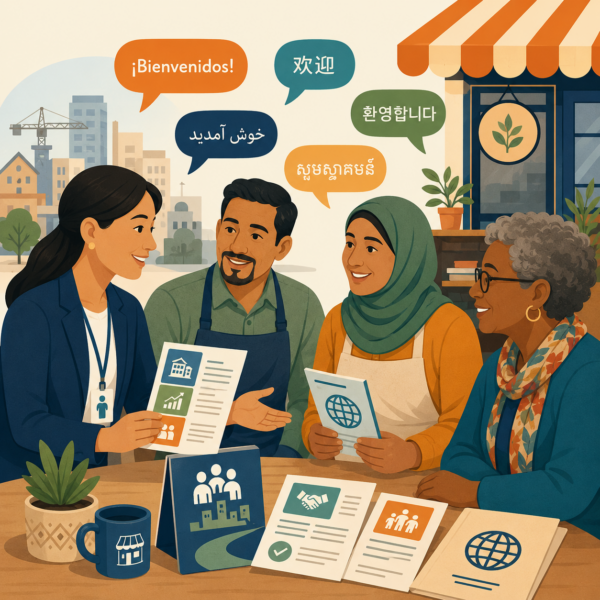 Language access for economic development agencies is simultaneously a communications challenge, a program design challenge, an organizational capacity challenge, and an equity challenge, and addressing it effectively requires treating it as all four rather than reducing it to a translation management task. Agencies that have the organizational commitment and the community knowledge to do this well produce measurably better program reach into immigrant and ethnic business communities, stronger relationships with ethnic chambers and trusted community organizations, more equitable distribution of program benefits across the full population of the businesses they serve, and a community reputation for genuine partnership that distinguishes them from agencies whose outreach is well-intentioned but structurally inaccessible.
Most economic development agencies have not built the organizational infrastructure for genuine language access, and the gap typically shows in program participation data that reveals underpenetration in specific ethnic business communities relative to their share of the overall business population. Closing that gap requires the full range of interventions described in this article: rigorous community assessment, prioritized language and channel strategy, ethnic chamber and ethnic media partnership, trusted messenger engagement, process barrier reduction, and technical assistance in relevant languages. None of these interventions alone is sufficient; the full stack is what converts a nominal commitment to language access into the genuine access that equitable economic development requires.
Stegmeier Consulting Group (SCG) helps economic development agencies build language access strategies that genuinely extend program reach into immigrant and ethnic business communities. That support may include language and community assessment, ethnic channel and messenger mapping, ethnic chamber and ethnic media partnership design, outreach material development including culturally adapted translation, technical assistance partnership development for non-English language support, process barrier analysis and reduction strategy, and program participation data analysis to identify language access gaps and measure progress in closing them.
The goal of this work is economic development programs that serve the full diversity of the business communities in the agency’s market, not just the communities most easily reached through English-language formal channels, and a community reputation for genuine inclusion that earns the trust of immigrant business communities through demonstrated commitment rather than aspirational language.
Future Trends in Language Access for Economic Development
The language access landscape for economic development agencies is evolving in several directions that will affect the strategies and investments most likely to produce genuine access for immigrant and ethnic business communities.
Demographic change is expanding the linguistic and cultural diversity of small business communities in most markets, driven by continued immigration, refugee resettlement, and the emergence of second-generation immigrant entrepreneurs whose business identities and communication preferences may differ from their parents’ generation. Agencies that have built language access strategies around the immigrant communities most visible in their market today will need to revisit those strategies periodically as the demographic composition of the business community evolves. This is not a one-time design problem but an ongoing one that requires sustained community knowledge and strategic adaptability.
Digital community platforms in community languages are proliferating, creating new communication channels that agencies have not historically engaged with but that are increasingly important in how immigrant business communities share information. Ethnic-language Facebook groups, WhatsApp communities, and social media platforms organized around specific national or cultural identities function as informal information networks for many immigrant business communities, and agencies that identify and engage these digital community spaces as outreach channels are reaching populations that formal ethnic media and organizational channels may miss.
Machine translation technology is improving substantially and is becoming more capable of producing usable first-draft translations for a wider range of language pairs and content types than was possible a few years ago. This improvement does not eliminate the need for human review and cultural adaptation, but it does reduce the cost of producing translated materials at scale and may make it more feasible for agencies to provide translated program information in a broader range of languages than was previously affordable. The investment judgment for agencies is not whether to use machine translation but how to use it appropriately alongside human review and cultural adaptation rather than as a substitute for them.
Conclusion
Language access in economic development is not achieved by translating materials and calling the work done. It is achieved by understanding how information actually reaches business owners in specific immigrant and ethnic communities, investing in the channels, messengers, and relationships through which that information travels with credibility, and building the program access pathways that allow business owners who learn about a program to participate in it without encountering a second layer of English-only barriers at the point of application. This is harder, more sustained, and more community-knowledge-intensive than translation management, and it is also more effective and more equitable.
Agencies that make this investment are not just improving their outreach metrics or their demographic representation statistics. They are building a genuine relationship between their programs and the full diversity of the business communities they serve, one that reflects an honest commitment to the proposition that economic development opportunity should be accessible to every business in a community regardless of the language its owner speaks or the cultural context in which they make their business decisions. That commitment, sustained through operational design rather than expressed only in agency mission statements, is what language access for economic development actually means.
SCG’s Strategic Approach to Communication Systems
Align your agency’s messaging, processes, and public engagement strategies.
Economic development agencies need language access strategies that go beyond translation to encompass channel selection aligned with how immigrant and ethnic business communities actually receive information, messenger calibration that engages trusted community voices rather than relying on government authority, culturally adapted communication that reflects the norms and expectations of each community rather than simply translating material designed for a different audience, process barrier reduction that addresses the structural obstacles between awareness and participation, and technical assistance in community languages that converts outreach into genuine program access.
SCG helps economic development agencies build language access strategies that extend genuine program reach into immigrant and ethnic business communities. Whether your agency needs community assessment, ethnic channel and messenger mapping, partnership design with ethnic chambers and media, culturally adapted material development, process barrier analysis, or technical assistance partnership development, SCG can help you build a language access program that earns the trust and participation of the full diversity of your business community.
Use the form below to connect with our team and explore how strategic language access investment can help your agency close the gap between program availability and program participation across all of the business communities in your market.