
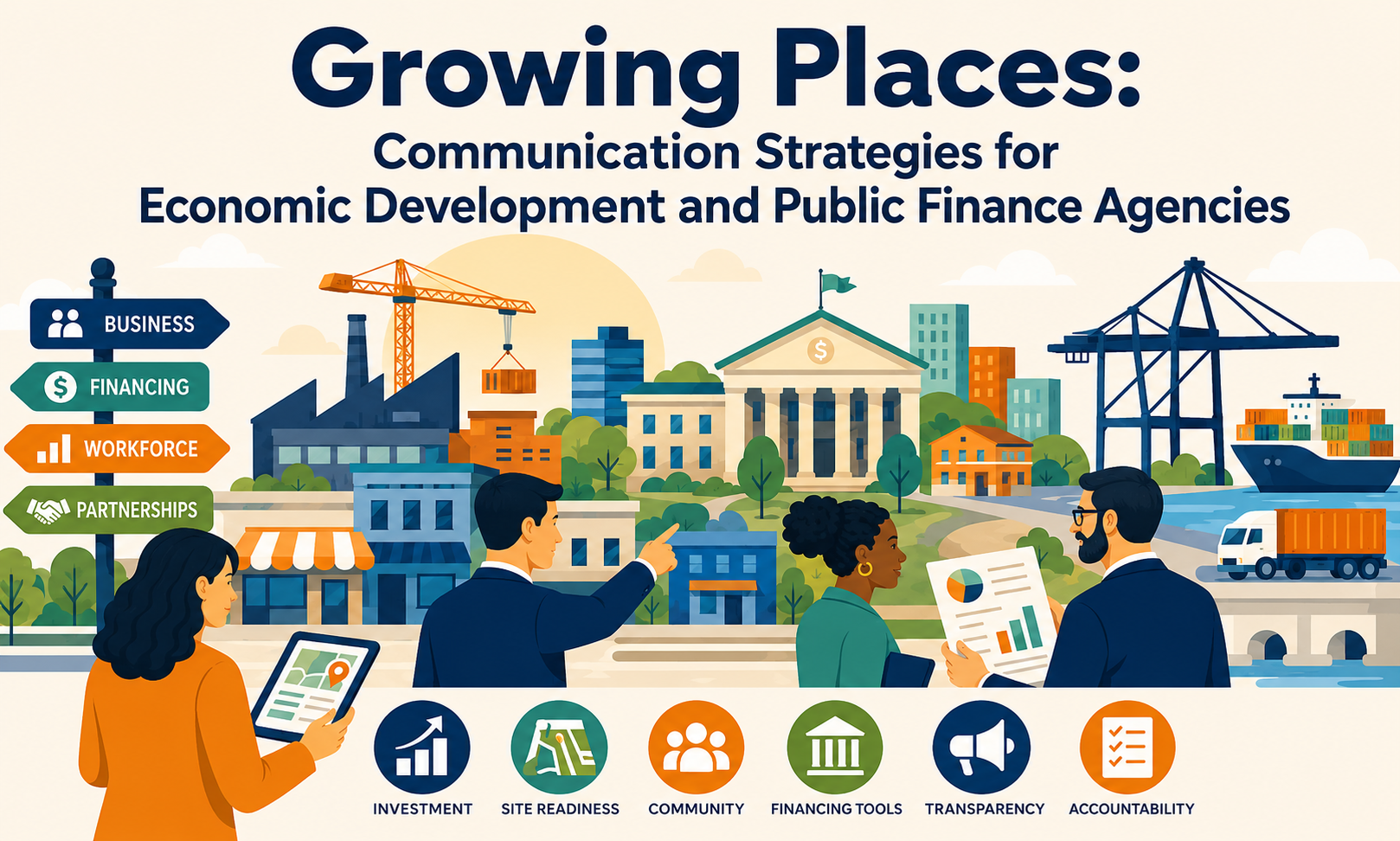
Growing Places: Communication Strategies for Economic Development and Public Finance Agencies

How Economic Development Agencies Can Make Communication Central to Growth
In the United States, economic development does not happen primarily in state capitols. It happens in county courthouses, downtown storefronts, industrial parks off interstate exits, community college workforce centers, port districts, development finance authorities, and regional economic development organizations that many people outside the business community have never heard of.
The organizations doing this work carry a variety of names: economic development corporations (EDCs), economic development organizations (EDOs), industrial development authorities (IDAs), business improvement districts (BIDs), port authorities, development finance authorities (DFAs), infrastructure banks, regional planning commissions with economic development functions, county bureaus of economic development, city offices of economic opportunity, and community development financial institutions (CDFIs). But they share a common operating reality. They are trying to grow local and regional economies using a mix of public incentives, financing programs, site readiness investments, business services, infrastructure tools, and partner relationships, often with lean staffs, limited marketing budgets, and audiences who do not fully understand what economic development agencies do or how to engage with them.
This communication challenge is not a minor operational inconvenience. It is central to whether these agencies fulfill their missions.
A regional EDC in the Midwest that has access to a state-backed revolving loan fund, a county tax increment financing district, a federal tax credit tool, and a workforce training grant program may be well-equipped to support business expansion. But if the manufacturers, developers, entrepreneurs, nonprofit developers, or community partners who could use those tools do not know they exist, cannot figure out how to qualify, cannot get a timely response to an inquiry, or cannot find plain-language explanations of what each program actually does, the tools sit unused.
Communication is not a marketing function layered on top of economic development programs. It is the mechanism by which those programs reach the businesses and communities they were designed to serve.
The audience for economic development communication is also more diverse than the old model of corporate site selection and ribbon-cutting ceremonies suggests. Site selectors and corporate real estate professionals evaluating manufacturing relocations or distribution center placements represent an important audience. But so do small manufacturers already operating in the region who need equipment financing. So do immigrant entrepreneurs launching food businesses in underserved commercial corridors. So do Black-owned construction firms that may qualify for a minority business enterprise program but have never been reached by agency outreach. So do nonprofit developers assembling financing for a community health center or an affordable housing project. So do rural farm-to-table businesses in counties that have a DFA but limited visible outreach to agriculture-adjacent enterprises.
The communication strategy that works for a Fortune 500 site selection inquiry looks nothing like the strategy needed to reach a second-generation family manufacturer in a legacy industrial city who is considering whether to expand or sell.
This content hub provides a practical framework for building stronger economic development communication. It is organized around the real operating contexts that economic development and public finance agencies face: how they attract and retain businesses, how they communicate about public financing tools like tax increment financing and industrial development bonds, how they build credibility with residents and elected officials, how they use digital tools and media, and how they extend their reach through community partners and trusted intermediaries.
The goal is communication that works for large metro regions, mid-sized cities, rural counties, port authorities, neighborhood commercial corridors, development finance agencies, and public finance entities that need to connect complex programs to the people and organizations they are meant to serve.
Who This Content Hub Is For
This content hub is designed for public agencies, quasi-governmental organizations, and public-sector partners involved in economic development, business attraction, business retention, infrastructure financing, and public finance communication.
That includes regional EDCs, EDOs, county economic development departments, city economic development offices, offices of economic opportunity, DFAs, IDAs, infrastructure banks, port authorities, BIDs, neighborhood commercial corridor organizations, public finance agencies, and related economic development partnerships.
It is also relevant for the people who help these organizations communicate: executive directors, department heads, public information officers, communications managers, business development officers, project managers, loan program staff, grant administrators, board members, elected officials, partner organizations, and consultants supporting public-sector economic development work.
The common thread is that these agencies and organizations need to explain complex tools to audiences that do not all speak the same language. A site selector may need current property data, utility capacity, workforce information, incentive eligibility, and a fast response. A small business owner may need to know whether a loan program can help buy equipment or renovate a storefront. A developer may need to understand whether a project fits a tax increment financing (TIF) district or conduit bond program. A resident may want to know why public financing is being used for a private or nonprofit project. A board member may need a plain-language explanation before a public vote. A journalist may want to know whether a job creation claim is projected, actual, direct, or indirect.
Strong communication helps each audience answer the questions that matter to them without forcing them to understand the agency’s internal structure first.
How to Use This Economic Development Communication Content Hub
This content hub is intended to serve as the central overview for SCG’s economic development and public finance communication series. It explains the major communication challenges that appear across EDCs, EDOs, DFAs, IDAs, port authorities, BIDs, county and city economic development offices, infrastructure banks, and related public finance entities.
The sections below provide a broad framework for understanding the sector. They explain who these agencies are, what tools they need to communicate, where communication often breaks down, why public accountability matters, and how agencies can strengthen communication systems across websites, staff, boards, partners, community engagement, and public reporting.
More targeted articles can build from this hub by going deeper into specific topics such as TIF communication, revolving loan fund outreach, conduit bond communication, site readiness, business retention visits, public accountability reporting, inclusive outreach, partner toolkits, digital content strategy, and port authority investor relations. The hub should function as the parent resource, while those narrower articles can address specific agency problems in more detail and link back to this broader framework.
Our Comprehensive Guide to Public Communications for State and Local Government Agencies
This article is part of our series on strategic communication for state and local government agencies. To learn more and to see the parent article, which links to other content just like this, click the button below.
How Economic Development Agencies Operate Across a Fragmented Landscape
Understanding who the agencies in this space actually are matters before addressing how they should communicate. The economic development ecosystem at the local and regional level in the United States is fragmented, overlapping, and highly variable by state. There is no single model. What follows describes the most common organizational types and their communication contexts.
Regional Economic Development Corporations and Organizations
Regional EDCs or EDOs are typically nonprofit organizations, often partially funded by local government, that serve a multi-county or metro-area geography. They are often the primary interface for business attraction, site selection support, and incentive packaging at the regional level.
Organizations such as the Greater Des Moines Partnership in Iowa, the Nashville Area Chamber of Commerce Economic Development division, JobsOhio’s regional partners, the Greater Phoenix Economic Council, and the Piedmont Triad Partnership in North Carolina operate in this space. They do not administer incentive programs directly in most cases, but they coordinate the package of state, county, and local tools that makes a project feasible. They also serve as the primary relationship manager for prospects evaluating the region.
Communication from these organizations tends to be outward-facing and promotion-heavy. The challenge is that site selectors and corporate real estate professionals, the traditional primary audience, represent a relatively small share of the economic impact these organizations can influence. Most job growth in many regions comes from existing business expansion, small business formation, and entrepreneurship, not only from new corporate relocations.
Regional EDCs that communicate only through business attraction materials, trade show presences, and corporate prospect briefings miss the larger opportunity to connect growing businesses in their own region with available tools.
County Economic Development Agencies and Departments
County-level economic development departments represent one of the most important and underappreciated entry points for businesses and developers in the United States.
Cook County, Illinois operates a Bureau of Economic Development with loan programs, business support services, and coordination with municipal and state resources. Montgomery County, Maryland’s Economic Development Corporation serves a dense suburban county with a mix of technology, biomedical, and professional services firms. Kern County, California’s Economic Development division operates in a large agricultural and energy-producing county with distinctive industry sector needs. Allegheny County, Pennsylvania’s Economic Development department administers financing programs, manages county-owned industrial sites, and coordinates with Pittsburgh-area development partners.
These county agencies are closer to the ground than regional organizations and often serve as the practical navigator for businesses that need to interface with multiple layers of government. A manufacturer in suburban Cook County may be eligible for a state tax credit, a county loan through a revolving loan fund (RLF), a local property tax abatement from the municipality where the facility is located, and a workforce training grant from the regional workforce investment board.
The county economic development office is often the organization best positioned to help the manufacturer identify, apply for, and coordinate across all of these resources, but only if its communication makes that navigational capacity visible.
City Economic Development Offices and Offices of Economic Opportunity
In large and mid-sized cities, economic development offices often sit inside city government and operate with a dual mandate: attracting new investment and ensuring that existing residents and business owners benefit from economic growth.
Washington, D.C.’s Office of the Deputy Mayor for Planning and Economic Development manages the District’s economic development portfolio, which includes business incentives, large development projects, and community benefit agreements. Chicago’s Department of Planning and Development administers TIF districts, small business improvement grants, and neighborhood commercial corridor investment programs. Baltimore’s Department of Economic and Neighborhood Development oversees enterprise zones, commercial revitalization funds, and small business lending programs. Detroit’s Planning and Development Department coordinates with public-private partnerships that manage business attraction, retention, industrial development, and small business services.
City economic development communication faces a distinctive tension. On one hand, city agencies need to attract investment, which requires presenting the city as a competitive business environment. On the other hand, city agencies in economically distressed or rapidly changing neighborhoods face community pressure to demonstrate that investment benefits longtime residents, not only real estate developers and corporate tenants.
Communication that speaks only to investors and ignores residents generates backlash. Communication that speaks only to community concerns without articulating an economic strategy generates skepticism from the business community. Getting this balance right is one of the core communication challenges for urban economic development offices.
Development Finance Authorities and Industrial Development Authorities
DFAs and IDAs are specialized public agencies that issue tax-exempt bonds, manage RLFs, administer TIF districts, and provide other structured financing tools for economic development and community development projects.
They exist at the state, county, and city level. The Indiana Finance Authority operates at the state level but finances projects across the state through local government partners. MassDevelopment serves as both a state development finance agency and a local deal-maker that structures financing directly with private developers and businesses. Summit County, Ohio’s Development Finance Authority focuses on county-level economic and community development financing. The New York City Industrial Development Agency, administered through the New York City Economic Development Corporation, issues bonds for manufacturing, nonprofit, and commercial projects within the five boroughs.
These agencies communicate with a more technically sophisticated audience than general business development organizations. Their primary audiences include bond counsel, investment bankers, commercial lenders, real estate developers, nonprofit executives, and corporate treasury departments. But they also have accountability obligations to elected officials and taxpayers who need to understand what public financing tools are being used for.
The communication gap in this sector is often between the technically precise language required for investor relations and regulatory compliance and the plain-language explanation required for public accountability. Agencies that produce excellent official statements and continuing disclosure filings but cannot explain what a conduit bond issuance does to a county commissioner or a neighborhood association have a genuine communication problem.
Port Authorities
Port authorities belong squarely in the economic development and public finance communication landscape. Many port authorities are not only transportation or maritime operators. They are also infrastructure developers, public finance entities, real estate managers, freight and logistics coordinators, redevelopment agencies, and regional economic development partners.
Their communication context is distinctive because they often need to speak to several audiences at once. Capital markets audiences may need investor relations materials, bond disclosures, financial statements, and project-level information about revenue-supported infrastructure. Freight, logistics, maritime, aviation, and industrial users may need clear information about terminal capacity, cargo facilities, redevelopment timelines, road and rail connections, permitting, and site availability. Residents, local officials, community organizations, and journalists may need to understand why a port is issuing debt, expanding a terminal, redeveloping waterfront property, or investing in freight infrastructure that affects traffic, land use, environmental conditions, or neighborhood access.
This dual-audience challenge makes port authority communication more complicated than standard economic development messaging. A port authority may need to explain a bond-financed terminal expansion in language that is accurate enough for investors, practical enough for freight users, and understandable enough for residents and elected officials. If it communicates only in capital-markets language, the public may not understand the project’s purpose or benefits. If it communicates only in community relations language, finance audiences may not see the technical detail and discipline they expect.
The strongest port authority communication connects infrastructure, financing, operations, economic impact, and public accountability in one coherent story. That may include plain-language project summaries, investor-facing materials, public meeting content, construction updates, freight and logistics briefings, environmental and traffic impact explanations, and consistent message frameworks that align what the port says to markets, businesses, public officials, and communities.
Business Improvement Districts and Neighborhood Commercial Corridor Organizations
BIDs represent one of the most locally grounded forms of economic development communication in the United States. BIDs in New York City, Los Angeles, Chicago, Washington, D.C., and hundreds of smaller cities operate as quasi-governmental entities funded by property assessments within a defined commercial area. They provide services including streetscape maintenance, marketing, small business support, and safety and sanitation.
Their economic development communication is inherently hyperlocal. The audience is businesses and property owners within a specific corridor, and the message is about the health and vitality of that specific place.
Major BIDs and downtown partnerships often operate with significant communication budgets and sophisticated outreach strategies. Smaller corridor organizations often operate with far fewer resources and may struggle to communicate program availability to diverse, multilingual business communities. The communication gap between well-resourced downtown BIDs and under-resourced neighborhood corridor organizations is itself an equity issue in local economic development.
How Economic Development Agencies Can Explain Financing Tools Clearly
 One of the most consistent failures in economic development communication is that agencies describe programs without explaining what they actually do or why a business or developer would want to use them.
Tax increment financing, conduit bonds, revolving loan funds, New Markets Tax Credits (NMTCs), opportunity zone investments, small business grants, workforce training incentives, and site readiness programs each have distinct mechanics, eligible uses, and typical applications. When agencies present them as undifferentiated items in a program menu, businesses cannot self-select, staff spend excessive time on inquiries that are unlikely to result in a match, and eligible projects are left without financing because the right tool was never identified.
Tax Increment Financing
TIF is one of the most widely used and most misunderstood local economic development tools in the United States. TIF districts are established by municipalities, cities, counties, and in some states, special districts to capture the incremental property tax revenue generated by new development and reinvest it in the district where the development occurs.
Illinois has more than 1,300 active TIF districts, making Chicago and its suburbs among the most TIF-intensive environments in the country. Missouri uses TIF extensively in Kansas City and St. Louis for both commercial and industrial projects. California eliminated traditional redevelopment agencies in 2012 but replaced them with Enhanced Infrastructure Financing Districts and Community Revitalization and Investment Authorities that function on similar tax increment logic.
TIF communication challenges are significant. The basic concept that a project generates tax growth that funds itself sounds circular to many audiences and raises legitimate questions about whether existing taxpayers are subsidizing private development. Elected officials who vote to create TIF districts face constituent questions about who benefits. Community advocates in cities like Chicago have organized significant opposition to TIF allocation decisions, arguing that TIF revenue should flow to schools and public services rather than subsidizing downtown commercial development. Developers and businesses that might benefit from TIF often do not know how to initiate a conversation about TIF eligibility.
Agencies that communicate proactively about how TIF works, what projects are eligible, how TIF funds are allocated, and what accountability mechanisms exist are better positioned to use TIF effectively and defend it publicly.
Industrial Development Bonds and Conduit Bond Programs
Industrial development bonds and conduit bond programs allow local and state governments to issue tax-exempt bonds on behalf of private businesses and nonprofit organizations, lowering the borrowing cost for eligible projects. The issuing government entity, whether a city, county, or DFA, does not take on direct credit risk in most conduit bond structures. The bond is repaid from project revenues, not public tax dollars. But the government’s name is on the bond, and the tax-exempt status represents a federal subsidy that requires the project to serve a public benefit purpose.
The New York City Industrial Development Agency issues bonds for manufacturers, nonprofit organizations, and certain commercial projects within the five boroughs. California’s Infrastructure and Economic Development Bank issues bonds for both public agency infrastructure and industrial development projects, working with local governments and DFAs to structure deals. The Philadelphia Industrial Development Corporation is a public-private nonprofit that issues conduit bonds, provides direct loans, and manages industrial land as part of a comprehensive business finance and site readiness operation.
Conduit bond communication requires navigating two very different audiences: sophisticated borrowers who understand bond financing and need precise information about rates, covenants, and issuance costs, and first-time users who need the concept explained from the ground up before they can evaluate whether it applies to their situation.
Revolving Loan Funds
RLFs are among the most flexible and locally controlled economic development financing tools available to local governments and EDOs. A fund is capitalized through federal grants, often from the U.S. Economic Development Administration’s Public Works and Economic Adjustment Assistance programs, state contributions, or local appropriations. Loans are made to eligible businesses, and repayments recapitalize the fund for future lending.
RLFs at the local level are often the primary financing option for small manufacturers, minority-owned businesses, businesses in rural areas, and early-stage companies that cannot access conventional bank credit at competitive terms. The Albuquerque Economic Development Department operates a revolving loan fund that has supported manufacturing, technology, and retail businesses in the Albuquerque metro area. The Detroit Economic Growth Corporation operates multiple loan programs for Detroit businesses, including programs specifically designed to reach businesses owned by people of color in underserved neighborhoods. Rural counties across Appalachia, the Mississippi Delta, and the rural West operate EDA-funded RLFs that are often the only source of affordable business capital within driving distance.
The communication challenge for RLFs is two-sided. On one side, agencies need to let eligible businesses know the fund exists and how to apply. On the other side, agencies need to communicate honestly about what the fund can and cannot do: maximum loan amounts, eligible uses, interest rates, collateral requirements, and application timelines.
Many RLF programs have loan sizes that are modest relative to what a growing manufacturer or commercial developer actually needs. A business owner who spends weeks preparing a loan application only to discover that the maximum loan amount is significantly less than the project requires will not return to that agency or refer other businesses to it.
New Markets Tax Credits and Opportunity Zones
The NMTC program is a federal tax credit program administered by the U.S. Treasury’s Community Development Financial Institutions Fund. Community development entities compete for NMTC allocations and use them to make below-market loans or equity investments in low-income communities. NMTCs have financed community health centers, grocery stores in food deserts, manufacturing facilities, charter schools, childcare centers, and commercial developments in economically distressed neighborhoods across the country.
Opportunity Zones, established by the 2017 Tax Cuts and Jobs Act, incentivize investment in designated census tracts through deferral and potential exclusion of capital gains taxes for investments held in Qualified Opportunity Funds. Local economic development agencies in cities such as Detroit, Baltimore, Cleveland, and Louisville have tried to channel opportunity zone investment toward community priorities, with mixed results.
Local EDOs that communicate effectively about NMTCs and opportunity zones do so by explaining the tools in terms of what projects they have financed and what community outcomes resulted, not by presenting only the technical tax structure. A community health center in a low-income neighborhood financed in part through NMTCs is a more compelling communication example than a description of qualified active low-income community business requirements. A mixed-use development in an opportunity zone that created affordable commercial space for minority-owned businesses is a better story than a discussion of qualified opportunity fund mechanics.
Workforce Training Incentives and Site Readiness Programs
Economic development financing is only one component of what local agencies offer businesses. Workforce training incentives, site readiness grants, and business technical assistance are equally important tools, and they are often better suited to smaller businesses and existing employers than structured financing programs.
Many states administer customized job training programs that local economic development agencies help businesses access. Examples include the Missouri One Start program, the Georgia Quick Start program, the California Employment Training Panel, the Texas Skills Development Fund, and similar programs across dozens of other states. Local agencies that understand these programs and can connect businesses to them quickly add immediate value to the relationship.
Site readiness communication is also increasingly important as industrial real estate markets have tightened. The Tennessee Valley Authority’s site certification program, which has influenced how utilities and local EDOs in the Southeast communicate industrial site readiness, is an example of how standardized communication frameworks can improve the speed and quality of business attraction conversations.
How Economic Development Agencies Can Improve On-the-Ground Communication
The gap between how local economic development agencies communicate and how businesses, developers, and community partners actually need to receive information is one of the most persistent operational problems in the field. The following practical communication approaches address that gap and reflect the operating reality of local and regional economic development in the United States.
Speed and Specificity Are the Primary Standards Businesses Use to Evaluate Agencies
Site selectors, business owners, and real estate developers who contact a local economic development agency are almost always doing so while simultaneously evaluating multiple alternatives. A manufacturer evaluating three metro areas for a plant expansion is not going to wait several days for a callback. A developer assembling financing for a mixed-use project in a TIF-eligible area is not going to sort through a website that buries program details under organizational description.
The speed and specificity of an agency’s response to an initial inquiry is often the most powerful signal a business receives about whether engaging with that agency is worth its time.
Strong inquiry response requires more than fast replies. It requires a mapped internal process. Agencies should know where inquiries arrive, who reviews them, how they are categorized, how they are routed, who owns the response, what partner input may be needed, and when follow-up occurs. A prompt response that does not answer the prospect’s actual question is not enough. A helpful response that arrives too late may also fail.
The goal is to move from first contact to qualified project without losing the business, developer, or site selector between inboxes, departments, partners, or programs.
The Business Retention Visit Is an Underused Communication Tool
Business retention and expansion programs, structured programs in which economic development staff make regular in-person visits to existing employers, generate two-way communication value that no digital channel can fully replicate.
Research from the economic development field consistently shows that most job growth in many regions comes from existing businesses, not new corporate relocations. Yet many local economic development agencies spend a disproportionate share of their communication resources on business attraction materials and a relatively small share on systematic relationship management with existing employers.
For the agency, retention visits provide market intelligence: which employers are growing, which are facing challenges, which are evaluating relocation, and what workforce needs are emerging. For the businesses visited, a retention visit signals that the agency knows they exist, cares about their continued operation, and can connect them with resources they may not know about.
A manufacturer who learns during a retention visit that they qualify for a workforce training grant they never heard of will remember that agency the next time they are considering an expansion project.
Community Development Financial Institutions as Communication Partners
CDFIs, including community development loan funds, community development banks, and community development credit unions, are among the most important and most underutilized communication partners for local economic development agencies.
Organizations such as Accion Opportunity Fund, Appalachian Community Capital, the Reinvestment Fund, and IFF operate specifically to provide financial services to low-income and underserved communities. They have deep relationships with the minority-owned businesses, immigrant entrepreneurs, rural businesses, and community organizations that local government economic development agencies often have difficulty reaching directly.
When a local economic development agency equips its CDFI partners with current program information, clear referral protocols, and direct contact points for program staff, the CDFI’s existing client relationships become an extension of the agency’s outreach capacity.
Immigrant and Ethnic Business Communities Require Language Access and Cultural Competence
The United States is home to some of the most vibrant immigrant and ethnic entrepreneurship in the world. Koreatown in Los Angeles, Devon Avenue in Chicago, the International District in Seattle, Flushing in Queens, Latinx business corridors in Southwest Detroit, Little Ethiopia in Washington, D.C., and Somali business communities in Minneapolis-Saint Paul are examples of places where immigrant and ethnic business communities represent significant concentrations of small business ownership and economic activity.
Local economic development agencies often fail to reach these communities effectively.
Language access is the most basic requirement, but translation alone is insufficient. A Spanish-language version of an RLF application designed for an English-language, document-intensive underwriting process may still be inaccessible to a small business owner whose financial records are maintained informally.
Effective communication with immigrant business communities requires working with trusted intermediaries: ethnic chambers of commerce, immigrant-serving nonprofits, and bilingual small business advisors who understand the cultural context within which businesses operate and can bridge between the agency’s program requirements and the business owner’s actual situation.
Rural Economic Development Communication Has Its Own Logic
Rural counties and regions across the United States face economic development communication challenges that are structurally different from urban and suburban contexts. Business populations are smaller and more dispersed. The agencies with financing programs are often farther away, both literally and institutionally, from the businesses that could benefit. Local newspapers, which served as a primary channel for public information in many rural communities, have experienced significant decline.
In this context, the most effective communication channels for rural economic development are often face-to-face, relationship-based, and routed through highly trusted local institutions. Agricultural extension offices, rural electric cooperatives, rural small business development centers, community foundations, local lenders, and regional development organizations often carry communication credibility in rural communities that a government agency may lack.
The most effective local administrators of rural economic development programs are the ones who have built relationships with these trusted local institutions and route communication through them.
How Economic Development Agencies Can Align Staff, Boards, and Partners Before Going Public
Economic development communication often fails because the public-facing message is written before the internal communication system is ready.
A business may hear about a program from a business development officer, a county commissioner, a chamber of commerce, a CDFI lender, a municipal partner, a utility economic development representative, a workforce board, a board member, or a consultant. If those partners explain the same program differently, the business experience becomes confusing. If an elected official describes a project one way while agency staff describe it another, public trust suffers. If a board member cannot explain what a financing tool does before a public vote, the agency may appear opaque even when the decision is legitimate.
Economic development agencies should align internal and partner communication before major external moments. That includes program launches, incentive announcements, project approvals, public meetings, bond issuances, TIF district creation, business attraction campaigns, corridor outreach, and public accountability reporting.
A strong alignment process should include:
- A shared message framework that explains the program, project, or decision in plain language.
- Staff talking points for business development officers, loan program staff, project managers, and public information officers.
- Board and elected official briefing materials that explain what is being approved, why it matters, and what questions may arise.
- Partner toolkits for chambers, CDFIs, utilities, workforce boards, small business development centers, and municipal partners.
- A single source of truth on the agency website where users can find current, accurate information.
- Clear routing instructions so partners know where to send inquiries and when to escalate questions.
Internal alignment is not about controlling every word every partner says. It is about making sure the core message is consistent, accurate, and usable. Businesses and residents should not receive different explanations of the same program depending on whom they ask.
How Economic Development Agencies Can Build Trust, Transparency, and Public Accountability
Local economic development agencies use public resources: tax-exempt bond authority, TIF district revenue, federal grants, public land, and public staff capacity on behalf of residents and taxpayers. This creates accountability obligations that go beyond the business development relationship.
Residents, community advocates, journalists, elected officials, and oversight bodies have legitimate interests in understanding how public financing tools are being used, who benefits, what outcomes are produced, and whether the public interest is being served.
Agencies that communicate proactively about these questions are better positioned to maintain public support and respond to criticism than those that treat program details as proprietary or public accountability as a distraction from the real work.
TIF Accountability Is One of the Most Contested Communication Arenas in Local Government Finance
No local economic development financing tool generates more controversy than TIF.
The structural argument against TIF is that it captures property tax revenue that would otherwise flow to schools, parks, libraries, and general government services and redirects it to subsidize private development. That argument is made by community advocates, journalists, and academic researchers in cities across the country.
In Chicago, civic organizations and neighborhood advocacy groups have maintained sustained scrutiny of TIF district finances, publishing analyses of TIF fund balances, subsidy amounts per job created, and geographic distribution of TIF benefits. In California, the elimination of redevelopment agencies in 2012 was driven in part by fiscal concerns about how tax increment revenue was being used.
Local economic development agencies that administer or coordinate TIF districts cannot escape this scrutiny by simply not communicating. The information is public record, and critics who analyze it are often better at presenting it accessibly than the agencies themselves.
The more effective approach is proactive transparency: publishing clear plain-language explanations of how TIF works, making TIF district financials accessible in formats non-specialists can navigate, and reporting on project outcomes including job creation and neighborhood investment.
Incentive Decisions Need Plain-Language Public Explanation
When a local economic development agency approves a grant from a commercial revitalization fund, allocates a tax credit to a community facility project, or closes a TIF-financed development deal, there is a public interest in understanding what was decided and why.
In most jurisdictions, the enabling legislation, the resolution approving the incentive, and the project agreement are public records. But public records are not the same as public communication.
A developer agreement running to dozens of pages with technical legal language is a public record. A two-page plain-language summary of what the project is, what public financing it is receiving, what commitments the developer made regarding jobs and wages, and what happens if those commitments are not met is public communication.
Agencies that publish plain-language project summaries at the time of approval, posted prominently on the agency website and distributed to elected officials and community stakeholders, build the transparency credibility that protects them when a project encounters difficulty.
Job Creation Claims Require Honest Communication and Realistic Timeframes
Economic development agencies are under persistent pressure to quantify the job creation impact of their investments. But job creation communication in economic development is susceptible to optimistic projection, methodological inflation, and attribution problems.
A manufacturer that commits to creating 200 jobs over five years may create 150 in three years, then face market conditions that prevent the final 50. Agencies should communicate job creation projections honestly, with clear distinctions between projected and actual jobs, construction and permanent employment, and direct jobs at the assisted business versus indirect jobs estimated through economic multiplier models.
An agency that commits to reporting actual job creation outcomes against projected commitments, and that is transparent when projects underperform, builds more durable credibility than one that publishes headline numbers without context.
How Economic Development Agencies Can Build a Communication Calendar Around Business Cycles, Board Actions, and Public Reporting
Economic development communication is often reactive. Agencies announce projects when they close, publish program updates when deadlines approach, answer questions when confusion rises, and respond to controversy after criticism has already shaped the story.
A communication calendar helps agencies move from reaction to readiness.
Economic development agencies have predictable communication cycles. Business retention visits can be planned by quarter, sector, geography, or employer size. Grant and loan programs often have application windows, board review timelines, and reporting deadlines. Business attraction campaigns often align with trade shows, industry events, site selector outreach, and state or regional marketing cycles. DFAs, IDAs, infrastructure banks, and port authorities may have board agendas, bond disclosure schedules, investor relations updates, project milestones, and annual financial reporting obligations. City and county agencies may need to align communication with budget season, public hearings, corridor planning, capital improvement schedules, and elected official briefings.
A useful economic development communication calendar should include:
- Business retention outreach cycles.
- Board meeting and deal approval dates.
- Grant, loan, and incentive application windows.
- Annual report and impact report production timelines.
- Business attraction campaign milestones.
- Industry trade shows and site selector outreach opportunities.
- Public finance reporting and investor relations deadlines.
- Community engagement windows for major development projects.
- Corridor outreach and small business campaign periods.
- Workforce program deadlines and employer outreach cycles.
- Capital project milestones for ports, infrastructure banks, and development finance agencies.
The calendar should also leave room for flexible issue response. Economic development agencies need the ability to respond to a major project announcement, a missed performance commitment, a public records request, a media inquiry, a plant closure, a new employer prospect, or a controversy around incentives. But those unplanned communications are easier to manage when the agency already has a planned communication rhythm, clear roles, reusable templates, and an established source of truth.
A communication calendar is not just a scheduling tool. It is a way to connect communication planning to the actual business cycle of the agency.
Case Studies: How Economic Development Agencies Communicate Strategy, Talent, and Inclusion
 The following three case studies are drawn from real campaigns conducted by local and regional EDOs in the United States. Each illustrates a specific communication challenge: sector-specific brand-building, rural talent attraction, and inclusive business messaging. Each offers practical lessons that transfer to other geographies and organizational contexts.
Palm Beach County, Florida: Sector Positioning and Financial Services Attraction
Palm Beach County’s Business Development Board (BDB) is a public-private partnership that serves as the county’s official economic development organization, providing confidential, no-cost relocation and expansion support to businesses considering the Palm Beaches. Its financial services strategy has been built over more than a decade through successive waves of New York migration. Each wave built on the communication foundation laid by the previous one, compounding the brand’s credibility over time.
The core of the strategy is the Wall Street South positioning, which presents Palm Beach County as a legitimate alternative financial services hub to New York City. The positioning is anchored in verifiable, specific facts: the number of hedge funds, private equity firms, and financial services companies operating in the county; the presence of major financial services firms; the size of the financial sector workforce; and the county’s track record of business relocation and capital investment.
These numbers matter because they make the brand durable rather than merely promotional.
The campaign that drew national attention used high-profile advertising in New York City to target financial professionals and firms reconsidering their future location decisions. The message framed relocation not as a rejection of New York, but as a personal life decision, acknowledging that leaving is emotionally complex while positioning Palm Beach County as the next right chapter.
By borrowing the vocabulary of personal relationships, emotional framing, and aspiration, the campaign made a business climate decision feel human and relatable in a way that statistical comparisons of tax rates and operating costs do not. Financial professionals scrolling through social media or walking through a high-visibility advertising environment respond to emotion and aspiration. The campaign generated media coverage well beyond what a conventional press release about business incentives would have produced.
The lesson for other county and regional economic development organizations is not to copy the Wall Street South positioning or replicate the billboard tactic. It is to identify the sector or sectors where the region has genuine, verifiable advantages, build a sustained communication strategy around those advantages over years rather than budget cycles, and find creative executions that make the message feel human rather than institutional.
The campaign worked because it was the product of years of substantive work, not a communications strategy in search of a story.
Read the full SCG case study on Palm Beach County’s financial services attraction campaign.
Chautauqua County, New York: Rural Talent Attraction Communication
Chautauqua County, New York sits in the southwestern corner of the state, bordering Lake Erie and Pennsylvania. It is home to the Chautauqua Institution, a nationally recognized cultural and intellectual center, and to a manufacturing base that includes food processing and advanced industrial production. It is also a county that, like many rural regions in the northeastern United States, has experienced decades of population decline.
At the launch of the county’s talent attraction campaign, county economic development leaders used a map showing every county in the United States color-coded by when its population peaked. Chautauqua County peaked in the 1970s, the same as several other New York counties. The map was not a crisis communication device. It was a transparency tool, showing elected officials, community stakeholders, and the public honestly what the county was working to address and why a sustained communication investment was necessary.
The campaign was developed by county economic development partners, with support from county government and tourism partners. It has two parallel tracks: one that targets individuals and families considering relocation to the county, emphasizing quality of life, affordability, outdoor recreation, cultural programming, and career opportunity; and another that targets businesses considering relocation or expansion.
The dual-track architecture reflects a sophisticated understanding that talent attraction and business attraction are connected but distinct communication challenges. A professional considering relocation needs to know about the community they will live in. A business considering a location decision needs to know about workforce, sites, incentives, and operating environment. One campaign cannot speak effectively to both audiences simultaneously.
The messaging strategy moves away from traditional economic development marketing that centers on business climate statistics. Instead, it builds a continuous narrative that encourages prospective residents to see Chautauqua County as a destination where professional ambition and quality of life can converge. Seasonal campaigns reinforce the narrative, with summer messaging emphasizing waterfront activities and festivals tied to the Lake Erie shoreline and winter messaging highlighting ski areas and year-round cultural programming.
The campaign also addresses retention alongside attraction, reminding current residents of local benefits to support their commitment to staying. A workforce ambassador program extends the communication infrastructure further, connecting newcomers with local knowledge, community networks, and quality-of-life resources that help them settle successfully rather than leave after a short period.
Economic development leaders were explicit that the campaign is not a solution on its own. It needs to be combined with business development, workforce development, infrastructure improvement, and placemaking investment to move the population needle. That honest contextualization of what a communication campaign can and cannot achieve, stated publicly to elected officials and community stakeholders at the time of launch, is itself a model for how economic development agencies should talk about communication programs.
The campaign has since been formalized as part of the county’s broader economic development strategy, which means it is treated as ongoing infrastructure, not a one-cycle marketing effort. That long-term commitment is what rural talent attraction campaigns require to change perception at meaningful scale.
Read the full SCG case study on Chautauqua County’s Live CHQ talent attraction campaign.
Montgomery County, Maryland: Inclusive Economic Development Communication
Montgomery County, Maryland presents an economic development communication challenge that is the mirror image of many rural counties. The county has exceptional assets: it anchors a major biopharma hub, houses a dense concentration of federal agencies and research institutions, has one of the most educated workforces in the United States, and is home to remarkable demographic diversity.
The challenge for the Montgomery County Economic Development Corporation was not that the county lacked competitive advantages. It was that those advantages were being communicated through traditional economic development marketing that failed to reach the entrepreneurs, minority-owned businesses, women-owned enterprises, and diverse innovators who represent the county’s economic future.
Business leaders from minority-owned and women-owned enterprises had come to perceive Montgomery County as difficult to navigate, expensive to operate in, and oriented primarily toward large corporate relocations. That perception was damaging both equity goals and the county’s overall economic development pipeline.
The agency’s response was an inclusive business attraction campaign that centered on aspiration, inclusion, and the transformative potential of entrepreneurship. Rather than leading with statistics, tax incentives, and generic quality-of-life messaging, the campaign empowered bold thinkers and risk-takers to build their legacy and make a mark on their industry in Montgomery County.
The campaign explicitly targeted small businesses, minority-owned enterprises, women-owned businesses, and businesses in life sciences, technology, real estate, hospitality, and nonprofits. It was designed from the ground up to speak to diverse entrepreneurs as the primary audience, not as an add-on to a campaign designed primarily for corporate site selectors.
The channel strategy reflected a serious multi-audience ambition. The campaign included broadcast television, billboards, radio, podcasts, and a digital presence spanning programmatic advertising, LinkedIn, YouTube, Google, video advertising, and trade publications. Geographically, it targeted Maryland, Virginia, and the District of Columbia as the primary geography, with extensions into major Northeast markets.
The equity dimension is worth examining carefully because it addresses a communication challenge that many economic development agencies struggle with: how to signal genuine inclusion without it feeling performative. The agency’s approach was structural rather than tonal. An agency that builds its campaign around a corporate relocation audience and then adds equity-oriented language around the margins sends a fundamentally different message than one that designs the campaign from the ground up to speak to diverse entrepreneurs as the primary audience.
The campaign also represents a model for how economic development agencies can communicate about institutional evolution. The agency was repositioning itself from an organization associated primarily with large corporate deals to one that explicitly serves businesses of all sizes and backgrounds. That repositioning required sustained communication investment at scale, not a single announcement.
The lesson for other county economic development organizations is that communication strategy is inseparable from program strategy when an agency is genuinely trying to shift who it serves and who it reaches.
Read the full SCG case study on Montgomery County’s Be Next inclusive economic development campaign.
How Economic Development Agencies Can Strengthen Digital Communication
The digital presence of a local economic development agency is now the primary medium through which businesses, developers, site selectors, and community partners form their first impression of the organization and its capacity.
A site selector who cannot find clear, current, and specific information about available sites, incentive programs, and financing tools on a regional EDC’s website will not invest time in a phone call. A small business owner who searches for an RLF in their county and finds a program page that has not been updated in three years will not apply.
Digital communication strategy for economic development agencies must address these realities directly.
Websites Must Be Organized Around What Businesses and Developers Actually Need to Know
Most economic development agency websites are organized around the agency’s internal structure rather than the user’s actual information needs.
A business owner looking for equipment financing does not know whether that falls under the economic development division, the small business services office, the DFA, or the county’s partnership with a CDFI. Navigation that requires users to understand the agency’s organizational chart before they can find relevant programs is navigation that fails.
The most effective economic development websites organize information around user tasks and questions:
- Find a site or property
- Explore financing and incentives
- Get business support
- Learn about recent projects
- Contact a business development officer
- Access financial reports and public records
Each category should lead to content organized around the user’s decision point, not the agency’s program inventory.
Search engine optimization is also a practical business development tool, not merely a technical website improvement. A manufacturer who searches for business expansion loans or a commercial site available near an interstate is actively in the market for exactly the services a local EDC provides. Appearing prominently in those searches generates qualified inquiries that would otherwise go unmet.
Site and Property Information Must Be Current, Specific, and Searchable
Nothing damages a local economic development agency’s credibility with site selectors faster than inaccurate or outdated property information.
A site listed as available that has been under contract for six months. A utility capacity figure that reflects conditions before a major industrial user came online. An environmental status listed as remediated when remediation is still in progress.
Best practices include designating a specific staff member responsible for verifying site information on a defined schedule, tagging every site profile with the date of last verification, providing direct contact information for the person who can answer technical questions about each site, and including GIS-based mapping tools that allow users to explore site characteristics and regional context visually.
Site readiness communication is not just a real estate function. It is a credibility function.
Social Media and Content Strategy for Economic Development Agencies
Economic development social media is most effective when it documents real activity rather than promoting general capability.
A LinkedIn post announcing that a regional manufacturer has completed an expansion with support from a county RLF, naming the company, describing the project, noting the number of jobs created, and linking to a fuller project description is more credible and more useful than a post asserting that the agency is committed to supporting business growth.
For the professional audiences that economic development agencies primarily serve, including corporate real estate professionals, developers, investors, lenders, elected officials, and business journalists, LinkedIn is often the most relevant platform. A consistent, high-quality presence on one or two platforms is more valuable than a scattered presence across many.
Social media managers should know what questions they can answer publicly, when to refer to secure channels, and what patterns in public comments signal the need for a notice update, a call center script change, or a partner briefing.
How Economic Development Agencies Can Make Program Communication Accessible and Usable
Economic development communication often depends on materials that are difficult to use: long PDFs, board packets, financial tables, legal agreements, site maps, application forms, eligibility documents, and technical program descriptions. Even when the content is accurate, it may not be accessible or usable for the people who need it.
Accessibility should be treated as part of communication strategy, not only as a compliance requirement. A small business owner using a mobile phone should be able to understand basic eligibility information without downloading a large PDF. A resident using a screen reader should be able to read a project summary or public meeting notice. A developer reviewing a program page should be able to find contact information, application steps, and required documents without navigating through unrelated agency structure.
Agencies should review accessibility across several dimensions:
- Website pages should be structured with clear headings, descriptive links, readable tables, and screen-reader-friendly formatting.
- PDFs should be accessible, searchable, properly tagged, and used only when they are the right format.
- Videos should include captions and, when needed, transcripts.
- Public meeting materials should be available in formats residents can access before, during, and after the meeting.
- Program forms should avoid unnecessary complexity and provide clear instructions.
- Maps, site sheets, dashboards, and financial tables should include plain-language context.
- Language access should be planned for communities and business audiences with limited English proficiency.
- Offline alternatives should be available for users who cannot easily complete digital forms.
Accessibility also matters for economic inclusion. If program information is difficult to use, the businesses with the least staff capacity may be the first to drop out. If application steps are unclear, businesses that already have consultants, attorneys, accountants, or development teams will have an advantage over smaller firms. Clear, accessible communication helps agencies reduce unnecessary barriers to program use.
How Economic Development Agencies Can Connect Community Engagement, Equity, and Long-Term Trust
The communities in which economic development agencies operate are not simply the backdrop for business attraction and investment activity. They are the ultimate purpose of economic development and the primary source of the public legitimacy that allows development finance tools to exist.
Agencies that engage community stakeholders only when a specific project requires a public hearing are missing the ongoing relationship-building that makes every project easier and every program more durable.
The Small Business Corridor Deserves as Much Communication Investment as Corporate Attraction
In many U.S. cities, neighborhood commercial corridors represent a significant proportion of local jobs, local economic activity, and community identity. Yet many local economic development agencies invest the majority of their communication resources in corporate attraction materials and relatively little in communicating available resources to the small business owners who operate along neighborhood corridors.
Effective corridor communication requires channel strategies that meet small business owners where they are: direct mail to business addresses, bilingual outreach through ethnic media outlets, partnerships with neighborhood business associations, and collaboration with small business development centers that have established corridor relationships.
Corridor-level stakeholder mapping can help agencies identify the people and organizations that shape communication in a commercial district. That may include business associations, chambers, landlords, community development organizations, lenders, ethnic media, anchor institutions, and trusted neighborhood leaders.
The goal is to build a more intentional outreach strategy than broad, one-size-fits-all communication.
Equity in Program Access Requires Communication Data, Not Just Communication Intention
The difference between an economic development agency that says it is committed to equity in program access and one that actually achieves it often comes down to whether the agency collects and acts on data about who is receiving program benefits.
If an RLF is designed to serve minority-owned businesses but the demographic profile of borrowers does not reflect the demographic profile of business owners in the region, the communication strategy is failing somewhere in the pipeline. The failure may be at the awareness stage, the application stage, the underwriting stage, or the approval stage.
Communication data can identify which failure is occurring.
Agencies should track the demographic profile of businesses that inquire about programs, submit applications, receive financing, and are declined, where appropriate and legally permissible. They should use that data to close the gap between equity intention and equity outcome.
How Economic Development and Public Finance Agencies Can Measure Communication Success
Economic development communication should be measured by whether it helps the agency achieve real operating outcomes, not only by whether content was published.
Website traffic, impressions, media mentions, and social media engagement can be useful indicators, but they are not enough. A program page can receive traffic and still fail if users do not understand eligibility. A campaign can generate attention and still fail if it does not lead to qualified inquiries. A public meeting can be well attended and still fail if residents leave confused about what decision is being made.
More useful communication metrics include:
- Inquiry volume and inquiry quality.
- Response time from first contact to substantive follow-up.
- Website-to-contact conversion rates.
- Program page completion paths.
- Application starts and application completion rates.
- Program uptake by geography, business size, sector, and demographic category where appropriate.
- Partner referrals from chambers, CDFIs, utilities, small business development centers, and workforce partners.
- Business retention visit follow-up and resource connection rates.
- Board questions and repeated points of confusion.
- Media accuracy in coverage of incentives, financing tools, and project decisions.
- Public meeting participation and feedback quality.
- Use of annual reports, dashboards, and project summaries.
- Reduction in repeated questions to staff after program materials are improved.
Measurement should also include after-action review. After a major project announcement, campaign launch, public meeting, incentive vote, bond issuance, or program rollout, agencies should ask what worked, what confused people, what questions repeated, which partners needed better materials, and where the website or process did not support the message.
The purpose of measurement is not to prove that every communication activity was successful. It is to help the agency learn where communication is helping businesses and communities move forward, and where the communication system needs to be improved.
How Economic Development Communication Compares With Other Agency Types
Economic development communication shares some challenges with other public agencies, but it has its own distinct operating logic.
Compared with tax agencies, economic development agencies communicate more about opportunity than obligation. Tax agencies often need residents and businesses to comply with deadlines, notices, payments, exemptions, or filing requirements. Economic development agencies often need businesses, developers, site selectors, lenders, and partners to understand opportunities that are voluntary, competitive, and sometimes difficult to evaluate. The challenge is less about making people comply and more about helping them decide whether to engage.
Compared with public safety agencies, economic development agencies face less immediate crisis pressure but more long-term credibility pressure. A police, fire, or emergency management agency may need to communicate within minutes during a critical incident. An economic development agency may have more time, but its credibility is built or damaged over months and years through project announcements, incentive decisions, performance reporting, public meetings, and business experience.
Compared with human services agencies, economic development agencies often serve businesses and developers directly while still needing to show public benefit to residents. Human services communication is usually centered on individual eligibility, benefits, documents, renewals, and service access. Economic development communication may focus on business incentives, financing structures, jobs, tax base growth, site readiness, and private investment. But in both sectors, plain language, trust, accessibility, and process clarity determine whether programs reach the people they are intended to serve.
Compared with transportation and public works agencies, economic development agencies often explain benefits that are indirect, delayed, or distributed across multiple outcomes. A road closure, bridge project, or transit detour has an immediate public effect. Economic development projects may create benefits through jobs, infrastructure, private investment, redevelopment, increased tax base, or long-term business retention. Those outcomes can be real, but they are harder to explain clearly.
The distinctive challenge for economic development agencies is balancing promotion, public finance, accountability, and trust. Agencies need to market their communities, attract investment, and compete for projects. At the same time, they need to explain how public resources are used, what commitments are attached, who benefits, and how results will be measured. That combination makes communication central to the legitimacy of economic development work.
The Role of External Communication Support in Economic Development
Most local and regional economic development agencies in the United States operate with limited communications capacity. A county economic development department may have no dedicated communications staff. A small regional EDC may have one person who handles media inquiries, manages the website, produces the annual report, manages social media, and supports business development staff simultaneously.
DFAs often have strong financial and legal expertise and minimal communications expertise. This capacity gap is real, and it shapes what communication work gets done and what gets deferred indefinitely.
External communication support from public relations firms with economic development sector experience, content agencies that specialize in local government and community development, digital strategy consultants, and specialized economic development communications advisors can help agencies build and maintain communication infrastructure they could not sustain internally.
That support can include annual reports and program outcome summaries that document public investment results, website content strategies organized around user needs, media relations support during major project announcements or public controversies, investor relations materials for bond issuances, and partner communication toolkits that equip CDFIs, chambers of commerce, and small business development centers with accurate, current program information.
The campaigns discussed above all involved external creative and communications partners working alongside agency staff, not replacing the agency’s institutional knowledge and relationships, but amplifying them with execution capacity and creative perspective that lean internal teams cannot sustain on their own.
Agencies evaluating external communication partners should prioritize experience with the specific tools, audiences, and accountability contexts of economic development: TIF, DFA bond programs, RLFs, federal grant programs, site selection communication, and community development finance.
A general-purpose public relations firm that has never worked with a TIF district or a conduit bond program will spend the first months of a contract learning the vocabulary. A partner who already understands how tax credit allocation announcements work, what continuing disclosure means for a DFA, and how to explain a clawback provision to a journalist in plain English can provide value from the first engagement.
The most durable external communication partnerships in economic development are structured as ongoing relationships rather than project-by-project engagements because the institutional context, the community relationships, and the communication history that an external partner accumulates over time are strategic assets.
How Economic Development Agencies Can Treat Communication as Infrastructure
Economic development communication is not a side function. It is part of how investment happens, how businesses grow, and how communities build lasting economic strength.
A business owner who cannot understand what an RLF covers may miss financing that would let them expand. A site selector who cannot find current site specifications may eliminate a region from consideration before a conversation begins. A developer who does not understand a TIF district approval timeline may structure a project around the wrong assumptions. A small manufacturer who never receives outreach about a workforce training grant may not know that help is available.
Communication is the connective tissue between economic development policy, financing programs, available sites, business services, community partners, and the businesses and residents those systems are meant to serve.
The strategies in this content hub are interconnected. Plain-language program descriptions support business inquiry responses. Staff training supports consistent explanations in business retention visits. Partner toolkits extend outreach to CDFIs, ethnic chambers, and small business development centers. Digital portals connect site information to site selector action. Website architecture establishes a source of truth for incentive and financing programs. Media strategy helps explain major project announcements and policy changes at scale. Community engagement reveals program access barriers. Internal alignment prevents conflicting messages across county, municipal, and regional partners. Data and after-action reviews help agencies refine outreach and improve program uptake over time.
For economic development agency leaders, the key shift is to treat communication as infrastructure. It should be planned, staffed, governed, tested, measured, and improved alongside the financing programs, site readiness investments, and business services the agency delivers. It should be integrated into program design from the beginning, not attached at the end.
When a new incentive program, financing tool, site certification process, or outreach initiative is being developed, the communication question should be asked early: What will businesses need to understand, believe, and do? What will site selectors need to know? What will community partners need to explain? What will happen if the program eligibility criteria or application process are unclear?
A mature economic development communication strategy also recognizes the stakes involved for the businesses and communities it is trying to reach. A manufacturer considering an expansion is often making a multi-million-dollar capital commitment that will affect jobs, supply chains, and community tax base for decades. A small business owner applying for an RLF may be betting their livelihood on a financing decision. A community developer assembling TIF for an affordable housing project may be serving residents who have been waiting for investment for a generation. A rural county trying to attract its first major employer in years may have one opportunity to make a first impression on a site selector.
Agencies can meet these realities with communication that is clear, specific, honest, and respectful of the decision weight their audiences are carrying.
The future of economic development communication will likely involve more digital tools, more data transparency, more real-time site and market information, more integration across state, county, and local program layers, and more pressure to demonstrate equity and accountability in how public financing is used.
These developments can help agencies reach more businesses, connect more projects to appropriate financing, and demonstrate more clearly that public investment in economic development is producing results. But they will only deliver these benefits if agencies remain focused on clarity, accuracy, equity, and trust. Technology should make economic development programs easier to find and use. It should not become another barrier between a business and the tools that could help it grow.
Ultimately, the strongest economic development communication systems help businesses, developers, and community partners answer four questions: What programs and resources are available? Do I qualify and how do I apply? How long will this take and what happens next? Where do I get help if I am stuck?
If an agency can answer those questions consistently across its website, program materials, partner communications, business retention visits, media presence, and public accountability reporting, it will be better positioned to attract investment, retain businesses, support entrepreneurs, and maintain the public confidence that makes continued investment in economic development possible.
Strategic Communication Support for Economic Development and Public Finance Agencies
Managing public communication for regional EDOs, DFAs, county economic development agencies, city economic opportunity offices, IDAs, port authorities, BIDs, infrastructure banks, and related public finance entities requires more than good writing.
It requires understanding business decision-making, program complexity, legal and regulatory obligations, financial structures, site readiness operations, frontline staff realities, community trust dynamics, and the layered relationships between local, regional, state, and federal economic development systems.
Many agencies have strong internal teams with deep program knowledge and local market understanding. Those internal teams are essential. At the same time, they are often stretched across urgent business inquiries, leadership requests, media calls about project announcements, partner briefings, website maintenance, social media, translation coordination, board communication, and crisis response simultaneously.
Agencies often choose to work with an external communication partner when internal capacity is limited; when a major program launch, incentive policy change, or system transition creates surge communication demand; when a business attraction campaign requires more strategic planning than internal staff can absorb alongside daily operations; when a significant project announcement or public controversy puts the agency under media and public scrutiny; or when an outside perspective can help translate complex financing structures, incentive programs, and site readiness assets into clearer messages for the businesses, developers, site selectors, and community stakeholders the agency needs to reach.
External support can also be useful when an agency needs specialized expertise in message architecture, plain language for complex financing tools, crisis communication, community engagement design, digital content strategy, partner toolkit development, or media relations for economic development contexts.
Stegmeier Consulting Group (SCG) supports public agencies and economic development organizations by helping them build communication systems that are clear, coordinated, and audience-centered. For regional EDOs, DFAs, county and city economic development agencies, and related public finance entities, this can include communication audits, message frameworks, business and developer journey mapping, program description and website review, business attraction campaign planning, partner toolkits for CDFIs and chambers of commerce, staff talking points for business retention visits, crisis communication protocols for project controversies and incentive disputes, media preparation for major announcements, community engagement design for development projects with neighborhood impact, and implementation support across the full communication lifecycle.
The value of this support is not simply producing more materials. The value is helping agencies connect the materials to the larger operating environment. An RLF program description should align with the website, the intake process, the partner briefing, the social post, and the staff script used in a business retention visit. A major project announcement should align with what the board approved, what the developer committed to, what the community has been told, and what the media will ask. A TIF district explanation should match what staff say in public meetings, what elected officials say to constituents, and what the annual report says about outcomes. A partner toolkit for small business development centers should reflect current program terms and give counselors practical ways to connect clients to agency resources.
External support can also help agencies step back from internal assumptions. Staff who work inside an economic development agency every day know what TIF means, where to find an application, how the board approval process works, or which program is the right fit for a specific project type. Businesses, developers, site selectors, and community members do not. SCG’s role is to help translate agency expertise into communication that meets people where they are, while still respecting legal accuracy, financial precision, operational constraints, and agency voice.
For agencies preparing for major transitions, such as a new financing program launch, a business attraction campaign targeting a specific industry sector, a TIF district creation or expansion, a conduit bond program opening to new eligible uses, a website overhaul, a significant project announcement with community impact, a controversy about incentive decisions, or a new effort to reach underserved business communities, a structured communication approach can reduce confusion, strengthen stakeholder relationships, and produce better outcomes for both the agency and the businesses and communities it serves.
The earlier communication strategy is integrated into the project, the more effective it becomes.
Ready to Strengthen Communication for Your Economic Development Agency?
At Stegmeier Consulting Group, we help regional EDOs, DFAs, county and city economic development agencies, port authorities, IDAs, infrastructure banks, BIDs, and related public finance entities develop clear, effective communication strategies that support businesses, developers, site selectors, community partners, elected officials, and public trust.
Our work is grounded in the idea that communication should make economic development programs easier to find, understand, and use, especially when businesses and communities are trying to access tools that could make a meaningful difference in their growth and stability.
We can help your agency:
- Build business- and developer-centered communication playbooks for program launches, business attraction campaigns, incentive announcements, project closings, policy changes, public controversies, and routine program updates.
- Clarify message architecture across programs such as TIF, industrial development bonds, conduit bond programs, RLFs, NMTCs, opportunity zone investments, workforce training incentives, site readiness grants, and small business loan programs.
- Develop plain-language program descriptions, eligibility guides, FAQs, website copy, portal support content, fact sheets, partner briefing materials, email templates, social media content, and investor relations summaries.
- Create partner toolkits that help CDFIs, chambers of commerce, small business development centers, minority business enterprise centers, agricultural extension offices, rural electric cooperatives, and neighborhood business organizations share accurate program information with the businesses and entrepreneurs they serve.
- Train business development officers, project managers, loan underwriters, call center staff, and spokespersons to communicate consistently, accurately, and persuasively across the full range of program and audience types your agency serves.
- Plan business attraction and retention campaigns that build regional brand identity, reach site selectors and corporate real estate professionals, and connect existing businesses to expansion resources they may not know about.
- Improve website architecture and digital content so businesses, developers, and site selectors can find the right program or site information quickly without needing to understand the agency’s internal organizational structure.
- Prepare crisis communication protocols for incentive controversies, project failures, TIF district disputes, public records requests about program decisions, and other situations that put the agency under media and political scrutiny.
- Design community engagement processes for development projects with significant neighborhood impact, ensuring residents, community advocates, and local stakeholders have meaningful opportunities to understand and participate in decisions that affect their communities.
- Measure communication effectiveness and refine strategies based on inquiry conversion data, program uptake trends, demographic reach analysis, partner feedback, media coverage patterns, and after-action learning from major campaigns and announcements.
Whether your agency is preparing for a major program launch, trying to reduce the gap between available tools and the businesses that could use them, strengthening your digital presence for a site selection audience, building equity into your outreach strategy, or developing a long-term communication system that supports both business growth and public accountability, SCG can help you create messages, tools, and workflows that work for the businesses, developers, and communities your agency serves, and for the elected officials, partners, and public who hold your agency accountable for how public resources are used.
Use the form below to connect with Stegmeier Consulting Group and explore how we can help strengthen clarity, credibility, and access across your economic development and public finance programs.
Board Agenda and Deal Approval Communication for Development Finance Authorities: What Elected Officials and Residents Need to Understand Before the Vote
The period before a development finance authority board approves a financing deal is among the most consequential and most poorly managed communication moments in public finance. Everything that determines whether the approval process builds or erodes public trust...
Conduit Bond Program Communication for Industrial Development Authorities: Explaining the Tool to First-Time Borrowers and the Public
Conduit bond financing occupies an unusual space in the public finance landscape. It is a tool that industrial development authorities use regularly, that sophisticated borrowers in the nonprofit and private sectors have learned to navigate, and that the public almost...
How State Infrastructure Banks Can Explain Financing Programs to Local Governments That Have Never Used Them Before
There is a quiet and persistent gap at the center of public infrastructure finance. State infrastructure banks across the country have developed financing programs that are, by any reasonable measure, well-structured, competitively priced, and designed to serve the...
Public Agency Revenue Bond Communication for State Infrastructure Banks and State Finance Authorities
Revenue bond financing sits at the heart of public infrastructure investment in the United States. For state infrastructure banks, state finance authorities, and the local governments and utilities they serve, revenue bonds are often the most important and most...
One Message Across the State: How State Economic Development Organizations Can Align Incentives, Sites, Financing, and Regional Partners
State economic development organizations operate at a fundamental tension. Their job is statewide, but most of the work that actually attracts, retains, and grows business investment happens locally. A state agency may develop the incentive programs, maintain the site...
Business Attraction Campaign Communication for State Economic Development Organizations: Building a Sector Story That Local Partners Can Actually Use
State economic development organizations invest enormous resources in business attraction. They fund marketing campaigns, develop sector strategies, attend trade shows, commission research, and build relationships with site selectors and corporate real estate...
Terminal Expansion Communication for Port Authorities: Explaining Redevelopment, Debt, and Community Impact Together
Port authorities occupy a distinctive position in public life. They manage infrastructure that most residents rarely think about until it changes. A terminal expansion, a cargo facility upgrade, or a waterfront redevelopment project can reshape the physical and...
Investor Relations Communication for Port Authorities: How to Explain Bond-Financed Infrastructure to Both Markets and the Public
A port authority occupies an unusual position among public agencies. It borrows money the way a corporation might, issuing revenue bonds to finance terminals, cranes, rail connections, and berth deepening projects that can cost hundreds of millions of dollars. At the...
Measuring Communication Success for Economic Development and Public Finance Agencies: Which Metrics Actually Matter
Economic development and public finance agencies invest significant resources in communication: websites, program materials, press releases, social media, community events, partner toolkits, annual reports, and a continuous stream of content intended to attract...
Public Meeting and Community Engagement Communication for City Economic Development Agencies
A public meeting about a proposed economic development project or neighborhood investment plan is one of the most revealing tests of an agency’s actual commitment to community engagement, because the difference between genuine engagement and procedural...
Digital Content Strategy for Economic Development Agencies: How to Turn Program Pages Into Qualified Inquiries
Most economic development agency websites contain a meaningful quantity of program information that does almost nothing to generate the qualified inquiries the agency needs to fill its pipeline with viable projects. The information exists. The programs are described....
Board and Elected Official Communication for Development Finance Authorities: Preparing Leaders to Explain Deals Clearly
Development finance authorities operate at the intersection of technical complexity and political accountability in a way that creates a recurring communication challenge unique to their institutional structure. They administer financing tools, conduit bonds, tax...
Development Project Controversy Communication for Economic Development Agencies: What to Say When Incentive Deals Face Backlash
Every economic development agency that operates at sufficient scale will eventually face a moment that tests everything its communication practices have built. A major incentive deal announced with fanfare becomes the subject of organized community opposition. A...
One Message Across Many Partners: How Economic Development Agencies Can Align Counties, Cities, Chambers, CDFIs, and Utilities
A business owner or developer trying to understand what economic development support is available in a region is navigating a landscape of organizations that simultaneously claim to be working toward the same goals and routinely give inconsistent answers to the same...
New Markets Tax Credit Communication for Economic Development and Public Finance Agencies: Making a Complex Tool Understandable
The New Markets Tax Credit program occupies a distinctive and often underappreciated position in the community development finance landscape. It is one of the most powerful federal financing tools available for projects in low-income communities, capable of generating...
Opportunity Zone Communication for Economic Development Agencies: Explaining the Tool Through Real Projects, Not Tax Jargon
When Congress created the Opportunity Zone program in 2017, it established a tax incentive that was genuinely novel in federal economic development policy and that created an almost immediate communication crisis for the state and local economic development agencies...
Workforce Incentive Communication for Economic Development Agencies: Helping Businesses Understand Training Support and Talent Programs
When a business owner thinks about what keeps them up at night, the inability to find, train, and keep qualified workers is among the most consistent answers across regions, sectors, and business sizes. Workforce challenges, whether manifesting as difficulty...
Business Attraction Campaigns for Regional Economic Development Organizations: Building a Sector Brand That Holds Up Under Scrutiny
Regional economic development organizations face a branding challenge that is structurally unlike almost any other in public communications: they must persuade sophisticated, skeptical decision-makers that a specific geographic area possesses genuine advantages for a...
Equity in Program Access for Economic Development Agencies: Using Communication Data to Find Who Is Being Missed
Equity commitments in economic development agencies have proliferated in recent years, appearing in strategic plans, annual reports, mission statements, and board resolutions with an increasing frequency that reflects genuine organizational intention in many cases and...
Rural Economic Development Communication Strategies: How Local Agencies Can Work Through Trusted Community Institutions
The geography of rural economic development communication is not simply a scaled-down version of urban economic development communication. It is a fundamentally different landscape with different organizational infrastructure, different information pathways, different...
Language Access for Economic Development Agencies: Reaching Immigrant and Ethnic Business Communities More Effectively
Across the United States, immigrant entrepreneurs and ethnic business communities contribute disproportionately to local economic vitality, often anchoring neighborhood commercial corridors, sustaining employment in industries that native-born businesses have...
CDFI Partner Toolkits for Economic Development Agencies: Expanding Reach Through Trusted Business Finance Intermediaries
Community development financial institutions occupy a position in the small business capital ecosystem that no government economic development agency can replicate from the outside: they have earned trust through direct relationship, often over years, with exactly the...
Corridor-Level Stakeholder Mapping for City Economic Development Agencies: Reaching Small Businesses Beyond Downtown
City economic development agencies face a geography problem that rarely appears on organizational charts but shapes everything about how their programs actually reach the businesses that need them most. Downtown corridors attract disproportionate attention: they have...
Inquiry Response and Process Mapping for Economic Development Organizations: From First Contact to Qualified Project
The first contact between a business, developer, or site selector and an economic development organization is a moment that the organization almost always underestimates. In the internal accounting of economic development work, it is a small event: an email received,...
Inquiry Response and Process Mapping for Economic Development Organizations: From First Contact to Qualified Project
The first contact between a business, developer, or site selector and an economic development organization is a moment that the organization almost always underestimates. In the internal accounting of economic development work, it is a small event: an email received,...