
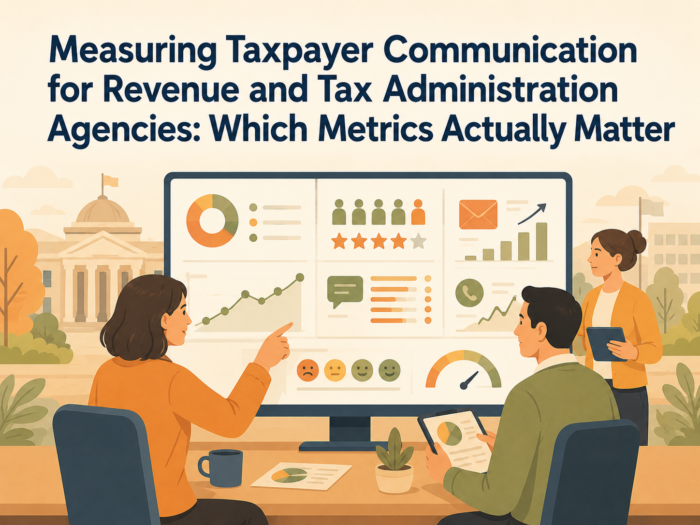
Measuring Taxpayer Communication for Revenue and Tax Administration Agencies: Which Metrics Actually Matter
A department of revenue can invest significant resources in redesigning its notices, rebuilding its website around taxpayer tasks, training its call center staff, and developing multilingual outreach materials, and still have no reliable way of knowing whether any of that investment actually improved the taxpayer experience or the compliance outcomes it was intended to support. This is not a hypothetical risk. It is the common condition of tax administration communication programs across the country, where substantial communication investment proceeds without a correspondingly substantial measurement discipline to evaluate whether that investment is producing its intended effect.
The absence of meaningful measurement is rarely a matter of agencies not caring whether their communication works. It more often reflects the genuine difficulty of identifying which metrics actually capture communication effectiveness, as distinct from metrics that are simply easy to collect but only loosely connected to the outcomes that matter. An agency that tracks website page views, social media followers, or the number of notices mailed has data, but that data does not directly answer the question of whether taxpayers understood what they read, took the correct action, or experienced less confusion than they would have under a less carefully designed communication approach.
This article examines how revenue and tax administration agencies can build a measurement framework that captures genuine communication effectiveness, distinguishing between metrics that primarily measure activity and metrics that measure outcomes connected to the actual purposes that taxpayer communication is meant to serve. It addresses specific measurement approaches across notice response rates, portal and digital engagement, call center patterns, exemption and credit uptake, and structured feedback from taxpayers and partners, and it offers a framework for prioritizing which metrics deserve sustained organizational attention given that no agency can or should attempt to measure everything with equal intensity.
The Difference Between Activity Metrics and Outcome Metrics
 The most fundamental distinction in communication measurement is between activity metrics, which capture how much communication occurred or how many people were exposed to it, and outcome metrics, which capture whether that communication actually produced the change in understanding or behavior it was intended to produce. Activity metrics are almost always easier to collect, since they typically come directly from the systems an agency already operates, such as mail volume from a print vendor, page view counts from website analytics, or call volume from a phone system. Outcome metrics require more deliberate measurement design, since they typically require connecting communication activity to a subsequent behavior or result that may not be automatically captured by the same system that produced the communication.
This does not mean activity metrics are worthless. They serve an important operational function, helping an agency understand its own communication footprint, identify capacity constraints, and track basic trends over time. But an agency that relies primarily or exclusively on activity metrics to evaluate its communication strategy risks mistaking volume for effectiveness, concluding that a communication program is succeeding because a large number of notices were sent or a large number of website visits occurred, without any direct evidence that the people who received those notices or visited that website actually understood what they encountered or took the correct subsequent action.
A useful discipline for any agency building a measurement framework is to ask, for each metric under consideration, what specific question about communication effectiveness this metric actually answers, and whether that question is the one the agency most needs answered. A metric like total notices mailed answers the question how much did we send, which is operationally useful but does not answer the more consequential question of whether the people who received those notices understood and acted on them correctly. Reframing the measurement conversation around this distinction helps an agency avoid accumulating large dashboards of activity data that create an impression of rigorous measurement without actually illuminating whether communication investments are working.
Clearer Taxpayer Communication: Strategies for State and Local Assessors, Treasurers, Revenue Departments, and Finance Offices
This article is part of our series on strategic communication for State and Local Assessors, Treasurers, Revenue Departments, and Finance Offices. Clear, timely, and accessible taxpayer communication helps government agencies improve compliance, reduce confusion, strengthen public trust, and enhance the citizen experience. To learn more and to see the parent article, which links to additional resources and best practices for taxpayer outreach and engagement, click the button below.
Notice Response Rates as a Communication Effectiveness Signal
Notice response rates, meaning the rate at which taxpayers who receive a specific notice take the action the notice requested within the requested timeframe, represent one of the most direct and most valuable outcome metrics available to a revenue agency, because a notice exists specifically to produce a taxpayer action, and the response rate is a direct measure of whether it succeeded in that purpose.
Tracking response rates by specific notice type, rather than only in aggregate across all notices, allows an agency to identify which specific notices are underperforming relative to others, providing a prioritized list of where communication redesign effort would have the highest impact. A notice type with a consistently low response rate relative to comparable notice types is signaling a specific communication problem, whether that is unclear language, a buried deadline, an unclear required action, or some other identifiable design flaw that a closer review of that specific notice’s content can help diagnose.
Response rate tracking should also be analyzed over time, particularly following any redesign or revision of a specific notice template, to provide a direct before-and-after comparison that demonstrates whether a communication intervention actually produced the intended improvement. An agency that redesigns a balance due notice using plain-language principles and then observes the response rate for that notice type increase in subsequent filing periods has direct evidence that the redesign investment produced a measurable result, which is valuable both for validating the specific redesign and for building an internal case for continued investment in similar plain-language redesign work across other notice types.
Response rate analysis is most useful when segmented by additional dimensions where data is available, such as the dollar amount involved, the taxpayer’s prior filing history, or the geographic region, since a notice that performs well for one segment of the taxpayer population but poorly for another is signaling a more specific problem, potentially related to language access, complexity calibration, or some other factor that an aggregate response rate alone would not reveal.
Distinguishing Non-Response From Disputed Response
A complete response rate analysis should distinguish between taxpayers who took no action at all following a notice and taxpayers who did respond but disputed the notice’s content, since these two outcomes signal different communication issues. A high rate of complete non-response may suggest that taxpayers did not understand the notice well enough to know that action was required at all, while a high rate of disputed response, where taxpayers contact the agency specifically to challenge the notice’s accuracy, may suggest that the notice’s substantive content, such as the calculation methodology or the basis for an assessment, was not communicated clearly enough for taxpayers to understand and accept the agency’s position even when they did engage with the notice. Each of these patterns points toward a different kind of communication improvement, making this distinction valuable for accurately diagnosing the specific nature of an underperforming notice.
Portal and Digital Engagement Metrics That Matter
Online taxpayer portal usage generates substantial data, and the challenge for most agencies is not a lack of available metrics but an overabundance of easily collected activity data that does not necessarily illuminate whether the portal is actually serving taxpayers effectively. Login counts, page views, and time spent on a page are all readily available from most portal analytics systems, but each requires careful interpretation to avoid drawing the wrong conclusion.
Task completion rate, meaning the percentage of taxpayers who begin a specific portal task, such as making a payment or submitting a document, and successfully complete that task without abandoning the process partway through, is one of the most valuable outcome metrics available for portal communication effectiveness, because it directly measures whether the portal’s guidance and interface successfully supported the taxpayer through to a successful outcome. A portal task with a high abandonment rate at a specific step in the process is signaling a likely communication or design problem at that specific point, providing a targeted location for improvement rather than requiring a guess about which part of a multi-step process is causing difficulty.
Time on task, interpreted carefully, can serve as a useful secondary indicator alongside completion rate, since a task that takes taxpayers significantly longer to complete than the agency’s internal estimate of how long it should reasonably take may indicate that taxpayers are encountering confusion or uncertainty during the process, even if they ultimately complete it successfully. This metric should be interpreted cautiously, however, since a longer time on task is not always a negative signal, particularly for complex tasks where careful, deliberate completion is preferable to rapid completion that might indicate insufficient attention to important details.
Search query analysis within the portal and the broader agency website, examining what terms taxpayers actually search for and whether those searches return useful, relevant results, provides direct insight into where the existing content and navigation are failing to anticipate how taxpayers actually think about and describe their needs. A consistently high-volume search query that does not return a clear, useful result is a direct signal of a content or navigation gap that the agency can address specifically, rather than relying on indirect inference about where taxpayers might be struggling.
Call-After-Portal-Use as a Failure Signal
One of the most useful but underutilized portal effectiveness metrics is the rate at which taxpayers who have recently used the online portal subsequently call the agency’s help line about a related issue within a short time window. A taxpayer who used the portal to attempt a specific task and then called shortly afterward to ask a related question, or to report that the task did not work as expected, is providing direct evidence that the portal’s self-service guidance was insufficient for their needs. Where an agency’s systems allow this kind of cross-channel correlation, even at a basic level such as tracking whether call volume related to a specific portal function spikes following a portal update, this metric provides a particularly direct signal that complements completion rate data with information specifically about where the portal experience failed to be self-sufficient.
Call Center Metrics That Reveal Communication Gaps Elsewhere
 Call center data, beyond its operational value for managing staffing and service levels, serves an important diagnostic function for the agency’s broader communication system, since call topics and volume patterns often reveal where other channels, including notices and website content, are failing to fully resolve taxpayer questions independently.
Call topic categorization, where representatives or an automated system tags each call with the general subject matter of the taxpayer’s question, allows an agency to identify which topics generate disproportionate call volume relative to the underlying population affected by that topic, providing a prioritized signal about where written communication may need improvement. A consistently high volume of calls asking a specific question that the agency’s website or notice language is intended to already answer indicates that the existing written communication on that topic is not succeeding in its purpose, regardless of how technically accurate that written communication might be.
First-call resolution rate, meaning the percentage of taxpayer inquiries that are fully resolved during the taxpayer’s first contact without requiring a callback, transfer, or follow-up contact, serves as a useful proxy for whether the call center’s own internal reference materials and representative training are supporting accurate, complete answers on the first attempt. A declining first-call resolution rate over time, or a rate that is significantly lower for specific topic categories, signals a need for improved internal reference materials or training in that specific area.
Repeat caller analysis, identifying taxpayers who call multiple times about what appears to be the same underlying issue, provides additional insight beyond first-call resolution rate alone, since a taxpayer who calls several times about the same matter, even if each individual call is technically resolved according to the representative’s notes, may be experiencing a more persistent communication or process gap that a single call’s resolution status does not fully capture.
Exemption and Credit Uptake as a Direct Equity Measurement
For communication programs specifically focused on increasing awareness and claiming of exemptions, refundable credits, or other taxpayer benefits, uptake rate, meaning the percentage of the estimated eligible population that actually claims the benefit, is the single most direct and most important outcome metric available, because the entire purpose of this category of communication is to close the gap between eligibility and actual claiming.
Calculating an accurate uptake rate requires the agency to develop a reasonable estimate of the eligible population, typically using income, demographic, or property characteristic data depending on the specific benefit involved, against which the actual number of claims can be compared. This estimation process is inherently imperfect, since the agency rarely has complete, independently verified data on exactly who is eligible for a given benefit, but even an approximate estimate provides significantly more diagnostic value than relying solely on the raw number of claims without any denominator to indicate what share of the eligible population that number actually represents.
Uptake rate analysis is most valuable when segmented geographically and demographically, where data allows, since this segmentation can reveal whether outreach efforts are reaching the full eligible population evenly or whether specific communities, geographic areas, or demographic groups continue to show persistently lower uptake despite general statewide or agency-wide outreach efforts. This kind of segmented analysis directly supports the kind of targeted, trusted-messenger outreach strategies that are most effective for closing persistent equity gaps in benefit claiming, by identifying specifically where that targeted effort is most needed.
Tracking uptake rate trends over multiple years, particularly in relation to specific outreach interventions such as a new trusted messenger partnership or a redesigned awareness campcampaign, allows an agency to build an evidence base connecting specific communication investments to measurable improvement in claiming rates, which both validates the specific intervention and supports a broader organizational case for continued investment in this category of outreach.
Structured Feedback From Taxpayers and Partners
Quantitative metrics derived from agency systems, while valuable, cannot fully capture the qualitative dimension of why taxpayers and partners experience communication the way they do, which is why structured feedback collection, directly soliciting input from the people who actually use the agency’s communication, provides an essential complement to the systems-derived metrics described above.
Taxpayer satisfaction surveys, deployed at specific points in the taxpayer journey such as immediately following a call center interaction or a portal transaction, can capture direct taxpayer perception of clarity, helpfulness, and overall experience that systems data alone does not reveal. These surveys are most useful when they include open-ended questions that allow taxpayers to describe specifically what was confusing or what they wish had been explained differently, rather than relying solely on a numeric satisfaction rating that indicates overall sentiment without explaining its underlying cause.
Usability testing, where the agency observes a small number of representative taxpayers attempting to complete a specific task, such as understanding a notice or navigating a website section, while talking through their thought process aloud, provides a depth of insight into specific points of confusion that quantitative metrics alone cannot replicate. Even a modest investment in periodic usability testing sessions, conducted with a handful of participants representative of the agency’s actual taxpayer population, can surface significant communication problems that internal review by agency staff, who are too familiar with the agency’s own systems and language to notice the same barriers, would not identify.
Partner feedback, collected systematically from the community organizations, tax professionals, and other intermediaries that the agency works with, provides a distinct and valuable perspective, since these partners observe firsthand how a broad range of taxpayers actually experience and respond to the agency’s communication, often surfacing patterns and concerns that do not reach the agency directly through its own channels. Establishing a regular, structured mechanism for collecting this partner feedback, rather than relying on partners to proactively reach out when they notice a problem, ensures that this valuable source of insight is captured consistently rather than only sporadically.
Avoiding Survey Fatigue and Low-Quality Feedback
Agencies that deploy feedback surveys too frequently, or that design surveys that are lengthy and burdensome relative to the value taxpayers perceive in completing them, risk both declining response rates over time and a self-selection bias where only taxpayers with unusually strong positive or negative reactions bother to respond, skewing the resulting data away from a representative picture of the broader population’s experience. Keeping surveys brief, targeted to a specific recent interaction rather than a general assessment of the agency overall, and clearly communicating how the feedback will be used, tends to produce both higher response rates and more representative, useful data than lengthy, infrequent, or vaguely purposed surveys.
Building a Coherent Measurement Framework Rather Than a Metrics Inventory
An agency that simply accumulates a long list of available metrics, tracking everything that can be easily measured without a clear prioritization or organizing framework, risks producing an overwhelming amount of data that does not actually inform decision-making any more effectively than having no measurement system at all. A coherent measurement framework requires connecting each tracked metric explicitly to a specific communication objective and a specific decision the metric is intended to inform, rather than tracking metrics simply because the underlying data happens to be available.
A practical approach to building this framework begins by identifying the agency’s most significant communication objectives, such as improving notice response rates for high-volume notice types, increasing exemption and credit uptake among underserved populations, reducing avoidable call volume related to specific recurring topics, and improving overall taxpayer satisfaction with digital self-service options. For each of these objectives, the agency should identify the specific metric or small set of metrics that most directly measures progress toward that objective, explicitly connecting the measurement effort to the underlying goal rather than treating metrics collection as a separate, disconnected activity.
This framework should also establish clear ownership and a regular review cadence for each tracked metric, ensuring that the data is not simply collected and archived but actively reviewed by the people responsible for the relevant communication function, with a clear process for translating a concerning trend identified through the metric into a specific action, such as a notice redesign initiative, additional call center training, or a targeted outreach campaign. Measurement that does not connect to action is, in practical terms, no more valuable than no measurement at all.
Setting Realistic Targets and Avoiding the Trap of Vanity Benchmarks
Agencies that establish measurement frameworks should resist the temptation to set targets based on what sounds impressive rather than what is realistically achievable and meaningfully connected to the underlying communication objective. A target of increasing a specific notice’s response rate by a substantial percentage within an unrealistically short timeframe, set primarily because it sounds like an ambitious and impressive goal, is less useful than a more modest, carefully calibrated target based on an honest assessment of what a specific, identified communication improvement could realistically be expected to achieve, informed by the agency’s own historical data and, where available, comparable experience from other similar agencies.
Strategic Communication Support for Revenue and Tax Administration Agencies
 Building a measurement framework that genuinely captures communication effectiveness, rather than simply accumulating easily available activity data, requires a level of analytical and organizational investment that many revenue and tax administration agencies have not yet made, often because the day-to-day demands of producing communication across multiple channels leave limited capacity for the separate work of evaluating whether that communication is actually achieving its intended effect.
A structured assessment of an agency’s communication measurement practice typically identifies a consistent set of gaps: heavy reliance on activity metrics such as mail volume and page views without corresponding outcome metrics like response rates or task completion rates, no segmented analysis that could reveal where specific populations or geographic areas are being underserved by current communication approaches, limited or no structured taxpayer and partner feedback collection, and no clear framework connecting tracked metrics to specific communication objectives and decision-making processes.
Stegmeier Consulting Group (SCG) helps revenue and tax administration agencies build measurement frameworks that connect communication investment to demonstrable outcomes. That support may include measurement framework design that prioritizes outcome metrics over activity metrics, notice response rate and segmentation analysis design, portal and digital engagement metric development, exemption and credit uptake measurement methodology, structured taxpayer and partner feedback program design, and governance structures that connect measurement findings to specific, actionable communication improvements.
The goal of this work is a measurement system that allows an agency to know, with reasonable confidence, whether its communication investments are actually working, where they are falling short, and which specific improvements would have the greatest impact on the outcomes that matter most: taxpayers who understand what is asked of them, who take the correct action without unnecessary friction or confusion, and who experience the agency’s communication as a source of clarity rather than a source of additional burden.
Future Trends in Communication Measurement
The practice of measuring tax administration communication effectiveness is evolving as agencies gain access to more sophisticated analytics tools and as the broader expectation for evidence-based public administration continues to grow across government generally.
Predictive analytics that can identify, before a notice is even sent, which taxpayers are statistically more likely to be confused by or to fail to respond appropriately to a specific notice type, based on patterns observed in prior similar cases, represent an emerging capability that could allow agencies to proactively intervene, such as by providing additional clarifying communication or directing higher-risk cases toward more personalized outreach, rather than waiting to observe a low response rate after the fact and respond reactively.
Natural language processing applied to call center transcripts and taxpayer feedback text, capable of automatically identifying recurring themes, sentiment patterns, and specific points of confusion across a large volume of unstructured text data, is making it increasingly feasible to extract systematic insight from qualitative data sources at a scale that manual review alone could not achieve, complementing the structured quantitative metrics described throughout this article with deeper insight into the specific nature of taxpayer confusion and frustration.
Cross-agency benchmarking, where revenue agencies in different states or jurisdictions share anonymized or aggregated measurement data to compare communication effectiveness across similar notice types, portal functions, or outreach strategies, is an emerging practice that could help individual agencies calibrate their own performance against a broader baseline, rather than evaluating their progress only against their own historical trend in isolation, which can sometimes mask the fact that even an improving trend may still represent significantly underperformance relative to what comparable agencies are achieving.
Finally, growing integration of communication measurement directly into the budget and resource allocation process, where evidence of communication effectiveness, or the lack thereof, directly informs decisions about where to invest future communication resources, represents a maturation of the measurement discipline from a separate evaluative activity into a core input for organizational decision-making, ensuring that the insight generated through measurement actually shapes how an agency prioritizes its ongoing communication investment rather than existing as a parallel reporting exercise disconnected from resource allocation decisions.
Conclusion
Measurement is the discipline that allows a revenue and tax administration agency to know whether its communication investments, in notice redesign, website restructuring, multilingual outreach, call center training, and every other category of taxpayer communication discussed throughout this body of work, are actually producing the outcomes they were intended to produce. Without that discipline, an agency is left to assume that well-intentioned, carefully designed communication is working, without the evidence to confirm that assumption or to identify specifically where further investment would have the greatest impact.
Agencies that build measurement frameworks centered on genuine outcome metrics, including notice response rates, portal task completion, call center resolution patterns, exemption and credit uptake, and structured taxpayer and partner feedback, rather than relying primarily on activity metrics that capture volume without capturing effectiveness, position themselves to continuously improve their communication system based on real evidence of what is working and what is not. That continuous improvement capability, sustained over time through clear ownership and a regular review cadence, is what ultimately determines whether an agency’s communication strategy remains effective as taxpayer needs, technology, and the broader communication landscape continue to evolve.
SCG’s Strategic Approach to Communication Systems
Align your agency’s messaging, processes, and public engagement strategies.
Revenue and tax administration agencies need measurement frameworks that capture genuine communication outcomes, not just activity volume. That means tracking notice response rates segmented by notice type and population, portal task completion and abandonment patterns, call center topic and resolution analysis that reveals gaps in other channels, exemption and credit uptake measured against the estimated eligible population, and structured taxpayer and partner feedback that captures the qualitative dimension quantitative data cannot reach. It means connecting every tracked metric to a specific communication objective and a clear process for turning findings into action.
SCG helps revenue and tax administration agencies build measurement frameworks that connect communication investment to demonstrable outcomes. Whether your agency needs measurement framework design, response rate and uptake analysis methodology, portal and call center metric development, structured feedback program design, or governance structures that link findings to action, SCG can help you build a system that tells you, with confidence, whether your communication is actually working.
Use the form below to connect with our team and explore how strategic communication measurement can help your agency identify what is working, prioritize future investment, and demonstrate the real impact of your communication strategy.