
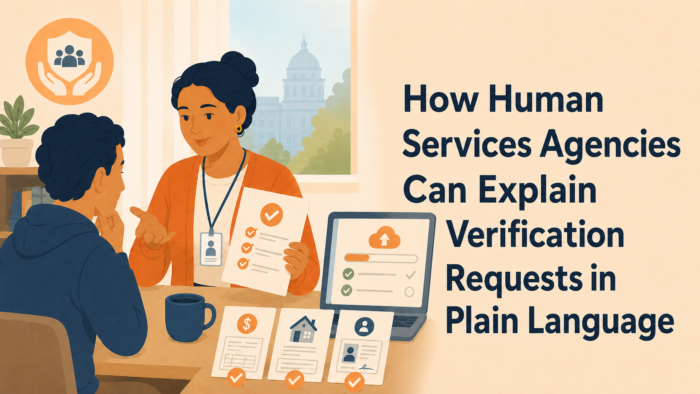
How Human Services Agencies Can Explain Verification Requests in Plain Language
Verification requests are some of the most important messages residents receive from human services agencies. They are also some of the easiest messages to misunderstand. A resident may be asked to provide proof of income, proof of identity, proof of address, proof of household composition, proof of employment, proof of child care need, proof of expenses, or another document connected to SNAP, Medicaid, cash assistance, child care assistance, housing-related support, or another public benefit. Inside the agency, these requests may follow clear eligibility rules and case-processing requirements. For the resident, the request may arrive as a confusing notice that does not clearly explain what is needed, why it is needed, how to provide it, or what happens if the information is not received on time.
This communication gap matters because verification requests often sit between eligibility and access. A resident may qualify for assistance but still experience delay, denial, closure, or benefit interruption if the required information is not provided correctly. In some cases, the resident may try to comply but send the wrong document, miss a deadline, upload an unreadable file, misunderstand which household member the request applies to, or assume the agency already has the information from another program. The agency may view the case as incomplete. The resident may view the process as confusing, repetitive, or impossible to navigate. Both experiences can be true at the same time.
For human services agencies, public benefits agencies, county social services departments, and state benefits offices, plain-language verification communication is not just a courtesy. It is a practical strategy for reducing avoidable churn, incomplete submissions, duplicate paperwork, repeat calls, preventable closures, and resident frustration. When verification requests are written in clear, specific, action-oriented language, residents are more likely to understand what to send, where to send it, and how quickly they need to act. Staff are also better positioned to answer questions consistently because the notice itself provides a stronger foundation.
A clear verification request does not remove program rules or weaken eligibility requirements. Agencies still need to confirm information, document decisions, protect program integrity, and follow federal and state requirements. The goal is not to make verification optional or informal. The goal is to make the request understandable enough that residents can respond correctly. This distinction is important because many verification problems are not caused by residents refusing to cooperate. They are caused by residents not understanding exactly what the agency is asking for or how to complete the request in a usable way.
Plain-language verification communication should explain the request from the resident’s point of view. It should identify the specific information needed, name the person or household member it applies to, provide examples of acceptable documents, state the deadline clearly, explain how to submit the information, and describe what happens next. It should also clarify when one document may support more than one program and when separate documents are still required. Without that level of clarity, verification requests can become one of the most common points where eligible residents get stuck.
Why Verification Requests Are So Often Misunderstood
 Verification requests are often misunderstood because they are written from the agency’s workflow rather than the resident’s decision point. A notice may say that income verification is needed, household information is incomplete, employment must be confirmed, or proof of residency is required. Those phrases may be technically accurate, but they do not always tell the resident what to do. A person may not know which document counts, whether a photo is acceptable, whether the agency needs information for one person or the full household, whether old documents can be used, or whether the request applies to one benefit or several benefits at once.
The confusion increases when verification language is vague or generic. A notice that says “send proof of income” may seem clear to staff, but residents may wonder whether the agency wants pay stubs, an employer letter, tax records, unemployment information, self-employment records, child support documentation, or a written explanation. A notice that says “provide proof of address” may leave residents unsure whether a lease, utility bill, shelter letter, school record, or mail from another agency will work. When residents are unsure, they may delay, call repeatedly, send too many documents, or submit something that does not resolve the case.
Verification requests can also be confusing because residents may not understand why the agency is asking for information again. A household may believe it already submitted income details during application, renewal, a prior change report, or another program review. If the notice does not explain why the information is needed now, the request may feel duplicative or arbitrary. This is especially common in cross-program settings where SNAP, Medicaid, cash assistance, and child care assistance may ask for similar information but use it differently. Without plain-language context, residents may assume the agency lost the information, ignored a prior submission, or is asking for the same thing unnecessarily.
The strongest verification communication acknowledges this reality. It does not simply state that information is missing. It explains what is needed to complete the case action. It helps residents understand that verification is part of confirming eligibility or continuing benefits, not a random paperwork demand. When the request is specific and practical, residents can focus on completing the step instead of trying to interpret the agency’s intent.
Plain Language Starts With the Specific Item Needed
A verification request should never make residents guess what the agency wants. The clearest requests name the specific item needed in language residents can recognize. Instead of relying only on broad categories such as “income verification,” the notice should explain the acceptable proof in practical terms. It can identify recent pay stubs, an employer statement, a benefit award letter, child support records, self-employment records, or other documents that apply to the resident’s situation. The goal is to move from a category to an action.
Specificity is especially important when the request applies to one person in the household. A resident may not know whether the agency needs income proof for a parent, spouse, adult child, roommate, caregiver, or another household member. If the notice does not identify the person clearly, the resident may submit incomplete information or provide documents for the wrong person. A better request explains both the item and the person it applies to. This reduces avoidable back-and-forth and helps residents provide the correct information the first time.
Plain language also means explaining what does not work when that helps prevent common errors. If screenshots are not accepted, if documents must show a date, if a pay stub must be recent, if a document must include the resident’s name, or if handwritten notes require additional information, the notice should say so clearly. Residents should not have to learn these rules only after submitting something that is rejected. A usable verification request anticipates the most common mistakes and prevents them before they occur.
This approach benefits staff as well. When the notice is specific, call center representatives, eligibility workers, reception staff, navigators, and community partners can reinforce the same request. Instead of interpreting a vague phrase differently, everyone can point to the same item, same deadline, and same submission options. The notice becomes an operational tool, not just a compliance document.
More Than Just Applications: Human Services and Public Benefits Communication Strategies for State and Local Agencies
This article is part of our series on strategic communication for Human Services Agencies, Public Benefits Agencies, and Health and Human Services departments. To learn more and to see the parent article, which links to other content just like this, click the button below.
Verification Requests Should Explain Why the Information Matters
Residents are more likely to respond correctly when they understand why the agency is asking for information. A verification request does not need to include a long legal explanation, but it should provide enough context to make the request feel understandable. For example, the notice can explain that the agency needs proof of income to decide whether benefits can continue, proof of address to send notices correctly, proof of child care need to confirm authorization, or proof of household members to calculate benefits accurately. This context helps residents see the connection between the document and the benefit outcome.
Explaining the reason for the request can also reduce distrust. When residents receive a vague demand for documents, they may worry that the agency is looking for a reason to deny benefits or that the process is intentionally difficult. When the request explains the practical purpose, the agency communicates that the information is needed to complete a defined step. That does not eliminate the burden of gathering documents, but it makes the request easier to understand and less likely to be perceived as arbitrary.
This is especially important when residents are asked for information they believe the agency already has. The notice can acknowledge that the agency may have received information before, but still needs a current or specific document to complete the present review. It can explain when information must be updated, when a prior document is too old, or when a different program requires a separate review. These explanations do not need to be lengthy. They need to be clear enough that residents understand the difference between duplication and a legitimate verification need.
Human services agencies should be careful not to let the explanation overwhelm the action. The first message should still make the required item and deadline visible. The reason should support action, not bury it. A good sequence is simple: what is needed, why it is needed, when it is due, how to send it, and where to get help.
The Request Should Make the Deadline and Consequence Clear
Verification requests often fail when the deadline is present but not prominent. A notice may include several dates, such as the notice date, response deadline, benefit end date, hearing deadline, appointment date, renewal date, or document processing date. Residents may not know which date controls the action they need to take. If the verification deadline is buried in a paragraph or surrounded by other dates with equal emphasis, the resident may miss the most important timing requirement.
A plain-language verification request should state the deadline in a visible and direct way. It should say when the information must be received and what may happen if it is not received. The consequence should be clear without sounding unnecessarily punitive. For example, the notice can explain that benefits may be delayed, reduced, denied, or stopped if the agency does not receive the requested information by the deadline. The resident should understand both the urgency and the path to avoid the negative outcome.
The request should also clarify whether the deadline means postmarked, uploaded, received, submitted, or completed by that date. This distinction matters. A resident who mails a document on the deadline may believe they complied, while the agency may require receipt by that date. A resident who uploads a file may not know whether the submission counts if the file is unreadable or incomplete. Plain language should reduce these uncertainties before they create case problems.
Clear deadline language supports equity and access as well. Residents may need time to gather documents from employers, landlords, schools, providers, banks, or other agencies. They may need transportation to an office, help from a community partner, access to a scanner, language assistance, or disability-related support. When the deadline is visible and the consequence is understandable, residents have a better chance to act early enough to avoid a crisis.
Use Resident-Friendly Examples, Not Abstract Document Categories
Verification requests become much easier to follow when agencies move from broad document categories to concrete examples residents can recognize. A notice that asks for “proof of income” may be accurate, but it still leaves too much interpretation to the resident. A stronger request explains that proof of income may include recent pay stubs, an employer statement, unemployment benefit information, child support records, self-employment records, Social Security benefit information, or another document that shows current income. The examples should be tied to the actual case whenever possible, so residents are not left scanning a long list and guessing which option applies to them.
This kind of specificity is especially important because many residents are trying to complete verification under time pressure. They may be using a phone camera, asking an employer for a letter, looking through old mail, visiting a library, or working with a community partner to upload documents. Abstract categories slow that process down. Concrete examples help residents identify a document they may already have or understand what they need to request from someone else. The goal is not to list every possible document. The goal is to give enough practical guidance that residents can take the next step without calling the agency only to understand what the phrase means.
Explain What a Good Document Should Show
Even when residents know which type of document to send, they may not know what the document needs to show. A pay stub may be submitted without a date. A lease may not include the resident’s name. A screenshot may cut off the employer name. A letter may not include contact information. A bank statement may show a deposit but not explain the source. If the notice only names the document type, residents may submit something that looks correct to them but cannot be used by the agency.
Plain-language verification requests should explain the basic features of an acceptable document. The notice can say that the document should show the resident’s name, the relevant date, the source of the information, and the amount or detail being verified. When requirements vary by document type, the notice can give a short example. This helps residents understand what makes the document usable and reduces the frustration of having something rejected after they believed they complied.
Clarify Whether Copies, Photos, or Screenshots Are Accepted
Many residents now complete benefits tasks through phones, online portals, email, text-enabled systems, or document upload tools. A verification request should make clear whether the agency accepts copies, photos, screenshots, scanned documents, mailed copies, or original documents. Without that guidance, residents may delay because they do not know whether a phone photo is enough, or they may send an original document that they should have kept.
This detail matters because document submission is often where confusion turns into case delay. If a photo is acceptable, the notice should explain that the image must be readable and show the full document. If screenshots are accepted only in certain situations, that should be stated plainly. If originals should not be mailed, the notice should say so. Clear submission guidance helps residents respond more confidently and helps agencies reduce unusable documents.
Verification Requests Should Identify Who the Information Is For
Many public benefits households include more than one person, and verification requests can become confusing when the notice does not clearly identify whose information is needed. A household may include adults, children, spouses, partners, roommates, caregivers, relatives, or people who are part of one program but not another. If a notice says that income proof, identity proof, or residency proof is needed without naming the relevant person, the resident may send information for the wrong household member or assume the request applies to everyone. That can lead to incomplete verification even when the resident made a serious effort to comply.
A clearer request identifies the person connected to the verification need. It may say that income proof is needed for a specific adult, school attendance is needed for a specific child, employment information is needed for a parent, or provider information is needed for a child care case. When privacy or system limitations prevent detailed naming, the agency can still provide enough context to help the resident understand the target of the request. This is especially important when several benefits are active at once, because one household member’s information may affect SNAP, another person’s information may affect Medicaid, and a child care request may depend on work or school details for a parent.
Plain Language Should Explain What Happens After Submission
 Residents often think the verification process ends when they send the document. From the agency’s perspective, submission may only begin the next step. Staff may still need to review the document, confirm that it is acceptable, compare it with case information, request clarification, or make an eligibility decision. If the notice does not explain this, residents may assume that uploading or mailing a document means the case is complete. Later follow-up notices may then feel contradictory or unfair.
A plain-language verification request should briefly explain what happens after the resident responds. It can state that the agency will review the information, contact the resident if more information is needed, and send a notice when a decision is made. It should also explain whether residents should keep proof of submission and how they can check status when that option is available. This does not require a long process description. It simply gives residents a more realistic expectation of what submission does and does not mean.
The Request Should Help Residents Avoid Common Mistakes
Verification requests should be designed with the most common resident errors in mind. If residents often submit outdated pay stubs, unreadable photos, documents without names, incomplete forms, partial screenshots, or information for the wrong household member, the notice should address those patterns directly. Agencies do not need to make notices negative or overly long, but they should use what they know from call center questions, rejected documents, lobby visits, partner feedback, and case-processing delays to prevent repeat problems.
This approach treats verification communication as a practical improvement tool. Instead of waiting for residents to make predictable mistakes, the agency builds clearer instructions into the request. A short line such as “Make sure the document shows the name, date, and amount” can prevent a large number of unusable submissions. A reminder that “documents must be current” can reduce outdated proof. A note that “we need this information for Maria, not for everyone in the household” can prevent mismatched documents. Small clarifications can have a large operational effect when they are placed where residents need them.
Staff and Partner Language Should Match the Verification Request
A verification request becomes more effective when everyone who supports the resident uses the same explanation. Call center staff, eligibility workers, reception teams, navigators, legal aid organizations, clinics, schools, libraries, food banks, child care resource organizations, and other community partners may all help residents understand what to submit. If each helper translates the request differently, residents may receive inconsistent guidance even when the agency’s intent is clear.
Human services agencies can reduce that risk by creating short staff and partner guidance that mirrors the notice. The guidance should use the same plain-language terms, document examples, deadlines, submission instructions, and status explanations that residents see in the request. This helps staff answer questions consistently and helps community partners reinforce the correct action without becoming eligibility specialists. When the notice, staff script, portal language, and partner guidance all match, residents are less likely to submit the wrong information or keep seeking confirmation from multiple places.
Verification Requests Should Distinguish Between Missing, Unclear, and Unusable Information
Human services agencies can reduce confusion by being specific about the reason information is still needed. A resident may believe they already responded because they uploaded a document, mailed a copy, completed a form, or provided information during an interview. If the next notice simply says that verification is still needed, the resident may not understand whether the agency never received the document, received it but could not use it, received it but needs a different item, or received it but needs clarification. These distinctions matter because each situation requires a different resident response. A missing document may need to be sent. An unclear document may need to be resubmitted in a readable form. An unusable document may need to be replaced with a different proof. A document under review may not require any action at all.
Plain-language verification communication should make these differences visible. Instead of using one general phrase for every problem, agencies can explain the status in practical terms. “We have not received proof of income” means something different from “We received your pay stub, but it does not show the pay date” or “We received your document, but the image is too blurry to read.” This level of clarity helps residents fix the problem faster and reduces the frustration that comes from feeling as though the agency is repeatedly asking for the same thing. It also supports staff because residents are more likely to call with a specific issue rather than asking what the notice means.
Cross-Program Verification Needs Extra Clarity
Verification can become especially confusing when a resident receives support through more than one program. SNAP, Medicaid, cash assistance, child care assistance, and related public benefits may all use household, income, residency, employment, identity, or expense information in different ways. A resident may not know whether one document can support multiple benefits or whether separate program rules require separate proof. If the notice does not explain the relationship among programs, the resident may assume that submitting information for one benefit completes every requirement, or they may submit the same information several times because they are afraid one program did not receive it.
A stronger verification request explains which program or programs need the information. If the same proof of income may support more than one review, the notice can say that plainly. If a child care assistance case needs a work schedule while SNAP needs income proof, the notice should separate those requirements. If Medicaid is still being reviewed but no action is needed right now, while cash assistance requires a document by a specific deadline, that distinction should be visible. Residents should not have to infer program boundaries from separate notices written in different styles. Cross-program clarity helps residents understand what one action covers and what still remains.
Submission Instructions Should Match the Real Process
A verification request is only useful if residents can understand how to provide the information in a way the agency can actually use. Many notices list several submission options, but do not explain the practical differences among them. A resident may be told they can upload, mail, fax, call, or visit an office, but still not know which option is fastest, which documents can be submitted through each channel, whether originals should be avoided, whether a phone photo is acceptable, or how to confirm that the agency received the information. When submission instructions are too general, residents may choose a channel that does not fit the request or may delay because they are unsure how to proceed.
Human services agencies should align submission instructions with real resident behavior and agency processing requirements. If the portal is the preferred method, the notice should guide residents to the correct task, not just the general website. If mail is allowed, the notice should clarify whether copies are acceptable and whether the deadline is based on receipt. If office drop-off is available, residents should know what to bring and whether they will receive confirmation. If phone completion is possible for some information but not documents, that should be clear. Practical submission guidance helps residents complete the verification step correctly and reduces avoidable follow-up work for staff.
Verification Communication Should Include a Clear Help Path
Residents often need help understanding verification requests, especially when they must gather documents from an employer, landlord, school, child care provider, bank, medical provider, or another agency. A notice that says “contact us if you have questions” may not be enough. Residents need to know what kind of help is available, how to request language assistance, how to ask for disability-related support, whether someone else can help them with the process, and what to do if they cannot get the requested document before the deadline. Without this guidance, residents may wait too long to seek help or assume they have no options if the exact document is difficult to obtain.
A clear help path should appear before the resident reaches a crisis point. The notice can explain how to call, visit, use an online account, ask for interpretation, request accommodations, or work with an authorized representative when allowed. It can also explain that residents should contact the agency before the deadline if they cannot get the requested proof. This does not guarantee that every problem can be resolved in the resident’s preferred way, but it tells residents that the correct response is to communicate early rather than abandon the process. Help language should be practical, visible, and connected directly to the verification request.
Plain-Language Verification Protects Program Integrity
Plain-language verification should not be framed as a weaker version of eligibility enforcement. It is one of the ways agencies support accurate eligibility decisions. When residents understand what information is needed, they are more likely to provide the right documents, provide them on time, and submit information that staff can review. Clear requests can reduce incomplete submissions, wrong-document uploads, repeated contacts, and unnecessary delays. That improves the quality of the case record and helps eligibility staff make decisions based on usable information.
For public benefits agencies, this connection matters. Program integrity depends not only on rules, but also on whether residents can understand the process well enough to comply with those rules. A vague or confusing verification request can produce nonresponse, but nonresponse does not always mean unwillingness. It may mean the resident did not understand the request, did not know what counted as proof, or did not know how to get help. Plain-language communication gives residents a fairer opportunity to respond correctly while still allowing agencies to apply eligibility requirements consistently.
Verification Requests Should Be Tested With the People Who Explain Them
A verification request may seem clear to policy staff, eligibility workers, attorneys, system administrators, or communications teams because they already understand the rule behind the request. Residents do not read from that same position. They may not know which document counts, which person the request applies to, whether the agency is asking for new information or information already submitted, or whether one proof can support more than one program. This is why human services agencies should test verification requests with the people most likely to explain them after they are sent. Call center staff, lobby staff, eligibility workers, supervisors, navigators, community partners, and residents with lived experience can often identify confusion that internal template review misses.
Testing should focus on practical comprehension, not just preference. Reviewers should be able to identify the specific item requested, the person it applies to, the program affected, the deadline, the submission options, and the consequence of nonresponse. They should also be able to explain the request in their own words without needing internal policy knowledge. If reviewers cannot quickly tell what the resident needs to do, the request is not yet ready for broad use. This kind of testing helps agencies catch unclear wording before it becomes repeat calls, unusable documents, missed deadlines, or preventable case closures.
Agencies Should Use Resident Questions to Improve Verification Language
Resident questions are one of the best sources of information about where verification requests are unclear. If many residents call to ask what proof of income means, the examples may not be specific enough. If residents repeatedly submit unreadable photos, the upload instructions may need to explain image quality more clearly. If residents send documents for the wrong household member, the notice may not identify whose information is needed. If residents ask why the agency is requesting information again, the notice may need better context about current review requirements, cross-program differences, or document age.
These patterns should be treated as communication signals, not only as workload problems. Call center trends, lobby questions, document rejection reasons, partner feedback, returned mail, portal abandonment, and procedural closure data can all show where residents are struggling to understand the request. Agencies can use those signals to refine notice language, strengthen document examples, clarify deadlines, update staff scripts, and improve portal instructions. Over time, the verification request becomes more accurate because it reflects how residents actually interpret and complete the process.
Digital Verification Tools Need the Same Plain-Language Structure
Online portals, document upload tools, mobile apps, text reminders, and automated case alerts can make verification easier, but only if they use the same plain-language structure as the notice. If the mailed request asks for “proof of income,” the portal should not use a different label that residents do not recognize. If the notice says a document is needed for a specific person, the upload tool should help residents connect the file to that person. If the reminder says information is still missing, it should identify the same item named in the original request. When digital tools use different terminology, residents may believe they are being asked for a separate action.
Digital verification communication should also confirm what happened after submission. Residents need to know whether a file was received, whether it is still being reviewed, whether it was accepted, or whether it could not be used. A simple upload confirmation is helpful, but it should not imply that the verification requirement is fully resolved if staff still need to review the document. Clear digital status language can reduce duplicate uploads, repeat calls, and frustration. It helps residents understand that submission, review, acceptance, and final eligibility action are different steps in the process.
Verification Communication Should Account for Access Barriers
Verification requests often assume that residents can quickly gather documents, make copies, scan files, access a portal, call during business hours, or travel to an office. Many residents cannot do all of those things easily. A person may need to request a letter from an employer, retrieve documents from a landlord, use a library computer, rely on a phone camera, coordinate transportation, ask for language assistance, or work around caregiving and job schedules. A verification request that does not account for these realities can unintentionally turn a documentation requirement into an access barrier.
A stronger request helps residents understand what options are available before the deadline becomes a crisis. It should explain acceptable document formats, available submission channels, language assistance, disability-related help, authorized representative options when applicable, and what to do if the resident cannot obtain the requested proof in time. This does not mean the agency can waive every requirement or accept every substitute. It means residents should understand how to communicate early, what alternatives may be considered, and where to seek help. Plain-language access information gives residents a better chance to comply and gives staff a clearer basis for guiding them.
Better Verification Requests Reduce Churn and Rework
Confusing verification requests create work across the entire public benefits system. Residents call because they do not understand what is needed. Staff explain basic instructions that the notice should have made clear. Documents arrive incomplete, outdated, blurry, or attached to the wrong case. Community partners spend time interpreting unclear requests. Cases stall or close because the required information was not provided in a usable form. Then residents may reapply, appeal, resubmit, or return later with urgent needs. What began as a communication problem becomes an operational problem.
Clear verification requests help reduce that burden. When residents know exactly what to send, who the document is for, when it is due, how to submit it, and what happens next, they are more likely to provide usable information the first time. Staff can focus more attention on complex eligibility questions instead of repeatedly translating vague requests. Partners can reinforce the agency’s instructions accurately. Agencies can protect program integrity while reducing avoidable churn, rework, and resident hardship. In that sense, plain-language verification is not only better communication. It is a practical improvement to the eligibility process itself.
Strategic Communication Support for Human Services and Public Benefits Agencies
 Verification requests are not minor administrative messages. They are decision points that can determine whether residents are able to complete an application, maintain eligibility, respond to a renewal, or prevent an avoidable interruption in benefits. For human services agencies, public benefits agencies, county social services departments, and state benefits offices, verification communication sits at the intersection of program integrity, resident access, eligibility workflow, legal requirements, technology systems, staff capacity, and public trust. When verification requests are vague, residents may submit the wrong document, miss a deadline, call repeatedly, upload unusable files, or lose benefits for procedural reasons even when they are trying to comply.
Because verification requests are connected to so many parts of the benefits experience, many agencies benefit from outside communication support when improving them. Internal teams often understand the policy and processing requirements, but that familiarity can make it harder to see where residents may become confused. An external partner can help review requests from the resident’s point of view, identify where language is too technical, clarify document examples, align staff scripts, improve portal language, and strengthen the full communication path from request to submission to status confirmation.
Stegmeier Consulting Group (SCG) helps human services and public benefits agencies create communication systems that make complex requirements easier for residents to understand and complete. That support may include verification notice audits, plain-language request templates, document example frameworks, staff and partner talking points, resident journey mapping, reminder message development, source-of-truth page guidance, and alignment across notices, portals, call centers, text messages, websites, and community partner materials. The goal is not to make verification less rigorous. The goal is to make it clear enough that residents can respond correctly and agencies can make decisions based on usable information.
This support is especially valuable when agencies are trying to reduce procedural benefit loss, improve renewal completion, lower duplicate submissions, reduce call volume, or strengthen equity in access to public benefits. A clear verification request gives residents a fairer opportunity to comply. It also gives staff and partners a stronger foundation for helping residents complete the process accurately.
Future Trends in Verification Communication
Human services agencies are likely to place greater emphasis on plain-language verification as resident communication becomes more connected across portals, mailed notices, text reminders, call centers, and community partner networks. Agencies will increasingly need to ensure that the same document request is explained consistently across every channel residents use. A request that appears clear in a mailed notice can still fail if the portal uses different terminology, the reminder message is too vague, or staff scripts do not match the written request.
Another likely trend is more case-specific verification guidance. Residents are better able to respond when the request names the person, program, document, deadline, and submission method that apply to their situation. Generic document lists may remain necessary in some settings, but agencies will benefit from making verification requests more targeted wherever systems allow. The more specific the request, the less likely residents are to guess, over-submit, or provide unusable information.
Agencies may also use operational data more intentionally to improve verification language. Rejected documents, repeat calls, duplicate uploads, missed deadlines, portal drop-off points, and partner questions can all show where residents are struggling. These signals can help agencies refine document examples, clarify acceptable proof, improve upload instructions, and adjust reminder timing. Verification communication will increasingly become part of continuous improvement rather than a static template.
Conclusion
Verification requests should help residents complete the eligibility process, not leave them guessing about what the agency needs. When requests rely on broad categories, technical terms, unclear deadlines, or incomplete submission instructions, residents may struggle to provide usable information even when they are trying to comply. That confusion creates avoidable harm for residents and additional work for agencies, staff, and community partners.
Plain-language verification communication gives residents clear information about the specific item needed, the person it applies to, the program affected, the deadline, acceptable document examples, submission options, and next steps after submission. It also explains why the information matters and what residents should do when they cannot obtain the requested proof in time. This type of communication supports access while preserving the agency’s ability to apply eligibility rules consistently.
In the end, stronger verification requests protect both residents and agencies. They reduce unnecessary churn, improve the quality of submitted information, support program integrity, and make public benefits processes easier to navigate. A verification request should not function as a vague demand for paperwork. It should function as a clear action guide that helps residents provide the right information at the right time.
SCG’s Strategic Approach to Communication Systems
Align your agency’s messaging, processes, and public engagement strategies.
Human services and public benefits agencies need communication systems that help residents understand what information is needed, why it matters, how to submit it, and what happens next. Whether your agency is improving verification requests, reducing incomplete submissions, aligning portal language, strengthening staff scripts, or creating clearer guidance for community partners, SCG can help you build a communication framework that supports clarity, access, consistency, and trust. Use the form below to connect with our team and explore how a strategic communication system can strengthen verification communication and reduce avoidable benefit interruptions.