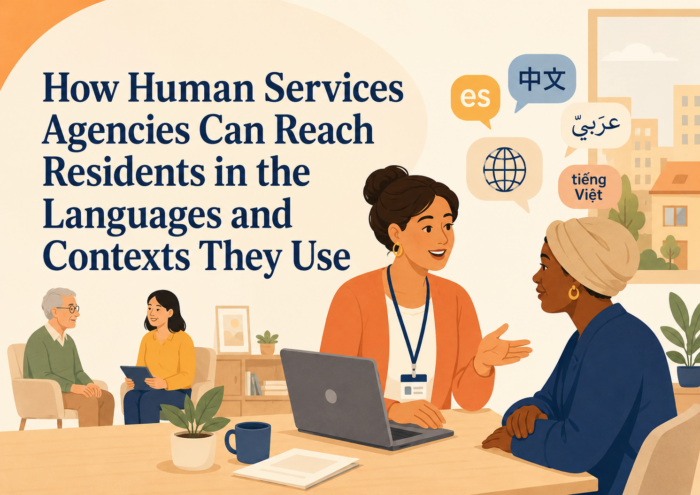
Language Access Beyond Translation: How Human Services Agencies Can Reach Residents in the Languages and Contexts They Use
Language access in human services is often discussed as though the central task is translation. Translation matters, and it is essential. Residents need notices, forms, web pages, scripts, and instructions in languages they can understand. But translation alone does not guarantee comprehension, trust, or action. A perfectly translated notice can still be hard to follow if the original message is dense, procedural, poorly sequenced, or disconnected from how residents actually talk about benefits, deadlines, documents, and household needs.
For human services agencies, public benefits agencies, county social services departments, and state benefits offices, this distinction is important. Residents navigating SNAP, Medicaid, cash assistance, child care assistance, housing-related support, energy assistance, EBT issues, renewals, verification requests, interviews, and case status questions may need more than words converted from one language to another. They may need communication that accounts for literacy, cultural context, trusted messengers, preferred channels, community terminology, family support patterns, digital access, and the practical circumstances under which people receive and act on information.
A resident may understand every translated word in a notice and still not understand whether action is required. They may know how to read the language but not recognize a formal program term. They may speak one language at home but prefer official documents in another. They may rely on an adult child, community organization, clinic, school, legal aid provider, or faith-based partner to help interpret complex instructions. They may receive a text alert in English, a mailed notice in another language, and verbal guidance from a partner in a third. If those messages are not coordinated, the resident is left to reconcile the differences on their own.
Language access beyond translation begins with a broader question: can residents understand the agency’s message well enough to take the right next step? That question pushes agencies to look beyond translated documents and examine the full communication environment. It includes how language preferences are captured, how notices are written before translation, how interpreters are supported, how staff explain complex rules, how websites and portals handle multilingual content, how community partners reinforce official guidance, and how residents verify current information when messages circulate through informal networks.
This is also a trust issue. Residents who do not receive information in a usable form may experience the agency as inaccessible or indifferent, even when translation resources technically exist. A resident who cannot understand a renewal notice may lose benefits for procedural reasons. A parent who cannot interpret a child care document request may miss a deadline. A household that cannot understand an EBT theft alert may fail to secure its card or report unauthorized activity. In each case, language access affects whether the resident can participate meaningfully in the process.
The strongest language access strategies treat translation as one part of a larger resident communication system. They begin with plain source language, consistent terminology, accessible formats, visible help pathways, trained staff, aligned partner materials, and feedback from the communities the agency serves. Translation is not the final step after a message has already been built. It is part of a communication design process that should make benefits easier to understand across languages, channels, and real-life contexts.
Translation Is Necessary, but It Is Not the Whole Strategy
 Translation is a foundational part of language access. Residents should not be expected to navigate public benefits rules, notices, deadlines, appeals, verification requests, and renewal requirements in a language they cannot understand. Human services agencies need translated materials, interpreter services, multilingual web content, and clear processes for residents to request language assistance. These supports are central to meaningful access and should be planned, resourced, and maintained with seriousness.
At the same time, translation can only carry the quality of the original message so far. If the English version of a notice is confusing, the translated version may also be confusing. If the original message buries the deadline, uses inconsistent terms, or fails to explain the resident’s next step, translation may reproduce those problems in another language. A translated packet can still feel overwhelming if the structure does not support action. A translated portal page can still fail if the button labels do not match the notice. A translated text alert can still create confusion if it does not identify the specific task.
This means language access work should begin before translation. Agencies should first make the source message clearer, more structured, and more action-oriented. The message should lead with what residents need to know, explain what action is required, clarify the deadline, identify where to get help, and use terms that can be translated consistently. When source content is plain and well organized, translation becomes more effective because the message itself is built to support understanding.
The broader strategy also recognizes that residents do not always interact with agency communication in a linear way. They may read part of a notice, call the agency, ask a community partner for help, check a website, show a text to a family member, or bring paperwork to an office. Language access must work across those touchpoints. If the translated notice uses one term, the interpreter uses another, the website uses a third, and the front desk script uses a fourth, residents may lose confidence in the guidance. Translation matters most when it is connected to a consistent communication system.
Plain Source Language Makes Every Translation Stronger
Plain source language is one of the most important language access tools agencies have. Before a notice, web page, text alert, or script is translated, the agency should ask whether the source message is clear enough to translate well. Dense language, long sentences, internal acronyms, unexplained legal phrases, and inconsistent program terminology create problems not only for English readers but also for translators, interpreters, staff, and community partners trying to explain the message accurately.
For example, a notice that uses renewal, redetermination, recertification, and eligibility review interchangeably may be confusing in English and even harder to explain consistently across languages. A document request that says “verification is required” without naming the specific proof may leave residents unsure what to send regardless of language. A status update that says “pending” without explaining whether the resident should act or wait may not become clearer through translation. Plain source language helps agencies reduce these issues before they spread across multilingual materials.
Plain source language does not mean removing required terminology or oversimplifying program rules. It means giving formal terms a clear resident-facing explanation. If a required term must appear, the message should explain what it means and what action follows. If a deadline matters, it should be visible. If a document is needed, it should be named in practical terms. If the agency is still reviewing a case, the resident should understand whether action is required or whether the next step belongs to the agency.
This approach also supports interpreters and bilingual staff. When source content is clear, interpreters can convey the message more accurately. Staff are less likely to improvise different explanations. Community partners can reinforce the same language. Residents receive more consistent guidance across written, spoken, digital, and in-person channels. Plain source language is therefore not only a writing preference. It is a language access foundation.
More Than Just Applications: Human Services and Public Benefits Communication Strategies for State and Local Agencies
This article is part of our series on strategic communication for Human Services Agencies, Public Benefits Agencies, and Health and Human Services departments. To learn more and to see the parent article, which links to other content just like this, click the button below.
Residents Use Language in Context, Not in Program Categories
Human services agencies often organize communication around programs, policies, and formal terms. Residents often organize their understanding around household needs and practical situations. They may talk about food help, health insurance, child care, rent, a letter from the county, missing paperwork, a card that stopped working, or a deadline they do not understand. The language residents use may not match official program names, even when they are talking about the same service. A language access strategy should account for that gap.
This is especially important in multilingual communities where residents may use community-specific terms, informal translations, mixed-language phrases, or locally understood names for programs. A resident may not use the official name of SNAP or Medicaid. They may refer to an EBT card, food money, medical coverage, the health card, county benefits, child care help, or another term shaped by local experience. Agencies do not need to abandon official names, but they do need to connect official language to the words residents recognize.
Context also includes where and how people receive information. Some residents may rely heavily on mailed notices. Others may rely on mobile phones, community organizations, clinics, schools, libraries, legal aid providers, or family members. Some may prefer spoken explanation over written material. Others may need materials that can be easily shared with a trusted helper. A translated document may be necessary, but it may not be sufficient if residents primarily act after hearing an explanation from someone they trust.
Agencies can strengthen language access by mapping resident language contexts. This means understanding which languages are spoken, which dialects may matter, which terms residents use for key programs, which channels communities trust, and which partners already help residents interpret agency communication. The goal is not to replace official agency language with informal terminology everywhere. The goal is to build bridges between official requirements and the language residents actually use to understand their benefits.
Language Access Must Be Visible Before Residents Are in Crisis
Language assistance should not be hidden inside the process. Residents should not have to reach a crisis point, miss a deadline, or misunderstand a notice before they discover that help is available. Language access is strongest when it is visible at the beginning of the resident journey. This includes application pages, renewal notices, document requests, lobby signs, portal screens, text alerts, call center menus, appointment reminders, and partner materials.
Visibility matters because residents may not know they have the right to ask for help, may feel embarrassed, may not know which language option to choose, or may rely on someone else to interpret the agency’s message informally. If language assistance is visible and normalized, residents are more likely to request help before a misunderstanding becomes a benefits problem. The agency also reduces the likelihood that residents will rely on incomplete or inaccurate explanations from unofficial sources.
Human services offices and digital channels should make language assistance easy to identify. A lobby should show where to request interpretation. A notice should explain how to get help understanding it. A website should not bury multilingual options at the bottom of the page. A phone line should provide clear language prompts. A text alert should direct residents to an official channel where language assistance is available. These cues tell residents that language access is part of the service model, not a special favor or an emergency workaround.
This visibility also benefits staff and partners. Staff can follow a defined process instead of improvising. Community partners can direct residents to official language assistance pathways. Supervisors can monitor whether the process is working. Residents receive a clearer signal that the agency expects and supports multilingual access. The result is a more reliable communication environment for people who may otherwise face the greatest barriers to understanding complex benefit rules.
Language Access Should Begin With the Resident’s Task
Language access becomes more effective when agencies organize communication around what residents need to do, not only around what language the material appears in. A translated notice may still fail if the resident cannot identify the action required, the deadline, the program affected, the document needed, or the place to get help. In public benefits communication, comprehension is not complete until the resident can connect the message to a practical next step.
For human services agencies, this means language access should be tied directly to common resident tasks. Applying for benefits, renewing eligibility, sending documents, reporting changes, checking case status, replacing an EBT card, attending an interview, understanding a notice, or asking for language assistance all require clear task-based communication. If those tasks are confusing in English, they will likely remain confusing after translation. The first step is to make the task clear, then ensure residents can understand and complete that task in the languages and formats they use.
This task-based approach also helps staff and partners provide more consistent support. A bilingual staff member, interpreter, clinic navigator, school liaison, legal aid worker, or community partner can more easily reinforce the agency’s guidance when the message is organized around action. Instead of explaining a dense policy paragraph, they can help the resident understand what the agency needs, when it is due, how to send it, and what will happen next.
Translate the Action, Not Just the Document
Translation should not be limited to converting the words on a document. Agencies should make sure the action itself is clear across languages. If a resident receives a translated notice but still cannot tell whether they need to renew, submit proof, call for an interview, or wait for the agency to review information, the communication has not done enough.
A stronger approach translates the action path. The notice, website, text alert, lobby sign, and staff script should all make the resident’s next step visible in the preferred language. This helps residents understand the meaning of the communication, not just the words used to deliver it.
Use Plain Source Content Before Translation Begins
Plain source content makes translation more accurate and more useful. Long sentences, legal density, inconsistent terms, and internal acronyms create avoidable difficulty for translators, interpreters, staff, and residents. If the source message is not clear, translation may reproduce confusion rather than solve it.
Agencies should review source content for action clarity before translation. The message should identify the task, deadline, benefit affected, documents needed, completion options, and help pathway in a structure that can be translated consistently. This makes multilingual communication stronger from the beginning.
Language Access Should Account for How Residents Actually Receive Help
Residents often do not navigate human services communication alone. They may rely on family members, community organizations, clinics, schools, libraries, legal aid providers, faith-based organizations, immigrant-serving groups, senior centers, food banks, or housing providers to understand notices and complete benefit tasks. These support networks are often where language access becomes practical. A resident may bring a notice to someone they trust before calling the agency or logging into a portal.
Agencies should design language access with these real support patterns in mind. That does not mean shifting responsibility away from the agency or relying informally on family members to interpret sensitive information. It means recognizing that residents often seek help through trusted community channels and that those channels need accurate, shareable, and bounded guidance. If community partners are left to interpret unclear notices or translate complex rules on their own, the risk of inconsistent guidance increases.
A stronger communication system gives partners materials they can safely use. Partner-ready materials should explain common tasks, official terminology, language assistance pathways, deadlines, and where residents should go for case-specific help. They should not require partners to become eligibility specialists. They should help partners reinforce official guidance and direct residents back to the correct agency channel when a case-specific answer is needed.
Trusted Messengers Need Clear Boundaries
Community partners can help residents understand agency communication, but they need clear boundaries. They should know what they can explain generally, what requires agency review, and what they should not promise. This is especially important for issues involving eligibility decisions, benefit replacement, appeal rights, case closures, or document acceptance.
Partner guidance should use plain language and avoid technical overload. It should give partners enough information to help residents take the right next step without asking them to interpret policy beyond their role. Clear boundaries protect residents, partners, and the agency.
Informal Language Should Be Connected to Official Terms
Residents may use familiar community terms for benefits instead of formal program names. They may refer to food help, medical coverage, the benefits card, county assistance, child care help, or papers from the agency. These terms matter because they show how residents actually understand the system.
Agencies can bridge informal and official language without abandoning program accuracy. Public-facing materials can use plain terms alongside official names so residents recognize that they are in the right place. This helps residents connect their lived experience to the agency’s formal requirements.
Interpretation Requires the Same Message Discipline as Written Translation
Interpretation is often where residents receive the clearest explanation of a complex benefits issue. A resident may understand a rule only after speaking with an interpreter, bilingual staff member, or trained support person who can explain the agency’s message in a familiar language. That spoken explanation can be critical, especially when the issue involves renewals, verification, case status, appeal rights, or documents that affect multiple programs.
But interpretation can become inconsistent if staff and interpreters do not have a shared message framework. If the notice says one thing, the staff member explains it differently, and the interpreter has to bridge the gap in real time, residents may receive a message that is technically close but not fully aligned. This is not usually a failure of the interpreter. It is often a sign that the agency has not provided clear source language, plain definitions, or consistent explanations for common benefits tasks.
Agencies can strengthen interpretation by giving staff and interpreters better communication tools. Common phrases, plain-language explanations, glossary terms, scenario guidance, and staff scripts can help ensure that spoken explanations match written materials. The goal is not to make every conversation identical. The goal is to make sure residents receive the same core meaning regardless of whether the message is written, spoken, translated, interpreted, or explained through a partner.
Staff Should Avoid Improvised Technical Language
When staff explain complex rules under pressure, they may rely on internal terms that are difficult to interpret clearly. Words like redetermination, adverse action, verification, pending, incomplete, or household composition may need plain-language support before they are interpreted into another language.
Training should help staff slow down technical explanations and translate them into resident-facing meaning first. Clear source speech supports clearer interpretation. It also reduces the chance that residents will hear different explanations depending on which staff member or channel they use.
Glossaries Should Support Consistency Across Channels
A multilingual glossary can help agencies maintain consistent language across notices, websites, portals, call scripts, lobby signs, and partner materials. It can define how the agency explains key terms such as renewal, documents, proof, case status, interview, appeal, and benefits card across languages.
A glossary should not be treated as a static translation list only. It should be a communication tool that connects formal program terms to plain-language explanations. When maintained well, it helps staff, translators, interpreters, and partners reinforce the same meaning.
Language Access Should Be Designed for Multi-Channel Communication
Residents do not receive human services information through one channel. A resident may get a mailed notice, a text alert, a portal message, a call center explanation, a lobby sign, and help from a partner organization during the same benefits process. If each channel handles language access differently, the resident experience becomes fragmented. A translated notice may be helpful, but if the text reminder is only in English, the portal is difficult to navigate, and the call center script uses different terms, the resident still faces barriers.
A stronger language access strategy aligns channels around the same resident task. If a resident needs to renew benefits, the translated notice, website page, text reminder, portal instruction, call center script, and lobby guidance should all reinforce the same core action. If a resident needs to send proof of income, the document request should use consistent examples and submission language across channels. If a resident needs interpretation, the pathway should be visible wherever the resident enters the system.
This kind of alignment is especially important during high-volume or high-stakes moments. Renewal periods, document deadlines, EBT theft alerts, portal changes, and program transitions can create confusion quickly if multilingual communication is not coordinated. Agencies should plan language access across the full communication path before residents start receiving mixed messages. This helps reduce avoidable calls, missed steps, partner confusion, and procedural benefit loss.
Text Alerts and Portals Should Not Become Language Access Gaps
Digital tools can create language access gaps when they are not aligned with translated notices or interpreter-supported services. A resident may receive a notice in one language but get a text alert or portal message in another. That can interrupt the path to action at the exact moment a reminder or status update is supposed to help.
Agencies should review digital communication as part of the language access system. Text alerts, portal labels, status messages, document upload instructions, and confirmation messages should use the same plain-language structure as notices and scripts. Digital convenience should not come at the cost of multilingual clarity.
The Source of Truth Should Be Multilingual and Maintained
A source-of-truth page is only useful if residents can understand it. Agencies should consider how key task pages, language assistance pages, emergency updates, benefit reminders, and high-consequence guidance are maintained across languages. Outdated translated content can create as much confusion as untranslated content.
Multilingual source-of-truth discipline requires ownership, review schedules, and alignment with current policy and operations. Residents, staff, and partners should be able to rely on official multilingual guidance that is current, clear, and connected to the agency’s broader communication system.
Digital Language Access Must Be Designed Into Portals, Text Alerts, and Websites
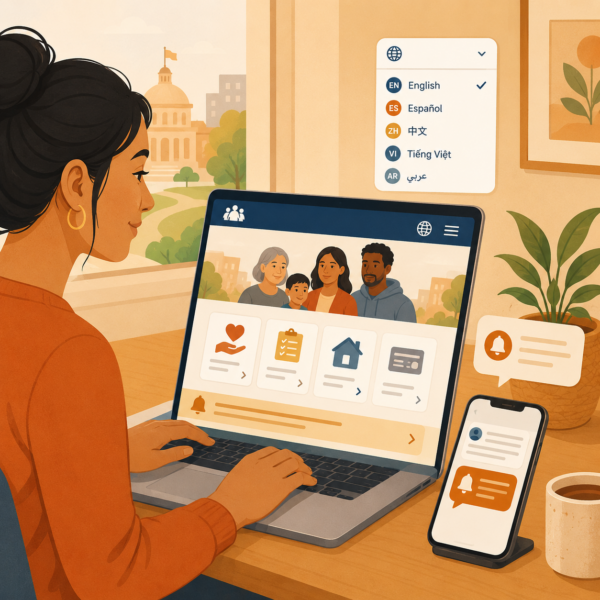 Digital benefits tools can expand access, but they can also create new language barriers when multilingual communication is not built into the user journey. A resident may receive a translated notice, then be directed to a portal that uses English-only labels or unfamiliar terminology. They may receive a text alert in a language they do not prefer, click through to a page that is not translated, or encounter a status message that does not match the language used in the notice. When digital channels are not aligned, residents may lose the ability to act at the exact moment the agency is trying to prompt action.
Human services agencies should treat digital language access as part of service design, not as a separate translation layer. Portal labels, document upload instructions, renewal screens, case status messages, text alerts, confirmation messages, and source-of-truth pages should use consistent plain-language terms across languages wherever possible. Residents should not have to interpret one vocabulary in a mailed notice and a different vocabulary inside an online account. The digital path should reinforce the same meaning the resident has already seen in other agency communication.
This is especially important for high-consequence tasks such as renewing benefits, submitting verification, reporting changes, checking case status, responding to EBT theft, or understanding a closure notice. If the resident cannot understand the digital instruction, the agency may see incomplete submissions, repeat calls, partner escalations, or missed deadlines. Digital convenience only supports access when the language and structure of the tool help residents complete the task correctly.
Language Access Should Support Spoken, Written, and Community-Based Communication
Residents do not always experience language access through formal written documents. Many people understand complex benefits issues through conversations with staff, interpreters, bilingual family members, community navigators, clinic staff, school liaisons, legal aid providers, food banks, libraries, or other trusted local organizations. These spoken and community-based interactions are often where residents turn when a notice is confusing or when a deadline feels urgent. Agencies should therefore design language access to support both formal translation and real-world explanation.
This does not mean agencies should rely on informal interpretation for sensitive or case-specific issues. The agency remains responsible for providing meaningful access through appropriate language assistance. But it does mean agencies should recognize that residents often seek help through trusted networks and that those networks need accurate, plain-language materials. When community partners have clear guidance, they can help residents understand official pathways without creating conflicting advice or overstepping into eligibility decisions.
A strong language access system gives staff, interpreters, and partners consistent explanations for the most common resident tasks. It clarifies how to explain renewals, document requests, missing information, case status, appointments, benefit changes, EBT issues, and appeal pathways in language that residents can use. This helps the agency extend the reach of official guidance while preserving accuracy and trust.
Cultural Context Shapes Whether Communication Feels Trustworthy
Language access is not only about the language used. It is also about whether the message makes sense within the resident’s context. A translated notice may be accurate but still fail to build trust if it sounds overly formal, punitive, unfamiliar, or disconnected from how residents understand the service. Some residents may come from communities where government systems are viewed with caution. Others may have prior experiences with benefits, immigration systems, health care, housing programs, or schools that shape how they interpret official communication. The agency’s language choices can either reduce or intensify that concern.
Human services agencies should be attentive to how messages may be received, not only how they are translated. A document request that sounds accusatory can discourage response. A renewal notice that does not explain that action is still possible can cause residents to give up too soon. A text alert that appears unfamiliar can be mistaken for a scam. A message about language assistance that is hard to find may make residents feel that help is not truly available. These are communication design issues, not just translation issues.
Cultural context does not require agencies to stereotype communities or create separate messages for every group. It requires agencies to test whether messages are clear, respectful, and usable for the people they are meant to reach. Community feedback, partner input, bilingual staff insight, interpreter experience, and resident questions can help agencies identify where formal language is not landing well. The goal is to communicate official requirements in a way that is accurate, respectful, and recognizable to the communities served.
Multilingual Communication Should Reduce Fear of Doing the Wrong Thing
Public benefits processes often require residents to act correctly under time pressure. They may need to send documents, complete a renewal, attend an interview, report a change, check a notice, or respond before benefits are delayed or stopped. Residents with limited English proficiency or limited familiarity with agency terminology may fear making a mistake. That fear can lead to delay, repeated calls, reliance on unofficial help, or inaction. Language access should reduce that fear by making the required path clearer.
The strongest multilingual communication explains not only what the agency needs, but how residents can complete the step correctly. A document request should name acceptable proof and explain where to send it. A renewal reminder should identify the deadline and the completion path. A case status message should distinguish between agency review and resident action. An appointment notice should explain what to bring and how to request interpretation. Residents should not have to choose between guessing and waiting for someone else to interpret the message.
This kind of clarity supports both resident access and agency operations. When residents understand what to do, they are more likely to submit usable information, meet deadlines, and ask for help earlier. Staff receive fewer basic clarification calls. Partners can reinforce official guidance more accurately. The agency reduces avoidable churn that begins not with eligibility, but with uncertainty about how to comply.
Staff Training Is Central to Language Access Beyond Translation
Language access depends heavily on staff behavior. Even when translated materials exist, residents often need staff to explain what a notice means, how to request interpretation, where to submit documents, how to check status, or what happens after a case action. Staff need training that helps them recognize language access needs, use plain language before interpretation, avoid unnecessary jargon, and connect residents to appropriate assistance without making the resident feel like a burden.
Training should also help staff understand that language access is not limited to residents who request help clearly. Some residents may nod politely even when they do not fully understand. Others may bring a family member to speak for them, rely on a child to interpret, or avoid asking questions because they feel embarrassed. Staff should have consistent, respectful ways to offer language assistance and confirm understanding without putting residents on the spot.
This training should connect to the agency’s larger communication system. Staff should use the same terms that appear in translated notices, multilingual website pages, call center scripts, lobby signs, and partner materials. They should know where to find current multilingual guidance and how to explain common benefit tasks in a way interpreters can convey accurately. Language access improves when staff are not left to improvise under pressure.
Language Access Should Be Measured Through Resident Understanding, Not Document Production Alone
Agencies often track language access by whether translated materials exist, whether interpretation is available, or whether certain language services were offered. Those measures matter, but they do not fully show whether residents understood the message well enough to act. A translated notice that residents cannot follow may still lead to missed renewals, wrong documents, incomplete submissions, and repeat calls. A multilingual website page that is hard to find may not reduce confusion. A phone menu with language options may still fail if residents cannot reach the right service path.
Human services agencies should look at resident behavior and feedback to understand whether language access is working. Repeated questions from residents, partner reports, call center themes, missed deadlines, document errors, portal abandonment, lobby confusion, and complaint patterns can all reveal where language support is not translating into usable action. These signals help agencies improve source language, translations, interpreter scripts, partner materials, digital pathways, and staff training.
The goal is not to measure language access only by outputs. The stronger measure is whether residents can understand what is happening, what action is required, how to complete the step, and where to get help. When agencies focus on comprehension and action, language access becomes a practical tool for improving equity, reducing procedural harm, and strengthening trust.
Language Access Should Be Built Into Source-of-Truth Communication
Language access becomes weaker when translated or multilingual guidance exists only in scattered documents, old flyers, disconnected PDFs, or informal partner materials. Residents need a reliable place to verify current instructions in a language and format they can understand. This is especially important for high-consequence topics such as renewals, verification requests, case closures, document submission, EBT issues, interviews, and appeal pathways. If multilingual guidance is difficult to find or not maintained, residents may rely on outdated information or secondhand explanations that do not reflect the current process.
A strong source-of-truth approach includes multilingual task pages, clear language assistance instructions, plain-language explanations of common benefit actions, and visible update discipline. Residents should be able to find current guidance about what to do, where to send information, how to request help, and how to verify case-specific details. Staff and partners should also know which official pages or materials to reference, so they are not forced to create separate explanations that may drift from agency guidance over time.
This does not mean every agency resource must be translated in the same way at the same depth. Agencies may need to prioritize based on resident need, legal requirements, program impact, language data, community feedback, and the consequences of misunderstanding. But the most important resident pathways should not depend on English-only source pages with translated materials added later, inconsistently, or only on request. Language access is strongest when the source of truth itself is designed to support multilingual understanding.
Partner Materials Should Extend Official Guidance Without Replacing It
Community partners play an important role in helping residents understand human services programs, especially when language, literacy, technology access, or trust barriers make direct agency communication harder to use. Clinics, schools, libraries, legal aid organizations, food banks, housing providers, child care organizations, immigrant-serving groups, faith-based organizations, and senior centers may all help residents interpret notices, gather documents, use portals, or understand deadlines. These partners can extend agency reach, but only when they are supported with accurate and bounded guidance.
Partner materials should be written so they can be shared without rewriting. If partners have to simplify dense agency language on their own, the message may change from one organization to another. A stronger approach gives partners plain-language materials that identify the resident task, explain the official terminology, provide language assistance pathways, and direct residents back to the agency for case-specific decisions. These materials should be easy to use in conversations, newsletters, resource tables, workshops, community meetings, and one-on-one support settings.
Agencies should also be clear about what partners should not promise. Partners can often explain general steps, help residents identify official channels, and support document preparation, but they should not be asked to interpret eligibility decisions, guarantee outcomes, or replace agency review. Clear boundaries protect residents from inaccurate expectations and protect partners from being placed in roles they cannot responsibly fill. When partner materials extend official guidance without replacing it, language access becomes broader without becoming less reliable.
Language Access Planning Should Include High-Stakes Communication Moments
Not every message carries the same level of risk. Language access planning should pay special attention to moments when misunderstanding can lead to benefit loss, delayed services, missed deadlines, lost appeal opportunities, or resident fear. Renewal notices, verification requests, document deadlines, case closures, appointment notices, benefit changes, fraud alerts, EBT theft guidance, and portal transition messages require especially careful multilingual communication because residents must understand the message quickly and act correctly.
For these high-stakes moments, agencies should plan language access before messages are released. The source language should be reviewed for clarity, translations should preserve the action path, interpreters and staff should have consistent explanations, and community partners should receive shareable guidance when appropriate. A text alert, notice, website page, call center script, and lobby handout should not each explain the same issue differently. Residents should experience one coherent message across the channels they use.
This planning is especially important during operational changes. A new portal, revised renewal process, changed document submission pathway, or updated service model can create confusion even for English-speaking residents. For residents who rely on translated materials, interpreters, bilingual staff, or community partners, the risk of misunderstanding may be greater if language access is added late. Agencies can reduce that risk by treating multilingual communication as part of change management from the beginning.
Staff and Interpreters Need Shared Communication Tools
Language access depends on the quality of the message staff and interpreters are asked to convey. If staff use dense, technical, or inconsistent explanations, interpretation becomes harder and resident understanding may suffer. A staff member may understand a rule internally, but if they explain it using program jargon, acronyms, and system labels, the interpreter must translate not only the language but also the agency’s internal logic. That creates unnecessary risk in conversations where residents may already be confused or worried.
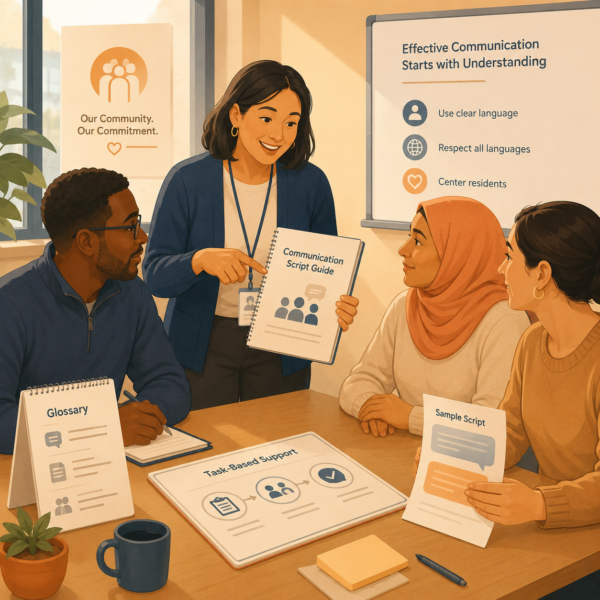
Agencies can support staff and interpreters with shared communication tools. These may include plain-language glossaries, common phrase guides, scenario-based scripts, explanations of key benefit terms, and guidance for high-consequence conversations. The tools should help staff explain renewals, verification, case status, missing documents, appointments, appeal pathways, and benefit changes in language that is easier to interpret accurately. They should also help staff avoid switching terms unnecessarily during the same conversation.
Shared tools also support consistency across channels. The same plain-language concepts used in notices should appear in interpreter guidance, staff scripts, website pages, lobby signs, and partner materials. This reduces the chance that residents hear one explanation in a translated notice and a different explanation during a phone call or office visit. Staff and interpreters do not need scripts that erase natural conversation, but they do need a common framework for preserving meaning.
Feedback From Residents and Communities Should Shape Language Access Strategy
Agencies cannot fully understand language access needs by looking only at document inventories or translation counts. They also need to understand where residents are still getting stuck. Repeated calls about the same notice, wrong-document submissions, missed renewal deadlines, partner questions, appeal patterns, portal abandonment, lobby confusion, and complaints about unclear instructions can all reveal where language access is not producing usable understanding. These signals should be treated as evidence for improvement.
Community feedback is especially valuable because language barriers often appear in ways that formal metrics do not capture. A translated notice may be technically accurate but too formal for residents to act on. A website page may be translated but hard to find. A text alert may be short but not clear enough to connect to the resident’s notice. A phone menu may offer language options but still leave residents unsure which path to choose. Partners, bilingual staff, interpreters, and residents themselves can help agencies see where communication is breaking down.
This feedback should be built into a regular improvement cycle. Agencies can review common questions, test revised messages, consult trusted partners, update glossaries, improve source language, refine translations, and adjust staff training based on what residents actually experience. Language access should not be treated as a one-time compliance output. It should be maintained as a living communication system that improves as resident needs, programs, technology, and community contexts change.
Language Access Should Strengthen Trust, Not Just Compliance
Language access is often framed as a requirement, and requirements matter. But the deeper purpose is resident participation. Residents need to understand agency communication well enough to apply, renew, send documents, report changes, ask questions, attend appointments, use digital tools, and protect their benefits when they remain eligible. When language access works well, residents are not merely receiving translated words. They are receiving a clearer path through the system.
Trust grows when residents see that the agency has anticipated their communication needs. Visible language assistance, plain multilingual guidance, consistent terminology, trained staff, accessible source-of-truth pages, and partner-ready materials all signal that the agency expects to serve residents across languages. This matters because residents who struggle to understand official communication may otherwise feel that the system was not built for them, even when services are technically available.
For human services agencies, language access beyond translation is therefore both an equity strategy and an operational strategy. It reduces avoidable confusion, supports timely action, improves the quality of resident submissions, lowers preventable workload, and helps staff and partners communicate with greater confidence. Most importantly, it helps residents understand what is happening and what to do next in the language and context they actually use.
Strategic Communication Support for Human Services and Public Benefits Agencies
 Language access beyond translation is not simply a document production issue. It is a communication systems issue that affects whether residents can understand benefit requirements, complete required steps, meet deadlines, ask for help, and maintain access to services for which they remain eligible. For human services agencies, public benefits agencies, county social services departments, and state benefits offices, language access must connect notices, portals, text alerts, call centers, lobby communication, staff scripts, community partners, and source-of-truth materials into one coherent resident experience.
Because language access sits at the intersection of policy, translation, interpretation, plain language, digital service design, community trust, staff training, and resident behavior, many agencies benefit from structured communication support. Internal teams may know the programs deeply, but that expertise does not always reveal where residents are struggling to understand the agency’s message across languages and contexts. A notice may be translated, but the action may still be unclear. A website may contain multilingual content, but the task page may be hard to find. A staff member may have access to interpretation, but not have plain source language to explain the issue clearly.
Stegmeier Consulting Group (SCG) helps human services and public benefits agencies strengthen multilingual communication systems that support understanding, action, and trust. That support may include plain-language source content review, multilingual message frameworks, source-of-truth page development, language access communication audits, staff and interpreter support tools, partner-ready materials, resident journey mapping, and alignment across notices, portals, websites, call centers, text reminders, lobby signage, and community outreach. The goal is not only to translate more words. The goal is to help residents understand what is happening, what action is required, and where to get help in the language and context they actually use.
This type of support is especially valuable when agencies are managing high-volume renewals, verification requests, digital portal changes, EBT communication, case closure notices, program transitions, or partner outreach in multilingual communities. Strong language access communication helps residents act with greater confidence, helps staff explain complex processes more consistently, and helps agencies reduce avoidable confusion before it becomes missed action, procedural benefit loss, or distrust.
Future Trends in Language Access for Human Services Communication
Human services agencies are likely to place greater emphasis on language access as part of resident experience, not only as a translation function. As residents interact with agencies through notices, portals, text alerts, call centers, lobby visits, mobile devices, and community partners, agencies will need multilingual communication systems that work across the full journey. Translation will remain essential, but it will increasingly need to be paired with plain source language, consistent terminology, accessible formats, and stronger source-of-truth discipline.
Another likely trend is more attention to task-based multilingual content. Agencies will need to organize language access around the actions residents must complete, such as applying, renewing, sending documents, reporting changes, checking case status, understanding notices, requesting interpretation, or responding to urgent benefit issues. Residents need clear action pathways across languages, not only translated program descriptions. This will make multilingual task pages, scripts, reminders, and partner materials more important to reducing avoidable confusion.
Agencies may also rely more on community feedback to improve language access. Partners, interpreters, bilingual staff, and residents can help identify where translated content is too formal, where terminology does not match community usage, where digital tools create language gaps, and where messages do not clearly support action. Agencies that use this feedback systematically will be better positioned to refine source language, translation quality, staff guidance, and partner communication over time.
Finally, language access will likely become more closely tied to digital modernization and equity strategy. Portals, online accounts, text reminders, upload tools, and case status screens can either expand access or create new barriers. Agencies that build multilingual clarity into digital tools from the beginning will be better able to serve residents who rely on different languages, devices, support networks, and communication channels. The strongest approaches will treat language access as a core design principle for public benefits communication.
Conclusion
Language access in human services must go beyond translating documents after they are written. Translation is essential, but residents also need messages that are clear, action-oriented, culturally understandable, accessible across channels, and connected to the ways they actually seek help. A translated notice, website page, or text alert is only effective when residents can understand what is happening, what action is required, what deadline matters, and where to get support.
Human services agencies can strengthen language access by improving source language, aligning terminology, supporting interpreters and bilingual staff, making help visible early, building multilingual source-of-truth pages, and equipping community partners with accurate materials they can share safely. These practices help residents navigate complex benefit processes without relying on guesswork, informal interpretation, or fragmented guidance.
In the end, language access is about meaningful participation in the benefits system. Residents should be able to understand agency communication well enough to apply, renew, send documents, report changes, respond to notices, and protect essential support. When agencies design language access around real resident contexts, they improve equity, reduce avoidable confusion, support staff, and build greater trust in public services.
SCG’s Strategic Approach to Communication Systems
Align your agency’s messaging, processes, and public engagement strategies.
Human services and public benefits agencies need communication systems that help residents understand complex benefit processes across the languages, channels, and contexts they use in daily life. Language access requires more than translated documents. It requires plain source language, consistent terminology, trained staff, interpreter support, partner-ready materials, accessible digital tools, and source-of-truth discipline across the full resident journey.
SCG helps agencies create communication frameworks that make multilingual public benefits communication clearer, more consistent, and more useful for residents and staff. Whether your agency is improving translated notices, aligning interpreter scripts, strengthening multilingual web content, preparing partner materials, revising source language, or supporting language access during a major program or digital change, SCG can help build a communication system that supports clarity, access, consistency, and trust. Use the form below to connect with our team and explore how a strategic communication system can help your agency strengthen language access and improve the resident experience.