Communication Calendars for Public Benefits Agencies: Planning Year-Round Education, Seasonal Campaigns, and Renewal Sequences
Public benefits communication is often treated as a response to whatever is most urgent at the moment. A renewal deadline approaches, a document campaign begins, a portal change goes live, a call center starts seeing repeated questions, an EBT concern emerges, a backlog develops, or a policy update requires explanation. Agencies then create notices, text alerts, website updates, social media posts, partner messages, staff scripts, and lobby materials under pressure. The communication may be necessary, but it can become fragmented when each message is created in isolation.
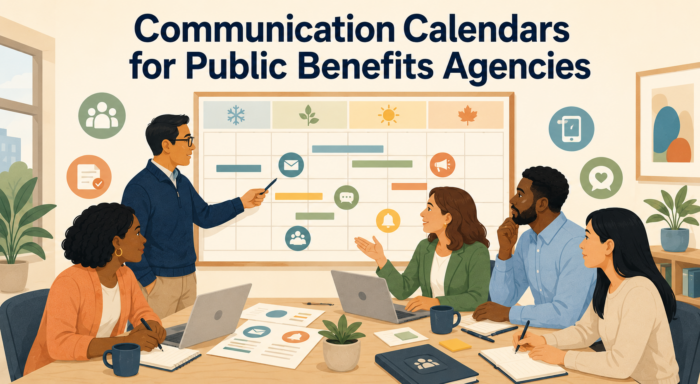
For human services agencies, public benefits agencies, county social services departments, and state benefits offices, a communication calendar helps move resident communication from reaction to planning. It gives the agency a way to organize year-round education, seasonal reminders, renewal sequences, document campaigns, partner updates, staff talking points, and public-facing messages around the moments when residents are most likely to need information. The calendar does not eliminate urgent communication. It gives agencies a stronger foundation so urgent communication can be added without overwhelming residents or staff.
This matters because residents do not experience agency messages as separate internal projects. A household may receive a renewal reminder, a document request, a portal notification, an EBT alert, a language access notice, and a community partner flyer during the same period. If those messages are not coordinated, residents may struggle to understand which action matters most, which deadline applies, whether one message replaces another, or where to verify current information. A communication calendar helps agencies see the resident’s full message environment before messages collide.
A strong calendar also helps agencies balance education and action. Not every message should arrive at the moment of urgency. Residents benefit from year-round information about how to keep contact information current, how to read notices, how to submit documents, how to check case status, how to recognize official messages, how to request language assistance, and how to use digital tools safely. When agencies only communicate during deadlines or disruptions, residents may receive important information too late to use it effectively. Planned communication helps build understanding before the high-stakes moment arrives.
Communication calendars are especially important for renewal sequences. A renewal is not one message. It is a process that may include early awareness, formal notice, reminder texts, portal prompts, document follow-up, staff scripts, partner guidance, deadline reminders, confirmation language, and status updates. If those pieces are not planned together, residents may receive reminders that do not match the notice, text alerts that do not match portal language, or partner messages that point to outdated guidance. A calendar helps agencies design the sequence as one coherent resident journey.
The goal is not to fill every month with more content. Public benefits agencies already communicate a great deal. The goal is to communicate with more discipline. A useful calendar identifies what residents need to know, when they need to know it, which channel should carry the message, which audience needs it, who owns the update, and how the message connects to notices, portals, call centers, staff scripts, lobby materials, and partner toolkits. Done well, the calendar becomes a management tool for clarity, consistency, access, and trust.
A Communication Calendar Is a Service Planning Tool, Not Just a Content Schedule
 A communication calendar is often misunderstood as a publishing schedule. In a public benefits context, it should be much more than a list of social media posts, newsletter items, or public announcements. It should help the agency plan communication around resident needs, service cycles, operational pressure points, and high-consequence tasks. The calendar should show when residents are likely to apply, renew, submit documents, report changes, check status, ask partners for help, call the agency, or visit an office.
This broader view changes how agencies use the calendar. Instead of asking only what message should be posted this week, the agency asks what resident action is coming next and what communication support is needed before, during, and after that action. A document submission campaign may require notice language, text reminders, portal instructions, staff scripts, partner talking points, and a source-of-truth page. A seasonal renewal period may require early education, direct reminders, backlog messaging, call center alignment, and post-submission confirmation language. The calendar helps the agency see all of those pieces together.
A service planning calendar also helps agencies avoid overloading residents. When multiple program units send separate messages without coordination, residents may receive several urgent-sounding communications at once. Some may be educational, some may be case-specific, some may be general, and some may require immediate action. Without coordination, even accurate messages can compete with one another. A calendar allows agencies to sequence communication more thoughtfully and reduce unnecessary message noise.
For staff, the calendar creates operational awareness. Call centers can prepare for questions before a reminder campaign goes out. Lobby staff can receive updated scripts before residents arrive with the same notice. Community partners can be briefed before families begin asking about a renewal sequence. Website teams can update source-of-truth pages before texts and flyers point residents there. The calendar makes communication less reactive because it connects public messaging to the people who will have to support it.
Year-Round Education Reduces Pressure During High-Stakes Moments
Public benefits agencies often communicate most intensely when action is required. Residents receive notices when documents are missing, reminders when renewals are due, alerts when benefits are at risk, and updates when a process changes. Those messages are necessary, but they ask residents to learn and act at the same time. Year-round education helps reduce that burden by building familiarity before the urgent moment arrives.
Year-round communication can explain recurring concepts that apply across many benefit processes. Residents can be reminded to keep contact information current, open agency mail, check official notices, protect EBT cards, use official portals safely, report changes through approved channels, understand that document receipt is different from document review, and request language assistance when needed. These messages do not need to be long or frequent. They need to be consistent, practical, and tied to resident behavior that prevents avoidable problems later.
This kind of education also helps normalize agency processes. If residents only hear about renewals when a deadline is approaching, renewal may feel sudden and intimidating. If they receive periodic plain-language education about why renewals happen and how to prepare, the formal notice becomes easier to understand when it arrives. If residents only hear about document requirements when something is missing, verification may feel like an unexpected barrier. If they understand in advance that the agency may need current proof to complete a review, the request can feel more navigable.
Year-round education should not become generic public awareness. It should be connected to the real questions residents ask and the real problems agencies see. Call trends, partner feedback, lobby questions, portal behavior, and document submission patterns can help agencies decide which topics deserve ongoing attention. The calendar gives those topics a place before they become urgent.
More Than Just Applications: Human Services and Public Benefits Communication Strategies for State and Local Agencies
This article is part of our series on strategic communication for Human Services Agencies, Public Benefits Agencies, and Health and Human Services departments. To learn more and to see the parent article, which links to other content just like this, click the button below.
Seasonal Campaigns Should Be Planned Around Resident Behavior
Many public benefits communication needs follow seasonal or cyclical patterns. Renewal volume may increase during certain periods. School-year transitions may affect child care questions, student household changes, or family support needs. Weather changes may affect energy assistance, shelter needs, transportation barriers, or office access. Tax season may affect income documentation questions. Holiday periods may affect office schedules, benefit timing questions, food access concerns, and partner referrals. A communication calendar helps agencies anticipate these patterns instead of reacting after confusion begins.
Seasonal campaigns work best when they are built around resident behavior, not only agency workload. The agency may know that a renewal cycle is coming, but residents need to know what to expect, what to watch for, what to prepare, and where to get help. The agency may know that documents are likely to be requested, but residents need plain-language examples of acceptable proof and submission pathways. The agency may know that office closures will occur around holidays, but residents need to know how to complete urgent tasks before or during that period.
A strong seasonal campaign also aligns channels. Website pages should be updated before social posts and partner messages go out. Text reminders should match the language in notices. Call center scripts should be ready before residents begin responding. Lobby signs should reinforce the same deadlines and pathways. Partner toolkits should include current language that schools, clinics, food banks, libraries, and other organizations can share without rewriting. The campaign becomes more effective when each channel supports the same resident action.
Seasonal planning also helps agencies avoid competing priorities. If one unit plans a portal promotion during the same period another unit sends renewal reminders and another launches an EBT awareness message, residents may receive too many unrelated prompts. A calendar helps agencies decide which messages should be combined, sequenced, delayed, or targeted more carefully. This is not only about content management. It is about respecting the resident’s attention and reducing avoidable confusion.
Renewal Sequences Need More Than One Reminder
Renewal communication is one of the clearest examples of why agencies need a calendar. A renewal is not a single notice or one reminder. It is a sequence of communication moments that should guide the resident from awareness to completion. Residents may need to know that renewal is coming, receive the official notice, understand what information is needed, complete the renewal, submit documents, confirm submission, wait for review, respond to any follow-up request, and understand the final decision or next step.
If the sequence is not planned, communication can become uneven. A resident may receive a notice but no reminder. They may receive a reminder but not understand which benefit it applies to. They may submit documents but continue receiving alerts that imply nothing was received. They may complete a renewal but not understand that agency review is still pending. These gaps can create repeated calls, duplicate submissions, missed deadlines, and frustration for both residents and staff.
A calendar helps agencies map the renewal journey and assign each message a purpose. Early messages can prepare residents. Formal notices can provide required information. Reminder texts can prompt action. Website pages can explain the task in plain language. Portal messages can show status. Staff scripts can explain what has been received and what remains under review. Partner messages can reinforce official guidance. Each message should fit into the sequence rather than repeating a vague instruction to renew.
The strongest renewal sequences also change based on resident status where systems allow. A resident who has not started a renewal needs a different reminder from a resident who submitted the renewal but still owes documents. A resident whose documents are under review needs reassurance, not another generic demand. A resident whose case needs action should receive a clear next step. Communication calendars help agencies plan these distinctions and avoid sending reminders that create more confusion than completion.
Communication Calendars Help Agencies Manage Message Overlap
Public benefits agencies communicate about many topics at once. Renewals, document requests, case status, benefit delays, EBT security, language access, portal updates, office hours, partner resources, program changes, seasonal supports, and community events may all be important. Without a calendar, each topic may be handled separately by the unit that owns it. Residents, however, receive the combined effect. They may not know which message requires action, which is informational, and which one is most urgent.
A communication calendar helps agencies see overlap before residents experience it. It allows teams to identify when multiple messages are scheduled for the same audience, channel, or time period. It can show when a general educational message may be overshadowed by a high-stakes renewal reminder or when a partner update should be sent before residents begin asking questions. It also helps agencies avoid sending messages that use different terminology for related actions.
Managing overlap does not mean suppressing important information. It means planning the order, channel, and emphasis more intentionally. Some messages may need to be combined into one clearer source-of-truth update. Others may need to be targeted to specific audiences. Some may need to be delayed so they do not compete with a deadline reminder. Others may need to be coordinated with staff training and partner outreach. The calendar gives agencies a way to make those decisions before confusion reaches the public.
This discipline becomes especially important during periods of strain. Backlogs, system changes, benefit security concerns, or high-volume renewals can create intense communication demands. A calendar helps agencies understand what is already in the field and what needs to be paused, clarified, updated, or amplified. During high-pressure periods, message coordination is not a luxury. It is part of protecting resident understanding and agency credibility.
Calendar Planning Should Begin With Resident Decision Points
A communication calendar is most useful when it is built around resident decision points rather than agency publishing preferences. Residents need information when they are deciding whether to apply, renew, send documents, report a change, check status, respond to a notice, use a portal, contact the agency, or ask a partner for help. If the calendar is organized only around internal deadlines, meeting schedules, or program ownership, it may miss the moments when communication can actually prevent confusion.
Human services agencies should identify the recurring points where residents are most likely to need guidance. These may include the start of a renewal cycle, the arrival of a document request, the period before a deadline, the time after submission, the transition into agency review, and the moment when a decision or follow-up notice is issued. Each point should have a communication purpose. Some messages prepare residents. Some prompt action. Some confirm receipt. Some clarify status. Some direct residents to help. A strong calendar assigns each message a job.
This decision-point structure also helps agencies avoid sending messages that are technically accurate but poorly timed. A reminder that arrives before residents have the official notice may create confusion. A document message that arrives after the deadline may feel pointless. A general education post during a high-stakes renewal period may be ignored because residents are focused on immediate action. Planning around resident decisions makes communication more timely, more relevant, and more likely to support completion.
Map the Resident’s First Question
Every calendar item should be tied to the question residents are likely asking at that moment. Early in a renewal sequence, the question may be what to expect. After a notice arrives, the question may be what to complete. After a document is submitted, the question may be whether the agency received it. During a backlog, the question may be whether action is still needed.
Mapping the resident’s first question helps agencies write messages that meet the moment. The calendar becomes more than a list of topics. It becomes a planning tool for reducing the uncertainty residents are most likely to experience.
Separate Education From Action Prompts
Education messages and action prompts serve different purposes. A year-round post about keeping contact information current is different from a renewal reminder that requires immediate action. A general explanation of document review is different from a case-specific request for proof. If the calendar treats these messages the same way, residents may not know which messages require a response.
Agencies should label calendar items by purpose. Educational messages can build understanding before deadlines. Action prompts should make the required step and timing clear. Confirmation or status messages should explain what has happened and what comes next. This distinction helps the agency manage tone, urgency, channel choice, and timing.
Renewal Sequences Should Be Planned as a Full Communication Journey
Renewal communication is often one of the most consequential parts of a public benefits communication calendar. Residents may need to recognize that a renewal is coming, receive and understand the formal notice, complete a form, submit documents, respond to follow-up requests, check status, and understand the final outcome. If those messages are planned separately, residents may receive fragments of guidance that do not add up to a clear path.
A renewal sequence should be planned as a full journey. Early communication can prepare residents to watch for notices and keep contact information current. Formal notices can explain the requirement, deadline, and completion options. Text reminders can prompt timely action. Website pages can provide plain-language support. Portal messages can show whether the renewal has been received, is under review, or still needs information. Partner materials can help schools, clinics, food banks, libraries, and community organizations reinforce the same official guidance.
The sequence should also account for what happens after the resident acts. Many agencies focus heavily on getting residents to submit renewals but communicate less clearly about review status. Residents may assume submission means approval, or they may continue calling because they do not know whether the agency received the information. A complete renewal sequence includes confirmation, review language, follow-up instructions, and final status communication. That full path reduces avoidable calls, duplicate submissions, and anxiety.
Early Messages Should Prepare Residents Before the Notice Arrives
Early renewal communication should not replace the official notice. It should prepare residents to recognize and respond to it. Agencies can remind residents to keep addresses, phone numbers, and portal access current, open agency mail, watch for official renewal information, and seek help early if they need language assistance or support using digital tools.
These messages should be calm and educational. They should help residents understand that renewals are a normal part of maintaining benefits, not a sudden sign that something is wrong. Early preparation can make the formal notice easier to act on when it arrives.
Later Messages Should Reflect Resident Status When Possible
Later renewal reminders should become more specific where systems allow. A resident who has not submitted anything needs a different message from a resident whose renewal was received but still needs documents. A resident whose documents are under review should not keep receiving alerts that sound as though nothing was received.
Status-aware messages are more trustworthy because they match the resident’s actual situation. They also reduce unnecessary action. When residents understand whether to act, wait, or respond to a specific request, they are less likely to resubmit documents or call only to confirm that prior action counted.
Seasonal Campaigns Should Connect Benefits Communication to Real-Life Timing
Seasonal campaigns are strongest when they reflect how residents experience the year. Families may have school-year transitions, child care changes, seasonal employment, weather-related costs, holiday office closures, tax documents, transportation barriers, or health coverage questions tied to recurring times of year. Public benefits agencies can use a communication calendar to anticipate these patterns and provide practical guidance before residents are in crisis.
These campaigns should be more than public awareness. They should connect seasonal timing to resident action. A school-year campaign might remind families to update contact information, report changes when required, understand child care documentation, and check notices. A winter-season campaign might direct residents to energy assistance information, office closure updates, document submission options, and partner resources. A tax-season message might help residents understand how income documentation may relate to benefit reviews without creating unnecessary confusion.
Seasonal planning also helps agencies coordinate partner outreach. Schools, clinics, food banks, libraries, housing providers, and community organizations often know when certain resident questions will increase. If agencies brief partners before those moments, partners can reinforce accurate guidance rather than improvising. The calendar helps the agency move from last-minute outreach to planned community alignment.
Seasonal Messages Should Be Timed Before the Pressure Point
A seasonal message is less useful if it arrives after residents have already encountered the problem. Agencies should send guidance early enough for residents to prepare, gather documents, update information, ask for help, or make a plan. Timing should reflect the action residents need to take, not only the agency’s internal schedule.
This is especially important when residents need help from employers, landlords, schools, providers, or community partners. A reminder that gives residents time to act can reduce stress and improve completion. A late reminder may only confirm that the resident is already behind.
Partners Should Receive Campaign Guidance Before Residents Ask
Partners often hear resident questions shortly after a campaign begins. If they are not prepared, they may rely on old materials or informal explanations. A communication calendar should include partner briefings before major seasonal messages, renewal campaigns, portal changes, or document reminders go public.
Partner guidance does not need to be long. It should explain the campaign purpose, resident action, official source of truth, and boundaries around case-specific questions. When partners receive the message early, they can help extend accurate information into the community.
The Calendar Should Coordinate Channels, Not Just Topics
A communication calendar should show more than what the agency plans to say. It should show where each message will appear and how channels support one another. A website source-of-truth page may carry the full explanation. A text alert may prompt action and link to the page. A mailed notice may provide required case-specific information. A call center script may explain the same step in conversation. A partner toolkit may help trusted organizations reinforce the message. A lobby sign may orient residents who come in person.
When channels are not coordinated, residents may receive mixed signals. A text may use different words from the notice. A portal may display a status that staff explain differently. A partner flyer may point to a page that has not been updated. A social post may create awareness but not identify the next step. The calendar should help agencies check these connections before messages are released.
Channel coordination also supports staff readiness. If a text reminder is scheduled, call center and lobby staff should know what it says before residents start asking about it. If a website page is updated, partner materials and scripts should be updated as well. If a renewal campaign launches, supervisors should have coaching points ready. The calendar becomes a practical alignment tool for the full resident-facing system.
Each Channel Should Have a Defined Job
Not every channel should carry the same amount of information. A text alert should prompt action. A notice should provide official detail. A website page should explain the task in plain language. A call script should help staff answer common questions. A partner message should direct residents to the official source without overpromising.
Defining the job of each channel prevents overloading short formats and underusing more detailed ones. It also helps residents move from a brief prompt to a fuller explanation without encountering different terminology or conflicting guidance.
Staff Should Know What Residents Are Receiving
Staff should not learn about resident-facing messages from residents. When a notice, text alert, campaign, or website update goes out, frontline teams should know what was sent, who received it, what action it prompts, and where to direct questions. This preparation reduces confusion and helps staff answer consistently.
The calendar should include internal communication steps, not only public release dates. Call centers, lobby staff, supervisors, eligibility workers, and partner liaisons all need enough lead time to support the message once residents begin responding.
Message Volume Should Be Managed With the Resident Experience in Mind
 Public benefits agencies may have many important messages to send, but residents have limited attention. A household may be managing work, caregiving, transportation, school, health care, bills, and several benefit processes at the same time. If every message sounds urgent, residents may struggle to identify which one requires action. If too many messages arrive through too many channels, residents may disengage or assume the agency is sending repetitive information.
A communication calendar helps agencies manage message volume by showing where messages overlap. Teams can see when the same audience may receive several reminders, alerts, and educational messages in a short period. They can decide which messages should be combined, delayed, targeted, or reframed. They can also identify where a high-stakes action message should take priority over general education.
Managing volume is not about communicating less for the sake of silence. It is about communicating with a better hierarchy. Residents should be able to tell the difference between information, preparation, reminder, warning, confirmation, and urgent action. The calendar gives agencies a way to plan that hierarchy across time instead of asking residents to sort it out after messages arrive.
High-Stakes Messages Should Not Compete With Low-Priority Content
A renewal deadline, document request, case closure warning, or EBT security alert should not be buried among general announcements. When high-stakes messages are active, agencies should be careful about sending unrelated messages to the same audience that could dilute attention or create confusion.
The calendar helps agencies protect priority communication windows. During those periods, lower-priority content can be postponed, targeted differently, or moved to less intrusive channels. This helps residents focus on the message that affects immediate action.
Repetition Should Add Clarity, Not Noise
Some messages need repetition, especially reminders tied to deadlines. But repetition should not simply resend the same vague alert. Each message in a sequence should add clarity based on timing and status. Early reminders can prepare. Midpoint reminders can clarify what remains. Final reminders can emphasize urgency. Confirmation messages can explain what happens next.
Repetition becomes noise when residents cannot tell why they are receiving another message. It becomes useful when each message helps them understand where they are in the process and what action, if any, remains.
Calendars Should Include Source-of-Truth Updates Before Campaigns Launch
A communication calendar is only useful if the public information residents rely on is current before reminders and campaigns begin. Agencies often send text alerts, social posts, partner messages, and staff scripts that point residents to a website, portal, form, or help page. If that source is outdated, incomplete, or inconsistent with the message being promoted, the campaign can create more confusion than clarity. Residents may follow a reminder, arrive at a web page, and still not know what to do.
Public benefits agencies should build source-of-truth updates into the calendar before public-facing messages go out. If a renewal campaign is scheduled, the renewal page should be reviewed first. If a document reminder is planned, document submission instructions should be current. If partners are being asked to share EBT, language access, or portal guidance, the official page should already reflect the correct pathway. The calendar should make these updates visible as required preparation, not optional cleanup.
This discipline also helps staff and partners. A call center script should point to the same guidance as the website. A partner toolkit should link to the same official page as the text alert. A lobby sign should reinforce the same action residents saw in the notice. When the source of truth is updated before the campaign launches, every channel has a stable reference point. Residents receive a clearer message, and staff spend less time correcting outdated or disconnected information.
Staff Preparation Should Be Built Into the Calendar
Public-facing communication often generates questions. A renewal reminder may increase calls about deadlines. A document campaign may lead residents to ask which proof is acceptable. A portal message may bring people into the lobby for help logging in or uploading files. A seasonal campaign may prompt questions from partners, elected officials, and community organizations. If staff are not prepared before the message goes out, the agency may create avoidable pressure inside its own service channels.
A strong communication calendar includes staff preparation as part of each campaign sequence. Call center representatives, eligibility workers, lobby staff, supervisors, navigators, and partner liaisons should know what residents are receiving, what action the message is intended to prompt, and what language staff should use in response. This does not require a long training process for every message. It does require enough internal alignment so staff are not surprised by resident questions.
Staff preparation should also include boundaries. Staff need to know what they can confirm, what remains under review, what should be escalated, and what should not be promised. This is especially important for renewal status, benefit delays, document acceptance, EBT concerns, appeal-related questions, and cross-program issues. When staff have clear guidance before residents respond, the public message is more likely to produce completion instead of confusion.
Partner Updates Should Be Scheduled Before Community Questions Begin
Community partners often become part of the communication system whether agencies plan for it or not. Schools, clinics, food banks, libraries, housing providers, legal aid organizations, faith-based groups, and community-based organizations may hear from residents shortly after notices, reminders, or campaigns are released. If partners do not receive accurate guidance in advance, they may rely on older materials, informal explanations, or their own interpretation of agency messages.
The communication calendar should include partner updates before major resident-facing campaigns. If the agency is launching a renewal sequence, partners should receive plain-language guidance they can share safely. If a document submission period is expected to generate questions, partners should know where the official instructions live and what they should not promise. If a portal change is coming, libraries and community organizations that support digital access should receive guidance before residents arrive asking for help.
Partner updates should be practical and bounded. They should explain the campaign purpose, the resident action, the official source of truth, and the referral pathway for case-specific questions. They should also identify any language access or accessibility considerations partners should know. When partners are briefed in advance, they can reinforce the agency’s message instead of becoming another place where residents receive incomplete or conflicting guidance.
Calendars Should Plan for Follow-Up, Not Just Launch
Many communication plans focus heavily on launch messages and not enough on what happens afterward. A campaign goes out, residents respond, staff receive questions, partners raise issues, and the agency begins to see where the message was clear or unclear. If the calendar does not include follow-up points, agencies may miss the chance to adjust while the campaign is still active. Communication should not end when the first message is published.
A strong calendar includes review points after major messages. Agencies can check call trends, web traffic, portal behavior, document submissions, partner questions, lobby patterns, and staff feedback. If residents are calling because a text was unclear, the agency can adjust future reminders. If documents are being submitted incorrectly, the agency can clarify examples. If partners report confusion, the agency can update partner guidance or source-of-truth pages. Follow-up makes the calendar responsive rather than static.
Follow-up is especially important for renewal sequences, backlog communication, EBT alerts, portal changes, and seasonal campaigns. These topics often generate questions after the first message because residents encounter the process in real life. A calendar that includes monitoring and adjustment gives agencies a way to improve communication while residents can still benefit from the change.
Calendars Should Help Agencies Avoid Conflicting Terminology
Public benefits agencies often use several terms for related actions. One program may say renewal, another may say redetermination, another may say recertification, and another may say eligibility review. One channel may say send documents while another says upload verification. One page may say case status while a portal says pending. These differences may reflect program history or system design, but residents may experience them as separate instructions.
A communication calendar can help agencies identify terminology conflicts before messages go out. When teams see notices, texts, website updates, staff scripts, and partner materials together, they can compare the language residents will encounter. If one channel uses a formal term and another uses plain language, the calendar process gives the agency a chance to bridge the terms. If several messages are scheduled for the same audience, the calendar helps ensure that the action language is consistent.
This is especially important when communication crosses programs. Residents receiving multiple benefits may not know whether one renewal applies to all programs, whether one document supports several reviews, or whether one reminder refers to one benefit only. Shared terminology does not eliminate program differences, but it helps residents understand what action is being requested. The calendar gives agencies a practical tool for maintaining that consistency over time.
Communication Calendars Should Include Maintenance Windows
Some communication work is not tied to a specific campaign. Agencies need time to review source-of-truth pages, update partner toolkits, retire outdated flyers, refresh staff scripts, check translated materials, test links, review portal instructions, and revise high-volume FAQs. If this maintenance work is not scheduled, it can be pushed aside until outdated information creates a problem. A communication calendar should make maintenance visible.
Maintenance windows are especially important after major campaigns or operational changes. A renewal sequence may reveal that a task page needs improvement. A backlog period may require a closeout update. A portal change may leave old screenshots or instructions in circulation. A seasonal campaign may produce partner questions that should be added to the toolkit. The calendar should include time to incorporate these lessons rather than moving immediately to the next campaign.
This maintenance discipline protects credibility. Residents often assume that anything on an agency website, flyer, lobby screen, or partner handout is current. Staff may also rely on older materials unless they know what has changed. Scheduled maintenance helps agencies keep public communication aligned with real operations. It also signals internally that communication quality is an ongoing responsibility, not a one-time production task.
Communication Calendars Should Account for Resident Capacity
A communication calendar should not only reflect what the agency needs to say. It should also reflect what residents can reasonably absorb. Public benefits residents may be managing work, caregiving, transportation, health needs, school schedules, housing instability, digital access challenges, language access needs, and multiple benefit requirements at once. A message may be accurate and timely from the agency’s perspective, but still arrive at a moment when the resident is already receiving too many instructions, reminders, or warnings.
Agencies should use the calendar to evaluate the resident’s message load. A resident who receives a renewal notice, a document request, a portal reminder, an EBT security alert, and a general program update in the same short period may struggle to identify what requires action first. The calendar helps agencies see when messages are competing for attention and when high-stakes communication needs more space. It also helps agencies decide when a message should be targeted, delayed, shortened, combined, or redirected to a source-of-truth page.
Resident capacity should also shape message hierarchy. Not every message should sound equally urgent. Some messages are educational. Some are reminders. Some are confirmations. Some require immediate action. Some provide context for a process already underway. A calendar can help agencies plan those distinctions so residents are not left to sort through several messages that all sound important but do not carry the same consequence. Managing resident attention is part of making communication more usable.
Calendars Should Support Language Access and Accessibility Planning
Language access and accessibility should be built into the communication calendar from the beginning, not added after messages are drafted. If an agency plans a renewal campaign, document reminder sequence, portal update, or seasonal education effort, it should also plan when translated materials, interpretation guidance, accessible formats, staff scripts, partner materials, and multilingual source-of-truth pages will be ready. Residents should not receive key messages in one language or format while supporting materials lag behind.
This planning matters because communication sequences often move quickly. A text reminder may point to a website page. A partner flyer may summarize a campaign. A call center script may explain a deadline. A lobby sign may reinforce the same action. If these materials are not aligned across languages and accessibility needs, some residents may receive incomplete or inconsistent guidance. The calendar gives agencies a place to plan for multilingual review, plain source language, accessible design, and channel consistency before the campaign reaches residents.
Accessibility planning should also include the formats residents actually use. Some residents may rely on mobile-friendly pages, printed notices, large-print materials, phone support, screen-reader-compatible content, translated pages, partner assistance, or in-person guidance. A communication calendar can identify which materials need which formats and when they must be available. This helps agencies avoid treating access as a separate compliance task and instead makes it part of the communication workflow.
Communication Calendars Should Include Internal Review Without Slowing Urgent Messages
Public benefits communication often requires review from several perspectives. Program teams may need to confirm policy accuracy. Legal or compliance staff may need to review required language. Communications staff may need to improve plain language, tone, and structure. Operations teams may need to confirm that the message matches real workflows. Digital teams may need to confirm links, portals, or status labels. Partner liaisons may need to ensure that community materials are usable and bounded.
A communication calendar can make this review process more predictable. Routine messages, seasonal campaigns, renewal sequences, and partner updates can be planned with enough time for appropriate review before release. This reduces last-minute revisions and helps prevent messages from going out with unclear deadlines, outdated links, inconsistent terminology, or missing staff guidance. The calendar turns review from a bottleneck into a planned part of message development.
At the same time, the calendar should not make urgent communication impossible. Agencies still need the ability to respond quickly to benefit delays, EBT concerns, office disruptions, system outages, weather events, or unexpected resident confusion. The solution is to prepare message frameworks, approval pathways, and source-of-truth procedures in advance. When urgent issues arise, agencies can communicate quickly while still preserving accuracy, accessibility, tone, and consistency.
Calendars Should Help Leadership See Communication Risk
A communication calendar can give agency leadership a clearer view of resident-facing risk. Without a calendar, leaders may see individual messages only when they are ready for approval or when a problem has already surfaced. With a calendar, leadership can see when major renewal sequences, document campaigns, portal changes, seasonal pressures, partner updates, and public notices are scheduled. This helps leaders anticipate workload, resident concern, staff needs, and public trust issues before they become visible problems.
Communication risk is not limited to controversial topics. A routine renewal reminder can create risk if it is vague. A document campaign can create risk if residents do not know what proof is acceptable. A portal update can create risk if staff and partners are not prepared. A seasonal office closure message can create risk if residents do not understand how to complete urgent tasks. The calendar helps leadership see these risks as part of service delivery rather than as isolated communication products.
This leadership visibility also supports better resource decisions. If a major communication sequence is expected to increase call volume, staff scripts may need to be prepared. If a partner campaign is planned, partner liaisons may need time to brief community organizations. If a source-of-truth page is central to a campaign, web maintenance becomes a service priority. A calendar helps leadership connect communication planning to staffing, operations, technology, and public trust.
Calendars Should Build in Measurement and Learning
A communication calendar should not end when messages are released. Agencies should plan how they will evaluate whether the communication helped residents understand and act. This may include reviewing call trends, website traffic, portal behavior, text alert responses, document submission quality, duplicate uploads, partner questions, lobby patterns, survey responses, and staff feedback. These signals can show whether the message reduced confusion or simply shifted it to another channel.
Measurement should be tied to the purpose of each communication. If a renewal reminder was designed to prompt completion, the agency should examine renewal completion and related questions. If a document campaign was designed to reduce wrong submissions, the agency should look at document quality and repeat requests. If a seasonal education message was designed to prepare residents earlier, the agency should look at whether related confusion decreased during the high-pressure period. The calendar can identify these review points in advance.
Learning should then feed the next cycle. A message that generated repeated calls may need clearer wording. A text alert that increased portal visits but not completion may need better task guidance. A partner update that was not used may need a simpler format. A source-of-truth page that received traffic but did not reduce questions may need stronger hierarchy. The calendar helps agencies turn each campaign into evidence for improving the next one.
The Best Calendars Remain Flexible Without Becoming Reactive
A communication calendar should provide structure, but it should not become rigid. Human services agencies operate in changing environments. Workloads shift, policy guidance changes, systems experience problems, residents ask unexpected questions, partners identify confusion, and urgent issues emerge. A useful calendar gives agencies a plan while still allowing space to adjust when conditions change.
Flexibility is different from reactivity. A reactive agency creates messages only after confusion grows. A flexible agency has a plan, monitors conditions, and adjusts messages when new information appears. The calendar supports this by showing what is scheduled, what can move, what must remain fixed, and which channels need to be updated when priorities change. It helps agencies make deliberate adjustments rather than sending disconnected messages under pressure.
This balance is what makes a communication calendar strategic. It supports year-round education, seasonal campaigns, renewal sequences, staff preparation, partner alignment, source-of-truth updates, and measurement. At the same time, it gives the agency enough visibility to respond responsibly when new issues arise. For public benefits agencies, that combination of planning and adaptability is essential to maintaining resident trust.
Strategic Communication Support for Human Services and Public Benefits Agencies
 Communication calendars are more than planning documents. They are tools for helping human services and public benefits agencies communicate with greater consistency, timing, and purpose across the full resident journey. When residents are applying, renewing, submitting documents, checking case status, responding to notices, using portals, asking partners for help, or trying to understand benefit changes, the timing and coordination of messages matter. A well-built calendar helps agencies decide what residents need to know, when they need to know it, which channel should carry the message, and how each message connects to the next step.
Because public communication touches notices, websites, portals, text alerts, call centers, lobby materials, staff scripts, partner toolkits, language access, and leadership messaging, many agencies benefit from structured communication support. Internal teams may know their own program deadlines and operational needs, but that does not always produce a resident-centered message sequence. Without coordination, residents may receive too many unrelated messages, conflicting terminology, late reminders, or urgent prompts that do not connect to a clear source of truth.
Stegmeier Consulting Group (SCG) helps human services and public benefits agencies build communication calendars that support clarity, access, and trust throughout the year. That support may include annual communication planning, renewal sequence design, seasonal campaign strategy, source-of-truth page planning, message hierarchy, staff and partner alignment, text reminder coordination, resident journey mapping, and calendar governance. The goal is not to produce more communication. The goal is to make communication more intentional, better timed, easier to support, and more useful for residents.
This type of support is especially valuable when agencies are managing renewal cycles, high-volume document requests, seasonal benefit questions, portal changes, EBT communication, benefit delays, language access needs, or recurring resident confusion. A strong communication calendar helps agencies prepare before pressure builds, coordinate channels before messages go out, and learn from resident response after campaigns launch. It gives staff, partners, and residents a clearer path through the communication system.
Future Trends in Communication Planning for Public Benefits Agencies
Public benefits agencies are likely to place greater emphasis on communication calendars as resident communication becomes more multi-channel and time-sensitive. Residents no longer rely on one notice or one office visit to understand benefits. They may receive a text reminder, check a portal, search a website, call a center, ask a partner, and visit a lobby during the same process. Agencies will need planning tools that help those channels reinforce one another rather than compete.
Another likely trend is more status-aware and sequence-based communication. Agencies will increasingly need to distinguish between early education, formal notice, reminder, confirmation, review status, missing information, and final decision communication. A resident who has not started a renewal needs a different message from a resident whose renewal is submitted but still under review. Communication calendars will help agencies plan those distinctions and reduce unnecessary repeat contact.
Agencies may also use calendars more intentionally to support language access, accessibility, and partner readiness. Multilingual materials, translated source-of-truth pages, staff scripts, partner updates, and accessible formats need to be ready before messages reach residents. Planning these pieces in advance will become more important as agencies try to serve residents across different languages, devices, support networks, and communication needs.
Finally, communication calendars will likely become more closely tied to measurement and continuous improvement. Agencies will use call trends, portal behavior, survey results, partner input, document submission patterns, and staff feedback to improve future message timing and wording. The calendar will not simply show what was sent. It will help agencies learn which messages helped residents act and which messages need refinement.
Conclusion
Communication calendars help public benefits agencies move from reactive messaging to coordinated resident guidance. They give agencies a way to plan year-round education, seasonal campaigns, renewal sequences, staff preparation, partner updates, source-of-truth maintenance, and measurement. This structure matters because residents experience agency communication as one connected journey, even when messages are created by different programs, teams, or systems.
A strong calendar does not add communication for its own sake. It helps agencies communicate with better timing, clearer hierarchy, and stronger alignment across channels. It ensures that high-stakes messages do not compete with lower-priority content, that staff know what residents are receiving, that partners are prepared before questions arise, and that source-of-truth pages are current before campaigns launch.
In the end, communication calendars are practical tools for building trust. They help agencies anticipate resident questions, reduce avoidable confusion, and support timely action. When public benefits agencies plan communication around resident needs rather than internal urgency alone, they create a clearer, more consistent, and more navigable benefits experience.
SCG’s Strategic Approach to Communication Systems
Align your agency’s messaging, processes, and public engagement strategies.
Human services and public benefits agencies need communication systems that help residents understand what to do throughout the year, not only when a deadline or disruption occurs. Communication calendars can bring structure to renewal sequences, seasonal campaigns, partner outreach, staff preparation, source-of-truth updates, and ongoing resident education.
SCG helps agencies create communication frameworks that support clarity, consistency, access, and trust across the full resident journey. Whether your agency is planning renewal reminders, coordinating seasonal campaigns, aligning partner messages, updating staff scripts, improving source-of-truth pages, or building an annual communication calendar, SCG can help create a system that makes public benefits communication more intentional and easier to support. Use the form below to connect with our team and explore how a strategic communication system can help your agency plan clearer year-round public benefits communication.