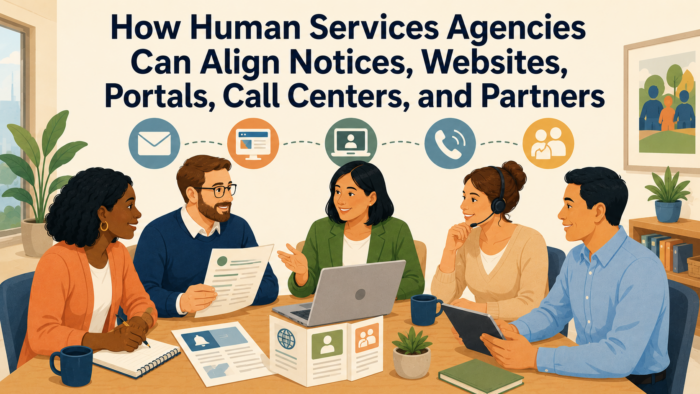
One Message Across Every Channel: How Human Services Agencies Can Align Notices, Websites, Portals, Call Centers, and Partners
Human services agencies rarely communicate through one channel at a time. A resident may receive a mailed notice, open a text alert, check a portal, visit the agency website, call a customer service line, ask a caseworker for help, bring paperwork to a lobby, and consult a community partner during the same benefits process. Each channel may have been created by a different team, updated on a different schedule, and written for a different operational purpose. But the resident experiences all of it as one agency voice.
That is why message alignment matters. When notices, websites, portals, call centers, and partners explain the same issue differently, residents may not know which instruction to trust. A mailed notice may say “renew your benefits,” while the portal says “complete redetermination.” A text alert may say documents are needed, while the website explains verification in general terms. A call center representative may say the agency received a document, while the portal still shows pending. A partner organization may share an old flyer that points residents to a process that has changed. Each message may be well-intentioned, but together they can create confusion.
For human services agencies, public benefits agencies, county social services departments, and state benefits offices, this is not just a branding concern. It is a service delivery issue. Residents rely on aligned communication to apply, renew, send documents, report changes, check case status, understand notices, attend interviews, protect EBT cards, request language assistance, and respond before deadlines. When the message changes across channels, the resident has to interpret the system instead of simply following the next step.
One message across every channel does not mean every channel must use identical wording or carry the same level of detail. A text alert must be shorter than a notice. A portal status must be more concise than a website page. A call center script must allow staff to respond to the resident’s case-specific question. A partner toolkit must include boundaries that a formal agency notice may not need. Alignment means the core meaning is consistent. The resident should hear the same answer about what is happening, what action is required, what deadline matters, where to get help, and where to verify current information.
This kind of alignment requires planning and governance. It cannot depend on each team independently trying to say the right thing. Agencies need shared terminology, source-of-truth discipline, staff scripts, partner-ready materials, digital content review, and feedback loops that identify where residents are hearing mixed messages. The goal is not to make communication rigid. The goal is to make it coherent enough that residents can move across channels without feeling as though they are starting over each time.
When agencies align communication across channels, they reduce avoidable confusion, call volume, duplicate submissions, partner uncertainty, staff improvisation, and resident frustration. More importantly, they strengthen trust. Residents are more likely to act when the agency’s message feels consistent, current, and understandable wherever they encounter it. A clear message repeated across the right channels becomes more than information. It becomes a path through the benefits system.
Residents Experience Channels as One Service Journey
 Inside an agency, communication channels may be managed separately. Notices may be owned by program or legal teams. Websites may be managed by communications or digital staff. Portals may be tied to technology vendors and eligibility systems. Call center scripts may be maintained by operations. Community partner materials may be handled by outreach teams. Lobby signs may be produced locally. These divisions may make sense internally, but residents do not experience the system that way.
Residents experience a service journey. They receive information, try to understand it, decide whether they need to act, seek confirmation, and move from one channel to another until they feel confident enough to complete the step. A resident may start with a notice, then use the website to understand the notice, then log into the portal, then call because the portal status is unclear, then ask a partner for help gathering documents. If each channel uses different terms or emphasizes different steps, the resident may feel that the process is unstable.
This is especially difficult when benefits are high stakes. A resident trying to maintain food assistance, health coverage, cash support, or child care assistance may not have time to reconcile conflicting instructions. They may be worried about a deadline, caring for children, managing work schedules, dealing with limited digital access, or trying to understand the process in a second language. The more channels conflict, the more the agency shifts interpretation work onto the resident.
A channel-aligned communication strategy starts from the resident journey rather than the agency chart. It asks what the resident is trying to do, what messages they encounter, where they are likely to become confused, and which channel should provide which level of guidance. This allows the agency to design communication as a connected experience instead of a collection of separate outputs.
More Than Just Applications: Human Services and Public Benefits Communication Strategies for State and Local Agencies
This article is part of our series on strategic communication for Human Services Agencies, Public Benefits Agencies, and Health and Human Services departments. To learn more and to see the parent article, which links to other content just like this, click the button below.
Misalignment Creates Work for Residents, Staff, and Partners
Communication misalignment creates work for everyone. Residents must compare messages and decide which one applies. Staff must explain why a portal label differs from a notice. Call centers must answer questions that could have been prevented by clearer status language. Community partners must translate agency terminology into practical guidance. Supervisors must resolve confusion that began before the resident ever reached a worker. What looks like a messaging issue becomes workload across the system.
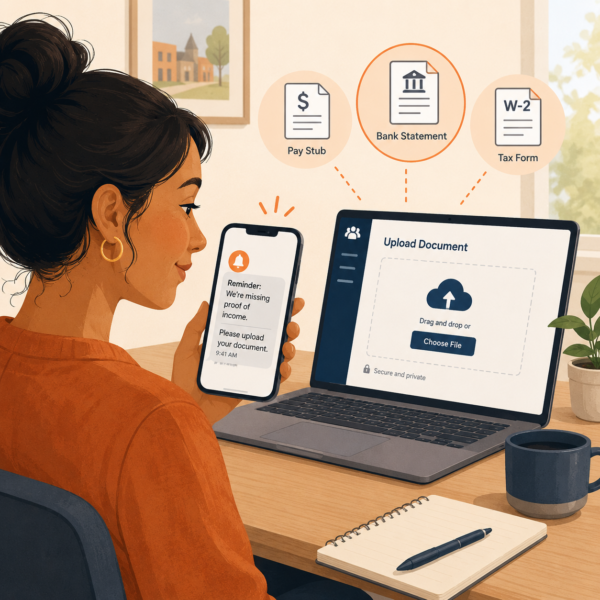
A common example is document submission. A notice may ask for proof of income. A portal may label the upload category as verification. A text alert may say documents are missing. A call center script may say the document was received but not reviewed. A partner may tell the resident to resend the same document because the status still looks incomplete. Without aligned language, the resident may upload the wrong item, submit the same file multiple times, or call repeatedly to confirm what happened.
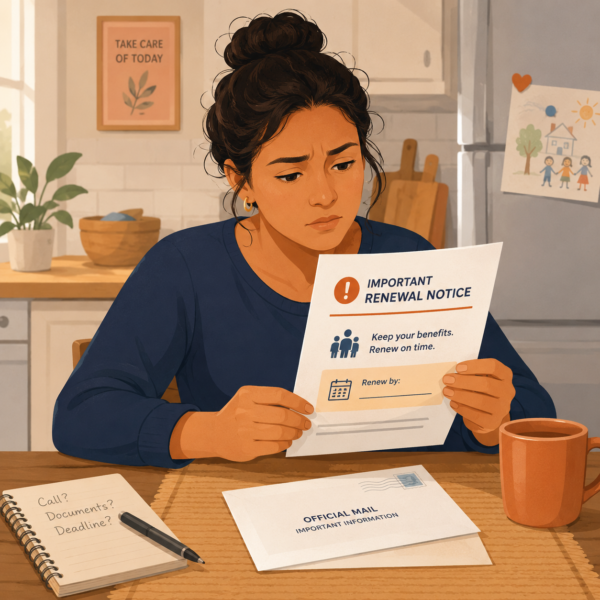
Another example is renewal communication. If a notice, text reminder, portal task, and website page use different terms for renewal, residents may not know whether they are being asked to complete one action or several. They may believe that completing a renewal in one program satisfies all benefits. They may assume submission means approval. They may not understand that documents can still be needed after the renewal form is submitted. Each point of confusion can lead to delays, unnecessary contacts, or avoidable benefit interruptions.
Misalignment also affects trust. When residents hear different explanations from different channels, they may conclude that the agency is disorganized or unreliable. Even if the underlying process is correct, inconsistent communication can make residents doubt whether the agency has their information, understands their case, or is giving them the full answer. Alignment helps agencies protect credibility by making the system feel more coherent and easier to navigate.
Source-of-Truth Discipline Is the Foundation of Channel Alignment
Agencies cannot align communication across channels unless there is a clear source of truth. A source of truth is the maintained place where current guidance lives for a resident task, program issue, process change, or high-volume question. It may be a public web page, an internal knowledge article, a partner toolkit page, a script library, or a maintained set of notice language. The key is that other channels point back to it and reflect its meaning.
Without source-of-truth discipline, channels drift. A notice may be updated while the website still uses old language. A portal screen may change while staff scripts remain the same. A partner handout may continue circulating after a process has been revised. A social media post may link to a page that no longer matches the current instructions. These mismatches are common when content is created quickly and ownership is unclear.
A strong source-of-truth system identifies which page or resource governs each major resident task. Applying, renewing, sending documents, checking case status, reporting changes, replacing an EBT card, understanding a notice, requesting language assistance, and responding to delays should all have maintained guidance. Other channels can summarize, prompt, or reinforce, but they should not become separate versions of the rules.
This discipline also makes updates easier. When a process changes, the agency updates the source of truth first, then updates notices, scripts, portal labels, partner materials, and public messages that depend on it. This helps prevent outdated information from remaining active in the community. It also gives staff and partners a reliable place to verify current guidance before answering resident questions.
Alignment Requires Shared Language for Common Resident Actions
Public benefits agencies often use multiple terms for the same or related actions. Renewal, redetermination, recertification, and eligibility review may appear across different programs or systems. Proof, documents, verification, and evidence may be used interchangeably. Pending, received, submitted, under review, incomplete, and processed may appear in portals or scripts without clear resident-facing definitions. These terms may be precise inside the agency, but residents need a more consistent vocabulary.
Shared language does not mean formal terms disappear. Some terms may be required by law, policy, system design, or program tradition. The goal is to pair formal terms with plain resident-facing explanations and use those explanations consistently across channels. If a formal term appears in a portal, the website and scripts should help residents understand it. If a notice uses a required phrase, the text reminder and call center script should connect that phrase to the action residents need to take.
Shared language should begin with the most common resident actions. Apply, renew, send documents, report a change, check status, attend an interview, read a notice, ask for help, and appeal a decision are the kinds of terms residents need to recognize quickly. Once the agency agrees on how these actions should be described, each channel can adapt the language to its format without changing the meaning.
This shared vocabulary supports staff, partners, and technology teams as well. Staff have clearer scripts. Partners have safer referral language. Website teams can improve search and navigation. Portal teams can better connect system labels to resident meaning. Notices and text alerts can reinforce the same action path. Over time, shared language becomes one of the most practical tools for reducing confusion across the benefits system.
Channel Alignment Should Focus on Meaning, Not Repetition
One message across every channel does not require repeating the same paragraph everywhere. Different channels have different strengths. Notices provide formal information and case-specific direction. Websites explain tasks in plain language. Portals show status and enable action. Text alerts prompt timely responses. Call centers provide clarification and case-specific support. Community partners help residents understand general guidance and connect to official pathways. Each channel should do its own job.
The mistake is allowing each channel to define the message independently. A text alert can be short, but it should still use the same action language as the notice. A portal can show status, but the status should mean the same thing staff explain by phone. A partner toolkit can be simplified, but it should not create expectations the agency cannot meet. A website page can be broader, but it should still align with the formal notice and the current process.
Alignment therefore requires a clear message hierarchy. The agency should define the core meaning first: what is happening, who is affected, what action is required, what deadline matters, what help is available, and where to verify current guidance. Then each channel can carry the part of that message appropriate to its role. This avoids both overloading short channels and underexplaining important ones.
When agencies focus on meaning rather than repetition, communication becomes more flexible and more coherent at the same time. Staff can respond naturally while preserving the core explanation. Partners can share shorter guidance without distorting it. Text alerts can prompt action without trying to become notices. Websites can provide context without contradicting case-specific letters. Residents can move across channels and still feel that they are hearing one agency message.
Alignment Should Begin With the Resident’s Core Question
Channel alignment should begin by identifying the question residents are trying to answer. A resident may want to know whether they need to renew, whether a document was received, whether benefits are delayed, whether a notice requires action, whether a portal status means they should wait, or whether a partner’s guidance is current. If each channel answers a different version of the question, the resident may continue searching for clarity even after receiving several messages.
Human services agencies can improve alignment by defining the core resident question before drafting channel-specific content. For example, if the issue is renewal, the resident’s core question may be whether action is required and by when. If the issue is document submission, the question may be what proof is needed and whether the agency has received it. If the issue is case status, the question may be whether the agency is reviewing information or waiting for the resident to act. Starting with the resident’s question helps the agency create one shared message before adapting it for notices, websites, portals, call centers, and partners.
This approach also keeps communication from becoming overly agency-centered. Internal teams may naturally begin with program rules, system status, processing categories, or workflow ownership. Residents usually begin with practical uncertainty. They need to know what is happening, what they should do, what deadline matters, and where to confirm current information. Alignment becomes stronger when every channel is designed to answer those questions in a consistent way.
Define the One Sentence Residents Should Remember
For each major communication issue, agencies should define the one sentence residents should be able to remember after encountering the message. That sentence might explain that the agency received their documents and is reviewing them, that a renewal must be completed by the date in the notice, or that a missing document must be submitted before the case can move forward. This sentence becomes the anchor for every channel.
The anchor sentence does not need to appear word-for-word everywhere, but its meaning should remain consistent. A text alert may shorten it. A website may explain it in more detail. A call center script may use it as the basis for a conversation. A partner toolkit may turn it into safe referral language. The resident should still hear the same core idea no matter where they turn.
Separate the Core Message From Supporting Detail
A common alignment problem occurs when supporting details compete with the main message. Residents may receive information about rules, forms, offices, portals, phone numbers, rights, deadlines, and program names before they understand the central action. The result is a message that contains information but does not guide behavior.
Agencies should define the core message first, then decide which supporting details belong in each channel. A notice may need formal detail. A website may need examples and explanations. A text alert may need only the action and link. A partner guide may need boundaries and referral language. This separation helps each channel do its job without changing the central meaning.
Notices Should Establish the Official Action Path
Notices often carry the most formal weight in public benefits communication. They may explain eligibility decisions, renewal requirements, document requests, deadlines, benefit changes, appeal rights, or consequences for nonresponse. Because notices are so consequential, they should establish the official action path that other channels reinforce. If the notice is unclear, every other channel may have to repair confusion later.
A well-aligned notice should state the resident action in plain language, identify the program or benefit affected, explain the deadline or timing, and direct the resident to the correct completion path. It should not rely on internal terminology without explanation. If formal language is required, it should be paired with a plain-language explanation that staff, websites, text alerts, and partners can reuse. The notice should give the agency’s communication system a clear foundation.
Other channels should then support the notice rather than reinterpret it. A website can provide more detailed help. A portal can show status or enable the action. A text alert can remind the resident to complete the step. A call center script can explain the same language in conversation. A partner toolkit can help residents locate the official path without offering case-specific determinations. Alignment begins to fail when those channels create a different action path from the one in the notice.
Required Language Should Be Connected to Plain Meaning
Some notices must include formal language, legal references, program terms, or rights information. Those requirements should remain, but they should not be the only explanation residents receive. A resident should not have to understand technical terminology before knowing what action is needed.
A notice can preserve required language while adding plain meaning. If the notice uses a term such as redetermination, verification, adverse action, or appeal, it should explain what that means in practical terms. The same plain explanation should then appear in scripts, websites, and partner materials so residents hear a consistent translation across channels.
Notice Language Should Anticipate Follow-Up Questions
Notices should be drafted with likely follow-up questions in mind. If residents usually call to ask what document is missing, whether a deadline still applies, where to submit proof, or whether the agency received something, the notice should answer those questions more clearly. The goal is not to make every notice long. The goal is to prevent predictable confusion.
Agencies can use call trends, staff feedback, and partner input to improve notice language over time. When recurring questions appear after a notice goes out, those questions should inform the next version of the notice and the supporting messages used across other channels.
Websites Should Expand the Message Without Changing It
Agency websites are often where residents go when they need more explanation than a notice or text alert can provide. A website can explain a process, provide examples, link to forms, describe submission options, clarify status terms, and direct residents to help. But the website should not introduce a different message from the notice. It should expand the message while preserving the same action path.
For example, if a notice tells residents to renew benefits, the website should explain how renewal works, what information may be needed, how to submit the renewal, what happens after submission, and how to get help. It should not use unrelated terminology or bury renewal guidance under agency divisions. If a text alert tells residents to send documents, the website should explain document submission in the same plain-language terms and connect those terms to any formal labels residents may see in the portal.
A source-of-truth page is especially useful for high-volume tasks. Applying, renewing, sending documents, checking case status, reporting changes, understanding notices, requesting language assistance, and responding to EBT issues should have clear, maintained pages that other channels can reference. These pages help prevent every channel from becoming its own explanation. They give residents, staff, and partners one stable place to verify current guidance.
Website Pages Should Be Organized Around Tasks
Program pages still matter, but residents often arrive with tasks. They need to renew, upload documents, report a change, check status, replace a card, or understand a notice. Website pages should make those tasks easy to find and should use the same language residents see in notices and reminders.
Task-based web pages make alignment easier because they give other channels a clear destination. A text alert can point to the renewal page. A call center script can reference the document submission page. A partner toolkit can link to the language assistance page. The website becomes the fuller explanation behind shorter messages.
Web Updates Should Happen Before Other Channels Point There
Agencies should update source-of-truth pages before sending notices, texts, partner messages, or social posts that direct residents to them. If the page is outdated or incomplete, the campaign will create confusion at the moment residents seek help.
This sequencing should be built into communication planning. The website is not a final detail. It is the foundation that makes shorter channels more useful and safer to share.
Portals Should Translate System Status Into Resident Meaning
Portals often display information generated by eligibility systems, document workflows, or vendor platforms. Those labels may be accurate internally but unclear to residents. A resident may see pending, incomplete, submitted, received, processed, or under review without knowing whether action is required. If portal language does not match notices and staff explanations, residents may call, resubmit documents, or assume something is wrong.
A channel-aligned portal should translate status into resident meaning. If a document was received but not reviewed, the portal should make that distinction clear. If no action is needed while the agency reviews the case, the portal should say so. If information is missing, the portal should identify the missing item when possible and direct the resident to the official notice or task page. The portal should reduce uncertainty, not simply expose system labels.
Portal alignment also requires terminology bridges. If the system uses a formal term, the website, notices, and scripts should explain that term in plain language. Residents should not encounter a new vocabulary every time they move from paper to digital. The portal should feel like part of the same communication journey, not a separate technical environment.
Status Labels Should Answer “Do I Need to Act?”
One of the most important functions of portal communication is helping residents know whether they need to act or wait. A vague status label can generate unnecessary calls because residents do not know what it means. Clear status language can reduce that uncertainty.
Each status should be connected to resident action. Received should explain that the agency has the information. Under review should explain whether the resident needs to do anything now. Incomplete should explain what is missing. Completed should explain what has been completed and whether any other step remains.
Confirmation Messages Should Avoid False Closure
Residents may believe that submitting a form or uploading a document means the case is complete. In many situations, the agency still needs to review the information. Portal confirmations should make that clear.
A strong confirmation message says what happened and what did not happen yet. It can explain that the agency received the submission, that review is still needed, and that the resident will be contacted if more information is required. This prevents false closure and reduces duplicate contact.
Call Centers and Partners Should Reinforce the Same Core Message
 Call centers and partners often become the channels residents use when they are still uncertain. That makes alignment especially important. If residents call after reading a notice or checking a portal, staff should not have to invent an explanation from scratch. They should have a script that reinforces the same message residents already saw. If a resident asks a school, clinic, food bank, library, or legal aid organization for help, the partner should have safe language that points back to the official source without creating a competing explanation.
Call center scripts should be built from the same source-of-truth language used in notices, websites, and portals. Staff need clear explanations of common statuses, deadlines, documents, renewal steps, and escalation pathways. They also need guidance on what not to promise. Alignment protects staff from having to reconcile conflicting materials during live conversations and helps residents hear a consistent answer.
Partner materials should be similarly bounded. Partners can help residents find official information, understand general steps, prepare questions, and connect to the agency. They should not be asked to make case-specific determinations or promise outcomes. A partner toolkit should therefore reinforce the core message while making boundaries clear. When call centers and partners are aligned, residents receive a more coherent communication experience across both formal and trusted community channels.
Staff Should Know What Residents Have Already Received
Call center representatives, lobby staff, eligibility workers, and supervisors should know when major notices, text alerts, portal updates, or campaigns have gone out. Residents often call with those messages in hand. If staff do not know what was sent, they may unintentionally create confusion or provide an answer that does not match the public communication.
Internal previews, short scripts, message summaries, and supervisor briefings can help staff prepare. Staff alignment should happen before residents begin responding, not after call volume increases.
Partner Guidance Should Be Current, Shareable, and Bounded
Partner guidance should use the same resident-facing terms as the agency’s source-of-truth materials. It should be easy to share in conversations, newsletters, handouts, and resource lists. It should also clearly identify when residents must return to the agency for case-specific answers.
This protects the resident, the partner, and the agency. Partners can be helpful without overstepping, and residents are directed back to the official path when accuracy depends on case review.
Alignment Should Be Managed Before Messages Go Public
Channel alignment is much easier to protect before messages are released than after residents begin responding to conflicting information. Once a notice has been mailed, a text alert has gone out, a portal message is live, and partners have shared a flyer, it becomes much harder to correct confusion. Residents may save screenshots, forward messages, print old materials, or repeat guidance they received from a trusted source. A small inconsistency can spread quickly across the communication environment.
Human services agencies should build alignment review into the message development process. Before a major communication goes public, the agency should compare the notice language, website content, portal instructions, text alerts, call center scripts, lobby guidance, and partner materials that residents may encounter. The review should focus on whether the resident hears the same action, deadline, status explanation, and help pathway across channels. This does not require every channel to use identical language. It requires the agency to confirm that the meaning is consistent.
This review is especially important for high-consequence topics such as renewals, document requests, benefit delays, case closures, EBT theft, portal changes, language access, and appeal pathways. These are the moments when residents are most likely to seek confirmation from multiple sources. If the channels are aligned before release, residents are more likely to understand the message the first time. If they are not aligned, the agency may spend days or weeks repairing confusion that could have been prevented.
Internal Teams Need a Shared Message Brief
A shared message brief can help agencies align channels before communication reaches the public. The brief does not need to be long. It should define the core resident message, the affected audience, the action required, the deadline or timing, the source of truth, the role of each channel, and the language staff and partners should use. It should also identify what should not be promised, especially when a case decision, timeline, document acceptance, or benefit outcome depends on review.
The value of a message brief is that it gives every team the same foundation. Program staff can confirm accuracy. Communications staff can shape plain language and tone. Digital teams can update website and portal content. Call center leaders can prepare scripts. Lobby staff can prepare for in-person questions. Partner liaisons can create shareable guidance. Supervisors can brief frontline teams. Instead of each group interpreting the issue separately, everyone works from one agreed explanation.
A message brief is particularly useful when a communication issue crosses programs or service channels. A renewal sequence, for example, may involve formal notices, text reminders, portal tasks, website content, call center explanations, partner outreach, and staff coaching. Without a shared brief, each channel may emphasize a slightly different version of the message. With a shared brief, each channel can adapt the message to its format while preserving the same core meaning.
Staff Alignment Should Happen Before Residents Start Calling
Residents often call the agency shortly after receiving a notice, text alert, portal message, or public update. Staff should not first learn about that communication from residents. When that happens, staff may have to read the message for the first time during a live conversation, interpret its meaning quickly, and reconcile it with what they see in the case system. That creates avoidable risk for inconsistent explanations.
Agencies should prepare staff before major messages go out. Call center representatives, lobby staff, eligibility workers, supervisors, navigators, and contracted service teams should know what residents are receiving, who is receiving it, what action the message prompts, and where residents should be directed for more information. Staff should also know the difference between general guidance and case-specific review. This allows them to answer with confidence without overpromising.
Staff alignment also helps residents feel that the agency is organized. When a resident calls about a text reminder and the representative immediately understands the message, the resident receives confirmation that the channel is legitimate and connected to the agency’s process. When a resident visits a lobby with a notice and staff use the same terms printed on the notice, the process feels more coherent. These small moments of alignment can reduce anxiety and build trust.
Partner Alignment Requires More Than Sending Materials
Community partners can reinforce agency communication, but only if they receive guidance that is current, usable, and clearly bounded. Schools, clinics, food banks, libraries, legal aid organizations, housing providers, child care resource organizations, and other partners often help residents interpret notices, find official pages, use portals, gather documents, or understand where to ask for help. If partners receive only dense materials or late updates, they may unintentionally create a separate version of the message.
Partner alignment should begin with the same core message used internally. Partners need to know what residents are being asked to do, where official guidance lives, what language they can safely share, and what questions must return to the agency. They also need to understand what not to promise. A partner can help a resident find the renewal page, understand a general document request, or prepare questions for a call. A partner should not be expected to determine eligibility, confirm approval, guarantee timelines, or interpret protected case details.
The timing of partner alignment matters. If partners receive guidance only after residents start asking questions, misinformation may already be circulating. Agencies should brief partners before major campaigns, renewal periods, portal changes, EBT alerts, backlog updates, or other high-volume communication moments. A brief partner update can make community guidance more accurate and reduce the likelihood that residents receive different answers from trusted local organizations and official agency channels.
Digital Channels Need Alignment With Human Support
Digital communication often creates the first prompt for resident action, but human support often resolves the confusion that follows. A resident may receive a text, open a portal, read a website page, and then call because the status is unclear. If the digital channel and the human support channel are not aligned, the resident may lose confidence quickly. A portal status that says one thing and a staff explanation that sounds different can make residents wonder whether their case is being handled correctly.
Agencies should review digital messages through the lens of staff support. If a portal status uses a term such as pending, under review, incomplete, or received, staff should have the same definition and plain-language explanation. If a text alert tells residents to send documents, staff should know which notice, task page, or portal screen lists the required item. If a website explains a renewal sequence, call center scripts should mirror that sequence when residents ask for help.
Digital alignment also requires confirmation language. Residents need to understand what happened after they submitted a form, uploaded a document, or responded to a request. If a portal confirms receipt but does not explain that review is still pending, staff may receive unnecessary calls. If a text reminder continues after a resident has acted, staff may have to explain why the message was sent. Digital channels should reduce uncertainty before residents need human support, and staff should be prepared to reinforce the same meaning when support is needed.
Feedback Loops Should Identify Where Alignment Breaks
Even well-planned messages can break down once residents begin using them. A notice may be clear to internal reviewers but confusing to residents. A portal label may not match the words residents search for online. A partner toolkit may be accurate but too long to use in a real conversation. A call center script may be technically correct but not aligned with the text alert residents received. Agencies need feedback loops that identify where alignment is failing in practice.
Useful signals can come from call trends, website searches, portal behavior, staff observations, partner questions, lobby patterns, document submission errors, resident surveys, and complaint themes. If residents repeatedly ask whether a text is legitimate, the sender identity or source-of-truth path may need improvement. If residents ask whether documents were received, confirmation language may need revision. If partners ask the same question after a campaign launches, partner guidance may need to be clearer or earlier.
The purpose of feedback is not simply to diagnose problems. It is to update the communication system. When alignment breaks, agencies should revise the source of truth, update channel-specific messages, brief staff, inform partners, and retire outdated materials. Alignment is not a one-time review. It is an ongoing discipline that must be maintained as programs, systems, resident questions, and operational conditions change.
Alignment Requires Clear Ownership, Not Just Good Intentions
Channel alignment does not happen because teams agree that consistency is important. It happens because someone owns the coordination process. In many human services agencies, notices, websites, portals, call center scripts, partner materials, lobby signs, and text alerts are managed by different units with different priorities and timelines. Each team may be doing responsible work within its own area, but the resident can still receive a fragmented message if no one is responsible for seeing the full communication path.
Clear ownership means the agency knows who approves the core message, who maintains the source of truth, who updates channel-specific materials, who briefs staff, who informs partners, and who retires outdated content. Ownership should not mean that one person writes everything or that one office controls every detail. Public benefits communication requires program accuracy, operational realism, legal review, plain language, digital usability, language access, and frontline practicality. The point of ownership is to make sure those perspectives come together before residents are asked to act.
This is especially important when processes change. A portal update, renewal sequence, document submission change, service model adjustment, or backlog message can affect several channels at once. If ownership is unclear, one channel may be updated while another remains outdated. Residents may then receive one instruction in a notice, another on the website, and another from a partner flyer. Clear ownership gives the agency a way to manage change across the full communication system instead of leaving alignment to chance.
Channel Alignment Should Include Language Access and Accessibility From the Start
A message is not truly aligned if it is only aligned in English or only aligned for residents who can easily use digital tools. Human services agencies serve residents with different languages, literacy levels, disabilities, technology access, and support needs. If translated notices use one phrase, the website uses another, the portal remains English-only, and call center scripts do not match the translated material, residents may still experience confusion even when the agency believes the channels are coordinated.
Language access should therefore be part of the alignment process from the beginning. The agency should review whether key terms are translated consistently, whether plain-language explanations survive across languages, whether multilingual source-of-truth pages are current, and whether staff and interpreters have shared guidance. If a formal term appears in one channel, residents should be able to find the same meaning in translated materials, scripts, partner guidance, and digital tools. Alignment should preserve meaning across language, not only across format.
Accessibility should be treated the same way. A message may be aligned on paper but difficult to use on a mobile device, in a screen reader, in a lobby setting, or through a portal interface. Residents should be able to understand the same core action whether they read a mailed notice, listen to staff explain it, receive support from an interpreter, visit a website, or ask a partner organization for help. Alignment is strongest when the agency designs for real resident access conditions rather than assuming one preferred channel will work for everyone.
Alignment Should Reduce Repetition Without Removing Reinforcement
Residents often need to hear important information more than once. A renewal reminder, document request, status update, or deadline warning may require reinforcement across several channels. The goal of alignment is not to eliminate repetition. The goal is to make repetition useful. When each channel repeats the same core meaning with the right level of detail, residents gain confidence. When each channel repeats a slightly different message, residents gain doubt.
Useful reinforcement has sequence and purpose. A notice can provide the formal requirement. A text alert can remind the resident to act. A website page can explain the task in plain language. A portal can show current status. A call center script can clarify case-specific questions. A partner message can point residents back to the official source. Each channel supports the others without forcing the resident to reconcile different terms or instructions.
Poor repetition creates noise. If a resident keeps receiving reminders after they have already acted, or if reminders do not reflect whether the agency has received information, the resident may call repeatedly or resubmit documents. If several channels say essentially the same thing but none of them explains the next step clearly, the repetition may increase frustration rather than completion. Alignment should help agencies decide when repetition is helpful, when it should change based on status, and when it should stop.
Agencies Should Retire Old Messages as Deliberately as They Release New Ones
Channel alignment can be undermined by old communication that remains in circulation. An outdated flyer may sit in a partner office. A prior portal screenshot may remain in a training deck. A lobby sign may refer to a former process. A web page may still rank in search even after a task has changed. A social media post may continue to be shared long after guidance has been updated. Residents often do not know which message is current, especially when old materials look official.
Agencies should build message retirement into the communication process. When a new source-of-truth page, notice template, script, or partner message is released, the agency should identify what old materials need to be removed, replaced, archived, or clearly labeled as outdated. This is not just a document management issue. It is a trust issue. Residents should not be expected to choose between competing official messages.
Retiring old messages also helps staff and partners. Frontline teams should not have to explain why a resident brought in an old flyer that no longer applies. Partners should not unknowingly share an outdated link. Supervisors should not coach staff using scripts that no longer match current guidance. Message alignment depends on both updating the current message and reducing the influence of prior messages that can confuse the resident journey.
Leadership Messaging Should Match Operational Guidance
Leadership communication can shape how residents, staff, elected officials, media, and partners understand a benefits issue. When agency leaders communicate about renewals, delays, technology changes, service improvements, EBT concerns, or access initiatives, their message should match the operational guidance residents receive in notices, websites, portals, and call center scripts. If leadership uses broad reassuring language while operational materials describe unresolved steps or delays, the agency may create an expectation gap.
Leadership messaging should therefore be grounded in the same source-of-truth framework as resident-facing communication. It can provide context, explain agency priorities, acknowledge concerns, and reinforce trust, but it should not introduce a different explanation of what residents should do. If residents still need to respond to notices, submit documents, check status, or wait for review, leadership language should support that reality. Public confidence is strengthened when leadership communication and service instructions reinforce each other.
This alignment is especially important during difficult moments. Backlogs, benefit delays, system changes, and high-volume renewal periods can attract public attention. Leaders may need to explain what the agency is doing while staff are explaining what residents should do. Those messages should not compete. A disciplined leadership message acknowledges the issue, points to the official source of truth, reinforces the resident action path, and avoids promises the operational system cannot support.
Alignment Should Be Maintained Through Governance and Routine Review
One message across every channel is not a one-time achievement. It requires governance and routine review. Public benefits programs change, portals are updated, forms are revised, policies shift, staff turnover occurs, partner materials age, and residents continue to ask new questions. Even a well-aligned communication system can drift if no one reviews it regularly.
Agencies should establish practical review routines for high-volume resident tasks. Applying, renewing, sending documents, reporting changes, checking status, understanding notices, requesting language assistance, and responding to benefit delays should all be reviewed across channels periodically. The review should ask whether the notice, website, portal, script, partner guidance, and lobby materials still say the same thing in ways residents can understand. It should also consider whether call trends, partner feedback, survey results, or staff observations show that alignment is breaking down.
Governance does not need to be overly complicated. It needs to be consistent enough that alignment survives normal agency change. A regular communication review, shared message library, source-of-truth ownership model, staff briefing process, partner update process, and outdated-content retirement practice can make a major difference. Alignment is a discipline. When agencies maintain it deliberately, residents are more likely to hear one coherent message wherever they turn.
Strategic Communication Support for Human Services and Public Benefits Agencies
 Channel alignment is not simply a communications preference. It is part of how human services and public benefits agencies help residents understand complex processes, complete required steps, and trust official guidance. Residents may move between notices, websites, portals, text alerts, call centers, lobby desks, staff conversations, and community partners during the same benefits issue. If those channels do not reinforce the same core message, the resident experience becomes harder, less predictable, and more vulnerable to confusion.
Because channel alignment touches policy, operations, technology, staff training, partner outreach, language access, accessibility, and leadership messaging, many agencies benefit from structured communication support. Internal teams may each manage their own channel responsibly, but residents experience the full system together. A notice may be accurate, a website may be helpful, and a call center script may be technically correct, but if they use different terms or point to different next steps, the overall message can still fail.
Stegmeier Consulting Group (SCG) helps human services and public benefits agencies build communication systems that align resident-facing messages across channels. That support may include source-of-truth page development, message briefs, notice and website alignment, portal status language review, call center scripts, partner toolkit language, staff briefing materials, leadership talking points, and communication governance frameworks. The goal is not to make every channel identical. The goal is to make sure every channel reinforces the same action, status, deadline, help pathway, and resident-facing meaning.
This type of support is especially valuable when agencies are managing renewals, document campaigns, portal updates, benefit delays, EBT communication, language access needs, partner outreach, or high-volume resident confusion. Strong channel alignment helps residents hear one coherent message wherever they turn. It also helps staff communicate with confidence, helps partners share accurate guidance, and helps agencies reduce avoidable workload created by mixed instructions.
Future Trends in Channel Alignment for Human Services Communication
Human services agencies are likely to place greater emphasis on channel alignment as resident communication becomes more digital, more immediate, and more multi-directional. Residents increasingly expect to receive reminders by text, check status in a portal, find explanations online, call for help, and ask trusted partners for support. Agencies will need communication systems that connect those experiences into one clear resident journey rather than treating each channel as a separate output.
Another likely trend is stronger source-of-truth governance. Agencies will need maintained task pages, shared message libraries, current scripts, partner-ready materials, and clear ownership for updating guidance when processes change. As portals, notices, and digital reminders become more central to benefits administration, outdated or inconsistent guidance will become more visible to residents and more costly for agencies to manage.
Agencies may also rely more on feedback signals to identify alignment gaps. Call trends, partner questions, website searches, portal abandonment, duplicate document submissions, lobby confusion, and resident survey responses can all show where channels are not reinforcing the same message. These signals can help agencies identify whether the issue is notice wording, portal language, staff scripts, source-of-truth pages, partner materials, or the sequence of communication itself.
Finally, channel alignment will likely become more closely tied to equity, language access, and accessibility. A message is not fully aligned if it only works for residents who read English, use the portal comfortably, or understand formal program terminology. Agencies will need to preserve the same core meaning across languages, formats, devices, support networks, and service settings. The strongest communication systems will help residents understand the same action whether they receive a notice, hear a staff explanation, read a translated page, use a mobile device, or ask a partner organization for help.
Conclusion
Human services agencies communicate through many channels, but residents need one coherent message. A resident should not have to reconcile different terms, conflicting status explanations, outdated partner materials, unclear portal labels, or call center scripts that do not match the notice in their hand. When channels are misaligned, the burden of interpretation shifts to residents, staff, and partners.
Channel alignment helps agencies reduce that burden. It begins with the resident’s core question, establishes a maintained source of truth, uses shared language for common actions, prepares staff before residents call, equips partners with current and bounded guidance, and retires old messages before they continue circulating. Each channel can still serve a different role, but the meaning should remain consistent.
In the end, one message across every channel is a practical standard for public benefits communication. It supports access, reduces avoidable confusion, protects staff capacity, strengthens partner trust, and makes the benefits system easier for residents to navigate. When agencies align notices, websites, portals, call centers, and partners around the same resident-facing guidance, they create a clearer and more trustworthy path through complex public benefits processes.
SCG’s Strategic Approach to Communication Systems
Align your agency’s messaging, processes, and public engagement strategies.
Human services and public benefits agencies need communication systems that keep resident-facing guidance consistent across every channel. Notices, websites, portals, text alerts, call center scripts, lobby materials, staff explanations, partner toolkits, and leadership messages should all reinforce the same source of truth so residents understand what is happening, what action is required, and where to get help.
SCG helps agencies create communication frameworks that support clarity, consistency, access, and trust across complex service environments. Whether your agency is aligning renewal notices, improving portal status language, updating source-of-truth pages, preparing staff scripts, equipping partners, or strengthening communication governance, SCG can help build a system that gives residents one coherent message across every channel. Use the form below to connect with our team and explore how a strategic communication system can help your agency align public benefits communication and improve the resident experience.