Rumor Control for Human Services Agencies: How to Respond to Misinformation Before It Spreads
Misinformation can spread quickly when people are worried about public benefits. A rumor about SNAP eligibility, Medicaid renewals, cash assistance payments, child care assistance, EBT cards, immigration-related fears, fraud investigations, office closures, benefit reductions, or application deadlines can move through social media, text groups, community conversations, local news, advocacy networks, schools, clinics, food pantries, and family circles before an agency has time to respond. By the time staff begin hearing the same question repeatedly, the rumor may already be shaping resident behavior.
For human services agencies, public benefits agencies, county social services departments, and state benefits offices, rumor control is not just a communications task. It is an access issue, an operational issue, and a trust issue. When residents believe inaccurate information, they may fail to apply for benefits, miss a renewal, avoid answering agency calls, delay submitting documents, withdraw from a program, panic about benefit loss, or share incorrect guidance with others. Staff may then face spikes in call volume, lobby visits, partner questions, complaint escalation, and case confusion. A rumor that begins as a single misunderstanding can quickly become a systemwide burden.
Human services misinformation is especially sensitive because benefits are connected to household stability. Residents may be trying to keep food on the table, maintain health coverage, secure child care, manage income loss, respond to a document request, or help a family member navigate a difficult case. In that context, even a vague claim can feel urgent. A post that says “benefits are ending next month,” “everyone has to reapply,” “do not answer calls from the agency,” or “your card will be shut off unless you click this link” can cause real harm. Residents may act before verifying because the perceived consequence feels immediate.
The challenge for agencies is that misinformation often fills gaps in official communication. If residents do not know where to verify information, if notices are hard to understand, if program rules are changing, if call wait times are long, or if partners have not received clear guidance, rumors become more believable. People may trust the fastest explanation available, especially if it comes from someone they know or appears to match a recent experience. A resident who received a confusing renewal notice may be more likely to believe a rumor about mass benefit closures. A partner organization that lacks updated guidance may unintentionally repeat an outdated explanation. A staff member without approved talking points may give a correct but inconsistent response that leaves room for more confusion.
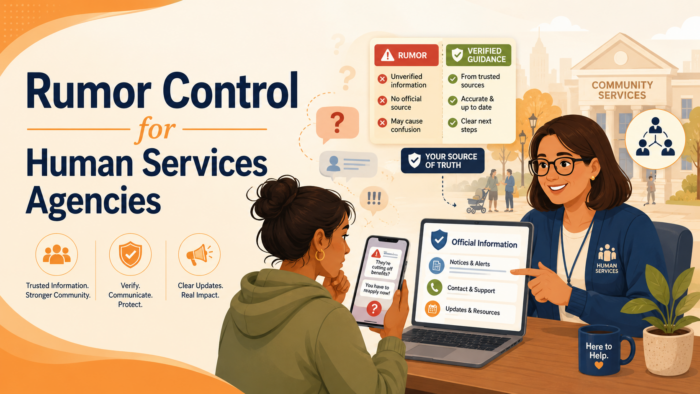
Rumor control should therefore be treated as part of the agency’s communication system, not as a crisis response tactic used only after misinformation has already spread. Agencies need predictable source-of-truth pages, plain-language FAQs, staff scripts, partner updates, social media monitoring, resident-facing corrections, and internal escalation paths that help them respond quickly and consistently. The goal is not to argue with every inaccurate post. The goal is to give residents, staff, partners, and the public a clear place to verify what is true, what has changed, what has not changed, and what action residents should take.
A strong rumor control approach is calm, specific, and practical. It does not repeat false claims in ways that amplify them unnecessarily. It does not dismiss resident concern. It does not wait until confusion becomes widespread. Instead, it identifies the misunderstanding, explains the accurate information in plain language, names the official action residents should or should not take, and points people to a trusted source for updates. For public benefits agencies, this kind of communication can reduce panic, protect access, support staff, and preserve trust during moments when uncertainty might otherwise spread faster than facts.
Why Rumors Spread Quickly in Public Benefits Environments
 Rumors spread quickly in public benefits environments because residents are often managing high-stakes decisions with incomplete information. A household may be waiting for a renewal decision, trying to understand a verification request, checking whether benefits were loaded, responding to a child care authorization issue, or deciding whether to apply for a program. When information is unclear or delayed, people naturally look for explanations. If the agency has not provided a clear answer, a rumor can become the answer that circulates.
Public benefits programs also involve rules that can be difficult to summarize. Eligibility may depend on income, household composition, residency, immigration-related rules, work requirements, reporting obligations, verification, deadlines, program categories, and case-specific facts. A small change in one area can be misunderstood as a larger change across all benefits. A renewal reminder may be misread as a closure warning. A targeted fraud alert may be interpreted as a threat to all recipients. A change affecting one program may be repeated as though it affects every household. The more complex the rules, the easier it is for partial information to become misinformation.
Another reason rumors spread is that residents often rely on informal networks for help. Family members, friends, neighbors, schools, clinics, food banks, legal aid organizations, child care providers, landlords, faith groups, and social media communities may all play a role in helping people interpret benefits information. These networks are essential sources of support, but they can also spread outdated or incomplete information when official guidance is not easy to find. A well-intentioned person may share what was true for one case, one county, one program, or one point in time as if it applies more broadly.
Agencies should not interpret this reliance on informal networks as a failure by residents. It is often a rational response to complicated systems. People turn to sources they trust when official communication feels hard to understand or hard to access. Rumor control works best when agencies recognize that trusted community channels are part of the communication environment. The agency’s role is to make accurate information easier for those channels to repeat.
Silence Can Allow Misinformation to Define the Issue
When misinformation begins to spread, agency silence may be interpreted in several ways. Residents may assume the rumor is true because the agency has not contradicted it. Partners may hesitate to correct the rumor because they do not have approved language. Staff may answer questions differently because there is no shared response. Local media or elected officials may begin asking for clarification after the rumor has already shaped public perception. In these situations, silence does not always sound neutral. It can sound like confirmation, uncertainty, or lack of awareness.
This is why timing matters. Human services agencies do not need to respond publicly to every small misunderstanding, but they do need a way to identify when a rumor is likely to affect resident behavior or program operations. A rumor that causes people to miss deadlines, stop using benefits, avoid official communication, expose personal information, or flood call centers needs a faster response than a minor error with limited reach. Agencies should have internal criteria for deciding when misinformation requires public correction, partner guidance, staff talking points, or a website update.
A timely response does not have to be dramatic. In many cases, a short clarification can prevent confusion from spreading. The agency can state the accurate information, explain who is affected, identify any action residents should take, and direct people to an official source. The response should be easy for staff and partners to repeat. It should not require residents to understand policy history or legal detail before knowing what to do. The faster the agency provides a clear, usable correction, the less space remains for speculation.
Silence is especially risky when the rumor concerns benefit loss, program eligibility, fraud, immigration fears, scams, or deadlines. These topics can cause residents to make immediate decisions. A family may not wait for a formal press release before choosing whether to respond to a notice or use a benefit card. Rumor control needs to meet the urgency of resident decision-making while still staying accurate and disciplined.
More Than Just Applications: Human Services and Public Benefits Communication Strategies for State and Local Agencies
This article is part of our series on strategic communication for Human Services Agencies, Public Benefits Agencies, and Health and Human Services departments. To learn more and to see the parent article, which links to other content just like this, click the button below.
Rumor Control Starts Before a Rumor Appears
The strongest rumor control systems are built before misinformation becomes visible. Agencies are better positioned to respond when residents already know where official information lives, partners already know how to verify updates, staff already have plain-language scripts, and the agency already uses consistent terminology across notices, portals, websites, text reminders, emails, and call center responses. When those foundations are missing, every rumor becomes harder to correct because the agency has to build trust and explain the facts at the same time.
A source-of-truth page is one of the most important foundations. This page can house current program updates, common questions, official deadlines, scam alerts, contact information, and corrections to active misinformation when needed. It should be easy to find, mobile-friendly, and written in plain language. It should also show when information was last updated so residents and partners can tell whether they are looking at current guidance. A source-of-truth page does not eliminate rumors, but it gives everyone a stable place to verify information before repeating it.
Staff alignment is another foundation. Frontline staff often hear misinformation early because residents bring rumors to call centers, lobbies, eligibility workers, reception desks, and local offices. If staff do not have a shared way to respond, the agency may unintentionally produce inconsistent corrections. A short rumor response guide can help staff explain what is true, what is not true, where residents should verify details, and when questions should be escalated. This protects staff from improvising under pressure and helps residents receive the same message across contact points.
Partner alignment is equally important. Community organizations, clinics, schools, libraries, food banks, legal aid offices, housing providers, child care resource organizations, and faith-based groups often become messengers during confusion. Agencies should not wait until misinformation spreads to begin communicating with these partners. Regular partner updates, simple correction language, and ready-to-share FAQs can help accurate information move through the same networks where rumors might otherwise grow.
Good Rumor Control Focuses on Resident Action
A rumor control message should not simply say that something is false. It should help residents understand what to do. If the rumor claims that all benefits are ending, the correction should explain who is actually affected, what residents should check, and where official notices or case status can be verified. If the rumor says residents should ignore agency calls, the correction should explain how residents can verify official calls safely. If the rumor says a new application is required, the correction should clarify when applications, renewals, or updates are actually needed. The resident needs a practical next step, not just reassurance.
This action focus matters because residents may be making decisions under stress. A message that says “this rumor is not true” may not be enough if the resident still does not know whether their own case is affected. A stronger response gives residents a path: check your official notice, log into the verified portal, call the published agency number, review the updated FAQ, submit documents by the stated deadline, or avoid clicking suspicious links. The correction should move people from uncertainty to safe action.
Action-focused rumor control also reduces workload. If a correction only denies a claim, residents may still call the agency to ask what they should do. If the correction includes the relevant next step, some residents can resolve their uncertainty without adding to call volume. Staff and partners can also repeat the same guidance, which reduces the chance of inconsistent explanations. In this way, rumor control becomes both a public information strategy and an operational support tool.
The tone should remain steady and respectful. Residents who believe or share a rumor are not necessarily careless. They may be responding to confusing notices, unclear policy changes, old information, or a real concern that has been distorted. A good correction does not shame people. It acknowledges concern, gives accurate information, and points to the official path forward.
Agencies Need a Clear Threshold for Public Response
Human services agencies do not need to publicly respond to every inaccurate comment, isolated misunderstanding, or small social media post. Responding to every rumor can unintentionally give misinformation more attention than it would otherwise receive. At the same time, waiting too long can allow a harmful claim to shape resident behavior before the agency has provided accurate guidance. The strongest approach is to create a clear internal threshold for when misinformation requires action. That threshold should consider whether the rumor could cause residents to miss a deadline, avoid applying, stop using benefits, ignore legitimate agency communication, expose personal information, overwhelm staff, or misunderstand a major program change.
A public response is most important when misinformation affects action. Rumors about benefit termination, eligibility changes, fraud investigations, immigration-related consequences, EBT card access, renewal requirements, office closures, application deadlines, or scam messages can all influence what residents do next. If the misinformation could change behavior in a way that harms residents or disrupts agency operations, the agency should not wait for perfect visibility before preparing a correction. A timely clarification can remain narrow, calm, and factual while still giving residents and partners the guidance they need to avoid acting on false or incomplete information.
Not Every Rumor Needs the Same Response
Different rumors require different levels of response. A small misunderstanding may only require updated staff talking points or a direct response to a partner organization. A rumor circulating across several community groups may require a website FAQ, partner email, and call center script. A widespread claim affecting resident behavior may require coordinated social media posts, a public statement, text or email clarification, local media outreach, and direct partner briefings. Treating every rumor the same way can either over-amplify minor confusion or under-respond to information that is already affecting access.
Agencies should match the response to the risk. The more likely a rumor is to affect benefits, deadlines, resident safety, personal information, or public trust, the more visible and coordinated the response should be. This allows the agency to stay disciplined while still acting quickly when the situation requires it.
The First Correction Should Be Short, Clear, and Usable
The first correction does not need to explain every policy detail. It needs to stabilize the situation. Residents should quickly understand what is true, who is affected, what action is needed, and where to verify current information. If the correction is too long or too technical, it may not travel well through the same channels where the rumor is spreading.
A useful first correction might clarify that a deadline has not changed, that only certain households are affected, that the agency is not asking for EBT PINs, that residents should continue responding to official renewal notices, or that people should verify messages through the published agency phone number or official portal. More detailed explanation can follow on a source-of-truth page, FAQ, partner bulletin, or staff guide.
Rumor Control Messages Should Avoid Repeating the False Claim Too Strongly
A rumor control response should correct misinformation without accidentally helping it spread. When agencies repeat a false claim too prominently, use dramatic language, or structure the message around the rumor itself, residents may remember the false idea more than the correction. This is especially risky when the rumor is simple and the correction is complicated. A message that begins by restating a frightening claim may unintentionally make that claim more familiar, even if the agency later explains that it is wrong.
A stronger approach leads with accurate information. Instead of centering the rumor, the agency can state the correct action or policy first, then briefly clarify the misunderstanding if needed. For example, if a rumor claims that all residents must reapply immediately, the agency can lead with the accurate guidance: “Most residents do not need to submit a new application unless they receive an official notice asking them to do so.” The message can then point residents to the official place to check their case or read current updates. This structure helps residents remember what they should do, not only what they should doubt.
Source-of-Truth Pages Should Be Ready Before Confusion Peaks
A source-of-truth page gives residents, staff, partners, local officials, and media one place to verify accurate information. For human services agencies, this is especially important because rumors often involve details that cannot fit into a short social media post or call center script. Residents may need to know who is affected, which program is involved, what action is required, which deadlines apply, how to verify case status, and where to report suspicious messages. If the agency does not have a stable page for those answers, people may continue relying on screenshots, forwarded posts, outdated notices, or informal explanations.
The page should be easy to find and easy to trust. It should use plain language, include a visible “last updated” line, explain what changed and what did not change, and provide the safest next steps for residents. It should also avoid becoming a cluttered archive of every rumor the agency has ever addressed. The page should focus on current questions, active corrections, common misunderstandings, and official verification pathways. When staff and partners can point to the same page, the agency’s correction becomes easier to repeat consistently.
Staff Should Hear the Correction Before Residents Start Calling
Frontline staff are often the first people residents contact after hearing a rumor. If staff do not receive clear guidance before or at the same time as the public correction, the agency may lose control of the message even while trying to fix the problem. Residents may call the contact center, visit a local office, speak with an eligibility worker, ask a receptionist, or contact a program specialist. If each person explains the issue differently, the rumor may continue to spread through inconsistent correction.
A staff message should be short, practical, and easy to use. It should explain the rumor or concern in neutral terms, state the accurate information, identify who is affected, provide the approved resident-facing language, and name the escalation path for questions staff cannot answer. It should also clarify what staff should not say if the issue is still evolving. This protects staff from having to improvise under pressure and helps residents hear the same guidance no matter which contact point they use.
Partners Need Shareable Language, Not Just Internal Updates
 Community partners are essential to rumor control because residents often trust them before they trust official channels. Clinics, schools, food banks, legal aid organizations, libraries, housing providers, senior service organizations, child care resource groups, workforce programs, faith-based organizations, and advocacy groups may all be asked whether a rumor is true. If the agency sends partners a long internal memo, partners may understand the issue but still struggle to explain it clearly to residents. What they need is shareable language.
Partner updates should include plain-language correction text, short talking points, a link to the source-of-truth page, and clear guidance on where residents should verify personal case information. When appropriate, agencies can also provide translated language, social media copy, printable flyers, text-message-length reminders, and a short FAQ. The goal is to make accurate information easier to share than the rumor. When partners have ready-to-use language, they can help stop misinformation before it spreads further through trusted community networks.
Rumor Control Should Explain What Residents Should Do Now
The most useful rumor control message gives residents a clear next step. In human services communication, misinformation often spreads because people are unsure whether they need to apply, renew, submit documents, call the agency, ignore a message, protect their EBT card, attend an appointment, or wait for an official notice. A correction that only says a rumor is inaccurate may not be enough because the resident still needs practical guidance. The agency should explain what residents should do now, what they should not do, and where they should verify case-specific information.
This action orientation is especially important when misinformation involves deadlines, eligibility, benefit amounts, office access, or scam messages. If a rumor claims that all households must reapply, the correction should explain that residents should follow official notices and check their case through the verified portal or published agency number. If a rumor says benefits are ending, the correction should clarify who is affected and whether most residents need to take any action. If a rumor involves suspicious texts or calls, the correction should remind residents not to share sensitive information through unverified channels and to confirm through official sources. The goal is to move residents from fear or confusion into safe, accurate action.
Corrections Should Be Written for How Rumors Actually Travel
Rumors rarely spread in the same format as official agency communication. They move through screenshots, forwarded texts, short social posts, quick conversations, partner questions, family group chats, and partial summaries of longer notices. This means the agency’s correction needs to be easy to repeat. A long policy explanation may be necessary on the website, but the first correction should include a short, clear message that staff, partners, residents, and local officials can share without changing its meaning. If the accurate information cannot be repeated easily, the rumor may continue to travel faster than the correction.
Human services agencies should write corrections with multiple formats in mind. A full FAQ may explain the details, but a shorter version should work for social media, call center scripts, partner newsletters, printed flyers, lobby signage, and text-message-length reminders. The language should be consistent across all versions. Residents should not see one version on the website, another in a partner email, and another from a staff member at the front desk. Consistency helps the correction become recognizable, and recognizability helps accurate information compete with the rumor.
Rumor Control Should Distinguish Between Broad Guidance and Case-Specific Answers
Many rumors create confusion because residents try to apply general information to their own case. A public correction may say that a benefit program is not ending, but a specific household may still have a renewal deadline, missing document, eligibility change, or benefit adjustment. A rumor may exaggerate a program change, but some residents may still be affected by a narrower rule, deadline, or notice. If the agency does not separate broad guidance from case-specific status, residents may either panic unnecessarily or ignore a legitimate action that applies to them.
A strong rumor control message explains both levels. It gives the broad correction in plain language, then tells residents where to check their own case. For example, the agency can clarify that a rumor about all benefits ending is inaccurate while also reminding residents that individual notices still matter. It can explain that residents should continue to respond to official renewal notices, document requests, and interview appointments. This distinction protects accuracy because it avoids over-reassurance while still correcting the misinformation. It also helps staff and partners reinforce a balanced message: the rumor may be false, but residents should still verify their own case through official channels.
Misinformation Response Should Avoid Blaming Residents
Residents may believe or share misinformation for understandable reasons. Public benefits rules can be complex, notices can be hard to follow, deadlines can feel urgent, and official channels may not always be easy to reach. Some residents may have had prior experiences where benefits changed unexpectedly, documents were not processed the way they expected, or different people gave different explanations. In that environment, a rumor may feel believable because it connects to real anxiety or past confusion. If the agency responds with a dismissive or blaming tone, it may weaken trust and make people less likely to seek clarification in the future.
A better response acknowledges concern while giving accurate information. The agency can say that it understands residents may have questions, that inaccurate information is circulating, and that the official guidance is available through a specific source. The tone should be calm, factual, and service-oriented. It should not shame people for asking whether something is true. This matters because rumor control depends on residents and partners being willing to bring misinformation forward early. If people fear being dismissed, they may stop asking and continue relying on informal channels instead.
Rumor Control Should Be Coordinated With Scam Prevention
Misinformation and scams often overlap in public benefits communication. A rumor may tell residents that they must click a link to keep benefits, call an unfamiliar number to unlock an EBT card, pay a fee to restore assistance, or provide personal information to avoid closure. These messages combine false information with direct fraud risk. Agencies should treat this overlap carefully because residents may not separate a rumor from a scam. They simply see a message about benefits and feel pressure to act.
Rumor control should therefore reinforce safe verification habits. Corrections should tell residents to use official websites, portals, published phone numbers, and mailed notices rather than relying on links, numbers, or instructions from suspicious messages. They should explain what the agency will never ask for through unverified contact, such as an EBT PIN, full password, or payment by gift card. This approach helps residents protect their information while still responding to legitimate agency communication. It also connects rumor control to a broader trust strategy, where residents learn not only what is false, but how to confirm what is true.
Internal Escalation Paths Help Agencies Respond Faster
Rumor control works better when staff know what to do when they first hear misinformation. A call center representative, eligibility worker, receptionist, local office manager, outreach staff member, or community partner liaison may notice a pattern before leadership sees it. If there is no escalation path, those early signals may stay scattered across the agency. By the time the issue reaches communications or program leadership, the rumor may already be widespread.
Human services agencies should create a simple internal process for reporting emerging misinformation. Staff should know where to send examples, screenshots, resident questions, partner concerns, and repeated call themes. The agency should also identify who decides whether the issue needs a staff script, partner update, website correction, public post, media response, or direct resident communication. This does not need to be overly bureaucratic. It needs to be clear enough that early warning signs move quickly to the people who can coordinate an accurate response.
Rumor Control Pages Should Be Easy to Find Before Residents Need Them
A rumor control page is most effective when residents, staff, partners, and local stakeholders already know where to find it. If the page is created only after misinformation spreads, the agency may spend valuable time trying to direct people to a new location while the rumor continues circulating through faster informal channels. Human services agencies should treat the rumor control page as part of their standing public information infrastructure. It should be linked from program pages, renewal guidance, scam prevention pages, contact pages, partner resources, and high-traffic resident support pages so people can find it before a crisis.
The page should be designed for fast use. It should identify current rumors or common misunderstandings, provide the accurate information in plain language, state what residents should do, and include a visible “last updated” line. It should also distinguish between general program information and case-specific guidance. Residents may need to know that a broad rumor is false while still being reminded to check their own official notice, portal status, or case communication. A strong page does not become a long archive of old claims. It functions as a current, practical source of truth that helps people verify information quickly.
Social Media Responses Should Point Back to the Source of Truth
Social media can help agencies respond quickly, but it should not carry the full burden of rumor control. Posts are easy to share, but they are also easy to screenshot, crop, separate from context, or circulate after they are outdated. A social media correction should therefore be short, clear, and connected to a more stable source of truth. The post can state the accurate information, identify the affected program or group when appropriate, and direct residents to the official page for details and updates.
This approach helps prevent social media from becoming the only version of the correction. Residents who need more detail can visit the source-of-truth page. Staff and partners can link to the same page in their own responses. Local media and elected officials can verify the agency’s current guidance without relying on informal summaries. Social media is useful for visibility, but the agency’s website or official portal should carry the most complete and current explanation.
Corrections Should Be Updated When the Facts Change
Rumor control becomes more difficult when agency information changes but old corrections remain visible. Public benefits rules, deadlines, office operations, benefit card guidance, renewal processes, and eligibility requirements can shift over time. A correction that was accurate last month may become incomplete after a new policy update, system change, emergency extension, vendor notice, or federal or state announcement. If residents or partners find outdated corrections, trust can weaken quickly.
Human services agencies should maintain an update discipline for rumor control materials. Pages should include dates, correction language should be reviewed when program rules change, and older guidance should be archived or clearly marked when it no longer applies. When a correction is updated, the agency should explain what changed in plain language. This helps residents understand that the agency is not contradicting itself casually. It is updating official guidance as circumstances evolve.
Rumor Control Should Be Integrated With Call Center and Front Desk Operations
Call centers, reception desks, and local offices often become the first place residents bring rumors. A resident may call to ask whether benefits are ending, visit an office with a screenshot, or ask whether a text message is real. If frontline teams do not have the same correction language as the website or social media post, residents may receive inconsistent answers. Even small differences in wording can make people wonder whether the agency is fully aligned.
Agencies can reduce that risk by giving frontline teams quick-reference rumor control scripts. These scripts should state the accurate information, identify the resident action, direct people to the source-of-truth page, and explain when the issue should be escalated. Staff should also know how to handle case-specific questions that cannot be answered through a general correction. This keeps rumor control connected to service delivery rather than treating it as a separate communications function.
Community Listening Helps Agencies Detect Rumors Earlier
Rumor control depends on listening as much as speaking. Agencies may not see misinformation first on official channels. It may appear in community Facebook groups, partner conversations, school staff questions, clinic inquiries, food pantry lines, local news comments, elected official offices, or repeated call center themes. If agencies wait until misinformation reaches a formal complaint or media inquiry, they may lose the chance to respond early.
Human services agencies can strengthen early detection by creating regular feedback loops with staff and partners. Community partners should know how to flag recurring questions or suspicious messages. Staff should know how to report patterns they hear from residents. Communications and program teams should review those signals together to determine whether a clarification is needed. This listening structure helps agencies respond before a rumor becomes dominant and gives residents more timely access to accurate information.
Rumor Control Should Be Part of Program Change Planning
Misinformation often increases during program changes. New eligibility rules, renewal shifts, benefit card updates, office changes, system launches, vendor transitions, application changes, or deadline adjustments can create uncertainty even when the agency has accurate information available. Residents may hear partial explanations and fill in the rest. Partners may receive questions before they receive official guidance. Staff may understand the technical change but not yet have simple language for explaining it.
For that reason, rumor control should be built into program change planning from the beginning. Before a change is announced, agencies should identify likely misunderstandings, draft plain-language FAQs, prepare staff scripts, brief partners, update source-of-truth pages, and create short correction language for predictable rumors. This does not mean assuming that misinformation will always spread. It means recognizing that change creates information gaps, and information gaps create room for rumor. Planning for those gaps helps agencies communicate with more speed, consistency, and trust.
Strategic Communication Support for Human Services and Public Benefits Agencies
 Rumor control is not only a public information function. It is part of how human services agencies protect access, reduce confusion, support staff, and maintain trust when residents are hearing conflicting information about benefits. For public benefits agencies, county social services departments, and state benefits offices, misinformation can affect SNAP, Medicaid, cash assistance, child care assistance, housing-related support, energy assistance, EBT cards, renewals, verification requests, office access, deadlines, eligibility, and scam risks. When inaccurate information spreads, residents may miss legitimate actions, avoid official communication, expose personal information, or make decisions based on fear rather than verified guidance.
Because rumor control touches program operations, resident behavior, staff communication, partner networks, digital channels, legal and policy updates, and public trust, many agencies benefit from outside communication support. Internal teams may understand the policy details and operational realities, but they may not always have the capacity to translate those details quickly into clear resident-facing corrections, staff scripts, partner updates, website content, and source-of-truth guidance. An external partner can help agencies identify likely points of confusion, prepare plain-language response frameworks, align internal and external messages, and create communication tools that help accurate information move faster than misinformation.
Stegmeier Consulting Group (SCG) helps human services and public benefits agencies build communication systems that make rumor control more proactive, consistent, and usable. That support may include rumor control page development, misinformation response frameworks, source-of-truth content, staff talking points, partner toolkits, resident-facing FAQs, social media correction language, scam-prevention alignment, and communication planning for program changes. The goal is not to overreact to every inaccurate claim. The goal is to help agencies identify which rumors matter, respond with the right level of visibility, and give residents a clear path to accurate information and safe action.
This support is especially valuable when agencies are preparing for policy changes, benefit transitions, renewal periods, EBT-related issues, scam activity, system launches, office changes, or high-volume public questions. Strong rumor control helps agencies reduce avoidable calls, protect residents from misinformation-driven decisions, equip partners with accurate language, and give staff the confidence to respond consistently. It also shows residents that the agency is paying attention, communicating clearly, and providing a reliable place to verify what is true.
Future Trends in Human Services Rumor Control
Human services agencies are likely to place greater emphasis on standing rumor control systems as public benefits communication continues to move across texts, portals, emails, social media, partner networks, local news, and informal community channels. Agencies will increasingly need source-of-truth pages that are easy to find, easy to update, and easy for staff and partners to share. Rumor control will become less of an occasional correction function and more of a regular part of public benefits communication infrastructure.
Another likely trend is closer integration between rumor control and scam prevention. Residents often encounter misinformation and fraud risk in the same message environment. A false claim about benefits may be paired with a suspicious link, a fake phone number, a request for an EBT PIN, or a threat that benefits will stop unless the resident acts immediately. Agencies will need communication frameworks that address both issues together, helping residents verify official information, avoid unsafe actions, and still respond to legitimate notices and deadlines.
Agencies may also use community listening more intentionally. Call center patterns, partner questions, social media comments, local office visits, and repeated resident concerns can all signal that misinformation is beginning to spread. Instead of waiting for a rumor to become public enough to require a large correction, agencies can use these signals to issue earlier clarifications, update FAQs, brief staff, and provide partner language. Earlier detection can make responses calmer, more targeted, and less disruptive.
Finally, rumor control will likely become part of program change planning. When agencies introduce new systems, change renewal processes, adjust eligibility rules, update benefit card guidance, or communicate major deadlines, they will need to anticipate likely misunderstandings before they circulate. Pre-written correction language, partner briefings, staff scripts, and source-of-truth updates can help agencies reduce confusion before misinformation becomes the dominant explanation.
Conclusion
Rumor control matters because misinformation can change resident behavior before agencies realize how far it has spread. A claim about benefit loss, eligibility changes, renewal deadlines, office access, EBT cards, or scam messages can cause residents to delay action, ignore official communication, submit unnecessary paperwork, expose personal information, or lose trust in the agency’s guidance. In public benefits communication, misinformation is not only a reputational concern. It can affect access to essential support.
Human services agencies can respond more effectively by building rumor control into their communication systems before confusion peaks. That means maintaining source-of-truth pages, preparing staff scripts, briefing community partners, monitoring recurring questions, writing corrections that focus on resident action, and updating guidance when facts change. Strong rumor control does not require agencies to amplify every false claim. It requires agencies to recognize when misinformation may affect resident behavior and provide accurate guidance quickly enough to prevent harm.
In the end, the best rumor control systems make accurate information easier to find, easier to trust, and easier to repeat. Residents need clear direction, staff need consistent language, and partners need shareable tools that help them reinforce official guidance. When human services agencies respond to misinformation with speed, clarity, and respect, they reduce confusion, protect access, and strengthen public trust in the benefits system.
SCG’s Strategic Approach to Communication Systems
Align your agency’s messaging, processes, and public engagement strategies.
Human services and public benefits agencies need communication systems that help residents verify accurate information before misinformation leads to missed steps, unsafe actions, or avoidable benefit disruption. Whether your agency is building a rumor control page, preparing staff scripts, aligning partner updates, responding to benefit-related misinformation, or strengthening source-of-truth guidance during program changes, SCG can help you build a communication framework that supports clarity, access, consistency, and trust. Use the form below to connect with our team and explore how a strategic communication system can strengthen rumor control and improve the resident experience.