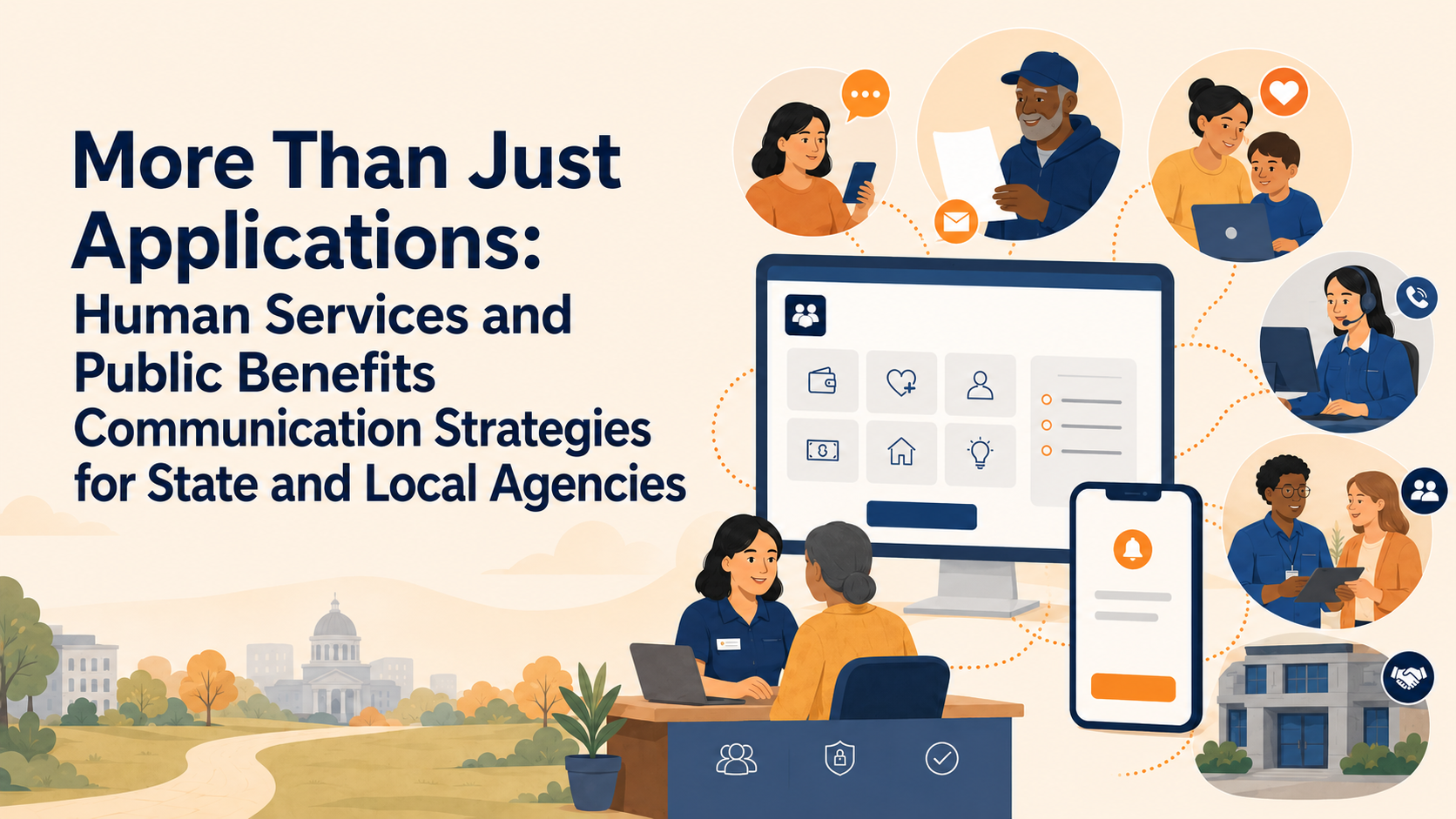
More Than Just Applications: Human Services and Public Benefits Communication Strategies for State and Local Agencies
Introduction to Effective Communication Strategy for Human Services and Public Benefits Agencies
Effective public communication is mission-critical for human services agencies, public benefits departments, social services offices, county assistance agencies, and state health and human services departments nationwide. These agencies administer programs that help people meet basic needs, including food assistance, health coverage, child care support, cash assistance, housing-related supports, energy assistance, aging services, disability services, family support, and emergency relief. When communication is clear, timely, accessible, and respectful, residents are more likely to understand what help is available, complete applications correctly, submit required documents on time, respond to renewal notices, and stay connected to services for which they may be eligible.
In human services, communication is not a decorative layer added after policy and operations are finalized. It is part of the service delivery system itself. A confusing notice can create a missed deadline. A poorly organized website can prevent a parent from completing an application after work. A hard-to-reach call center can leave a senior unsure whether coverage is active. An unclear renewal packet can cause an eligible household to lose benefits for procedural reasons rather than because their circumstances changed. Every public-facing word, sign, letter, portal prompt, text message, social media post, and staff explanation affects whether people can successfully navigate the system.
Public benefits communication also carries a different emotional weight than many other forms of government communication. People often approach human services agencies when they are under financial pressure, caring for children or older relatives, dealing with health needs, recovering from a job loss, experiencing a housing crisis, or trying to stabilize after an emergency. In those moments, technical accuracy matters, but so does tone. Residents need to understand what to do next without feeling blamed, shamed, overwhelmed, or dismissed. A strong communication strategy protects dignity while improving compliance, participation, and operational efficiency.
The communication challenge is made more complex by the structure of public benefits programs in the United States. Many benefits involve federal rules, state administration, county or local delivery, contracted service providers, community-based partners, eligibility systems, call centers, and digital portals. Residents rarely experience these layers as separate systems. To them, it is one confusing journey: Where do I apply? What do I qualify for? Why did I receive this notice? What does this deadline mean? Is this letter real? Who can help me? Will I lose coverage? Can I upload a document instead of visiting an office?
Because the stakes are high, human services agencies need communication systems that do more than announce program availability. They need to explain decisions, reduce fear, prevent avoidable churn, build trust, support frontline staff, coordinate with partners, and make complicated rules feel navigable. This is especially important during renewals, policy changes, benefit transitions, eligibility redeterminations, disaster response, and periods of increased public scrutiny. Agencies that communicate proactively can reduce avoidable calls, improve document submission, support program integrity, and help eligible residents maintain access to critical support.
This hub article provides a comprehensive framework for building stronger communication across public benefits and human services systems. It covers on-the-ground communication, enrollment and renewal campaigns, trust-building, factual U.S. case study placeholders, digital tools, community engagement, internal alignment, crisis planning, and the role of external communication support. The goal is to help agencies move from reactive, fragmented communication to a more coordinated system that supports residents, staff, partners, and public confidence.
Our Comprehensive Guide to Public Communications for State and Local Government Agencies
This article is part of our series on strategic communication for state and local government agencies. To learn more and to see the parent article, which links to other content just like this, click the button below.
Public Benefits Education, Enrollment, and Renewal Campaigns
Public benefits communication is often organized around program operations, but residents experience it as a life-management challenge. They need to know what help exists, whether they may qualify, how to apply, what documentation is needed, how long decisions may take, how to use benefits, how to renew, and what to do if something changes. Effective public benefits education turns a fragmented set of program requirements into a clear resident journey.
Make Eligibility and Application Pathways Visible
Many eligible residents never apply for benefits because they do not know they may qualify, assume the process will be too difficult, believe they will be denied, worry about stigma, or cannot identify the right place to begin. Public benefits agencies should therefore make eligibility and application pathways visible in everyday community settings. This includes libraries, schools, clinics, food banks, workforce centers, community colleges, senior centers, shelters, child care providers, housing organizations, courts, faith communities, and local government offices.
The most effective outreach messages do not simply say “apply today.” They answer the questions that stop people from applying. Who is the program for? What can it help with? Can working families qualify? Can older adults qualify? Can students qualify? Can someone apply online? Is help available in another language? Is there a deadline? What documents should be gathered first? Is there a way to check status after applying?
A strong application campaign should include both broad awareness and targeted guidance. Broad awareness creates recognition of the program and reduces stigma. Targeted guidance helps specific audiences understand their path. A caregiver applying for Medicaid long-term services and supports needs a different explanation than a working parent applying for child care assistance. A college student who may be eligible for food assistance needs different guidance than a senior applying for energy assistance. A one-size message rarely answers the specific question that is preventing action.
Agencies should also avoid creating the impression that online access is the only legitimate path. Digital portals are valuable, but some residents will need phone, mail, in-person, assisted, or partner-supported options. Communication should present online access as one pathway, not as proof that the agency is unavailable to people who cannot use it. The best message is not “go online.” It is “here are the ways to apply, and here is how to get help choosing the right option.”
Explain Renewals and Required Actions Before They Become Crises
Renewals are among the most important communication moments in public benefits administration. A resident who successfully applied months earlier may not remember when the renewal will happen, what forms are required, whether the agency will attempt an automatic renewal, how to update contact information, or what deadline matters most. When renewal communication is unclear, eligible residents can lose benefits because they missed paperwork, overlooked a notice, moved addresses, misunderstood a request, or could not reach help in time.
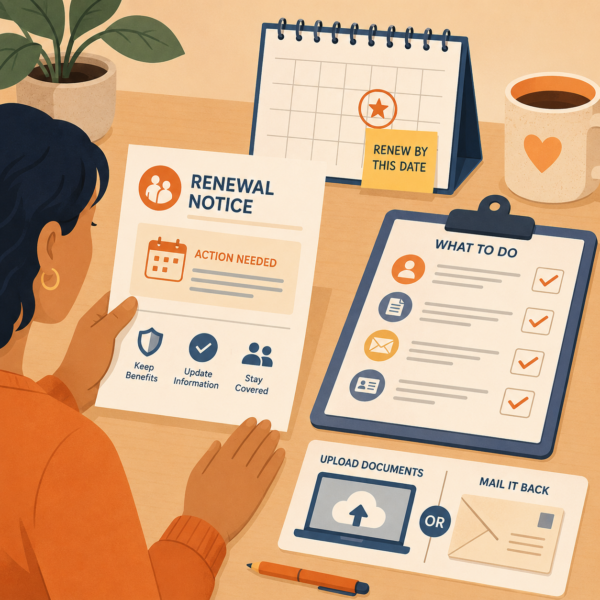
Renewal communication should begin before the formal notice arrives. Agencies can use websites, text alerts, partner toolkits, social media, call center scripts, health plan partnerships, community organizations, and local offices to reinforce a small set of messages: keep your contact information current, watch for official mail, respond by the deadline, submit requested documents, and ask for help early. These messages should be repeated in plain language across channels.
The formal renewal notice should be designed as an action guide, not a legal wall of text. Legal requirements may need to be included, but residents should be able to quickly identify what is happening, what action is needed, what documents are required, how to submit them, when they are due, what happens if they do not respond, and where to get help. The most important action steps should appear near the top of the notice and be repeated in a checklist format.
Renewal reminders should be timed around behavior, not simply around agency calendars. Residents may need one message before a packet is mailed, one when it is mailed, one before the deadline, and one after a missing item is identified. Text or email reminders can be effective, but they should not replace mailed notices or other legally required communication. Agencies should also make sure reminder messages are specific enough to be useful without exposing private information in unsafe ways.
Communicate Across Program Lines Without Creating Confusion
Public benefits programs are often interconnected. A household may apply for SNAP (Supplemental Nutrition Assistance Program), Medicaid, cash assistance, child care, energy assistance, and housing-related support through different systems or offices. Eligibility rules, renewal timelines, documents, and appeal rights may differ by program. Residents may reasonably assume that submitting a document for one program covers all programs or that being denied for one benefit means they cannot qualify for another. Agencies need communication that clarifies program relationships without overwhelming people.
A cross-program communication approach should explain what is shared and what is separate. For example, a combined application may collect information for multiple programs, but each program may still have different eligibility rules. A household may be eligible for health coverage even if it is not eligible for cash assistance. A child may remain eligible for coverage even if a parent’s eligibility changes. A document uploaded to a portal may still need to be linked to a specific case or request. These distinctions matter, and they need to be explained in plain terms.
Cross-program communication should also avoid agency-centric language. Residents do not need to understand every office division before taking action. They need a practical roadmap. A good roadmap might say: “Use this portal to apply for food, medical, and cash assistance. Use this phone number for help with your case. Contact this office for child care assistance. If you received a notice about health coverage only, your SNAP (Supplemental Nutrition Assistance Program) benefits may not be affected.”
The goal is to reduce cognitive load. Public benefits rules are complex, and many residents interact with them under stress. Communication should organize information by resident question: What can I apply for? What changed? What do I need to do? What deadline applies? How do I submit proof? How do I check status? Who can help? This resident-centered structure makes cross-program communication more useful than a list of agency units or statutory program names.
Use Reminder Systems and Status Updates to Reduce Churn
Churn occurs when eligible residents lose benefits and then reapply or are reinstated soon afterward. It creates hardship for residents and additional workload for agencies. Some churn is caused by changes in eligibility, but much of it is procedural, driven by missed notices, incomplete forms, verification gaps, address changes, or confusion about required actions. Communication cannot solve every administrative challenge, but it can reduce avoidable churn by making status and next steps clearer.
Status updates should answer the question residents most often ask: “What is happening with my case?” A portal, call center, or text alert should help residents know whether an application was received, whether documents are missing, whether an interview is required, whether a renewal is due, whether a deadline is approaching, or whether benefits have been approved, denied, reduced, or closed. Without status information, residents call repeatedly, visit offices unnecessarily, or assume silence means nothing is happening.
Reminder systems should be carefully designed. A generic reminder may not be enough. A useful reminder says that action is needed, identifies the type of action, gives the deadline, explains where to complete it, and offers help options. It should also help residents avoid scams by explaining how to verify official communications. When possible, messages should be available in the resident’s preferred language and aligned with mailed notices, portal screens, and call center scripts.
Agencies should measure whether reminders actually reduce missed actions. Useful metrics include renewal completion rates, procedural closures, call volume by notice type, document submission timeliness, portal logins after reminders, and reinstatement rates. The purpose of measurement is not only to prove communication value. It is to identify where residents still get stuck and refine the message, channel, timing, or process.
Normalize Help-Seeking and Reduce Stigma
Public benefits programs are often surrounded by stigma. Some eligible residents may avoid applying because they believe benefits are only for people in extreme crisis, because they fear being judged, because they think accepting help means failure, or because misinformation has made the process feel risky. Communication should normalize help-seeking as a practical way families, workers, seniors, caregivers, and individuals stabilize during difficult periods.
Messages should emphasize that benefits exist to help eligible residents meet basic needs and stay connected to health, nutrition, housing, child care, and family stability. This framing is especially important for working families who may not realize that they can qualify for support, older adults who may under-enroll in nutrition assistance, students who face confusing eligibility rules, and immigrant communities that may have heightened concerns about government interaction. The message should be accurate, but also human.
Reducing stigma also means avoiding imagery and language that reinforce stereotypes. Public benefits materials should show diverse residents in everyday life, including workers, caregivers, seniors, people with disabilities, students, veterans, families with children, and people in rural and urban communities. The tone should be welcoming and practical. Instead of “Are you desperate?” the message can be “Help may be available to support food, health coverage, child care, and other needs while you work toward stability.”
Community messengers can play a powerful role in stigma reduction. People may be more willing to ask questions at a clinic, school, library, community center, food pantry, or faith organization than at a government office. Agencies can equip trusted messengers with accurate, neutral information and referral tools. When help is presented through familiar community channels, it can feel less intimidating and more accessible.
Human Services Agency Best Practices for On-the-Ground Communication
For many residents, the first impression of a human services agency is not a policy memo or a website. It is a lobby sign, a security desk interaction, a caseworker explanation, a community outreach table, a county office waiting room, a call center greeting, or a printed notice handed across a counter. On-the-ground communication shapes whether people feel oriented or lost, respected or judged, supported or pushed away. It also affects workflow. When residents arrive with the right documents, know where to go, understand what line to join, and know what happens next, staff can spend more time solving problems and less time correcting preventable confusion.
Use Clear, Plain-Language Signage and Wayfinding
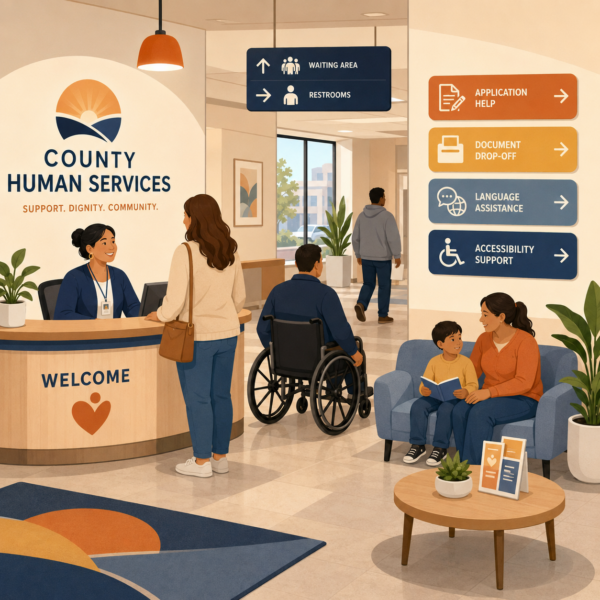
Human services offices often serve residents who are balancing stress, time pressure, transportation challenges, disability-related barriers, limited English proficiency, literacy differences, or fear about what will happen if they make a mistake. Signage should therefore be designed for speed, clarity, and reassurance. The most important messages should be visible before residents have to ask for help. These include where to check in, where to wait, which documents may be needed, how to request language assistance, how to ask for disability-related support, where to drop off paperwork, and how to access online options if a visit is not required.
Plain language is essential. Instead of relying on program acronyms or internal terminology, signs should use the words residents use when describing their needs. A sign that says “Food Benefits and SNAP (Supplemental Nutrition Assistance Program) Help” will be more immediately useful than one that only uses an internal unit name. A sign that says “Upload or Drop Off Documents Here” is clearer than one that says “Verification Submission.” A sign that says “Need an interpreter? Ask here” is more inviting than one buried in a paragraph about language access rights.
Placement matters as much as wording. Signs should appear at decision points, not only on walls where residents may see them too late. Entry areas should orient visitors before they enter a line. Lobby screens should repeat the same message residents hear from staff. Document drop boxes should clearly explain what to include, whether copies are acceptable, and how residents will know the agency received the materials. If a digital kiosk is available, signage should explain what residents can do on the kiosk and what still requires staff assistance.
Consistency across locations helps build trust. In a statewide or countywide system, residents may interact with multiple offices, partner organizations, and online tools. When signage, icons, colors, program names, and directions are consistent, residents can more easily recognize official information and know that they are in the right place. Consistency also helps staff and community partners use the same language when guiding residents.
Make Front Desk and Lobby Communication Count
The front desk is one of the highest-impact communication points in any human services office. It is where confusion either begins or gets resolved. Staff at this point need quick-reference language that helps them identify needs, direct residents, and reduce anxiety without giving incomplete or inaccurate eligibility advice. A resident may arrive with a notice they do not understand, a deadline they fear they missed, or a question about benefits that could involve multiple programs. A calm, structured intake conversation can prevent escalation and help the resident leave with a clear next step.
Lobby communication should also manage expectations. Residents should know whether they will be seen today, whether an appointment is required, whether they can complete a task online, whether they need to wait for a phone interview, or whether a document drop-off will be sufficient. When wait times are long, silence creates frustration. A simple update such as “Current estimated wait for application assistance is 45 minutes” can reduce uncertainty. A message explaining that urgent benefits, replacement cards, hearings, or domestic violence-related safety concerns may have separate processes can also help residents identify the right path.
Agencies should develop approved scripts for common lobby situations. These scripts do not need to sound robotic. Their purpose is to make sure staff are supported with accurate, respectful wording. Common scenarios include missing documents, late renewals, EBT card issues, benefit closure notices, online account problems, disability accommodation requests, language assistance needs, complaints, and concerns about fraud or scams. The best scripts acknowledge the resident’s concern, explain what can be done at that moment, and provide one or two concrete next steps.
Lobby communication should also protect privacy. Human services interactions often involve income, household composition, medical coverage, immigration-related concerns, child support, domestic violence, or housing instability. Agencies should avoid forcing residents to explain sensitive circumstances in open areas. Signs and scripts should make private assistance available when needed. A resident should be able to say “I need to discuss something privately” without having to disclose the reason in public.
Ensure Accessibility and Language Access for Every Resident
Accessible communication is both a legal obligation and a practical necessity. Human services agencies serve older adults, people with disabilities, caregivers, people with limited English proficiency, people with low literacy, people without reliable internet, people who are unhoused, people with cognitive disabilities, and people experiencing trauma. A communication system that depends on one channel, one language, one reading level, or one mode of response will leave people behind.
Materials should be available in the languages most commonly spoken in the service area, and language assistance should be easy to request. Translation should prioritize notices, renewal instructions, application guides, rights and responsibilities, appointment information, contact options, and time-sensitive action steps. Interpreters should be used for important eligibility conversations, appeals, and case actions. Agencies should also train staff to avoid using children, family members, or unqualified bystanders as interpreters for sensitive matters.
Disability access should be built into every communication channel. Printed materials should use readable font sizes, clear headings, high contrast, and simple layouts. Websites and portals should be usable with screen readers and keyboard navigation. Videos should include captions. Phone systems should work for people using relay services. Offices should display clear instructions for requesting reasonable accommodations. When residents need help with forms, staff should know what assistance is allowed and how to provide it without taking control away from the resident.
Accessibility also includes channel choice. A resident with limited transportation may need online or phone options. A resident without stable internet may need mail, in-person assistance, or community partner support. A resident who changes addresses frequently may benefit from text or email alerts. A caregiver may need permission and instructions to help someone else navigate the process. The communication system should recognize that equal access often requires multiple pathways, not a single standardized pathway.
Train and Empower Eligibility Workers, Caseworkers, and Frontline Staff
Frontline staff are not only processors of applications and documents. They are interpreters of the system for the public. They translate program rules into practical next steps. They explain notices, calm fears, clarify deadlines, and help residents distinguish between what is required, what is optional, and what is still under review. Even when agencies have excellent websites and printed materials, residents often rely on staff to confirm what those materials mean for their specific situation.
Training should therefore include communication skills alongside policy and system training. Staff need to know how to explain complex program concepts in plain language, how to avoid jargon, how to de-escalate frustration, how to recognize when a resident does not understand, and how to communicate uncertainty honestly. A staff member should feel comfortable saying, “I need to check that before I give you an answer,” rather than guessing. Accuracy protects both the resident and the agency.
Training should also include scenario-based practice. Common scenarios include a resident who received a closure notice, a parent who missed a renewal deadline, a person who cannot access a portal account, a household that submitted documents but still received a request, a resident who believes their benefits were calculated incorrectly, a person who fears a scam text, or a community partner asking for guidance. Role-playing these moments helps staff practice calm, consistent wording before they face pressure in real time.
Staff also need tools. A communication strategy should produce quick-reference guides, escalation maps, one-page program explainers, approved message banks, FAQs, and decision trees. These tools reduce the burden on individual staff members to invent language on the spot. They also reduce inconsistency across offices and channels. When staff know the approved message and where to send a resident next, the agency becomes easier to navigate.
Coordinate Outreach Across Local Offices, Call Centers, and Community Partners
Human services agencies often operate through distributed networks. A state may set policy, counties may administer eligibility, community organizations may provide application assistance, health plans may communicate with Medicaid members, schools may help families access nutrition programs, and contracted call centers may answer resident questions. If these partners are not aligned, residents receive conflicting messages. One office says a document is required. A partner says it is optional. A website says a deadline is one date. A notice says another. These inconsistencies create distrust and increase workload.
Coordination starts with a shared message architecture. Agencies should create core explanations for each major program, service change, renewal process, and resident action. Those explanations should be distributed to local offices, call centers, outreach teams, community partners, and contracted vendors. Partners should know which messages they can customize and which messages must remain exact because they involve eligibility rules, rights, deadlines, or legal requirements.
Community partners need more than flyers. They need briefing sessions, partner toolkits, sample social posts, resident-facing FAQs, escalation contacts, and updates when guidance changes. Partners are often trusted by residents who may be reluctant to contact government directly. When those partners are equipped with accurate information, they become an extension of the agency’s communication system. When they are left to interpret policy changes on their own, misinformation can spread even with good intentions.
Call centers and local offices should also be included early when new communications are planned. Staff who answer phones often know which words confuse residents, which notices trigger calls, and which portal screens create errors. Their feedback can improve communication before materials are released. Agencies that treat frontline staff and partners as communication intelligence sources are better able to anticipate confusion and reduce avoidable demand.
Protect Dignity, Privacy, and Trust in High-Stress Interactions
A human services communication strategy must be grounded in dignity. Residents may already feel embarrassed, anxious, angry, or exhausted when they contact an agency. Communication that sounds punitive, cold, or overly bureaucratic can increase that stress. This does not mean agencies should avoid requirements, deadlines, or program integrity expectations. It means those requirements should be communicated in a way that is clear, factual, and respectful.
Dignity-centered communication explains why information is being requested, what will happen if the resident responds, what may happen if the resident does not respond, and where the resident can get help. It avoids implying that the resident is at fault for not understanding the system. It recognizes that many missed actions are caused by confusing notices, unstable addresses, limited internet access, work schedules, caregiving responsibilities, or unclear instructions.
Privacy-centered communication is equally important. Agencies should be careful with text messages, emails, mailed notices, and lobby conversations that may reveal sensitive information. Residents may share phones, addresses, or devices. Survivors of domestic violence may have safety concerns. Young adults may be in transitional living situations. People who are unhoused may rely on shelters or service providers for mail. Communication should be designed with these realities in mind.
Trust grows when agencies show residents that they are competent, honest, and respectful. This includes acknowledging mistakes, correcting outdated information, explaining delays, and making it easy to verify official messages. In an environment where scams and misinformation are common, residents need to know how to distinguish official agency communication from fraudulent messages. A simple “How to know this message is from us” page can be a powerful trust-building tool.
How Human Services Agencies Can Build Trust Through Transparency and Accuracy
 Trust in human services systems is built through repeated experiences of clarity, fairness, follow-through, and respect. Residents may not agree with every eligibility decision, but they are more likely to trust an agency when they understand how decisions are made, what rights they have, why information is needed, and how to get help. Transparency does not mean overloading residents with technical rules. It means communicating the right level of detail at the right time in a way that helps people act.
Be Clear About What Agencies Can and Cannot Do
Human services agencies operate within complex legal and funding structures. Some benefits are federally funded and state-administered. Some are locally delivered. Some are entitlement programs. Others are limited by appropriations, waitlists, caps, or local program availability. Residents do not need a policy seminar, but they do need honest explanations of what the agency can do, what it cannot do, and what may depend on program rules or funding availability.
Clear boundaries protect trust. If a benefit cannot be issued until verification is complete, say that. If a program has a waiting list, explain how the list works and how residents will be notified. If a county office cannot change a federal rule, explain what it can do, such as help with an application, provide referrals, or explain appeal rights. If a delay is caused by a system issue, acknowledge the delay and explain what residents should do in the meantime.
Agencies should avoid vague promises such as “we will take care of it” when a decision depends on eligibility review. They should also avoid overly defensive language that makes residents feel blamed for asking questions. A better approach is direct and respectful: “We can help you submit the documents today. After they are reviewed, you will receive a notice explaining the decision. If you disagree with the decision, the notice will explain how to request a hearing.”
This kind of transparency also supports staff. Frontline workers often face frustration when residents expect immediate answers that staff cannot provide. Approved language about timelines, eligibility review, escalation, and rights helps staff respond consistently without appearing dismissive. It also reduces the risk of residents receiving different answers from different channels.
Communicate Timelines, Backlogs, and Status Honestly
Timeliness is one of the most visible indicators of agency performance. When applications, renewals, or document reviews take longer than expected, residents may fear that something went wrong or that they will lose support. Agencies should communicate timelines honestly, especially when backlogs, staffing shortages, system transitions, policy changes, or emergency events affect processing.
A timeline message should include what is delayed, why it is delayed at a general level, what the agency is doing, what residents should do, and where to get help if they have an urgent issue. For example, a notice about high renewal volume might explain that document review is taking longer than usual, that residents should keep proof of submission, that they do not need to resubmit the same document unless asked, and that they should contact the agency if they have a cutoff notice or emergency need.
Status transparency can reduce duplicate submissions and repeat calls. When residents do not know whether documents were received, they may upload them multiple times, mail copies, call repeatedly, or visit offices. A document receipt confirmation, even one that says “received but not yet reviewed,” can reduce anxiety and workload. Similarly, a portal status that distinguishes “pending review,” “missing information,” “interview needed,” and “decision issued” is more useful than a vague “in process.”
Agencies should also be careful about publicly communicating backlog information. The message should not undermine confidence or reveal internal details that residents cannot use. It should be practical. A resident does not need to know every staffing challenge. They need to know whether their benefits are at risk, what action they should take, and how to confirm that the agency has what it needs.
Explain Eligibility, Verification, and Appeal Rights in Human Terms
Eligibility rules are often difficult to understand because they involve income, household composition, deductions, categorical rules, disability criteria, residency, citizenship or immigration-related rules, age, student status, work requirements, program-specific exemptions, and changing policy guidance. Notices must be legally precise, but resident-facing communication should also explain these concepts in human terms.
Verification requests are a major source of confusion. Residents may not understand why the agency is asking for a pay stub, lease, utility bill, school record, medical document, identity proof, or household member information. A better verification message explains: “We need this information to confirm eligibility or calculate your benefit amount. You can submit one of the following documents. If you cannot get these documents, contact us because other options may be available.”
Appeal and hearing rights should also be presented clearly. Residents should know that disagreeing with a decision is allowed, that requesting a hearing is a formal process, what the deadline is, whether benefits can continue pending appeal under certain circumstances, and where to get help. This information should not be hidden at the end of a dense notice. It is central to procedural fairness.
Human terms do not mean oversimplifying the law. They mean explaining the law in a way that allows people to act. A resident should leave a notice or webpage understanding what decision was made, why it was made at a basic level, what action is available, and what deadline applies. If the resident cannot identify those points, the communication has not done its job.
Address Misinformation, Rumors, and Policy Changes Promptly
Human services agencies often face misinformation, especially during policy changes, benefit emergencies, disasters, pandemic-related transitions, Medicaid renewals, EBT issues, immigration-related confusion, fraud alerts, benefit theft, or viral social media claims. False information can spread quickly and may cause residents to miss deadlines, share personal information with scammers, avoid applying, or flood call centers with urgent questions.
Agencies should maintain a rumor response process. This can include social listening, frontline staff feedback, partner reports, call center trend monitoring, and media monitoring. When a rumor appears, the agency should determine whether it is harmless, confusing, harmful, or urgent. Not every rumor requires a public response, but harmful claims should be addressed quickly through official channels.
A good rumor response does not repeat false information in a way that amplifies it. It focuses on the correct action. For example: “Official benefit updates will come from [agency name] by mail, through your secure online account, or through verified agency channels. We will never ask for your EBT PIN by text or social media. To check your case, use [official portal] or call [official number].”
Policy change communication should begin before the effective date whenever possible. Residents need to know what is changing, what is not changing, who is affected, what action is required, when the change takes effect, and where to get help. Staff and partners should receive the same message before the public launch so they can answer questions consistently. When agencies wait until confusion begins, they lose the advantage of being the first trusted source.
Use Data and Dashboards Responsibly
Public dashboards, reports, and performance updates can build trust when they help residents, partners, policymakers, and media understand what the agency is doing. A dashboard might show application volume, renewal processing, call center volume, benefit issuance, document processing, outreach activity, or service availability. Used well, this information demonstrates accountability and helps explain why communication matters.
However, data must be presented responsibly. A dashboard that is too technical may confuse residents. A number without context can create misunderstanding. A map or demographic breakdown can raise privacy concerns if populations are small. Agencies should decide who the audience is and what decision or understanding the data is supposed to support. Resident-facing data should be simple, contextual, and connected to practical information.
Data should also be paired with narrative. A chart showing increased call volume may be useful, but it becomes more meaningful when the agency explains that calls rose after renewal notices were mailed and that residents can use the portal to check status or upload documents. A statistic showing document processing times should be paired with guidance on what residents should do if they submitted documents and are waiting.
Responsible transparency strengthens trust because it shows that the agency is not hiding complexity. It also gives community partners and elected officials a better understanding of operational realities. When data, narrative, and action guidance are aligned, transparency becomes a communication tool rather than a reporting exercise.
Case Studies: Factual U.S. Public Benefits Communication and Access Examples
New York City, New York. ACCESS HRA as a Resident-Facing Benefits Navigation Platform
New York City’s Human Resources Administration provides ACCESS HRA as a web and mobile platform that allows residents to get information, apply for benefit programs, and manage key case actions online. Publicly available HRA materials describe ACCESS HRA as a mobile-responsive platform that allows clients to apply for SNAP (Supplemental Nutrition Assistance Program) benefits, recertify for SNAP (Supplemental Nutrition Assistance Program) or Cash Assistance, make case changes, see required documents, submit documents electronically using a phone camera, update contact information, check case or application status, and receive reminders and timely updates, while also improving accessibility, reducing paperwork burdens, and supporting faster communication between clients and caseworkers.
From a communication strategy perspective, ACCESS HRA is useful as a case study because it illustrates the shift from agency-centered communication to resident-centered navigation. The platform does not merely announce that benefits exist. It gives residents a place to take action, check status, submit documentation, and receive reminders. This matters because public benefits communication is most effective when information and action are connected. A resident who reads a reminder but cannot easily complete the next step may still fall out of the process. A resident who can see a document request and upload the document from a phone has a clearer path to resolution.
The broader lesson for human services agencies is that digital tools should be communicated as part of the service journey, not as standalone technology. Residents need to know what the portal can do, what it cannot do, when to use it, how to get help, how to verify that documents were submitted, and what to expect after taking action. Community partners and frontline staff also need consistent language so they can guide residents to the right function without overpromising immediate results.
Michigan. MI Bridges as an Integrated Benefits and Community Resource Connection
Michigan’s MI Bridges is presented by the State of Michigan as a place for residents to apply for benefits, manage their case, and explore resources. Michigan Department of Health and Human Services materials also describe a broad public assistance environment that includes food assistance, health care coverage, cash assistance, child care assistance, emergency relief, Medicaid, housing and homeless services, migrant services, child welfare, aging services, and many other programs. Public MI Bridges information also references trained community partners who can help residents complete applications and use MI Bridges resources.
As a communication placeholder, MI Bridges demonstrates the importance of connecting eligibility systems with community navigation. Residents seeking public benefits often have needs that cross program lines. A food assistance applicant may also need utility help, child care support, health coverage, or local nonprofit resources. A digital platform that combines application functions, case management, and resource exploration can help residents move from a single program question to a broader support pathway.
The communication lesson is that agencies should not assume residents will understand how programs relate to one another. The agency must explain the pathway. This includes how to apply, how to manage a case, how to find community help, what partner organizations can and cannot do, and when residents should contact the agency directly. A partner network can extend reach, but only if partners receive training, current materials, and clear escalation paths.
Colorado. Colorado PEAK as a Statewide Online Entry Point for Medical, Food, Cash, and Other Benefits
Colorado describes Colorado PEAK as the place to apply for and manage medical, food, cash, and other State of Colorado benefits online. This kind of statewide entry point can reduce fragmentation by giving residents a recognizable location for public benefits actions. It can also support counties and community partners by creating a common reference point for application, management, and assistance messaging.
As a communication case study placeholder, Colorado PEAK illustrates how a benefits portal can become a source-of-truth destination. A single portal is not automatically clear. It must be supported by plain-language outreach, mobile-friendly design, accessibility, partner guidance, help information, and consistent terminology across state and local channels. Residents should know what programs are included, what actions can be completed online, what help is available, and what to do if they cannot use the portal.
The lesson for other agencies is that centralization can improve communication only when it is paired with strong explanation. A portal name alone does not tell residents what to do. The agency must repeatedly connect the name of the portal to real-life resident tasks: apply for food assistance, renew health coverage, report a change, upload documents, check status, or find local help. The more consistent that message becomes across county offices, partner organizations, and outreach materials, the easier the system becomes to navigate.
How Human Services Agencies Can Leverage Digital Tools and Media Strategy for Success
Digital tools have transformed how residents access public benefits, but technology alone does not replace the need for a strong communication strategy. A portal can simplify an application process, or it can become another confusing doorway that discourages participation. A text message can help prevent a missed deadline, or it can appear suspicious and be ignored as a scam. A website can function as a reliable source of truth, or it can bury the most important action steps beneath layers of program jargon and complex navigation. Human services agencies need a digital communication strategy that aligns technology with resident behavior, staff workflows, legal notices, accessibility standards, and partner outreach efforts to ensure residents can clearly understand, trust, and successfully access the services available to them.
Online Portals and Mobile Access
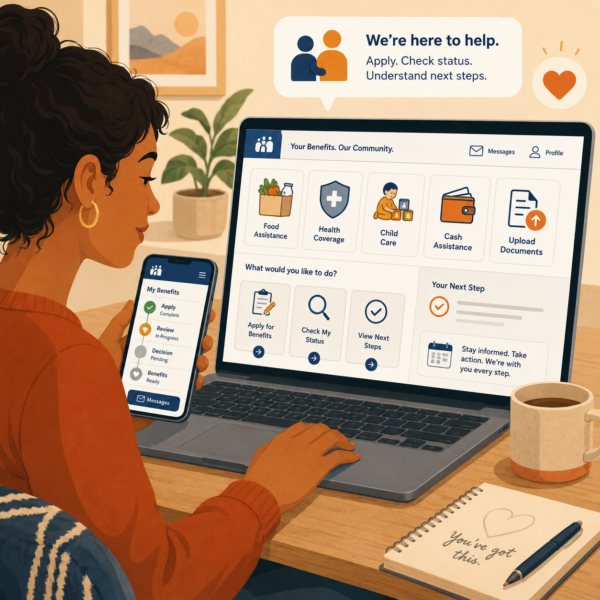
Online portals are increasingly central to public benefits administration. Residents may use them to apply, upload documents, recertify, report changes, check status, view notices, schedule appointments, or manage benefits. Because portals carry so much operational weight, agencies should communicate about them with precision. Residents need to know the official portal name, how to access it, which programs it covers, what actions are available, whether a mobile app exists, how to recover an account, and what to do if they cannot use the portal.
Portal communication should be task-based. Instead of saying “Use our self-service portal,” agencies can say “Use the portal to upload documents, check whether your renewal is due, update your mailing address, or see whether we need more information.” This approach connects technology to resident needs. It also helps reduce calls when residents can complete simple actions online.
At the same time, agencies should be careful not to make digital access feel mandatory for everyone. Some residents will struggle because of disability-related barriers, language access needs, digital literacy, limited broadband, unstable housing, shared devices, or privacy concerns. Portal messages should include alternative pathways such as phone help, in-person support, mailed forms, assistive technology, or community partner assistance. Digital equity is part of communication equity.
Agencies should also design portal messages for trust. Residents should know how to identify official websites, avoid phishing, protect login information, and confirm that document uploads were received. If the agency sends text or email links, the message should clearly explain how residents can verify the link independently through the official website or phone number.
Email and Text Alert Systems
Email and text alerts can be powerful tools for public benefits communication because they reach residents quickly and can prompt action before a deadline is missed. Alerts can remind residents to renew, update contact information, submit documents, complete interviews, check mail, attend appointments, or review a notice. They can also inform residents about office closures, disaster benefits, benefit issuance issues, EBT security, or policy changes.
The best alerts are short, specific, and connected to a trusted action pathway. A strong message tells residents what happened, what they should do, where to do it, and how to verify the message. For example, “Your renewal packet was mailed. Please check your mail and respond by the date on the notice. Log in to your official account or call [agency number] for help.” This is more useful than a vague message saying “Important benefits update.”
Alert systems should also be designed around resident consent, language preference, accessibility, privacy, and opt-out rules. Residents should understand what types of messages they will receive and how their contact information will be used. Agencies should not rely solely on digital alerts for legally required notices, but alerts can reinforce mail and portal communication by prompting residents to act sooner.
Agencies should test alert timing and wording. A reminder sent too early may be ignored. A reminder sent too late may not leave enough time to respond. A message with too much information may be unreadable on a phone. A message with too little information may generate calls. Continuous refinement based on data and resident feedback is essential.
Websites as Public Benefits Information Hubs
A human services agency website should function as a source-of-truth hub for residents, partners, media, elected officials, and staff. It should answer the most common questions clearly: what programs are available, who may qualify, how to apply, how to renew, how to submit documents, how to check status, how to report changes, how to request accommodations, how to get language help, how to appeal, and how to avoid scams.
Navigation should be organized around resident needs rather than agency structure. Residents should not have to know the difference between divisions, bureaus, or funding streams to find help. A site can still include technical pages for providers or policy users, but the main resident pathway should use action verbs and everyday terms: Apply for benefits, Renew benefits, Upload documents, Check your case, Report a change, Get help, Find an office, Request a hearing.
Websites should also include timely alert sections. During renewals, disasters, EBT theft events, system outages, office closures, or major policy changes, the top of the website should clearly state what is happening and what residents should do. Outdated alerts should be removed quickly. Nothing undermines credibility like an expired deadline still appearing on a homepage.
Accessibility and language access must be built into the website. Translated pages, screen-reader friendly design, readable layouts, mobile responsiveness, alt text, headings, and plain language all matter. Agencies should test their websites with real users, including people with disabilities, limited English proficiency, and low digital literacy. Usability testing often reveals issues that internal teams miss because they already understand the system.
Social Media Engagement for Human Services Agencies
Social media can help human services agencies reach residents quickly, normalize help-seeking, correct misinformation, and distribute reminders. It is especially useful for deadline reminders, program awareness, benefit theft alerts, disaster assistance updates, office closures, community events, and partner amplification. However, social media should not be treated as a replacement for official notices or individualized case communication.
Human services social media should be practical and empathetic. Posts should answer common questions, link to official pages, and use accessible graphics. A post about SNAP (Supplemental Nutrition Assistance Program) renewals might show a simple checklist: update your contact information, check your mail, respond by the deadline, upload documents, ask for help. A post about Medicaid renewals might remind residents that children may still qualify even if a parent’s eligibility changes, where that is accurate under program rules.
Agencies should also establish comment and direct message protocols. Residents may ask case-specific questions in public comments, which creates privacy concerns. Staff should be trained to respond with general guidance and direct residents to secure channels. Social media managers should know what questions they can answer, when to refer, when to escalate, and when not to engage.
Social media listening can provide valuable insight. If residents repeatedly ask the same question, the agency may need a clearer notice, a better webpage, a call center script update, or a partner briefing. Social media should therefore be part of a feedback loop, not merely a broadcast tool.
Media Relations and Earned Media Strategy
Traditional media still matters in human services communication, especially during benefit changes, crises, investigations, legislative debates, emergency programs, and major operational transitions. Local news, ethnic media, public radio, neighborhood newspapers, and television can reach residents who may not follow agency social media or visit government websites regularly.
Agencies should build media relationships before controversy occurs. Reporters who understand how benefits programs work are more likely to explain deadlines, renewals, eligibility rules, and agency actions accurately. Pre-briefings can be helpful before major policy changes or renewal campaigns. A clear media kit can include key dates, plain-language explanations, official contact information, resident action steps, and links to source-of-truth pages.
When issues arise, agencies should be factual, timely, and human. A benefit issuance delay, EBT theft surge, call center backlog, system outage, or policy change can quickly become a public trust issue. Media statements should acknowledge the concern, explain what is known, avoid speculation, describe what the agency is doing, and provide guidance for affected residents. Silence allows others to define the story.
Earned media should also be used for positive resident education. Interviews with agency leaders, community partners, or program staff can explain how to apply, what renewal notices mean, how to protect EBT cards, or where to get help. The most useful media story is not always a press release. Sometimes it is a calm, plain-language explanation delivered by a credible official before confusion spreads.
Video and Visual Content to Increase Clarity
Video and visual content can make public benefits processes easier to understand. Many residents learn more quickly from a short demonstration than from a dense instruction page. Agencies can use videos to show how to create an online account, upload documents, complete a renewal, read a notice, protect an EBT card, request an interpreter, or find local help. These videos should be captioned, translated or subtitled where appropriate, and embedded on relevant webpages.
Infographics can be especially useful for deadlines, process steps, and document checklists. A renewal infographic might show: update contact information, watch for mail, complete the form, submit documents, check status, ask for help. A scam prevention graphic might show what the agency will and will not ask for by text or phone. A benefits overview graphic can help residents see how food, health, cash, child care, and energy assistance relate without overwhelming them.
Visual content should not rely on tiny text or decorative icons that do not support comprehension. The design should guide action. Use clear headings, large type, consistent icons, plain language, high contrast, and enough white space. Materials should be tested for readability on mobile devices because many residents will view them on phones.
Human services agencies can also use behind-the-scenes content carefully to build trust. For example, a video explaining how document processing works or how to recognize an official notice can demystify the system. However, agencies must protect privacy and avoid showing client information. Transparency should always be balanced with confidentiality.
AI, Chatbots, and Automation With Careful Guardrails
Many agencies are exploring chatbots, automated phone systems, virtual assistants, and AI-supported customer service tools. These tools can help residents find basic information quickly, reduce repetitive questions, and route people to the right resources. They can also create risk if they provide inaccurate eligibility guidance, fail to recognize urgent situations, or make it difficult to reach a human being.
Automation should be limited to clearly defined tasks unless it is supported by strong oversight. A chatbot can help residents find office hours, explain how to upload documents, link to a renewal page, or provide general program information. It should not make eligibility determinations, interpret complex case facts, or discourage residents from applying. It should clearly state when information is general and when residents need official notice or staff assistance.
Agencies should monitor automated tools for accuracy, accessibility, language quality, and equity. A tool that works well for a technically confident English-speaking user may fail for a resident with limited literacy, a person using a screen reader, or someone asking a question in another language. Automation must be tested with the same seriousness as any other public-facing communication channel.
The most important guardrail is escalation. Residents should always have a clear path to human help, especially for urgent needs, appeals, disability accommodations, language assistance, domestic violence concerns, benefit loss, or suspected fraud. Automation should make the system easier to navigate, not harder to reach.
Fostering Community Engagement and Inclusivity for Human Services Agencies
 Human services communication cannot be built only from inside an agency. Residents learn about benefits through trusted people and places: schools, clinics, libraries, food banks, faith communities, shelters, workforce programs, senior centers, disability organizations, immigrant-serving groups, neighborhood associations, veterans organizations, and local service providers. Inclusive communication means meeting people where they already seek help and designing messages around the realities of their lives.
Build Trust Through Dialogue, Not Just Announcements
Community engagement is often treated as distribution: send a flyer, post a notice, ask partners to share a link. Distribution matters, but trust requires dialogue. Agencies should create opportunities for residents, advocates, providers, and local partners to ask questions, identify barriers, and share what they are hearing. This can happen through advisory groups, listening sessions, partner briefings, community forums, office hours, post-campaign debriefs, or targeted focus groups.
Dialogue helps agencies understand how policies are being experienced. A renewal packet may look clear to program staff but confusing to residents. A portal may function technically but fail for people using older phones. A call center script may be accurate but not answer the emotional concern behind a question. A partner may hear rumors long before the agency sees them in official complaint data. Engagement turns community experience into communication intelligence.
Agencies should close the loop after engagement. If residents or partners identify a barrier, the agency should explain what it changed or why it cannot change something. Even when the answer is limited by law or resources, the act of responding builds credibility. People are more likely to participate in future engagement when they see that their input is taken seriously.
Dialogue is especially important during program changes. Before launching a major communication campaign, agencies can test messages with community partners and resident representatives. They can ask: What is confusing? What words would residents use? What fears will this raise? What channels will reach people? What groups might be missed? This kind of pre-launch testing can prevent avoidable problems.
Reflect the Full Range of Residents Served
Human services agencies serve people across age, geography, race, ethnicity, language, disability, family structure, income, employment status, housing status, and immigration-related circumstances. Communication should reflect that diversity without reducing people to stereotypes. Imagery, examples, scenarios, and language should show that public benefits support workers, caregivers, seniors, children, people with disabilities, students, veterans, rural residents, urban residents, and families in transition.
Representation is not only visual. It is also structural. Materials should include examples that reflect real eligibility questions. A working parent may wonder whether income is too high. A senior may need help with food and medical costs. A person with a disability may need accommodation instructions. A family experiencing homelessness may need to know how to receive mail. A domestic violence survivor may need safe communication options. A student may need program-specific eligibility guidance.
Language should also be respectful and current. Terms such as “client,” “participant,” “resident,” “household,” and “beneficiary” may each fit in different contexts. Agencies should avoid labels that make people feel reduced to their benefit status. In public-facing materials, “residents,” “families,” or “people who receive benefits” often feel more human than bureaucratic labels. The best choice may vary by jurisdiction and program, but dignity should guide the decision.
Inclusive communication should also account for rural communities. Rural residents may face transportation barriers, limited broadband, fewer local service providers, and stronger privacy concerns because everyone knows each other. A message that works in a dense urban service environment may not work in a rural county. Agencies should tailor outreach channels and partner networks accordingly.
Partner With Community Organizations as Trusted Messengers
Community organizations extend reach and credibility. A resident may trust a food pantry, clinic, library, school social worker, disability advocate, or faith leader more than a government notice. Agencies should use this trust responsibly by equipping partners with accurate, current, easy-to-share information. Partners should not have to interpret complex policy changes from long administrative memos.
A good partner toolkit includes a plain-language overview, resident action steps, FAQs, printable flyers, translated materials, social media copy, newsletter copy, talking points, referral instructions, escalation contacts, and a schedule of key dates. For major changes, agencies should host partner webinars or briefings and record them for later use. Partners should also have a way to submit questions and receive updates when guidance changes.
Agencies should define partner roles clearly. Some partners may only distribute information. Others may help residents complete applications, upload documents, renew coverage, or navigate appeals. Some may serve as official assisters or navigators. Communication should clarify what each partner can do, what they cannot do, and when residents must contact the agency directly. This prevents well-meaning partners from giving incomplete or unauthorized guidance.
Partner communication should be ongoing, not only during crises. A standing partner newsletter, quarterly briefing, or shared resource hub can keep community organizations aligned. When a crisis happens, agencies with existing partner relationships can move faster because the network is already in place.
Reach Residents Who Are Often Missed
Some residents are less likely to receive, understand, or act on standard agency communication. This includes people who are unhoused, people with frequent address changes, people leaving incarceration, survivors of domestic violence, people with limited English proficiency, people with disabilities, older adults, youth aging out of foster care, migrant and seasonal workers, people without broadband, and families with unstable work schedules. Inclusive communication requires targeted strategies for these groups.
For residents without stable mail access, agencies should communicate options for authorized representatives, alternate mailing addresses, shelter addresses, online accounts, phone updates, community partner assistance, and safe contact methods. For residents with safety concerns, agencies should clearly explain how to protect contact information where applicable. For justice-involved individuals, agencies should clarify eligibility rules and reentry-related application pathways. For youth transitioning from foster care, agencies should use plain guidance about health coverage, food assistance, housing supports, and local resources.
Language access should go beyond translation. Agencies should consider cultural context, trusted channels, literacy levels, and fears about interacting with government. Immigrant-serving organizations can help identify which messages may reassure residents and which may create confusion. Agencies should be careful and accurate when discussing immigration-related eligibility and privacy issues, and should direct residents to qualified help when questions are complex.
Reaching missed groups often requires mobile outreach, co-location, and partner referrals. Benefits information can be integrated into school events, health clinics, community fairs, reentry programs, shelters, food distribution events, senior programs, and workforce services. The goal is not to overwhelm people with every program detail. The goal is to create an accessible entry point and a warm handoff to help.
Create Two-Way Feedback Channels
A strong communication system listens as much as it informs. Residents and partners should have simple ways to provide feedback about notices, websites, portals, call center experiences, office visits, language access, accessibility, and overall clarity. Feedback mechanisms can include surveys, comment forms, text polls, focus groups, partner listening sessions, complaint trend analysis, and post-interaction questions.
Feedback should be connected to decision-making. If residents consistently report that a notice is confusing, the agency should review the notice. If partners report that a webpage is outdated, the agency should fix the webpage. If call center data shows repeated questions after a mailing, the next mailing should be revised. Feedback is only useful when it changes something.
Agencies should also share back what they learn. A post-campaign summary might say, “Residents told us the renewal instructions were confusing, so we added a checklist and updated the website.” This kind of transparency shows that the agency is responsive and creates a culture of continuous improvement.
Two-way communication is also a risk management tool. Complaints and questions often reveal emerging problems before formal metrics do. A sudden increase in partner questions about EBT theft, renewal deadlines, or portal errors may signal a broader issue. Agencies that listen closely can respond before confusion becomes a crisis.
Content Planning and Internal Alignment for Human Services Communication Effectiveness
Behind every strong public benefits communication effort is internal coordination. Human services agencies manage routine communication, urgent updates, legal notices, policy changes, renewal campaigns, fraud alerts, disaster responses, partner briefings, media questions, and elected official inquiries. Without a planning system, communication becomes fragmented. Different units create different messages, frontline staff receive information too late, partners improvise, and residents get conflicting answers.
Develop a Communication Calendar for Benefits Programs
Human services communication should be planned around the way public benefits actually operate in the United States. Unlike the federal Health Insurance Marketplace, which has a defined annual open enrollment period, many benefits programs allow residents to apply when they need assistance. Medicaid and Children’s Health Insurance Program (CHIP) enrollment can occur at any time, and SNAP (Supplemental Nutrition Assistance Program) applications are handled through state agencies or their local arms rather than a single national enrollment season. For this reason, a communication calendar for public benefits should not assume that every household has the same application or renewal timeline. Instead, it should organize year-round education, recurring public awareness themes, seasonal program campaigns, and individualized reminder sequences.
A useful calendar may include monthly or quarterly themes such as EBT card security, fraud prevention, emergency preparedness, disaster food assistance awareness, “did you know” service education, Medicaid navigation, SNAP (Supplemental Nutrition Assistance Program) application support, child care assistance, housing stability resources, tax season reminders, school-year transitions, and summer nutrition programs. Some programs do have stronger seasonal patterns. Low Income Home Energy Assistance Program (LIHEAP) communication often aligns with heating, cooling, and crisis assistance periods, while SUN Bucks or Summer EBT communication is naturally tied to the summer months when children are not receiving school meals.The Low Income Home Energy Assistance Program (LIHEAP) is a federal program helping eligible low-income households manage heating and cooling costs, with grants ranging from $200 to $1,000. It provides aid for energy bills and emergency crisis situations to roughly million households annually. SUN Bucks provides $120 in grocery benefits per eligible school-age child when school is out for summer. These seasonal messages should sit alongside broader evergreen campaigns that help residents understand what benefits exist, how to apply, where to get help, and how to avoid common errors.
Renewals and recertifications should still be part of the strategy, but they should be treated as a sequence-based communication need rather than only a calendar-based campaign. SNAP (Supplemental Nutrition Assistance Program) households must recertify at the end of their certification period, and Medicaid and Children’s Health Insurance Program (CHIP) renewals are generally conducted annually based on each person’s eligibility timeline. That means May, for example, is not “renewal month” for everyone. A better practice is to develop plain-language renewal messaging that can be triggered at the right point in each household’s cycle. This may include reminders before the deadline, explanations of what documents may be needed, instructions for submitting information, alerts about how to get help, and follow-up messages that explain what happens if action is not taken.
The calendar should also include internal communication milestones. Staff need time to understand policy changes, system updates, benefit security risks, seasonal campaigns, and new outreach themes before residents ask questions. Community partners need toolkits before public campaigns begin. Call centers need scripts before notices, texts, or emails are sent. IT teams need to know when website traffic may increase. Legal, eligibility, program, and communications teams need enough review time before materials are published. In this sense, the communication calendar is not just a public-facing schedule. It is an internal coordination tool that helps the whole service system provide consistent information.
Flexibility is still essential. Federal or state guidance, disasters, system outages, fraud alerts, emergency allotments, legislative changes, media coverage, and local crises can quickly change what residents need to know. But agencies with a baseline calendar are better prepared to adjust because they already know which messages are scheduled, which audiences are affected, which partners are involved, and which channels can be activated quickly. The goal is not to force public benefits communication into a rigid annual enrollment model. The goal is to build a reliable structure for year-round education, seasonal awareness, individualized renewal support, and rapid response when conditions change.
Align Program, Legal, Operations, IT, and Communications Teams
Public benefits communication often fails when it is treated as the communications office’s responsibility alone. Program teams know the rules. Legal teams know required language. Operations teams know workflow realities. IT teams know portal capabilities. Call centers know resident questions. Local offices know frontline barriers. Community partners know trust dynamics. Communications teams know message strategy, plain language, channel planning, and audience framing. All of these perspectives are needed.
Alignment should happen early. If communications staff are brought in only after a notice has been finalized, they may be unable to improve structure, tone, or clarity. If call center staff receive a script after residents start calling, they are forced to improvise. If IT changes portal screens without resident-facing explanations, staff may receive questions they cannot answer. Cross-functional planning prevents these issues.
Agencies should create communication review workflows for major initiatives. A workflow might include program accuracy review, legal review, plain-language review, accessibility review, translation review, web review, frontline staff review, partner review, and leadership approval. Not every social media post needs every step, but major resident-impacting communication does. The workflow should be fast enough to support timely updates and structured enough to prevent errors.
Internal alignment also requires version control. When guidance changes, outdated PDFs, flyers, scripts, and webpages should be retired or updated. Staff should know where the current approved message lives. Partners should receive update notices. A shared content library or intranet page can prevent obsolete materials from continuing to circulate.
Ensure Message Consistency Across All Channels
Residents encounter agency communication across websites, notices, portals, call centers, offices, social media, partner organizations, media coverage, text messages, and community events. If these channels do not align, residents may not know which message to trust. Consistency does not mean every channel uses identical wording. It means the core facts, dates, actions, and tone are aligned.
For major topics, agencies should create a core message document. This document should include the plain-language explanation, who is affected, what is changing, what is not changing, what action is required, key dates, resident help options, internal escalation contacts, and approved language for sensitive questions. The message document becomes the source for notices, webpages, social posts, flyers, talking points, call center scripts, and partner materials.
Timing consistency is also important. If a notice is mailed before a webpage is updated, residents may search online and find no information. If a social post announces a change before staff are briefed, call centers may be unprepared. If partners receive materials after the public launch, they cannot help residents respond. Communication planning should synchronize channel release as much as possible.
Agencies should also correct inconsistencies transparently. If a webpage has an outdated deadline or a flyer contains an error, the agency should update it quickly and, when appropriate, explain the correction. Residents do not expect perfection, but they do expect agencies to fix mistakes that affect their ability to act.
Measure Communication Impact and Adapt
Communication should be evaluated as part of program performance. Agencies can measure whether residents are seeing messages, understanding them, and acting on them. Useful metrics may include website traffic, portal logins, document upload rates, renewal completion rates, procedural closures, call volume by topic, abandoned calls, office visit volume, email open rates, text click-throughs, social media engagement, partner referrals, complaint trends, and survey responses.
Metrics should be interpreted carefully. High call volume may mean residents are engaged, but it may also mean communication is unclear. Low website traffic may mean a campaign is not reaching people, or it may mean residents are using partner channels. A high text click-through rate may show strong interest, but if document submissions do not improve, the next step may still be confusing. Data should trigger questions, not just reports.
Qualitative feedback is just as important. Resident interviews, partner listening sessions, frontline staff debriefs, and call center summaries can reveal why a message did or did not work. A notice may technically include all required information but still be overwhelming. A portal instruction may be accurate but unclear. A campaign may reach the wrong audience. Listening helps agencies interpret the numbers.
After major initiatives, agencies should conduct communication after-action reviews. What questions came in? Which audiences were missed? Which materials worked? Which channels performed best? Did partners feel prepared? Did staff have the information they needed? What should be changed before the next cycle? These reviews help agencies build institutional learning rather than repeating the same problems each year.
Plan for Crisis Communication Before It Is Needed
Human services agencies face crisis communication moments that can affect residents quickly: EBT outages, benefit theft, office closures, cyber incidents, natural disasters, system errors, program funding uncertainty, court decisions, sudden policy changes, call center failures, or inaccurate viral claims. During these moments, residents need fast, accurate, calm guidance. Staff and partners need the same message at the same time.
Crisis planning should include pre-drafted templates for common scenarios. Templates can cover office closures, benefit issuance delays, system outages, document upload problems, suspected scams, disaster assistance, emergency benefits, call center delays, and policy changes. A template should include placeholders for what happened, who is affected, what residents should do, what the agency is doing, when the next update will be provided, and where to get help.
The plan should define who approves urgent communication, who posts updates, who briefs frontline staff, who contacts partners, who responds to media, and who monitors public questions. Without a clear chain of command, agencies can lose valuable time while residents search for answers elsewhere. Speed matters, but accuracy matters more. The plan should allow rapid updates without creating new confusion.
Crisis communication should also include a cadence. Even when there is no new information, a short update saying “We are still working on the issue and will provide another update at [time]” can reduce speculation. Residents should not be left wondering whether the agency knows about the problem. A predictable update rhythm is one of the simplest ways to build trust during uncertainty.
How Human Services Communication Compares With Other Agency Types
Human services agencies share many communication challenges with other public agencies, but the resident experience is distinct. Like election offices, they must communicate legal deadlines, eligibility requirements, official notices, and process integrity. Like public health agencies, they must explain complex rules in ways that support individual and community well-being. Like housing agencies, they must communicate with residents facing stress, instability, and high-stakes decisions. Like emergency management agencies, they must be ready to communicate quickly during crises.
What makes human services communication unique is the combination of complexity, vulnerability, and continuity. A resident may interact with the agency repeatedly over months or years. The relationship may include applications, renewals, changes, notices, interviews, document requests, benefit use, appeals, fraud prevention, and transitions between programs. Communication therefore needs to support an ongoing journey, not a single transaction.
Human services agencies also face a particular trust challenge because many residents fear that a mistake will cause benefit loss. This fear is not abstract. A missed deadline can affect food, health coverage, child care, housing stability, utility support, or cash assistance. Communication must therefore be unusually precise about next steps. A beautiful awareness campaign is not enough if the notice, portal, or call center does not help residents complete required actions.
Compared with transportation or parks communication, human services communication often requires more privacy protection. Agencies cannot publicly troubleshoot individual cases on social media. They must avoid disclosing sensitive information in shared households or unsafe situations. They must design communication for people who may be in crisis. This makes channel planning more complicated and makes staff training essential.
Compared with public health communication, human services communication often involves more individualized eligibility rules and documentation. Public health messages may encourage broad behavior such as vaccination or testing. Public benefits messages often require specific actions based on household circumstances. This means agencies need both general education and individualized case communication. The two must align, but they are not the same.
Compared with election communication, public benefits communication is less cyclical but more continuous. Election offices often build toward a specific date. Human services agencies communicate every day, with overlapping program cycles and resident deadlines. However, the election office lesson about source-of-truth communication applies strongly. During confusion, residents need to know which agency page, phone number, notice, or portal is official.
Compared with emergency management, human services agencies must integrate crisis communication into routine service delivery. A disaster may trigger replacement benefits, emergency food assistance, shelter support, Medicaid flexibilities, child care disruptions, or local resource coordination. Agencies that already have strong partner networks, plain-language templates, and multi-channel systems can respond more effectively when a crisis occurs.
Across all agency types, the core principles are similar: clear language, early planning, audience understanding, accessibility, transparency, internal alignment, trusted messengers, and continuous improvement. Human services agencies simply operate in an environment where these principles have immediate consequences for household stability. Communication quality can determine whether eligible residents maintain food, health care, and other essential supports.
Tying It All Together for Your Human Services and Public Benefits Communication Strategy
Human services communication is not a side function. It is part of how benefits are delivered. A resident who cannot understand a notice may lose help. A parent who cannot find child care assistance information may miss work. A senior who does not understand renewal instructions may lose health coverage. A family that cannot verify an official text message may ignore a legitimate reminder or fall for a scam. Communication is the connective tissue between policy, operations, technology, staff, partners, and the people those systems are meant to serve.
The strategies in this hub are interconnected. Plain-language signage supports office navigation. Staff scripts support consistent explanations. Partner toolkits extend reach. Digital portals connect information to action. Text reminders reduce missed deadlines. Website hubs establish a source of truth. Media strategy helps explain change at scale. Community engagement reveals barriers. Internal alignment prevents conflicting messages. Data and after-action reviews help agencies improve over time.
For agency leaders, the key shift is to treat communication as infrastructure. It should be planned, staffed, governed, tested, measured, and improved. It should be integrated into program design from the beginning, not attached at the end. When a new policy, system, renewal process, or outreach effort is being developed, the communication question should be asked early: What will residents need to understand, believe, and do? What will staff need to explain? What will partners need to know? What will happen if the message is unclear?
A mature communication strategy also recognizes the emotional context of public benefits. Residents may be doing everything they can to stabilize their household. They may be embarrassed to ask for help, frustrated by delays, afraid of losing coverage, or overwhelmed by paperwork. Agencies can meet these realities with communication that is clear, direct, compassionate, and practical. Respectful communication is not softer than compliance. It is often what makes compliance possible.
The future of human services communication will likely involve more digital tools, more automation, more cross-program integration, more data transparency, and more pressure to improve customer experience. These developments can help residents, but only if agencies remain focused on clarity, equity, privacy, and trust. Technology should simplify the journey. It should not become another barrier.
Ultimately, the strongest public benefits communication systems help residents answer four questions: What help is available? What do I need to do? How do I know this information is official? Where can I get help if I am stuck? If an agency can answer those questions consistently across notices, websites, portals, call centers, offices, partners, and media, it will be better positioned to serve residents and maintain public confidence.
Strategic Communication Support for Human Services and Public Benefits Agencies
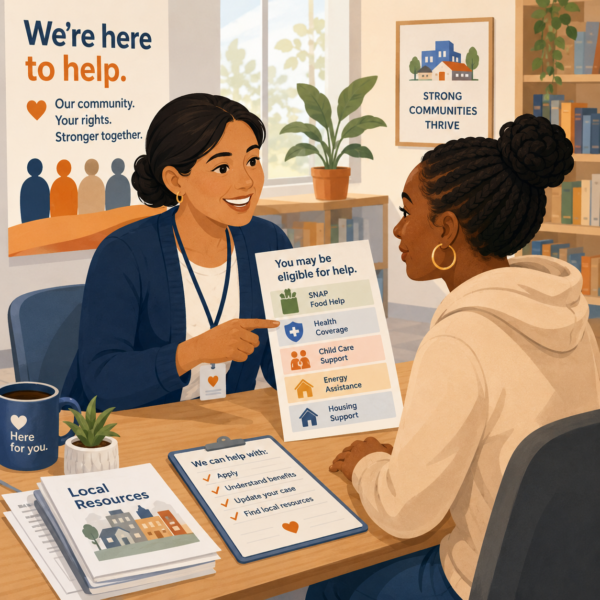 Managing public communication for human services agencies, public benefits departments, social services offices, and county assistance agencies requires more than good writing. It requires understanding resident experience, program complexity, legal obligations, operational workflows, digital tools, frontline realities, and community trust. Many agencies have strong internal teams with deep subject-matter expertise and local knowledge. Those internal teams are essential. At the same time, they are often stretched across urgent notices, leadership requests, media inquiries, partner updates, website maintenance, social media, translation coordination, and crisis response.
Agencies often choose to work with an external partner when internal capacity is limited, when a major policy or system change creates surge demand, when a renewal campaign requires more planning than staff can absorb, when public trust is at risk, or when an outside perspective can help translate complex operations into clearer resident-facing communication. External support can also be useful when an agency needs specialized expertise in message architecture, plain language, crisis communication, community engagement, digital content strategy, stakeholder alignment, or staff communication tools.
Stegmeier Consulting Group (SCG) supports public agencies by helping them build communication systems that are clear, coordinated, and resident-centered. For human services and public benefits agencies, this can include communication audits, message frameworks, resident journey mapping, notice and website review, renewal campaign planning, partner toolkits, staff talking points, crisis communication protocols, media preparation, community engagement design, and implementation support.
The value of this support is not simply producing more materials. The value is helping agencies connect the materials to the larger operating environment. A renewal flyer should align with the notice, website, portal, call center script, partner briefing, and social post. A crisis statement should align with what frontline staff are saying. A program webpage should match the action residents need to take. A partner toolkit should reflect current policy and give community organizations practical ways to help.
External support can also help agencies step back from internal assumptions. Staff who work inside a system every day may know what a term means, where to find a form, or which program owns a process. Residents do not. SCG’s role is to help translate agency knowledge into communication that meets people where they are, while still respecting legal accuracy, operational constraints, and agency voice.
For agencies preparing for major changes, such as eligibility system modernization, Medicaid renewal campaigns, SNAP (Supplemental Nutrition Assistance Program) (Supplemental Nutrition Assistance Program) policy shifts, benefit theft response, new portal rollouts, office consolidation, disaster benefit communication, or customer service improvements, a structured communication approach can reduce confusion and strengthen trust. The earlier communication is integrated into the project, the more effective it becomes.
Ready to Strengthen Public Communication for Your Human Services Agency?
At Stegmeier Consulting Group, we help human services and public benefits agencies develop clear, effective communication strategies that support residents, staff, community partners, and public trust. Our work is grounded in the idea that communication should make government easier to navigate, especially when residents are trying to access essential support.
We can help your agency:
- Build resident-centered communication playbooks for applications, renewals, notices, policy changes, crisis response, and routine updates.
- Clarify message architecture across programs such as SNAP (Supplemental Nutrition Assistance Program) (Supplemental Nutrition Assistance Program), Medicaid, TANF, child care assistance, energy assistance, housing support, aging services, disability services, and emergency relief.
- Develop plain-language resident guides, FAQs, website copy, portal support content, flyers, mailers, email templates, text message language, and social media content.
- Create partner toolkits that help community organizations, clinics, schools, libraries, food banks, and service providers share accurate information.
- Train frontline staff, call center teams, outreach workers, and spokespersons to communicate consistently and respectfully.
- Plan renewal and recertification campaigns that reduce avoidable churn and help eligible residents respond on time.
- Improve website and digital content so residents can find the right action quickly.
- Prepare crisis communication protocols for benefit disruptions, system outages, disasters, scams, misinformation, and policy changes.
- Conduct resident and partner listening sessions to identify communication barriers and improve materials.
- Measure communication effectiveness and refine strategies based on data, feedback, and after-action learning.
Whether your agency is preparing for a major benefits change, trying to reduce avoidable confusion, strengthening digital communication, or building a long-term public benefits communication system, SCG can help you create messages, tools, and workflows that support both residents and staff.
Reach out today for a consultation. We would welcome the opportunity to learn more about your agency’s communication needs and explore how we can help strengthen clarity, trust, and access across your public benefits programs.
Communication Strategy and Public Messaging: Building Colorado PEAK as a Recognizable Statewide Benefits Portal
In many parts of the United States, residents seeking public assistance are required to navigate systems that are spread across multiple agencies, programs, and levels of government. Food assistance, medical coverage, cash aid, and other forms of support are often...
MI Bridges in Michigan as an Integrated Benefits Communication and Community Resource Navigation Platform
The Human Resources Administration is one of the largest social service agencies in the United States. The agency oversees a broad range of public assistance programs that affect millions of New Yorkers every year. Prior to the expansion of ACCESS HRA, residents...
From Information to Action: ACCESS HRA as a Resident-Facing Communication Platform in New York City
In the wake of Colorado’s devastating 2002 drought, Denver Water faced a critical challenge: the utility needed to fundamentally change how residents thought about water consumption. With reservoir levels plummeting and mandatory restrictions looming,...
AI, Chatbots, and Automation in Human Services Communication: Where Public Benefits Agencies Need Guardrails
Artificial intelligence, chatbots, automated reminders, virtual assistants, predictive routing, and other digital tools are becoming more common in public-facing service environments. For human services agencies, public benefits agencies, county social services...
Data Dashboards Residents Can Actually Use: Responsible Transparency for Public Benefits Agencies
Public benefits agencies are increasingly expected to be transparent about performance, access, service demand, processing activity, call volume, timeliness, renewals, document backlogs, benefit issuance, and program changes. Data dashboards can help meet that...
Crisis Communication for Human Services Agencies: What to Say During EBT Outages, System Failures, and Disaster Benefit Changes
Human services agencies are expected to communicate clearly during ordinary operations, but their communication is tested most when something disrupts access to benefits. An EBT outage, eligibility system failure, portal disruption, call center overload, delayed...
One Message Across Every Channel: How Human Services Agencies Can Align Notices, Websites, Portals, Call Centers, and Partners
Human services agencies rarely communicate through one channel at a time. A resident may receive a mailed notice, open a text alert, check a portal, visit the agency website, call a customer service line, ask a caseworker for help, bring paperwork to a lobby, and...
Communication Calendars for Public Benefits Agencies: Planning Year-Round Education, Seasonal Campaigns, and Renewal Sequences
Public benefits communication is often treated as a response to whatever is most urgent at the moment. A renewal deadline approaches, a document campaign begins, a portal change goes live, a call center starts seeing repeated questions, an EBT concern emerges, a...
Community Feedback Loops for Human Services Agencies: Using Surveys, Call Trends, and Partner Input to Improve Communication
Human services agencies communicate with residents through notices, websites, portals, text alerts, call centers, lobby interactions, community partners, and frontline staff conversations. Each of those channels carries important information about applications,...
Reaching Residents Who Are Often Missed: Communication Strategies for Human Services Agencies Serving Hard-to-Reach Populations
Human services agencies often describe certain residents as hard to reach, but the phrase can obscure an important reality. Residents are not usually difficult to reach because they are indifferent to benefits, unwilling to respond, or uninterested in agency...
Partner Toolkits That Actually Help: How Human Services Agencies Can Equip Schools, Clinics, Food Banks, and Libraries to Share Accurate Public Benefits Information
Community partners often become the places residents turn when public benefits information feels confusing, urgent, or hard to verify. A parent may ask a school about child care assistance. A patient may ask a clinic about Medicaid renewal. A family may ask a food...
When Benefits Are Delayed: How Human Services Agencies Should Communicate Backlogs, Timelines, and Status
Benefit delays are never experienced as purely administrative delays. For residents, a delayed application, renewal, document review, interview, eligibility decision, card replacement, or case update can affect food access, health coverage, cash assistance, child care...
Dignity-Centered Communication in Public Benefits Agencies: Why Tone Affects Compliance and Trust
Public benefits communication often focuses on accuracy, deadlines, eligibility rules, required documents, and procedural notices. Those elements matter. Human services agencies, public benefits agencies, county social services departments, and state benefits offices...
Language Access Beyond Translation: How Human Services Agencies Can Reach Residents in the Languages and Contexts They Use
Language access in human services is often discussed as though the central task is translation. Translation matters, and it is essential. Residents need notices, forms, web pages, scripts, and instructions in languages they can understand. But translation alone does...
Frontline Staff as Communicators: How Human Services Agencies Can Train Eligibility Workers and Caseworkers to Explain Complex Rules Clearly
Eligibility workers, caseworkers, call center representatives, reception staff, navigators, and other frontline staff are often the people residents rely on when public benefits rules become difficult to understand. A notice may explain that information is missing. A...
Lobby Communication That Reduces Stress: Signage, Front Desk Scripts, and Wayfinding for Human Services Offices
A human services office lobby is more than a waiting area. It is often the first physical place where residents try to make sense of benefits, documents, notices, deadlines, interviews, case status, eligibility questions, and urgent household needs. A resident may...
Text Alerts That Prompt Action: Designing Renewal and Document Reminders for Public Benefits Agencies
Text alerts have become one of the most practical tools public benefits agencies can use to reach residents quickly. A short reminder can prompt someone to renew benefits, upload documents, check a notice, complete an interview, report a change, or act before a...
Task-Based Website Design for Public Benefits Agencies: Organizing Around Resident Questions, Not Agency Divisions
Public benefits websites often reflect the way agencies are organized internally. A resident may arrive looking for help with food, health coverage, child care, cash assistance, housing-related support, or a renewal notice, but the website may immediately sort them...
Portal Names Are Not Instructions: How Human Services Agencies Should Communicate Digital Benefits Tools
Human services agencies increasingly rely on digital tools to help residents apply for benefits, renew eligibility, upload documents, report changes, check case status, manage notices, and communicate with the agency. These tools may be branded as portals, accounts,...
EBT Theft Communication That Protects Residents and Builds Trust for Public Benefits Agencies
EBT theft is one of the most sensitive communication challenges public benefits agencies face because it touches immediate household needs, financial harm, technology risk, resident confidence, and agency credibility at the same time. For residents who rely on SNAP or...
Rumor Control for Human Services Agencies: How to Respond to Misinformation Before It Spreads
Misinformation can spread quickly when people are worried about public benefits. A rumor about SNAP eligibility, Medicaid renewals, cash assistance payments, child care assistance, EBT cards, immigration-related fears, fraud investigations, office closures, benefit...
Official or Scam: How Public Benefits Agencies Can Help Residents Verify Texts, Calls, Emails, and Mail
Residents who rely on public benefits are often asked to respond quickly to official communication. A human services agency may send a renewal notice, a text reminder, an email about missing documents, a phone call about an interview, a portal alert, or a mailed...
Appeal Rights Without Legal Fog: How Public Benefits Agencies Can Explain Hearings, Deadlines, and Next Steps
Appeal rights are among the most important protections in public benefits administration, but they are often explained in language that is difficult for residents to understand at the exact moment they need clarity most. A resident may receive a notice saying that...
How Human Services Agencies Can Explain Verification Requests in Plain Language
Verification requests are some of the most important messages residents receive from human services agencies. They are also some of the easiest messages to misunderstand. A resident may be asked to provide proof of income, proof of identity, proof of address, proof of...
How Human Services Agencies Can Explain Verification Requests in Plain Language
Verification requests are some of the most important messages residents receive from human services agencies. They are also some of the easiest messages to misunderstand. A resident may be asked to provide proof of income, proof of identity, proof of address, proof of...