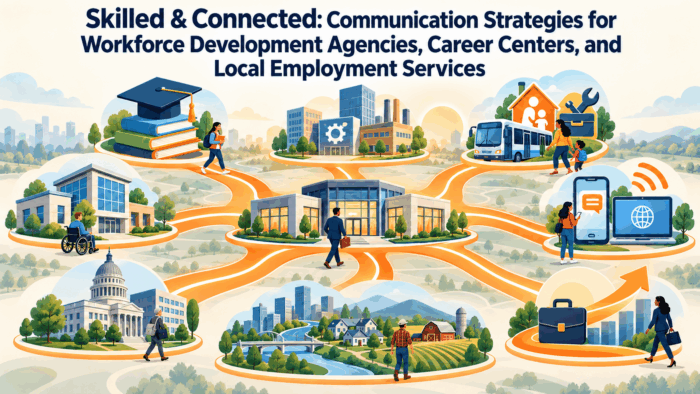
Skilled & Connected: Communication Strategies for Workforce Development Agencies, Career Centers, and Local Employment Services

Workforce development agencies occupy a distinctive place in public communication. They sit between two audiences that rarely speak the same language and seldom share the same sense of urgency. On one side are jobseekers who need a path to stable work, a new skill, a better wage, or a second chance after a layoff. On the other are employers who need qualified people now, who measure value in time and productivity, and who have little patience for programs they do not understand. The workforce system exists to connect the two, and nearly everything it does depends on whether each side understands what the system offers and trusts it enough to engage.
Local workforce development agencies, career centers, and their partners manage that connection every day. They help people search for jobs, assess their skills, enroll in training, find apprenticeships, access supportive services such as transportation and childcare, and prepare for interviews. They help employers post openings, screen candidates, host hiring events, offset the cost of training new and current workers, and respond when a downturn forces layoffs. Behind the scenes, they answer to chief elected officials, state agencies, and federal performance measures that most residents never see, and they coordinate with education, human services, and economic development partners whose programs touch the same people.
The work is deeply personal. A jobseeker may walk into a career center after losing a job they held for twenty years and feel, for the first time in decades, that they do not know what comes next. A young adult may arrive unsure whether anyone will take them seriously. A parent may need training that fits around a child’s school day. A person returning from incarceration may wonder whether a record closes every door before they even ask. An employer may call after a critical position has sat empty for six months and production is falling behind. Each of these moments carries real financial and emotional weight, and the way the agency communicates in those moments shapes whether people stay engaged long enough for services to help.
This closeness to people’s livelihoods gives workforce agencies opportunities that many public institutions do not have. A single training program can change the direction of a household’s finances for a generation. One successful placement can become a story that brings dozens of new participants through the door. A strong relationship with one employer can open hiring pathways for an entire neighborhood or industry. When communication works, it multiplies the impact of every dollar the system spends.
The same closeness can magnify communication problems. A jobseeker who is told they are not eligible, without a clear explanation or an alternative, may never return and may tell others the system is not for people like them. A training program described in vague terms may enroll people who drop out when the schedule, workload, or cost surprises them. An employer who receives poorly matched referrals may stop calling and quietly tell peers that public programs are not worth the trouble. A career center that residents associate only with unemployment claims may be ignored by the very people it could help most. A plant closure announced before the workforce agency is ready can leave hundreds of workers without information at the moment they need it.
These agencies must communicate across a remarkably broad range of subjects, often without a dedicated communications department. A board executive director may write the annual report between grant applications, partner negotiations, and board meetings. Career advisors may manage social media posts while carrying a full caseload. Business services representatives may design their own employer flyers because no one else has time. Partner agencies housed in the same center may each describe the same service using different program names. In many places, one employee is responsible for event promotion, website updates, outreach materials, and participant success stories all at once.
The central challenge is therefore not simply producing more communication. It is building a manageable system that helps jobseekers and employers understand what is available, decide to engage, and stay connected long enough for services to work, without creating a workload that lean teams cannot sustain. This content hub and its related articles provide a practical framework for that work, covering jobseeker outreach, eligibility and intake, training enrollment, career pathways, rapid response, employer partnerships, board transparency, partner coordination, digital and in-person channels, media relations, accessibility, funding and policy change, outcome reporting, and communication continuity. The goal throughout is communication that is clear, useful, honest, accessible, and realistic for the staff and resources available.
Who This Content Hub Is For
This content hub is designed for public agencies, quasi-governmental bodies, and their partners involved in connecting people to employment, training, and career advancement, and in connecting employers to the workers they need. That includes local workforce development agencies and their staff, one-stop career centers and American Job Centers including state-branded networks, state workforce agencies and state workforce development agencies, county and city workforce departments, and the human services agencies that operate or partner in career centers. It also includes youth workforce and summer employment programs, rapid response and dislocated worker units, community college workforce divisions and approved training providers, registered apprenticeship sponsors working alongside the public system, and regional workforce partnerships that span multiple local areas.
The content hub is equally relevant for the people who lead and support this work. Board executive directors and chairs, career center managers and operators, career advisors and case managers, business services representatives, youth program coordinators, rapid response coordinators, partner agency leaders, and communication and outreach staff will each find sections that speak directly to their responsibilities. Chief elected officials who appoint workforce agencies, and consultants who support public-sector workforce communication, will find context that helps them understand how communication decisions affect program results.
The common thread is that these organizations must explain complex, consequential programs to audiences with very different needs, levels of trust, and stakes in the outcome. A jobseeker needs to know whether help is available, whether they qualify, and whether it will actually lead to a job. An employer needs to know how quickly the system can deliver qualified candidates and what it will ask in return. A partner agency needs to know how referrals work and what its customers will experience on the other side. An elected official needs credible evidence that public investment is producing employment and earnings for constituents. Strong communication helps each of these audiences answer the questions that matter to them without first having to learn how the public workforce system is organized.
How to Use This Workforce Development and Local Employment Services Communications Hub
Workforce agencies communicate with people whose circumstances, priorities, and expectations of government vary widely, and this content hub is intended to serve as a central resource for strengthening that communication. It can be read from beginning to end as a broad orientation to the field, or used section by section as a reference when a specific challenge arises, such as a plant closure, a new training initiative, or a change in governance.
The sections that follow explain who these organizations are, what they need to communicate, where communication most often breaks down, and how agencies can build practical systems across jobseeker outreach, eligibility and intake, training enrollment, rapid response, employer partnerships, governance, digital and in-person channels, media relations, and public accountability. Three case studies illustrate how real workforce systems have handled communication under pressure. The related articles listed at the end of the hub go deeper into individual topics, from explaining who does what in the public workforce system to turning labor market information into content that jobseekers and employers can actually use.
The Workforce Development Landscape: Boards, Career Centers, State Agencies, and Partners
The public workforce system in the United States does not follow a single organizational model. Federal law establishes the framework, but each state designates its own local workforce areas, names its own career center network, and decides how much authority rests with local agencies versus state agencies. Two regions with similar populations may have very different structures, partner arrangements, and communication needs. Understanding this diversity matters because an agency’s communication system should reflect its actual role in the community rather than a generic picture of how workforce programs are supposed to work.
Local Workforce Development Agencies
Local workforce development agencies set strategy and oversee federally funded employment and training programs within a designated area, which may be a single large county, a city, or a multi-county region. Board members are appointed by local elected officials, and a majority typically represent local businesses, alongside representatives from labor, education, economic development, and community organizations. Depending on the area, agencies develop local and regional workforce plans, select career center operators and service providers, approve training providers and in-demand occupations, oversee adult, dislocated worker, and youth programs, convene employers by industry, monitor performance, and manage budgets and the cost-sharing agreements that fund shared career centers.
This breadth creates a distinctive communication challenge. A board must speak credibly to employers, jobseekers, elected officials, partners, and state agencies, often with a small staff and a single website that doubles as the public face of the career center. Most residents have never heard of their workforce board and have no reason to. To them, the career center is the workforce system, and a confusing intake process, an outdated job fair flyer, or a training list that is hard to find shapes their perception of the entire effort far more than any board decision.
Career Centers and American Job Centers
Career centers, often called one-stop centers or American Job Centers, are where most jobseekers and many employers actually encounter the workforce system. Many states brand these networks under their own names, and some regions layer local names on top of state and federal brands, which can leave the public unsure what to call the place or how to find it. Inside, a center may combine staff employed by several agencies and contractors, walk-in traffic alongside scheduled appointments, self-service resource rooms and virtual services, partner programs sharing the same front desk, and constant pressure to meet enrollment and placement targets.
Because many customers arrive under financial or emotional stress, they expect clear direction quickly, and they reasonably expect every staff member to understand every program in the building regardless of which agency employs that person. When that expectation is not met, customers experience the center as a maze rather than a resource. Career center communication therefore has to work on two levels at once: helping each individual find the right service, and presenting a coherent picture of the whole center even when many organizations operate within it.
State Workforce Agencies
State workforce agencies administer federal funds, issue policy to local areas, produce labor market information, operate statewide job matching portals, and in many states also run unemployment insurance. Their communication spans policy guidance to local agencies, statewide outreach campaigns, labor market reports and in-demand occupation lists, grant announcements, and performance reporting to federal partners and state leaders.
The central communication challenge at the state level is alignment with local operations. A statewide campaign may drive residents toward a local center that uses different language, different forms, or a different brand. A statewide portal may describe services differently from the local website a jobseeker visits next. From the jobseeker’s point of view, state and local messages need to fit together seamlessly, which requires deliberate coordination that rarely happens by accident.
Human Services and Community Partners
County human services agencies, vocational rehabilitation, adult education, community colleges, housing authorities, veterans services, and nonprofit organizations are frequent partners in the workforce system. Some operate career centers directly, while others refer participants or deliver services under shared agreements. Each partner may bring its own eligibility rules, intake forms, program names, communication staff, and brand standards, and many customers receive benefits and employment services from several partners at the same time without fully understanding how they connect.
When partners communicate independently, jobseekers can be sent in circles, asked to repeat their stories, or given conflicting information about what they qualify for. When partners coordinate their language and referral practices, the system can feel like one welcoming door instead of many separate ones. That coordination is itself a communication task, and it is one of the most consequential in the workforce field.
Training Providers and Regional Partnerships
Community colleges, technical centers, apprenticeship sponsors, and private training providers deliver much of the training that workforce programs fund, and regional workforce partnerships increasingly span several local areas to address shared labor markets and industry needs. Communication in this space must reach jobseekers comparing programs, employers shaping curricula, counselors and case managers advising clients, high school and adult education partners, economic development organizations, and elected officials in multiple jurisdictions. The challenge is making sure each audience understands who offers what, who pays for it, and how to take the next step, without assuming they already understand the arrangements that connect training providers to the public system.
The Common Communication Environment
Despite their structural differences, these organizations tend to share the same operating conditions. They serve two primary audiences with very different needs, work with lean communication capacity, and administer complex eligibility rules set at the federal and state levels. They share front doors with many partners, operate under performance measures tied to enrollment and outcomes, and serve customers who are often under financial and emotional strain. Public awareness of their services is typically low, brands vary across federal, state, and local levels, and funding and policy can shift with little notice. The common thread is not a particular organizational chart. It is the need to connect people and employers to opportunity through a system that much of the public does not fully understand.
Our Comprehensive Guide to Public Communications for State and Local Government Agencies
This article is part of our series on strategic communication for state and local government agencies. To learn more and to see the parent article, which links to other content just like this, click the button below.
How Workforce Agencies Can Adapt Communication to Dual Audiences, Partner Networks, and Federal Requirements
Workforce agencies do not operate like service agencies with a single customer, and their communication environment differs in ways that affect tone, channels, approvals, public expectations, and risk. Strategies borrowed from other public agencies often fall short because they assume one audience, one program owner, and one voice. Recognizing what makes the workforce environment different is the first step toward communication that actually works within it.
Two Customers With Different Needs
Most public agencies serve one primary audience. Workforce agencies serve two at once, and each expects to be treated as the main customer. Jobseekers want to know whether they qualify, what it will cost them, how long it will take, and whether it will lead to a job that pays enough to live on. Employers want to know how quickly they can hire, how candidates are screened, what paperwork is involved, and whether participating is worth the time of a busy manager.
A message written for one of these audiences rarely works for the other. A website organized around program names may confuse jobseekers who simply want to find work, while a business brochure built around social impact may fail to persuade a plant manager who needs twelve welders by spring. Effective workforce communication separates these audiences deliberately, writing for each in its own language and through its own channels, while making sure the facts underneath stay consistent.
Many Partners Share One Front Door
A single career center may house the core workforce program, employment services, adult education, vocational rehabilitation, veterans employment representatives, human services staff, and community nonprofits. Each partner may have its own eligibility rules, forms, brand standards, and reporting obligations, and each may describe overlapping services in its own terms. Without a shared approach, customers hear different explanations of the same service from different people in the same building, and they leave unsure which version is true.
This arrangement means that communication in a workforce setting is rarely the work of one organization. It requires agreements among partners about how services will be described, how referrals will be handled, and who speaks for which program. Those agreements are as important to the customer experience as any flyer or web page.
Federal Language Does Not Translate Well
Workforce programs are built on federal statutes and regulations, and staff routinely use terms such as adult program, dislocated worker, individual training account, eligible training provider list, supportive services, and performance measures. These terms carry precise meanings that matter for compliance and funding. To a jobseeker, however, they can sound like a series of hurdles designed to keep people out.
Communication must translate program language into plain answers about what a person can get, what they need to provide, and what happens next. That does not mean abandoning accuracy. It means leading with the person’s situation and goal, then explaining the program terms only where they help the person act. Agencies that make this translation consistently find that more people complete intake and fewer people give up before they start.
Customers Often Arrive Under Stress
Many jobseekers contact the workforce system after a layoff, a long period of unemployment, a health change, a move, or a major life transition. They may be worried about rent, childcare, medical bills, or debt, and they may be carrying a sense of failure or embarrassment about needing help at all. That context shapes how every message is received.
Long forms, unexplained waiting periods, or a cold tone can feel like rejection to someone in that position, even when staff intend no such message. Clear next steps, honest timelines, and respectful language can make the difference between a person who enrolls and a person who quietly walks away. Workforce communication that takes stress into account is not softer or less accurate. It is simply more effective at keeping people engaged.
Public Awareness Is Low
Many residents do not know a career center exists, and many who do assume it only serves people filing for unemployment. Some believe public workforce programs are only for people with very low incomes or no work history, while some employers assume candidates referred by a public program will be less qualified than those they find elsewhere. These perceptions shape every outreach effort before it begins.
The agency’s goal, therefore, is not only to promote services but to change what people believe the workforce system is for. That shift takes time and repetition, and it depends on consistent messages delivered through trusted messengers over months and years rather than single campaigns.
Trust Is Built Through Routine Communication
Workforce agencies often concentrate their communication around events, grant announcements, or layoffs, and between those moments jobseekers and employers may hear very little. That pattern leaves the agency invisible until the moment it is most needed, when it must suddenly establish credibility with people who have never heard of it.
Regular job postings, training updates, employer spotlights, workshop calendars, and outcome reports create familiarity long before a crisis occurs. When a major employer closes, workers who already recognize the career center and know someone who was helped by it are far more likely to trust it and use its services quickly. Routine communication is how that recognition is built.
How Workforce agencies and Career Centers Can Build a Practical Communication System
The most effective communication system for a workforce agency is not the one with the most campaigns, platforms, or materials. It is the one staff and partners can maintain consistently, week after week, alongside their other responsibilities. A practical system reduces repeated work, clarifies who is responsible for what, and makes it easier to communicate accurately across programs and partners, so that good communication becomes routine rather than heroic.
Identify Recurring Communication Responsibilities
Agencies should begin by taking stock of the information they communicate on a regular basis. In most workforce settings, that includes workshop and orientation calendars, job postings and hiring events, training program openings and application deadlines, eligibility and intake information, employer services and incentive programs, youth program recruitment, board meeting notices, layoff and rapid response information, labor market updates, success stories and outcome reports, partner referral guides, and notices about office hours, closures, and virtual services.
Seeing these responsibilities in one place changes how an agency plans. Work that once felt like a constant stream of urgent requests becomes a set of predictable tasks that can be scheduled, templated, and assigned. That visibility also exposes gaps, such as an important program that has no current materials or a recurring event that is always promoted too late.
Establish Clear Roles
A basic communication process should define who identifies the need for a message, who confirms program rules and eligibility details, who drafts the content, who reviews it for accuracy and compliance, who approves sensitive or public-facing material, who publishes it, who answers follow-up questions, and who serves as backup when the primary person is unavailable. In a career center with multiple partners, roles should also make clear which agency speaks for which program, so that customers do not receive competing explanations.
This does not require an elaborate approval chart. A one-page responsibility guide that everyone can reference is often enough to prevent delays, contradictions, and the quiet assumption that someone else is handling a message. The point is to make ownership visible so that important information does not fall between partners.
Create Reusable Templates
Templates are especially valuable for agencies with limited staff and frequently repeated messages. Training announcements, hiring event promotions, workshop descriptions, eligibility explainers, employer incentive summaries, rapid response information packets, board meeting notices, participant success stories, service change notices, and frequently asked questions all follow recognizable patterns that can be captured once and reused many times.
A good template provides structure without forcing every message into identical wording. It reminds staff to include the information customers need most: who the opportunity is for, what it costs, how long it takes, what to bring, how to apply, and who to contact with questions. Over time, templates also create a consistent voice across programs and partners, which helps customers recognize official information when they see it.
Define the Official Source of Information
Jobseekers, employers, and partners should know where confirmed information will appear. In most cases, the agency website should serve as the primary source of truth for services, eligibility, training options, events, and contacts, while email, social media, printed materials, partner channels, and statewide portals direct people back to it for complete details.
When the website is outdated or incomplete, customers rely on old flyers, word of mouth, or partner explanations that may no longer be accurate, and staff spend time correcting confusion that could have been prevented. Keeping one reliable source current is one of the simplest and most effective ways to improve communication across every other channel.
How Career Centers Can Reach Jobseekers Who Do Not Know the System Exists
For many communities, the largest communication gap is not explaining services to people who walk through the door. It is reaching the people who never would. Underemployed workers, discouraged jobseekers who have stopped looking, rural residents far from a center, young adults who are out of school and out of work, and people with limited English may never search online for a career center or think to call one. Outreach has to meet them where they already are, through people and places they already trust, and it has to give them a reason to believe the system is meant for them.
Change What People Believe the Career Center Is For
Many residents associate the workforce system only with unemployment claims, while others assume its services are reserved for people with very low incomes or no work history. These beliefs quietly screen out large numbers of people who could benefit, including employed workers looking for better jobs and mid-career adults who need a new credential to advance.
Outreach should explain in plain terms that job search help is free and open to the public, that people who are already working can use services to move into better-paying jobs, that training may be available at little or no cost to those who qualify, that services are offered both in person and online, and that local employers use the center to find candidates. Repeating these basic facts across channels over time does more to change perceptions than any single campaign.
Use Trusted Community Messengers
Jobseekers often learn about opportunity from people and institutions they already trust. Libraries, community colleges and adult education programs, human services offices, housing authorities, faith communities, reentry programs, veterans organizations, food banks, community action agencies, schools, parent groups, local employers, and unions can all serve as powerful outreach partners because they already have relationships with the people the workforce system wants to reach.
These partners are far more likely to share information when the agency makes it easy for them. Ready-to-use flyers, short descriptions they can paste into newsletters, social media posts they can share without editing, and a named referral contact who answers quickly all lower the effort required. Partners also need to hear back about what happened to the people they referred, which strengthens the relationship and encourages future referrals.
Lead With Outcomes People Care About
Jobseekers respond to concrete benefits far more than to program names. Announcing that adult and dislocated worker services are available means little to most people. Explaining that local residents can get help paying for commercial driver training, earn a healthcare certification in twelve weeks, or meet employers who are hiring this month gives them something tangible to consider.
Outcome-focused messages also help people picture themselves succeeding. Short stories from participants who share similar backgrounds, used with consent, can be especially effective because they answer the unspoken question many jobseekers carry: whether someone like them can actually do this.
Go Where Jobseekers Already Gather
Outreach can take place at libraries and community centers, laundromats and transit stops, community events and festivals, human services waiting rooms, high school and adult education programs, neighborhood organizations, and through mobile career units in rural areas. Each of these settings puts information in front of people at moments when they have time to read it and may be thinking about their circumstances.
A career center that communicates only through its own building and website will mostly reach people who already know it exists. Agencies that invest in consistent, visible presence in community spaces gradually build recognition that pays off when residents eventually need help, whether that need arrives through a layoff, a career change, or a young person’s first job search.
How Workforce Agencies Can Explain Eligibility, Intake, and Program Requirements in Plain Language
Eligibility and intake are where many jobseekers are lost. A person who was motivated enough to come in, or to complete an online interest form, may leave discouraged if the process feels confusing, invasive, or slow. Posting the federal eligibility rules on a website does not help a jobseeker understand whether they qualify, what they need to bring, or how long it will take. Clear, respectful communication at this stage protects the investment the agency has already made in outreach and keeps people moving toward services.
Separate Open Services From Enrolled Programs
Many career center services, such as job search assistance, resume help, workshops, and access to computers and job listings, are available to anyone. Other services require registration, eligibility documentation, assessment, or approval, and supportive services such as transportation help often carry criteria of their own. When these distinctions are not explained, jobseekers may assume that everything requires paperwork and give up before using services they could have accessed that same day.
Communication should make clear what someone can do immediately without enrolling, what requires a short registration, and what involves a fuller eligibility process. Starting people with open services builds momentum and trust, and it gives staff time to explain the more involved programs once the person is already engaged.
Explain Eligibility in Terms People Recognize
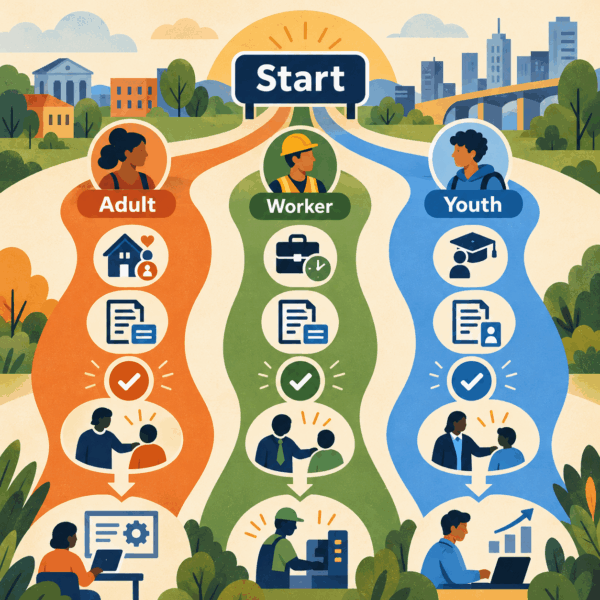
Rather than leading with program categories, communication can describe situations people recognize in their own lives: being laid off or facing a job that is ending, looking for a better-paying job, being between sixteen and twenty-four and not in school, returning to work after time away, being a veteran or military spouse, or receiving public assistance. Each situation can then point to the services and next steps that apply.
This approach respects the way people actually think about their circumstances. It also reduces the sense that eligibility is a test to be passed, replacing it with the more accurate message that different kinds of help exist for different situations, and that staff can help people find the right fit.
Prepare People for Documentation
Jobseekers are much more likely to complete intake when they know what to bring before the first appointment. A useful checklist explains which documents are required, why each one is needed, what alternatives are accepted if a document is missing, how personal information will be protected, and whether staff can help obtain records such as identification or proof of a layoff.
Explaining the reason behind each requirement matters more than many agencies realize. People who understand that a document is needed to establish eligibility for funded training are more willing to provide it than people who simply receive a list. Clear explanations also reduce the number of repeat visits caused by missing paperwork.
Set Honest Expectations About Timing
Assessment, eligibility review, and training approval can take weeks, especially when funding cycles, training start dates, or partner reviews are involved. When people are not told this, they may assume they were forgotten or quietly denied, and some will move on before a decision arrives.
Communication should explain the steps in order, typical timeframes for each, and when the person will hear back. A firm commitment to the next contact, even if the final decision is not yet known, is often more valuable than an uncertain promise about the outcome. Regular check-ins during waiting periods keep people engaged and signal that the agency is still working on their behalf.
Explain Decisions Respectfully
When a person is not eligible for a particular program, they should still leave with a path forward. That may include open services they can use right away, referrals to partner programs, other funding sources for training, or a future date when circumstances might change their eligibility. The explanation should be specific enough that the person understands the reason, and it should be delivered in a way that preserves their dignity.
A clear and respectful explanation protects the agency’s reputation in the community and keeps the person connected to the system. People who feel dismissed tell others, while people who feel respected often return later or refer friends and family, even if the first answer was not the one they hoped for.
 How Workforce Agencies Can Communicate Training Funds, Enrollment, and Career Pathways
Training is one of the most valuable services the workforce system offers and one of the hardest to explain well. Jobseekers must understand what can be funded, what will be expected of them, how long it will take, and what kind of job the training can realistically lead to. Employers must understand how training programs connect to their hiring needs. When this communication is clear, the right people enroll and finish. When it is vague, programs fill with people who leave partway through, and the agency loses both money and credibility.
Explain How Training Funds Work
Jobseekers often hear that training is free and assume there are no limits or conditions attached. In reality, workforce training funds typically cover approved programs from approved providers, may carry dollar limits, usually must lead to occupations in demand in the local labor market, and often require assessment and counseling before approval. Some programs also have expectations about attendance and progress, and there may be consequences if a participant withdraws.
Explaining these conditions up front is not meant to discourage interest. It is meant to prevent the frustration that comes when people discover the rules after they have already made plans. Jobseekers who understand how funding works can make realistic choices, ask better questions, and move through the approval process with fewer surprises.
Recruit Without Overpromising
Training recruitment should be both motivating and honest. Strong enrollment communication describes the length of the program, class schedules and weekly time commitment, prerequisites and entrance testing, the physical or technical demands of the work, typical starting wages and career progression, the local employers who hire graduates, and the support available during training. It presents a demanding program as achievable without pretending it is easy.
Overpromising can produce impressive enrollment numbers and disappointing completion rates. Clear expectations help people choose programs that fit their lives and abilities, which improves completion, placement, and the agency’s performance outcomes. They also protect the trust of employers, who depend on graduates being prepared for the work they were trained to do.
Promote Apprenticeship and Earn-and-Learn Options
Many jobseekers and families still associate apprenticeship only with the building trades. Registered apprenticeships now exist across healthcare, information technology, advanced manufacturing, transportation, and public service, and earn-and-learn models allow people to be paid while they build skills. For people who cannot afford to stop working to attend school, these options can be the difference between advancing and staying stuck.
Communication should explain clearly that apprentices are employees who earn wages from the start, how to apply, what credentials they earn, and how wages typically rise as skills grow. Stories from both apprentices and employers make the model easier to understand and help overcome the outdated perceptions that limit interest.
Make Supportive Services Visible
Practical barriers often decide whether someone can start or finish training. Transportation, childcare, work tools, uniforms, testing and licensing fees, books, and internet access or devices can all stand between a motivated participant and a credential. Where supportive services are available to address these needs, communication should describe them plainly and early, so people know help exists before they rule themselves out.
People rarely ask for help they do not know is possible. Agencies that make supportive services visible in outreach materials, intake conversations, and training orientations see fewer people decline training for practical reasons and fewer participants drop out when an unexpected cost arises.
Keep Participants Engaged Through Completion
Enrollment is not the end of communication. A thoughtful retention approach includes a welcome message with key contacts, reminders about milestones and deadlines, regular check-ins from a career advisor, encouragement at the points in a program where people commonly struggle, prompt outreach when attendance drops, job search support before graduation, and follow-up after placement.
Participants who feel connected to someone who knows their name and their goals are far more likely to finish training, find work, and report their outcomes. That follow-through benefits the participant first, but it also strengthens the agency’s performance data, its stories, and its case for continued investment.
How Rapid Response Communication Supports Dislocated Workers After Layoffs and Closures
A major layoff or facility closure is one of the most visible moments for the workforce system. Workers, families, local officials, suppliers, and the media all want to know what is happening and what help is available. The workforce agency may have only a short window to reach affected workers before they scatter into job searches, unemployment claims, and uncertainty, and the quality of its communication in those first days often determines how many workers ever use its services.
Coordinate With the Employer Early
When possible, rapid response teams should work with the employer before the public announcement or immediately after it. Early coordination can settle when and how workers will be told, whether on-site information sessions can be held during work hours, how workforce materials will be distributed, which shifts and locations are affected, whether some workers may be transferred or recalled, and how the employer will encourage workers to use available services.
Employers are often focused on legal obligations, operations, and their own public messaging during a closure, and workforce services can feel like an afterthought. Rapid response staff who approach the employer as a partner, offering to reduce the burden of explaining benefits and services to workers, are more likely to gain access to the workplace and to the workers themselves.
Lead With What Workers Need First
In the first communication, workers usually want answers to immediate, practical questions. They want to know how to file for unemployment, what happens to their health insurance, whether they can get help finding a new job, whether training is available, who to call with questions, and when and where information sessions will be held. These questions reflect real anxiety about rent, medical care, and family finances.
Detailed descriptions of training programs, eligibility categories, and partner services can follow once those urgent questions are answered. Communication that starts with program explanations before addressing immediate needs tends to lose workers’ attention at the moment it matters most.
Reach Workers Through Multiple Channels
Workers may leave the job before a session is held, work shifts that conflict with meeting times, or prefer to receive information in a language other than English. Effective rapid response communication uses several channels at once: on-site sessions scheduled across all shifts, printed packets in the languages workers speak, a dedicated web page with current information, text and email follow-up where permitted, union and community partner channels, and local media for large closures.
Using multiple channels is not redundancy for its own sake. Each channel reaches a slightly different group of workers, and together they make it far more likely that every affected person learns where to go for help.
Continue After the Announcement
The first session is rarely the last message dislocated workers need. In the weeks and months that follow, workers benefit from invitations to job fairs, notices about training enrollment deadlines, announcements from employers who are hiring, and reminders that services remain available long after the closure date. Many workers take time to process a job loss before they are ready to pursue retraining, and continued communication keeps the door open for them.
Keep Local Officials Informed
Elected officials and economic development partners are often the first people the public and the media call after a layoff announcement. Briefing them early on the services being provided, the locations and dates of information sessions, and the contacts for affected workers helps them point constituents to the right place. It also demonstrates the value of the workforce system at a moment when public attention is focused on the local economy.
How Workforce Agencies Can Build Employer Partnerships Through Business Services Communication
Employers are both customers and partners of the workforce system. Without them, there are no placements, no work-based learning opportunities, and no credible training programs aligned with real jobs. Yet many employers do not know what the system offers, and those who do may assume it is a government program that brings paperwork, delays, and poorly matched candidates. Business services communication has to overcome those assumptions with clear, specific, business-oriented messages backed by reliable follow-through.
Position the System as a Hiring Partner
Business services communication should speak directly to employer priorities. Employers care about faster access to screened candidates, help filling roles that have been open too long, lower recruiting and training costs, customized training for new and current employees, support during expansion or downsizing, and labor market information that helps them plan wages and recruitment strategies.
The message is strongest when it uses the language of business and offers concrete examples rather than program names. A short case showing how a local manufacturer filled ten positions in six weeks through a customized training cohort will persuade more hiring managers than a brochure describing the agency’s mission and funding sources. Employers want evidence that working with the system will save them time and money.
Explain Incentives and Programs Clearly
On-the-job training, incumbent worker training, work experience, and apprenticeship programs can offer real value to employers, but only if employers understand how they work. Before committing, employers need to know what the program provides, what it costs them, what paperwork is required, how long approval takes, what they commit to in return, and who will serve as their main point of contact throughout the process.
A single named contact and a short, honest overview of the process can remove much of the hesitation that keeps employers from participating. Employers who feel that the agency respects their time, explains requirements clearly, and follows through on promises often become long-term partners who return year after year and recommend the system to peers.
Convene Employers Around Shared Needs
Sector partnerships bring employers from the same industry together to shape training programs, identify skill gaps, and address hiring challenges they share. These partnerships can produce training that genuinely matches local demand, but they depend on employers seeing their participation as worthwhile.
Communication should make clear why each employer’s time matters, what decisions the group will influence, and how their input will be used. After each meeting, employers should hear what changed as a result of their participation, whether that is a revised curriculum, a new training cohort, or a joint recruitment effort. Employers who see their input shape real outcomes stay engaged, while those who feel they are attending meetings for appearances quietly drop out.
Align With Economic Development Partners
Economic development organizations frequently describe a region’s workforce when recruiting new businesses or supporting expansions. If those descriptions promise more than the workforce system can deliver, new employers arrive with expectations that cannot be met, and both organizations lose credibility. Workforce agencies should coordinate with economic development partners so that talent claims made to prospective employers reflect the system’s real capacity.
Shared messaging, joint employer visits, coordinated labor market data, and regular conversations about upcoming projects can strengthen both efforts. When workforce and economic development partners speak with one voice, employers experience the region as organized and responsive.
Recognize Employers Who Hire Through the System
Employer recognition, case studies, and public spotlights encourage other businesses to participate and give the workforce system credible proof of value. They also show jobseekers that real local employers trust the training and services the system provides. Recognition works best when it highlights concrete results, such as the number of people hired or promoted, and when the employer is comfortable sharing its experience in its own words.
How Workforce Agencies Can Communicate Governance, Local Plans, and Public Accountability
Workforce development agencies make decisions about public funds, service providers, training priorities, and performance targets that shape opportunity across their communities. Yet most residents, and many local officials, know little about how agencies operate or what they decide. Transparent governance communication builds credibility with elected officials, partners, employers, and the public, and it helps protect the board when difficult decisions or funding pressures arise.
Make Board Meetings Understandable
Posting a meeting notice and agenda meets legal requirements, but it does not explain what the board will decide or why those decisions matter to the community. Agendas filled with acronyms, contract numbers, and policy references can make even routine meetings difficult for the public to follow.
Agencies can improve meeting communication by publishing short plain-language summaries of major agenda items, noting whether each item is for discussion or action, explaining how the public can comment, and providing accessibility and virtual attendance information. A brief recap after each meeting describing key decisions and next steps helps partners and the public stay informed even if they did not attend.
Explain Local and Regional Plans
Local and regional workforce plans describe priorities, target industries, service strategies, and partner roles for several years at a time. They are typically long, technical documents written to satisfy state and federal requirements, and few members of the public will read them in full.
A public-facing summary can explain what the plan is for, which industries and occupations it prioritizes, which populations it focuses on, what will change for jobseekers and employers, how the public can comment, and when the plan takes effect. Making that summary easy to find and easy to read turns a compliance exercise into a genuine opportunity for public input.
Communicate Provider and Operator Decisions
When a board selects a new career center operator or service provider, customers often notice the change through new staff, new procedures, new phone numbers, or new locations. Without clear communication, these changes can create confusion and anxiety, particularly for participants already enrolled in training or receiving services.
Communication should explain what is changing, what stays the same, when the transition will occur, and how enrolled participants will be supported. Partners and employers should be informed directly before the change becomes visible, so they can answer questions accurately and continue making referrals without interruption.
Report to Elected Officials Regularly
Chief elected officials appoint board members and share legal responsibility for the local workforce area, yet many receive information only when something requires their signature. Regular briefings, short dashboard that show key outcomes, and constituent-ready talking points help officials understand the system’s value and represent it accurately when they are asked about jobs, layoffs, or training in their communities.
How One-Stop Partners Can Create One Reliable Information System
Workforce agencies frequently struggle with fragmentation. The state portal says one thing, the local website says another, a partner’s flyer still describes a program that changed last year, and the front desk gives yet another answer. Customers experience all of these sources as a single system, and every inconsistency erodes their confidence that the system knows what it is doing. The partners behind the career center should manage their communication accordingly, treating consistency as a shared responsibility rather than each partner’s private concern.
Build Shared Language Across Partners
Partners should agree on common descriptions of the core services available to everyone, how to start the intake process, the training options available and how they are funded, the supportive services that exist, the services offered to employers, and the contacts and locations customers should use. These descriptions become the foundation for websites, flyers, scripts, and referral guides across every partner.
Shared language does not erase each partner’s identity or require every organization to abandon its own brand. It simply ensures that customers hear the same facts regardless of which partner they encounter first. Agreeing on that language is often the most valuable outcome of partner coordination, because it improves every interaction that follows.
Make No Wrong Door Real
Many career centers promise a no wrong door experience, meaning any staff member can direct a customer to the right service. Delivering on that promise requires deliberate investment: referral scripts and quick reference guides, cross-training on partner programs, a current shared directory of contacts, warm handoffs that introduce the customer to the right person rather than simply handing them a phone number, and follow-up to confirm the customer was actually served.
When these practices are in place, customers feel guided rather than passed along. When they are missing, the no wrong door promise becomes a slogan that customers quickly learn not to believe.
The Website as the Official Source
The website should contain complete, current information about jobseeker services, employer services, eligibility and intake steps, training programs and providers, events and workshops, locations and hours, virtual options, partner programs, board meetings and plans, and performance reports. Every other channel should point back to it, and partners should link to it rather than maintaining their own competing versions of the same information.
The site should be organized around customer tasks such as finding a job, getting training, or hiring workers, rather than around funding streams or partner agencies. Customers should be able to find what they need without first learning how the workforce system is structured.
Email, Text, and Social Media
Email and text messages are useful for appointment reminders, workshop notices, hiring events, and training deadlines, while social media can promote events, share job openings, and highlight success stories. Each channel extends the agency’s reach, but each also creates opportunities for inconsistency if it is not managed carefully. Agencies should establish who may post on official accounts, which accounts are official, how comments and questions are handled, and how corrections are issued when information changes.
Print and In-Person Communication
Printed materials remain essential in career centers, partner offices, libraries, and community sites, especially for customers who are not reliably online. Printed flyers should carry a date and a web address so customers can confirm that information is current, and outdated materials should be removed promptly whenever programs, dates, or contacts change. A single expired flyer left on a partner’s counter can send dozens of people to the wrong place.
How Workforce Agencies Can Strengthen Digital Communication
For many jobseekers and employers, the agency website or a search result is their first impression of the workforce system. A board website that leads with its mission statement and funding sources, buries the address of the nearest career center, or lists programs by federal title rather than by what people need will lose visitors before a human connection is ever made. Digital communication is now the front door for a large share of customers, and it deserves the same attention as the physical front desk.
Most workforce websites share a common structural problem: they are organized around funding streams and partner agencies rather than around user needs. A laid-off worker does not arrive knowing whether their question belongs to the adult program, the dislocated worker program, or employment services. A small business owner does not know whether to look under business services, on-the-job training, or the state job board. They arrive knowing what they want to do, and the site should start there.
Organizing Digital Content Around What Users Need to Do
The most effective workforce websites organize content around a few clear paths, such as finding a job, getting training, getting help after a layoff, programs for young adults, and hiring or training workers. Each path should lead to plain-language explanations of what is available, who it is for, what it costs, and a single clear next step, whether that is booking an orientation, completing a short interest form, or calling a named contact. Eligibility explanations and document checklists should appear before application forms, and every page should show how to reach a real person.
Long plans, policy documents, and performance reports should be paired with short summaries so that visitors without technical background can understand the key points. The website should also connect cleanly with statewide job matching portals, so that jobseekers who move between local and state sites do not have to guess where they are or why the branding changed.
Social Media and Content Strategy
Workforce social media is most effective when it is useful and local. Current job openings, upcoming hiring events, training start dates, employer spotlights, and short participant stories consistently outperform general announcements about the agency’s mission. Content should connect services to outcomes people care about, such as a credential earned in twelve weeks, a hiring event featuring specific local employers, or the starting wage for a regional apprenticeship.
Peer voice is underused and highly effective. A recent graduate explaining how they paid for commercial driver training, or a young adult describing their first paid work experience, reaches jobseekers who would scroll past an agency announcement. Agencies should establish clear consent, privacy, and review practices before sharing participant stories, so that storytelling builds trust rather than putting participants at risk.
Text Messaging and Virtual Services
Text reminders for appointments, orientations, and training deadlines can reduce missed appointments and keep participants engaged, especially those who change email addresses frequently or rarely check them. Virtual orientations and appointments extend access to people facing transportation, childcare, or work schedule barriers, and they have become an expected option for many customers.
Virtual services only work when instructions are simple and alternatives exist. Agencies should explain plainly how to join a virtual session, what device or connection is needed, and what to do if technology fails, and they should keep in-person and telephone options available for people without reliable devices or internet access.
Accessibility as a Core Digital Principle
Digital communication regularly fails jobseekers with disabilities, limited English, or limited digital skills, who are among the people the workforce system is specifically designed to serve. Flyers posted as images or inaccessible PDFs, videos without captions, websites that do not work on a phone, and application portals with confusing steps all keep people out. Many jobseekers access the internet primarily through a smartphone, so mobile usability is not optional. Agencies should review accessibility and mobile performance systematically and treat them as baseline requirements rather than enhancements to be added when time allows.
How Workforce Agencies Can Communicate in Career Centers, at Hiring Events, and in Public Meetings
The physical environment of the workforce system communicates messages about respect, competence, and welcome that no website can replicate. A jobseeker who walks into a career center for the first time forms an impression within minutes, and that impression often decides whether they come back. Employers attending a hiring event or board members attending a meeting form similar impressions about whether the system is organized and worth their time.
The Career Center as a Communication Environment
Many career centers were designed around program operations rather than customer experience. Visitors may encounter a sign-in kiosk with no explanation, a waiting area crowded with partner brochures, a resource room with outdated job postings, and staff who each describe services from the perspective of their own program. None of these details is dramatic on its own, but together they tell visitors that the center was not built with them in mind.
A welcoming center makes the first step obvious. Clear signage explains what people can do today, how long a typical first visit takes, and who can help. Front desk staff are trained to ask what brought someone in and to direct them without making them repeat their story several times. Printed materials carry dates and are removed when programs change, and partner logos and program names are organized around customer needs rather than displayed as a wall of acronyms.
The tone of the space matters as much as the information it contains. People who arrive after a layoff, a long period of unemployment, or time in prison may already feel judged. Respectful greetings, privacy for personal conversations, and staff who explain next steps patiently are all forms of communication, and they often matter more to a first-time visitor than any brochure.
Hiring Events and Job Fairs
Hiring events are among the most visible moments in the workforce calendar for both jobseekers and employers, and they succeed when communication begins well before the event and continues after it. Jobseekers need to know which employers will attend, which positions are open, what to bring, whether registration is required, how to dress, and whether interviews will happen on site. Employers need clear logistics, realistic expectations about attendance, and information about the candidates they are likely to meet.
After the event, both audiences should hear about outcomes and next steps. Jobseekers should know how to follow up with employers and where to find help if they were not selected, and employers should receive thanks, attendance information, and an invitation to future events. Employers who hired should be recognized publicly where they are comfortable, which encourages others to participate next time.
Workforce Board Meetings and Public Hearings
Board meetings and public comment periods on local plans are formal moments when the public is invited to understand and influence workforce strategy. Meetings held at inconvenient times, with dense slide presentations and no plain-language summaries, signal that public participation is a formality rather than a valued contribution.
Well-designed meetings include short previews of major decisions, accessible materials, virtual participation options, clear instructions for public comment, and staff available before and after the meeting to answer questions. A brief recap afterward tells participants that their attendance mattered and helps those who could not attend stay informed.
How Workforce Agencies Can Build a Communication Calendar Around Program and Community Cycles
Workforce communication is often reactive. Agencies promote a training cohort when seats are still empty a week before it starts, announce hiring events only days in advance, and respond to layoffs as they happen. A communication calendar helps agencies move from reaction to readiness by anticipating the moments when communication is most needed and preparing for them before they arrive. It also protects staff capacity, because work that is planned in advance leaves more room to respond when something unexpected occurs.
The workforce system runs on predictable cycles that a well-structured calendar can address. Training providers run cohorts on academic and seasonal schedules. Summer youth employment programs recruit participants and employers months before school lets out. Local and regional plans follow multi-year update cycles with required public comment periods. Program years and performance reporting follow fixed federal timelines. Seasonal industries, from agriculture and tourism to retail and logistics, hire in recognizable waves that create recurring opportunities for jobseekers.
Program Cycles That Drive Communication Needs
Each recurring program moment calls for a different kind of communication. Training enrollment windows need recruitment that begins early enough for people to complete eligibility steps before classes start. Youth programs need outreach to schools, families, and employers well before spring. Plan updates need public-facing summaries and clear comment instructions. Annual reports need outcome stories and data gathered and approved before the release date. Grant launches need partner briefings and materials ready before the public announcement so that partners can answer questions on day one.
Agencies that build these phases into their annual planning produce fuller training cohorts, stronger employer participation, and more credible public reporting than agencies that treat each moment as a separate scramble. A calendar that maps these cycles across the year also helps leaders see where communication demands will peak, so they can allocate staff time or outside support accordingly.
Community and Labor Market Cycles
Effective calendars also reflect the rhythms of the communities and employers the agency serves. School calendars shape when parents can attend training or appointments. Tax season brings people to libraries and community sites where career information can be shared. Industry associations, chambers of commerce, and union halls hold regular meetings that create natural opportunities for employer and worker outreach. Community festivals and resource fairs offer chances to reach residents who would never walk into a career center on their own.
A useful workforce communication calendar brings these cycles together in one place. It typically tracks training cohort start dates and recruitment windows, youth program recruitment milestones, seasonal hiring peaks by industry, board and committee meetings, plan update and public comment periods, performance reporting and annual report dates, hiring events and job fairs, employer recognition events, partner briefing schedules, and the after-action review windows that follow major events and campaigns.
How Workforce Agencies Can Reach Youth, Returning Citizens, and Jobseekers Facing Barriers
The public workforce system is designed to serve people with significant barriers to employment, including young adults disconnected from school and work, people returning from incarceration, people with disabilities, and people with limited English. Communication must be built for these audiences from the start rather than adapted after general materials are finished. Messages designed for a typical mid-career jobseeker often miss these groups entirely, or worse, signal that the system is not meant for them.
Youth and Young Adults
Young adults who are out of school and out of work may not respond to messages designed for older jobseekers. They are more likely to respond to short, direct language and visual content, to stories from peers who share their experiences, and to clear information about paid work experience and what they can earn. They are also more likely to be reached through schools, community organizations, recreation programs, and the social platforms they actually use than through agency websites or printed brochures.
The first step should be as simple as possible, such as replying to a text message or completing a short online form, because a complicated application can end a young person’s interest before it begins. Where appropriate, involving parents, mentors, coaches, or other trusted adults can encourage follow-through. Youth communication works best when it treats young people as capable and ambitious rather than as problems to be managed.
People Returning From Incarceration
People returning from incarceration often assume that a criminal record closes every door before they even ask. Communication should explain which services are available to them, which local employers are open to hiring people with records, and what support exists for record sealing, occupational licensing questions, interview preparation, and explaining a work history gap.
Respectful, nonjudgmental language matters enormously to this audience, and so do trusted messengers. Partnerships with reentry programs, probation and parole offices, and community organizations that serve returning citizens can extend reach and lend credibility. Clear examples of people who have successfully found work after incarceration can help counter the assumption that trying is pointless.
People With Disabilities
Communication should make clear that career centers are accessible, that accommodations are available, and that people with disabilities are welcome and expected participants rather than special cases. Coordination with vocational rehabilitation partners helps customers understand how workforce and rehabilitation services fit together, so they are not left to navigate two systems on their own.
Digital and printed materials should support assistive technology through descriptive link text, alternative text for meaningful images, accessible headings and document formatting, captions and transcripts for video, sufficient color contrast, and layouts that work on mobile devices. These practices benefit many customers beyond those with disabilities, including older jobseekers and people using small screens.
Limited English Speakers
Agencies should identify the languages commonly spoken in their area and decide which materials require translation. Service overviews, eligibility and intake checklists, training program information, rapid response packets, hiring event notices, and information about rights and complaint procedures are typically the highest priorities, because they determine whether people can access services at all.
Translation should be paired with outreach through channels and partners the intended audience actually uses, such as community organizations, ethnic media, and faith communities. Bilingual staff, interpreter access, and clear signage in the languages people speak help ensure that translated materials lead to real service rather than a dead end at the front desk.
Use Plain Language Throughout
Plain language benefits every audience the workforce system serves. Information should lead with the main point, use familiar words, explain program terms when they are necessary, highlight deadlines and required actions, and make contact information easy to find. Plain language does not remove accuracy or detail. It helps people understand information well enough to act on it, which is the purpose of workforce communication in the first place.
How Workforce Agencies Can Reach Jobseekers and Employers in Rural Communities
Rural workforce areas often cover several counties with a single comprehensive career center and a handful of affiliate sites or part-time access points. The nearest office may be an hour’s drive away, public transportation may not exist, and broadband and cellular coverage may be unreliable. Employers are often small, and the loss of a single plant, hospital, or distribution center can reshape the entire local labor market. These conditions make rural workforce communication structurally different from communication in urban and suburban areas, and strategies built for dense, transit-accessible centers consistently underreach rural residents.
Bring Services to Where People Are
Mobile career units, scheduled office hours at libraries and community centers, and staff presence at county fairs, agricultural events, and school functions remain among the most effective ways to reach rural jobseekers. These approaches place workforce staff in settings people already visit and allow conversations to happen naturally rather than requiring a long trip to an unfamiliar office.
For these access points to work, communication about them must be reliable. Residents need to know where and when staff will be available, and that schedule needs to be consistent enough that people can plan around it. A mobile unit that appears unpredictably will be missed by the people it is meant to serve.
Build on Trusted Rural Institutions
Rural residents often place deep trust in institutions they already know, including community colleges and technical centers, agricultural extension offices, electric cooperatives, healthcare providers, faith communities, chambers of commerce, local newspapers, and radio stations. These institutions frequently reach people that government agencies cannot reach directly.
Workforce agencies that equip these partners with current, ready-to-use information about training, hiring events, and layoff assistance can extend their reach far beyond what their own staff could cover. Regular contact with these partners, rather than outreach only when a program needs participants, builds the relationships that make rural communication effective over time.
Communicate by Location
Regional messages should make clear which counties, towns, and access points they apply to. A training cohort offered at a campus ninety minutes away is not a realistic option for many rural residents without transportation help, and communication should say plainly whether travel support, online options, or closer alternatives exist. Vague regional announcements can leave rural residents feeling that opportunities are always somewhere else.
Account for Limited Digital Access
Online applications and virtual services can widen rural access, but only for people who can reliably use them. Critical information should also be available by telephone, in print, through partners, and in person, and staff should be prepared to help people complete online steps when they cannot do so on their own. Treating digital channels as universal in rural areas risks excluding the very residents who most need help.
How Workforce Agencies Can Manage Media Relations and Public Narratives
Workforce development receives the most media attention at moments of disruption: a major plant closure, a rise in unemployment, a large new employer arriving, or a public debate over funding and governance. Coverage at those moments shapes how residents, employers, and elected officials understand the workforce system, often more than anything the agency publishes itself. A single news story can reach more people in a day than an agency’s website reaches in a month.
Agencies that communicate with the media only reactively tend to find that the story is shaped by others: the employer announcing the closure, elected officials reacting to it, advocates criticizing program results, or reporters who are unfamiliar with what a workforce board does. Agencies that build working relationships with local reporters, explain the system clearly, and offer useful information at the right moments help produce more accurate coverage and direct more people toward services.
Proactive Media Communication
Major layoffs, new training initiatives, large hiring events, and annual outcome releases are natural moments for proactive media outreach. Proactive communication means giving reporters a plain-language explanation of what services are available, where affected workers should go, and what results the system typically produces. It also means offering participants and employers who are willing to share their experiences, since personal stories make coverage more accurate and more compelling.
Coverage of a closure that includes the career center’s address and the date of the next information session is a direct service to affected workers. Agencies that prepare fact sheets, background briefings, and spokesperson availability in advance make it easy for reporters to include that information, rather than leaving them to piece it together on deadline.
Responding to Criticism and Controversy
Workforce agencies will face critical coverage at some point, whether it concerns cost per participant, low placement rates in a specific program, a provider transition that disrupted services, or disagreement over funding and governance changes. How the agency responds often matters more than the original criticism.
Effective response depends on preparation. Agencies should designate trained spokespeople, keep accurate and current outcome data ready, agree on who approves public statements, and commit to responding promptly. An honest acknowledgment of a problem, paired with a clear account of what the agency is doing about it, consistently produces better coverage than silence or defensiveness, and it preserves credibility for the next time the agency needs public trust.
Keeping Partners Aligned in Public Statements
When a major event occurs, the workforce board, career center operator, state agency, economic development partners, employers, and unions may all speak publicly at once. If their statements conflict on basic facts such as where workers should go or when sessions will be held, confusion spreads quickly. Sharing key facts in advance, including service locations, session dates, and contact information, helps ensure that every public statement points people to the same place, even when partners emphasize different aspects of the story.
How Workforce Agencies Can Communicate Through Funding Changes, Consolidation, and Policy Shifts
The public workforce system is regularly affected by changes in federal funding levels, state policy, local area boundaries, and program rules. In some states, governance itself is being restructured as local agencies are consolidated or state agencies assume functions once handled locally. These changes can unsettle staff, partners, employers, and participants, and without clear communication they can damage trust in the system even when services continue largely unchanged.
Tell People What Changes and What Stays the Same
Customers mostly want to know whether they can still get help. When a change occurs, communication should explain which services continue without interruption, what is changing and when, whether people already enrolled in training are affected, whether locations, hours, or contacts will change, and where updates will be posted. Leading with continuity reassures people who might otherwise assume the worst.
Specificity matters in these moments. A general statement that the agency remains committed to serving the community does little to answer a participant’s question about whether their training will still be paid for next month. Clear, practical answers prevent rumors and reduce the volume of anxious calls staff must handle.
Brief Staff and Partners First
Front-line staff are often asked about changes before official messages are released, and they need to be prepared. Approved talking points, frequently asked questions, and a clear plan for referrals help staff respond accurately and consistently. Staff who learn about a change from the news or from customers lose confidence in leadership and may inadvertently spread inaccurate information.
Partners and employers should also hear directly from the agency rather than through rumor or media reports. A brief, early conversation with key partners can preserve relationships that took years to build and ensure that referrals continue smoothly during the transition.
Communicate Value to Decision-Makers
During budget and policy debates, workforce agencies need clear, credible evidence of what the system delivers. Short summaries of participants served and placed, highlights of employer partnerships, credentials earned, wage gains, and local stories shared with consent can all help decision-makers understand the stakes. Where appropriate, information about cost per outcome can show that the system uses public funds responsibly.
The tone of this communication should remain factual and appropriate for a public agency. Agencies can explain the effects of proposed changes and share evidence about program results, while distinguishing that information from advocacy and respecting the roles of elected officials in making final decisions.
Maintain Continuity Through Staff Transitions
Workforce agencies are vulnerable when communication knowledge sits with one person. Reorganizations, operator changes, and funding cuts often bring staff turnover, and when the person who managed the website or social media leaves, access and knowledge can leave with them. Agencies should document website and account access, email and text platforms, templates, approval workflows, partner contact lists, and recurring deadlines, and official accounts should belong to the agency rather than to an individual employee or contractor.
Measuring Workforce Communication Without Creating an Administrative Burden
Workforce agencies already report extensive performance data to state and federal partners, and communication measurement should build on that work rather than create a separate reporting system. The goal is not to track every post and flyer, but to understand whether communication is helping jobseekers and employers find the system, engage with it, and stay connected long enough for services to work.
Useful measurement starts with practical questions. Are jobseekers finding the career center, and through which channels? Are people who start intake completing it? Are people enrolling in training and finishing it? Are employers responding to outreach and coming back? Are partners referring customers accurately? Are common questions at the front desk decreasing over time? Are underserved groups being reached in proportion to their need?
Many of the measures that answer these questions already exist in agency systems. Registrations by referral source, intake completion rates, workshop and orientation attendance, training applications, enrollments, and completions, hiring event attendance and employer participation, repeat employers, partner referral volume, rapid response session attendance, website visits to key service pages, email and text response rates, language access requests, and customer feedback can all shed light on how communication is performing when they are reviewed together.
The most visible metric is not always the most meaningful. A social media post may receive few reactions but bring in several training applicants. A clearer eligibility checklist may not increase website traffic but may significantly reduce the number of people who drop out during intake. An employer one-pager may not generate immediate calls but may shorten the sales conversation for business services staff. Measurement should focus on whether communication helps people understand, engage, and stay connected, not simply on how many people saw a message.
After-Action Learning as a Communication Improvement System
The most effective workforce communication programs build review into every major communication moment, whether after a rapid response effort, a hiring event, a training recruitment campaign, a plan comment period, or a provider transition. A short review asks what worked as intended, what caused confusion, which questions kept coming up, which channels failed to reach the intended audience, and what partners heard from the people they referred.
These reviews should be documented and used to update templates, scripts, and training before the next comparable moment. Agencies that treat communication problems as isolated incidents tend to repeat them across programs and years. Agencies that build learning into their communication system improve steadily, and they retain that knowledge even as staff turn over and programs evolve.
Case Studies: How Workforce Systems Communicate Access, Opportunity, and Results
The following three case studies draw on documented, real-world programs. Each illustrates a different communication challenge: reaching workers after a major plant closure, explaining long-term training to low-income adults and employers, and recruiting young people for summer employment while reporting results honestly. Each offers lessons that transfer to other regions and organizational structures.
Mahoning Valley, Ohio: A Shared Transition Center After a Major Plant Closure
The General Motors assembly plant in Lordstown, Ohio was for decades the economic anchor of the Mahoning Valley, once employing more than 10,000 people. After the company announced in late 2018 that it had no new product for the plant, production ended in March 2019, and the last roughly 1,600 workers were sent home. Supplier companies filed their own layoff notices tied to the closure, adding hundreds more affected workers across the region.
The communication challenge was immediate and broad. Thousands of workers, contractors, and families needed to know where to get help with unemployment, health coverage, job search, and retraining. Workers also faced a flood of competing information from the company, elected officials, the media, and the union about whether the plant might reopen.
One of the most important responses was physical and practical. A transition center opened inside the local United Auto Workers union hall, bringing OhioMeansJobs career center staff, the state Department of Job and Family Services, and union staff together under one roof. The center served GM workers, contractors, and spouses, and local leaders made a point of saying it was open to any dislocated auto worker, not only union members. Meanwhile, the region’s chamber of commerce, economic development corporation, council of governments, and port authority met to coordinate a crisis response and pursue grant funding for affected workers.
The lesson for workforce agencies is that rapid response communication is most credible when it arrives through places and messengers workers already trust. Locating services in the union hall removed the need for workers to find an unfamiliar government office at a moment of loss. Clear, repeated messages about who was eligible, delivered by trusted voices, reduced confusion. And coordination among workforce, economic development, and local government partners helped workers hear one consistent account of the help available.
San Antonio, Texas: Explaining Long-Term Sector Training to Jobseekers and Employers
Project QUEST was founded in San Antonio in the early 1990s by two community-based organizations responding to the loss of manufacturing jobs in the previous decade. It acts as an intermediary connecting employers, workers, community colleges, and the City of San Antonio, which provides part of its funding. QUEST covers education-related costs for low-income adults pursuing occupational certificates and associate degrees in high-demand fields, and provides intensive support to help them stay in school and finish.
This model asks a lot of participants: often close to two years of full-time study, remedial coursework for some, and certification exams at the end. Recruitment communication must be honest about that commitment while making the payoff clear. Employer communication must explain why their input into training content and their hiring commitments matter.
The results gave QUEST an unusually strong story to tell. A randomized controlled trial of healthcare-focused participants who entered between 2006 and 2008 found sustained earnings gains. Nine years after enrollment, participants earned about 20 percent more per year than the comparison group, roughly $34,900 compared with $29,200, and the gains were still about 15 percent in year eleven. The average cost per participant was about $10,500.
The lesson for workforce agencies is that long-term training must be communicated as a long-term commitment with a long-term payoff. Messages that promise quick results set participants up to drop out. Messages that explain the time, support, and realistic earnings trajectory, backed by credible evidence, help the right people enroll and finish. Rigorous outcome data also gives agencies a durable case for continued public and philanthropic investment.
Chicago, Illinois: Recruiting Youth for Summer Jobs and Reporting Results Honestly
One Summer Chicago Plus, a summer employment program run by the city’s Department of Family and Support Services with local nonprofit partners, offered part-time summer jobs at minimum wage and an adult job mentor to young people from neighborhoods with high levels of violence. In 2012, 1,634 youth ages 14 to 21 applied through 13 public high schools and were randomly assigned so the city could measure what the program achieved.
Recruiting through schools allowed the program to reach young people who might never have contacted a workforce agency. Paid work, a mentor, and a clear time-limited commitment of several weeks made the offer concrete and easy to understand.
The evaluation found that participants had substantially fewer violent-crime arrests, a reduction of more than 40 percent over the following year. It also found that the program did not improve overall formal employment in the years after, although participants were more likely to keep working for their summer employers. Researchers and the city shared both findings publicly, and the program drew national attention and additional investment.
The lesson for workforce agencies is that honest outcome communication builds credibility. Reporting what a program did and did not achieve allows funders, partners, and the public to understand its real value and helps agencies design better programs. It also protects the agency from overpromising when results are mixed.
How Workforce Agencies Can Align Staff, Partners, and the Public Before Major Communication Moments
Workforce communication often fails because public-facing messages go out before the people who will answer questions are ready. A jobseeker may hear about a new training program on the radio, receive a different description from a partner agency, find an older version on the website, and hear yet another explanation at the career center front desk. Even when each account is technically accurate from one partner’s perspective, the overall experience is confusing, and the system loses credibility with the very people it is trying to reach.
Agencies should align internal and partner communication before every major external moment. These moments include training launches, rapid response efforts, changes in eligibility or funding, new career center operators or locations, brand changes, large hiring events, and the release of annual outcomes. In each case, the people most likely to field questions should understand the message before the public does.
A strong alignment process begins with a shared message framework that explains the change or announcement in plain language. From that framework, the agency can prepare talking points and frequently asked questions for front desk staff, career advisors, and business services representatives; briefing materials for partner agencies, training providers, and employer partners; one current source of information on the website; clear referral instructions so that people receive consistent guidance at every entry point; and media materials built on the same facts. Front-line staff should be briefed first, because they will hear the questions first.
Alignment is not about controlling every word partners say or forcing every organization to use identical language. It is about making sure the core facts, such as who is eligible, where to go, what it costs, and when it starts, are the same everywhere people encounter them. When those facts are consistent, partners can tell the story in their own voices without creating confusion.
How Workforce Agencies Can Build Trust and Maintain Public Accountability
Many jobseekers and employers come to the workforce system with skepticism rooted in past experience. Some have completed programs that did not lead to jobs. Some were told they were ineligible without a clear explanation. Some employers received referrals that did not fit their needs and concluded that public programs were not worth their time. These experiences create justified doubt, and agencies must earn their way past it through demonstrated results and consistently honest communication rather than through promotional messages alone.
Transparency About What the System Can and Cannot Do
Workforce agencies cannot create jobs that do not exist, guarantee placement, or fund every training request that comes through the door. Funding is limited, eligibility rules are set by federal and state policy, and training usually must lead to occupations in demand in the local labor market. These constraints are not failures, but they can feel like failures when people encounter them unexpectedly.
Explaining these limits plainly and early helps jobseekers make informed choices, helps employers set realistic expectations, and protects the agency from promises it cannot keep. People generally respond better to an honest explanation of a constraint than to vague encouragement that later turns into disappointment.
Outcome Reporting People Can Understand
Workforce programs are measured on employment, earnings, credential attainment, and other federal performance indicators, but these measures are often reported in formats that only staff and state agencies understand. Public-facing reports should explain in plain language how many people were served, how many found jobs, what they typically earned, which credentials they earned, which employers hired them, and where results fell short of goals.
Breaking results down by program, population, and geography helps partners and the public see whether services are reaching the people who need them most. A report that acknowledges gaps and explains what the agency is doing about them is more credible than one that presents only success, and that credibility carries over into every other message the agency sends.
Crisis Communication Requires Preparation
Workforce agencies will eventually face difficult moments, such as a sudden mass layoff, a training provider that closes in the middle of a cohort, a data breach involving participant records, a funding lapse that pauses enrollment, or an investigation into program spending. Agencies that have prepared protocols for who speaks, what can be confirmed, how participants will be notified, and how partners will be informed handle these moments far better than agencies that improvise under pressure.
The priority in every case should be clear, timely information for the people directly affected, followed by honest public communication about what happened and what the agency is doing in response. Silence or delay in a crisis is almost always interpreted as evasion, while prompt and candid communication preserves trust even when the news is bad.
How Workforce Development Communication Compares With Other Agency Types
Workforce development agencies have a distinct mission, but many of their communication strategies are shared with human services, economic development, education, public health, and emergency management. Across these fields, communication is how programs reach the people they are designed to serve, how participants stay engaged long enough for services to work, and how agencies demonstrate value to the public that funds them. What makes workforce communication different is the combination of two primary customers, many partners behind one front door, federal program language, and outcomes measured by whether people actually get and keep jobs.
Shared Core Principles
Effective communication begins with strategic planning, whatever the agency type. A workforce board recruiting for a training cohort, a public health department promoting a screening program, and a human services agency explaining a benefits change must all answer the same questions: what the communication should accomplish, who needs the information, what they need to understand or do, which channels will reach them, and how the agency will know whether it worked. Audience segmentation matters in every sector, and workforce agencies must segment more than most, separating messages for jobseekers, employers, partners, and officials while keeping the underlying facts consistent.
Communicating With People Under Financial Stress
Workforce communication shares important traits with human services and behavioral health communication, because many customers arrive during difficult periods in their lives. Unclear eligibility explanations, unexplained delays, or a dismissive tone can cause people to disengage at precisely the moment they most need help. Veterans services agencies face a similar dynamic when people’s past experiences with institutions shape how they hear new messages, and workforce agencies serving dislocated workers, returning citizens, and disconnected young adults face that same challenge every day.
Serving Businesses as Customers
Workforce agencies share with economic development organizations the need to earn employer trust and speak in business terms. The difference is that a workforce agency must speak to a plant manager and to the person hoping to be hired by that plant, often in the same week, and must keep both relationships credible. An economic development organization may communicate primarily with executives and site selectors, while a workforce agency must translate employer needs into training and recruitment messages that jobseekers can understand and act on.
Trust, Follow-Through, and Shared Brands
An education institution usually owns its programs and its brand. A workforce agency often coordinates programs it does not directly operate, under brands set at the federal, state, and local levels, which makes follow-through especially important. A referral that leads nowhere, a training approval that never arrives, or an employer request that goes unanswered damages trust in the entire system rather than in a single partner, because customers rarely distinguish among the organizations behind the front door.
Stakeholder Expectations and Accountability
Like other publicly funded agencies, workforce organizations answer to many stakeholders at once. Jobseekers expect respect and clear guidance, employers expect speed and quality, elected officials and taxpayers expect measurable results, partners expect fair coordination, and state and federal agencies expect compliance. These expectations can conflict, and workforce agencies serve themselves best by communicating consistently across all of them rather than telling each audience only what it wants to hear. Inconsistency eventually becomes visible, and when it does, credibility suffers with every audience at once.
Cross-Agency Learning Opportunities
Workforce communicators can learn a great deal from other sectors. Public health offers lessons in reaching people who do not yet recognize a need. Emergency management demonstrates fast, coordinated communication during a crisis, which applies directly to mass layoffs. Human services offers models for plain-language eligibility explanations and trauma-informed communication, and education offers proven approaches to recruitment and retention. Workforce agencies, in turn, bring strengths of their own to the broader public sector, including experience serving employers as customers, coordinating many partners through a single front door, and connecting public services to measurable economic outcomes.
How Workforce Agencies Can Communicate With Elected Officials and Oversight Bodies
Workforce agencies operate within political environments that shape their funding, governance, and authority. Chief elected officials appoint board members and share legal responsibility for local workforce areas. State legislators and governors set workforce priorities and decide how federal funds are distributed. County commissioners and mayors field constituent calls when a plant closes or a training program disappoints. These officials are simultaneously governance partners, funders, and potentially powerful advocates or critics, and the way agencies communicate with them has a direct effect on the system’s stability.
Agencies that treat elected officials mainly as recipients of required reports often find themselves with less support when budgets are set and more exposure when controversies arise. Officials need something different from what compliance reports provide. They need a clear summary, the impact on their constituents, and concrete results they can describe in their own words when they are asked about jobs and training in their districts.
Budget Communication and the Case for Workforce Investment
Budget communication should connect resources to results. Rather than presenting line items alone, effective workforce agencies show how funding supports career center access, training seats, employer services, and youth programs, and how those services translate into jobs, earnings, credentials, and employer hiring in each official’s district. Local stories, shared with consent, make the data concrete and memorable.
Consistency across communication is essential to credibility. The numbers presented in a budget request should match the numbers in the annual report, the figures shared with the media, and the stories told at public events. When officials see the same evidence presented consistently over time, they gain confidence that the agency understands its own results and manages public funds responsibly.
Communicating Through Policy and Governance Change
Workforce policy changes in response to federal reauthorization, state plan revisions, waivers, executive budgets, and decisions to consolidate or redesignate local areas. When agencies wait for confusion to arise before communicating about these changes, misinformation fills the gap, and correcting it costs far more time and credibility than preventing it.
Proactive communication requires monitoring policy developments, preparing response plans for likely changes before they are final, and maintaining briefing relationships with partners, employers, and officials so that coordinated communication can happen quickly. When a change takes effect, agencies should explain clearly what is different, what stays the same, and what jobseekers, employers, and partners need to do, so that the transition disrupts services as little as possible.
Public Reporting as Strategic Communication
Annual reports and outcome summaries serve several audiences at once. They satisfy oversight requirements, give reporters a factual foundation for coverage, give partners and advocates data to support continued investment, and show the public how its money is being used. Treating these reports as compliance documents misses a significant communication opportunity.
The most effective reports lead with outcomes people care about, break results down by population and geography, acknowledge gaps honestly, and include plain-language summaries and simple visuals rather than tables written only for compliance reviewers. For readers who want to go further, A Comprehensive Guide to Public Communications for State and Local Government Agencies explores many of the same principles, including building trust, explaining complex requirements in plain language, and choosing channels that reflect how people actually seek help.
The Role of External Communication Support in Workforce Development
Most workforce agencies and career centers are staffed by people whose expertise lies in program operations, case management, employer relations, and federal compliance rather than public communication. Communication responsibilities are often spread across staff who already carry full workloads, assigned to a single outreach coordinator, or left undone when reporting deadlines and enrollment targets take priority. The result is not a lack of effort but a lack of capacity.
This capacity gap shows up in predictable ways. Outreach materials describe programs by federal title rather than by what people need. Training flyers omit the information jobseekers require to make decisions. Rapid response packets are assembled under pressure in the days after a closure is announced. Partner materials contradict one another, annual reports satisfy requirements without persuading anyone, and websites fall behind program changes. External communication support can help agencies build and sustain capacity they could not maintain internally, from plain-language service guides and employer materials to rapid response templates, outcome reports, and coordinated partner messaging.
Agencies evaluating external partners should look for experience with public workforce systems, an understanding of federal and state program requirements, sensitivity to the experiences of jobseekers facing barriers, and the ability to write for employers in business terms. The most durable partnerships tend to be ongoing rather than project by project, because knowledge of the local system, its partners, and its communication history builds over time and becomes more valuable with each engagement.
External partners who work well with workforce agencies understand that their role is to extend agency expertise, not replace it. A partner who has supported a rapid response effort understands what workers need in the first forty-eight hours after a closure announcement. A partner who has supported training recruitment understands how to describe a demanding program honestly while still motivating people to apply. A partner who has developed employer materials understands how to translate program incentives into the language of hiring managers. These competencies are built through experience in workforce settings, and they allow agency staff to focus on the services only they can deliver.
How Workforce Agencies Can Treat Communication as Infrastructure
Workforce development communication is not a side function. It is part of how jobseekers and employers experience the system, and it shapes whether services reach the people they are designed to help. A career center is more useful when residents know it exists and understand what it offers. Intake is more successful when people know what to bring and how long the process will take. Training is more likely to be completed when participants understand the commitment before they enroll. A layoff response is more effective when workers receive clear information before they leave the building. An employer partnership is stronger when the business understands exactly what the system provides and what it asks in return.
The communication strategies in this hub are interconnected. Outreach brings new jobseekers into the system, plain-language eligibility communication keeps them there, and training and supportive services communication helps them start and finish. Rapid response communication reaches workers at their most uncertain moments, while business services communication builds the employer relationships that make placements possible. Board transparency builds credibility with elected officials and the public, shared partner language turns many programs into one front door, and outcome reporting shows the community what its investment produces. Together, these strategies make communication part of service delivery rather than a set of promotional tasks.
For workforce agency leaders, the key shift is to treat communication as infrastructure. It should be planned, staffed, funded, tested, measured, and improved alongside career services, training programs, and employer partnerships, and it should be built into program design from the beginning rather than added when enrollment falls short or a layoff makes headlines. When a new program, partnership, or service change is being developed, the communication questions should be asked early: what jobseekers will need to understand to enroll and finish, what employers will need to know to participate, what partners will need to say consistently, and what will happen if eligibility, timelines, or expectations are unclear.
Communication infrastructure also makes workforce agencies more resilient. Leadership transitions, operator changes, funding shifts, regional consolidation, and sudden layoffs are recurring realities in this field. An agency with documented protocols, trained staff, established partner relationships, and tested rapid response plans can respond effectively when those moments arrive, while an agency that depends on one experienced employee or improvises each time will struggle. In those moments, the people who need help are the first to feel the difference.
A mature workforce communication strategy also recognizes the emotional context of employment. Jobseekers may be worried, discouraged, or skeptical, employers may be frustrated by positions that will not fill, and partners may feel stretched by demands that exceed their capacity. Clear, respectful communication does not resolve every challenge, but it keeps people engaged and builds the trust on which every successful placement depends. New tools, from virtual services to automated reminders and data-driven outreach, can improve access and efficiency, but they should support the people and employers the system serves rather than create processes staff cannot sustain.
Ultimately, the strongest workforce communication systems help jobseekers, employers, partners, and the public answer four questions. What help is available, and is it for me? What will it take, and what can I expect at the end? Who do I talk to, and what happens next? Is the system delivering results for my community? An agency that can answer those questions consistently across its website, career centers, partner networks, employer outreach, and public reports will be better positioned to connect people to good jobs and to sustain the public confidence that makes continued investment possible.
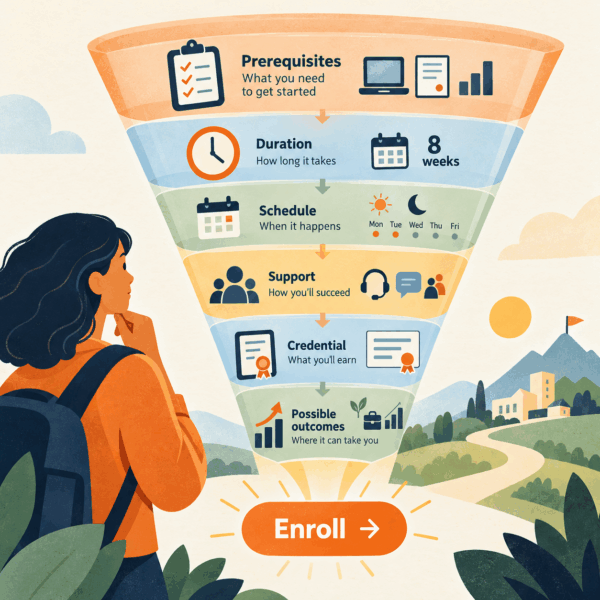 Strategic Communication Support for Workforce Development Agencies and Career Centers
Managing communication for workforce development agencies, career centers, and local employment services requires more than producing flyers or promoting job fairs. It requires understanding jobseeker and employer needs, program requirements, partner relationships, frontline workflows, and the expectations of elected officials and funders. Many agencies have strong internal teams with deep program knowledge and community connections. Those teams are essential. At the same time, they are often stretched across caseloads, compliance, reporting, employer visits, partner coordination, outreach, and events.
Agencies often choose to work with an external partner when internal capacity is limited, when residents and employers are unaware of available services, when intake and eligibility information creates confusion, or when partners struggle to communicate consistently under a shared career center identity. External support can also be useful when a major layoff, a new training initiative, an operator transition, a funding change, or a regional consolidation creates communication demands beyond what existing staff can absorb. In these situations, agencies benefit from a partner who understands how communication connects with service delivery and can build practical approaches that staff can sustain.
Stegmeier Consulting Group (SCG) supports public agencies by helping them build communication systems that are clear, coordinated, and customer-centered. For workforce development agencies and career centers, this can include communication audits, jobseeker and employer research, message frameworks, customer journey mapping, intake and eligibility content review, employer outreach materials, partner referral guides, rapid response communication packets, staff talking points, outcome reports, and implementation support.
A good external partner should help agencies build the tools and workflows that make effective communication routine. This includes establishing shared language across one-stop partners, clarifying communication responsibilities and approval processes, developing reusable templates, and organizing calendars around training schedules, hiring cycles, and community needs. Staff preparation and clear documentation should help career advisors, business services representatives, front desk teams, and partner organizations use those tools consistently through staff turnover and provider transitions.
The value of this support is helping agencies connect individual materials to the full customer experience. A training flyer should align with the website, intake checklist, and what career advisors explain during appointments. An employer one-pager should align with the business services process and the paperwork that follows. A rapid response packet should connect workers with accurate unemployment information and available local services. A board report should present outcomes consistently with the information shared with elected officials, funders, and community partners.
External support can also help agencies step back from internal assumptions. Staff who work inside the workforce system every day may understand individual training accounts, partner responsibilities, referral procedures, and eligibility review timelines. Jobseekers and employers often do not. An outside perspective can help translate that knowledge into clear explanations and practical next steps while respecting program requirements, operational constraints, and the agency’s voice.
For agencies preparing for major changes, such as a career center rebranding, a new operator or service provider, a regional consolidation, a large employer closure, or a shift in training priorities, a structured communication approach can reduce confusion and support continuity. Building communication into planning early gives staff and partners time to align their messages, prepare customer-facing materials, and explain what the change means for the people and businesses they serve. Practical measures, including intake completion, referral follow-through, employer responses, and customer feedback, can then help agencies assess whether communication is working and where further improvement is needed.
Ready to Strengthen Workforce Development Communication?
At Stegmeier Consulting Group, we help state and local government agencies develop clear, practical communication strategies that support residents, staff, elected officials, community partners, and public trust.
For workforce development agencies, career centers, and local employment services, we can help:
- Build manageable communication plans for workforce agencies and career centers
- Develop outreach campaigns that reach jobseekers who do not know the system exists
- Rewrite eligibility, intake, and program information in plain language
- Create training enrollment, apprenticeship, and supportive services materials
- Develop participant retention and follow-up communication sequences
- Prepare rapid response packets and layoff communication protocols
- Create business services materials and employer outreach strategies
- Develop sector partnership and employer convening communication
- Align workforce messaging with economic development and education partners
- Build shared language and referral tools for one-stop partners
- Improve website organization and customer-facing content
- Create board meeting summaries, local plan explainers, and public reports
- Develop outcome reports and briefings for elected officials and funders
- Plan communication for operator transitions, funding changes, and consolidation
- Improve accessibility, plain language, and multilingual communication
- Train staff and partners to communicate consistently
- Assess communication performance and identify practical improvements
Whether your agency is launching a new training initiative, responding to a major layoff, introducing a new career center operator, strengthening employer partnerships, explaining a funding or governance change, or building a long-term communication system that fits a lean team, SCG can help create messages, tools, and workflows that support jobseekers, employers, and staff.
Use the form below to connect with our team and explore how strategic workforce development communication can help your board, career center, or local employment services agency connect more people to opportunity.
Communication Strategy and Public Messaging: Building Colorado PEAK as a Recognizable Statewide Benefits Portal
In many parts of the United States, residents seeking public assistance are required to navigate systems that are spread across multiple agencies, programs, and levels of government. Food assistance, medical coverage, cash aid, and other forms of support are often...
MI Bridges in Michigan as an Integrated Benefits Communication and Community Resource Navigation Platform
The Human Resources Administration is one of the largest social service agencies in the United States. The agency oversees a broad range of public assistance programs that affect millions of New Yorkers every year. Prior to the expansion of ACCESS HRA, residents...
From Information to Action: ACCESS HRA as a Resident-Facing Communication Platform in New York City
In the wake of Colorado’s devastating 2002 drought, Denver Water faced a critical challenge: the utility needed to fundamentally change how residents thought about water consumption. With reservoir levels plummeting and mandatory restrictions looming,...
AI, Chatbots, and Automation in Human Services Communication: Where Public Benefits Agencies Need Guardrails
Artificial intelligence, chatbots, automated reminders, virtual assistants, predictive routing, and other digital tools are becoming more common in public-facing service environments. For human services agencies, public benefits agencies, county social services...
Data Dashboards Residents Can Actually Use: Responsible Transparency for Public Benefits Agencies
Public benefits agencies are increasingly expected to be transparent about performance, access, service demand, processing activity, call volume, timeliness, renewals, document backlogs, benefit issuance, and program changes. Data dashboards can help meet that...
Crisis Communication for Human Services Agencies: What to Say During EBT Outages, System Failures, and Disaster Benefit Changes
Human services agencies are expected to communicate clearly during ordinary operations, but their communication is tested most when something disrupts access to benefits. An EBT outage, eligibility system failure, portal disruption, call center overload, delayed...
One Message Across Every Channel: How Human Services Agencies Can Align Notices, Websites, Portals, Call Centers, and Partners
Human services agencies rarely communicate through one channel at a time. A resident may receive a mailed notice, open a text alert, check a portal, visit the agency website, call a customer service line, ask a caseworker for help, bring paperwork to a lobby, and...
Communication Calendars for Public Benefits Agencies: Planning Year-Round Education, Seasonal Campaigns, and Renewal Sequences
Public benefits communication is often treated as a response to whatever is most urgent at the moment. A renewal deadline approaches, a document campaign begins, a portal change goes live, a call center starts seeing repeated questions, an EBT concern emerges, a...
Community Feedback Loops for Human Services Agencies: Using Surveys, Call Trends, and Partner Input to Improve Communication
Human services agencies communicate with residents through notices, websites, portals, text alerts, call centers, lobby interactions, community partners, and frontline staff conversations. Each of those channels carries important information about applications,...
Reaching Residents Who Are Often Missed: Communication Strategies for Human Services Agencies Serving Hard-to-Reach Populations
Human services agencies often describe certain residents as hard to reach, but the phrase can obscure an important reality. Residents are not usually difficult to reach because they are indifferent to benefits, unwilling to respond, or uninterested in agency...
Partner Toolkits That Actually Help: How Human Services Agencies Can Equip Schools, Clinics, Food Banks, and Libraries to Share Accurate Public Benefits Information
Community partners often become the places residents turn when public benefits information feels confusing, urgent, or hard to verify. A parent may ask a school about child care assistance. A patient may ask a clinic about Medicaid renewal. A family may ask a food...
When Benefits Are Delayed: How Human Services Agencies Should Communicate Backlogs, Timelines, and Status
Benefit delays are never experienced as purely administrative delays. For residents, a delayed application, renewal, document review, interview, eligibility decision, card replacement, or case update can affect food access, health coverage, cash assistance, child care...
Dignity-Centered Communication in Public Benefits Agencies: Why Tone Affects Compliance and Trust
Public benefits communication often focuses on accuracy, deadlines, eligibility rules, required documents, and procedural notices. Those elements matter. Human services agencies, public benefits agencies, county social services departments, and state benefits offices...
Language Access Beyond Translation: How Human Services Agencies Can Reach Residents in the Languages and Contexts They Use
Language access in human services is often discussed as though the central task is translation. Translation matters, and it is essential. Residents need notices, forms, web pages, scripts, and instructions in languages they can understand. But translation alone does...
Frontline Staff as Communicators: How Human Services Agencies Can Train Eligibility Workers and Caseworkers to Explain Complex Rules Clearly
Eligibility workers, caseworkers, call center representatives, reception staff, navigators, and other frontline staff are often the people residents rely on when public benefits rules become difficult to understand. A notice may explain that information is missing. A...
Lobby Communication That Reduces Stress: Signage, Front Desk Scripts, and Wayfinding for Human Services Offices
A human services office lobby is more than a waiting area. It is often the first physical place where residents try to make sense of benefits, documents, notices, deadlines, interviews, case status, eligibility questions, and urgent household needs. A resident may...
Text Alerts That Prompt Action: Designing Renewal and Document Reminders for Public Benefits Agencies
Text alerts have become one of the most practical tools public benefits agencies can use to reach residents quickly. A short reminder can prompt someone to renew benefits, upload documents, check a notice, complete an interview, report a change, or act before a...
Task-Based Website Design for Public Benefits Agencies: Organizing Around Resident Questions, Not Agency Divisions
Public benefits websites often reflect the way agencies are organized internally. A resident may arrive looking for help with food, health coverage, child care, cash assistance, housing-related support, or a renewal notice, but the website may immediately sort them...
Portal Names Are Not Instructions: How Human Services Agencies Should Communicate Digital Benefits Tools
Human services agencies increasingly rely on digital tools to help residents apply for benefits, renew eligibility, upload documents, report changes, check case status, manage notices, and communicate with the agency. These tools may be branded as portals, accounts,...
EBT Theft Communication That Protects Residents and Builds Trust for Public Benefits Agencies
EBT theft is one of the most sensitive communication challenges public benefits agencies face because it touches immediate household needs, financial harm, technology risk, resident confidence, and agency credibility at the same time. For residents who rely on SNAP or...
Rumor Control for Human Services Agencies: How to Respond to Misinformation Before It Spreads
Misinformation can spread quickly when people are worried about public benefits. A rumor about SNAP eligibility, Medicaid renewals, cash assistance payments, child care assistance, EBT cards, immigration-related fears, fraud investigations, office closures, benefit...
Official or Scam: How Public Benefits Agencies Can Help Residents Verify Texts, Calls, Emails, and Mail
Residents who rely on public benefits are often asked to respond quickly to official communication. A human services agency may send a renewal notice, a text reminder, an email about missing documents, a phone call about an interview, a portal alert, or a mailed...
Appeal Rights Without Legal Fog: How Public Benefits Agencies Can Explain Hearings, Deadlines, and Next Steps
Appeal rights are among the most important protections in public benefits administration, but they are often explained in language that is difficult for residents to understand at the exact moment they need clarity most. A resident may receive a notice saying that...
How Human Services Agencies Can Explain Verification Requests in Plain Language
Verification requests are some of the most important messages residents receive from human services agencies. They are also some of the easiest messages to misunderstand. A resident may be asked to provide proof of income, proof of identity, proof of address, proof of...