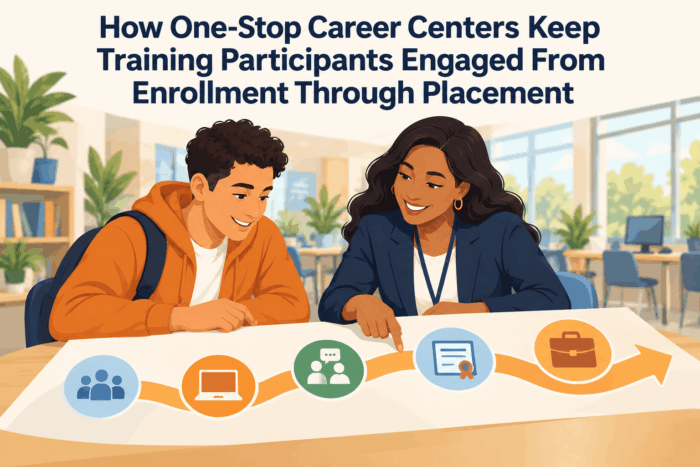
How One-Stop Career Centers Keep Training Participants Engaged From Enrollment Through Placement
Most workforce training stories are told with a beginning and an end. At the beginning, a participant enrolls, often after weeks of assessment, eligibility determination, and planning, and the career center records a milestone. At the end, she completes the program, earns a credential, and finds a job, and the career center records another. Between those two moments lies the part of the story that is rarely told: the weeks and months of training itself, when the participant is balancing classes with work and family, struggling with difficult material, managing transportation and childcare, and wondering whether the effort will pay off. This middle stretch is where many participants are lost, and it is often the stretch in which the career center communicates least.
The pattern is common. Career centers invest heavily in communication before enrollment: outreach, orientation, assessment conversations, training planning, and paperwork. Once the participant is enrolled and attending training, contact often drops sharply. The training provider becomes the participant’s main point of contact, the career advisor’s caseload fills with new jobseekers, and the participant hears from the career center again only near completion or when a problem has already escalated. When a participant stops attending, the career center may not learn about it for weeks. By then, she has fallen behind, lost confidence, or moved on, and re-engaging her is far harder than it would have been at the first sign of trouble.
This gap matters because training is a substantial investment, both for the participant and for the public system. A participant who drops out after several weeks has spent time she could have used otherwise, and the training funds already spent produce no credential or employment. A participant who completes training but does not find employment may have been underprepared for the job search because no one helped her begin it while she was still in training. A participant who finds a job but leaves within weeks may have been left without support through the transition. Each of these outcomes reflects a communication gap as much as a program gap.
This article examines how one-stop career centers can keep training participants engaged from enrollment through placement. Its central argument is that engagement is sustained through deliberate, continuous communication across the entire training journey, centered on a consistent relationship with a career advisor, coordinated with training providers, alert to early warning signs, attentive to progress, and oriented toward employment from the start rather than only at the end. It addresses why participants disengage, how to plan communication across each stage of training, the roles of advisors and training providers, how to respond to early warning signs, how to recognize progress, how to prepare for the job search and connect participants with employers during training, the value of peer connection, the choice of channels, and the ethical and accessibility considerations that apply throughout.
The Quiet Middle of Training
 The middle of a training program has a particular character. The excitement of starting has faded, and the satisfaction of finishing is still far away. Coursework becomes more demanding as programs move past introductory material. The practical arrangements that seemed workable at enrollment, such as a ride from a friend, a relative watching the children, or a reduced work schedule, begin to strain under weeks of repetition. Life events intervene: a car breaks down, a child gets sick, an employer changes a schedule, a landlord raises the rent. Participants who started with determination may begin to wonder whether they can keep going, and whether the program will lead where they hoped.
For the career center, this middle stretch is often quiet. Once a participant is enrolled and attending, the immediate tasks are complete. Training funds have been obligated, the provider is delivering instruction, and the participant appears to be on track. Advisors with large caseloads understandably focus on jobseekers who need immediate attention: new registrants, people completing eligibility, participants preparing to enroll. Participants already in training may receive only periodic check-ins required for case management records, or none at all until the end of the program approaches.
The quiet is not neglect so much as a gap in design. Many career centers have well-developed processes for getting participants into training and for helping them find jobs after completion, but much less structure for the period in between. The assumption is often that the training provider will handle that period. Providers do play a central role, but they typically focus on instruction and may not know about the participant’s broader circumstances, goals, or the supports the career center can offer. Nor do providers always inform the career center when a participant is struggling. The result is that neither organization takes full responsibility for sustaining engagement.
The consequences of this gap appear in completion rates and in the experiences of participants who leave. Many participants who drop out of training do so for reasons that could have been addressed: a transportation problem that supportive services might have solved, an academic difficulty that tutoring might have helped, a scheduling conflict that a conversation with the provider might have resolved, or simply discouragement that a timely word of encouragement might have eased. When no one is in regular contact, these problems compound silently until the participant stops attending.
Filling the quiet middle with deliberate communication changes this dynamic. Regular, personal contact from a career advisor lets participants know that someone is paying attention and is available to help. Coordination with providers ensures that early warning signs reach the career center quickly. Recognition of progress sustains motivation through difficult stretches. And attention to the job search during training keeps the purpose of training in view, connecting daily effort to the goal that motivated enrollment.
This does not require constant contact, which would burden both staff and participants. It requires a planned rhythm of communication, matched to the stages of training and to each participant’s needs, combined with responsiveness when problems arise. The sections that follow describe how to build that rhythm, beginning with an understanding of why participants disengage.
Skilled & Connected: Communication Strategies for Workforce Development Agencies, Career Centers, and Local Employment Services
This article is part of our series on strategic communication for Workforce Development Agencies, Career Centers, and Local Employment Services. To learn more and to see the parent article, which links to other content just like this, click the button below.
Why Training Participants Disengage
Participants rarely leave training because they stop caring about their goals. They leave because circumstances, difficulties, and doubts accumulate until continuing seems impossible or pointless. Understanding the common causes of disengagement helps career centers design communication that anticipates and addresses them.
Practical Barriers
The most common causes are practical. Transportation that worked at the start of training may fail. Childcare arrangements may fall through. Work schedules may change, forcing a choice between training and income. Financial pressure may build as savings run out or unemployment benefits end. Health problems, family emergencies, and housing instability can disrupt attendance. Many of these barriers can be addressed, at least partly, through supportive services, schedule adjustments, or referrals, but only if the career center learns about them in time.
Academic Difficulty
Some participants struggle with the content of training. They may have been out of school for many years, may have gaps in reading or math skills, or may find the pace faster than expected. Academic difficulty is often accompanied by embarrassment, and participants may hide it rather than ask for help. If they fall behind without support, they may conclude that they cannot succeed and withdraw. Tutoring, study groups, instructor support, and encouragement can help, but participants need to know these resources exist and feel comfortable using them.
Loss of Confidence and Motivation
Training can be emotionally demanding. Participants who have experienced setbacks in school or work may enter training with fragile confidence, and early difficulties can confirm their fears. Fatigue from balancing training with other responsibilities can erode motivation. Doubts about whether training will lead to a job can grow, especially if participants hear discouraging stories or see few job openings. Regular contact, recognition of progress, and reminders of the purpose of training can sustain motivation through these periods.
Mismatch With Expectations
Some participants discover during training that the program or occupation is not what they expected. The work may be more physical, less interesting, or different in other ways from what they imagined. In some cases, this mismatch reflects inadequate information before enrollment. In others, it reflects genuine discovery that the field is not right for them. Either way, a timely conversation can help participants decide whether to continue, adjust their plans, or transition to a better-fitting option, rather than simply dropping out.
Disconnection From the Career Center
Participants who hear little from the career center after enrollment may feel that they are on their own. When problems arise, they may not think to contact their advisor, or may not know whom to contact if staff have changed. They may not know that help with practical barriers is available. Disconnection makes every other cause of disengagement more likely to lead to dropout.
Competing Opportunities
Sometimes participants leave training because they find a job before completing the program. This can be a positive outcome, particularly if the job is in the field of training, but it can also mean leaving a credential unfinished for a job with limited prospects. Communication can help participants weigh these choices and, where possible, find ways to complete training while working.
Each of these causes points to a communication need: early identification of problems, information about available help, encouragement and recognition, honest conversations about fit, consistent connection, and guidance through decisions. The communication plan described in the next section addresses these needs across the stages of training.
A Communication Plan for the Whole Training Journey
Sustaining engagement requires a deliberate plan for communication across the entire training journey, from enrollment through placement and early employment. Rather than relying on individual advisors to decide when to reach out, a career center can define standard touchpoints for each stage, specifying their purpose, content, and channel, while leaving room for additional contact based on each participant’s needs. The stages below illustrate such a plan; the timing should be adjusted to the length and structure of each training program.
Enrollment and the First Week
The transition into training is a vulnerable moment. Participants face new schedules, new environments, and new demands. Communication at enrollment should confirm the practical details: start date, location, schedule, required materials, and supportive services arranged. It should introduce the participant to her point of contact at the career center and explain how to reach that person. It should explain what the career center will do during training, such as regular check-ins, and what the participant should do if problems arise. A check-in during or at the end of the first week, asking how things are going and whether anything is making attendance difficult, catches early problems while they are still easy to address.
The Early Weeks
During the first several weeks, participants are adjusting to the program and discovering whether their arrangements work. Regular check-ins, perhaps every week or two depending on program length, allow advisors to identify emerging barriers. These check-ins can be brief, often by text or phone, and should focus on practical questions: attendance, workload, transportation, childcare, and any concerns. Coordination with the training provider during this period helps identify participants who are struggling academically.
The Midpoint
The midpoint of a program is often when motivation dips and difficulties accumulate. A more substantial conversation at this point, reviewing progress, recognizing accomplishments, discussing any challenges, and looking ahead to completion and the job search, can renew motivation. This is also a good time to begin job search preparation, as discussed later.
The Final Weeks
As completion approaches, communication should shift toward the transition to employment. Participants need to prepare for certification exams, update resumes, prepare for interviews, and begin applying for jobs. They also need to plan for practical changes, such as the end of supportive services tied to training. Regular contact during this period keeps participants focused and ensures that the job search begins before training ends.
Completion
Completion deserves recognition. A message or event acknowledging the participant’s achievement reinforces the value of her effort. Communication at completion should also confirm next steps: credential exams if not yet taken, job search activities, and continued support from the career center.
The Job Search
After completion, participants who have not yet found employment need active support. Regular contact, job leads, interview preparation, and encouragement help sustain the job search, which can be discouraging. Participants should understand that the career center’s support continues after training ends.
Placement and Early Employment
Once a participant finds a job, communication should continue through the early weeks of employment, when practical barriers and adjustment challenges can lead to early departure. Check-ins during the first weeks, attention to any supportive service needs during the transition, and follow-up services consistent with WIOA requirements help participants succeed in their new jobs.
Documenting this plan, training staff to use it, and building reminders into case management systems ensure that every participant receives consistent communication throughout the journey, rather than communication that depends on individual advisors’ workloads and habits.
The Career Advisor Relationship as the Core Channel
Of all the factors that sustain engagement, a consistent, trusting relationship with a career advisor is among the most powerful. Participants who know that a specific person at the career center knows their goals, follows their progress, and will help when problems arise are more likely to reach out early, accept help, and persist through difficulties. The advisor relationship is the core channel through which engagement communication flows, and career centers that protect and strengthen this relationship see the benefits in completion and placement.
Continuity is the foundation. Participants benefit from working with the same advisor throughout their journey, from planning through placement. Each change of advisor requires the participant to rebuild a relationship and re-explain her situation, and transitions are moments when participants can slip through the cracks. Staff turnover and caseload reassignments are sometimes unavoidable, but career centers can minimize disruption by assigning advisors for the duration of training where possible and by managing transitions carefully when changes occur. When an advisor changes, the participant should be informed promptly, introduced to the new advisor, and assured that her information and plan carry forward.
Accessibility of the advisor matters. Participants need to know how to reach their advisor and need confidence that they will receive a response. Advisors who are reachable by text, phone, and email, who respond within a reasonable time, and who return messages consistently build trust. When an advisor is unavailable, participants should know whom to contact instead. Out-of-office messages and backup contacts prevent participants from feeling abandoned when their advisor is away.
The quality of check-ins determines their value. Brief, perfunctory check-ins that ask only whether the participant is still attending provide little support and can feel like monitoring. Check-ins that ask how the participant is doing, what is going well, what is difficult, and whether anything would help invite genuine conversation. Advisors who listen, respond to concerns, and follow through on offers of help demonstrate that check-ins are about support, not compliance.
The advisor relationship should be grounded in the participant’s goals. Reminding participants of why they chose training, what they hope to achieve, and how their current effort connects to that goal sustains motivation. Advisors who know participants’ goals well can tailor encouragement and job search support to them.
Caseload size is a practical constraint. Advisors with very large caseloads cannot sustain meaningful relationships with every participant. Career centers can manage this by structuring caseloads to allow regular contact with participants in training, by using efficient channels such as text messaging for routine check-ins, by focusing more intensive contact on participants showing signs of difficulty, and by involving other staff or peers in some aspects of engagement. Boards and providers should recognize that sustained engagement requires adequate staffing, and that the cost of advisor time is often far less than the cost of training dropouts.
Advisors also need support. Maintaining relationships with many participants, responding to crises, and holding difficult conversations is demanding. Supervision, training in engagement and motivational communication, and manageable workloads help advisors sustain the quality of their relationships.
Finally, the advisor relationship extends to coordination with others in the participant’s support network: training providers, supportive service staff, partner agencies, and employers. The advisor serves as the hub, ensuring that information flows where it is needed, with the participant’s consent, and that the participant experiences coordinated support rather than fragmented contacts.
Coordinating With Training Providers
During training, the training provider sees the participant far more often than the career center does. Instructors observe attendance, academic progress, engagement, and signs of difficulty. Provider staff may learn about practical barriers before the career center does. Effective engagement therefore depends on communication between career centers and training providers, so that information about participants’ progress and difficulties reaches the career center in time to respond. Many career centers and providers communicate only at enrollment and completion, missing the opportunity to support participants in between.
The first step is establishing clear expectations. Career centers and providers can agree, as part of their relationship, on what information will be shared, how often, and through what channels. This might include regular attendance reports, notification when a participant misses a specified number of sessions, notification of academic difficulty, and notification of withdrawal. Agreements should specify contacts on both sides, so that information reaches the right person promptly.
The second step is consent and privacy. Information about a participant’s attendance and academic progress may be protected by privacy laws, particularly when the provider is an educational institution subject to the Family Educational Rights and Privacy Act, which generally requires written consent before education records are disclosed, subject to exceptions. Career centers should obtain participants’ informed consent for information sharing at enrollment, explaining what will be shared, with whom, and why. Participants should understand that information sharing is intended to help them succeed, and should know they can ask questions or limit sharing within applicable requirements. Providers and career centers should handle shared information securely and use it only for the purposes explained.
The third step is timely communication. Information that arrives weeks after a problem began is far less useful than information that arrives within days. Agreements should emphasize prompt notification of concerns, such as consecutive absences or failing grades, so that advisors can reach out while problems are still manageable. Some career centers and providers use shared systems or regular brief calls to exchange information efficiently.
The fourth step is coordinated response. When a provider identifies a struggling participant, the career center and provider can coordinate their responses. The provider may offer tutoring, schedule adjustments, or instructor support. The career center may offer supportive services, encouragement, or help with personal barriers. Coordinating these responses ensures that the participant receives comprehensive support rather than separate, uncoordinated contacts.
The fifth step is shared information about resources. Providers may not know what supportive services the career center can offer, and career centers may not know what academic supports the provider offers. Sharing this information allows each to refer participants to the other’s resources. Instructors who know that the career center can help with transportation can encourage a struggling participant to contact her advisor.
The sixth step is attention to the transition to employment. Providers often have relationships with employers and may offer job placement assistance. Coordinating job search support between the provider and the career center avoids duplication and ensures that participants benefit from both.
The seventh step is feedback on the partnership. Periodic discussions between career centers and providers about how communication is working, which participants struggled, and what could improve strengthen the partnership over time.
Career centers can encourage this coordination through clear expectations communicated to providers on the eligible training provider list, through relationships built with providers that train many participants, and through board policies that support information sharing with consent. Providers that communicate well with career centers become valued partners in participant success.
Early Warning Signs and Responsive Outreach
Most participants who drop out of training show signs of difficulty before they leave. Attendance becomes irregular. Assignments go unfinished. Grades slip. Participants stop responding to messages. They mention problems in passing. Each of these signs offers an opportunity to intervene before difficulty becomes departure. Career centers that identify early warning signs and respond quickly retain participants who would otherwise be lost.
Identifying warning signs depends on information. Attendance and academic information from training providers, shared with participant consent, is the most direct source. Responses, or lack of responses, to regular check-ins are another. Requests for supportive services, or mentions of practical difficulties, may signal emerging barriers. Changes in a participant’s circumstances, such as a new job, a move, or a family change, may affect her ability to continue. Career centers can define which signs should prompt outreach, such as missing a certain number of sessions, failing an assessment, or not responding to two consecutive check-ins, so that staff respond consistently.
The speed of response matters greatly. A participant who has missed two classes can often catch up with modest support. A participant who has missed two weeks may feel too far behind to return. Outreach within a day or two of a warning sign, rather than at the next scheduled check-in, dramatically increases the chance of re-engagement. Systems that alert advisors promptly when warning signs appear, whether through provider notifications or case management reminders, enable timely response.
The tone of outreach determines whether it helps. Outreach that sounds like monitoring or enforcement, such as a message noting that the participant has violated attendance requirements, may increase the participant’s sense of failure and push her away. Outreach that expresses concern and offers help, such as a message saying the advisor noticed she missed a couple of classes and wanted to check in to see if anything is going on and whether there is something that might help, invites the participant to share what is happening. The goal is to understand and address the cause, not to reprimand.
Outreach should lead to concrete help. When a participant explains what is happening, the advisor should respond with specific options: supportive services for transportation or childcare, coordination with the provider for tutoring or schedule adjustments, referrals to community resources for personal crises, or help adjusting the training plan. Participants who receive concrete help in response to outreach learn that reaching out works, which makes them more likely to raise problems early in the future.
Sometimes outreach reveals that the participant cannot or should not continue in the current program. Circumstances may have changed, or the program may not be the right fit. In these cases, the conversation should focus on the participant’s goals and options: whether a temporary pause is possible, whether a different program would fit better, whether a direct job search makes sense, or whether she can return to training later. Helping participants make thoughtful decisions about leaving, rather than simply disappearing, preserves their relationship with the career center and their future options.
Finally, outreach to participants who have stopped responding requires persistence and respect. Multiple attempts through different channels, such as text, phone, email, and, with consent, contact through the training provider, may be needed. Outreach should respect participants’ autonomy and privacy and should stop if a participant clearly asks not to be contacted. Even when re-engagement is not possible, a final message letting the participant know she is welcome to return keeps the door open.
Recognizing Progress Along the Way
Training programs typically mark only two moments: enrollment and completion. But the path between them includes many achievements that deserve recognition: finishing the first week, passing a difficult module, earning a good grade, completing a clinical placement, mastering a skill, maintaining perfect attendance for a month, or simply persisting through a hard stretch. Recognizing these achievements sustains motivation, builds confidence, and reinforces the participant’s connection to the career center. For participants whose past experiences with education or work included more criticism than encouragement, recognition can be especially meaningful.
Recognition works because it addresses one of the main causes of disengagement: loss of confidence and motivation. When participants face difficulty, they may focus on what they have not yet achieved. Recognition draws attention to what they have accomplished, reminding them that they are capable of progress. It also signals that someone is paying attention, which strengthens the advisor relationship.
Recognition should be genuine and specific. Generic praise, such as a form message congratulating all participants, has limited effect. A specific message from an advisor, such as noting that the participant passed the first certification practice test after struggling with the material, shows that the advisor knows her situation and values her effort. Specificity makes recognition credible.
Recognition can take many forms. Personal messages from advisors, by text or email, are simple and effective. Phone calls to congratulate participants on milestones add warmth. Small certificates or acknowledgments at program milestones can be meaningful, particularly for participants who have rarely received such recognition. Group recognition, such as cohort celebrations at the midpoint or completion, builds community. Recognition from instructors, coordinated with the career center, reinforces the message.
Recognition should respect participants’ preferences. Some participants enjoy public recognition, while others prefer private acknowledgment. Some may feel uncomfortable with recognition that draws attention to their circumstances. Advisors who know their participants can tailor recognition accordingly. Public recognition, such as sharing achievements on social media, should occur only with participants’ explicit consent.
Recognizing persistence is as important as recognizing achievement. A participant who returns to training after a difficult period, who keeps attending despite challenges, or who asks for help when she needs it is demonstrating qualities that lead to success. Acknowledging these behaviors, rather than only grades or credentials, reinforces the persistence that training requires.
Recognition should connect to the participant’s goals. Reminding participants how each achievement brings them closer to their goal, such as noting that completing the clinical rotation means she is one step closer to working as a medical assistant, reinforces the purpose of training and sustains motivation for what remains.
Completion deserves particular attention. Completing a training program is a significant achievement, often requiring months of effort and sacrifice. Celebrating completion, through ceremonies, certificates, messages, or events that include family members, honors the participant’s accomplishment and can inspire others. Completion celebrations also provide opportunities to connect graduates with employers and to gather stories, with consent, for future recruitment.
Finally, recognition is not a substitute for addressing problems. A participant struggling with transportation needs help with transportation, not only encouragement. Recognition works best alongside practical support, as part of a relationship in which the career center both acknowledges progress and helps remove obstacles.
Preparing for the Job Search Before Training Ends
A common pattern in workforce training is that job search activity begins only after training ends. Participants focus on completing their programs, career centers focus on getting them through, and the question of employment is deferred until graduation. Then, suddenly, participants face the job search without preparation, often while their supportive services and other assistance are ending. The gap between completion and employment becomes a period of uncertainty and financial pressure, and some participants who completed training successfully struggle to convert their credential into a job. Beginning job search preparation during training, and communicating about it throughout, keeps employment in view and shortens this gap.
The purpose of training is employment, and communication should reflect this from the start. At enrollment, the career center can explain how it will help with the job search, both during and after training. Throughout training, check-ins can include questions about the participant’s employment goals and progress toward them. This framing reminds participants that training is a means to an end and that the career center will support the transition.
Job search preparation can begin well before completion. During the middle and later stages of training, participants can update their resumes to reflect new skills and the expected credential, practice interviewing for jobs in their new field, research employers, and learn about the hiring process in the occupation. Career centers can offer workshops timed to training schedules, individual sessions with advisors, and materials tailored to particular occupations. Training providers may offer similar support, and coordination prevents duplication.
Understanding the hiring landscape is important. Participants should know which employers hire for their occupation, what employers look for, what the hiring process involves, and what typical starting positions and wages look like. They should understand any employer requirements that may affect hiring, such as background checks, drug tests, driving records, or licensing, and should address these early where possible. This information helps participants set realistic expectations and prepare effectively.
Credential completion requires attention. Some programs culminate in certification or licensing exams administered separately from the program. Participants should know when and how to register for these exams, what they cost and whether supportive services can help, and how to prepare. Participants who complete training but do not take or pass the exam may be unable to work in the occupation. Communication about exams, including reminders and preparation support, helps ensure that training leads to a credential.
The transition from training to work involves practical changes that communication should anticipate. Supportive services tied to training may end. Unemployment benefits may run out. Participants may need work clothing, tools, or transportation for a new job. Discussing these changes before completion allows participants to plan and allows the career center to arrange any transitional support available under local policy.
Honest communication about the job search is essential. Some participants will find jobs quickly; others will take longer. Some will start in entry-level positions and need time to advance. Communication should prepare participants for these realities without discouraging them, emphasizing the career center’s continued support and the value of persistence. Participants who expect an instant job and do not get one may become discouraged; those who expect a search process and receive support through it are more likely to persevere.
Finally, starting the job search during training allows career centers to connect participants with employers before completion, which is the subject of the next section.
Connecting Participants With Employers During Training
One of the most effective ways to sustain engagement and improve placement is to connect participants with employers while they are still in training. Contact with employers makes the goal of training tangible, motivates participants by showing them what they are working toward, and creates relationships that can lead directly to jobs. Communication that facilitates these connections links the career center’s business services and participant services, which are often separated.
Employer contact during training can take many forms. Employers can speak to training cohorts about their work, their hiring needs, and what they look for in new hires. Participants can visit worksites to see the occupation in practice. Employers can participate in mock interviews, giving participants practice and feedback. Some programs include work-based learning, such as clinical placements, internships, or externships, which provide direct experience and allow employers to evaluate participants. Job fairs or hiring events targeted to participants nearing completion can connect them with employers who are hiring.
These connections depend on coordination between business services staff, who work with employers, and career advisors, who work with participants. Business services staff know which employers are hiring and what they need; advisors know which participants are approaching completion and what their goals are. Regular communication between these teams, such as sharing lists of participants nearing completion with relevant employers’ needs, allows them to match participants with opportunities. Without this coordination, business services may develop job openings that advisors do not know about, and participants may complete training without being connected to employers seeking their skills.
Communication with participants about employer connections should be clear about what they involve. A guest speaker from an employer is an opportunity to learn and make an impression, not a job offer. A mock interview is practice, not an evaluation. A hiring event is a chance to apply, not a guarantee. Being clear about these distinctions prevents disappointment and helps participants prepare appropriately.
Communication with employers should be accurate about participants’ readiness and timelines. Employers should know when participants will complete training and earn credentials, what skills they will have, and how the career center can support the hiring process. Overstating participants’ readiness damages employer trust; accurate information builds it. With participants’ consent, career centers can share resumes or arrange introductions, but they should not share personal information about participants without consent.
For participants in training linked to specific employers, such as sector partnerships or customized training, communication about employer commitments is especially important. Participants should understand exactly what employers have committed to, such as interviews or hiring, and what the process will be. If employer hiring plans change, participants should be told promptly.
Employer connections also support engagement directly. Participants who meet an employer interested in hiring people with their emerging skills often find renewed motivation to complete training. Participants who hear from employers about what the work involves can confirm that they have chosen the right field, or recognize early that they have not. These insights help participants make good decisions and persist through training.
Finally, employer connections built during training can extend into placement and retention. Employers who hire participants they met during training may be more invested in their success. Career centers can maintain communication with these employers during the early weeks of employment, supporting both the participant and the employer through the transition.
Peer Connection and Cohort Communication
 Participants in training are not only individuals in relationship with a career advisor. They are often members of a group of people facing similar challenges at the same time, whether in a formal cohort or simply as participants enrolled in similar programs. Peer connection can be a powerful source of engagement, providing encouragement, practical help, shared information, and a sense of belonging. Career centers that foster peer connection, and use cohort communication effectively, strengthen engagement beyond what individual contact can achieve.
Cohort-based training, in which participants start and progress together, naturally creates peer connections. Participants study together, share experiences, and support one another through difficulties. Career centers can strengthen these connections by facilitating introductions at the start of training, organizing occasional cohort meetings or check-ins that bring participants together with career center staff, and encouraging participants to form study groups or support networks. Cohort meetings can address common concerns, share information about the job search, celebrate milestones, and remind participants of available support.
For participants in individual training plans, rather than cohorts, peer connection requires more deliberate effort. Career centers can organize periodic gatherings of participants in training, regardless of program, to share experiences, learn about job search strategies, and hear from employers or recent graduates. These gatherings reduce isolation and remind participants that they are part of a larger community working toward similar goals.
Graduates can serve as peer mentors. Participants who have completed training and found employment can share their experiences with current participants, offering practical advice, encouragement, and evidence that the path leads somewhere. Peer mentoring can occur through organized programs, speaking engagements, or informal connections. Mentors should be supported and their contributions recognized, and mentoring relationships should respect boundaries and privacy.
Group communication channels can support peer connection. Some programs use group messaging or online platforms where participants can communicate with one another and with career center staff. These channels allow participants to ask questions, share resources, and encourage each other between meetings. They require careful management, including clear guidelines for respectful communication, attention to privacy, and moderation to address problems. Participants should be able to choose whether to join such groups.
Peer connection has particular value for participants facing isolation, such as those new to a community, those without family support, or those entering occupations where they are underrepresented, such as women in skilled trades. Connecting these participants with peers who share their experiences can provide support that career center staff cannot. Partnerships with affinity organizations, such as associations of women in trades, can extend peer support beyond the career center.
Cohort communication also serves practical purposes. Information that applies to everyone in a program, such as schedule changes, exam registration deadlines, job fair announcements, and supportive service reminders, can be shared efficiently with the whole cohort. Group communication should complement, not replace, individual contact, since participants’ circumstances and needs differ.
Finally, peer connection can continue after training. Graduates who stay connected can share job leads, support each other through early employment, and form professional networks in their new field. Career centers that maintain alumni connections, through occasional events or communication channels, extend the benefits of peer connection and build a community of graduates who can support future participants.
Choosing Channels for Ongoing Contact
Sustaining engagement over weeks and months requires communication channels that participants actually use and that staff can maintain efficiently. Participants in training are often busy, juggling classes, work, and family, and they may not answer phone calls during the day or check email regularly. Choosing the right channels for different purposes, and respecting participants’ preferences, makes ongoing contact more effective and less burdensome.
Each channel has strengths and limitations. A practical approach assigns each channel to the purposes it serves best:
-
Text messaging works well for brief check-ins, reminders, quick questions, and recognition of milestones, because most participants read texts promptly and can respond at their convenience.
-
Phone calls work well for more substantive conversations, such as discussing a problem, responding to an early warning sign, or celebrating a significant achievement, because they allow tone and nuance.
-
In-person meetings work well for planning, complex problem-solving, midpoint reviews, and job search preparation, because they build relationships and allow detailed work.
-
Video meetings offer a middle ground for participants who cannot easily come to the career center but need more than a phone call.
-
Email works well for sharing documents, detailed information, and resources participants may want to refer to later.
-
Group meetings and group messaging work well for cohort-wide information, peer connection, and shared events.
-
Participant portals or case management system messaging, where available, can provide a central place for information and updates, but only if participants actually use them.
Participant preferences should guide channel choice. At enrollment, advisors can ask participants how they prefer to be contacted, at what times, and whether certain channels are difficult for them, such as limited phone minutes or no reliable internet access. Respecting these preferences increases responsiveness. Preferences may change during training, so advisors should check periodically.
Consistency and reliability matter. Participants should know what to expect, such as a text check-in every week or two and a phone call at the midpoint, and should be able to count on responses when they reach out. Inconsistent contact, with long silences followed by sudden messages, undermines trust.
Efficiency allows staff to sustain contact across many participants. Text messaging platforms that allow advisors to send personalized messages efficiently, schedule reminders, and track responses can help, provided they comply with privacy and consent requirements. Templates for common messages, personalized for each participant, save time while maintaining a personal tone. Case management systems that remind advisors of scheduled check-ins ensure that contact happens consistently.
Privacy and consent are essential for every channel. Participants should consent to text messaging and should be able to opt out. Messages should not reveal sensitive information, since phones and email accounts may be shared or seen by others. Group channels should not expose participants’ personal information to others without consent. Records of communication should be handled in accordance with privacy requirements.
Finally, channels should be accessible. Participants who are deaf or hard of hearing may prefer text or video relay; participants who are blind may rely on screen readers for email and portal messages; participants with limited English proficiency may need communication in their language. Choosing and adapting channels for these participants ensures that engagement communication reaches everyone.
Ethical Commitments in Participant Engagement
Sustained engagement communication involves frequent contact with participants, collection and sharing of information about their progress and circumstances, and attempts to influence their decisions about continuing training. These activities carry ethical responsibilities. Engagement that respects participants’ autonomy, privacy, and dignity builds trust; engagement that feels intrusive, controlling, or manipulative undermines it.
The first commitment is respect for autonomy. Participants are adults making decisions about their own lives. Engagement communication should support their goals and decisions, not override them. When a participant decides to leave training, pause, or change direction, the career center can offer information and help her think through options, but the decision is hers. Pressure to continue training in order to protect performance outcomes or avoid wasted funds would put the career center’s interests ahead of the participant’s.
The second commitment is privacy. Engagement involves information about participants’ attendance, grades, finances, family circumstances, health, and other personal matters. This information should be collected only as needed, shared only with consent and in accordance with applicable law, and protected securely. Participants should understand what information the career center receives from training providers and others, and how it is used. Information should never be shared with employers, other participants, or the public without explicit consent.
The third commitment is supportive rather than punitive framing. Engagement communication can easily slip into monitoring and enforcement, particularly when attendance requirements or program rules are involved. While participants should understand program expectations, communication about difficulties should focus on understanding and support rather than warnings and consequences. Participants who feel monitored may hide problems; participants who feel supported are more likely to share them.
The fourth commitment is honesty. Engagement communication should be honest about the participant’s progress, the realities of the job search, and the limits of available support. Encouragement should be genuine, not false reassurance. If a participant is at risk of not completing, she deserves to know so she can make decisions. If the job market for her occupation is difficult, she deserves accurate information. Honest communication respects participants and supports better decisions.
The fifth commitment is fairness. All participants should receive consistent engagement communication, regardless of their background, the program they are in, or their advisor’s caseload. Engagement practices that concentrate attention on participants most likely to succeed, or that neglect participants facing the greatest barriers, are inequitable. Monitoring engagement across groups helps ensure fairness.
The sixth commitment is respect for boundaries. Frequent contact can become intrusive. Participants should be able to set preferences for how often and how they are contacted, and to ask for less contact if they wish. Staff should respect these preferences while ensuring participants know how to reach out when they need help.
The seventh commitment concerns the use of participant stories and data. Participants’ progress and success may be shared in reports, recruitment materials, or recognition events. Individual stories should be shared only with informed, voluntary consent, and aggregate data should protect individual identities.
These commitments are not obstacles to engagement. They are the foundation of the trust that makes engagement effective. Participants who trust that the career center respects their autonomy, protects their privacy, and supports rather than polices them are more likely to stay connected, share problems early, and persist through training.
Accessibility and Language Access Throughout Training
Participants with disabilities, limited English proficiency, limited literacy, or limited digital access face additional challenges in staying engaged through training. They may struggle not only with training itself but with communication from the career center and training provider. Engagement communication that is not accessible leaves these participants with less support precisely when they may need more.
Language access must continue throughout training, not only at enrollment. Participants with limited English proficiency should receive check-ins, reminders, and important information in their language, and should have access to interpretation for substantive conversations. Federal civil rights requirements and WIOA’s nondiscrimination provisions apply to all communication with participants. Participants enrolled in training conducted in English may also need support with language as they progress, and career centers can coordinate with adult education providers to offer English language support alongside occupational training. Programs that integrate language instruction with occupational training may be especially valuable for these participants.
Participants with disabilities may need accommodations both in training and in communication with the career center. Training providers have their own obligations to provide reasonable accommodations, and career centers can help participants understand and request them. Coordination with vocational rehabilitation can provide additional support for eligible participants. Communication from the career center should be accessible, including messages that work with screen readers, captioned videos, relay services for phone contact, and plain-language explanations for participants with cognitive disabilities. Advisors should ask participants at enrollment about their communication needs and preferences.
Participants with limited literacy may struggle with written communication, including text messages, emails, and written materials about exams, job search, and supportive services. Advisors can use phone calls and in-person conversations for important information, keep written messages short and simple, and check understanding. Training providers may offer academic support, and career centers can help participants access it.
Participants with limited digital access may miss communication sent primarily through email, online portals, or apps. They may have phones with limited data or no reliable internet. Advisors should use channels participants can access and should not assume that online communication reaches everyone. Training increasingly involves online components, and participants without reliable internet access or devices may struggle; career centers can help by providing access to computers, coordinating with libraries, or, where local policy allows, assisting with devices or connectivity as supportive services.
Cultural considerations affect engagement as well. Participants from different backgrounds may have different expectations about communication with institutions, different comfort levels with asking for help, and different family and community obligations that affect participation. Advisors who understand these differences can communicate in ways that respect participants’ values and circumstances.
Accessibility should be monitored. Career centers can examine whether participants with limited English proficiency, disabilities, or other barriers complete training at rates comparable to other participants, and whether they receive comparable engagement contact. Disparities may indicate that engagement communication or training itself is not accessible, and they can guide targeted improvements.
Finally, accessibility in engagement communication reflects the career center’s commitment to serving all participants. Participants facing additional barriers often have the most to gain from training and the most at risk if they do not complete it. Ensuring that they receive accessible, consistent support throughout training is essential to equitable outcomes.
An Engagement Approach in Practice
The following hypothetical example illustrates how a one-stop career center might improve engagement from enrollment through placement. It does not describe an actual career center.
A career center reviewing its training outcomes finds that a substantial share of participants who enroll in training do not complete, and that many who complete take months to find employment. Case file reviews reveal a common pattern: after enrollment, contact with participants is sporadic, often limited to required case notes every ninety days. Advisors learn about dropouts weeks after they occur, usually when the training provider reports a withdrawal. Job search assistance typically begins only after participants report completion. Training providers say they rarely know whom to contact at the career center when a participant is struggling.
The career center develops a structured engagement plan. At enrollment, each participant meets with her advisor to confirm practical arrangements, discuss communication preferences, sign a consent form for information sharing with the training provider, and receive a one-page guide explaining what the career center will do during training and how to reach her advisor. The advisor sends a text message at the end of the first week asking how things are going. During training, advisors send brief text check-ins every two weeks and hold a phone or in-person midpoint review focused on progress, challenges, and the job search. Case management reminders prompt advisors for each touchpoint.
The career center establishes agreements with its most frequently used training providers. Providers agree to notify the assigned advisor when a participant misses two consecutive sessions or is at risk of failing a module. Advisors commit to contacting the participant within two business days of a notification. The career center and providers share information about available supports, so instructors can refer struggling participants to their advisors for help with transportation or childcare.
The career center builds job search preparation into the later stages of training. Participants receive resume and interview workshops scheduled in the evenings around training. Business services staff share lists of employers hiring in each occupation with advisors, and advisors share lists of participants nearing completion with business services. The career center organizes small hiring events for participants approaching completion in high-demand programs, and invites employers to speak to cohorts.
The career center adds recognition. Advisors send personalized messages when participants reach milestones, and the career center holds a quarterly celebration for recent completers and their families, with employers invited. Graduates who are willing serve as peer mentors, speaking at orientation and cohort meetings.
After placement, advisors check in during the first two weeks and again at one month, asking about adjustment to the job and any practical needs. Follow-up services continue according to policy.
Over the following year, the career center tracks engagement and outcomes. Completion rates improve, and the time from completion to employment shortens. Advisors report that early warning notifications allow them to address problems that previously would have led to dropout, such as transportation breakdowns and childcare gaps. Participants report feeling supported and knowing whom to contact. Some challenges remain: advisors with the largest caseloads struggle to maintain the schedule, and the career center works with its board to adjust caseloads and staffing.
The example illustrates the core principles: a structured communication plan across the training journey, a consistent advisor relationship, coordinated information sharing with providers, rapid response to warning signs, recognition, early job search preparation, employer connections during training, and support through early employment.
Measuring Engagement From Enrollment Through Placement
Career centers measure training outcomes through completion, credential attainment, employment, and earnings, as WIOA performance accountability requires. These measures show results but not the engagement process that produces them. Measuring engagement directly, at each stage of the training journey, reveals where participants are lost and whether communication practices are working.
The first area is contact. Career centers can track whether planned touchpoints occur: whether participants receive a first-week check-in, regular check-ins during training, a midpoint review, and post-placement follow-up. Tracking contact by advisor and by program reveals whether the engagement plan is being implemented consistently. Gaps may indicate caseload pressures or practices that need reinforcement.
The second area is early warning and response. Tracking how many early warning notifications are received from providers, how quickly advisors respond, and what happens afterward shows whether the early warning system works. If notifications arrive but responses are slow, process changes are needed. If participants who receive prompt outreach are more likely to continue, the value of the system is demonstrated.
The third area is retention through training. Tracking when participants leave training, in which programs, and for what reasons, reveals patterns. Many dropouts occurring in the first weeks suggest problems with initial arrangements or expectations. Many occurring at the midpoint suggest academic or motivational challenges. Exit conversations, when possible, provide reasons that guide improvements.
The fourth area is the transition to employment. Tracking the time from completion to employment, the share of completers who find jobs in their field, and the share who take credential exams and pass them shows whether job search preparation during training is working.
The fifth area is early employment retention. Tracking whether participants remain employed in the first weeks and months after placement, and why some leave, shows whether support during the transition is sufficient.
The sixth area is participant experience. Surveys at the midpoint and completion can ask whether participants knew how to reach their advisor, whether they received help when they needed it, whether communication was useful, and whether they felt supported. These perspectives reveal communication strengths and gaps.
Several questions keep engagement in view:
-
What share of participants in training receive each planned touchpoint on schedule?
-
How quickly do advisors respond to early warning notifications, and what share of those participants continue training?
-
At what point in training do most participants who leave do so, and what reasons do they give?
-
How long does it take completers to find employment, and how many begin their job search before completion?
-
Do participants report knowing whom to contact and receiving help when they asked?
Equity is an essential lens. Comparing engagement contact, retention, and outcomes across groups reveals whether some participants receive less support or face greater barriers. Disparities should prompt investigation and targeted improvements.
Finally, measurement should be used. Sharing engagement data with advisors, supervisors, providers, and the board makes engagement a visible priority. Reviewing data regularly allows career centers to adjust their engagement plan, address caseload pressures, and strengthen provider coordination.
How Participant Engagement Compares With Other Agency Types
Sustaining engagement over a period of weeks or months is a challenge shared by many programs that ask people to commit to a demanding process. Comparing workforce training engagement with other contexts offers useful lessons.
Community colleges face persistent challenges with student retention and completion, particularly among adult learners balancing school with work and family. Many colleges have adopted proactive advising, sometimes called intrusive advising, in which advisors reach out to students regularly and respond quickly to early warning signs rather than waiting for students to seek help. Early alert systems, in which instructors flag struggling students for advisor follow-up, have become common. These practices parallel the engagement approaches described in this article, and many colleges report that proactive outreach is associated with improved persistence. Career centers can learn from colleges’ experience with early alert systems, including the importance of timely response and supportive framing.
Health care programs that ask patients to complete multi-step treatments, such as chronic disease management or rehabilitation, face similar engagement challenges. Care coordination models, in which a coordinator maintains contact with patients, identifies barriers, and connects them with resources, parallel the career advisor’s role. These programs emphasize regular contact, addressing practical barriers such as transportation, and coordination among providers, lessons directly applicable to workforce training.
Apprenticeship programs sustain engagement over years through structured mentoring, regular progress reviews, and wage increases tied to milestones. The combination of a mentor relationship and visible recognition of progress offers a model for sustaining motivation in shorter training programs.
Human services case management, in programs that support families through employment and self-sufficiency goals, uses regular contact and goal-setting to sustain engagement. These programs have also demonstrated the risks of engagement that feels punitive or compliance-driven, reinforcing the importance of supportive framing.
What distinguishes workforce training engagement is the involvement of multiple organizations, typically the career center and an external training provider, each with partial information and partial responsibility; the time-limited nature of training with a clear endpoint and an employment goal beyond it; the constraints of privacy laws on information sharing between career centers and educational providers; and performance accountability tied to outcomes that occur after training ends. These features make coordination with providers, consent-based information sharing, and attention to the transition to employment especially important. Career centers can draw on lessons from colleges, health care, apprenticeship, and human services, but must adapt them to this distinctive structure.
Tying It All Together
Participant engagement is not a side function of administering training. It is what turns an enrollment into a completion and a completion into a job. Career centers often invest heavily in getting participants into training and helping them find work afterward, while the long middle of training goes quiet. That quiet is where many participants are lost to practical barriers, academic difficulty, fading motivation, mismatched expectations, and simple disconnection from anyone who could help.
Filling the quiet middle requires a deliberate communication plan across the entire training journey, with defined touchpoints at enrollment, in the first week, during the early weeks, at the midpoint, in the final weeks, at completion, during the job search, and through early employment. At the center of that plan is a consistent, accessible, goal-focused relationship with a career advisor, supported by manageable caseloads and efficient channels.
Coordination with training providers, grounded in consent and privacy protections, ensures that early warning signs reach the career center quickly. Rapid, supportive outreach in response to those signs, leading to concrete help, retains participants who would otherwise drift away, while respecting their decisions when continuing is not the right choice. Recognition of progress sustains motivation and confidence through difficult stretches.
Beginning job search preparation during training keeps employment in view, prepares participants for credential exams and the hiring process, and shortens the gap between completion and work. Connecting participants with employers during training, through business services coordination, makes the goal tangible and creates pathways to jobs. Peer connection and cohort communication provide encouragement and belonging that individual contact cannot.
Channels should match purposes and participant preferences, with attention to efficiency, privacy, and accessibility. Ethical commitments to autonomy, privacy, supportive framing, honesty, fairness, and boundaries make engagement trustworthy. Language access and accessibility ensure that participants facing additional barriers receive equal support.
Finally, measuring contact, early warning response, retention, the transition to employment, early job retention, participant experience, and equity reveals whether engagement communication is working and where it needs strengthening.
Strategic Communication Support
 Building sustained engagement across the training journey requires coordination among career advisors, supervisors, business services staff, training providers, and employers, along with systems that support timely communication and measurement. Career centers often recognize that participants are lost during training but lack the time and capacity to design an engagement plan, negotiate information-sharing agreements with providers, and train staff in proactive, supportive communication. External support can help career centers build these practices efficiently.
Stegmeier Consulting Group (SCG) helps public agencies design communication that sustains people through multi-step processes. For one-stop career centers, that work can begin with a review of current engagement practices: analyzing when and why participants leave training, reviewing case management contact patterns, examining coordination with training providers, and conducting interviews and focus groups with participants who completed training, those who left, advisors, and providers. This review identifies the points where engagement breaks down and the communication changes most likely to help.
From that foundation, SCG can help career centers design a structured engagement plan with defined touchpoints, messages, and channels for each stage of training, and develop participant-facing guides explaining what to expect and how to get help. SCG can facilitate the development of information-sharing agreements and early warning protocols with training providers, including consent processes that respect privacy requirements, and can help coordinate business services and career advisors so that participants are connected with employers during training.
Implementation support can include training for advisors on proactive, supportive outreach, responding to early warning signs, recognizing progress, and discussing decisions about continuing training; message templates for check-ins and recognition; and leadership toolkits that help supervisors monitor engagement and manage caseloads. SCG can also help design peer mentoring and cohort communication approaches.
Evaluation support helps career centers track touchpoint completion, early warning response, retention, transition to employment, early job retention, participant experience, and equity, and use findings to refine engagement over time. The aim is a training experience in which participants are supported from enrollment through placement, and fewer are lost in the quiet middle.
Future Trends
Several established developments are shaping how career centers sustain engagement through training. The growth of online and hybrid training means that more participants complete some or all of their training remotely. Online formats offer flexibility for participants with work and family responsibilities, but they can also increase isolation and make it harder for instructors and career centers to notice early signs of difficulty. Engagement communication will need to adapt, with more attention to digital check-ins, online peer connection, and information from providers about participation in online coursework.
Text-based and digital communication tools for case management continue to develop. Platforms that allow advisors to send personalized messages at scale, schedule reminders, and track responses can help sustain contact with large caseloads. These tools are most effective when they support rather than replace personal relationships, and when they are used with attention to consent, privacy, and accessibility.
Data integration between workforce systems and training providers is improving in some states, potentially allowing more timely information about participant attendance and progress. Where such integration develops, it may strengthen early warning systems, though it will also raise questions about privacy and appropriate use that require careful governance.
Emerging technologies, including artificial intelligence tools, are being explored to identify participants at risk of dropping out, based on patterns in attendance and engagement data, or to provide automated responses to common questions. Such tools could help advisors focus attention where it is most needed, but they carry risks: predictions may be inaccurate or biased, automated messages may feel impersonal, and participants may not understand how their data is used. Career centers considering these tools should evaluate their accuracy and fairness, ensure human judgment remains central, and be transparent with participants. Their appropriate role is still being worked out.
The extension of Pell Grant eligibility to certain short-term workforce training programs, under federal legislation enacted in 2025 and beginning with the 2026 to 2027 award year, may increase the number of participants in short-term programs funded by multiple sources. Coordinating engagement with institutions’ own student support services, and clarifying who is responsible for which aspects of participant support, may become more important as funding arrangements change.
Changes in public assistance policy may also affect training participants. Federal legislation enacted in 2025 broadened work requirements associated with SNAP and introduced community engagement requirements for certain Medicaid enrollees, with implementation phased in by states. Some participants in training may need to document participation to meet these requirements, and career centers may need to coordinate with human services agencies to ensure that engagement communication supports rather than complicates participants’ compliance. Implementation details are still developing.
Finally, the structure of federal workforce funding may change. Budget proposals in recent cycles have contemplated consolidating workforce funding streams, which could affect staffing, caseloads, and performance expectations. Whether such changes occur is uncertain. Career centers that have built efficient, structured engagement practices will be better positioned to maintain support for participants under changing conditions.
Conclusion
The milestones the workforce system records, enrollment, completion, and placement, are the visible markers of a journey whose outcome is decided mostly in between. Participants do not drop out at enrollment or at graduation. They drop out on an ordinary Tuesday in the sixth week, when the car will not start, the babysitter cancels, the math unit makes no sense, and no one from the career center has called in a month. Whether that Tuesday becomes the end of the journey or a manageable setback depends largely on whether the participant has a relationship with someone who knows her goals, notices her absence, and can offer practical help quickly.
For career center managers, service providers, and boards, the implication is that engagement through training should be designed and resourced as deliberately as enrollment and placement. That means a documented communication plan with defined touchpoints, caseloads that allow advisors to keep it, agreements with training providers that bring early warning signs to the career center within days, and coordination between business services and career advisors so that participants meet employers before they finish. It also means measuring engagement directly, not only final outcomes, so that leaders can see where participants are being lost and act on it.
Career centers that close the quiet middle will see more participants complete training, earn credentials, and move into jobs that justify the investment. Just as important, participants will experience the career center as a steady presence through one of the most demanding periods of their working lives, which is the kind of experience that builds lasting trust in the public workforce system.
Stegmeier Consulting Group’s Strategic Approach to Communication Systems
SCG approaches participant engagement as a communication system that spans the full training journey and the organizations involved in it. That approach begins by finding where participants are lost and why, then designs a structured rhythm of contact anchored in a consistent advisor relationship, early warning protocols with training providers built on informed consent, and connections between participant services and business services that bring employers into the journey before completion. It treats recognition, peer connection, and honest conversation about progress and the job search as essential parts of the system, not extras.
For one-stop career centers, this means participants who know whom to call and get help quickly when problems arise, advisors equipped and resourced to stay in touch, providers who share warning signs in time to act, job search preparation that begins while training is still underway, and support that continues into the first weeks of employment. It means engagement that respects participants’ autonomy and privacy, reaches participants facing additional barriers, and is measured stage by stage so that improvements can be targeted where they matter most.
Use the form below to connect with our team and explore how strategic communication support can help your career center keep training participants engaged from enrollment through placement.