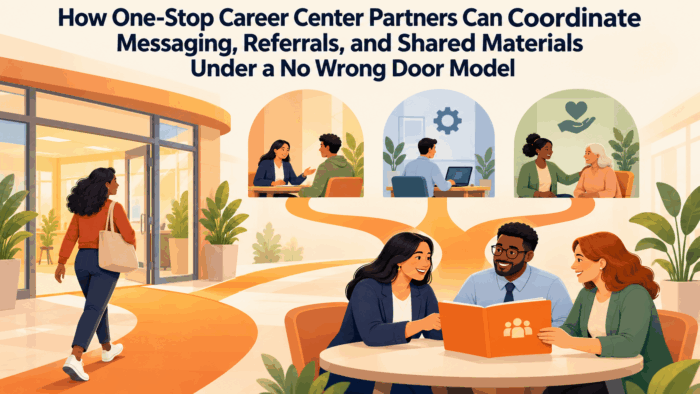
How One-Stop Career Center Partners Can Coordinate Messaging, Referrals, and Shared Materials Under a No Wrong Door Model
A referral is one of the smallest acts in public service and one of the most consequential. It usually takes less than a minute: a caseworker at a human services office mentions that the career center down the street can help with job training, an adult education instructor tells a student that vocational rehabilitation might be able to assist with an accommodation, a career advisor suggests that a participant talk to the veterans’ employment representative in the next office. In that minute, a resident is handed from one organization to another, and the outcome depends almost entirely on what is said. If the resident understands why the referral matters, what the next organization offers, what to bring, and what will happen when she arrives, she is likely to follow through. If she receives only a name and an address, there is a good chance the referral will go nowhere, and neither organization will ever know why.
The one-stop career center system is built on thousands of these handoffs. The Workforce Innovation and Opportunity Act brings together a set of required partners, each with its own funding, governance, eligibility rules, and professional culture, and asks them to function as a coordinated system from the resident’s perspective. The phrase most often used for that aspiration is no wrong door: wherever a resident first makes contact, she should be connected to the full range of services she needs, without being sent away, asked to repeat her story endlessly, or left to navigate the system’s internal boundaries on her own.
No wrong door is a promise made collectively by many organizations and kept or broken individually by whichever staff member a resident happens to meet. It cannot be fulfilled through a memorandum of understanding alone, or through co-location, or through a shared logo on the front of the building. It is fulfilled, or not, through communication: the shared language partners use to describe the system, the referral conversations that move residents between organizations, the materials that explain options consistently, and the feedback that tells partners whether their handoffs worked.
This article examines how one-stop partners can coordinate messaging, referrals, and shared materials so that the no wrong door model becomes a reality rather than a slogan. Its central argument is that the referral is a communication event that deserves the same design attention as any public message, and that partners keep the no wrong door promise when they share a common description of the system, design referrals residents can act on, protect privacy while sharing what residents consent to share, and build feedback loops that reveal where handoffs fail. Throughout, it treats coordination not as a matter of good intentions among partners but as a set of specific communication practices that can be designed, governed, and measured.
What No Wrong Door Promises and Why It Is Hard to Keep
 The no wrong door idea is simple to state. A resident who contacts any participating organization, whether a career center, an adult education program, a vocational rehabilitation office, a human services agency, or a community college workforce program, should be able to learn about and be connected to the services across the system that fit her needs. She should not be told that she is in the wrong place and left to find the right one herself. She should not have to repeat basic information to every organization she encounters. And she should experience the system as coordinated, even though it is made up of separate organizations.
The idea reflects how residents actually seek help. People rarely approach the workforce system with a clear understanding of which program serves which need. A person who has lost a job may also need help with literacy, a disability accommodation, childcare, transportation, or housing. A young adult who left school may need education, job training, and support with a criminal record. A worker with a disability may need both career services and vocational rehabilitation. Each of these needs falls under a different program, and residents reasonably expect the system to sort that out for them rather than requiring them to diagnose their own situation in the system’s terms.
Keeping the promise is difficult for reasons rooted in the system’s design. Each partner operates under its own federal and state statutes, with its own eligibility rules, performance measures, reporting requirements, data systems, and confidentiality obligations. Partners are accountable to different agencies and governing bodies. Their staff are trained in different professional traditions, from social work to vocational counseling to adult education to employer services. They use different vocabularies to describe similar things. They may compete for the same participants when performance measures reward enrollment. And they often have limited time, because each partner’s own caseload is demanding.
These differences produce predictable communication failures. Partners may not know enough about each other’s services to make accurate referrals. They may describe the system in ways that conflict, leaving residents confused about what is available. They may make referrals that consist only of a name and a phone number, with no explanation of why the referral matters or what to expect. They may not learn whether a referral succeeded, so they cannot improve. They may hesitate to share information because of confidentiality concerns, requiring residents to repeat their stories. And they may produce separate materials that present each program as a destination of its own, rather than as part of a connected system.
None of these failures stems from indifference. Partner staff generally want residents to get the help they need. The failures stem from the absence of shared communication infrastructure: a common language for describing the system, referral practices designed for residents’ needs, materials that present the system coherently, protocols for sharing information appropriately, and feedback loops that close the circle. WIOA provides the governance framework, through memoranda of understanding and the one-stop operator’s coordinating role, within which partners can build this infrastructure. But the framework does not build it automatically. Partners have to design it together, deliberately, and maintain it over time.
Skilled & Connected: Communication Strategies for Workforce Development Agencies, Career Centers, and Local Employment Services
This article is part of our series on strategic communication for Workforce Development Agencies, Career Centers, and Local Employment Services. To learn more and to see the parent article, which links to other content just like this, click the button below.
The One-Stop Partner Landscape and Its Communication Fault Lines
Coordinating communication among one-stop partners requires understanding who those partners are and where the boundaries between them create friction. The specific partners and arrangements vary by local area, but the general landscape is consistent enough to identify the fault lines where communication most often breaks down.
The Required Partners
WIOA identifies a set of required one-stop partners. They include the Title I Adult, Dislocated Worker, and Youth programs; adult education and literacy programs under Title II; Wagner-Peyser employment services under Title III; and vocational rehabilitation under Title IV. Other required partners include career and technical education programs at the postsecondary level, Trade Adjustment Assistance, the Jobs for Veterans State Grants program, the Senior Community Service Employment Program, employment and training activities carried out under Community Services Block Grants, employment and training programs administered by housing agencies, programs serving Native American and migrant and seasonal farmworker communities, Job Corps, YouthBuild, reentry employment programs, unemployment compensation programs, and the Temporary Assistance for Needy Families program, unless the governor determines otherwise. Many local areas also include additional partners, such as SNAP employment and training programs, community colleges, libraries, and community organizations.
Each of these partners brings distinct services and distinct obligations. Some are physically present in the comprehensive American Job Center, some are available part-time or by appointment, and some provide access through technology or referral. Partners enter memoranda of understanding with the local board that describe how they will provide access to their services through the one-stop system, how referrals will work, and how infrastructure costs will be shared.
Where Communication Breaks Down
The first fault line is knowledge. Partner staff often know their own programs deeply and other programs only superficially. A Wagner-Peyser staff member may not understand vocational rehabilitation eligibility well enough to recognize when a jobseeker might benefit. An adult education instructor may not know that a student could qualify for Title I training funds. A human services caseworker may think of the career center only as a place to search for jobs. These gaps lead to missed referrals and inaccurate expectations.
The second fault line is vocabulary. Partners use different words for similar things and the same words for different things. Terms like enrollment, case management, assessment, eligibility, barriers, and services carry different meanings across programs. When partners describe the system to residents using their own program’s vocabulary, residents hear inconsistent accounts and struggle to understand how the pieces connect.
The third fault line is process. Each partner has its own intake procedures, documentation requirements, and timelines. A resident referred from one partner to another may face an entirely new intake process, with different forms and different questions, which can feel like starting over. Without communication that prepares residents for this, referrals can feel like rejections.
The fourth fault line is information. Confidentiality rules differ across programs, and partners are often uncertain what they can share. Vocational rehabilitation records, unemployment insurance data, education records, and public assistance information each have their own protections. Uncertainty leads many partners to share nothing, which forces residents to repeat information and prevents coordinated support.
The fifth fault line is feedback. In most systems, a referring partner never learns whether the resident followed through, what happened, or whether the referral was appropriate. Without feedback, partners cannot improve their referrals, and failed handoffs remain invisible.
Each of these fault lines is a communication problem with communication solutions. The sections that follow address them in turn: shared language, referral design, shared materials, information sharing, cross-training, accessibility, governance, technology, and measurement.
Building a Common Description Partners Will Actually Use
Residents form their understanding of the one-stop system from what partner staff tell them. If each partner describes the system differently, residents receive a fragmented picture, and the no wrong door promise becomes difficult to keep because no one is describing the same door. A common description of the system, developed jointly by partners and used consistently, is the foundation of coordinated messaging.
The common description should explain the system from the resident’s perspective, not the system’s. A resident does not need to know that the system includes Title I, Title II, Title III, and Title IV programs. She needs to know that the career center and its partners together can help with finding a job, building skills, getting training, earning a high school equivalency or improving English, getting support related to a disability, and connecting to other resources such as transportation or childcare assistance, and that starting with any partner can connect her to the others. A description framed this way gives every partner a way to talk about the whole system, not only its own part, in language residents understand.
The description must be short enough for staff to use in conversation. A two-paragraph narrative that partner staff can adapt, supported by a one-sentence version for quick mentions, is more likely to be used than a detailed document. Staff need to be able to say, in a few seconds, something like: we work with the career center and other partners, so if you want help finding work or getting training, I can connect you with them, and they can also help with things like education and support services. That sentence, repeated consistently across partners, builds a shared understanding among residents that no single partner could create alone.
Developing the description jointly is essential. A description written by the local board or one-stop operator and handed to partners will likely be ignored, especially if it does not reflect partners’ own perspectives or uses language that conflicts with their professional norms. A description developed through partner working sessions, in which each partner explains how it describes its services and how it understands the system, produces language that partners recognize and will use. The process also educates partners about one another, which supports better referrals.
The common description should be supported by a shared vocabulary. A short glossary that explains how key terms are used across partners, and which plain-language terms will be used with residents, helps reduce the confusion that arises when partners use different words. For example, partners might agree to describe intake as getting started, eligibility determination as finding out which programs fit, and case management as working with a staff member who helps you plan and stay on track. These choices are small, but consistency across partners makes the system easier for residents to understand.
The description must also be honest about limits. Not every resident will qualify for every service, funding may be limited, and some services have waiting lists. A description that implies unlimited access sets up disappointment when a referral leads to an ineligibility determination or a long wait. The most credible description acknowledges that partners will help residents find the services that fit them, that some services depend on eligibility or availability, and that staff will explain options clearly. Honesty at the level of the shared description protects every partner’s credibility.
Finally, the description needs to be maintained. As programs change, new partners join, or services are added or discontinued, the description should be updated, and partners should be informed. Assigning responsibility for maintenance, typically to the one-stop operator in coordination with the board, ensures that the shared description stays accurate over time.
The Referral as a Communication Event
Most workforce systems treat referrals as administrative transactions: a form completed, a name entered in a system, a phone number provided. From the resident’s perspective, however, a referral is a moment of communication in which she must decide whether to trust a recommendation and take a step that may involve time, travel, and uncertainty. Whether she takes that step depends on what she is told, how she is told, and whether the referral feels like an opportunity or a dismissal. Treating the referral as a communication event, deserving deliberate design, is the most important shift partners can make in keeping the no wrong door promise.
The difference between a weak referral and a strong one is easy to recognize. In a weak referral, a staff member tells a resident that another organization might be able to help and gives her its address or phone number. The resident does not know why she is being referred, what the other organization offers, whether she will qualify, what to bring, or what will happen when she arrives. She may feel that she is being passed along because the first organization could not or would not help her. If she calls and reaches a voicemail, or arrives and faces a long wait, she may give up. The referring organization will never know.
In a strong referral, the staff member explains why the referral makes sense for this resident’s goals, describes in plain terms what the other organization can offer, is honest about what it may not offer or what eligibility may involve, tells the resident what to bring and what the first step will be, and, where possible, makes a direct connection, such as introducing the resident to a staff member at the other organization, scheduling an appointment, or sending information ahead with the resident’s consent. The resident leaves knowing what to expect and feeling that the first organization is helping her move forward rather than sending her away.
The practice often called a warm handoff illustrates the difference. When a partner is co-located in the career center, a warm handoff might mean walking the resident to the partner’s office and introducing her. When the partner is elsewhere, it might mean calling the partner with the resident present, scheduling an appointment during the conversation, or sending a referral through a shared system so that the receiving partner reaches out. Warm handoffs take more time than simply providing a phone number, but they dramatically increase the likelihood that the resident will follow through, and they communicate that the system is coordinated rather than fragmented.
Not every referral can be warm, given staff time and caseloads, but every referral can be clear. Partners can agree on the minimum content of a referral conversation: why the referral is being made, what the receiving partner offers, what the resident should expect and bring, how to make contact, and what to do if the connection does not work. Simple referral cards or handouts that capture this information, completed during the conversation, help residents remember what they were told and give them something to show the receiving partner.
The referral conversation is also where the resident’s dignity is most at stake. Residents who have been sent from office to office in the past may approach any referral with weariness or suspicion. Staff who acknowledge this, explain clearly why this referral is different, and follow up afterward can rebuild trust that previous experiences eroded. Language matters here as well. Saying that the career center can help with training funds, which is something the resident has said she wants, frames the referral around her goals. Saying that she does not qualify for this program, so she should try the career center, frames it around rejection. The information may be the same, but the message the resident receives is very different.
Viewed this way, the quality of a no wrong door system is the sum of the quality of its referral conversations. Partners that invest in those conversations, through shared standards, training, materials, and feedback, are investing in the core mechanism through which the system serves residents.
Designing Referral Processes Partners Can Explain
Strong referral conversations depend on referral processes that are clear enough for staff to explain and reliable enough for residents to trust. When partners do not know when a referral is appropriate, how to make one, or what happens next, their conversations with residents will be vague. Designing referral processes jointly, and documenting them in a form staff can use, gives every partner the foundation for clear communication.
Clarifying When to Refer
Partners need shared guidance on when a referral to another partner is likely to help. This guidance does not need to replicate each program’s full eligibility rules, which frontline staff in other organizations cannot be expected to master. It should instead describe, in plain terms, the situations in which a referral is worth making. For example, guidance might suggest considering a vocational rehabilitation referral when a resident mentions a disability or health condition that affects work, an adult education referral when a resident lacks a high school credential or wants to improve reading, math, or English skills, a Title I referral when a resident wants help paying for training, or a veterans’ employment referral when a resident is a veteran facing significant barriers to employment. This kind of guidance helps staff recognize opportunities without asking them to make eligibility determinations that belong to the receiving partner.
Guidance should also encourage referrals that serve residents rather than partners. Referrals made primarily to meet another program’s enrollment targets, or to move a difficult case elsewhere, damage trust. Partners should agree that referrals are made when they are likely to benefit the resident and that residents will be told honestly why.
Defining What the Resident Is Told
Each referral pathway should come with a short, plain-language explanation that staff can share. The explanation describes what the receiving partner offers, what the first step looks like, what documents the resident may need, how long the process typically takes, and whom to contact. Partners can develop these explanations together, with each receiving partner verifying the accuracy of its own description. Keeping them current is essential, because an explanation that lists outdated hours or documents creates exactly the frustration the referral was meant to avoid.
The explanation should prepare residents for differences between partners. If the receiving partner has its own intake process, the resident should know that she may be asked some of the same questions again and why. If the receiving partner has a waiting list, the resident should know that before she goes. This candor reduces the sense that the system is disorganized, because the resident understands that the differences are expected and that the referral is still worthwhile.
Closing the Loop With the Referring Partner
A referral process is incomplete without feedback. Partners should agree on how the receiving partner will let the referring partner know whether the resident connected and, where appropriate and with consent, what services followed. This feedback serves several purposes. It allows the referring partner to follow up with residents who did not connect, perhaps because they encountered a barrier. It helps partners learn which referrals tend to succeed and which do not. And it builds trust among partners, because each sees that its referrals are taken seriously.
Feedback does not need to be elaborate. A simple status update, such as connected, not yet connected, or not eligible with an explanation, may be enough. Where partners share a referral system, it can generate these updates automatically. Where they do not, a regular exchange of referral lists, handled in compliance with confidentiality rules, can serve the same purpose. The essential point is that referrals should not disappear into silence.
Documenting referral processes in a shared referral guide, organized by pathway and written in plain language, gives partners a reference they can consult during conversations with residents. The guide is an internal tool, but its quality directly shapes what residents hear.
Shared Materials: What to Share and What to Keep Distinct
Printed and digital materials are where the system’s coordination, or lack of it, becomes most visible to residents. A resident who picks up a stack of brochures in a career center lobby, each produced by a different partner with its own design, vocabulary, and contact information, sees a collection of separate programs. A resident who picks up a single guide that explains how partners work together, followed by short descriptions of each partner’s services in a consistent format, sees a system. Shared materials are one of the most direct ways partners can communicate that the no wrong door promise is real.
The central shared material is usually a system overview: a short guide, in print and online, that uses the common description to explain what the system offers, how to get started, and how partners connect. It should be organized around residents’ goals, such as finding a job, getting training, finishing education, getting support related to a disability, or finding help with other needs, with each goal linked to the partners who can help. It should include clear contact information for getting started and an explanation that any partner can help connect residents to the others.
Beneath the overview, partners can develop service descriptions in a common format. Each partner’s description might explain, in a consistent structure, what the partner offers, who it typically serves, how to get started, and how to reach it. A common format makes the materials easier to read and compare, and it reinforces the sense of a connected system. Partners retain control over the content of their own descriptions, which respects their expertise and legal obligations, while the shared format creates coherence.
Shared materials should also include the referral tools discussed earlier: referral cards or handouts that staff complete during conversations, documentation checklists for common pathways, and simple explanations of what residents can expect when moving between partners. These materials support the referral conversation and give residents something tangible to carry.
Some things should remain distinct. Each partner has its own legal notices, such as nondiscrimination statements, confidentiality notices, and rights and responsibilities, that must be provided in specific forms. Some partners have state or federal branding requirements. Some have specialized materials, such as vocational rehabilitation information about specific disability-related services, that require professional expertise to produce. Shared materials should not attempt to absorb these obligations. Instead, they should point to partner-specific materials where appropriate and ensure that residents can find them.
Visual coordination supports shared materials. Partners can agree on how the shared system identity appears on materials, how partner identities are presented alongside it, and what design elements create a recognizable family of materials. This does not require partners to abandon their own identities. It requires a consistent approach to how those identities appear within the shared system, so that residents recognize partner materials as part of the same whole.
Production and maintenance of shared materials require clear responsibility. In many local areas, the one-stop operator coordinates shared materials, with each partner responsible for the accuracy of its own content and the board approving the overall approach. Materials should have review dates, and partners should notify the coordinator when their services, hours, or contact information change. Outdated shared materials damage every partner’s credibility, so maintenance is not optional.
Shared materials must also be available in the languages most common locally and in accessible formats. When some partners translate their materials and others do not, residents with limited English proficiency encounter a system that is coordinated in English and fragmented in their own language. Coordinating translation through shared materials ensures consistency and often reduces cost, since partners can share the expense of translating common content.
Privacy, Consent, and Information Sharing Across Partners
The aspiration that residents should not have to repeat their stories to every partner runs directly into the reality that partners operate under different confidentiality rules. Information sharing is one of the most legally complex aspects of the no wrong door model, and it is also one of the most important for residents’ experience. Handling it well requires partners to understand their obligations, communicate them honestly to residents, and design consent processes that give residents real control over their information.
The legal landscape varies by program. Vocational rehabilitation records are protected by federal regulations that restrict disclosure without the individual’s informed written consent, with limited exceptions. Unemployment insurance information is subject to federal confidentiality requirements that govern how state agencies may share claimant data. Education records held by educational institutions may be protected under the Family Educational Rights and Privacy Act. Public assistance programs have their own confidentiality provisions. WIOA programs have requirements for protecting personally identifiable information, and states often add their own privacy laws. Health information, where it arises, may involve additional protections. Partners should rely on their legal counsel and state guidance to understand precisely what applies to them, and should not assume that rules are the same across programs.
Uncertainty about these rules often leads partners to share nothing, even when sharing with consent would be permitted and would benefit the resident. The better approach is to develop clear, legally reviewed consent processes that allow residents to choose what information is shared, with whom, and for what purpose. A well-designed consent form explains in plain language what information will be shared, which partners will receive it, why sharing helps, how long consent lasts, and how the resident can withdraw consent. It allows residents to consent to some sharing and not other sharing. And it is offered as a genuine choice, not as a condition of receiving help, except where a specific program legally requires certain information.
Communicating about consent is itself a trust-building act. Residents who have had negative experiences with public agencies may worry about how their information will be used, particularly information about disabilities, public assistance, immigration status of family members, or justice involvement. Staff who explain clearly what will and will not be shared, why sharing can make the process easier, and what choices the resident has demonstrate respect. Staff who present consent forms as routine paperwork to be signed without explanation miss an opportunity to build trust and may obtain consent that is not genuinely informed.
Honesty about limits is essential. Partners should never promise confidentiality they cannot guarantee or suggest that information will never be shared when legal requirements might require it. If a program must report certain information to a state agency, or if a resident’s information will be entered into a statewide case management system accessible to other staff, residents should know. Overstating privacy protections to encourage participation would undermine the trust the no wrong door model depends on.
Where residents decline to share information, partners must respect that choice without penalty. A resident who prefers not to have her vocational rehabilitation information shared with the career center should still receive career center services, even if coordination is more limited. Partners should communicate this clearly, so that residents do not feel that declining consent will harm them.
Information sharing also affects referral feedback. Partners who want to tell each other whether a referral succeeded need to do so in compliance with confidentiality rules, often with consent obtained at the time of referral. Building consent for basic referral status updates into the referral process allows feedback loops to function while respecting residents’ rights.
Finally, data security is part of the privacy commitment. Information shared among partners, whether through email, shared systems, or paper, must be protected appropriately. Sending personally identifiable information through unencrypted email, leaving referral forms in shared spaces, or granting broad system access to staff who do not need it creates risks for residents. Partners should agree on secure methods for sharing information and train staff to use them.
Cross-Training and Partner Staff Fluency
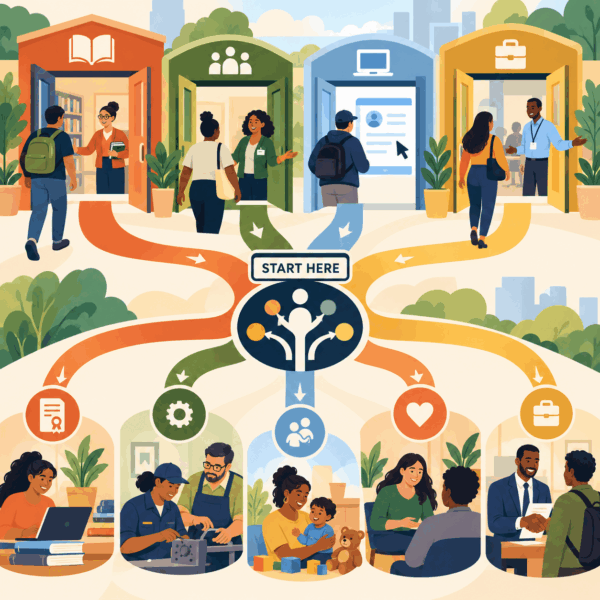 The common description, referral guide, and shared materials are tools. Whether they are used well depends on whether partner staff understand the system deeply enough to apply them confidently. Cross-training, in which partner staff learn about one another’s services, processes, and perspectives, is the practice that turns coordination tools into coordinated behavior.
The goal of cross-training is fluency rather than expertise. A Wagner-Peyser staff member does not need to become a vocational rehabilitation counselor, but she should understand enough about vocational rehabilitation to recognize when a referral might help, explain what the program offers in plain terms, and describe what the resident can expect. An adult education instructor does not need to master Title I eligibility, but she should know that students may be able to receive training funds and how to connect them. Fluency of this kind allows staff to have confident, accurate referral conversations without overstepping into other partners’ professional roles.
Effective cross-training is practical and interactive. Presentations in which each partner describes its programs are a starting point, but they are rarely enough on their own, because staff forget details they have not applied. Scenario-based exercises, in which staff from different partners work through realistic resident situations together and decide which partners should be involved, build both knowledge and relationships. Site visits, in which staff spend time observing another partner’s intake or services, give them a concrete understanding of what residents will experience after a referral. Brief recurring sessions, such as a short partner spotlight at each partner meeting, keep knowledge current.
Cross-training also builds relationships, which may be its most important effect. Referrals succeed more often when the referring staff member knows someone at the receiving partner and can make a personal connection. Staff who have trained together, worked through scenarios together, and met each other in person are more likely to call each other, resolve problems informally, and trust each other’s judgment. These relationships are a form of communication infrastructure that no document can replace.
New staff orientation should include partner cross-training as a standard component. Because staff turnover can be significant across workforce and human services programs, a one-time cross-training event quickly loses its effect. Recorded overviews, a partner directory with photos and contact information, and a standing invitation for new staff to visit partner sites help sustain fluency as staff change. Including partner overviews in each organization’s own onboarding process ensures that knowledge of the system is part of every new employee’s preparation.
Cross-training should address communication practices directly, not only program content. Staff benefit from learning how to have strong referral conversations, how to explain consent and information sharing, how to use shared materials, and how to describe the system using the common description. Practicing these conversations, with feedback from colleagues, builds skills that program knowledge alone does not provide.
Finally, cross-training should be reciprocal. Partners sometimes perceive that the career center expects them to learn about its programs without investing equally in learning about theirs. Training designed so that every partner both teaches and learns, with the one-stop operator coordinating rather than directing, reinforces the shared ownership on which the no wrong door model depends.
Extending No Wrong Door to Employers
The no wrong door model is usually discussed in terms of jobseekers, but employers face a version of the same problem, and partner coordination determines whether they experience the system as one resource or many. An employer looking to hire, train workers, accommodate an employee with a disability, or manage a layoff may be contacted by, or may reach out to, several partners: a business services representative from the local board or provider, a Wagner-Peyser employer services staff member, a vocational rehabilitation business relations specialist, a veterans’ employment representative, a community college workforce division, an adult education program offering workplace literacy, or a Rapid Response coordinator. Each may describe its own services as the public workforce system. Without coordination, the employer receives overlapping calls, inconsistent promises, and no clear sense of whom to rely on.
Employers are particularly sensitive to this fragmentation. Their time is limited, they expect a single point of contact as they would with any service provider, and they tend to disengage quickly when public programs seem disorganized. An employer who receives three calls in a week from different partners offering similar help may conclude that the system is not worth the effort. An employer who makes a request and is passed among partners without resolution is unlikely to make a second request. For the system’s dual customer design to work, partners must coordinate how they communicate with employers as deliberately as they coordinate how they communicate with residents.
The principles are the same. Partners need a common description of what the system offers employers, organized around employers’ needs rather than program boundaries. They need agreement on who serves as the primary contact for a given employer, so that one relationship carries the system’s offerings forward and brings in other partners as needed. They need referral practices for employer requests, so that a representative who receives a request outside her program’s scope can connect the employer to the right partner with a warm handoff and follow up to ensure the request was addressed. And they need shared information about which employers are working with which partners, so that outreach is coordinated rather than duplicated.
Many local areas address this through a coordinated business services team that brings together employer-facing staff from multiple partners. Such teams can maintain a shared employer contact record, coordinate outreach plans, agree on account leads for significant employers, and present a unified set of services. Where a formal team is not feasible, regular coordination meetings and a shared contact log can achieve much of the same benefit. The communication goal is that an employer experiences the public workforce system as a single, reliable partner, even when several organizations stand behind it.
Coordinating employer communication also strengthens jobseeker referrals. Partners who share information about employer needs can better match residents to opportunities, and employers who trust the system are more likely to hire the residents partners refer. Vocational rehabilitation business relations staff, for example, can help other partners understand how to discuss accommodations with employers, while Title I business services staff can share information about on-the-job training opportunities that may benefit vocational rehabilitation participants. Coordination across employer-facing staff thus extends the benefits of no wrong door to both sides of the labor market.
Honesty is as important with employers as with residents. Partners should not promise employers a volume or quality of candidates the system cannot deliver, nor describe training reimbursements or other services without being candid about documentation requirements and timelines. When several partners make overlapping or inflated promises, the system’s credibility suffers collectively. A shared understanding of what the system can realistically provide, and a commitment to describe it accurately, protects every partner’s relationships with the employers on whom residents’ opportunities depend.
Language Access and Accessibility Across Partner Lines
A no wrong door system is only as accessible as its least accessible door. If a resident with limited English proficiency can receive interpretation at the career center but not at the adult education program to which she is referred, the referral may fail. If a resident who is deaf can communicate with vocational rehabilitation staff but not with the human services agency that referred her, she may never reach vocational rehabilitation at all. Accessibility and language access must therefore be coordinated across partners, not managed separately by each.
The legal obligations are substantial. WIOA Section 188 prohibits discrimination in programs and activities funded under the law, including on the basis of disability and national origin, and requires equal opportunity for individuals with disabilities. The Americans with Disabilities Act and the Rehabilitation Act apply to public entities and recipients of federal funds. Federal civil rights requirements call for reasonable steps to provide meaningful access for people with limited English proficiency. These obligations apply to each partner individually, but residents experience them collectively. A system in which every partner meets its own obligations but no one coordinates them can still leave residents stranded at the handoffs.
Coordination begins with shared knowledge. Partners should know what language and accessibility resources each one offers, including interpreters, translated materials, assistive technology, alternative formats, and staff with specific language skills. A shared directory of these resources allows staff to make referrals that account for residents’ needs, such as connecting a Spanish-speaking resident to a partner staff member who speaks Spanish or ensuring that an interpreter will be available at the receiving partner. Without this knowledge, staff may refer residents to partners that cannot serve them effectively.
Referral conversations should include accessibility and language needs. When a staff member makes a referral, asking whether the resident needs interpretation, an accommodation, or materials in a particular format, and passing that information to the receiving partner with consent, allows the receiving partner to prepare. This simple step can transform a referral from a likely failure into a successful connection. Shared referral tools can include a field for these needs so that they are captured consistently.
Shared materials, as noted earlier, should be translated into the languages most common locally and produced in accessible formats. Coordinating translation across partners ensures that residents encounter a consistent system in their own language. Partners can also share interpretation resources, such as telephone interpretation contracts, which may reduce costs and ensure that every partner has access to interpretation when needed.
Physical accessibility matters for co-located partners and for referral destinations. A career center that is fully accessible but refers residents to a partner location with barriers creates a problem the resident must solve alone. Partners should know which locations are accessible and should be prepared to offer alternatives, such as meeting at an accessible location or providing services remotely, when needed.
Vocational rehabilitation partners bring particular expertise in disability and accessibility, and their involvement in coordinating accessibility across the system can strengthen every partner’s practice. Similarly, adult education programs serving English language learners, and community organizations serving specific language communities, can help partners understand how to communicate effectively with those residents. Drawing on this expertise is one of the benefits of a coordinated system.
Accessibility and language access also extend to digital tools. Shared websites, online referral forms, and virtual services must be accessible, consistent with the technical standards for state and local government web content established by the Department of Justice in 2024 and with partners’ broader obligations. A system that moves referrals online without ensuring accessibility risks excluding the residents who most need coordinated help.
Governance Through the MOU and Partner Coordination
Coordination among one-stop partners does not sustain itself on goodwill. Partners have their own priorities, staff turn over, and the shared practices described in this article erode without a structure that holds them in place. WIOA provides that structure through the memorandum of understanding between the local board and partners and through the one-stop operator’s coordinating role. Using these mechanisms deliberately for communication is what makes no wrong door durable.
The memorandum of understanding is required to describe the services each partner will provide through the one-stop system, how costs will be shared, and methods of referral between the operator and partners. Many MOUs address referrals only in general terms. A memorandum that supports coordinated communication goes further, documenting commitments that partners can be held to. These commitments do not need to be extensive, but they should be specific enough to guide practice. Communication provisions that local areas may consider for their MOUs typically include:
-
Use of the common system description and shared vocabulary in partner communication with residents.
-
Standards for referral conversations, including the minimum information residents receive.
-
Referral methods, including warm handoffs where feasible, and timelines for receiving partners to make contact.
-
Feedback on referral status, with consent procedures that comply with each partner’s confidentiality rules.
-
Participation in developing and maintaining shared materials, including responsibility for the accuracy of each partner’s own content.
-
Participation in cross-training and new staff orientation.
-
Coordination of language access and accessibility resources.
-
Participation in a partner communication working group and in periodic review of referral data.
Writing these commitments into the MOU signals that communication is part of each partner’s formal role in the system, not an optional courtesy. It also provides a reference point when coordination breaks down, allowing the board and operator to raise concerns based on agreed commitments rather than on informal expectations.
The one-stop operator is typically responsible for coordinating service delivery among partners, and communication coordination fits naturally within that role. The operator can convene partner meetings, maintain the shared description and referral guide, coordinate shared materials, organize cross-training, and track referral data. It is important that the operator coordinates rather than directs, since partners are independent organizations with their own governance. An operator that facilitates shared decisions, respects partner expertise, and makes coordination easier for partners will gain more cooperation than one that issues instructions.
Regular partner meetings provide the forum where coordination happens in practice. Meetings that focus on administrative updates alone do little to improve communication. Meetings that include review of referral data, discussion of handoffs that failed and why, updates on changes to partner services, short cross-training segments, and planning for shared materials actively strengthen the system. Inviting frontline staff, not only managers, to some meetings brings practical knowledge into the discussion.
The local board provides oversight and support. It negotiates the MOU, holds the operator accountable for coordination, and can use its convening authority to address persistent problems. Boards can also allocate resources for shared communication work, such as translation of shared materials or development of a shared referral system, which benefits all partners.
Governance should include a periodic review of how well the no wrong door model is working, using the measures discussed later in this article. Reviews that examine referral data, partner feedback, and resident experiences allow partners to identify problems and adjust their practices. Without review, coordination tends to drift, and the system gradually returns to the fragmented state it began in.
Technology and Shared Referral Systems
Technology can make referrals faster, more reliable, and easier to track, and many local areas have explored shared referral platforms, common intake tools, or integration between partner case management systems. WIOA itself contemplates technology as a means of access, recognizing that partners may provide access to their services through a direct linkage via technology that results in a program staff member providing meaningful information or services. Used well, technology strengthens the communication practices that make no wrong door work. Used poorly, it can replace human connection with a form that disappears into a queue.
A shared referral platform typically allows a staff member at one partner to send a referral electronically to another partner, with the resident’s consent, including basic information about the resident and the reason for the referral. The receiving partner is notified, contacts the resident, and updates the referral status, which the referring partner can see. This closes the feedback loop automatically, reduces the need for residents to repeat information, and generates data about referral patterns and outcomes. Some community-wide referral platforms also connect workforce partners to health, housing, and human services organizations, extending the no wrong door model beyond the workforce system.
The benefits are real, but they depend on design and use. A referral platform is a communication channel, and like any channel it works only if people use it consistently and the information it carries is accurate and timely. If some partners use the platform and others do not, referrals fall through the gaps between systems. If receiving partners are slow to act on electronic referrals, residents wait without knowing why. If the platform is difficult to use, staff will revert to informal methods. Implementation therefore requires partner agreement on use, training, clear expectations for response times, and ongoing attention to adoption.
Technology must also respect the privacy and consent principles discussed earlier. Shared platforms concentrate information, which increases both their usefulness and their risk. Partners need clear agreements about what information is entered, who can see it, how consent is obtained and recorded, and how data is secured. Residents should understand, in plain language, that their information will be shared through a platform and what that means. Platforms should allow residents to consent to some sharing and not other sharing, consistent with each partner’s legal obligations.
Technology should not eliminate the human elements of referral. An electronic referral sent without a conversation with the resident is a weak referral, regardless of how efficiently it is transmitted. The resident still needs to understand why the referral is being made, what the receiving partner offers, and what to expect. Technology works best as a support for strong referral conversations, handling the transmission and tracking of information while staff handle the explanation and encouragement.
Digital access is another consideration. If residents are expected to complete online forms, schedule appointments through portals, or communicate through apps, those tools must be accessible, available in relevant languages, and usable on mobile devices. Residents without reliable internet access or digital skills need alternatives, and partners should ensure that technology-based processes do not create new barriers for the residents who most need coordinated help.
Finally, technology decisions should involve all partners. A platform chosen by one partner and imposed on others is unlikely to be used consistently. A platform selected through a shared process, with attention to each partner’s systems, legal constraints, and staff capacity, has a far better chance of becoming the common infrastructure that coordinated communication requires. Where a shared platform is not feasible, simpler tools, such as standardized referral forms, secure shared spreadsheets, or regular referral reconciliation meetings, can serve many of the same purposes.
Following One Resident Through the System
The practices described so far are easiest to evaluate when traced through a single resident’s experience. The following scenario is hypothetical, but it reflects situations that one-stop partners encounter regularly, and it shows how communication at each handoff determines whether the no wrong door promise is kept.
A woman in her forties visits a human services office to renew her food assistance benefits. During the conversation, she mentions that she has been working part-time in retail since her previous employer closed, that she would like to find full-time work with better pay, and that she never finished high school. She also mentions that she has a hearing impairment that has made some jobs difficult. In a fragmented system, the caseworker might process the renewal, mention that the career center helps people find jobs, and give her the address. The resident, unsure what the career center offers, whether it can help someone without a diploma, or whether staff there will be able to communicate with her, might never go.
In a coordinated system, the caseworker recognizes several referral opportunities from the shared guidance: the career center for job search and training, adult education for a high school equivalency, and possibly vocational rehabilitation for support related to her hearing impairment. Using the common description, she explains that the career center and its partners work together and can help with finding better work, finishing her education, and getting support related to her hearing. She asks whether the resident would like to be connected and whether she would like information shared to make the process easier, explaining what would be shared and with whom. With the resident’s consent, she sends a referral through the shared referral process, noting the resident’s communication needs, and gives her a referral card explaining what to expect, what to bring, and whom to contact.
The career center receives the referral and contacts the resident to schedule an appointment, arranging for a sign language interpreter or other communication support based on her stated preference. At the appointment, the career advisor already knows the basics of her situation, so the resident does not have to start over. The advisor explains career services and the possibility of training funding, and discusses how finishing a high school equivalency could open more options. With the resident’s agreement, the advisor makes a warm handoff to the adult education partner, introducing her to an instructor during the same visit. The advisor also explains what vocational rehabilitation offers, and the resident decides she would like to learn more, so the advisor schedules a meeting with the vocational rehabilitation counselor, sharing information only as the resident has consented.
At each step, the referring partner receives a status update, so the human services caseworker learns that the resident connected with the career center, and the career advisor learns that she enrolled in adult education and met with vocational rehabilitation. When the resident later struggles to attend classes because of her work schedule, the adult education instructor contacts the career advisor, with the resident’s consent, to explore options, and the partners coordinate a plan that fits her schedule.
Nothing in this scenario requires extraordinary resources. It requires a shared description the caseworker can use, referral guidance that helps her recognize opportunities, a consent process the resident understands, a referral method that carries information and accessibility needs forward, warm handoffs where possible, and feedback that keeps partners informed. Each of these is a communication practice. Together, they turn a series of separate programs into a system the resident experiences as coordinated, which is the entire point of the no wrong door model.
The scenario also shows where things could still go wrong. If the interpreter was not arranged, if the adult education schedule did not fit, if the referral sat unanswered for two weeks, or if the resident felt pressured to consent to sharing she was uncomfortable with, the experience could unravel. Tracing scenarios like this one, with partners together, is a useful exercise for identifying where their own processes are vulnerable.
Measuring Whether No Wrong Door Works
The no wrong door model is a claim about residents’ experience, and like any claim it should be tested. Many local areas describe their systems as no wrong door without any evidence of how referrals actually perform. Measurement allows partners to see where handoffs succeed, where they fail, and whether changes in communication practice make a difference.
Referral volume and direction are the starting point. Tracking how many referrals each partner makes and receives, and between which partners, reveals the actual shape of the system’s connections. Patterns often surprise partners. Some pathways that should be common may be rare, indicating that partners do not recognize opportunities. Some partners may refer frequently but receive few referrals, or the reverse, suggesting imbalances in knowledge or relationships. These patterns point to where cross-training and referral guidance are most needed.
Referral completion is the most important measure. Of the referrals made, how many resulted in the resident connecting with the receiving partner, and how long did it take? Low completion rates for particular pathways indicate breakdowns in the referral conversation, the referral method, or the receiving partner’s response. Comparing completion rates for warm handoffs with those for simple information referrals can show the value of warmer approaches. Tracking time to connection reveals delays that may cause residents to give up.
Referral appropriateness matters as well. Referrals that consistently result in ineligibility determinations or residents who are surprised by what the receiving partner offers suggest that referring staff need better information about when to refer and what to tell residents. Receiving partners can provide this feedback, which, shared constructively, helps referring partners improve.
Resident experience can be measured directly. Brief surveys or conversations can ask residents whether they understood why they were referred, whether they knew what to expect, whether they had to repeat their information, whether their communication and accessibility needs were met, and whether they felt the partners worked together. Asking residents how they first learned about the system, and whether anyone helped them connect to other services, provides additional insight. These measures capture what the no wrong door model is ultimately about: whether residents experience a coordinated system.
Partner experience is a further dimension. Surveys or discussions with partner staff can assess whether they understand other partners’ services, whether they feel confident making referrals, whether they receive feedback, and whether they trust other partners to follow through. Low confidence or trust signals the need for more cross-training and relationship building.
Measurement requires attention to privacy, especially when referral data crosses partner lines. Aggregated data and consent-based status updates can provide most of the information partners need without exposing individual residents’ information inappropriately. Partners should agree on what data will be collected, how it will be shared, and how it will be protected.
Finally, measurement is useful only if partners review it together and act on it. Including referral data in regular partner meetings, discussing failed handoffs without blame, and agreeing on specific improvements turns data into practice. Over time, partners that measure and review their coordination together build a shared understanding of the system that no single partner could develop alone, and that shared understanding is itself one of the strongest foundations for coordinated communication.
How No Wrong Door Communication Compares With Other Agency Types
The no wrong door concept did not originate in workforce development, and comparing its application across sectors clarifies what is distinctive about the one-stop context and what workforce partners can learn from others.
Aging and disability services have used no wrong door approaches for many years, often through networks that help older adults and people with disabilities access long-term services and supports through any participating organization. These networks have emphasized person-centered counseling, common intake tools, and coordinated information and referral. Their experience demonstrates the value of trained staff who understand the full range of available services and can guide individuals through options. It also shows that sustaining coordination requires ongoing investment in training, shared tools, and governance, lessons that apply directly to one-stop partners.
Health and human services integration efforts, including community-wide referral networks that connect health care providers with social services, have developed shared referral platforms and closed-loop referral practices. These efforts have highlighted both the promise of technology for tracking referrals and the importance of consent, privacy, and community organization capacity. One-stop partners exploring shared referral systems can learn from these efforts, particularly regarding the need for receiving organizations to have the capacity to respond to the referrals they receive.
Public libraries function as informal no wrong door access points for many services, because residents bring a wide range of needs to library staff. Libraries’ experience shows the value of staff who know the community’s resources and can make warm, respectful referrals, as well as the importance of trust in the referring institution. Workforce partners often find that library partnerships extend their reach precisely because libraries already serve as trusted community connectors.
Emergency management offers lessons about coordination under pressure. Multi-agency coordination during emergencies relies on pre-established roles, shared communication protocols, and common terminology, which allow organizations with different structures to act as one. One-stop partners rarely face emergencies, but large layoffs, plant closures, and economic disruptions create surges in demand that test coordination. Partners that have established shared protocols in advance respond far more effectively.
The distinctive features of the one-stop context are the number of required partners, the diversity of their funding streams and legal obligations, the varying degrees of co-location, and the fact that partners are bound together by a federal framework rather than by voluntary affiliation alone. These features make coordination both more structured, because MOUs and the operator role provide formal mechanisms, and more complex, because each partner remains accountable to its own authorities. Workforce partners can draw on lessons from other sectors, but they must adapt those lessons to a system in which coordination is required by law and achieved, or not, through everyday communication among organizations that remain independent.
Tying It All Together
No wrong door communication is not a side function of operating a one-stop system. It is the mechanism through which a collection of independent programs becomes a system residents can actually use. The promise that any door leads to the help a resident needs is made collectively by partners, but it is kept or broken in individual conversations, referrals, and materials. Coordinating those communications is therefore not an administrative nicety. It is the substance of the model.
The foundation is a common description of the system, developed jointly and used consistently, that explains what partners offer together in language residents understand. That description gives every partner a way to talk about the whole system rather than only its own part, and it is supported by a shared vocabulary that reduces the confusion created by each program’s technical terms.
The core practice is the referral, treated as a communication event rather than an administrative transaction. Strong referrals explain why the connection matters, what the receiving partner offers, what to expect and bring, and how to make contact, and they use warm handoffs wherever feasible. Referral processes designed jointly, documented in a shared guide, and supported by feedback loops allow partners to make referrals confidently and learn whether they worked.
Shared materials make coordination visible, presenting the system coherently while respecting each partner’s distinct obligations. Information sharing, governed by legally reviewed consent processes and honest communication about limits, allows residents to avoid repeating their stories while retaining control over their information. Cross-training builds the fluency and relationships that turn tools into practice, and coordinated language access and accessibility ensure that every door is open to every resident.
Governance holds it all together. The MOU can document specific communication commitments, the one-stop operator can coordinate shared work, partner meetings can review referral data and address failures, and the board can provide oversight and resources. Technology can strengthen these practices when it is chosen jointly, used consistently, designed for privacy and accessibility, and treated as a support for human conversation rather than a replacement for it.
Finally, measurement tests whether the model works. Referral completion, appropriateness, resident experience, and partner confidence reveal where handoffs succeed and fail, and reviewing these measures together allows partners to improve continuously. A no wrong door system is not achieved once. It is maintained through ongoing attention to the communication practices on which it depends.
Strategic Communication Support
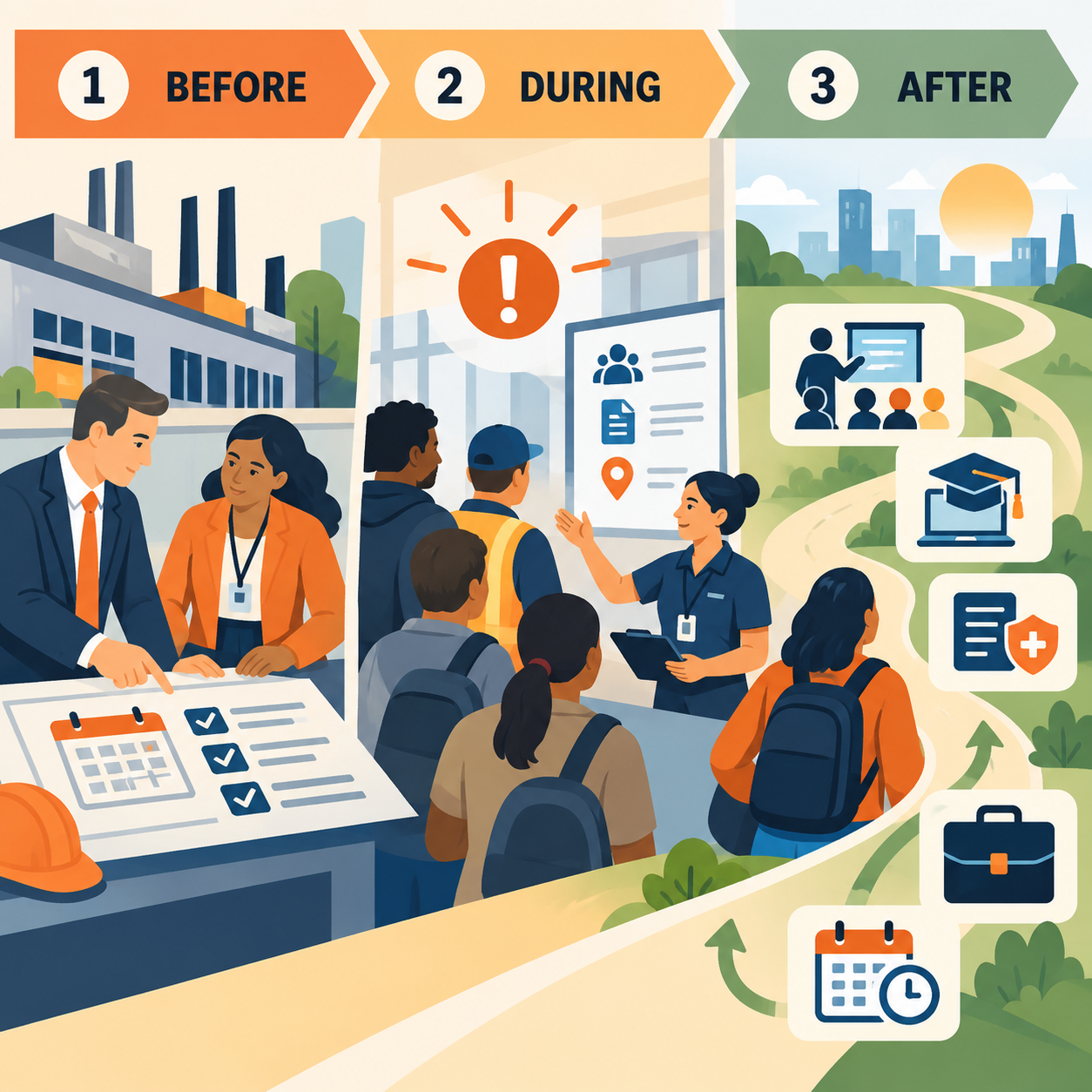 Coordinating communication across one-stop partners is work that belongs to everyone and therefore often to no one. Each partner is focused on its own programs, the one-stop operator may have limited capacity for system-wide communication work, and the board’s oversight role does not extend to day-to-day coordination. Developing a common description, referral guide, shared materials, consent processes, and cross-training requires facilitation across organizations with different cultures and obligations, along with research into how residents and partner staff actually experience the system. External support can provide that facilitation and research while helping partners build practices they will own and sustain.
Stegmeier Consulting Group (SCG) works with public agencies on communication challenges that span organizational boundaries. For one-stop partners, that work can begin with an assessment of how coordination currently functions: interviews and focus groups with partner staff and managers, conversations with residents who have moved between partners, review of existing referral processes and materials, and analysis of available referral data. This assessment identifies where handoffs fail, where partner knowledge is thin, and where materials and messages conflict.
SCG can facilitate partner working sessions to develop the common system description, shared vocabulary, and referral guidance, ensuring that every partner’s perspective is reflected and that the results are practical for frontline staff. SCG can help design referral conversation standards and tools, shared materials in a common format, and plain-language consent explanations that partners can review with their legal counsel. SCG can also help draft communication provisions for memoranda of understanding and design partner meeting structures that keep coordination active.
Implementation support can include developing and delivering cross-training programs built around realistic scenarios, creating onboarding resources that help new staff learn the system quickly, and producing leadership toolkits that help partner managers reinforce coordinated practice within their own organizations. Where partners are considering shared referral technology, SCG can help them clarify communication and privacy requirements before selecting a platform.
Evaluation support helps partners define measures of referral completion, appropriateness, resident experience, and partner confidence, establish privacy-conscious methods for gathering them, and review results together. The aim throughout is a one-stop system in which coordinated communication is built into how partners work, so that the no wrong door promise is kept consistently rather than occasionally.
Future Trends
Several established developments are increasing the importance of coordinated communication among one-stop partners. The most immediate is the expansion of work-related requirements in public assistance programs. Federal legislation enacted in 2025 broadened work requirements associated with SNAP and created community engagement requirements for certain Medicaid enrollees, with implementation phased in by states. As states implement these requirements, residents may be referred among human services agencies, career centers, and other partners in larger numbers, often with deadlines attached. Referral communication that explains clearly what each partner can and cannot do in relation to these requirements, coordinated across agencies so residents receive consistent information, will become more important. Because state implementation approaches differ and continue to develop, partners should expect their referral processes and messages to evolve and should coordinate closely as state guidance emerges.
The growth of community-wide referral platforms is another established trend. Many communities have adopted or are exploring platforms that connect health care, social services, and community organizations through closed-loop referrals. Workforce partners may be invited to join these networks or may consider them as an alternative to workforce-specific systems. Participation can extend the no wrong door model beyond the workforce system, but it also raises questions about privacy, consent, data governance, and the capacity of receiving organizations. Partners considering these platforms should ensure that communication and privacy requirements are addressed before adoption.
Digital accessibility requirements have become more concrete with the Department of Justice’s 2024 rule establishing technical standards for state and local government web content and mobile applications. As more referral, intake, and service processes move online, partners will need to ensure that shared digital tools meet these standards, so that the shift toward technology does not exclude residents with disabilities.
The structure of federal workforce funding may change. Budget proposals in recent cycles have included options to consolidate workforce funding streams, which could alter the number and nature of partner programs. Whether such changes occur is uncertain. If they do, partners would need to explain new arrangements to residents and to each other, and those with established coordination practices would be better positioned to adapt.
Emerging technologies may also affect coordination. Some agencies are exploring automated tools to help staff identify relevant services, draft referral information, or answer residents’ questions about available programs. These tools could help staff who lack deep knowledge of every partner’s services, but they depend on accurate, current information about partner programs and must respect privacy and consent. Their appropriate role in referral communication is still being worked out, and partners should approach them as aids to human judgment, verify their accuracy, and be transparent with residents about their use.
Finally, expectations for seamless service are rising. Residents accustomed to coordinated digital experiences in other areas of life increasingly expect public services to share information appropriately, avoid redundant requests, and guide them through complex processes. One-stop partners cannot match the integration of large private platforms, but they can meet the core of these expectations through coordinated communication, consent-based information sharing, and referrals that carry residents forward rather than sending them back to the beginning.
Conclusion
The no wrong door model asks something difficult of one-stop partners: to behave, from the resident’s perspective, like a single organization while remaining legally and institutionally separate. That request cannot be fulfilled through structure alone. Co-location, memoranda of understanding, and shared logos create the conditions for coordination, but residents experience coordination only through what partners say to them, what materials they receive, how referrals are handled, and whether anyone follows up. The model succeeds or fails in the minute-long conversation at the moment of referral.
For partner leaders, board members, and one-stop operators, the implication is that communication coordination deserves the same deliberate management as any other shared function. It needs agreed standards, written commitments, assigned responsibility, staff preparation, and regular review of evidence. It needs leaders who expect their staff to know and describe the whole system, not only their own programs, and who treat failed handoffs as shared problems rather than another organization’s fault. And it needs a firm commitment to residents’ control over their own information, because a coordinated system that residents do not trust will not be used.
Partners that make these commitments will find that the system becomes easier to navigate, referrals succeed more often, and residents receive the combination of services their situations actually require. That is what no wrong door was always meant to deliver, and it is within reach of any group of partners willing to coordinate how they communicate.
Stegmeier Consulting Group’s Strategic Approach to Communication Systems
SCG approaches no wrong door coordination as a communication system that spans independent organizations. That approach treats the referral as the system’s most important communication event and builds the infrastructure around it: a common description partners will actually use, referral guidance and standards that give staff confidence, shared materials that present the system coherently, consent processes that respect residents’ control over their information, and feedback loops that reveal whether handoffs succeed. It grounds this work in research with the residents and partner staff who experience the system every day, so that solutions address the handoffs that actually fail.
For one-stop partners, this means coordination written into memoranda of understanding and sustained through operator facilitation and regular partner review, cross-training that builds both fluency and relationships, and language access and accessibility coordinated across partner lines so that every door is open to every resident. It means technology chosen jointly and used to support, not replace, human conversation. And it means measurement that tests the no wrong door promise against residents’ real experience, so that partners can keep improving the system they share.
Use the form below to connect with our team and explore how strategic communication support can help your one-stop partners coordinate messaging, referrals, and shared materials so that every door leads residents to the help they need.