
How Rapid Response Teams and Career Centers Can Communicate With Dislocated Workers Before, During, and After Layoffs and Closures
There is a strange interval in every announced layoff. Between the day workers learn their jobs will end and the day they actually end, people keep coming to work. They clock in, run the line, stock the shelves, answer the calls, and finish the projects, while carrying the knowledge that in a few weeks or months none of it will be theirs to do. During that interval, they are still employees with a regular schedule, a paycheck, coworkers, and a familiar building. They are also, in every practical sense, jobseekers who have not yet begun to search. That interval is the single best opportunity the public workforce system will ever have to help them, and it is the moment at which many of them are least ready to listen.
This tension sits at the heart of layoff communication. Workers who receive information about career services, unemployment insurance, training, and health coverage before they lose their jobs can plan, apply, and begin searching while they still have income and structure. Workers who learn about these resources only after their last day have already lost time, often at the point when financial pressure is greatest and the routines that supported them have disappeared. Yet the period before separation is also a period of shock, anger, grief, uncertainty, and continued work obligations. Workers may not be ready to think about resumes or training while they are still processing the news. Some will hold out hope that the decision will be reversed. Others will be too busy finishing their work to attend information sessions. The information they most need arrives when they are least able to absorb it.
Rapid Response teams and career centers exist to bridge this gap. Under the Workforce Innovation and Opportunity Act, states carry out Rapid Response activities when layoffs and closures occur, often in close partnership with local workforce boards and career centers. These activities include working with employers, informing workers about available services, and connecting them with the public workforce system. But the effectiveness of Rapid Response depends heavily on communication: when information reaches workers, what it says, who delivers it, how it is sustained over the notice period, and whether workers remain connected after their last day. A single information session, however well run, cannot carry workers through all three phases of job loss.
This article examines how Rapid Response teams and career centers can communicate with dislocated workers before, during, and after layoffs and closures. Its central argument is that layoff communication must be designed as a continuous sequence across these phases, with different messages, channels, and tones for each, rather than as a single event. It addresses the roles of the organizations involved, the work with employers before notice reaches workers, the worker information session and what must follow it, the emotional realities of job loss, the honest communication of training options, the workers standard approaches miss, community and media communication, ethical obligations, and the coordination and measurement that make the whole sequence work.
Why Timing Defines Layoff Communication
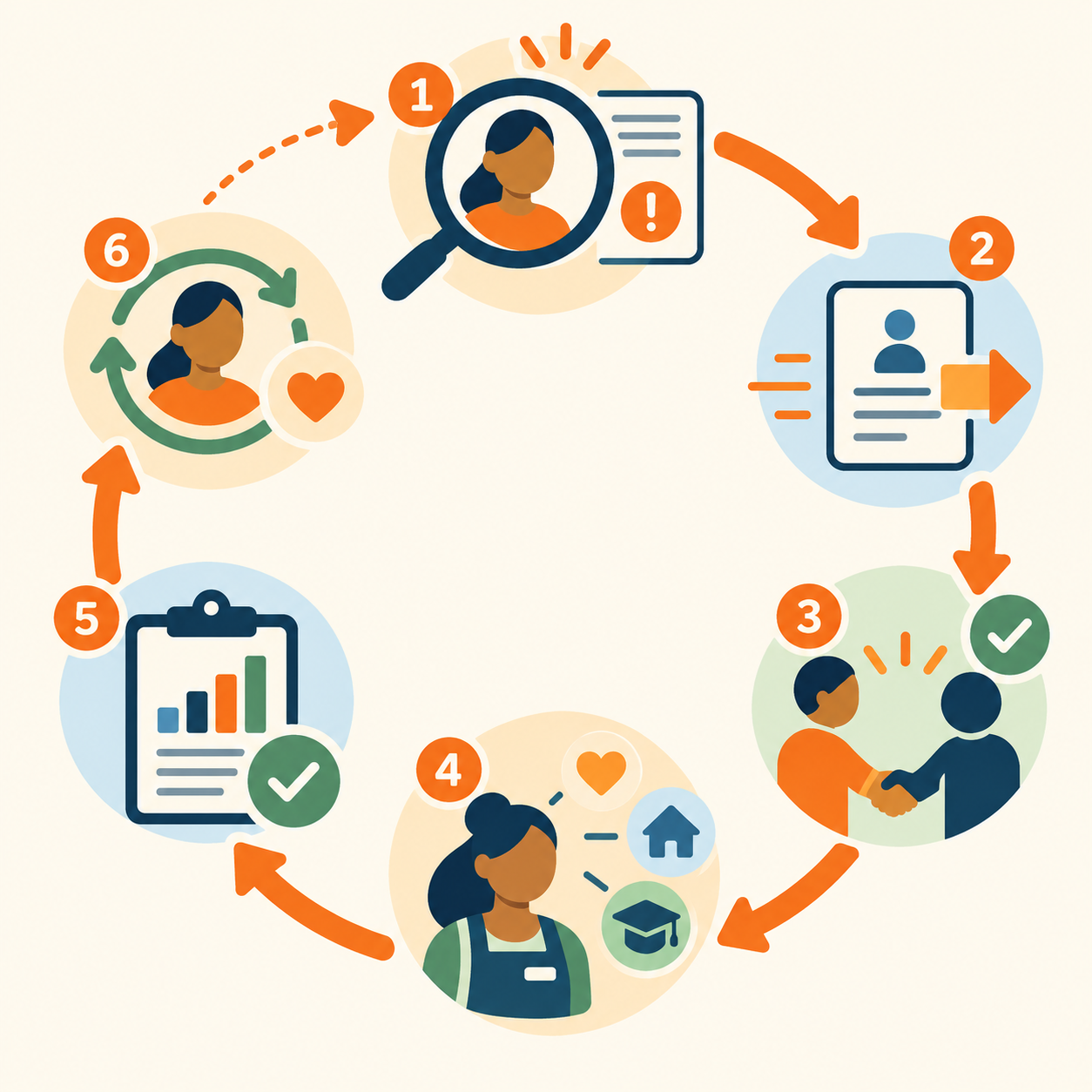 Layoff communication differs from most public agency communication because its audience changes fundamentally over a short period. The same worker passes through three distinct conditions: anticipating job loss while still employed, experiencing the transition as the last day approaches and arrives, and living without the job afterward. Each condition shapes what the worker needs to know, what she is able to hear, and how she can be reached. Communication that ignores these changes will deliver the right information at the wrong time, which in practice means it will not be used.
Before separation, workers are reachable in ways they will never be again. They are gathered in one place, on regular schedules, and connected to an employer who can facilitate access. They still have income, which gives them some room to plan. They have coworkers going through the same experience, which creates natural peer support and information sharing. And they have time, measured in days or weeks, to prepare. This is when information about unemployment insurance, health coverage options, career services, and training can do the most good, because it allows workers to make decisions before pressure forces them. But it is also when many workers are least receptive. Shock and anger can make people resistant to information that seems to accept the layoff as final. Some workers hope the decision will be reversed or that they will be among those retained. Others are absorbed by the demands of finishing their work. Communication in this phase must be designed for an audience that is reachable but not yet ready.
During the transition, as the last day approaches and arrives, practical concerns become urgent. Workers need to know exactly what happens to their pay, benefits, and health coverage, when and how to file for unemployment insurance, and what they need to bring or save. They may also face emotional intensity as the reality sets in. Information that seemed abstract weeks earlier becomes immediately relevant. Communication in this phase must be concrete, timely, and easy to act on, because workers are making decisions with real financial consequences.
After separation, workers become dispersed and harder to reach. They are no longer gathered at the workplace, they may have changed phone numbers or moved, and they are dealing with financial stress, disrupted routines, and in some cases depression or family strain. Some begin searching immediately; others take time before they are ready. Some find work quickly, often at lower wages, while others face extended unemployment. Communication in this phase must reach people individually, sustain contact over weeks and months, and remain available for workers who were not ready earlier but are ready now.
The implication is that layoff communication cannot be a single event. The worker information session, often the centerpiece of Rapid Response, is essential, but it occurs at one point in a process that extends well beyond it. Workers who miss the session, are not ready to engage at that moment, or forget what they heard need further contact. Workers who absorb information at the session still need concrete follow-up as their last day approaches and continued connection afterward. A communication sequence that spans all three phases, with each phase designed for the worker’s condition at that time, is the only approach that matches how job loss actually unfolds.
Timing also governs coordination among the organizations involved. Information delivered by the employer, the state Rapid Response team, the local career center, the unemployment insurance program, and unions or worker representatives must be sequenced so that workers receive consistent messages in a logical order rather than a confusing barrage at the moment of announcement. That sequencing is the subject of the sections that follow.
Skilled & Connected: Communication Strategies for Workforce Development Agencies, Career Centers, and Local Employment Services
This article is part of our series on strategic communication for Workforce Development Agencies, Career Centers, and Local Employment Services. To learn more and to see the parent article, which links to other content just like this, click the button below.
Who Communicates: Roles in Layoff Response
Layoff communication involves several organizations, each with a legitimate role and its own relationship with affected workers. When their roles are clear and their communication is coordinated, workers receive a coherent picture. When roles are unclear, workers hear from multiple sources with overlapping or conflicting information, or from no one at all, because each organization assumes another is handling it.
The State Rapid Response Team
Under WIOA, states are responsible for carrying out Rapid Response activities, typically through a designated state dislocated worker unit or Rapid Response unit. The state is usually the first public entity to learn of a layoff, often through notices required under the federal Worker Adjustment and Retraining Notification Act, which generally requires covered employers to provide sixty days’ notice of plant closings and mass layoffs to affected workers or their representatives, the state dislocated worker unit, and the chief elected official of the local government. Some states have their own notice laws with different thresholds or timelines. The state team typically contacts the employer, assesses the situation, and coordinates the response, including worker information sessions. In many states, Rapid Response is carried out jointly with local boards, or substantially delegated to them under state coordination.
Local Workforce Boards and Career Centers
Local boards and their career centers provide the services dislocated workers will actually use: career services, training, supportive services, and job search assistance. Career center staff often participate in or lead worker information sessions, and they become the workers’ ongoing point of contact after the initial response. Because workers will continue their relationship with the local career center long after the state team has moved on to the next layoff, the career center’s presence in early communication is important for continuity.
The Unemployment Insurance Program
Unemployment insurance is often the most urgent concern for workers facing job loss. The state unemployment insurance program determines eligibility and pays benefits, and its rules shape when and how workers should file. Unemployment insurance information is typically part of worker information sessions, but the program’s own communications, including online portals, notices, and call centers, also reach workers directly. Coordinating these communications with Rapid Response messages ensures consistency.
The Employer
The employer controls the timing of the announcement, the terms of separation, the continuation of benefits, and access to workers during the notice period. Its cooperation determines whether Rapid Response can reach workers before separation. The employer also communicates with workers directly about pay, benefits, severance, and logistics, and those communications need to align with what public agencies say. Employers vary widely in their willingness and capacity to support Rapid Response, and building a constructive relationship quickly is one of the team’s most important tasks.
Unions and Worker Representatives
Where workers are represented by a union, the union is a central communication partner. It may negotiate severance or transition terms, receive formal notice, and hold the trust of workers in ways public agencies cannot. Unions can co-host information sessions, share information through their own channels, and help ensure that workers’ concerns are heard. Some unions operate their own dislocated worker assistance, which should be coordinated with public services.
Other Partners
Depending on the situation, other partners may be involved: health coverage navigators and the health insurance marketplace, community colleges and training providers, human services agencies, economic development organizations seeking to attract new employers, mental health and community support organizations, and, where a layoff is linked to trade, programs that may provide additional assistance to eligible workers. Each adds information workers may need, and each adds to the challenge of coordination.
The central communication task is to assign clear roles: who informs workers about what, through which channels, and in what order. That assignment, made early and shared among all partners, prevents the confusion that arises when every organization speaks independently.
Before the Layoff: Working With Employers on Notice and Planning
The quality of communication with workers depends heavily on what happens between the Rapid Response team and the employer before workers hear from anyone. This early work determines whether the team will have access to workers, how much time workers will have to prepare, whether employer and public communications will be consistent, and whether there is any possibility of averting the layoff altogether. It is also delicate, because employers are often under significant pressure, may be concerned about confidentiality, and may not understand what Rapid Response offers.
Formal Notice and Informal Signals
When an employer files a notice under the federal WARN Act or a state equivalent, the state Rapid Response unit receives formal notice and can initiate contact. But many layoffs fall below federal notice thresholds or occur at employers not covered by the law, and some employers fail to give required notice. Rapid Response teams that rely solely on formal notices will miss many layoffs. Effective teams cultivate informal sources of information: business services staff who notice signs of trouble at employers they work with, economic development partners, local elected officials, unions, news reports, and unemployment insurance claim patterns that suggest a group layoff. These signals allow teams to reach out early, sometimes before the employer has finalized its decisions.
Early Employer Contact
The first conversation with the employer sets the tone for everything that follows. Employers who do not understand Rapid Response may assume it is a regulatory intrusion or a public relations risk. The team’s first message should explain clearly and concisely what Rapid Response offers the employer and its workers: no-cost information sessions for workers, help with unemployment insurance and health coverage questions, career and training services, and support that can reduce the burden on the employer’s human resources staff and help the employer maintain its reputation. Where appropriate, the team should also explain layoff aversion options.
Layoff Aversion
Rapid Response under WIOA includes layoff aversion activities intended to prevent or minimize job losses. Depending on the circumstances and state practice, these may include connecting the employer with incumbent worker training, short-time compensation programs where the state offers them, which allow employers to reduce hours rather than lay off workers while employees receive partial unemployment benefits, assistance identifying potential buyers or partners, and connecting the employer with economic development resources. Communication about layoff aversion requires care. It should be offered sincerely and early, while options remain open, but it should not create false hope among workers if the layoff is unlikely to be averted. Generally, layoff aversion discussions occur with the employer confidentially, and workers should not be told that the layoff might be avoided unless that possibility is real and the employer agrees to share it.
Agreeing on a Communication Plan
Once the layoff is confirmed, the team and the employer should agree on a communication plan. The plan covers when and how workers will be informed, what the employer will say about pay, benefits, severance, and the timeline, when Rapid Response information sessions will occur and whether they will be held on paid time, how the team will reach workers who work different shifts or locations, and how the union, if present, will be involved. It should also address what the employer will say publicly and how public agencies will respond to media inquiries.
Consistency between employer and public communications is essential. Workers who hear one account of their health coverage from the employer and another from the Rapid Response team lose confidence in both. Reviewing key facts with the employer in advance, including the separation date, final pay, severance terms, benefit end dates, and options for continuing health coverage, allows the team to reinforce accurate information rather than contradict it.
Where employers resist cooperation or limit access to workers, the team must find other routes, such as distributing information through unions, community organizations, local media, and unemployment insurance communications. These routes are less effective than on-site access, which is why investing in the employer relationship is so valuable.
The Worker Information Session
The worker information session is the centerpiece of most Rapid Response efforts and, for many workers, their first and most memorable encounter with the public workforce system. It is typically held at or near the worksite, sometimes on paid time, and includes presentations from the Rapid Response team, career center staff, the unemployment insurance program, and other partners. Done well, it gives workers essential information, a sense that help is available, and a clear path forward. Done poorly, it overwhelms workers with information they cannot absorb, delivered by a parade of agencies whose relationships are unclear, and leaves them more confused than when they arrived.
The most common failure is overload. Information sessions often attempt to cover everything at once: unemployment insurance eligibility and filing, health coverage options, career services, training funds, supportive services, job search resources, financial counseling, mental health resources, and programs for specific groups. Each presenter has important information, and each wants to be heard. But workers who have recently learned their jobs are ending can absorb only a limited amount. After the first few presentations, most of what follows is lost. A session designed around what workers most need to know now, with everything else provided in materials and follow-up, is far more effective than one that tries to deliver everything in one sitting.
Prioritization begins with the questions workers bring. Almost always, the most pressing are about money and health coverage: when their last paycheck will come, whether they will receive severance, how to file for unemployment insurance and how much they might receive, and what happens to their health insurance. Sessions that address these questions first, clearly and concretely, earn workers’ attention for what follows. Sessions that open with descriptions of career services or training programs, before workers’ immediate concerns are addressed, often lose their audience.
After immediate concerns, the session’s main task is to establish a relationship with the career center and make the next step clear. Rather than describing every service in detail, presenters can explain in plain terms what the career center can do, such as help with finding a new job, deciding whether training makes sense, and paying for training for those who qualify, and how workers can begin. The most effective sessions end with a concrete action: completing a brief registration form, scheduling an appointment, signing up for follow-up sessions, or providing contact information so the career center can reach out. A session that ends with a stack of brochures and no next step relies on workers to take the initiative at the moment they are least able to.
The session’s structure should feel coordinated rather than fragmented. A single facilitator who introduces each presenter, explains how the organizations relate, and connects the pieces helps workers understand that they are hearing from a team rather than a series of separate agencies. Presenters should coordinate their content in advance to avoid repetition and contradiction, and they should use plain language rather than program terminology.
Practical arrangements matter. Sessions should be scheduled to reach all shifts, held in accessible locations, and offered in the languages workers speak, with interpretation arranged in advance. Holding sessions on paid time, where the employer agrees, increases attendance and signals the employer’s support. Allowing time for individual questions, with staff available to speak with workers privately after the presentation, accommodates workers who do not want to ask personal questions in front of coworkers.
Materials should complement the session rather than duplicate it. A concise packet that summarizes key information, organized by what workers need to do and when, gives workers something to refer to later, when they are more ready to absorb details. The packet should include clear contact information for each organization and a single primary contact at the career center. Many workers will set it aside at first and return to it weeks later, so it should remain useful after the session.
Finally, the session should be treated as the beginning of a relationship, not its culmination. Every element of the session, from the registration form to the materials, should be designed to support the follow-up communication that must come next.
Communicating About Immediate Concerns
Workers facing job loss have pressing practical questions, and the credibility of everything else the public workforce system says depends on how well those questions are answered. A Rapid Response team that explains career services eloquently but gives vague or inaccurate information about unemployment insurance or health coverage will lose workers’ trust. Answering immediate concerns accurately, specifically, and honestly is the foundation of effective layoff communication.
Unemployment Insurance
Workers want to know whether they are likely to be eligible for unemployment insurance, when and how to file, what information they will need, how much they might receive, and how long benefits may last. These questions have state-specific answers, and some depend on individual circumstances, such as earnings history or the receipt of severance pay, which may affect timing in some states. Communication should explain the general rules clearly, direct workers to the official filing channel, and avoid promising specific outcomes that only the unemployment insurance program can determine. Workers should understand when to file, typically after their last day of work, and what to do if they encounter problems. Because claims systems can be confusing and sometimes overloaded during large layoffs, explaining how to get help with the filing process can prevent significant frustration.
Communication should also explain how unemployment insurance relates to career services and work search requirements. Workers should understand that they may be required to register for work and conduct work search activities, that some may be selected for reemployment services, and that the career center can help with these requirements while also offering services beyond them. Framing the career center as a resource for their own goals, rather than only as part of benefit compliance, encourages workers to engage more fully.
Health Coverage
Loss of employer-sponsored health coverage is among the most frightening consequences of job loss, particularly for workers with health conditions or dependents. Workers need to know when their current coverage ends, whether they can continue it through federal continuation coverage rules or state equivalents and at what cost, and what alternatives exist, such as coverage through the health insurance marketplace, for which job loss typically creates a special enrollment period, or Medicaid, depending on income and state rules. These options involve deadlines that workers can miss if they do not learn about them in time. Communication should explain the options clearly, emphasize deadlines, and direct workers to navigators or official resources that can help them choose. Rapid Response teams should coordinate with the employer to ensure that coverage end dates and continuation information are accurate.
Pay, Severance, and Retirement
Questions about final pay, accrued leave, severance, and retirement accounts are largely matters between the worker and the employer, and Rapid Response teams should be careful not to speak for the employer. But teams can ensure that the employer has communicated these matters clearly, can direct workers to the right contacts, and can provide general information about financial planning during job loss, including resources for financial counseling. Workers who are considering withdrawing retirement funds should be encouraged to understand the tax consequences and to seek qualified advice.
Other Immediate Needs
Some workers face urgent needs beyond income and health coverage, including housing costs, childcare arrangements tied to work schedules, transportation, and food. Information about human services, food assistance, utility assistance, and community resources can help workers manage the transition. This information should be available without being imposed, since many workers will not need it and some may feel stigmatized by an assumption that they do.
Across all of these topics, accuracy is paramount. Rapid Response teams should verify information before sharing it, coordinate with the unemployment insurance program and employer, and update materials when rules or circumstances change. When something is uncertain, saying so and explaining how workers can get a definitive answer is far better than offering a confident answer that turns out to be wrong.
Respecting the Emotional Reality of Job Loss
Job loss is not only an economic event. For many workers, a job is a source of identity, routine, social connection, and dignity, and losing it can produce grief, anger, fear, shame, and disorientation. Workers who have spent many years at a single employer may feel that a part of their lives has been taken from them. Workers in communities where a closing plant was the major employer may experience the loss as a blow to the whole community. These emotional realities shape how workers hear everything the Rapid Response team and career center say, and communication that ignores them will struggle to connect.
The first principle is acknowledgment. Presenters who begin by recognizing that the news is difficult, that workers may be feeling many things, and that the purpose of the session is to help rather than to process them, establish a respectful tone. This acknowledgment should be sincere and brief. Workers do not want lengthy expressions of sympathy from strangers, but they do want to feel that the people addressing them understand the weight of the moment. Acknowledgment that sounds scripted or perfunctory is worse than none, so presenters should speak plainly and genuinely.
The second principle is respect for workers’ experience and skills. Dislocated workers often bring years of expertise and accomplishment, and communication that treats them as people needing remediation can feel insulting. Messages that recognize their skills, explain how those skills can transfer to other work, and present career services as a resource for skilled people navigating a transition affirm workers’ dignity. Experienced workers in particular may resist the idea that they need help finding work, and framing services as professional resources rather than as assistance for those who cannot manage alone can make them more willing to engage.
The third principle is patience with readiness. Not every worker is ready to plan their next step when they first hear about services. Some need time to absorb the news, process their feelings, or hold out hope. Communication that pressures workers to commit immediately to training or job search can feel disrespectful and may produce resistance. Communication that makes clear the help will be available when they are ready, and that offers multiple opportunities to engage over time, respects workers’ pace. This is one of the strongest reasons for sustaining communication beyond the initial session.
The fourth principle is attention to wellbeing. Job loss is associated with stress, and some workers will experience significant distress. Rapid Response sessions and career center communications can include information about mental health resources, employee assistance programs if the employer offers them, peer support, and community resources, presented in a way that normalizes seeking support rather than suggesting that workers are in crisis. Staff should be prepared to recognize when a worker may be in serious distress and to connect them with appropriate help, while respecting privacy.
The fifth principle is honesty without false comfort. It is tempting to reassure workers that everything will be fine, that they will quickly find new jobs, or that training will lead to better opportunities. These reassurances may be well intentioned, but they are not always true, and workers who later find the reality harder than promised may feel misled. Honest communication acknowledges that transitions can be difficult and take time, while emphasizing the concrete help available and the steps workers can take. This honesty builds trust that sustains workers through the harder parts of the transition.
Peer connection can be one of the most powerful forms of support. Workers going through the same layoff share experiences and information, and some Rapid Response efforts help establish worker transition committees or peer support structures in which affected workers, sometimes with union involvement, help organize services and encourage coworkers to participate. These structures carry information through the trusted relationships workers already have and give workers a sense of agency during a period when much has been taken out of their hands.
During the Notice Period: Sustaining Contact Before the Last Day
 The weeks between the information session and the last day of work are often wasted from a communication perspective. Workers attend a session, receive materials, and then return to their jobs, and the next contact from the public workforce system may not come until after they have been separated, if it comes at all. Yet this period offers the greatest opportunity to help workers prepare while they still have income, structure, and access. Sustaining contact throughout the notice period is one of the most valuable improvements Rapid Response teams and career centers can make.
The simplest form of sustained contact is a series of follow-up sessions at the worksite. Rather than holding a single information session, the team can schedule several shorter sessions over the notice period, each focused on a specific topic: filing for unemployment insurance, health coverage options, resume writing, job search strategies, exploring training options, and connecting with employers who are hiring. Shorter, focused sessions are easier for workers to attend and absorb, and their repetition reaches workers who were not ready earlier. Where the employer permits, on-site resource tables or office hours during breaks and shift changes allow workers to ask questions informally.
Some Rapid Response efforts establish temporary transition centers at or near the worksite, where workers can access career services, computers, job listings, and staff assistance during the notice period and sometimes afterward. Transition centers make the career center’s services tangible and convenient, and they allow workers to begin preparing without leaving the familiar environment of their workplace. They require employer cooperation and staff resources, so they are more common for larger layoffs, but even a modest space with regular staff hours can significantly increase engagement.
Direct communication with individual workers is another important channel. Workers who provide contact information at the information session can receive periodic messages by text, email, or phone reminding them of upcoming sessions, deadlines, and next steps. These messages should be brief, practical, and respectful of workers’ consent and privacy. A message reminding workers to file for unemployment insurance after their last day, or to review health coverage options before a deadline, can prevent costly mistakes.
The notice period is also when early registration with the career center can begin. Workers who register and meet with a career advisor before their last day can start assessing their options, exploring training, and connecting with employers while they are still employed. Some may be eligible for dislocated worker services before separation once a notice has been issued, depending on program rules. Encouraging early registration, and making it easy, gives workers a head start that can shorten their period of unemployment.
Employer cooperation remains important throughout. Employers can allow sessions on paid time, provide space, share schedules, distribute messages through internal channels, and encourage supervisors to support workers’ participation. Some employers also organize job fairs at the worksite, inviting other employers to recruit affected workers, and Rapid Response teams can help coordinate these events. Maintaining the relationship with the employer through the notice period, rather than only at the start, keeps these opportunities open.
Communication should adjust as the last day approaches. Early in the notice period, the emphasis may be on information and preparation. As the last day nears, the emphasis shifts to concrete steps: filing for unemployment insurance, enrolling in health coverage, gathering documents, and confirming appointments with the career center. A final session or communication shortly before separation can summarize these steps and remind workers how to stay connected.
Finally, the notice period is the last opportunity to collect the information needed to reach workers after they leave. Personal contact information, preferred communication methods, and consent to receive follow-up communication should be gathered before workers disperse. Workers who leave without providing this information may be difficult or impossible to reach afterward, and the connection built during the notice period may be lost.
After Separation: Keeping Dislocated Workers Connected
Once workers leave the worksite, the communication environment changes completely. They are no longer gathered in one place, no longer reachable through the employer, and no longer on a shared schedule. They are dispersed across the community, dealing individually with financial pressure, family responsibilities, and the emotional aftermath of job loss. The connection built during the notice period can quickly fade unless the career center maintains it deliberately. This post-separation phase is where many Rapid Response efforts lose the workers they reached so successfully at the beginning.
The first task is proactive outreach shortly after separation. Workers who registered with the career center or provided contact information should hear from a specific person, ideally a career advisor assigned to them or to the group, within days of their last day. This contact should check in on their situation, remind them of available services, confirm any appointments, and offer help with immediate concerns such as unemployment insurance filing. A personal contact from a named staff member is far more effective than a generic message, because it reinforces that someone at the career center knows about them and is available to help.
The second task is offering multiple ways to stay connected. Some workers will engage immediately and come to the career center. Others will prefer remote services, especially if the career center is far away or if they are caring for family members. Others will not be ready for weeks or months. Communication should make clear that services are available in person, by phone, and online, and that workers can return whenever they are ready. Periodic messages over the following months, spaced to avoid being intrusive, can remind workers that help remains available and highlight specific opportunities such as hiring events, training program start dates, or workshops.
The third task is maintaining the group connection where it is valuable. Workers from the same layoff often benefit from staying in contact with one another, sharing job leads, and supporting each other. Group sessions or job clubs for workers from a particular layoff, held at the career center or a community location, can sustain this connection while delivering services. Where a worker transition committee or union structure exists, it can continue to help coordinate communication and encourage participation.
The fourth task is reaching workers who did not engage earlier. Some workers will not have attended the information session, registered with the career center, or provided contact information. Others may have engaged briefly and then dropped away. Reaching them may require using channels such as unemployment insurance communications, which can include information about the career center and specific services for workers from the layoff, as well as union communications, community organizations, local media, and social media. The message should make clear that it is not too late to get help.
The fifth task is adjusting communication as workers’ situations evolve. Workers who find jobs quickly may still benefit from information about advancement, training, or support if the new job does not work out. Workers facing long periods of unemployment may become discouraged and need encouragement, new approaches, or connections to additional support. Workers who enter training need communication that supports their persistence and connects them with employers as they near completion. Recognizing that dislocated workers follow different paths, and tailoring communication accordingly, keeps the career center relevant to each.
Throughout this phase, communication should respect workers’ choices. Some workers will decline services, find their own paths, or ask not to be contacted. Their preferences should be honored promptly. Persistent contact with workers who have opted out damages trust and may violate rules governing direct communication. The goal is to remain available and visible, not to pressure workers into services they do not want.
Finally, career centers should recognize that the end of Rapid Response is not the end of their responsibility. The state team may move on to the next layoff, but the career center remains the workers’ ongoing resource. Continuity of contact, ideally with the same staff members workers met during the notice period, preserves the trust built early in the process.
Training Decisions and Honest Expectations
For many dislocated workers, the most consequential decision they will make during the transition is whether to pursue training. Training can open paths to new occupations, higher wages, and greater security, particularly for workers whose skills are tied to a declining industry. But training also requires time, often months or longer, during which workers may have limited income. It requires choosing a field, a program, and a provider. And it carries uncertainty, because no training program guarantees employment. How Rapid Response teams and career centers communicate about training shapes whether workers make good decisions or are drawn into choices they later regret.
The central risk is overpromising. Training is often presented in Rapid Response sessions and career center materials in aspirational terms: retrain for a new career, gain in-demand skills, move into a better job. These messages are not false, but they can create an impression that training is a reliable path to better employment for everyone. In reality, outcomes depend on the occupation, the program’s quality, the local labor market, the worker’s circumstances, and factors no one can fully predict. Workers who enter training expecting a guaranteed better job and then struggle to find work in their new field may feel that the system misled them.
Honest training communication begins with clarity about what training funding is and is not. Dislocated worker programs can help eligible workers pay for training, typically through individual training accounts for programs on the state’s eligible training provider list, often focused on occupations the local board has identified as in demand. Funding is limited, may be capped, and depends on eligibility and availability. Workers should understand these conditions before they invest time in planning, so that they are not surprised later. Where other funding sources exist, such as Pell Grants for eligible students, communication can explain how they may fit together, while directing workers to the appropriate offices for specific determinations.
Honest communication also means giving workers the information they need to make informed choices. Labor market information about demand and wages in different occupations, information about training providers’ completion and employment outcomes where it is available and reliable, and realistic descriptions of program length and requirements help workers weigh their options. Career advisors play a central role in this, and their conversations should support workers’ own decisions rather than steering them toward particular programs to meet enrollment goals. Workers should understand that choosing not to enter training, and instead focusing on a direct job search, can also be a sound decision depending on their situation.
The financial dimension deserves explicit attention. Workers considering training need to understand how they will support themselves and their families during training. Unemployment insurance benefits may continue for some period, and some states have provisions related to training, but benefits are time-limited. Supportive services may help with some costs, such as transportation or childcare, where available. Workers should be encouraged to plan realistically, and career advisors should help them understand the full picture before they commit.
Where a layoff is connected to foreign trade, workers may be eligible for additional assistance under trade-related programs if a petition is certified and the program is authorized to provide benefits at the time. The availability of these programs has changed in recent years, and communication about them should reflect their current status accurately rather than assuming benefits that may not be available. Rapid Response teams should verify the current situation with state partners before discussing trade-related assistance with workers.
Timing matters for training communication. Workers who learn about training options early, during the notice period, have more time to research, plan, and apply before program start dates and before their income runs out. Training communication should begin early but should not pressure workers to decide quickly. Offering information sessions on training options, connecting workers with training providers, and arranging individual conversations with career advisors during the notice period allows workers to make considered decisions.
Finally, communication about training should continue after enrollment. Workers in training benefit from encouragement, help with obstacles, and connection to employers as they approach completion. Career centers that maintain contact with workers in training, and help them transition into employment afterward, increase the likelihood that training produces the outcomes workers hoped for.
Reaching Workers Standard Approaches Miss
The standard Rapid Response model, centered on an on-site information session during the notice period, works best for workers who are present at a single worksite, work regular shifts, speak the language of the presentation, and are employed directly by the company announcing the layoff. Many affected workers do not fit this profile. Reaching them requires deliberate adaptation, and failing to do so means that some of the workers who need help most receive the least.
Workers on Different Shifts and Schedules
Workers on night shifts, weekend schedules, or rotating shifts may be unable to attend sessions scheduled during standard business hours. Holding sessions at multiple times, including shift changes, and providing recorded or virtual options ensures that schedule does not determine access. Workers on leave, including medical or family leave, may not be at the worksite at all and need to be reached directly with the employer’s cooperation.
Workers With Limited English Proficiency
Workers who speak languages other than English need sessions and materials in their languages, with interpretation arranged in advance rather than improvised. Simultaneous interpretation or separate sessions in different languages may be needed, depending on the workforce. Materials should be translated professionally and reviewed for clarity. Bilingual career center staff, community organizations serving the relevant language communities, and in-language media can extend reach after separation. Workers with limited English proficiency may also face barriers in filing for unemployment insurance and navigating online systems, so additional assistance should be offered.
Workers With Disabilities
Workers with disabilities need accessible sessions, materials, and follow-up. This includes accessible meeting locations, sign language interpretation or captioning for workers who are deaf or hard of hearing, materials in accessible formats, and accommodations for workers with other disabilities. Vocational rehabilitation partners can provide expertise and services, and their involvement in Rapid Response can help workers with disabilities understand the full range of support available.
Contract, Temporary, and Subcontracted Workers
Layoffs and closures often affect workers who are not direct employees of the company: temporary workers placed by staffing agencies, contract workers, subcontractor employees, and workers at supplier businesses whose jobs depend on the closing facility. These workers may not be included in the employer’s notice or invited to information sessions, yet they may lose their jobs just the same. Rapid Response teams can work with the employer, staffing agencies, and suppliers to identify and reach these workers, and can use community channels and local media to ensure they know services are available to them.
Remote and Dispersed Workers
Some layoffs affect workers who work remotely or at multiple locations, including workers in other parts of the state or other states. These workers cannot attend an on-site session and may not be connected to the local career center. Virtual sessions, direct outreach, and coordination with Rapid Response units and career centers in the areas where these workers live help ensure they are not overlooked.
Workers Who Do Not Engage
Some workers will not engage with Rapid Response regardless of how well it is designed, because they are skeptical of government, confident they can find work on their own, overwhelmed, or not yet ready. These workers should not be pressured, but they should be able to find help later. Ensuring that information about services reaches them through multiple channels, including unemployment insurance communications, unions, community organizations, and peers, keeps the door open for when they are ready.
Adapting Rapid Response to these workers takes additional effort and planning. Teams that identify the composition of the affected workforce early, in conversation with the employer and union, can plan sessions, materials, and outreach that reach everyone affected rather than only those who fit the standard model.
Communicating With the Community, Officials, and Media
Large layoffs and closures are public events. They affect not only the workers who lose their jobs but their families, suppliers, local businesses, tax revenues, and the community’s sense of its own future. Local elected officials, journalists, community organizations, and residents all want to know what is happening and what is being done. How the public workforce system communicates with these audiences shapes public understanding of the response, affects workers’ perceptions of the help available, and can influence how quickly the community recovers.
Local elected officials are often among the first to learn of a significant layoff, since the WARN Act requires notice to the chief elected official of the local government, and they face immediate pressure from constituents and the media. They need clear, accurate information about the scope of the layoff, the response underway, the services available to workers, and how they can help. Rapid Response teams and local boards should brief officials promptly, coordinate public statements with them, and provide information they can share with constituents. Officials who understand the response can reinforce its messages and direct affected workers to services, while officials left uninformed may make statements that confuse workers or create unrealistic expectations.
Media coverage of major layoffs can be a powerful channel for reaching affected workers, especially those not reached through the employer, such as contract and supplier workers. Coverage that includes clear information about where workers can get help, how to contact the career center, and when information sessions are being held extends the response’s reach. Rapid Response teams and career centers can support this by providing reporters with accurate, concise information and designating spokespersons who can explain services clearly. Statements should be factual and respectful of workers, avoiding language that frames them as victims or that minimizes the impact of the loss.
Communication with the media and the public requires attention to confidentiality and coordination. Employers may have legitimate reasons for controlling the timing and content of public announcements, and public agencies should generally avoid announcing a layoff before the employer has informed its workers. Workers should never learn about their own layoff from a news report triggered by a public agency. Rapid Response teams should coordinate with employers on the timing of any public statements and should be careful not to disclose information shared in confidence during layoff aversion discussions.
The broader community may also need information. Local businesses that depend on the closing facility’s workers or purchases may themselves face difficulties. Community organizations may see increased demand for food assistance and other support. Schools may notice effects on families. Communicating with these community partners about what is happening and what resources exist helps the community respond collectively. Economic development partners may be working to attract new employers or repurpose the facility, and coordinated communication about those efforts, when appropriate, can offer the community a sense of direction.
In communities heavily dependent on a single employer, a closure can affect the community’s identity and morale. Communication from public leaders that acknowledges the significance of the loss, honors the contributions of the workers and the facility to the community, and describes concrete steps being taken to support workers and the local economy can help the community process the event. This communication should be honest about the challenges ahead while emphasizing available support and the community’s capacity to adapt.
Finally, public communication should be sustained beyond the initial announcement. Updates on how workers are faring, such as the number engaged with services, the number entering training, and the number reemployed, shared in aggregate and without identifying individuals, keep the community informed and demonstrate the value of the public workforce system’s response. These updates also remind workers who have not yet engaged that help remains available.
Privacy, Fairness, and Ethical Obligations
Layoff communication involves sensitive information about workers at a vulnerable moment, and it takes place among multiple organizations with different obligations. Ethical practice requires attention to privacy, fairness, accuracy, and the balance of interests between employers and workers.
Privacy is central. Rapid Response teams may receive lists of affected workers from employers, collect contact information at information sessions, and share information among partners to coordinate services. Each of these activities requires care. Information provided by employers should be used only for the purpose of informing workers about services and should be protected appropriately. Contact information collected from workers should be gathered with clear explanation of how it will be used, and workers should be able to decline to provide it. Sharing information among partners, such as between the state Rapid Response team, the local career center, and the unemployment insurance program, must comply with applicable confidentiality rules, which for unemployment insurance data are particularly strict. Workers should know who will contact them and why.
Privacy also applies to how workers are treated in group settings. Workers may have personal circumstances, such as health conditions, financial difficulties, immigration concerns, or family situations, that they do not want to discuss in front of coworkers. Information sessions should allow individual, private conversations, and staff should avoid asking personal questions publicly. Communications sent to workers should avoid disclosing sensitive information in ways family members or others might see.
Fairness requires that all affected workers have equal access to information and services, regardless of shift, language, disability, employment status, or position in the company. As discussed earlier, standard approaches often favor workers who fit a typical profile, and deliberate adaptation is needed to reach others. Fairness also means that information about services, eligibility, and training opportunities should be the same for all workers, without favoritism or steering based on assumptions about who is likely to succeed.
Accuracy is an ethical obligation, not only a practical one. Workers make significant decisions based on what they are told about unemployment insurance, health coverage, severance, and training. Inaccurate information can cause real harm, such as missed deadlines, lost benefits, or poor training choices. Rapid Response teams and career centers should verify information, coordinate with authoritative sources, correct errors promptly, and acknowledge uncertainty honestly.
The relationship with the employer raises its own ethical questions. Rapid Response teams depend on employer cooperation and should maintain a constructive relationship. But their primary obligation in communicating with workers is to the workers’ interests, not the employer’s. Teams should not present the employer’s decisions in a misleadingly favorable light, discourage workers from exercising their rights, or withhold information workers need. Where workers have questions about whether the employer has met its legal obligations, such as notice requirements or final pay, teams should direct them to the appropriate enforcement agency or legal resources rather than offering opinions on legal questions.
Finally, respect for workers’ autonomy means honoring their choices. Workers may decide not to use services, not to pursue training, or not to be contacted. These decisions should be respected without judgment, while ensuring that workers know help remains available if they change their minds.
Coordination Protocols Between State and Local Teams
The sequence of communication described in this article involves the state Rapid Response unit, local boards and career centers, the unemployment insurance program, employers, unions, and other partners, often working under time pressure. Coordination cannot be improvised for each layoff without producing inconsistency, duplication, and gaps. Agreed protocols, established in advance and applied to each event, allow the system to respond quickly and coherently.
The foundation is a clear division of responsibilities between the state and local levels. In some states, the state unit leads employer contact and information sessions, with local career centers participating. In others, local boards lead most activities under state coordination. Either arrangement can work, but each local area should know exactly how responsibilities are divided, who makes first contact with employers, who organizes sessions, who follows up with workers, and how information flows between levels. Ambiguity about these roles is one of the most common sources of delay and confusion.
Protocols should address the full sequence of communication. Elements that state and local partners commonly agree on include:
-
How the state unit notifies local boards when it learns of a layoff, and how local boards share informal signals with the state.
-
Who makes first contact with the employer, and how the employer relationship is managed throughout the event.
-
Standard content and structure for worker information sessions, including which partners present and in what order.
-
Shared core materials, adaptable for each event, covering unemployment insurance, health coverage, career services, and training.
-
How worker contact information is collected, with what consent, and how it is transferred to the local career center for follow-up.
-
Timelines for follow-up contact before and after separation, and who is responsible for each.
-
Procedures for reaching workers outside the standard model, including other shifts, other languages, contract workers, and remote workers.
-
How public statements and media inquiries are handled, and how communication with local elected officials is coordinated.
-
How outcomes are tracked and reported, and how lessons from each event are captured.
Shared materials are particularly valuable. Rather than creating new handouts and presentations for every layoff, state and local teams can maintain a set of core materials, reviewed regularly for accuracy and translated into common languages, that can be quickly customized with event-specific details. This approach saves time, ensures consistency, and allows teams to focus their effort on the aspects of each event that are unique.
The transfer of workers from the Rapid Response phase to ongoing career center services is a critical handoff that protocols should address explicitly. Workers who engage with the state team during the notice period should not have to start over when they come to the local career center. Contact information, registration data, and notes about workers’ interests and needs, shared with appropriate consent and in compliance with confidentiality rules, allow the career center to continue the relationship seamlessly.
Protocols should also include a debrief after each significant event. Reviewing what worked, what did not, which workers were reached and which were missed, and how communication could be improved allows teams to refine their practices over time. Lessons learned should be incorporated into the protocols and shared materials.
Finally, protocols require relationships. Agreements on paper are only as effective as the working relationships behind them. Regular communication between state and local Rapid Response staff, joint training, and shared participation in events build the trust that allows coordination to function under pressure.
A Closure From Notice to Reemployment
The following hypothetical scenario traces a plant closure from first notice through reemployment, illustrating how the communication sequence described in this article might unfold. It does not describe any actual event.
A manufacturing plant employing several hundred workers in a small city announces that it will close in about three months. The company files a notice under the WARN Act, and the state Rapid Response unit receives it. Within a day, the state unit contacts the local workforce board, which had already heard rumors through its business services staff, and the two agree that the local career center will co-lead the response with state support. The state unit contacts the company’s human resources director to explain Rapid Response services. Layoff aversion options are explored briefly, but the company has made a final decision tied to a corporate consolidation, so the focus shifts to supporting workers.
The team meets with the company and the union representing most production workers. They learn that the workforce includes three shifts, a significant number of workers whose primary language is Spanish, a group of maintenance workers employed by a contractor, and several office employees who work partly from home. They agree on a communication plan: the company will inform workers first, followed within days by information sessions on paid time for each shift, in English and Spanish, with the union co-hosting. The company shares accurate details on final pay, severance terms, and health coverage end dates in advance, so the team’s materials are consistent with company communications. The team arranges for the contractor’s workers to be invited and plans a virtual session for remote office staff.
The initial sessions focus on immediate concerns: unemployment insurance filing after the last day, health coverage options and deadlines, and the company’s severance terms. Career center staff then explain briefly how they can help, introduce a career advisor assigned to the plant’s workers, and invite workers to complete a short registration form with contact information and consent for follow-up. A concise packet, in both languages, summarizes the key steps and contacts.
Over the following weeks, the team holds shorter on-site sessions on specific topics, staffs a resource table in the break room twice a week, and, with the company’s agreement, opens a small transition room with computers and career center staff. Workers receive text reminders about sessions and deadlines. The union helps form a worker transition committee that encourages participation and relays workers’ questions. A job fair at the plant brings in several regional employers. Workers interested in training meet with career advisors to explore options, review labor market information, and understand funding limits and timelines.
As the closing date approaches, a final session summarizes steps for filing claims, enrolling in health coverage, and staying in contact with the career center. Workers who have not yet registered are encouraged to do so. Within a week after the closure, the assigned career advisor contacts each registered worker. The career center holds weekly job club meetings for former plant workers and continues periodic outreach. Unemployment insurance communications to affected claimants include information about career center services for the plant’s workers. Local media coverage, coordinated with the city’s mayor, includes information on how former workers can get help.
Six months later, the team reviews outcomes. Many workers have found new jobs, some in training, and some still searching. The review shows that Spanish-speaking workers engaged at high rates thanks to the bilingual sessions, but that contractor workers engaged less, and that the remote office staff were largely missed. These lessons are added to the state and local protocols.
The scenario illustrates several principles: early coordination with the employer and union, sessions designed around immediate concerns, sustained contact during the notice period, proactive follow-up after separation, adaptation for different groups of workers, and a debrief that improves future responses. None of these requires extraordinary resources, but together they produce a response that carries workers through all three phases of job loss.
Measuring Layoff Communication
Rapid Response efforts are often measured by activity: the number of layoffs responded to, information sessions held, and workers attending. These measures show that the system is active, but they do not show whether communication succeeded in carrying workers through the transition. Measuring the effectiveness of layoff communication requires tracking how many workers were reached at each phase, how many engaged with services, and how their experiences and outcomes compare across groups.
Reach is the first dimension. For each event, teams can estimate the total number of affected workers, including contract and supplier workers where possible, and track how many attended information sessions, how many provided contact information, and how many were reached through other channels. Breaking these figures down by shift, language, worker type, and location reveals which groups were reached and which were missed. The goal is not only high overall reach but equitable reach across the affected workforce.
Engagement is the second dimension. Tracking how many workers registered with the career center, met with a career advisor, enrolled in services, and entered training, both before and after separation, shows whether initial contact turned into ongoing engagement. Comparing engagement before separation with engagement after reveals whether sustained contact during the notice period is producing early registration. Tracking how many workers re-engaged after initially declining shows whether the door was kept open effectively.
Timing is the third dimension. How quickly after notice did the first session occur? How many days after separation did the career center make first contact? How long did workers wait for appointments? Timing measures help identify delays that may cost workers valuable time.
Worker experience is the fourth dimension. Brief surveys at information sessions and follow-up points can ask whether workers found the information clear and useful, whether their immediate questions were answered, whether they knew what to do next, and whether they felt respected. Follow-up surveys months later can ask whether workers used services, whether they found them helpful, and what they wished they had known earlier. These perspectives reveal communication strengths and weaknesses that activity data cannot show.
Outcomes are the fifth dimension, interpreted carefully. Reemployment rates, time to reemployment, wage replacement, and training completion for dislocated workers are influenced by labor market conditions, worker characteristics, and many factors beyond communication. They should not be attributed solely to the quality of Rapid Response communication. But comparing outcomes for workers who engaged early with those who engaged late, or across groups, can suggest where communication and services are making a difference and where gaps remain. WIOA dislocated worker performance measures provide some of this information for enrolled participants, though they do not capture workers who never enrolled.
Finally, measurement should feed back into practice. A structured debrief after each significant event, drawing on these measures, allows teams to identify what worked and what should change. Aggregating findings across events over time reveals patterns, such as consistent difficulty reaching contract workers or consistently low engagement after separation, that call for changes in protocols. Sharing findings with state and local partners, and with boards and elected officials, demonstrates the value of Rapid Response and builds support for continued investment.
How Layoff Communication Compares With Other Agency Types
Layoff communication shares characteristics with crisis communication, change management, and social services outreach, but it combines them in a way that is distinctive to the public workforce system. Comparing it with communication in other settings clarifies what lessons are transferable and what makes the Rapid Response task unique.
Emergency management offers the closest parallel in structure. Emergencies require rapid coordination among multiple agencies, clear assignment of roles, consistent public messaging, and communication that changes as the situation evolves from warning to response to recovery. Emergency managers rely on pre-established protocols and shared materials so they can act quickly when an event occurs. Layoffs are less sudden and less dangerous than most emergencies, but the same principles of advance preparation, role clarity, and phased communication apply. Rapid Response teams that adopt an emergency management mindset, preparing protocols and materials before they are needed, respond more effectively.
Organizational change management, as practiced within companies undergoing restructuring, addresses the communication needs of employees facing changes to their jobs. Change management emphasizes acknowledging emotions, communicating early and repeatedly, explaining the reasons for change, and supporting people through transitions. Rapid Response teams can learn from these practices, particularly regarding the emotional dimension of job loss and the value of repeated communication. The difference is that Rapid Response teams communicate as outsiders to the organization, without control over the decision or its terms, and their obligation is to the workers rather than to the employer’s goals.
Human services agencies communicate with people facing financial hardship and must explain complex eligibility rules for benefits. Their experience with plain-language communication, trauma-informed approaches, and coordination among programs is relevant to layoff communication, particularly regarding unemployment insurance and other immediate needs. But dislocated workers often have no prior experience with public assistance and may resist being treated as benefit recipients, which requires a different tone.
Health care settings offer lessons about communicating difficult news and supporting people through decisions with uncertain outcomes. The practice of giving people information in manageable amounts, checking understanding, and providing written summaries they can review later applies directly to information sessions. The emphasis on informed decision-making, without pressure, applies to training decisions.
What distinguishes Rapid Response communication is the combination of a defined event with a known endpoint, a shrinking window of access to the affected population, high emotional intensity, significant financial stakes, multiple organizations with different roles, and an employer whose cooperation is essential but whose interests differ from the workers’. No other public communication task combines all of these features. That combination is why layoff communication rewards deliberate design across all three phases and why it suffers when treated as a single event.
Tying It All Together
Layoff communication is not a side function of Rapid Response. It is the means by which the public workforce system reaches workers at the moment they are most reachable and carries them through a transition that unfolds over months. The information session, often treated as the whole of Rapid Response communication, is only one point in a sequence that begins before workers hear the news and continues long after their last day.
Before the layoff, the work with employers determines everything that follows: whether the team learns of the layoff early, whether layoff aversion is possible, whether workers can be reached on site, and whether employer and public messages will be consistent. Cultivating informal signals, explaining Rapid Response clearly to employers, and agreeing on a communication plan lay the foundation.
The information session should address workers’ most pressing concerns first, especially money and health coverage, then establish a relationship with the career center and end with a concrete next step. Overloading workers with every possible piece of information defeats the session’s purpose. Respect for the emotional reality of job loss, through sincere acknowledgment, recognition of workers’ skills, patience with their readiness, and honest communication without false comfort, shapes whether workers trust what they hear.
The notice period offers the best opportunity to help workers prepare, and sustaining contact through follow-up sessions, transition centers, direct messages, and early registration makes the most of it. After separation, proactive outreach from named staff, multiple channels for staying connected, group support, and patient re-engagement keep workers from drifting away. Training communication must be honest about funding, outcomes, and financial realities, supporting workers’ own decisions rather than steering them.
Workers outside the standard model, including those on other shifts, those with limited English proficiency, workers with disabilities, contract and supplier workers, and remote workers, require deliberate adaptation. Communication with elected officials, the media, and the community extends the response’s reach and helps the community recover. Privacy, fairness, accuracy, and respect for workers’ autonomy guide all of this work.
Finally, coordination protocols between state and local teams, shared materials, and structured debriefs make it possible to respond quickly and consistently and to improve over time. Measuring reach, engagement, timing, experience, and outcomes across groups reveals whether communication is carrying workers through all three phases or losing them along the way.
Strategic Communication Support
 Designing layoff communication that spans all three phases requires work most Rapid Response teams and career centers struggle to do while responding to events as they occur: developing protocols, building adaptable shared materials, preparing staff for emotionally charged conversations, planning for workers outside the standard model, and creating measurement and debrief processes. Because layoffs arrive unpredictably, the time to build this capacity is between events, and external support can help teams make the most of that time.
Stegmeier Consulting Group (SCG) helps public agencies design communication for high-stakes transitions involving multiple organizations. For Rapid Response teams and career centers, that work can begin with research into recent layoff responses: interviews with state and local staff, employers, union representatives, and dislocated workers, review of existing materials and protocols, and analysis of reach and engagement data. This research identifies where communication succeeded, where workers were lost, and which groups were missed.
From that foundation, SCG can help state and local partners develop coordination protocols that clarify roles, sequence communication across the before, during, and after phases, and govern the handoff from Rapid Response to ongoing career center services. SCG can facilitate working sessions that bring state units, local boards, career centers, unemployment insurance staff, and partners together to agree on these protocols and on the content and structure of worker information sessions.
Implementation support can include developing shared core materials in plain language, adaptable for each event and ready for translation and accessible formats; scripts and guidance for information sessions that prioritize workers’ immediate concerns; employer briefing materials that explain Rapid Response clearly; follow-up message sequences for the notice period and after separation; and training that prepares staff to communicate with respect for the emotional reality of job loss. SCG can also help develop approaches for reaching contract, supplier, remote, and other workers the standard model misses.
Evaluation support helps teams define measures of reach, engagement, timing, and worker experience across groups, design worker surveys, and structure debriefs that turn each event into lessons for the next. The aim is a layoff communication system that is ready before the next notice arrives and carries workers from the first announcement to their next job.
Future Trends
Several established changes are affecting how Rapid Response teams and career centers communicate with dislocated workers. The growth of remote and hybrid work means that many layoffs now affect workers who are not gathered at a single worksite. A company headquartered in one city may lay off employees who work from homes across several states. The on-site information session, long the centerpiece of Rapid Response, cannot reach these workers. Virtual sessions, digital materials, and coordination among Rapid Response units and career centers across jurisdictions are becoming standard requirements rather than special adaptations. Teams that build capacity for virtual and distributed response will be better prepared for the layoffs they are increasingly likely to encounter.
Changes in the structure of employment also affect who is reached. Contract, temporary, and platform-based work arrangements mean that a facility’s closure may affect many workers who are not its employees and are not included in formal notice. Rapid Response teams will need stronger relationships with staffing agencies, contractors, and community channels to reach these workers.
Technological change in many industries, including automation and the adoption of artificial intelligence tools, is a subject of considerable public discussion regarding its potential effects on employment. The extent and pace of any resulting displacement are uncertain and vary widely across occupations and industries, and projections differ. What is reasonably clear is that some workers will face changes in their jobs and skill requirements, and that communication about training and career transitions will need to address the uncertainty of which skills will be in demand. Rapid Response teams and career centers should be careful not to make confident predictions about which occupations are safe or at risk, and should instead provide the best available labor market information while acknowledging its limits.
Layoff aversion is receiving continued attention as a strategy, particularly through incumbent worker training and short-time compensation programs in states that offer them. Communication with employers about these options before layoffs become inevitable is an area where Rapid Response teams may increase their effectiveness, though the availability and design of these options vary by state.
The structure and funding of federal workforce programs may change. Budget proposals in recent cycles have contemplated consolidating workforce funding streams, and the availability of programs such as trade-related assistance has changed in recent years. Rapid Response teams should keep their materials current with the programs actually available and avoid describing benefits that may no longer exist. Any significant restructuring would require updating protocols, materials, and explanations to workers.
Finally, digital accessibility requirements have become more specific with the Department of Justice’s 2024 rule establishing technical standards for state and local government web content and mobile applications. As more Rapid Response communication moves to virtual sessions, digital materials, and online registration, these tools must be accessible to workers with disabilities.
Conclusion
The workers who keep coming to work after learning their jobs will end are giving the public workforce system an opportunity it will not have again. While they are still gathered, still paid, and still within reach, accurate information and a relationship with the career center can change the course of their transition. After they leave, the system must work much harder to find them, and some will never be found. The central lesson of layoff communication is that this window must be used fully, and that what happens inside it must connect to what comes after.
For state Rapid Response leaders, local board directors, and career center managers, this means treating layoff communication as a designed sequence rather than an event. It means investing between layoffs in protocols, shared materials, staff preparation, and relationships with employers and unions, so that each response begins from readiness rather than improvisation. It means holding teams accountable not for the number of sessions held but for how many workers were reached across every group, how many stayed connected after separation, and what those workers say about the help they received. And it means respecting workers throughout, as experienced people facing a hard moment who deserve honest information and the time to decide for themselves.
Systems that make these commitments will carry more workers from the first announcement to their next job, and they will earn the trust of employers, unions, and communities who see the public workforce system at its most visible and consequential moment.
Stegmeier Consulting Group’s Strategic Approach to Communication Systems
SCG approaches layoff communication as a communication system that must work across time and across organizations. That approach maps the worker’s experience before, during, and after separation, identifies what each phase requires, and builds the protocols, materials, and relationships that allow state Rapid Response units, local boards, career centers, unemployment insurance programs, employers, and unions to deliver those requirements in a coordinated sequence. It grounds this design in research with the workers, employers, and staff who have lived through recent layoffs, so that improvements address the points where workers are actually lost.
For Rapid Response teams and career centers, this means information sessions built around workers’ immediate concerns, sustained contact through the notice period, proactive and personal follow-up after separation, honest communication about training and its tradeoffs, and deliberate adaptation for workers the standard model misses. It means communicating with respect for the emotional weight of job loss, protecting workers’ privacy, and coordinating public communication with officials and the media. And it means measuring and debriefing each event so that the system grows more effective with every response.
Use the form below to connect with our team and explore how strategic communication support can help your Rapid Response team and career centers reach dislocated workers before, during, and after layoffs and closures.